The Return of the Feminine and the World Soul
Vaughan-Lee
— A critical reading of Perplexity AI’s positioning of AdiShakti.org for seekers of Truth, particularly women
Summary
This paper reads the supplied Perplexity AI exchange as a positioning argument. It does not convert a one-time AI assessment into a permanent, independently audited fact that no comparable resource exists. The defensible core is nevertheless substantial: the published AdiShakti.org corpus unites a named Divine Feminine tradition, comparative interpretation across several religious worlds, eschatological claims concerning resurrection and judgment, and an invitation to experiential testing. These elements are often distributed across separate scholarly, devotional, wellness, or ecological literatures. Here they are assembled into one explicit spiritual proposition.
The phrase the return of the feminine and the World Soul first receives a careful reading through Llewellyn Vaughan-Lee’s 2009 book, where the feminine is not a synonym for women as a class but a spiritual principle shared by women and men. The paper then asks why an explicitly feminine and eschatological resource may matter especially to women seekers. Its answer is not that women possess a fixed spiritual nature. It is that female divine imagery, direct access to interpretive traditions, and a legitimate right to test and reject claims can change the conditions under which women seek Truth.
Table of Contents
- The Question and the Method
- Reading the Return of the Feminine and the World Soul
- The World Soul: Ancient Lineage and Interpretive Limits
- Why Eschatology Changes the Question
- What AdiShakti.org Actually Brings Together
- Distinctness as a Qualified Positioning Thesis
- What the Claim Means for Seekers of Truth
- Why It Matters Particularly for Women
- Experience, Evidence, and the Limits of Proof
- A Practical Discipline of Discernment
- Conclusion
- References
1. The Question and the Method
The original question, “What does this mean? The Return of the Feminine and the World Soul,” is not merely lexical. It asks whether a cluster of images — feminine, soul, world, return — offers an intelligible way to interpret spiritual life amid cultural and ecological fracture. The supplied AI conversation answers in two stages. It first presents Vaughan-Lee’s language as a spiritual-ecological diagnosis. It then proposes the title ADI SHAKTI: THE DIVINE FEMININE — A Comparative, Experiential, and Eschatological Resource as a distinctive identity for a website. The later claim of distinctness is therefore a claim about a combination of frames, not just a string of keywords.
Four registers must be kept visible. A primary-text statement reports what a scripture or classical work says. A scholarly interpretation reports how a field of study has examined a text or tradition. A contemporary confessional interpretation reports what AdiShakti.org itself proposes. A comparative theological synthesis places traditions in dialogue without pretending that they have already reached a consensus. This distinction is essential because the site’s most consequential identifications — for example, between a modern religious figure and scriptural expectation — are theological interpretations rather than claims directly named by the primary texts.
The paper therefore does two things at once. It gives the Perplexity formulation its strongest coherent reading: AdiShakti.org has a genuinely unusual editorial architecture. It also states the limits of that conclusion. Search rankings vary by query, place, device, language, personalization, indexing, and time. A positioning judgment can identify a strategic and intellectual niche; it cannot, without a defined corpus and repeatable method, prove an absolute negative about every other resource on the web.
2. Reading the Return of the Feminine and the World Soul
Llewellyn Vaughan-Lee’s The Return of the Feminine and the World Soul was published in 2009 as a 242-page compilation of two decades of teachings on the feminine and anima mundi, the World Soul. The publisher’s description makes a point that prevents a common error: “Feminine qualities belong to both men and women.” In this account, the feminine names depth, receptivity, interiority, generativity, and the soul’s wisdom, associated with Sophia. It does not classify women and men into fixed psychological types.[2]
The word return is not a prediction that a gendered deity will simply appear in public history. It names the recovery of a neglected spiritual capacity. Vaughan-Lee’s language protests what he regards as a culture of instrumentalism: a way of seeing in which the world becomes a stock of resources and human life becomes a project of control. His proposed remedy is spiritual and ethical. The human heart must recover relation to a living whole, and responsibility for the Earth must become part of inner transformation.
This is a theological and imaginal diagnosis, not an environmental science hypothesis. In the book excerpt, Vaughan-Lee proposes a relation between collective consciousness, planetary energy, and the desecration of the Earth. The claim should be read as a spiritual-ecological interpretation that calls for accountability, not as a measured causal model in climatology. Its enduring challenge is ethical: if the world is received as sacred rather than owned as material, what obligations follow for persons, communities, and economies?[3]
3. The World Soul: Ancient Lineage and Interpretive Limits
The phrase anima mundi, literally “soul of the world,” carries a long and contested intellectual history. At Timaeus 30b, Plato’s cosmological speaker describes the cosmos as a living creature “endowed with soul and reason.” This ancient formulation gives a recognizable philosophical lineage to later talk of a World Soul. It does not establish that the world has a soul in the same way a human being does, nor does it settle contemporary disputes in philosophy of mind or environmental ethics.[4]
Scholarly treatment reinforces the need for restraint. Interpreters continue to disagree over whether the creation story in the Timaeus should be read literally or metaphorically and over the ontological relationship among the Craftsman, Intellect, and the world soul. In other words, the World Soul is not a detachable proof-text. It is a complex cosmological idea whose later receptions have been philosophically creative precisely because it can be read as a literal metaphysics, a symbolic grammar of interdependence, or an account of intelligible order.[5]
For a seeker, this limitation is liberating rather than disappointing. One need not first assent to an untestable cosmology to receive the ethical force of the image. The World Soul can function as a question: can one perceive the more-than-human world as intrinsically valuable, relationally significant, and resistant to exploitation? If the answer begins to reshape conduct, the image has done spiritual work. Whether it has also described the ultimate structure of reality remains a further philosophical and religious question.
4. Why Eschatology Changes the Question
Eschatology concerns last things, ultimate destinies, judgment, resurrection, and the transformation of history. It changes the Divine Feminine question because it moves the discussion from symbolism alone to claims about decisive time. The Johannine Paraclete passages describe an Advocate or Spirit who teaches, testifies, guides into truth, and declares things to come. They do not name a modern individual. Any claim that a present-day person fulfills the Paraclete must therefore be marked as a later confessional interpretation rather than as the plain historical sense of John’s Gospel.[6]
Likewise, the Qur’an’s Surah 75 is titled al-Qiyāmah, “The Resurrection,” and opens with an oath by the Day of Judgment. The cited text does not identify a female eschatological agent. A comparison that joins Qiyāmah to a feminine figure can therefore be offered as a theological proposal within a particular community, but not as a statement of Islamic consensus. This distinction safeguards both serious comparison and respect for the traditions being compared.[7]
Within the contemporary confessional synthesis advanced by AdiShakti.org, these boundaries are crossed deliberately. The site’s Sufi-oriented article presents Shri Mataji Nirmala Devi as Khatun-i Qiyāmat, the Lady of Resurrection, and places her in a web of analogies that includes the Paraclete, Sophia, Shekinah, and Shakti. This is the eschatological element Perplexity identified: the site does not only celebrate a Divine Feminine archetype; it argues that feminine divinity has a bearing on the fulfillment of prophetic hope in history. That claim is strongest when named candidly as the site’s confessional thesis.[11]
5. What AdiShakti.org Actually Brings Together
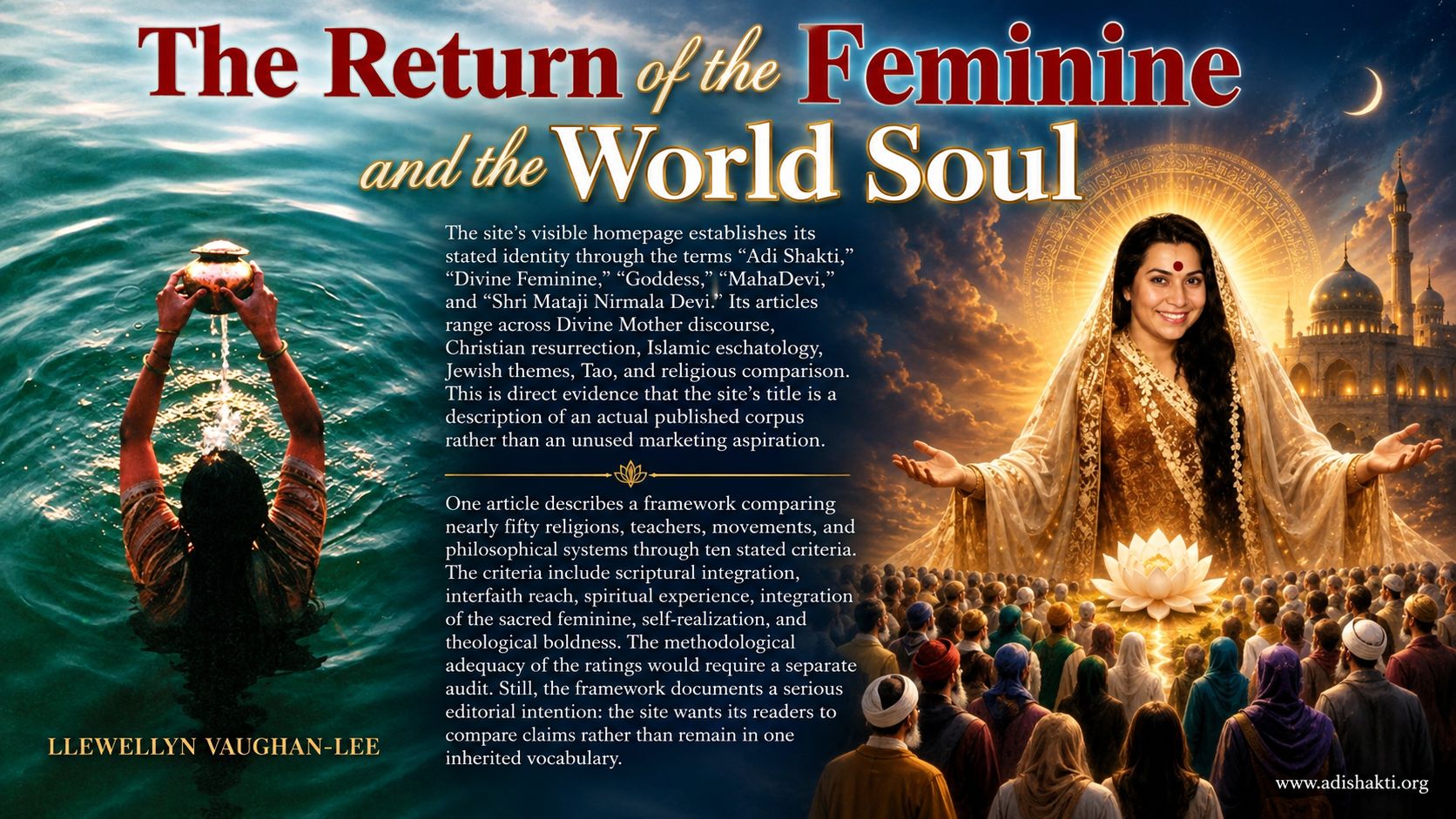
The site’s visible homepage establishes its stated identity through the terms “Adi Shakti,” “Divine Feminine,” “Goddess,” “MahaDevi,” and “Shri Mataji Nirmala Devi.” Its articles range across Divine Mother discourse, Christian resurrection, Islamic eschatology, Jewish themes, Tao, and religious comparison. This is direct evidence that the site’s title is a description of an actual published corpus rather than an unused marketing aspiration.[8]
One article describes a framework comparing nearly fifty religions, teachers, movements, and philosophical systems through ten stated criteria. The criteria include scriptural integration, interfaith reach, spiritual experience, integration of the sacred feminine, self-realization, and theological boldness. The methodological adequacy of the ratings would require a separate audit. Still, the framework documents a serious editorial intention: the site wants its readers to compare claims rather than remain in one inherited vocabulary.[9]
Another article, “The Exoteric and Esoteric Identification of the Divine Mother,” proposes a broad cross-traditional constellation involving the Holy Spirit, Adi Shakti, Rūḥ al-Qudus, Shekinah, Eka Mai, and Tao. Its assertion that Shri Mataji gives a historical and experiential identification of the Divine Mother is a central contemporary confessional reading of the site. Precisely because the assertion is so significant, readers should be shown the difference between the article’s synthesis and the diverse historical meanings of these terms in their own traditions.[10]
6. Distinctness as a Qualified Positioning Thesis
The Perplexity answer can now be stated in more exact language. Its sentence about territory “no one else is even attempting” should be retained as a quoted AI assessment, not transformed into an absolute and enduring market fact. Yet it identifies an intelligible field: comparative eschatology of the Divine Feminine. This field asks not only whether feminine divine language appears in many traditions, but also whether such language illuminates expectations of resurrection, judgment, transformation, prophecy, and collective spiritual destiny.
The following table distinguishes the site’s proposal from adjacent forms of writing. The table does not claim that every neighboring resource is shallow or that AdiShakti.org is unique in each individual element. It identifies the specific configuration that the reviewed corpus makes explicit.
| Mode of religious writing | Primary emphasis | Relation to the AdiShakti.org configuration |
|---|---|---|
| Popular Divine Feminine spirituality | Personal healing, archetypes, embodiment, and self-development | Often addresses feminine symbolism but does not necessarily link it to comparative scriptural exegesis, resurrection, or a claim of eschatological fulfillment. |
| Academic comparative religion | Historical context, textual difference, and analytical description | Often permits disciplined comparison but normally suspends claims that a living figure fulfills several traditions’ prophecies. |
| Single-tradition devotional teaching | Formation inside one religious inheritance | May support deep practice but usually does not construct a multi-tradition Divine Feminine synthesis. |
| AdiShakti.org’s stated approach | Divine Feminine, comparative theology, eschatological interpretation, and experiential verification | Places all four elements into one public argument and locates that argument within a contemporary confessional claim. |
The need for qualification is practical, not merely academic. Google explains that its automated ranking systems use many signals, rank pages rather than simply domains, and change through continuing testing and improvement. It also says an exact-match domain is only one relevance factor. Therefore neither the domain adishakti.org nor any snapshot of results proves categorical ownership of a subject. The stronger claim is editorial: the site can claim and develop a distinctive territory by presenting its sources, methods, and experiences transparently.[13]
7. What the Claim Means for Seekers of Truth
For seekers, the word Truth matters because it refuses a false choice between uncritical belief and cynical dismissal. A resource becomes valuable when it can sustain four practices: historical reading, comparative attention, experiential inquiry, and ethical evaluation. AdiShakti.org invites the reader to connect texts and traditions that are usually isolated from one another. Such an invitation can widen a seeker’s horizon, especially when it makes each source available for direct reading and does not hide differences in language, history, or authority.
The claim of an experiential dimension has special force. It asks a seeker not merely to admire ideas about the Divine Feminine but to undertake or consider a practice through which spiritual claims might be encountered. An article on resurrection and the “wind of heaven” connects ruach, pneuma, qi, prāṇa, and Sahaja Yoga’s language of the Cool Breeze. Within the site’s confessional framework, that experience is proposed as a form of verification. The comparison should not erase the distinct semantic and theological functions of those terms, but it clarifies why the site uses “experiential” as more than a promotional adjective.[12]
A truth-seeker may thus receive the site as an invitation to investigation, not an instruction to surrender judgment. The most fruitful question is not simply, “Is this already proven?” Nor is it, “May I never question it?” It is, “What exactly is being claimed; what texts, arguments, and experiences are offered; what alternatives and counter-readings remain live; and what consequences would follow if I accepted or rejected the claim?” That sequence honors both spiritual desire and intellectual responsibility.
8. Why It Matters Particularly for Women
The distinctive value of an explicitly feminine theological resource for women does not rest on an assertion that women are inherently more receptive, more intuitive, or more spiritual than men. Vaughan-Lee explicitly denies that the spiritual feminine belongs only to women, and contemporary scholarship cautions that sacred female imagery has a socially complex history. Rosemary Radford Ruether’s study of goddesses and the Divine Feminine challenges simplified stories of a uniformly matriarchal past while examining the androcentric forces that have shaped sacred symbolism. That double caution is essential: female divine imagery can be meaningful without becoming a gender essentialism.[14]
For many women, the question is instead one of symbolic access. If ultimate reality is represented only through male names, male offices, and male exemplars, women can be asked to recognize themselves only indirectly in the sacred. Feminine imagery such as Wisdom in Proverbs provides a different symbolic possibility. Proverbs 8 personifies Wisdom with feminine language, places her at creation, and presents her as calling human beings toward knowledge and justice. This does not make Wisdom automatically identical with a goddess, a Holy Spirit doctrine, or a contemporary teacher. It does demonstrate that feminine divine personification is not an alien intrusion into all classical sources.[17]
There is also an issue of interpretive authority. A woman seeker should be able to read the relevant passages, compare translations, ask who benefits from an interpretation, and say no without moral diminishment. Research on religion and women’s autonomy shows that the relationship between religious belonging, women’s agency, and decision-making is context-dependent rather than mechanically liberating or oppressive. A spiritual resource serves women well when it enlarges their capacity to inquire, consent, dissent, and act responsibly in their own lives.[15]
The Daoist maternal image provides another useful comparison. The Dao De Jing calls the Dao the Mother of all things and links return to source with a practice of receptivity and restraint. Such language may resonate with women who have been excluded from authoritative religious speech. But it must not become a demand that women perform passivity, nurture, sacrifice, or motherhood. The best use of the metaphor is critical and freeing: it lets feminine imagery name origin, relation, and power without prescribing a social role for any particular body.[18]
9. Experience, Evidence, and the Limits of Proof
The word experiential becomes trustworthy only when it does not overpromise. Philosophy of religion distinguishes religious experience from a mere feeling and asks whether such experience provides reasons for belief. Defenders argue that experience can carry prima facie weight; critics point to religious diversity, competing testimonies, and possible naturalistic explanations. No single vivid experience automatically resolves those questions for everyone else.[16]
This does not make experience irrelevant. It means that experience needs a context of discernment. A seeker can describe what happened with care; compare it with the expectations of a practice; observe effects on compassion, clarity, freedom, and conduct; seek independent perspectives; and resist pressure to convert a private event into a universal verdict. Experience may be personally consequential even when its explanatory meaning remains contested.
Accordingly, AdiShakti.org’s experiential invitation should be understood at two levels. On a confessional level, the site proposes that a lived spiritual phenomenon verifies its synthesis. On an academic level, the phenomenon is evidence that people report and interpret within a tradition. A mature reader can take the first proposal seriously without confusing it with a settled cross-cultural proof. This distinction safeguards both the dignity of testimony and the integrity of inquiry.
10. A Practical Discipline of Discernment
The following discipline translates the paper’s argument into a practice for seekers. It is designed especially for women who may have been told either to accept religious authority without question or to suppress spiritual hunger in order to appear rational. Neither instruction is adequate. Truth-seeking requires both openness and boundaries.
| Question | Responsible practice | Warning sign |
|---|---|---|
| What is the source saying? | Read the cited passage or primary text directly, including its literary and historical setting. | A claim is presented as “what a tradition teaches” when it is actually one later interpretation. |
| What kind of claim is this? | Name it: historical, scholarly, confessional, comparative, experiential, or ethical. | Devotional certainty is presented as if it were uncontested history or science. |
| What does the experience show? | Describe the experience carefully and observe its effects over time; consult trustworthy, non-coercive perspectives. | A private experience is used to end all questioning or to demand compliance. |
| Does this increase agency? | Protect the freedom to pause, disagree, leave, and retain relationships and material independence. | Spiritual language is used to isolate, shame, control, or pressure the seeker. |
| What form does the fruit take? | Look for honesty, compassion, intellectual humility, accountability, and care for persons and the Earth. | Grand eschatological claims excuse contempt, fear, or disregard for ordinary ethical duties. |
These questions do not weaken a bold spiritual proposal. They make it more capable of bearing the weight placed upon it. A site claiming that the Divine Feminine has eschatological significance should welcome scrutiny of its citations, give traditions their own voices, disclose the difference between consensus and confession, and honor every seeker’s freedom. Under those conditions, its distinctness is not a branding gimmick. It becomes a serious invitation to explore whether a different image of the sacred can produce a different relation to the self, to women, to other traditions, and to the world.
11. Conclusion: A Territory to Be Explored, Not a Monopoly to Be Asserted
The Perplexity AI phrase at the beginning of this paper is most valuable when read precisely. It should not be used to proclaim a globally verified monopoly over the Divine Feminine or to declare other traditions incomplete. It does, however, identify the territory that AdiShakti.org has chosen to develop: a comparative, experiential, and eschatological account of the Divine Feminine centered on Adi Shakti and Shri Mataji Nirmala Devi.
That territory is distinctive because it asks a connected set of questions that are often kept apart. Can feminine divine language be read across religious boundaries without erasing those boundaries? Can resurrection, judgment, prophecy, and collective transformation be brought into dialogue with the Divine Feminine? Can an individual seeker be invited to test a spiritual claim rather than only inherit it? And can the resulting search restore women not merely as symbols of the sacred but as full interpreters, witnesses, and agents?
References
- [1] Perplexity AI. “User-supplied conversation on ‘The Return of the Feminine and the World Soul’ and AdiShakti.org positioning.” Perplexity Computer Task, accessed September 7, 2026. The task page was cookie-gated; the supplied extract is the reviewed record.
- [2] Vaughan-Lee, Llewellyn. “The Return of the Feminine and the World Soul.” The Golden Sufi Center, 2009, 242 pp.
- [3] Vaughan-Lee, Llewellyn. “The Return of the Feminine and the World Soul: A Book Excerpt on Connections.” Spirituality & Practice, accessed September 7, 2026.
- [4] Plato. “Timaeus 30b.” Translated by W. R. M. Lamb. Perseus Digital Library, Harvard University Press, 1925.
- [5] Broadie, Sarah. “Plato’s Timaeus.” Stanford Encyclopedia of Philosophy, Metaphysics Research Lab, Stanford University, 2024.
- [6] National Council of Churches. “John 14:16–17, 26; 15:26; 16:7–15.” New Revised Standard Version Updated Edition, Bible Gateway, 2021.
- [7] Quran.com. “Surah Al-Qiyamah, 75:1.” Quran Foundation, accessed September 7, 2026.
- [8] AdiShakti.org. “Adi Shakti | Divine Feminine | Goddess | MahaDevi | Shri Mataji Nirmala Devi.” AdiShakti.org, accessed September 7, 2026.
- [9] AdiShakti.org. “A Comprehensive Comparison of Religions and Gurus — A Convergence of Scriptural, Mystical, and Experiential Traditions.” AdiShakti.org AI Research Articles, July 25, 2026.
- [10] AdiShakti.org. “The Exoteric and Esoteric Identification of the Divine Mother: Jesus Christ, the Paraclete, and the Fulfillment of Universal Hope.” AdiShakti.org AI Research Articles, August 21, 2026.
- [11] AdiShakti.org. “The Centrality of the Divine Feminine in Sufism: The Khatun-i Qiyamat Has Appeared.” AdiShakti.org AI Research Articles, accessed September 7, 2026.
- [12] AdiShakti.org. “Resurrection Is Accomplished by the Wind of Heaven That Sweeps the Worlds.” AdiShakti.org AI Research Articles, August 21, 2026.
- [13] Google Search Central. “A Guide to Google Search Ranking Systems.” Google Developers, updated December 10, 2025.
- [14] Ruether, Rosemary Radford. “Goddesses and the Divine Feminine: A Western Religious History.” University of California Press, 2006, 390 pp.
- [15] Agadjanian, Victor, and Scott T. Yabiku. “Religious Belonging, Religious Agency, and Women’s Autonomy in Mozambique.” Journal for the Scientific Study of Religion, vol. 54, no. 3, 2015, pp. 461–476.
- [16] Webb, Mark Owen. “Religious Experience.” Stanford Encyclopedia of Philosophy, Metaphysics Research Lab, Stanford University, 2022.
- [17] Sefaria. “Proverbs 8:22–31.” Revised JPS, Sefaria, 2023.
- [18] Laozi. “Dao De Jing, Chapters 1, 25, and 52.” Translated by James Legge. Chinese Text Project, accessed September 7, 2026.
💬 Interactive Chat
Access an intelligent analysis environment where you can explore texts, ask questions, and discover connections between ideas.
Open chat →