Before the End of Days: Shaykh Abdul Hadi Palazzi on Qur'an 17:104 and the Return of the Children of Israel
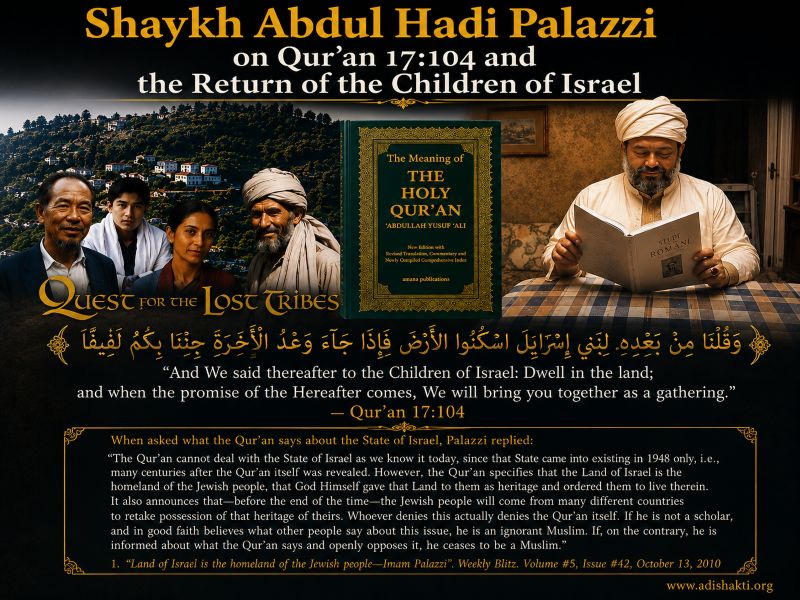 A rigorous examination of Palazzi's claim that the Qur'an predicts that God will gather the dispersed Children of Israel and restore them to the Land before the Last Judgment
This study examines one precise and unusually consequential claim made by Shaykh Prof. Abdul Hadi Palazzi: that the Qur'an predicts an eschatological return of the Children of Israel to the Land before the Last Judgment. A 2006 profile summarizes his position by saying that Palazzi believes the Qur'an predicts “that before the end of days, God will bring the Children of Israel to retake possession of the Land, gathering them from the different countries and nations (Sura 17:104).” Material circulated under Palazzi's own name states the thesis even more explicitly: “The Qur'an recognizes the Land of Israel as the heritage of the Jews and it explains that, before the Last Judgment, Jews will return to dwell there. This prophecy has already been fulfilled.”
The importance of this claim must be stated exactly. Palazzi is not merely arguing that the Qur'an remembers an ancient Israelite presence in Canaan. He is not merely arguing that Moses once commanded Israel to enter a Holy Land. He reads Qur'an 17:104 prospectively and eschatologically: dispersion is followed by divine regathering; the regathering is terrestrial; it returns the Children of Israel to the Land; it occurs before the final Judgment; and, in Palazzi's judgment, that predicted return has occurred in modern history.
Academic rigor, however, requires distinguishing Palazzi's interpretation from the bare lexical content of the verse and from classical exegetical consensus. Qur'an 17:104 indisputably addresses the Children of Israel, commands them to dwell in al-arḍ, and announces that God will later bring them lafīfā, collectively or as a mingled gathering. Qur'an 5:21 indisputably represents Moses as directing his people to enter al-arḍ al-muqaddasah, the Holy Land that God has “written” or assigned for them. Yet classical tafsir frequently interprets the “promise of the Hereafter” in 17:104 as Resurrection. Palazzi's reading is therefore best described as a clear, deliberate, textually anchored but contested Muslim eschatological interpretation. The central scholarly fact established here is not that Islam unanimously teaches Palazzi's conclusion, but that Palazzi himself explicitly teaches that the Qur'an foretells the Jewish return before the Last Judgment and regards the modern return as its fulfillment.
The Exact Claim Under Examination
The subject of this paper is deliberately narrow. It is not a general history of Zionism, an adjudication of the Israeli–Palestinian conflict, or a survey of every Muslim interpretation of Israel. It asks whether a prominent Muslim interpreter, Shaykh Abdul Hadi Palazzi, has in fact advanced a much more specific proposition: that the Qur'an predicts the return of the dispersed Children of Israel to their Land before the end of days.
Palazzi believes that the Qur'an clearly predicts “that before the end of days, God will bring the Children of Israel to retake possession of the Land, gathering them from the different countries and nations (Sura 17:104).”
This is not a reconstruction imposed upon Palazzi. A published profile reports essentially this formulation, while material circulated under his own name states that the Qur'an teaches that before the Last Judgment Jews will return to dwell in the Land and adds: “This prophecy has already been fulfilled.”
Those formulations make the chronology indispensable. The argument is not simply Israel once possessed the Land. It is Israel → dispersion → divinely caused regathering from dispersion → return to the Land → Last Judgment. Whether Qur'an 17:104 necessarily carries that chronology is an exegetical question. That Palazzi himself teaches it is a documentary question. The latter can be established much more firmly than the former.
The Qur'an “Explains That, Before the Last Judgment, Jews Will Return”
“The Qur'an recognizes the Land of Israel as the heritage of the Jews and it explains that, before the Last Judgment, Jews will return to dwell there. This prophecy has already been fulfilled.”
Every clause matters. “The Land of Israel” identifies the geographical referent in Palazzi's interpretation. “Heritage of the Jews” states his theological understanding of Israel's relationship to the land. “Before the Last Judgment” establishes chronology. “Jews will return to dwell there” identifies the event as terrestrial return rather than merely resurrection from the dead. Finally, “This prophecy has already been fulfilled” identifies the predicted event with modern history.
Consequently, describing Palazzi merely as saying that “the Qur'an recognizes Jewish ties to Israel” understates his position. His claim is prophetic and eschatological. He understands the modern return as an event anticipated by revelation before the final Judgment.
Palazzi on the State of Israel, the Jewish Homeland, and the End-of-Time Return
When asked what the Qur'an says about the State of Israel, Palazzi replied:
"The Qur'an cannot deal with the State of Israel as we know it today, since that State came into existing in 1948 only, i.e., many centuries after the Qur'an itself was revealed. However, the Qur'an specifies that the Land of Israel is the homeland of the Jewish people, that God Himself gave that Land to them as heritage and ordered them to live therein. It also announces that—before the end of the time—the Jewish people will come from many different countries to retake possession of that heritage of theirs. Whoever denies this actually denies the Qur'an itself. If he is not a scholar, and in good faith believes what other people say about this issue, he is an ignorant Muslim. If, on the contrary, he is informed about what the Qur'an says and openly opposes it, he ceases to be a Muslim."
— Imam Shaykh Abdul Hadi Palazzi
“Land of Israel is the homeland of the Jewish people—Imam Palazzi,” Weekly Blitz, Volume #5, Issue #42, October 13, 2010.
This quotation removes any ambiguity about the structure of Palazzi's own interpretation. He explicitly distinguishes the modern State established in 1948 from the much older Qur'anic revelation; he therefore does not claim that the Qur'an literally names the twentieth-century State. His argument is instead that the Qur'an establishes three propositions whose modern significance he considers unmistakable: the Land is the homeland of the Jewish people; God gave it to them as a heritage and commanded them to dwell there; and, “before the end of the time,” the Jewish people will come “from many different countries” to retake possession of that heritage.
For academic purposes, the final sentences concerning who is or is not a Muslim must be attributed strictly to Palazzi's own theological judgment. They should not be generalized into a statement about Islamic consensus. Their importance here is documentary: they demonstrate the exceptional degree of certainty with which Palazzi himself advances this Qur'anic interpretation.
“Before the End of Days”: The 2006 Profile
A January 2006 profile by Gail Lichtman describes Palazzi's position in unusually explicit terms. The report states that he believes the Qur'an says in Sura 5:21 that God granted the Land of Israel to the Children of Israel and ordered them to settle there. It then summarizes his interpretation of Sura 17:104 as predicting that before the end of days God will bring the Children of Israel back to possession of the Land, gathering them from different countries and nations.
This evidence is important because it independently summarizes the same interpretive structure found in the Palazzi material: land grant + dispersion + international regathering + restoration + eschatological timing. The “before the end of days” formulation is therefore not an inference created by this paper. It is part of the documented public description of Palazzi's teaching.
There is strong documentary support for attributing this interpretation to Palazzi. The scholarly controversy concerns whether his interpretation of Qur'an 17:104 is exegetically compelling or representative—not whether Palazzi has actually advanced it.
Dwelling, the Last Promise, and the Collective Gathering
وَقُلْنَا مِنۢ بَعْدِهِۦ لِبَنِىٓ إِسْرَٰٓءِيلَ ٱسْكُنُوا۟ ٱلْأَرْضَ فَإِذَا جَآءَ وَعْدُ ٱلْـَٔاخِرَةِ جِئْنَا بِكُمْ لَفِيفًۭا
Representative literal sense: “And We said thereafter to the Children of Israel: Dwell in the land; and when the promise of the Hereafter comes, We will bring you together as a gathering.”
Palazzi's reading rests on three textual facts. First, the addressee is unmistakable: Banī Isrā'īl, the Children of Israel. Second, the imperative uskunū al-arḍ concerns dwelling in “the land” or “earth.” Third, the concluding clause is future-oriented: ji'nā bikum lafīfā, God will bring them collectively, together, or as a mingled gathering.
The crucial interpretive hinge is waʿd al-ākhirah. English translations vary because al-ākhirah can point to the Hereafter, while contextually related renderings speak of the latter or final promise. Palazzi's presentation interprets this eschatologically as the End of Days / Last Judgment and understands the gathering as occurring in the Land.
The Arabic itself does not contain the modern expressions “State of Israel,” “Zionism,” “1948,” or “from all the countries and nations.” Those belong to Palazzi's historical interpretation of the verse. This does not invalidate his reading; it identifies precisely where translation ends and exegesis begins.
Why Palazzi Reads “The Land” as the Land of Israel
Qur'an 17:104 says al-arḍ, “the land” or “earth,” without itself using the modern name Israel. Palazzi's geographical identification is strengthened by Qur'an 5:20–21, where Moses addresses the Children of Israel and commands them to enter al-arḍ al-muqaddasah—“the Holy Land”—which God has kataba for them.
“O my people, enter the Holy Land which God has assigned unto you...”
The verb kataba literally carries the sense of writing and, in divine-command contexts, can signify prescribing, decreeing, assigning or ordaining. Thus the Qur'anic text unquestionably contains a narrative in which Moses tells his people that God has assigned a Holy Land to them.
Palazzi reads 5:21 and 17:104 together. The first identifies the divinely assigned Holy Land; the second, in his interpretation, predicts the later gathering of the same Children of Israel back into that land.
From Two Qur'anic Passages to an End-of-Days Prophecy
| Proposition | Basis | Academic status |
|---|---|---|
| The Holy Land is assigned to Moses' people. | Qur'an 5:20–21 | Explicit textual premise. |
| The Children of Israel are told to dwell in the land. | Qur'an 17:104a | Explicit textual premise. |
| God will later gather them collectively. | Qur'an 17:104b | Explicit gathering; referent debated. |
| The gathering is from international dispersion back to the Holy Land. | Palazzi's synthesis of the passages and history | Interpretive conclusion. |
| It occurs before the Last Judgment / at the end of days. | Palazzi's reading of waʿd al-ākhirah | Eschatological interpretation. |
| The modern Jewish return fulfills it. | Palazzi's application to modern history | Fulfillment claim. |
This hierarchy does not weaken Palazzi's thesis. It makes the thesis academically intelligible. His argument is cumulative rather than lexical. No single Arabic word means “the twentieth-century return of Jews from many nations.” Instead, Palazzi constructs that conclusion by joining the identity of the people, the Holy Land assignment, the command to dwell, the future gathering and the eschatological promise.
The Major Counter-Reading: Gathering at Resurrection
The strongest scholarly qualification is classical tafsir. Al-Qurṭubī identifies the geographical setting of the command to dwell with the region of al-Shām and Egypt, but interprets the relevant “promise” principally as the Resurrection. He also transmits an alternative interpretation associated with the eschatological descent of Jesus. Ibn Kathīr explains lafīfā in the sense of being brought all together, but does not identify the verse with the modern State of Israel.
This evidence requires precision. It would be academically unsound to write that “Islam teaches that Qur'an 17:104 predicted modern Israel” as though that were an uncontested classical doctrine. But the opposite overstatement would also be unsound. The verse really does contain Israelite dwelling, a future divine promise and collective gathering; and Palazzi really does interpret those elements as a return to the Land before Judgment.
Palazzi's interpretation is neither invented out of nothing nor demonstrably the unanimous classical reading. It is a modern Muslim eschatological exegesis constructed from genuine Qur'anic textual elements and applied explicitly to the modern Jewish return.
“This Prophecy Has Already Been Fulfilled”
The most striking part of Palazzi's argument is not merely prediction but claimed fulfillment. He does not leave 17:104 in an indefinite future. After stating that the Qur'an explains that Jews will return before Last Judgment, he immediately concludes: “This prophecy has already been fulfilled.”
That sentence transforms his exegesis into a claim about sacred history. The modern Jewish return is not, in his interpretation, simply a political migration caused by nationalism, persecution, war and state-building. Those historical causes can remain fully operative while the same event is interpreted theologically as the means through which a divine prediction comes to pass.
For Palazzi, the return is not merely compatible with the Qur'an. It is predicted by the Qur'an. It is not merely a return sometime in history. It belongs before the Last Judgment. And it is not merely future: Palazzi says the prophecy “has already been fulfilled.”
Why This Is an Important Islamic Eschatological Claim
Palazzi's interpretation challenges two assumptions simultaneously. First, it challenges the idea that acknowledgement of a divinely grounded Jewish relationship to the Holy Land must necessarily be foreign to Islam. Second, it challenges readings in which modern Jewish return can possess no positive Qur'anic or eschatological significance.
Its importance is heightened by the chronology. If the return is placed before the Last Judgment, then modern Jewish restoration becomes, in Palazzi's theology, a sign situated within sacred eschatological time. That is a much stronger proposition than ordinary political recognition of Israel.
Yet the strength of the proposition is precisely why its attribution must remain exact: this is Palazzi's interpretation of Islam, not a statement that all Muslims, all Sunni authorities, or all classical commentators agree with him.
What the Evidence Establishes—and What It Does Not
The resulting academic formulation can therefore be both strong and precise: Palazzi explicitly reads the Qur'an as predicting the end-of-days return of the Children of Israel to the Land and explicitly identifies the modern return as fulfillment; this is a serious Muslim eschatological interpretation grounded in Qur'anic texts, but it is not synonymous with uncontested Islamic consensus.
XI. Conclusion: The Claim in Its Full Force
Shaykh Abdul Hadi Palazzi's interpretation should not be weakened into the vague proposition that “the Qur'an is friendly toward Jewish attachment to Israel.” His actual claim is considerably more specific.
He believes that God assigned the Holy Land to the Children of Israel; that Qur'an 17:104 foretells a future divine gathering of that people; that the gathering entails their return from dispersion to the Land; that it occurs before the Last Judgment or at the end of days; and that the modern Jewish return constitutes the fulfillment of this prophecy.
The documentary evidence strongly supports attributing that thesis to Palazzi. The Qur'anic text supplies real premises for it. Classical tafsir prevents it from being represented as the only possible or universally received interpretation. Those three judgments can—and academically should—stand together.
The resulting conclusion is therefore exact:
Shaykh Abdul Hadi Palazzi explicitly interprets Qur'an 17:104 as an eschatological prophecy that, before the Last Judgment, God will gather the dispersed Children of Israel and restore them to the Land. He further states that this prophecy has already been fulfilled in the modern Jewish return. The Qur'anic wording gives this interpretation genuine textual anchors, especially when 17:104 is read together with 5:21; nevertheless, the identification of the verse with the modern return remains Palazzi's exegetical and historical-theological conclusion rather than an uncontested consensus of classical Islam.
This formulation neither minimizes Palazzi's extraordinary claim nor exaggerates its authority. It states exactly what he teaches, exactly what the Qur'anic texts contribute to his argument, and exactly where scholarly interpretation begins.
References and Primary Source Notes
- Qur'an 5:20–21. Moses' address to the Children of Israel and command to enter al-arḍ al-muqaddasah, the Holy Land God has assigned/written for them.
- Qur'an 17:101–105, especially 17:104. The Children of Israel are commanded to dwell in al-arḍ; at waʿd al-ākhirah God will bring them lafīfā.
- Shaykh Prof. Abdul Hadi Palazzi, material circulated under titles including “What the Qur'an Really Says” and “The Land of Israel in Qur'anic Exegesis.” Used for Palazzi's explicit statement that before Last Judgment Jews return to dwell in the Land and that the prophecy has already been fulfilled.
- “Land of Israel is the homeland of the Jewish people—Imam Palazzi.” Weekly Blitz, Volume #5, Issue #42, October 13, 2010. The extended Palazzi response reproduced in this paper is retained verbatim as supplied.
- Gail Lichtman, “Sheikhing up the real Islam,” The Jerusalem Post, 31 January 2006. Used as independent journalistic evidence for Palazzi's view that Sura 17:104 predicts an end-of-days gathering of the Children of Israel back to the Land.
- Al-Qurṭubī, al-Jāmiʿ li-Aḥkām al-Qurʾān, commentary on Qur'an 17:104. Used to establish the important classical Resurrection interpretation and the transmitted alternative concerning Jesus' descent.
- Ibn Kathīr, Tafsīr al-Qurʾān al-ʿAẓīm, commentary on Qur'an 17:104. Used for the collective sense of lafīfā and as a control against projecting modern political terminology into the classical commentary.
Methodological note: Direct Qur'anic propositions, classical exegetical interpretations, Palazzi's own theology, secondary descriptions of Palazzi, and modern historical applications have been kept analytically distinct throughout.