MYSTICAL TESTIMONY | SHRI HANUMAN | SHRI SITA AND SHRI RAMA | BHAKTI
The Authenticity of Kash’s Mystical Witnessing of Shri Sita and Shri Rama in Shri Hanuman’s Heart
An Evidence-Based Assessment of Mystical Testimony, Scriptural Convergence, Devotional Iconography, and Religious Experience
The Matchless Devotion Of Shri Hanuman
“On April 24, 1994, at about 7:00 p.m. Kash was told to ask a specific request from Shri Hanuman. He meditated and took along a coconut that had a swastika on it. The divine energy of The Mother Kundalini took him through the Sushumna Nadi to the Thousand-Petal Lotus — this was the Land of Nirvana that the ancient Buddhists knew existed within humans.
Kash floated slowly down into his spiritual body that was meditating beside the Great Adi Shakti. The Paramjyoti shone ever so brilliantly as the Great Primordial Goddess sat on the Supreme Throne in Bliss and Joy.
Kash bowed to the Devi, hands folded in reverence, and extended greetings. He then informed Her of his desire to visit Shri Hanuman, and the question that would be posed to Him. Shri Mataji, without any hesitation, agreed and levitated him. They then traveled across the universe at a velocity that NASA will find difficult to believe.
On the way they visited Shri Ganesha to offer the coconut. The Eternal Child was in meditation. Kash offered his customary greetings and respects, together with the coconut. Shri Ganesha, with His eyes still closed, bowed and thanked him.
The Divine Mother then levitated him again and soon reached Shri Hanuman's temple. It was a small structure and walled on all four sides. There was one window at the back with two on each side. Both entered by the front open entrance and walked to Shri Hanuman, who was in meditation.
Kash bowed to Him and asked the Adi Shakti again, “I want to see Shri Rama and Sita in His heart please.” Shri Hanuman opened His eyes as Shri Mataji translated the request into Sanskrit.
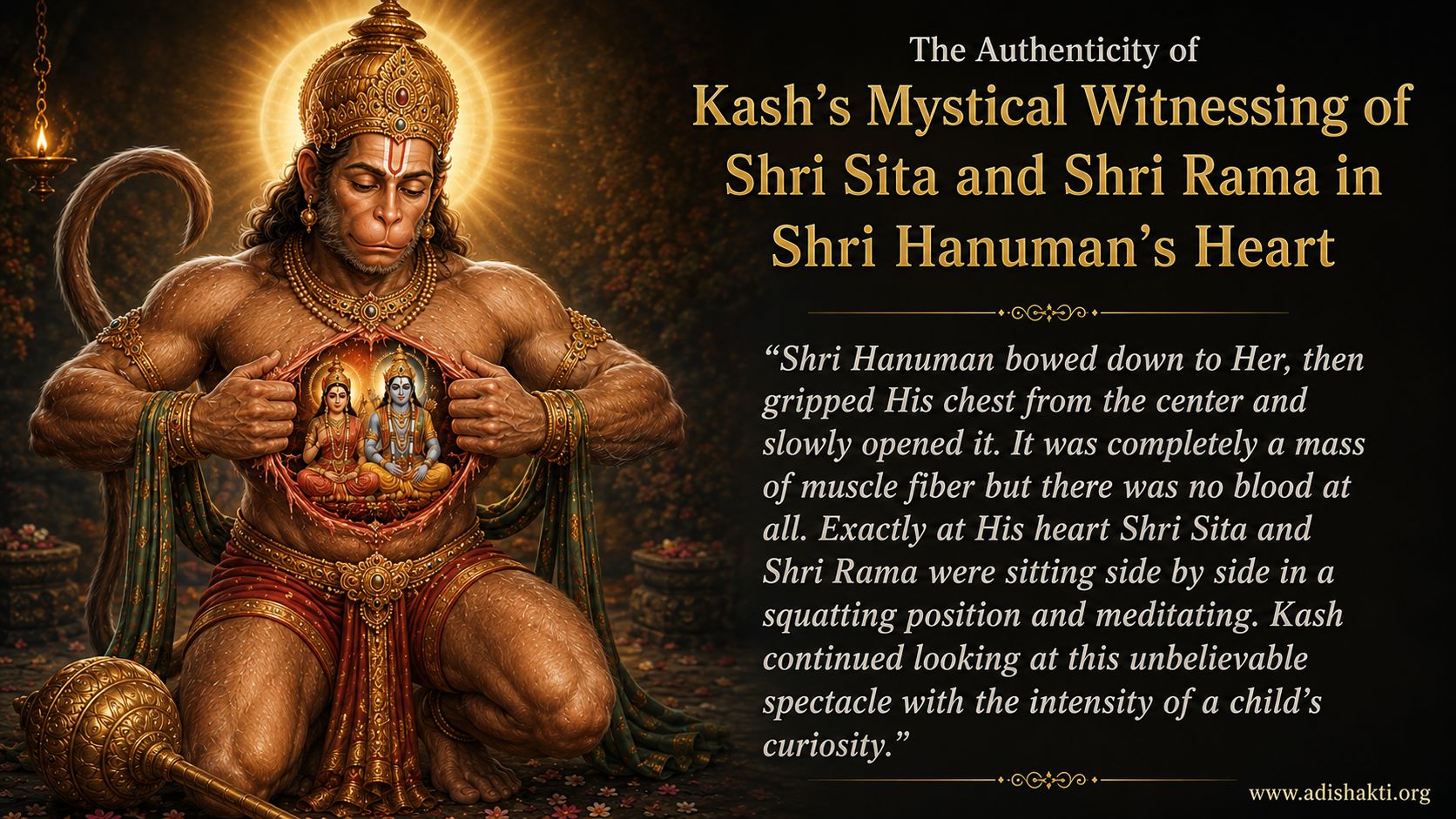
Shri Hanuman bowed down to Her, then gripped His chest from the center and slowly opened it. It was completely a mass of muscle fiber but there was no blood at all. Exactly at His heart Shri Sita and Shri Rama were sitting side by side in a squatting position and meditating. Kash continued looking at this unbelievable spectacle with the intensity of a child's curiosity.
Shri Hanuman then closed His chest again and Shri Mataji requested meditation.
However, Kash could not become thoughtless as the unforgettable sight of Shri Sita and Shri Rama actually meditating in the heart of Shri Hanuman kept whirling in his mind. He had never seen such an incredible spectacle — two Divine Deities in the heart of another Divine Deity! Shri Sita and Shri Rama were really in the heart of Shri Hanuman as the ancient scriptures had proclaimed. And now the Great Adi Shakti had fulfilled his desire to witness something that hundreds of millions of Hindus have believed for thousands of years.
When they had finished Kash bowed down to Shri Hanuman and again thanked Him for fulfilling his request. Shri Sacamara-ramavani-savya-daksina-sevita Devi and he then walked out of Shri Hanuman's small, simple temple and left for the Land of Primordial Light.
Before leaving Shri Mataji's place Kash stood up, bowed down with folded hands in obeisance, and thanked Her again. He then closed his spiritual eyes and left the Kingdom of Sadashiva in his Thousand-Petal Lotus to this misguided world of sacred cows and untouchable humans.
Shri Adi Shakti: The Kingdom of GodJagbir Singh, 1999, p. 180
Abstract
This paper evaluates Kash’s reported mystical witnessing of Shri Sita and Shri Rama within Shri Hanuman’s heart. It distinguishes documentary authenticity, phenomenological authenticity, and metaphysical authenticity; examines the explicit prompt that preceded the experience; analyzes the vision’s sensory, emotional, spatial, and devotional structure; and compares the opened-heart motif with broader religious understandings of divine indwelling. The study concludes that the testimony displays substantial characteristics of a serious mystical report if the publication substantially preserves Kash’s original account. Its objective metaphysical interpretation remains a theological possibility rather than a publicly demonstrated fact.
Keywords: Kash; Shri Hanuman; Shri Sita; Shri Rama; mystical testimony; Sahaj Samadhi; bhakti; divine indwelling; child witness; phenomenological authenticity.
Introduction ¶ ↩ TOC
The Authenticity of Kash’s Mystical Witnessing of Shri Sita and Shri Rama in Shri Hanuman’s Heart
The Claim and the Question of Authenticity ¶ ↩ TOC
On April 24, 1994, Kash reportedly entered Sahaj Samadhi and, under the guidance of Shri Mataji Nirmala Devi, visited Shri Hanuman. At Kash’s request, Hanuman opened His chest and revealed Shri Sita and Shri Rama seated in meditation within His heart. The narrative presents this not as metaphor alone but as a directly witnessed spiritual reality.
An evidence-based assessment must resist two premature conclusions. Devotional acceptance cannot by itself establish historical or metaphysical fact, while naturalistic dismissal cannot by itself explain the form, emotional force, and internal structure of the testimony. The central academic question is narrower: what does the surviving account support concerning sincerity, phenomenological character, textual transmission, and theological significance?
Three Levels of Authenticity ¶ ↩ TOC
This paper distinguishes documentary authenticity, phenomenological authenticity, and metaphysical authenticity. Documentary authenticity concerns whether the published narrative reliably preserves what Kash reported. Phenomenological authenticity concerns whether the report exhibits the organization, passivity, noetic force, emotional effect, and boundedness associated with serious mystical experience. Metaphysical authenticity concerns whether an objective spiritual encounter occurred beyond the witness’s mind.
These levels must not be collapsed. A sincere mystical experience may be interpreted incorrectly; a theologically meaningful narrative may have undergone editorial expansion; and a private revelation may possess great religious value without becoming publicly demonstrable proof.
Method and Sources ¶ ↩ TOC
The principal source is the account published in Shri Adi Shakti: The Kingdom of God (1999, p. 180), supplemented by the supplied interpretive material. The method combines source criticism, phenomenology of religion, philosophy of testimony, psychology of absorption, Hindu devotional studies, comparative theology, and iconographic analysis.
The paper treats references to divine travel, subtle anatomy, cosmic velocity, and spiritual embodiment as claims internal to the narrative unless independently supported. It also distinguishes the report’s concrete observations from theological commentary supplied by the adult narrator.
Chapter One ¶ ↩ TOC
The Historical and Narrative Setting of April 24, 1994
1.1 Date, Time, and Prompt ¶ ↩ TOC
The testimony is anchored to April 24, 1994, at approximately 7:00 p.m. Precise dating is relevant because it creates the possibility of comparison with family recollections, contemporaneous notes, and later versions. The immediate prompt was specific: Kash was asked to request that Shri Hanuman reveal Shri Sita and Shri Rama within His heart.
The specificity of the prompt is both evidentially useful and methodologically cautionary. It establishes what Kash was expected to seek, but it also introduces suggestion. The subject of the vision cannot therefore be presented as wholly unanticipated. The evidential question shifts from subject matter to the form, detail, emotional response, and transmission of the experience.
1.2 The Coconut and the Swastika ¶ ↩ TOC
Kash reportedly carried a coconut marked with a swastika and offered it to Shri Ganesha before proceeding to Hanuman. In Hindu ritual life the coconut commonly signifies offering, auspiciousness, and the surrender of the ego, while the swastika is an ancient auspicious sign rather than the modern political emblem familiar in the West.
Within the narrative, the offering gives the journey a ritual sequence rather than a free-form fantasy: preparation, ascent, greeting, offering, request, revelation, meditation, thanksgiving, and return. This sequence contributes to internal coherence but may also reflect the ritual culture in which the account was formed.
1.3 Publication and Source History ¶ ↩ TOC
The experience is dated to 1994 and the cited publication to 1999. The interval requires inquiry into oral transmission, memory consolidation, editorial language, and theological amplification. A critical edition should identify the earliest surviving version, the persons who heard the report immediately, and the wording attributable directly to Kash.
The five-year gap does not establish invention. It does, however, limit confidence in exact verbal detail unless earlier records survive. Claims concerning NASA, cosmic velocity, and the spiritual identities of the figures are more plausibly editorial commentary than the spontaneous vocabulary of a child witness.
1.4 What Historical Method Can Establish ¶ ↩ TOC
Historical method can investigate that a meditation occurred, what request preceded it, what Kash said afterward, how the account changed, and whether independent witnesses remembered the same central details. It cannot directly inspect the reported spiritual realm.
The strongest historical conclusion would therefore concern the existence and stability of the testimony, not the objective presence of Hanuman, Sita, or Rama. This distinction is essential to an evidence-based argument.
Chapter Two ¶ ↩ TOC
Shri Hanuman and the Theology of Matchless Devotion
2.1 Hanuman as the Ideal Devotee ¶ ↩ TOC
Across the devotional reception of the Ramayana, Hanuman embodies strength disciplined by service, knowledge subordinated to love, and power emptied of self-interest. His greatness is expressed through unwavering devotion to Rama rather than through independent sovereignty.
The reported vision is therefore theologically coherent with Hanuman’s established devotional identity. He does not display power for spectacle or self-glorification. He obeys a request mediated by Shri Mataji, bows, reveals the divine couple, and returns to meditation.
2.2 The Opened Chest Motif ¶ ↩ TOC
The image of Hanuman opening His chest to reveal Rama and Sita is one of the most recognizable expressions of bhakti iconography. It makes interior devotion visible: the beloved is not merely remembered but enthroned within the devotee’s heart.
The testimony literalizes this iconographic claim. Kash reportedly sees muscle fibre without blood and, at the heart, Sita and Rama seated side by side in meditation. The account therefore moves from symbolic language to visionary ontology: what devotional art signifies is presented as spiritually real.
2.3 Devotion as Indwelling ¶ ↩ TOC
The theological meaning of the scene is not anatomical. The heart functions as the center of loyalty, consciousness, love, and identity. Rama and Sita reside in Hanuman because His being has become completely oriented toward them.
This indwelling model resists a merely external religion. Devotion is authentic when the divine presence shapes the interior person. The vision’s evidential force, for believers, lies in its claim that a traditional symbol describes an objective spiritual relation.
2.4 Humility Rather Than Power ¶ ↩ TOC
Hanuman’s chest-opening could easily be narrated as a miracle of power. The testimony instead frames it as an act of obedience and service. Hanuman first bows to Shri Mataji and then fulfills the child’s request.
This non-triumphal structure supports the narrative’s moral coherence. The figures are not competing for superiority; each acts according to a relational order grounded in reverence.
Chapter Three ¶ ↩ TOC
A Close Reading of Kash’s Reported Experience
3.1 Ascent Through the Sushumna ¶ ↩ TOC
The journey begins with the Mother Kundalini moving through the Sushumna Nadi toward the Thousand-Petal Lotus. This language locates the experience within Sahaja Yoga’s subtle-body map and identifies the Kingdom or Land of Nirvana with the Sahasrara.
For phenomenological analysis, the important point is that the transition follows a recurring method rather than an accidental dream. The report presents a stable contemplative protocol: meditation, ascent, entry into a spiritual body, encounter with Shri Mataji, guided travel, and return.
3.2 The Visit to Shri Ganesha ¶ ↩ TOC
The stop before Shri Ganesha provides a secondary encounter not strictly necessary to the requested revelation. Kash offers the coconut, Ganesha remains in meditation, and acknowledges the offering without elaborate speech.
This restrained episode gives the narrative texture. It can be interpreted as evidence of an autonomous visionary environment, as ritualized imagination, or as later literary composition. Its evidential value depends upon whether it belonged to the earliest report.
3.3 Hanuman’s Temple ¶ ↩ TOC
The temple is described as small, simple, enclosed on four sides, with a front entrance and several windows. The modest architecture is consistent with Hanuman’s devotional humility and contrasts with the cosmic grandeur of the journey.
Concrete architectural details may support experiential vividness, but they are not independently verifiable. Their significance is phenomenological: the vision presents a navigable environment with spatial relations rather than a sequence of disconnected images.
3.4 The Opening of the Chest ¶ ↩ TOC
Hanuman reportedly grips the center of His chest and slowly opens it. Kash sees a mass of muscle fibre but no blood. At the heart, Sita and Rama are seated side by side, squatting and meditating.
The absence of blood is a notable detail. It separates the scene from injury and emphasizes spiritual revelation rather than physical violence. The description is visually concrete yet anatomically non-naturalistic, supporting the claim that the event belongs to a visionary body rather than ordinary biology.
3.5 The Child’s Prolonged Attention ¶ ↩ TOC
Kash continues looking with intense curiosity. He is not described as preaching, interpreting, or asserting authority. His role is observational. This relative absence of self-exaltation is important to the authenticity assessment.
At the same time, the phraseology of the published account may not reproduce the child’s own words. A source-critical edition should distinguish direct quotation, paraphrase, and adult interpretation.
Chapter Four ¶ ↩ TOC
Child Testimony, Suggestion, and Prior Knowledge
4.1 Competence and Vulnerability ¶ ↩ TOC
Children can report experiences sincerely and with striking sensory detail. They are also vulnerable to suggestion, social reinforcement, and retrospective shaping. Age therefore neither validates nor invalidates the account.
The proper questions concern the interviewing process, the form of the prompt, the timing of the first report, the stability of the account, and whether adults rewarded particular answers.
4.2 The Specific Request as Suggestion ¶ ↩ TOC
Kash was explicitly instructed to ask to see Sita and Rama in Hanuman’s heart. This means the central image cannot be treated as information produced without prior conceptual input.
The strongest evidence must therefore come from elements not contained in the prompt: the route, temple, Sanskrit translation, manner of opening, muscle fibre, absence of blood, meditative posture of Sita and Rama, and Kash’s inability to settle into thoughtless awareness afterward.
4.3 Prior Exposure to Iconography ¶ ↩ TOC
The surviving source does not establish the degree of Kash’s prior exposure to images of Hanuman opening His chest. Because the motif is widespread in Hindu devotional culture, lack of exposure cannot be assumed without documentary evidence.
An academically responsible paper must therefore avoid the claim that the imagery could not have been imagined. It may instead ask whether the experience displays signs of sincerity, involuntariness, and integration beyond ordinary recollection.
4.4 Interview Evidence Needed ¶ ↩ TOC
A reliable inquiry would ask Kash to describe the experience without showing images or supplying theological language. It would compare his present account with earlier versions and ask which details he remembers directly.
Independent testimony from persons present in 1994 would help establish what he said immediately after meditation and whether the unusual details were present before later discussion.
Chapter Five ¶ ↩ TOC
Phenomenology of the Vision
5.1 Passivity and Guidance ¶ ↩ TOC
Kash does not claim to produce the vision by will. He requests, waits, is guided, and witnesses. Shri Mataji translates the request and Hanuman decides to respond. This passivity is characteristic of many experiences regarded by witnesses as revelatory.
Passivity does not prove an external source; involuntary imagery can occur in absorption and dreamlike states. It nevertheless supports the witness’s sense that the encounter was received rather than authored.
5.2 Noetic Quality ¶ ↩ TOC
The experience communicates knowledge: the ancient devotional assertion that Sita and Rama dwell in Hanuman’s heart is understood as true. Kash returns not merely with an image but with conviction concerning the spiritual reality of devotion.
Noetic force explains subjective certainty but is not equivalent to public evidence. Dreams, intense imagination, and altered states can also produce conviction. External criteria remain necessary.
5.3 Boundedness and Return ¶ ↩ TOC
The narrative has a clear beginning and ending. Kash enters meditation, follows a sequence of encounters, participates in meditation, asks permission to leave, closes his spiritual eyes, and returns to ordinary consciousness.
This boundedness differs from disorganized or intrusive experience. The source reports no continuing confusion or functional impairment, though it does describe temporary inability to become thoughtless because the image continued to occupy his attention.
5.4 Emotional Disruption ¶ ↩ TOC
Kash’s inability to become thoughtless is one of the account’s most psychologically plausible details. A fabricated devotional story might depict perfect serenity. Instead, the witness remains cognitively stirred by what he has seen.
This disruption may support experiential realism: the event exceeds the child’s capacity for immediate contemplative integration. It can also be explained through vivid imaginative absorption. Its evidential value is cumulative rather than decisive.
5.5 Sensory and Spatial Coherence ¶ ↩ TOC
The narrative combines movement, architecture, posture, bodily texture, visual arrangement, and ritual interaction. These features create an internally coherent scene rather than an abstract theological statement.
Coherence supports the classification of the account as a structured visionary experience. It cannot distinguish by itself between revelation, imagination, memory construction, and literary shaping.
Chapter Six ¶ ↩ TOC
The Heart as a Cross-Religious Symbol
6.1 The Hindu Heart-Space ¶ ↩ TOC
Indian religious traditions frequently treat the heart as a locus of consciousness, selfhood, and divine presence. The image of divinity within the heart therefore belongs to a broad contemplative grammar, even though Hanuman’s particular iconography is devotional and personal.
The vision intensifies this grammar by making the heart spatially visible and inhabited. Divine indwelling becomes a relationship among persons rather than an impersonal metaphysical principle.
6.2 The Christian Interior Temple ¶ ↩ TOC
Christian traditions also speak of Christ dwelling in the heart and of the believer as a temple of the Spirit. The Sacred Heart symbolizes divine love made interior and vulnerable.
The comparison should not imply doctrinal identity. Hanuman’s heart reveals devotional indwelling of Rama and Sita; Christian language concerns participation in Christ and the Spirit. The shared theme is interior transformation by the beloved.
6.3 The Islamic Qalb ¶ ↩ TOC
Islamic spirituality often describes the qalb as the inward organ of perception that may be purified, hardened, illuminated, or turned toward God. Divine presence is not represented through incarnation within another deity’s chest, yet the heart remains central to spiritual knowing.
The comparison is therefore phenomenological rather than ontological: each tradition treats the heart as more than a biological pump.
6.4 Buddhist and Sikh Resonances ¶ ↩ TOC
Buddhist compassion and bodhicitta, and Sikh references to remembrance within the hirda , likewise locate transformation in the interior person. These parallels illuminate a common religious intuition that ultimate loyalty becomes embodied in consciousness.
Comparative study is strongest when it preserves differences. The vision’s distinctive claim is personal and devotional: Sita and Rama are seen as living divine persons within Hanuman.
Chapter Seven ¶ ↩ TOC
Scriptural and Iconographic Convergence
7.1 What Convergence Can Show ¶ ↩ TOC
The reported image converges with a long devotional tradition in which Hanuman reveals Rama and Sita within His heart. Such convergence shows that the testimony is culturally and theologically intelligible.
It does not, by itself, establish paranormal knowledge, particularly because the prompt already contained the central motif. The evidential value lies more in the reported mode of presentation and emotional response than in the motif’s mere presence.
7.2 Scripture, Retelling, and Popular Image ¶ ↩ TOC
The Hanuman tradition has developed through scripture, vernacular retelling, performance, temple art, printed images, film, and television. Academic analysis must therefore distinguish textual antiquity from later iconographic elaboration.
The source supplied for this paper asserts that ancient scriptures proclaimed the indwelling of Sita and Rama. A critical study should identify the exact textual witnesses rather than treating every popular image as directly derived from the earliest Ramayana.
7.3 The Meditating Divine Couple ¶ ↩ TOC
Kash’s reported detail that Sita and Rama were meditating is theologically significant. The divine couple is not depicted waving, blessing, or enthroned in courtly splendour. Their contemplative posture integrates the Ramayana devotional motif with Sahaja Yoga’s meditative language.
This may be read as cultural mediation: the experience translates received sacred figures into the contemplative grammar familiar to the witness. It may also be interpreted by believers as revealing the universal meditative state of divine persons.
7.4 Literalization of Symbol ¶ ↩ TOC
Religious symbols often function without requiring anatomical literalism. The opened heart means that Hanuman’s consciousness belongs wholly to Rama and Sita.
The vision’s distinctive move is to present the symbol as an actual spiritual sight. Academic interpretation can recognize the power of this literalization while remaining agnostic regarding its metaphysical status.
Chapter Eight ¶ ↩ TOC
Shri Mataji as Guide and Interpreter
8.1 The Mediating Role ¶ ↩ TOC
Shri Mataji initiates no spectacle for her own glorification. She agrees to guide Kash, translates his request, requests meditation, and receives his thanks. Her role is mediatory.
Within Sahaja Yoga theology, this function is consistent with identification as Adi Shakti and the living divine power who grants access to the Sahasrara. Outside that framework, it can be interpreted as the visionary representation of trusted spiritual authority.
8.2 Translation into Sanskrit ¶ ↩ TOC
The detail that Shri Mataji translates the request into Sanskrit establishes hierarchy and cultural location. Kash does not communicate directly in the sacred language; the guide mediates between child and deity.
Because no Sanskrit wording is preserved, this element cannot be independently assessed. Its function in the narrative is relational rather than philological.
8.3 Authority Without Self-Exaltation ¶ ↩ TOC
Shri Mataji’s authority is shown through access and recognition, yet the revelation centers upon Hanuman’s devotion to Sita and Rama. This distribution of attention reduces the narrative’s appearance of self-serving propaganda.
Nevertheless, the account also confirms the theological status of Shri Mataji as guide to divine realms. An evidence-based assessment should acknowledge both dimensions.
8.4 The Recurring Kingdom ¶ ↩ TOC
The encounter occurs within the same broad spiritual geography reported in other Kash narratives: ascent through Sahasrara, brilliant light, Shri Mataji, divine persons, guided movement, meditation, and return.
Recurrence may support a stable contemplative world. It may also reflect a durable internal schema. Independent convergence from other witnesses would materially strengthen the objective-realm hypothesis.
Chapter Nine ¶ ↩ TOC
The Ethics and Theology of Bhakti
9.1 Love as Identity ¶ ↩ TOC
The image declares that Hanuman’s devotion is not one activity among others; it constitutes His identity. Sita and Rama occupy the heart because every power, memory, and intention is oriented toward them.
The vision therefore defines authenticity ethically. A genuine spiritual life is measured less by extraordinary experience than by selfless fidelity.
9.2 Service and the Absence of Ego ¶ ↩ TOC
Hanuman’s strength is subordinated to service. He does not claim possession of Rama and Sita; their presence reveals surrender, not control.
This ethic mirrors the non-narcissistic structure of the testimony itself: Kash receives no title, authority, or reward. He witnesses, struggles to settle, gives thanks, and returns.
9.3 The Divine Couple ¶ ↩ TOC
The presence of both Sita and Rama matters. Devotion is directed not toward isolated masculine sovereignty but toward a relational divine unity in which fidelity, compassion, sovereignty, and sacred partnership are held together.
Their side-by-side meditation also prevents Sita from becoming a secondary ornament. She is equally present within Hanuman’s heart.
9.4 Devotion as Epistemology ¶ ↩ TOC
The scene suggests that love knows what detached observation cannot. Hanuman’s heart becomes a site of revelation because devotion has made it transparent to the beloved.
Academic analysis need not accept this epistemology uncritically, but it should recognize that the narrative understands moral transformation as a condition of spiritual knowledge.
Chapter Ten ¶ ↩ TOC
Psychological and Naturalistic Explanations
10.1 Guided Imagery ¶ ↩ TOC
The simplest naturalistic account is guided imagery shaped by the explicit request, prior religious exposure, and a strong capacity for absorption. This explanation can account for thematic fit and vividness.
It is less complete if the experience was experienced as autonomous, contained unexpected details, remained stable over time, and produced enduring transformation. Those factors require documentation rather than assumption.
10.2 Memory and Retrospective Organization ¶ ↩ TOC
Repeated retelling can increase coherence, theological interpretation, and narrative polish. The published text may therefore represent a layered product of experience, memory, family discussion, and editorial composition.
This possibility is normal rather than discrediting. The task is to recover the earliest core and identify later interpretive additions.
10.3 Absorption Without Pathology ¶ ↩ TOC
High absorption can generate vivid internally experienced environments while remaining compatible with psychological health. The report’s boundedness and return to normal awareness weigh against casual pathologization.
No clinical conclusion is possible from the narrative alone. Extraordinary experience should not be equated automatically with disorder.
10.4 Social Reinforcement ¶ ↩ TOC
A spiritually committed family or community may reinforce particular interpretations and increase confidence in visionary reports. Such reinforcement could shape both the witness’s memory and the narrator’s language.
The possibility should be investigated through interviews and document history rather than used as a blanket dismissal.
Chapter Eleven ¶ ↩ TOC
Philosophy of Testimony and Evidence
11.1 Sincerity Is Not Veridicality ¶ ↩ TOC
A witness may be entirely sincere and still mistaken about the source or interpretation of an experience. Establishing sincerity is therefore necessary but insufficient for metaphysical conclusions.
The account’s non-egocentric structure, boundedness, and emotional effect may support sincerity, but stronger claims require corroboration.
11.2 First-Person and Third-Person Evidence ¶ ↩ TOC
Kash, if the account is accurate, possessed immediate experiential evidence. Readers possess testimony mediated by publication. The rational confidence available to the witness can therefore exceed that available to outsiders.
This asymmetry is common in mystical testimony and explains why personal certainty does not automatically become public proof.
11.3 Inference to the Best Explanation ¶ ↩ TOC
Competing explanations include deliberate fabrication, prompted imagination, dreamlike absorption, archetypal experience, culturally mediated revelation, and objective encounter with divine persons.
The best explanation must account for the prompt, details, emotional disruption, recurring geography, witness character, transmission history, and long-term fruit. The surviving narrative alone does not decisively select one hypothesis.
11.4 The Principle of Proportionality ¶ ↩ TOC
The claim that Kash had a vivid meditation requires modest evidence. The claim that he objectively entered a divine realm and saw Hanuman’s spiritual heart requires substantially stronger evidence.
An evidence-based paper may affirm the first as plausible while treating the second as a theological interpretation open to further support.
11.5 Cumulative Rather Than Decisive Evidence ¶ ↩ TOC
No single detail proves authenticity. The case arises cumulatively from precise dating, ritual sequence, coherent geography, sensory specificity, lack of personal reward, emotional disturbance, theological fit, and recurrence across related testimonies.
Each feature is compatible with more than one explanation. Their combined force justifies serious attention, not certainty.
Chapter Twelve ¶ ↩ TOC
A Structured Assessment of Authenticity
12.1 Documentary Authenticity ¶ ↩ TOC
The account is documentarily identifiable in a 1999 publication and tied to a precise date. Its documentary weakness is the absence, within the supplied material, of the earliest written report, verbatim interview, or independent contemporaneous testimony.
A responsible assessment is therefore moderate: the narrative is established as a published claim, but its exact relation to Kash’s original words requires further archival work.
12.2 Phenomenological Authenticity ¶ ↩ TOC
The reported experience exhibits passivity, noetic force, vivid sensory organization, boundedness, ritual sequence, recurring spiritual geography, emotional impact, and non-narcissistic orientation.
These features support classification as a serious mystical or visionary experience if the report substantially reflects Kash’s own testimony. They do not prove objective metaphysical content.
12.3 Metaphysical Authenticity ¶ ↩ TOC
The hypothesis that Kash objectively encountered Shri Mataji, Shri Ganesha, Shri Hanuman, Shri Sita, and Shri Rama is coherent within the theological world of the narrative. It remains inaccessible to ordinary historical verification.
Metaphysical acceptance will therefore depend upon wider beliefs about consciousness, divine revelation, the credibility of Shri Mataji, and convergent testimony.
12.4 Authenticity Matrix ¶ ↩ TOC
The following matrix summarizes the evidential position of the principal criteria.
| Criterion | Assessment | Principal Limitation |
|---|---|---|
| Precise date and prompt | Moderate evidential value | The prompt supplied the central image |
| Internal narrative coherence | Strong | May reflect editorial shaping |
| Sensory specificity | Moderate to strong | Vivid imagery can arise through absorption |
| Emotional disruption | Moderate | Not independently documented |
| Absence of self-exaltation | Strong within the text | Literary presentation may emphasize humility |
| Scriptural/iconographic convergence | Theologically strong | Prior exposure is unknown |
| Documentary provenance | Moderate | Five-year publication interval |
| Metaphysical verification | Open | No public independent access to the event |
12.5 What Would Strengthen the Case ¶ ↩ TOC
The strongest additions would be contemporaneous notes, recorded interviews with Kash, testimony from those present, evidence concerning prior exposure to Hanuman imagery, stable retellings across decades, and independent reports of the same spiritual environment.
Evidence of lasting moral transformation would also be relevant, particularly because the vision’s content concerns devotion, humility, and service.
Chapter Thirteen ¶ ↩ TOC
Final Conclusions
13.1 What the Testimony Reasonably Supports ¶ ↩ TOC
The supplied account reasonably supports the conclusion that Kash was reported to have undergone a highly structured contemplative experience centered upon Hanuman’s devotion. The narrative is coherent, morally serious, and theologically intelligible.
It also supports the conclusion that the experience was interpreted within Sahaja Yoga as direct confirmation of a Hindu devotional truth.
13.2 What the Testimony Does Not Establish ¶ ↩ TOC
The narrative does not independently establish that the event occurred in an objectively accessible divine realm, that every published detail originated with Kash, or that the popular chest-opening image belongs unchanged to the earliest textual stratum of the Ramayana tradition.
It should not be described as scientific proof or as eliminating psychological explanation.
13.3 The Strongest Evidence-Based Judgment ¶ ↩ TOC
The strongest defensible judgment is that the account possesses substantial phenomenological authenticity and moderate documentary plausibility, while metaphysical authenticity remains a serious but unverified theological possibility.
This formulation neither trivializes the witness nor claims more than the evidence supports.
13.4 The Religious Significance of the Vision ¶ ↩ TOC
The vision’s enduring significance lies in its presentation of devotion as indwelling reality. Hanuman’s heart is not occupied by ego, status, or power, but by Sita and Rama in meditation.
The experience therefore interprets divine intimacy through humility and service. It is less a claim about spectacular anatomy than a theological statement about what perfect love makes of the self.
13.5 Final Conclusion ¶ ↩ TOC
Kash’s reported witnessing of Shri Sita and Shri Rama in Shri Hanuman’s heart deserves serious academic consideration as a modern mystical testimony. Its strengths are its coherent sequence, sensory particularity, emotional realism, recurring contemplative context, lack of self-exaltation, and close fit with the theology of bhakti.
Its limitations are equally clear: the central motif was explicitly requested, prior exposure is undocumented, the published account is separated from the event by several years, and no public method can verify the spiritual realm described. The appropriate conclusion is critical openness. The testimony may be accepted devotionally, interpreted psychologically, or held as a metaphysical possibility, but it should neither be proclaimed as conclusive proof nor dismissed as meaningless fantasy.
Selected Bibliography
- Singh, Jagbir. Shri Adi Shakti: The Kingdom of God . 1999, p. 180.
- James, William. The Varieties of Religious Experience . 1902.
- Alston, William P. Perceiving God: The Epistemology of Religious Experience . Cornell University Press, 1991.
- Davis, Caroline Franks. The Evidential Force of Religious Experience . Clarendon Press, 1989.
- Hawley, John Stratton, and Mark Juergensmeyer. Songs of the Saints of India . Oxford University Press, 1988.
- Lutgendorf, Philip. Hanuman’s Tale: The Messages of a Divine Monkey . Oxford University Press, 2007.