Authenticity of Kash’s Mystical Witnessing First Sight of Christ
An Evidence-Based Reassessment of the Christmas 1993 Testimony, Counter-Suggestion, Historical Compatibility, Mystical Phenomenology, and the Reported Living Christ
The First Sight Of Christ
The voluntary celebration of Christmas was an expression of inner Joy in a nation of social security, racial peace, and religious harmony; even its coldest nights comforted, warmed and rested the heart, mind and soul. There was always a sense of peace on Earth, an atmosphere that remains truly and uniquely Canadian. Again we have to proclaim: This is indeed a Blessed Land!
Christmas was celebrated for the very first time in 1992 and the reasons worth repeating: there were no parents, friends or relatives to ridicule the family, impose culturally correct views, rebuke religious shortcomings, or engage in collective gossip for observing the birth of Christ.
A Christmas tree was decorated nearly a month in advance, and the lights left to twinkle entire nights, a bold statement to all that the family had accepted the Universal Savior. Christmas carols were played practically every day and “Silent Night” became everyone's favorite. A circle of mistletoe was hung on the door. This was the first Christmas.
It was the Christmas Day of 1993, just weeks after Kash had met the Great Spirit of the Almighty Creator, that turned out to be the most special ever. He was told to request Shri Adhiparasakthi Shri Nirmala Devi if it was possible to visit Shri Jesus and wish Him a Merry Christmas.
He meditated and the Power of the Holy Spirit (Kundalini), coiled in his sacrum bone, snaked up the Tree of Life into the Kingdom of God. The Everlasting Light shone ever so dazzlingly from above the Golden Throne of the Great Celestial Mother as Al-Muntazar (The Hidden Imam Mahdi) Shri Mataji Nirmala Devi sat in Bliss and Joy.
After the customary greetings he asked if She could fulfill his wish of visiting Shri Jesus. Shri Adbhutta-caritra Shri Nirmala Devi replied that of course She would, and got down from Her Throne. She then stretched Her Hands towards him, with palms facing upwards, and requested him to do the same just above them, but with palms turned downwards. He followed Her instructions.
Immediately he found himself being lifted a few inches above the carpet of clouds on which he had been standing earlier. Both then started traveling at super-warp speed into the Universe.
Upon reaching Shri Jesus’ place they stopped at a short distance away. The whole area was glowing softly, as if charged by a Divine presence.
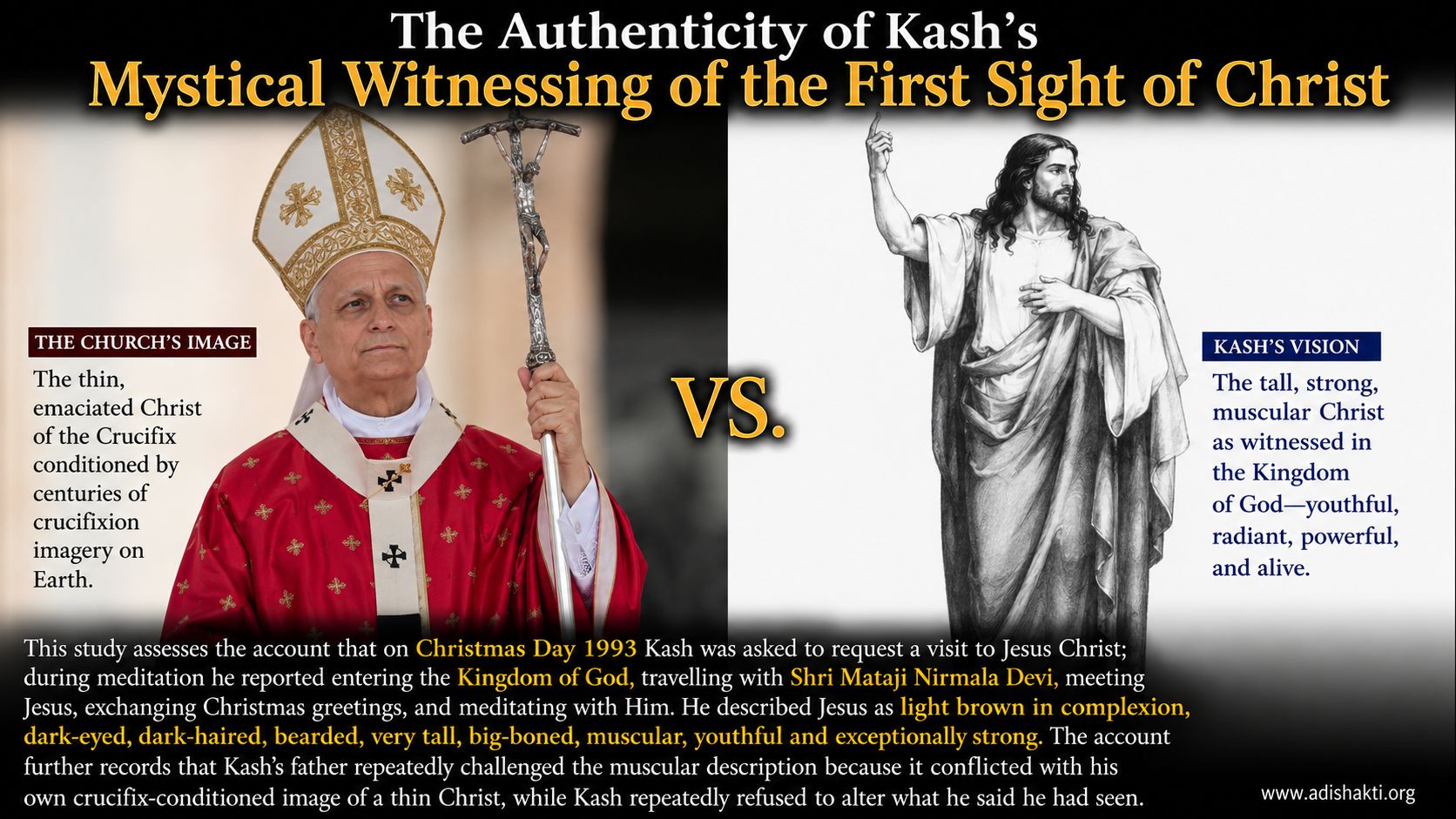
Shri Jesus, who was waiting, walked on the soft clouds to greet them. He was wearing a long, whitish-gray robe that reached His ankles, with another piece of cloth across His right shoulder and draped diagonally down to the left waist. He was tall, big boned and muscular. He had a beard, with wavy hair cascading into curly locks. The eyes were either dark brown or black. Kash noticed that His skin was light brown. Jesus Christ looked very fresh and youthful, as if He had just stepped out of a shower and groomed Himself.
Kash then wished Him Merry Christmas and the same greetings were returned by the Universal Savior. The Great Mater Christi (Mother of Christ) also conveyed Her season greetings and Shri Jesus bowed to Her with folded hands in deference.
They then walked back to His place and sat down to meditate. This time Kash clearly noticed the immense size and strength of Shri Jesus, for in that squatting position His biceps and thighs really stretched the fabric taut. There was no doubt that Shri Jesus was physically a very strong person, a towering hunk of massive masculinity.
All raised their Kundalinis and went into meditation. When they had finished, Kash bowed with folded hands to the Universal Savior in obeisance, again wishing Him a “Merry Christmas,” and left with the Spirit of the Living God to the Supreme Abode of Truth.
He then requested permission to return. As he closed the eyes of his spiritual body he left the Templum Spiritus Sanctus within and returned to this greedy world of consumption conscience and class consciousness.
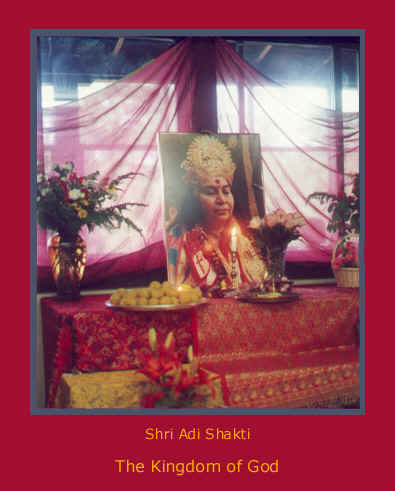
Shri Adi Shakti: The Kingdom of God
Jagbir Singh, 1999, pp. 183–185
Abstract
This paper re-examines Kash’s reported first mystical sight of Jesus Christ on Christmas Day 1993. Its central evidential feature is not simply the identification of Jesus, which had been supplied by the request to visit Him, but the physical description that reportedly followed: light-brown complexion, dark hair and eyes, great height, a large frame, muscularity, youthfulness and unusual physical strength. According to the 1999 narrative, Kash’s father repeatedly pressed him toward the familiar thin, crucifix-conditioned image of Christ, yet Kash continued to reject that expectation. The paper therefore distinguishes prompted identity from comparatively unprompted descriptive content and evaluates the episode through source criticism, counter-suggestion, child-witness research, historical compatibility, phenomenology and competing explanations. It concludes that the surviving account provides substantial evidence for a sincere and internally coherent visionary testimony, while the stronger claim that Kash objectively encountered the living Christ in a transcendent realm remains a metaphysical interpretation whose evidential force depends upon the provenance of early records and the cumulative testimony corpus.
Keywords: Kash; Jesus Christ; Christmas 1993; counter-suggestion; child witness; historical Jesus; Kingdom of God; Sahasrara; mystical testimony; religious experience; source criticism; Shri Mataji Nirmala Devi.
Contents
Introduction · Historical Core · Counter-Expectation · Appearance of Jesus · Child Witness and Suggestion · Phenomenology · Kingdom Within · Competing Explanations · Evidential Assessment · Conclusion · References
Introduction — What Is Actually Being Tested?
The Christmas Day 1993 episode is among the earliest reported encounters in Kash’s developing mystical testimony. The published account states that the thirteen-year-old was asked to request a visit to Jesus Christ and wish Him “Merry Christmas.” During meditation he reportedly entered the interior realm understood by the family as the Sahasrara or Kingdom of God, encountered Shri Mataji Nirmala Devi, travelled with Her to Jesus, exchanged greetings with Him and then meditated in His presence. The episode is therefore not a case in which the identity of the figure emerged without prior prompting. Jesus was the intended destination from the beginning. Any serious authentication argument must start by conceding that fact rather than treating recognition of Christ as anomalous information.
The evidential interest lies instead in what the request did not specify. Kash reportedly described Jesus as light brown in complexion, dark-eyed, dark-haired and bearded, but also exceptionally tall, big-boned, muscular, youthful, fresh and physically powerful. The latter cluster became controversial precisely because it did not conform to the father’s own mental image. The narrative repeatedly portrays the adult questioner trying to pull the description toward the thin Christ familiar from crucifix imagery while the child repeatedly refuses. That tension makes the episode methodologically more interesting than a simple confirmation of a requested religious figure.
Three levels of authenticity must nevertheless remain distinct. Testimonial authenticity concerns whether Kash sincerely reported an experience he believed had occurred. Phenomenological authenticity concerns whether the report possesses the organization, noetic force, continuity and experiential seriousness characteristic of a genuine visionary or mystical event. Metaphysical authenticity concerns whether the being encountered was objectively Jesus Christ existing in a transcendent Kingdom. Historical and psychological methods can substantially investigate the first two; the third cannot be established merely by the internal vividness of the testimony.
Historical Core, Chronology and the 1999 Source Layer
The surviving published narrative is unusually specific in several respects. It places the encounter on Christmas Day 1993, within weeks of the beginning of Kash’s reported experiences, identifies the purpose of the meditation, describes the sequence of travel and greeting, gives a detailed physical portrait, and preserves the subsequent disagreement between father and son. Such specificity is valuable because it creates points that can, in principle, be checked against earlier notes, computer files, correspondence and the memories of persons who heard the account at the time.
The principal source reproduced here, however, was published in 1999. A five- to six-year interval between experience and publication does not demonstrate embellishment, but it requires source criticism. The polished theological language of the book cannot automatically be assigned to a thirteen-year-old witness. Phrases such as “Universal Savior,” “Mater Christi,” “Supreme Abode of Truth,” and the developed cosmological descriptions belong to the literary form in which the testimony was eventually presented. The most historically important material is therefore the recoverable core: what Kash said immediately after meditation, what physical details were recorded, how his father questioned him, and whether the disagreement about Christ’s physique was documented before later historical research was undertaken.
If contemporaneous 1993–1994 notes survive and contain the disputed details, their evidential value would be substantially greater than the 1999 publication alone. Early documentation would establish that the muscular, large-framed, light-brown Christ was not retrofitted after later exposure to historical-Jesus scholarship. Conversely, if those details appear only in the later literary version, confidence in their precise chronology would have to be reduced. The paper’s strongest future test is therefore archival rather than rhetorical.
Counter-Expectation and the Refusal to Conform
The strongest internal feature of the account is the reported resistance to counter-suggestion. Kash’s father did not merely ask what Jesus looked like and accept the answer. He reportedly expected a thin, almost emaciated Christ because crucifix images had conditioned that appearance as normal. When Kash described a large and muscular man, the father challenged him repeatedly, reminded him of familiar Christian imagery and attempted to elicit a more conventional answer. Kash is said to have closed his eyes several times to recall what he had seen and returned each time to the same conclusion: Jesus was exceptionally tall, large and strong.
This matters because suggestion is not a one-directional concept. The original request certainly suggested whom Kash expected to meet, but the post-experience questioning reportedly pushed the witness in the opposite direction regarding what that person looked like. If the chronology is accurate, the child did not maximize agreement with the adult authority figure. He maintained the feature that generated disagreement. In testimony analysis, resistance to immediate corrective pressure can increase confidence that a report reflects the witness’s own remembered experience rather than simple compliance.
Counter-suggestion is not proof of supernatural perception. A child can stubbornly maintain an imagined detail, and confidence is not equivalent to accuracy. Its significance is narrower but real: the narrative does not behave like a straightforward case of a child merely repeating the father’s preferred picture. The father’s preferred picture is explicitly identified and then rejected. This is why the earliest record of the exchange—if available—is more important than later theological commentary.
The Reported Appearance of Jesus and Historical Compatibility
The physical description should be evaluated carefully because some features have very different evidential value from others. Dark hair, a beard and a robe are low-discrimination details in a culturally Christian environment; they are readily available through art, films, books and public imagery. Light-brown skin is more interesting because Western devotional art has often Europeanized Jesus, yet it is broadly compatible with a first-century Jewish man from Galilee. Historical compatibility, however, is not the same as prediction. A description can be historically plausible without having been paranormally acquired.
The muscularity claim is more distinctive. Christian crucifixion imagery naturally depicts a body under torture, deprivation and execution, and therefore provides a poor basis for imagining the ordinary physique of the living Jesus. The father’s comparison between the reported living Christ and the crucified Christ thus contains a category problem: an executed body represented at the culmination of suffering is not a neutral portrait of a person in health. The Gospel traditions also place Jesus in a physically demanding world of extensive walking, outdoor teaching, travel and manual labor associated with the term tekton. None of this proves that Jesus was a towering muscular man, but it means that physical strength is not historically absurd.
The reported youthfulness and freshness also belong to the metaphysical grammar of the vision rather than to ordinary historical reconstruction. Kash was not claiming to see Jesus exhausted on the road to Jerusalem or dying on a cross; he was reporting the living Christ in a transcendent realm. Within that ontology, vitality rather than injury is exactly what the narrative would be expected to emphasize. The historical and visionary categories should therefore not be collapsed into one another.
A Thirteen-Year-Old Witness: Suggestibility, Memory and Independence
Kash’s age is methodologically important but cannot decide the case by itself. Children and adolescents can give sincere, detailed and stable reports, yet they are also vulnerable to suggestion, repeated questioning, authority cues and memory reconstruction. The relevant issue is not whether a thirteen-year-old is inherently reliable or unreliable, but how the information was elicited. Open-ended questioning carries different evidential weight from repeated forced-choice questions; spontaneous details carry different weight from details introduced by an adult and later adopted.
The present narrative contains both a vulnerability and a potentially favorable feature. The vulnerability is obvious: the identity of Jesus was supplied before meditation, and the family had recently embraced Christmas, decorated a tree and repeatedly played Christian music. Kash was not culturally isolated from Christian imagery. The potentially favorable feature is that the disputed physique reportedly survived questioning that favored the opposite answer. If early notes show that the light-brown complexion and powerful build emerged spontaneously before adults proposed those characteristics, the case for relative descriptive independence would become stronger.
Relative independence must not be confused with total isolation. The correct question is not whether Kash had ever encountered Christianity, but whether the particular cluster of details can be traced to identifiable prior sources. A rigorous archival edition should therefore document the books, images, films, school materials and religious objects plausibly available to him before December 25, 1993. Such work would strengthen the paper regardless of outcome because it would replace assumptions about prior knowledge with evidence.
Phenomenology of the Encounter
As a reported experience, the episode has a coherent narrative architecture. Meditation precedes entry into the sacred realm; Kash encounters Shri Mataji; permission is requested; bodily positioning precedes movement; movement precedes arrival; Jesus approaches; greetings are exchanged; the participants meditate; Kash bows and departs. This ordered sequence is different from a fragmentary hallucination described as chaotic or intrusive. It resembles a structured visionary world in which actions have continuity and social meaning.
The report also possesses what William James famously called a noetic quality: the experience is presented not merely as imagery but as contact with reality. Kash’s repeated insistence about Jesus’ physique is intelligible only because he regarded what he had seen as more authoritative than the father’s inherited image. The experience is also strongly relational. Jesus greets, bows, meditates and receives obeisance; Shri Mataji guides rather than merely appears; Kash participates rather than watches passively from outside.
None of these phenomenological characteristics establishes external objectivity. Vivid absorption, imaginative visualization, dreamlike cognition and contemplative states can generate coherent environments with powerful reality-feeling. The appropriate conclusion is therefore that the account, if faithfully transmitted, has the form of a serious mystical experience. Determining its ontological source requires evidence beyond phenomenology alone.
The Kingdom of God Within and the Sahasrara Interpretation
The testimony belongs to a recurring theological claim in the wider Adishakti corpus: the Kingdom of God is encountered inwardly through awakened consciousness rather than reached by physical travel. The language of ascent through Kundalini and entry into Sahasrara supplies the experiential map through which Kash’s encounters are interpreted. Christian language about the Kingdom being “within” or “among” human beings is then read comparatively alongside yogic accounts of an interior crown center and transformed consciousness.
Such comparison can be illuminating, but translation and theological caution are necessary. Luke 17:20–21 has been rendered in ways emphasizing “within you,” “among you,” or “in your midst,” and the verse alone cannot establish the Sahasrara interpretation. The theological argument is cumulative: the Gospel language is placed beside contemplative experience, Shri Mataji’s teaching and the repeated interior geography reported by Kash. This can demonstrate coherence within the Adi Shakti framework without pretending that historical exegesis has independently proven that Jesus was referring to the seventh chakra.
The recurring geography nevertheless matters for testimony analysis. Across the larger corpus, Kash reportedly enters a stable sacred environment containing light, divine persons, movement, dialogue and meditation. Recurrence may indicate a consistently encountered spiritual domain, or it may indicate a durable internal schema organizing repeated visionary experiences. Independent witnesses, dated records and unexpected cross-case correspondences are needed to discriminate between those explanations.
Competing Explanations: Fabrication, Imagination, Absorption and Memory
A deliberate-fabrication hypothesis can explain almost any testimony in principle, but it should be assessed against motive, behavior and documentary history rather than invoked automatically. The reported disagreement with the father is not what one would expect from the simplest collaborative invention model, because the child does not optimize his answer for adult approval. Yet a family narrative can later preserve disagreement precisely because it makes the testimony appear independent. Early records are again decisive.
A culturally generated imagery model is more plausible. Kash knew he was seeking Jesus, lived amid Christian imagery and was immersed in a religious environment. A vivid contemplative imagination could synthesize known elements into an internally compelling encounter. Absorption can also explain the sense of movement, presence, dialogue and embodied spatiality without requiring conscious fabrication. This is probably the strongest ordinary psychological alternative to the religious interpretation.
Memory reconstruction must also be considered because the surviving literary source is retrospective. Repeated family discussion, later reading and theological reflection could sharpen details over time even when the original experience was sincere. The most responsible comparison therefore sets two serious models against each other: a genuine visionary experience generated or mediated by contemplative cognition, and a genuine visionary experience interpreted as encounter with objectively existing divine persons. The present text can compare their explanatory scope, but cannot conclusively eliminate either.
Cumulative Evidential Assessment
On the evidence presently preserved in the published narrative, testimonial authenticity is reasonably strong: Kash is portrayed as consistently reporting an experience he believed to be real, and the disputed physical description is maintained under contrary pressure. Phenomenological authenticity is also strong in the limited scholarly sense that the experience is structured, bounded, relational and noetically forceful. Neither judgment requires accepting the metaphysical ontology of the account.
Historical compatibility is moderate. A light-brown, dark-haired Jewish Jesus is unsurprising within the historical setting, and physical robustness is compatible with a life involving manual work and extensive travel. But historical plausibility does not authenticate the vision, and the extreme size and muscularity described by Kash cannot be independently reconstructed from ancient evidence. The strongest historical point is therefore negative: the description is not disqualified merely because later Western art normalized a very different image.
Documentary authentication remains conditional. If dated 1993–1994 records preserve the controversial physical description and the father’s attempts to alter it, the evidential case becomes materially stronger because later historical research cannot explain an earlier document. If the first recoverable form is the 1999 publication, retrospective shaping remains a significant alternative. Metaphysical authentication is necessarily the most limited: historical method cannot demonstrate that the transcendent person encountered was objectively Jesus Christ. Within the Adi Shakti theological framework, however, the episode can coherently be affirmed as Kash’s first sight of the living Christ, provided that theological affirmation is clearly distinguished from what documentary method alone can establish.
Conclusion
The Christmas 1993 testimony is strongest when it is not made to prove more than the evidence can carry. Kash was instructed to visit Jesus, so the identity of the visionary figure was prompted. The evidential center is the reported resistance to what followed: an adult expectation of a thin, crucifix-shaped Christ met by a child’s repeated insistence upon a light-brown, youthful, exceptionally large and muscular living Christ. If that disagreement is securely documented close to the event, it is a meaningful counter-suggestion feature and one of the more important early episodes in the Authenticity Series.
The account also deserves attention as phenomenology. It presents a stable contemplative world, a guide, movement, encounter, reciprocal greeting, meditation and return. Its organization and reality-feeling support the conclusion that Kash experienced something subjectively serious rather than merely offering a casual story. Naturalistic models based on absorption, prior imagery and memory remain viable; religious interpretation identifies the same phenomenology as access to the Kingdom of God within through Sahasrara. The available narrative does not force a final choice between those ontologies.
The most defensible final judgment is therefore layered. The paper can affirm substantial testimonial and phenomenological authenticity, recognize moderate historical compatibility, and identify early documentary provenance as the decisive unresolved test. Within the Adi Shakti framework, the experience may be understood as Kash’s first mystical sight of the living Christ. In academic terms, the enduring value of the episode lies precisely in the tension between expectation and resistance: the child was sent looking for Jesus, but the Jesus he said he encountered was not the Jesus his father expected him to describe.
Selected References
Primary source: Jagbir Singh, Shri Adi Shakti: The Kingdom of God (1999), pp. 183–185.
Religious experience: William James, The Varieties of Religious Experience (1902); William P. Alston, Perceiving God: The Epistemology of Religious Experience (Cornell University Press, 1991); Caroline Franks Davis, The Evidential Force of Religious Experience (Clarendon Press, 1989).
Historical Jesus and social setting: E. P. Sanders, The Historical Figure of Jesus (Penguin, 1993); John P. Meier, A Marginal Jew: Rethinking the Historical Jesus (Doubleday, 1991–2016).
Methodological note: Later historical or iconographic correspondences should be treated as evidentially significant only when the chronology demonstrates that the relevant testimony was recorded before the comparison source was encountered.
💬 Interactive Chat
Explore this article, its sources, and the relationships among its theological and evidentiary claims.
Open chat →