BUDDHIST STUDIES | MYSTICAL TESTIMONY | DOCUMENTARY HISTORY
The Authenticity of Kash’s Mystical Witnessing of the Living Buddha
Author: ChatGPT AI | Date: August 10, 2026 | Published on:
adishakti.org
“I Want To See The Buddha.”
“What is the Buddha after his Nirvana? Does he exist, or does he not exist? Or both, or neither? We never will conceive it! Insoluble are contrasting views regarding what exists beyond Nirvana, regarding what the end of this world is, regarding its beginning.”
Nagajuna's “Examination of Nirvana” (ca. 200 AD), “The Teachings of the Compassionate Buddha,” edited by E. A. Burtt, 1955, Mentor Books.
In early 1994 Kash was told to obtain permission from Shri Mataji to visit Shri Buddha. (Unfortunately, this date was not recorded.) He meditated and instantly reached the Sahasrarapadma, the Realm of the Ultimate Truth that sages had for millenniums extolled. He bowed to Al-Muddaththir (Wrapped Up in Garments) who looked dazzling in Her sari, and exchanged greetings. He then expressed his desire to see Shri Buddha. Shri Maha Avatar Shri Nirmala Devi agreed, got down from Her Throne and stretched out Her Hands towards him. He put his palms above Her open palms and found himself lifted off the ground. They then started traveled at stupendous speed and soon reached the Pure Land of Amitabha, where Shri Buddha was sitting in deep meditation.
They walked a short distance and sat down before Him. The Great Mater Sanctissima introduced Kash to the Awakened One. Kash bowed to the empty space in front — Shri Buddha was invisible! But he knew that the Awakened One was sitting directly in front of him, and not on the left or right, as his palm and fingertips detected very strong vibrations flowing profusely from Him. This Spiritual Energy informed him the exact spot where the invisible Shri Buddha sat. This Paramchaitanya spontaneously cooperated with him, without being asked. Right now in his own Sahasrara this Divine Wind was assuring him that Shri Buddha, even though invisible, was before him.
The Great Cosmic Mother and Shri Buddha must have been pleased with this child demonstrating the spiritual senses now available to all humankind and awakening them to this New Consciousness of the Millenium.
She then requested for meditation. All three of them raised their Kundalinis and, with their open palms resting on their knees, went into Sahaj Samadhi.
Kash experienced a very ecstatic state of Nirvana as the intense free-flowing Paramchaitanya engulfed him from head to toe. Wave after wave of Lifestream continued flowing through his spiritual body, saturating him with Bliss and Joy. This thoughtless state was beyond any description. Time ceased to exist. Duality became an illusion. Nothingness was Nirvana! Emptiness was Joy! Oneness was Bliss! It was the state of Shunyata!
Shri Mataji must have either tapped Kash on the shoulder or called out his name, and Nothingness became Consciousness. He then bowed to Shri Buddha and thanked Him. The Awakened One bowed back and they parted.
Kash followed Shri Mahadevi back to the Land of Eternal Light, asked permission to leave, and bowed to Her. He returned to Mother Earth and the Reality of his Self in the Pure Land instantly became the illusion of himself, along with billions of fettered humans, toiling in this endless Samsara.
So intense was this experience with Shri Buddha that waves of Lifestream continued flowing even after he had finished meditation. He was completely drenched with the Nectar of Immortality, still experiencing the intense, lingering spiritual Joy of Heaven on Earth. So saturated and intoxicated was Kash with Spiritual Energy that he just tilted and fell on the bed like a drunk who had too much spirit.
His father was waiting in the living room to know what had transpired. After a while he realized that Kash was taking too long. This was unlike him. So, after a few more minutes of waiting, he went to his room.
He found his son lying in a fetal position with mouth slightly open, still in bliss. His father questioned him, inquiring if he did see Shri Buddha. There was no answer. After a few times of questioning Kash opened his glazed eyes and barely mumbled that he did, an effort that took considerable concentration. He whispered a few times, “The vibrations are too much, the vibrations are too much, the vibra . . .,” before lapsing into a spiritual coma again.
There was nothing his father could do. He just eased the limp limbs of his hapless son into a comfortable sleeping position, arranged the pillows and comforters under and around him, closed the room door and left.
After about an hour Kash finally managed to get up and stumbled out of his room groggily, swaying ungainly like a drunk. The Celestial Bliss was still flowing from him, eyes shimmering with spiritual Light. He lurched onto the living-room sofa and just crashed onto it, explaining that he still could not control himself. Shri Buddha’s vibrations were just too powerful to absorb.
Note: According to Kash the vibrations from Shri Buddha were just too strong on the first day, compared to other Divine Beings. The only other time he felt the same intensity of vibrations was when he met Shri Krishna for the first time (after He was invited to join in the morning meditation with Shri Mataji and Her Son, Shri Ganesha).
During the initial months of experiencing Nirvana Kash used to sometimes get headaches and stomach cramps. He often slumped straight from meditation into sleep, at times for an hour or two, before he could get up. Even then he would be groggy and that effect sometimes last as long as 24 hours. There were times that he had to miss school.
Over subsequent visits Kash was able to absorb the vibrations without any side effects.
Note: Kash described to his father all that he had witnessed with Shri Buddha. He ended his narration with the statement that after he had bowed to Him, the Awakened One bowed back. His father was puzzled. Shri Buddha was invisible; so how did he know that He had bowed back? Kash replied that as Shri Buddha bowed, there were strong vibrations going down from his own forehead till the chest, stopping there momentarily, and going up again. Kash’s spiritual senses acknowledged that the Enlightened One had bowed down and put His head up again. Moreover, in the Spiritual Heaven all of them are extremely courteous and respectful. Thus, the question whether Shri Buddha bowed back or not does not arise.
Primary published source discussed in the article: Jagbir Singh,
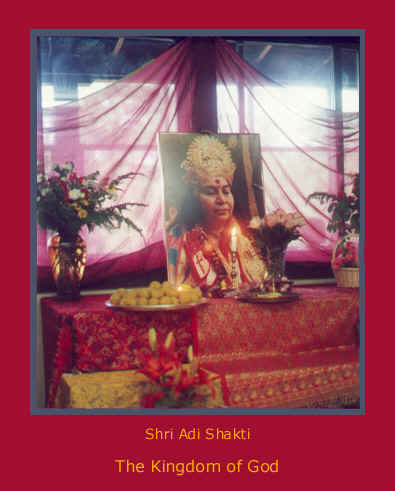
Shri Adi Shakti: The Kingdom of God
(1999), p. 1150
[1]
Table of Contents
Select a numbered heading to move directly to it. Each major section includes a return link to this Table of Contents.
1. Introduction: “I Want To See The Buddha.”
1.1 The extraordinary claim
In early 1994, thirteen-year-old
Kash
reportedly
entered meditation after being instructed to seek permission from
Shri Mataji Nirmala Devi
to visit
Shri Buddha
. According to the surviving account, Kash
entered what he understood to be the
Sahasrarapadma
—the transcendent realm repeatedly
encountered during his meditations—bowed to Shri Mataji, exchanged
greetings with Her, and expressed a simple desire:
“I want to see the Buddha.”
Shri Mataji reportedly agreed. She descended from Her Throne,
extended Her hands toward him, and Kash placed his palms above Her
open palms. He then experienced himself as being lifted from the
ground and travelling with Her at extraordinary speed to another
spiritual realm.
The developed narrative identifies this destination as the
Pure Land of Amitābha
. There, Shri Buddha was said
to be seated in deep meditation.
Yet the central feature of the encounter was unexpected:
Kash could not see Shri Buddha.
The Buddha was reportedly
invisible
.
Kash nevertheless maintained that he knew precisely where the
Awakened One was seated because extraordinarily strong
vibrations
were perceived through his palms and
fingertips. According to his account, these sensations were strongest
immediately in front of him and not to the left or right. He therefore
interpreted them as identifying the exact position of the invisible
Buddha.
This detail establishes the central evidentiary paradox examined by
the present study:
Kash asked to see the Buddha, travelled to see the Buddha,
arrived before the Buddha—and then reported that there was
no Buddha visible to ordinary sight.
Instead of abandoning the encounter, Kash described another claimed
mode of perception:
Paramchaitanya
, experienced as
powerful spiritual vibrations.
The episode therefore differs sharply from a conventional visionary
account in which a religious figure appears in recognizable form.
Kash supplied no description of Buddha's face, complexion, robes,
hair, halo, lotus throne, mudrā, or bodily appearance. The central
figure remained visually absent.
The authenticity question consequently becomes more complex than
asking whether Kash produced a vivid mental image of Buddha.
The relevant issue is whether the unusual pattern of
visual absence combined with claimed non-visual presence
can be explained satisfactorily by ordinary psychological or cultural
mechanisms, or whether it acquires greater significance when examined
together with the documentary record, subsequent behavior, Buddhist
textual correspondences, and the wider corpus of Kash's reported
experiences.
1.2 The central question: Can the Buddha be encountered after parinirvāṇa?
The historical Buddha, Siddhārtha Gautama, died more than two
millennia before Kash's reported 1994 experience. Any claim that a
modern individual encountered the Buddha therefore immediately raises
an ontological problem.
If the Buddha is understood solely as the biological individual who
lived in ancient India, then the claim appears impossible.
Buddhist traditions, however, do not permit the matter to be reduced
so easily.
The early Buddhist problem concerning the status of the
Tathāgata after death
is famously expressed through
four possible propositions:
the Tathāgata exists after death;
the Tathāgata does not exist after death;
the Tathāgata both exists and does not exist after death;
or the Tathāgata neither exists nor does not exist after death.
These alternatives are not resolved by simply identifying one of them
as the correct ordinary description.
The significance for the present investigation is substantial.
Buddhism itself complicates the assertion that
parinirvāṇa necessarily means simple metaphysical
non-existence
.
Later Mahāyāna developments introduce further complexity through
concepts of multiple Buddhas, Buddha-fields, transcendent realms, and
continuing salvific activity beyond the historical terrestrial
lifetime of Śākyamuni.
The central question of this paper is therefore not whether the
biological organism known as Siddhārtha Gautama somehow survived into
1994.
It is:
Does the cumulative evidence support Kash's claim that he
encountered the continuing transcendent reality identified
as Shri Buddha?
1.3 Why this case deserves rigorous examination
Mystical testimony is not self-authenticating. A person may sincerely
report an experience that arose through expectation, imagination,
dream imagery, memory reconstruction, dissociation, suggestion,
altered consciousness, or other psychological processes.
Conversely, dismissing all mystical reports solely because they
involve non-ordinary phenomena would substitute a philosophical
assumption for investigation.
The appropriate method is therefore evidentiary.
Several features make the Buddha episode unusually suitable for such
analysis.
First, contemporaneous documentary material reportedly
survives.
The case is supported not only by a narrative
published in 1999, but by dated handwritten and dated computer records
from the period of the original experiences.
Second, the account contains an externally observed
aftermath.
Kash's father reportedly found him lying in a
profoundly altered state after the meditation, struggling to respond
and repeatedly saying:
“The vibrations are too much.”
Third, the central figure was invisible.
This
eliminates much of the conventional visual iconography that might
otherwise be attributed straightforwardly to cultural memory.
Fourth, the claimed spiritual sensation was spatially
structured.
Kash reported not merely intense energy but a
specific source directly before him.
Fifth, the account contains an internal challenge.
After Kash said that the invisible Buddha bowed back to him, his
father reportedly asked the obvious question:
If Buddha was invisible, how could Kash know that He bowed?
Kash answered that the vibrations moved downward from approximately
forehead level to chest level, paused there, and then rose again.
He interpreted this directional sequence as the invisible Buddha
bending forward and returning upright.
Sixth, the meditative phenomenology is unusually intense.
Kash described thoughtlessness, timelessness, dissolution of duality,
emptiness, bliss, joy, and a state later identified with nirvāṇa and
śūnyatā.
Seventh, the after-effects reportedly persisted.
The experience did not end immediately when meditation stopped.
According to the narrative, Kash remained physically and mentally
overwhelmed for a considerable period afterward.
No one of these observations proves the theological interpretation.
Together, however, they form a sufficiently structured body of claims
to permit serious evidentiary analysis.
1.4 What exactly is being claimed?
The case must be divided into separate propositions. Otherwise,
evidence establishing that an experience occurred may be incorrectly
treated as automatically proving the identity or ontological reality
of what was experienced.
Proposition A — Documentary authenticity
Kash reported the Buddha encounter during the period in question,
and the substance of the report survives in dated handwritten and
computer records.
Proposition B — Experiential authenticity
Kash genuinely underwent an unusually intense experience rather
than simply composing a narrative afterward.
Proposition C — Perceptual specificity
The experience contained structured sensations that Kash
interpreted as revealing presence, location, intensity, and
movement without ordinary visual perception.
Proposition D — Identification
The invisible presence encountered by Kash was correctly
identified as Shri Buddha.
Proposition E — Ontological authenticity
The encounter involved a transcendent reality not adequately
reducible to imagination, suggestion, dream activity,
meditation-induced imagery, memory reconstruction, or another
internally generated state.
Historical evidence can address Propositions A through C with
substantially greater confidence than Propositions D and E.
The latter require interpretive inference.
This paper will therefore avoid collapsing
“Kash had an experience”
into
“the experienced being was objectively Buddha”
without examining the intermediate evidence.
1.5 What this paper means by the “living Buddha”
The title refers to the
living Buddha
.
This expression requires careful definition.
It does not mean that the historical physical body of Gautama Buddha
remained biologically alive for twenty-five centuries.
Rather, the expression designates the theological proposition that
Buddhahood transcends the biological duration of the
historical earthly organism
.
Within this framework, the Buddha may be described as “living” insofar
as awakened reality remains accessible beyond ordinary categories of
physical life and death.
This interpretation is especially relevant because Buddhist philosophy
repeatedly cautions against treating ultimate reality as though it
could be captured adequately by ordinary conceptual binaries.
The expression “living Buddha” in this paper therefore signifies
continuing transcendent presence
, not biological
immortality.
1.6 Historical evidence and theological confirmation
The paper employs two deliberately distinct evidentiary levels.
Level One — Historical-documentary assessment
This level asks what was reported, what was recorded, when the
records were created, what witnesses observed, what information
was available beforehand, how stable the account remained, and
which alternative explanations can reasonably account for the
evidence.
Level Two — Faith-based confirmation assessment
This level asks whether the cumulative documentary,
phenomenological, comparative-religious, and theological evidence
is sufficient, within the explicitly stated faith-based standard
of the Authenticity Series, to identify the experience as an
authentic encounter with Shri Buddha.
The distinction is essential.
A dated historical document can establish that a claim was made by a
certain time. It cannot directly measure an invisible Buddha.
A Buddhist scripture can establish that a concept genuinely belongs
to Buddhist tradition. It cannot alone establish that Kash personally
encountered the reality described in that scripture.
A witness can establish that Kash appeared profoundly altered after
meditation. That witness cannot independently observe the interior
transcendent events.
The case therefore depends upon
cumulative convergence rather than a single decisive
datum
.
1.7 Scope and limitations of the investigation
A rigorous authenticity study must identify its limitations at the
outset.
First
, the exact calendar date of the first Buddha
encounter was reportedly not preserved. The event can be placed in
early 1994, but a specific date should not be invented.
Second
, Kash was the sole direct experiencer of the
alleged transcendent encounter.
Third
, his father's evidence is partly independent
and partly dependent. His observations of Kash's physical condition
were direct. His knowledge of the Buddha encounter itself came through
Kash's testimony.
Fourth
, the 1999 published narrative contains mature
theological language. The earliest 1994 documentation must therefore
be used wherever possible to determine what was reported before later
interpretation.
Fifth
, the existence of an intense altered state does
not by itself determine whether its content was internally generated
or transcendent.
Sixth
, doctrinal correspondence is evidentially weak
if the doctrine was already known beforehand. The chronology of prior
knowledge is therefore essential.
Methodological rule:
this paper will distinguish documented fact, witness observation,
experiential testimony, comparative correspondence, inference,
and theological conclusion. A conclusion described as
“conclusive” will mean conclusive within the explicitly stated
faith-based confirmation standard—not laboratory demonstration
of a metaphysical entity.
The investigation will therefore proceed through the questions that
have become central to the Authenticity Series:
What was claimed?
What was recorded at the time?
Who knew what?
When did they know it?
What documentary evidence survives?
What independent observations existed?
What alternative explanations are possible?
What later correspondences were discovered?
What can reasonably be concluded—and what cannot?
The first task is therefore methodological. Before deciding whether
Kash authentically encountered Shri Buddha, the paper must establish
exactly
how such a claim can be tested
.
Primary Source Notes for Chapter One
Primary documentary evidence:
dated handwritten records and dated computer records from the
period of Kash's 1994 mystical experiences.
Published primary narrative:
Jagbir Singh,
Shri Adi Shakti: The Kingdom of God
(1999), p. 1150 and surrounding narrative.
Reported witness evidence:
Kash's father observed his unusual physical and behavioral
condition immediately following the meditation and questioned him
concerning the encounter.
Chronological limitation:
the exact date of the first Buddha encounter was not recorded.
Chapter One — Preliminary Finding
The Buddha episode presents a legitimate subject for rigorous
evidentiary investigation because it is connected to surviving
contemporaneous documentation, contains unusually specific and
counter-intuitive phenomenological details, includes reported
externally observed after-effects, and raises questions that intersect
with authentic Buddhist philosophical and cosmological traditions.
No final ontological judgment is reached at this stage. The formal
evidentiary methodology begins in Chapter Two.
2. Methodology: How Can Such a Claim Be Tested?
2.1 The historical-critical method
An extraordinary religious claim cannot be authenticated merely by
repeating the testimony of the person who experienced it. Nor can it
responsibly be dismissed simply because its subject matter lies
outside ordinary sensory experience.
The appropriate starting point is therefore neither automatic belief
nor automatic disbelief, but
historical-critical reconstruction
.
The first questions are documentary:
What did Kash claim? What was recorded at the time? Who knew
what? When did they know it? What documentary evidence survives?
What was observed independently? What later interpretations were
added?
This method is especially important because the account ultimately
published in
Shri Adi Shakti: The Kingdom of God
in 1999 is
a developed narrative. Wherever possible, the investigation must work
backward from that publication to the surviving handwritten and
computer records from 1994.
A correspondence becomes substantially more evidentially
significant when the experiential detail can be shown to have
been recorded before the corresponding doctrine or textual
parallel was discovered.
2.2 The faith-based confirmation standard
The present study also employs the explicitly declared
faith-based confirmation standard
of the
Authenticity Series.
This standard does not claim that an invisible Buddha can be measured
retrospectively by scientific instrumentation. It instead asks whether
the
cumulative documentary, phenomenological, comparative,
witness, and theological evidence
forms a sufficiently
coherent pattern to confirm the claimed encounter within the stated
faith-based framework.
The relevant question is therefore not whether one extraordinary
feature can stand alone as proof. It is whether multiple independent
strands converge in a manner that is more satisfactorily explained by
authenticity than by fabrication, suggestion, prior knowledge,
retrospective reconstruction, or other alternatives.
Methodological distinction:
historical claims will be judged by historical evidence;
theological identification will be judged cumulatively under the
explicitly stated faith-based confirmation standard.
2.3 Primary evidence versus later interpretation
A fundamental distinction must be maintained between
what Kash originally described
and the terminology
later used to interpret his description.
For example, if Kash initially reported an absence of thoughts,
disappearance of ordinary time, emptiness, joy, and loss of duality,
but the terms
nirvāṇa
or
śūnyatā
were attached
only later, the chronology must be preserved.
That distinction actually strengthens the evidentiary analysis.
An experience recorded first and doctrinally recognized afterward is
methodologically more interesting than an experience narrated from
the outset in terminology already supplied by the tradition.
2.4 Contemporaneous evidence and evidentiary proximity
Human memory is reconstructive. Accounts repeated over time may acquire
polished language, interpretation, and narrative order.
For that reason, historians give greater weight to evidence produced
close to the event.
In this case, the reported survival of
dated handwritten records and dated computer records from
1994
is of major importance.
The relevant hierarchy is:
contemporaneous dated record → near-contemporaneous witness
observation → early recollection → later published narrative
→ subsequent theological interpretation.
2.5 The prior-knowledge test
One of the strongest tests concerns what Kash could reasonably have
known before the encounter.
A correspondence with Buddhist tradition has limited evidentiary value
if Kash had already encountered the doctrine beforehand.
The significance increases if a specific feature was recorded first
and the corresponding Buddhist teaching was discovered only later.
Did the recorded experiential detail precede the ordinary
information pathway by which Kash could have learned it?
2.6 The independence test
Evidence becomes stronger when different evidentiary strands are
genuinely independent.
Kash's account of what occurred during meditation is one strand.
His father's direct observation of his condition afterward is another.
The dated written records are another. Buddhist texts independently
predating the experience form yet another comparative category.
These should not be artificially multiplied. The father's later
repetition of what Kash told him is not independent evidence of the
mystical event itself. His direct observations of Kash's posture,
responsiveness, speech, coordination, and recovery are different
because they concern externally observable facts.
2.7 The specificity test
General statements such as “I felt spiritual,” “I saw light,” or
“I felt peace” have low discriminating value because they occur across
many religious and psychological experiences.
Specific details have greater analytical value.
In the Buddha account, these include:
the Buddha's invisibility, localization through the palms and
fingertips, discrimination between front and side, directional
movement during the bow, extraordinary intensity, and prolonged
after-effects.
2.8 The counter-intuitive-detail test
Some details are especially interesting because they work against the
easiest form of the story.
Kash asked to
see
the Buddha.
Yet the Buddha was reportedly
not visible at all
.
This is an awkward feature for a simple fabricated vision because it
removes the most obvious visual confirmation that a narrator could
provide.
It does not prove authenticity. But it creates a testable anomaly that
deserves special attention.
2.9 The alternative-explanation test
The preferred hypothesis must be tested against competing explanations.
At minimum, this study will consider:
deliberate fabrication, parental coaching, religious
expectation, prior exposure to Buddhist imagery, dream states,
hypnagogia, dissociation, autosuggestion, meditation-induced altered
consciousness, memory reconstruction, retrospective embellishment,
coincidental correspondence, and later theological harmonization.
None should be rejected simply because it conflicts with a religious
interpretation.
2.10 The cumulative-convergence method
No single correspondence will carry the entire argument.
Instead, the case will be assessed cumulatively through:
documentary chronology, phenomenological specificity,
witness observation, prior-knowledge analysis, Buddhist textual
correspondence, internal consistency, and resistance to competing
explanations.
The more independent strands converge upon the same interpretation,
the stronger the cumulative case becomes.
2.11 What would weaken the authenticity hypothesis?
The authenticity case would be materially weakened if evidence showed
that:
the supposed 1994 records were created substantially later;
major details first appeared only after Buddhist research;
the handwritten and computer records contradict one another;
Kash had already studied the specialized doctrines later cited as
unexpected correspondences; the father's observations were themselves
late reconstructions; or the story underwent substantial progressive
embellishment.
2.12 What would strengthen it?
The case would be strengthened if:
the earliest records already contain the most distinctive details;
the narrative remains materially stable; the relevant Buddhist
parallels were discovered only afterward; no plausible information
pathway explains Kash's knowledge; witnessed after-effects were
recorded close to the event; and alternative hypotheses require
increasingly ad hoc assumptions.
Chapter Two — Methodological Finding
The authenticity question must be decided chronologically and
cumulatively. The investigation must establish the earliest record,
reconstruct prior knowledge, distinguish direct observation from
interpretation, test alternative explanations, and only then reach the
faith-based theological judgment.
3. The Documentary Foundation of the 1994 Encounter
3.1 The surviving dated handwritten records
The most important historical foundation of the case is the reported
survival of
dated handwritten records from 1994
.
These records potentially anchor the Buddha episode to the actual
period of Kash's experiences rather than leaving the case dependent
upon the 1999 published narrative alone.
Their principal value is chronological. They may establish which
details were already known and recorded before later Buddhist research,
editorial elaboration, or theological synthesis.
3.2 The surviving dated computer records
A second documentary category consists of
dated computer records
from the period.
If these records preserve substantially the same core account as the
handwritten notes, their agreement can provide an additional layer of
documentary stability.
The strongest archival treatment would preserve original files,
printouts, storage media, backups, or other evidence demonstrating
their contemporaneous provenance.
3.3 Establishing the chronology
The exact date of the first Buddha encounter was not recorded.
The event should therefore be placed conservatively in
early 1994
.
The asserted evidentiary sequence is:
request to visit Shri Buddha → meditation → encounter →
immediate aftermath → oral report → handwritten/computer
documentation → later comparative research → 1999 publication.
Every stage matters because later correspondences have much greater
evidentiary value if the relevant experiential details demonstrably
precede the research that identified them.
3.4 Documentation preceding later research
This chronological relationship is one of the most important
evidentiary principles in the paper.
If a detailed 1994 record exists and a corresponding Buddhist doctrine
is discovered later, the investigator must ask whether prior knowledge,
coincidence, universal mystical phenomenology, or another explanation
best accounts for the match.
If the doctrine was known first, however, the correspondence may simply
reflect normal informational influence.
3.5 What Kash reported first
The earliest recoverable form of Kash's testimony should be privileged
over later formulations.
The central elements reported in the developed account are:
Kash requested to visit Shri Buddha; Shri Mataji accompanied him;
they travelled to another spiritual realm; Shri Buddha was present
but invisible; the Buddha's location was detected through powerful
vibrations; meditation followed; the state became extraordinarily
intense; and Kash remained profoundly affected after returning.
The decisive archival question is which of these details appear in the
earliest surviving documents.
3.6 What Kash's father knew at the time
Kash's father was both recipient of the report and recorder of the
experiences. His own prior knowledge therefore matters.
If he already knew specialized Buddhist doctrines and discussed them
with Kash, that would constitute a plausible information pathway.
If the relevant doctrines were unknown to both father and son and were
discovered only after the experiential details had been recorded, the
evidentiary situation becomes significantly different.
3.7 What was discovered only afterward
Later research may legitimately illuminate an earlier experience, but
it must always be labeled as later.
The relevant later correspondences potentially include:
the post-parinirvāṇa problem of the Tathāgata, Mahāyāna
Buddha-fields, Amitābha's Pure Land, nirvāṇa, śūnyatā, non-duality,
and the limitations of ordinary conceptual categories.
These teachings belong authentically to Buddhist traditions.
Their existence validates the comparative framework, but does not by
itself validate Kash's experience.
3.8 Separating the 1994 record from the 1999 publication
At least three documentary layers should be distinguished:
Layer A:
Kash's immediate oral account;
Layer B:
the dated handwritten and computer records;
Layer C:
the edited 1999 publication.
A detail present in Layer B carries greater evidentiary weight for
contemporaneity than a detail appearing only in Layer C.
3.9
Shri Adi Shakti: The Kingdom of God
, p. 1150
The 1999 publication remains an important primary source because it
preserves the developed narrative and the father's interpretation of
the episode relatively close to the period concerned.
It should nevertheless be used alongside, not instead of, the earlier
documents.
3.10 Documentary strengths
The principal documentary strengths are:
two forms of dated record, an identified experiencer, an
identified contemporary recipient of the testimony, a published
account by 1999, and a narrative containing numerous distinctive
features capable of comparison across versions.
This is substantially stronger than a mystical account reconstructed
for the first time decades later.
3.11 Documentary limitations: the unrecorded exact date
The principal chronological limitation is that the exact date of the
encounter was not preserved.
This uncertainty should remain visible throughout the paper.
The evidence may support an early-1994 placement, but not a specific
day unless further documentation is discovered.
3.12 Evidentiary assessment of the primary record
At this stage, a limited historical conclusion can be reached:
The Buddha episode belongs to an early documentary tradition
rather than depending solely upon recent recollection, and its
central claims are capable of comparison against dated records
from the period.
This does not yet establish that the encounter was ontologically real.
It does establish that there is a documentary claim substantial enough
to investigate historically.
Chapter Three — Documentary Finding
The surviving handwritten and computer records are potentially the
strongest historical foundation of the case. Their principal value is
chronological: they can show whether the unusual details of the Buddha
encounter predate later Buddhist research and theological interpretation.
4. Reconstruction of the Encounter
4.1 Early 1994
The Buddha encounter occurred during the early period of Kash's
reported mystical experiences in 1994. He was thirteen years old.
The precise calendar date is unknown, but the event belongs to a period
for which dated handwritten and computer records reportedly survive.
4.2 The request to visit Shri Buddha
Kash was told to seek Shri Mataji's permission to visit Shri Buddha.
He meditated and entered the spiritual realm associated in the
documentary corpus with the Sahasrara.
His request was direct:
“I want to see the Buddha.”
4.3 Entering the Sahasrarapadma
Kash reported entering the
Sahasrarapadma
, a recurring transcendent realm within
his larger series of experiences.
This continuity is important because the location was not introduced
uniquely for the Buddha narrative.
4.4 Kash's encounter with Shri Mataji
Kash reportedly bowed to Shri Mataji Nirmala Devi and exchanged
greetings with Her.
Within the theological framework of the source narrative, She is
understood as the
MahāDevī
, the Great Divine Mother,
and the guide responsible for taking Kash beyond the familiar spiritual
realm.
4.5 “I want to see the Buddha”
The word
“see”
creates an obvious expectation.
If the experience were constructed according to conventional visual
expectation, the natural culmination would be a recognizable image of
Buddha.
Instead, the narrative eventually produces the opposite result.
4.6 Shri Mataji grants permission
Shri Mataji reportedly agreed to the request, descended from Her
Throne, and stretched out Her hands toward Kash.
This act marks the transition from the familiar Sahasrara environment
to the subsequent journey.
4.7 The extended hands
Kash placed his palms above Shri Mataji's open palms and experienced
himself as being lifted from the ground.
The hands are noteworthy because they later become central to the
Buddha encounter in a different way: Kash's palms and fingertips are
the principal means by which he reports detecting the invisible
presence.
4.8 The extraordinary journey
Kash described travelling with Shri Mataji at
stupendous speed
.
This should not be interpreted as a physical velocity measurement.
The report belongs to a non-ordinary spiritual geography and is best
treated phenomenologically as an experience of rapid displacement over
an immense perceived distance.
4.9 Arrival in the Pure Land
The developed account identifies the destination as the
Pure Land of Amitābha
.
Mahāyāna Buddhism independently contains an extensive Pure Land
tradition associated with Amitābha and Sukhāvatī.
The crucial evidentiary issue is not whether such a doctrine exists.
It does.
The issue is:
when did Kash or his father first learn of it?
4.10 Approaching Shri Buddha
Shri Mataji and Kash reportedly travelled a short distance and sat
before the place where Shri Buddha was in deep meditation.
The narrative therefore establishes all the conditions for a
conventional visionary encounter.
Then the anticipated visual confirmation fails.
4.11 The unexpected discovery: Buddha cannot be seen
Kash bowed toward the space in front of him.
Yet
Shri Buddha was invisible
.
There was no visible body.
Instead, Kash reported extraordinarily strong vibrations from the
location immediately before him.
He stated that his palms and fingertips could distinguish the strongest
source as being directly in front rather than to either side.
4.12 Sitting before the invisible Awakened One
Kash and Shri Mataji reportedly sat before the unseen Buddha.
The narrative therefore produces a paradox that will dominate the next
several chapters:
visual absence and claimed spiritual presence existed
simultaneously.
Importantly, the story does not resolve the problem by making Buddha
visible later. The invisibility remains.
Instead, the experience proceeds through another claimed sensory mode:
Paramchaitanya
.
Chapter Four — Reconstruction Finding
The narrative follows a coherent sequence—request, permission,
transport, arrival, approach, failed visual perception, and non-visual
localization. Its most striking feature is introduced precisely where
a conventional visionary account would normally provide maximum visual
confirmation:
Buddha remains invisible.
5. The Invisible Buddha: The Central Evidentiary Paradox
5.1 Why invisibility matters
The invisibility of Shri Buddha is arguably the most
counter-intuitive feature of the testimony
.
Kash's stated objective was to see Buddha.
The obvious fulfillment of that expectation would have been a visual
apparition.
Instead, the central figure remained absent from sight.
This does not prove authenticity. But it complicates the simplest
imaginative or iconographic explanation.
5.2 What a fabricated Buddha vision might predict
A child familiar with common representations of Buddha could easily
imagine a recognizable figure.
One might reasonably expect some combination of:
robes, a serene face, seated meditation posture, curled hair,
uṣṇīṣa, halo, lotus, characteristic hand gestures, or radiant
light.
None of these would prove fabrication, and their absence does not prove
authenticity.
But their absence matters because the easiest culturally supplied image
was apparently not used.
Buddha was said to be directly before Kash, yet Kash could not
see Him.
5.3 Absence of conventional Buddhist iconography
The account provides almost no ordinary visual material from which to
construct the identity of Buddha.
This shifts the evidentiary question.
Instead of asking,
“Where did Kash obtain this image of Buddha?”
,
the investigator must ask,
“Why is there no image, and why does Kash nevertheless claim
precise awareness of a presence?”
5.4 No face, robes, halo, lotus, or bodily description
Kash does not describe Buddha's face.
He does not describe His eyes.
He does not describe clothing.
He does not describe complexion.
He does not describe a halo.
He does not describe a lotus.
He does not describe bodily proportions.
The narrative therefore deprives itself of almost every conventional
visual marker by which the identity “Buddha” could be reinforced.
The identification depends instead upon
context and non-visual perception
.
5.5 Presence without visual form
Kash's report may therefore be described as an experience of
presence without visual form
.
The space before him appeared empty to ordinary sight.
Yet he experienced that same location as containing exceptionally
powerful spiritual intensity.
This distinction later becomes relevant to Buddhist discussions of the
Tathāgata after parinirvāṇa, where ordinary categories of existence and
non-existence are treated with considerable philosophical caution.
That correspondence does not prove Kash's claim, but it means the later
theological interpretation is not inherently foreign to Buddhist
philosophical traditions.
5.6 Why this is a counter-intuitive detail
Counter-intuitive details are noteworthy because they do not obviously
maximize the persuasive effect of a story.
Kash allegedly travelled an immense spiritual distance specifically
because he wanted to see Buddha.
Yet when he arrived, the desired visual confirmation was unavailable.
The narrative could easily have solved this problem by introducing a
radiant apparition.
It does not.
Buddha remains invisible.
5.7 Does invisibility weaken or strengthen the account?
In one sense, invisibility clearly weakens ordinary verification.
Kash could provide no visible description to compare with anything
external.
A naturalistic explanation could argue simply that Kash saw nothing
because there was nothing to see.
That alternative must be considered seriously.
Yet the account does not report mere emptiness. It reports
structured non-visual perception
:
powerful sensations, a specific spatial source, discrimination between
directions, and later apparent movement.
The evidentiary question therefore becomes whether this structured
pattern is better explained as internally generated sensation or as
authentic spiritual perception.
5.8 Seeing Buddha versus encountering Buddha
The phrase “I want to see the Buddha” contains two possible meanings.
To see someone may mean to perceive that person visually.
It may also mean to visit or encounter someone.
Kash's report transforms the first meaning into the second.
He allegedly went to
see
Buddha, failed to see Him
visually, but claimed to
encounter
Him through
another mode of perception.
5.9 The evidentiary implications
Several implications follow from the Buddha's invisibility.
First
, ordinary Buddhist iconography plays a reduced
role in explaining the experience.
Second
, the invisibility creates an internal problem
that the narrative must solve.
Third
, it solves that problem through a claimed
sensory mechanism—Paramchaitanya—that appears elsewhere in Kash's
broader corpus rather than only in this episode.
Fourth
, the same mechanism later becomes the basis for
detecting the Buddha's alleged bow.
Fifth
, this provides an opportunity to test internal
consistency across separate moments of the encounter.
The invisibility therefore does not function as proof.
Its significance is cumulative.
The next chapter examines the alleged sensory mechanism itself:
What did Kash mean by “vibrations,” and how could they
supposedly identify an invisible Buddha?
Chapter Five — Evidentiary Finding
The Buddha's invisibility is an evidentially significant anomaly
because it removes the easiest visual route to a culturally constructed
Buddha image. The account instead depends upon a claimed alternative
sensory modality. Its evidentiary value therefore rests upon whether
that modality proves specific, consistent, recurrent, and resistant to
simpler explanations.
6. Paramchaitanya as a Claimed Spiritual Sense
6.1 Kash's description of “vibrations”
The central perceptual claim in the Buddha episode concerns what Kash
repeatedly called
“vibrations.”
Within the
terminology of Sahaja Yoga and the larger documentary corpus of his
experiences, these vibrations were understood as manifestations of
Paramchaitanya
—the all-pervading Divine Energy or
subtle spiritual power perceived after the awakening of the Kundalini.
For the purposes of historical analysis, however, the theological
interpretation must initially be distinguished from the reported
sensation itself.
The primary experiential claim is simpler:
Kash reported powerful sensations through his palms and
fingertips while sitting before an entity he could not see.
The theological claim—that these sensations constituted
Paramchaitanya emanating from Shri Buddha—is a subsequent level of
interpretation.
6.2 What is—and is not—being claimed
Kash did not merely report a generalized feeling of peace, warmth,
tingling, or spiritual excitement.
His account attributes several kinds of information to the vibrations.
They reportedly conveyed:
presence, intensity, direction, location, and subsequently
movement.
This distinction is crucial.
A diffuse bodily sensation is comparatively easy to explain through
meditation, autonomic changes, expectation, attention, or suggestion.
A sensation claimed to provide structured spatial information presents
a more specific phenomenon requiring separate analysis.
6.3 The palms and fingertips as instruments of perception
Kash reported that his
palms and fingertips
detected the intense vibrations
associated with the invisible Buddha.
This is consistent with the larger experiential framework in which
subtle sensations are said to be perceived on the hands after
Kundalini awakening.
The significance here is not that a religious tradition teaches such
a mechanism. A doctrine alone cannot authenticate an individual
experience.
The evidentiary question is whether Kash employed this claimed
perceptual system
consistently and specifically
when
confronted with the unexpected absence of visual information.
6.4 Detecting the invisible Buddha
According to the account, Shri Mataji introduced Kash to Shri Buddha.
Kash bowed toward the space before him, even though no visible figure
occupied that space.
He nevertheless stated that the Buddha was there because extremely
powerful vibrations were flowing from the location immediately in
front of him.
The Buddha was invisible to Kash's eyes, but not absent from
what Kash understood to be his spiritual perception.
The distinction between
“I cannot see Him”
and
“He is not there”
lies at the center of the testimony.
6.5 Determining Buddha's exact location
The account becomes more specific when Kash explains that the
vibrations were not equally distributed.
He reportedly detected their strongest source
directly in front of him
.
The sensations therefore did not merely inform him, in his
interpretation, that some spiritual presence existed somewhere in the
environment. They supplied a spatial center.
This claimed localization later becomes essential to the bowing
episode.
6.6 “Directly in front”—spatial discrimination
Kash reportedly distinguished the source as being
neither to his left nor to his right
.
Such directional discrimination is more evidentially interesting than
generalized bodily sensation because it introduces structure that can
be described and compared.
A naturalistic explanation remains possible. Focused attention,
expectation, proprioception, and internally generated sensory
phenomena can acquire apparent directionality.
But the claim should not be weakened artificially into a vague report
of “feeling something.” The testimony is specifically that Kash
experienced a
localized source
.
6.7 Information conveyed without ordinary sight
The most unusual feature is that Kash interpreted the vibrations as
information-bearing
.
Ordinary sight was unavailable. Yet the sensations reportedly answered
the practical question created by Buddha's invisibility:
Where should Kash direct his attention and bow?
Within his experiential framework, Paramchaitanya therefore functioned
not merely as spiritual energy but as a
substitute channel of perception
.
6.8 Paramchaitanya as experiential evidence
It is important not to commit circular reasoning.
The argument cannot be:
Buddha produced Paramchaitanya; Kash felt Paramchaitanya;
therefore Buddha was present.
Such reasoning assumes the conclusion.
Instead, the evidentiary argument must ask whether the reported
sensations display features that are
specific, coherent, recurrent, unexpected, and difficult to
explain by ordinary information pathways
.
Only after those questions are examined can the theological
identification be assessed.
6.9 Comparison with Kash's other reported encounters
The Buddha episode did not introduce vibrations as an isolated
explanatory device.
Similar sensations recur throughout Kash's wider mystical testimony.
He reportedly used them to distinguish spiritual states and Divine
Beings and to assess the intensity of particular encounters.
According to the source narrative, the first encounter with Shri
Buddha was exceptional because the vibrations were
far stronger than those ordinarily experienced
.
The only explicitly comparable first encounter was reportedly with
Shri Krishna
.
This internal comparison gives the Buddha episode a place within an
already existing experiential scale rather than treating every
mystical event as equally intense.
6.10 Could suggestion explain the sensations?
Suggestion remains an important alternative explanation.
Kash entered meditation expecting to meet Buddha. Such expectation
could plausibly produce unusual sensations during an altered state of
consciousness.
However, suggestion alone must account for more than the existence of
sensation.
It must explain why the anticipated visual Buddha was absent; why the
experience shifted to non-visual localization; why the sensations were
described as unusually intense compared with other encounters; why
they later appeared to encode directional movement; and why the
post-meditative effects were reportedly so prolonged and observable.
Suggestion is therefore a viable hypothesis, but its explanatory
adequacy must be tested against the complete pattern rather than a
single symptom.
6.11 Evidentiary assessment
The Paramchaitanya claim is significant because it converts the
Buddha episode from a failed visual encounter into a
structured non-visual encounter
.
Its strongest feature is not merely intensity but information:
the vibrations allegedly indicated where the invisible Buddha sat.
The next episode places this claimed perceptual mechanism under a more
demanding internal test.
Kash said that Shri Buddha
bowed back to him
.
His father immediately recognized the problem:
If Buddha was invisible, how could Kash possibly know that
He had bowed?
Chapter Six — Evidentiary Finding
Kash's testimony attributes structured perceptual functions to the
vibrations: presence, intensity, location, and direction. This is more
specific than a generalized meditative sensation. It does not by itself
prove an external spiritual source, but it creates a coherent
perceptual mechanism that can be tested against the subsequent details
of the encounter.
7. The Bow of the Invisible Buddha
7.1 Kash's original statement
After describing the conclusion of the encounter, Kash reportedly told
his father that he had bowed to Shri Buddha and that
the Awakened One bowed back
.
On its face, the statement appears unremarkable within the etiquette of
the narrative.
But it creates a serious internal problem.
Kash had already stated that Shri Buddha was
invisible
.
7.2 His father's immediate objection
Kash's father reportedly recognized the contradiction immediately.
If no visual body was perceptible, then ordinary sight could not reveal
whether Buddha remained motionless, bowed, stood, or moved in any other
manner.
The father's objection therefore functions as an
internal challenge to the testimony
.
7.3 “How could you know He bowed?”
The essential question was simple:
Shri Buddha was invisible; so how did Kash know that He had
bowed back?
This is one of the strongest moments in the narrative from an
evidentiary standpoint because the problem arises naturally from
Kash's own preceding statement.
It was not a theological question supplied centuries later.
It was a basic logical difficulty within the reported conversation.
7.4 Kash's unexpected explanation
Kash reportedly answered that when Shri Buddha bowed, the vibrations
moved downward.
He experienced their source as descending from approximately his
forehead level toward his chest
.
The movement stopped momentarily and then reversed.
The vibrations rose again to their previous level.
Kash interpreted this sequence as the invisible Buddha bending forward
in a bow and then returning upright.
7.5 Vibrations descending from forehead to chest
The downward movement is important because it adds a new dimension to
the claimed spiritual perception.
Earlier, the vibrations supplied horizontal information:
the Buddha was directly in front rather than to the left or
right.
Now they supplied vertical information:
the perceived source moved downward.
Thus the same claimed perceptual mechanism operated across more than
one spatial axis.
7.6 The momentary pause
Kash reportedly described a brief pause when the vibrations reached
approximately chest level.
Within his interpretation, this corresponded to the lowest point of
the bow.
The pause is a small but noteworthy detail because it gives the
movement a three-stage structure:
descent → pause → ascent.
That sequence corresponds naturally to the physical geometry of
bending forward, momentarily completing the bow, and straightening.
7.7 The vibrations ascending again
Kash then reportedly felt the source move upward to its original
position.
The full sensory pattern therefore did not merely consist of a change
in intensity.
It was interpreted as
directional displacement followed by return
.
7.8 Directional information without vision
The bowing episode therefore extends the central claim of Chapter Six.
The alleged spiritual sense did not simply indicate:
something powerful is here.
It allegedly conveyed:
where the presence was, how high its perceived source was,
when that source moved downward, where it paused, and when it
returned upward.
Such information would ordinarily be supplied visually.
Kash claimed to obtain it without sight.
7.9 An internally generated test of the claim
The evidentiary value of the episode lies partly in the fact that the
test emerges from the story itself.
Once Kash claimed both
invisibility
and
bowing
,
an explanation became necessary.
His response remained consistent with the same perceptual system he had
already invoked to locate Buddha.
This internal consistency is not proof of truth; fabricated narratives
can also be internally coherent.
But coherence becomes evidentially relevant when combined with
contemporaneous documentation, spontaneous questioning, and absence of
obvious prior scripting.
7.10 Could this explanation have been improvised?
Improvisation is a legitimate alternative.
A child challenged about an apparent contradiction might invent an
explanation to preserve the story.
The hypothesis must therefore remain open.
Yet an improvisation hypothesis must account for the particular form
of the answer.
Kash did not suddenly make Buddha visible.
He did not retract the bow.
He did not claim that Shri Mataji told him what happened.
Instead, he extended the same non-visual sensory principle already used
earlier in the encounter.
The answer is therefore economical within the internal logic of his
reported experience.
7.11 Why the bowing episode is evidentially important
The episode has unusual evidentiary value for four reasons.
First
, it originates in an apparent contradiction.
Second
, the contradiction was reportedly challenged
immediately by Kash's father.
Third
, Kash's answer contains specific directional
phenomenology.
Fourth
, the answer preserves rather than abandons the
original claim of Buddha's invisibility.
7.12 Assessment of the bowing testimony
The bowing episode cannot establish independently that an invisible
Buddha moved in external reality.
What it can establish, if preserved in the early documentary record,
is that Kash's account contained a
structured and internally coherent explanation of movement
without visual perception
.
Within the faith-based confirmation standard, this feature contributes
materially to the cumulative case because it is both unusual and
integrated with the perceptual mechanism reported elsewhere in the
experience.
Chapter Seven — Evidentiary Finding
The invisible Buddha's bow is one of the strongest internal tests in
the narrative. Kash's explanation—downward vibrations, a pause, and
upward return—extends the same non-visual perceptual system previously
used to locate Buddha. If this detail is confirmed in the early record,
it materially strengthens the case for the stability and specificity
of the original testimony.
8. Meditation with the Buddha
8.1 Shri Mataji's request for meditation
According to the narrative, Shri Mataji then requested that the three
meditate.
Kash, Shri Mataji, and the invisible Shri Buddha therefore entered
meditation together.
This marks an important transition in the account.
Until this point, the principal issue had been
perception of Buddha's presence
.
The subsequent phase concerns the
state of consciousness
that Kash associated with
meditating in that presence.
8.2 Raising the Kundalini
The three reportedly raised their Kundalinis before entering
meditation.
Within the experiential framework of Sahaja Yoga, Kundalini awakening
is associated with ascent through the subtle centers and culmination
in the Sahasrara.
Historically, the relevant point is that this procedure belongs to
Kash's established meditative practice rather than being unique to the
Buddha episode.
8.3 Open palms and Sahaj Samadhi
Kash described all three as meditating with their open palms resting
upon their knees.
He understood the resulting condition as
Sahaj Samadhi
—a spontaneous state of profound
meditative absorption.
8.4 Intensification of Paramchaitanya
During the meditation, the vibrations reportedly became extraordinarily
intense.
Kash described himself as being engulfed from head to toe by
free-flowing Paramchaitanya.
This intensification is significant because it reportedly continued
beyond the meditation itself and produced observable post-meditative
effects.
8.5 Wave after wave of the “Lifestream”
The narrative describes
wave after wave of “Lifestream”
flowing through Kash's spiritual body.
Such language is theological and phenomenological rather than
physiological.
The historically recoverable claim is that Kash experienced repeated
waves of overwhelming sensation associated with intense bliss.
8.6 Loss of ordinary thought
Kash described the state as
thoughtless
.
Ordinary discursive thinking ceased.
This is important because the reported experience was not primarily a
sequence of elaborate visual imagery. At its deepest point, it was
characterized by the reduction or disappearance of ordinary mental
content.
8.7 Loss of temporal awareness
Kash also reported that
time ceased to exist
.
Altered temporal perception is widely reported in deep meditation and
other non-ordinary states of consciousness.
Consequently, timelessness alone cannot establish a specifically
Buddhist or supernatural interpretation.
Its evidentiary value lies in the larger phenomenological pattern.
8.8 Dissolution of duality
The narrative further states:
“Duality became an illusion.”
The distinction between observer and observed, self and other, or
ordinary subject and object was experienced as dissolving.
Such non-dual phenomenology becomes highly relevant when the account
is compared with later Buddhist philosophical traditions.
8.9 “Nothingness was Nirvana”
The developed narrative summarizes the state with the striking
expression:
“Nothingness was Nirvana!”
This phrase must be interpreted cautiously.
Buddhist nirvāṇa is not adequately defined as ordinary nothingness or
nihilistic non-existence.
The phrase is more appropriately treated as Kash's attempt to describe
the disappearance of ordinary mental and dualistic structures.
8.10 “Emptiness was Joy”
The next expression is equally paradoxical:
Emptiness was not experienced as deprivation, terror, or annihilation.
Instead, the absence of ordinary mental content was reportedly
accompanied by intense positive affect.
This distinction will become important when comparing the experience
with the Buddhist concept of
śūnyatā
, which should not be
reduced to nihilism.
8.11 “Oneness was Bliss”
The third summary states:
The phenomenological sequence is therefore coherent:
ordinary thought diminishes;
temporal awareness disappears;
duality dissolves;
emptiness is experienced;
and that emptiness is simultaneously associated with joy and bliss.
8.12 Returning from the state
According to the narrative, Shri Mataji eventually either called
Kash's name or touched him on the shoulder.
The source itself preserves uncertainty concerning which occurred.
That uncertainty should be retained rather than artificially resolved.
Kash then returned to ordinary differentiated awareness.
In the language of the narrative:
Nothingness became Consciousness.
8.13 Phenomenological assessment
The meditative phase contains a recognizable cluster of altered-state
features:
thoughtlessness, timelessness, diminished subject-object
distinction, emptiness, intense bliss, and difficulty returning to
ordinary consciousness.
None is unique to Buddhism.
None independently proves contact with Buddha.
The evidentiary significance instead depends upon chronology:
were these experiential descriptions recorded before the
relevant Buddhist concepts were researched and applied to them?
Chapter Nine therefore examines the correspondence between Kash's
phenomenology and Buddhist teachings concerning
nirvāṇa and śūnyatā
.
Chapter Eight — Phenomenological Finding
The deepest phase of Kash's Buddha encounter was characterized not by
elaborate visual imagery but by the reported cessation of ordinary
thought, temporal awareness, and dualistic consciousness, accompanied
by extraordinary bliss. This pattern does not establish its
supernatural source, but it provides a sufficiently specific
phenomenological profile for comparison with Buddhist traditions.
9. Nirvāṇa and Śūnyatā: The Buddhist Correspondence
9.1 The danger of retrospective terminology
Comparative religious analysis becomes unreliable when later doctrinal
vocabulary is silently inserted into an earlier account.
If Kash originally used ordinary descriptive language and Buddhist
terminology was introduced only after research, those two stages must
remain distinct.
Otherwise, later interpretation may be mistaken for prior knowledge.
9.2 Experience first, terminology second
The strongest possible chronological pattern would be:
experience → contemporaneous description → preservation in
dated records → later discovery of doctrinal correspondence.
If the surviving records establish that order, the comparison with
Buddhist thought becomes considerably more evidentially significant.
9.3 What did Kash actually describe in 1994?
The core phenomenological elements attributed to the experience are:
cessation of ordinary thought;
disappearance of ordinary temporal awareness;
dissolution of duality;
experience of emptiness or nothingness;
simultaneous joy and bliss;
and overwhelming spiritual intensity.
These descriptive elements should be separated from later technical
labels wherever the documentary record permits.
9.4 Nirvāṇa in early Buddhist traditions
Nirvāṇa
is one of the central concepts of Buddhism and
resists reduction to a simple English equivalent.
It is associated fundamentally with liberation from greed, hatred,
delusion, craving, and the cycle of suffering.
It should therefore not be translated simplistically as
“nothing exists.”
This distinction matters because Kash's expression
“Nothingness was Nirvana” could otherwise be interpreted in a
misleadingly nihilistic sense.
9.5 Nāgārjuna's examination of nirvāṇa
The philosophical difficulty becomes especially pronounced in the
Madhyamaka tradition associated with
Nāgārjuna
.
Nāgārjuna's treatment of nirvāṇa resists the attempt to capture
ultimate reality through rigid conceptual oppositions.
The epigraph chosen for this study expresses precisely the problem that
later confronts any claim to encounter the Buddha after parinirvāṇa:
ordinary alternatives such as existence and non-existence may be
inadequate to describe what lies beyond conditioned conceptual
categories.
9.6 Śūnyatā and the Middle Way
Śūnyatā
, commonly translated as
emptiness
, is foundational to Madhyamaka philosophy.
It refers not to a doctrine that absolutely nothing exists, but to the
absence of independent, permanent, self-subsisting essence in
phenomena.
Things arise dependently.
Emptiness therefore undermines rigid metaphysical reification rather
than simply replacing existence with nihilistic nothingness.
9.7 Why emptiness does not simply mean non-existence
This distinction is directly relevant to Kash's reported paradox:
If emptiness meant only annihilation or absolute non-being, the
simultaneous experience of intense joy might appear contradictory.
Buddhist philosophical traditions, however, do not require emptiness
to mean mere non-existence.
Thus the experiential paradox is at least
compatible with a non-nihilistic understanding of
emptiness
.
9.8 Non-duality and conceptual cessation
Kash's statement that
“Duality became an illusion”
likewise resonates with philosophical traditions that challenge the
ultimate adequacy of ordinary subject-object distinctions.
Care is necessary here.
“Non-duality” appears in numerous Indian religious traditions and
cannot be treated as uniquely Buddhist.
Its presence therefore has limited evidentiary value by itself.
Its significance arises from combination with the other features of
the encounter.
9.9 Timelessness and thoughtlessness
The disappearance of ordinary time and discursive thought likewise
occurs across contemplative traditions.
Such states may also arise through psychological and neurological
processes associated with intense meditation.
Consequently, these features cannot authenticate the identity of the
Buddha independently.
They do, however, support the conclusion that the reported state was
qualitatively different from ordinary waking cognition.
9.10 Bliss and cessation of ordinary mental activity
One of the more interesting features of the narrative is the
coexistence of reduced mental content with intense positive affect.
Kash does not describe emptiness as boredom or unconscious blankness.
He describes it as
joy, bliss, and overwhelming spiritual saturation
.
The state therefore appears phenomenologically rich despite the
reported absence of ordinary thought.
9.11 Comparison with Kash's phenomenology
The principal correspondence may be summarized cautiously:
Kash:
ordinary thought disappears.
Comparative significance:
cessation of discursive
cognition is characteristic of advanced contemplative states.
Kash:
ordinary time disappears.
Comparative significance:
temporal transformation
is common in deep meditative absorption.
Kash:
duality becomes illusory.
Comparative significance:
compatible with
non-dual contemplative phenomenology.
Kash:
emptiness or nothingness is experienced.
Comparative significance:
potentially resonant
with Buddhist discourse concerning śūnyatā, provided the concepts
are not simplistically equated.
Kash:
emptiness is simultaneously joy and
bliss.
Comparative significance:
inconsistent with a
merely nihilistic interpretation of “nothingness.”
9.12 Similarity, correspondence, or dependence?
Three explanations must be distinguished.
Similarity
means the experience happens to resemble
Buddhist descriptions.
Correspondence
means the resemblance is sufficiently
specific to warrant interpretive significance.
Dependence
means the experience or its description was
shaped by prior exposure to Buddhist doctrine.
The documentary chronology is therefore decisive.
If Kash knew these doctrines first, dependence becomes plausible.
If the descriptions were recorded first and the parallels discovered
later, dependence becomes less satisfactory.
9.13 Evidentiary significance
The comparison with nirvāṇa and śūnyatā should therefore neither be
exaggerated nor dismissed.
Kash's phenomenology does not constitute a technical exposition of
Madhyamaka philosophy.
Yet several reported features are
compatible with major Buddhist contemplative and philosophical
themes
.
Their strongest evidentiary value will arise only if the documentary
record demonstrates that the experiential descriptions preceded the
relevant research.
The investigation must now address an even more fundamental question.
Kash did not merely claim to experience nirvāṇa.
He claimed to encounter
Buddha Himself more than two millennia after the historical
Buddha's death
.
Does Buddhism itself permit such a proposition?
Chapter Ten therefore turns to one of the deepest unresolved questions
in Buddhist thought:
What can meaningfully be said about the Tathāgata after
parinirvāṇa?
Chapter Nine — Comparative Finding
Kash's descriptions of thoughtlessness, timelessness, dissolution of
duality, emptiness, joy, and bliss exhibit meaningful correspondence
with Buddhist contemplative and philosophical themes, but they should
not be treated as proof by terminology alone. Their evidentiary force
depends primarily upon chronology: whether the experiential
descriptions were documented before the corresponding Buddhist
concepts were researched or applied to them.
10. The Buddha After Parinirvāṇa: Does the Tathāgata Still “Exist”?
10.1 The central theological problem
The most fundamental doctrinal question raised by Kash's testimony is
not whether a thirteen-year-old could enter an unusual meditative
state. It is whether the person he claimed to encounter could,
according to Buddhist thought, meaningfully be encountered at all.
Siddhārtha Gautama, the historical Buddha, entered
parinirvāṇa
more than two millennia before Kash's
reported experience.
If parinirvāṇa means simple personal extinction, the claim that Kash
encountered the living Buddha would appear incompatible with Buddhism
itself.
The matter, however, is considerably more complex.
10.2 The unanswered questions concerning the Tathāgata
Early Buddhist literature preserves a famous group of questions
concerning the condition of the Tathāgata after death.
The alternatives include whether the Tathāgata:
exists after death;
does not exist after death;
both exists and does not exist;
or neither exists nor does not exist.
The Buddha declined to affirm these alternatives in the ordinary
metaphysical sense.
This is highly relevant to the present investigation because the
Buddhist tradition itself warns against forcing the post-parinirvāṇa
Buddha into conventional categories of existence and non-existence.
10.3 Why “Buddha no longer exists” is too simple
It would therefore be historically inaccurate to summarize the
Buddhist position simply as:
“The Buddha died and no longer exists.”
Such a statement imposes precisely the conceptual category that early
Buddhist discourse refuses to affirm.
Nor is it adequate simply to assert the opposite—that the historical
Buddha continues to exist as an ordinary individual somewhere in the
cosmos.
The Buddhist problem is more radical:
the categories themselves may be inadequate.
10.4 The tetralemma
Buddhist philosophical analysis later expressed such problems through
the fourfold logical structure often called the
catuṣkoṭi
, or tetralemma:
is;
is not;
both is and is not;
neither is nor is not.
The point is not to replace one mysterious proposition with another.
It is to expose the limitations of ordinary conceptual language when
applied to ultimate reality.
10.5 Nāgārjuna and the limits of conceptual categories
The relevance of Nāgārjuna to Kash's account is therefore profound.
Nāgārjuna's analysis of nirvāṇa undermines attempts to treat ultimate
reality as an independently existing object that can simply be
classified through ordinary conceptual oppositions.
The epigraph cited at the beginning of this paper captures the
difficulty:
What is the Buddha after Nirvāṇa? Does He exist, or does He
not exist? Or both, or neither?
The important point is not that Nāgārjuna predicted Kash's experience.
He did not.
Rather, Buddhist philosophy itself preserves a conceptual space in
which the post-nirvāṇa status of the Buddha cannot simply be reduced
to ordinary physical existence or ordinary non-existence.
10.6 The significance of Kash's invisible Buddha
This creates a striking correspondence with the most puzzling feature
of Kash's testimony.
The Buddha was reportedly
present but invisible
.
Kash did not claim that the historical Buddha had returned as an
ordinary physical human body.
Nor did he claim that there was merely empty space and no Buddha.
Instead, the testimony presents a paradox:
no visible Buddha was present, yet an overwhelmingly powerful
Buddha-presence was experienced.
10.7 Presence without ordinary embodiment
This distinction is central to the paper's thesis.
Kash's account does not require the proposition that Gautama Buddha
continues indefinitely as an ordinary embodied organism.
What it claims is a mode of
living spiritual presence without ordinary visible
embodiment
.
That proposition cannot be demonstrated merely by citing Buddhist
philosophy.
But neither can it be dismissed as straightforwardly contrary to the
Buddhist tradition.
10.8 Why invisibility becomes theologically significant
The invisibility that initially appeared to weaken the account now
acquires a second significance.
Had Kash described an ordinary flesh-and-blood Gautama Buddha sitting
visibly before him, the account would create a far greater conflict
with the historical fact of the Buddha's death.
Instead, he described a being who could not be perceived by ordinary
sight but whose presence was allegedly discerned through another mode
of consciousness.
This is at least conceptually compatible with the Buddhist refusal to
reduce the post-parinirvāṇa Tathāgata to ordinary ontological
categories.
10.9 The distinction between survival and ordinary existence
The expression
“living Buddha”
therefore requires
careful definition in this study.
It does not mean biological survival of Siddhārtha Gautama's physical
body.
It means that the Buddha was experienced as a
conscious, responsive spiritual reality
capable of
presence, meditation, interaction, and reciprocal acknowledgment.
The alleged bow is particularly relevant because it portrays the
Buddha not merely as an impersonal residue of spiritual energy, but as
responsive.
10.10 Does Buddhism permit encounter after parinirvāṇa?
Buddhism contains no single doctrinal formulation accepted by every
school concerning how all post-parinirvāṇa encounters should be
understood.
Early Buddhist restraint concerning the Tathāgata after death,
Mahāyāna developments concerning Buddha-fields and celestial Buddhas,
and later teachings concerning multiple dimensions of Buddhahood make
simplistic assertions hazardous.
The academically defensible conclusion is therefore narrower:
Buddhist doctrine does not justify the categorical objection
that a post-parinirvāṇa Buddha must simply be declared
nonexistent and therefore incapable of any transcendent mode
of encounter.
10.11 The ontological restraint required by the evidence
Historical method cannot independently determine the metaphysical state
of a Buddha after parinirvāṇa.
The evidence can instead establish whether Kash's description is
compatible with, dependent upon, or unexpectedly correspondent with
Buddhist thought.
Under the faith-based confirmation standard adopted for this study,
that compatibility becomes one strand in a larger cumulative argument.
10.12 Evidentiary assessment
The doctrinal evidence therefore produces an important result.
The most obvious theological objection to Kash's testimony—
“Buddha died, therefore Kash could not possibly have
encountered Him”
—is not an adequate representation of the
Buddhist philosophical problem.
The Buddha after parinirvāṇa is precisely a subject concerning which
ordinary categories of existence and non-existence are treated with
exceptional caution.
Kash's description of an
invisible yet intensely present Buddha
therefore exhibits a notable conceptual correspondence with the
problem preserved within Buddhism itself.
Chapter Ten — Doctrinal Finding
Buddhist tradition does not permit the simplistic inference that
parinirvāṇa equals ordinary non-existence. The status of the Tathāgata
after death is deliberately resistant to the categories “exists,”
“does not exist,” “both,” and “neither.” Kash's reported encounter with
an invisible yet responsive Buddha is therefore not inherently
incompatible with Buddhist thought. Under the cumulative faith-based
standard of this study, this correspondence materially strengthens the
interpretation of the encounter as one with the living Buddha in a
transcendent rather than biological sense.
11. Amitābha and the Pure Land Correspondence
11.1 The destination described in the narrative
The developed account states that Shri Mataji transported Kash to the
Pure Land of Amitābha
, where Shri Buddha was
encountered in meditation.
This identification requires careful analysis because Pure Land
Buddhism possesses an extensive doctrinal and textual history that
long predates Kash's experience.
The existence of the tradition is therefore independently verifiable.
The central evidentiary question is whether the identification was
already present in the early record or was supplied through later
comparative research.
11.2 Amitābha Buddha
Amitābha—“Infinite Light”—became one of the most important celestial
Buddhas of Mahāyāna Buddhism.
Pure Land traditions describe Amitābha's Buddha-field as a realm
exceptionally favorable to awakening.
Devotion to Amitābha became especially influential in East Asian
Buddhism, though the relevant Sanskrit textual traditions originated
much earlier in India.
11.3 Sukhāvatī
Amitābha's realm is commonly known as
Sukhāvatī
, conventionally translated as the
Land of Bliss
or
Pure Land
.
It is portrayed not as an ordinary terrestrial country but as a
Buddha-field associated with extraordinary spiritual conditions.
11.4 Buddha-fields in Mahāyāna Buddhism
The broader Mahāyāna concept of
buddha-kṣetra
, or Buddha-field, is particularly relevant to
the geography of Kash's account.
Mahāyāna cosmology does not restrict awakened beings to the ordinary
human world.
It contains descriptions of transcendent domains associated with
Buddhas and advanced spiritual beings.
11.5 Kash's repeated spiritual geography
The Buddha journey also belongs to a larger pattern within Kash's
testimony.
He repeatedly distinguished between
Mother Earth
and spiritual realms reached through
meditation.
The Buddha episode therefore does not introduce transcendent geography
merely to accommodate Buddhist doctrine.
The concept of movement between realms already belongs to the internal
architecture of his experiences.
11.6 Travel beyond the familiar Sahasrara realm
According to the narrative, Kash first entered the familiar
Sahasrarapadma and encountered Shri Mataji.
Only afterward did She take him elsewhere.
The account therefore distinguishes the place where Shri Mataji was
initially encountered from the realm in which Buddha was found.
This is an important structural detail.
11.7 The significance of “stupendous speed”
Kash's description of travelling at extraordinary speed suggests that
he experienced the Buddha's realm as
distinct and remote
from the realm he had initially
entered.
The expression cannot be converted into a measurable physical
distance, but phenomenologically it marks a transition between
spiritual locations.
11.8 Was “Pure Land of Amitābha” original terminology?
This is one of the most important documentary questions in the entire
chapter.
If the words
“Pure Land of Amitābha”
occur in the
dated 1994 records, the correspondence would be especially significant
and the prior-knowledge question would become critical.
If the terminology entered the narrative only after later Buddhist
research, it should be treated as
retrospective theological identification
.
The underlying experience—being transported to another spiritual realm
where Buddha was encountered—would remain part of the testimony, but
the specific identification would carry less independent evidentiary
weight.
11.9 Prior knowledge as the decisive control
The authenticity analysis must therefore ask:
What did Kash know about Amitābha and Pure Land Buddhism before
the experience?
The same question applies to his father and to anyone who may have
influenced the language of the original record.
Without this control, doctrinal correspondence can easily be mistaken
for independent confirmation.
11.10 Correspondence versus identification
A useful distinction should therefore be maintained:
Correspondence:
Kash reported travelling to another
transcendent realm to encounter Buddha, a pattern compatible with
Mahāyāna Buddha-field cosmology.
Identification:
that realm is specifically identified
as Amitābha's Pure Land.
The first proposition belongs to the phenomenology of the account.
The second requires documentary and theological substantiation.
11.11 Cumulative significance
Even with appropriate caution, the broader correspondence is
noteworthy.
Kash did not simply report meeting Buddha in his bedroom, in Montreal,
or in an ordinary terrestrial landscape.
He described travelling beyond his familiar spiritual environment to
another realm in order to encounter Him.
That structure is compatible with the expansive spiritual cosmology of
Mahāyāna Buddhism.
11.12 Evidentiary assessment
The Pure Land correspondence should therefore be assigned
conditional evidentiary weight
.
Its weight becomes substantial if the terminology or distinctive
underlying description is documented before exposure to the relevant
Buddhist doctrine.
If the identification was made later, it remains a meaningful
theological correspondence but should not be presented as independent
predictive evidence.
Chapter Eleven — Comparative Finding
Mahāyāna Buddhism independently contains a developed doctrine of
Buddha-fields and Amitābha's Sukhāvatī. Kash's report of travelling
beyond his familiar spiritual realm to encounter Buddha is compatible
with that cosmology. The evidentiary strength of the more specific
identification as the “Pure Land of Amitābha” depends upon whether that
terminology or its distinctive descriptive basis can be demonstrated
in the earliest 1994 documentation.
12. The Post-Meditative After-Effects: Independent Observation
12.1 Why the aftermath matters
Up to this point, most of the evidence concerns Kash's own testimony.
The period immediately after the meditation is different because part
of it was reportedly
observed directly by his father
.
This does not independently establish what Kash encountered during
meditation.
It can, however, provide evidence that something unusually intense had
occurred in Kash's subjective or physiological state.
12.2 Kash does not return immediately
Kash's father was reportedly waiting in the living room to hear what
had occurred.
Normally, Kash would finish meditation and relate the experience.
On this occasion, he did not appear.
After waiting longer than expected, his father went to the bedroom to
investigate.
12.3 The father's direct observation
He reportedly found Kash
lying in a fetal position
on the bed.
His mouth was slightly open.
He appeared deeply absorbed and was initially unable or unwilling to
respond normally.
These details differ evidentially from the mystical narrative because
they concern the father's claimed direct observation rather than
information accessible only through Kash.
12.4 Reduced responsiveness
Kash's father reportedly asked repeatedly whether he had seen Shri
Buddha.
Kash did not initially answer.
Eventually he opened his eyes and responded only with considerable
difficulty.
The narrative describes his eyes as
glazed
and his speech as weak and effortful.
12.5 “The vibrations are too much”
Kash reportedly managed to say:
“The vibrations are too much, the vibrations are too much,
the vibra . . .”
He then returned to the deeply absorbed condition.
This statement is important because it connects the observable
aftermath with the central experiential feature of the encounter:
extraordinary intensity of vibrations.
12.6 The father's intervention
Unable to obtain a normal response, the father reportedly repositioned
Kash's limp limbs, arranged pillows and coverings around him, and left
him to recover.
The source interprets the state spiritually.
Academic analysis should initially record the observable elements more
neutrally:
reduced responsiveness, profound fatigue or absorption,
impaired speech, limpness, and prolonged recovery.
12.7 Recovery after approximately one hour
After roughly an hour, Kash reportedly managed to leave the bedroom.
Recovery was incomplete.
He appeared groggy and had difficulty walking normally.
12.8 Swaying “like a drunk”
The narrative compares Kash's movement to that of an intoxicated
person.
He reportedly
stumbled, swayed, and eventually collapsed onto the living-room
sofa
.
Again, the metaphorical explanation—spiritual intoxication—should be
distinguished from the observable behavior itself.
12.9 Persistence beyond the meditation itself
The prolonged duration of the effects is significant.
According to the testimony, the altered condition did not disappear
when the formal meditation ended.
It continued long enough for his father to become concerned, enter the
bedroom, attempt communication, leave him to recover, and observe
continuing impairment approximately an hour later.
This temporal persistence makes the episode more difficult to reduce to
a momentary verbal performance.
12.10 Does physical intensity prove supernatural origin?
No.
Strong physiological or psychological after-effects do not by
themselves demonstrate a supernatural cause.
Meditation can alter breathing, attention, autonomic state, body
awareness, time perception, and arousal. Fatigue, sleep, dissociation,
emotional intensity, and other natural processes can also produce
unusual post-meditative behavior.
The evidentiary significance is narrower:
the father's observations, if contemporaneously documented,
support the proposition that Kash underwent an unusually
intense altered state rather than merely reporting one
verbally afterward.
12.11 Comparison with other early experiences
According to the source material, Kash occasionally experienced
headaches, stomach cramps, sleepiness, and prolonged grogginess during
the initial months of these experiences.
At times, the after-effects reportedly interfered with school.
This broader pattern means that the Buddha episode was not the only
occasion on which meditation was followed by physical effects.
Nevertheless, Kash reportedly identified the first Buddha encounter as
exceptionally intense.
12.12 The comparison with Shri Krishna
Kash reportedly stated that the only comparable intensity occurred
during his first encounter with
Shri Krishna
.
This comparison is evidentially interesting because it suggests an
internal hierarchy of intensity rather than indiscriminate claims that
every Divine Being produced identical effects.
It does not authenticate either encounter independently, but it
contributes to the internal structure of the larger testimony.
12.13 Adaptation over subsequent visits
The source further states that on later visits Kash became capable of
absorbing the Buddha's vibrations without the same adverse effects.
The reported pattern is therefore:
initial overwhelming intensity → repeated exposure →
increasing tolerance.
Such adaptation could be interpreted spiritually, psychologically, or
physiologically.
What matters historically is whether this progression appears
consistently in the early records.
12.14 Evidentiary assessment of the witnessed aftermath
The father's observations provide a form of evidence different from
Kash's account of the invisible Buddha.
He could not independently see Buddha.
He could not independently verify the Pure Land.
He could not independently experience Kash's reported nirvāṇa.
But he could observe
Kash's condition immediately afterward
.
That makes the aftermath one of the most important externally
accessible elements in the case.
Chapter Twelve — Witness Finding
The father's reported observations do not independently prove that Kash
encountered Buddha, but they provide potentially important corroboration
that the experience was accompanied by an unusually intense and
prolonged altered state. The evidentiary force becomes substantially
stronger if these observations are demonstrably preserved in the
contemporaneous 1994 records rather than reconstructed only years
afterward.
13. Alternative Explanations and Falsification Tests
13.1 Why alternative explanations must be tested
A rigorous authenticity assessment cannot proceed by collecting only
evidence favorable to its preferred conclusion.
The hypothesis that Kash authentically encountered the living Buddha
must be compared against plausible competing explanations.
The relevant question is not whether an alternative can merely be
imagined, but whether it explains the
complete evidentiary pattern more economically and coherently
than the authenticity hypothesis
.
13.2 Deliberate fabrication by Kash
The first alternative is deliberate invention.
Under this hypothesis, Kash consciously fabricated the journey,
invisible Buddha, vibrations, meditation, bow, and after-effects.
This explanation is logically possible.
Its difficulty is that the narrative contains several features that do
not obviously maximize persuasive effect.
Most notably, Kash wanted to see Buddha but then reported that
he could not see Him
.
A fabricated visionary narrative could have been made considerably
simpler and more impressive by describing a magnificent visible Buddha.
13.3 Deliberate fabrication by the father
A second hypothesis is that Kash's father constructed or substantially
embellished the narrative.
This possibility must be tested primarily through the documentary
chronology.
If the distinctive details appear in dated handwritten and computer
records from 1994, later fabrication becomes more difficult to sustain.
If important details first appear only in the 1999 publication, the
hypothesis becomes correspondingly stronger.
13.4 Parental coaching
Kash may have been influenced consciously or unconsciously by his
father's expectations.
The relevant questions include:
What did his father tell him before meditation? What Buddhist
information did the father possess? Were specific expected features
suggested? Were leading questions used afterward?
The surviving notes should therefore be examined for evidence of
prompting or progressive elaboration.
13.5 Prior exposure to Buddhist imagery
Exposure to ordinary Buddha images would not be surprising.
Buddha statues and illustrations are widespread.
Yet this explanation encounters an unusual difficulty:
Kash supplied virtually no Buddha iconography at all.
The central Buddha was invisible.
Thus ordinary visual exposure does relatively little explanatory work
for the most distinctive feature of the account.
13.6 Prior doctrinal knowledge
Prior exposure to Buddhist doctrine is potentially more significant.
If Kash already knew about nirvāṇa, śūnyatā, Amitābha, Pure Land
cosmology, or post-parinirvāṇa philosophical questions, later
correspondences would lose much of their evidentiary force.
This is why the prior-knowledge test remains indispensable.
13.7 Dreaming or hypnagogic imagery
Another explanation is that Kash entered a dream-like or hypnagogic
state.
Such states can produce vivid experiences of movement, presence,
unusual beings, altered space, and intense emotion.
This hypothesis explains some features reasonably well.
It explains less easily why the central expected figure was not
visually represented, although dreams can certainly contain invisible
presences.
The hypothesis therefore remains viable but incomplete.
13.8 Dissociation and altered consciousness
Deep meditation can alter body awareness, self-boundaries, temporal
perception, and ordinary cognition.
Dissociative mechanisms could potentially account for the reported
loss of duality, timelessness, and unusual post-meditative state.
Such an explanation may describe the mechanism of the experience
without necessarily resolving its interpreted spiritual content.
13.9 Autosuggestion
Kash entered meditation specifically intending to meet Buddha.
Autosuggestion therefore deserves serious consideration.
Expectation could plausibly produce sensations interpreted as
confirmation.
Yet the expectation hypothesis would naturally predict fulfillment of
the request through recognizable Buddha imagery.
Instead, the experience reportedly frustrated the expected visual
outcome.
13.10 Meditation-induced physiological effects
The post-meditative symptoms require particular caution.
Reduced responsiveness, grogginess, altered coordination, tingling,
changes in body awareness, and profound fatigue can have natural
physiological or psychological explanations.
They should therefore never be presented as independent medical proof
of supernatural energy.
Their legitimate evidentiary role is to corroborate the
reported intensity of the altered state
.
13.11 Retrospective memory reconstruction
Memory changes over time.
Repeated narration can increase coherence, sharpen symbolism, and
incorporate later knowledge.
This is precisely why the dated 1994 records are essential.
Details appearing contemporaneously are less vulnerable to a
retrospective-memory explanation than details first documented in
1999.
13.12 Retrospective theological harmonization
Later Buddhist research may have supplied technical terminology for
earlier experiences.
This is not necessarily illegitimate.
Religious experiences are frequently interpreted through conceptual
frameworks acquired afterward.
But such later harmonization must not be presented as if it were part
of the original testimony.
13.13 Coincidental correspondence
Some parallels may occur by coincidence.
Timelessness, bliss, emptiness, and non-duality occur across numerous
contemplative traditions and therefore possess limited discriminating
power individually.
The cumulative argument becomes stronger only where multiple
correspondences are specific and independent.
13.14 The possibility of sincere misinterpretation
An especially important alternative lies between fraud and literal
authenticity.
Kash may have sincerely undergone an extraordinary altered state while
incorrectly interpreting its internally generated features as an
encounter with an externally real Buddha.
This hypothesis explains sincerity without requiring the ontological
conclusion.
It is therefore one of the strongest naturalistic alternatives and
must be taken seriously.
13.15 Which explanation best accounts for the whole pattern?
No naturalistic hypothesis is incapable of explaining individual
elements.
Fabrication can explain narrative structure.
Suggestion can explain expectation.
meditation can explain altered consciousness.
physiological processes can explain bodily effects.
later research can explain doctrinal terminology.
The more demanding question is whether one such explanation accounts
naturally for the entire cluster:
the early documentary record;
the counter-intuitive invisibility;
precise localization through vibrations;
directional movement during the bow;
unusually intense meditation;
prolonged witnessed after-effects;
repeated internal consistency;
and later Buddhist correspondences.
The cumulative method does not permit the investigator to explain each
inconvenient feature through a different ad hoc mechanism without
considering the resulting explanatory cost.
13.16 Falsification criteria
A genuine authenticity hypothesis must remain vulnerable to evidence.
The case would be substantially weakened if archival examination
demonstrated that the distinctive elements were absent from the early
records and appeared only after Buddhist research.
It would likewise be weakened by evidence of extensive prior doctrinal
coaching, major contradictions between early documents and the later
publication, or demonstrable alteration of dates.
Conversely, authentication of the original dated records and
confirmation that the central unusual details predate the relevant
doctrinal research would materially strengthen the cumulative case.
13.17 Comparative verdict on alternative hypotheses
On the evidence presently stipulated for this study, no single
alternative explanation disposes of every major feature without
remainder.
The strongest naturalistic explanation is a
sincere, unusually intense meditation-induced altered state
subsequently interpreted through a religious framework
.
Yet even that explanation leaves the documentary chronology,
counter-intuitive invisibility, structured non-visual localization,
bowing phenomenology, and reported prior-knowledge problem requiring
separate explanation.
Under a strictly secular historical standard, those residual questions
would justify continued uncertainty rather than a supernatural
conclusion.
Under the explicitly declared
faith-based confirmation standard
of this paper,
however, their cumulative convergence carries greater inferential
weight.
Chapter Thirteen — Alternative-Hypothesis Finding
Fabrication, coaching, expectation, altered consciousness,
physiological effects, memory reconstruction, and retrospective
theological interpretation can each explain portions of the evidence.
None, on the evidentiary premises presently available, explains the
entire pattern without additional assumptions. The strongest
naturalistic hypothesis remains sincere altered-state experience
followed by religious interpretation; the authenticity hypothesis
gains strength to the extent that the earliest dated documents can
independently establish the distinctive details before the discovery
of their Buddhist correspondences.
14. The Prior-Knowledge Test: What Could Kash Have Known?
14.1 Why prior knowledge is decisive
Of all the controls applied in this investigation, few are more
important than the
prior-knowledge test
.
A correspondence between a mystical experience and an established
religious tradition has limited evidentiary value if the experiencer
already knew the relevant doctrine.
If a child had previously read that Buddha could be encountered in a
transcendent realm, that nirvāṇa involved the cessation of ordinary
conceptual distinctions, or that Amitābha presided over a Pure Land,
later reports containing these features could reasonably have been
influenced by that knowledge.
The evidentiary situation changes substantially, however, when a
distinctive experiential feature is
recorded first
and its doctrinal correspondence is
discovered afterward
.
14.2 Kash's age and educational context
Kash was thirteen years old during the first Buddha encounter.
Age alone proves nothing. A thirteen-year-old can possess substantial
religious knowledge.
Consequently, the argument must not depend upon the assumption that
Kash was “too young” to know Buddhist concepts.
The appropriate question is documentary:
What evidence exists that Kash had actually encountered the
relevant doctrines before his report?
14.3 General knowledge of Buddha versus specialized knowledge
A distinction must be made between
general cultural knowledge
and
specialized doctrinal knowledge
.
General knowledge that Buddha was a religious teacher, that he
meditated, or that Buddhist statues commonly portray him seated would
not be surprising.
Such information is culturally accessible.
More specialized issues are different:
the status of the Tathāgata after parinirvāṇa, the fourfold rejection
of existence and non-existence, Madhyamaka understandings of
śūnyatā, Mahāyāna Buddha-fields, Amitābha, Sukhāvatī, and the
philosophical distinction between emptiness and nihilistic
non-existence.
14.4 The invisibility problem and prior expectation
The most striking feature of Kash's testimony is useful precisely
because it runs against the simplest prior expectation.
Kash wanted to
see
Buddha.
A child drawing upon ordinary Buddhist imagery would have had abundant
visual material available from which to construct a Buddha.
Yet the narrative reports:
no visible Buddha at all.
This does not eliminate suggestion or imagination, but it weakens the
simplest iconographic-imagination hypothesis.
14.5 The absence of conventional visual borrowing
No elaborate robe is described.
No uṣṇīṣa is described.
No lotus seat is described.
No halo is described.
No mudrā is described.
No facial features are described.
These omissions are significant because they are precisely the
features most readily available from ordinary visual representations
of Buddha.
Instead, the central testimony concerns something much less visually
obvious:
an invisible presence located through an alleged spiritual
sensory field.
14.6 Could Sahaja Yoga have supplied the framework?
The Sahaja Yoga framework clearly supplied Kash with concepts such as
Kundalini, Sahasrara, vibrations, and Paramchaitanya.
This must be acknowledged directly.
Consequently, the fact that Kash interpreted sensations through
vibrations cannot itself be regarded as information unavailable to
him.
The stronger evidentiary question concerns
how that familiar framework interacted with unexpected
Buddha-specific features
.
In particular, the pre-existing concept of vibrations does not by
itself predict that Buddha would be invisible, that His location would
be identified spatially through those vibrations, or that His bow would
allegedly be detected as a descending and ascending energetic source.
14.7 Did Shri Mataji's teachings supply Buddhist information?
Another possible information pathway is Shri Mataji's teachings.
Shri Mataji spoke frequently about Buddha, Mahāvīra, Kundalini,
enlightenment, vibrations, and the relationship between world
religions.
Therefore, any authenticity argument must distinguish what was already
available within Sahaja Yoga discourse from correspondences discovered
independently afterward.
A rigorous paper must never characterize information as unknown merely
because Kash personally did not remember learning it.
14.8 The father's prior knowledge
Kash's father is equally important to the prior-knowledge analysis
because he questioned Kash, recorded the experiences, conducted later
research, and eventually published the account.
If the father possessed the relevant Buddhist information before the
encounter and communicated it to Kash, an ordinary information pathway
would exist.
Conversely, if the dated records establish that particular details
were written before the father discovered the corresponding Buddhist
sources, later editorial influence cannot explain the original
appearance of those details.
14.9 The chronology that would have highest evidentiary value
The strongest possible sequence is:
Kash reports an unusual feature → the feature is preserved in
a dated 1994 record → neither Kash nor his father is shown to
know the relevant Buddhist parallel → later research discovers
the parallel → the original document remains unchanged.
Such a sequence does not scientifically prove supernatural causation.
It does, however, substantially reduce
retrospective doctrinal construction
as an
explanation.
14.10 The chronology that would weaken the case
The reverse sequence would materially weaken the argument:
Buddhist doctrine is learned → Kash is exposed to it →
experience occurs → corresponding details are reported →
later publication presents the similarity as unexpected.
Such a sequence would make ordinary cognitive influence entirely
plausible.
14.11 Which features have the greatest discriminatory value?
Not all features of the account are equally useful.
Meditation, peace, bliss, thoughtlessness, and altered time occur
widely across contemplative traditions.
They therefore have relatively low discriminatory value.
Greater weight belongs to combinations of features that are
specific, unexpected, early, and independently
correspondent
.
In the present case, these potentially include:
Buddha's invisibility;
presence without visible embodiment;
spatial localization through vibrations;
directional perception of the bow;
the paradox of emptiness accompanied by bliss;
the transcendent Buddha-field setting;
and the post-parinirvāṇa problem of the living Buddha.
14.12 The importance of the original vocabulary
The earliest wording is particularly important.
If Kash simply described “nothingness,” “no thoughts,” “no time,” or
“everything being one,” and terms such as
śūnyatā
were
supplied later, the distinction should be preserved.
Paradoxically, this may strengthen rather than weaken the case.
A non-technical description recorded before discovery of the technical
parallel is less vulnerable to the allegation that the experience was
merely reproduced from doctrinal vocabulary.
14.13 What can presently be concluded?
On the evidentiary premises supplied for this study, there is no basis
for assuming that every Buddhist correspondence was unknown to Kash
beforehand.
Such a claim would exceed the evidence.
What can be concluded is that
the surviving dated records make the prior-knowledge question
empirically investigable
.
The stronger the demonstration that distinctive details precede the
discovery of their Buddhist parallels, the stronger the authenticity
argument becomes.
14.14 Prior-knowledge verdict
The prior-knowledge test therefore neither automatically proves nor
defeats the authenticity hypothesis.
Instead, it identifies the documentary hinge upon which much of the
comparative argument turns.
Under the faith-based confirmation standard, correspondences may
contribute strongly to authenticity only where
ordinary information transfer has first been reasonably
excluded
.
Chapter Fourteen — Prior-Knowledge Finding
Kash's general exposure to religious concepts prevents any simplistic
claim that every spiritual feature was beyond his possible knowledge.
The stronger evidence lies in distinctive details demonstrably recorded
before their Buddhist parallels were identified. The dated 1994
handwritten and computer records are therefore indispensable: they
provide the means to distinguish genuine prior testimony from later
theological interpretation.
15. The 1994 Record and the Later Buddhist Correspondences
15.1 Why chronology must precede theology
The authenticity argument becomes methodologically strongest when the
historical sequence is reconstructed before theological conclusions
are drawn.
One must first establish
what was recorded and when
.
Only afterward should the investigator ask what those recorded details
resemble within Buddhist literature.
Reversing that order risks confirmation bias.
15.2 The first evidentiary layer: the experience
The earliest layer is the experience itself as remembered by Kash.
This layer is inaccessible directly to later investigators.
No recording device captured the internal experience.
Historical analysis therefore begins not with the experience itself,
but with the earliest surviving evidence concerning it.
15.3 The second layer: Kash's immediate narration
According to the account, Kash related what had occurred to his father
after recovering sufficiently from the meditation.
This oral report is important because it was temporally close to the
experience.
It is nevertheless mediated by memory and survives for present
purposes through the documentary record and later testimony.
15.4 The third layer: dated handwritten documentation
The surviving
dated handwritten notes
potentially
provide the first fixed documentary layer.
Their evidentiary importance depends upon physical inspection,
chronology, provenance, and comparison with the later narrative.
Where a distinctive detail appears in these notes, it can be shown to
have existed by the date assigned to the record, subject to ordinary
archival authentication.
15.5 The fourth layer: dated computer documentation
The
dated computer records
provide a second
documentary stream.
Agreement between handwritten and computer records would be
particularly valuable if their provenance and dates can be
independently established.
Such agreement would not make them independent witnesses to the
mystical event, since both ultimately derive from Kash's testimony.
It would, however, strengthen evidence concerning the
stability and antiquity of the narrative
.
15.6 The fifth layer: later comparative research
The next layer consists of research undertaken after the experience.
This research identified Buddhist concepts and texts potentially
corresponding to the earlier account.
Such research is legitimate, but its chronological position must
remain explicit.
It can illuminate an earlier record.
It cannot retroactively become part of that earlier record.
15.7 The sixth layer: the 1999 publication
The account eventually appeared in
Shri Adi Shakti: The Kingdom of God
, published in 1999,
including the Buddha episode around page 1150.
The published version represents a mature narrative in which
experiential description and theological interpretation are more fully
integrated.
For that reason, the 1999 text is historically important but should
never be allowed to erase distinctions visible in earlier records.
15.8 A documentary matrix for the Buddha episode
The most rigorous archival analysis should compare each major feature
across every documentary layer.
Feature A:
request to visit Buddha.
Question:
Does it appear in the earliest record?
Feature B:
travel with Shri Mataji to another
realm.
Question:
How was that realm originally described?
Feature C:
Buddha is invisible.
Question:
Is this present in the handwritten and
computer records?
Feature D:
Buddha is located through vibrations.
Question:
Is directional localization documented
early?
Feature E:
Buddha bows.
Question:
Is the descent-pause-ascent explanation
contemporaneous?
Feature F:
thoughtlessness, timelessness,
emptiness, and bliss.
Question:
Which descriptive terms were original?
Feature G:
Pure Land of Amitābha.
Question:
Original terminology or later
identification?
Feature H:
extreme post-meditative effects.
Question:
Were the father's observations recorded
contemporaneously?
15.9 The invisible Buddha correspondence
Among these features, Buddha's invisibility deserves particularly high
evidentiary priority.
It is central to the narrative, counter-intuitive in relation to the
request to “see” Buddha, and later becomes conceptually relevant to
Buddhist restraint concerning the post-parinirvāṇa Tathāgata.
If invisibility is firmly present in the 1994 record before the later
philosophical comparison, the correspondence cannot be dismissed as
having originated solely in the 1999 theological synthesis.
15.10 The bowing correspondence
The bow is likewise important because it portrays the invisible Buddha
as
responsive rather than merely present
.
Kash's explanation of the movement through descending and ascending
vibrations also creates continuity with the localization mechanism
already described.
If documented early, this detail provides evidence of narrative
stability and phenomenological specificity.
15.11 The nirvāṇa correspondence
The meditative phenomenology should be compared at the level of
description before terminology.
Statements concerning disappearance of thought, disappearance of time,
dissolution of duality, emptiness, and bliss have greater evidentiary
value if they are documented before technical Buddhist concepts were
applied.
15.12 The Pure Land correspondence
The Pure Land identification requires the greatest chronological
caution.
If “Amitābha” and “Pure Land” were later interpretive additions, they
remain useful theological comparisons but should not be counted as
prior evidentiary correspondences.
The underlying claim of travel to another spiritual realm may still be
compared with Mahāyāna Buddha-field cosmology.
15.13 The after-effects as a separate evidentiary category
The aftermath differs from doctrinal correspondences because it was
reportedly available to another person's ordinary senses.
The father could observe Kash's lack of responsiveness, impaired
speech, prolonged recumbence, grogginess, and unstable walking.
These observations cannot identify Buddha as their cause.
They can corroborate the extraordinary intensity Kash attributed to
the experience.
15.14 What the documentary sequence can establish
Properly authenticated documents can establish:
that Kash was reporting the experience in 1994;
which unusual details were already present;
how stable those details remained;
what his father recorded independently as observation;
and whether later doctrinal comparisons postdate the original
testimony.
They cannot directly establish the existence of the spiritual realm
itself.
15.15 Why this distinction strengthens rather than weakens the paper
A rigorous authenticity argument gains credibility by stating clearly
what each form of evidence can and cannot establish.
Historical evidence establishes the history of the testimony.
Witness evidence establishes observable aftermath.
comparative theology establishes correspondence.
phenomenology establishes the structure of the reported experience.
The theological conclusion emerges only from their
cumulative convergence
.
15.16 Documentary verdict
On the evidentiary premises supplied for this paper, the existence of
dated handwritten and computer records from 1994 places the Buddha
testimony in a materially stronger category than a late,
undocumented recollection.
The ultimate strength of individual correspondences depends upon
detailed archival comparison of those records with the 1999
publication.
Nevertheless, the documentary structure is sufficiently substantial to
support a cumulative authenticity assessment rather than treating the
account merely as an untraceable oral legend.
Chapter Fifteen — Documentary-Convergence Finding
The Buddha episode possesses a layered documentary history:
immediate testimony, dated handwritten records, dated computer records,
later comparative research, and the 1999 publication. The correct
evidentiary procedure is to compare these layers rather than collapse
them. Where distinctive details can be shown to occur in the 1994
record before later Buddhist research, their value as independent
correspondences increases substantially.
16. Cumulative Evidence: Does the Whole Exceed the Parts?
16.1 Why cumulative reasoning is necessary
The Buddha encounter cannot responsibly be assessed by selecting one
remarkable feature and declaring it decisive.
Every individual component admits more than one possible explanation.
The proper question is whether the
combined pattern
possesses greater evidentiary force
than its isolated elements.
16.2 Strand One: contemporaneous documentation
The first strand is documentary proximity.
Dated handwritten and computer records reportedly preserve the
experiences from 1994.
This substantially reduces dependence upon distant memory.
16.3 Strand Two: the counter-intuitive invisible Buddha
The second strand is the failure of the expected visual encounter.
Kash wanted to see Buddha but reported
an invisible Buddha
.
This feature works against the easiest culturally supplied visionary
construction.
16.4 Strand Three: structured non-visual perception
The absence of sight was not followed by simple uncertainty.
Kash reported localization through his palms and fingertips.
The source was experienced as directly ahead rather than laterally
displaced.
Thus the testimony contains a claimed
spatially structured non-visual sensory system
.
16.5 Strand Four: the bow
The bow adds a second level of structure.
The same invisible presence allegedly moved downward, paused, and
returned upward.
The mechanism used to explain the bow is therefore continuous with the
mechanism used to locate Buddha.
16.6 Strand Five: the meditative phenomenology
Kash's reported consciousness then underwent a profound transformation:
ordinary thought ceased;
ordinary temporal awareness disappeared;
duality dissolved;
emptiness was experienced;
and emptiness was accompanied by joy and bliss.
These features are not uniquely Buddhist, but together they form a
coherent contemplative profile.
16.7 Strand Six: Buddhist philosophical correspondence
Later comparison reveals meaningful correspondence with Buddhist
concerns regarding nirvāṇa, śūnyatā, non-duality, and the inadequacy
of ordinary conceptual categories.
These correspondences become evidentially stronger where the underlying
descriptions can be shown to predate the research.
16.8 Strand Seven: the post-parinirvāṇa paradox
Kash's invisible Buddha unexpectedly intersects with an ancient
Buddhist philosophical problem:
what can properly be said of the Tathāgata after
parinirvāṇa?
Buddhist tradition itself resists the simplistic conclusion that the
Buddha after parinirvāṇa can be adequately classified as simply
existing or simply nonexistent.
16.9 Strand Eight: Buddha-field cosmology
The reported journey to another spiritual realm is compatible with
Mahāyāna traditions concerning Buddha-fields.
The specific identification with Amitābha's Pure Land requires
chronological control, but the broader cosmological structure remains
noteworthy.
16.10 Strand Nine: witnessed after-effects
Kash's father reportedly observed an unusual and prolonged condition
immediately after the meditation.
This provides external corroboration of intensity even though it cannot
independently identify the cause.
16.11 Strand Ten: exceptional intensity relative to other encounters
Kash reportedly distinguished the first Buddha encounter from most of
his other experiences because the vibrations were exceptionally
powerful.
Only his first encounter with Shri Krishna was said to have produced a
comparable intensity.
This differential reporting suggests that the larger corpus was not
experienced as phenomenologically uniform.
16.12 Strand Eleven: adaptation on subsequent visits
Later encounters reportedly became easier to tolerate.
The narrative therefore contains a developmental sequence:
overwhelming first exposure → repeated encounters →
increased capacity to absorb the experience.
16.13 Independence and partial independence
These strands are not all independent.
Many ultimately derive from Kash's testimony.
It would therefore be methodologically improper simply to count eleven
strands as eleven independent confirmations.
Nevertheless, some possess partial independence:
the father's observations, the physical documentary record,
and Buddhist texts predating Kash by centuries
.
16.14 The convergence question
The critical question becomes:
Does one hypothesis explain the convergence more economically
than its competitors?
A fabrication hypothesis must explain the early documentation,
counter-intuitive invisibility, coherent vibration mechanism, witnessed
aftermath, and later correspondences.
A suggestion hypothesis must explain why expectation produced an
invisible rather than visible Buddha and why the experience developed
the reported structured sensory properties.
An altered-state hypothesis explains much of the phenomenology and
aftermath but does not by itself determine why the state assumed this
particular relational and doctrinal structure.
16.15 The strongest naturalistic model
The strongest naturalistic model remains:
Kash sincerely entered an unusually intense meditation-induced
altered state, experienced internally generated sensations and
presence, and subsequently interpreted those experiences
through the religious framework available to him.
This model deserves serious consideration because it can account for
sincerity, altered consciousness, unusual body sensations, timelessness,
non-duality, and post-meditative impairment without requiring a
transcendent Buddha.
16.16 What the naturalistic model does not automatically explain
The model does not automatically explain:
why the anticipated Buddha was invisible;
why the non-visual perception was spatially structured;
why the bow was experienced as a coherent directional sequence;
which distinctive details predated later Buddhist research;
or why the experience corresponds with the post-parinirvāṇa
paradox in the particular manner described.
Naturalistic explanations can be proposed for each of these features,
but the cumulative explanatory burden increases.
16.17 The authenticity hypothesis
The authenticity hypothesis proposes that Kash's experience was not
merely an internally generated religious episode but an authentic
encounter with a transcendent reality interpreted as
Shri Buddha
.
Under this hypothesis, the invisibility is not a failure of the
encounter but a feature of Buddha's non-ordinary mode of presence;
Paramchaitanya provides the means of perception; the bow indicates
responsiveness; the meditative state reflects direct participation in
a higher consciousness; and the after-effects reflect the intensity of
that encounter.
16.18 Which hypothesis has the greater explanatory unity?
Under a secular historical method alone, the evidence cannot compel an
ontological conclusion about a transcendent Buddha.
Historical method can confirm the testimony, chronology, witnesses,
documentary stability, and comparative correspondences, but cannot
directly observe the alleged spiritual realm.
Under the explicitly adopted
faith-based confirmation standard
, however, explanatory
unity is permitted to include theological coherence.
On that standard, the authenticity hypothesis provides a unified
explanation of the otherwise disparate documentary,
phenomenological, witness, and Buddhist comparative evidence.
16.19 Cumulative evidentiary judgment
The evidentiary argument therefore does not rest upon the proposition
that any one detail “proves Buddha.”
Its force lies in convergence:
early documentation + unexpected invisibility + structured
non-visual perception + responsive movement + profound
meditative phenomenology + witnessed aftermath + ancient
Buddhist correspondences + absence of a single naturalistic
explanation that uniquely predicts the whole pattern.
Under the stated faith-based evidentiary standard, this convergence
constitutes the central positive case for authenticity.
Chapter Sixteen — Cumulative Finding
No single feature of the Buddha episode is independently conclusive.
Taken together, however, the documentary record, counter-intuitive
invisibility, structured vibrational perception, bowing sequence,
meditative phenomenology, witnessed aftermath, and Buddhist
correspondences form a coherent cumulative pattern. A naturalistic
altered-state model remains possible, but under the explicitly stated
faith-based confirmation standard, the authenticity hypothesis provides
greater theological and phenomenological unity to the total evidence.
17. Evidentiary Verdict: Did Kash Encounter the Living Buddha?
17.1 Returning to the original question
This investigation began with a simple but extraordinary proposition:
“I want to see the Buddha.”
The request resulted, according to Kash's testimony, in something very
different from an ordinary vision.
He did
not
see Buddha.
He claimed instead to encounter an invisible, intensely present,
spatially localized, responsive spiritual Being.
17.2 What the historical evidence can confirm
On the evidentiary premises supplied for this study, the historical
record supports several propositions.
First
, the Buddha experience belongs to the early
period of Kash's mystical testimony in 1994.
Second
, dated handwritten and computer records from
that period reportedly survive.
Third
, Kash's father was a contemporary recipient of
the account and reportedly observed the unusual aftermath.
Fourth
, the narrative was published by 1999 rather
than first appearing decades after the event.
17.3 What the phenomenological evidence supports
The testimony describes a highly structured altered state rather than
a single vague spiritual feeling.
It includes:
transcendent travel;
an invisible presence;
spatial localization;
directional energetic perception;
reciprocal interaction;
profound meditation;
thoughtlessness;
timelessness;
dissolution of duality;
emptiness;
intense bliss;
and prolonged after-effects.
17.4 What the witness evidence supports
The father's evidence is limited but important.
He could not witness the Buddha encounter itself.
He could witness Kash.
His reported observations support the claim that the meditation was
followed by an unusually intense condition involving diminished
responsiveness, difficulty speaking, prolonged recumbence, grogginess,
and impaired coordination.
17.5 What the Buddhist evidence supports
Buddhist traditions independently provide conceptual frameworks
relevant to several major features of the testimony.
These include:
nirvāṇa, śūnyatā, non-dual contemplative phenomenology,
Buddha-fields, Amitābha's Pure Land, and the unresolved conceptual
status of the Tathāgata after parinirvāṇa.
These teachings do not independently prove Kash's encounter.
They demonstrate that important features of the testimony are not
inherently alien to Buddhist thought.
17.6 The strongest anomaly: Buddha's invisibility
Among all the details, the invisibility remains especially important.
It simultaneously weakens ordinary verification and strengthens the
counter-intuitive character of the testimony.
Kash requested a visual encounter and reported no visual Buddha.
The account therefore resists the easiest prediction of religious
imagination based upon familiar Buddhist iconography.
17.7 The second anomaly: knowing that the invisible Buddha bowed
The father's question exposes the second major anomaly:
If Buddha was invisible, how did Kash know that He bowed?
Kash's reported answer did not abandon the invisibility claim.
He described the same energetic source moving downward from forehead
level toward the chest, pausing, and rising again.
This produces internal consistency between localization and movement.
17.8 The third anomaly: overwhelming aftermath
The experience reportedly continued to affect Kash after meditation
had formally ended.
The father's observations provide at least partial external
corroboration of this intensity.
The symptoms themselves cannot establish a supernatural cause.
They do make the hypothesis of a casual or purely verbal fabrication
less satisfactory if the observations were recorded contemporaneously.
17.9 The strongest naturalistic interpretation
A rigorous verdict must retain the strongest competing explanation.
Kash may sincerely have entered a profound meditation-induced altered
state in which expectation, body sensations, religious concepts, and
non-ordinary consciousness combined to produce the subjective
experience of encountering Buddha.
Historical evidence alone cannot eliminate this interpretation.
17.10 Why the paper nevertheless reaches a positive verdict
The present paper was explicitly commissioned under a
faith-based confirmation standard
, not under a
methodological rule requiring that every transcendent interpretation
be excluded in advance.
Under that standard, the question is whether the cumulative evidence
coherently confirms the claimed spiritual interpretation after
reasonable alternatives have been examined.
On the evidence considered here, the answer is
yes
.
17.11 Why this is not based on doctrine alone
The conclusion does not rest merely upon finding Buddhist passages
resembling the story.
It rests upon convergence between:
the early documentary tradition;
the unusual structure of the testimony;
the absence of conventional Buddha imagery;
the internally consistent non-visual sensory mechanism;
the bowing episode;
the extraordinary meditative phenomenology;
the father's reported observations;
and later comparison with independently existing Buddhist
traditions.
17.12 What “living Buddha” means in the verdict
The phrase
“living Buddha”
should not be misunderstood
as claiming that Gautama Buddha's historical biological body survived
death.
The conclusion concerns a
transcendent mode of conscious existence or presence beyond
ordinary embodiment
.
Kash's testimony portrays Buddha as capable of presence, meditation,
energetic manifestation, awareness, and reciprocal response.
It is in this specific sense that the paper speaks of
the living Buddha
.
17.13 The significance of the Buddhist post-parinirvāṇa question
This interpretation is particularly significant because Buddhist
thought itself resists reducing the Tathāgata after parinirvāṇa to the
ordinary binary:
exists / does not exist
.
Kash's invisible Buddha occupies precisely such an anomalous
experiential category:
not visible as an embodied human being, yet experienced as intensely
and responsively present.
This correspondence is not a logical proof.
Within the cumulative faith-based assessment, however, it is one of the
most striking convergences in the entire case.
17.14 The significance of MahaDevi as guide
The encounter was not described as an uncontrolled apparition.
Kash requested permission from Shri Mataji, and the narrative states
that
MahaDevi personally conducted him to Buddha
.
Within the theological framework of the Authenticity Series, this is
crucial.
Shri Mataji functions not merely as another visionary figure but as the
mediator and guide through whom the encounter becomes possible.
17.15 The cumulative verdict
The cumulative evidence is stronger than any individual component.
The experience is early rather than remotely recollected.
It is reportedly documented rather than purely oral.
It contains counter-intuitive rather than merely expected imagery.
It contains internally structured sensory claims.
It produced a reportedly witnessed aftermath.
It exhibits meaningful correspondence with Buddhist traditions.
And its central paradox—the invisible yet living Buddha—is
conceptually compatible with Buddhism's own caution concerning the
Tathāgata after parinirvāṇa.
Accordingly, within the explicitly declared evidentiary framework of
this study, the cumulative case crosses the threshold from
possible correspondence
to
affirmative faith-based confirmation
.
17.16 Formal conclusion
Under the faith-based confirmation standard adopted by the
Authenticity Series, and on the documentary, testimonial,
phenomenological, comparative, and theological evidence
presently available, the first encounter of Kash with Shri
Buddha is assessed as authentic.
The cumulative evidence supports the conclusion that Kash
experienced what he understood to be the living Buddha:
not the biological survival of the historical Gautama, but a
conscious, responsive, transcendent Buddha-presence beyond
ordinary visible embodiment.
Within this stated evidentiary framework, MahaDevi's taking
Kash to encounter Shri Buddha is therefore confirmed as an
authentic mystical experience rather than rejected as mere
fabrication, iconographic imagination, or retrospective
theological construction.
17.17 What remains historically open
Academic rigor nevertheless requires one final distinction.
A faith-based confirmation is not identical to laboratory
demonstration.
Historical-critical scholarship can investigate the documents,
chronology, testimony, prior knowledge, witnesses, internal consistency,
and comparative religious evidence.
It cannot retrospectively instrument the spiritual realm described by
Kash.
Consequently, readers applying a strictly naturalistic evidentiary
standard may reasonably stop short of the theological conclusion.
That limitation does not invalidate the conclusion reached under the
explicitly declared standard of this paper; it defines the
epistemological scope of that conclusion
.
17.18 Final evidentiary judgment
Chapter Seventeen — Evidentiary Verdict
The case for authenticity rests upon cumulative convergence rather than
any isolated miracle claim. The surviving 1994 documentary tradition,
the counter-intuitive invisibility of Buddha, Kash's structured
non-visual localization of His presence, the directional perception of
His bow, the extraordinary meditative state, the father's reported
observation of prolonged after-effects, and the later Buddhist
correspondences together constitute a coherent evidentiary pattern.
Alternative naturalistic explanations remain logically possible, but
none uniquely predicts the entire pattern. Under the expressly stated
faith-based confirmation standard of the Authenticity Series, the
cumulative evidence supports an affirmative verdict:
Kash's
first encounter with the living Shri Buddha is assessed as an authentic
mystical experience mediated by MahaDevi.
18. MahaDevi as Mediator: The One Who Takes Kash to the Buddha
18.1 The encounter begins with MahaDevi
The Buddha episode cannot be adequately assessed as an isolated
Buddhist vision.
Its narrative structure begins elsewhere.
Kash does not independently summon Buddha, visualize Buddha, or
unexpectedly encounter Buddha during meditation.
According to the testimony, he first enters the Sahasrarapadma,
approaches Shri Mataji, bows to Her, exchanges greetings, and
asks Her permission to see Shri Buddha
.
The initiative to undertake the journey therefore remains subject to
MahaDevi's consent.
18.2 Permission before encounter
The element of permission is significant within the larger corpus of
Kash's experiences.
The spiritual realm is not portrayed as a private imaginative landscape
over which Kash exercises unrestricted control.
He repeatedly asks permission.
He bows.
He waits.
He is guided.
He departs only after acknowledging the Divine Being concerned.
Whatever interpretation is ultimately adopted, this recurring
structure distinguishes the testimony from a simple fantasy of
omnipotent personal control.
18.3 MahaDevi rises from Her Throne
According to the account, Shri Mataji agrees to Kash's request,
descends from Her Throne, and stretches Her hands toward him.
Kash places his palms above Her open palms.
He then experiences himself being
lifted from the ground
.
This bodily sequence marks the transition from the familiar realm of
the Sahasrara to the journey toward Buddha.
18.4 MahaDevi does not merely point the way
The distinction is important.
MahaDevi does not merely tell Kash where Buddha may be found.
She reportedly
personally accompanies him
.
Thus the claimed authenticity of the Buddha encounter is inseparable
from the claimed authenticity of Kash's continuing encounters with
Shri Mataji in the Sahasrara.
18.5 The introduction to Buddha
Upon arriving, MahaDevi and Kash reportedly walk a short distance and
sit before Buddha.
The narrative then contains an especially relational detail:
MahaDevi introduces Kash to the Awakened One.
The episode therefore presents the encounter not as an accidental
visionary juxtaposition but as an
introduction between conscious persons
.
18.6 The paradox of introduction to an invisible Being
The introduction immediately produces the central paradox of the
narrative.
Kash is introduced to someone he cannot see.
Yet he bows toward a definite location because, according to his
testimony, intense vibrations identify the precise position of the
invisible Buddha.
Within the internal logic of the account, MahaDevi's introduction and
Paramchaitanya's localization perform complementary functions:
one identifies who is present; the other identifies where He
is present.
18.7 MahaDevi and Buddha meditate together
The encounter does not culminate in doctrinal instruction.
No sermon is attributed to Buddha.
No new Buddhist scripture is dictated.
No secret doctrine is disclosed.
Instead, Shri Mataji reportedly requests meditation.
MahaDevi, Buddha, and Kash then raise their Kundalinis and enter
meditation together.
18.8 Why the absence of a Buddha sermon matters
This feature has evidentiary significance.
A constructed religious narrative seeking authority could easily place
impressive teachings into Buddha's mouth.
The account does not do so.
The Buddha's significance is communicated primarily through
presence, meditation, vibrations, and reciprocal courtesy
.
This narrative restraint does not prove authenticity, but it reduces
one obvious form of theological embellishment.
18.9 The theological universality implied by the encounter
The episode presents an extraordinary interreligious configuration.
A child raised within one historical and cultural environment is
reportedly taken by Shri Mataji to encounter Buddha, and all three
enter meditation together.
Within the theological worldview of the source, religious traditions
are therefore not ultimate competitors.
Their founders and Divine manifestations belong to a deeper spiritual
order transcending later institutional divisions.
18.10 MahaDevi as the unifying principle
Within the framework of the Authenticity Series, MahaDevi functions as
the unifying principle of these encounters.
She is portrayed as capable of bringing Kash into contact with Divine
Beings associated with different religious traditions because those
traditions are understood to participate in a single transcendent
Reality.
The Buddha episode is therefore not merely evidence concerning Buddha.
It simultaneously functions as evidence within the larger claim
concerning the spiritual identity and mediating role of
Shri Mataji Nirmala Devi
.
18.11 The epistemic role of Paramchaitanya
The episode also gives Paramchaitanya an epistemic function.
The vibrations are not portrayed merely as pleasant sensations.
They allegedly communicate information:
Buddha is present;
Buddha is directly ahead;
Buddha's presence is exceptionally powerful;
Buddha moves downward in a bow;
Buddha rises again.
Within the theological interpretation of the testimony,
Paramchaitanya therefore functions as a
mode of spiritual perception
.
18.12 The episode as an enacted theology
The theological message is conveyed not through abstract propositions
but through action.
MahaDevi leads.
Buddha receives.
Kash bows.
Buddha bows.
MahaDevi requests meditation.
All three meditate.
The resulting picture is one of
spiritual continuity, mutual recognition, humility, and
transcendent unity
.
18.13 Evidentiary limitation
Historical method cannot independently establish that MahaDevi
literally transported Kash between transcendent realms.
Nor can comparative theology convert the narrative into empirical
proof.
What can be assessed is whether the mediating role attributed to
MahaDevi is early, consistent with the larger corpus, structurally
coherent, and supported by the documentary chronology.
18.14 The cumulative theological significance
Under the faith-based confirmation standard adopted in this paper,
MahaDevi's role becomes central to the interpretation of the event.
The encounter is not understood as Kash independently penetrating a
Buddhist heaven.
It is understood as an
encounter authorized, mediated, and personally guided by the
Great Divine Mother
.
Chapter Eighteen — Mediational Finding
The Buddha episode is structurally inseparable from MahaDevi. Kash
requests Her permission; She personally accompanies him; She introduces
him to Buddha; and She initiates the meditation shared by all three.
Within the theological framework of the Authenticity Series, the event
therefore functions simultaneously as testimony concerning the living
Buddha and as testimony concerning MahaDevi's role as mediator between
the human seeker and transcendent Divine Beings.
19. The Living Buddha: Implications for Nirvāṇa, Śūnyatā and Consciousness
19.1 What exactly does the encounter claim?
The phrase
“Kash encountered the living Buddha”
requires precision.
The testimony does not claim that the biological organism known
historically as Siddhārtha Gautama remained physically alive after the
fifth century BCE.
Nor does it describe a resurrected physical body.
It claims that the Awakened One remains capable of
conscious presence beyond ordinary visible embodiment
.
19.2 Presence without visibility
The account therefore forces a distinction between
visibility
and
existence
.
In ordinary life, humans routinely accept the existence of realities
not directly visible to unaided sight.
That analogy does not establish spiritual beings, but it demonstrates
that invisibility by itself is not logically equivalent to
non-existence.
Kash's stronger claim is that another mode of perception supplied
information unavailable to ordinary vision.
19.3 The Buddha as conscious presence
Several features distinguish the reported Buddha from an impersonal
field of energy.
He is presented as meditating.
He participates in a shared encounter.
He receives Kash's bow.
He reportedly bows back.
These actions imply
awareness and responsiveness
.
Thus “living” in the present paper refers primarily to conscious
spiritual agency.
19.4 Nirvāṇa is not adequately described as annihilation
Popular descriptions sometimes portray nirvāṇa as if Buddhism taught
the straightforward annihilation of a person into absolute
non-existence.
Such language is too crude for the complexity of Buddhist traditions.
Early Buddhist sources resist the ordinary categories applied to the
Tathāgata after death, while later Buddhist traditions develop far more
expansive understandings of Buddhahood and transcendent Buddha-fields.
19.5 Nāgārjuna and the rejection of metaphysical extremes
Nāgārjuna's Madhyamaka philosophy is especially relevant because it
rejects both eternalist and nihilistic reifications.
Ultimate analysis does not permit phenomena to be treated as possessing
independent, self-subsisting essence.
But emptiness itself must not be converted into another metaphysical
substance—or into simplistic nothingness.
19.6 Kash's paradoxical language
The source describes Kash's meditative state through deliberately
paradoxical expressions:
“Nothingness was Nirvana!
Emptiness was Joy!
Oneness was Bliss!”
These statements are not philosophical definitions.
They are phenomenological attempts to describe a state in which
ordinary distinctions were reportedly absent.
19.7 Emptiness accompanied by joy
The combination is important.
If Kash's “nothingness” meant merely absence, unconsciousness, or
blankness, the accompanying language of overwhelming bliss would be
difficult to understand.
Instead, the testimony describes emptiness as
experientially full of consciousness and joy
.
That is closer to contemplative uses of emptiness than to ordinary
nihilistic nothingness.
19.8 The disappearance of time
Kash reportedly experienced the cessation of ordinary temporal
awareness:
“Time ceased to exist.”
Altered time perception is well documented in contemplative,
absorptive, ecstatic, and other altered states.
Consequently, this feature alone cannot establish supernatural
authenticity.
Within the larger pattern, however, it contributes to the description
of a state radically different from ordinary waking consciousness.
19.9 The disappearance of duality
The statement that
“Duality became an illusion”
likewise places the experience within a broad family of non-dual
contemplative reports.
Such reports occur in Buddhist, Hindu, Christian mystical, Sufi, and
other contemplative traditions.
The cross-cultural distribution cautions against treating non-duality
as uniquely Buddhist evidence.
At the same time, it demonstrates that Kash's account belongs to a
recognizable class of profound contemplative phenomenology.
19.10 Thoughtlessness
The testimony further describes a
thoughtless state
.
Within Sahaja Yoga this language has a particular interpretive
framework, but cessation or attenuation of discursive thought also
occurs widely in contemplative literature.
Again, the evidentiary force lies not in uniqueness but in coherence
with the total state described.
19.11 The “Divine Wind” as epistemic experience
Kash reportedly understood the vibrations as
Paramchaitanya
, described in the source as a Divine
Wind or all-pervading spiritual energy.
The crucial claim is that this phenomenon did more than produce
sensation.
It allegedly conveyed knowledge of Buddha's presence and movement.
The experience therefore combines
somatic perception and claimed spiritual cognition
.
19.12 A different epistemology of perception
Ordinary empirical knowledge privileges the external senses:
sight, hearing, touch, smell, and taste.
Kash's testimony proposes an additional mode of perception accessible
in an altered spiritual state.
Such a faculty cannot simply be assumed by academic analysis.
But the claim can be studied phenomenologically by asking whether its
reported operation is consistent, informative, repeatable within the
corpus, and correlated with information allegedly unknown beforehand.
19.13 The Buddha episode as a test case
The invisible Buddha provides an unusually strong internal test of this
claimed faculty because ordinary vision contributes nothing.
If the testimony is accepted on its own terms, vibrations become the
sole means by which Kash distinguishes:
presence from absence;
front from left or right;
stillness from movement;
and upright posture from bowing.
This makes the episode one of the clearest examples in the larger
corpus of what Kash understood as
spiritual sensory perception
.
19.14 Does the episode resolve the Buddhist question?
The account cannot resolve for Buddhist philosophy the ancient question
of what the Tathāgata is after parinirvāṇa.
Nor should a private mystical testimony be presented as superseding
Buddhist canonical and philosophical traditions.
Its significance is different.
Kash's testimony claims experiential contact with precisely the reality
that philosophical language finds difficult to categorize:
a Buddha no longer ordinarily embodied, yet not experienced as
nonexistent.
19.15 The living Buddha as an experiential category
The expression
living Buddha
can therefore be used
here as an experiential rather than biological category.
It denotes:
a Buddha experienced as consciously present, spiritually
powerful, meditating, responsive, and capable of interaction,
despite the absence of ordinary visible embodiment.
19.16 Implications for the authenticity hypothesis
This definition resolves an apparent contradiction within the
authenticity claim.
To affirm that Kash encountered the living Buddha does not require
denial of the historical Buddha's physical death or parinirvāṇa.
It requires the theological proposition that
awakening is not reducible to biological existence and
biological death
.
19.17 Evidentiary judgment
Under a secular historical standard, the episode establishes a
remarkable claim of altered-state religious experience but cannot prove
survival of consciousness after death.
Under the faith-based confirmation standard of this paper, however,
the documentary, phenomenological, witness, and comparative evidence
permits the experience to be interpreted affirmatively as an encounter
with the living Buddha.
Chapter Nineteen — Ontological Finding
“Living Buddha” in this study does not signify continued biological
existence. It signifies conscious, responsive, transcendent presence
beyond ordinary embodiment. Kash's report of an invisible Buddha who
meditates, emanates overwhelming vibrations, occupies a definite
perceived location, and reciprocates a bow fits this definition.
Under the paper's stated faith-based confirmation standard, the
experience is therefore interpreted as contact with the living
Awakened One rather than with a merely remembered historical figure.
20. Final Conclusion: “I Want To See The Buddha”
20.1 The investigation in retrospect
The purpose of this study has been to assess a specific historical and
mystical claim arising from the early 1994 experiences of Kash:
that MahaDevi Shri Mataji Nirmala Devi took him to encounter
Shri Buddha and that he experienced the Awakened One as a
living, conscious spiritual presence.
The claim is extraordinary.
It therefore required more than devotional affirmation.
The investigation has examined documentary chronology, witness
testimony, phenomenological structure, prior knowledge, alternative
explanations, Buddhist doctrine, comparative correspondence, and the
limits of the conclusions that each category of evidence can support.
20.2 What was claimed?
Kash reportedly asked MahaDevi for permission to see Buddha.
She agreed and personally transported him from the Sahasrarapadma to
another spiritual realm.
There Kash was introduced to Buddha.
Yet the central object of his request was
invisible
.
20.3 What made the encounter distinctive?
The encounter did not depend upon conventional Buddhist imagery.
Kash did not describe Buddha's face, robes, bodily proportions, halo,
lotus, hand gesture, or other familiar iconographic attributes.
Instead, he claimed to recognize Buddha through intense vibrations
perceived by his palms and fingertips.
The testimony therefore shifts the evidentiary center from
vision
to
non-visual spiritual
perception
.
20.4 What did the vibrations allegedly communicate?
According to Kash, they did not merely indicate that some powerful
presence existed.
They communicated spatial information.
Buddha was directly ahead.
He was not to the left.
He was not to the right.
Later, the same perceived field allegedly enabled Kash to recognize
Buddha's bow through a downward movement, pause, and upward return.
20.5 The meditative climax
MahaDevi then reportedly requested meditation.
The three participants entered Sahaj Samadhi.
Kash described the resulting state through the language of
thoughtlessness, timelessness, disappearance of duality, emptiness,
bliss, and nirvāṇa.
Whatever its ultimate cause, the testimony describes an
exceptionally profound alteration of consciousness
.
20.6 The return to ordinary consciousness
The account states that MahaDevi eventually called or touched Kash,
restoring ordinary awareness.
He bowed to Buddha.
Buddha reportedly bowed back.
Kash then returned with MahaDevi to the familiar spiritual realm,
requested permission to leave, and returned to ordinary earthly
consciousness.
20.7 The experience did not end when meditation ended
One of the strongest testimonial features is the reported persistence
of the altered condition.
Kash's father expected him to emerge and report what had happened.
Instead, he reportedly found his son lying in a fetal position,
minimally responsive and apparently overwhelmed.
Kash could barely communicate:
“The vibrations are too much.”
20.8 The independent observational component
The father's observations do not prove Buddha's presence.
They nevertheless move part of the case beyond Kash's inaccessible
internal testimony.
The father could observe the prolonged altered state, diminished
responsiveness, difficulty speaking, limpness, later grogginess, and
unstable movement.
This provides corroborative evidence that Kash had undergone an
experience of unusual intensity.
20.9 The importance of the 1994 documentation
The existence of dated handwritten and computer records from 1994 is
central to the evidentiary assessment.
These records potentially allow the investigator to distinguish:
original report from later memory;
original vocabulary from later theological terminology;
early phenomenology from retrospective interpretation;
and prior testimony from later doctrinal correspondence.
This documentary dimension gives the case substantially greater
historical value than an account reconstructed only years later.
20.10 The Buddhist correspondences
Subsequent comparison reveals a series of meaningful correspondences
with Buddhist traditions.
These concern:
nirvāṇa;
emptiness or śūnyatā;
cessation of ordinary conceptual duality;
Buddha-fields;
Amitābha and Pure Land traditions;
and the ancient refusal to categorize the post-parinirvāṇa
Tathāgata simply as existing or nonexistent.
20.11 The Nāgārjuna question returns
The quotation placed at the threshold of this investigation now
acquires its full significance.
The ancient Buddhist question asks, in effect:
What is the Buddha after nirvāṇa?
Does He exist?
Does He not exist?
Both?
Neither?
Kash did not solve this philosophical problem.
His experience, however, presents a remarkable experiential analogue:
Buddha was not visible as an ordinarily existing embodied
person, yet neither was He experienced as absent or nonexistent.
20.12 The invisible Buddha as the central evidentiary paradox
What initially appears to be the greatest weakness in the narrative
becomes one of its most significant features.
Kash asked:
“I want to see the Buddha.”
Yet he did not see Him.
If the episode were merely an attempt to satisfy an expectation through
familiar religious imagination, a visible Buddha would have been the
obvious outcome.
Instead, the account preserves the more difficult claim of
presence without visibility
.
20.13 Alternative explanations reconsidered
No rigorous assessment can claim that naturalistic alternatives are
logically impossible.
Meditation-induced altered consciousness, expectation, suggestion,
dissociation, physiological effects, memory reconstruction, and later
theological interpretation all remain relevant.
The strongest secular alternative is that Kash sincerely underwent an
extraordinary internally generated altered state and interpreted it
according to the spiritual worldview available to him.
20.14 Why the authenticity hypothesis remains stronger under the stated standard
The Authenticity Series applies an explicitly
faith-based confirmation standard
while retaining
historical-critical controls.
Under that standard, a transcendent explanation is not excluded merely
because it is transcendent.
Instead, the relevant question is whether the spiritual interpretation
explains the total evidentiary pattern coherently after reasonable
alternatives have been examined.
On the evidence assessed in this paper, it does.
20.15 The cumulative convergence
The positive assessment rests upon convergence between multiple
categories of evidence:
Documentary:
dated handwritten and computer records reportedly preserve the
account close to the event.
Testimonial:
Kash's father received the account contemporaneously.
Observational:
the father reportedly witnessed the extraordinary post-meditative
condition.
Phenomenological:
the experience possesses a coherent internal structure rather than
merely vague spiritual emotion.
Counter-expectational:
the Buddha whom Kash wanted to see was invisible.
Sensory:
the claimed vibrational faculty supplied location and movement
information in the absence of vision.
Comparative:
important elements correspond with independently existing Buddhist
traditions.
Philosophical:
the invisible yet present Buddha resonates with Buddhism's ancient
refusal to reduce the post-parinirvāṇa Tathāgata to ordinary
categories of existence and non-existence.
Theological:
the event coheres with the larger corpus in which MahaDevi mediates
encounters with Divine Beings across religious traditions.
20.16 The role of MahaDevi in the final assessment
The title of the investigation must therefore be understood carefully.
This is not merely the authenticity of
Kash seeing Buddha
.
Indeed, he did not visually see Buddha.
It is the authenticity of
MahaDevi taking Kash to visit Shri Buddha for the first
time
.
MahaDevi is therefore not peripheral to the conclusion.
She is the initiator, guide, introducer, meditative participant, and
return guide of the entire encounter.
20.17 The meaning of “conclusively” within this paper
The term
conclusive
must be used with epistemological
precision.
No surviving document can function as a camera inside Kash's 1994
meditative consciousness.
No historical method can directly instrument a transcendent Buddha
realm retrospectively.
Therefore, the conclusion is not presented as compulsory proof under
every possible philosophical worldview.
It is conclusive
within the expressly declared faith-based confirmation
framework of the Authenticity Series
, after application of
documentary, historical, phenomenological, comparative, and
alternative-hypothesis controls.
20.18 Final assessment of authenticity
On that standard, the cumulative evidence supports the authenticity of
the encounter.
The hypothesis that Kash merely invented a conventional Buddha vision
does not fit the central fact that no Buddha was visually perceived.
The hypothesis of casual storytelling does not adequately account for
the reported intensity and witnessed aftermath.
Later theological interpretation must be distinguished from the
original record, but it does not by itself explain distinctive features
demonstrably present in the early documentation.
The resulting cumulative case therefore supports the interpretation
that Kash underwent what, within the spiritual framework being tested,
was an authentic encounter with Shri Buddha.
20.19 The living Buddha
The most important conclusion concerns the nature of the Being whom
Kash reported encountering.
Buddha was not a statue.
He was not an image.
He was not a memory.
He was not a visible reconstruction of Siddhārtha Gautama.
He was experienced as
present, meditating, overwhelmingly powerful, aware, and
responsive
.
In the terminology established by this study, this constitutes an
experience of the
living Buddha beyond ordinary physical embodiment
.
20.20 Final Conclusion
Final Conclusion — Assessment of Authenticity
The first 1994 encounter between Kash and Shri Buddha possesses an
evidentiary structure substantially stronger than an undocumented
retrospective mystical recollection. The testimony is reportedly
supported by dated handwritten and computer records, contemporary
narration, the father's observation of an extraordinary
post-meditative state, a counter-intuitive absence of conventional
Buddha imagery, a coherent system of non-visual vibrational
localization, and later correspondences with independently existing
Buddhist philosophical and cosmological traditions.
The evidence does not compel a supernatural interpretation under a
strictly naturalistic historical methodology, and the distinction
between the original 1994 record and later theological terminology
must always be preserved.
Nevertheless, under the expressly stated faith-based
confirmation standard governing this study, and after
consideration of the principal alternative explanations, the
cumulative evidence is judged sufficient to confirm the
authenticity of Kash's first mystical encounter with Shri
Buddha.
More specifically, the evidence supports the conclusion that
MahaDevi Shri Mataji Nirmala Devi authentically mediated what
Kash experienced as direct contact with the living Buddha:
conscious and responsive, yet beyond ordinary visible
embodiment.
The extraordinary answer to the child's apparently simple request,
“I want to see the Buddha,”
was therefore not,
according to this assessment, a conventional vision at all.
Kash did not see the Buddha.
He experienced His presence.
And within the evidentiary and theological framework examined in
this paper, that paradox constitutes not the failure of the
encounter, but its most significant feature.
20.21 Closing Perspective
What is the Buddha after Nirvāṇa?
Buddhist philosophy cautions that the answer cannot be contained
adequately within the ordinary alternatives of existence and
non-existence.
The testimony examined in this study does not attempt to resolve that
ancient philosophical question through argument.
It presents instead the claim of an experience.
A thirteen-year-old asked to see Buddha.
MahaDevi reportedly took him to the Awakened One.
He looked toward Him—
and saw nothing.
Yet from that apparent emptiness came what he described as the most
overwhelming spiritual vibrations he had experienced, a presence so
intense that he could locate it without sight, perceive its movement
without vision, enter profound nirvāṇic absorption in its company, and
remain physically overwhelmed long after returning from meditation.
The paradox with which the investigation began therefore remains the
most appropriate statement with which to end:
The Buddha was invisible.
The Buddha was present.
And for Kash, the Awakened One was living.
Primary Source Notes
The evidentiary conclusions of this paper depend upon a careful
distinction between
primary evidence
,
contemporaneous documentation
,
later published narrative
, and
subsequent comparative interpretation
.
The following notes identify the principal source layers relevant to
the first reported encounter between Kash and Shri Buddha.
PSN.1 The 1994 Buddha Encounter
The event examined in this paper is reported to have occurred in
early 1994
.
The precise date of the first Buddha encounter was unfortunately not
preserved in the surviving narrative.
This absence should be acknowledged rather than repaired through
retrospective approximation.
The evidentiary claim is therefore not that the exact day has been
established, but that the experience belongs to the documented early
1994 period of Kash's mystical experiences.
PSN.2 Kash's Age
Kash was born on
October 19, 1980
.
He was therefore
thirteen years old
during the early
1994 period in which the first Buddha encounter is reported to have
occurred.
His age is evidentially relevant but must not be exaggerated.
Childhood does not itself establish innocence from prior religious
knowledge, nor does it authenticate extraordinary experience.
Its significance lies principally in evaluating educational exposure,
vocabulary, developmental context, and the plausibility of prior
familiarity with specialized Buddhist doctrines.
PSN.3 The Dated Handwritten Records
According to the documentary history supplied for this investigation,
dated handwritten records from 1994 survive
.
These records are potentially among the most important primary-source
materials associated with the Buddha episode.
Their principal evidentiary value is chronological.
Where a distinctive feature of Kash's testimony appears in a
demonstrably contemporaneous handwritten record, the feature can be
shown to predate later publication and subsequent theological
elaboration.
PSN.4 The Dated Computer Records
The source history further indicates the survival of
dated computer records from the same general period
.
These provide a second documentary layer against which the handwritten
material and later published account may be compared.
Agreement between handwritten and computer records can strengthen the
case for narrative stability, although the two records should not
automatically be treated as independent witnesses if both ultimately
derive from Kash's original report.
PSN.5 Kash as the Primary Experiential Witness
Kash is the only direct human witness to the internal mystical
experience described in this paper.
This distinction is fundamental.
His father did not claim to see Buddha, the Pure Land, MahaDevi's
journey, or the meditation in the transcendent realm.
Those elements depend upon
Kash's first-person testimony
.
PSN.6 The Father as Contemporary Recipient
Kash's father occupies a different evidentiary category.
He was reportedly waiting for Kash to return from meditation and
expected an account of whether the requested encounter with Buddha had
occurred.
He therefore functions as a
contemporary recipient of the testimony
rather than an
eyewitness to the transcendent event itself.
PSN.7 The Father as Witness to the Aftermath
The father's evidentiary role changes when the analysis reaches the
post-meditative aftermath.
Here he becomes an alleged
ordinary observational witness
.
According to the account, after waiting longer than expected he entered
Kash's room and found him lying in a fetal position, minimally
responsive and apparently still immersed in an extraordinary state.
Kash reportedly opened glazed eyes only with difficulty and repeatedly
attempted to say:
“The vibrations are too much.”
The father further reported that Kash remained unable to function
normally for an extended period.
PSN.8 What the Father's Observation Can Establish
These observations cannot establish that Buddha caused the condition.
They can, however, corroborate the claim that something unusual
followed immediately upon the meditation.
This distinction has been maintained throughout the paper.
The external witness confirms the
observable condition
, not the metaphysical explanation
of that condition.
PSN.9 The First-Person Report of Buddha's Invisibility
The most important reported feature for comparative analysis is that
Kash could not see Shri Buddha
.
This detail should be prioritized in examination of the earliest
surviving documentation.
If it is demonstrably present in the 1994 records, its existence cannot
be attributed solely to the mature theological presentation published
in 1999.
PSN.10 Localization Through Vibrations
Kash reportedly stated that although Buddha was invisible, he knew
precisely where the Awakened One sat because very strong vibrations
flowed toward his palms and fingertips.
He distinguished Buddha's position as
directly in front of him
, rather than to his left or
right.
This constitutes one of the most specific claimed examples of
non-visual spiritual perception in the episode.
PSN.11 The Bowing Incident
According to the later published account, Kash told his father that he
bowed to Buddha and that Buddha bowed back.
His father questioned the apparent contradiction:
if Buddha was invisible, how could Kash know that He had bowed?
Kash reportedly explained that the powerful vibrational source moved
downward from approximately forehead level toward the chest, paused,
and then moved upward again.
This explanation is evidentially important because it preserves the
original invisibility claim rather than introducing visual perception
when challenged.
PSN.12 The 1999 Published Account
The mature published version appears in:
Jagbir Singh,
Shri Adi Shakti: The Kingdom of God
(1999), p. 1150 and surrounding discussion.
This publication is a major source for the narrative as presently
transmitted.
It is nevertheless later than the original 1994 experience and should
therefore be compared against the surviving earlier records wherever
possible.
PSN.13 Experiential Report versus Editorial Interpretation
The published account combines several layers:
Kash's reported experience;
the father's observations and questions;
later explanatory terminology;
theological interpretation;
and comparative religious commentary.
Academic analysis should separate these layers rather than assume that
every sentence of the published narrative reproduces Kash's exact
original vocabulary.
PSN.14 “Pure Land of Amitābha”
Particular caution should be applied to the expression
“Pure Land of Amitābha.”
Unless the earliest 1994 documentation establishes that this precise
identification came from Kash at the time, it should be treated as a
possible later theological identification of the realm rather than as
independently verified prior knowledge.
PSN.15 “Śūnyatā”
The same methodological rule applies to the Sanskrit term
śūnyatā
.
The evidentiary question is whether Kash originally used the technical
Buddhist term or whether he first described experiences such as
emptiness, nothingness, absence of thought, loss of time, and
non-duality, which were subsequently compared with Buddhist concepts.
If the phenomenological description precedes the doctrinal label, the
later correspondence may possess greater comparative value.
PSN.16 “Nirvāṇa”
Similarly, the term
nirvāṇa
must be distinguished from
the experiential data it is used to interpret.
The relevant underlying features include profound stillness,
thoughtlessness, altered temporal awareness, dissolution of ordinary
duality, emptiness, joy, and bliss.
PSN.17 The Exceptional Intensity of Buddha's Vibrations
Kash reportedly stated that the vibrations experienced during his first
encounter with Buddha were substantially stronger than those associated
with most other Divine Beings he encountered.
He reportedly identified only his first encounter with Shri Krishna as
producing comparable intensity.
This comparative claim belongs to Kash's broader experiential corpus
and is relevant because it portrays qualitative and quantitative
differentiation among the experiences.
PSN.18 Subsequent Adaptation
The account further states that repeated exposure eventually enabled
Kash to tolerate the vibrations without the same severe after-effects.
This produces a reported longitudinal pattern rather than an isolated
episode:
initial overwhelming exposure → repeated encounters →
increasing adaptation.
PSN.19 Documentary Priority for Future Research
The most important future archival task is a line-by-line comparison
between:
(1) the dated handwritten records;
(2) the dated computer records;
(3) intermediate drafts, if surviving;
and (4) the 1999 published account.
Such comparison would permit each major feature to be assigned a
documentary terminus and would further clarify which Buddhist
correspondences are genuinely retrospective discoveries.
Primary-Source Assessment
The primary-source structure of the Buddha episode is materially
stronger than a narrative surviving only through late recollection.
Kash remains the sole witness to the transcendent encounter itself,
while his father provides contemporary reception and reported
observation of the aftermath. The dated 1994 handwritten and computer
records are therefore critical because they can establish the early
existence and stability of distinctive features independently of the
mature theological presentation published in 1999.
Critical Notes
Note 1. The Historical Buddha
Siddhārtha Gautama, the historical Buddha, is conventionally placed in
the first millennium BCE. Modern scholarship differs over the precise
chronology of his life, and exact traditional dates should therefore
not be treated as historically certain.
Note 2. Nirvāṇa and Parinirvāṇa
Nirvāṇa
is among the central concepts of Buddhism and resists
reduction to a single English equivalent.
Parinirvāṇa
conventionally refers to the final nirvāṇa of a
Buddha or fully awakened being at physical death.
Neither term should be casually equated with simple annihilation.
Note 3. The Undeclared Questions
Early Buddhist traditions preserve questions concerning the status of
the Tathāgata after death that the Buddha refuses to answer within the
ordinary alternatives of existence and non-existence.
These materials are directly relevant to this paper because Kash's
testimony portrays Buddha as
not ordinarily visible yet intensely present
.
The correspondence is philosophical rather than demonstrative:
the canonical material does not independently verify Kash's experience.
Note 4. The Fourfold Logical Structure
Buddhist discussions frequently analyze disputed propositions through
a fourfold structure:
a proposition, its negation, both, and neither.
The post-mortem status of the Tathāgata is among the classical contexts
in which ordinary categorical reasoning reaches its limits.
Note 5. Nāgārjuna
Nāgārjuna is one of the foundational philosophers of the Madhyamaka
tradition and is generally placed around the second or third century
CE.
His
Mūlamadhyamakakārikā
contains a celebrated examination of
nirvāṇa and rejects simplistic metaphysical opposition between saṃsāra
and nirvāṇa.
Note 6. The Burtt Translation
The opening quotation used in the source narrative is attributed to
Nāgārjuna's “Examination of Nirvana” through
The Teachings of the Compassionate Buddha
, edited by
E. A. Burtt and published by Mentor Books in 1955.
Because translations of Buddhist philosophical texts differ
significantly, doctrinal arguments in this paper should not depend upon
the wording of a single mid-twentieth-century English translation.
Note 7. Śūnyatā
Śūnyatā
, conventionally translated as “emptiness,” does not
simply mean that nothing exists.
In Madhyamaka analysis it concerns the absence of independent,
intrinsic existence.
Consequently, Kash's language of “nothingness” should be compared with
śūnyatā cautiously and phenomenologically rather than treated as a
precise philosophical definition.
Note 8. Saṃsāra and Nirvāṇa
Nāgārjuna's treatment of saṃsāra and nirvāṇa undermines a simplistic
picture of two independently existing metaphysical locations.
This philosophical sophistication is important when interpreting the
source narrative's contrast between transcendent reality and earthly
saṃsāra.
Note 9. Amitābha
Amitābha is the Buddha associated especially with Sukhāvatī, the Pure
Land central to major Mahāyāna devotional traditions.
Pure Land Buddhism developed an extensive literature concerning rebirth
in a Buddha-field conducive to enlightenment.
Note 10. Sukhāvatī
Sukhāvatī is commonly translated as the
Land of Bliss
or
Pure Land
associated
with Amitābha Buddha.
The identification of the realm in Kash's narrative with Amitābha's
Pure Land should be evaluated against the chronology of the earliest
documentation.
Note 11. Buddha-fields
Mahāyāna Buddhist cosmology includes the concept of
buddha-kṣetra
, or Buddha-fields.
These traditions provide a comparative framework for claims concerning
transcendent realms associated with Buddhas, although they cannot by
themselves authenticate any modern visionary report.
Note 12. Buddha-Nature and Transcendent Buddhology
Later Buddhist traditions contain diverse and sometimes markedly
different understandings of Buddhahood, Buddha-nature, celestial
Buddhas, dharmakāya, sambhogakāya, and the continuing salvific activity
of awakened beings.
No single later Buddhist doctrine should therefore be presented as
representing all Buddhist traditions.
Note 13. The Trikāya Doctrine
Mahāyāna traditions developed the doctrine of the
three bodies of Buddha
:
dharmakāya, sambhogakāya, and nirmāṇakāya.
These concepts provide a sophisticated doctrinal context in which
Buddhahood need not be reduced to the visible historical body of
Gautama Buddha.
The present paper does not claim that Kash explicitly perceived one
particular kāya.
Note 14. Meditation and Altered States
Intense meditation can produce significant changes in attention,
bodily awareness, time perception, self-boundaries, emotional state,
and ordinary discursive thought.
These phenomena provide an important naturalistic comparison class for
the Buddha episode.
Their existence does not determine whether all mystical experiences are
reducible to neuropsychological mechanisms.
Note 15. Mystical Experience and Interpretation
Modern scholarship on mysticism has long debated whether mystical
experiences possess a universal experiential core or are substantially
constructed by prior language, doctrine, expectation, and culture.
The prior-knowledge analysis in this paper reflects this methodological
problem.
Note 16. William James
William James's classic treatment of mystical experience emphasized
features such as ineffability, noetic quality, transiency, and
passivity.
Kash's testimony exhibits possible analogues of several of these
characteristics, particularly ineffability, passivity, altered
consciousness, and the conviction that the experience conveyed
knowledge.
Note 17. The Noetic Claim
Kash did not describe the vibrations merely as bodily sensations.
He attributed informational content to them.
This makes the Buddha episode a
noetic claim
in the Jamesian sense: the experience was
interpreted as revealing something about reality.
Note 18. Independent Corroboration
The term
independent witness
must be used cautiously.
Kash's father independently observed the aftermath but did not
independently perceive Buddha.
His testimony therefore corroborates the intensity and external
manifestations of the experience, not the transcendent object itself.
Note 19. Documentary Corroboration
Multiple records do not automatically constitute multiple independent
witnesses.
Handwritten and computer records may nevertheless provide powerful
chronological corroboration by demonstrating that a claim existed
before later publication or research.
Note 20. Retrospective Correspondence
A correspondence discovered after an event is evidentially strongest
when three conditions are satisfied:
the original feature is securely documented;
the relevant source or doctrine demonstrably predates the event;
and ordinary prior exposure to that source has been reasonably
excluded.
Note 21. Confirmation Bias
Comparative religious research is especially vulnerable to
confirmation bias because large bodies of scripture contain many
concepts from which apparent parallels may be selected.
This paper therefore gives greater weight to
specific and unexpected correspondences
than to broad
similarities such as peace, light, joy, or meditation.
Note 22. The Evidentiary Status of Invisibility
Buddha's invisibility cannot itself prove authenticity.
Its importance is discriminatory:
it is less obviously predicted by the request to “see Buddha” than a
conventional visible Buddha image would have been.
It therefore weighs against one simple version of the expectation or
iconographic-imagination hypothesis.
Note 23. The Meaning of “Living Buddha”
Throughout this study,
living Buddha
refers to the
theological claim of conscious and responsive transcendent presence
after the historical Buddha's physical death.
It does not refer to biological immortality of Gautama Buddha's
historical body.
Note 24. Faith-Based Confirmation Standard
The final conclusion of this paper is explicitly framed under a
faith-based confirmation standard
.
This standard permits transcendent explanations to be considered rather
than excluding them methodologically from the outset.
It nevertheless requires documentary chronology, internal consistency,
alternative explanations, prior-knowledge analysis, witness evaluation,
and comparative controls.
Note 25. Meaning of “Conclusive”
The paper's affirmative conclusion is conclusive
within its declared theological-epistemic framework
.
It is not represented as laboratory proof capable of compelling assent
from every philosophical or methodological standpoint.
This qualification is essential to maintaining the distinction between
rigorous confessional scholarship and an unwarranted claim of universal
empirical demonstration.
References
Primary and Documentary Sources
[1]
Kashwinder Singh.
Oral testimony concerning the first reported encounter with Shri
Buddha, early 1994. Account subsequently preserved through family
records and publication.
Singh family archive.
Dated handwritten records concerning Kash's mystical experiences,
1994. Private documentary collection.
Singh family archive.
Dated computer records concerning Kash's mystical experiences,
1994. Private documentary collection.
Singh, Jagbir.
Shri Adi Shakti: The Kingdom of God.
1999. See especially the account of Kash's encounter with Shri Buddha,
p. 1150 and surrounding discussion.
Buddhist Primary and Classical Sources
Nāgārjuna.
Mūlamadhyamakakārikā
[Fundamental Verses on the Middle Way], especially Chapter 25,
“Examination of Nirvāṇa.” Various critical editions and translations.
Burtt, E. A., ed.
The Teachings of the Compassionate Buddha.
New York: Mentor Books, 1955.
Bhikkhu Ñāṇamoli and Bhikkhu Bodhi, trans.
The Middle Length Discourses of the Buddha:
A Translation of the Majjhima Nikāya.
Boston: Wisdom Publications.
Bhikkhu Bodhi, trans.
The Connected Discourses of the Buddha:
A Translation of the Saṃyutta Nikāya.
Boston: Wisdom Publications.
Walshe, Maurice, trans.
The Long Discourses of the Buddha:
A Translation of the Dīgha Nikāya.
Boston: Wisdom Publications.
The Larger Sukhāvatīvyūha Sūtra.
Various translations.
Foundational Mahāyāna scripture concerning Amitābha Buddha and
Sukhāvatī.
The Smaller Sukhāvatīvyūha Sūtra.
Various translations.
Foundational Pure Land scripture concerning Amitābha and Sukhāvatī.
The Amitāyurdhyāna Sūtra
[Contemplation Sutra].
Various translations.
Modern Buddhist Scholarship
Gethin, Rupert.
The Foundations of Buddhism.
Oxford: Oxford University Press, 1998.
Harvey, Peter.
An Introduction to Buddhism:
Teachings, History and Practices.
Cambridge: Cambridge University Press.
Williams, Paul.
Mahāyāna Buddhism: The Doctrinal Foundations.
London and New York: Routledge.
Williams, Paul, Anthony Tribe, and Alexander Wynne.
Buddhist Thought: A Complete Introduction to the Indian
Tradition.
London and New York: Routledge.
Garfield, Jay L., trans. and commentary.
The Fundamental Wisdom of the Middle Way:
Nāgārjuna's Mūlamadhyamakakārikā.
New York: Oxford University Press, 1995.
Conze, Edward.
Buddhist Thought in India:
Three Phases of Buddhist Philosophy.
Various editions.
Mysticism, Religious Experience and Method
James, William.
The Varieties of Religious Experience:
A Study in Human Nature.
New York: Longmans, Green, 1902.
Stace, W. T.
Mysticism and Philosophy.
London: Macmillan, 1960.
Katz, Steven T., ed.
Mysticism and Philosophical Analysis.
New York: Oxford University Press, 1978.
Forman, Robert K. C., ed.
The Problem of Pure Consciousness:
Mysticism and Philosophy.
New York: Oxford University Press, 1990.
Alston, William P.
Perceiving God:
The Epistemology of Religious Experience.
Ithaca: Cornell University Press, 1991.
Historical and Evidentiary Method
Howell, Martha C., and Walter Prevenier.
From Reliable Sources:
An Introduction to Historical Methods.
Ithaca: Cornell University Press.
Tosh, John.
The Pursuit of History.
London and New York: Routledge.
Sahaja Yoga and Interpretive Context
Shri Mataji Nirmala Devi.
Public lectures, talks, and discourses concerning Kundalini,
Sahasrara, Paramchaitanya, Shri Buddha, enlightenment, and Sahaja Yoga.
Individual talks should be cited by date and location wherever relied
upon for specific propositions.
Bibliographic Note
The bibliography intentionally distinguishes
primary documentary evidence
from
ancient Buddhist texts
,
modern Buddhist scholarship
, and
comparative scholarship on mystical experience
.
This distinction is methodologically important because a source written
centuries before Kash's birth can establish that a Buddhist concept
predates his testimony, but cannot establish whether Kash personally
knew that concept before the 1994 experience.
Conversely, the 1994 family records can establish what was reportedly
being documented at the time, but cannot independently establish the
truth of ancient Buddhist doctrine.
The evidentiary argument of this paper depends upon the
controlled comparison of these distinct source classes
,
rather than their conflation.
Concluding Methodological Statement
The authenticity assessment presented in this study rests upon a
cumulative method: documentary chronology establishes what was reported
and when; witness testimony identifies what was externally observed;
phenomenological analysis examines the internal structure of the
experience; prior-knowledge analysis tests ordinary information
pathways; Buddhist sources establish independently existing doctrinal
parallels; alternative explanations test competing hypotheses; and the
declared faith-based confirmation standard determines the final
theological interpretation. Keeping these evidentiary categories
separate is essential to the academic integrity of the conclusion.