Mystical Testimony, Hindu Cosmology, and Critical Inquiry
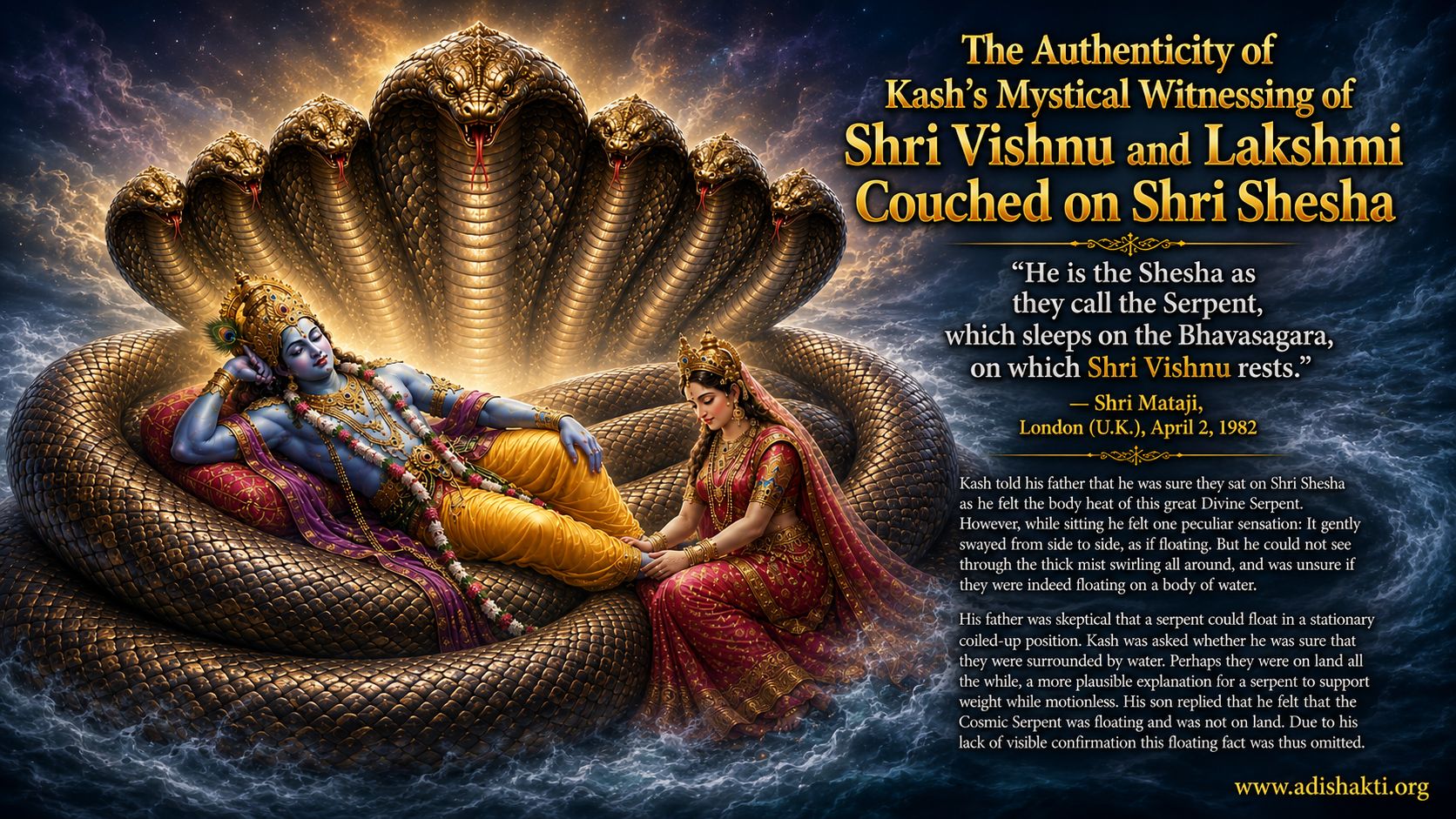
The Authenticity of Kash’s Mystical Witnessing of Shri Vishnu and Lakshmi Couched on Shri Shesha
“Shri Padmanabha Sahodari Shri Nirmala Devi also took Kash to visit Shri Vishnu and Lakshmi as they couched on Shri Sesha, their Primordial Cosmic Serpent.
Kash told his father that he was sure they sat on Shri Shesha as he felt the body heat of this great Divine Serpent. However, while sitting he felt one peculiar sensation: It gently swayed from side to side, as if floating. But he could not see through the thick mist swirling all around, and was unsure if they were indeed floating on a body of water.
His father was skeptical that a serpent could float in a stationary coiled-up position. Kash was asked whether he was sure that they were surrounded by water. Perhaps they were on land all the while, a more plausible explanation for a serpent to support weight while motionless. His son replied that he felt that the Cosmic Serpent was floating and was not on land. Due to his lack of visible confirmation this floating fact was thus omitted.
More than a year later the searing Truth of a child's Inner Vision came streaming forth. As his father watched Ramayana — an epic mythical narration of ancient times — for the first time there appeared the glorious form of Shri Vishnu reclining on Shri Ananta in the vast Milky Ocean!1 Kash had indeed witnessed this Timeless Vedic Truth and his sensation of being afloat correct. The Spirit of the Living God, Shri Adhiparasakthi Shri Nirmala Devi, had indeed taken him to the Cosmic Causal Ocean where Shri Vishnu and Shri Lakshmi rested on the floating Shri Sankarsana — Shri Vishnu’s serpent bed!”
“He is the Shesha as they call the Serpent, which sleeps on the Bhavasagara, on which Shri Vishnu rests. The same Shesha had taken birth as Shri Lakshmana. Now for a western mind you see if you talk about snakes, they only know the Adam and Eve snake that's all. They don't understand anything, and they can't understand why people worship snakes . . .”
Shri Visnurupini Shri Nirmala Devi
Shri Rama's Birthday Puja, London, U.K. — April 2, 1982
Nearly two years later on October 29, 1995, at 10:45 a.m., Kash was again asked to describe Shri Shesha on whose coils he had sat together with Shri Mataji, Shri Vishnu, and Shri Lakshmi. His father wanted information on the number of heads. He again replied that there were 6 heads (see first fax) and that the middle head was larger than the rest. He was requested to state the number of smaller heads on either side, that is, whether two on left or right of middle head, and the remaining three on the either side. Kash realized that he had all the while not counted the larger middle head. He then told that Shri Shesha had seven heads, with three smaller heads on either side of the larger middle one.
1, These Ramayana videotapes were borrowed from the Gulati family of Toronto. This trivial information is given as another piece of evidence that would enable readers to understand the Divine Drama of the Great Primeval Mother. The entire Shri Adi Shakti: The Kingdom of God is a tight tapestry of interlocking incidents, people, places, and proof, crisscrossed by intertwining weaves of scriptural evidence and prophecies, all held firmly together from beginning to end with the unbreakable thread of Truth and Divine Predeterminations (Al-Qadar).
Shri Adi Shakti: The Kingdom of God
Jagbir Singh. 1999 p. 146
Abstract
An interdisciplinary academic study of Kash’s reported mystical encounter with Shri Vishnu and Shri Lakshmi upon Shri Shesha, examining sensory testimony, skepticism, delayed iconographic corroboration, Hindu cosmology, child mysticism, and the philosophy of religious experience.
This paper argues that the account is most defensible as a serious, coherent, and potentially sincere mystical testimony whose metaphysical interpretation remains open. Its strongest evidential feature is not mere agreement with Hindu iconography, but the recorded sequence of sensory perception, uncertainty, skepticism, omission, delayed recognition, and later clarification.
Keywords: Kash; Vishnu; Lakshmi; Shesha; Ananta; Kshira Sagara; child mysticism; darshan; religious testimony; phenomenology; memory; iconographic corroboration.
Introduction ¶ ↩ TOC
The Authenticity of Kash’s Mystical Witnessing of Shri Vishnu and Lakshmi Couched on Shri Shesha
The Claim and the Evidential Question ¶ ↩ TOC
This study examines a reported mystical journey in which Shri Mataji Nirmala Devi is said to have taken the child witness Kash into the presence of Shri Vishnu and Shri Lakshmi, who rested upon Shri Shesha in the Cosmic Causal or Milky Ocean. The central academic question is not whether Hindu iconography contains such a scene—it plainly does—but whether the structure and transmission of Kash’s testimony support its classification as a sincere and potentially veridical mystical experience. The report is unusually valuable because it preserves uncertainty, skepticism, omitted interpretation, delayed recognition, and later clarification rather than presenting an immediately polished revelation.
Three Levels of Authenticity ¶ ↩ TOC
Three questions must be separated. Documentary authenticity concerns whether the published narrative accurately preserves what Kash said and when he said it. Phenomenological authenticity concerns whether the experience bears recognizable marks of a serious mystical state: sensory vividness, passivity, noetic force, coherence, and bounded return. Metaphysical authenticity asks whether Kash actually encountered Shri Vishnu, Shri Lakshmi, and Shri Shesha in an objective spiritual realm. The first two questions are open to historical and phenomenological analysis; the third remains a philosophical and theological judgment.
Method and Sources ¶ ↩ TOC
The paper treats the supplied account from Shri Adi Shakti: The Kingdom of God as its primary testimony and distinguishes that source from later interpretive commentary. It uses comparative theology, textual criticism, Hindu iconography, phenomenology of religion, psychology of memory, and philosophy of testimony. The New Encyclopaedia Britannica and Heinrich Zimmer are cited because they document the established cultural form of Vishnu reclining on Shesha upon the cosmic ocean, but such correspondence is treated as contextual corroboration rather than automatic proof of supernatural perception.
Chapter One ¶ ↩ TOC
The Primary Testimony and Its Transmission
1.1 The Reported Encounter ¶ ↩ TOC
The core report contains a simple sequence: Shri Mataji took Kash to Shri Vishnu and Shri Lakshmi; all sat upon the coils of Shri Shesha; Kash felt the serpent’s body heat; the support swayed gently from side to side; thick mist prevented visual confirmation of surrounding water; and Kash nevertheless felt that the serpent was floating rather than resting on land. These sensory claims are more evidentially significant than the later theological declarations because they constitute the report’s experiential core.
1.2 Publication and Attribution ¶ ↩ TOC
The narrative was published in 1999 in Shri Adi Shakti: The Kingdom of God. The precise date of the original experience is not stated in the supplied passage, while a later follow-up is dated October 29, 1995 at 10:45 a.m. This creates a source-critical need for the earliest notes, faxes, or witnesses. The published text combines reported speech, retrospective interpretation, and devotional titles; a scholarly edition should identify these layers rather than attributing every phrase to the child witness.
1.3 The Role of the Father ¶ ↩ TOC
Kash’s father is not merely the recorder but an active interlocutor. He questions whether a coiled serpent could float, proposes land as a more plausible alternative, asks for certainty regarding water, and omits the floating inference because Kash lacked visual confirmation. This skeptical intervention is important. It shows that the testimony was not accepted uncritically at the point of narration, although the father’s later theological interpretation also shapes the final published form.
1.4 The Importance of Omission ¶ ↩ TOC
The decision to omit the floating claim because it could not be visually confirmed is one of the strongest internal marks of testimonial restraint. It records a distinction between sensation and sight. Kash did not claim to see an ocean through the mist; he reported a swaying motion and inferred flotation. Such differentiation resembles ordinary eyewitness reasoning more closely than fully elaborated visionary certainty.
Chapter Two ¶ ↩ TOC
Shri Vishnu, Shri Lakshmi, and Shri Shesha in Hindu Cosmology
2.1 Vishnu on the Cosmic Ocean ¶ ↩ TOC
Hindu cosmological and iconographic traditions frequently portray Vishnu reclining upon Ananta or Shesha on the Kshira Sagara, the Ocean of Milk. The image locates divine preservation within primordial waters from which the manifest cosmos emerges. It is therefore not a marginal motif but one of the most recognizable visual and theological configurations of Vaishnava tradition.
2.2 Lakshmi and the Divine Pair ¶ ↩ TOC
Lakshmi’s presence beside Vishnu expresses the inseparability of sustaining consciousness and divine power, abundance, order, and grace. The reported scene is relational rather than solitary: Vishnu, Lakshmi, Shri Mataji, Kash, and Shesha form a living assembly. This differs from merely seeing a devotional picture because Kash reports tactile and vestibular sensations while seated within the scene.
2.3 Shesha, Ananta, and Sankarshana ¶ ↩ TOC
Shesha is also called Ananta, the Endless One, and in Vaishnava theological traditions may be identified with Sankarshana. The serpent serves simultaneously as couch, support, cosmic residue, time, and the stable foundation of worlds. Traditional texts may describe innumerable or thousand heads, while artistic representations frequently reduce the number to five, seven, or another manageable symbolic form.
2.4 The Ocean as Causal Reality ¶ ↩ TOC
The Milky or Causal Ocean should not be reduced to an astronomical sea. In Hindu cosmology it functions as a symbolic-metaphysical domain of latent creation, divine repose, and cosmic recurrence. Therefore the question of whether a physical snake can float while coiled does not directly address the tradition’s own category of claim. The narrative concerns a spiritual cosmology, not ordinary zoology.
“Visnu ... is represented in Hindu myth as the Milky Ocean of Immortal Life ... Meanwhile, in anthropomorphic form, Visnu is pictured as recumbent on this serpent.”
Chapter Three ¶ ↩ TOC
Sensory Structure of the Experience
3.1 Body Heat ¶ ↩ TOC
Kash’s report that he felt Shri Shesha’s body heat introduces a tactile element rarely emphasized in abstract mystical discourse. Tactile sensations can occur in vivid dreams, meditative absorption, neurological states, or putative spiritual perception. Their evidential value lies not in proving the object but in showing that the experience was embodied and multimodal rather than a flat visual fantasy.
3.2 Gentle Swaying ¶ ↩ TOC
The gentle side-to-side movement is the decisive sensory datum. Kash did not begin with the doctrinal statement that Shesha floats on the cosmic ocean; he described a bodily sensation of unstable yet supported motion. Vestibular phenomena are common in altered states, but here the motion later became meaningful when compared with the traditional setting of Shesha upon cosmic waters.
3.3 Thick Mist and Limited Vision ¶ ↩ TOC
The mist establishes a limit. Kash could not see through it and therefore could not visually verify water. This limitation matters because visionary fabrication often supplies complete scenery. The report instead preserves partial perception: touch and motion were available, visual confirmation was not. Such asymmetry is phenomenologically plausible.
3.4 Multisensory Coherence ¶ ↩ TOC
Heat, pressure, movement, mist, bodily placement, and the presence of named divine figures form a coherent sensory field. Multisensory coherence may strengthen confidence that Kash underwent a vivid state, although it cannot determine whether that state was internally generated or externally disclosed. The proper conclusion is experiential richness, not metaphysical proof.
Chapter Four ¶ ↩ TOC
Uncertainty as a Mark of Testimonial Restraint
4.1 'I Felt' Rather Than 'I Saw' ¶ ↩ TOC
The language of feeling rather than seeing is epistemically significant. Kash distinguishes direct visual perception from bodily inference. He reportedly remained confident that the serpent floated, but acknowledged uncertainty about the surrounding water because mist prevented sight. This is a more nuanced claim than an unqualified declaration.
4.2 Why Uncertainty Matters ¶ ↩ TOC
Sincere witnesses often preserve uncertainty at the margins of perception. Deliberate legendary expansion tends to eliminate ambiguity and supply doctrinally expected details. The presence of unresolved uncertainty therefore weighs modestly in favor of testimonial sincerity, provided that it belongs to the earliest account and was not introduced retrospectively for apologetic effect.
4.3 The Father's Alternative Hypothesis ¶ ↩ TOC
The father proposes a land-based explanation. This is a rudimentary but genuine alternative hypothesis: perhaps the support was stable ground and the swaying sensation misleading. By recording this challenge, the narrative presents a miniature process of critical inquiry rather than immediate devotional assent.
4.4 Limits of the Argument ¶ ↩ TOC
Uncertainty does not prove revelation. A creative narrator may include doubt for realism, and ordinary altered states may contain incomplete sensory information. Its evidential force is cumulative and depends on early documentation. Nonetheless, it is a feature that any adequate explanation must address.
Chapter Five ¶ ↩ TOC
Delayed Recognition Through the Ramayana
5.1 The Later Viewing ¶ ↩ TOC
More than a year later, Kash’s father reportedly viewed borrowed Ramayana videotapes and for the first time saw Vishnu reclining upon Ananta in the Milky Ocean. The image appeared to resolve the earlier question: Kash’s sensation of floating matched a traditional cosmological setting that the father had not supplied during the original questioning.
5.2 Corroboration or Recognition? ¶ ↩ TOC
Academically, this event is best described as delayed iconographic recognition rather than independent proof. The Ramayana image corroborates that Kash’s account corresponds to an established tradition; it does not independently demonstrate that he visited the cosmic ocean. The evidential question is whether Kash knew the motif before the report and whether the original wording was recorded before the later viewing.
5.3 The Gulati Videotapes ¶ ↩ TOC
The note that the videotapes were borrowed from the Gulati family of Toronto functions as a provenance marker. Such mundane details can make a narrative historically testable. Names, dates, loan circumstances, and surviving witnesses could help establish chronology and determine whether the viewing genuinely followed the initial report.
5.4 Coincidence, Cultural Memory, or Synchronicity ¶ ↩ TOC
Three interpretations remain available. The correspondence may reflect forgotten prior exposure; it may be an ordinary coincidence within a Hindu cultural environment; or it may be interpreted religiously as providential synchronicity or divine predetermination. Scholarship can document the sequence but cannot adjudicate providence by historical method alone.
Chapter Six ¶ ↩ TOC
The Seven-Headed Shesha and Memory Clarification
6.1 The 1995 Re-questioning ¶ ↩ TOC
On October 29, 1995, Kash was asked again about the number of Shesha’s heads. He initially repeated the number six while also describing a larger central head. When asked to distribute the smaller heads on each side, he recognized that the larger central head had not been included in his count and revised the total to seven.
6.2 Error Correction Rather Than Simple Accuracy ¶ ↩ TOC
The value of this episode is not that Kash instantly produced the expected number seven. Instead, it records a counting error, clarification, and correction. This process resembles retrieval of a spatial image: three smaller heads on each side plus one larger central head. The imperfection may support sincerity more than a perfectly rehearsed answer would.
6.3 Iconography and Variable Head Counts ¶ ↩ TOC
Traditional Shesha is described as innumerable- or thousand-headed, while visual art often depicts a limited hood canopy. Seven-headed representations are common, but not exclusive. Therefore correspondence with seven-headed iconography is relevant but should not be exaggerated into a uniquely identifying fact.
6.4 Memory After Delay ¶ ↩ TOC
Memory after nearly two years is reconstructive. Re-questioning can sharpen, distort, or reorganize an image. The later answer should therefore be assessed alongside the earliest fax or note mentioned in the source. Without that document, the stability of the original description cannot be independently measured.
Chapter Seven ¶ ↩ TOC
Child Mysticism and Prior Knowledge
7.1 The Child Witness ¶ ↩ TOC
Children may report religious experiences with concrete sensory detail and limited doctrinal interpretation. Their relative innocence can reduce strategic theological construction, but children are also highly suggestible and absorb visual culture without explicit memory. Age alone neither guarantees purity nor invalidates testimony.
7.2 The Prior-Knowledge Problem ¶ ↩ TOC
The strongest authenticity argument requires evidence that Kash had not previously seen Vishnu on Shesha or learned that the serpent rested on cosmic waters. The source asserts surprise and delayed recognition primarily on the father’s side. A rigorous study must ask separately what Kash had encountered through books, temples, television, conversation, or community teaching.
7.3 Implicit Memory ¶ ↩ TOC
Information can influence imagination even when explicit recall is absent. A child might have seen iconography earlier and later experience it as novel. This naturalistic possibility must be acknowledged. Conversely, invoking implicit memory without evidence is also speculative. The appropriate conclusion is conditional.
7.4 Open Interviewing ¶ ↩ TOC
Future interviews should avoid supplying expected imagery. Questions should begin with free recall: 'Describe where you were,' 'What did you feel beneath you?' and 'How were the heads arranged?' Leading questions about oceans, seven heads, or traditional iconography would reduce evidential value.
Chapter Eight ¶ ↩ TOC
Darshan, Sakshatkara, and Mystical Participation
8.1 Beyond Viewing ¶ ↩ TOC
In Hindu religious life, darshan involves seeing and being seen by the divine. Kash’s report goes further: he is not merely an observer before an image but a participant seated upon Shesha with the divine figures. The experience therefore resembles visionary participation or sakshatkara—direct realization—more than ordinary devotional viewing.
8.2 The Role of Shri Mataji ¶ ↩ TOC
Shri Mataji is presented as the guide who grants access to the divine realm. Within the narrative’s theology she is Padmanabha-Sahodari, Adhiparasakthi, and Spirit of the Living God. Academic analysis can document this role and compare it with traditions of divine mediation without assuming the ontological identity claimed by devotees.
8.3 Presence and Reciprocity ¶ ↩ TOC
The encounter is relational: the divine beings are not static symbols but persons whose presence can be entered. This sense of reciprocity is common in mystical testimony and contributes to noetic force. Yet the report provided here emphasizes the support and setting more than dialogue, which gives unusual weight to bodily sensation.
8.4 Myth as Lived Reality ¶ ↩ TOC
For believers, the experience transforms mythological imagery into encountered reality. Religious-studies scholarship uses 'myth' to denote sacred narrative, not falsehood. The key question is whether Kash’s experience should be understood as imaginative participation in a cultural myth, perception of an objective sacred reality, or both.
Chapter Nine ¶ ↩ TOC
Serpent Symbolism Across Religious Worlds
9.1 Shesha and the Positive Serpent ¶ ↩ TOC
In the Vaishnava context, Shesha signifies endurance, infinity, support, cosmic time, and divine service. The serpent is not an adversary but the living couch of Vishnu and, in some traditions, a manifestation intimately related to the deity himself.
9.2 The Biblical Serpent Contrast ¶ ↩ TOC
Shri Mataji’s 1982 remark contrasts the Western association of the serpent with Adam and Eve against Hindu veneration of sacred serpents. The contrast identifies a genuine difference in dominant symbolism, though biblical traditions also contain more complex serpent imagery, including healing, wisdom, danger, and chaos.
“He is the Shesha as they call the Serpent, which sleeps on the Bhavasagara, on which Shri Vishnu rests.”
9.3 Cultural Translation ¶ ↩ TOC
A Western reader may interpret a serpent bed as grotesque or threatening, while a Hindu reader sees cosmic protection and eternity. The report therefore requires cultural translation. Authenticity cannot be judged by whether the image conforms to one tradition’s symbolic expectations.
9.4 Symbol and Ontology ¶ ↩ TOC
Shesha may be read symbolically as infinite time, cosmic remainder, life-substance, or the foundation of manifestation. The testimony, however, describes a being with heat, coils, motion, and heads. It thus resists reduction to abstract symbolism and claims personal encounter with the symbol’s ontological referent.
Chapter Ten ¶ ↩ TOC
Psychological and Naturalistic Interpretations
10.1 Meditative Imagery ¶ ↩ TOC
Deep meditation can generate vivid imagery, altered body boundaries, sensations of movement, and perceived presence. A naturalistic account may therefore explain heat and swaying as internally generated bodily phenomena organized by cultural imagery.
10.2 Vestibular Experience ¶ ↩ TOC
Floating, rocking, rising, and spinning sensations can occur when normal sensory integration changes. The swaying may reflect vestibular activity rather than an external ocean. This hypothesis explains the bodily feeling but not by itself the later thematic correspondence.
10.3 Narrative Reconstruction ¶ ↩ TOC
Repeated retelling may transform a simple sensation into a developed cosmological narrative. Adult interpretation, devotional titles, and later iconographic recognition could have organized the memory. The published text’s literary polish makes source separation essential.
10.4 Why Reduction Is Not Demonstration ¶ ↩ TOC
Identifying plausible psychological mechanisms does not prove that the experience lacked transcendent reference. A brain state accompanies every experience, including ordinary perception. Naturalistic hypotheses are necessary alternatives, but their adequacy depends upon documentary evidence, prior exposure, and explanatory scope.
Chapter Eleven ¶ ↩ TOC
Philosophy of Testimony and Corroboration
11.1 Testimony as Evidence ¶ ↩ TOC
Most human knowledge depends upon testimony. Mystical testimony is not disqualified merely because its object is extraordinary, but the required evidential support rises with the claim’s improbability. Honesty, opportunity, early recording, consistency, independence, and absence of motive all matter.
11.2 The Principle of Credulity ¶ ↩ TOC
A witness may be prima facie justified in trusting an experience that appears clear and coherent unless defeaters are present. Kash may therefore have been rational in believing he sat upon Shesha. Readers, however, possess only mediated testimony and must evaluate additional layers of transmission.
11.3 Corroboration by Tradition ¶ ↩ TOC
Agreement with Hindu iconography increases cultural and theological coherence. It is strongest when the matching details were unknown and recorded beforehand. It is weakest when the tradition was already familiar or the record was composed after recognition. The chronology is therefore decisive.
11.4 Cumulative Rather Than Conclusive Evidence ¶ ↩ TOC
No single feature proves the experience: not body heat, swaying, mist, seven heads, nor the Ramayana viewing. Their evidential significance lies in convergence. A cumulative argument can make sincere mystical experience more plausible without compelling the conclusion of literal cosmic travel.
Chapter Twelve ¶ ↩ TOC
A Cumulative Evaluation of Authenticity
12.1 Factors Supporting Sincerity ¶ ↩ TOC
The account preserves uncertainty, records paternal skepticism, distinguishes feeling from sight, omits an unconfirmed inference, includes a later correction rather than perfect recall, and centers no obvious personal reward. These features weigh against a simplistic fraud hypothesis.
12.2 Factors Requiring Caution ¶ ↩ TOC
The experience was transmitted through an invested parent, published retrospectively, embedded in a devotional cosmology, and linked to traditional imagery that may have been culturally available. The earliest fax and independent witness testimony are not supplied here. These limitations prevent strong historical conclusions.
12.3 Authenticity Matrix ¶ ↩ TOC
The testimony is strongest as evidence of a vivid and coherent mystical experience; moderately suggestive regarding sincerity and stable memory; potentially interesting as a case of delayed iconographic correspondence; and insufficient by itself to establish objective metaphysical travel. Such graded judgment is more defensible than either total dismissal or absolute proof.
| Criterion | Assessment | Limitation |
|---|---|---|
| Sensory vividness | Strong | Compatible with altered-state imagery |
| Epistemic restraint | Strong within narrative | Earliest wording must be verified |
| Delayed iconographic correspondence | Suggestive | Prior exposure remains unresolved |
| Seven-head clarification | Moderately interesting | Iconography is variable; memory is reconstructive |
| Documentary provenance | Incomplete | Original fax and contemporaneous notes unavailable here |
| Metaphysical verification | Open | Not publicly demonstrable by the narrative alone |
12.4 What Further Evidence Would Matter ¶ ↩ TOC
The most valuable evidence would be the first contemporaneous account, the referenced fax, testimony from those who heard the report before the Ramayana viewing, documentation from the Gulati family concerning the tapes, and an open-ended adult interview with Kash. These could clarify chronology, prior knowledge, and stability.
Chapter Thirteen ¶ ↩ TOC
Conclusion: Mystical Testimony Between Vision and Verification
13.1 What the Account Can Establish ¶ ↩ TOC
The supplied material establishes that a detailed narrative is attributed to Kash and that its central sensations correspond coherently with the established image of Vishnu and Lakshmi upon Shesha in the cosmic ocean. It also preserves a notable internal process of doubt and later interpretation.
13.2 What It Cannot Establish Alone ¶ ↩ TOC
The narrative cannot independently prove that Kash entered an objective cosmic realm, that Shri Mataji transported him there, or that Hindu cosmology has been empirically verified. Those are theological and metaphysical conclusions extending beyond the public evidence.
13.3 The Strongest Academic Formulation ¶ ↩ TOC
The strongest defensible thesis is that Kash’s account exhibits several characteristics associated with sincere mystical testimony: multimodal vividness, limited perception, epistemic restraint, coherence, delayed correspondence with traditional iconography, and later effort at clarification. These features justify serious study while leaving the metaphysical interpretation open.
13.4 Final Conclusion ¶ ↩ TOC
The enduring significance of the testimony lies in its movement from sensation to question, from skepticism to recognition, and from mythic image to claimed lived encounter. Whether read as objective revelation, culturally mediated mystical perception, or psychologically generated visionary participation, the account is richer than a simple tale of a floating serpent. It is a case study in how religious experience is remembered, challenged, corroborated, and transformed into a claim about the reality behind sacred imagery.
Appendix A ¶ ↩ TOC
Primary Source and Source-Critical Notes
A.1 Core Primary Testimony ¶ ↩ TOC
The primary narrative reports that Shri Mataji took Kash to visit Shri Vishnu and Shri Lakshmi upon Shri Shesha. Kash felt the serpent’s heat and a gentle swaying motion but could not see water through thick mist. His father questioned the floating interpretation and omitted it because visual confirmation was absent. More than a year later, a Ramayana depiction of Vishnu upon Ananta in the Milky Ocean was interpreted as confirming the earlier sensation.
A.2 Later Head-Count Clarification ¶ ↩ TOC
On October 29, 1995 at 10:45 a.m., Kash again described the serpent. He first said six heads and a larger middle head; when asked how the smaller heads were distributed, he recognized that he had excluded the central head from the count and stated a total of seven, with three smaller heads on each side.
A.3 Editorial Layers ¶ ↩ TOC
The published passage combines observation, questions, retrospective validation, theological titles, and the doctrine of divine predetermination. These layers should be cited separately in academic work. The sensory report carries a different evidential status from the conclusion that the experience proves the Spirit of the Living God transported Kash to the Causal Ocean.
A.4 Recommended Citation ¶ ↩ TOC
Jagbir Singh [published under the name Pariah Kutta], Shri Adi Shakti: The Kingdom of God (1999), p. 146, as reproduced and contextualized in the supplied source materials. Page and authorship should be checked against the physical edition before formal publication.
Bibliography ¶ ↩ TOC
Selected Sources
B.1 Primary and Traditional Sources ¶ ↩ TOC
Bhagavata Purana, especially traditions concerning Ananta-Shesha and the cosmic waters; Vishnu Purana; Ramayana traditions concerning Lakshmana and Shesha; Shri Mataji Nirmala Devi, Shri Rama’s Birthday Puja, London, April 2, 1982; Jagbir Singh [Pariah Kutta], Shri Adi Shakti: The Kingdom of God, 1999.
B.2 Reference and Comparative Works ¶ ↩ TOC
The New Encyclopaedia Britannica, 1992, entry discussing Vishnu’s iconographic forms; Heinrich Zimmer, Philosophies of India, Princeton University Press, 1974, especially p. 164; William James, The Varieties of Religious Experience; William P. Alston, Perceiving God; Richard Swinburne, The Existence of God; works on Hindu iconography, child mysticism, memory, and the phenomenology of religion.
💬 Interactive Chat
Access an intelligent analysis environment where you can explore texts, ask questions, and discover connections between ideas.
Open chat →