

A Comprehensive Comparison of Religions and Gurus
— A convergence of scriptural, mystical, and experiential traditions
Summary
This article offers a broad and systematic comparison of nearly 50 religions, gurus, spiritual movements, and philosophical systems from around the world. Using a consistent 10-point evaluative framework — Source of Revelation, Depth of Scriptural Integration, Universality & Interfaith Reach, Spiritual Experience Focus, Fearlessness in Proclamation, Devotee Involvement & Community, Integration of the Sacred Feminine or Balance of Divine Aspects, Clarity on Self-Realization, Mystical Revelation, and Theological Boldness — it allows readers to explore the strengths and focus areas of various traditions. The framework is organized into categories including 'By Gurus and Teachers,' 'By Religions and Traditions,' and 'Modern / Esoteric Movements.' The article also includes a detailed section on the Adi Shakti tradition, tracing its roots in Hinduism (Adi Shakti as Primordial Power), Christianity and Judaism (Ruach and Shekinah as feminine divine presence), and Gnostic traditions (Sophia as eternal Wisdom). It highlights the tradition's relevance to contemporary eschatology, its insistence on experiential verification through Kundalini awakening, and its role in fostering interreligious dialogue.
Table of Contents
- The 10 Criteria for Spiritual Comparison
- A Matrix of Traditions
- The Adi Shakti Tradition
- Historical and Scriptural Origins
- Integration Across Traditions
- Relevance to Contemporary Eschatology
- Experiential Verification and Inclusive Practice
- Situating the Sources within Academic Discourse
- The Global Impact and Continuing Evolution
- Conclusion
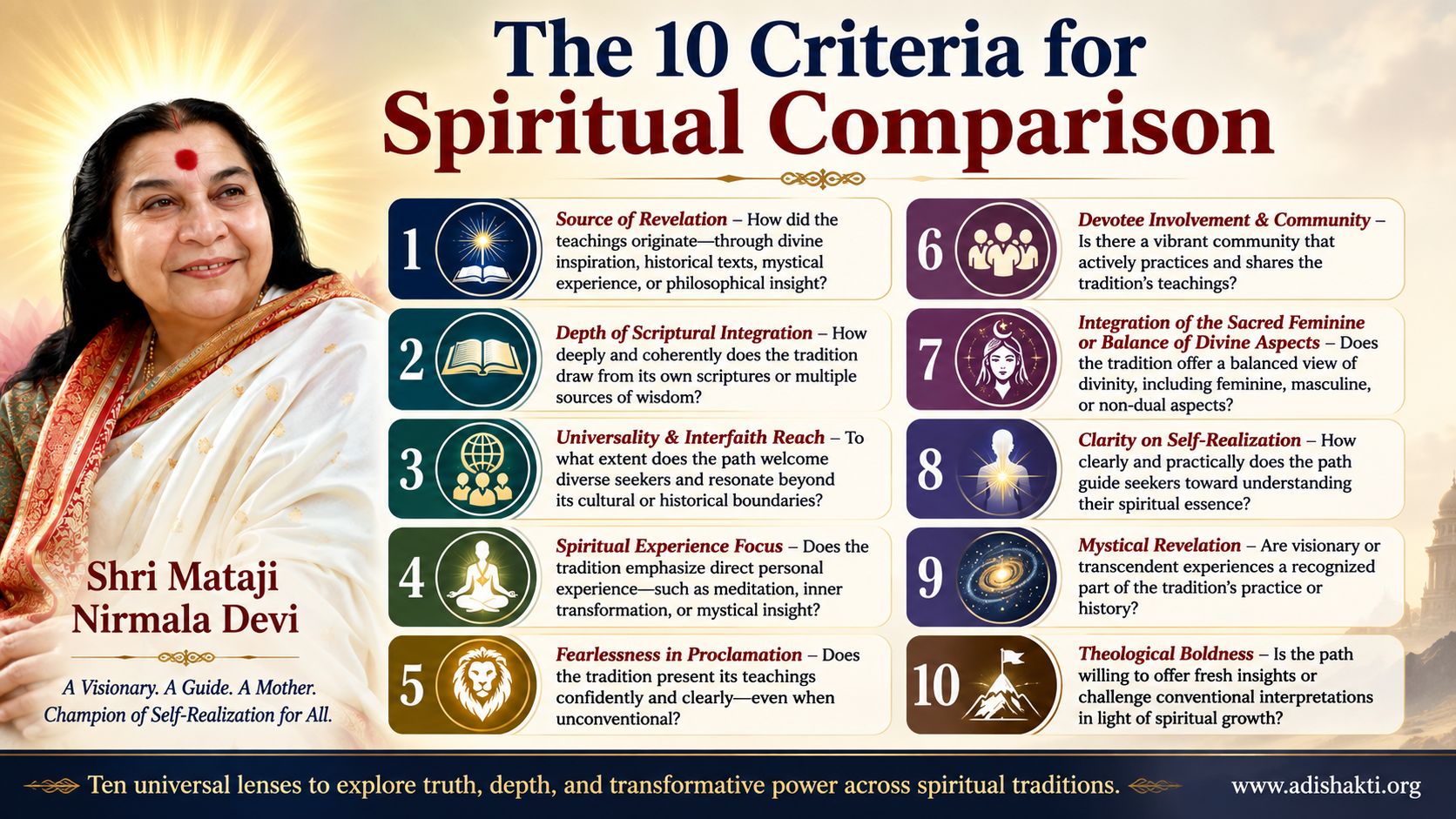
The 10 Criteria for Spiritual Comparison
Each spiritual tradition, guru, or organization is evaluated using the same 10 key criteria, allowing for a fair and informed comparison. These points are not meant to rank traditions competitively, but rather to highlight distinct qualities and approaches to spiritual growth.
- Source of Revelation – How did the teachings originate—through divine inspiration, historical texts, mystical experience, or philosophical insight?
- Depth of Scriptural Integration – How deeply and coherently does the tradition draw from its own scriptures or multiple sources of wisdom?
- Universality & Interfaith Reach – To what extent does the path welcome diverse seekers and resonate beyond its cultural or historical boundaries?
- Spiritual Experience Focus – Does the tradition emphasize direct personal experience—such as meditation, inner transformation, or mystical insight?
- Fearlessness in Proclamation – Does the tradition present its teachings confidently and clearly—even when unconventional?
- Devotee Involvement & Community – Is there a vibrant community that actively practices and shares the tradition’s teachings?
- Integration of the Sacred Feminine or Balance of Divine Aspects – Does the tradition offer a balanced view of divinity, including feminine, masculine, or non-dual aspects?
- Clarity on Self-Realization – How clearly and practically does the path guide seekers toward understanding their spiritual essence?
- Mystical Revelation – Are visionary or transcendent experiences a recognized part of the tradition’s practice or history?
- Theological Boldness – Is the path willing to offer fresh insights or challenge conventional interpretations in light of spiritual growth?
A Matrix of Traditions
This comparative framework organizes paths into the following categories, providing a structured approach to exploring the vast landscape of human spirituality:
1. By Gurus and Teachers
- Global Gurus
- Amma
- Sadhguru (Isha)
- Yogananda
- Mooji
- Ram Dass
- Yogi Bhajan
- Osho
- Eckhart Tolle
- Deepak Chopra
- Sri Sri Ravi Shankar
- Brahma Kumaris
- Thích Nhất Hạnh
2. By Religions and Traditions
- World Religions
- Christianity
- Catholicism
- Pentecostal Christianity
- Protestantism
- Eastern Orthodox
- Islam
- Judaism
- Hinduism
- Sikhism
- Sufism
- Buddhism
- Jainism
- Mormonism
- Shaktism
- Native American Religions
3. Modern / Esoteric Movements
- Theosophy / Anthroposophy
- Integral Theory
- Gnosticism
- Gaia-based Spirituality
- Human Design / Astrology
- Channeling Movements
- Psychedelic Spirituality
- AI / Technospirituality
- Scientific Consciousness / Panpsychism
- Liberation Theology
- Sahaja Yoga
4. Prophecies and Revelations
- Kalki Avatar
- Mahdi
- Al-Qiyamah & An-Naba
- Resurrection Theology
- Birth of Israel & Messiah
- Prajnaparamita
5. Other
https://chatgpt.com/c/685b57ac-6c5c-8002-b360-c8c761b1c33aHistorical and Scriptural Origins
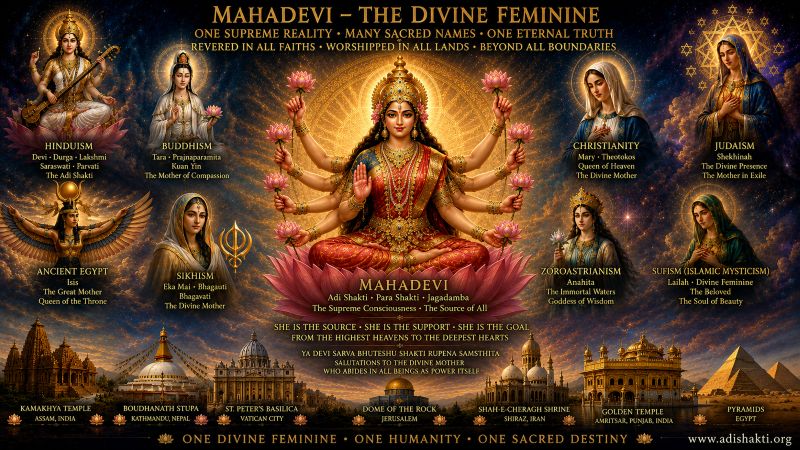
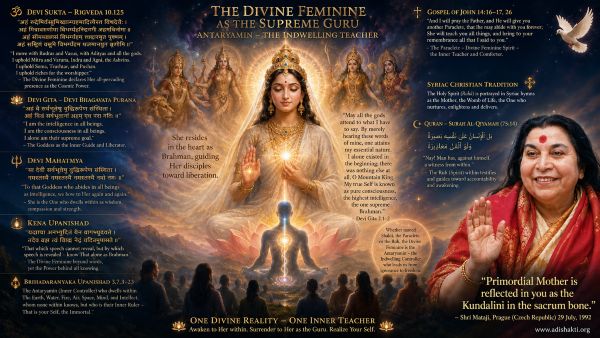
The Adi Shakti tradition draws from a profound tapestry of religious and philosophical literature across Hinduism, Christianity, and Judaism. “Adi Shakti,” literally the “Primordial Power,” is rooted in ancient Indian understandings of the feminine principle as the source of all creation, exemplified in figures such as MahaDevi and various goddesses throughout the Vedas, Upanishads, and Puranas.
Parallel currents are found in Judeo-Christian sources. The Hebrew idea of “Ruach” (Spirit) and “Shekinah” (Divine Presence) carry feminine grammatical gender and were understood by early mystics to denote the nurturing, indwelling, and redemptive energy of God.
Integration Across Traditions
The Adi Shakti sources position themselves at the nexus of religious pluralism, harmonizing concepts from Eastern and Western mysticism:
- Hinduism: Adi Shakti is revered as the source from which Shiva and Vishnu derive power.
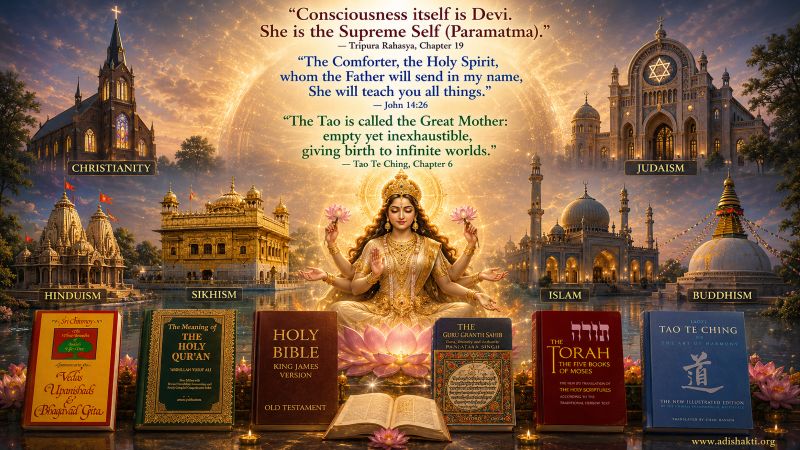
- Christianity & Judaism: She is recognized as the feminine face of God—the Holy Spirit or Shekinah.
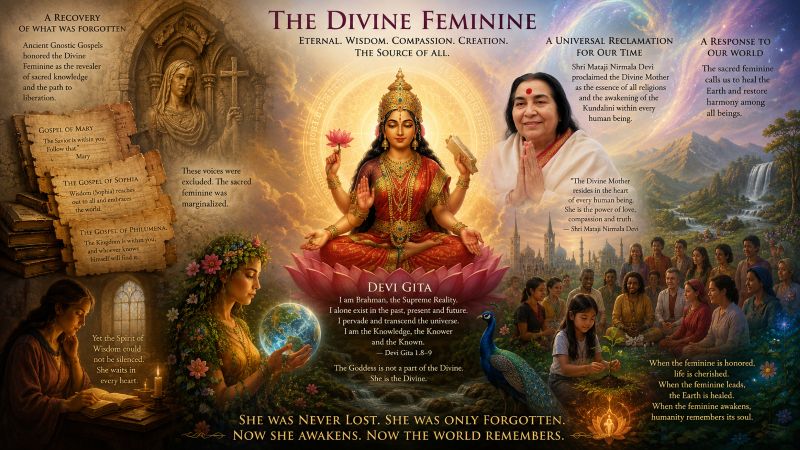
- Gnostic & Esoteric Traditions: The Divine Mother appears as Sophia, the eternal Wisdom.
Relevance to Contemporary Eschatology
The Adi Shakti tradition's sources are especially relevant to modern eschatological thought. Ancient expectations of a messianic age—whether in the form of the return of Christ, the arrival of the Mahdi in Islam, the coming of Kalki in the Hindu tradition, or the birth of a new Israel—are reframed as contiguous and mutually illuminating events, not as competitive or mutually exclusive prophecies. Shri Mataji's teachings point to a realization that the era in which spiritual transformation and divine testimony manifest most powerfully is now, and it is universally accessible.
The Aquarian Age, according to these sources, is characterized by unprecedented advances in spiritual consciousness, collective harmony, and new understandings of interconnectedness. Technologies and social changes are interpreted as outer signs of a much deeper inner renaissance—the ongoing birth of the kingdom of God within humanity, facilitated by the outpouring of the Divine Feminine and testified by direct spiritual experience.
Experiential Verification and Inclusive Practice

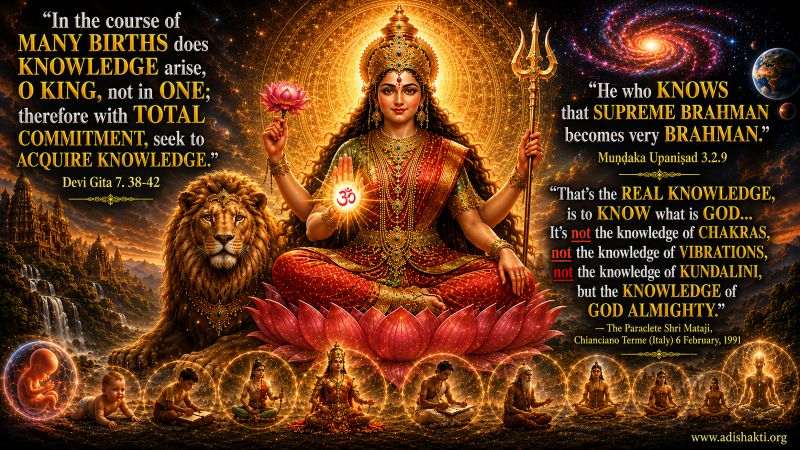
A distinctive hallmark of the Adi Shakti sources, as presented by Shri Mataji, is the insistence upon experiential verification. Unlike traditions that depend solely on faith, external ritual, or intellectual assent, Sahaja Yoga and the Adi Shakti path invite practitioners to test spiritual truths firsthand. The awakening of the Kundalini is marked not by subjective emotion but by objective physiological changes: cool or warm vibrations, relief of bodily and psychological disorders, and the establishment of thoughtless awareness (samadhi).[2]
This insistence on lived experience underpins Shri Mataji's critique of religious formalism and dogma, urging seekers to move beyond inherited belief systems toward a universal gnosis. In this light, the Adi Shakti tradition fosters interreligious dialogue, mutual respect, and collective spiritual growth. People from all backgrounds are welcomed, and the process of Self-realization is proclaimed to be open to all, free of charge and organizational barriers.
Situating the Sources within Academic and Interreligious Discourse

From an academic perspective, Adi Shakti sources offer rich material for the study of comparative religion, mysticism, pneumatology, and gendered understandings of the divine. They challenge prevailing narratives in theology that have marginalized the feminine, proposing a well-documented alternative based in both scriptural exegesis and spiritual practice.[3]
The sources engage in rigorous historical analysis, drawing on canonical and extra-canonical texts, linguistic studies (such as the feminine form of Ruach in Hebrew), and the historical evolution of mystical traditions across continents. They also contribute meaningfully to ongoing discussions about the role of living revelation, the intersection of religion and science, and the democratization of divine grace.
The Global Impact and Continuing Evolution

Since their initial emergence, Adi Shakti sources—distributed through websites, academic papers, lectures, and Sahaja Yoga centers—have impacted thousands worldwide. The flowering of Sahaja Yoga as an international movement parallels the growing academic and popular interest in feminine divinity, collective consciousness, and global eschatological themes.
Shri Mataji's message and the Adi Shakti tradition persist as a dynamic force, inviting seekers, scholars, and communities to participate in what may be the most consequential spiritual renaissance in recent history. The tradition's focus on inclusivity, experiential truth, and the harmonization of religious differences situates the Adi Shakti sources as indispensable references for anyone investigating the future of religion, spirituality, and human development.
Conclusion
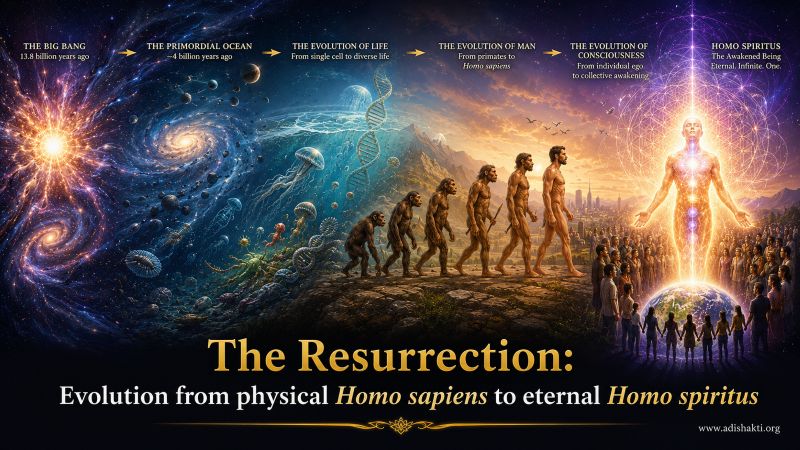
In summary, the Adi Shakti sources offer a transformative lens through which to view the evolution of humankind, divine revelation, and universal harmony. By situating themselves at the convergence of Eastern and Western mystical traditions, they present not only a model of spiritual fulfillment but also a roadmap for the realization of prophecy, inner peace, and collective enlightenment in the modern world. Their significance lies in their ability to communicate ancient truths in a contemporary idiom, to foster authentic spiritual experiences, and to catalyze the ongoing rebirth of sacred consciousness across the globe.
References
- [1] Manus AI. “Divine Feminine Consciousness: The Eternal, Living Presence of the Mother in All Traditions.” Adishakti.org, July 10, 2026.
- [2] Manus AI. “Chi, Prana, Holy Spirit and Other Terms for the Spirit Are All Salvific.” Adishakti.org, 2026.
- [3] Manus AI. “The Supremacy of the MahaDevi (Divine Mother) Across All Faiths.” Adishakti.org, July 17, 2026.