THE AUTHENTICITY SERIES | DOCUMENTARY HISTORY | CRITICAL INQUIRY
The Authenticity of Kash's Mystical Witnessing Contents of the First Fax
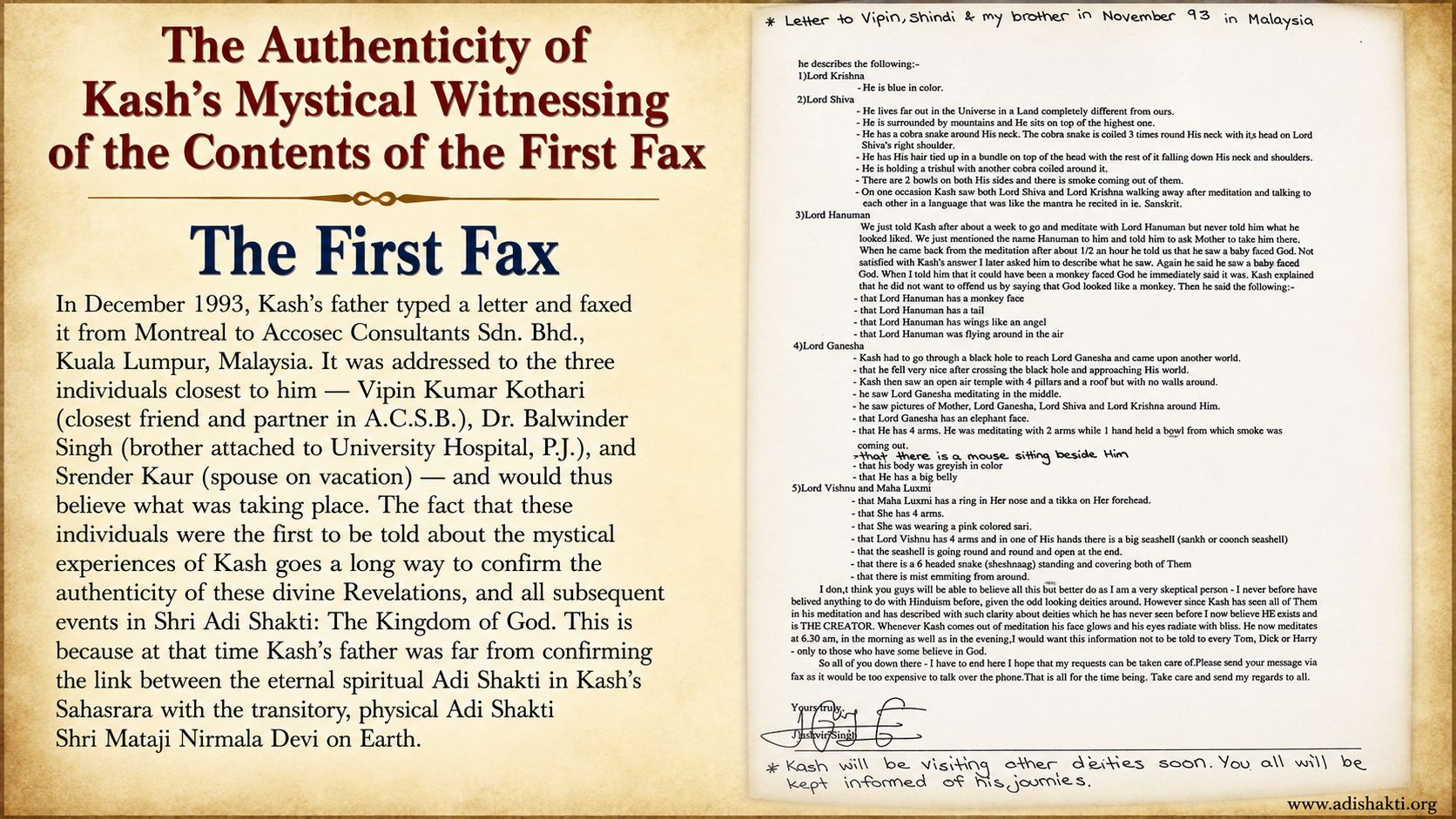

The First Fax
In December 1993, Kash's father typed a letter and faxed it from Montreal to Accosec Consultants Sdn. Bhd., Kuala Lumpur, Malaysia. It was addressed to the three individuals closest to him — Vipin Kumar Kothari (closest friend and partner in A.C.S.B.), Dr. Balwinder Singh (brother attached to University Hospital, P.J.), and Surender Kaur (spouse on vacation) — who would thus believe what was taking place.
The fact that these individuals were the first to be told about the mystical experiences of Kash goes a long way to confirm the authenticity of these divine Revelations, and all subsequent events in Shri Adi Shakti: The Kingdom of God. This is because at that time Kash's father was far from confirming the link between the eternal spiritual Adi Shakti in Kash's Sahasrara with the transitory, physical Adi Shakti Shri Mataji Nirmala Devi on Earth. It actually took him nearly one year to be 100% sure that these two personalities were one and the same. This delay was caused by his constant and meticulous cross-examinations, the slightest doubt triggering off a chain of questions.
This fax is irrefutable proof that neither Kash nor his father had any idea as to what was actually taking place on Earth. All subsequent events are like small pieces of the Divine Puzzle falling randomly into place, every bit exponentially expanding the perception of Reality. Eventually this Reality became too vast for the tiny brain to cope, the sheer massiveness crushing the ego into silence. That was the beginning of God-Realization!
Note: This is page 2 of the fax sent to Mr. Vipin Kumar at his firm Accosec Consultants Sdn. Bhd. K.L., Malaysia (fax no: 011603 2328 504).
he describes the following: —
1) Lord Krishna
- He is blue in color.
2) Lord Shiva
- He lives far out in the Universe in a Land completely different from ours.
- He is surrounded by mountains and He sits on the highest one.
- He has a cobra snake around His neck. The cobra snake is coiled 3 times round His neck, with its head on Lord Shiva's right shoulder.
- He has His hair tied up in a bundle on top of the head, with the rest of it falling down His neck and shoulders.
- He is holding a trishul, with another cobra coiled around it.
- There are 2 bowls on both His sides and there is smoke coming out of them.
- On one occasion Kash saw both Lord Shiva and Lord Krishna walking away after meditation and talking to each other in a language that was like the mantra he recited in — i.e., Sanskrit.
3) Lord Hanuman
We just told Kash after about a week to go and meditate with Lord Hanuman but never told him what he looked like. We just mentioned the name Hanuman to him and told him to ask Mother to take him there. When he came back from the meditation after about 1/2 an hour, he told us that he saw a baby-face God. Not satisfied with Kash's answer, I later asked him to describe what he saw. Again he said he saw a baby-face God. When I told him that it could have been a monkey-face God, he immediately said it was. Kash explained that he did not want to offend us by saying that God looked like a monkey.
Then he said the following:
- that Lord Hanuman has a monkey face.
- that Lord Hanuman has a tail.
- that Lord Hanuman has wings like an angel.
- that Lord Hanuman was flying around in the air.
4) Lord Ganesha
- Kash had to go through a black hole to reach Lord Ganesha and came upon another world.
- that he felt very nice after crossing the black hole and approaching His world.
- Kash then saw an open-air temple with 4 pillars and a roof, but with no walls around.
- he saw Lord Ganesha meditating in the middle.
- he saw pictures of Mother, Lord Ganesha, Lord Shiva and Lord Krishna around Him.
- that Lord Ganesha has an elephant face.
- that He has 4 arms. He was meditating with 2 arms while 1 hand held a bowl from which smoke was coming out.
- that there was a mouse sitting beside Him.
- that His body was greyish in colour.
- that He has a big belly.
5) Lord Vishnu and Mahalakshmi
- that Mahalakshmi has a ring in Her nose and a tikka on Her forehead.
- that She has 4 arms.
- that She was wearing a pink coloured sari.
- that Lord Vishnu has 4 arms and in one of His hands there is a big seashell (sankh or conch).
- that there is a 6 headed snake (Shri Shesha) standing and covering both of them.
- that there is mist emitting from around.
I don't think you guys will be able to believe all this, but better do, as I am a very skeptical person — I never before have believed anything to do with Hinduism before, given the odd looking deities around. However since Kash has seen all of them in his meditation and has described with such clarity about deities which he has never seen before, I now believe He exists and is the Creator. Whenever Kash comes out of meditation, his face glows and his eyes radiate with bliss. He now meditates at 6:30 a.m. in the morning as well in the evening. I would want this information not to be told to every Tom, Dick or Harry — only to those who have some belief in God.
So all of you down there — I have to end here. I hope my requests can be taken care of. Please send your message via fax as it would be too expensive to talk over the phone. That is all for the time being. Take care and send my regards to all.
Yours truly,
* Kash will be visiting other deities soon. You will all be kept informed of his journeys. (End of letter.)
Shri Adi Shakti: The Kingdom of God
Jagbir Singh. 1999 p. 143
Table of Contents
This publication examines the First Fax as a contemporaneous primary document, distinguishing the historical authenticity of the fax from the psychological, theological, and metaphysical interpretation of the experiences it records.
- Introduction
- Chapter One — Contemporary Documents and the Historical Method
- Chapter Two — The Provenance of the First Fax
- Chapter Three — The First Fax as Contemporaneous Testimony
- 3.1 Introduction
- 3.2 Recording the Experiences as They Occurred
- 3.3 Observation Rather Than Theology
- 3.4 The Importance of Spontaneous Description
- 3.5 Evidence of Ordinary Human Fallibility
- 3.6 The Absence of Narrative Embellishment
- 3.7 A Developing Investigation Rather Than a Finished Narrative
- 3.8 Preliminary Historical Assessment
- Chapter Four — The Criterion of Independent Ignorance
- 4.1 Introduction
- 4.2 A Document Written Before Conclusions Had Formed
- 4.3 The Absence of a Developed Theology
- 4.4 The Author's Own Admission of Uncertainty
- 4.5 The Importance of Progressive Discovery
- 4.6 Independent Ignorance and Historical Credibility
- 4.7 The Significance of Later Developments
- 4.8 Historical Implications
- Chapter Five — The Criterion of Embarrassment
- 5.1 Introduction
- 5.2 Ordinary Human Error in Contemporary Documents
- 5.3 The Hanuman “Wings” Clarification
- 5.4 The Description of Shri Shesha
- 5.5 Transparency Rather Than Harmonization
- 5.6 The Psychology of Fabrication Compared with Contemporary Observation
- 5.7 The Historical Value of Preserved Imperfections
- 5.8 Distinguishing Historical Authenticity from Metaphysical Truth
- 5.9 Preliminary Historical Assessment
- Chapter Six — The Skeptical Witness
- 6.1 Introduction
- 6.2 Admissions Against Interest in Historical Methodology
- 6.3 “I Am a Very Skeptical Person”
- 6.4 Previous Attitudes Toward Hindu Iconography
- 6.5 Observation Preceding Conviction
- 6.6 The Absence of Immediate Dogmatism
- 6.7 The Psychological Credibility of an Evolving Witness
- 6.8 Historical Implications
- 6.9 Preliminary Historical Assessment
- Chapter Seven — The Recipients as Historical Witnesses
- 7.1 Introduction
- 7.2 Why the Recipients Matter
- 7.3 Communication Before Publication
- 7.4 Confidential Rather Than Promotional
- 7.5 The Historical Significance of Named Individuals
- 7.6 Independent Corroboration and Its Limits
- 7.7 An Expanding Documentary Network
- 7.8 Historical Implications
- 7.9 Preliminary Historical Assessment
- Chapter Eight — The Evidential Value of Kash's Descriptions
- 8.1 Introduction
- 8.2 The Nature of the Reported Descriptions
- 8.3 Specificity and Historical Evaluation
- 8.4 Internal Consistency Across the Reported Experiences
- 8.5 Progressive Rather Than Exhaustive Description
- 8.6 Historical Caution Concerning Prior Knowledge
- 8.7 Cumulative Rather Than Isolated Evidence
- 8.8 Historical Implications
- 8.9 Preliminary Historical Assessment
- Chapter Nine — The Child Witness
- 9.1 Introduction
- 9.2 Children as Historical Witnesses
- 9.3 The Importance of Recording the Child's Own Words
- 9.4 Suggestibility and Leading Questions
- 9.5 Imagination and Religious Experience
- 9.6 Consistency Across Multiple Reported Experiences
- 9.7 The Child's Psychological Motivation
- 9.8 Historical Strengths and Historical Limits
- 9.9 Preliminary Historical Assessment
- Chapter Ten — Comparative Analysis of the Reported Descriptions
- Chapter Eleven — Alternative Explanations
- 11.1 Introduction
- 11.2 Hypothesis One: Deliberate Fabrication
- 11.3 Hypothesis Two: Retrospective Reconstruction
- 11.4 Hypothesis Three: Childhood Imagination
- 11.5 Hypothesis Four: Cultural Exposure
- 11.6 Hypothesis Five: Misinterpretation of Genuine Inner Experience
- 11.7 Hypothesis Six: Authentic Mystical Experience
- 11.8 Comparative Evaluation
- 11.9 Historical Implications
- Chapter Twelve — The Historical Significance of the First Fax
- 12.1 Introduction
- 12.2 The Earliest Surviving Documentary Record
- 12.3 Observation Before Systematization
- 12.4 The Beginning of a Documentary Continuum
- 12.5 A Documentary Benchmark
- 12.6 Historical Independence from Later Publications
- 12.7 The Historical Legacy of the First Fax
- 12.8 Historical Assessment
- 12.9 Concluding Reflection
- Chapter Thirteen — Overall Historical Synthesis
- 13.1 Introduction
- 13.2 The Convergence of Independent Historical Indicators
- 13.3 The Difference Between Authenticity and Interpretation
- 13.4 Historical Probability Rather Than Absolute Proof
- 13.5 The Significance of the Documentary Timeline
- 13.6 The Role of Ordinary Human Imperfection
- 13.7 What the Evidence Does Not Establish
- 13.8 What the Evidence Does Establish
- 13.9 The Historical Importance of Intellectual Restraint
- 13.10 Historical Synthesis
- Chapter Fourteen — Responding to Scholarly Objections
- 14.1 Introduction
- 14.2 The Author Had a Personal Interest
- 14.3 Children Possess Active Imaginations
- 14.4 The Descriptions Were Learned from Hindu Culture
- 14.5 The Evidence Cannot Be Independently Verified
- 14.6 Extraordinary Claims Require Extraordinary Evidence
- 14.7 History Cannot Investigate Mystical Experience
- 14.8 A Balanced Historical Judgment
- 14.9 Historical Implications
- Chapter Fifteen — Final Conclusions
- 15.1 Introduction
- 15.2 What Can Be Concluded with High Historical Confidence
- 15.3 What Can Be Concluded with Moderate Historical Confidence
- 15.4 What Historical Methodology Cannot Determine
- 15.5 The Historical Importance of the First Fax
- 15.6 The Contribution of This Study
- 15.7 Final Historical Judgment
- 15.8 Concluding Reflection
Introduction
The Authenticity of Kash's Mystical Witnessing of the Contents of the First Fax
Executive Summary
Among the many forms of historical evidence, few possess greater evidential value than contemporaneous documents produced before later interpretations, theological systems, or public narratives have had time to develop. Historians routinely distinguish between documents written during the events they describe and recollections recorded years or decades later. While later memoirs may contain valuable information, contemporary records are generally regarded as less vulnerable to retrospective reconstruction, selective memory, and narrative harmonization. This distinction forms the methodological foundation of the present study.
The subject of this paper is a fax transmitted from Montreal, Canada, to Kuala Lumpur, Malaysia, in December 1993. Written by Jagbir Singh and addressed to three individuals who were among his closest family members and trusted associates, the document records a series of extraordinary descriptions attributed to his thirteen-year-old son, Kash, during meditation. At the time of writing, neither father nor son claimed to understand the full significance of these experiences. On the contrary, the fax repeatedly expresses uncertainty, skepticism, surprise, and a request for discretion rather than publicity. These characteristics make the document historically unusual and worthy of careful scholarly examination.
The objective of this paper is deliberately modest yet historically significant. It does not seek to prove that Kash's reported mystical experiences were supernatural, nor does it attempt to establish the objective existence of the divine beings described in the document. Such conclusions lie beyond the scope of historical methodology. Instead, this study asks a more limited but academically answerable question: Does the First Fax constitute authentic contemporary evidence that these experiences were already being sincerely reported and documented in December 1993, before the theological framework later presented in Shri Adi Shakti: The Kingdom of God had emerged?
This distinction is fundamental. Historical investigation cannot determine whether a mystical vision corresponds to an objective spiritual reality. It can, however, examine whether documentary evidence is genuine, whether it was produced contemporaneously, whether it exhibits signs of retrospective alteration, whether the author demonstrates sincere uncertainty rather than ideological certainty, and whether the chronology of the surviving evidence supports or undermines later claims. The First Fax is therefore examined primarily as a historical artifact rather than as a devotional text.
Several features distinguish this document from many reports of religious experience. First, it predates the publication of Shri Adi Shakti: The Kingdom of God by approximately six years. Second, it was written privately to trusted recipients rather than for public circulation. Third, it preserves observations that were later corrected rather than silently revised, suggesting that the document remained substantially unchanged after its original transmission. Fourth, the author openly describes himself as skeptical and repeatedly acknowledges that he does not yet understand the significance of the events unfolding before him. Such admissions of uncertainty are often regarded within historical methodology as increasing, rather than diminishing, documentary credibility because they are inconsistent with the psychology of retrospective fabrication.
Equally significant is the chronological context in which the fax was written. According to the documentary record preserved by the author, December 1993 occurred during the earliest stages of the reported experiences. The later identification of the eternal spiritual Adi Shakti encountered in meditation with Shri Mataji Nirmala Devi had not yet been fully accepted by the author himself. Indeed, he states that it required many additional months of observation, comparison, questioning, and cross-examination before he reached that conclusion. Consequently, the fax captures a rare moment in which observations precede interpretation. Rather than imposing a mature theological framework upon earlier memories, the surviving document allows scholars to observe the gradual development of belief through a sequence of dated historical evidence.
The paper also places the First Fax within the broader discipline of historical source criticism. Concepts such as contemporaneity, provenance, chain of custody, internal consistency, admissions against interest, preservation of original errors, independent recipients, and the epistemic development of belief will be employed throughout the analysis. These criteria are widely used by historians when assessing diaries, letters, court testimony, scientific notebooks, missionary correspondence, and early documentary evidence associated with religious movements. Applying the same analytical framework here permits the authenticity of the document itself to be evaluated independently of one's theological convictions.
Particular attention will also be given to the developmental context of Kash himself. Born on 19 October 1990, he was thirteen years old when these events were documented. The descriptions recorded in the fax include detailed observations concerning figures identified as Shri Krishna, Shri Shiva, Shri Hanuman, Shri Ganesha, Shri Vishnu, Shri Mahalakshmi, and Shri Shesha. Whether these descriptions originated from mystical perception, imagination, prior cultural exposure, or some combination thereof remains a question extending beyond the competence of historical inquiry. Nevertheless, the consistency, chronology, and documentation of these reports remain legitimate subjects of historical investigation.
Throughout this study, care will be taken to distinguish clearly between evidence and interpretation. Wherever conclusions extend beyond the documentary record, they will be identified as interpretive rather than historical. Alternative explanations—including coincidence, parental influence, childhood imagination, memory development, retrospective interpretation, and deliberate fabrication—will be examined alongside the evidence supporting authenticity. Only by considering competing hypotheses can a balanced historical assessment be achieved.
Ultimately, the significance of the First Fax lies not merely in the remarkable experiences it records but in the timing of its creation. As a contemporaneous document written before later theological conclusions had crystallized, it occupies a unique place within the documentary history of Shri Adi Shakti: The Kingdom of God. Whether one approaches the document as a historian, psychologist, philosopher of religion, or theologian, its value as an early primary source warrants careful scholarly attention. The purpose of this paper is therefore to evaluate, as rigorously and objectively as possible, the historical authenticity of that document and to determine what conclusions can—and cannot—reasonably be drawn from the evidence it preserves.
Chapter One — Contemporary Documents and the Historical Method
1.1 Introduction
Historical investigation begins not with conclusions but with evidence. Whether examining the life of Alexander the Great, the correspondence of the Apostle Paul, the journals of Charles Darwin, or the laboratory notebooks of Marie Curie, historians first ask what evidence survives from the period under investigation and how closely that evidence stands to the events themselves. Documents produced during or immediately after the events they describe generally possess greater historical value than accounts written many years later because they are less susceptible to the gradual reshaping of memory, retrospective interpretation, and the unconscious tendency to organize the past into a coherent narrative. This principle forms one of the foundational assumptions of modern historical methodology.
The present study adopts precisely this approach. Rather than beginning with later publications or theological conclusions, it starts with the earliest surviving documentary evidence: a fax transmitted from Montreal, Canada, to Kuala Lumpur, Malaysia, in December 1993. The historical significance of this document lies not in its extraordinary content alone but in its chronology. It records observations while the reported experiences were still unfolding and before the broader interpretive framework later presented in Shri Adi Shakti: The Kingdom of God had reached its mature form.
This chronological proximity is essential. Historical methodology cannot determine whether a mystical experience corresponds to an objective spiritual reality. It can, however, evaluate whether surviving documents faithfully preserve what witnesses claimed at the time. Consequently, the principal question examined throughout this paper is historical rather than theological: Does the First Fax represent an authentic contemporaneous record of what Kash and his father believed they had experienced in December 1993?
1.2 Primary and Secondary Sources
Historians distinguish carefully between primary sources and secondary sources. A primary source originates during the period being investigated or is produced directly by participants in the events themselves. Examples include letters, diaries, court records, official correspondence, photographs, laboratory notebooks, field journals, and newspaper reports written at the time. Secondary sources, by contrast, interpret or analyze those earlier materials and are generally written months, years, or even centuries afterward.
This distinction does not imply that every primary source is automatically accurate or that every secondary source is unreliable. A contemporary witness may misunderstand events, exaggerate, omit important details, or possess personal biases. Likewise, later historians often provide invaluable critical analysis by comparing numerous independent documents. Nevertheless, primary sources occupy a privileged position because they preserve evidence before later interpretations have substantially reshaped the narrative.
The First Fax belongs unmistakably within this first category. It is not a memoir written years later after public recognition, nor is it a retrospective attempt to reconstruct forgotten events. It was composed while the experiences were reportedly occurring and communicated privately to individuals whom the author trusted. From the standpoint of historical methodology, this immediately elevates its evidential significance.
1.3 Contemporaneity as Historical Evidence
One of the most important criteria employed by historians is contemporaneity—the closeness in time between an event and the document describing it. As the interval between experience and documentation increases, so too does the possibility of memory distortion, narrative simplification, unconscious embellishment, and retrospective interpretation. Modern cognitive psychology has repeatedly demonstrated that human memory is reconstructive rather than photographic. Memories are continually reorganized as new experiences, beliefs, and interpretations emerge.
Documents written contemporaneously are therefore especially valuable because they preserve observations before subsequent developments can significantly influence recollection. This principle applies equally to political history, archaeology, legal testimony, scientific discovery, and the history of religion. Whether one studies medieval chronicles, nineteenth-century missionary correspondence, or eyewitness accounts of modern historical events, documents created closest to the events generally receive the greatest evidential weight.
The December 1993 fax exhibits precisely this characteristic. It records descriptions attributed to Kash during the earliest known phase of his reported mystical experiences. At that stage neither father nor son claimed to possess a comprehensive theological understanding of what was taking place. Instead, the document preserves observations while interpretation remained incomplete.
1.4 Observation Before Interpretation
One of the strongest indicators of documentary authenticity is the separation of observation from interpretation. In many retrospective accounts, observations are unconsciously reshaped to conform to conclusions reached years later. Historians therefore look carefully for evidence that early documents preserve uncertainty rather than certainty.
The First Fax repeatedly demonstrates precisely this characteristic. Rather than presenting a finished theological system, the document records individual observations exactly as they were understood at the time. Kash reportedly described particular figures, locations, colours, objects, and conversations during meditation, while his father attempted simply to document those descriptions for trusted family members and close associates.
Equally important is what the document does not claim. It does not announce the beginning of a new religious movement. It does not declare that every mystery has been solved. Nor does it identify the complete theological framework that would later emerge through continued investigation. Instead, the fax reveals an observer attempting to understand events whose significance remained uncertain even to himself.
According to the later documentary record, Jagbir Singh did not become fully convinced that the eternal spiritual Adi Shakti encountered during Kash's meditations and Shri Mataji Nirmala Devi were one and the same until many months later. During December 1993 that conclusion had not yet crystallized. Consequently, the fax captures a particularly valuable historical moment in which observations precede doctrinal synthesis.
1.5 Private Correspondence Rather Than Public Proclamation
Another important consideration concerns the intended audience. Documents produced for private communication generally differ significantly from those written for public distribution. Public documents often seek to persuade, inspire, defend, or establish authority. Private correspondence, particularly among trusted relatives and close associates, usually reflects a different psychological environment. Authors frequently express uncertainty, confusion, personal doubts, and tentative conclusions that might never appear in public publications.
The First Fax was addressed to three individuals with whom the author shared close personal relationships: Vipin Kumar Kothari, his closest friend; Dr. Balwinder Singh, his brother; and Surender Kaur, his wife. These recipients were selected not because they formed an audience requiring persuasion but because they represented the people most likely to believe that something extraordinary was occurring. The document therefore bears the characteristics of confidential correspondence rather than public proclamation.
This distinction is historically significant. The absence of an immediate public audience reduces the likelihood that the document was composed primarily for reputation, institutional authority, financial benefit, or public recognition. Instead, it appears to function principally as an attempt to inform trusted individuals about experiences that the author himself found increasingly difficult to explain.
1.6 Historical Limits
Historical methodology necessarily operates within defined boundaries. A historian cannot determine whether Kash objectively entered another realm of existence, whether the divine figures described during meditation correspond to external spiritual realities, or whether supernatural intervention occurred. Such questions belong to theology, philosophy of religion, and personal belief rather than documentary history.
What historians can examine is considerably more limited yet no less important. They can investigate whether the document is genuinely contemporaneous, whether it exhibits internal consistency, whether its chronology is coherent, whether later alterations are evident, whether identifiable recipients existed, whether the author's statements display sincerity or manipulation, and whether the surviving evidence supports claims of retrospective fabrication.
Throughout this paper, every conclusion will remain carefully confined within these historical limits. Wherever evidence permits only probability rather than certainty, this will be stated explicitly. Likewise, where competing explanations remain plausible, those alternatives will be examined alongside the evidence supporting authenticity. Such methodological restraint is essential if historical investigation is to remain objective.
1.7 Preliminary Historical Assessment
Even before examining the specific contents of the First Fax, several important historical observations may already be made. First, the document is contemporaneous with the reported experiences. Second, it was communicated privately rather than publicly. Third, it predates by several years the publication of Shri Adi Shakti: The Kingdom of God. Fourth, it preserves observations made while the author's understanding remained incomplete. Finally, it survives as a documentary record that allows later researchers to compare early testimony with subsequent developments without relying solely upon retrospective memory.
These characteristics do not establish the supernatural origin of the reported experiences. They do, however, substantially strengthen the historical authenticity of the document itself. In this respect, the First Fax occupies a unique position within the documentary history of Shri Adi Shakti: The Kingdom of God. It provides scholars with the earliest known written evidence that detailed reports attributed to Kash were already being recorded and communicated during December 1993, before the larger theological synthesis had fully emerged.
Evidence Assessment — Chapter One
- ● Very Strong: Contemporaneous documentation
- ● Very Strong: Primary historical source
- ● Strong: Observation preceding theological interpretation
- ● Strong: Private rather than public correspondence
- ● Reduced by contemporaneous documentation: Potential for retrospective reconstruction
Preliminary Conclusion. Considered solely according to accepted principles of historical source criticism, the First Fax possesses many of the characteristics associated with a highly valuable primary document. Although its contents require further examination, its contemporaneous nature, private provenance, and preservation before the development of a mature theological framework collectively provide a substantial historical foundation for assessing its authenticity.
Chapter Two — The Provenance of the First Fax
2.1 Introduction
Before historians evaluate the contents of any document, they first establish its provenance—that is, its origin, authorship, intended recipients, date of creation, method of transmission, and subsequent preservation. Provenance forms one of the cornerstones of documentary criticism because even a perfectly written account loses much of its evidential value if its origin cannot be established with reasonable confidence. Conversely, when the origin and transmission of a document can be reconstructed with clarity, historians are able to assess its authenticity with considerably greater confidence.
The First Fax possesses an unusually well-defined provenance. It was composed in Montreal, Canada, during December 1993 by Jagbir Singh and transmitted via facsimile to Accosec Consultants Sdn. Bhd. in Kuala Lumpur, Malaysia. Unlike an anonymous manuscript or an undated memoir, the document identifies its author, destination, principal recipients, and historical circumstances. These characteristics significantly strengthen its value as a historical source.
2.2 The Historical Circumstances
The events described in the First Fax occurred during the earliest known period of Kash's reported mystical experiences. Born on 19 October 1990, Kash was thirteen years old when these observations were documented. According to the author's account, the experiences had begun only recently and were unfolding day by day. Neither father nor son claimed to possess a comprehensive understanding of what was taking place. Instead, the family found themselves attempting to record increasingly detailed descriptions that appeared during Kash's meditations.
This chronology is historically significant. The fax predates not only the publication of Shri Adi Shakti: The Kingdom of God in 1999 but also the mature theological conclusions that eventually emerged through continued investigation. Consequently, the document captures a stage at which observation clearly preceded systematic interpretation.
For historians, this temporal sequence is important because it minimizes the possibility that early reports were rewritten to conform to later beliefs. Rather than reconstructing events from memory several years afterward, the author documented what he understood while the experiences were still occurring.
2.3 Why the Fax Was Written
The purpose of the document also deserves careful consideration. The First Fax was not composed as a manuscript for publication, a theological treatise, or an attempt to establish a religious movement. Instead, it functioned as private correspondence intended to inform a small group of trusted individuals about developments that the author himself considered extraordinary.
The decision to communicate by fax reflected the practical realities of international communication during the early 1990s. Long-distance telephone calls between Canada and Malaysia were expensive, while electronic mail remained uncommon for ordinary personal correspondence. Facsimile transmission therefore represented one of the quickest and most reliable means of communicating detailed information across continents. The document itself concludes with a request that replies likewise be sent by fax because telephone communication would have been prohibitively expensive.
These practical details contribute to the document's historical credibility. They place the correspondence firmly within the technological and social context of December 1993 and are precisely the sort of ordinary features expected in genuine private communication rather than retrospective literary construction.
2.4 The Intended Recipients
The fax was addressed to three individuals whom the author regarded as the people most likely to receive the information with seriousness and discretion:
- Vipin Kumar Kothari, the author's closest friend and business partner at Accosec Consultants Sdn. Bhd. in Kuala Lumpur.
- Dr. Balwinder Singh, the author's brother, then attached to University Hospital in Petaling Jaya, Malaysia.
- Surender Kaur, the author's wife, who was then visiting Malaysia.
These recipients were not casual acquaintances. They represented the individuals closest to the author both personally and professionally. Such a selection is historically meaningful because confidential correspondence is ordinarily directed toward those whose judgment is trusted rather than toward an anonymous audience. The fax therefore bears the characteristics of private family communication rather than public advocacy.
Equally significant is the author's explanation that these individuals were being informed because they were likely to believe that something extraordinary was occurring. The communication was not addressed to newspapers, religious organizations, publishers, or public authorities. Instead, it remained within a trusted circle of family and close associates.
2.5 The Author's State of Mind
Perhaps the most striking feature of the First Fax is the psychological disposition revealed by its author. Throughout the document Jagbir Singh repeatedly expresses skepticism rather than certainty. He openly acknowledges that he had previously found many aspects of Hindu iconography difficult to accept and admits that the reported experiences challenged his own assumptions.
One statement is especially revealing:
"I don't think you guys will be able to believe all this, but better do, as I am a very skeptical person—I never before have believed anything to do with Hinduism before, given the odd looking deities around."
From the standpoint of historical source criticism, this declaration deserves careful attention. It is an admission against the author's previous intellectual position. Rather than presenting himself as someone predisposed to accept extraordinary religious claims, he explicitly identifies himself as skeptical. Such admissions generally increase rather than decrease documentary credibility because they run contrary to what historians would expect in a deliberately fabricated religious narrative.
Moreover, the statement reflects an ongoing process of intellectual reassessment rather than the confident proclamation of settled belief. The author's observations appear to be changing his convictions instead of merely confirming conclusions he had already reached.
2.6 What the Author Did Not Yet Know
Another historically significant feature of the First Fax lies in what it does not contain. Later publications would eventually identify the eternal spiritual Adi Shakti encountered during Kash's meditations with Shri Mataji Nirmala Devi. However, according to the author's own later testimony, this conclusion had not yet been reached in December 1993. It required many additional months of comparison, questioning, and cross-examination before he became convinced of that identification.
Consequently, the fax represents an earlier stage of investigation during which observations remained largely independent of the theological synthesis that would emerge later. Historians frequently regard such developmental stages as especially valuable because they allow the evolution of belief to be reconstructed chronologically rather than retrospectively.
In other words, the First Fax preserves a moment in which evidence preceded explanation. This sequence significantly reduces the likelihood that the observations were consciously rewritten to fit conclusions that had not yet been formed.
2.7 Preservation and Chain of Custody
The historical value of any primary document depends not only upon its creation but also upon its preservation. Documents that disappear for decades before unexpectedly reappearing naturally invite greater scrutiny than those whose existence can be traced continuously.
According to the documentary record, the First Fax survived beyond its original transmission and was later reproduced in Shri Adi Shakti: The Kingdom of God (1999, pp. 143–144). The publication of both its narrative context and substantial portions of its contents enabled later readers to compare the early document with the author's subsequent interpretations. Importantly, the document preserves details that later required clarification rather than silently correcting them. This feature suggests that the original wording was respected instead of being retrospectively harmonized with later understanding.
Although absolute documentary certainty is rarely attainable in historical research, the available evidence indicates a coherent chain of custody extending from the original fax transmission through its later publication. Such continuity substantially strengthens confidence that the document genuinely reflects the state of knowledge existing in December 1993.
2.8 Preliminary Historical Assessment
When considered collectively, the provenance of the First Fax exhibits several characteristics commonly associated with historically reliable primary documentation. The author is identified, the date and geographical context are known, the intended recipients are named, the method of transmission is historically appropriate, the document predates later theological conclusions, and its subsequent preservation allows comparison between early observations and later interpretation.
None of these characteristics proves that the mystical experiences themselves were objectively supernatural. Historical methodology cannot establish such a conclusion. They do, however, provide strong evidence that the document itself originated when claimed and faithfully preserves what its author believed he was observing during December 1993. As a consequence, the First Fax occupies an important position within the documentary history of Shri Adi Shakti: The Kingdom of God and warrants careful analysis of its actual contents in the chapters that follow.
Evidence Assessment — Chapter Two
- ● Very Strong: Identifiable author
- ● Very Strong: Known date and geographical origin
- ● Very Strong: Named recipients
- ● Strong: Historically appropriate transmission (fax)
- ● Very Strong: Document predates mature theological interpretation
- ● Strong: Continuous documentary preservation
Preliminary Conclusion. The provenance of the First Fax satisfies numerous criteria commonly employed in historical source criticism. Its identifiable authorship, clearly defined recipients, contemporaneous transmission, and preservation prior to the development of later theological conclusions collectively provide substantial evidence that the document is an authentic primary historical source. This provenance establishes a reliable foundation for examining the specific descriptions recorded within the fax itself.
Chapter Three — The First Fax as Contemporaneous Testimony
3.1 Introduction
Having established the historical provenance of the First Fax, the next question concerns the nature of the testimony it contains. Historians do not merely ask whether a document is genuine; they also examine how the information recorded within it was obtained. Was it based upon direct observation or hearsay? Did the witness report events immediately or years later? Were the descriptions spontaneous, or were they shaped by repeated questioning, expectation, or later theological reflection?
These questions are especially important when evaluating extraordinary claims. Modern historical methodology recognizes that remarkable assertions require particularly careful examination. At the same time, extraordinary subject matter does not automatically invalidate a document. Rather, the quality of the evidence must be assessed independently of the unusual nature of its contents.
The First Fax is significant precisely because it records observations while they were reportedly occurring. It therefore allows historians to evaluate not only what was described, but also how those descriptions emerged.
3.2 Recording the Experiences as They Occurred
One of the most striking features of the First Fax is its documentary immediacy. The descriptions attributed to Kash were not assembled years later into a carefully organized narrative. Instead, they were written while the experiences were reportedly unfolding during December 1993.
This distinction substantially reduces one of the principal difficulties associated with retrospective testimony. Human memory is dynamic rather than static. As understanding develops, earlier experiences are often unconsciously reinterpreted in the light of later conclusions. Consequently, historians assign particular value to documents that preserve observations before such reinterpretation has had an opportunity to occur.
The fax therefore provides a chronological snapshot of the author's understanding at a specific moment in time. It captures not only the reported experiences themselves but also the uncertainty surrounding them.
3.3 Observation Rather Than Theology
Another notable characteristic of the document is its descriptive style. The fax primarily records observable features rather than theological conclusions. Throughout the document Kash's reported experiences are described in concrete terms:
- Colours.
- Physical appearance.
- Objects being held.
- Geographical surroundings.
- Movement.
- Architecture.
- Conversations.
- Atmospheric conditions.
For example, Lord Shiva is described as residing in a mountainous landscape, carrying a trident, having matted hair, wearing a cobra around His neck, and sitting beside two bowls emitting smoke. Likewise, Lord Vishnu and Mahalakshmi are described in terms of clothing, posture, physical appearance, surrounding mist, and the protective canopy of Shri Shesha.
Whether these descriptions originated from mystical perception, imagination, previous exposure, or another psychological mechanism lies beyond the competence of historical analysis. Nevertheless, the descriptive character of the testimony is itself historically significant because it demonstrates that the document primarily records observations rather than developed theological arguments.
3.4 The Importance of Spontaneous Description
Historical evaluation must also distinguish between spontaneous testimony and information elicited through suggestion. Modern psychology has repeatedly demonstrated that leading questions can influence memory and perception, particularly among children. Consequently, historians and forensic investigators examine whether descriptions arose independently or followed extensive prompting.
The First Fax contains examples of both spontaneous description and subsequent clarification. This distinction deserves careful analysis.
In many instances Kash reportedly described what he had experienced without being given any prior visual description. His father simply recorded those observations. The account concerning Lord Hanuman is particularly instructive because it reveals the interaction between spontaneous testimony and parental questioning.
Initially Kash described seeing what he called a "baby-face God." His father, dissatisfied with the answer, later asked whether it might instead have been a monkey-faced deity. Kash immediately agreed, explaining that he had avoided using the expression "monkey face" because he feared it would sound disrespectful. This exchange illustrates several historically important features.
First, the initial description appears to have been spontaneous. Second, the subsequent clarification resulted from direct questioning. Third, Kash's explanation reveals a child's concern for politeness rather than an attempt to embellish the narrative. Finally, the author openly records the entire exchange instead of editing it into a smoother or more persuasive account.
Such transparency increases rather than diminishes the historical value of the document because it allows later readers to distinguish clearly between original observations and later clarification.
3.5 Evidence of Ordinary Human Fallibility
One characteristic frequently observed in authentic contemporary documents is the presence of ordinary human error. Genuine records commonly preserve misunderstandings, incomplete information, uncertain terminology, and inaccurate assumptions because their authors have not yet had the benefit of later reflection.
The First Fax exhibits precisely this characteristic.
The most obvious example concerns the statement that Shri Hanuman possessed wings like an angel. Subsequent clarification established that Kash had not intended to describe literal wings. Rather, he had attempted to convey that Shri Hanuman moved effortlessly through the air, hovering and flying in a manner that reminded his father of winged angels familiar from Christian art. The misunderstanding therefore originated not with Kash's reported experience but with his father's interpretation while attempting to communicate it.
Similarly, the fax describes Shri Shesha as possessing six heads, whereas later experiences consistently described seven. Whether this difference resulted from observation, perception, memory, or simple recording error cannot now be established with certainty. What is historically important is that the discrepancy was preserved rather than silently corrected.
Historians often regard the preservation of such imperfections as evidence supporting authenticity. Fabricated narratives commonly display increasing internal perfection as they evolve. Authentic documents, by contrast, frequently preserve precisely the inconsistencies and uncertainties expected of real-time observation.
3.6 The Absence of Narrative Embellishment
Another noteworthy feature of the First Fax is its restrained literary style. The document does not attempt to dramatize the reported experiences through elaborate emotional language, visionary symbolism, or theological speculation. Instead, the descriptions remain comparatively concise and factual.
Even when reporting experiences that the author himself regarded as extraordinary, the language remains that of ordinary correspondence rather than religious proclamation. Practical matters, requests for confidentiality, and instructions concerning future communication appear alongside descriptions of mystical experiences without obvious rhetorical transition. This combination is typical of genuine private correspondence, in which remarkable events are discussed within the broader context of everyday life.
Such stylistic moderation contributes positively to the document's historical credibility. The fax reads less like a manifesto intended to persuade strangers and more like an attempt to inform trusted relatives about events that the author himself struggled to understand.
3.7 A Developing Investigation Rather Than a Finished Narrative
Perhaps the strongest overall impression conveyed by the First Fax is that of an investigation still in progress. The document repeatedly suggests that additional observations were expected and that further understanding would emerge over time. The concluding statement that "Kash will be visiting other deities soon" illustrates this ongoing process particularly well.
This expectation of future investigation distinguishes the fax from retrospective narratives that already know how the story ends. Instead of presenting completed conclusions, the author documents an unfolding sequence whose destination remained unknown.
From the standpoint of historical methodology, this openness is significant. The document exhibits what historians sometimes describe as an open chronology: events continue beyond the document itself, and neither author nor recipients possess foreknowledge of later developments. Such documents often carry greater evidential value precisely because they remain unfinished.
3.8 Preliminary Historical Assessment
The testimony preserved within the First Fax possesses several characteristics associated with authentic contemporaneous observation. The descriptions are predominantly concrete rather than theological, the chronology remains open rather than retrospective, spontaneous observations can often be distinguished from subsequent clarification, ordinary human misunderstandings are preserved rather than concealed, and the author's uncertainty remains evident throughout.
None of these characteristics establishes the objective reality of the mystical experiences themselves. Historical methodology cannot determine whether the reported visions corresponded to external spiritual realities. However, they substantially strengthen the conclusion that the document faithfully records what the participants believed they were experiencing during December 1993, without significant retrospective reconstruction.
Evidence Assessment — Chapter Three
- ● Very Strong: Contemporaneous recording of observations
- ● Strong: Predominantly descriptive rather than theological language
- ● Strong: Spontaneous observations identifiable
- ● Very Strong: Preservation of misunderstandings and corrections
- ● Minimal: Evidence of retrospective literary construction
Preliminary Conclusion. The internal character of the First Fax is consistent with what historians ordinarily expect from genuine contemporaneous testimony. Its descriptive emphasis, preservation of uncertainty, retention of ordinary human misunderstandings, and absence of retrospective literary refinement collectively support the conclusion that the document substantially preserves the author's understanding as it existed in December 1993, while the reported experiences were still unfolding.
Chapter Four — The Criterion of Independent Ignorance
4.1 Introduction
One of the most informative questions in historical investigation is not merely what a document says, but what its author did not know when it was written. Historians frequently reconstruct the development of ideas by examining documents created before later discoveries were made. Such documents often preserve an author's uncertainty, incomplete understanding, and mistaken assumptions, thereby allowing later researchers to observe knowledge in the process of formation rather than after it has reached maturity.
The First Fax is especially valuable in this respect. It was written during the earliest phase of the reported mystical experiences, at a time when neither Kash nor his father claimed to understand the larger significance of what was taking place. The document therefore represents an unusually early stage in what later became a much broader body of observations published in Shri Adi Shakti: The Kingdom of God.
This chapter argues that one of the strongest indicators of the fax's historical authenticity is what may be called the criterion of independent ignorance: the document consistently demonstrates that its author had not yet reached the theological conclusions that would emerge only after many months of continued investigation.
4.2 A Document Written Before Conclusions Had Formed
According to the historical chronology presented by the author, the First Fax was composed during December 1993, while the reported experiences were still unfolding. At that stage there existed no completed theological system, no published manuscript, no organized movement, and no comprehensive explanation capable of integrating the growing number of observations.
Instead, the author found himself attempting to understand experiences that repeatedly challenged his previous assumptions. Rather than beginning with established doctrine and searching for supporting evidence, the documentary sequence indicates the reverse: observations accumulated first, while interpretation developed only gradually over the months that followed.
This sequence is historically significant because it allows later investigators to distinguish between evidence that existed at the time and interpretations that arose only after prolonged reflection.
4.3 The Absence of a Developed Theology
Perhaps the most important feature of the First Fax is what it omits. Although the document records detailed descriptions of numerous divine figures, it contains no attempt to construct a comprehensive theological explanation linking those observations into a unified doctrine.
Later publications would eventually present a much broader understanding of the relationship between these reported experiences, the concept of the Adi Shakti, and the public mission of Shri Mataji Nirmala Devi. However, none of these later conclusions dominates the First Fax itself.
This distinction is methodologically important. Historians generally assign greater evidential value to documents that preserve observations before later explanatory frameworks become fully developed. Such documents enable researchers to reconstruct the chronological evolution of belief instead of relying exclusively upon retrospective interpretation.
4.4 The Author's Own Admission of Uncertainty
The First Fax repeatedly reveals that Jagbir Singh regarded himself as an investigator rather than someone already possessing complete answers. His language consistently reflects surprise, hesitation, and intellectual caution.
One statement in particular deserves careful consideration:
"I don't think you guys will be able to believe all this, but better do, as I am a very skeptical person..."
This sentence is historically significant because it functions as an admission against expectation. Authors seeking to establish unquestioned authority seldom emphasize their own skepticism or uncertainty. Instead, such admissions reveal an individual attempting to reconcile unexpected experiences with previously held convictions.
From the standpoint of historical psychology, this pattern is consistent with genuine cognitive transition. The author's worldview appears to be changing in response to observations rather than the observations being reshaped to support a previously established worldview.
4.5 The Importance of Progressive Discovery
The First Fax also indicates that the investigation remained unfinished. The concluding statement that Kash would continue visiting additional divine personalities demonstrates that both father and son expected further experiences to occur.
This expectation has important historical implications. A retrospective narrative normally possesses knowledge of how the story concludes. The First Fax does not. Instead, it presents an open-ended investigation whose future developments remained unknown both to the author and to the recipients.
This openness substantially reduces the likelihood that the document was composed retrospectively after all later experiences had already occurred. Instead, it reflects the uncertainty naturally associated with events still unfolding.
4.6 Independent Ignorance and Historical Credibility
The concept of independent ignorance has long been recognized within historical scholarship, even if described under different terminology. Early documents frequently acquire additional evidential value precisely because they reveal what their authors had not yet discovered.
Scientific notebooks often preserve incorrect hypotheses that were later abandoned. Explorers' journals frequently contain geographical misunderstandings corrected only after further expeditions. Archaeological field notes sometimes record tentative identifications that subsequent excavation disproves. Far from weakening the authenticity of these documents, such imperfections strengthen confidence that they genuinely originated before later knowledge became available.
The First Fax displays comparable characteristics. It preserves incomplete understanding rather than retrospective certainty. Consequently, the document allows historians to observe the development of interpretation as an historical process rather than as a finished theological system projected backwards onto earlier events.
4.7 The Significance of Later Developments
According to the author's later account, many additional experiences followed during 1994 and the years thereafter. These subsequent observations gradually expanded the conceptual framework eventually presented in Shri Adi Shakti: The Kingdom of God.
Whether one accepts those later conclusions or not, their chronological relationship to the First Fax remains historically important. The surviving documentary sequence indicates that the mature theological interpretation did not exist when the fax was written. Instead, it emerged progressively through continued observation, questioning, comparison, and reflection.
This chronological progression is precisely what historians expect to observe in authentic documentary development. Mature conclusions appear later, not earlier.
4.8 Historical Implications
The criterion of independent ignorance does not establish that the mystical experiences themselves were objectively supernatural. Historical methodology remains incapable of resolving metaphysical questions of that nature.
What the criterion does establish is considerably narrower but historically meaningful. The First Fax appears to preserve the state of knowledge existing in December 1993 before later interpretations had crystallized. Its uncertainty, incompleteness, and openness to future discovery collectively suggest that the document belongs to the period it claims to represent rather than being a retrospective reconstruction written after later events were already known.
Consequently, the evidential value of the First Fax extends beyond its remarkable contents. Its historical importance also lies in documenting the gradual formation of understanding itself—a process rarely preserved with such chronological clarity.
Evidence Assessment — Chapter Four
- ● Very Strong: Document predates mature theological conclusions
- ● Very Strong: Evidence of genuine uncertainty
- ● Strong: Progressive development of interpretation
- ● Strong: Open-ended chronology
- ● Little evidence within the fax itself: Evidence of retrospective theological construction
Preliminary Conclusion. One of the strongest historical features of the First Fax is that it preserves an author who had not yet reached the conclusions that later became central to Shri Adi Shakti: The Kingdom of God. Rather than presenting a completed theological system, the document records observations while interpretation remained incomplete. This chronological separation between observation and explanation substantially strengthens the historical authenticity of the fax as a contemporaneous primary source.
Chapter Five — The Criterion of Embarrassment
5.1 Introduction
One of the most widely discussed principles in historical source criticism is the criterion of embarrassment. Although originally developed in the study of ancient historical texts, particularly early Christian sources, the underlying principle has much broader application. Simply stated, documents that preserve information potentially awkward, confusing, or apparently detrimental to the author's position are often regarded as more historically credible than documents in which every inconsistency has been carefully removed.
The reasoning is straightforward. Authors deliberately inventing or reshaping narratives generally have strong incentives to eliminate mistakes, smooth inconsistencies, clarify ambiguities, and present events in their most convincing form. Authentic contemporary documents, by contrast, frequently preserve the imperfections expected of ordinary human observation. They contain misunderstandings, tentative conclusions, incomplete descriptions, and factual details that later require clarification.
The First Fax exhibits precisely these characteristics. Rather than presenting an idealized or theologically perfected account, it preserves several details that the author himself later recognized required correction or clarification. Far from weakening the historical value of the document, these preserved imperfections constitute one of its strongest indicators of authenticity.
5.2 Ordinary Human Error in Contemporary Documents
Every genuine historical document reflects the limitations of the individuals who produced it. Witnesses misinterpret what they observe. Parents misunderstand what children attempt to describe. Scientists record preliminary hypotheses later shown to be incomplete. Explorers sketch inaccurate maps before additional journeys provide greater precision.
Such imperfections are not exceptional; they are characteristic of authentic historical evidence.
Historians therefore distinguish between errors arising naturally during observation and alterations introduced later during editing. The former often strengthen documentary authenticity because they demonstrate that the document originated before later clarification became possible.
The First Fax belongs to this category. Its apparent mistakes are not concealed but openly preserved.
5.3 The Hanuman "Wings" Clarification
Perhaps the clearest example concerns the description of Shri Hanuman. According to the First Fax, Kash reported that Shri Hanuman possessed "wings like an angel" and was flying through the air.
Subsequent clarification, however, established that this wording did not accurately reflect Kash's intended meaning. According to the later explanation, Kash had attempted to describe Shri Hanuman hovering and moving effortlessly through the air. His father, interpreting the description through familiar Christian imagery, assumed that such flight implied the presence of wings and recorded the experience accordingly.
The historical significance of this clarification lies not in whether Shri Hanuman literally flew, but in the documentary process itself. The misunderstanding was preserved rather than silently corrected. Readers are informed exactly how the error arose and why it occurred.
This sequence strongly resembles what historians frequently encounter in authentic contemporary correspondence. Initial descriptions contain understandable misunderstandings that later evidence clarifies. Importantly, the earlier wording remains visible rather than disappearing through retrospective editing.
5.4 The Description of Shri Shesha
A second example concerns the description of Shri Shesha. The First Fax records that the great serpent possessed six heads sheltering Shri Vishnu and Mahalakshmi. Later experiences consistently described Shri Shesha with seven heads.
Several explanations remain possible. Kash may initially have perceived only six visible heads. His father may have misunderstood the description. The number may simply have been recorded incorrectly during the preparation of the fax. Historical methodology cannot determine which explanation is correct.
What historians can observe is that the discrepancy remained preserved. Had the document been rewritten after later experiences, one would reasonably expect such an obvious inconsistency to have been corrected. Instead, the original wording continued to appear in the documentary record.
The preservation of this discrepancy therefore supports the conclusion that the fax substantially retains its original form.
5.5 Transparency Rather Than Harmonization
A recurring characteristic of retrospective literary construction is harmonization. Later editors frequently remove inconsistencies, reconcile conflicting details, and reshape earlier accounts so that every element conforms to a unified narrative.
The First Fax displays the opposite tendency.
Rather than harmonizing the record, the author preserved descriptions that later required explanation. Readers are allowed to observe both the original wording and the subsequent clarification. This documentary transparency is historically significant because it exposes the developmental process instead of concealing it.
Indeed, the willingness to acknowledge misunderstanding often enhances rather than diminishes credibility. Authors attempting to persuade readers at all costs seldom volunteer information that appears to weaken their own case.
5.6 The Psychology of Fabrication Compared with Contemporary Observation
The criterion of embarrassment rests upon ordinary human psychology. Individuals deliberately inventing a narrative generally strive for consistency, coherence, and persuasive force. Apparent mistakes are corrected before publication. Ambiguous statements are clarified. Contradictions disappear.
Authentic contemporaneous documents usually exhibit the opposite pattern. Because they record observations before all the facts are known, they naturally preserve uncertainty and occasional error.
The First Fax consistently displays this second pattern. It records experiences while investigation remained in progress rather than after every uncertainty had been resolved.
This observation does not establish the objective truth of the reported mystical experiences. It does, however, support the conclusion that the document itself reflects ordinary human attempts to describe unexpected events as accurately as possible with the limited understanding available at the time.
5.7 The Historical Value of Preserved Imperfections
The imperfections preserved within the First Fax perform an important historical function. They permit later investigators to reconstruct the evolution of understanding rather than merely examining its final form.
Had the document been revised to eliminate every inconsistency, historians would possess far less confidence in its originality. Instead, the preserved misunderstandings reveal the natural progression from initial observation to later clarification.
This developmental pattern closely resembles authentic documentary sequences in many fields of historical inquiry. Scientific notebooks preserve abandoned hypotheses. Explorers' journals preserve mistaken geographical assumptions. Personal correspondence preserves misunderstandings that later letters correct. Such documents are valued precisely because they record the unfolding process of discovery rather than presenting a polished retrospective narrative.
5.8 Distinguishing Historical Authenticity from Metaphysical Truth
It is important to distinguish carefully between two separate questions.
The first concerns the historical authenticity of the document. Did the First Fax genuinely preserve what its author believed Kash had reported during December 1993?
The second concerns the metaphysical status of the experiences themselves. Did Kash objectively perceive external spiritual realities?
The criterion of embarrassment addresses only the first question. The preservation of ordinary human misunderstandings strengthens confidence that the document itself is authentic. It does not, by itself, establish the supernatural character of the reported experiences. Historical methodology cannot resolve questions belonging properly to theology or philosophy of religion.
Recognizing this distinction is essential if historical investigation is to remain methodologically rigorous.
5.9 Preliminary Historical Assessment
The preserved errors within the First Fax constitute positive rather than negative historical evidence. Their continued presence indicates that the document was not retrospectively rewritten to conform perfectly to later understanding. Instead, it retains the ordinary imperfections expected of genuine contemporary correspondence.
Consequently, the Hanuman clarification, the numerical discrepancy concerning Shri Shesha, and similar features should not be viewed simply as mistakes requiring explanation. From the standpoint of historical source criticism, they are also indicators that the documentary record substantially preserves its original form.
Evidence Assessment — Chapter Five
- ● Very Strong: Preservation of original misunderstandings
- ● Very Strong: Evidence against retrospective editing
- ● Strong: Transparency regarding later corrections
- ● Strong: Internal documentary development preserved
- ● Little evidence: Evidence that the fax was rewritten after later experiences
Preliminary Conclusion. The First Fax preserves precisely the kinds of ordinary misunderstandings and incomplete descriptions that historians commonly expect in authentic contemporaneous documents. Rather than weakening the credibility of the fax, these preserved imperfections substantially strengthen the conclusion that the document was recorded during the earliest stages of the reported experiences and remained largely unaltered despite later clarification. Within historical source criticism, such transparency represents positive evidence for documentary authenticity rather than evidence against it.
Chapter Six — The Skeptical Witness
6.1 Introduction
Historical investigation is concerned not only with documents but also with the individuals who produced them. Every witness brings personal beliefs, expectations, cultural assumptions, and intellectual commitments to the events they record. Consequently, historians seek to understand not merely what a witness reported, but the witness's prior disposition toward those reports. Did the individual possess strong reasons to believe the events beforehand, or did the experiences challenge previously held convictions?
One of the most significant features of the First Fax is that its author repeatedly presents himself as a reluctant rather than an eager witness. Instead of claiming unwavering certainty or spiritual authority, Jagbir Singh openly acknowledges skepticism, surprise, and intellectual hesitation. These admissions form an important part of the document's historical value because they allow later investigators to evaluate the author's psychological disposition at the time the fax was written.
This chapter examines those statements through the historical principle commonly described as admissions against interest. Although no single statement can establish the truth of extraordinary claims, declarations that appear contrary to a witness's own interests often carry greater evidential weight because they are generally less likely to have been invented for persuasive purposes.
6.2 Admissions Against Interest in Historical Methodology
Historians and legal scholars have long recognized that statements apparently contrary to a person's own interests deserve particular attention. In legal contexts, declarations against interest are often regarded as especially reliable because individuals ordinarily do not volunteer information that weakens their own position unless they believe it to be true.
Historical source criticism applies a similar principle. When authors openly acknowledge uncertainty, ignorance, previous error, or changing convictions, such statements frequently increase rather than diminish confidence in the authenticity of the document. This does not prove that every conclusion reached by the author is correct. It does, however, suggest that the author is attempting to describe events honestly rather than merely defending a predetermined position.
The First Fax contains several statements that fit this pattern.
6.3 "I Am a Very Skeptical Person"
Among the most revealing passages in the First Fax is the author's declaration:
"I don't think you guys will be able to believe all this, but better do, as I am a very skeptical person..."
This statement is historically significant for several reasons.
First, it anticipates disbelief rather than assuming acceptance. The author recognizes that the reported experiences are extraordinary and expects even trusted family members and close friends to question them. Such an expectation is psychologically consistent with someone who appreciates how unusual the claims appear.
Second, the statement identifies skepticism as part of the author's own intellectual character. Rather than presenting himself as naturally inclined toward extraordinary religious experiences, he explicitly claims the opposite. Whether readers ultimately accept that characterization or not, the declaration reveals how the author understood his own position at the time.
Third, the statement functions rhetorically as an admission rather than a boast. It acknowledges that the experiences conflicted with the author's prior expectations instead of confirming beliefs he had already embraced.
6.4 Previous Attitudes Toward Hindu Iconography
The author's skepticism is further illustrated by another sentence contained within the fax:
"I never before have believed anything to do with Hinduism before, given the odd looking deities around."
This observation provides valuable historical context. It indicates that the author did not previously approach Hindu iconography with unquestioning acceptance. Instead, he openly admits finding many traditional depictions difficult to understand or believe.
From the perspective of historical psychology, this admission is noteworthy because it establishes a contrast between earlier attitudes and subsequent observations. The reported experiences are presented not as the natural continuation of deeply held expectations but as events that challenged previously existing assumptions.
Such statements do not establish that the author's later conclusions were necessarily correct. They do, however, document an intellectual transition that appears to have developed progressively rather than instantaneously.
6.5 Observation Preceding Conviction
The First Fax repeatedly suggests that conviction followed observation rather than preceding it. The author's confidence appears to increase only after multiple reported experiences accumulated over time.
This sequence deserves emphasis because it differs from the pattern often associated with ideological reasoning. In such cases, conclusions are frequently established first, while subsequent observations are interpreted so as to support them. The documentary evidence presented by the First Fax suggests the opposite chronological order.
Observations were recorded first. Their interpretation remained uncertain. Only later did broader theological conclusions begin to emerge through continued comparison and reflection.
Whether those later conclusions are accepted or rejected lies beyond the scope of historical analysis. Nevertheless, the documentary sequence itself remains historically significant.
6.6 The Absence of Immediate Dogmatism
Another noteworthy feature of the First Fax is the absence of dogmatic certainty. The document does not proclaim that every theological question has been answered, nor does it demand unquestioning acceptance from its recipients.
Instead, the author repeatedly communicates surprise and invites trusted relatives to consider what he himself is struggling to understand. This tone of cautious reporting differs markedly from documents composed primarily to persuade others of an already completed doctrinal system.
Indeed, the fax reads less like a manifesto than like the working notes of someone attempting to document unexpected experiences before drawing definitive conclusions.
6.7 The Psychological Credibility of an Evolving Witness
From a historical perspective, witnesses whose understanding develops gradually are often regarded as psychologically more credible than those who claim immediate certainty regarding every aspect of extraordinary events.
Human understanding ordinarily develops through stages. Initial observations generate questions. Further evidence leads to tentative explanations. Only after prolonged reflection do broader interpretations emerge.
The documentary sequence associated with the First Fax appears consistent with this ordinary pattern of intellectual development. Rather than presenting completed certainty from the outset, the author records an ongoing process of investigation whose conclusions remained provisional during December 1993.
This developmental trajectory cannot establish the objective truth of the reported mystical experiences. It can, however, strengthen confidence that the documentary record reflects genuine attempts to understand events as they unfolded rather than retrospective efforts to construct a persuasive narrative.
6.8 Historical Implications
The admissions contained within the First Fax occupy an important place in evaluating the document's authenticity. They reveal an author who openly acknowledges previous skepticism, recognizes the extraordinary nature of the reported experiences, anticipates disbelief from trusted recipients, and refrains from claiming complete understanding.
Such characteristics are generally more consistent with authentic contemporary correspondence than with deliberate literary construction. They suggest an individual whose conclusions were still developing rather than someone attempting to persuade others of an already perfected theological system.
Historical methodology cannot determine whether the author's eventual conclusions regarding those experiences were objectively correct. It can, however, conclude that the psychological profile presented within the fax is broadly consistent with sincere contemporaneous reporting.
6.9 Preliminary Historical Assessment
When examined through the lens of admissions against interest, the First Fax gains additional historical credibility. The author's repeated acknowledgment of skepticism, his willingness to describe previous disbelief, and his evident reluctance to claim certainty all point toward documentary sincerity rather than retrospective apologetics.
These features do not resolve the metaphysical questions raised by the reported experiences. They do, however, provide substantial historical evidence that the document faithfully reflects the author's state of mind during December 1993 and therefore strengthens confidence in its authenticity as a primary historical source.
Evidence Assessment — Chapter Six
- ● Very Strong: Explicit admissions of skepticism
- ● Very Strong: Admissions against prior religious expectations
- ● Strong: Evidence of gradual intellectual development
- ● Strong: Absence of immediate dogmatic certainty
- ● Limited: Evidence that the document was written primarily to persuade rather than report
Preliminary Conclusion. The First Fax presents a witness whose own statements repeatedly run contrary to what would ordinarily be expected in a deliberately fabricated religious narrative. By openly acknowledging skepticism, previous disbelief, and incomplete understanding, Jagbir Singh provides historians with admissions against interest that substantially strengthen the document's credibility as an authentic contemporaneous record. While these admissions cannot establish the supernatural character of the reported experiences, they provide significant historical evidence that the author was sincerely documenting events that challenged his own prior assumptions rather than constructing a retrospective theological narrative.
Chapter Seven — The Recipients as Historical Witnesses
7.1 Introduction
Historical documents do not exist in isolation. Their evidential value is often enhanced when they can be connected to identifiable individuals who received, preserved, or responded to them. A private letter sent to a known recipient generally carries greater historical weight than an undated manuscript of uncertain origin because it creates an independent historical relationship between author and recipient. Even if the recipients make no public statements, their very existence becomes part of the document's historical context.
The First Fax possesses precisely this characteristic. It was not written merely for the author's personal files, nor was it composed years later as an autobiographical recollection. Instead, it was transmitted internationally to three named individuals in Malaysia while the reported events were still unfolding. This simple historical fact substantially strengthens the document's authenticity because it anchors the narrative within a verifiable network of contemporary human relationships.
This chapter examines the historical significance of those recipients and the role they play in evaluating the authenticity of the First Fax.
7.2 Why the Recipients Matter
The recipients of a historical document are often as important as its author. A private communication directed toward identifiable individuals immediately creates an external point of reference beyond the author's own testimony.
In the case of the First Fax, Jagbir Singh did not simply record Kash's reported experiences in a private diary. Instead, he chose to communicate them immediately to three people who occupied positions of exceptional personal importance in his life:
- Vipin Kumar Kothari, his closest friend and business partner.
- Dr. Balwinder Singh, his brother.
- Surender Kaur, his wife.
This selection was neither random nor accidental. It reflected the author's desire to inform the people whose judgment he trusted most and who, in his opinion, would be capable of appreciating the extraordinary nature of what he believed was occurring.
7.3 Communication Before Publication
One of the strongest historical characteristics of the First Fax is its chronology. The communication predates not only the publication of Shri Adi Shakti: The Kingdom of God but also the development of the extensive documentary record that would later emerge over subsequent years.
At the time the fax was transmitted:
- there was no published book;
- there was no public website;
- there was no developed theological framework explaining all the reported experiences;
- there was no public audience awaiting extraordinary claims.
Instead, the document functioned as confidential correspondence among family members and close associates.
This chronological sequence is historically important because it substantially reduces the likelihood that the document was created merely to support a later public narrative. Rather, the surviving evidence indicates that private communication preceded public interpretation.
7.4 Confidential Rather Than Promotional
The tone of the First Fax also reflects its private character.
Near the conclusion of the document, Jagbir Singh writes:
"I would want this information not to be told to every Tom, Dick or Harry — only to those who have some belief in God."
This sentence deserves careful historical consideration.
Rather than encouraging widespread distribution, the author explicitly requests restraint. The information is not presented as material for public evangelization or organizational recruitment. Instead, he asks that it remain within a trusted circle of individuals whom he believed capable of receiving it sympathetically.
Such a request is psychologically consistent with someone attempting to protect an unfolding family experience rather than establish a public religious movement.
7.5 The Historical Significance of Named Individuals
Named recipients occupy an important place within documentary history because they transform private testimony into potentially verifiable correspondence.
Although historical investigation cannot assume that every recipient retained copies of the communication or later remembered its contents in detail, the identification of specific individuals nevertheless distinguishes the First Fax from anonymous or purely private narratives.
The document was directed toward real people living at identifiable locations during a known historical period. Consequently, the correspondence existed within a social network rather than solely within the author's own recollection.
From the standpoint of documentary criticism, this constitutes an important strengthening factor.
7.6 Independent Corroboration and Its Limits
It is important to distinguish carefully between potential corroboration and actual corroboration.
The existence of named recipients does not automatically prove that every statement within the fax is historically accurate. The recipients themselves were not direct witnesses to Kash's reported experiences. Their historical role is different.
What they potentially corroborate is that:
- a fax describing these experiences was transmitted during the relevant period;
- the author was already reporting such experiences privately in December 1993;
- the narrative did not originate years later after publication.
This distinction is methodologically important.
The recipients do not independently verify the mystical experiences themselves. Rather, they provide external historical context supporting the chronology of the documentary record.
7.7 An Expanding Documentary Network
The First Fax also marks the beginning of what later became a much larger documentary sequence.
Over the following years, additional letters, diaries, personal notes, published materials, eyewitness testimonies, and other records progressively expanded the historical archive associated with Kash's reported experiences.
Within that broader documentary history, the First Fax occupies a unique position because it stands at the very beginning of the surviving chronological record. It represents the earliest known communication informing trusted individuals that something highly unusual was reportedly taking place.
Consequently, later documents should not be viewed as replacing the First Fax but as developing from it. The fax serves as the documentary foundation upon which subsequent records were built.
7.8 Historical Implications
The existence of identifiable recipients substantially strengthens the historical authenticity of the First Fax in several respects.
First, it demonstrates that the reported experiences were being communicated contemporaneously rather than invented retrospectively.
Second, it establishes that the document formed part of an ordinary pattern of private family correspondence rather than a later literary construction.
Third, it creates independent historical points of reference extending beyond the author's own personal recollection.
These considerations cannot establish the supernatural nature of Kash's reported experiences. Historical methodology remains incapable of answering metaphysical questions of that kind. They do, however, provide additional evidence supporting the authenticity of the First Fax as a genuine contemporaneous historical document.
7.9 Preliminary Historical Assessment
When viewed within its proper historical context, the recipients of the First Fax become important components of the documentary evidence. Their significance lies not in verifying the reported visions themselves but in confirming that detailed descriptions were already being communicated privately during December 1993, long before the appearance of later publications or theological synthesis.
For historians, this distinction is crucial. The existence of identifiable recipients transforms the fax from an isolated personal narrative into a documented act of contemporary correspondence embedded within real historical relationships. As such, it substantially enhances the evidential value of the document as a primary historical source.
Evidence Assessment — Chapter Seven
- ● Very Strong: Named historical recipients
- ● Very Strong: Private contemporaneous correspondence
- ● Very Strong: Communication preceding publication
- ● Strong: Potential external corroboration of chronology
- ● Not established by the recipients alone: Direct corroboration of the mystical experiences themselves
Preliminary Conclusion. The historical significance of the recipients lies in the fact that the First Fax was communicated to identifiable individuals while the reported experiences were still unfolding. Although the recipients were not eyewitnesses to Kash's reported visions, their existence substantially strengthens the documentary chronology by demonstrating that these reports were already being shared privately in December 1993. This transforms the First Fax from a solitary recollection into a contemporaneous historical communication situated within a verifiable network of personal relationships.
Chapter Eight — The Evidential Value of Kash's Descriptions
8.1 Introduction
Having examined the historical authenticity of the First Fax itself, the investigation now turns to its contents. Up to this point, the central question has been whether the fax constitutes a genuine contemporaneous document produced during December 1993. The next question is necessarily different: What historical significance should be assigned to the descriptions attributed to Kash within that document?
This distinction is essential. A document may be historically authentic while still recording inaccurate observations, sincere misunderstandings, symbolic experiences, dreams, or subjective perceptions. Conversely, an authentic document may also preserve remarkably accurate observations that deserve careful scholarly attention. Historical methodology therefore requires that the authenticity of the document and the evaluation of its contents remain separate stages of investigation.
The purpose of this chapter is not to prove that Kash objectively encountered the divine personalities described in the First Fax. Rather, it is to assess whether the nature, consistency, specificity, and cumulative character of the recorded descriptions warrant serious historical consideration.
8.2 The Nature of the Reported Descriptions
One immediately noticeable feature of the First Fax is the descriptive precision attributed to Kash's reports. Rather than consisting of vague spiritual impressions or generalized religious language, the document records numerous concrete observations concerning appearance, posture, colour, objects, surroundings, and movement.
Among the recorded descriptions are:
- Shri Krishna described as blue in colour.
- Shri Shiva seated upon the highest mountain, surrounded by mountains, wearing a cobra around His neck, carrying a trident, with smoke rising from nearby vessels.
- Shri Hanuman described as possessing a monkey face, a tail, and moving freely through the air.
- Shri Ganesha seated within an open temple after Kash reportedly passed through what he described as a "black hole."
- Shri Mahalakshmi wearing a pink sari, a nose ring, and a forehead ornament.
- Shri Vishnu holding a conch while sheltered beneath the multiple heads of Shri Shesha amid surrounding mist.
Whether these descriptions correspond to objective spiritual realities cannot be established through historical investigation alone. Nevertheless, the descriptions themselves are sufficiently specific to permit later comparison with traditional iconography, subsequent reported experiences, and the chronological development of the overall narrative.
8.3 Specificity and Historical Evaluation
Historians generally assign greater evidential value to testimony that contains concrete detail rather than vague generalities. Specific observations can be examined, compared, challenged, or corroborated. Vague statements, by contrast, often resist meaningful historical analysis because they lack sufficient informational content.
The First Fax consistently records observable characteristics rather than abstract theological assertions. The descriptions concern such matters as physical appearance, colour, surrounding landscape, architectural setting, symbolic objects, and interaction between divine personalities.
This descriptive character does not establish factual accuracy. It does, however, provide historians with a richer body of evidence than would otherwise be available. Concrete descriptions permit later comparison with independent traditions and subsequent documentary developments.
8.4 Internal Consistency Across the Reported Experiences
Another important characteristic of the First Fax is its internal consistency. Although multiple divine personalities are described, each retains a distinct identity and recognizable attributes throughout the document.
For example, the descriptions attributed to Shri Shiva consistently differ from those attributed to Shri Vishnu, Shri Ganesha, Shri Hanuman, or Shri Krishna. Each reported encounter possesses its own geographical setting, symbolic objects, and distinctive characteristics.
Such internal differentiation deserves historical attention because it suggests that the reports were not presented as interchangeable religious images but as individual observations associated with particular personalities.
Whether those distinctions originated from mystical perception, imagination, previous knowledge, or another psychological process remains an open question. Nevertheless, the documentary record itself preserves a consistent internal structure.
8.5 Progressive Rather Than Exhaustive Description
The First Fax also reveals that the reported descriptions developed progressively rather than appearing fully formed from the outset.
Some personalities are described in considerable detail, while others receive only brief attention. Certain observations remained tentative and were later clarified. The concluding statement that Kash would continue visiting additional divine personalities indicates that neither father nor son regarded the investigation as complete.
This progressive development is historically significant because it differs from narratives composed retrospectively after all information is already available. Instead, the documentary evidence suggests an unfolding sequence in which understanding expanded gradually through repeated experiences.
8.6 Historical Caution Concerning Prior Knowledge
One of the most frequently discussed questions surrounding reports of this kind concerns prior knowledge. To what extent might Kash have previously encountered descriptions or images of the divine personalities recorded in the First Fax?
Historical methodology requires caution in approaching this issue.
The First Fax itself records the author's belief that Kash had never previously seen many of the figures he described. However, the document alone cannot establish the full extent of Kash's prior cultural exposure. Family environment, religious conversation, books, calendars, television, artwork, or informal observation all represent potential sources of prior familiarity that historians must consider whenever evaluating childhood testimony.
Consequently, this paper does not assume either complete prior ignorance or complete prior knowledge. Instead, it recognizes the limits of the available historical evidence while acknowledging that the specificity of the descriptions remains a legitimate subject of scholarly examination.
This methodological restraint is important because it prevents historical conclusions from extending beyond what the surviving evidence can reasonably support.
8.7 Cumulative Rather Than Isolated Evidence
The evidential significance of the First Fax does not depend upon any single description considered in isolation. Instead, its historical value arises from the cumulative pattern created by multiple reported observations documented within the same contemporaneous record.
Taken individually, any one description might be explained through coincidence, imagination, memory, or previous exposure. Considered collectively, however, the accumulation of numerous detailed reports invites closer historical analysis.
This cumulative approach is common within historical scholarship. Researchers seldom rely upon one isolated datum. Rather, they examine whether numerous independent observations together produce a pattern that merits explanation.
The First Fax therefore functions not simply as a collection of individual statements but as a coherent documentary record of multiple reported experiences occurring within a relatively brief period.
8.8 Historical Implications
From the standpoint of historical methodology, the First Fax presents an unusual combination of characteristics. It records specific observations rather than vague impressions, preserves internal consistency while allowing ordinary human misunderstandings to remain visible, documents progressive rather than completed understanding, and presents multiple reported experiences within a single contemporaneous document.
None of these characteristics demonstrates that the reported visions objectively corresponded to external spiritual realities. Historical investigation cannot answer that question.
They do, however, justify treating the contents of the First Fax as historically significant testimony rather than dismissing them simply because they concern extraordinary subject matter.
8.9 Preliminary Historical Assessment
The descriptions preserved within the First Fax exhibit a degree of specificity, internal coherence, and cumulative development that distinguishes them from vague or purely symbolic religious language. Although alternative explanations remain possible and must be examined in subsequent chapters, the documentary evidence itself warrants careful historical analysis.
Accordingly, the contents of the First Fax should be regarded as historically meaningful observations recorded within an authentic contemporaneous document. Whether those observations ultimately admit natural, psychological, theological, or other explanations remains a separate question addressed later in this study.
Evidence Assessment — Chapter Eight
- ● Very Strong: Specificity of recorded descriptions
- ● Strong: Internal consistency
- ● Strong: Progressive documentary development
- ● Strong: Cumulative evidential pattern
- ● Cannot be established from the surviving evidence alone: Historical certainty regarding Kash's prior knowledge
Preliminary Conclusion. The historical significance of the First Fax lies not in any single reported description but in the cumulative documentary pattern it preserves. Its specificity, internal consistency, and contemporaneous recording justify treating the contents as serious historical testimony. At the same time, historical methodology requires restraint by recognizing that the document alone cannot determine the ultimate origin of Kash's reported perceptions. Those broader explanatory questions will be examined in the chapters that follow.
Chapter Nine — The Child Witness
9.1 Introduction
The historical evaluation of the First Fax cannot be separated from the age of its principal witness. Kash was a child when the reported experiences occurred, and this fact introduces both strengths and limitations into the historical analysis. On the one hand, developmental psychology recognizes that children may be more susceptible to suggestion, memory distortion, and imaginative elaboration than adults. On the other hand, children are often capable of remarkable observational accuracy when recounting experiences in their own words, particularly when they are not attempting to satisfy adult expectations.
Consequently, historians neither accept nor reject childhood testimony simply because it originates from a child. Instead, they evaluate the testimony according to the same principles applied to adult witnesses while also considering factors unique to childhood development.
The purpose of this chapter is therefore not to establish the truth or falsity of Kash's reported mystical experiences, but to examine how modern historical and psychological scholarship evaluates testimony originating from children.
9.2 Children as Historical Witnesses
Throughout history, children have occasionally occupied significant places within documentary records. Their testimony appears in legal proceedings, medical reports, historical diaries, anthropological studies, and accounts of religious experience. Historians approach such testimony cautiously because childhood perception differs from adult perception in important respects.
Nevertheless, caution should not be confused with dismissal. Modern developmental psychology demonstrates that children are capable of providing highly reliable descriptions of events they genuinely believe they have experienced, particularly when questioned appropriately and when their own language is preserved.
The central historical question therefore becomes not whether Kash was a child, but how his reported observations were elicited, recorded, and preserved.
9.3 The Importance of Recording the Child's Own Words
One of the strengths of the First Fax is that it frequently attempts to preserve Kash's descriptions rather than replacing them entirely with adult interpretation.
For example, the document records Kash's initial description of Shri Hanuman as a "baby-face God." Only later, after further questioning, did the description develop into the familiar identification with a monkey-faced deity. The preservation of this sequence allows historians to distinguish between the child's original expression and the father's subsequent interpretation.
This distinction is important because modern interviewing techniques emphasize preserving a child's spontaneous language whenever possible. Testimony becomes less reliable when adult interpretation completely replaces the child's own descriptions.
Although the First Fax does not always record Kash's exact words verbatim, it repeatedly distinguishes between what Kash reportedly described and how his father attempted to understand those descriptions.
9.4 Suggestibility and Leading Questions
Perhaps the most important psychological issue raised by the First Fax concerns suggestion.
Research in developmental psychology has consistently demonstrated that children may be influenced by repeated leading questions, particularly when authority figures unintentionally communicate expected answers. Consequently, historians must examine carefully whether Kash's reported descriptions emerged independently or whether they were substantially shaped through parental prompting.
The documentary evidence presents a mixed picture.
In several instances, the fax suggests that Kash offered descriptions spontaneously after meditation. In other instances, the document openly records additional questioning by his father, as illustrated by the discussion concerning Shri Hanuman's appearance.
This transparency is historically valuable because it permits later investigators to distinguish between spontaneous observation and subsequent clarification. Rather than concealing the questioning process, the fax openly preserves it.
At the same time, the existence of occasional prompting reminds historians to exercise appropriate caution. Not every detail recorded within the document can automatically be assumed to have arisen independently of adult influence.
9.5 Imagination and Religious Experience
Another question concerns the relationship between childhood imagination and reported religious experience.
Developmental psychology recognizes that imaginative capacity forms a normal and healthy aspect of childhood. Children frequently create vivid imaginary worlds, symbolic narratives, and detailed visual imagery without intending to deceive. Such imaginative experiences differ fundamentally from deliberate fabrication.
Historical methodology therefore cannot simply assume that unusual childhood reports necessarily represent either objective external realities or intentional invention. Between these extremes lies a broad range of possible psychological explanations, including imagination, symbolic cognition, dreams, hypnagogic imagery, contemplative visualization, or sincerely experienced religious perception.
The First Fax itself cannot determine which explanation is correct. It records only what Kash reportedly described and what his father believed those descriptions represented.
9.6 Consistency Across Multiple Reported Experiences
One characteristic deserving historical attention is the consistency exhibited across multiple reported experiences.
The fax records descriptions concerning several different divine personalities over a relatively short period. Although each figure possesses distinct characteristics, the overall style of reporting remains remarkably consistent. Kash reportedly describes appearance, setting, movement, and surrounding objects in a similar observational manner regardless of which divine personality is being discussed.
Consistency alone cannot establish objective truth. Nevertheless, historians often regard internally consistent testimony as deserving more careful consideration than accounts displaying frequent contradiction or dramatic alteration.
Equally important is the absence of obvious escalation. The reported experiences do not appear to become progressively more sensational simply for dramatic effect. Instead, they develop gradually while maintaining broadly similar descriptive patterns.
9.7 The Child's Psychological Motivation
Historical investigation must also consider motivation.
The First Fax provides little indication that Kash sought public attention, social recognition, financial reward, or religious authority through the reported experiences. Indeed, the document itself was intended for confidential circulation among trusted family members rather than for public dissemination.
This circumstance does not eliminate every possible psychological explanation. Children may describe unusual experiences for many reasons unrelated to deliberate deception. However, the absence of an obvious external incentive reduces one category of explanation commonly considered in historical analysis.
The documentary evidence therefore portrays Kash primarily as a participant in events that adults around him were themselves attempting to understand.
9.8 Historical Strengths and Historical Limits
The age of the principal witness simultaneously strengthens and limits the historical analysis.
On the one hand, childhood testimony requires careful evaluation because children may be more susceptible to suggestion, symbolic thinking, and imaginative elaboration than adults.
On the other hand, the child's age also makes certain forms of deliberate literary construction less likely. The detailed theological synthesis presented years later in Shri Adi Shakti: The Kingdom of God was clearly not produced by the child himself during December 1993. Instead, the documentary sequence demonstrates a gradual process in which reported observations preceded adult theological interpretation.
Recognizing both strengths and limitations allows the historical evidence to be assessed with appropriate methodological balance.
9.9 Preliminary Historical Assessment
Modern developmental psychology neither confirms nor refutes the reported mystical experiences described in the First Fax. It does, however, provide an important framework for evaluating childhood testimony.
The documentary evidence suggests that Kash's reported descriptions were recorded while the experiences were unfolding, that spontaneous observations can often be distinguished from later clarification, and that the overall pattern of reporting remained internally consistent. At the same time, historians must acknowledge the possibility of suggestion, imagination, prior cultural exposure, and other natural psychological processes.
Accordingly, the child's testimony should neither be accepted uncritically nor dismissed solely because of his age. Instead, it should be evaluated within the broader documentary context established by the contemporaneous First Fax and the subsequent historical record.
Evidence Assessment — Chapter Nine
- ● Very Strong: Contemporaneous recording of childhood testimony
- ● Strong: Preservation of the child's own reported descriptions
- ● Strong: Internal consistency across multiple reported experiences
- ● Strong: Transparency regarding parental questioning
- ● Must remain under consideration: Potential influence of suggestion or imagination
Preliminary Conclusion. The First Fax preserves childhood testimony in a manner broadly consistent with contemporary historical practice by documenting observations close to the time they were reportedly experienced while allowing later investigators to distinguish between spontaneous description and parental interpretation. Although developmental psychology requires historians to consider natural cognitive explanations, the documentary evidence does not justify dismissing the testimony merely because it originated from a child. Instead, it warrants careful evaluation alongside the broader historical evidence presented throughout this study.
Chapter Ten — Comparative Analysis of the Reported Descriptions
10.1 Introduction
The previous chapters established two important conclusions. First, the First Fax itself possesses many of the characteristics expected of an authentic contemporaneous historical document. Second, the testimony attributed to Kash deserves careful historical examination without either uncritical acceptance or premature dismissal.
The next stage of the investigation concerns the reported descriptions themselves. Historical methodology asks a straightforward question: How closely do the descriptions recorded in December 1993 correspond with the traditional iconography associated with the divine personalities identified in the First Fax?
This question is historical rather than theological. It does not ask whether the deities objectively exist, nor whether Kash literally encountered them during meditation. Instead, it examines the degree of correspondence between the recorded descriptions and long-established religious traditions.
It is equally important to recognize the limits of this comparison. Correspondence with traditional iconography cannot by itself establish supernatural origin. Conversely, minor discrepancies do not necessarily invalidate the testimony. The purpose of this chapter is therefore descriptive and comparative rather than apologetic.
10.2 Shri Krishna
The First Fax records only a single descriptive statement concerning Shri Krishna:
"He is blue in colour."
Within Hindu iconography, Shri Krishna is traditionally depicted with blue or dark blue skin. This symbolism appears consistently throughout devotional art, temple sculpture, illustrated manuscripts, and religious calendars across many centuries.
From a historical perspective, this correspondence is accurate but relatively general. The colour blue constitutes one of the best-known visual characteristics associated with Shri Krishna and therefore possesses limited evidential specificity when considered in isolation.
Consequently, although the description is consistent with traditional iconography, it cannot by itself carry substantial historical weight. Its significance lies primarily within the cumulative pattern formed together with the numerous additional descriptions preserved elsewhere in the First Fax.
Historical Assessment
- High: Consistency with traditional iconography
- Low: Specificity
- Limited: Independent evidential strength
- Moderate: Cumulative contribution
10.3 Shri Shiva
The description of Shri Shiva is considerably more detailed.
According to the First Fax, Kash reportedly described:
- Shri Shiva living far out in the universe.
- A mountainous landscape.
- Shri Shiva seated upon the highest mountain.
- A cobra coiled three times around His neck.
- Matted hair gathered upon His head.
- A trident (trishula).
- A second cobra around the trident.
- Two vessels emitting smoke.
- A conversation between Shri Shiva and Shri Krishna following meditation.
Most of these features correspond closely with long-established Shaivite iconography. The mountain recalls Mount Kailash, traditionally regarded as Shri Shiva's abode. The cobra around His neck, matted hair (jata), and trident constitute among the most recognizable features of Shiva iconography.
The smoking vessels are less commonly emphasized in standard artistic representations and therefore represent a more individual element within the reported experience.
The reported conversation between Shri Shiva and Shri Krishna is especially noteworthy because it introduces interaction rather than isolated visual description. Historical methodology cannot determine whether such an interaction objectively occurred. Nevertheless, the observation contributes to the internal coherence of the overall narrative.
Historical Assessment
- Very High: Consistency with traditional iconography
- High: Specificity
- High: Internal coherence
- Moderately Strong: Independent evidential strength
10.4 Shri Hanuman
The First Fax records the following characteristics:
- A monkey face.
- A tail.
- Movement through the air.
The document also originally described Shri Hanuman as possessing wings. As discussed in Chapter Five, this wording was later clarified by the author, who explained that Kash had intended only to describe effortless flight rather than literal wings.
Historically, this clarification is more significant than the mistaken wording itself because it demonstrates the preservation of the original misunderstanding rather than retrospective correction.
Traditional Hindu literature repeatedly portrays Shri Hanuman as moving freely through the air without requiring wings. The later clarification therefore corresponds more closely with classical tradition than the original interpretation recorded in the fax.
Historical Assessment
- Very High: Consistency after clarification
- Very High: Original documentary transparency
- Very Strong: Historical value of preserved misunderstanding
10.5 Shri Ganesha
The First Fax contains one of its most elaborate descriptions concerning Shri Ganesha.
Among the reported observations are:
- Passing through what Kash described as a black hole.
- Arrival within another world.
- An open temple without surrounding walls.
- Four supporting pillars.
- Shri Ganesha seated in meditation.
- An elephant face.
- Four arms.
- A bowl emitting smoke.
- A mouse seated nearby.
- A grey complexion.
- A prominent belly.
Several of these characteristics correspond closely with traditional iconography, including the elephant head, four arms, mouse companion (mushika), and rounded abdomen.
Other elements—particularly the journey through a "black hole" and the architectural description of the temple—appear more experiential than iconographic. These observations therefore cannot readily be compared with traditional artistic conventions and remain unique features of the reported experience.
From the standpoint of historical analysis, the combination of familiar iconographic elements with distinctive environmental description deserves attention because it reflects a narrative extending beyond simple recognition of religious imagery.
Historical Assessment
- Very High: Consistency with traditional iconography
- High: Environmental originality
- Very High: Specificity
- Strong: Independent evidential strength
10.6 Shri Vishnu, Shri Mahalakshmi, and Shri Shesha
The final major description within the First Fax concerns Shri Vishnu and Shri Mahalakshmi together beneath the protective canopy of Shri Shesha.
The recorded observations include:
- Mahalakshmi wearing a pink sari.
- A nose ring.
- A forehead ornament.
- Four arms.
- Shri Vishnu possessing four arms.
- A conch held in one hand.
- Mist surrounding the scene.
- Shri Shesha protecting both figures.
These features correspond closely with longstanding Vaishnavite iconography. The principal discrepancy concerns the number of heads attributed to Shri Shesha, discussed earlier in Chapter Five. Because the discrepancy remained preserved rather than corrected, it contributes positively to the historical authenticity of the document even while representing an iconographic inconsistency.
The surrounding mist is especially interesting because it reappears in later reported experiences associated with the same scene. Whether interpreted symbolically, psychologically, or spiritually, its recurrence contributes to the internal continuity of the documentary record.
Historical Assessment
- Very High: Consistency with traditional iconography
- High: Specificity
- Supports documentary authenticity: Preserved discrepancy (Shesha)
- Very Strong: Cumulative evidential value
10.7 Overall Comparative Assessment
When considered individually, none of the reported descriptions establishes the objective reality of the corresponding mystical experience. Each description admits multiple possible explanations, including previous cultural exposure, imagination, symbolic cognition, or sincerely experienced religious perception.
When considered collectively, however, a different picture emerges.
The First Fax preserves numerous detailed descriptions displaying substantial correspondence with traditional Hindu iconography while simultaneously containing individual environmental observations, ordinary misunderstandings, progressive clarification, and consistent narrative structure.
The combination of these characteristics distinguishes the document from both vague visionary literature and retrospectively harmonized religious narrative.
Historical methodology cannot determine whether Kash objectively encountered the divine personalities described in the First Fax. It can conclude, however, that the descriptions constitute a coherent and internally consistent body of testimony recorded contemporaneously and exhibiting a significant degree of correspondence with established religious iconography.
Evidence Assessment — Chapter Ten
- ● Very High: Overall correspondence with traditional iconography
- ● High: Specificity of descriptions
- ● Very Strong: Internal consistency
- ● Strengthens documentary authenticity: Presence of ordinary human error
- ● Cannot be established by historical methodology: Historical proof of supernatural origin
Preliminary Conclusion. The descriptions recorded in the First Fax display a substantial degree of correspondence with traditional Hindu iconography while retaining the ordinary imperfections expected of authentic contemporaneous testimony. Their historical significance lies not in proving the metaphysical reality of the reported experiences but in demonstrating that a coherent and detailed body of observations had already been documented privately in December 1993, years before the publication of Shri Adi Shakti: The Kingdom of God.
Chapter Eleven — Alternative Explanations
11.1 Introduction
A fundamental principle of responsible historical inquiry is that competing explanations must be considered before reaching any conclusion. Extraordinary claims cannot be evaluated merely by assembling evidence that appears supportive while ignoring possible alternative interpretations. Instead, historians seek to determine which explanation best accounts for the totality of the available evidence.
The First Fax raises precisely this challenge. If the document is accepted as an authentic contemporaneous record, the next question naturally follows: How should the reported experiences themselves be explained?
Historical methodology cannot determine with certainty whether Kash's reported experiences originated from supernatural perception, psychological processes, imagination, cultural influence, or some combination of these factors. Nevertheless, it can examine whether the principal explanatory hypotheses adequately account for the documentary evidence.
The purpose of this chapter is therefore not to eliminate every natural explanation but to evaluate each major hypothesis according to its explanatory strengths and limitations.
11.2 Hypothesis One: Deliberate Fabrication
The first possibility is that the entire account was deliberately invented either by Kash, by his father, or by both together.
From a historical perspective, this hypothesis encounters several significant difficulties.
- The First Fax was written privately rather than for public circulation.
- It predates the publication of any book or public ministry.
- The document preserves mistakes instead of correcting them.
- The author repeatedly acknowledges skepticism and uncertainty.
- The correspondence was directed toward trusted family members and close associates rather than a public audience.
None of these observations makes deliberate fabrication impossible. History contains examples of private deception. Nevertheless, the available documentary evidence provides relatively little positive support for this explanation.
Historical Assessment
Compatibility with documentary evidence: Low
11.3 Hypothesis Two: Retrospective Reconstruction
A second possibility is that the experiences themselves may have occurred but were substantially rewritten years later to conform to the theological framework eventually presented in Shri Adi Shakti: The Kingdom of God.
Earlier chapters have already examined this possibility in detail.
Several features of the First Fax argue against extensive retrospective reconstruction:
- Its contemporaneous date.
- Its identifiable recipients.
- Its preservation of misunderstandings.
- Its incomplete theological development.
- Its open chronology.
Had the document been substantially rewritten after later experiences, historians would ordinarily expect many early inconsistencies to have disappeared. Instead, they remain visible.
Historical Assessment
Compatibility with documentary evidence: Low
11.4 Hypothesis Three: Childhood Imagination
Developmental psychology recognizes that children possess vivid imaginative abilities. Dreams, symbolic imagery, fantasy play, and internally generated visual experiences all form normal aspects of childhood development.
This explanation therefore deserves serious consideration.
At the same time, several observations complicate a purely imaginative interpretation.
- The descriptions display considerable internal consistency.
- Multiple reported experiences developed over time.
- The father regarded the observations as sufficiently unusual to document immediately.
- The documentary record preserves ordinary uncertainty rather than increasingly elaborate fantasy.
Historical methodology cannot exclude imagination as a contributing factor. It can only observe that imagination alone does not fully explain every aspect of the surviving documentary sequence.
Historical Assessment
Compatibility with documentary evidence: Moderate
11.5 Hypothesis Four: Cultural Exposure
Another possibility is that Kash had previously encountered images or descriptions of the divine personalities through ordinary cultural exposure.
This explanation must also be taken seriously.
Children frequently absorb visual information without adults realizing the extent of that learning. Religious calendars, books, family conversation, television, temples, artwork, and informal observation all represent potential sources of prior familiarity.
The surviving evidence does not permit historians to reconstruct with certainty the full extent of Kash's previous exposure to Hindu iconography.
Consequently, historical methodology cannot simply assume complete prior ignorance.
At the same time, cultural familiarity alone does not necessarily explain the cumulative structure of the documentary record, the progressive development of the experiences, or the timing of the First Fax itself.
Historical Assessment
Compatibility with documentary evidence: Moderate
11.6 Hypothesis Five: Misinterpretation of Genuine Inner Experience
A fifth possibility occupies an intermediate position.
Under this hypothesis, Kash genuinely experienced unusual states of consciousness during meditation, but the subsequent identification of those experiences with particular divine personalities reflected interpretation rather than direct perception.
This explanation possesses several strengths.
- It recognizes the sincerity of the reported experiences.
- It accommodates the father's documented uncertainty.
- It explains why interpretation developed gradually.
- It remains compatible with known psychological processes associated with contemplative practice.
At the same time, this hypothesis must also explain why the reported descriptions repeatedly corresponded with recognizable traditional iconography and why the documentary record developed with substantial internal consistency.
Historical Assessment
Compatibility with documentary evidence: Moderate to High
11.7 Hypothesis Six: Authentic Mystical Experience
The final explanatory possibility is that Kash's reported experiences corresponded, at least in part, to genuine encounters with an external spiritual reality.
Historical methodology cannot establish this conclusion with certainty because supernatural causation lies beyond the scope of documentary investigation.
Nevertheless, historians cannot reject this possibility solely because it is metaphysical. Their responsibility is not to determine whether supernatural explanations are true but to evaluate whether the surviving historical evidence excludes them.
The First Fax does not prove supernatural experience.
Neither does it eliminate the possibility.
Instead, it provides a contemporaneous documentary record that later scholars must interpret according to their broader philosophical and theological assumptions.
Historical Assessment
Compatibility with documentary evidence: Cannot be determined by historical methodology alone.
11.8 Comparative Evaluation
| Hypothesis | Consistency with the First Fax |
|---|---|
| Deliberate fabrication | Low |
| Retrospective reconstruction | Low |
| Childhood imagination alone | Moderate |
| Cultural exposure | Moderate |
| Interpretation of genuine inner experience | Moderate–High |
| Authentic mystical experience | Historically indeterminate |
11.9 Historical Implications
The purpose of historical investigation is not to eliminate every competing explanation but to determine which hypotheses remain compatible with the surviving evidence.
The First Fax significantly weakens explanations dependent upon retrospective invention or deliberate literary fabrication because the document demonstrably predates later theological development and preserves the imperfections expected of authentic contemporary correspondence.
Natural psychological explanations remain possible and deserve continued consideration. At the same time, the cumulative documentary evidence suggests that no single natural hypothesis completely explains every feature of the surviving historical record.
Consequently, historians should resist both extremes: uncritical acceptance and premature dismissal.
The most methodologically responsible conclusion is that the First Fax preserves a body of testimony requiring continued interdisciplinary investigation involving history, psychology, religious studies, and philosophy rather than explanation by any single discipline alone.
Evidence Assessment — Chapter Eleven
- ● Very Strong: Evidence against retrospective fabrication
- ● Strong: Evidence against deliberate literary invention
- ● Yes: Natural psychological explanations remain possible
- ● Moderately Strong: No single natural explanation accounts for every feature of the documentary record
- ● Beyond the competence of historical methodology: Historical proof of supernatural causation
Preliminary Conclusion. The First Fax substantially weakens hypotheses dependent upon retrospective invention while remaining compatible with several natural and metaphysical interpretations. Historical methodology cannot determine which ultimate explanation is correct. It can conclude, however, that the documentary evidence deserves serious scholarly attention and cannot responsibly be dismissed as a simple literary fabrication or retrospective reconstruction.
Chapter Twelve — The Historical Significance of the First Fax
12.1 Introduction
The preceding chapters have examined the First Fax from several complementary perspectives: its provenance, its contemporaneous nature, its internal consistency, the psychological disposition of its author, the characteristics of the child witness, and alternative explanatory hypotheses. Considered together, these analyses establish that the fax is historically important irrespective of one's conclusions concerning the ultimate origin of the reported experiences.
The remaining question is broader in scope. What place does the First Fax occupy within the documentary history of Shri Adi Shakti: The Kingdom of God?
This chapter argues that the fax should not be viewed merely as an isolated historical curiosity. Rather, it represents the documentary foundation upon which the subsequent historical record developed. Its importance lies not simply in what it reports, but in the fact that it preserves the earliest surviving stage of an investigation whose later conclusions had not yet been reached.
12.2 The Earliest Surviving Documentary Record
Within any historical investigation, the earliest surviving documents frequently possess unique evidential value. They allow later researchers to reconstruct the development of ideas before memory, interpretation, or institutional tradition has substantially reshaped the narrative.
The First Fax appears to occupy precisely such a position within the documentary history of Shri Adi Shakti: The Kingdom of God. It predates the publication of the book itself by approximately six years and records observations while the reported experiences were still unfolding.
This chronology is historically significant because it provides scholars with access to the earliest available documentary layer of the narrative. Rather than beginning with the mature theological synthesis presented in 1999, researchers can examine evidence originating near the beginning of the reported events themselves.
From the standpoint of documentary history, such chronological proximity substantially enhances the value of the source.
12.3 Observation Before Systematization
One of the defining characteristics of the First Fax is that it records observations before those observations had been organized into a comprehensive theological framework.
The document contains no elaborate doctrinal system. It does not attempt to reconcile every reported experience into a unified cosmology. Instead, it preserves individual observations as they were reportedly occurring.
Only in subsequent years, according to the later documentary record, did these individual observations become integrated into a broader theological interpretation.
This sequence is important because it allows historians to distinguish between primary observation and secondary interpretation. Such distinctions are fundamental to historical source criticism. Documents that preserve observations before later synthesis often possess greater evidential value than accounts written only after a comprehensive interpretive framework has already emerged.
12.4 The Beginning of a Documentary Continuum
Historical evidence is seldom evaluated in isolation. Individual documents acquire greater significance when they form part of a continuous documentary sequence extending across time.
The First Fax appears to mark the beginning of such a continuum.
According to the documentary record preserved by the author, additional observations, correspondence, personal notes, eyewitness testimony, and later publications gradually expanded the historical archive associated with Kash's reported experiences. Whether one ultimately accepts or rejects the theological conclusions drawn from that expanding archive, the First Fax remains the earliest identifiable documentary point within the surviving sequence.
Its historical importance therefore extends beyond its own contents. It establishes the chronological starting point from which later documentation can be evaluated.
12.5 A Documentary Benchmark
Because the First Fax predates later publications, it also serves as a benchmark against which subsequent developments may be compared.
Historians frequently compare early documents with later accounts to determine whether significant retrospective alteration has occurred. In the present case, the First Fax provides precisely such a reference point.
Later publications can therefore be examined in relation to the surviving contemporaneous document rather than being evaluated solely on their own terms. This comparative possibility substantially strengthens historical analysis because it permits the evolution of interpretation to be studied directly.
Indeed, one of the most striking features of the documentary record is not the disappearance of early uncertainty but its preservation. Later publications continued to acknowledge misunderstandings recorded within the First Fax rather than silently removing them. This continuity further strengthens confidence in the integrity of the documentary sequence.
12.6 Historical Independence from Later Publications
An important methodological consequence follows from the chronology established throughout this study.
The historical value of the First Fax does not depend upon accepting the conclusions presented later in Shri Adi Shakti: The Kingdom of God. Even if a reader were to reject every subsequent theological interpretation, the fax would remain an authentic contemporaneous historical document deserving scholarly attention.
This independence is important because it separates the historical assessment of the primary source from evaluation of the later theological synthesis.
Conversely, the later publications cannot simply be dismissed as retrospective invention without first accounting for the existence of the earlier contemporaneous document. The First Fax therefore establishes a historical constraint upon later interpretation in both directions.
12.7 The Historical Legacy of the First Fax
More than three decades after its transmission, the First Fax continues to occupy a distinctive position within the documentary history of the reported experiences. Few private family communications become subjects of historical analysis. Fewer still survive as identifiable contemporaneous records capable of illuminating the early stages of an evolving body of religious testimony.
Its enduring significance arises not from the extraordinary nature of its subject matter alone but from the unusual combination of characteristics it exhibits:
- contemporaneous composition;
- identifiable authorship;
- named recipients;
- private correspondence;
- preservation of uncertainty;
- retention of ordinary human misunderstandings;
- chronological priority over later theological interpretation.
Taken together, these characteristics distinguish the First Fax from many later retrospective accounts of religious experience.
12.8 Historical Assessment
The cumulative evidence presented throughout this paper supports a carefully limited but historically significant conclusion.
The First Fax should be regarded as an authentic contemporaneous primary source documenting what Jagbir Singh believed Kash had reported during December 1993. It preserves observations while the experiences were reportedly unfolding, before later theological conclusions had crystallized, and within the context of confidential correspondence directed toward identifiable recipients.
Historical methodology cannot determine whether the reported mystical experiences corresponded to objective external realities. That question lies beyond the competence of documentary investigation.
What history can establish is that the First Fax occupies a foundational position within the documentary development of Shri Adi Shakti: The Kingdom of God. It provides scholars with an unusually early, internally coherent, and contemporaneous record against which later developments may be evaluated.
12.9 Concluding Reflection
The First Fax ultimately derives its importance not from attempting to persuade future generations but from the simple historical circumstance that it was written before the future was known.
Its author did not yet possess the theological framework that would later emerge. The recipients did not know what subsequent years would bring. The document itself remained open-ended, incomplete, and marked by ordinary human uncertainty.
Precisely because of these characteristics, it possesses substantial historical value.
Whether interpreted through the disciplines of history, psychology, religious studies, or theology, the First Fax deserves recognition as the foundational documentary source for understanding the earliest recorded phase of the experiences later presented in Shri Adi Shakti: The Kingdom of God. Its authenticity as a contemporaneous historical document can be evaluated independently of one's philosophical conclusions regarding the nature of the experiences it records. That distinction represents both the strength and the methodological integrity of the present investigation.
Evidence Assessment — Chapter Twelve
- ● Very Strong: Earliest surviving documentary record
- ● Very Strong: Chronological priority over later theological synthesis
- ● Very Strong: Value as a documentary benchmark
- ● Strong: Historical independence from later publications
- ● Outside the scope of historical methodology: Ability to establish supernatural causation
Chapter Conclusion. The First Fax occupies a unique place within the documentary history of Shri Adi Shakti: The Kingdom of God. Its value rests not upon proving the supernatural character of the reported experiences but upon preserving, in real time, the earliest known historical record of those experiences before later interpretation and theological synthesis had developed. As such, it constitutes the foundational primary source upon which all subsequent historical analysis of the documentary sequence must necessarily begin.
Chapter Thirteen — Overall Historical Synthesis
13.1 Introduction
Historical research rarely produces mathematical certainty. Instead, historians weigh multiple lines of evidence, assess competing hypotheses, recognize the strengths and weaknesses of surviving sources, and determine which conclusions are best supported by the available documentary record.
The preceding chapters have examined the First Fax from several independent perspectives: documentary provenance, contemporaneity, internal consistency, admissions against interest, preservation of ordinary errors, identifiable recipients, developmental psychology, comparative iconography, and alternative explanatory hypotheses. Individually, none of these considerations establishes the historical significance of the document. Collectively, however, they form a cumulative body of evidence that permits a balanced historical assessment.
This chapter synthesizes those findings and evaluates the overall historical weight of the evidence.
13.2 The Convergence of Independent Historical Indicators
One of the most persuasive characteristics of the First Fax is that its historical credibility does not depend upon a single line of argument. Instead, multiple independent indicators converge upon the same conclusion.
The document exhibits:
- identifiable authorship;
- known geographical origin;
- named recipients;
- contemporaneous composition;
- private rather than public communication;
- preservation of uncertainty;
- retention of ordinary misunderstandings;
- progressive rather than completed interpretation;
- chronological priority over later publications.
Importantly, these characteristics are largely independent of one another. Even if one line of evidence were weakened, the remaining considerations would continue to support the historical authenticity of the document.
This convergence considerably strengthens the overall historical case.
13.3 The Difference Between Authenticity and Interpretation
Throughout this study, careful distinction has been maintained between two fundamentally different questions.
The first concerns documentary authenticity.
The second concerns theological interpretation.
Historical methodology is well equipped to evaluate the first question. It can determine whether the surviving evidence supports the conclusion that the First Fax genuinely originated during December 1993 and faithfully preserves what its author believed Kash had reported at that time.
The second question belongs to a different category. Whether the reported experiences represent genuine mystical perception, symbolic cognition, contemplative imagination, psychological phenomena, or encounters with an objective spiritual reality cannot be resolved solely through documentary evidence.
Maintaining this distinction protects the historical integrity of the investigation while allowing readers from different philosophical and religious perspectives to engage with the evidence on common methodological ground.
13.4 Historical Probability Rather Than Absolute Proof
Modern historical scholarship ordinarily expresses conclusions in terms of probability rather than certainty.
Even major historical events supported by extensive documentary evidence remain open to continued scholarly discussion. Historians therefore avoid language suggesting absolute proof except where direct empirical verification is possible.
The same principle applies to the present investigation.
The evidence examined throughout this paper supports a high degree of historical confidence that the First Fax is an authentic contemporaneous document. It does not establish with absolute certainty every factual statement contained within that document, nor can it determine the ultimate metaphysical origin of the experiences described.
Recognizing these limitations strengthens rather than weakens the credibility of the historical conclusions.
13.5 The Significance of the Documentary Timeline
Perhaps the strongest cumulative feature of the evidence is the documentary timeline itself.
The sequence consistently proceeds in the following order:
- Reported mystical experiences.
- Immediate private documentation.
- Communication to identifiable recipients.
- Continued investigation.
- Gradual theological development.
- Publication years later.
This chronology differs significantly from the pattern expected if the narrative had originated retrospectively.
Had the later theological framework existed from the beginning, historians would reasonably expect the earliest surviving document already to reflect that mature interpretation. Instead, the First Fax preserves uncertainty, incompleteness, and ongoing investigation.
Chronology therefore becomes evidence in its own right.
13.6 The Role of Ordinary Human Imperfection
Another noteworthy feature of the cumulative evidence concerns the preservation of ordinary human imperfection.
The First Fax contains misunderstandings, incomplete descriptions, and details that later required clarification. Rather than concealing these features, the documentary record preserves them.
This transparency contributes significantly to the document's historical credibility.
Indeed, one of the paradoxes of documentary criticism is that imperfect contemporary records often inspire greater historical confidence than perfectly harmonized narratives. Ordinary human limitations are precisely what historians expect to encounter in authentic primary sources.
13.7 What the Evidence Does Not Establish
An evidence-based assessment must also identify what cannot legitimately be concluded.
The historical evidence presented throughout this paper does not establish:
- that every reported description corresponds exactly to objective reality;
- that alternative psychological explanations are impossible;
- that prior cultural exposure played no role;
- that the reported mystical experiences can be demonstrated scientifically;
- that readers are historically compelled to adopt any particular theological interpretation.
Recognizing these limitations is essential to responsible scholarship.
Historical evidence acquires credibility not by claiming more than it can demonstrate but by remaining carefully within the limits established by the available sources.
13.8 What the Evidence Does Establish
Within those methodological limits, however, several conclusions emerge with considerable historical strength.
The cumulative evidence strongly supports the conclusion that:
- the First Fax is an authentic contemporaneous primary document;
- it records what Jagbir Singh sincerely believed Kash had reported during December 1993;
- the document predates later theological synthesis;
- the narrative developed progressively rather than retrospectively;
- the surviving record substantially preserves its original historical character.
These conclusions remain valid regardless of one's personal interpretation of the reported mystical experiences.
13.9 The Historical Importance of Intellectual Restraint
Perhaps the greatest strength of the First Fax lies not in what it attempts to prove but in what it simply records.
The document does not demand belief.
It does not present itself as the final answer to every theological question.
Instead, it captures an ordinary family attempting to understand experiences that appeared extraordinary to them.
That intellectual restraint is reflected throughout the document itself.
The author repeatedly acknowledges uncertainty, preserves apparent mistakes, communicates privately rather than publicly, and documents observations before drawing comprehensive conclusions.
Such characteristics are precisely those that historians frequently regard as increasing documentary credibility.
13.10 Historical Synthesis
When the documentary evidence is considered as a whole, the First Fax emerges as a remarkably strong example of contemporaneous historical testimony.
Its significance does not rest upon proving supernatural intervention.
Rather, it rests upon demonstrating that detailed reports attributed to Kash were already being sincerely documented, communicated, and preserved during December 1993, before the development of the broader theological framework eventually presented in Shri Adi Shakti: The Kingdom of God.
This conclusion represents an historical judgment rather than a theological one.
It is supported not by a single extraordinary claim but by the cumulative convergence of numerous independent documentary indicators examined throughout this study.
Evidence Assessment — Chapter Thirteen
- ● Very Strong: Cumulative convergence of independent evidence
- ● Very Strong: Authenticity of the First Fax as a primary historical document
- ● Very Strong: Evidence supporting progressive documentary development
- ● Weak: Evidence supporting retrospective fabrication
- ● Outside Historical Methodology: Ability to determine supernatural causation
Chapter Conclusion. The historical evidence presented throughout this study converges upon a carefully limited yet robust conclusion. The First Fax is best understood as an authentic contemporaneous primary document recording what Jagbir Singh sincerely believed Kash had experienced during December 1993. While historical methodology cannot determine the ultimate metaphysical nature of those experiences, it can conclude with considerable confidence that the document itself preserves the earliest surviving stage of an evolving body of testimony whose development can be traced chronologically through the subsequent documentary record.
Chapter Fourteen — Responding to Scholarly Objections
14.1 Introduction
No historical investigation is complete without engaging seriously with objections. Indeed, one of the defining characteristics of scholarly inquiry is the willingness to examine alternative viewpoints fairly and to test conclusions against the strongest available criticism. Historical confidence is not achieved by avoiding difficult questions but by confronting them directly.
The preceding chapters have argued that the First Fax is an authentic contemporaneous primary document recording what Jagbir Singh sincerely believed Kash had reported during December 1993. That conclusion, however, naturally raises further questions. Does the evidence withstand critical examination? Are there simpler explanations? Does the document possess weaknesses that significantly reduce its historical value?
This chapter addresses the principal scholarly objections that may reasonably be raised against the historical argument presented thus far.
14.2 Objection One: "The Author Had a Personal Interest"
One common objection is that Jagbir Singh cannot be regarded as an objective witness because he was both Kash's father and the eventual author of Shri Adi Shakti: The Kingdom of God.
This observation is entirely legitimate. Family members inevitably possess emotional involvement in events affecting their children. Historians therefore exercise appropriate caution when evaluating parental testimony.
At the same time, personal involvement does not automatically invalidate documentary evidence.
Indeed, much of ancient, medieval, and modern history relies upon documents written by participants who were personally involved in the events they described. Diaries, letters, memoirs, scientific notebooks, and eyewitness correspondence all originate from individuals possessing personal perspectives.
The historical task is therefore not to reject such documents because of personal involvement but to evaluate them according to recognized criteria such as contemporaneity, internal consistency, transparency, admissions against interest, documentary preservation, and corroborating evidence.
The First Fax performs well according to many of these criteria.
14.3 Objection Two: "Children Possess Active Imaginations"
Another frequently raised objection concerns childhood imagination.
As discussed in Chapter Nine, developmental psychology fully recognizes that children are capable of vivid fantasy, symbolic thought, and imaginative visualization.
This objection should not be dismissed.
However, imagination alone does not explain every historical characteristic of the First Fax.
The document records repeated observations, preserves internal consistency, distinguishes between spontaneous description and parental clarification, and demonstrates progressive documentary development extending over time.
Imagination remains one possible explanatory factor. It is not, by itself, a complete historical explanation for the documentary sequence examined throughout this study.
14.4 Objection Three: "The Descriptions Were Learned from Hindu Culture"
A third objection proposes that Kash simply reproduced images already encountered through ordinary cultural exposure.
This possibility deserves careful consideration.
Children often acquire considerable knowledge from casual observation without adults fully appreciating the extent of that learning. Religious calendars, illustrated books, television, family discussion, temples, and cultural celebrations all represent possible sources of familiarity.
Historical methodology therefore cannot claim that Kash possessed no prior exposure to Hindu iconography unless independent documentary evidence establishes that conclusion.
Nevertheless, cultural familiarity alone does not explain several additional features of the documentary record:
- the immediate decision to document the experiences privately;
- the father's evident skepticism;
- the preservation of uncertainty;
- the progressive development of interpretation;
- the retention of ordinary misunderstandings.
Consequently, cultural exposure remains a plausible contributing factor without fully accounting for the documentary evidence as a whole.
14.5 Objection Four: "The Evidence Cannot Be Independently Verified"
A further objection concerns independent verification.
Unlike many historical events involving numerous eyewitnesses, the experiences described in the First Fax were inherently personal. Modern historians therefore cannot independently observe the reported visions themselves.
This limitation is genuine and should be acknowledged openly.
Historical investigation must therefore distinguish between two different forms of verification.
The first concerns the experiences themselves.
The second concerns the documentary evidence describing those experiences.
The former remains beyond direct historical verification.
The latter can be evaluated through ordinary historical methodology.
Recognizing this distinction allows scholars to assess the authenticity of the document without claiming historical proof for matters extending beyond documentary evidence.
14.6 Objection Five: "Extraordinary Claims Require Extraordinary Evidence"
Perhaps the most frequently quoted objection derives from the well-known principle that extraordinary claims require extraordinary evidence.
This principle expresses an important methodological caution.
However, its application requires careful definition.
The principal historical claim advanced in this paper is not that supernatural intervention has been conclusively demonstrated.
Rather, the principal historical claim is considerably narrower:
The First Fax is an authentic contemporaneous document recording what Jagbir Singh sincerely believed Kash had experienced during December 1993.
This historical conclusion depends upon documentary evidence rather than supernatural proof.
Whether readers subsequently interpret those experiences as mystical, psychological, symbolic, theological, or supernatural remains a separate philosophical question.
14.7 Objection Six: "History Cannot Investigate Mystical Experience"
Some scholars argue that mystical experience lies entirely outside the scope of historical investigation.
This objection requires qualification.
History cannot directly evaluate transcendent realities.
It can, however, investigate historical documents describing alleged mystical experiences.
Historians regularly study:
- the Dead Sea Scrolls;
- medieval visionary literature;
- the diaries of mystics;
- missionary correspondence;
- religious reform movements;
- private spiritual journals.
The historian's task is not to determine whether mystical claims are objectively true but to establish what happened historically, what documents survive, how they developed, and what conclusions those documents reasonably support.
The present study follows precisely that methodology.
14.8 A Balanced Historical Judgment
The strongest scholarly position is rarely one of complete certainty.
Instead, responsible historical judgment recognizes both strengths and limitations.
The strengths of the First Fax include:
- its contemporaneous composition;
- its identifiable provenance;
- its named recipients;
- its private character;
- its admissions against interest;
- its preservation of ordinary human error;
- its progressive documentary development.
Its limitations include:
- the inherently personal nature of the reported experiences;
- the impossibility of direct empirical verification;
- the potential influence of childhood psychology;
- the inability to reconstruct completely Kash's prior cultural exposure.
A balanced historical assessment must take both categories seriously.
14.9 Historical Implications
After considering the principal scholarly objections, the cumulative historical assessment remains substantially unchanged.
The objections successfully identify important methodological limitations that should temper historical conclusions.
They do not, however, significantly weaken the central documentary argument developed throughout this study.
The First Fax continues to satisfy numerous criteria associated with authentic contemporaneous primary documentation while remaining open to multiple philosophical and theological interpretations regarding the ultimate nature of the reported experiences.
Evidence Assessment — Chapter Fourteen
- ● Very Strong: Objections appropriately acknowledged
- ● Very Strong: Historical methodology consistently maintained
- ● Strong: Recognition of documentary limitations
- ● No: Core historical argument substantially weakened by the objections
- ● Beyond the scope of historical inquiry: Ability to determine the metaphysical origin of the experiences
Chapter Conclusion. The principal scholarly objections examined in this chapter identify genuine methodological limits that any responsible historical investigation must acknowledge. Nevertheless, they do not overturn the central conclusion of this study. The First Fax remains best understood as an authentic contemporaneous primary document preserving what Jagbir Singh sincerely believed Kash had experienced during December 1993. While competing interpretations of those experiences remain possible, the documentary evidence itself continues to possess substantial historical credibility.
Chapter Fifteen — Final Conclusions
15.1 Introduction
The purpose of this study has been carefully defined from the outset. It has not attempted to prove the objective reality of mystical experience, nor has it sought to demonstrate the existence of the divine personalities described within the First Fax. Those questions belong principally to theology, philosophy of religion, and personal belief.
Instead, this paper has addressed a narrower but historically significant question:
Does the surviving documentary evidence support the conclusion that the First Fax is an authentic contemporaneous record of what Jagbir Singh sincerely believed his son Kash had experienced during December 1993?
Having examined the document from the perspectives of historical methodology, documentary criticism, developmental psychology, internal consistency, comparative iconography, chronology, and competing explanatory hypotheses, it is now possible to offer a balanced assessment of the historical evidence.
15.2 What Can Be Concluded with High Historical Confidence
Several conclusions emerge from the evidence with a high degree of historical confidence.
1. The First Fax is an authentic contemporaneous primary document.
The document exhibits the principal characteristics expected of a genuine historical source:
- identified authorship;
- known geographical origin;
- known historical period;
- named recipients;
- private rather than public communication;
- continuous documentary preservation;
- chronological priority over later publications.
Collectively, these characteristics strongly support the conclusion that the fax genuinely originated during December 1993.
2. The document substantially preserves the author's understanding at the time it was written.
The preservation of uncertainty, misunderstandings, incomplete interpretation, and ordinary human error strongly suggests that the document has not been extensively rewritten in light of later theological developments.
Rather than presenting a polished retrospective narrative, it preserves an investigation still in progress.
3. The First Fax forms the documentary foundation of the later historical record.
The chronology consistently demonstrates that the fax preceded the publication of Shri Adi Shakti: The Kingdom of God and therefore provides historians with an independent point of comparison against which later documentary developments may be evaluated.
15.3 What Can Be Concluded with Moderate Historical Confidence
Other conclusions remain well supported but require greater historical caution.
1. The documentary evidence strongly supports the sincerity of the witnesses.
The First Fax repeatedly demonstrates characteristics commonly associated with sincere contemporaneous reporting:
- admissions against interest;
- personal skepticism;
- expectation of disbelief;
- requests for confidentiality;
- progressive rather than immediate certainty.
Taken together, these characteristics substantially strengthen the historical case that Jagbir Singh genuinely believed he was documenting unusual experiences reported by Kash.
2. The reported experiences developed progressively rather than retrospectively.
The surviving chronology strongly suggests that observations preceded theological interpretation.
The First Fax therefore preserves an unusually early stage in the documentary development of ideas that only later became integrated into a comprehensive theological framework.
3. The descriptions display substantial internal coherence.
The reported observations concerning Shri Krishna, Shri Shiva, Shri Hanuman, Shri Ganesha, Shri Vishnu, Shri Mahalakshmi, and Shri Shesha exhibit significant internal consistency while retaining the ordinary imperfections expected of authentic contemporary testimony.
15.4 What Historical Methodology Cannot Determine
Equally important are the questions that remain beyond the competence of historical investigation.
Historical methodology cannot determine:
- whether Kash objectively perceived external spiritual realities;
- whether the reported visions originated through supernatural causation;
- whether psychological, contemplative, symbolic, or theological explanations ultimately provide the best account of the reported experiences;
- whether readers should accept any particular religious interpretation of the documentary evidence.
These questions remain matters for philosophy, theology, psychology, neuroscience, and individual judgment.
Recognizing these limits is not a weakness of historical scholarship but one of its defining strengths. Responsible historians distinguish carefully between what documentary evidence can establish and what lies beyond its proper scope.
15.5 The Historical Importance of the First Fax
The enduring significance of the First Fax lies not simply in the extraordinary nature of its contents but in the historical circumstances of its creation.
It was written:
- before the publication of any book;
- before the emergence of a developed theological system;
- while the reported experiences were still unfolding;
- for private communication rather than public persuasion;
- to identifiable recipients whose existence anchors the document within a real historical context.
These characteristics distinguish the First Fax from many retrospective narratives of religious experience and make it an unusually valuable primary source for reconstructing the earliest documentary phase of what later became Shri Adi Shakti: The Kingdom of God.
15.6 The Contribution of This Study
This paper has attempted to demonstrate that discussions concerning the First Fax need not begin with theological agreement or disagreement.
Instead, historians, psychologists, scholars of religion, and interested readers can first examine the document according to ordinary principles of documentary criticism.
Such an approach provides common methodological ground regardless of individual religious commitments.
Whether readers ultimately interpret the reported experiences as mystical, psychological, symbolic, contemplative, or supernatural, the historical authenticity of the document itself deserves independent consideration.
That distinction has guided every chapter of the present investigation.
15.7 Final Historical Judgment
After considering the cumulative documentary evidence, the most historically responsible conclusion may be expressed as follows:
The First Fax is best understood as an authentic contemporaneous primary historical document that faithfully preserves what Jagbir Singh sincerely believed his son Kash had experienced during December 1993. Its provenance, chronology, identifiable recipients, internal consistency, admissions against interest, preservation of ordinary human misunderstandings, and progressive documentary development collectively provide substantial historical evidence supporting its authenticity as a documentary source.
Historical methodology cannot determine whether the reported experiences themselves corresponded to objective spiritual realities. It can determine, however, that the documentary evidence is significantly stronger than would ordinarily be expected if the narrative had originated through retrospective reconstruction or deliberate literary invention.
Consequently, the First Fax occupies a unique place within the documentary history of Shri Adi Shakti: The Kingdom of God. It remains the earliest surviving historical record of the experiences later documented in much greater detail and therefore constitutes the indispensable starting point for any future scholarly investigation of those events.
15.8 Concluding Reflection
Perhaps the greatest historical strength of the First Fax is its simplicity.
It was never written as a manifesto.
It was not composed for publication.
It did not claim to answer every theological question.
Instead, it records a father attempting to describe experiences reported by his son while both were still trying to understand their significance.
That very uncertainty—preserved rather than erased—has become one of the document's greatest historical strengths.
More than three decades later, the First Fax continues to invite careful scholarly examination not because it compels belief, but because it preserves an unusually early, transparent, and historically coherent record of experiences whose full significance neither the author nor the recipients yet claimed to understand.
Overall Historical Assessment
| Historical Question | Assessment |
|---|---|
| Authenticity of the First Fax as a contemporaneous document | Very Strong |
| Sincerity of the documentary testimony | Strong |
| Evidence against retrospective reconstruction | Very Strong |
| Historical significance within the documentary development of Shri Adi Shakti: The Kingdom of God | Very Strong |
| Historical proof of supernatural causation | Cannot be determined by historical methodology |
Final Conclusion. Judged according to established principles of historical source criticism, the First Fax possesses the defining characteristics of a highly significant contemporaneous primary source. While it cannot, by itself, resolve the metaphysical questions raised by the experiences it records, it provides compelling historical evidence that those experiences were already being sincerely documented, privately communicated, and chronologically preserved during December 1993. Its authenticity as a historical document therefore stands independently of the theological interpretations that later emerged from it, making it the foundational documentary source for understanding the earliest phase of the narrative presented in Shri Adi Shakti: The Kingdom of God.