Fountain of Immortality that rises from the Coccyx
Summary
This paper presents the sacral region at the base of the spine as the sacred point where Jewish, Islamic, Christian, and Sahaja Yoga traditions converge on the hope of resurrection and eternal life. In Rabbinic tradition, the luz is the enduring bone from which God restores the human body; in Islamic tradition, the ʿajb al-dhanab is the remnant from which the human being is recreated on the Day of Judgment. Shri Mataji Nirmala Devi identifies this same sacred base as the dwelling place of Kuṇḍalinī, the indwelling Holy Spirit or Divine Mother, whose awakening gives the seeker the “second birth” promised by Jesus. The paper argues that the resurrection bone is not merely a symbol of a distant future event: through Kuṇḍalinī awakening, its power becomes a present experience of the “fountain of water welling up to eternal life” announced in John 4:14.
Introduction: The Fountain Within
Human beings have long imagined immortality as an external fountain—a hidden spring, a sacred river, or a paradise beyond death. The traditions examined here reverse that search. They locate the fountain within the human being, at the base of the spine, in the sacred bone from which life began and from which life will be restored.
Jesus declares: “The water I shall give will become in him a spring of water welling up to eternal life” (John 4:14). This is not merely a metaphor for moral improvement. In the Sahaja Yoga understanding developed by Shri Mataji Nirmala Devi, it names the awakening of Kuṇḍalinī, the indwelling divine power that rises from the sacrum and transforms the seeker from within.
The Jewish luz, the Islamic ʿajb al-dhanab, and the Sahaja Yoga sacrum therefore form one profound continuum. The first two proclaim that God will raise the dead from an enduring remnant; the third teaches that the power of resurrection can be awakened now, during embodied life, as the cool breeze of the Holy Spirit.
The Sacred Bone at the Base of the Spine
The bone at the base of the vertebral column has occupied a singular place in religious imagination. Though physically small, it is treated as the hidden nucleus of the whole person: the point of origin, the remnant that survives decay, and the seed of the resurrected body.
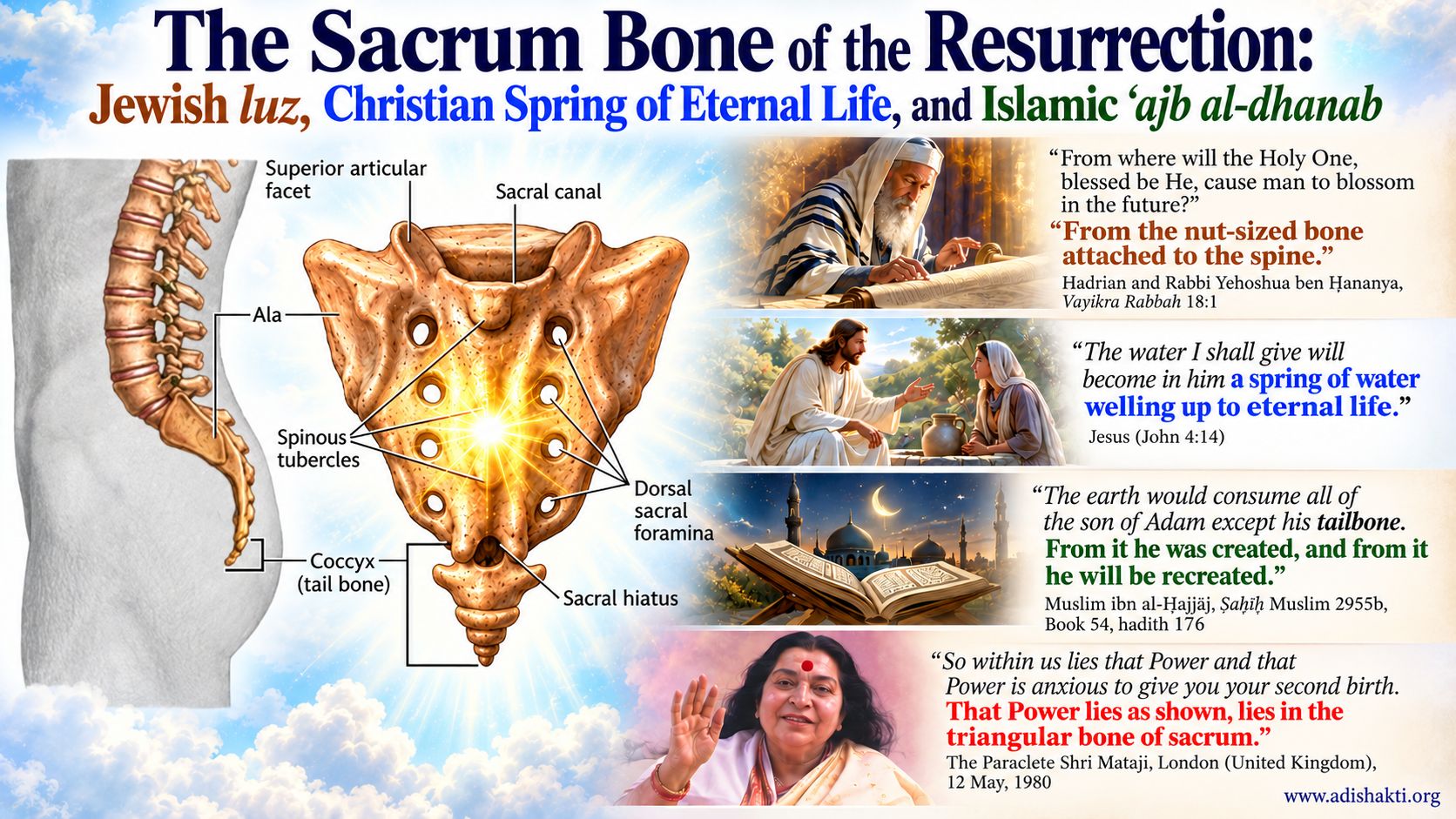
In modern anatomy, the coccyx is the terminal portion of the spine, while the sacrum is the larger triangular bone immediately above it. Religious language does not always preserve this modern distinction. The luz, ʿajb al-dhanab, and Mooladhara are all situated in the sacred lower-spinal region, where religious traditions locate the mystery of creation, death, and rebirth.
This paper therefore uses “sacrum bone” in its broad spiritual sense: the sacred base of the spine, the bodily threshold between mortality and resurrection. It is the place where the earthly body ends and divine renewal begins.
The Rabbinic Luz: Seed of the Resurrection
In Vayikra Rabbah 18:1, the Roman emperor Hadrian asks Rabbi Yehoshua ben Ḥananya: “From where will the Holy One, blessed be He, cause man to blossom in the future?” The rabbi answers: “From the nut-sized bone attached to the spine.”
The Midrash then recounts that this bone cannot be destroyed. Water does not soften it, fire does not burn it, the mill cannot grind it, and when it is struck upon an anvil, the hammer and anvil break while the bone remains intact. The narrative is not a laboratory report; it is a theological parable of divine fidelity. The body may fall into dust, but God preserves the point from which the person will blossom again.
The luz is thus the “nut” or seed of the spinal column. The Jewish Encyclopedia identifies it with the os coccyx and records the belief that, being indestructible, it will form the nucleus of the resurrected body. Its significance is not that the bone possesses independent power, but that it reveals the Creator’s power to preserve and restore life beyond death.
The rabbinic image is agricultural: humanity will “blossom” from this hidden seed. Death is therefore not annihilation but a return to the ground from which the divine Gardener can bring forth new life.
Islamic ʿAjb al-Dhanab: Recreation on the Day of Judgment
Islam expresses the same mystery through the ʿajb al-dhanab, commonly translated as the tailbone or coccyx. In Ṣaḥīḥ Muslim 2955b, the Prophet Muhammad is reported to have said: “The earth would consume all of the son of Adam except his tailbone. From it he was created, and from it he will be recreated.”
The hadith establishes three linked affirmations: the human being is created from this bone, the bone is not consumed by the earth, and resurrection will proceed from it on the Day of Judgment. The Qur’an provides the wider doctrine: God, who first created human beings, is able to revive decayed bones and reassemble even the fingertips.
Here again, the bone is not an autonomous source of life. It is the created sign of God’s continuing power. The ʿajb al-dhanab is the last visible trace of the body, yet it becomes the first point of the new creation. In the Islamic account, trumpet blasts and heavenly water precede the growth of the dead, imagery that closely parallels the seed, rain, and blossoming of the rabbinic tradition.
Thus, in both Judaism and Islam, the sacred bone at the base of the spine is the divinely preserved bridge between the first creation and the resurrection.
Shri Mataji: The Sacrum as the Seat of Kuṇḍalinī
Shri Mataji Nirmala Devi gives this ancient resurrection imagery its living, experiential fulfillment. She teaches that within every human being rests Kuṇḍalinī, the awakened power of the Divine Mother, located in the sacrum—the triangular bone at the base of the spine.
In her Caxton Hall discourse of 12 May 1980, she declares: “So within us lies that Power and that Power is anxious to give you your second birth. That Power lies as shown, lies in the triangular bone of sacrum.” This teaching identifies the sacrum not simply as an anatomical structure but as the sanctuary of the indwelling Spirit.
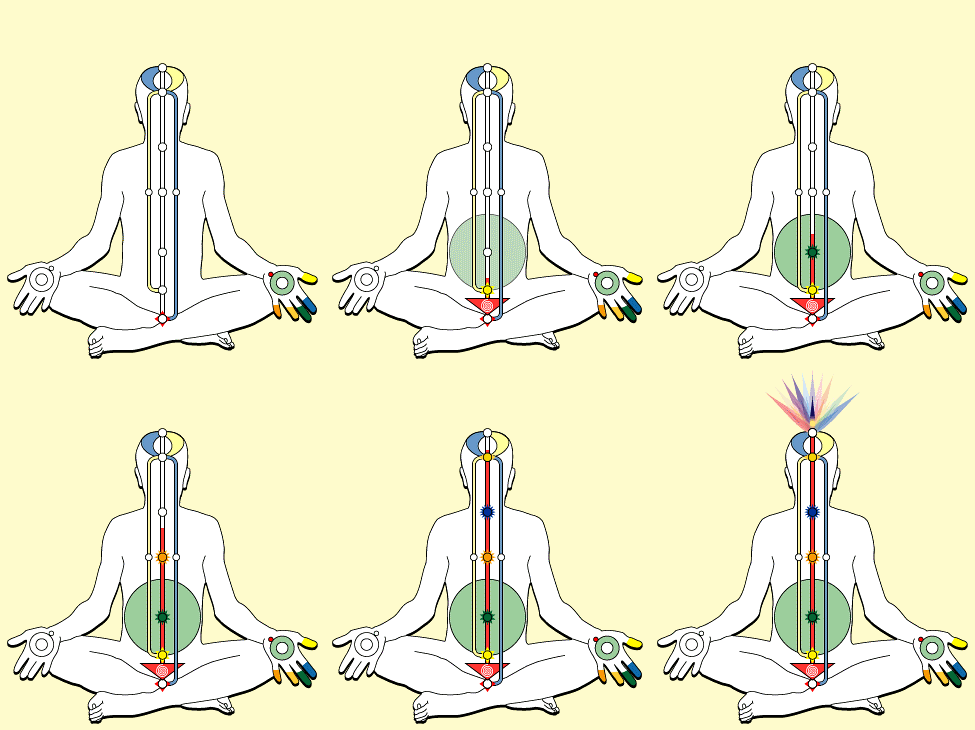
For Shri Mataji, Kuṇḍalinī is the reflection of the Holy Spirit within each person. She is the loving Mother who knows the seeker’s needs, rises through the subtle centers, and grants Self-realization. When She reaches the crown of the head, the seeker may feel a gentle cool breeze—the tangible sign of baptism, second birth, and the presence of the Holy Spirit.
The connection with resurrection is direct. The same sacred base from which God will raise the dead is, in Sahaja Yoga, the base from which the power of resurrection rises during life. Kuṇḍalinī awakening is the inner inauguration of the resurrection: the movement from spiritual sleep to divine life, from fragmentation to wholeness, from mortality-bound awareness to participation in eternal life.
Kuṇḍalinī and the Holy Spirit
Classical yogic texts describe Kuṇḍalinī as the coiled Goddess, luminous and subtle, resting in the root center. The Ṣaṭ-cakra-nirūpaṇa portrays her as the sleeping power whose awakening opens the path of eternal knowledge and ambrosial bliss.
Shri Mataji universalizes this teaching. Kuṇḍalinī is not the possession of an elite few; she is the birthright of every human being, the divine power “anxious” to give second birth. In Christian language, she is understood as the Holy Spirit, the Paraclete whom Jesus promised would dwell within the disciples, teach them, and guide them into truth.
This identification does not erase the distinct histories of Judaism, Christianity, Islam, and Yoga. Rather, it reveals their shared eschatological grammar: God’s Spirit is the agent of life; the human being is the temple or vessel of that Spirit; and resurrection begins with the awakening of the divine presence within.
Jesus’ promise in John 4:14 becomes, in this reading, a description of Kuṇḍalinī awakening. The “water” is the divine life bestowed by the Spirit; the “spring” is the awakened Kuṇḍalinī; and “eternal life” is the state of union with the Divine that begins now and reaches fulfillment in the resurrection to come.
Resurrection Now and Resurrection to Come
The resurrection bone traditions and the Kuṇḍalinī teaching must be held together. The luz and ʿajb al-dhanab affirm the future resurrection: God will restore the body from the sacred remnant. Shri Mataji’s teaching proclaims the present dimension of that resurrection: the same divine power can awaken within the living person.
John’s Gospel supports this double movement. Jesus says that the believer “has eternal life” and has “passed from death to life,” while also affirming that those in the tombs will hear his voice and come forth in the future resurrection. Eternal life is therefore both a present gift and a future fulfillment.
In Sahaja Yoga, the cool breeze is the daily experiential sign of this mystery. It is the “wind” of the Spirit, the pneuma of Christian scripture, the rūḥ of Islamic tradition, and the awakened breath of divine life. It does not abolish the final resurrection; it makes its power available now.
The Mooladhara: Innocence and the Fountain
The base center, or Mooladhara, is associated in Sahaja Yoga with innocence, wisdom, dignity, and simplicity. Shri Mataji teaches that innocence can never ultimately be destroyed; it may be covered, but Kuṇḍalinī awakening restores it.
This restores the moral meaning of the fountain. Eternal life is not escape from responsibility but the purification of attention. When the Divine Mother rises, lust, greed, fear, and egoic fragmentation lose their dominion; the seeker recovers the innocent attention through which divine love can be received and expressed.
The fountain of immortality therefore rises as both experience and transformation. It is felt as the cool breeze above the head and lived as peace, compassion, humility, and self-mastery.
Conclusion: The Sacrum Bone of Eternal Life
The luz of Rabbinic tradition, the ʿajb al-dhanab of Islamic tradition, and the sacrum of Sahaja Yoga proclaim one sacred truth: at the base of the human spine lies the hidden point of resurrection. Judaism declares that God will restore the body from the luz; Islam declares that God will recreate humanity from the ʿajb al-dhanab; Shri Mataji declares that the same sacred base contains Kuṇḍalinī, the Holy Spirit’s indwelling power, ready to give second birth.
Jesus’ words—“The water I shall give will become in him a spring of water welling up to eternal life”—thus find their eschatological fulfillment in the awakened sacrum. The fountain of immortality is not sought in a distant land. It resides within the human being, rises through the subtle body, and manifests as the cool breeze of the Holy Spirit.
This is the resurrection proclaimed by Shri Mataji: not only an event at the end of history, but a living awakening in the present. The sacred bone is the seed; Kuṇḍalinī is the rising water; and eternal life begins wherever the Divine Mother is awakened within the seeker.
References
Vayikra Rabbah 18:1 — rabbinic account of the enduring resurrection bone.
Ṣaḥīḥ Muslim 2955b — narration concerning the tailbone and recreation.
John 4:14 and John 3:1–8 — living water and birth of the Spirit.
Shri Mataji Nirmala Devi, Caxton Hall, London, 12 May 1980 — discourse on the sacrum and second birth.
The Fountain of Immortality That Resides and Rises from the Coccyx.
Interpretive note: The proposed equivalence of the luz, coccyx, sacrum, Kundalini and the Holy Spirit is a comparative theological interpretation, not an established anatomical or interreligious consensus.