CHRISTIAN THEOLOGY · CONSUMER CULTURE · GOSPEL PROCLAMATION
“These Leaders Have Prostituted the Divine Intention of the Gospel”

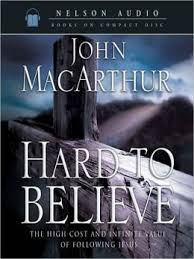
"The first role of successful merchandising is to give consumers what they want. If they want bigger burgers, make their burgers bigger. Designer bottled water in six fruit flavors? Done. Minivans with ten cup holders? Give them twenty. You've got to keep the customer satisfied. You've got to modify your product and your message to meet their needs if you want to build a market and get ahead of the competition.
Today this same consumer mind-set has invaded Christianity. The church service is too long, you say? We'll shorten it (one pastor guarantees his sermons will never last more than seven minutes!). Too formal? Wear your sweatsuit. Too boring? Wait'll you hear our band!
And if the message is too confrontational, or too judgmental, or too exclusive, scary, unbelievable, hard to understand, or too much anything else for your taste, churches everywhere are eager to adjust that message to make you more comfortable. This new version of Christianity makes you a partner on the team, a design consultant on church life, and does away with old-fashioned authority, guilt trips, accountability, and moral absolutes.
One suburban church sent out a mailer recently, promising an 'informal, relaxed, casual atmosphere,' 'great music from our band,' and that those who come will, 'believe it or not, even have fun.' That's all great if you're a coffee house. But anyone who claims to be calling people to the gospel of Jesus with those as his priorities is calling them to a lie.
It's Christianity for consumers: Christianity Lite, the redirection, watering down, and misinterpretation of the biblical gospel in an attempt to make it more palatable and popular. It tastes great going down and settles light. It seems to salve your feelings and scratch your itch; it's custom tailored to your preferences. But that lightness will never fill you up with the true, saving gospel of Jesus Christ, because it is designed by man and not God, and it is hollow and worthless. In fact, it's worse than worthless, because people who hear the message of Christianity Lite think they're hearing the gospel-think they're being rescued from eternal judgment-when, in fact, they're being tragically misled...
Christianity, in the hands of some seeker-sensitive church leaders, has become a "get what you want" rather than a "give up everything" movement. These leaders have prostituted the divine intention of the Gospel. They have replaced the glory of God with the satisfaction of man. They have traded the concept of abandoning our lives to the honor of Christ for Christ honoring us. As such, our submission to His will is replaced by His submission to our will. Since people usually reject the real gospel, modern evangelicals have simply changed the message.”
John Arthur, Hard To Believe
Thomas Nelson (January 10, 2006) pp. 1-2
Summary
The supplied passage warns that Christian leaders may exchange divine authority for consumer satisfaction. Its anxiety is intellectually serious: consumer culture can train people to treat traditions as customizable goods, and religious organizations can adopt flexible, market-responsive practices. Yet the charge is defensible only under a disciplined criterion. Gospel integrity is compromised not by accessibility itself, but when the preferences of an intended audience become the authority that censors, reverses, or subordinates constitutive claims about Christ, repentance, costly discipleship, truthfulness, and communal accountability. The New Testament itself joins a demanding call to discipleship with a mission capable of crossing cultural boundaries. Therefore, the relevant question is neither whether a church is contemporary nor whether it is large; it is whether the church remains governed by the Gospel it announces.
1. The Source, Its Attribution, and Its Rhetoric
The passage supplied for this study depicts consumer expectations moving from ordinary commercial life into church practice. It names short services, casual dress, popular music, and an aversion to difficult theological claims as signs of a larger inversion: the church begins to satisfy the customer rather than to summon the disciple. The argument is not fundamentally aesthetic. It is an accusation about authority: whether the divine intention disclosed in the Gospel rules the congregation, or whether anticipated consumer response rules it.
There is an attribution issue that matters for academic precision. The supplied webpage credits the passage to “John Arthur,” while the bibliographic record for Hard to Believe: The High Cost and Infinite Value of Following Jesus identifies its author as John F. MacArthur, published by Thomas Nelson in 2006. [2] This paper therefore cites the supplied page as the immediate source of the reproduced wording and identifies MacArthur as the book’s recorded author. That correction does not settle every textual-variant or pagination question, but it prevents the repetition of an apparent naming error.
The title’s verb is deliberately shocking. In the Hebrew prophetic tradition, sexual imagery could dramatize a breach of covenantal loyalty; in modern academic prose, however, this language has substantial ethical costs. It can stigmatize sex workers and move hearers from analysis to denunciation. The underlying judgment may be reformulated more carefully: a church betrays its theological vocation when it treats the Gospel as a product whose substance may be redesigned to secure approval, attendance, or revenue. This formulation preserves the claim’s gravity while refusing to make contemptuous metaphor a substitute for evidence.
2. Consumer Culture as a Formative Power
The most useful scholarly account of the problem begins with formation rather than with a catalogue of allegedly worldly objects. Vincent J. Miller argues that consumerism is not only a set of false beliefs about money or pleasure. It can commodify culture by making beliefs and practices appear as shallow, interchangeable objects of consumption. [3] His later book develops the point at greater length: consumer culture is a pervasive worldview that can shape religious belief, theological method, community, and the very imagination of the self. [4]
This diagnosis explains why debates about bands, coffee, dress, and screens are often inadequate. None of these things is intrinsically a theological corruption. A guitar can accompany lament, praise, confession, or self-advertisement; a concise sermon can be lucid and demanding, or it can omit every claim likely to generate resistance. The decisive issue is the social grammar of the practice. Does the gathered church teach people that they may select religious elements as private benefits, discarding whatever threatens self-rule? Or does it form persons able to receive a truth that judges, consoles, commands, and remakes them?
Consumer logic is especially powerful because it presents itself as care. Listening to people, removing needless barriers, offering clear language, providing childcare, and welcoming wounded visitors are genuine forms of care. But care becomes assimilation when hospitality must guarantee that the visitor will never encounter contradiction, sacrifice, repentance, discipline, or an authority beyond private preference. The problem is not that churches ask what people need. It is that the question silently changes from What practices may help persons hear and live the Gospel? to What product will keep persons from leaving?
3. What Research Actually Establishes About Megachurches
Research does support the claim that some large churches operate within a competitive religious marketplace. Marc von der Ruhr describes megachurch strategies in terms of organizational flexibility, multiple services and sites, tailored communication, small groups, and customized spiritual experiences. [5] Such descriptions are sociological observations; they do not, by themselves, prove theological infidelity. A church can organize intelligently, use technology, and attend to the varied circumstances of families without treating Christ as a service provider.
The market-religion relationship is also more complex than a simple tale of sacred purity defeated by commerce. Samuelson Appau and Ye Nicole Yang’s study of 3,741 church advertisements in Ghana over six years identifies several coexisting relationships between religion and marketization, including commensalism, mutualism, and competition. [6] The study does not authorize uncritical marketing; it demonstrates that market practices can interact with religious life in multiple ways across contexts. Any theological critique that simply labels every advertisement, media strategy, or visitor survey an apostasy fails to distinguish empirical form from spiritual norm.
Aaron B. James makes the needed methodological caution explicit in his study of Willow Creek and consumer culture. He accepts that megachurches can reproduce consumer habits, yet argues that a totalizing critique is myopic because churches may use consumer culture tactically and creatively toward ends compatible with the Gospel. [7] Thus, neither size nor informality establishes the case. The burden is to show a more specific displacement: that market metrics, consumer satisfaction, or brand maintenance have acquired practical supremacy over Gospel truth.
4. The New Testament Grammar of the Gospel
The supplied passage rightly recognizes that Christianity cannot be reduced to an instrument of self-enhancement. In Mark’s account, Jesus calls those who would follow Him to deny themselves, take up their cross, and lose life for His sake and for the Gospel. [8] This is not a marketing promise of frictionless fulfillment. The claim reorders desire: life is not secured by possession or self-protection but received in relation to Christ. A church that systematically conceals this reordering is no longer merely choosing a welcoming tone; it is withholding a central dimension of discipleship.
Paul’s opening warning in Galatians is similarly severe. He is astonished that communities are turning to a “different gospel,” and he contrasts pleasing people with servanthood to Christ. [9] The passage supplies a theological norm of non-negotiability: the Gospel is not an empty container whose content may be revised whenever the audience objects. Its center is received rather than manufactured. Grace, Christ’s lordship, the cross, reconciliation, repentance, and a new communal life are not optional features added after the sale.
Philippians 2 gives this norm a corporate and Christological form. The community is instructed to act without selfish ambition, regard others with humility, and inhabit the pattern of Christ who takes the form of a servant and becomes obedient to death. [10] This does not authorize religious harshness. It measures leadership by self-giving service rather than by the management of an audience. When a congregation treats attendees only as customers whose continued approval is its highest good, it risks forming both leaders and members in the opposite of this pattern.
5. Contextualization Is Not Capitulation
Yet the New Testament forbids an opposite error: mistaking cultural rigidity for faithfulness. Paul writes that he became “all things to all people” in order to save some, while immediately locating himself under the law of Christ and acting for the sake of the Gospel. [11] His flexibility concerns posture, relation, and mission; it does not mean that the Gospel’s governing claims are delegated to the hearer’s preference.
This distinction can be put succinctly. Contextualization adapts the church’s forms so that the Gospel may be understood; consumer accommodation adapts the Gospel’s authority so that the consumer may remain unchallenged. Contextualization asks how a hearer can receive the message in a real language, place, and history. Accommodation asks how the message can be made unable to interrupt a preferred self. The former can be an act of love; the latter is an abandonment of pastoral responsibility.
6. Why Style Alone Cannot Bear the Judgment
The supplied passage’s concrete examples must therefore be handled discriminately. A seven-minute sermon may be intellectually impoverished, but length alone is not a measure of truth. Informal clothing may signal anti-institutional consumer identity, or it may simply remove a class-coded barrier to participation. Contemporary music may function as entertainment, but it may also be musically serious, scripturally saturated worship. Even a coffee bar can serve either consumption or neighborly attention. Theology cannot infer the inner rule of a church from a single surface feature.
| Practice | Faithful contextualization | Consumer accommodation |
|---|---|---|
| Accessible language | Explains difficult doctrines without evasion and enables substantive participation. | Removes doctrines judged too demanding, exclusive, or unsettling. |
| Contemporary music and media | Serves prayer, proclamation, confession, and congregational formation. | Creates a spectacle in which emotional consumption replaces worship and discernment. |
| Shorter gatherings | Uses time responsibly while retaining Scripture, prayer, sacrament, and moral seriousness. | Eliminates whatever might inconvenience the attendee or challenge the brand. |
| Visitor research | Identifies avoidable obstacles, material needs, and failures of hospitality. | Allows preference data to decide what the church may proclaim or require. |
| Small groups and services | Build genuine mutual care, accountability, and formation. | Segments people into affinity products with no shared conversion of life. |
The table is a framework for inquiry, not a mechanism for condemnation. It asks about purpose, content, authority, and fruit. A strong assessment must examine what is preached over time, whose interests receive protection, whether the poor and inconvenient are welcomed, how leaders handle error, and whether members are formed for service beyond the congregation. The critique becomes responsible only when it moves from aesthetic suspicion to accountable theological discernment.
7. A Discernment Framework for Congregations
Congregations that wish to test themselves can begin with five questions. First, what is non-negotiable? If repentance, the cross, judgment, sexual ethics, economic justice, communal discipline, or Christ’s lordship disappear whenever they threaten retention, then the church has identified its practical authority. Second, what does success mean? Attendance, giving, online impressions, and volunteer utilization can be useful indicators, but they become idolatrous when detached from truthful teaching, durable charity, and transformed practices.
Third, who is allowed to speak back? A customer relationship tends to reduce critique to a review and leadership to brand protection. A Christian community should preserve practices through which members, elders, theologians, and especially vulnerable persons can question priorities without being treated as threats to growth. Fourth, what formation occurs beyond the service? If worship gathers consumers for an experience but does not cultivate prayer, service, confession, reconciliation, biblical literacy, and solidarity, it risks leaving consumer habits intact.
Finally, what happens when truth costs? This is the decisive practical test. Every community communicates a hierarchy of goods when it faces loss: loss of status, revenue, approval, or numbers. Faithful leadership does not seek conflict for its own sake. It does, however, refuse to purchase peace by muting truths that the community has received as constitutive of the Gospel.
8. Corrective Practices: From Preference to Formation
The remedy is neither nostalgic withdrawal nor contempt for those who arrive with consumer expectations. Communities can refuse market supremacy through ordinary, concrete practices. They can proclaim Scripture in forms that are comprehensible but not selectively silent; connect generosity to justice rather than to institutional expansion alone; organize worship in which congregants participate rather than merely receive; and measure leadership by service, transparency, and shared discernment. These practices do not make a church culturally pure. They make visible an alternative account of what persons are for.
Pastoral leaders can also separate listening from obeying preference. Listening reveals trauma, exclusion, exhaustion, disability, poverty, language barriers, and institutional failure. To ignore such testimony would be a failure of love. But listening must be answered by theological judgment: what will help this particular person and community encounter Christ truthfully, even where the encounter is costly? That is a different question from what will make attendance most effortless.
The aim is not a church that is difficult in order to prove seriousness. Artificial difficulty can be another form of vanity. The aim is a church whose welcome is expansive because its center is not a narrow social identity, but whose welcome is also truthful because Christ is not a mascot for the autonomous self. In this sense, the opposite of consumer Christianity is not an unpleasant church; it is a formative church.
9. The Limits of the Indictment
The indictment in the title becomes unjust when it identifies an entire class of leaders as corrupt on the basis of worship style, institutional scale, or evangelistic concern. It is especially important not to conflate megachurches with all evangelical or charismatic communities, or to assume that congregations outside the United States inhabit identical market conditions. The available scholarship instead counsels a layered judgment: marketization can be real and damaging; religious organizations can also employ modern tools in creative, even resistant ways; and local evidence is indispensable.
Nor should concern for seekers be caricatured. The Gospels portray Jesus addressing crowds, welcoming the marginalized, teaching in public, and calling persons into a demanding new life. Accessibility without truth is thin; truth without intelligibility and mercy fails in another way. A church faithful to the Gospel should resist both temptations: the temptation to protect its culture by making newcomers decipher unnecessary codes, and the temptation to protect its market by making discipleship cost nothing.
10. Conclusion
The supplied passage names a genuine theological danger: Christian institutions can become so responsive to consumer demand that they exchange the formative authority of the Gospel for the maintenance of an audience. Miller’s analysis helps identify the depth of the danger, because commodification affects not only the content people believe but the way they learn to relate to beliefs and practices. Research on megachurches and religious marketing, however, cautions against treating every adaptive practice as proof of betrayal. The church is situated in culture; its unavoidable task is to speak and act intelligibly within it.
For that reason, the most responsible reform is not aesthetic reversal but ecclesial reordering. Churches should ask, repeatedly and publicly, whether their practices form persons who can receive truth beyond their preference, bear one another’s burdens, submit their lives to Christ, and serve the world without requiring the world’s applause. Where the answer is yes, contextualization may be serving the Gospel. Where the answer is no, the warning has found its object.
References
- [1] AdiShakti.org. “Leaders Have Prostituted the Divine Intention of the Gospel.” AdiShakti.org, accessed August 7, 2026. The supplied page reproduces the passage and attributes it to “John Arthur.”
- [2] MacArthur, John F. “Hard to Believe: The High Cost and Infinite Value of Following Jesus.” Thomas Nelson, 2006. Bibliographic record used to correct the supplied page’s author attribution.
- [3] Miller, Vincent J. “Taking Consumer Culture Seriously.” Horizons 27, no. 2 (2000): 276–295. https://doi.org/10.1017/S0360966900032564.
- [4] Miller, Vincent J. “Consuming Religion: Christian Faith and Practice in a Consumer Culture.” Bloomsbury Publishing, 2005, 262 pp.
- [5] von der Ruhr, Marc. “Megachurches in the Religious Marketplace.” In Handbook of Megachurches, edited by Stephen Hunt, Brill, 2020, pp. 131–151. https://doi.org/10.1163/9789004412927_008.
- [6] Appau, Samuelson, and Ye Nicole Yang. “Church Advertising and the Marketization of Religious Hegemony.” Marketing Theory, 2024. https://doi.org/10.1177/14705931231202434.
- [7] James, Aaron B. “Rehabilitating Willow Creek: Megachurches, De Certeau, and the Tactics of Navigating Consumer Culture.” Christian Scholar’s Review, November 17, 2019.
- [8] The Holy Bible, New International Version. “Mark 8:34–38.” Bible Gateway, accessed August 7, 2026.
- [9] The Holy Bible, New International Version. “Galatians 1:6–10.” Bible Gateway, accessed August 7, 2026.
- [10] The Holy Bible, New International Version. “Philippians 2:1–11.” Bible Gateway, accessed August 7, 2026.
- [11] The Holy Bible, New International Version. “1 Corinthians 9:19–23.” Bible Gateway, accessed August 7, 2026.
Primary function of the Comforter is to make men holy
"Jesus solemnly assures the disciples that they will, in the future, perform even greater miracles than He. By this He means to say that through the power of the Holy Spirit, they will bring about the greatest miracle of all — the salvation of lost souls. He promises them that whatever they ask for, in connection with their ministry of bringing the miracle of salvation to lost men, will be granted them.
The theme of this section is reassurance and encouragement. Jesus gives the disciples three basic reasons they should cease being troubled in their spirits. First, He tells them that, although He is going away, He will return for them so that they may ultimately join Him where He is going (vv. 1-3). Second, He tells them that, though He is going away, He will be the only means by which men may come to God and go to Heaven (vv. 4-11). Third, He tells them that, though He is going away, their ministries are not finished. In fact, the best is still ahead. They are going, by the Holy Spirit's power, to be part of the greatest miracle of all, bringing men to salvation (vv. 12-14).”...
25 These things have I spoken unto you, being yet present with you.
26. But the Comforter, which is the Holy Ghost, whom the Father will send in my name, shall teach you all things, and bring all things to your remembrance, whatsoever I have told unto you.
Jesus now summarizes all that He has been saying in this section. Referring to the many things which He has taught them while He has been present with them in the flesh, He tell the disciples that the Comforter not only is going to remind them of these things, but also will go to teach them all things necessary to their understanding and happiness. The Comforter will recall to their minds Jesus' teachings, will enable them to understand truly and completely, and will develop and expand them into new and wonderful truths.
Jesus has referred to the coming Comforter as the Spirit of Truth (v. 17)...[whose] primary function is the work of making men holy. This is the work we call sanctification.
In v. 16 Jesus has said that the Comforter is going to be provided to the disciples by the Father on the basis of His (Jesus') prayer that He should do so. Now He says that the Father is going to send the Comforter in His (Christ's) name. These statements are essentially identical and imply a joint action involving both Father and Son.”
Jack Wilson Stallings and Robert E. Picirilli,
The Randall House Bible Commentary: The Gospel of John,
Randall House Publications, 1989, page 205

The Child Preachers of Brazil
The youngest evangelists in the country's Pentecostal churches try to balance the demands of their youth with those of their faith.
By SAMANTHA M. SHAPIROJUNE 11, 2015
"No one keeps track of the number of child preachers in Brazil, but Pastor Walter Luz, who coordinates a 10-day conference for preachers ages 5 to 18 in São Paulo, estimates there are thousands. Most come from poor or lower-middle-class families, and nearly all of them are affiliated with Assemblies of God, a Pentecostal denomination started in America in 1914 and taken to South America by missionaries. Assemblies of God is now the largest Pentecostal group in Brazil.
The central tenet of Pentecostalism is that God remains an active presence in the world; people can access his divine power just as Jesus, Peter and Paul did, to prophesy, speak in tongues and heal the sick. Assemblies of God, in particular, emphasizes that the Holy Spirit acts not just through trained priests but through anyone — the poor, the uneducated, even children.
The growth of Pentecostalism and other charismatic movements influenced by it — which also emphasize the Holy Spirit and miracles — has been responsible for an epochal shift in Christianity. In the 1970's, less than 10 percent of Christians were affiliated with these charismatic or "renewalist" churches. Today it is estimated that one-quarter are, and their rapid growth outpaces that of other denominations. With this expansion, Pentecostalism has shifted the center of world Christianity from Europe to what is sometimes called the Global South — Africa, Asia and Latin America. As Philip Jenkins, a history professor at Baylor University and the author of "The New Christendom: The Coming of Global Christianity," writes: "The era of Western Christianity has passed within our lifetimes.”
In Brazil, Pentecostalism — and especially Assemblies of God — has its strongest foothold in poorer neighborhoods, where residents are often overlooked by the government and too transient to be easily reached by the Catholic Church, which is structured around place-based dioceses. Scholars once thought that Catholic liberation theologies, which arose in the 1960s and 1970's, preaching a connection between faith and socioeconomic justice, would be the religion of choice for the poor, but Pentecostalism, with its emphasis on the supernatural, has proved far more appealing. Improvised storefront Pentecostal churches bloom like mushrooms in the cities' cracks, jutting out behind a gas station or wedged into the ground floor of a home.
Among charismatic denominations, competition to produce fantastic miracles and emotional release is fierce. Startling stories of redemption — from former prostitutes, for example, or drug dealers or murderers — are prized. (One famous preacher, Aldidudima Salles, is the former head of the Red Command, a drug-trafficking gang in Rio, and claims he was so depraved before he converted that he broke into tombs and ate human flesh.) Child preachers fill a special niche: They embody the charisma and showmanship of older preachers, but filtered through a child's inherent innocence. As Andrew Chesnut, a professor of religious studies at Virginia Commonwealth University and the author of "Born Again in Brazil," explains it: "These child preachers are something that Assemblies of God have found that sets them apart.”
The phenomenon is controversial, earning scorn from other Pentecostal denominations and even criticism from within Assemblies of God. Silas Malafaia, a high-profile Brazilian Pentecostal pastor whose TV show airs internationally and who has preached at American megachurches, says that children who are preaching are being exploited. "it's absurd," Malafaia says. "These are commercial interests on behalf of the parents in receiving donations and selling DVDs. It is not about God, and I am firmly against this.”
But the Internet and social media have helped young preachers find wide, sometimes international audiences. Today Brazil's most successful child preachers work nearly every day and travel extensively.”
https://www.nytimes.com/2015/06/14/magazine/the-child-preachers-of-brazil.html
Web (Retrieved May 14, 2015)
"They no longer will be subject to death but will, like the angels, be immortal, for they have become 'sons of the resurrection.'"
"When we trace this word [aion] in the new Testament, we discover that in the course of God's redemptive purpose, there are two ages which are frequently called 'This Age' [The past sending of Jesus by the Father/God Almighty]* and 'The Age to Come.' [The present sending of the Paraclete by Jesus through the Father/God Almighty.]* In Matthew 12:32 the A.V. reads: 'Whosoever speaketh a word against the Son of man , it shall be forgiven him: but whosoever speaketh against the Holy Ghost, it shall not be forgiven him, neither in this world, neither in the world to come.' However, our Lord is not speaking of two worlds but of two ages. The entire sweep of man's existence is set forth in terms of this age and the age to come. The Greek word used is not kosmos but alon, age. It is unfortunate that our older English Bibles obscure this important fact; but it is correctly rendered in the R.S.V. Blasphemy against the Son of Man will be forgiven, but blasphemy against the Holy Spirit will never be forgiven; and the sweep of 'never' is two periods of time; This Age, and that which is to come.
In Ephesians 1:21, Paul describes the exaltation of Christ 'far above all rule and authority and power and dominion, and above every name that is named, not only in this age but also in that which is to come.' Here again the A.V.'s translation 'world' is inaccurate. Paul does not have in mind two worlds but two ages. His word is not kosmos but aion. There is no thought of two orders of society but of two periods of time.
A slight variant of this expression is found in Mark 10:29, 30.”Jesus said, 'Truly, I say to you, there is no one who has left house or brethren or sisters or mother or father or children or lands, for my sake and for the gospel, who will not receive a hundredfold now in this time, houses and brothers and sisters and mothers and children and lands, with persecution, and in the age to come eternal life.' In the second half of the verse, we find again the word aion; and the translation 'in the world to come' does not accurately represent the idea. In the first half of the verse, the word 'time' (kairos) appears instead of aion or age. This makes it doubly clear that the reference of the verse is to two periods of time, not to two worlds. In this time, in This Age, we are to expect hostility to the Gospel. In The Age to Come, those who have followed Christ will be freed from all opposition and sufferings and will enjoy eternal life...
But a different state of affairs will prevail in The Age to Come, for those who enter that Age will do so by way of resurrection. Therefore, they will be like the angels in this one respect: they no longer will be subject to death but will, like the angels, be immortal, for they have become 'sons of the resurrection.'...
When we ask what Scripture teaches about the characters of these two ages, we find a sharp contrast. This Age is dominated by evil, wickedness, and rebellion against the will of God, while The Age to Come is the age of the Kingdom of God.”
George Eldon Ladd, The Gospel of the Kingdom
Wm. B. Eerdmans Publishing Company (March 13, 1990) pp. 26-8
* emphasis ours
THE NARROW GATE
"So, what do you want to do? According to lots of churches and preachers, the answer is to popularize the gospel: get rid of all this slaying-yourself and carrying-your-cross stuff, and get a decent band up there on the stage. Tell everybody God wants him to be happy and successful and full of self-esteem.
The only problem is that saying those things gives people who don't know any better the illusion they're saved, when they're not. And someday, when they face Christ, they're going to say, "Lord, Lord!" and He's going to say, "Depart from Me. I never knew you" (see Matt. 7:23). What's a good band worth then? About as much as healthy self-esteem.
Mankind wants glory. We want health. We want wealth. We want happiness. We want all our felt needs met, all our little human itches scratched. We want a painless life. We want the crown without the cross. We want the gain without the pain. We want the words of Christian salvation to be easy.
That's how people think. But that's not God's instruction to us. According to Hebrews 2:10, suffering made perfect the Captain of our salvation. And so we also will go through the crucible of suffering. What we suffer first of all is the death of all hopes, all ambitions, all desires, all longings, all needs that are human.
Listening to a seeker-sensitive evangelical preacher today, we're likely to think it's easy to be a Christian. Just say these little words, pray this little prayer, and poof! you're in the club. According to the Bible, it doesn't work that way. In Matthew 7:13 during the Sermon on the Mount, Jesus admonished His followers, "Enter by the narrow gate.” The connotation of "narrow" here is constricted. it's a very, very tight squeeze. We can't carry anything through it; we come through with nothing.
A wide religious gate also exists, and I am saddened to think so many preachers, and so many churches, are leading people through it. They're saying, "You don't have to do all that hard stuff to get into heaven. We're open-minded and inclusive, and we think everybody who wants to, should get saved.”
We've actually come to the point where people who call themselves Christians have apologized on behalf of all us hopelessly inflexible nitpickers: those who hang onto old, outmoded ideas that Christianity should be biblical, exclusive, inflexible, and inconvenient. Recently, a group of more than fifty pastors and laymen, including a divinity school dean, representing half a dozen mainline Christian denominations, placed an ad in a major daily newspaper insisting it was "Wrong-ethically, morally, and spiritually-for anyone, whether individual, group, church, or religion, to claim exclusive access to God or God's grace, blessing, or salvation . . . Claims of exclusivity by Christians and others have played a self-justifying role in causing untold human suffering . . .”
Excuse me, but if Christians don't acknowledge and preach the fact that salvation is through Christ alone, they are herding unwitting people through the wide gate that leads to destruction. That's not my opinion; that's the Word of God. People are breezing through those wide, comfortable, inviting gates with all their baggage, their self-needs, their self-esteem, and their desire for fulfillment and self-satisfaction. And the most horrible thing about it is they think they're going to heaven. And somebody thinks he's done them a big favor by coming up with a consumer-friendly gospel about which everybody feels good.
But that gospel is a false gospel, a treacherous lie. That easy-access gate doesn't go to heaven. It says "Heaven," but it ends up in hell.
"Because narrow is the gate," Jesus said in Matthew 7:14, "And difficult is the way which leads to life, and there are few who find it.” I agree that we have a hard time finding it, especially today. You could go to church after church after church and never find it. it's a very narrow gate.
The same teaching appears in Luke 13:23-24: "Then one said to Him, 'Lord, are there few who are saved?' And He said to them, 'Strive to enter through the narrow gate, for many, I say to you, will seek to enter and will not be able.'" it's hard to find, and it's hard to get through.
Why is it so hard to find today, and why is it so hard to get through? it's hard to find because so many churches have strayed from teaching the truth of the gospel. And it's even harder, once we've heard the truth, to submit to it. Man worships himself. He's his own god. What we need to tell people is not "Come to Christ and you'll feel better about yourself," or "Jesus wants to meet whatever your needs are.” Jesus doesn't want to meet our needs-our worldly, earthly, human needs. He wants us to be willing to say, "I will abandon all the things I think I need for the sake of Christ.”
it's hard to get through the narrow gate because it's so hard for us to deny ourselves. Jesus' first requirement in Luke 9 was for Christians to deny themselves, but that's just about impossible to do. Self-importance is the reigning reality in human fallenness: man is the master of his own soul, the captain of his own fate, the monarch of his own world.
To say he has to deny and slay himself is simply too much to swallow. Preach a gospel that doesn't include that, and people will flock around to get out of hell and into heaven. But start preaching the true gospel, the hard words of Jesus that call for total and absolute self-denial-the recognition that we're worthy of nothing, commendable for nothing, and that nothing in us is worth salvaging-and that's a lot less popular. Take it from someone who has been targeted on national television for saying this.”
MacArthur, John (2003-11-13). Hard to Believe: The High Cost and Infinite Value of Following Jesus (Kindle Locations 238-282). Thomas Nelson. Kindle Edition.
Does God Want You To Be Rich?
By David Van Biema and Jeff Chu Sunday, Sept. 10, 2006
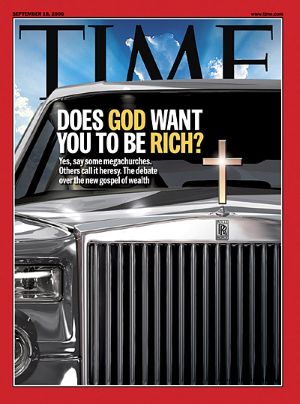
When George Adams lost his job at an Ohio tile factory last October, the most practical thing he did, he thinks, was go to a new church, even though he had to move his wife and four preteen boys to Conroe, a suburb of Houston, to do it. Conroe, you see, is not far from Lakewood, the home church of megapastor and best-selling author Joel Osteen.
Osteen's relentlessly upbeat television sermons had helped Adams, 49, get through the hard times, and now Adams was expecting the smiling, Texas-twanged 43-year-old to help boost him back toward success. And Osteen did. Inspired by the preacher's insistence that one of God's top priorities is to shower blessings on Christians in this lifetime--and by the corollary assumption that one of the worst things a person can do is to expect anything less--Adams marched into Gullo Ford in Conroe looking for work. He didn't have entry-level aspirations: "God has showed me that he doesn't want me to be a run-of-the-mill person," he explains. He demanded to know what the dealership's top salesmen made--and got the job. Banishing all doubt--"You can't sell a $40,000-to-$50,000 car with menial thoughts"--Adams took four days to retail his first vehicle, a Ford F-150 Lariat with leather interior. He knew that many fellow salesmen don't notch their first score until their second week. "Right now, I'm above average!" he exclaims. "it's a new day God has given me! I'm on my way to a six-figure income!" The sales commission will help with this month's rent, but Adams hates renting. Once that six-figure income has been rolling in for a while, he will buy his dream house: "Twenty-five acres," he says. "And three bedrooms. We're going to have a schoolhouse (his children are home schooled). We want horses and ponies for the boys, so a horse barn. And a pond. And maybe some cattle.”
"I'm dreaming big--because all of heaven is dreaming big," Adams continues. "Jesus died for our sins. That was the best gift God could give us," he says. "But we have something else. Because I want to follow Jesus and do what he ordained, God wants to support us. it's Joel Osteen's ministry that told me. Why would an awesome and mighty God want anything less for his children?”
In three of the Gospels, Jesus warns that each of his disciples may have to "deny himself" and even "take up his Cross.” In support of this alarming prediction, he forcefully contrasts the fleeting pleasures of today with the promise of eternity: "For what profit is it to a man," he asks, "If he gains the whole world, and loses his own soul?” It is one of the New Testament's hardest teachings, yet generations of churchgoers have understood that being Christian, on some level, means being ready to sacrifice--money, autonomy or even their lives.
But for a growing number of Christians like George Adams, the question is better restated, "Why not gain the whole world plus my soul?” For several decades, a philosophy has been percolating in the 10 million--strong Pentecostal wing of Christianity that seems to turn the Gospels' passage on its head: certainly, it allows, Christians should keep one eye on heaven. But the new good news is that God doesn't want us to wait. Known (or vilified) under a variety of names--Word of Faith, Health and Wealth, Name It and Claim It, Prosperity Theology--its emphasis is on God's promised generosity in this life and the ability of believers to claim it for themselves. In a nutshell, it suggests that a God who loves you does not want you to be broke. Its signature verse could be John 10: 10: "I have come that they may have life, and that they may have it more abundantly.” In a TIME poll, 17% of Christians surveyed said they considered themselves part of such a movement, while a full 61% believed that God wants people to be prosperous. And 31%--a far higher percentage than there are Pentecostals in America--agreed that if you give your money to God, God will bless you with more money.
"Prosperity" first blazed to public attention as the driveshaft in the moneymaking machine that was 1980s televangelism and faded from mainstream view with the Jim Bakker and Jimmy Swaggart scandals. But now, after some key modifications (which have inspired some to redub it Prosperity Lite), it has not only recovered but is booming. Of the four biggest megachurches in the country, three--Osteen's Lakewood in Houston; T.D. Jakes' Potter's House in south Dallas; and Creflo Dollar's World Changers near Atlanta--are Prosperity or Prosperity Lite pulpits (although Jakes' ministry has many more facets). While they don't exclusively teach that God's riches want to be in believers' wallets, it is a key part of their doctrine. And propelled by Osteen's 4 million--selling book, Your Best Life Now, the belief has swept beyond its Pentecostal base into more buttoned-down evangelical churches, and even into congregations in the more liberal Mainline. It is taught in hundreds of non-Pentecostal Bible studies. One Pennsylvania Lutheran pastor even made it the basis for a sermon series for Lent, when Christians usually meditate on why Jesus was having His Worst Life Then. Says the Rev. Chappell Temple, a Methodist minister with the dubious distinction of pastoring Houston's other Lakewood Church (Lakewood United Methodist), an hour north of Osteen's: "Prosperity Lite is everywhere in Christian culture. Go into any Christian bookstore, and see what they're offering.”
The movement's renaissance has infuriated a number of prominent pastors, theologians and commentators. Fellow megapastor Rick Warren, whose book The Purpose Driven Life has outsold Osteen's by a ratio of 7 to 1, finds the very basis of Prosperity laughable. "This idea that God wants everybody to be wealthy?”, he snorts. "There is a word for that: baloney. it's creating a false idol. You don't measure your self-worth by your net worth. I can show you millions of faithful followers of Christ who live in poverty. Why isn't everyone in the church a millionaire?”
The brickbats--both theological and practical (who really gets rich from this?)--come especially thick from Evangelicals like Warren. Evangelicalism is more prominent and influential than ever before. Yet the movement, which has never had a robust theology of money, finds an aggressive philosophy advancing within its ranks that many of its leaders regard as simplistic, possibly heretical and certainly embarrassing.
Prosperity's defenders claim to be able to match their critics chapter and verse. They caution against broad-brushing a wide spectrum that ranges from pastors who crassly solicit sky's-the-limit financial offerings from their congregations to those whose services tend more toward God-fueled self-help. Advocates note Prosperity's racial diversity--a welcome exception to the American norm--and point out that some Prosperity churches engage in significant charity. And they see in it a happy corrective for Christians who are more used to being chastened for their sins than celebrated as God's children. "Who would want to get in on something where you're miserable, poor, broke and ugly and you just have to muddle through until you get to heaven?” asks Joyce Meyer, a popular television preacher and author often lumped in the Prosperity Lite camp. "I believe God wants to give us nice things.” If nothing else, Meyer and other new-breed preachers broach a neglected topic that should really be a staple of Sunday messages: Does God want you to be rich?
As with almost any important religious question, the first response of most Christians (especially Protestants) is to ask how Scripture treats the topic. But Scripture is not definitive when it comes to faith and income. Deuteronomy commands believers to "remember the Lord your God, for it is He who gives you power to get wealth", and the rest of the Old Testament is dotted with celebrations of God's bestowal of the good life. On at least one occasion--the so-called parable of the talents (a type of coin)--Jesus holds up savvy business practice (investing rather than saving) as a metaphor for spiritual practice. Yet he spent far more time among the poor than the rich, and a majority of scholars quote two of his most direct comments on wealth: the passage in the Sermon on the Mount in which he warns, "Do not lay up for yourselves treasures on earth ... but lay up for yourselves treasures in heaven"; and his encounter with the "rich young ruler" who cannot bring himself to part with his money, after which Jesus famously comments, "It is easier for a camel to go through the eye of a needle than for a rich man to enter the kingdom of God.”
Both statements can be read as more nuanced than they at first may seem. In each case it is not wealth itself that disqualifies but the inability to understand its relative worthlessness compared with the riches of heaven. The same thing applies to Paul's famous line, "Money is the root of all evil," in his first letter to Timothy. The actual quote is, "The love of money is a root of all kinds of evil.”
TIME September 10, 2006
"So it’s quite true that the parables do help illustrate and explain truth to simple people who listen with faithful hearts. But they also conceal truth from unwilling and unbelieving auditors— by neatly wrapping the mysteries of Christ’s kingdom in familiar symbols and simple stories. This is not an incidental point. By His own testimony, the main reason Jesus suddenly adopted the parabolic style had more to do with hiding the truth from hard-hearted unbelievers than explaining the truth to simple-minded disciples. It was Jesus’ own declared purpose thus to “utter things kept secret”— and His parables still serve that same dual purpose today. If it seems the stories Jesus told are capable of endless interpretations and therefore devoid of any discernible objective meaning, that’s because truly understanding them requires faith, diligence, careful exegesis , and a genuine desire to hear what Christ is saying.
It is important to also know that all unbelievers lack that capacity. Jesus’ parables “speak the wisdom of God in a mystery, the hidden wisdom which God ordained before the ages for our glory, which none of the rulers of this age knew; for had they known, they would not have crucified the Lord of glory” (1 Cor . 2: 7– 8). No unbeliever will ever grasp the mysteries of the kingdom by filtering these stories through the sieve of human wisdom. Scripture is clear on that. The carnal, unbelieving ‘eye has not seen, nor ear heard , nor have entered into the heart of man the things which God has prepared for those who love Him.’ But God has revealed them to us through His Spirit. For the Spirit searches all things , yes, the deep things of God” (vv. 9– 10, emphasis added). In other words, faith, prompted and enabled by the work of the Holy Spirit in our hearts, is the necessary prerequisite for understanding the parables. These stories do have objective meaning. They have a divinely intended, and therefore correct, interpretation. Jesus Himself explained some of the parables in detail, and the hermeneutic He employed gives us a model to follow as we learn from the rest of His stories. But we must come to the parables as believers, willing to hear— not as skeptics with hearts hardened against the truth.
John F. MacArthur, Parables: The Mysteries of God's Kingdom Revealed Through the Stories Jesus Told
Thomas Nelson, Kindle Edition (2015) pp. xxiii-xxiv
💬 Interactive Chat
Access an intelligent analysis environment where you can explore texts, ask questions, and discover connections between ideas.
Open chat →It may include source panels and analysis tools for deeper exploration of the content.