Eschatology | Paraclete Theology | Last Judgment
“But They Killed Him Not … But So It Was Made to Appear to Them”
The Crucifixion of Jesus, Qur’an 4:157, and the Indestructibility of the Spirit
Summary
The central proposal is that Jesus’ crucifixion and bodily death occurred, but that neither the cross nor death destroyed the eternal Spirit. On this interpretation, the illusion in Qur’an 4:157 lies not in the visible event itself but in the supposition that the executioners had extinguished Jesus’ ultimate spiritual reality. This is a contemporary comparative theological reading, not the only possible meaning of the Arabic and not the standard reading in much Islamic commentary. The paper also distinguishes the Gospel accounts of burial before the Sabbath and the women’s discovery on the first day of the week from the mistaken idea that Jesus was taken down and buried on Easter Sunday.
1. Introduction: The Question of What Was Killed
The words “they killed him not” appear to place the Qur’an and the accounts of Jesus’ crucifixion in direct opposition. The interpretation considered here asks whether the disagreement changes when the word death is used in two different senses. A body can be crucified and can die. Can the person’s deepest spiritual reality, understood as eternal, be destroyed in the same way?
The supplied AdiShakti.org passage answers no. It accepts the physical crucifixion and bodily death of Shri Jesus and affirms the continued life of the Spirit. It reads the Qur’anic negation as a denial of ultimate spiritual annihilation, not as a denial that his body suffered. This distinction gives the paper its controlling thesis. It is offered here as a confessional interpretation: the text of the Qur’an does not explicitly state this body–Spirit explanation, and its plausibility depends on philosophical and theological premises that require argument.
2. The Verse, Its Arabic, and Its Context
Qur’an 4:157 reports a claim to have killed the Messiah, Jesus son of Mary, and responds with the negations, “they killed him not, nor crucified him,” followed by the appearance clause. The Arabic expression is وَلَٰكِن شُبِّهَ لَهُمْ, conventionally transliterated wa-lākin shubbiha lahum: “but it was made to appear so to them,” or a similar rendering. The following verse, 4:158, states that God raised Jesus to Himself. The two verses must be read together. [2] [3]
The passive appearance phrase does not name an explicit agent or state in so many words that a substitute was placed on the cross. Nevertheless, neither does it say explicitly that the crucified person’s eternal Spirit survived a physical death. The words allow questions about what appeared, to whom, and in what sense; they do not themselves resolve those questions. A reading that affirms bodily crucifixion must also explain the force of the immediately preceding “nor crucified him,” rather than quoting the appearance clause in isolation.
Two other Qur’anic passages invite comparison without settling this question. In 8:17, an act of killing is described in terms of God’s ultimate agency rather than merely human agency. In 3:169, those killed in God’s cause are called alive with their Lord. These analogies show how physical events can be distinguished from a deeper divine reality. Yet 8:17 explicitly attributes the killing to God, while 3:169 acknowledges that its subjects were killed; 4:157 also denies that Jesus was crucified and 4:158 speaks of his being raised. The analogies are therefore interpretive aids, not proof of an identical meaning. [4] [5]
The surrounding passage includes accusations and polemical claims addressed to particular people or groups in the narrative. It must not be turned into a charge of collective guilt against Jewish people. Roman authority and Pilate’s role are central to the Christian narratives and to the historical sources discussed below.
3. The AdiShakti Reading, Line by Line
The supplied passage, reproduced on AdiShakti.org and attributed there to Shri Adi Shakti: The Kingdom of God (1999), p. 1744, states its proposal as follows:
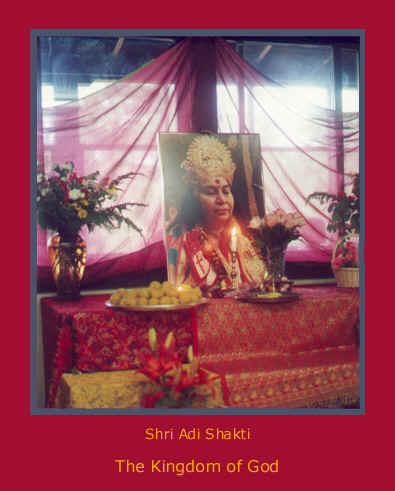 “The critical words ‘but so it was made to appear to them’ clearly indicates that humans did see Him being crucified. They saw Him being crucified and killed (and the body later removed and entombed.) All this did happen but it was made to appear to them that they had crucified and killed Him. But in Reality, ‘for a surety they killed him not.’ This means that they ‘killed’ Him physically, but spiritually He was alive. He never died because the Spirit is eternal. So, for sure they never killed Him — just as no human ever dies as we are all eternal spirits. Shri Jesus was physically crucified but He did not die spiritually. In other words, He was not crucified although it was made to appear so. The spirit is eternal and cannot be crucified, killed, maimed, burnt, or cut, that is, it is indestructible. This was probably the simplest way of explaining a very subtle and complex Truth to illiterate tribal folks.”
First, the visible event is affirmed. The passage says that people saw Jesus crucified and that his body was later entombed. In its proposed distinction, the appearance is not a hallucinated cross or a victim mistaken for Jesus. The cross and bodily death are real in the ordinary historical sense.
Second, the appearance concerns what the event was thought to accomplish. The executioners could observe a dying body and infer that they had ended Jesus altogether. On this reading the mistaken inference was not “a body is suffering,” but “the whole reality of Jesus has been extinguished.” The qualification “for a surety they killed him not” is taken to correct that conclusion: no human act had power to destroy his eternal Spirit.
Third, the referent of “him” changes register. In ordinary speech, “they crucified him” means that Jesus, an embodied person, was physically crucified. In the source’s spiritual register, “they did not crucify him” means that his deepest, deathless reality was not crucified. The two statements are compatible only because they identify different senses in which the person can be spoken of; taken in the same sense, they would contradict one another. This is the decisive hermeneutical move, not an explanation explicitly supplied by the verse itself.
Fourth, the claim becomes universal. The source extends the distinction to every human being: bodily death is real, but the deepest self is said to endure. Its statement that “no human ever dies” must therefore be understood as a theological claim about spiritual continuity, not as a denial of the biological deaths of human beings. Such continuity is a matter of religious and philosophical conviction; it is not established by an account of a crucifixion alone.
The quotation’s speculation about “illiterate tribal folks” is retained to document the supplied source, not adopted as a description of the Qur’an’s first audiences. Neither the verse nor the passage establishes that generalization about their literacy or offers evidence that it explains the form of the revelation.
4. The Difference from Common Islamic Exegesis
A great deal of classical and contemporary Muslim commentary understands 4:157–158 differently: Jesus was not killed or crucified by his opponents, and God raised him. A widespread group of interpretations holds that another person was made to resemble him; other commentators have described the appearance differently. These accounts are interpretations of the verse. The identity and very presence of a substitute are not specified in the Qur’anic words themselves. [7]
The reading advanced in this paper differs in a clear and substantive way: it affirms that Jesus himself was physically crucified and died. To state this difference is not to say that all Muslims think alike, that Muslim interpreters have never considered alternatives, or that a religious community’s exegesis can be dismissed by asking any one person. Gregory R. Lanier surveys alternative readings that stress the opponents’ failure to defeat Jesus, as well as the dominant denial of the crucifixion; his own proposal is one scholarly interpretation, not a Muslim consensus. [8]
The ambiguity of shubbiha lahum makes discussion possible, but it does not by itself prove the AdiShakti explanation. The reading requires an additional premise—that the person’s eternal Spirit, rather than only the bodily individual, is the primary referent of the negation. It also treats God’s raising in 4:158 as consistent with Jesus’ continuing life, while recognizing that many Muslim interpreters understand the raising as the rescue of Jesus from crucifixion. Academic treatments also disagree: Gabriel Said Reynolds has argued for a reading in which the Qur’an accepts Jesus’ death, while Louay Fatoohi disputes harmonizing interpretations and argues that the text denies the crucifixion. Their disagreement is evidence of a live scholarly debate, not proof that all proposed readings carry the same historical weight. [9] [10]
5. The Crucifixion and the Limits of History
Historians widely accept that Jesus was crucified under the Roman governor Pontius Pilate. Early Christian writings and the Gospel narratives testify to his execution. The Roman historian Tacitus later reports that Christus suffered the death penalty under Pilate during Tiberius’ reign. Tacitus does not in that passage specify the method of execution, describe the burial, or attest the resurrection; each source has to be allowed to say what it actually says. [11] [12]
That broad historical judgment should not be inflated into certainty about every narrated detail. The Gospel accounts are religious narratives with differences of emphasis and chronology; the identity of every observer, the details of burial, and the circumstances of the tomb remain matters for source-critical inquiry. Nor does the historical conclusion that Jesus was crucified, by itself, prove that an immortal soul survives death.
Likewise, the resurrection belongs centrally to Christian confession and to the earliest surviving Christian proclamation. Historians can investigate the claims and the convictions of followers, while the claim that God raised Jesus and the claim that the Spirit is indestructible involve theological judgments beyond the bare historical conclusion of execution. A respectful comparison need not force those distinct forms of claim into a single category.
6. Burial Before the Sabbath and the Tomb on Sunday
The chronology in the supplied question requires a correction. Mark 15:42–47 places Joseph of Arimathea’s request for the body and the burial on the day of preparation, before the Sabbath. Joseph wraps the body in linen, places it in a tomb cut from rock, and rolls a stone against the entrance. Mary Magdalene and Mary the mother of Joseph see where he is laid. Mark 16:1–8 places the women’s visit after the Sabbath, early on the first day of the week: they find that the stone has already been rolled away. [13]
John 19:38–42 likewise places the burial on the day of preparation. John names Joseph and Nicodemus and says that they wrap Jesus’ body in linen with spices before placing it in a nearby tomb. These verses do not say that the body was bathed. Mark says that women later brought spices to anoint the body; the separate accounts should not be silently combined into a single detailed procedure. [14]
According to the customary Christian Friday–Saturday–Sunday sequence, Jesus is taken down and buried before the Sabbath, not on Easter Sunday. Easter morning is associated with the women’s visit and the proclamation that he has been raised. The accounts vary in the women named, the setting and descriptions of the messengers, and other details; they should be read carefully rather than made to say precisely the same thing.
7. Mary Magdalene and the Meaning of “Do Not Touch Me”
John 20:11–18 reports that Mary Magdalene sees Jesus near the tomb, at first mistakes him for the gardener, and recognizes him when he speaks her name. She then tells the disciples, “I have seen the Lord!” The King James Version renders his instruction “Touch me not”; the New International Version reads “Do not hold on to me.” Both translations concern a real interpretive issue, and John connects the instruction with Jesus’ not yet having ascended to the Father. [15]
The instruction alone does not establish that the risen Jesus was an intangible spirit or that physical touch was impossible. The Greek permits translation in terms of touching or holding; it does not by itself prove that Mary had already grasped him. John 20:27 later depicts Jesus inviting Thomas to place a finger and hand in his wounds, although it does not say that Thomas did so. [16]
Other Gospel texts have their own emphases. Matthew 28:9 depicts women grasping Jesus’ feet, and Luke 24:39–43 depicts Jesus inviting his disciples to touch him and eating in their presence. The AdiShakti perspective may understand the appearances as disclosure of spiritual life, but “do not touch me” cannot honestly be used as decisive biblical proof of an untouchable or purely immaterial body. [17] [18]
8. The Spiritual Body and the Resurrection
Paul’s first letter to the Corinthians preserves an early tradition that Christ died, was buried, was raised, and appeared to several people and groups, including Cephas, the Twelve, James, and Paul. The list does not mention the women or describe the empty tomb; an omission by itself does not prove that Paul denied either. Later in the chapter Paul contrasts a natural body with a “spiritual body” (1 Corinthians 15:44). [19]
The expression sōma pneumatikon, “spiritual body,” does not settle the question of materiality on its own. The scholar Ben Witherington III reads Paul as describing a transformed body energized by God’s Spirit, not a ghost. Other scholars debate how to understand Paul’s language of spirit, embodiment, and continuity. The dominant historic Christian confession affirms resurrection of the body, transformed and glorified; the AdiShakti interpretation emphasizes the immortality of Spirit. These are related claims, but they should not be presented as identical. [20] [21]
There is a further distinction. Immortality, in this paper’s central argument, refers to a spiritual reality that cannot be destroyed by bodily death. Resurrection, in the New Testament, concerns God’s raising of the dead into life. They may be brought into dialogue, but simple survival of an immortal self is not automatically the same doctrine as resurrection. The paper’s synthesis treats the risen Jesus as a revelation of living Spirit without claiming that this exhausts Paul’s or every Christian community’s meaning.
9. The Indestructible Self and the Bhagavad Gītā
The language in the supplied passage—that the Spirit cannot be cut, burnt, or destroyed—has a close thematic parallel in the Bhagavad Gītā 2:20–23. There the enduring self is distinguished from the perishable body, and weapons, fire, water, and wind are said not to destroy it. The Gītā supplies an illuminating comparative framework for the source’s claim: physical injury has an object, the body, but cannot wound the eternal self as the doctrine understands it. [22]
In a public programme in Milan on September 17, 1984, Shri Mataji Nirmala Devi made a related comparison. A draft transcript records Her saying that Krishna taught that eternal life “cannot be killed, cannot be crucified, cannot be destroyed,” and that Christ’s crucifixion and resurrection made eternal life visible. The quotation is from that talk, not from the book commentary quoted above; the online recording was not independently checked against the draft transcript. [23]
The comparison is illuminating precisely because its terms are not automatically interchangeable. The Gītā’s ātman, Christian accounts of the soul and resurrection, and Qur’anic language concerning divine raising belong to different textual and doctrinal contexts. The proposed identification of their deepest meaning is an AdiShakti comparative synthesis, not a conclusion demanded by any single verse. Nor does the Gītā itself state what happened at Golgotha.
If the immortal-self premise is accepted, the source’s conclusion follows within its framework: an execution can end embodied life without extinguishing the person’s ultimate spiritual ground. If the premise is not accepted, the historical event alone does not demonstrate that conclusion. This conditional structure makes the argument clearer without diminishing its devotional force.
10. A Careful Interreligious Challenge
The proposal invites readers to ask what a claim of victory over Jesus must mean. Does physical death establish that the executioners overcame him in every sense? The AdiShakti answer is no: the destruction of a body is not the destruction of the eternal Spirit. The moral force of the distinction is that visible violence cannot be assumed to have the last word about the worth or destiny of a person.
The challenge also works in the other direction. Readers who endorse the proposal should acknowledge the plain force of the Qur’anic negations and the continuing importance of traditional Muslim commentary. Readers who reject it can still consider whether historical inquiry and faith ask different questions. Disagreement over a verse does not justify contempt for Muslims, Christians, Jews, or any other community.
The Qur’an also contains other passages concerning Jesus and death, including 3:55 and 19:33; their wording and relationship to 4:157–158 are themselves debated. In 3:55 the form mutawaffīka is rendered variously as taking Jesus or causing him to die; its lexical range and the conjunction “and” do not alone resolve the timing or manner of death. In 19:33 Jesus speaks of the day he dies and the day he is raised alive, without specifying crucifixion or a third-day resurrection. These verses add context but do not remove disagreement simply by being placed side by side. To make a bridge between traditions is to offer an interpretation for consideration, not to erase their differences. [24] [25]
Conclusion: The Cross Did Not Destroy the Spirit
The interpretation examined here affirms the reality of Jesus’ physical crucifixion and death, while denying that the cross could annihilate the eternal Spirit. It locates the appearance in an incomplete judgment: observers saw bodily death and could suppose that the life of the whole person had ended. On the AdiShakti reading, the greater reality was that Jesus remained alive in Spirit.
That conclusion is a theological interpretation, not a neutral translation compelled by shubbiha lahum. Common Muslim exegesis, mainstream Christian bodily-resurrection theology, and the Gītā’s account of the self each retain their own distinct commitments. Careful attention to those differences allows the central claim to be presented clearly rather than through an artificial consensus.
References
[1] A. Yusuf Ali, trans. “Surah Al-Nisāʾ 4:157.” The Holy Qur’an; digital translation hosted by Quran.com. The supplied source cites the Amana Corporation edition, 1989.
[2] University of Leeds, Qur’anic Arabic Corpus. “Word morphology: Qur’an 4:157, shubbiha.” Qur’anic Arabic Corpus, n.d.
[3] Mustafa Khattab, trans. “Surah Al-Nisāʾ 4:158.” The Clear Quran, hosted by Quran.com, n.d.
[4] Mustafa Khattab, trans. “Surah Al-Anfāl 8:17.” The Clear Quran, hosted by Quran.com, n.d.
[5] Mustafa Khattab, trans. “Surah Āl ʿImrān 3:169.” The Clear Quran, hosted by Quran.com, n.d.
[6] “Quran and Nag Hammadi Scriptures confirm nature of Jesus’ Crucifixion”, AdiShakti.org, n.d. The site attributes the quoted commentary to Shri Adi Shakti: The Kingdom of God, 1999, p. 1744; the original manuscript and pagination have not been independently checked.
[7] Ibn Kathīr. “Commentary on Qur’an 4:155–159.” Tafsīr Ibn Kathīr, abridged English edition hosted by Quran.com, n.d.
[8] Gregory R. Lanier. “It Was Made to Appear Like That to Them: Islam’s Denial of Jesus’ Crucifixion.” Reformed Faith & Practice, vol. 1, no. 1, May 2016.
[9] Gabriel Said Reynolds. “The Muslim Jesus: Dead or Alive?” Bulletin of the School of Oriental and African Studies, vol. 72, no. 2, 2009, pp. 237–258.
[10] Louay Fatoohi. “The Non-Crucifixion Verse: A Historical, Contextual, and Linguistic Analysis.” American Journal of Islam and Society, vol. 40, nos. 1–2, 2023, pp. 39–76.
[11] Paula Fredriksen and John Dominic Crossan. “Death and Resurrection.” FRONTLINE: From Jesus to Christ, PBS/WGBH, April 1998.
[12] Tacitus. “Annals 15.44.” The Annals of Tacitus, trans. John Jackson, Loeb Classical Library; online at LacusCurtius, University of Chicago.
[13] “Mark 15:42–16:8: The burial and the women at the tomb.” New International Version, Bible Gateway, n.d.
[14] “John 19:38–42: The burial of Jesus.” New International Version, Bible Gateway, n.d.
[15] “John 20:11–18: Jesus appears to Mary Magdalene.” New International Version and King James Version, Bible Gateway, n.d.
[16] “John 20:19–29: The risen Jesus and Thomas.” New American Bible, Revised Edition, United States Conference of Catholic Bishops, n.d.
[17] “Matthew 28:1–10: The women encounter Jesus.” New American Bible, Revised Edition, United States Conference of Catholic Bishops, n.d.
[18] “Luke 24:36–43: The appearance to the disciples.” New American Bible, Revised Edition, United States Conference of Catholic Bishops, n.d.
[19] Paul. “1 Corinthians 15:3–8, 35–54: Resurrection and the spiritual body.” New American Bible, Revised Edition, United States Conference of Catholic Bishops, n.d.
[20] Megan Sauter. “What Does 1 Corinthians 15 Mean?” Bible History Daily, Biblical Archaeology Society, April 18, 2022; discusses Ben Witherington III’s interpretation.
[21] Catholic Church. “Compendium of the Catechism of the Catholic Church,” questions 124–129. Holy See, 2005.
[22] A. C. Bhaktivedanta Swami Prabhupāda, trans. “Bhagavad-gītā 2:20 and 2:23.” Bhagavad-gītā As It Is, Bhaktivedanta Book Trust / Vedabase, n.d.
[23] Shri Mataji Nirmala Devi. “When We Are Seeking the Truth, We Have to Know Also What Is the Truth.” Public Program, Milan, Italy, September 17, 1984; English transcript marked draft, Sahaja Yoga talk archive. Recording not independently audited.
[24] “Qur’an 3:55: English translations compared.” Alim Foundation, n.d. Compare the renderings of mutawaffīka; the verse does not specify crucifixion.
[25] Mustafa Khattab, trans. “Surah Maryam 19:33.” The Clear Quran, hosted by Quran.com, n.d.