![]()
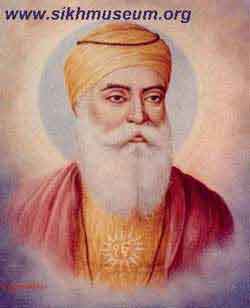
"Guru Nanak taught that the way to connect with the Supreme is ... but through direct personal experience"
"Guru Nanak taught that the way to connect with the Supreme is not through the mind or through rituals, but through direct personal experience. Therefore, He emphasised meditation on the Name and Presence of God. "As fragrance abides in the flower, as reflection is within the mirror, so does your Lord abide within you. Why search for Him without?" He also made it clear that realisation of Self/God is not possible without the compassionate agency of a true guru: "The Guru is my ship to cross the world ocean. The Guru is my place of pilgrimage and sacred stream." "Let no man in the world live in delusion. Without a Guru none can cross over to the other shore." "
Guru Nanak
"Mysticism Of Guru Nanak" by Dewan Singh
Shri Guru Nanak Ji
Guru Nanaka was born into a Hindu family in 1439 in what is now
Pakistan. Following a transformative realisation while bathing in the
river Bein, He gave up his career as an accountant and began to
travel throughout India teaching, composing hymns and establishing
centres of worship known as dharamsalas.
He taught the absolute unity of God; everything is God, and
everything is dependent on the will of God; therefore, spirit and
matter are not ultimately antagonistic. Spirit is the only reality,
and matter is a form of spirit.
"When I saw truly, I knew that all was primeval. Nanak, the subtle
(Spirit) and the gross (material) are, in fact, identical," Guru
Nanak said. "That which is inside a person, the same is outside;
nothing else exists; by Divine prompting look upon all existence as
one and undifferentiated."
It was a time in India's history when Mughal domination had led to
increasing tension between Hindu and Muslim. Seeing the divisiveness
of human religions, He said: "There is no Hindu or Muslim, so whose
path shall I follow? I shall follow the path of God."
Guru Nanak taught that the way to connect with the Supreme is not
through the mind or through rituals, but through direct personal
experience. Therefore, He emphasised meditation on the Name and
Presence of God.
"As fragrance abides in the flower, as reflection is within the
mirror, so does your Lord abide within you. Why search for Him
without?"
He also made it clear that realisation of Self/God is not possible
without the compassionate agency of a true guru:
"The Guru is my ship to cross the world ocean. The Guru is my place
of pilgrimage and sacred stream."
"Let no man in the world live in delusion. Without a Guru none can
cross over to the other shore."
Before His death in 1539, Guru Nanaka chose one of his followers to
take responsibility for establishing the principles He had taught.
The principles were then passed down through a succession of gurus in
the Sikh religion. Sikhism was not initially intended to be a
separate religion from Hinduism or Islam but, due to a long period of
persecution, it became increasingly distinct.
The Concept Of Sahaj
"The concept of Sahaj is central and pivotal in Guru Nanak's mystical
thought. It relates to the highest spiritual state humanly attainable
and has thus deepest connotations attached to it. The ordinary
meaning of Sahaj [is] `just what it should be' or `just normal'. In
other words, a simple human proposition: that a man should become a
man par excellence, a real man; no adhesions, no default, no
accretions, no deviations.
But this paradoxical word Sahaj does not go with mere `saying' or
verbal expression. It is an actuality, a real human state, a tangible
workable human achievement. Guru Nanak himself … experienced directly
the blissful union with God and the concomitant divine manifestations
attending such beatitude.
Sahaj is originally a Sanskrit word which means `having been born
together' and thus something inwardly perceived or intuited along
with one's birth as a human being – a sort of indwelling mystical
principle of divine perception given to man as his birthright and
therefore, a natural and effortless heritage of divinity ingrained in
humanity.
Properly speaking, Sahaj is the very mysticality of religion. It is
the acceptance of inwardness and intuitionism as the true basis of
religion, to the negation of all ritualistic externalities. Sahaj in
this meaning would be the mystical state of a man who has accepted
the divine will. Sahaj, thus, is the highest spiritual state
attainable in Sikhism. It is the highest bliss.
Sahaj connotes a natural slowness and steadiness required for perfect
action. Sahaj is the opposite of inordinate haste. Sahaj is
compactness and self-sufficiency, while haste is flippancy and inner
weakness. Sahaj would mean equipoise, equanimity and equilibrium. It
may be called `balanced perspicacity' or sambuddhata, in the
psychological sense. All true balance and true action (which may be
called Sahaj-karam, as distinct from the self-willed action) engender
aesthetic as well as spiritual pleasure, while spiritual fulfillment
produces infinite bliss."
Mysticism Of Guru Nanak by Dewan Singh
Title: Mysticism Of Guru Nanak
Author: Dewan Singh
ISBN: 8172051417
ISBN-13: 9788172051419, 978-8172051419
Publisher: Singh Brothers

Question: How does one discard all the organization and useless activities (of Sahaja Yoga) and seek her (Holy Spirit/Adi Shakti) only in the Sahastrara (Kingdom of God)?
Answer: Silence on Self
Question: I am still unable to rid myself of catches and other chakra problems despite years of daily (Sahaja Yoga) footsoaking and treatments. What do I do now?
Answer: Silence on Self
Question: I am far from a Sahaja Yoga collective. How do I continue practicing Sahaja Yoga?
Answer: Silence on Self
Question: My collective leader has told me to leave Sahaja Yoga due to some personal problems. What do I do now?
Answer: Silence on Self
Question: Despite being years in Sahaja Yoga I do not agree with what our leaders are doing. I am thinking of leaving my collective. Can you suggest something that will help me continue on my own?
Answer: Silence on Self
Question: I am a Muslim who absolutely am against worshipping of any idol or image. How then is Sahaja Yoga and Shri Mataji compatible with Islam?
Answer: Silence on Self
Question: We are devout Christians who are very uncomfortable with Hindu rituals, and see the same in Sahaja Yoga. Is there any way we can do without such rituals?
Answer: Silence on Self
Question: You loudly claim on your website that all religions and holy scriptures preach the same message. I don't see such evidence. What have you got to say?
Answer: Silence on Self
Question: I do not want to meditate on anything non-Christian but agree that the Holy Spirit is feminine. How do I only worship the Holy Spirit but not the Adi Shakti?
Answer: Silence on Self
Question: My parents and husband are against worshipping Shri Mataji. How can I solve this serious family problem but still continue to practice Sahaja Yoga without their knowledge?
Answer: Silence on Self
Question: I completely agree with your belief that if you have to take a single step in any direction to seek the Divine you are going the wrong way. How and why did you reach this incredible conclusion only now despite spending so many years meditating, checking the scriptures and listening to Shri Mataji's speeches?
Answer: Silence on Self
Question: How can we spread Shri Mataji's message successfully? So many have failed all these years and Sahaja Yoga is very slow. Most of the seekers have never heard of Shri Mataji. Other than Her Divine Message what can we teach new seekers that will attract them?
Answer: Silence on Self
Question: I do not want to follow any religious organization or yoga teacher but still am interested in spirituality. You think that is possible?
Answer: Silence on Self
Question: My mother-in-law is totally against Shri Mataji and regards Her as just another false guru. But I know Shri Mataji is the Adi Shakti and want to continue. However, i do not want to antagonize my mother-in-law. Any suggestions?
Answer: Silence on Self
Question: I am a Sikh. I am completely against any Hindu ritual or worshipping of their idols and gods. Sikhism is completely against such practices. But Sahaja Yoga is also so full of such rituals and gods. What have you got to say, being a Sikh yourself?
Answer: Silence on Self
Question: I am getting somewhat ridiculed for my own spiritual experiences regarding the crown chakra and the divine feminine. People think I'm weird by emphasizing that the Devi is the true nature of brahman and it is creating doubt about my path (despite my own experiences). Should I continue with my meditations and ignore them or try to explain to them? What do you suggest?
Answer: Silence on Self
Question: There is so much information about yoga and meditation. I am so confused and do not know which path to take. What then is the truth? How do I attain it?
Answer: Silence on Self
Question: I have been in Sahaja Yoga for years but still do not know what is Self-realization. Can you tell me in detail what you understand by it?
Answer: Silence on Self
Question: I have been a SY for many years and some of us find shoe- beating and some rituals quite absurd. You also are against them. How then can we solve our subtle system problems without such treatments?
Answer: Silence on Self
Question: I am a Muslim living in Pakistan who want to practice Sahaja Yoga. But there are no centers here. How can I continue?
Answer: Silence on Self
Question: What will happen after Shri Mataji passes away? Will She still be in the photograph? Where will the vibrations come from then?
Answer: Silence on Self
Question: I have just started meditating on Shri Mataji in the Sahasrara but find it very difficult. Is there a better way?
Answer: Silence on Self
Question: I do not want to join Sahaja Yoga but believe in a number of Shri Mataji's teachings. Can you help me?
Answer: Silence on Self
Question: I am an established SYogini who am concerned at the way the organization is heading. However, I still want to spread Shri Mataji's teachings. What do you suggest I tell others?
Answer: Silence on Self
Question: I want to practice meditation but find it impossible to stop the thoughts. I value you opinion. If you don't mind my asking, but how do you do it?
Answer: Silence on Self
Question: What is the shortest and surest route to realize God?
Answer: Silence on Self
Question: Some religions claim that humans are divine in nature and that liberation is from within. Can you tell me how all this is realized in such a hectic and materialistic world?
Answer: Silence on Self
Question: As a SY I am concerned that after Shri Mataji takes Mahasamadhi there will great grief and sense of loss. How can I cope with this eventuality and continue my faith and devotion? Do I continue to meditate on Her photo even though She is not physically present anymore?
Answer: Silence on Self
Question: Jagbir, you are already telling us to discard Shri Mataji's photo and meditate on Her is the Sahasrara. A number of SYs have been offended by this and have left the forum. What makes you so sure you are right?
Answer: Silence on Self
Question: What is the most profound and deepest enlightenment you have discovered after all these years, based on the teachings of Shri Mataji? She also claims that all religions teach the same truth about the spirit. How is that so given all the religious differences and centuries-old rivalry?
Answer: Silence on Self
Question: Hi, man-made religions, sects and denominations are wide spread. So much misdeeds and divisions are committed and blood is shed in the name of God and religion. Is there a way to make humans realize that they are all worshipping the One and same Creator, no matter how different religious organizations have made God to be?
Answer: Silence on Self
Question: It seems that religions are all preaching about a God that is to be found only in their organizations. Why then is it that the Divine can only be realized through one's own experience? What and where is God then?
Answer: Silence on Self
Related Articles:
Who am I - Deepak Chopra
Silence Is God's First Language
On being liberated from the dualities of pleasure and pain
Yoga Methods in Christian Mysticism
Each religion springs from a profound experience of the Spirit
This new mode of being and consciousness is the ...
For the mystics, Jesus was a living embodiment of union with God
Gnosis essentially is act of distinguishing soul from deepest self
People who have never even glimpsed the realm of the sacred
Eckhart Tolle's Teachings and Self-realization are in perfect harmony
Eckhart Tolle's Stillness Speaks and T. A. are in perfect harmony
The Third Jesus: The Christ We Cannot Ignore - Deepak Chopra
Jesus rebukes those who seek access to God elsewhere
Self-Atma: The Teachings of Sri Ramana Maharshi Part One & Two
Guru Nanak taught that the way to connect with the Supreme is ...
Silence on Self (read it regularly till in Silence you realize your Self)
Jesus: "God is spirit, and those who worship him ..."
Self as Spirit: “Jesus answered them ..."
Theosis is a state akin to 'enlightenment'
Look deep within
God (Brahman) exists in every living being
Aim of being reborn known to almost every religion
All Holy Scriptures uphold the Self as Spirit, for Self is God
Allâh is "closer to him (the human) than [his] jugular vein."
Has Yoga strayed from its core?
Yoga is an art of living and not a religious practice
A Christian practicing sahaja yoga meditation
Shri Mataji: "Achieve your Self, become your Self."
Shri Mataji: "But this Judgment is so beautiful."
Shri Mataji: "What Christ said ... is nothing but Advaita."
For if you walk on this road, it is impossible to go astray
Mystic’s discovery of the higher Self is only a step on a greater journey
Shri Mataji: "The ultimate act against the Spirit ..."
Shri Mataji: "Self-Realization will ... lead to the creation of a new race"
A heavenly realm where a great invisible Spirit dwells
What and where is Self/Brahman/God/Being ...?
Archives of FAQs and Articles on Shakti/Last Judgment/Qiyamah
Homepage