The Ninth Commandment
"You shall not covet your neighbor's wife.” The ninth commandment states that every one who looks at a woman lustfully has already committed adultery with her in his heart.


“You shall not covet your neighbor's house; you shall not covet your neighbor's wife, or his manservant, or his maidservant, or his ox, or his ass, or anything that is your neighbor's.298
Every one who looks at a woman lustfully has already committed adultery with her in his heart.299
St. John distinguishes three kinds of covetousness or concupiscence: lust of the flesh, lust of the eyes, and pride of life. 300 ... The heart is the seat of moral personality: "Out of the heart come evil thoughts, murder, adultery, fornication ...”304 Baptism confers on its recipient the grace of purification from all sins ...
"The Good News of Christ continually renews the life and culture of fallen man; it combats and removes the error and evil which flow from the ever-present attraction of sin. It never ceases to purify and elevate the morality of peoples. It takes the spiritual qualities and endowments of every age and nation, and with supernatural riches it causes them to blossom, as it were, from within; it fortifies, completes, and restores them in Christ.” "315
(298. Ex 20:17; 299. Mt 5:28; 304. Mt 15:19; 315. GS 58. 4.)
Joseph Cardinal Ratzinger, Catechism of the Catholic Church, USSC Inc,. 1994, p. 601-5.
The 10 Commandments in the Old and New Testaments
The following chart identifies references to the 10 Commandments in both the Old and New Testaments.
Old Testament New Testament
First Commandment Exodus 20:3; Deuteronomy 5:7
Matthew 4:10; Luke 4:8; Revelation 14:7
Second Commandment Exodus 20:4-6; Deuteronomy 5:8-10
Acts 15:20; 1 Corinthians 6:9-10; Galatians 5:19-20; Ephesians 5:5
Third Commandment Exodus 20:7; Deuteronomy 5:11
Matthew 5:33-37; 1 Timothy 6:1; James 2:7
Fourth Commandment Exodus 20:8-11; Deuteronomy 5:12-15
Luke 4:16; 23:55-56; Acts 17:1-2; 18:4; Hebrews 4:9; 1 John 2:6
Fifth Commandment Exodus 20:12; Deuteronomy 5:16
Matthew 15:4-9; 19:19; Mark 10:19; Luke 18:20; Romans 1:29-30; Ephesians 6:1-3
Sixth Commandment Exodus 20:13; Deuteronomy 5: 17
Matthew 5:21-22; 19:18; Mark 10:19; Luke 18:20; Romans 1:29-30; 13:9
Seventh Commandment Exodus 20:14; Deuteronomy 5:18
Matthew 5:27-28; 19:18; Mark 10:11-12, 19; Luke 16:18; 18:20; Romans 7:2-3; 13:9
Eighth Commandment Exodus 20:15; Deuteronomy 5:19
Matthew 19:18; Mark 10:19; Luke 18:20; Romans 13:9; Ephesians 4:28; 1 Peter 4:15; Revelation 9:21
Ninth Commandment Exodus 20:16; Deuteronomy 5:20
Matthew 19:18; Mark 10:19; Luke 18:20; Acts 5:3-4; Romans 13:9; Ephesians 4:25
10th Commandment Exodus 20:17; Deuteronomy 5:21
Luke 12:15; Romans 1:29; 7:7; 13:9; 1 Corinthians 6:9-10; Galatians 5:19-21; Ephesians 5:3, 5
www.https://lifehopeandtruth.com/
Web (January 3, 2014
Beatissimus Pater (Most Blessed Father), Urban VI"one of the most spiteful and vile-tempered of pontiffs"had three passions — drink, religion and revenge. The combination of three proved lethal to his foes, who met agonizing deaths in his torture chambers. Pope Alexander V also had three passions — food, servants and money. He was excessive in two and astounding in the other, namely servants. He kept more than four hundred of them — all female.
John Gratian, Archpriest of St John and godfather, advised Pope Benedict IX, that he was entitled to pursue his beautiful cousin and even took the trouble to find a suitable successor — himself.
His Holiness Sylvester was no saint. After divorcing his first wife he sired six children by the second. When she became jaded he dumped her and married a third from whom he had two daughters. In between he had another daughter by a concubine.”Childless by his fourth wife, when she died he kept four concubines — twelve was his life-long tally — and had at least one child by each.”
It was indeed an ungodly union. Rome, already steeped in a history of gluttony, lust and barbarism, was indeed a warm womb for the Prince of Darkness. The Beast repeatedly mounted the insatiable, wanton Vatican Whore and impregnated deep inside her the seed of Evil!
Women"Were warned not to enter St John Lateran if they prized their honour.”Our Blessed Father John XII was always on the prowl.
Sanctissimus dominus noster (Our Most Holy Lord) John XII became pope at sixteen. He invented sins"not known since the beginning of the world, including sleeping with his mother.”He"even toasted the Devil.”
"God likes to fool us: Catholics are forbidden to doubt"The legitimacy of papal elections"— in which fallible mortals choose an infallible Pope. The copious historical evidence that the chain of Apostolic succession was broken more than once during the Middle Ages is just one of those tricks, like fossil evidence of evolution, that God sometimes uses to tempt the evil ones—the rational—in revealing themselves.”
The Globe and Mail
July 6, 1998 (Spider Robinson, The Crazy Years)

"The Popes at (1309-77) Avignon
Historians who repeat the Catholic claim that the thirteenth century is the greatest in history fail to explain why it closed with and was followed by a long period of degradation of the Papacy and ruin of the city of Rome. Boniface VIII (1294-1303), one of the most depraved and sceptical of the Popes , was soon followed by Clement V, who secured the tiara by a corrupt deal with Philip of France and was obliged to transfer his Court to that country. In order to evade paying the price he had promised — public exposure of the vices of Boniface VIII and of the Knights Templars — he fled to Avignon. The principality of Avignon had until that time belonged to the Queen of Naples, but the Pope bought it from her for the ridiculous sum of 40,000 — it contained several towns besides the rich city of Avignon — and, which was the real price, a promise of absolution for her notorious crimes and vices. The sojourn of the Popes in the city for more than sixty years is called by the older Catholic historians"The Babylonian Captivity," though it was voluntary, and they admit that it was one of the very corrupt periods of Papal history. The famous Italian scholar Petrarch, one of the most respected men of the age, then lived in exile near Avignon, and he has left us a shuddering indictment of its vices, natural and unnatural, in his Latin Letters Without a Title. This is one of the hundreds of documents of great interest which tell the true character of the Middle Ages that have never been translated into English. Few pictures in the history of morals are more repellent. Even when fairly respectable Popes were on the throne the Papal Court remained sordid. See also Les Papes d'vignon (1914), by O. Mollat (Catholic), and La prostitution du XIII au XVII siècle (1908), by Dr. L. Le Pileur (who reproduces amazing documents from the city archives). It is a Catholic fable that the prayers of St. Catherine of Siena drew the Popes back to Italy. Rome, stung by the progress and prosperity of North Italy while it remained on the level of a village, threatened again to reject their authority if they did not return.”
Dr. Jacob McCabe, Rationalists Encyclopaedia
https://www2.prestel.co.uk/littleton/jmsimony.htm
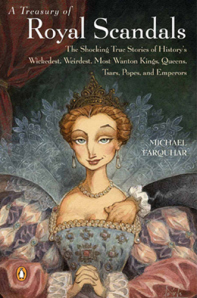
A Treasury of Royal Scandals: The Shocking True Stories History's Wickedest, Weirdest, Most Wanton Kings, Queens, Tsars, Popes, and Emperors
Michael Farquhar, Penguin Books; (10) edition (May 1, 2001)
Part IX - Death Be Not Dignified
“A Lot Off The Top"
Marie Antoinette's enduring reputation for decadent extravagance is not entirely unearned. Even if she never actually dismissed reports of widespread bread shortages with the infamous line," Let them eat cake," her lavish lifestyle nevertheless flew smack in the face of the abject poverty and hunger that surrounded her. The puffed and powdered queen blithely ignored the misery, immersing herself instead in a cycle of elaborate ceremony, obsessive spending, and absurd fashion.
"The queen is a pretty woman," her brother, the Austrian emperor Joseph II, wrote during a visit to France in 1777," but she is empty-headed, unable as yet to find her advantage, and wastes her days running from dissipation to dissipation, some of which are perfectly allowable but nonetheless dangerous because they prevent her from having the thoughts she needs so badly.”
Maybe it was the big hair. Piles and piles of it. The enormous coiffures the queen so fancied—hours spent in their construction, reaching several feet high, and elaborately decorated with fruits, feathers, jewels, and figurines— seemed to sum up her entire vacuous existence. The head that carried this frivolous mass would eventually be lopped off amid the screeches of revolutionary madness, but it was the degrading existence Marie Antoinette was forced to endure just prior to her public execution that offered the starkest contrast to her former life as France's over-pampered queen.
Whereas she once amused herself amid the glitter and luxury of Versailles with hundreds of fawning nobles eagerly competing to attend to her every whim, she was now held in a blackened prison cell that dripped with moisture and was kept frigid in the absence of a fireplace. The rich gowns and adornments were all gone, replaced by a single frayed black dress. Deprived of her children, or even the comfort of a single candle at night, the former queen—now known as prisoner number 280—suffered illness and severe anxiety all alone on a narrow, filthy cot.
She was taken from her cell to appear before the Revolutionary Tribunal, which was an utter travesty. Absurd accusations of murder, treason, and even incest with her own son were hurled at"The Austrian Bitch," as she was called, without any consideration for the truth. It was here, however, that the once flighty and spoiled queen proved her mettle. She addressed the court with dignity and honor, seeming to transcend the deadly spectacle that engulfed her.
"One saw sadness in the faces of the honest spectators," an eyewitness of the trial recorded," and madness in the eyes of the crowd of men and women placed in the room by design—madness which, more than once, gave way to emotions of pity and admiration. The accusers and judges did not succeed in hiding their anger, or the involuntary confusion they felt at the Queen's noble firmness.”
The preordained verdict was death—the same fate her husband Louis XVI had met nine months earlier.1 The ex-queen was brought back to her miserable cell to await the guillotine. On the appointed day, October 16, 1793, she sent farewells to her children and in her prayer book wrote," My God have pity on me! My eyes have no more tears to shed for you, my poor children. Adieu. Adieu!"
She then had to prepare herself for the execution scheduled for midday. When she was queen, Marie Antoinette always had a giddy coterie on hand as she picked out the day's wardrobe and took her luxurious bath behind a screen for modesty. Now there was only one woman assigned to her. Bleeding heavily, she asked the maid to stand in front of her while she undressed and changed her soiled undergarments.”The [guard] came up to us at once," the woman recalled," and, standing by the headrest, watched her change. She put her fichu up to cover her shoulders, and with great sweetness said to the young man, 'In the name of decency, monsieur, let me change my linen in private.'"The guard, claiming he had orders to watch the prisoner's every movement, refused to look away, so the former queen was forced to take off her stained petticoat with as much modesty as she could manage and stuff it into a chink in the wall.
Soon it was time to go. The executioner, who happened to be the son of the man who had beheaded Louis XVI, came in to tie up her hands and cut off her hair. She had hoped that she would be carried to the execution site in a coach, as her husband had been, but saw when she left the prison that a cart awaited her—a cart used to carry common criminals to their deaths. Feeling her bowels loosen, the former queen of France had to request that her hands be unbound so she could relieve herself against the prison wall.
Riding backwards on the cart to the Place de la Revolution, she stoically endured the jeers of the inflamed crowds that lined the route. It was a festive occasion all around. In the square where the guillotine stood, people were selling fruits and wine to the excited onlookers who closed in around the scaffold to watch"The Widow Capet"lose her head.
In the middle of this horrific circus, Marie Antoinette—looking old well beyond her years, with her white hair shorn—remained calm and dignified. Accidentally stepping on the executioner's foot as she ascended the scaffold, she apologized gently.”Pardon, monsieur. I did not mean to do it.”She was then tied down on the beheading machine and the wooden collar was snapped around her neck. In an instant the head was severed and held aloft for all to see. The crowd roared its approval.
Editorial Reviews
From Publishers Weekly
In another royal exposé, Farquhar, a writer at the Washington Post, duplicates some of the ground covered in Karl Shaw's Royal Babylon, such as Peter the Great's delight in administering torture (he had his son lashed to death) and the way Britain's Queen Mary cajoled her subjects into giving her their household treasures ("I am caressing it with my eyes," she would coyly coo). Written in a provocative tabloid style (with headings like"We Are Not Abused. We Are Abusive," “A Son Should Love His Mother, But...”and"All the Holiness Money Can Buy"), Farquhar publicly washes the dirty laundry of not only European royalty, but also of Roman emperors and popes. Murderers and torturers who slept with their siblings (and other relatives), the emperors of Rome excelled at corruption. The maniacal pedophile Tiberius Caesar (A.D. 14-37) left the corpses of his many victims to rot on the Gemonian Steps, which descended from the Capitol to the Forum, or alternatively enjoyed watching them being thrown from a cliff (“A contingent of soldiers was stationed below to whack them with oars and boat hooks just in case the fall failed to do the trick"). Many popes were no better. Not content with just rooting out Christian heretics by launching a bloody crusade against the Cathars in southern France, Innocent III (1160-1216) declared himself ruler of the world. He sacked Constantinople and massacred every Muslim he could find. Like Royal Babylon, this gossipy string of anecdotes is a popularized rather than an authoritative history and perfect for travel reading.
The Popes of the Renaissance
Against the Catholic assertion that the Church was instrumental in Europe's recovery, historical evidence suggests the opposite. The forces driving this renewal were largely secular, and the emerging Renaissance culture often openly defied Christian ethics. Furthermore, the Papacy was largely an idle spectator during this period. When it eventually began to engage by patronizing art and letters, the Papal Court, most Popes, and the majority of Italian bishops embraced the era's characteristic vices. This pattern began with the "Babylonian Captivity" in Avignon, which contemporaries like Petrarch described as a sink of iniquity, and continued through the greed and chaos of the Great Schism. Even after the Schism was resolved, calls for reform were ignored, and early efforts to revitalize Rome were modest at best.
The subsequent centuries saw the Papacy sink deeper into corruption, with powerful Roman families exploiting every source of tainted wealth-from the sale of indulgences to offices-to dominate the Church. A parade of Popes from the mid-15th to the mid-16th century were notoriously immoral, including Nicholas V, who patronized obscene writers; Sixtus IV, who promoted his corrupt nephews and connived at murder; and Alexander VI and Julius II, whose pontificates form a uniquely sordid chapter in religious history. This systemic corruption, documented even in sympathetic Catholic histories and the private diaries of Vatican officials, persisted through the Reformation and beyond. Despite brief, partial attempts at reform, the gaiety and license of the Papal Court continued for over a century, closing with the scandalous pontificates of Urban VIII and Innocent X.
https://www.big-lies.org/rationalism/joseph-mccabe-religious-wars.htmlWeb (October 22, 2013)

Paedophile cases haunt the church
"Following these and other allegations made during the 1990s, the Christian Brothers, the Oblates of Mary Immaculate and the Sisters of Mercy have issued public apologies for abuse inflicted over the years in their institutions.
The Christian Brothers have also been implicated in sex scandals in Canada. More than 300 former pupils at Mount Cashel orphanage, Newfoundland, have alleged the lay brothers abused them.
The scandal forced the order to sell property and assets to pay legal and compensation bills"
BBC, Wednesday, 19 July, 2000
“A Roman Catholic priest has been jailed for seven years for sexually abusing boys at an orphanage.
The offences took place at the Father Hudson Society's home in Warwickshire, between 1957 and 1965. Some of the boys were as young as six.
Father Eric Taylor, 78, was convicted at Warwick Crown Court on 16 charges of indecent assault and two more serious charges on boys at the Father Hudson's home in Coleshill, Warwickshire....
Another told the BBC about a reign of terror at the home, which he called Taylor's"harem.”
However, some were not around to see Taylor sent down, having committed suicide because they could not live with what the priest had done to them.”
BBC, Thursday, April 30, 1998

Catholic sex abuse scandal fallout spreads in Europe
Friday, 23 April 2010
VATICAN CITY (Reuters) - Fallout from the Catholic child sex abuse scandal spread across Europe on Thursday as the Vatican retired an Irish bishop, a German offered to step down and prelates in England and Wales apologised for the "terrible crimes"of priests.
The Vatican said Pope Benedict, under criticism from victims for not doing enough about past cases of abuse by priests now being revealed, had accepted the resignation of Bishop James Moriarty, the third Irish bishop to leave over the scandal.
In Germany, Walter Mixa, who is bishop for Augsburg and for the German armed forces, offered to resign late on Wednesday after admitting he physically abused children decades ago.
Bishops in England and Wales issued an apology for the scandal and urged Catholics there to pray for the Church.
Moriarty said in a statement that he was auxiliary bishop of Dublin from 1991 to 2002, before child protection policies were implemented.
"I accept that from the time I became an auxiliary bishop, I should have challenged the prevailing culture," he said. "I apologise to all survivors and their families.”
Hundreds of cases of sexual and physical abuse of youths in recent decades by priests have come to light in Europe and the United States in the last month as disclosures encourage long-silent victims to finally go public with their complaints.
MORE TO COME IN IRELAND?
Moriarty was the second of four Irish bishops retired by the Vatican after being named in an official report last year as Church leaders who hid predator priests. Two others have offered their resignations but Rome has not yet decided their cases.
Bishop John Magee, a former personal secretary to the past three popes, had his resignation letter accepted last month after he was accused in a separate Church report of mishandling sex abuse cases in his diocese of Cloyne.
There have been growing calls for the head of the Irish Church, Cardinal Sean Brady, to quit over his role in covering up a sexual abuse case in 1975. He has not offered to resign.
Mixa, an outspoken conservative bishop, was accused of slapping and hitting children while he was a parish priest in a small town in the pope's native Bavaria the 1970's and 1980s.
He was not accused of sexual abuse, but his admission of slapping children after weeks of denials prompted calls for him to quit. Mixa also faces allegations of financial misconduct.
"With his resignation, he wants to avert further damage to the Church and to allow a new start," the Augsburg diocese said in a statement. The Vatican has not yet responded.
Catholic bishops in England and Wales said child abuse in the Church had received so much attention recently that they wanted to address the issue "directly and unambiguously.”
"We express our heartfelt apology and deep sorrow to those who have suffered abuse, those who have felt ignored, disbelieved or betrayed," they said in a statement.
The bishops said Catholics belonged to a single Church worldwide, so"These terrible crimes, and the inadequate response by some church leaders, grieve us all.”
SCANDALS STAY IN HEADLINES
The Church in England and Wales had a wave of abuse scandals about 20 years ago and reforms have since been introduced.
The scandal haunting the Catholic Church worldwide looks set to stay in the headlines for weeks to come.
In Germany, government-sponsored"round table talks"Will open in Berlin on Friday to investigate child abuse in Catholic, Protestant and secular schools. A Catholic Church hotline for abuse victims there has been inundated with calls.
An inquiry run by a Protestant politician in the Netherlands is probing abuse cases in Catholics schools there. Rotterdam Bishop Adrianus van Luyn, head of the Dutch bishops' conference, has come under fire after admitting he knew of abuse cases in his Salesian order back in the late 1970's.
A retired senior Vatican prelate, Cardinal Dario Castrillon Hoyos, has caused another controversy by saying a recently published letter he wrote in 2001 congratulating a French bishop for hiding a predator priest was written with the blessing of the late Pope John Paul.
(Writing by Tom Heneghan, Editing by Angus MacSwan)
Reuters, Friday, 23 April 2010

"Sex as an act that empowers the individual threatens a religion intent upon controlling society.”
Chapter Three
Deciding upon Doctrine: Sex, Free Will, Reincarnation and the Use of Force
300 - 500 C.E.
"The Church formulated its doctrine regarding sex, free will
and reincarnation in response to early heretics. In each case, it
chose ideological positions which best justified Church control
over the individual and over society. The Church also developed
a doctrine which justified its use of force in order to compel
obedience. It was not long before the Church needed that
doctrine to defend its violent suppression of heresy.
'Heresy' comes from the Greek hairesis meaning 'choice.'1
In the early centuries there was much to choose from within
Christianity—and consequently, many heresies. Gnostics were
joined by Marcionites, Montanists, Arians, Sabellians,
Nestorians, Monophysites, the Copts in Egypt, the Jacobites in
Syria, and the Armenian Orthodox Church in disagreeing with
the Catholic Church. The heresies surrounding Pelagius, Origen,
and the Donatists led to particularly significant new doctrine.
The Mannichaean heresy, while not leading to specific doctrine,
set a precedent for the Church's denial of unpopular aspects of
its own ideology.
The Pelagian controversy brought about Church doctrine
regarding human free will and sexuality. Pelagius, an Irish monk
who arrived in Rome at the beginning of the fifth century,
believed that a person had freedom of will and responsibility for
his or her actions. He believed that a person's own efforts play
a part in determining whether or not he or she will be saved. In
Pelagius's eyes, reliance upon redemption by Christ should be
accompanied by individual responsibility and efforts to do good.2
In granting humans responsibility for their acts, the Creator gave
them freedom. As one historian writes:
Pelagius fought for the immeasurably precious
good of man's freedom. That freedom cannot be
surrendered without loss of human dignity...
Unless man's freedom to make his own decisions
is recognized, he is reduced to a mere
marionette. According to Pelagius, the Creator
conferred moral authority upon man, and to
detract from that authority is to cast doubt upon
man's likeness to God.3
Pelagius' most vehement opposition came from St. Augustine,
the celebrated Doctor of the Church and Bishop of Hippo.
Salvation, as Augustine saw it, is entirely in God's hands; there
is nothing an individual can do. God has chosen but a few people
to whom He will give bliss and salvation. It is for these few that
Christ came into the world. All others are damned for all
eternity. In Augustine's eyes, it is only God's grace and not any
action or willingness on the part of the individual that leads to
salvation.
Augustine believed that our freedom of will to choose good
over evil was lost with the sin of Adam. Adam's sin, that, in
Augustine's words, is in the 'nature of the semen from which
we were propagated,' brought suffering and death into the
world, took away our free will, and left us with an inherently
evil nature.4 To sin is now inevitable. Should we occasionally do
good, it is only because of irresistible grace. 'When, therefore,
man lives according to man, not according to God, he is like the
devil,' Augustine wrote.5
An individual, according to Augustine,
has little power to influence his or her predetermined fate and is
entirely dependent upon God for salvation.
Human sexuality, to Augustine, clearly demonstrates a human
inability to choose good over evil. Augustine based this belief
upon his own experience. Having himself led a promiscuous life
in his youth during which he fathered and then abandoned an
illegitimate child, he thought that sex was intrinsically evil. He
complained of sexual desire:
Who can control this when its appetite is
aroused? No one! In the very movement of this
appetite, then, it has no 'mode' that responds to
the decisions of the will... Yet what he wishes he
cannot accomplish... In the very movement of
the appetite, it has no mode corresponding to the
decision of the will.6
According to Augustine, human will is powerless either to
indulge sexual desire or to suppress it:
But even those who delight in this pleasure are
not moved to it at their own will, whether they
confine themselves to lawful or transgress to
unlawful pleasures; but sometimes this lust
importunes them in spite of themselves, and
sometimes fails them when they desire to feel it,
so that though lust rages in the mind, it stirs not
in the body. Thus, strangely enough, this
emotion not only fails to obey the legitimate
desire to beget offspring, but also refuses to
serve lascivious lust; and though it often opposes
its whole combined energy to the soul that resists
it, sometimes also it is divided against itself, and
while it moves the soul, leaves the body
unmoved.7
'This diabolical excitement of the genitals,' as Augustine
referred to sex, is evidence of Adam's original sin which is now
transmitted 'from The Mother's womb,' tainting all human
beings with sin, and leaving them incapable of choosing good
over evil or determining their own destiny.8
Augustine's views regarding sexuality differed sharply from
pre-Christian views which often considered sex to be an integral
part of the sacredness of life. His views did, however, represent
those of many Christians. With the exception of minor heretical
groups such as the Gnostic Carpocratians who exalted sex 'as a
bond between all created things,'9 nearly all Christians thought
that sex should be avoided except for purposes of procreation.
St. Jerome warns, 'Regard everything as poison which bears
within it the seed of sensual pleasure.'10 In her book Adam, Eve
and the Serpent, Elaine Pagels writes:
Clement (of Alexandria) excludes oral and anal
intercourse, and intercourse with a menstruating, pregnant, barren, or menopausal wife and
for that matter, with one's wife 'in the morning',
'in the daytime', or 'fter dinner'. Clement
warns, indeed, that 'not even at night, although
in darkness, is it fitting to carry on immodestly
or indecently, but with modesty, so that whatever
happens, happens in the light of reason...' for
even that union 'which is legitimate is still
dangerous, except in so far as it is engaged in
procreation of children.'11
Sex as an act that empowers the individual threatens a religion
intent upon controlling society. As Clement said, 'lust is not
easy to restrain, being devoid of fear...'12
Denying human free will and condemning sexual pleasure
made it easier to control and contain people. Augustine wrote:
...man has been naturally so created that it is
advantageous for him to be submissive, but
disastrous for him to follow his own will, and
not the will of his creator...13
He believed that Adam's 'sin was a despising of the authority of
God... it was just that condemnation followed...'14 Augustine
wrote to the bishop of Rome in 416, warning him that Pelagian
ideas undermined the basis of episcopal authority and that
appeasing the Pelagians would threaten the Catholic Church's
new-found power.15 Augustine's friend, the African bishop
Alypius, brought 80 Numidian stallions to the imperial court as
bribes to persuade the Church to side with Augustine against
Pelagius. Augustine won. In April of 418 the pope
excommunicated Pelagius. Ever since, the Catholic Church has
officially embraced the doctrine of hereditary transmission of
original sin.16"
Helen Ellerbe, The Dark Side of Christian History
Morningstar Books (July 1, 1995) pp. 35-9
Note: 1. Evrett Ferguson, Michael P. McHugh & Frederick W. Norris, Encyclopedia
of Early Christianity (New York & London: Garland Publishing, 1990) 420.
2. Walter Nigg, The Heretics: Heresy Through the Ages (New York: Dorset
Press, 1962) 138.
3. Ibid., 138.
4. Elaine Pagels, Adam, Eve and the Serpent (New York: Random House, 1988)
107.
5. Saint Augustine, The City of God, Book XIV, Ch.4, translated by Marcus
Dods (New York: The Modern Library, 1950) 445.
6. Pagels, Adam, Eve and the Serpent, 141.
7. Augustine, The City of God, Book XIV, Ch. 16, 465.
8. Pagels, Adam, Eve and the Serpent, 131-134.
9. Nigg, The Heretics, 37.
10. Barbara Walker, The Wman's Encyclopedia of Myths and Secrets (San
Francisco: Harper & Row, 1983) 910.
11. Pagels, Adam, Eve and the Serpent, 28.
12. Ibid., 45.
13. Ibid., 107.
14. Augustine, The City of God, Book XIV, Ch. 15, 462.
15. Pagels, Adam, Eve and the Serpent, 125.
16. Ibid., 129-130, 134.

 THE NINTH COMMANDMENT