


The prophecies of Nostradamus
Battle
Of Armageddon
Eyes
closed, opened by antique imagination,
The
habits of those alone will be brought to nothing:
The
great monarch will chastise their frenzy,
Attacking
the treasures before the temples.
Century 2:11
Eyes
that were closed will be opened by an ancient understanding.
The
aura and environment of those who have been alone will be
proved pointless,
And
the religious leaders and those that have an investment in
continuing fear will chastise the enthusiasm of the rest,
Putting
the newfound treasures as useless.
Manuela Dunn
Mascetti and Peter Lorie
Nostradamus: Prophecies for
Women
(Manuela Dunn
Mascetti and Peter Lorie, Nostradamus: Prophecies for
Women, Simon & Schuster, 1995, p. 187.)
Eyes
closed, opened by antique imagination,
The
devotees of the Great Holy Mother practice a very
ancient art of Kundalini awakening that connects them with Universal Mind
or Collective Consciousness.
With physical eyes closed in deep meditation and their Third
Eye opened by the revolutionary Sahaja Yoga, they journey
into the Kingdom of God within. The guardians of
religious regimes know nothing of the Kundalini that not
only all Messengers spoke of, but is also recorded in all
scriptures.
"The
word Kundalini is derived from a Sanskrit word 'Kundal' meaning coiled
up. It is the primordial dormant energy present in three-and-a-half, coils
at the base of the spine in a triangular bone called the Sacrum. The Latin
name 'Os Sacrum' suggests that it is a holy or sacred part of the
body. The ancient Greeks were aware of this and therefore they called it
the 'Hieron Osteon', noting that it was the last bone to be destroyed
when the body is burnt, and also attributed supernatural powers to it.
Egyptians also held this bone to be very valuable and considered it the
seat of special power.
In
the West, Sacrum is symbolised by the sign of Aquarius and by the Holy
Grail, container of the water of life.
The
Kundalini, which is to nourish the tree of life within us, is coiled up
like a serpent and therefore it has been called, 'The Serpent Power'.
It has been described in great detail in the Upanishads. Kundalini Yoga is
supposed to be supreme in all the Yogas. Guru Vashistha asserted that
Kundalini is the seat of absolute knowledge. The awareness of the presence
of this primordial energy Kundalini within the human body was considered
by the sages and saints to be the highest knowledge. The Kundalini and
Chakras have been vividly described in Vedic and Tantric texts.
Adi
Sankaracharya
He
lived in the 7th-8th century AD. and wrote:
"Having
filled the pathway of the Nadis with the streaming shower of nectar
flowing from the Lotus feet, having resumed thine own position from out
of the resplendent Lunar regions and Thyself assuming the form of a
serpent of three and a half coils, sleepest thou, in the hollow of Kula
Kunda (Kula Kunda means the hollow of Mooladhara Sacrum bone)."
"Saundarya
Lahari': 'Thou art residing in secrecy with Thy Lord (The spirit) in
the thousand petalled Lotus, having pierced through the Earth situated
in 'Mooladhara', the Water in Manipura, the Fire abiding in the
Svadhisthana, the Air in the Heart ('Anahata'), the Ether above (Visshuddhi)
and 'Manas' between the eyebrows ('Agnya') and thus broken
through the entire 'Kula Path'."
Gyaneshwara
Gyaneshwara,
another famous saint of Maharashtra born around 1275 AD, described
Kundalini in the 6th chapter of his famous book 'Gyaneshwari'. He
wrote:
'Kundalini
is one of the greatest energies. The whole body of the seeker starts
glowing because of the rising of the Kundalini. Because of that, unwanted
impurities in the body disappear. The body of the seeker suddenly looks
very proportionate and the eyes look bright and attractive and the
eyeballs glow.' — (Gyaneshwari, Chapter VI).
Guru
Nanak Dev
(born
in 1496 AD) has made references to Kundalini awakening as mentioned below:
"A
pure heart is the golden vessel to fill the Divine Nectar which is to be
sucked from the 'Dasham Dwar' through the two channels 'Ida' and
'Pingala'." Dasham Dwar means Brahmarandhra. (Sahasrara Chakra).
"God
has made this human body a house with six Chakras and has established
the light of spirit in it. Cross the ocean of Maya and meet the eternal
God who does not come, who does not go, who neither takes birth nor
dies. When your six Chakras meet in line, Surati (Kundalini) takes you
beyond distortions.' (Sri Guru Granth). Note that the seventh Chakra
was not open at this time."
In
the Holy Koran
Prophet
Mohammed Sahib talked of the day of resurrection when he says that the 'hands
will speak'. 'That day, we set a seal on their mouths, but their hands
will speak to us, and their hands bear witness to all that they did.'
When Kundalini awakening occurs, a flow of energy in the form of cool
vibrations from the hands is experienced, and the various Chakras can be
felt on parts of the hand and fingers.
In
the West
Christians
called it a reflection of the Holy Ghost, and worshipped its
manifestations as tongues of flames over the heads of apostles during the
Pentecost reunion.
Moses
Moses
saw it in the form of the burning bush. During the exodus the Israelites
lost faith and were smitten by fiery serpents so God told Moses "make
thee a serpent, and set it upon a pole: and it shall come to pass, that
everyone that is bitten, when he looketh upon it, shall live. And Moses
made a serpent of brass, and put it on a pole, and it came to pass, that
if a fiery serpent had bitten any man, when he beheld the serpent of
brass, he lived" An apt description of the healing qualities of the
awakened Kundalini. Some of the Israelites even began to worship this
symbol, and the practice of worshipping the brazen serpent on the pole as
a god was either passed on, or was revived later. Bronze and stone serpent
artifacts have been found in excavations in Canaan, Gezer and other parts
of Israel!
Jesus
The
Old Testament symbol becomes significant in Christianity when Christ
suggests Kundalini awakening, not just for the tribe of Israel but as the
true destiny of all Christians: "And as Moses lifted up the serpent
in the wilderness, even as the son of man be lifted up: That whosoever
believeth in him should not perish but have eternal life" He says
unequivocally in the Gnostic Gospel of Thomas and elsewhere, that 'The
Holy Spirit is My Mother'. 'The Kingdom of God is within you' (Luke
17:21).
Tao
In
the Tao Te Ching the primordial power is described as that of a mother.
Lao Tze described Kundalini as the "spirit of the valley" (in
which flows the Nadi of Sushumna). The spirit of the valley never dies.
The spiritual instrument within us can be described as a microcosm
(miniature form of creation) which links us with the Divine. The ancient
esoteric text "Scripture of the Golden Flower" also spoke of the
effects of the awakened kundalini energy.
Buddhism
The
Lord Buddha spoke of the "middle path" to achieve nirvana. He
was actually describing the central channel (sushumna) through which the
Kundalini ascends. Later Buddhist masters considered that the existence of
the path of liberation within a human being was the greatest secret. They
transmitted it to only a few deserving disciples.
Other
Cultures
One
also finds symbols of Kundalini in many different cultural legacies, such
as Mercury's serpent which is an alchemical symbol for the process of
psychic metamorphosis. The Gnostics understood the serpent to represent
the spinal cord. In ancient Greek and later, Roman mythology, we find
Asclepius, the god of healing. He is seen holding a staff which is
entwined with a serpent (or sometimes two). Why did the Greeks relate this
symbol to healing? The staff represents the central support of the human
body or spinal cord (physical location of the sushumna. In Rome Aescaluius
came to be represent mercury who usually held a healing staff called the
Caduceus. The one or two coiled snakes or serpents entwined around the
staff, represent the kundalini which rises along the central subtle
channel in a spiral double helical movement.
Summary
The
Kundalini is there to nourish, to heal and look after and to give an
individual a higher and deeper personality. The power of Kundalini is
absolute purity, auspiciousness, chastity, self respect, pure love,
detachment, concern for others and enlightened attention, to give infinite
joy and peace to an individual. "
Knowledge of Reality
Historical
Sources and Knowledge of Kundalini
(Issue 14)
"A
KABBALISTIC VIEW ON THE CHAKRAS
by
Rebekah Kenton (PDF
format)
This
article places the chakras onto the diagram of the Tree of Life.
The
chakras are connections between the physical and psychological bodies. They are
situated in the spinal column but their reflections can also be perceived as
whirling discs in front of the body. As for the exact physical location points
in the body, there is much literature available that deals with this in detail.
My reference is Kundalini Tantra by Swami Satyananda Saraswati and all
quotations are from this book.
The
physical aspects of the chakras have many implications for health and healing.
However, from the Kabbalistic point of view it is more interesting to
concentrate on the psychological aspect and evolving consciousness, and as such
the chakras should be seen on the Jacob's Ladder on the psychological or
Yeziratic Tree of Life.
There
are seven major chakras, but there are also numerous smaller chakras connected
to and governed by them. Maybe that is why there are so many different views on
the subject. I hope that relating the major chakras to the Kabbalistic scheme
will help to clarify the underlying principles.
According
to the tradition, there are lower chakras that are responsible for the evolution
of instinct in the animal kingdom and no longer active or conscious in humans.
In the animal body, these inferior chakras are situated in the legs. On the Tree
they can be seen as Malkhut. There are also said to be higher chakras above the
Crown, and these can be seen as different levels of the Beriatic Tree. Little
can be said about them as they belong to the realm of no form.
Paradoxically,
the awakening of the chakras should start as high as Ajna or the Third Eye. One
needs a degree of Wisdom and Understanding, a certain philosophical outlook and
detachment, to be able to cope with the psychic phenomena that follow the
awakening of the lower chakras.
Mooladhara
Chakra (Base); Yesod
"The
Sanskrit word moola means 'root or foundation' and that is precisely what this
chakra is. Mooladhara is at the root of the chakra system and its influences are
at the root of our whole existence. In tantra, Mooladhara is the seat of
kundalini, the basis from which the possibility of higher Realization
arises."
The
ordinary ego-mind of Yesod works and runs our lives more or less automatically.
It is not until one takes steps towards spiritual development that this chakra
awakens and its functions become conscious, which can be a painful experience.
"All
the passions are stored in Mooladhara, all the guilt, every complex and every
agony has its root in Mooladhara chakra. It is so important for everybody to
awaken this chakra and get out of it. Our lower karmas are embedded there, as in
lower incarnations, one's whole being is founded on the sexual
personality."
The
awakening of any chakra is rarely a sudden event. It may take several years or
lifetimes. In order to move on from Mooladhara, one has to clear the barrier of
ignorance, egocentricity, attachment to physical pleasures and material objects.
Swadhisthana
Chakra (Sacral); Hod-Nezah
Reaching
Swadhisthana means that one is starting to penetrate the Hod-Nezah threshold of
the unconscious. Usually one has to face the lowest manifestations first; there
may be excessive fear (Hod) or sexual fantasies (Nezah).
"This
stage of evolution is known as Purgatory, and if you read the lives of many of
the great saints, you will find that most of them encountered great turmoil and
temptations when they were passing through this stage."
It
is interesting to note, that in traditional symbolism the animal related to
Swadhisthana is a crocodile. It is here that we encounter the dragon as
described in mythology and fairy-stories, in other words the unconscious aspects
of our psyche that are preventing us from evolving.
The
way forward is keeping to the Path of Honesty. "One
must have detachment, which is the outcome of a thorough analysis of the
situations of life. To get beyond Swadhisthana you must improve the general
background of your psycho-emotional life."
Manipura
Chakra (Navel or Solar Plexus); Tiferet
"In
the same way that the sun continually radiates energy to the planets, Manipura
chakra radiates and distributes pranic energy throughout the entire human
framework, regulating and energizing the activity of the various organs, systems
and processes of life." Poorly
functioning Manipura means lack of vitality, depression and ill health.
If
this is true regarding the physical body, the more important it is
psychologically. Manipura or Tiferet is the Self, the midpoint of the psyche. "It
is the centre of dynamism, energy, will and achievement and is often compared to
the dazzling heat and power of the sun."
"When
the consciousness evolves to Manipura, one acquires a spiritual
perspective." This refers to the
position of Tiferet as the Kingdom of Heaven. In Mooladhara and Swadhisthana the
consciousness is still preoccupied with personal matters and resolving old
karmas, but in Manipura one starts to realize the possibilities in becoming
truly human.
However
at this level one may fall for money, sex and power instead of striving for
truth, goodness and beauty. The temptations are becoming more subtle as one
starts developing siddhis or psychic powers. Attachment to these powers often
makes one believe one has "arrived", thus blocking further
development.
Anahata
Chakra (Heart); Gevurah-Hesed
Anahata
operates at the level of the soul and symbolically relates to the awakening of
the heart. It is important to remember the warning about the barrier: "The
second psychic knot is located at this heart centre. It represents the bondage
of emotional attachment, the tendency to live one's life making decisions on the
strength of the emotions rather than in the light of the spiritual quest."
Awakening
this chakra is the key to fate and freewill. "Anahata
chakra is almost completely beyond empirical dimensions. One depends solely upon
the power of one's own consciousness rather than on anything that is external or
concerning faith. In Anahata chakra, the freedom to escape from a preordained
fate and to determine one's own destiny becomes reality." As
such, it is said that there is a wish fulfilling tree in this chakra.
It
seems that awakening of a chakra follows the pattern of the Lightning Flash on
the Tree. In Anahata the negative tendencies of Gevurah usually surface first,
like fear and pessimistic attitudes towards life. One has to remember the power
of wish fulfilling at this level in order not to manifest negative wishes. "It
is important to have a firm and alert control over the mental tendencies and
fantasies of the mind."
In
order to move on, one needs to cultivate the qualities of Hesed. A positive way
of thinking is vital. Also enjoying the arts at their best can be helpful. "Anahata
chakra awakens refined emotion in the brain and its awakening is characterized
by a feeling of universal, unlimited love for all beings."
Vishuddhi
Chakra (Throat); Da't
Besides
Vishuddhi being described as the void in the tantra, there is also the knowledge
aspect as in Kabbalah. "The more
abstract aspect of Vishuddhi is the faculty of higher discrimination. Hence any
communication received telepathically can be tested here for its correctness and
accuracy. Similarly, Vishuddhi allows us to differentiate between Realization
coming into our consciousness from the higher levels of knowledge, and the mere
babblings of our unconscious mind and wishful thinking."
Vishuddhi
is also known as the 'nectar and poison centre'. This would mean 'death and
transformation' in more familiar terms. The nectar is transcendental fluid, 'the
Dew of Heaven'. "As long as
Vishuddhi chakra remains inactive, this fluid runs downward unimpeded, to be
consumed in the fire of Manipura, resulting in the processes of decay,
degeneration and finally death in the body's tissues. When Vishuddhi is awakened
the divine fluid is retained and utilized, becoming the nectar of immortality.
The secret of youth and regeneration of the body lies in the awakening of
Vishuddhi chakra."
Vishuddhi
is also the key to psychological regeneration. "At
the level of Vishuddhi and above, even the poisonous and negative aspects of
existence become integrated into the total scheme of being. They are rendered
powerless as concepts of good and bad fall away. At this state of awareness the
poisonous aspects and experiences of life are absorbed and transformed into a
state of bliss."
Interconnected
with Vishuddhi chakra is Bindu Visarga. Very little is known and written about
it as it is beyond the realm of all conventional experience. On the Jacob's
Ladder it would relate to the Yesod of Beriah, which underlies the Daat of
Yezirah. "Bindu is a trap-door
opening in both directions." It is
said to be the origin of manifest individuality. "From
this point or seed an object, an animal, a human being or whatever, can arise
and manifest. Each and every object has a Bindu as its base. That which was
previously formless assumes shape through the Bindu, and its nature is fixed by
the Bindu as well."
Ajna
Chakra (The Third Eye); Binah-Hokhmah
Ajna
is the chakra of higher intellect. "Ajna
is the witnessing centre where one becomes the detached observer of all events,
including those within the body and mind. Here the level of awareness is
developed whereby one begins to 'see' the hidden essence underlying all visible
appearances. When Ajna is awakened, the meaning and significance of symbols
flashes into one's conscious perception and intuitive knowledge arises
effortlessly."
"Up
until Ajna chakra awakens, we are under delusions. It is only after awakening of
Ajna chakra that the laws of cause and effect can be known. Thereafter your
whole philosophical attitude and approach to life changes."
As said, it is very important to develop the qualities of Binah and Hokhmah
already at the very beginning of one's spiritual journey. "Only
those who have reason and understanding are able to cope."
It
would seem that the awakening of the Ajna chakra follows the sequence of the
Lightning Flash, activating first the Binah and then the Hokhmah aspect of this
level. It is said that from Ajna there is only a short way to Sahasrara or
enlightenment; from Hokhmah we would see how to get there.
Sahasrara
Chakra (Crown); Keter
Sahasrara
is actually not considered to be a chakra; it is the source of the chakras. "It
is the crown of expanded awareness. The power of the chakras does not reside in
the chakras themselves, but in Sahasrara. The chakras are only switches. All the
potential lies in Sahasrara."
Patanjali
classifies samadhi or enlightenment in three different stages. This would
correspond to the position of the Keter of Yezirah on Jacob's Ladder overlapping
the Tiferet of Beriah and the Malkhut of Azilut. "Sahasrara
is both formless and with form, yet it is also beyond, and therefore untouched
by form."
There
are many descriptions about enlightenment, but ultimately it is not possible to
define such an experience. "Super-mental
awareness is not a point; it is a process, a range of experience. Just as the
term 'childhood' refers to a wide span of time, in the same way, samadhi is not
a particular point of experience but a sequence of experiences which graduate
from one stage to another."
In
the course of one's development, the chakras may be only partially or
temporarily awakened. They can also awaken independently from each other and do
not necessarily follow the traditional sequence. In Kabbalah, an individual
whose all chakras have fully and permanently awakened would be called the
Messiah."
Rebekah
Kenton
(Rebekah
Kenton, www.kabbalahsociety/chakras)
The
habits of those alone will be brought to nothing:
Inside
the human body are millions and millions of tiny
whirling vital life forces concentrated into centres
called Chakras. Chakra means wheel in Sanskrit
because these energies spin at these points rotating
clockwise at a certain frequency. The Chakra is a subtle
energy centre that normally cannot be perceived. The
activity resembles a galaxy of planets, each spinning on
its axis at points along the spinal cord. Each Chakra is
designed to supervise and maintain the perfect operation
of the bodily systems under its control. This
purification is done by spinning in pure or positive
vibrations and spinning out impure or negative ones.
An
understanding of what each Chakra attracts and what can
disturb it is important for our well being. Each thought
and action influence the sensitiveness and performance
of these centres. Immediately after Self-Realization
these Chakras are activated and initially begin the slow
process of clearing the gross negativity accumulated by
years of neglect or self-destructive activities like
drugs, drinking, violence, anger, hatred, fanaticism,
sexual deviation and so on. The benefits are almost
immediate; small anxieties decrease and some joy and
objectivity begins to manifest, and the blocked Chakras
begin to rotate properly again.
The
human being has seven major Chakras and these correspond
to the autonomic nerve plexuses. Thus:
The
Mooladhara Chakra
corresponds to the pelvic plexus.
The
Swadhisthan Chakra
corresponds to the aortic plexus.
The
Nabhi Chakra corresponds to the coeliac plexus.
The
Anahath Chakra corresponds to the cardiac plexus.
The
Vishuddhi Chakra
corresponds to the cervical plexus.
The
Agnya Chakra corresponds to the optic chiasma.
The
Sahasrara Chakra
expresses at the limbic area.
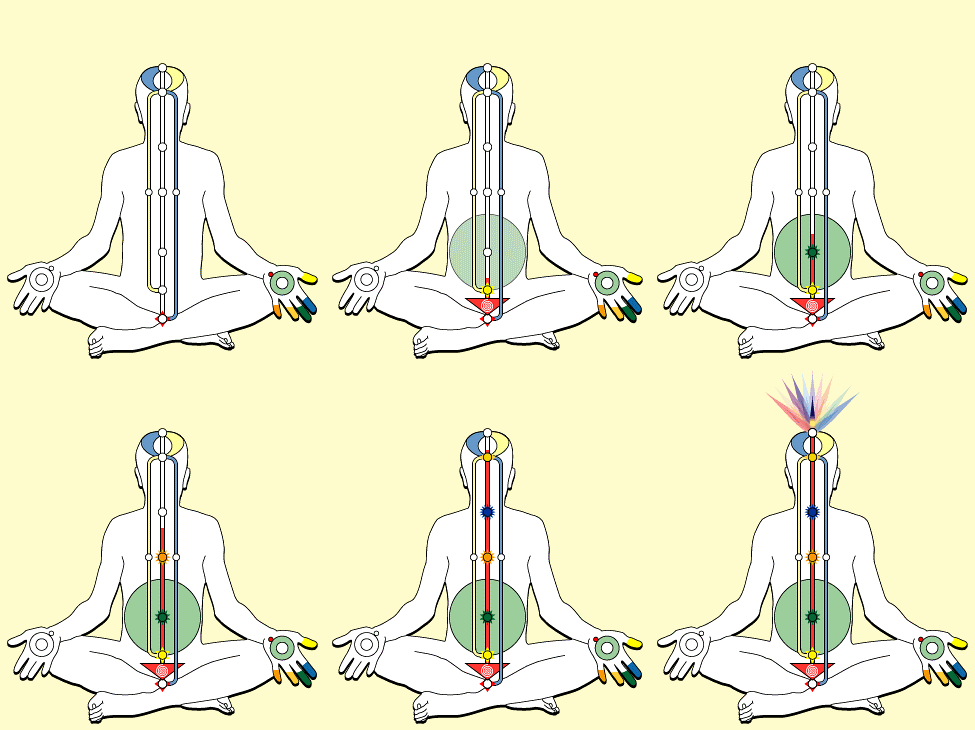
Subtle system with Kundalini rising
and opening 1000
petal Lotus
Furthermore,
the petals of each Chakra correspond to the subplexuses
of the autonomic system. For example the classically
described six petals of the Swadhisthan Chakra
correspond to the spermatic, left colic, sigmoid,
superior haemorrhoidal, inferior mesenteric and
hypogastric subplexuses of the aortic plexus. The Chakra
directs the particular type of energy controlling the
autonomic nerve plexus and also adjacent endocrine and
other organs.
By
a series of subtle connections called 'nadis' in
Yogic terminology each Chakra is connected to and brings
its influence to bear on the whole body. For example the
Nabhi Chakra controls the entire lymphatic system. In
classical texts there are said to be three hundred and
fifty million of these nadis. Very importantly, each
Chakra is connected to a part of the hand as indicated
in the subtle system diagram. Once the state of Yoga is
achieved, the hands become sensitive to the state of the
Chakras, and with practice this is easily interpreted.
The
Chakras also influence and reflect our mental and
emotional life. For example, the Swadhisthan Chakra
controls a person's creativity and those who work hard
— artists and other creative people — it may become
weak. The right Anahath Chakra (there are three parts of
the Anahath Chakra: right, center and left) reflects the
relationship of fatherhood, either with the person's
own father or his own children. Sufferers from anorexia
nervosa, for example, invariably have a problem with
this centre. There are more complex scenarios for
serious problems where two or more Chakras are
inter-related and affected, but we need not worry for
eventually the Kundalini is able to set the entire
subtle system working at optimum levels.
Thus
the state of the Chakras at a subtle level reflects and
influences a person's physical, mental and emotional
welfare. This is a dynamic relationship and so action at
a subtle level on the Chakra can improve and (very
importantly) integrate all these aspects. This is why,
in a nutshell, people who achieve and consolidate their
Yoga invariably find that their physical, emotional and
other problems improve.
All
nations on Earth will be notified that this antique
imagination is the supreme Sahaja Yoga of the Great
Primordial Mother! This Sahaja Yoga will be second to none,
way advanced than every other path. All seekers of the
eternal Afterlife will be told that the final evolution of humankind has
begun. All captives-of-religion will be notified that the
Resurrection has begun! Some faces will beam in Joy, others
will be saddened by this Good News.
"MESSAGE OF METASCIENCE
The religions, if they had been practised from the
understanding how important it was to make one wise, balanced
and compassionate for the last breakthrough of our evolution by
following spirit-oriented religions, even the wrong doers would
have become good normal people and deep seekers of absolute
truth. But the people at the helm of affairs of religion are
themselves money or power-oriented and not spirit-oriented. They
can poison the ignorant minds of the simple faithful and mislead
them into hell.
The truth is there is a residual power in the triangular bone
Sacrum, called as the Kundalini. She has the power to bring
forth the complete nourishment and adjustment of the disturbed
genes. Whether they are genetic, inherent or acquired. When She
is awakened, She changes the series of genes. Not only that She
corrects the gene's data base but She breaks through the
fontanel bone area and connects the seeker to the all pervading
power of Divine Love also called as the cool breeze of the Holy
Ghost, Ruh Ritambhara or Parama Chaitanya. Thus one, by this
second birth, becomes a realised person as actualisation of
Baptism takes place. The light of the spirit which is the
reflection of God Almighty in our heart enters into our
attention and enlightenment. The seeker is really born again,
not just a certificate but he changes as the transformation
takes place within. There is a vast difference between an
ordinary seeker and a realised soul (Yogi). He becomes his own
master full of Divine Love. It is a resurrection process, like
an egg becoming the bird. Maybe this is the reason eggs are
presented as a symbol, reminding, that one has to get
resurrected. The genes change and complete transformation takes
place. For some people it takes time if they are sick or
egotistical.
Also some of them who feel guilty or cannot forgive others
are rather difficult to perfect their state of self-realisation.
If they have a problem from false Gurus, cults, or fanaticism it
also takes time, but can be established in Sahaja Yoga. People
have given up even drugs over night. They never had withdrawal
symptoms or any other trouble. Self realisation as a result of
Kundalini awakening has exhibited fantastic results. It brings
forth new creativity; many people have become poets; musicians
and artists have achieved great heights in their talents;
financial problems are solved; the problems of psychosomatic
diseases get cured, like cancer, myelitis etc. Many incurable
diseases also get cured without any medicines. The seeker
becomes the witness of the drama of life and establishes an
inner peace. He respects all the religions and belongs to
Universal religion which encompasses all the religions of the
world. Morality becomes innate and spontaneous. After the
complete transformation he is averse to do any immoral acts. In
the light of the spirit he knows exactly what is wrong or right
and he is also empowered to stay clean and holy. He enjoys his
virtues which he respects and without any doubt he becomes a
moral human being. First thoughtless awareness is achieved and
later doubtless awareness is established beyond the mind. At
this stage the Sahaja Yogi can give self-realisation to others.
The ageing does not take place, on the contrary the Sahaja Yogi
becomes and looks at least twenty years younger than his age.
They become universal beings. All human enemies of lust, greed,
anger, possessiveness, jealousies, attachments just disappear.
Thus a new race of saints are created who do not have to give up
anything to show off their detachment or asceticism. You cannot
pay for Divine Love which is absolute truth, which the Sahaja
Yogi feels on his finger tips as vibrations of the cool breeze
of the Holy Ghost. The finger tips are related to the energy
centres (the chakras). The chakras are responsible for our
physical, emotional and mental being. If the Yogis can correct
their chakras, they can also correct the chakras of others. Thus
all the physical, emotional and mental problems are solved.
Those who are pure people have the necessary balance of moral
life which ensures a very wide central channel (the Sushumna
Nadi) of ascent for the Kundalini.
In this chapter we have to now understand that there is a
subtle system in every human being, which is fully developed
during this evolutionary process to reach up to human awareness.
For example', in the animals, there is no awareness of sin,
dirt, filth, art or poetry. But among human beings, these
sensitivities are manifesting very clearly as we appreciate and
enjoy the birds, fishes and animals as well. Do they also see
the beauty in us? This question can be answered this way; human
beings are at a higher level of evolution than all the animals
for whom we care so much. We love the birds and we enjoy the
fishes dancing, but the best thing is really to have respect for
ourselves, love ourselves as we should keep our body clean, our
mind and our heart should be open and transparent. Because we
are the highest evolved beings in this world it is our
birthright to get our self-realisation.
Instead, thanks to writers like Freud and Sade, we have
reduced the human being into a sex point, even worst than
beasts. It is such a contagious, demeaning disease that if a
cell of a perverted sex is introduced into any animal, they also
become perverted. Now this disease has contaminated societies in
the West that by the end of this century we may have statues
raised in memory of these new moralists who have shown the way
to our adored destruction.
Now, whatever I am going to tell you has not, to be accepted
blindfolded but treated like a hypothesis. Again and again, I
would request you that you must keep your mind open like a
scientist. If whatever I am saying is proved then, as honest
people, human beings have to accept this beautiful discovery
about yourself because this is for your benevolence, and for the
benevolence of your family, benevolence of your society,
benevolence of your nations and benevolence of the whole world.
The theories created by current scientific conclusions and
also the mental projections are not by any means eternal truths.
To know the reality one has to enter into the realm of
Metascience which is only possible when we enter into the
collective super-consciousness through self realisation."
Shri Mataji Nirmala Devi
"The
prophet warns that Satan will "make war with the rest
of her offspring, who keep the commandments of God and have
the testimony of Jesus Christ" (Revelation 12:17.)
These tribulation saints will prove their faith by martyrdom
during the severe persecution, first from the Great Whore
church and later, from the Antichrist. In Revelation 7:9
John saw "a great multitude which no one could number,
of all nations, tribes, peoples, and Lamb." The angel
told John that these are the tribulation martyrs who will
form the last great harvest of souls. They will pay the
supreme price of martyrdom for their faith. "These are
the ones who come out of the great tribulation, and wash
their robes and made them white in the blood of the
Lamb" (Revelation 7:14.)"
|
Grant
R. Jeffry, Apocalypse: The Coming Judgement of the
Nations, Bantam Books, 1994, p. 189-90
|
|
|
The
institutionalized religions and paranoid anti-sect
organizations will counter with lies,
distortion, deception and propaganda to destroy the
integrity of the Great Universal Mother and Vishwa Nirmala
Dharma. Their followers will be told that these devotees
belong to a sect, that they mistreat children, are abusive
towards others, break up families, indulge in strange
practices, collect vast sums of money, use brainwashing
techniques, power oriented and so on. Popes, deacons,
bishops, monks, swamis, acaryas, priests, pandits,
ayatollahs, shaikhs, ulema, muftis, and mullahs will froth
as they pour out their scorn. Anti-cult bounty hunters will
advertise their private consultations or professional
interview fees and services to rescue hostages held captive
in the mind altering dungeons. Today their sophisticated
trade skills include "a much more refined method to
help family and friends, called the Strategic Interaction
Approach. This non-coercive, completely legal approach is
far better than deprogramming, and even exit counseling.
Topics covered in depth include: evaluating the situation;
interacting with dual identities; communication strategies
for phone calls, letter writing and visits; understanding
and utilizing cult beliefs and tactics; techniques to
reality-test and promote freedom of mind; and planning and
implementing effective interventions."
"Today
we are going to celebrate the birth of Christ. At a very
crucial time we are doing that because there are some
Antichrists who have become in charge of the Christian
religion and are talking against the birth of Christ. They
have no authority. They are not realized souls. They have no
idea of the Divine, nothing. And they're saying that it is
all falsehood, that She was not a virgin and that Christ was
not born that way. Who told them? Did Gabriel come and told
them? What right they have got to talk these things?
So
because they are anti-Christ, now they have become in charge
of Christianity. Even Pope is like that. So in Satya Yuga
they'll be all exposed, have to be exposed."
|
Sri
ViragosthiPriya
Shri Nirmala Devi
Christmas
Puja, Ganapatipule, India — December 25, 1993
|
|
|
Her
Truth, which is way beyond their comprehension, is stranger
than fiction.
But
She has prophesied that the
"Truth which is Absolute
has to express itself in these modern times. And even if it
is not accepted it will never die. On the contrary, if it is
not accepted, it will expose all falsehood and destroy
it."
Hearing
this challenge and warning the Armies of Armageddon will battle with all
their might to destroy this Truth before it destroys them.
The Mighty War will rage in full fury when the Christian
crusaders, Muslim mujahiddin and Vedic brahmins hear
Her messengers announcing the Good News of Resurrection, and
rise to challenge Her. Thus will the prophecy that
"whosoever speaketh against the Holy Ghost, it shall
not be forgiven him, neither in this world, neither in the
world to come" (Matthew 12:32) come true. That will be
the beginning of their end. They
will die from within. Not a drop of blood will be
shed. Not a single human will be killed. But hundreds of
millions of fools and fundamentalists will spiritually die
defying the Good News of God Almighty. There is a Sinister
Century! Take heed, religious prisoners, take
heed!
And
one of the elders answered, saying unto me, What are these
which are arrayed in white robes? And whence came they?
And
I said unto him, Sir, thou knowest. And he said to me, These
are they which came out of great tribulation,
And
have washed their robes, and make them white in the blood of
the Lamb.
Therefore
are they before the throne of God, and serve him day and
night in his temple:
And
he that sitteth on the throne shall dwell among them.
They
shall hunger no more, neither thirst any more; neither shall
the sun light on them, nor any heat.
For
the Lamb which is in the midst of the throne shall feed
them, and shall lead them into living fountains of waters:
And
God shall wipe all tears from their eyes.
|
|
|
|
|
"Christianity
today is nothing but a mental activity which is dead, just
nonsense, just like any other nonsensical religion. It has
become just another foolish, stupid religion which has no
meaning. Unless and until you get your Realization, unless
and until you feel the vibrations, unless and until you feel
this Divine surrounding Power, how will you understand?
Because that's the only thing that is Truth, that's the only
thing that's Reality. And unless and until you achieve it
how will you know about Christ?
And
fighting about Him! How can you fight? I can't understand.
To Me it's stupid, gone to another extreme. By this thing
what you do actually is to use all these incarnations to
kill each other. Can you imagine? The things that came to
elevate you, to make you into higher living are now used,
the same things, the names are used to kill, to kill each
other, to bring down each other.
At
the most, if you reach a point where you don't understand,
then they start saying, "It's a mystery." What is
the mystery? In Sahaja Yoga there's no mystery. It's
all just there. To Me human beings are a mystery. I don't
understand them. I can't understand. The Resurrection of
Christ has to now be Collective Resurrection."
Shri
Tattvamartha-Svarupini Shri Nirmala Devi
The
Creation Of Lord Jesus,
Pune, India — April 11, 1982
The
great monarch will chastise their frenzy,
Attacking
the treasures before the temples.
"But
whether or not the worst of the events Nostradamus foretold
come to pass, he saw that there would be a great spiritual
rebirth throughout the world. Individuals would renounce the
falsehoods of materialism and look within themselves. After
communication is restored, people will come to this
realization together, and there will be a great rebirth of
philosophy that blends the Eastern and Western religions. It
will be a worldwide movement upholding the truth as everyone
perceives it, just as it is to be expected in the Age of
Aquarius ...
Also
in keeping with what the alignment of planets presages for
the New Millennium, Nostradamus predicts the tearing down of
past institutions, including the mighty religions of the Age
of Pisces. "Temples consecrated in the early Roman
fashion," he wrote, "will reject the broken
foundations; taking their early human laws, expelling almost
all the cults of the saints."
Some also
interpret his words to mean that the feminine aspects of
God, which have been ignored, neglected, and reviled for the
eternity of the Age of Pisces, will again be recognized and
revered. This too is a return to the early ages of humanity
and ancient societies in which the female aspect of God was
worshipped and adored. During the patriarchal era of Pisces,
the female aspect was suppressed and repressed. Now society
will come to terms with divinity of both masculine and
feminine aspects, of Mother Earth and Father Sky, of yin and
yang, and of the synthesis of energies for a more balanced
world view."
|
Walter
Mercado, Beyond The Horizon, A Time Warner Company,
1997, p. 55-6
|
|
|
Declaration
Introduction
New Age Children
Miracle Photo
Kingdom Of God
Meeting His
Messengers
Double Worlds
Inner Intimacy
Third-Eye Views
Prophecies
Age Of Aquarius
Our Conscious Earth
Adi Shakti's Descent
Witnessing Her
Miracles
Jesus' Resurrection
His Human Adversary
Book Of Revelation
Book Of Enlightenment
Al-Qiyamah
His Light within
His Universe within
His Beings within
Subtle System
Evolution By Rebirth
Miscellaneous
Lectures To Earth
Shri Mataji
Frequently Asked Questions
Self-Realization
The
pope will mock the seekers for believing the Kingdom of God has been found. The pontiff will rebuke those who want to
be born of the Spirit. The Vicar will reproach those who
believe this is the Age of Resurrection. The Unholy One will
excommunicate all Catholics who dare to embrace the Great
Holy Spirit. The Antichrist will lead the Armies of
Armageddon in this final battle between the forces of good
and evil. The henchmen of the monarch will scurry and rally
around their 'infallible human' and carry out his orders
diligently. Small bands of the Great Supreme
Mother will battle the crumbling Evening Empires of Christianity, Judaism,
Islam, Hinduism, and Buddhism. This is
indeed a Satanic Century! Be forewarned, Unbelievers,
be forewarned!
The
treasures are the Pure Knowledge, the Divine Truths,
the Revelations of the Kingdom of God, and Scriptural
Prophecies of the Great Holy Spirit. The fact that
Nostradamus foretold that these treasures would be laid
before the temples has far reaching consequences for all
humanity. The temples are all the Idols of Worship on Earth
— churches, synagogues, mosques, temples, gurdwaras, and
shrines. The priceless spiritual treasures of the Kingdom of
God will be displayed before them for the benefit of
those who believe in the One God and His Divine Unity. The
fabulous wealth of Self-Realization will be displayed to
heal the nations and resurrect humankind into higher beings.
The Grace of God to enter His Kingdom will be announced to
all.
Yet
the pope will arrogantly dismiss the Revelations as useless trinkets
despite all irrefutable proofs and fulfilled prophecies.
(And so will the rabbis, ayatollahs, clerics, imams, ulema,
mullahs, muftis, shaikhs, swamis, acaryas, pandits, brahmins,
monks, lamas, granthis and other false men of Idols.) He
will attack the inestimable spiritual treasures set before
the temples. Spit and slander will splutter and the papal
monarch fume in fury. Every Truth of the Comforter will be
attacked and denounced with the ferocity and tenacity of a
rabies-ridden pitbull. No quarters will be given in this
last struggle between Good and Evil, between God and Satan,
between His Kingdom and the external Idols.
The
Muslim fanatics will be horrified that Allah's Ruh was
born as a Christian and, thus, won't accept Her Revealed
Truths.
The
Christian zealots will be dismayed that the Mater
Sanctissima was a Hindu and, thus, won't accept Her
Revealed Truths.
The
Buddhist fools will be appalled that there is a Holy Spirit
and, thus, won't accept Her Revealed Truths.
The
Christian diehards will be confounded that The Mother is the
Holy Spirit and, thus, won't accept Her Revealed Truths.
The
Muslim bigots will be infuriated that the Holy Spirit is
part of Allah and, thus, won't accept Her Revealed Truths.
The
Hindu religious prisoners will be aghast that Shri Jesus is
Shri Mahavishnu and, thus, won't accept Her Revealed
Truths.
The
Christian extremists will be alarmed that Shri Krishna is a
Supreme Personality in the Kingdom of God and, thus,
won't accept Her Revealed Truths.
The Jew
radicals will be dumbfounded that Shri Buddha is a Divine
Personality in the Heaven of Yahweh and, thus, won't
accept Her Revealed Truths.
The Muslim
agitators will be shocked that Shri Nitya Shri
Nirmala Devi is the Eternal Personality of Allah and, thus,
won't accept Her Revealed Truths.
The
Sikh idiots will be irked that Prophet Muhammad is a
Primordial Personality and, thus, won't accept Her
Revealed Truths.
The
Buddhist hypocrites will be baffled that Guru Nanak is a
Primordial Guru and, thus, won't accept Her Revealed
Truths.
The
Muslim fundamentalists will be indignant that kafirs
(non-Muslims) are eligible for Allah's Paradise and, thus,
won't accept HER Revealed Truths.
The
Hindu conservatives will be protesting that Qiyamah is not
in the Vedas and, thus, won't accept Her Revealed Truths.
The
Muslim zealots will be enraged that non-Muslim messengers
revealed Qiyamah to them and, thus, won't accept HER
Revealed Truths.
We only
send the Messengers to give Glad Tidings, and to give
Warnings: [2400]
But the Unbelievers dispute with vain argument, in
order therewith to weaken the truth,
And they treat My Signs as a jest, as also the fact that
they are warned!
And who doth more wrong than one who is reminded of the
Signs of the Lord, but turns away from them,
Forgetting the (deeds) which his hands have sent forth?
Verily We have set veils over their hearts, lest they
should understand this, and over their ears, deafness,
If thou callest them to guidance, even then will they
never accept guidance.
surah
18:56-57 Al Kahf (The Cave)
(Abdullah Yusuf Ali, The Holy Qur'an, 1989, p.
724.)
"2400.
The Prophets of Allah are not sent to humour us with
dialectics ... They come to preach the Truth — not in
an abstract way, but with special reference to our
conduct. They give us the Good News of salvation lest we
despair in the presence of Sin, and to warn us clearly of
the dangers of Evil. Vain controversies about words only
weaken their mission, or turn it into ridicule. The
ungodly have a trick also of treating the earnest
preaching to them itself as a jest and ridicule it."
Abdullah
Yusuf Ali, The Holy Qur'n
(Abdullah Yusuf Ali, The Holy Qur'an, 1989,
p. 724.)
The
Jew orthodox will be troubled that Qiyamah is not
revealed in the Torah and, thus, won't accept Her Revealed
Truths.
The
Christian diehards will be bewildered that Qiyamah is
also Resurrection and, thus, won't accept Her Revealed
Truths.
The
Hindu bigots will be disturbed that the Vedas said moksa not
Resurrection, and, thus, won't accept Her Revealed Truths.
The
Buddhist radicals will be unsettled that Shri Buddha said
Nirvana not Qiyamah and, thus, won't accept Her Revealed
Truths.
The
Jew extremists will be annoyed that they don't own God
and, thus, won't accept Her Revealed Truths.
The
Buddhist agitators will be disgusted that God actually
exists and, thus, won't accept Her Revealed Truths.
The
Hindu hypocrites will be distressed that they have to
believe in the Qur'an and, thus, won't accept Her
Revealed Truths.
The
Christian fundamentalists will be upset that non-Christians
are not pagans and, thus, won't accept Her Revealed
Truths.
"In
Britain, Fundamentalist Christians have firebombed Esoteric
bookshops. In several Western countries, including Britain,
women who are exercising their legal right to have an
abortion have been harassed as they enter the clinic; in
America several doctors who performed abortions have been
shot dead by anti-abortionists who have open support of the
Fundamentalists leaders... .
For those
who are worried about the rise of religious Fundamentalism,
it can seem as if it is the spiritual equivalent of the
National Front: bully boys with Bibles."
David V.
Barret, Sects, 'Cults' and Alternative Religions
(Sects,
'Cults' and Alternative Religions, David V. Barret,
Cassell PLC, 1996, p. 285.)
The
Muslim transgressors will be infuriated that all non-Muslims
are not infidels and, thus, won't accept Her Revealed
Truths.
"In
another verse, the Holy Quran declares in the same context:
Surely,
those who have believed in Muhammad and the Jews, and the
Sabians, and the Christians — whoso believes in Allah and
the Last Day and does good deeds, on them shall come no fear
nor shall they grieve. (Ch. 5; Al-Ma'idah: 70)
Let
me remind you that although the People of the Book is
applicable to the Jews and Christians, potentially, it has a
much wider application. In the context of the Quranic
assertion 'that there is no people in the world but We have
sent a Warner to them', and similar verses (cited earlier),
we are left with no room for doubt that these were not only
the people of the Old Testaments and the Gospel (or the
Torah and the Injeel) who were given the Book, but most
certainly other books were revealed for the benefit of
mankind. So all religions which have a claim to be founded
on divine revelation would also be included among the People
of the Book.
Again
the Holy Quran uses the term Sabi which further clarifies
the issue and dispels the doubt. Sabi is a term used by the
Arabs to apply to the followers of all non-Arab and non-Semetic
religions which have their own revealed Books. As such,
followers of all religions based on divine revelation have
been granted the assurance that provided they do not
genuinely fail to recognize the light of a new religion and
stick honestly and truly to the values of their ancestral
religion, they have nothing to fear from God and will not be
denied salvation.
The
Holy Quran, speaking of whichever party from among the
Believers: Jews, Christians and Sabians, promises: .....
Shall have their reward with their lord, and no fear shall
come upon them, nor shall they grieve. (Ch. 2: Al-Baqarah:
63)"
www.ahmadiyya.org/
The
Jew fanatics will be mortified that their Jewish Jesus was
His Messenger and, thus, won't accept Her Revealed Truths.
"Proposed
Israeli law would ban Christian missionaries - July 8, 1997
JERUSALEM
(CNN) — The dwindling number of Christians in the Holy
Land are facing yet another threat. Militant Jews and
Israelis are trying to force members of the religion from
seeking converts in the country.
Most
alarming to Christians is a newly proposed law that would
let authorities jail anyone who shares Christian literature.
. .
What
is being waged is a cultural clash that opens centuries of
old wounds between Jews and Christians. It is a struggle for
souls, and the Christians do not have the upper hand."
CNN,
July 8, 1997
The
Hindu radicals will be agitated that brahmins are destined
for spiritual death and, thus, won't accept Her Revealed
Truths.
The
Muslim zealots will be flabbergasted that Shri Jesus was
actually crucified and, thus, won't accept Her Revealed
Truths.
The
Buddhist conservatives will be protesting that Shri Jesus
has to be glorified and, thus, won't accept Her Revealed
Truths.
The
Christian morons will be bitter that heathens are eligible
for His Kingdom and, thus, won't accept Her Revealed
Truths.
The
Hindus will be shocked that idol worship is never sanctioned
by God and, thus, won't accept Her Revealed Truths.
The
Jain bigots will be perturbed that vegetarianism does not
confer moksa and, thus, won't accept Her Revealed
Truths.
The
Muslim idiots will be furious that Puranas have superior
spiritual Knowledge and, thus, won't accept Her Revealed
Truths.
The
Hindu fools will be resentful that Qur'n has superior
prophetic Knowledge and, thus, won't accept Her Revealed
Truths.
The
Christian prisoners-of-religion will be disturbed that the
Bible was corrupted and, thus, won't accept Her Revealed
Truths.
The
Muslim fundamentalists will be incensed that the Qur'an
was misinterpreted and, thus, won't accept Her Revealed
Truths.
The
Hindu brahmins will be irked that they are not hereditary
inheritors of moksa and, thus, won't accept Her Revealed
Truths.
The
Buddhist monks will be troubled that all their prajna
is a mental maze and, thus, won't accept Her Revealed
Truths.
The
Muslim mullahs will be crazed that all of Allah's
Messengers are together, and, thus, won't accept Her
Revealed Truths.
"ALL
PROPHETS ARE EQUAL
The
question arises that if there are so many Prophets of God
sent to all peoples of the world, in different parts of
the world and in different ages, do they have the same
divine authority? According to the Holy Quran, all
Prophets belong to God, and as such, insofar as their
divine authority is concerned, they exercise such
authority with equal force and strength. No one has a
right to discriminate between one Prophet and another. As
far as the authenticity of their message is concerned, all
Prophets must be equal. This attitude of Islam towards
other religions and their Founders as well as minor
Prophets, can work as a very important uniting and
cementing factor between various religions. The principle
that the authenticity of each Prophet's revelation enjoys
the same status can be used as a very powerful unifying
force bringing various religions together. This transforms
the attitude of hostility towards the revelation of
Prophets of other religions to that of respect and
reverence. This again, is the clear and logical position
taken by the Holy Quran:
This
Messenger the Holy Founder of Islam believes in that which
was revealed to him from his Lord, and so do the
believers; all of them believe in Allah; and in His
angels, and in His Books, and in His Messengers saying,
'We make no distinction between any of His Messengers. And
they say, 'We have heard and we are obedient....' (Ch. 2:
Al-Baqarah: 286)
This
subject is repeated in other verses of the Holy Quran. For
instance:
Surely,
those who disbelieve in Allah and his Messengers and seek
to make a distinction between Allah and His Messengers,
and say, 'We believe in some and disbelieve in others',
and seek to take a way in between, these really are the
disbelievers, and We have prepared for the disbelievers a
humiliating punishment. And those who believe in Allah and
in all of His Messengers and make no distinction between
any of them, to such He will soon give their rewards. And
Allah is Most Forgiving, Merciful.(Ch. 4: Al-Nisa:
151-153)"
http://www.ahmadiyya.org/
The
Catholic clergy will be wild that their Church is despised
in His Kingdom and, thus, won't accept Her Revealed
Truths.
The
Buddhist lamas will be nervous that Buddhists will know the
Creator, and, thus, won't accept Her Revealed Truths.
The
Muslim imams will be mad that the Kitab al Munir is Sri
Lalita Sahasranama and, thus, won't accept Her
Revealed Truths.
The
Christian pope will be irate that Lalita Sahasranama glorifies
the Holy Ghost and, thus, won't accept Her Revealed
Truths.
The
Hindu priests will be suspicious that the Bible glorifies
the Adi Shakti and, thus, won't accept Her Revealed
Truths.
The
Buddhist dalai lama will be fidgety that there is a Holy
Ghost and, thus, won't accept Her Revealed Truths.
The
Christian archbishops will be petrified that God is
Sadashiva and, thus, won't accept Her Revealed Truths.
The
Muslim ayatollahs will be thunderstruck that Allah is also
Sadashiva and, thus, won't accept Her Revealed Truths.
The
Hindu bhagwans will be restless that Sadashiva is also
Yahweh and, thus, won't accept Her Revealed Truths.
The
Jewish rabbis will be dismayed that Yahweh is also Allah
and, thus, won't accept Her Revealed Truths.
The
Buddhist monks will be irritated that Buddha is also
Waheguru and, thus, won't accept Her Revealed Truths.
The
Sikh granthis will be upset that Waheguru is also The Mother
and, thus, won't accept Her Revealed Truths.
The Muslim
sheiks will be horrified that Shri Jesus sent the Comforter
and, thus, won't accept Her Revealed Truths.
The
Jain digambars will be appalled that vegetarianism is not
ahimsa and, thus, won't accept Her Revealed Truths.
Those
who praise their own doctrines and disparage the doctrines
of others do not solve any problems.
Sutrakritanga
1.1.50 (Jainism)
The
Vaishnavas will be agitated that She is Shri Vishnu's
Supreme Shakti and, thus, won't accept Her Revealed
Truths.
The
Hare Krishnas will be uneasy that She is Shri Krishna's
Supreme Shakti and, thus, won't accept Her Revealed
Truths.
The
Shaivites will be unsettled that She is the Supreme Shakti
of Shri Shiva and, thus, won't accept Her Revealed Truths.
The
Rama devotees will be uneasy that She is Shri Rama's
Supreme Shakti and, thus, won't accept Her Revealed
Truths.
The
Kali worshipers will be upset that Shri Mahakali is not the
Ultimate Reality and, thus, won't accept Her Revealed
Truths.
The
Durga worshipers will be aghast that Shri Durga is not the
Ultimate Reality and, thus, won't accept Her Revealed
Truths.
"What
Are Hinduism's Principal Sects?
The
Sanatana Dharma, or "eternal faith," known today
as Hinduism, is a family of religions that accept the
authority of the Vedas. Its four principal denominations are
Saivism, Shaktism, Vaishnavism and Smartism. Aum.
The
world's billion Hindus, one-sixth of the human family, are
organized in four main denominations, each distinguished by
its Supreme Deity. For Vaishnavites, Lord Vishnu is God. For
Shaivites, God is Siva. For Shaktas, Goddess Shakti is
supreme. For Smartas, liberal Hindus, the choice of Deity is
left to the devotee. Each has a multitude of guru lineages,
religious leaders, priesthoods, sacred literature, monastic
communities, schools, pilgrimage centers and tens of
thousands of temples. They possess a wealth of art and
architecture, philosophy and scholarship. These four sects
hold such divergent beliefs that each is a complete and
independent religion. Yet, they share a vast heritage of
culture and belief-karma, dharma, reincarnation,
all-pervasive Divinity, temple worship, sacraments, manifold
deities, the guru-shishya tradition and the Vedas as
scriptural authority. While India is home to most Hindus,
large communities flourish worldwide. The Vedas elaborate,
"He is Brahma. He is Siva. He is Indra. He is the
immutable, the supreme, the self-luminous. He is Vishnu. He
is life. He is time. He is the fire, and He is the
moon." Aum Namah Sivaya.
What
Is the Deeply Mystical Saiva Sect?
Saivism
is the world's oldest religion. Worshiping God Siva, the
compassionate One, it stresses potent disciplines, high
philosophy, the guru's centrality and bhakti-raja- siddha
yoga leading to oneness with Siva within. Aum.
Saivism
is ancient, truly ageless, for it has no beginning. It is
the precursor of the many-faceted religion now termed
Hinduism. Scholars trace the roots of Siva worship back more
than 8,000 years to the advanced Indus Valley civilization.
But sacred writings tell us there never was a time when
Saivism did not exist. Modern history records six main
schools: Saiva Siddhanta, Pashupatism, Kashmir Saivism, Vira
Saivism, Siddha Siddhanta and Siva Advaita. Saivism's
grandeur and beauty are found in a practical culture, an
enlightened view of man's place in the universe and a
profound system of temple mysticism and siddha yoga. It
provides knowledge of man's evolution from God and back to
God, of the soul's unfoldment and awakening guided by
enlightened sages. Like all the sects, its majority are
devout families, headed by hundreds of orders of swamis and
sadhus who follow the fiery, world-renouncing path to moksha.
The Vedas state, "By knowing Siva, the Auspicious One
who is hidden in all things, exceedingly fine, like film
arising from clarified butter, the One embracer of the
universe-by realizing God, one is released from all
fetters." Aum Namah Sivaya.
What
Is the Magic and Power of Shaktism?
Shaktism
reveres the Supreme as the Divine Mother, Shakti or Devi, in
Her many forms, both gentle and fierce. Shaktas use mantra,
tantra, yantra, yoga and puja to invoke cosmic forces and
awaken the kundalini power. Aum.
While
worship of the Divine Mother extends beyond the pale of
history, Shakta Hinduism arose as an organized sect in India
around the fifth century. Today it has four
expressions-devotional, folk-shamanic, yogic and
universalist-all invoking the fierce power of Kali or Durga,
or the benign grace of Parvati or Ambika. Shakta
devotionalists use puja rites, especially to the Shri Chakra
yantra, to establish intimacy with the Goddess. Shamanic
Shaktism employs magic, trance mediumship, firewalking and
animal sacrifice for healing, fertility, prophecy and power.
Shakta yogis seek to awaken the sleeping Goddess Kundalini
and unite her with Siva in the sahasrara chakra. Shakta
universalists follow the reformed Vedantic tradition
exemplified by Shri Ramakrishna. "Left-hand"
tantric rites transcend traditional ethical codes. Shaktism
is chiefly advaitic, defining the soul's destiny as complete
identity with the Unmanifest, Siva. Central scriptures are
the Vedas, Shakta agamas and Puranas. The Devi Gita extols,
"We bow down to the universal soul of all. Above and
below and in all four directions, Mother of the universe, we
bow." Aum Chandikayai Namah.
What
Is the Devotional Vaishnava Sect?
Vaishnavism
is an ancient Hindu sect centering on the worship of Lord
Vishnu and His incarnations, especially Krishna and Rama.
Largely dualistic, profoundly devotional, it is rich in
saints, temples and scriptures. Aum.
The
worship of Vishnu, meaning "pervader," dates back
to Vedic times. The Pancharatra and Bhagavata sects were
popular prior to 300 bce. Today's five Vaishnava schools
emerged in the middle ages, founded by Ramanuja, Madhva,
Nimbarka, Vallabha and Chaitanya. Vaishnavism stresses
prapatti, single-pointed surrender to Vishnu, or His ten or
more incarnations, called avataras. Japa is a key devotional
sadhana, as is ecstatic chanting and dancing, called kirtana.
Temple worship and festivals are elaborately observed.
Philosophically, Vaishnavism ranges from Madhva's pure
dualism to Ramanuja's qualified nondualism to Vallabha's
nearly monistic vision. God and soul are everlastingly
distinct. The soul's destiny, through God's grace, is to
eternally worship and enjoy Him. While generally nonascetic,
advocating bhakti as the highest path, Vaishnavism has a
strong monastic community. Central scriptures are the Vedas,
Vaishnava agamas, Itihasas and Puranas. The Bhagavad Gita
states, "On those who meditate on Me and worship with
undivided heart, I confer attainment of what they have not,
and pre- serve what they have." Aum Namo Narayanaya.
What
Is the Universalistic Smarta Sect?
Smartism
is an ancient brahminical tradition reformed by Shankara in
the ninth century. Worshiping six forms of God, this liberal
Hindu path is monistic, nonsectarian, meditative and
philosophical. Aum Namah Sivaya.
Smarta
means a follower of classical smriti, particularly the
Dharma Shastras, Puranas and Itihasas. Smartas revere the
Vedas and honor the agamas. Today this faith is synonymous
with the teachings of Adi Shankara, the monk-philosopher,
known as shanmata sthapanacharya, "founder of the
six-sect system." He campaigned India-wide to
consolidate the Hindu faiths of his time under the banner of
Advaita Vedanta. To unify the worship, he popularized the
ancient Smarta five-Deity altar-Ganapati, Surya, Vishnu,
Siva and Shakti-and added Kumara. From these, devotees may
choose their "preferred Deity," or Ishta Devata.
Each God is but a reflection of the one Saguna Brahman.
Shankara organized hundreds of monasteries into a ten-order,
dashanami system, which now has five pontifical centers. He
wrote profuse commentaries on the Upanishads, Brahma Sutras
and Bhagavad Gita. Shankara proclaimed, "It is the one
Reality which appears to our ignorance as a manifold
universe of names and forms and changes. Like the gold of
which many ornaments are made, it remains in itself
unchanged. Such is Brahman, and That art Thou." Aum
Namah Sivaya."
Hinduism
Today, November 1994
Himalayan
Academy, 1998,
The
Theravada Buddhists will be astonished that Matreya
is Maitreya and, thus, won't accept Her Revealed
Truths.
The
Mahayana Buddhists will be bewildered that Matreya is
the AdiBuddha and, thus, won't accept Her Revealed Truths.
"Kapathika:
"How should a wise man ascertain truth?"
The
Buddha: "A man has faith. If he says 'This is my
faith,' so far he maintains truth. But by that he cannot
proceed to the absolute conclusion; This alone is Truth, and
everything else is false." "
Majjhima
Nikaya ii. 176, Canki Sutta
The
Varrayana Buddhists will be troubled that Shri Matreya
chastised them and, thus, won't accept Her Revealed
Truths.
The
Shi'ites will be petrified that a 'non-Muslim' can be
a Imam Mahdi and, thus, won't accept Her Revealed
Truths.
The
Sunnis will be indignant that there is an Imam Mahdi and,
thus, won't accept Her Revealed Truths.
The
Baha'is will be distressed that their leader is not the Imam
Mahdi and, thus, won't accept Her Revealed Truths.
"BAHAIS
and BAHAISM: Another group that strives to demolish Islam is
the Bahais. The chief of these irreligious people is
Bahaullah. He was a pupil and the caliph of a Persian named
Albab Ali Muhammad. Albab used to call himself mirror. He
used to say, Allah is seen in this mirror. When he died,
Bahaullah became their chief and began to spread his
sophistries which he termed Bahaism. Before he died, they
put his son Abdulbaha Abbas in this place. Abbas took the
name Ghasniyyi Azam. Abbas, who went to Europe and America,
gathered more than a hundred thousand Bahais and died in
1339 A.H. [1921]. He was succeeded by his son Shawqi. He
also spread the religion of Bahaism. Bahaullah used to say
that he was a prophet and the great savior of the latest
time. It was this pretension whereby he first smeared
himself with the ignominy of blasphemy. He also said that
one more prophet would come two thousand years later.
According to these disbelievers, who have no proximity to
Islam, nineteen is a sacred number. Their fasting practice
continues for nineteen days. Each Bahai has to invite
nineteen Bahais after every nineteen days. Their irreligious
cult is governed by nineteen people elected for their
supreme assembly which they call The House of General
Justice. Each Bahai has to give each year one fifth of his
earnings to this assembly. It is necessary, so they say, to
marry at the age of eleven... .
The
Bahais have eighty-eight organizations all over the world.
They deceive Christians, Jews, Magians, Sikhs, Zoroastrians
and Buddhists and allure them towards themselves....
Their
namaz (ritual prayer) is a matter of standing towards Haifa
and thinking of Allah. Their hajj is to go to see Bab's
house in Shiraz or Bahaullah's house in Baghdad, and to read
ayats is to think of Allah through the heart."
Waqf
Ikhlas, Istanbul, 1995.
"A
similar phenomenon exists among other world religions as
well, and often a great deal of condemnation will be heaped
on parallel religious bodies, especially those originating
from within the parent group. While visiting a Baha'i
retreat centre recently I indicated to my resident hosts
that they seemed to be a very tolerant group. Were there no
religious groups or individuals that they did not accept or
endorse? Their answer was that any religion claiming Divine
revelation before that of their leader was
acceptable. Any claim made after his, were not
acceptable. This meant that any religious group originating after
the midpoint of the 19th century was considered invalid.
A further discussion revealed that Baha's were also quite
opposed to individuals who once have belonged to the Baha'i
faith and then left it. Such is an act of unforgivable
apostasy. Apparently these individuals are to be ignored,
shunned or condemned. So much for unconditional universal
brotherly/sisterly love. It has its limits."
J
W. Friesen, Pick One: A User-Friendly Guide to Religion
(John
W. Friesen, Pick One: A User-Friendly Guide to Religion,
Detseling Enterprises Ltd., 1995, p. 34.)
The
Ahmadiyahs will be infuriated that M. Ghulam Ali is not the Imam
Mahdi and, thus, won't accept Her Revealed Truths.
The
Isma'ilis will be angered their seven imams exclude
another Imam Mahdi and, thus, won't accept Her
Revealed Truths.
The
Protestants will be astonished that Mother Mary was a virgin
and, thus, won't accept Her Revealed Truths.
The
Catholics will be incensed that their popes are Antichrists
and, thus, won't accept Her Revealed Truths.
"Dissent
is strong within the Roman Catholic Church today. Large
numbers of priests are leaving the Church, while others are
staying to fight from within... . Hundreds of Catholic
have gone against the pope's ruling and married, and not
all of them have given up their calling. There are numerous
splinter denominations, especially in the USA, with married
priests. Most of these Churches also deny the infallibility
of the pope."
David
V. Barret, Sects, 'Cults' and Alternative Religions
(Sects,
'Cults' and Alternative Religions, David V. Barret,
Cassell PLC, 1996, p. 121.)
The
Episcopalians will be furious that their bishop-ruled church
is Antichrist and, thus, won't accept Her Revealed Truths.
The
Lutherans will be startled that their communion is just
useless ritual and, thus, won't accept Her Revealed
Truths.
The
Methodists will be alarmed that John Wesley (founder) is
self-authorized and, thus, won't accept Her Revealed
Truths.
The
Presbyterians will be angry that their church courts are a
joke and, thus, won't accept Her Revealed Truths.
The
Baptists will be shocked that their baptism does not confer
'second birth' and, thus, won't accept Her Revealed
Truths.
The
Mormons will be mad that their baptism and marriage of the
dead is a ghoulish Antichrist belief and, thus, won't
accept Her Revealed Truths.
"Because
the validity of Mormonism rests so much on both Joseph and
the Book of Mormons, critics of the religion attack
the credibility of both. They quote contemporaries of Smith
who describe him as 'a notorious liar ... utterly
destitute of conscience,' as vulgar and lewd. The Smith
family, they say, were known as treasure-hunters; Joseph
Smith hired himself out searching for buried treasure by
peering into a magical stone, or 'peepstone.' The
Mormons accept that in 1826 he was arrested as a 'glass
looker' under a New York State law which made it illegal
'to tell fortunes, or where lost or stolen goods mat be
found.' This, critics say, is the origin of the magic
eyepieces and golden plates... .
Critics
also point not just to the large number of verses from the
Bible in the Book of Mormon (over 27,000 words) but
to the fact that they are taken from the King James Version,
and ask why an 1829 translation of an AD 428 text should be
in 1611 English. The Book of Mormons apparently also
contains quotations from the seventeenth-century Westminister
Confession of Faith and an excerpt from a Methodist book
of discipline... .
Some
of the original papyri from which Joseph Smith translated
the 'Book of Abraham' in The Pearl of Great Price were
discovered in 1996. When translated by scholars, they were
found to be standard funerary documents, bearing no
resemblance to Smith's 'translation' of 'the
writings of Abraham while he was in Egypt.' ...
There
are two further arguments against the Book of Mormon
which should be mentioned. Firstly, there are no
archaeological evidence of all the settlements in America
recorded in the Book of Mormon, and no genetic
evidence of the Semitic origin of the North American
peoples. Secondly, the three witnesses quoted at the
beginning of the book as having 'seen the engravings which
are upon the plates,' including Harris and Cowdery, all
alter left the Church. One of them said, 'I saw them with
the eye of faith' — in other words, not as material
objects... .
There
is much speculation among non-Mormons as to what Mormons do
in their temples ... . The rites include solemnization of
marriage for eternity, baptism for the dead and other
ordinances... . Mormons 'in good standing' wear a
white undergarment like a long T-shirt all the time ...
The
Church was often accused in the past of being racist; its
early leaders made a number of statements about non-white
being lower than whites."
David
V. Barret, Sects, 'Cults' and Alternative Religions
(David
V. Barret, Sects, 'Cults' and Alternative Religions,
David V. Barret, Cassell PLC, 1996, p. 62-3.)
The
Seven-Day Adventist will be afraid that their embarrassing
miscalculations of the Second Coming is now solved and,
thus, won't accept Her Revealed Truths.
"Seventh-day
Adventist grew out of the adventist movement of the early
nineteenth century ... A German Lutheran minister J. G.
Bengel, taught the doctrine in the mid-eighteenth century,
setting the date of the Second Coming at 1836. William
Miller, an American Baptist minister, attracted thousands of
followers with his message, based on the prophecies in
Daniel and Revelation, that Christ would return in 1843.
When nothing happened, he reworked his calculations, taking
account of the calendric fact that there isn't a 0 year
between 1 BC and AD 1, and announced that the great event
would take pplace in 1844, specifically on 22 October.
Believers sold their properties and possessions in readiness
... Once again, nothing happened, and the event became to
be known as the Great Disappointment."
David
V. Barret, Sects, 'Cults' and Alternative Religions
(Sects,
'Cults' and Alternative Religions, David V. Barret,
Cassell PLC, 1996, p. 71.)
The
Unification Church members will be aghast that Sun Myung
Moon is not the Messiah and, thus, won't accept Her
Revealed Truths.
"The
doctrine holds that mankind will be redeemed by a perfect
man, married to a perfect women, and bearing perfect
children. God gave mankind a first chance to achieve that
with the creation of Adam and Eve, and a second chance to
Jesus, but in neither case was the Perfect Family created.
The 20th century is another chance, with the
perfect man appearing on earth.
This
man, according to Moon's calculations, should have been
born between 1917 and 1930. Moon once predicted the coming
of the Christian millennium in 1967. According to another
Unification Church calculation, 1981 was to be the year of
"final victory," twenty-one years after the
Marriage of the Lamb, that is the marriage of Sun Myung Moon
to his wife, Hak Ja Han, the "Mew Eve," in 1960.
Moon and his wife, Hak Ja Han (second or fourth wife,
according to different counts), are known as the True
Parents. Members refer to Moon as "Father" or
"Master." Although Moon has not clearly proclaimed
himself the Messiah, it is apparent that Church members
consider him just that."
Belt-Ha
Ilahmi, The Illustrated Encyclopedia of Active New
religions, Sects and Cults
(The
Illustrated Encyclopedia of Active New religions, Sects and
Cults, Rosen Publishing Group, Inc. New York, p. 301-2.)
"Until
recently, although his followers always believed him to be
the Messiah, Moon himself avoided answering the question
directly, much as Jesus did ('Whom do men say I am? [Mark
8:27].) In 1992, however, he made a formal declaration that
he was indeed the Messiah... .
Marriage,
for members, is a vitally important part of God's work.
The new couple are creating a new ideal family, and their
children will be born without Original Sin. To symbolize
their holiness of their marriage, and it's place in God's
plan, the newly married couple make a private and sacred
ritual of their first three nights of love making. On the
first night the man lies on top, symbolizing God in
authority; on the second night the women lies on top,
symbolizing Eve's transgression and the victory of Satan;
and on the third night the man is top again, symbolizing God's
victory over Satan and the re-establishment of God's plan."
David
V. Barret, Sects, 'Cults' and Alternative Religions
(Sects,
'Cults' and Alternative Religions, David V. Barret,
Cassell PLC, 1996, p. 105.)
The
Jehovah's Witness will be dismayed that Jehovah's
Kingdom was inaugurated by the opening of the Sahasrara
Chakra on May 5, 1970, and, thus, won't accept HER
Revealed Truths.
"Like
many of the new religions which began in the nineteenth
century, the Jehovah's Witnesses are a Millennialist
Church, believing strongly in the literal return of Christ
and the setting up of his kingdom on earth. Initially they
believed this would start happening in 1874, and then in
1914; Christ was to return openly, and then it became
invisibly....
Other
attempts to set dates — 1920, 1925, 1940, 1975 and 1984
— resulted in disappointment and sometimes loss of members
on the one hand and rapid back-pedaling of the Church
leaders and subtle altering of Watchtower books on the
other.
Much
is made of the 'little flock' of 144,000 who will go to
heaven and rule with Christ ... members from the 1930's
realized that they stood no chance of becoming one of the
chosen few....
Jehovah's
Witnesses are known for one other aspect of their beliefs:
their refusal to accept blood transfusions... . The Church's
second president, 'Judge' Rutherford, followed Charles
Taze Russell in regarding anyone who is not a loyal Jehovah's
Witness as an 'evil slave.'
"
David
V. Barret, Sects, 'Cults' and Alternative Religions
(Sects,
'Cults' and Alternative Religions, David V. Barret,
Cassell PLC, 1996, p. 83-5.)
The
Pentecostals will be perturbed that the biblical 'speaking
in tongues' is the divine language of the Kundalini, not
their foolish gibbering and, thus, won't accept Her
Revealed Truths.
"Columnist
James Beverly recently described a Toronto revival campaign
of the California-originated Vineyard movement started by
John Wimber. Beverly suggested that some of the charismatic
displays might be hard to justify by reference to the Holy
Spirit or the Day of Pentecost. According to Beverly:
Two women near the front were rocking so strongly in their
seats that their heads were almost banging into people in
the row behind them. Little children were duplicating the
frenzy in wild dancing that looked artificial and contrived.
One man roared like a lion during Wimber's sermon. A few
individuals hit the concrete hard when they were "slain
in the spirit" (Faith Today, Sept/Oct. 1994,
13).
Beverley's analysis may seem a bit too harsh to Vineyard
followers, but it does support the point that there are
significant differences in religious practice — even among
subsections of specific religious camps like
fundamentalists, conservatives, pentecostals, charismatics
or evangelicals. Naturally, Beverley was severely chastised
by a Vineyard leader, Roger Helland, in a subsequent issue
of Faith
Today. Beverley was warned that: those who pretend to
pass judgement in spiritual matters must be prepared to show
their credentials of personal spiritual experience.
Unfortunately, many people condemning manifestations and
experiences birthed by the Holy Spirit have had little
personal experience with either" (Faith Today,
Nov/Dec. 1994, 8)."
J
W. Friesen, Pick One: A User-Friendly Guide to Religion
(John W. Friesen, Pick One: A User-Friendly Guide to Religion,
Detseling Enterprises Ltd., 1995, p. 32.)
"There have been many testimonies in this latest
questionable move of refreshing in the Church that also
speak of God's power being manifested as electricity, or raw
energy or a burning fire that can be experienced in the
physical body. Twenty-five years ago, we taught these were
Occult manifestations, because such manifestations were
unheard of in the (charismatic/Pentecostal) Church. God was
(and is) Spirit, not energy of any sort. The God manifested
as energy or electricity is the God of the New Age. National
leaders in the charismatic movement have been testified to
as having this power that is electrical in nature, even to
the point of affecting electrical and sound systems when
they are in the same room. But God is not a God of confusion
and disorder, who "walks" through meetings in His
people disrupting electrical circuits, literally giving
people a shock when His "anointed ones" touch
people in prayer." "
Source:
Internet
"It is not easy for the Christian layman to find his
way through the thicket of contradictions in the new
Testament. It is simpler for informed theologians: they
doubtless have a hot line over which they can get
information from the highest source. Through their mouths
and again through the mouths of those they teach, children
in religious classes and believers in church learn how
everything is to be understood and how it may on no account
be interpreted. If only the theologians were united on the
subject! But, depending on their membership of a particular
church they get in each other's hair, violently, angrily,
hotly in favour of their own angle. And anything that cannot
be brought under one head and is completely inexplicable is
inflicted on 'those who are without' as a test of faith.
How does it go? 'Let your communication be yea, yea: nay,
nay.' "
Erich
Von Daniken, Miracle of the Gods
Erich Von Daniken, Miracle of the Gods, Dell
Publishing Co., Inc., 1975, p. 85.)
"So, with
faith, if somebody says, "Oh, you will be healed, you
see", and they start shouting and screaming and this
and that and suddenly you might feel, maybe there's a
spirit. They replace sometimes, sometimes, you see. It's
very surprising. They can replace a spirit from one to
another. I've seen such cases also. All kinds of things I've
seen in spirit... . Eight days back, in France, a
gentleman came in, young fellow, must be about twenty-four
or so. He got into such a big agitation and he started
crying and a funny type of a thing that I'd never seen a
spirit entered into him. Whole body was shaking and, I mean,
he fell down. He started crying, weeping. All sorts of
things happened and he said that, "I went to
charismatic movement where I got it and many get it and they
think Holy Ghost has entered into them." Now, just
imagine, how can the Holy Ghost make you miserable? I don't
know from where these ideas come in."
Shri
Caitanyarghya-Samaradhya Shri Nirmala Devi
Problems Of Subconscious,
U.K. — May 13, 1982
The
Promise Keepers will be apprehensive that women hold the key
to the Spirit and, thus, won't accept Her Revealed Truths.
The
Catholics will be annoyed that the Holy Spirit was also a
Protestant and, thus, won't accept Her Revealed Truths.
"The
Bible and the Koran talk about Heaven and Hell as two poles.
Some religious sects such as Catholicism have introduced
"limbo" or nothingness for non-Catholics. It is
believed that non-Catholics will enter into a state of
eternal "unsatisfied longing" as their only
torment because they will not be exposed to the sight of
God. This is one of the most negative beliefs in Catholic
doctrine. How could Catholics believe that every
non-Catholic is doomed?"
(Mounir
Murad, Axioms: In search of a Comprehensive Philosophy of
Life, Murad Publishing, USA, 1992, p. 34.)
The
Protestants will be offended that the Holy Spirit is no
longer a Protestant and, thus, won't accept Her Revealed
Truths.
"As
Christian history unfolded, the power of the Church to
control knowledge and public opinion increased
exponentially, and so these views of God as both an external
power and an invasive deity became dominant in all of
Western civilization. When the Spanish armada, sailing for
England in 1588, was destroyed at sea by a storm, it was
widely interpreted by the English as a defeat for the
Spanish Catholic deity at the hands of the Protestant deity.
God had sent that storm out of the sky to destroy the
Spaniards and thus to shape English history with a new
version of the biblical favored-nation status."
John
Shelby Spong, Why Christianity Must Change Or Die: A
Bishop Speaks To Believers In Exile, HarperCollins
Publishers, 1998, p. 21.
The
Scientologists will be flabbergasted that there is no Alien
Overlord and, thus, won't accept Her Revealed Truths.
"Operating
Thetan III ('The Wall of Fire') is the big revelation.
The knowledge revealed at that level is so explosive, it
must be kept secret. Anyone coming across it without the
years of careful (and very expensive) training through all
the preceding levels would be seriously damaged, and might
even die from the knowledge — it is apparently 'rigged
to kill' them. Even Hubbard himself nearly died learning
of it. Scientologists at OT III level are allowed access to
Hubbard's handwritten notes of his own experience.
Here,
in brief, is a paraphrase of the OT III revelation*
Seventy-six million years ago a dictator named Xenu, worried
about the overpopulation of the galaxy, persuaded the
billions of people of the 75 inhabited planets in the
Galactic Federation he ruled to go on earth (or Teegeeack.)
There he chained them up in volcanoes in Hawaii and dropped
H-bombs on them. This was sufficiently traumatic to separate
their inner selves (Thetans) from their bodies, and the
bodiless Thetans were taken to Hawaiii and Las Palmas, where
they were frozen in alcohol and put in packages which were
scattered around the solar system. They also had engrams
implanted in them, including religion and sexual perversity.
These Thetans, wanting to have bodies again, hitch a ride on
the humans on earth. We are each covered in millions of 'Body
Thetans' — which accounts for all the troubles of the
human race over the millennia.
Once
a Scientologist has reached OT III, he is enabled to deal
with these Body Thetans, very carefully and precisely ...
The Body Thetans can then be woken up and encouraged to
leave ('or blow') from the Scientologist's body. This
has to be done with great care, though; Body Thetans can
cause illness and insanity if they become upset.
All
religions have their central myths and this is the hidden
myth at the heart of Scientology... . There was another
whole set of mythology in Hubbard's 1952 book The History
of Man, which was apparently produced by Hubbard while lying
on a couch in company with an auditor and a tape recorder. .
. . The History of Man, according to a 'factual Account of
your last sixty trillion years,' details the evolution of
mankind ... An Australian official inquiry into
Scientology commented: 'For compressed nonsense and
fantasy it must surpass anything theretofore written.' [32] .
..
'The
easiest way to make a lot of money,' Hubbard is reported
to have said — 'is to found a new religion.' ...
Whatever the truth of it, Hubbard founded a new religion and
made a lot of money.
A
note to the trepidations: thousands of non-Scientologists
have now read this without coming to any apparent harm."
(32.
Kevin V. Anderson, Report of the Board of Inquiry into
Scientology, Melbourne, 1965.)
David
V. Barret, Sects, 'Cults' and Alternative Religions
(Sects,
'Cults' and Alternative Religions, David V. Barret,
Cassell PLC, 1996, p. 256.)
"Scientology
is evil, its techniques evil, its practice a serious
threat to the community, medically, morally and socially;
and its adherents sadly deluded and often mentally ill. .
. . Scientology is a delusional belief system, based on
fiction and fallacies and propagated by falsehood and
deception ... the world's largest organization of
unqualified persons engaged in the practice of dangerous
techniques which masquerade as mental therapy."
Kevin
V. Anderson, Report of the Board of Inquiry into
Scientology, Melbourne, 1965.
The
Nirankaris will be rankled that the Formless One manifests
in all forms and, thus, won't accept Her Revealed Truths.
The
Namdharis will be mad that extensive chanting won't open
their Dsam Duar and, thus, won't accept Her Revealed
Truths.
The
Sai Baba devotees will be outraged that their 'bhagwan'
is a demon and, thus, won't accept Her Revealed Truths.
The
Brahma Kumaris will be enraged that their dada is no better
and, thus, won't accept Her Revealed Truths.
"In
his friend's garden, in 1936, Dada saw the vision of a huge
destruction. He watched in disbelief — a bomb fell, the
earth rocked and flesh was splintered into pieces-screams,
frenzy and fire everywhere — a scene from the future. The
great world war had been revealed to him. Later, another
vision came. Points of light, like stars, fell from the sky
onto a new earth. On touching the ground they changed into
divine beings. These were the deities of the future Golden
Age. Dada was told he would be the human instrument for the
creation of this new world. How and when as yet he did not
know. His family and friends noticed the deep transformation
within him, as he awakened a deeper and deeper silence.
Vishnu
appeared again. This time he spoke, "I am the
four-armed, and so are you." What did this mean? Was he
like God? Dada was confused. His first thought went to his
guru, "Who else would grant me this blessing?" But
the guru denied giving anything. So, Dada thought, this
blessing was granted by God Himself....
The
BK estimate having 230,000 members, defined as
"students," emphasizing the need to put the
spiritual knowledge into practice — an important BK
doctrine. They have a unique policy of not asking for or
accepting any money from anyone who is not "benefiting
from the teachings." They receive no grants from
governments or any other organizations. All funds come from
students' voluntary donations. They are staunch promoters
and practitioners of the traditional observance of
brahmacharya, celibacy, even among householders. As a symbol
of the purity they strive for, Brahma Kumaris and Brahma
Kumars wear white, the traditional garb of the brahmachari.
They live strictly. The most strict will not eat food which
is not prepared by a BK. While traveling they abstain from
public fare and carry their own utensils for cooking... .
.
Prajapita
Brahma gave up his physical frame on January 18, 1969. This
day is celebrated as the day of his spiritual ascension. It
is believed that he continues to aid the organization from
inner worlds, but the ultimate guidance and authority still
comes directly from God Siva, who has since chosen another
to be His "trance messenger." Currently Sister
Raday Mohini serves as the instrument to give voice to
Siva's messages, but this is viewed as a temporary
assignment given by God. Every year, around February/March,
a gathering occurs in Mt. Abu where Siva speaks, guides and
gives blessings. This sets the patterns for the coming year
as the guidance is distributed to the centers around the
world, including through their intra-organizational e-mail.
In this way the Brahma Kumaris advance into the future as
pure and humble servants of God, preparing the way for the
Spiritual Age."
Hinduism
Today, May 1995
(Himalayan
Academy, 1998
The
ISKCON followers devotees will be insulted that their guru
was a phony and, thus, won't accept Her Revealed Truths.
"Devotees
don't have such an easy time. Those who choose to live in
the temple have to chant the Hare Krishna mantra 1,728 times
a day — once per bead, for 16 rounds of 108 beads — to
purify their consciousness. This is known as japa and
takes about two hours a day, first thing in the morning.
Prabhupada's guru used to chant 64 rounds; cutting it to
16 was Prabhupada's concession to the West, says Bhagvat
Dharma... ..
Their
appearance is quite conspicuous. Some shave their heads,
though this is no longer very common among those not living
in a community, or ashram. All wear the sikha, a
small plait or pigtail, to show that they are an individual
— they haven't shaved everything off, as a
Buddhist might. They usually wear a tilika, a white
stripe of clay from a sacred lake in India, on their
forehead, and on seven other points of their body... . Men
wear dhotis — saffron for celibate men, white for
married men — and women wear saris... .
Those
living in an ashram — far fewer than in the 1970's — have
to get up at 4 a.m. for worship. All members have to give up
meat, fish and eggs; alcohol, tobacco, drugs, tea and
coffee; gambling, sports, games and novels; and sex except
for procreation within marriage — which means only on the
two or three days a month when the women is fertile, and not
while she is pregnant or lactating."
David
V. Barret, Sects, 'Cults' and Alternative Religions
(Sects,
'Cults' and Alternative Religions, David V. Barret,
Cassell PLC, 1996, p. 105.)
The
TM 'flyers' will be disgraced that only fools seek power
and idiots pay for mantras and, thus, won't accept Her
Revealed Truths.
"The
Maharishi International University was established in Iowa
in 1971 ... . In 1976 he began teaching the TM-Sidhi
Programme, which included Yogic Flying ... After basic
training, which in 1995 cost £490 (pounds), people are
given a mantra, which is claimed to be specially chosen for
each individual. Ex-members say, however, say that the
mantra is selected on the basis of sex and age from a list
of only around 16 mantras altogether. Those who wish can go
on to study more advanced techniques, including Yogic
Flying."
David
V. Barret, Sects, 'Cults' and Alternative Religions
(Sects,
'Cults' and Alternative Religions, David V. Barret,
Cassell PLC, 1996, p. 249-50.)
"One
thing one should know that there cannot be any gimmick about
Truth. There cannot be any sort of a false pretenses about
it. It has to be straight forward and simple, but I have
known people who have been doing all kinds of things like
people paid three hundred pounds for a mantra. I
mean, this, in India, nobody would do, but thank God we are
not so rich to waste our money. Three hundred pounds for a mantra
you don't need any Guru for that. A donkey can do
it also. And then, after that, somebody says you can raise
yourself from the grounds and about three feet you can fly.
Already there's jam on the roads. Why do you want to have
such people flying at three feet? They'll be hitting all
the cars, I think.
But
people paid six thousand pounds for such a nonsense. They
broke their bottoms and had all kinds of problems and they
have been to Me with epilepsy. So all such stupid things
people have done without even thinking.
Now
there's a new thing they started, showing a pendulum can
move with your mind power. It's nothing but mesmerism,
simple. But we have to know what is what is our value. What
are we here for? What? Are we here just to move pendulums or
to fly in the air? Why are we here? That's why at the very
outset I said that Sahaja Yoga is not meant for
idiotic or stupid people. It's a complete logical thing
which is tangible. You can find out...
Freedom
without discretion can be very dangerous. That may be the
reason we are now finding lost,
as far as our society is concerned, as far as our children
are concerned. In every way, we are confused.
But
there's a way out from all this which is very simple and
the way out is that your Kundalini is to be awakened.
That's very simple, I told you, because it is built in. It's
your own Power that is going to work it out. No obligation.
There's no commitment, nothing. As far as you are a human
being, that is sufficient because you are at the epitome of
evolution. We do not know our value. We don't even think
why God made us human beings. We just accept ourselves as
human beings, but there are so many problems and so many
confusions that we don't understand what's going on. One
of the reasons is that we do not know the absolute Truth.
Somebody says this is right, another says that is right.
Somebody says this is right and they're fighting. They
believe in it. They believe that this is right, that is
right and they fight. All kinds of wrong ideas have been
managed to exploit us, to befool us and to lead us into the
path of destruction. We are getting destroyed from within,
if you see. All kinds of diseases, unknown diseases are
coming up. Our children are getting ruined. Families are
getting ruined. What is the reason for this decline? within
these thirty, forty years only such a decline has come. What
is the reason? The reason is one of them is that our
indiscrete freedom. And second one is, I think, is
materialism... .
So
what happens to you when you get your Realization is first
you feel a Cool Breeze on your fingertips. Also you feel a
Cool Breeze coming out of your fontanelle bone area,
which is the actualization of your baptism. It's
actualization. And Sahaja Yoga is becoming. It is not
just a lecture or explanation or a sermon. It is becoming.
Means you become something that is already described that
you are to be born again. Now, if you just certify yourself
as born again, you are not. It's just a false certificate.
If you are born again, you have certain Powers and you
become a saint. You have to be a saint if you are born
again. You become a Sufi, but if that doesn't
happen to you, you cannot just certify yourself as born
again. Any certificate is like this. It's just a brand.
For example, it might be a Hindu, Muslim, Christian, any one
can commit any sin. It's just a brand. It's nothing
inside.
So
what happens to you that you become a righteous person.
Become you can't do wrong things. You cannot do things
which are irreligious. You just don't do it. You don't
get tempted to do anything. On the contrary, you enjoy your
virtues. Your attention becomes absolutely innocent, without
any lust and greed. And such a person even a glance of such
a person can bring Peace."
Shri
Pratistha Shri Nirmala Devi
Philadelphia,
USA — October 15, 1993
The
Osho International members will be mortified that their 'bhagwan'
Rajneesh was a charlatan and, thus, won't accept Her
Revealed Truths.
"He
is criticized for a wide range of things over the years,
perhaps the most obvious being his ostentatious wealth. He
preached his message only to the well-off. The poor have
enough to do simply surviving, so have no time and energy
left for spiritual development... .
The
name Bhagwan is variously translated as 'the Blessed One,'
'god-man,' 'master of the vagina' and, it seems, 'cunt-cock';
according to Rajneesh himself, it was coined from the words
for the female and male genitalia. Rajneesh used the word as
a 'challenge,' but at the end of 1988 he announced that
he had tired of the joke. For a few days he was called
Gautama the Buddha, and then Shree Rajneesh Zorba the
Buddha, but when both names brought complaints he dropped
them and took the name Osho, meaning 'friend,' by which
the whole movement is known... .
One
of the central meditational practices of the movement is the
Mystic Rose. This involves laughing for three hours a day
for the first week, crying for three hours a day for the
second and sitting in silence for three hours a day for the
third week."
David
V. Barret, Sects, 'Cults' and Alternative Religions
(Sects,
'Cults' and Alternative Religions, David V. Barret,
Cassell PLC, 1996, p. 144-45.)
The
Muktananda morons will be provoked that they had a raksasa
(demon) for a master and, thus, won't accept Her Revealed
Truths.
The
Gurumayi nitwits will be incensed that she also is a raksasa
and, thus, won't accept Her Revealed Truths.
The
Muslims will be raving that Prophet Muhammad is not the last
prophet and, thus, won't accept Her Revealed Truths.
The
Jews will be vexed that there are not His 'chosen people'
and, thus, won't accept Her Revealed Truths.
The
Muslims will be repelled that the Ummah is not His favored
ones and, thus, won't accept Her Revealed Truths.
"SALVATION
CANNOT BE MONOPOLIZED BY ANY SINGLE RELIGION
The
question of salvation, howsoever innocent it may appear to
be on the face of it, is potent in its danger to peace in
the religious world.
It
is one thing for a religion to declare that those who seek
to be redeemed from Satan and attain salvation should rush
to the safe haven of that religion; it is there that they
would find salvation and eternal liberation from sin. But it
is quite another thing for the same religion to declare in
the next breath that those who do not come hither to seek
refuge will be damned eternally one and all. Whatever they
do to please God, however much they love their Creator and
His creation, however much they lead a life of purity and
piety, they would most certainly be condemned to an
everlasting Fire."
http://www.ahmadiyya.org/
The
Nation of Islam will be insulted that Fard was a fraud and,
thus, won't accept Her Revealed Truths.
"According
to original NOI doctrine, Fard came to the U.S. from
"Arabia" around 1930 and was actually an
incarnation of Allah, and he appointed Elijah Muhammad as
his prophet. The prophet taught that all humans were black
until an evil genius named Yakub created a white race of
devils on the island of Patmos. Following a world upheaval
predicted for 1970, black people would assume control of the
planet."
Belt-Ha
Ilahmi, The Illustrated Encyclopedia of Active New
religions, Sects and Cults
(The
Illustrated Encyclopedia of Active New religions, Sects and
Cults, Rosen Publishing Group, Inc. New York, p. 198-99.)
The
Hindu zealots will be mocking that the Great Adi Shakti was
born a Christian and, thus, won't accept Her Revealed
Truths.
The
Christian hypocrites will be annoyed that there is rebirth
and, thus, won't accept Her Revealed Truths.
The
Muslim morons will be angered that there is reincarnation
and, thus, won't accept Her Revealed Truths.
The
Christian idiots will be affronted that angels have no wings
and, thus, won't accept Her Revealed Truths.
The
Hindu fools will be furious that untouchables are eligible
for moksa and, thus, won't accept Her Revealed Truths.
The
Christian fundamentalists will be angered by SHRI ADI
SHAKTI: THE KINGDOM OF GOD and, thus, won't accept Her
Revealed Truths.
The
Muslim fanatics will be offended by SHRI ADI SHAKTI: THE
KINGDOM OF GOD and, thus, won't accept Her Revealed
Truths.
"There
has been a rise in state fundamentalism in recent years, and
not just with Christianity. Author Salman Rushdie was
sentenced to death by an Iranian religious leader for
writing a novel which some Muslims found blasphemous
(whether they has actually read it or not.) The Bengali
writer Tasuma Nasrin had to flee to Sweden for a similar
reason; she criticized Islam (and thus by implication the
Koran, say the Fundamentalists) for its treatment of women.
Poets, novelists, journalists and intellectuals — 'free-thinkers'
— are currently fleeing Algeria, where hundreds have been
killed by 'Islamist.' In Pakistan one Christian boy was
murdered and his illiterate brother was very nearly executed
(against the wishes of President Benizir Bhuto) for
allegedly chalking up Christian slogans which offended
Muslims. Also in Pakistan, members of the Ahmadi sect of
Sufism can be arrested for doing anything 'to injure the
feelings of a Muslim'; when three friends visited an
Ahmadi in prison, one was stoned almost to death, while
another was beaten to death and his eyes were gouged out."
[5] (5.Observer, 14 May 1995.)
David
V. Barret, Sects, 'Cults' and Alternative Religions
(Sects,
'Cults' and Alternative Religions, David V. Barret,
Cassell PLC, 1996, p. 285.)
The
Christian radicals will be mortified that Shri Ganesha
(Alpha, the First) and
Christ (Omega, the Last) are One and, thus, won't accept
Her Revealed
Truths.
"I
am one of the many hundreds of millions of 'Christians,'
who are dictated to from the cradle and pay taxes for the
privilege, but cannot believe in a dictatorial religion. I
am not an atheist. I admire the magnificent drama that was
written around the central figure of Jesus of Nazareth; I
admire the products of Christian culture in painting,
sculpture and music. I recognize most of the laws and rules
governing human conduct in the codex of the Christian faith
(as they are in essence peculiar to all religions, myths and
legends.)
But
I deny the claim of the church into which I was born to be
the only one offering salvation, because I — to name only
two examples — consider the dogmas and tenets of Buddha
and Mohammed to be of no less value.
Millions
of devout Christians know nothing or too little of the
background of the Bible. Consequently, they accept is as the
'Word of God' from generation to generation."
Erich
Von Daniken, Miracle of the Gods
Erich
Von Daniken, Miracle of the Gods, Dell Publishing
Co., Inc., 1975, p. 90.)
The
Muslims will be dumbfounded that the Holy Ghost is not Angel
Gabriel and, thus, won't accept Her Revealed Truths.
The
Hindus will be piqued that Shri Jesus is now Shri
Mahaganesha and, thus, won't accept Her Revealed Truths.
The
Buddhists wil be disturbed that only the Kundalini leads to
Nirvana and, thus, won't accept Her Revealed Truths.
The
Jews will be suspicious that the Kundalini is Shekinah and,
thus, won't accept Her Revealed Truths.
The
Sikhs will be doubting that Surati is Kundalini and, thus,
won't accept Her Revealed Truths.
The
Muslims will be deranged that Allah must be found within
and, thus, won't accept Her Revealed Truths.
And
the list goes on and on and on and ... on and ... on.
There is a Diabolical Century approaching. Beware,
Armies of Armageddon, beware!
"In
all religions it is said that you have to seek the Eternal,
and transitory things have to be treated in its own
limitations. But religions have gone astray completely. They
have given terrible conditioning; people started fighting in
the name of religion."
Shri
Bhanda-sainya-vadhodyukta-sakti-vikrama-harsita
Shri Nirmala
Devi
Moscow
University, Moscow, USSR — October 19, 1989
"God
then nullifies what the devil has done. God perfects His revelation.
It is a part
of God's system that He allows Satan and his forces (human and Jinn
devils) to interfere in the work done through His messengers (6:112;
22:52). God's guidance sent through His messengers provides us with
light; it helps us see the truth. Satan is permitted to cast shadows
of darkness around the truth in order to conceal it. For it is also a
part of God's system that we must be tested. We must want to see God's
light; we must be willing to fight the devil to tear down his
corrupted foundation in order to exit the darkness and, God willing,
enter into the light. Satan's grand evil scheme has at least three
folds. (1) He becomes offensive against God's religion. With the
help of his constituents, he overshadows the truth in order to corrupt
the religion. (2) Having corrupted the religion, he offers his own
alternative, Satan's religion and (3) having been forewarned and shown
the signs of the beginning of his end, he prepares to put up with a
fight in order to defend his satanic stands against God's forces.
The Quran teaches us that God's religion has always been the same
religion (42:13). God's messengers and prophets delivered the same
message; they advocated the worship of God ALONE without the
idolization of anything or anyone beside Him. Every time God sends
guidance through His messengers, the devil's recruits, the so-called
religious scholars get busy. They add piles of nonsensical innovations
in order to conceal the truth. 2:79, "Therefore woe to those who
distort the scripture with their own hands, then say, "this is
what God has revealed," seeking a cheap material gain. Woe to
them for such fabrication, and woe to them for their illicit
gains."
Corrupted religious leaders have truly fulfilled Satan's expectations.
Man-made religions, sects and denominations are wide spread. So much
mischief is committed and blood is shed in the name of God and
religion. Judaism, Christianity, Islam, Buddhism, Hinduism, etc are so
severely corrupted that in actuality they have become satanic cults.
The satanic nature of these corrupted religions can be easily
recognized. Almighty God commands, "Do not commit evil." But
much evil has been committed in the name of these religions. Almighty
God commands; "You shall not kill." But the most vicious
killers have done the killing in the name of these religions. Satan
has achieved the first part of his objective. He has corrupted God's
religion, and shown the inadequacies of the existing religions to
solve the problems we face on this Earth."
|
Universal
Unity, July 1995 issue
|
|
|
"They have an organization called ADFI which is
constantly prying into the activities of the religious and
spiritual organizations and maligning them by describing
them as cults. I do not know if the Catholic Church is not a
cult. If the definition of a cult is an organization that
indulgences in violence, or has illegal weapons, or makes
tainted money, then the Catholic Church could itself be
called a cult because all these things are happening in the
Catholic Church as well. They call us a cult even though it
is well established that in Sahaja Yoga we have no
secrets, underground or clandestine activities and that Sahaja
Yoga is a purely religious-cum-spiritual organization
working for the benefit of all people of the world."
Shri
Varuni-Mada-Vivhala Shri Nirmala Devi
"The
Ten Commandments have to become your own nature. You are to
be completely identified with this nature. So in the
evolutionary process it was the job of the Guru to
establish these Dharmas into you, and by these
establishments you were made a person who was dharmic. But
if you see in the world whatever is told, written down,
explained verbally, becomes a lip-service. That's why we see
all the religions who preached about the same things have
gone in different lines. Some are money-oriented, some are
power-oriented, some are violent, and some are absolutely
false. So when you see this, you are amazed how this
principle of Dharma has been ruined by human
beings."
Shri
Tirodhanakari Shri Nirmala Devi
The
Base Of Dharma,
Shri
Vishnu Puja, Paris, France — July 13, 1994
"We
are made out of Yoga. Our is the Land of Yoga.
We are not egoistic, nor do we want to be. We desire to live
on this land as Yogis. A day will dawn when the whole
world would bow to this country (India) in reverence. Then
people would know who Jesus Christ was, and from where He
came. He would then be worshipped with due respect on this
sacred land.
In
India, even today, the modesty of women is protected and
they are treated with proper respect. All over our country
we regard The Mother with great reverence. When the people
from other countries would visit this land they would know
that it is in this country that real Christianity is
practiced with great devotion, but not in countries which
profess the Christian religion.
Jesus
Christ said that we should be born again. In our country we
refer to this process as Dwija or born for the
second time. The second birth of any human being is
possible only by awakening of Kundalini Power. So
long as the Kundalini is not awakened, one will not
acquire the second birth. And as long as we do not have
rebirth we will not be able to recognize God. You read the
Bible after Realization. You will be surprised to know that
Jesus Christ has told nothing but the importance of Sahaja
Yoga. Everything has been explained with minor details.
Those who have no insight misinterpreted the matters.
In
reality, giving baptism means the awakening of the Kundalini
Power so that it rises and pierces the Sahasrara —
there is the union of the All-Pervading Power of God and the
Kundalini Power. This, in fact, is the final job of
the Kundalini Power. But the clergy know nothing
about this. On the contrary, they are vainly trying to do
something which they are not even authorized to do.
Otherwise
you will find these clergymen involved in all sorts of acts
of kindness — kindness to animals, service of the poor,
service of the patients and so on. You would say,
"Mataji, these are all noble deeds." Yes,
certainly they are noble deeds, but then, it is not the work
of God. It is not the work of God to serve the poor by
paying them money. The real work of God consists in helping
people to enter the Kingdom of God, and to enable them to
unite with God. To make their life full of peace,
prosperity, happiness, beauty and grace is in Reality the
Work of God. God will not catch the feet of the persons who
commit theft, or speak lies, or wander around because of
poverty. To help such persons is an act of kindness and can
be done by any person... .
Jesus
Christ came to save and liberate the whole Mankind. He was
not the personal possession of any particular sect. He
Himself was Aumkar incarnate. He was Pranava
and Truth. The bodies of the other incarnations were made of
Earth principle, whereas the body of Jesus was made of the
Soul principle. That is why He was resurrected after death.
And it was only through the Resurrection that His disciples
could know that He was none other than God Himself. Then
they started beating the trumpets, started reciting His
name, started delivering lectures on Him. The most important
thing is that God incarnated. If the people should recognize
Him and secure spiritual development and bliss, this would
enlighten the soul and spread Happiness and Bliss
everywhere. May all of you acquire the Yoga of God.
Many, many blessings."
Shri
Isvari Shri Nirmala Devi
Shri
Kundalini Shakti And Shri Jesus Christ,
Bombay,
India — September 26, 1979
(Translation
of Shri Mataji's advice given in Marathi at Bombay, 26th
September 1979.)

NEXT STORY
—>
|
|
 |
|
NOSTRADAMUS
CONTENTS |
|
 The
Prophecies Of Nostradamus
The
Prophecies Of Nostradamus
|
|
Nostradamus
Prophecies For Women
|
|
The
Seline Movement
|
|
The
Silence Of The Lambs
|
|
The
Three Great Mothers
|
|
Enlighten,
Mother Kundalini Enlighten!
|
|
City
And Province Will Gain
|
|
Healing
Of Hearts And Nations
|
|
The
Eternal Light within
|
|
Oh
Vast Rome Your Ruin Approaches
|
|
Lunar
Consciousness
|
|
Face
On The Moon
|
|
Evening
Empires Will Fall
|
|
Battle
Of Armageddon
|
|
The
Resurrection And Last Judgment 1
|
|
The
Resurrection And Last Judgment 2 |
|
|
|
HER DIVINE MESSAGE TO HUMANITY
|
|
 Video Excerpts of Shri Mataji
|
|
Self-Realization/Second Birth/Allah's Baptism
|
|
Shakti/Last Judgment/Al-Qiyamah Forum
|
|
L'expérience de la Réalisation du Soi
|
|
Shri Adi Shakti Forum
|
|
Worldwide Contacts
|
|
|
|
MAIN HEADINGS
|
|
Home Page
|
|
Declaration And Divine Message
|
|
Introduction
|
|
New Age Children
|
|
Miracle Photo
|
|
Meeting His Messengers
|
|
Prophecies
|
|
Age of Aquarius
|
|
Our Conscious Earth
|
|
Adi Shakti's Descent
|
|
Witnessing Holy Spirit's Miracles
|
|
Jesus' Resurrection
|
|
His Human Adversary
|
|
Book of Revelation
|
|
Book Of
Enlightenment
|
|
Al-Qiyamah
|
|
His Light
within
|
|
His
Universe within
|
|
His Beings
within
|
|
Subtle
System
|
|
Miscellaneous
|
|
Lectures To Earth
|
|
Shri Mataji
|
|
FAQ
|
|
Self-Realization
|
|
Drumbeat Of Death
|
|
Dance Of
Divinity
|
|
Site Map
|
|
Table Of
Contents
|
|
Shri Adi
Shakti Forum
|
|
Contact Us
|
|
|
|
"La
loy du Sol, & Venus contendens,
Appropriant
l'efprit de prophetie:
Ne
l'vn ne l'utre ne feront entendus,
Par
Sol tiendra la loy du grand Meffie.
The
law of the Sun contending with Venus,
Appropriating
the spirit of prophecy.
Neither
the one nor the other will be understood.
The
law of the great Messiah retained though the Sun.
Century
V. LIII
This relates to Nostradamus' Jewish beliefs, that the law of
the Messiah, the Second Coming which was prophesied in the
Book of Enoch, will occur in the century of the Sun, the
twentieth century. The prophecy referred to is probably
Biblical. See the introductory material for a discussion of
Jewish influences on Nostradamus' views concerning the
Millennium. Most people certainly do not believe
in a Second Coming at the end of this century, Ne l'vn ne
l'utre ne seront entendus. However, it is difficult to
reconcile this with Nostradamus' conviction that the Third
Antichrist will come before the end of the next decade.
JEWISH
SOURCES WHICH INDICATE THE COMING OF THE MILLENNIUM
As
I have mentioned, Nostradamus' family had declared
themselves converts to the Christian religion by 1502, two
years before he was born. But they never entirely left their
Judaism behind. We learn that among the first things
Nostradamus was taught by his grandfather was Hebrew, so the
ancient creed must have been a strong tradition among the
family.
The
Old Testament predicts that seven great events will happen
roughly the same time, all of which shall be indicators that
Mankind is approaching Armageddon, Nostradamus' Millennium.
Horrifyingly enough, these events appear to have already
started and mankind will have to act quickly if the
predictions are not to be fulfilled.
The
first is religious deception, false religions....
The
second Biblical warning Nostradamus would have us heed is
one of internal revolution....
The
third event that should warn us is war: "You will hear
of wars and rumours of war," Matthew 24.6....
The
fourth warning is famine... The fifth problem we are
warned to face is the poisoning of the earth, pollution...
.
The sixth
warning is the Earthquake... . The final seventh sign of
the Millennium will be plagues and disease."
|
Erika
Cheetham, The Final Prophecies of Nostradamus, The
Berkley Publishing Book, 1989, p. 242
|
|
|
|
|
|
|
"The
Divine Light is always in man, presenting itself to
the senses and to the comprehension, but man rejects
it. -Giordano Bruno
Bruno was born in 1548 in Nola near Naples, Italy. He
grew up to be a frail man with a slight build and dark
beard. Early in life, at age 17, he entered a
Dominican monastery. Upon doing so, he changed his
name from Filippo (or Philip) to Giordano. The name
was reserved for monks with the highest promise, so he
received it due to his evident genius. In the
monastery he immediately began studying every book of
interest to him in the library-which meant practically
everything-but especially the works of Virgil,
Aristotle, Plato, and Erasmus. He was hungry for
knowledge and it got him in trouble. By age 18 he was
questioning the veracity of the Trinity and speaking
highly of certain heretics.
Nevertheless, he was a genius who soon became a
Dominican priest. He took full priestly honors in 1572
and conducted his first mass at age 24. In the
following years he threw away his images of the saints
and began advising his fellow monks to read books
"more sensible" than Lives of the Holy
Fathers. The books he studied dealt with science,
philosophy, and theology. On two separate occasions
after his ordination he was formally censured by his
superiors. His great gift was with memory, he could
remember practically everything.
His studies led him to believe that through
philosophy, all religious doctrines and secular
learning could be understood. This elevation of human
reason over Church authority got him into theological
hot water. After 11 years of being a monk, he was
accused of heresy by the Inquisition. In order to
avoid interrogation he fled Naples in 1576 and began
wandering Europe. By leaving he broke his monastic
vows and, officially no longer a monk, began a new
phase of life which involved 16 years of wandering.
Adventures
of a Spiritual Pioneer
He
went to Rome first and claimed hospitality at the
Dominican headquarters of his former order. The
Dominican Order was founded for the purpose of
combating heresy, but Bruno moved in with them. They
were none the wiser until some of the forbidden books
he traveled with were discovered (works of Erasmus),
which exposed him and, although he escaped, elevated
the seriousness of the charges against him. Before
leaving town he was able to visit the Pope and
demonstrate the art of mnemonics, or memory. He
achieved recognition for this, but left Rome for his
own safety.
He once said, "For the love of true wisdom, and
zeal for true contemplation, I tire, torment, and
crucify myself." He did not know at the time how
prophetic this statement would be. Although a believer
in philosophy and human reason, Bruno was not an
atheist. He knew there was a deep connection between
the human soul and God-and spent his entire life
exploring it. One book he wrote (in 1585) was called
On Heroic Rages, describing the philosophical soul's
ascension to God. Bruno claimed we-our souls-could
reach God and do it through philosophical means as
opposed to religious ones. He believed that spiritual
knowledge rather than faith would deliver us, and
spent his life vigorously pursuing it. In his travels
he lectured and wrote in Geneva, Toulouse, Paris,
Oxford, and London, but usually ended up in disputes
with ecclesiastical, academic, or governmental
authorities.
In Geneva in 1577 he lashed out against puritanical
Calvinism, which held a virtual religious dictatorship
over the city. Calvinism revolted him. He was
arrested, denounced, and forced to destroy a pamphlet
he had written criticizing an Aristotelian professor
of philosophy. After being forced to apologize, he
left the city. He then earned a doctorate in theology
in Toulouse, and was appointed to a chair in
philosophy. He taught and lectured here until 1581,
when war broke out against Protestants and Bruno was
forced to seek safety in Paris. While in France he
received great praise for his series of lectures on
Thomas Aquinas' thirty attributes of God. He also
taught his memory skills and was summoned by King
Henry III, who was shown the secret techniques of a
good memory. The King was pleased and appointed him to
a professorship in the College de France. After two
years Bruno moved on to England, with letters of
introduction provided by Henry III. He stayed at the
home of the French ambassador in London, Michel de
Castelnau, for almost the entire two and half years he
spent in England.
While in London he wrote On the Infinite Universe,
based on Copernicus's heretical but correct claim that
the planets revolved around the sun rather than the
earth. Bruno also described the universe as being
infinite and full of stars, which also turned out to
be accurate. He believed the stars to be actual living
beings, which we have never accepted, but could still
have merit on a different or higher level from what we
currently perceive.
Castelnau brought Bruno with him to many of his
meetings with the Queen, as she and her subjects had
an active interest in Italian culture and wanted to
hear of his views and experiences. Castelnau also made
sure to introduce Bruno to all of the leading
intellectuals of the day, including Sir Philip Sydney,
to whom Bruno dedicated two of his later works.
When Castelnau was recalled to France, Bruno returned
with him but the religious wars caused Bruno to almost
immediately move to Germany. Here he continued to
write and publish in several university towns, until
deciding to return to Italy in 1591.
God,
Spirit and Infinity
The
soul was important to Bruno. He believed all things to
have some degree of soul and that soul was present in
not just us, but in all matter. He believed that
through wisdom, love, and reason individual souls
could rise higher and higher toward eventual unity
with God. He considered God to be evident throughout
nature, expressing Itself through the flowering of a
meadow, the singing of a thrush, and the glory of a
sunset. The Church was angered and insulted by these
teachings of God in nature, as well as by his belief
in infinite worlds.
An interesting aspect of Bruno is that contemporary
thinkers classify him as a having been a philosopher,
but Bruno instead considered himself a poet. He once
said, "A poet I am, and am so by God's
grace." He felt there was a true spiritual
kinship between poets, painters, philosophers, and
musicians. It was this side of Bruno which was
attracted to the work of Copernicus. Copernicus
advanced the theory of infinity in space, and Bruno
was one of few thinkers who could grasp its
significance. The Church had already attacked this
idea because if things out there were actually
limitless, it would dissolve the limits of high and
low and threaten the idea of heaven and hell. People
wanted the feeling of God's protection, but the Church
was scared to death that people would no longer feel
secure if a limitless horizon was accepted into Church
doctrine. To the Church, only God was infinite.
This
made no sense to Bruno. If God was infinite, as the
Church claimed, why was He worshipped in the form of a
man? Bruno saw God as an all-encompassing
"force" or "mind" that included
nature as a vital component. The Church insisted that
God was a personal being apart from nature. Bruno
stated that an infinite God would display his power in
an infinite universe with infinite stars and infinite
planets. The Church, not wanting to be shrunk in an
infinite way, disagreed. This infinity of Copernicus
also swept away the idea of the earth being the center
of the universe. Suddenly, we would become a small dot
in the middle of a huge incredible void, something God
might care far less about with an entire infinity to
deal with. So the Church felt they had better deal
with Bruno. Copernicus had enlarged the world view
with his work. Bruno was now enlarging God-and the
Church would not stand for it.
When a horse wears blinders it is because the owner
wants him to go in a straight line only. He demands
that the horse should know no other course. That is
how the Church wanted people to see God-in a narrow
way (no infinity). Without blinders on, the potential
information of infinity virtually shattered the narrow
reality tunnel of the Church. They saw confusion on
the horizon and feared losing control, with followers
running in all different directions. Bruno saw things
differently. He took a new view of Christianity and
felt a need to explore the possibility of heaven being
an inner reality, as opposed to an outer one. Infinity
to him seemed proof of God's incredible power and
incomprehensive nature. Here was a God with no
dogmatic definitions, a far greater God than the
Church could define. It was a new step toward the
greatest mystery we have, and Bruno jumped in to
explore it. The Church tried grabbing him, and
everyone else, by the neck, to prevent the leap. Bruno
described his new view of God in the following way:
I consider the universe the infinite creation of an
infinite divine omnipotence because I would think it
unworthy of divine goodness and omnipotence to have
created a finite world when it would be possible for
another or countless other such worlds to be created
alongside this one. For this reason I have declared
that there are countless worlds similar to this earth
which I, with Pythagoras, regard as a heavenly body
similar to the moon and the other planets and
countless other stars. I regard all these heavenly
bodies as worlds, and their number as limitless.
Together they constitute an infinite whole nature in
infinite space, and this is the infinite All in which
are innumerable worlds of the same kind, so that there
is a dual infinite both of the size of the universe
and the number of worlds. Indirectly, it must be
granted, this conception challenges one of the
doctrines of religion. However, I place in this
universe a universal Providence by virtue of which
every being lives, preserves its life and moves,
existing in its perfection, and I take this always in
a twofold sense. In the first place this Providence is
omnipresent as the soul, present wholly throughout the
whole body and wholly in each of its parts, and as
such I call it nature, the shadow and trace of
divinity. But in the second place it is present in an
inexpressible manner as the omnipresence of God
according to his nature and as an omnipotence in all
things and above all things, not as a part, not as
soul, but in an inexplicable fashion.
This passage has immense implications, especially
after reading it more than once and thinking about it.
Bruno once said that his teachings were for cultivated
men, and that for the masses, faith was indispensable.
True spirituality, unfortunately, is difficult to be
fully grasped by the masses, both then and now.
Understanding the spirit requires effort, which the
general masses in large part refuse to exert.
One place where Bruno deviated on the teachings
of Copernicus was that he believed the stars were not
fixed in the sky, but were constantly moving (which is
now known as correct). This motion is relative, based
on where in the infinite universe one is observing it.
Therefore, there is no up or down, and no center of
the universe-which the Church had believed was us.
Since the universe is infinite, Bruno said, and there
cannot be two infinities, then the infinite God and
the infinite universe must be One. If these teachings
were to spread, it would be a disaster for the Church.
His views were not welcomed at the universities where
he taught and he failed to hold such posts for any
length of time due to various clashes with fellow
professors and authorities. After many travels he
longed for Italy once again so returned to his
homeland. He believed there was a chance he could
patch up his differences with the Catholic Church
without having to return to the Dominican Order. Maybe
he believed the Italians never heard of the book he
wrote in England called The Expulsion of the
Triumphant Beast, in which the beast needing expulsion
could be interpreted as Catholicism, or Christianity,
or religious doctrines in general. In Bruno's writings
was an evident love-hate relationship with the Church,
sometimes calling it "dearest" to him, other
times he was highly caustic and critical. He was
widely known in Europe as "a man with no
religion."
Treachery
in Disguise
The
Inquisition had long since announced that Bruno was a
criminal who should be arrested as soon as possible,
but Bruno knew Venice to be a relatively safe haven
for people defying the Inquisitors. He crossed the
Alps and arrived there in the fall of 1591 after being
invited by a nobleman named Giovanni Mocenigo, who had
chanced upon one of Bruno's books and wished to learn
his incredible art of memory. What Bruno didn't know
was that shortly after his arrival, Mocenigo requested
information from Frankfurt regarding Bruno's views and
religious convictions. When he learned that Bruno held
such radical views, he went to his priest and asked if
he should turn him in. The priest told him to wait
until he could get Bruno to implicate himself more
completely, and to keep track of the violations.
In the meantime, Mocenigo was a slow learner and
thought Bruno might be holding back some advanced
magical teachings. He was impatient, and wanted to
learn as much as he could from Bruno before he would
stab him in the back. When Bruno announced his
intention to return to Germany, the nobleman acted
quickly. Through an act of shameful treachery, he
handed Bruno over to the Inquisition.
Facing
the Inquisitors
Thrown
in jail on May 23, 1592, he decided to cooperate fully with
the Inquisition. At his first examination he stated that
many past remarks had been made carelessly and should not be
taken too seriously. This applied to his comments on the
monastic life he once led, where he stated it was the
highest form of superstition and hypocrisy, and for saying
the papal system was a vicious tyranny. He now came forth
with the deepest of sorrows and denied all charges that he
was anti-Christian (which, technically, was not inconsistent
with his previous statements). In reality, he did not mean a
word of it, but was just trying to get the Inquisitors off
his back. He did not take the Venetian Inquisitors
seriously, knowing they had tried fifteen hundred people and
had put only five to death.
The Inquisitors listened to him but did not seem too
impressed. Bruno had thought this tactic would allow him to
walk free, but it became clear that this would not happen.
They knew who Bruno was and were treating him seriously.
Before the examination was over, he was forced to beg for
his life, recanting all his heresies and promising to mend
his ways. He may have been a good poet, but an actor he was
not. The Inquisitors did not buy his tactics and would
"think it over." No verdict was given at this
hearing, and Bruno was brought to his cell.
Pope Clement VIII, upon taking his recent post, had vowed to
stamp out all heretics with no mercy. The Inquisition in
Rome was deeply interesting in prosecuting Bruno and
demanded that Venice turn him over. At first Venice refused,
but Bruno's writings were too well known and the pope
refused to rest until it was agreed. Bruno arrived in a
Roman dungeon on February 27, 1593. Once in Rome, virtually
all trace of him vanished. It was common practice by the
Inquisition to let prisoners brood in jail for long periods
of time between their questionings. Locked away, he was
allowed no visitors and went through long years of
imprisonment.
His concessions in Venice did not matter and the Inquisitors
were determined to see him pay dearly for being so far ahead
of his time. They simply did not believe Bruno's concessions
and sensed he might have been trying to get off easy. They
were right.
Bruno was charged with denying the existence of hell,
questioning the divinity of Christ, rejecting the worship of
icons, relics, and saints, opposing the idea of the
Immaculate Conception, and believing that the act of
physical love was not a sin. But the major problem they had
with him, once again, was his beliefs and teachings on
infinity. They kept him imprisoned in a dark dungeon for
years, determined to break his spirit so that once he got
out, he would never dare go back to his teachings. On
average, he was examined on a yearly basis. A common
practice to find out what an inmate was thinking was to put
an informer in with him. One prison informer who was Bruno's
cellmate was Matthaus de Silvestris. He reported back to the
Inquisitors that Bruno claimed the Church was run by
ignorant priests, monks, and asses and that all Church
teachings were the teachings of asses. Bruno also told him
that he did not believe in God (the Church's God).
Nevertheless, the Inquisitors remained patient. They knew if
Bruno finally recanted, it would be a great propaganda coup
for the Church. Bruno was famous, and they wanted him to
admit that the Church was right so they could publicize it
to the world.
Unbroken
in Spirit
After
eight years of jail they felt they were close. Bruno was
brought in for a final interrogation. Thinking they had
broken this man, they discovered that he had grown in spirit
from his years of confinement. In complete isolation for
eight long years, Bruno had the time to face his own soul,
head-on. He found inner truths that could not be denied. At
the interrogation he refused to make any concessions and
announced that he had nothing to repent of and nothing to
recant. Recanting would have saved him from being burnt
alive and quite possibly set him free. Bruno refused. He
said the Inquisition did not understand his teachings and
when the verdict was announced he was declared an
"impenitent and obstinate apostate." (His accusers
failed to understand that apostates and heretics are often
those with triumphant spirits.) Pope Clement VIII made the
final decision concerning Bruno's fate, and the sentence was
signed by nine cardinals. A great many people had not
forgotten Giordano and his important teachings. He was well
known, even famous. When the judges read the sentence, which
stated he was to die by burning at the stake, he turned to
them and said, "Perhaps you who pronounce my sentence
are in greater fear than I who receive it."
This
was the very moment when Bruno achieved his triumph of the
spirit. He admitted his fear of death, but would not let it
rule him. He was telling his accusers that although they
could kill him and achieve a physical victory, they were
being dealt a spiritual and intellectual defeat. This defeat
proved true in the coming years, because people did not
forget Bruno's death-nor his ideas, which were eventually
taken up by others.
On
the morning of February 19, 1600, this incredibly gifted man
was taken to an open area just outside of Rome called the
Field of Flowers, tied to an iron stake, and burned
publicly. He was accompanied by a small band of Dominican
monks, plus Jesuits and others, who all begged him to
repent. As he was led to the execution he was seen chained
at the neck and wore a sheet with the cross of St. Andrew on
each corner, with additional pictures of devils and red
flames. At the stake, when he spoke his last words in
defense of his beliefs, it so offended his executioners that
he was gagged and not allowed to continue. As the flames
began spreading, a crucifix was held before his eyes, but he
turned away with an expression that showed utter contempt
for the symbol of a religion that treated people in so
ghastly a way. Although he could not speak, he did not cry
out in pain at all. He died refusing to give anyone the
satisfaction of seeing him suffer, which is what they all
had gathered for. He was 52 years old. A newspaper published
two days later said Bruno believed himself a martyr, and
shortly before his death said he would die gladly because
"his soul will rise out of the flames to
Paradise."
It
took 289 years before he was honored in any way, but in 1889
a statue was erected at the place of his death. It was paid
for by donations from around the world. In 1930 something
completely different happened. The cardinal who had overseen
the punishment and trial of Bruno, Robert Bellarmino, was
declared a saint by the Catholic Church."
|
|
|
|
|
|
|
|
|
""Atmajnanam
Searching
for the lofty spiritual path, finding it, understanding it,
following it to the summit, perfecting it and Who
Am I? Where Did I Come From?
Rishis
proclaim that we are not our body, mind or emotions. We are
divine souls on a wondrous journey. We came from God, live
in God and are evolving into oneness with God. We are, in
truth, the Truth we seek. Aum.
We
are immortal souls living and growing in the great school of
earthly experience in which we have lived many lives. Vedic
rishis have given us courage by uttering the simple truth,
"God is the Life of our life." A great sage
carried it further by saying, there is one thing God cannot
do: God cannot separate Himself from us. This is because God
is our life. God is the life in the birds. God is the life
in the fish. God is the life in the animals. Becoming aware
of this Life energy in all that lives is becoming aware of
God's loving presence within us. We are the undying
consciousness and energy flowing through all things. Deep
inside we are perfect this very moment, and we have only to
discover and live up to this perfection to be whole. Our
energy and God's energy are the same, ever coming out of the
void. We are all beautiful children of God. Each day we
should try to see the life energy in trees, birds, animals
and people. When we do, we are seeing God Siva in action.
The Vedas affirm, "He who knows God as the Life of
life, the Eye of the eye, the Ear of the ear, the Mind of
the mind-he indeed comprehends fully the Cause of all
causes." Aum Namah Sivaya.
Where
Am I Going? What Is My Path?
We
are all growing toward God, and experience is the path.
Through experience we mature out of fear into fearlessness,
out of anger into love, out of conflict into peace, out of
darkness into light and union in God. Aum.
We
have taken birth in a physical body to grow and evolve into
our divine potential. We are inwardly already one with God.
Our religion contains the knowledge of how to realize this
oneness and not create unwanted experiences along the way.
The peerless path is following the way of our spiritual
forefathers, discovering the mystical meaning of the
scriptures. The peerless path is commitment, study,
discipline, practice and the maturing of yoga into wisdom.
In the beginning stages, we suffer until we learn. Learning
leads us to service; and selfless service is the beginning
of spiritual striving. Service leads us to understanding.
Understanding leads us to meditate deeply and without
distractions. Finally, meditation leads us to surrender in
God. This is the straight and certain path, the San Marga,
leading to Self-Realization-the inmost purpose of life-and
subsequently to moksha, freedom from rebirth. The Vedas
wisely affirm, "By austerity, goodness is obtained.
From goodness, understanding is reached. From understanding,
the Self is obtained, and he who obtains the Self is freed
from the cycle of birth and death." Aum Namah Sivaya.
What
Is Meant by "Dancing with Siva"?
All
motion begins in God and ends in God. The whole universe is
engaged in a whirling flow of change and activity. This is
Siva's dance. We are all dancing with Siva, and He with us.
Ultimately, we are Siva dancing. Aum.
The
world is seen as it truly is-sacred-when we behold Siva's
cosmic dance. Everything in the universe, all that we see,
hear and imagine, is movement. Galaxies soar in movement;
atoms swirl in movement. All movement is Siva's dance. When
we fight this movement and think it should be other than it
is, we are reluctantly dancing with Siva. We are stubbornly
resisting, holding ourselves apart, criticizing the natural
processes and movements around us. It is by understanding
the eternal truths that we bring all areas of our mind into
the knowledge of how to accept what is and not wish it to be
otherwise. Once this happens, we begin to consciously dance
with Siva, to move with the sacred flow that surrounds us,
to accept praise and blame, joy and sorrow, prosperity and
adversity in equanimity, the fruit of understanding. We are
then gracefully, in unrestrained surrender, dancing with
Siva. The Vedas state, "The cosmic soul is truly the
whole universe, the immortal source of all creation, all
action, all meditation. Whoever discovers Him, hidden deep
within, cuts through the bonds of ignorance even during his
life on earth." Aum Namah Sivaya.
How
Can We Learn to Dance with Siva?
Dance
is movement, and the most exquisite dance is the most
disciplined dance. Hindu spiritual disciplines lead to
oneness with God through self-reflection, surrender,
personal transformation and the many yogas. Aum.
To
progress on the path, we study the Vedas, other scriptures
and our guru's teachings and make every effort to apply
these philosophical truths to daily experience. We strive to
understand the mind in its fourfold nature: chitta,
consciousness; manas, instinctive mind; buddhi, intellectual
mind; and ahamkara, ego or I-maker. We perform japa,
meditation and yoga each day. Such spiritual discipline is
known as sadhana. It is the mystical, mental, physical and
devotional exercise that enables us to dance with Siva by
bringing inner advancement, changes in perception and
improvements in character. Sadhana allows us to live in the
refined and cultured soul nature, rather than in the outer,
instinctive or intellectual spheres. For consistent
progress, sadhana should be performed regularly, without
fail, at the same time each day, preferably in the early
hours before dawn. The most important sadhanas are the
challenges and practices given by one's guru. The Vedas
caution, "The Self cannot be attained by the weak, nor
by the careless, nor through aimless disciplines. But if one
who knows strives by right means, his soul enters the abode
of God." Aum Namah Sivaya.
What
Is the Ultimate Goal of Earthly Life?
The
ultimate goal of life on earth is to realize the Self, the
rare attainment of nirvikalpa samadhi. Each soul discovers
its Sivaness, Absolute Reality, Parashiva-the timeless,
formless, spaceless Self God. Aum Namah Sivaya.
The
realization of the Self, Parashiva, is the destiny of each
soul, attainable through renunciation, sustained meditation
and frying the seeds of karmas yet to germinate. It is the
gateway to moksha, liberation from rebirth. The Self lies
beyond the thinking mind, beyond the feeling nature, beyond
action or any movement of even the highest state of
consciousness. The Self God is more solid than a neutron
star, more elusive than empty space, more intimate than
thought and feeling. It is ultimate reality itself, the
innermost Truth all seekers seek. It is well worth striving
for. It is well worth struggling to bring the mind under the
dominion of the will. After the Self is realized, the mind
is seen for the unreality that it truly is. Because
Self-Realization must be experienced in a physical body, the
soul cycles back again and again into flesh to dance with
Siva, live with Siva and ultimately merge with Siva in
undifferentiated oneness. Yea, jiva is actually Siva. The
Vedas explain, "As water poured into water, milk poured
into milk, ghee into ghee become one without
differentiation, even so the individual soul and the Supreme
Self become one." Aum Namah Sivaya."
|
Hinduism
Today, November 1994
|
|
|
|
|
|
|
"Dr.
Carey's millennium message to the faithful, titled
Jesus 2000, contained far more than pronouncements on
the resurrection.
However,
he said the church had "let Jesus down" by
contributing to the oppression of women, the
repression of free speech and by supporting
imperialism and slavery.
The archbishop declared that Christ himself spent
little time in religious buildings and described
priests as "hypocrites."
Dr. Carey, whose roots are in the evangelical
tradition, blamed the Christian Church for being a
"stumbling block" in many world conflicts.
He also said that it "defamed the name of
Jesus" by playing a part in "the
victimization of Jews in the Middle Ages and in Nazi
Germany."
He attacked the "idolatrous ideologies which have
poisoned this century," such as communism and
capitalism, and said that people in the developed
world now perceived "the market" or
"economic forces" as the nearest thing to a
supreme being."
|
National
Post, August 2, 1999
(Dr.
George Carey is the Archbishop of Canterbury, head of the
Church of England and the Anglican Communion.)
|
|
|
|
|
|
|
"A
vivid testimony to the need to reconnect community and
transcendence lies in the empty church pews, particularly in
those faiths that bought heavily into the modern processes
of liberalization, and whose leaders came to understand
charity primarily as succouring the oppressed, wounded,
forlorn and abandoned. To be sure, the greatest test of
faith may come where the life of the spirit meets the
afflictions of the flesh. And for the thousands of
Canadians, there could be no hope were it not for the
shelters, food banks and missions sponsored by the churches.
Edmonton's Mustard Seed, Toronto's Yonge Street Mission,
Drumheller's M2W2 prison project offer poignant
illustrations of true faith at work. But service
disconnected from mystery — the awesome experience of the
infinite and the holy — soon withers and dies. The
suffering to which the liberal churches so visibly minister
may be a signal of a deeper, darker affliction that only the
awesome mystery of transcendence can cure."
|
Peter
C. Emberley, Searching for Purpose, Maclean's,
December 28, 1998/January 4, 1999, p. 105
|
|
|
|
|
|
|
"Division
and separation must surely be the major disease of Homo
sapiens. There are over three hundred religions, cults,
subcults and sects throughout the world. There are over
three hundred Gods of all different colors who range from
the jealous and vengeful to the Lover or the Indifferent.
The priests of these various Endlessnesses have exacted a
terrible toll on human suffering and life."
|
Yatri,
Unknown Man, Simon and Schuster, 1988, p. 108
|
|
|
|
|
|
|
"Abraham,
according to Christians, was a pre-Christian Christian.
According to Mohammad he was consciously and explicitly a
Muslim. The Jews naturally claim him as their own. According
to Jews, salvation is primarily in the Exodus from Egypt and
the observation of the Mosiac Law. Christians maintain that
it was the beginning of salvation and that this held until
Jesus came. Then all was changed. Exodus, Law, Promised
Land, all these lost validity. Only the sacrifice of Jesus
gives salvation now; the Exodus, the Law, and the Promised
Land were mere symbols and foretaste of what Jesus brought
to men. The Muslims maintain that this was true until
Mohammad came. By that time, Christians had corrupted the
Gospel, and Jesus' sacrifice was useless. Now only
Mohammad's religion and teaching can give men salvation;
both Moses and Jesus were really pre-Muslim Muslims who
failed to accomplish the God's purpose on account of man's
perversity and weakness.
According
to Judaism, God chose the Jews and never changed his mind;
they have the true and unique revelation about man's destiny
and about God's nature; they know what Hell is, what
Paradise is, what goodness is. According to the Christians,
God choose them, revealed to them all he had originally
revealed to the Jews (discontinuing ethnic habits such as
circumcision, for example), and gave them much more besides.
According to Muslims, these claims are farcical, and
blasphemous; Jews and Christians have a portion of the
truth, but God has now chosen the Muslims to whom he has
revealed all he ever revealed to Jews and Christians, in
addition to much else besides."
|
Malachi
Martin, The Encounter, Farrar, Straus and Giroux,
1970, 188-89
|
|
|
|
|
|
|
"Central
to the revelation concept in all three religions is the
notion that the truth revealed to them is permanent,
unchangeable, unalterable. Today, the main characteristic of
advancing civilization and the main challenge to human
society arise precisely from the never-ending processes of
change which assail man on all sides. In fact, modern man
accepts change in his knowledge and its application as a
sign of progress. Man reposes his hope of progress and
betterment in such change. He regards the flux of change as
the hallmark of modernity and as being more human than ever
...
Modern
man himself, therefore, hangs back from final judgements,
from saying definitively "that is that." His
direction is not predictable any more than the determination
of his will, anymore than the outcome of his actions or his
final fate. For all things are possible; a final coherence
of all things human; a disintegration of the human fabric; a
widening of human freedom and satisfaction to paradisiacal
bonds; a closing of responsibilities to the point of
puritanism. All is possible because for him all is changing."
|
Malachi
Martin, The Encounter, Farrar, Straus and Giroux,
1970, 286-87
|
|
|
|
|
|
|
"It
is essential to find out what forces are acting in the mind
and affect its reasoning and its outlook. Once the student
unearths the real basis of his actions and attitudes he can
philosophize freely and fearlessly, but not before. He must
ruthlessly unmask by searching criticism his hidden motives,
his unconscious desires, his darkly-covered bias. The
complexes which fill the subconscious layer of the human
mind and which he neither recognizes nor names are partly
responsible for his inability to apprehend truth. A most
important department of preliminary activity is therefore to
dig out these mental weeds and present them to the clear
light of consciousness.
Once
he becomes aware of the secret processes of his mind and the
secret workings of his wishes, he will discover that many
false beliefs, many emotional distortations cling to it out
of his long past, acting as powerful detriments of right
conduct and preventing the clear insight into truth. He will
find that he carries a heavy burden of illusions and
rationalizations which resist the entry of real knowledge.
Only through such a thorough psychological understanding
into what is going on behind the scenes of his conscious
personal life can liberation come and prepare the way for
further steps on the ultimate path. He must strip naked his
innermost characteristics taking and making no excuses, but
boldly seeking to understand the bitterest truths about
himself. He must see himself as he really is, exposing self
to self. Such is the delicate psychological operation needed
to detect for removal from the process of thought and action
all those tendencies, complexes, hallucinations and
rationalizations which prevent the entry of truth into the
mind or drive it along wrong roads. Until these influences
are detected by analysis and exposed by interrogation, they
will not cease their maleficent operation. These complexes
come to dominate the man and retard his free use of reason.
He has to humble himself from the beginning by not
hesitating to admit that his character, both in its open and
concealed phases, is a deformed, crippled, and unbalanced
thing....
When
a particular idea, for instance, recurs constantly and
irresistibly to the mind and finally becomes a deep-seated
obsession it interferes with the free play of thinking and
thus renders accurate philosophical reflection impossible.
Or when a man makes a mental reservation in favour of
certain beliefs in a particular subject or field of interest
and will not allow his faculties to work fully therein, his
mind is then divided into two or more insulated departments
which are never permitted to interact logically on each
other. We may then have the spectacle of complete credulity
in one department and critical reasoning in the other. He is
really unbalanced in one department and yet quite balanced
in the other. The excellence of the latter hides the defect
of the former. The fault does not lie in the ability to
think properly but in a particular complex which interferes
at a certain point. Again when a concession must be made to
reason for the sake of self-respect or for the respect of
others, we witness the peculiar process of the person
finding a conscious basis for his conclusions which is quite
other than the real one. Thus he deceives himself and
perhaps others by such rationalizations of egoistic wishes
and unjustifiable prejudices. Other difficulties are
delusions which assume such a fixed character as to afford
an impregnable front to reason....
All
these may be classed as diseases of the mind and until they
are cured they prevent a healthy working of those faculties
which are called into play when we seek truth. For they
determine the processes of thinking and action.
Such
is the self-revelation which awaits the student. It will not
be pleasant but if he will have the courage to accept it
like a medicine it will be purifying. There can be no cure
as long as he is not aware that he is diseased."
|
Paul
Brunton, Ph.D., The Hidden Teaching Beyond Yoga, E.
P. Dutton & Co., Inc., 1966, p. 112-4
|
|
|
|
|
|
|
""There
is no point in insisting that religious teachers have been
almost all equally misunderstood even by their closest
disciples, followers, apostles. Arjuna did not show a better
understanding of Shri Krishna than Peter did of Lord Jesus
or Abu Bakr of Muhammad. The less God or his messenger were
understood, the more the concept of God was developed and
abused by the aforementioned institutionalized religions.
When
the Divine Incarnation propounded the Truth, the followers
understood his message to be their own possession. After the
death of the Incarnation, all too often the substance of the
great teaching was lost and its empty form was called as
religion. Now, as soon as one even thinks wrongly, the
vibratory awareness reacts.
This
is why we are confident that Sahaja Yoga will not turn into
a dead Church. For a realised soul the deities are alive
within; he becomes a recording and correcting instrument; a
sensation of burning comes from the awakened reaction of the
deities to any obstacles on the concerned chakras; the
teaching of HH Mataji can be verified as they are directly
built in to the central nervous system and this drastically
reduces the chances of a realised soul making mistakes. As
we have said before, religion becomes a daily living
experience of the awareness. The inexpressible feeling of
joy and peace that was experienced at the first breakthrough
of the Kundalini gradually settles down as the witness stage
develops.
The
Indian Sahaja Yogis explain that the Kundalini rises at the
first sight of HH Mataji (Prathama Darshana) as if
she meets again Her primordial source, after having waited
for so many yugas. In Her gushing welcome She pierces the
Brahmarandra, granting rebirth. After this, the Kundalini
falls to Her abode but She gradually comes back, to look
after the reborn being, enriching and transforming him.
Sahaja Yoga is a living religion which convinces you through
the living proof of the Kundalini's manifestation. When it
is properly established in a realised soul the subject can
decode without difficulty the different sensations within
the fingers, spine and brain. He reads the Universal
Unconscious."
|
Grégoire
de Kalbermatten, The Advent, The Life Eternal Trust
Publishers, 1979, p. 165-66
|
|
|
|
|
|
|
"The
comprehension of the divine message in its essence, the
liberation of the archetypes from the artificial network
created by man, could lead to a pure, universal religion (Vishwa
Nirmala Dharma, in Sanskrit), thus fulfilling the dream of
many contemporary exponents of the great religions who,
however, are hindered by the dogmatic conservatism of the
intolerant, exclusivist institutions driven by a thirst for
power and wealth that have nothing to do with the
spirituality of which they are pretending to be the sole,
authorized representatives."
|
Dan
Costian, Bible Enlightened, Computex Graphics, 1995,
p. 11
|
|
|
|
|
|
|
"Millions
upon millions of grown-up men and adult women living in the
world today are still intellectual children who fully accept
and completely believe much that is nonsensical and more
that is false... . But society being what it is, the
masses of mankind busy with toil or suffering in trouble,
must trust in authoritarianism and in normal times can
usually find no better guides through the maze of
life-problems than their traditional ones, provided the
trust is not abused.
Take
the instance of religion. A religion has to establish its
authority by congealing its views into formal assertions and
fixed dogmas. It has to announce these doctrines as
supernaturally revealed "sacred" truths, not as
arguable secret ones. The moment it is willing to discuss
its tenets on any other basis than that of given and
infallible revelation, it has opened a door to numerous
schisms and to slow but sure weakening of its entire
position.
Let
us examine this position. It is historically satisfactory to
the masses, who naturally set out in life with the simplest
possible conceptions and who are willing to accept the
universe in which they find themselves without troubling
their heads overmuch about it. Its value is little however,
to the few who are engaged in the quest of ultimate
certitude and who are therefore counselled to begin with the
exercise of agnostic enquiry....
There
must be adamant refusal to be overawed by authority. There
must be an attitude which keenly probes and dissects every
dogma which is set up for consumption; there must be a
freedom from the ancient prejudices and irrational
predilections implanted by heredity, environment, and
experience; there must be courage to resist the emotional
pressure generated by conventional social forces, a pressure
which carries most people along the stream of untruth,
dissimulation and selfish interest.
What
shall we find when the authority of a book, bible, man or
institution is offered as sole sanction of the philosophical
truth of any statement? We shall find that it is always
possible to discover elsewhere another book, bible, man or
institution that may also be offered as the sanction for a
directly contrary statement! ...
Whence
have all these conflicting tenets and discordant assertions
been derived? They have invariably been proffered on some
dead or living authority. They cannot all be true; many even
cancel each other out! The timid enquirer usually ignores
this awkward position but the more courageous one will face
it fully, for it indicates that somewhere among the
statements there is a logical fallacy. He will be compelled
to confess what the sages have long taught, that the mere
say-so of any man, be he as world-revered as Muhammad or as
world-reviled as Nero possesses no value at all to the
philosophical student ... He has no right to accept
beliefs solely because somebody else accepts them or because
most people accept them. For if the others hold their
beliefs on the same basis, then all may have accepted
complete falsehoods as being completely true. Hence
philosophy is unable to bend the knee before fallible
persons but only before hard facts....
The
student on the philosophical quest must therefore entirely
discard blind faith, unquestioning acceptance, easy
following of tradition and submission to the tyranny of
large numbers, for all those are to be reckoned as fallacies
of thinking! Though useful to the majority of men for the
practical purposes of everyday living as they are, they are
useless to him for the ascertainment of a truth which cannot
be belied.
This
is not to say that all such authorities are always wrong; on
the contrary they are sometimes right; it is to say that
they might be wrong, that we have no guarantee
ensuring their perpetual infallibility....
This
is not to say that we are to rest satisfied with our doubts
and be content with the gloomy confinement of agnosticism.
It means that we shall make our doubt act as a
constantly-pressing spur to deeper investigation, and not as
a cold clammy hand to dishearten us. The sages say that
doubts are extremely valuable provided we are induced to
overcome and solve them be perservering search which carries
us eventually to a higher level of understanding. They are
not to be forcibly expelled or feebly smothered. And if we
foolishly let doubts paralyse all further search then we
have no right to dogmatize pessimistically about the
unattainability of truth in general, as so many in the West
do."
|
Paul
Brunton, Ph.D., The Hidden Teaching Beyond Yoga, E.
P. Dutton & Co., Inc., 1966, p. 177-78
|
|
|
|
|
|
|
|
|
|
|
|
|
|
|
|
|
|
|
|
|
|
|
|
|
|
|
|
|
|
|
|
|
|
|
|
|
