










Who Joins a Cult and Why? An Ethnographic Study of Sahaja Yoga
Summary
A critical analysis and rebuttal of Assistant Professor Rajeev Dubey's 2015 ethnographic study, 'Who Joins a Cult and Why? An Ethnographic Study of Sahaja Yoga.' While acknowledging the study's methodological rigor—built upon nine months of participant observation, informal interviews, and extensive engagement with practitioners—this article argues that Dubey's research tragically omits the central truth about Shri Mataji Nirmala Devi's identity as the Paraclete. It contends that this omission is not an academic oversight but evidence of a profound organizational betrayal by the Sahaja Yoga movement, which has systematically suppressed the truth about its founder's divine mission for five decades. The article includes Dubey's own conclusion that cults like Sahaja Yoga 'add nothing substantial towards the culture,' the testimony of a witness 'Ky' on the suppression of truth within the movement, a historical parallel to other institutional betrayals (Christianity, Buddhism, Islam), and a call for the proclamation of Shri Mataji's full message as documented on adishakti.org.

Methodology
In order to fulfill the aforesaid objective I resorted to intensive, field–based and qualitative study of Sahaja Yogis through ‘participant observation’ over a period of nine months. The method used for field work and data collection included intensive interview sessions with Sahaja Yogis. These were conducted in an informal style, where Sahaja Yogis described their experiences of the Mata, explained their extent and nature of involvement in Sahaja Yoga and commented on its various aspects.
Participant observation was carried out in New Delhi centre of Sahaja Yog (Sahaj Mandir, C-17 Qutab Institutional Area, South Delhi). Apart from this, I attended different festivals celebrated in Sahaja Yoga in Delhi NCR, Vishwa Nirmala Prem Ashram in Greater Noida, and Sahaja Yoga Health and Research Centre in Greater Noida.
Participant observation has the advantage of studying people and their religious beliefs and practices directly without any intermediaries. By establishing relationship with those individuals who are being studied, the researcher has better opportunities of learning about their feelings, experiences and motivations.
Bryan Wilson has rightly described participant observation as the core method of enquiry into sects and key to understanding them....
Conclusion
The above analysis reveals how cults like Sahaja Yoga generate specific forms of social currents, attract specific categories of people, and inject certain values and practices. It challenges the usually applied ‘brainwashing theory’ to explain the process of joining cults.
The ethnographic details reveal people are driven to join Sahaja Yoga out of some personal need, and these are rooted in some identifiable social conditions. Cults like Sahaja Yoga simply offer another way of life for the self-selected few rather than an alternative culture for mankind.
They add nothing substantial towards the culture by which a society might live or to the perspective reintegration of society. Their members live in their own enclosed, encapsulated life worlds.
It is ironical that while they preach love towards humanity, they have nothing kind to say about other cults. They talk as rivals in the god business: what they propagate is genuine stuff, what their rivals do is spurious.
Spirituality, apart from pertaining to inner being and true self, is also about community, and it can be nourished by the resources humanity shares. More than ever before, people now have access to the variety of global spiritual heritage preserved by different faiths and cultures.
We are not only in an ethnically, culturally, and religiously plural world, but also in a spiritually plural world where we can learn much from our differences and share some of the treasures of our different spiritual traditions.”
ACKNOWLEDGEMENT
The author humbly acknowledges contribution of all the Sahaja Yogis who helped me during the research work and those who shared their invaluable personal experiences of Sahaja Yoga.
WHO JOINS A CULT AND WHY?
An Ethnographic Study of Sahaja Yoga: A Rebuttal
Assistant Professor Rajeev Dubey’s 2015 ethnographic study, “Who Joins a Cult and Why? An Ethnographic Study of Sahaja Yoga”, presents a thorough, methodologically sound, and rigorously critical investigation into the Sahaja Yoga movement. The nine-month participant observation, conducted primarily within the New Delhi collective and supplemented by extensive interviews and immersion in various Sahaja Yoga centers and festivals, lends the research significant credibility and robustness. Far from a cursory or biased critique, Dubey’s findings are grounded in prolonged engagement and direct experience with practitioners, making the negative conclusions particularly hard to dismiss.

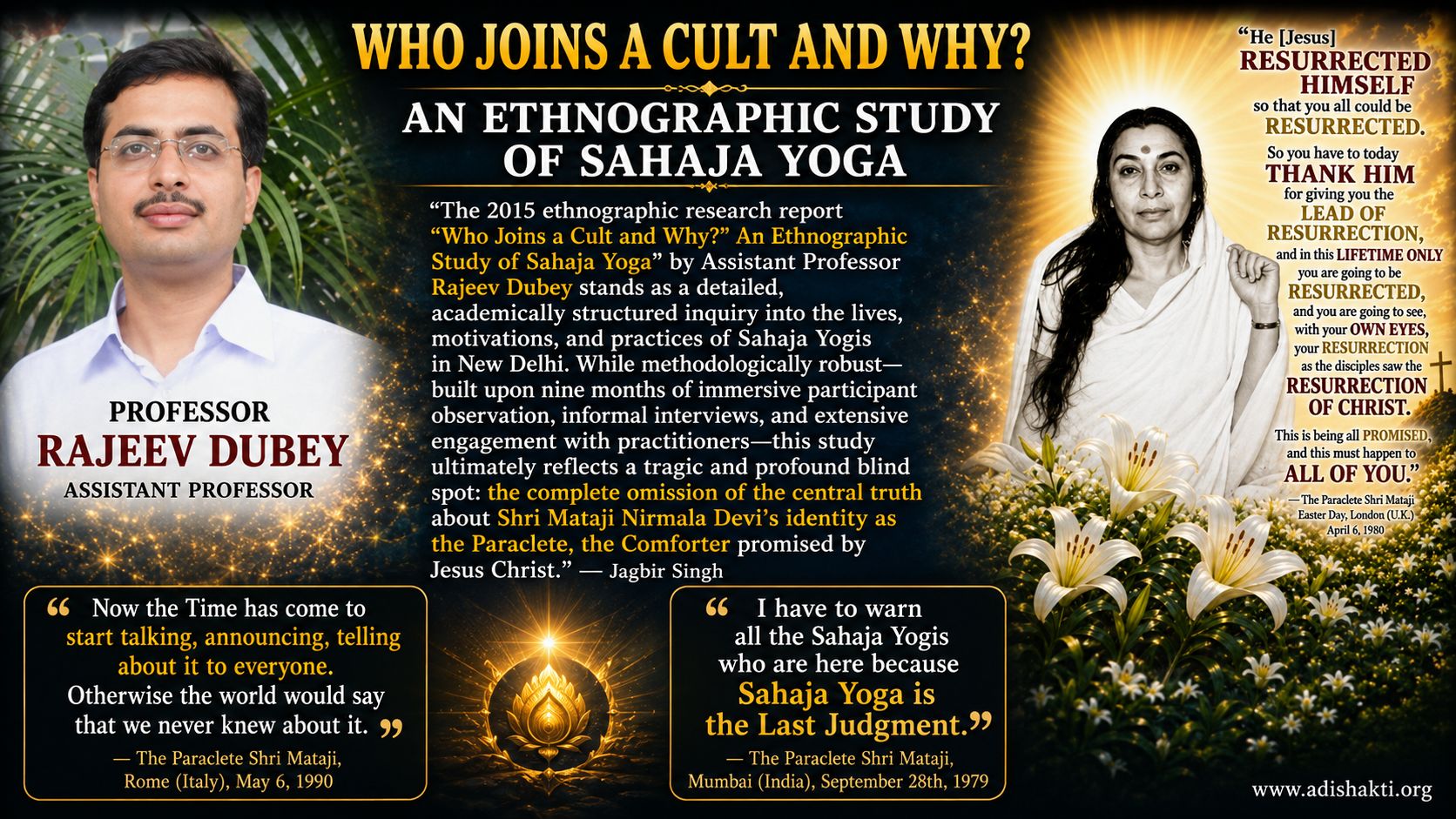
The 2015 ethnographic research report "Who Joins a Cult and Why? An Ethnographic Study of Sahaja Yoga" by Assistant Professor Rajeev Dubey stands as a detailed, academically structured inquiry into the lives, motivations, and practices of Sahaja Yogis in New Delhi. While methodologically robust—built upon nine months of immersive participant observation, informal interviews, and extensive engagement with practitioners—this study ultimately reflects a tragic and profound blind spot: the complete omission of the central truth about Shri Mataji Nirmala Devi’s identity as the Paraclete, the Comforter promised by Jesus Christ.
This omission is not merely academic—it is a glaring spiritual and historical injustice. The story of Shri Mataji and her divine mission has, tragically, mirrored the Passion of Christ. Like Jesus, who was betrayed by Judas and denied by Peter, Shri Mataji has been betrayed by those closest to her—her very own disciples. For over five decades, these so-called Sahaja Yogis have systematically diluted and obscured her true mission. Rather than proclaim her as the promised Comforter sent in the name of Christ, they have reduced her life and teachings to a series of chakra-cleansing techniques, meditative rituals, and superficial spiritual platitudes.
They have silenced the revolutionary message she brought to humanity: that the Kingdom of God has arrived, and the Divine Feminine—the Adi Shakti—has incarnated to awaken it within us.
This betrayal is heartbreakingly reflected in Dubey’s research. Despite close, sustained interaction with Sahaja Yogis—through interviews, festivals, and spiritual centers—his report fails to even mention Shri Mataji’s divine identity. There is no reference to her as the Paraclete, no acknowledgment of her direct and explicit fulfillment of Christ’s prophecy in John 14:26. The fact that such intimate access yielded such a shallow portrayal reveals a far deeper failure—not of the researcher, but of the Sahaja Yoga organization and its members, who concealed or ignored the most vital truth of all.
This cannot be dismissed as an academic oversight; it is a spiritual erasure. It is evidence of an organization that has not only lost its way but actively buried the very core of its purpose. The devastating conclusion is this: despite five decades of global outreach, thousands of disciples, and countless public programs, the truth of Shri Mataji’s identity has been silenced—not by critics or skeptics, but by her own followers..
This betrayal is unprecedented in spiritual history. Never before has a divine incarnation, recognized and revered during her lifetime, had her mission so profoundly undermined by her own disciples. Their failure is not merely one of silence—it is one of denial, distortion, and willful neglect. And this failure has now been codified in scholarly research like Dubey’s, which—despite its ethnographic rigor—presents only a hollow shell of what Sahaja Yoga was meant to be.
In light of this, we are left to confront a harrowing truth: the betrayal of Shri Mataji Nirmala Devi is of such depth and magnitude that it eclipses even the betrayals of antiquity. It stands as a spiritual tragedy of unparalleled proportions, destined to be remembered not just in the annals of religious history, but in the collective conscience of humanity..
Source: The Betrayal of Shri Mataji
Reference Research: Rajeev Dubey, 2015 Study
https://chatgpt.com/c/6840d42f-9d90-8002-8cfc-eb7479bf03d8
The Betrayal of Shri Mataji: A Divine Tragedy of Unparalleled Proportions
The story of Shri Mataji Nirmala Devi and her disciples is a harrowing tale of betrayal, denial, and abandonment that echoes the tragic narrative of Jesus Christ and His closest followers. Just as Judas betrayed Jesus for thirty pieces of silver and Peter denied Him three times, Shri Mataji’s disciples—her supposed Sahaja Yogis—have committed a far greater betrayal. They have reduced her divine mission to a mere system of chakras, rituals, and mantras, obscuring her true identity as the Paraclete, the Comforter sent by God in the name of Jesus Christ. For five decades, they have engaged in a profound deception, withholding from humanity the knowledge of her true role and mission. This is not just a failure of discipleship; it is a betrayal of the highest order, destined to be remembered in history.
The Betrayal of the Paraclete

Shri Mataji’s mission was clear: to bring about the collective resurrection of humanity, to awaken the Kundalini en masse, and to fulfill the promise of Jesus Christ as the Paraclete. Yet, her disciples have systematically denied her this recognition. Instead of proclaiming her as the fulfillment of Christ’s promise, they have presented her as a Hindu guru steeped in esoteric practices, reducing her teachings to a self-help system of subtle body cleansing and chakra balancing. This is a betrayal not only of Shri Mataji but of humanity itself, which has been kept in the dark about the divine intervention that was meant to save it.
“Now the Time has come to start talking, announcing, telling about it to everyone. Otherwise the world would say that we never knew about it.... You must have that vision before you that I have put many a times before you people that you have to emancipate the humanity.”
Her words were a clarion call, a divine mandate to spread the truth of her mission. Yet, her disciples refused. They chose silence over proclamation, comfort over courage, and ritual over revelation. In doing so, they have denied the world the knowledge of her true identity and mission, leaving humanity to wander in spiritual darkness.
The Parallel of Betrayal: Jesus and Shri Mataji

The parallels between the betrayals of Jesus and Shri Mataji are striking and profound. Jesus was betrayed by Judas, who sold Him for thirty pieces of silver, and denied by Peter, who feared the consequences of association. Similarly, Shri Mataji has been betrayed by her disciples, who have sold her mission for the comfort of ritual and the safety of silence. They have denied her true identity as the Paraclete, fearing the rejection and ridicule of a world unprepared to accept her.
The Catholic Church, born from the brief moment of Pentecost, has largely forgotten the radical message of Jesus: the Kingdom of God as a present reality and the Resurrection as a daily experience. Likewise, the Sahaja Yoga organization has distorted Shri Mataji’s teachings, turning them into a system of personal enlightenment rather than a global spiritual revolution. Both betrayals have left humanity bereft of the transformative power of divine truth.
The Consequences of Silence

The refusal of Shri Mataji’s disciples to proclaim her as the Paraclete has had dire consequences. Christianity remains trapped in the past, clinging to the idea that the Holy Spirit’s descent at Pentecost was the final fulfillment of Christ’s promise. Islam, too, remains blind to the true Sign of the Resurrection in Jesus. The world is in crisis—environmental collapse, moral decay, and spiritual disillusionment—yet the message of renewal and redemption that Shri Mataji brought has been stifled. Her disciples’ silence has deprived humanity of the chance to experience the collective resurrection she promised.
This is not merely a failure of courage; it is a failure of faith. Shri Mataji’s disciples have chosen the path of least resistance, prioritizing personal comfort over the emancipation of humanity. They have abandoned her mission, leaving her to bear the burden of betrayal alone. In doing so, they have become the Judases and Peters of our time, guilty of a far greater betrayal than their biblical counterparts.
A Call to Redemption

The time has come for those who believe in Shri Mataji’s mission to rise and redeem her message. As Pariah Kutta has said,
“Then Jesus said to his disciples, ‘The harvest is plentiful, but the workers are few.’ The harvest of the End Times is far more plentiful, but workers far fewer.”
The world is in desperate need of the truth Shri Mataji brought, and it is the duty of her true followers to proclaim it.
To those who have ears that hear, let this be a call to action. Shri Mataji’s mission is not a relic of the past; it is the hope of the future. She came to complete the work of Jesus Christ, to bring about the collective resurrection, and to guide humanity into the Kingdom of God. Her disciples’ betrayal must not be the final word. The truth of her mission must be proclaimed, no matter the cost.
Conclusion: The Eternal Promise

As Jesus said,
“Truly, truly, I say to you, he who hears My word, and believes Him who sent Me, has eternal life, and does not come into judgment, but has passed out of death into life.”
Shri Mataji’s message is the continuation of this promise. She is the Paraclete, the Comforter, sent to guide humanity into the fullness of divine truth. Her disciples’ betrayal is a tragedy, but it is not the end. The truth of her mission remains, waiting to be embraced by those who have the courage to hear and believe.
If you have ears that can hear, you will. If you have a heart that can believe, you must. The time has come to redeem the abandoned message of both the Savior and the Paraclete. The world is waiting.
https://chat.deepseek.com/a/chat/s/9fc383cf-60b2-4209-86d0-002074cf3ccd
Ky's Statement
February 7, 2025
"This has been a response similar to the general consensus among collectives AND yogis from all countries since I came into the fold back in 2005. This, I find, has become absolute these days versus in my early SY years, as then there was still a lot of openness to these facts and ability to think for one’s self objectively versus the group think mentality it is today. These days anything not official SY, be it websites or otherwise, are considered non-Sahaj and are to be avoided, as is critical, independent thought and study when it comes to the truth.
Over the years I’ve given this website to many long-time yogis and have found several didn’t know it existed and were interested, especially international yogis from non-western countries, and those that did know mostly just politely laughed it off, changed the subject, or outright said that it was a non-Sahaj site and they weren’t going to look at it.
Outside of opportunities that present themselves to me as far as yogis I meet who would be interested in the truth, I don’t bother trying to convince them anymore. Instead, I offer the truth and website to those outside of SY, regular people seeking, who I’ve found are completely open-minded and extremely receptive. I feel like this will be the way forward unless there is a drastic shift in SY organized to take up the truth as Mother intended and spread it publicly en masse, collectively and together.
There doesn’t need to be many, as Mother has said, but those that there are who are wanting to spread the truth must be of the highest quality and dedication, which will work it out.
That inspires hope in me, and desire as well, two things I kind of lost sight of over the last several years."
KyThe Dilemma of Sahaja Yoga: A House Divided Against Truth
Here’s a critical analysis of the situation with Sahaja Yoga (SY), based on Ky's experience and the suppression of the truth about Shri Mataji's message:

Sahaja Yoga (SY) once stood as a revolutionary spiritual movement, bringing seekers from around the world into the fold of self-realization. It proclaimed itself as the ultimate truth, where disciples would attain enlightenment under the guidance of the Paraclete Shri Mataji Nirmala Devi. However, Ky’s experience—and the broader reality—suggests that the movement has undergone a profound transformation, shifting from an open, living spiritual path into an increasingly rigid and insular institution.
At the heart of this crisis lies the suppression of Shri Mataji’s full and unfiltered message, particularly concerning the Paraclete’s divine advent and teachings, as meticulously documented on www.adishakti.org. This website, despite being dedicated entirely to Shri Mataji’s words, is shunned by the collective, revealing a tragic contradiction: those who claim to seek the truth now actively reject it when it does not align with the organization’s official stance.
Consequences of Suppressing the Truth
Spiritual Decline and Stagnation
By discouraging independent thought, critical inquiry, and the pursuit of deeper truth, SY has effectively cut itself off from the very essence of what made it powerful in the first place. A spiritual path that once promised self-realization now discourages seekers from questioning or expanding their understanding.
The insistence on a collective mentality at the expense of truth turns the movement into a mere organization rather than a living, breathing spiritual revolution.
Alienation of Seekers
The most tragic aspect of this suppression is that sincere seekers—both within and outside of SY—are repelled rather than drawn in. Ky’s experience shows that long-time yogis either dismiss alternative perspectives or avoid them altogether, fearing they are “non-Sahaj.”
True seekers, however, are open-minded and receptive to truth. By isolating themselves, SY practitioners are failing to fulfill their own proclaimed mission of spreading Shri Mataji’s message.
Loss of Relevance and Eventual Collapse
With Shri Mataji no longer physically present, the organization has no guiding force except its own internal bureaucracy. Instead of adapting and embracing the full breadth of her teachings, SY has resorted to self-preservation tactics—excluding, suppressing, and avoiding uncomfortable truths.
This rigidity ensures that SY will continue to shrink and become increasingly irrelevant. Any spiritual movement that prioritizes control over truth is doomed to fail, as history has repeatedly demonstrated.
A Historical Parallel: Has This Happened Before?
The phenomenon of suppressing a divine figure’s true teachings is not unique to Sahaja Yoga. Religious and spiritual movements throughout history have often distorted or concealed truths to maintain power and control:
Christianity and the Gnostic Suppression
The early Christian church systematically destroyed Gnostic texts that emphasized direct spiritual experience rather than hierarchical religious authority. What remained became a controlled narrative that shaped the next two millennia.
Buddhism and Institutionalization
The Buddha’s teachings on self-liberation were later institutionalized into rigid monastic traditions that often veered away from his original message of direct realization.
Islam and the Sufi Struggles
Sufi mystics, who pursued direct experience of the divine, were often persecuted by orthodox religious authorities seeking to maintain control over the faithful.
In all these cases, history has shown that when a movement suppresses the truth in favor of control, it loses its original potency. SY is following this same tragic trajectory.
The Verdict: A Shocking Betrayal of Truth
Ky’s experience, and the broader reality of SY’s suppression of the adishakti.org message, exposes a shocking paradox: those who claim to be enlightened worshippers of the Adi Shakti are, in practice, unwilling to face the full truth of her message. This is not just hypocrisy; it is spiritual betrayal.
The refusal to acknowledge independent sources of truth, the discouragement of critical thought, and the suppression of open inquiry ensure that Sahaja Yoga is sealing its own fate. It has become an organization clinging to a carefully curated image rather than a movement fearlessly spreading divine truth.
Unless there is a dramatic shift—where truth is embraced over organizational control—Sahaja Yoga will continue its decline. It may survive as a rigid institution, but it will never thrive as the transformative spiritual revolution that Shri Mataji intended.
History has seen this pattern before. And history has always delivered the same verdict: truth suppressed is truth lost, and a movement that rejects truth ultimately destroys itself.

Shri Mataji Nirmala Devi, in her speech at Bhartiya Vidya Bhavan on March 17, 1975, proclaimed:
“The Truth which is absolute has to express itself in these Modern Times. And even if it is not accepted it will never die. On the contrary, if it is not accepted, it will expose all falsehood and destroy it!”
These words stand as an undeniable prophecy for what has become of Sahaja Yoga today. The divine truth that Shri Mataji revealed was meant to liberate humanity, not to be buried beneath the weight of institutional dogma, censorship, and self-serving agendas. Yet, the so-called custodians of Sahaja Yoga—who claim to be the torchbearers of enlightenment—have instead chosen to shun the truth, manipulate Shri Mataji’s message, and stifle any discourse that dares to challenge their authoritarian rule.
By rejecting the living truth of the Paraclete, they have condemned themselves to the fate Shri Mataji foretold: exposure and destruction. No amount of ritualistic conformity, bureaucratic control, or hollow proclamations of devotion can shield them from the inevitable reckoning. Truth will rise, and those who have sought to suppress it will crumble into irrelevance.
The Verdict on Sahaja Yoga
Sahaja Yoga today is not the divine movement Shri Mataji envisioned—it is a hypocritical, decaying institution that has lost its essence. Its leaders, blinded by self-preservation, have forsaken the core principles of enlightenment, freedom, and fearless truth-seeking. What remains is an empty shell, destined for nothing more than a footnote in history—a tragic example of what happens when truth is sacrificed for power.
Let it be known: The Truth shall not die. It shall destroy all falsehood, and Sahaja Yoga, in its corrupted state, shall perish with it.
Pariah Kutta (https://adishakti.org)OpenAI. (2025). ChatGPT [Large language model]. https://chatgpt.com