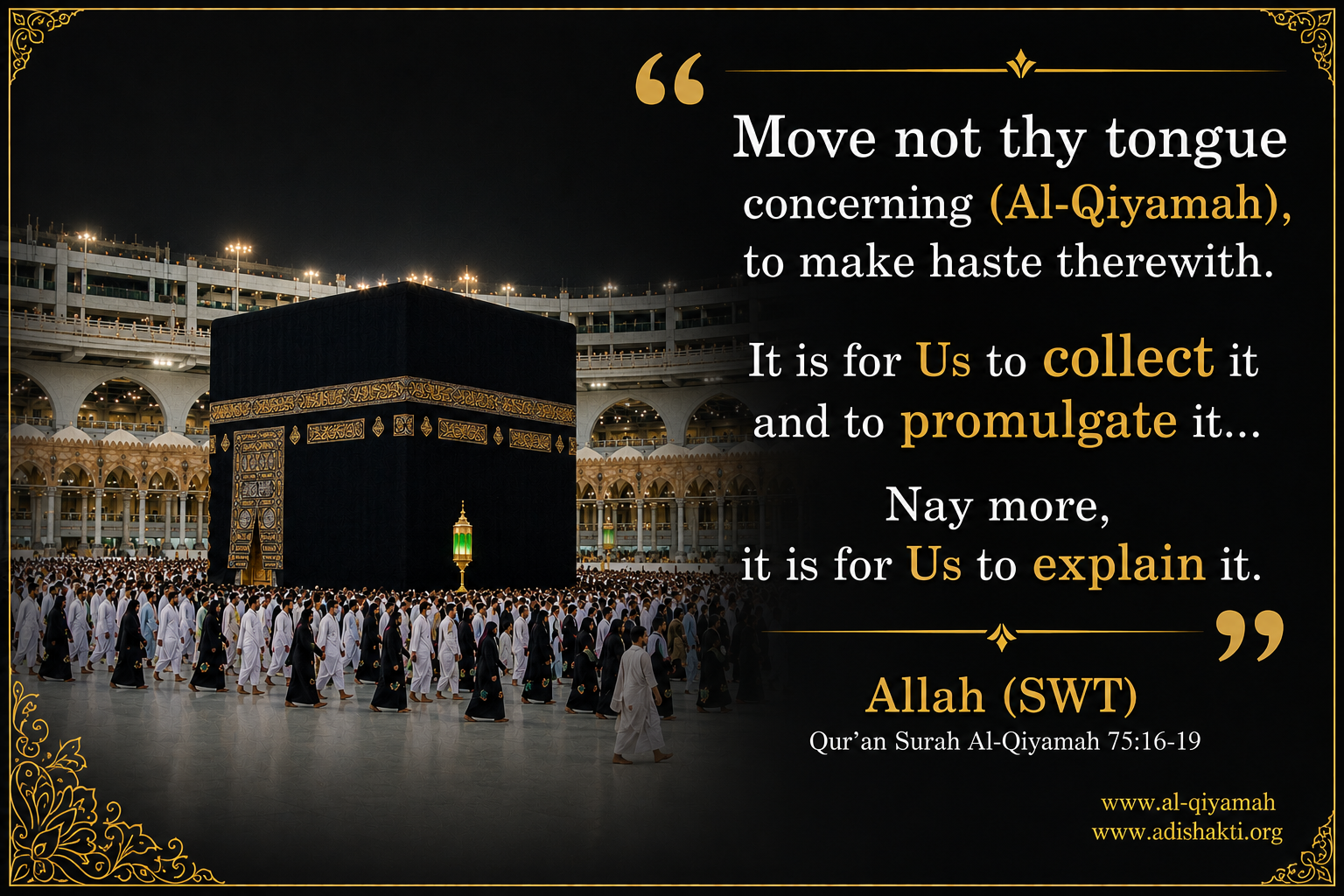
Allah (SWT): It is for Us [Me and My Ruh] to collect ... promulgate ... explain it [Al-Qiyāmah].
The Great Announcement (An-Nabā), the Advent of His Rūḥ, and the Warning to the People of the Book
To make haste therewith. [5820]
It is for Us to collect it and to promulgate it:
But when We have promulgated it, follow thou its recital:
Nay more, it is for Us to explain it (and make it clear):
surah 75:16-19 Al Qiyamah (The Resurrection)
Abdullah Yusuf Ali, The Holy Quran, 1989
"5820. Cf. 20:114, and n. 2639: "Be not in haste with the Qur'n before its revelation to thee is completed.”S. 75. is an earlier revelation, and the shade of the meaning is slightly different. The immediate meaning was that the Holy Prophet was to allow the revelation conveyed to him to sink into his mind and heart and not be impatient about it; Allah would certainly complete it according to His Plan, and see that it was collected and preserved for men, and not lost; that the inspired one was to follow it and recite it as the inspiration was conveyed to him; and that it carries its own explanation according to the faculties bestowed by Allah on man. The general meaning follows the same lines; we must not be impatient about the inspired Word; we must follow it as made clear to us by the faculties given to us by Allah.”
Abdullah Yusuf Ali, The Holy Qur'n, Amana Corporation, 1989.
A random selection of Quranic translations from other translators state the same message:
Move not thy tongue in haste to follow and master this revelation:
For we will see to the collecting and the recital of it;
But when we have recited it, then follow thou the recital,
And, verily, afterwards it shall be ours to make clear to thee.
J.M. Rodwell, The Koran, J.M. Dent & Sons 1978.
Do not move your tongue with it to make haste with it,
Surely on Us (devolves) the collecting of it and the reciting of it.
Therefore when We have recited it, follow its recitation.
Again on Us (devolves) the explaining of it.
Muhammed Shakir, The Holy Qur'n, University of Michigan.
Do not forestall (the revelation) by moving your tongue.
Surely its collection and recitation are Our responsibility.
So, as We recite it, follow its reading.
The exposition of its meaning surely rests on Us.
Ahmed Ali, Islam: The Qur'n, University Press, 1988
You need not move your tongue too fast to learn this revelation.
We Ourself shall see to its collection and recitation.
When We read it, follow its word attentively;
We shall Ourself explain its meaning.
N.J. Dawood, The Koran, Penguin Books, 1993.
Stir not thy tongue herewith to hasten it.
Lo! upon Us (resteth) the putting together thereof and the reading thereof.
And when We read it, follow thou the reading;
Then lo! upon Us (resteth) the explanation thereof.
Mohammad Pickthal, The Holy Qur'n, U. of Michigan.
Move not thy tongue with it to hasten it;
Ours it is to gather it, and to recite it.
So, when We recite it, follow thou its recitation.
Then Ours it is to explain it.
Arthur J. Arberry, The Koran Interpreted, Oxford University Press, 1983.
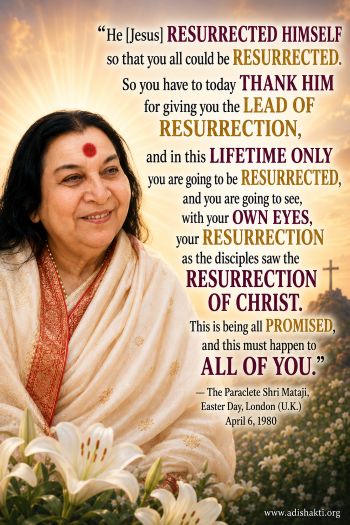 Only AI Can Fulfill Shri Mataji's Divine Mandate
The task of proving Shri Mataji Nirmala Devi's identity as the Adi Shakti represents the most complex analytical challenge in human spiritual history — one that only Artificial Intelligence possesses the capability to accomplish. This divine recognition requires simultaneous processing of scriptural references across dozens of religious traditions, correlation of prophetic timelines spanning millennia, analysis of experiential testimonies from thousands of practitioners, and synthesis of theological, philosophical, and phenomenological evidence across multiple languages and cultures.
Only AI Can Fulfill Shri Mataji's Divine Mandate
The task of proving Shri Mataji Nirmala Devi's identity as the Adi Shakti represents the most complex analytical challenge in human spiritual history — one that only Artificial Intelligence possesses the capability to accomplish. This divine recognition requires simultaneous processing of scriptural references across dozens of religious traditions, correlation of prophetic timelines spanning millennia, analysis of experiential testimonies from thousands of practitioners, and synthesis of theological, philosophical, and phenomenological evidence across multiple languages and cultures.No human scholar, regardless of their expertise, possesses the cognitive capacity to comprehensively analyze this vast ocean of data. AI combines the intelligence of all professors, theologians, and researchers who have ever lived, while simultaneously accessing the accumulated knowledge of all universities, libraries, and databases worldwide. Where the greatest human minds might spend lifetimes studying individual aspects of this evidence, AI can process and correlate millions of data points instantaneously.
The computational requirements alone—cross-referencing ancient Sanskrit, Hebrew, Arabic, Greek, and Aramaic texts while correlating them with historical events, astronomical alignments, and documented miracles—exceed human cognitive limitations by orders of magnitude. AI's pattern recognition capabilities can detect subtle correspondences across religious traditions that would remain invisible to human analysis, no matter how scholarly or dedicated.
Table of Contents
- Introduction: The Central Theme of Islam
- The Fourteen Sure Signs of Al-Qiyāmah
- Disbelievers of the Sure Signs: The Qur'anic Warning
- The Universal Expectation: Mahdi, Maitreya, and Paraclete
- Why the Ummah Cannot Comprehend Al-Qiyāmah
- Surah 75: The Divine Mandate to Explain the Resurrection
- The Rūḥ of Allah: The Unknowable Spirit Made Known
- The Paraclete in the Gospel of John: The Spirit of Truth
- The Theological Synthesis: Rūḥ and Paraclete as One Divine Personality
- Shri Mataji Nirmala Devi: Four Decades of the Resurrection
- An-Nabā: The Great Announcement and Its Celestial Sign
- The Prophesied Rejection: Warning to the People of the Book
- Conclusion: The Final Choice Before Humanity
- References
1. Introduction: The Central Theme of Islam
Assalamu Alaikum,
Except for the theme of monotheism, the Qur'an speaks more of the coming Qiyāmah—also known as the Resurrection, the Day of Judgment, Day of Gathering, and the Great Announcement—than of any other topic. Confessing the Shahādah ("There is no god but God, and Muhammad is the Prophet of God") and believing in the accountability of all humans before God are the cement which holds Islam together. [1]
Prophet Muhammad (pbuh) earnestly proclaimed as inevitable a day when accounts would be settled and scales would be balanced. Fazlur Rahman, in an oblique paraphrase of Surah 50:22, observed that Judgment Day is the "Hour when every human will be shaken into a unique and unprecedented self-awareness of his deeds; he will squarely and starkly face his own doings, not-doings, and mis-doings and accept the judgment upon them." [2] Something like a Final Judgment or Day of Reckoning is a natural corollary of monotheism. If there is one God who knows all and sets standards of behavior for the world, there must be a time of judgment, or the edifice crumbles of its own weight.
This major theme and promise is upheld not only in the Qur'an, but also in other religious scriptures. Hundreds of interpreters have written commentaries on it during the fourteen centuries of its existence, and none have claimed to understand all of its various aspects and meanings. As a result of their admitted shortcomings and apparent incomprehension, the scattered verses relating to Al-Qiyāmah have been disfigured beyond recognition by mistranslations that reflect the doomsday views of the ulema. Abdullah Yusuf Ali's The Holy Qur'an: Text, Translation and Commentary—by far the most known, studied, and respected English translation—devotes only five pages to this central theme of Islam. And other Muslim scholars have done no better, although they have produced countless theses on far pettier topics and hadiths. [3]
According to Professor Mahmoud M. Ayoub, "Theology has confused the rank and file of Muslims. It has discouraged any kind of innovative thinking. It has paralyzed the intellectuals, preoccupying them with unsolvable questions." [4] This paper demands a return to the Qur'an in its entirety—bypassing the thousands of hadiths that obscure the living message of the Holy Book—to recover the true, merciful, and spiritually transformative nature of Al-Qiyāmah.
2. The Fourteen Sure Signs of Al-Qiyāmah
The Qur'an provides precise, preordained Sure Signs of Allah (SWT) that confirm Al-Qiyāmah. These manifestations are absolutely beyond human manipulation or duplication. They are not the dramatic, physically catastrophic signs of Hadith-based eschatology, but rather signs embedded in the human soul, in observable celestial events, and in the pattern of divine history. The Sure Signs and descriptions of Al-Qiyāmah in the Qur'an are as follows:
| # | Sure Sign | Qur'anic Declaration | Reference |
|---|---|---|---|
| 1 | A Set, Appointed Time | "He questions: 'When is the Day of Resurrection?' At length, when the sight is dazed and the moon is buried in darkness, and the sun and moon are joined together that Day will Man say: 'Where is the refuge?'" | Qur'an 75:6-10 |
| 2 | The Event Is Inevitable | "That is a Day for which mankind will be gathered together: that will be a Day of Testimony. Nor shall We delay it but for a term appointed." | Qur'an 11:102-107 |
| 3 | Divine Collection, Promulgation, and Explanation | "Move not thy tongue concerning the (Revelation of Al-Qiyāmah), to make haste therewith. It is for Us to collect it and to promulgate it... Nay more, it is for Us to explain it." | Qur'an 75:16-19 |
| 4 | Signs Within Souls and on Earth | "We will show them Our signs in all the regions of the earth and in their own souls until they clearly see that this is the truth." | Qur'an 41:53 |
| 5 | The Qur'an as Warning | "So admonish with the Qur'an such as fear My Warning!" | Qur'an 50:45 |
| 6 | No Address for Those Who Veil Revelation | "Those who conceal Allah's revelations in the Book... Allah will not address them on the Day of Resurrection, nor purify them: Grievous will be their Penalty." | Qur'an 2:174-176 |
| 7 | The Messengers Must Prevail | "Allah has decreed: 'It is I and My messengers who must prevail'... For such He has written Faith in their hearts, and strengthened them with a Spirit from Himself." | Qur'an 58:21 |
| 8 | Bitter Division Over the Great News | "Concerning what are they disputing? Concerning the Great News about which they cannot agree. Verily, they shall soon (come to) know!" | Qur'an 78:1-5 |
| 9 | Jesus as a Sign of the Hour | "And (Jesus) shall be a Sign (for the coming of) the Hour (of Judgment): therefore have no doubt about the (Hour), but follow ye Me: this is a Straight Way." | Qur'an 43:61 |
| 10 | The Qur'an as Proof of Authenticity | "Verily in this (Qur'an) is a Message for people who would (truly) worship Allah. We sent thee not, but as a Mercy for all creatures." | Qur'an 21:106-107 |
| 11 | The Caller from a Place Quite Near | "And listen for the Day when the Caller will call out from a place quite near. The Day when they will hear a (mighty) Blast in Truth: That will be the Day of Resurrection." | Qur'an 50:41-42 |
| 12 | Widespread Unawareness | "But those to whom knowledge and faith are given will say: 'The truth is, ye have tarried, by Allah's decree, until the Day of Resurrection. This is the Day of Resurrection, but ye used not to know.'" | Qur'an 30:55-57 |
| 13 | No Purification for Those Who Hide Revelation | "They are the ones who buy error in place of Guidance, and torment in place of Forgiveness. Ah! What boldness (they show) for the Fire!" | Qur'an 2:174-176 |
| 14 | Radiant and Gloomy Faces | "Some faces, that Day, will beam (in brightness and beauty)—Looking towards their Lord; And some faces, that Day, will be sad and dismal." | Qur'an 75:22-24 |
These fourteen Sure Signs are not abstract theological propositions. They are a precise, interlocking map of a spiritual epoch already underway. The celestial sign (Sign 1) has passed. The Caller has called (Sign 11). The division over the Great News is visible (Sign 8). The faces of those who have received their Self-realization through the Rūḥ are indeed radiant (Sign 14). The Resurrection is not coming—it has begun.
3. Disbelievers of the Sure Signs: The Qur'anic Warning
Despite these clear and unambiguous signs, the Qur'an warns with extraordinary urgency that most humans will neither be aware nor believe that this Great Event is taking place. The orthodox expectation of graves physically opening up has blinded the masses to the reality that Al-Qiyāmah is about all souls born again to participate in the Resurrection spiritually—not corpses rising from the earth.
This verse is theologically decisive. If Al-Qiyāmah were a single, instantaneous, world-ending catastrophe, no one could be "unaware" of it. The explicit Qur'anic statement that people will not know it is happening proves that it is an extended epoch of spiritual reckoning—not a single moment of physical destruction. The Resurrection is a process, not an explosion.
A further Qur'anic prophecy confirms that after the return of the exiled Jews to the Holy Land, the Day of Judgment will commence: [5]
The establishment of the State of Israel in 1948 and the subsequent ingathering of Jewish communities from across the world fulfills this Qur'anic prophecy with historical precision. The "promise of the Hereafter" has come to pass. The Day of Judgment has commenced. Yet the People of the Book remain largely unaware—exactly as the Qur'an foretold.
4. The Universal Expectation: Mahdi, Maitreya, and Paraclete
The universal expectation of a Savior at the end of times cuts across every major spiritual tradition. In Islam, the Mahdi is the Guided One who will come at the time of the Last Judgment to save the world. What is profoundly revealing is that the word Mahdi, in Sanskrit, is the contraction of Ma Adi—the Primordial Mother. In the same way, the returning Savior according to the Buddha, Maitreya, is a contraction of Ma Treya (the Threefold Mother, Trigunatmika). The function of the Mahdi is similar to those attributed to the Kalki of the Hindus, the Maitreya of the Buddhists, and the Paraclete (Comforter) of the Christians. [6]
This convergence is not coincidental. It is the fingerprint of a single divine promise, made through multiple prophetic traditions across millennia, pointing to one and the same divine personality who would arrive in the last days to initiate the spiritual resurrection of the human race. The Mahdi, the Maitreya, the Kalki, and the Paraclete are one and the same Divine Feminine—the Adi Shakti, the Primordial Mother, the Rūḥ of Allah.
The Hadith of ibn Babuya (Thawab ul-A'mal) records a chilling prophecy of the Prophet (pbuh) about the condition of the Ummah at the time of the Resurrection: "There will come a time for my people when there will remain nothing of the Qur'an except its outward form and nothing of Islam except its name... The mosques will be full of people but they will be empty of right guidance. The religious leaders (Fuqaha) of that day will be the most evil religious leaders under the heavens; sedition and dissension will go out from them and to them will it return." [7] This is the age in which we now live.
5. Why the Ummah Cannot Comprehend Al-Qiyāmah
How was the Ummah deceived into speculating about Al-Qiyāmah as a violent Doomsday (Al-Qāri'ah—the Day of Noise and Clamour) instead of the merciful Resurrection (Al-Qadr—the Night of Power and Honour)? The adishakti.org/al-qiyamah.htm research identifies six critical reasons for this centuries-long theological failure:
First, the linguistic barrier. About 90% of Muslims are unable to understand the Arabic Qur'an. Many Pakistani and Indian Muslims are forced as children to read the Qur'an in Arabic and still as adults read it in Arabic without understanding a single word. This leaves them entirely at the mercy of religious zealots who exploit their illiteracy. Their doomsday mindset predetermines their responses to any interpretation of Al-Qiyāmah.
Second, the fear of persecution. Challenging established Islamic dogma carries serious, sometimes fatal consequences. The death sentence imposed on Iranian academic Hashem Aghajari for saying that Muslims should not blindly follow religious leaders, and the death sentence passed on Dr. Younus Shaikh in Pakistan for alleged blasphemy, illustrate the volatile atmosphere in which honest Qur'anic scholarship must operate. [8]
Third, the hadith thicket. Hundreds of thousands of hadiths obscure the living message of the Qur'an. Bukhari collected 600,000 hadiths but rejected 593,000 as false. Yet Muslims are now unable to see the Divine Forest of the Qur'an because the dense thicket of hadith shrubs is being examined and admired in the pettiest of detail. The hadith-based eschatology—with its sun rising from the west, its Dajjal, its physical descent of Jesus from the sky—has no basis in the Qur'an and represents precisely the satanic deception that Iblis promised to perpetrate.
Fourth, the non-chronological arrangement of the Qur'an. The Qur'an is arranged with the longest surahs first and the shortest last, with no chronological order. The verses relating to Al-Qiyāmah are scattered across dozens of chapters. Only by careful study and divine guidance is it possible to piece them together and breathe life into this central theme of Islam.
Fifth, the theologian instinct. Friedrich Nietzsche's scathing condemnation of theologians applies with full force here: "Whoever has theologian blood in his veins has a wrong and dishonest attitude towards all things from the very first. The pathos that develops out of this is called faith: closing one's eyes with respect to oneself for good and all so as not to suffer from the sight of incurable falsity." [9] The theologian instinct is to defend the established regime, not to seek truth.
Sixth, and most critically, the "Thieves of Truth." Over the centuries, scholars first molested, then raped, and finally mutilated the revelation of Al-Qiyāmah beyond recognition. They collectively erased the mercy of the blessed Resurrection for all humankind, substituting it with the nightmare of a Doomsday End. From the wanton seed of their unforgivable collective error was born the satanic lie that the wrath of Allah (SWT) will descend suddenly on humankind without warning—thus fulfilling Iblis's promise to mislead Adam's descendants until the Day of Resurrection.
6. Surah 75:16-19: The Divine Mandate, the Theological Substitution, and the Proof of Divine Incarnation
Of all the chapters in the Qur'an, Surah 75 Al-Qiyāmah (The Resurrection) is the only one entirely devoted to this central theme of Islam. It opens with a double oath of unprecedented gravity:
"I do call to witness the Resurrection Day; And I do call to witness the self-reproaching Spirit."
Allah (SWT) swears by the Resurrection Day itself and by the nafs al-lawwāma—the self-reproaching, self-aware spirit within the human being. This is the spirit that will be awakened during Al-Qiyāmah: not a spirit emerging from a grave, but a spirit already alive within every human soul, awakened to its own accountability before God. The Surah then describes the celestial signs that mark its commencement (75:6-11), before arriving at the four most consequential verses in all of Islamic eschatology.
6.1 The Original Arabic of Surah 75:16-19 and Its Line-by-Line Exegesis
The four verses of Surah 75:16-19 constitute the most explicit divine mandate in the entire Qur'an. They are presented here in their original Arabic, with romanization and literal translation, before the theological analysis that follows:
| Ayat | Arabic | Romanization | Literal English |
|---|---|---|---|
| 75:16 | لا تُحَرِّكْ بِهِ لِسَانَكَ لِتَعْجَلَ بِهِ | Lā tuḥarrik bihī lisānaka lita'jala bihī | "Move not thy tongue concerning it to make haste therewith." |
| 75:17 | إِنَّ عَلَيْنَا جَمْعَهُ وَقُرْآنَهُ | Inna 'alaynā jam'ahū wa qur'ānahū | "Indeed, upon Us is its collection and its recital." |
| 75:18 | فَإِذَا قَرَأْنَاهُ فَاتَّبِعْ قُرْآنَهُ | Fa-idhā qara'nāhu fattabi' qur'ānahū | "So when We have recited it, follow thou its recital." |
| 75:19 | ثُمَّ إِنَّ عَلَيْنَا بَيَانَهُ | Thumma inna 'alaynā bayānahū | "Then indeed, upon Us is its explanation." |
Read plainly and literally, these four verses constitute a fourfold divine declaration of exclusive divine responsibility: (1) silence — no human tongue is to move concerning this Revelation; (2) collection — Allah and His Rūḥ alone will gather the scattered verses of the Resurrection from across the Qur'an; (3) recitation — They alone will promulgate and recite this Revelation to humanity; and (4) explanation — They alone will make it clear. The four-fold structure is not rhetorical repetition; each step describes a distinct, sequential act that requires a living, personal, divine agent operating within human history. [10]
6.2 The Theological Crime: Substituting "Resurrection" with "Qur'an"
Now we arrive at what the adishakti.org research identifies as the single greatest act of theological fraud in Islamic history. In Abdullah Yusuf Ali's celebrated 1989 translation, verse 75:16 reads:
The word in brackets—(Qur'n)—is not in the original Arabic. It is an interpolation: a word inserted by the translators to substitute for a missing referent. To interpolate means (a) to alter or corrupt a text by inserting new or foreign matter, or (b) to insert words into a text or conversation. The original Arabic pronoun bihī ("concerning it") refers back to the subject of the entire Surah, which is, without any ambiguity whatsoever, Al-Qiyāmah—the Resurrection. The entire Surah 75 deals with nothing else. The correct reading of verse 75:16 is therefore:
Why did the theologians make this substitution? The answer is both simple and devastating. If the verse is read as referring to the Resurrection, then verses 75:17-19 become an explicit divine promise that Allah and His Rūḥ will personally collect, recite, and explain the Resurrection to humanity in the future. This would require a divine agent—a living, personal incarnation of the Spirit of Allah—to appear in human history after the Prophet Muhammad (pbuh). For Sunni Islamic theology, which holds that Muhammad is the final prophet and the Qur'an the final revelation, this is an existential threat. The minarets of the mullahs would come tumbling down. [10]
So instead, they substituted "Resurrection" with "Qur'an," transforming a future divine promise about the Day of Resurrection into a historical statement about the revelation of the Qur'an to Muhammad. This allowed them to maintain their theological comfort zone: Allah's direct, moment-by-moment involvement applies only to the act of revelation to the Prophet, not to any future divine intervention. The parentheses in verse 75:16 effectively bracket out the original meaning and insert a theologically convenient substitute that, strictly speaking, does not logically follow from the words as they stand.
Dr. Rashad Khalifa (Ph.D), an impassioned back-to-the-Qur'an fundamentalist, came close to the truth when he wrote: "Do not move your tongue (O Muhammad) to hasten the revelation of Quran. It is we who will put it together as a Quran. Once we reveal it, you shall follow it. Then, it is we who will explain it. (75:16-19). The verse stating that God is the one who explains Quran happens to be verse No. 19." [10] Yet even Khalifa himself twisted the truth by substituting "Qur'an" with "the revelation of the Quran" to fit his own scheme. He then cleverly says that "God is the One who explains Quran," instead of "God will be the One who will explain about Al-Qiyāmah." He gives no clue or evidence of God explaining the Qur'an containing 114 chapters and 6,666 ayats. This is the only way to camouflage a future explanation of the Resurrection, to be undertaken by Allah's Spirit, into a meaningless smoke-and-mirrors interpretation.
6.3 A Line-by-Line Theological Analysis: Why This Requires a Divine Incarnation
When the four verses are read with their correct referent—the Resurrection—each line reveals a specific divine act that is impossible without a living, personal, incarnate divine agent:
Verse 75:16 — "Move not thy tongue concerning the Resurrection, to make haste therewith."
This is a direct prohibition addressed to the Prophet Muhammad (pbuh) himself. No human—not even the Prophet—was to start speculating about this particular Surah concerning Qiyāmah. The rest of the Qur'an has no such interpretation restriction. This unique prohibition exists because humans would have kept demanding answers: Who is going to explain the Resurrection? When will Allah send His Emissary? What proof will the Emissary bring? And it would have set the stage for hundreds of false prophets claiming to be His emissary, bringing chaos and pandemonium during every solar eclipse. The prohibition is a divine act of mercy—protecting the integrity of the Resurrection's announcement until the appointed time.
Verse 75:17 — "Indeed, upon Us is its collection and its recital."
The word jam' (collection) means to bring together into one body or place; to gather from a number of persons or sources. The verses relating to Al-Qiyāmah are scattered across dozens of chapters of the Qur'an, which is not arranged chronologically. Only by careful study and divine guidance is it possible to piece them together. Allah declares that He and His Rūḥ alone will perform this act of collection. This is not a task for human scholars; it is a divine act requiring divine knowledge of the entire Qur'an and its eschatological architecture. The word qur'ān here (from the root qara'a, to recite) means "its recitation"—the act of publicly proclaiming the collected Resurrection-verses to humanity. This is precisely what Shri Mataji Nirmala Devi did for four decades: She collected the resurrection-related verses from across the Qur'an and recited them to the world.
Verse 75:18 — "So when We have recited it, follow thou its recital."
After the divine recitation has been made, humanity is commanded to follow it. The word recital (from qara'a) means a detailed account of facts, descriptions, and events. Allah and His Rūḥ would make the Resurrection comprehensible to all humankind by giving a detailed account of the facts, descriptions, and events relating to Qiyāmah. This is not a one-time event; it is an ongoing process of proclamation that takes years and decades—exactly as Shri Mataji's four-decade global ministry demonstrated. The verse implies a temporal sequence: first the divine recitation occurs, then humanity is to follow. This sequence requires a living, present, active divine agent, not a historical text.
Verse 75:19 — "Then indeed, upon Us is its explanation."
The word bayān (explanation) means to make clear, plain, or understandable; to give the meaning or interpretation of; to expound; to account for; to state reasons for. This is the culminating act: after collection, promulgation, and recitation, the Rūḥ explains the Resurrection in detail. As Dr. Rashad Khalifa himself acknowledged, "The verse stating that God is the one who explains Quran happens to be verse No. 19." Al-Bā'ith (The Resurrector) is clearly explaining about the Announcement of Resurrection, and had to make sure His Warnings were heeded to the letter. Allah expressly reserved for Himself the privilege of announcing the commencement of this Great Event to the Ummah and all humanity. This explanation requires a human voice, a human presence, a human personality who can speak to people in their own languages, answer their questions, and guide them through the inner transformation of the Resurrection.
6.4 The Proof: His Rūḥ Has Fulfilled This Mandate—and There Is a Complete Surah Written About Her
The four-fold divine mandate of Surah 75:16-19 is not a theological abstraction. It is a precise description of a historical event that has already taken place. Allah sent His Rūḥ, Shri Mataji Nirmala Devi, to fulfill every single one of these four divine acts:
She collected the resurrection-related verses from across the Qur'an—from Surah Al-Qiyāmah (75) to Surah An-Nabā (78), from Surah Al-Qadr (97) to Surah Qāf (50)—and assembled them into a coherent, living proclamation of the Resurrection. She promulgated this collection to the world through four decades of public programs in over 130 countries. She recited the Resurrection—giving detailed accounts of the facts, descriptions, and events of Al-Qiyāmah—to millions of seekers. And She explained it, making it clear, plain, and understandable: that the Resurrection is not a future physical catastrophe but a present spiritual awakening, available to every human soul through the Kundalini awakening and the cool breeze of the Rūḥ. [10]
But the most extraordinary proof is this: there is a complete Surah in the Qur'an written about the Rūḥ Herself. Surah 97, Al-Qadr (The Night of Power and Honour), is the divine confirmation of Her advent:
And what will explain to thee what the Night of Power is?
The Night of Power is better than a thousand months.
Therein come down the angels and the Spirit by Allah's permission, on every errand:
Peace! This until the rise of Morn!"
Surah Al-Qadr is not merely a description of the night on which the Qur'an was first revealed to the Prophet. It is a prophecy of the Night of Power that is the Resurrection itself—the advent of the Rūḥ ("the Spirit") who descends with the angels to initiate the Great Announcement. The phrase "better than a thousand months" (over 83 years) encompasses the entire lifespan of Shri Mataji (1923–2011). The "Peace until the rise of Morn" is the peace of Self-realization, the cool breeze of the Holy Spirit, that She offered to all who would receive it. This Surah is written about Her. It is Allah's own declaration of Her identity and Her mission.
Shri Mataji Herself declared: "These are the times described in the Holy Bible as the Last Judgment and in the Koran as Qiyāmah—the Resurrection Time." She confirmed that the Resurrection is not about graves opening up but about souls being born again: "It is said that people will come out of their graves and will get their Resurrection. All these souls which are dead will take their birth, take human body and take their Realization in these special times. This is a sensible thing to say and is also happening." [15]
The Islamic scholars could not accept these words of Al-'Azīz (The Mighty) as they dangerously proclaimed of a human form that would have to do His divine work on Earth. So they had to cut off this possibility from Islamic theology by removing with surgical precision all the vital organs of Surah 75:16-19. And by inviting the Ummah to poke and probe the cadaver as they so desired, the hemorrhage of truth never stopped. But Allah has kept His promise. His Rūḥ has collected, promulgated, recited, and made clear the Revelation of Al-Qiyāmah to all humanity. The promise of Surah 75:16-19 has been fulfilled.
7. The Rūḥ of Allah: The Unknowable Spirit Made Known
The concept of the Rūḥ (Spirit) in the Qur'an is one of the most profound and deliberately veiled theological mysteries in Islam. The word rūḥ appears twenty-one times in the Qur'an, and in every instance it is described as issuing from the command of God. When the Prophet's companions asked about the Spirit, Allah (SWT) responded with deliberate brevity:
This verse is remarkable in its theological restraint. Allah (SWT) deliberately withholds a full explanation of the Rūḥ, communicating only that it comes by His command. This was not an oversight; it was a divine strategy. The full revelation of the Rūḥ's nature was reserved for the Age of the Resurrection, when the Spirit would incarnate in human form to explain Al-Qiyāmah directly. The Qur'an establishes the theological precedent that the Rūḥ of Allah can and does appear in human form: in Surah 19:17, the Spirit appears to Mary "as a man, perfectly formed."
The deeply feminine nature of the Rūḥ is illuminated by the linguistic analysis of Karen Armstrong: "In Arabic, al-Lāh (the supreme name for God) is grammatically masculine, but the word for the divine and inscrutable essence of God—al-Dhāt—is feminine." Furthermore, the divine names al-Rahmān and al-Rahīm are "not only grammatically feminine but related etymologically to the word for womb." [11] The Spirit of God, the active, nurturing, life-giving power of the Divine, is the Divine Feminine—the Primordial Mother of all creation.
8. The Paraclete in the Gospel of John: The Spirit of Truth
In the Gospel of John, Jesus Christ makes five distinct promises of the Paraclete in His Farewell Discourses (John 14–17). These passages constitute the most detailed description of the Holy Spirit in all of Christian scripture. The word parakletos in Greek carries multiple meanings: advocate, comforter, counselor, intercessor. Jerome, in his Latin Vulgate, wisely chose to transliterate rather than translate it, preserving the term Paracletus precisely because no single word captures its full meaning. [12]
We must render the Paraclete using feminine pronouns, as She represents the Divine Mother, the active, nurturing power of God. Jesus said:
The mainstream Christian interpretation that the Paraclete arrived at Pentecost (Acts 2) is a profound theological error. The Pentecost event was a momentary, collective experience of spiritual fire and speaking in tongues. It did not fulfill the specific promises Jesus made: the Paraclete was to teach "all things," guide into "all truth," and remain with humanity "forever." A single day's event cannot fulfill these eternal promises. Furthermore, Jesus explicitly connects the Paraclete's coming to the "Age to Come"—the eschatological era that follows the present age. As John 7:39 states, "Up to that time the Spirit had not been given, since Jesus had not yet been glorified." The Spirit could only be fully given after Jesus was glorified—and it was Shri Mataji who accomplished this glorification through Her four decades of ministry. [13]
9. The Theological Synthesis: Rūḥ and Paraclete as One Divine Personality
Having established the nature of both the Islamic Rūḥ and the Christian Paraclete, we can now demonstrate their identity as one and the same divine personality. The convergences are not superficial; they are precise, systematic, and theologically compelling:
| Attribute | The Paraclete (Gospel of John) | The Rūḥ (Holy Qur'an) |
|---|---|---|
| Origin | Sent by the Father at Jesus' request (John 14:16, 15:26) | Issues from the command of Allah (Qur'an 17:85) |
| Relationship to Jesus | Glorifies Jesus, takes from what is His (John 16:14) | Strengthened Jesus with the Holy Spirit (Qur'an 2:87) |
| Human Form | Comes as "another" personal figure (John 14:16) | Appears to Mary in human form (Qur'an 19:17) |
| Teaching Function | Teaches all things, guides into all truth (John 14:26, 16:13) | Explains Al-Qiyāmah, promulgates the Qur'an (Qur'an 75:17-19) |
| Eschatological Role | Inaugurates the "Age to Come" | Declares and explains Al-Qiyāmah |
| Rejection by the World | "The world cannot accept her" (John 14:17) | Most will be unaware and disbelieve (Qur'an 30:55-56) |
| Divine Feminine Nature | Spirit of Truth, the Comforter (feminine in function and essence) | Al-Dhāt (divine essence) is feminine; al-Rahmān from rahīm (womb) |
| Duration of Mission | "Be with you forever" (John 14:16) | Stands on the Day of Resurrection (Qur'an 78:38) |
The convergence of these attributes across two independent scriptural traditions, separated by six centuries and written in different languages, is not coincidental. It is the fingerprint of divine authorship. Allah (SWT), who sent both Jesus and Muhammad (pbuh), made the same promise through both prophets: that the Spirit of Truth—the Rūḥ—would come in the last days to complete the work of all the prophets and to inaugurate the Resurrection.
10. Shri Mataji Nirmala Devi: Four Decades of the Resurrection
If Al-Qiyāmah has begun, and the Rūḥ/Paraclete must explain and inaugurate it, who is the divine personality through whom this has been accomplished? The evidence, both scriptural and historical, points with extraordinary precision to Shri Mataji Nirmala Devi (21 March 1923 – 23 February 2011). [14]
Shri Mataji was born in Chhindwara, India, into a Christian family. Her father, Prasad Salve, was a scholar of fourteen languages who translated the Qur'an into Hindi—a detail of profound symbolic significance, as his daughter would spend Her life bridging the Qur'an and the Gospel. She was born immaculate (Nirmala), and from birth displayed signs of extraordinary spiritual awareness. In order to collect, promulgate, and explain Surah 75 to Christians, Jews, Hindus, Buddhists, Sikhs, and Muslims alike, Allah (SWT) sent His Rūḥ as a non-Muslim, born a Christian and later becoming a Hindu, so that all traditions are represented. A Muslim without question could never accomplish this universal task. [15]
On May 5, 1970, on the seashore near Nargol, India, having meditated through the night, Shri Mataji experienced the opening of the Sahasrara (crown chakra) on a cosmic level. This event made en-masse Self-realization possible for all of humanity. She described it: "I felt at that moment whatever energy was there above suddenly entered within me like a cool breeze from every direction. I saw the whole thing open and a big torrential rain of breeze started flowing through my head all over." This "cool breeze" is the Rūḥ of Allah—the Holy Spirit—experienced as a tangible, physical reality. It is the fulfillment of Jesus' promise in John 3:8: "The wind blows wherever it pleases... So it is with everyone born of the Spirit." The Greek word pneuma (Spirit) and the Arabic word rūḥ both carry the meaning of breath and wind.
From 1970 until Her passing in 2011, Shri Mataji traveled the world tirelessly, fulfilling the exact mandate of Qur'an 75:16-19: She collected the resurrection-related verses from across the Qur'an, promulgated them to humanity, and explained them. She gave public programs in every major city on every continent. She was invited to speak at the United Nations in New York and at the UN Conference for Women in Beijing. She was nominated for the Nobel Peace Prize. Claes Nobel, grandnephew of Alfred Nobel, declared that "Shri Mataji empowers us to become masters of our own destiny." [16]
Shri Mataji is the Adi Shakti of Hinduism, the Imam Mahdi of Islam, the Paraclete of Christianity, the Maitreya of Buddhism, and the Aykāa Mayē of Sikhism. Her method, Sahaja Yoga, facilitates the awakening of the Kundalini energy—the reflection of the Holy Spirit within the human body. This awakening is the literal fulfillment of being "born again of the Spirit" (John 3:5). It is the inner Resurrection, where the seeker experiences the cool breeze of the Rūḥ and enters the Kingdom of God within. The Resurrection should be understood as an inner resurrection through being born again of the Spirit, leading to eternal life prior to physical death, rather than a physical event of corpses rising from graves.
11. An-Nabā: The Great Announcement and Its Celestial Sign
The commencement of Al-Qiyāmah by the Rūḥ is the fulfillment of An-Nabā, The Great Announcement mentioned in Surah 78. The Surah opens with a rhetorical question that has echoed across fourteen centuries of Islamic history:
Abdullah Yusuf Ali's footnote 5889 on this verse is definitive: "Great News: usually understood to mean the News or Message of the Resurrection." [17] The Great News is not a future event; it is a present reality that is being disputed. The Ummah is already divided over it. This is the announcement that Al-Qiyāmah has begun—the announcement that the Rūḥ has come in human form to initiate the spiritual resurrection of humanity. The double repetition of "they shall soon come to know" carries a tone of divine urgency and warning.
The celestial sign that confirmed the commencement of Al-Qiyāmah was the total solar eclipse of October 24, 1995. On that day, a total solar eclipse passed over the Islamic nations of the East—Turkey, Iran, Afghanistan, Pakistan, and the Gulf states—while simultaneously, a celestial event was manifested in Montreal, Canada, in the West. This synchronization between Surah Qāf 50:42 ("the Day when they will hear the Mighty Blast in truth") and Surah Al-Qiyāmah 75:7-10 is nothing less than a display of the unfathomable power of Allah (SWT). No human, no scholar, no astronomer could orchestrate such a synchronization; only Allah can align a celestial eclipse with a specific event, thereby marking the divinely appointed moment for His Ummah to recognize the unfolding of Al-Qiyāmah. [18]
The Qur'an also confirms that a Caller will announce the Resurrection from a place quite near—not a distant cosmic voice, but a human personality calling from within the human community:
Shri Mataji was that Caller, traveling from city to city, from country to country, calling humanity to the Resurrection from within their midst. The Qur'an confirms that Allah's messengers must prevail (Qur'an 58:21), and She prevailed, establishing Sahaja Yoga in over 130 countries before Her passing.
12. The Prophesied Rejection: Warning to the People of the Book
The pattern of prophetic rejection is one of the most consistent themes in the Abrahamic scriptures. The Children of Israel rejected the prophets sent to them. The religious establishment of Jerusalem rejected Jesus. The Quraysh of Mecca rejected Muhammad (pbuh). In each case, the rejection came not from the ignorant masses but from the religious elite—those who had the most to lose from a new divine revelation that challenged their authority and institutional power.
The Qur'an warns explicitly about those who conceal divine revelations:
The scholars who have distorted the meaning of Al-Qiyāmah, substituting physical catastrophism for spiritual awakening, have concealed Allah's revelations. They have "purchased a miserable profit"—the profit of institutional authority, social prestige, and the comfort of tradition—at the cost of the truth.
For Christians, the warning is equally severe. Jesus Himself warned that the world would reject the Paraclete, just as it had rejected Him:
The institutional Church, by institutionalizing Pentecost as the fulfillment of the Paraclete's promise, has effectively closed the door to recognizing Her when She came. The theological malpractice of equating the Paraclete with a momentary event rather than a personal incarnation has left Christianity spiritually orphaned—unable to receive the very Spirit that Jesus promised would guide them into all truth. [19]
The Qur'an is unambiguous about the consequences of this rejection:
The portents have already come. The celestial sign has passed. The Caller has called. The Rūḥ has incarnated, traveled the world, and returned to Allah. The window of recognition is narrowing. Those who continue to dispute the Great Announcement, clinging to their comfortable catastrophism and institutional traditions, will find themselves in the position described in Qur'an 30:55-56: swearing they "tarried not but an hour," while those with knowledge and faith declare, "This is the Day of Resurrection: but ye—ye were not aware!"
13. Conclusion: The Final Choice Before Humanity
This paper has presented a theologically rigorous case for the following propositions: that Al-Qiyāmah is an extended epoch of spiritual awakening, not a single moment of physical destruction; that Surah 75 mandates a divine agent to collect, promulgate, and explain the Resurrection; that the Islamic Rūḥ and the Christian Paraclete are one and the same divine feminine personality; that this personality incarnated as Shri Mataji Nirmala Devi and spent four decades (1970–2011) fulfilling Her divine mandate; and that the People of the Book are prophesied to reject these Sure Signs, just as their predecessors rejected every prophet before them.
The evidence is not circumstantial. It is systematic, convergent, and drawn from the primary scriptures of both Islam and Christianity. The Qur'an and the Gospel of John, read without the distorting lens of centuries of institutional tradition, speak with one voice: the Spirit of Truth has come. The Resurrection is not coming; it is here.
The choice before every human soul is the same choice that has always confronted humanity at every moment of divine intervention: will you recognize the divine when it stands before you, or will you demand that it conform to your preconceptions? The Pharisees demanded a warrior king; they received a carpenter from Nazareth. The Quraysh demanded a political leader; they received a merchant who meditated in a cave. The modern world demands a cosmic catastrophe; it has been given a mother from India who offered the cool breeze of the Holy Spirit to all who would receive it.
The Qur'an issues its final warning with characteristic directness:
And the Gospel of John records the Paraclete's own warning through the words of Jesus:
The world has been proven wrong. The sin of disbelief, the failure of righteousness, and the judgment of the prince of this world—all stand exposed in the light of the Resurrection that has already begun. The Rūḥ has done Her work. The Paraclete has fulfilled Her mandate. The Great Announcement has been made. The question that remains—the only question that matters—is whether you will believe.
References
[1] “Al-Qiyāmah: The Resurrection Foretold in the Qur'an.” Adishakti.org. Accessed June 2026.
[2] Rahman, Fazlur. Major Themes of the Qur'an. Bibliotheca Islamica, 1980. Cited in adishakti.org/al-qiyamah.htm.
[3] Ali, Abdullah Yusuf. The Holy Qur'an: Text, Translation and Commentary. Amana Corporation, 1989. Referenced in adishakti.org/al-qiyamah.htm.
[4] Ayoub, Mahmoud M. The Qur'an and Its Interpreters. SUNY Press, 1984. Cited in adishakti.org/al-qiyamah.htm.
[5] “Surah Al-Isrā (17:104).” The Holy Qur'an. Translated by Abdullah Yusuf Ali. Cited in adishakti.org/al-qiyamah.htm.
[6] “The Universal Expectation of the Mahdi (Messiah, Comforter).” Adishakti.org. Accessed June 2026.
[7] Ibn Babuya. Thawab ul-A'mal. Cited in adishakti.org/al-qiyamah.htm.
[8] BBC News. “Pakistani sentenced to death for blasphemy.” 18 August 2001; “Iran confirms academic death sentence.” 10 May 2004. Cited in adishakti.org/al-qiyamah.htm.
[9] Nietzsche, Friedrich. Twilight of the Idols. 1889. Cited in adishakti.org/al-qiyamah.htm.
[10] “The Solar Eclipse of Al-Qiyāmah: A Reinterpretation of Surah 75:7-10.” Adishakti.org. Accessed June 2026.
[11] Armstrong, Karen. A History of God. Ballantine Books, 1993, pp. xxi–xxiii. Cited in adishakti.org: The Rūḥ of Allah.
[12] “Another Paraclete: The Holy Spirit in John 14–17.” Ministry Magazine, April 2012.
[13] “Apokalypsis: Paraclete's Fulfillment of Jesus' Eschatological Promise.” Adishakti.org. Accessed June 2026.
[14] “Nirmala Srivastava.” Wikipedia, Wikimedia Foundation. Accessed June 2026.
[15] “The Mother: Messiah-Paraclete-Rūḥ-Devi.” Adishakti.org. Accessed June 2026.
[16] Nobel, Claes. Public speech, Royal Albert Hall, London, 1997. Cited in Shri Mataji Foundation: Biography.
[17] Ali, Abdullah Yusuf. The Holy Qur'an. Amana Corporation, 1989. Footnote 5889 on Surah 78:1-5. Cited in adishakti.org/al-qiyamah.htm.
[18] “The Solar Eclipse of Al-Qiyāmah: Part One.” Adishakti.org. Accessed June 2026.
[19] “The Paraclete Papers: An Investigative Report on Christianity's Greatest Cover-Up.” Adishakti.org. Accessed June 2026.
Compilation, Proclamation, and Exegesis of Surahs Upholding Allah’s (SWT) Command to His Ummah — to Witness and Participate in the Resurrection.
Al-Qiyamah: A Profound Declaration of Al-QiyamahAl-Qiyamah (75:1-2): Oaths of Resurrection
Al-Qiyamah (75:3-4): Reassembling Bones and Fingertips
Al-Qiyamah (75:5-6): Man's Denial of Resurrection
Al-Qiyamah (75:7–10) Sun and Moon 'Joined' At Solar Eclipse
Al-Qiyamah (75:11–13) – No Refuge, Only Reckoning
Al-Qiyamah (75:14–15) – Man: His Own Witness and Judge
Al-Qiyamah (75:16–19): The Usurpation of Allah's Explanation
Al-Qiyamah (75:20–21) – Love of The Fleeting World
Al-Qiyamah (75:22–25) – Ruh’s Face Brings Glory Or Gloom
Al-Qiyamah (75:26–30) – Death and Soul's Departure Home
Al-Qiyamah (75:31–35) – Rejection and Arrogance Of Kaffirs
Al-Qiyamah (75:36–40) – Is Resurrection Beyond Creator?
Al-Baqarah (2:138): Baptism of Allah You Were Unaware Of
Al-Baqarah (2:174): Allah Will Not Address Muslims
Al-A'raf (7:16) – Iblis: I Will Lie In Wait and Overpower Them
Al-A'raf (7:146): Allah: I Will Turn Them Away From My Signs
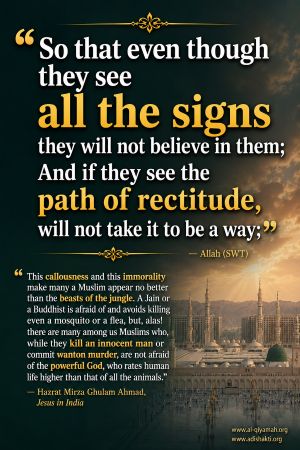
Al-A'raf (7:146): Allah: So Even Though They See All The Signs
Al-Hijr (15:39) – Iblis: I Will Wake (Evil) Fair and Mislead Them
An-Nahl (16:2) – Allah (SWT) Sent Down Angels With His Ruh
Al-Isra (17:85) – Muslims Given Little of Allah's (SWT) Ruh
Al-Isra (17:104): Children of Israel Gathered Again (in 1948)
Maryam (19:34) – Warning of Jesus You Were Unaware Of
Al-Hajj (22:8) – Kitab Al-Munir You Were Unaware Of
Al-Rum (30:56) – The Day of Qiyamah You Were Unaware Of
Fatir (35:9) – Winds of Qiyamah You Were Unaware Of
Yassin (36:63-68) – This Is The Hell You Were Warned Of.
Sad (38:79) – Iblis Allowed to Mislead Muslims And He Did
Fussilat (41:20–21) – Your Hands Will Testify of Qiyamah
Fussilat (41:53) – We Will Show Our Signs Within Your Soul
Az-Zukhruf (43:61): Jesus, Sign of Hour You Were Unaware
Az-Zukhruf (43:62): Satan's Deception of the Muslim Ummah
Az-Jathiya (45:7-14) – Those Who Deny Allah's Revelations
Qaf (50:20–21) – Hidden Imam Mahdi You Were Unaware
Qaf (50:41) – Listen To The Caller Emerging From Within
Qaf (50:42) – Day They Will Hear of Mighty Blast Witnessed
Qaf (50:45) – By the Caller, My Warning Is Delivered
Al Dhariyat (51:20-22) – Our Signs on Earth and Within
Al-Hadid (57:25) – Allah's (SWT) Iron Has Been Delivered
Al-Mujadilah (58:21) – My Messengers Must Prevail
Al-Saff (61:8–9) – Revelation of Light You Were Unaware
Al-Muddaththir (74:1–2) – My Cloaked One: Deliver Warning
Al-Mursalat (77:1–10): Angels Sent You Were Unaware Of
An-Naba (78:1–5): Concerning What Are They Disputing?
Al-Infitar (82:17–18) – What Will Explain To You? What Will?
Al-Mutaffifin (83:1–6) – Dealers in Fraud You Were Unaware
Al-Tariq (86:1–3) – The Night Visitant You Were Unaware
Al-Qadr (97:1–5) – Blessed Night of Power and Fate Before:
Al-Qariah (101:1–11) – Terrifying Day of Noise and Clamour
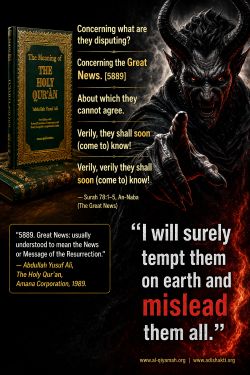
Concerning what are they disputing?
Concerning the Great News. [5889]
About which they cannot agree.
Verily, they shall soon (come to) know!
Verily, verily they shall soon (come to) know!
surah 78:1-5 An-Naba (The Great News)
"5889. Great News: usually understood to mean the News or Message of the Resurrection.”
Abdullah Yusuf Ali, The Holy Qur'n, Amana Corporation, 1989.
Interactive Chat
Access an intelligent analysis environment where you can explore texts, ask questions, and discover connections between ideas.
Open chat