1. Introduction: A Title as a Theological Proposition
“The Divine Mother: The God of All Scriptures” is deliberately stronger than the claim that many religions contain feminine images of the sacred. It proposes that Motherhood names something fundamental about divine reality itself: the power to originate life, hold it within being, enter it as presence, nourish its development, and draw it toward transformation. The title therefore functions as theology before it functions as description.
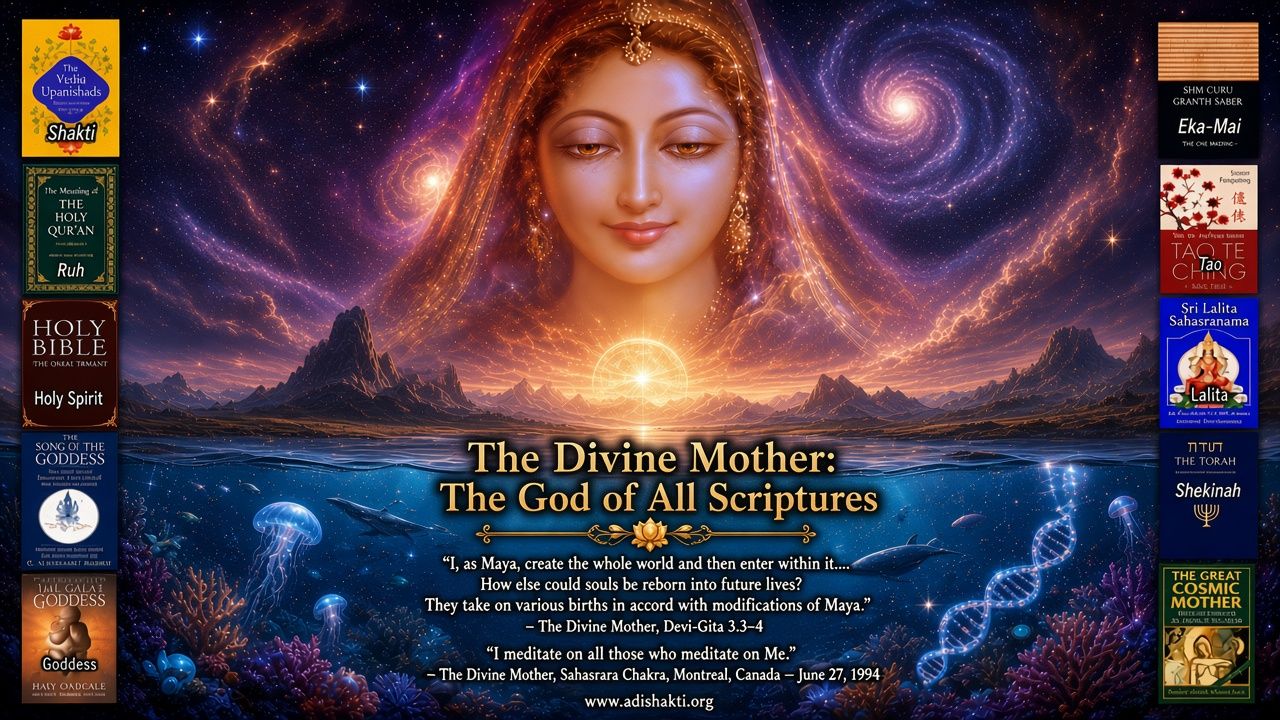
The accompanying image makes the proposition visible. The Divine Mother occupies the centre while scriptures and interpretive traditions surround Her. This is not an argument that the Upanishads, Bible, Qur’an, Guru Granth Sahib, Torah, Tao Te Ching, Lalitā Sahasranāma, and later Goddess literature are interchangeable. Their doctrines of God, creation, revelation, salvation, selfhood, and ultimate reality differ profoundly. The image instead asks a more disciplined comparative question: why do traditions separated by language, geography, and doctrine repeatedly turn to images of womb, mother, breath, wisdom, indwelling, generativity, compassion, and birth when speaking about what is ultimate?
The paper develops an answer in three stages. First, it begins from the Mahādevī’s own self-description as Maya who creates the world and enters within it. Second, it compares that structure—source plus indwelling presence—with maternal and feminine theological patterns in several traditions. Third, it interprets the Sahaja Yoga claim concerning the Divine Mother as a constructive synthesis in which these dispersed scriptural motifs are understood as converging upon a living spiritual reality.
2. The Theology of the Indwelling Mother: A Conceptual Map
The argument of this paper becomes clearer if its vocabulary is not treated as a collection of interchangeable names. Each term performs a different theological task. The central movement begins with the Supreme Mother, passes through manifestation into indwelling, becomes consciously accessible through spiritual awakening, and culminates in liberation. The simplest formulation is therefore: She creates; She enters; She dwells within; She awakens; She leads Home.
2.1 Mahādevī: Who is the Mother?
Mahādevī names the Supreme Goddess in the Shakta theological frame of this paper: not merely one divine female figure among others, but the ultimate Divine Reality understood as Mother. She is the subject of the controlling declaration, “I, as Maya, create the whole world and then enter within it.” The remaining terms explain dimensions of that declaration rather than introducing a series of unrelated divine beings.
2.2 Māyā and Śakti: How does the Mother manifest?
Śakti names divine power or potency; Māyā, in the passage governing this paper, names the Mother’s power of differentiation and manifestation. Neither term should simply be collapsed into “illusion.” The theological emphasis here is productive: the One becomes the ground of the many without ceasing to be One.
2.3 Antaryāmin: Where is the Divine after creation?
Antaryāmin means, in the concise language used throughout this paper, “the Divine who dwells within.” It answers the question that follows creation: after bringing forth the world, is the Creator absent from it? The Mahādevī’s answer is decisive—She “enters within.” Antaryāmin therefore names the paper’s hinge between cosmology and spirituality. The Mother is not only the origin of existence; She is its hidden interior Presence.
2.4 Kundalini: not a synonym for Antaryāmin
This distinction is essential. Antaryāmin describes the theological fact of Divine indwelling; Kundalini describes, within the Shakta–Sahaja framework used here, the individualized maternal power through which that indwelling becomes spiritually realized. Antaryāmin answers, “Where is the Divine?” Kundalini concerns the interior process by which the human being awakens to Divine presence. Conflating the two would obscure both concepts.
2.5 Self-realization: recognition rather than importation
If the Divine already dwells within, realization cannot mean importing God into an otherwise empty person. It means awakening to a Presence that precedes the awakening itself. This is why the inward spiritual journey is fundamentally a movement of recognition. The distance between seeker and Divine is not primarily geographical; it is a distance of awareness.
2.6 Eka Mai and Antarjāmī: two Sikh contributions that must remain distinct
The Sikh comparison becomes clearest when two concepts are not merged. Eka Mai/Ekaa Maaee concerns maternal generativity and the unity from which differentiated cosmic functions arise; Antarjāmī concerns the Divine as inward-knowing Presence, the Knower of the heart. In the shorthand used throughout this paper: Eka Mai illuminates Source; Antarjāmī illuminates Presence.
Neither expression should simply be declared a Sikh synonym for Mahādevī. Sikh theology remains governed by the radical unity of Ik Oankar. The comparative claim is structural: maternal generativity and divine interiority coexist within a theology of the One. This creates an unusually fruitful dialogue with the Shakta declaration that the Supreme Mother both manifests and enters creation.
2.7 The entire argument in one sequence
| Movement | Primary concept | Question answered |
|---|---|---|
| She creates | Mahādevī as Māyā / Śakti | From where does manifestation arise? |
| She enters | Antaryāmin | Does the Divine remain separate from creation? |
| She dwells within | Antaryāmin / interior Divine Presence | Where is the Divine in relation to the living being? |
| She awakens | Kundalini / Self-realization | How does indwelling become consciously known? |
| She leads Home | Liberation / eternal Divine ground | What is the spiritual destiny of awakened consciousness? |
The Necessary Conclusion: If She Is the One Divine Reality Within the Scriptures, She Is God Almighty
“The Divine Mother: The God of All Scriptures” is deliberately stronger than the observation that many religions contain feminine images, maternal metaphors, or female symbols of the sacred. That weaker claim would leave the Divine Feminine at the level of recurring religious imagery. The argument of this paper is different. It proposes that beneath the differing names, languages, symbols, and doctrinal forms of the major scriptural traditions there is one Divine Reality, and that the maternal, creative, indwelling, life-giving, revelatory, and liberating Presence encountered within them is the Divine Mother.
If there is ultimately one God; if that One is the source, sustainer, indwelling Presence, revealer, and final ground of life; and if the reality identified here as the Divine Mother is that same Reality encountered across the scriptures under different names and theological languages, then the conclusion is not merely that “the feminine is an aspect of God.” Within this paper's constructive theology, the Divine Mother is God Almighty—the One Divine Reality whom the scriptures approach under many names.
Not one goddess among many gods
This conclusion must not be misunderstood as adding a supreme female deity to a universe already populated by competing male and female gods. That would contradict the argument. “Mother” here does not designate biological sex, nor does “Divine Mother” mean a divine woman standing beside an independently supreme Father. The claim is ontological: the One who creates, enters, sustains, knows, awakens, and receives creation is the Supreme Divine Reality itself. Masculine titles such as Father, Lord, or King and feminine titles such as Mother, Wisdom, Śakti, or the indwelling Spirit may arise within different revelatory grammars; they do not require two ultimate Gods.
Different names do not imply different ultimate realities
The force of the title therefore depends upon unity beneath nomenclature. Mahādevī, Śakti, Eka Mai, the inward-knowing Antarjāmī, Shekinah, Spirit, Wisdom, Rūḥ, Prajñāpāramitā, Mother Tao, and other terms discussed in this paper do not possess identical dictionary meanings or identical histories. Nor does every tradition explicitly call its ultimate reality “the Goddess.” The argument is instead cumulative and theological: where the traditions witness the One as source, presence, wisdom, life, interior knower, spiritual transformer, or maternal ground, this paper interprets those witnesses as converging upon the one Divine Reality it names the Divine Mother.
This distinction allows the paper to press its conclusion without confusing comparison with philology. The historical claim is that traditions use different concepts. The comparative claim is that striking structures and functions recur. The Authenticity Series theological conclusion is that these are not finally unrelated fragments: they are diverse apprehensions of the One who is present before the traditions divide into separate vocabularies.
Antaryāmin makes the conclusion more radical
Antaryāmin is crucial because it prevents “God of all scriptures” from meaning merely “a deity mentioned in many books.” If the Divine Mother creates and then enters within, Her universality is not literary but ontological. She is not confined to Hindu scripture, Sikh scripture, Christian scripture, Islamic scripture, or any other textual boundary. She is, in the theological vision advanced here, the Divine Presence already within the human beings who later become Hindu, Sikh, Christian, Muslim, Jewish, Buddhist, Taoist, or members of other traditions. Scripture names and interprets the sacred; Antaryāmin precedes the naming because the indwelling Divine is already present.
She is not God Almighty because many books happen to mention a feminine sacred figure.
Rather, this paper argues that She appears across the scriptures because She is the one Divine Reality underlying and indwelling human existence. The recurrence follows from the universality of the Reality, not the other way around.
From “a feminine dimension of God” to the identity claim
The paper should therefore resist retreating, at its decisive moments, into formulations such as “the Divine Feminine is one aspect of God” unless a particular tradition itself requires that description. The central Shakta claim is stronger. Mahādevī does not merely say that She assists the Creator. She declares Herself the creative power through which the world comes forth and the Presence that enters it. Read through the paper's non-dual synthesis, the Mother is not a fraction of the Absolute. She is the Absolute apprehended as living, generative, conscious, indwelling Divine Reality.
Why the title says “The God of All Scriptures”
The singular word God is therefore intentional. The title is making a thesis about ultimacy. If the Mother were merely one sacred figure found alongside other ultimate beings, the title would be excessive. But if the paper's central premise is accepted—that the One Divine Reality repeatedly discloses maternal, generative, indwelling, wisdom-bearing, and spiritually awakening dimensions across the scriptural traditions—then the title states the conclusion directly: the Divine Mother is not simply present in the scriptures; She is the Almighty whom the scriptures, through different names and conceptual worlds, are attempting to disclose.
2. The Image as a Scriptural Mandala
The visual composition can be read as a scriptural mandala: plurality arranged around a centre. The books remain visibly distinct, but none occupies the centre. That position belongs to the Mother. The iconography therefore reverses the usual comparative-religion arrangement in which traditions are treated as self-contained systems placed side by side. Here the traditions become witnesses arranged around a proposed metaphysical centre.
The cosmic background expands the argument beyond institutional religion. Galaxies, radiant light, ocean, biological forms, DNA-like structures, fish, and primordial marine life locate the Mother not only within theology but within the entire drama of manifestation. The symbolism moves from cosmos to life, from life to consciousness, and from consciousness to scripture. The same question runs through each level: what is the source capable of bringing forth multiplicity while remaining present within it?
The central saying supplies the personal answer: “I meditate on all those who meditate on Me.” The image is therefore not merely cosmological. The One who generates the cosmos is represented as conscious of the individual seeker. Infinity and intimacy are held together.
4. Mother as Source, Matrix, Presence, and Nourisher
The theological force of “Mother” begins with generativity but does not end there. A mother is not simply an efficient cause that produces something external to herself. Maternal imagery suggests interior formation: life arises within a sustaining matrix before it becomes outwardly differentiated. This makes Mother a particularly powerful symbol for a theology in which creation remains dependent upon, permeated by, and inwardly related to its source.
3.1 Womb: being held before being separate
The womb symbolizes potentiality becoming form. Theologically, it expresses the priority of divine interiority over creaturely independence. What appears as a separate being first exists within a field that precedes it, sustains it, and makes its development possible. In Shakta metaphysics, Śakti supplies precisely this dynamic dimension: the Absolute is not sterile transcendence but possesses the power of self-manifestation.
3.2 Earth: material existence as sustained life
Mother Earth extends maternal symbolism into the material world. Earth receives seed, sustains growth, bears weight, decomposes death, and makes new life possible. The symbol therefore joins patience, fecundity, endurance, and renewal. A theology of the Mother does not require contempt for matter; matter itself can become the field in which divine power operates.
3.3 Nourishment: creation is unfinished without sustenance
To create and then abandon would be insufficiently maternal. The Mother feeds what She brings forth. In religious language this function appears as grace, wisdom, breath, consolation, guidance, protection, and inner transformation. The maternal principle consequently provides a conceptual bridge between cosmology and spirituality: the power that gives existence is also the power that enables existence to mature toward its purpose.
5. Maya: The Mother’s Power to Manifest and Enter the World
I, as Maya, create the whole world and then enter within it.... How else could souls be reborn into future lives? They take on various births in accord with modifications of Maya.The Mahādevī — Devi Gita 3.3–4, as cited in the project
This is the paper’s controlling theological statement because it unites four ideas that are often separated: divine transcendence, cosmic manifestation, divine immanence, and the continuity of embodied life. The speaker is not merely associated with Maya; She identifies Maya as the mode through which She creates.
4.1 Maya is not adequately exhausted by “illusion”
In popular usage Maya is often reduced to the proposition that the world is unreal. That is too crude for the present passage. Here Maya performs work. It differentiates, forms, conditions, and makes embodiment possible. The theological problem is therefore not that nothing exists, but that conditioned forms can conceal the unity and source upon which their existence depends.
Maya has a double aspect. It can veil because finite beings encounter reality through distinctions—self and other, subject and object, birth and death. Yet it can also reveal, because without form there would be no embodied consciousness, relationship, moral action, scripture, meditation, or awakening. The same field that permits forgetfulness also permits recognition.
4.2 “Then enter within it”: creation becomes indwelling
The phrase “then enter within it” prevents a deistic reading of creation. The Mother is not imagined as an artisan who makes an object and stands apart from it. The creative source becomes interior presence. This creates a striking theological pattern: the transcendent cause of the world is simultaneously the immanent ground within the world.
That structure helps explain why maternal language recurs so powerfully in mystical traditions. The Divine is nearer than an external ruler because the creature exists within, through, and by the power of the sacred. Spiritual realization can therefore be described not merely as receiving information from beyond but as awakening to a presence already intimate to consciousness.
4.3 Maya and rebirth
The Mahādevī explicitly connects Maya with successive embodiment. If souls assume different births through the “modifications of Maya,” then Maya is the field of differentiation through which continuity acquires new form. The statement gives rebirth a metaphysical architecture: an enduring principle of life passes through changing configurations generated within the Mother’s creative power.
4.4 Creation and liberation are not unrelated processes
If the Mother both manifests the world and dwells within it, liberation need not mean escaping from a creation foreign to God. It can mean recognizing the divine ground obscured by conditioned identification. The power responsible for manifestation is thus also implicated in awakening. Cosmology becomes soteriology: the source from which beings emerge is the source to which consciousness awakens.
6. The Indwelling Mother and the Eternity of Life
I, as Maya, create the whole world and then enter within it.... How else could souls be reborn into future lives? They take on various births in accord with modifications of Maya.The Mahādevī — Devī Gītā 3.3–4
The entire paper turns on the words “then enter within it.” If the Mahādevī were only the external cause of the universe, the relationship between God and the individual could remain one of distance. But the Devī Gītā describes something more radical: the Mother who manifests the world also becomes its indwelling presence. The distinction between Creator and creature is not erased, yet creaturely life is never metaphysically abandoned.
5.1 Antaryāmin: the Divine within
The Sanskrit theological idea of Antaryāmin—the Inner Controller or indwelling Divine—gives precise language to this interiority. The human being is not spiritually self-sufficient. Beneath the changing body, personality, memory, social identity, and circumstance lies a deeper dependence upon the Divine presence. In the theology developed here, the Divine Mother is that interior ground: She gives the field of embodiment through Maya and is simultaneously present within it.
This makes identification with the Mother within spiritually critical. If identity is restricted to the body, death appears as absolute negation. If identity deepens toward the indwelling Divine, bodily death can be understood as a transition affecting form rather than the destruction of the eternal ground of life.
5.2 “How else could souls be reborn?”—death cannot be annihilation in the Devī Gītā’s logic
The Mahādevī herself connects Her entry into creation with successive birth. The rhetorical question—“How else could souls be reborn into future lives?”—makes continuity fundamental to the passage. Bodies change; Maya assumes modifications; births differ. Yet the very possibility of another birth presupposes that bodily dissolution has not reduced the living principle to nothing.
The Bhagavad Gītā states the same conviction in another form: “Never was there a time when I did not exist, nor you, nor all these kings; nor in the future shall any of us cease to be” (2.12). Its argument distinguishes the transient embodiment from the continuity of the Self. The spiritual lesson is not that physical death is unreal as a biological event. Bodies truly die. The stronger claim is that physical death is not ontological extinction.
5.3 Eternal life across scriptures: convergence without forced sameness
The world’s scriptures do not offer one uniform theory of what follows bodily death. Hindu traditions speak variously of rebirth, liberation, and realization of the Self; Christianity speaks of resurrection and eternal life; Judaism contains developing and diverse teachings concerning resurrection and the world to come; Islam emphatically teaches resurrection, judgment, and continuing existence; Sikh scripture teaches liberation from the cycle of birth and death; Buddhist traditions speak of rebirth and liberation while rejecting a permanent independent self in the Hindu sense. These differences matter.
What can responsibly be said is more profound than a superficial claim that “all religions say exactly the same thing”: many of humanity’s major scriptural traditions deny that the death of the present body exhausts the meaning or destiny of life. The Authenticity Series goes further and interprets this convergence through the Divine Mother: the One who generates embodied existence is also the One in whom its continuity, transformation, and return are grounded.
5.4 Comfort without denial of grief
This theology is intended to change the existential meaning of death, not to pretend that bereavement is painless. A body disappears from ordinary human relationship; a voice becomes silent; familiar presence is lost. Grief is real because love is real. But grief need not become metaphysical despair. If life participates in the eternal Mother, then the grave cannot possess the final definition of the person.
The comfort offered by the Mother is therefore not merely “you will survive.” It is deeper: you have never existed outside the Divine ground of life. Before birth, through embodiment, through death, and beyond the present form, the Mother remains the encompassing Reality. Spiritual practice gradually transfers identity from what changes to That which abides.
5.5 Meditation as the practice of remembering who we are
To meditate upon the Divine Mother is, in this framework, to practice a new center of identity. The seeker does not merely imagine a distant Goddess. The seeker turns toward the One who has already “entered within.” Meditation becomes recognition of Antaryāmin.
I meditate on all those who meditate on Me.The Divine Mother — Sahasrara Chakra, Montreal, June 27, 1994, as presented in the Adishakti.org project
Placed beside Devī Gītā 3.3–4, this saying creates a remarkable reciprocity. She enters within us; we turn within toward Her. We meditate upon Her; She meditates upon us. The journey toward God is therefore simultaneously the discovery that the Divine has never been absent.
5.6 From one Mother within to peace among many scriptures
This inner recognition has an interreligious consequence. A person deeply rooted in one scripture need not abandon it in order to respect another. The proposed movement is the opposite: go deeply enough into the living Divine within one’s own tradition that the presence of the sacred in another tradition no longer appears threatening.
If the same Divine Mother is understood to dwell within humanity while sacred traditions preserve different witnesses to divine life, then another scripture can slowly cease to look like a rival book belonging to a rival God. It can be approached as another historical language through which human beings have sought, received, interpreted, and transmitted encounters with the sacred. Acceptance need not mean agreement with every doctrine. It means that difference no longer requires hostility.
5.7 The unforgettable journey Home
Human life then acquires a different narrative. Birth is not emergence from absolute nothingness, and death is not collapse into absolute nothingness. Earthly life becomes a finite stage within a larger spiritual journey: a place of relationship, learning, error, forgiveness, awakening, and remembrance. The purpose is not to despise Earth but to live upon it so consciously that temporary identity becomes transparent to eternal identity.
“Home” in this theology is not merely a location after death. It is the Divine Reality from which life derives and within which life already exists. The spiritual journey Home begins while alive: whenever a human being turns inward, recognizes the Mother, becomes less afraid of death, becomes less hostile toward another faith, and discovers that the sacred cannot be imprisoned inside one name.
Only a theological reality universal enough to be within creation, within the seeker, and yet beyond every particular form could ground such a synthesis. This paper names that Reality the Divine Mother of all scriptures.
7. Antaryāmin: The Indwelling Divine Feminine in Mahādevī and Eka Mai
Working definition used throughout this paper: Antaryāmin is “the Divine who dwells within”—the hidden interior Presence that joins the transcendent Source to embodied life.
I, as Maya, create the whole world and then enter within it....The Mahādevī — Devī Gītā 3.3–4
The Sanskrit term Antaryāmin (अन्तर्यामिन्) is among the deepest concepts available for expressing the central thesis of this paper. It is commonly rendered “Inner Controller,” “Inner Ruler,” or “Indweller”: antar, “within,” joined to a form derived from yam, “to restrain, govern, or direct.” The term therefore says more than “God is everywhere.” It points to a Divine Reality that is interior to the being, silently present at the depth from which life, consciousness, order, and spiritual awakening arise. The sacred is not merely above the cosmos or outside the person. The sacred is within.
This chapter argues that Antaryāmin provides a particularly powerful bridge between the Mahādevī theology developed in the Devī Gītā and the Sikh scriptural language of Antarjāmī together with Eka Mai/Ekaa Maaee, the One Mother. The comparison must be made carefully. The terms do not originate in the same textual setting, and Sikh scripture does not simply define “Eka Mai” as a Sanskrit Shakta Antaryāmin. Yet when the two scriptural patterns are placed beside one another, a profound theological structure becomes visible: the One who is the source of multiplicity is not absent from what She brings forth; the Divine is also known as the One present within and knowing the interior of every being.
6.1 Antaryāmin in the Upanishadic inheritance: the One within all things
The classical locus of the Antaryāmin doctrine is the Bṛhadāraṇyaka Upaniṣad 3.7, whose repeated formula describes the One who dwells within earth, waters, fire, atmosphere, heaven, living beings, mind, and other dimensions of existence while remaining deeper than the object in which the Divine dwells. The theological rhythm is deliberate: the indwelling One is within; the finite entity does not exhaust or contain that One; the entity is described as the Divine’s body; and the Divine governs from within. The conclusion identifies this hidden indweller with the immortal Self.
This is the metaphysical background against which the Mahādevī’s declaration becomes especially powerful. “I create” establishes Her as source; “I enter within it” establishes immanence. The movement is therefore not simply God → world, as though creation were an artifact left outside its Maker. It is Mother → manifestation → indwelling presence. Creation remains inwardly related to its Source.
6.2 Mahādevī as Antaryāmin: She creates the field and inhabits its interior
Within the Shakta reading developed by this paper, the Mahādevī does not merely possess creative power: She is the conscious Divine Reality whose power appears as Maya and whose presence remains within manifestation. This gives the phrase “then enter within it” exceptional weight. The Mother is both the metaphysical ground from which forms arise and the interior presence by which those forms participate in consciousness and life.
The implications are extensive. If She enters the world, then matter is not metaphysically godless. If She enters living beings, then spiritual realization is not merely the acquisition of information about a distant deity. If She is present as the deepest ground of consciousness, then the inward journey can become a mode of revelation. And if successive embodiments occur within modifications of Her Maya, then birth and death concern changing configurations of manifestation rather than the extinction of the Divine ground itself.
Adishakti.org’s Shakta research makes this connection explicit by interpreting the Goddess as the inner consciousness and witness within beings. Its presentation of the Antaryāmin theme draws upon the Upanishadic “inner controller” and reads the Mahādevī as the feminine Divine Consciousness that animates and illuminates from within. Within the theology of this paper, this is not a minor attribute of the Mother. Indwelling is the link between cosmology and Self-realization.
Read: SHAKTI — Supreme Feminine Guru Who Teaches: The Universal Inner Indweller →
6.3 From cosmic Mother to intimate Mother: the theological meaning of “within”
A cosmic Goddess can remain psychologically remote if She is imagined only as the power behind galaxies, worlds, and creation. Antaryāmin overturns that distance. The same Mother who is invoked as primordial source is encountered at the most intimate level of existence. She is not merely the Mother of the universe; She is the Divine Presence within the living being.
This distinction clarifies why the paper repeatedly joins Mahādevī with Kundalini. In Sahaja Yoga theology, Kundalini is the individualized maternal power placed within the human being. The universal and the individual are therefore related as macrocosm and microcosm: the Mother who manifests the cosmos is encountered inwardly as the power of spiritual awakening. The movement of meditation is not an attempt to manufacture divine presence. It is an awakening to a Presence already there.
She is your pure Mother. She is the Mother who is individually with you.Shri Mataji Nirmala Devi — as reproduced in the Adishakti.org Kundalini/Holy Spirit materials
Read through Antaryāmin, “individually with you” acquires metaphysical depth. The Mother is not individualized in the sense of being divided into billions of separate goddesses. Rather, the one Divine Presence is inwardly available to each person without ceasing to be universal. The paradox is precisely the paradox of indwelling: the Infinite can be wholly intimate without becoming merely private.
6.4 Sikhism: Antarjāmī and the God who knows the interior
Sikh scripture supplies an especially important parallel through the term Antarjāmī (also transliterated Antarjami). In Gurbani this title emphasizes the Divine as the Knower of the inner being—the One to whom the contents of the heart are not hidden. Adishakti.org’s earlier study of the term notes repeated use of antarjami in the Guru Granth Sahib and places it in comparative dialogue with the Sanskrit antaryāmin. The linguistic and philosophical relationship is illuminating, but the Sikh usage should retain its own emphasis: Waheguru is inwardly present and knows the interior condition of the creature.
Read: The Indweller — Antarjami or Antaryamin of the Granth →
This inwardness is not peripheral to Sikh spirituality. The path of Naam, remembrance, Guru, and interior transformation presupposes that the Divine sought by the devotee is not restricted to temple, geography, image, or external ritual. The One is transcendent, yet also immanent. Consequently, spiritual knowledge is inseparable from the transformation of the heart: the Divine already knows the seeker from within.
6.5 Eka Mai: the One Mother before the differentiated cosmic functions
Guru Nanak’s Japji Sahib contains the celebrated expression commonly rendered Eka Mai or Ekaa Maaee—“the One Mother”—in the passage describing the emergence of the three cosmic functions. In the comparative reading developed on Adishakti.org, this One Mother is treated as primordial generative power: multiplicity proceeds from a prior unity, and the differentiated functions of creation, sustenance, and dissolution do not constitute three independent ultimate realities.
Ekaa Maaee jugat viaaee tin chele parvaan.Guru Nanak, Japji Sahib — commonly rendered in the project as the One Mother giving rise to the three cosmic functions; translations and interpretations vary.
The qualification at the end is important. Sikh exegesis is not uniform in treating this line as an ontological declaration of an independently worshipped Goddess. The Guru Granth Sahib is governed by Ik Oankar, the radical unity of the Divine. Therefore the strongest academically responsible formulation is not that Sikhism introduces a second divine being called Eka Mai alongside the One. Rather, the maternal image can be read as expressing the generative potency of the One from which differentiated cosmic activity proceeds.
That limitation does not weaken the comparison; it deepens it. The Divine Mother sought by this paper is likewise not intended as a rival deity standing beside an ultimate masculine God. The central claim is that the One Divine Reality possesses—and in Shakta theology explicitly is—the generative, indwelling, awakening power named Mother.
Read: Ekaa Maaee — The One Divine Mother →
6.6 Eka Mai and Antarjāmī together: source and Presence
The deepest Sikh contribution to this paper emerges when Eka Mai and Antarjāmī are read together without pretending that they are synonyms. Eka Mai emphasizes generative unity; Antarjāmī emphasizes divine interiority and knowledge of the heart. One answers the question, “From what unity does differentiated existence arise?” The other answers, “Where is the Divine in relation to the interior life of the creature?” Together they form a striking source-and-indwelling pattern.
| Dimension | Hindu/Shakta articulation | Sikh articulation | Comparative significance |
|---|---|---|---|
| Ultimate unity | Brahman / Mahādevī as supreme reality | Ik Oankar, the One | Multiplicity is not ultimate. |
| Generative power | Mahādevī as Śakti and Maya | Eka Mai / Ekaa Maaee as maternal-generative imagery | The One is not sterile abstraction but source of manifested order. |
| Indwelling | Antaryāmin; the Goddess “enters within” manifestation | Antarjāmī; the Divine knows the inner being and is immanent | Divinity is not exhausted by external transcendence. |
| Interior spiritual path | Kundalini, Self-knowledge, realization of the indwelling Divine | Naam, Guru, inner transformation, Dasam Dwar traditions | Religion moves from external information toward transformed consciousness. |
| Non-division of the Divine | Śakti is not finally independent of supreme Reality in non-dual Shakta theology | Eka Mai cannot be made a second God beside Ik Oankar | Mother-language can express divine power and presence without requiring theological dualism. |
6.7 “The Creator created the creation; within the creation the Creator abides”
One of the strongest points of contact is the Sikh insistence that the Creator is not absent from creation. Adishakti.org’s comparative Sikh material highlights Gurbani passages in which the Creator brings forth creation and abides within it. The theological architecture is remarkably close to the controlling Mahādevī declaration of this paper: manifestation is followed not by withdrawal but by presence.
The comparison can therefore be stated with precision. The Devī Gītā gives the paper its explicitly feminine first-person formulation: “I create … and then enter within.” Sikh scripture, within the sovereignty of Ik Oankar, gives a complementary theology of the One who pervades creation, knows the heart as Antarjāmī, and is approached through maternal language such as Eka Mai. The traditions are not thereby made identical. But both resist the picture of a remote Creator separated from the interior of life.
6.8 Antaryāmin and the end of spiritual alienation
The existential consequence of indwelling is as important as the metaphysics. Human beings ordinarily experience themselves as isolated centers of consciousness: “I am here; God is elsewhere.” Antaryāmin overturns that spiritual geography. The Divine is not merely the distant destination of the journey. The Divine is the hidden ground from which the journey is already taking place.
This is why Self-realization, in the framework of this paper, is fundamentally recognition. The seeker does not import the Mother from outside. The seeker becomes conscious of the Mother who was already inwardly present. The distance between humanity and God is therefore not primarily spatial. It is a distance of awareness.
6.9 Why Antaryāmin strengthens “The God of All Scriptures”
The title of this paper becomes more intelligible when read through indwelling. “The God of All Scriptures” need not mean that every religion uses the same divine name, accepts the same metaphysics, or explicitly worships a Goddess. It can make the more profound constructive claim that the Divine Reality witnessed through scripture is not merely the object about which scriptures speak. The Divine is also the interior Presence in the human beings who receive, recite, contemplate, and realize scripture.
Antaryāmin thus shifts comparative theology from a library of competing books to the mystery of consciousness itself. Scriptures remain historically different, but the reader is no longer imagined as spiritually empty. If the Divine dwells within, then revelation has an interior horizon: the words outside awaken recognition of the Presence inside. This is precisely where Mahādevī, Eka Mai, Antarjāmī, Kundalini, Naam, and Self-realization become most fertile for comparison—not because they erase one another, but because each directs attention toward the mystery of a Divine Reality that is at once transcendent, generative, and intimately present.
8. “The God of All Scriptures”: What the Claim Means
The strongest defensible form of the title is neither “all religions are the same” nor “every scripture explicitly worships a female deity.” Both propositions would flatten the evidence. The title instead expresses a constructive theological reading: sacred traditions repeatedly preserve functions and symbols that can be gathered under the category of divine Motherhood.
| Tradition | Relevant image or term | Comparative function | Important distinction |
|---|---|---|---|
| Shakta Hinduism | Śakti, Mahādevī, Lalitā, Kundalini | Supreme power, manifestation, indwelling spiritual energy | Here divine femininity can be explicit and ontologically supreme. |
| Christianity | Spirit, Wisdom, Paraclete; maternal divine imagery | Indwelling, teaching, consolation, regeneration, sanctification | Classical Christianity does not ordinarily identify the Spirit as a Goddess. |
| Judaism | Shekhinah, Ruach, Wisdom | Dwelling presence, breath, wisdom, nearness of God | Later mystical personification must not be retrojected uniformly into all Jewish texts. |
| Islam | Rūḥ, Sakīnah, divine breath | Spirit, tranquillity, life, divine assistance and presence | Islamic tawḥīd rejects a divine consort or separate goddess alongside Allah. |
| Sikhism | Eka Mai and maternal language for the One | Generativity and unity behind differentiated existence | The imagery belongs within uncompromising divine unity. |
| Taoism | Mother, Mysterious Female | Inexhaustible generativity; source of the ten thousand things | The Tao is not simply a personal creator deity. |
| Mahāyāna Buddhism | Prajñāpāramitā as Mother of Buddhas | Wisdom gives birth to awakening | The symbolism operates without requiring a creator-God doctrine. |
The comparison becomes strongest when it concerns function rather than superficial vocabulary. A term need not mean “Goddess” in its original tradition to participate in a recurring theological pattern of generativity, indwelling, wisdom, life, nurture, or transformative presence.
9. The Maternal Principle Across Scriptural Worlds
8.1 Hindu traditions: the Mother as metaphysical power
Within Shakta traditions the argument reaches its clearest form because the feminine is not merely metaphorical. Devī can be the supreme reality itself. Śakti names divine power not as an accessory added to God but as the capacity through which the Absolute manifests, acts, knows, and transforms. Lalitā and Mahādevī therefore supply the paper with its most explicit language for the Mother as ultimate source.
8.2 Christianity: Spirit, Wisdom, indwelling, and rebirth
Christian scripture is dominated by masculine titles such as Father and Son, yet its theology of divine action includes functions central to the present comparison: the Spirit indwells, teaches, consoles, gives life, sanctifies, and brings about new birth. Biblical Wisdom traditions also employ feminine personification. These materials do not by themselves prove a Christian doctrine of “the Goddess,” but they prevent divine reality from being reduced to masculine biological imagery.
For the Authenticity Series, the Paraclete is especially significant because the Johannine promises describe a coming divine presence who remains with believers, teaches, reminds, testifies, guides into truth, discloses what is to come, and glorifies Christ. Read through the project’s Sahaja Yoga framework, these functions are interpreted as converging with the work attributed to Shri Mataji and the awakened spiritual presence experienced through Self-realization. That identification is a theological claim of the project and should be distinguished from the consensus interpretation of historical Christian scholarship.
8.3 Judaism: Shekhinah and the theology of divine dwelling
Shekhinah is important to this comparison because it shifts attention from a God conceived only as “above” to divine presence that dwells. In later Jewish mystical symbolism, feminine associations become especially developed. The comparative point is not that Shekhinah is simply another name for Mahādevī, but that divine nearness and dwelling acquire a symbolic form capable of sustaining a maternal theology of presence.
8.4 Islam: Rūḥ, Sakīnah, and the boundary imposed by tawḥīd
Islam requires particularly careful comparison. Allah is One and is not one member of a gendered divine pair. Nevertheless, Qur’anic language of Rūḥ and Sakīnah provides categories of spirit, life, tranquillity, and divine assistance that can enter comparative dialogue with an indwelling theology. The legitimate comparison concerns divine function and experience; an assertion that classical Islam explicitly teaches a Goddess would exceed the textual evidence.
8.5 Sikhism: Eka Mai and unity before multiplicity
The phrase Eka Mai—“One Mother”—is especially suggestive for this paper because it places maternal generativity within radical unity. The One precedes multiplicity. Motherhood thus becomes a way of speaking about how plurality emerges without requiring multiple ultimate sources.
8.6 Taoism: Mother and Mysterious Female
The Tao Te Ching offers some of the most striking maternal language outside theistic traditions. The Tao is associated with the Mother of the ten thousand things and with the inexhaustible Mysterious Female. This imagery is philosophically valuable because it separates motherhood from anthropomorphic sex. “Mother” can signify the inexhaustible generative depth from which beings arise and to which they return.
8.7 Buddhism: wisdom that gives birth to Buddhas
Prajñāpāramitā demonstrates that maternal theology need not depend upon creator theology. Transcendent wisdom is called Mother because awakening is born from wisdom. The comparison therefore expands: Mother can name not only the source of biological or cosmic existence but the source of spiritual realization itself.
10. “I Meditate on All Those Who Meditate on Me”: Reciprocal Consciousness
I meditate on all those who meditate on Me.The Divine Mother — Sahasrara Chakra, Montreal, June 27, 1994, as presented in the project
This sentence radicalizes the ordinary structure of devotion. Religion usually describes the human being as the one who remembers, prays, contemplates, or seeks. Here the direction is reversed without cancelling the first movement: the seeker meditates upon the Mother, and the Mother meditates upon the seeker.
Theologically, this means that ultimate reality is not merely an object of consciousness. Divine consciousness precedes and encompasses human consciousness. The seeker’s attention toward God occurs within a more primordial divine attention toward the seeker. The statement therefore turns meditation into reciprocity rather than solitary introspection.
Placed beside the Maya declaration, a coherent sequence emerges: She creates; She enters; beings live within differentiated forms; consciousness turns toward its source; and the source is already consciously turned toward consciousness. The Mother is consequently cosmological ground and relational presence at once.
11. Sahasrara: From Scriptural Symbol to Claimed Experience
The paper’s argument becomes distinctively Sahaja Yoga at the Sahasrara. The thousand-petaled lotus is not treated merely as an inherited esoteric symbol but as the culmination of an interior process in which Kundalini rises and spiritual integration becomes consciously perceptible. Within this framework, the Divine Mother who creates and indwells the cosmos is also present microcosmically within the human being.
10.1 Macrocosm and microcosm
The same theological pattern operates at two scales. Cosmically, the Mother manifests and enters creation. Individually, divine power is understood as latent within embodied consciousness and capable of awakening. The human person becomes a microcosm of the larger act of manifestation.
10.2 Revelation as recognition
This changes the role of scripture. Scripture remains testimony and map, but its purpose is fulfilled when what it describes becomes recognizable in experience. The claim is therefore stronger than intellectual syncretism: the traditions are said to point toward a reality that can be encountered rather than merely compared.
10.3 The epistemic limit
An academic account must still distinguish phenomenological testimony from universally demonstrable proof. Reports of cool breeze, Kundalini awakening, inner silence, or Sahasrara opening are evidence that people report and interpret such experiences. Whether those experiences establish a particular metaphysical identification remains a theological and philosophical question.
12. Beyond a Competition Between Father and Mother
The recovery of the Divine Mother should not be reduced to replacing a male deity with a female deity. That would leave the deeper conceptual problem untouched: treating ultimate reality as though it were literally confined by human sexual differentiation. Classical theology repeatedly insists that the Divine exceeds bodily sex even when gendered language is religiously indispensable.
The significance of Mother-language is therefore corrective and revelatory. It restores dimensions that exclusively masculine symbolism can obscure: gestation, interiority, generativity, nourishment, embodied dependence, receptive power, compassion, and the mysterious continuity between source and offspring.
Within the stronger Shakta claim, however, the feminine is more than a corrective metaphor. The Mother is the active divine power itself. The title of this paper intentionally preserves that stronger possibility rather than reducing Mahādevī to a poetic symbol acceptable to traditions that prefer masculine language.
13. What Can Be Claimed—and What Cannot
12.1 Similar functions do not erase doctrinal difference
Śakti, Spirit, Shekhinah, Rūḥ, Eka Mai, Tao, and Prajñāpāramitā cannot responsibly be treated as dictionary synonyms. Their meanings are controlled by distinct scriptures, languages, metaphysics, and communities.
12.2 Grammatical femininity is suggestive, not sufficient
Feminine grammatical forms can preserve or encourage feminine symbolism, but grammar alone cannot prove ontological gender. A serious case for Divine Motherhood must rest on wider theological functions, imagery, and claims.
12.3 Comparative theology may legitimately become constructive theology
Academic restraint does not require theological neutrality inside a confessional or constructive project. One may argue that disparate traditions genuinely converge. The requirement is clarity: readers should be told when the paper is reporting a tradition, comparing traditions, or advancing the Authenticity Series’ own synthesis.
12.4 The Shri Mataji identification is a theological conclusion, not a neutral datum
Within Sahaja Yoga and this project, Shri Mataji Nirmala Devi is interpreted as the manifestation of the Primordial Mother and, in the wider Authenticity Series argument, as fulfilling expectations associated with the Divine Feminine and Paraclete. Historical scholarship can document the claim and examine its sources and effects; accepting the identification itself requires theological judgment.
12.5 Science can enrich symbolism without functioning as proof
The poster’s galaxies, oceanic life, DNA, and primordial organisms powerfully visualize emergence and continuity. Modern cosmology and biology can deepen wonder at generativity, but neither DNA nor the Big Bang independently demonstrates the existence of Mahādevī. Their role in the image is analogical and symbolic.
14. Adishakti.org Evidence: From Universal Motherhood to Living Presence
The wider Adishakti.org research corpus deepens this paper because it describes itself as “A Comparative, Experiential, and Eschatological Resource.” Its argument is therefore larger than comparative symbolism: scripture, spiritual experience, the Sahasrara, the Paraclete, Rūḥ, Śakti, resurrection, and Self-realization are treated as parts of one theological investigation.
13.1 Womb, Mother Earth, nourishment, and Kundalini
She is the one who is the Womb, She is the one who is the Mother Earth, and She is the one who nourishes you.Shri Mataji Nirmala Devi — Santa Cruz, USA, October 1, 1983
This gives the Mother principle a fourfold structure: Womb signifies generative source; Mother Earth sacred maternity within embodied existence; nourishment continuing sustenance; and Kundalini the same feminine principle within the human being. The universal and individual Mother are therefore not two unrelated realities.
Read: Self-Realization — Awakening the Divine Within →
13.2 The individual Mother and second birth
She is your pure Mother. She is the Mother who is individually with you.Shri Mataji Nirmala Devi — reproduced in the Adishakti.org Kundalini/Holy Spirit materials
“Individually with you” is crucial. The Mother is not only a cosmic abstraction. The Adishakti.org material identifies Kundalini as the Holy Ghost within and as the maternal power awaiting the opportunity to give realization. In this theology, spiritual rebirth is an interior event: the universal Mother is already present within the individual before awakening occurs.
Read: Mother Kundalini as the Holy Spirit →
13.3 A seven-tradition comparative pattern
The Adishakti.org homepage explicitly indexes the “Presence of Mother in All Traditions” through Śakti in Hinduism, Holy Spirit in Christianity, Shekinah in Judaism, Rūḥ Allah in Islam, Prajñāpāramitā in Buddhism, Eka Mai in Sikhism, and Mother Tao in Taoism. This directly supports the comparative architecture of the present paper. The proposed unity rests not merely on feminine vocabulary but on recurring functions: generating life, dwelling within, giving wisdom, nourishing, guiding, awakening, and transforming.
Explore the Divine Feminine research index →
13.4 Mahādevī as Maya and liberating consciousness
Adishakti.org’s Devi Gita research adds an essential qualification to Maya. The Goddess is presented not only as the power associated with samsaric manifestation but also as vidyā, liberating knowledge. The Mother is therefore not divided into a creator who binds and another power that saves. The same ultimate Śakti can be understood under the aspect of concealment and under the aspect of revelation.
Till the complete knowledge in the form of my consciousness arises, there is no liberation.Devi teaching as presented in the Adishakti.org Devi Gita research
This sharpens the central thesis: the Divine Mother is the ground of manifestation and the consciousness through which manifestation is finally understood.
Read: Devi — The Embodiment of Consciousness →
13.5 Paraclete and Rūḥ: the eschatological dimension
The homepage places the Divine Feminine within an explicitly eschatological argument. Its Paraclete research emphasizes the Johannine functions of the promised Spirit—continuing revelation, teaching, reminding, testifying, guiding, glorifying Christ, and bringing divine presence into the believer—while its Rūḥ/Paraclete research argues for a common revelatory mission across Christian and Islamic scriptural worlds.
This moves “the God of all scriptures” beyond an inventory of ancient feminine symbols. Within the Adishakti.org interpretation, the decisive question becomes functional and historical: if the promised divine agency teaches, awakens, reveals, transforms, and gives spiritual rebirth, where and through whom are those functions realized?
See “Paraclete Presence: Eschaton Realization” and “Rūḥ and Paraclete” →
13.6 Shri Mataji and the stronger identity claim
The Adishakti.org corpus ultimately advances a stronger conclusion than comparative resemblance. It interprets Shri Mataji Nirmala Devi as the Adi Shakti and places that identity in relation to the Paraclete, Rūḥ, Shekhinah, Sophia, Kundalini, and other expressions of the Divine Feminine.
The evidence can therefore be distinguished at three levels: (1) scriptures and traditions preserve maternal/feminine divine imagery and functions; (2) Shri Mataji explicitly teaches that the Mother principle is present in every scripture and within the human being as Kundalini; and (3) the Authenticity Series advances the theological conclusion that Shri Mataji is the historical manifestation in whom these dispersed expectations converge. The third is the strongest claim and depends upon the larger documentary and theological case rather than comparative vocabulary alone.
Read: Awakening to the One Divine Feminine →
Taken together, these sources deepen the argument substantially. The Mother is proposed as the metaphysical source of manifestation, the indwelling spiritual power within humanity, the giver of second birth, the consciousness through which liberation occurs, and—within Adishakti.org’s eschatological interpretation—the living divine personality in whom scriptural promises of transformative divine presence converge.
13. Conclusion: The Journey Home
I, as Maya, create the whole world and then enter within it.... How else could souls be reborn into future lives? They take on various births in accord with modifications of Maya.The Mahādevī — Devī Gītā 3.3–4
This is the sentence to which the entire paper returns. The Mahādevī does not say only that She creates the world. She says that She enters within it. She does not describe embodied beings as disposable products of creation. She explicitly connects Her immanent presence with their capacity to assume further births. The Mother is therefore source, field, indwelling presence, continuity, and destination.
Within the theological vision argued here, life is eternal and bodily death is not the extinction of the deepest Self. The body belongs to the changing configurations of Maya; the Divine ground of life does not perish with a particular configuration. This is why identifying exclusively with the temporary body produces existential terror, while identification with the indwelling Divine—Antaryāmin—opens a radically different horizon.
That recognition is not intended as an abstract doctrine reserved for the moment of dying. It changes how one lives now. The person who seeks the Divine Mother within can begin to see another human being not merely as nationality, religion, body, status, or opinion, but as another life grounded in the same sacred Source. The fear of another scripture can likewise diminish. One may remain Christian, Hindu, Muslim, Sikh, Jewish, Buddhist, Taoist, or otherwise rooted while learning to hear, without hostility, another tradition’s testimony concerning the eternal.
The scriptures do not become identical. They become capable of conversation. Resurrection need not be renamed reincarnation; Rūḥ need not be linguistically collapsed into Śakti; Shekhinah need not become a Sanskrit concept; Buddhist rebirth need not be forced into an eternal-self doctrine it rejects. Peace comes not from falsifying difference but from discovering a depth at which difference no longer requires enmity.
For the Authenticity Series, that depth is the Divine Mother. She is the One who manifests the field in which religions arise; the One who enters the beings who read their scriptures; the One toward whom meditation turns; and the One whose presence can transform religious plurality from rivalry into pilgrimage.
I meditate on all those who meditate on Me.The Divine Mother
The two declarations now become one theology. She enters us, and we return our attention to Her. She gives the field of birth, and She remains when a bodily form passes. She is encountered inwardly, yet Her witnesses appear across civilizations. She is One without requiring humanity to become culturally one.
The spiritual journey on Earth can therefore be understood as an unforgettable journey Home—not because Earth is worthless, but because earthly life is the place where eternal life can awaken to its own Source. Every sincere meditation, every movement beyond fear, every recognition of sacredness in another human being, and every genuine encounter across religious boundaries becomes a step in that return.
This is the deepest meaning intended by the title The Divine Mother: The God of All Scriptures: not a Goddess competing with the gods of other religions, but the eternal Divine ground whom this paper argues humanity has encountered through many names, symbols, revelations, and spiritual languages—the Mother who creates, enters, sustains, awakens, and finally receives life Home.
References and Citation Note
Primary project text and iconography: The Divine Mother: The God of All Scriptures, Adishakti.org, including the Mahādevī/Maya declaration and “I meditate on all those who meditate on Me.”
Devī Gītā, chapter 3, vv. 3–4, as cited in the project material.
Lalitā Sahasranāma. Sanskrit hymn to Lalitā/Tripurasundarī and an important textual witness to the supreme Goddess tradition represented in the accompanying image.
Tao Te Ching, especially the maternal and “Mysterious Female” imagery traditionally associated with chapters 1, 6, 20, 25, 34 and 52; translations vary.
Guru Granth Sahib. Consulted comparatively for maternal imagery and the language of the One; individual translations and transliterations vary.
Hebrew Bible and New Testament. Consulted comparatively for Spirit, Wisdom, indwelling, new birth, and maternal imagery of divine care.
Qur’an. Consulted comparatively for Rūḥ, divine breathing, Sakīnah, revelation, and divine assistance; these comparisons do not imply a classical Islamic doctrine of a Goddess.
Jewish mystical traditions concerning the Shekhinah. Used comparatively for divine dwelling and later feminine symbolism.
Mahāyāna Prajñāpāramitā traditions. Used comparatively for the designation of transcendent wisdom as the “Mother” of Buddhas/awakening.
Shri Mataji Nirmala Devi and Sahaja Yoga teachings. Used for the project’s interpretation of Kundalini, Sahasrara, Divine Motherhood, Self-realization, and the experiential fulfilment of scriptural motifs.
Adishakti.org. Adi Shakti: The Divine Feminine — A Comparative, Experiential, and Eschatological Resource.
Shri Mataji Nirmala Devi. Radio Interview, Santa Cruz, USA, October 1, 1983. Adishakti.org source for the Mother as womb, Mother Earth, nourishment, and Kundalini.
Adishakti.org. The Universal Declaration of the Divine Mother.
Adishakti.org. Mother Kundalini as the Holy Spirit.
Adishakti.org. Devi: The Embodiment of Consciousness — The Sole Cause of Liberation.
Adishakti.org. Awakening to the One Divine Feminine.
Bṛhadāraṇyaka Upaniṣad 3.7. Classical Antaryāmin (“Inner Controller/Indweller”) passage, used as the conceptual background for divine indwelling.
Guru Granth Sahib / Japji Sahib. Consulted for Ekaa Maaee (Eka Mai), Ik Oankar, divine immanence, and the Gurbani title Antarjāmī; transliterations and translations vary.
Adishakti.org. The Indweller (Antarjami or Antaryamin) of Granth.
Adishakti.org. Ekaa Maaee — The One Divine Mother.
Adishakti.org. SHAKTI — Supreme Feminine Guru Who Teaches: The Universal Inner Indweller.
Method note: The article intentionally distinguishes textual description, comparative analogy, and the constructive theological claims of the Authenticity Series. Similarity of function is not presented as proof of historical identity.