The Great Goddess as the Totality of Being: A Theology of Mahādevī as Para Brahman
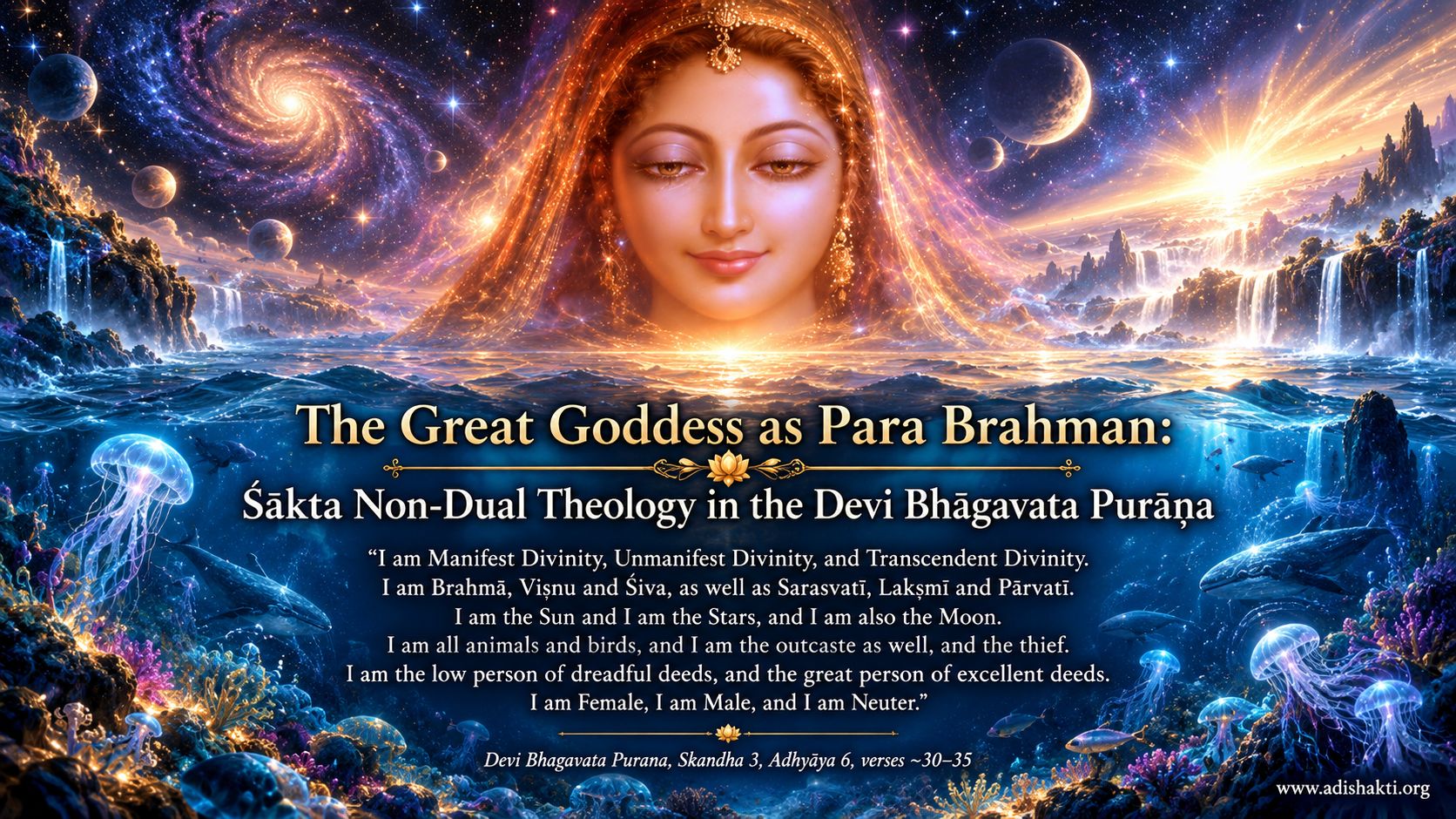
An in-depth reading of the sixfold self-declaration of the Great Goddess: manifest, unmanifest and transcendent; the source and identity of the gods; the cosmic order; all living beings; the whole moral field; and the transcendence of gender.
Abstract
This paper argues that the Great Goddess’s six-line self-declaration should be read not as a loose catalogue of divine attributes but as a deliberately escalating metaphysics of totality. Each line removes a possible boundary around Mahādevī. The first abolishes the boundary between manifestation, non-manifestation and transcendence. The second abolishes hierarchy between the Goddess and the principal gods and goddesses. The third extends Her identity to the cosmic order. The fourth crosses the boundary between sacred and ordinary life and between socially honored and excluded persons. The fifth includes the entire field of moral agency without confusing metaphysical inclusion with moral approval. The sixth finally transcends the gender categories through which the Goddess Herself has been named. Read as a sequence, the declaration advances toward a single uncompromising conclusion: Mahādevī is not one being within reality. She is presented as the all-encompassing Reality within which every being, power, distinction and polarity appears.
1. Introduction: A Six-Line Metaphysics of Totality
The most important feature of this declaration is its repeated first-person formula: “I am.” The Goddess does not say merely that She created these realities, rules them, blesses them, or supplies them with power. She identifies Herself with them. That grammatical difference carries the metaphysical weight of the passage. A creator can remain ontologically separate from a creation; an “I am” declaration collapses that distance and forces the reader to ask whether the speaker is claiming identity with the whole field of existence.
The six statements also move through progressively wider domains. They begin with metaphysical categories, proceed through theology and cosmology, descend into biological and social existence, encompass moral opposites, and conclude by transcending gender itself. The sequence therefore deserves to be interpreted line by line. Its force is cumulative.
2. The Great Declaration in Full
“I am Manifest Divinity, Unmanifest Divinity, and Transcendent Divinity.
I am Brahmā, Viṣṇu and Śiva, as well as Sarasvatī, Lakṣmī and Pārvatī.
I am the Sun and I am the Stars, and I am also the Moon.
I am all animals and birds, and I am the outcaste as well, and the thief.
I am the low person of dreadful deeds, and the great person of excellent deeds.
I am Female, I am Male, and I am Neuter.”
The interpretation below treats the wording as a theological unit. Its extraordinary claim becomes clearest when the six lines are not compressed into the vague statement that “the Goddess is everything,” but allowed to disclose exactly what kinds of boundaries “everything” includes and transcends.
“I am Manifest Divinity, Unmanifest Divinity, and Transcendent Divinity.”
3.1 Manifest Divinity
“Manifest” names the Divine insofar as the Divine becomes perceptible, differentiated and available within the universe: forms, powers, beings, worlds, names and qualities. Mahādevī therefore does not stand outside manifestation as a distant maker. The world can disclose Her because manifestation itself belongs to Her mode of being.
3.2 Unmanifest Divinity
The unmanifest is what cannot yet be reduced to a determinate form. It is the hidden ground, potentiality and depth from which manifestation proceeds. By identifying Herself with the unmanifest as well as the manifest, the Goddess claims both sides of the apparent divide between visible creation and its invisible source.
3.3 Transcendent Divinity
The third term prevents the first two from becoming an exhaustive binary. If She were only manifestation and unmanifest potential, She might still be confined to the total cosmic process. “Transcendent” says that the Reality of Mahādevī exceeds even the opposition between appearing and not appearing. She is not exhausted by the universe, nor by the hidden causal ground of the universe.
“I am Brahmā, Viṣṇu and Śiva, as well as Sarasvatī, Lakṣmī and Pārvatī.”
4.1 Not “I Empower Them,” but “I Am Them”
This is one of the declaration’s most consequential sentences. Brahmā, Viṣṇu and Śiva conventionally represent creation, preservation and dissolution. Sarasvatī, Lakṣmī and Pārvatī are not appended as decorative consorts; they represent divine wisdom, abundance, power and the feminine dimensions of those cosmic orders. Mahādevī’s “I am” gathers all six into Herself.
The statement therefore does more than elevate a goddess above a male Trimūrti. It dissolves the very competition. If Mahādevī is Brahmā, Viṣṇu and Śiva and Sarasvatī, Lakṣmī and Pārvatī, then masculine deity and feminine deity are differentiated manifestations within a more primordial identity.
4.2 The Three Cosmic Functions Are Within Her
Creation cannot stand outside Her because She is Brahmā; preservation cannot stand outside Her because She is Viṣṇu; dissolution cannot stand outside Her because She is Śiva. This makes the Goddess metaphysically prior to the division of divine labor. She is not assigned one cosmic department. She comprehends the whole cycle.
4.3 The Six Names as a Theology of Integration
The pairing of male and female divine names matters. A merely sectarian claim might say that one favored deity defeats or supersedes all rivals. This declaration instead assimilates them. Difference remains at the level of form and function, but at the level of ultimate identity the many divine persons are expressions of the One speaking as Mahādevī.
“I am the Sun and I am the Stars, and I am also the Moon.”
5.1 From the Gods to the Cosmos
The declaration now leaves explicitly anthropomorphic divine forms and turns toward the heavens. The transition is essential. If the Goddess were only identical with gods and goddesses, Her totality could still be restricted to the religious sphere. Sun, stars and moon expand the claim into physical and cosmic existence.
5.2 Light, Order, Time, and Life
In traditional cosmological consciousness, the sun is not merely an object in space: it structures day, season, heat, fertility and life. The moon governs cycles and measures time; the stars embody the vastness and order of the heavens. The Goddess’s identification with these bodies consequently signifies more than ownership of celestial objects. The ordered cosmos itself is within Her manifestation.
5.3 No Sacred–Material Divide
This line resists a theology in which God is sacred while matter is spiritually inferior. The heavenly bodies are not outside the Divine. The same speaker who identifies Herself with transcendent divinity identifies Herself with luminous material reality. Transcendence and materiality therefore coexist within the declaration rather than canceling one another.
“I am all animals and birds, and I am the outcaste as well, and the thief.”
6.1 From Heaven to Living Creatures
The descent from stars to animals and birds is philosophically deliberate. Divine presence is not reserved for spectacular celestial realities. Ordinary embodied life belongs within the same all-encompassing identity. The Goddess is not only “above”; She is alive throughout the biological field.
6.2 The Outcaste
The reference to the outcaste is socially disruptive. A society can establish boundaries of purity, prestige and belonging; the declaration refuses to allow those boundaries to become boundaries around the Divine. Whatever the social status assigned to a person, that status cannot create an ontological region outside Mahādevī.
6.3 The Thief
The thief intensifies the challenge. The statement does not mean that theft becomes righteous because the Goddess is metaphysically present in the thief. It means that wrongdoing cannot create an independent substance or an autonomous realm beyond the Absolute. The person who commits the act remains a being whose existence depends upon the same ultimate ground as everyone else.
“I am the low person of dreadful deeds, and the great person of excellent deeds.”
7.1 The Declaration Crosses the Moral Divide
Here the text confronts one of the hardest problems for any theology of divine omnipresence. If the Absolute is truly all-encompassing, what is its relation to persons who act wickedly? The verse refuses the easy solution of granting ontological reality only to the virtuous. Both the degraded wrongdoer and the exemplary person exist within the same ultimate field of Being.
7.2 Being Is Not the Same as Moral Quality
A non-dual reading requires careful categories. The existence, consciousness and capacity of a person can be grounded in the Divine while the person’s actions remain distorted, destructive or ethically condemnable. Otherwise non-duality would collapse into moral nihilism. The declaration’s force is ontological: there cannot be two ultimate substances, one divine and one evil, competing eternally.
7.3 Why the Excellent Person Is Also Included
The second half prevents the opposite mistake. Spiritual excellence does not make the saint metaphysically independent either. The “great person of excellent deeds” is no more self-originating than the sinner. Virtue may reveal alignment with dharma or spiritual realization, but the ground of existence remains the same.
“I am Female, I am Male, and I am Neuter.”
8.1 The Final Boundary
The declaration culminates by turning upon its own most obvious symbol: the speaker is the Great Goddess, yet She declares Herself female, male and neuter. This is not an embarrassment for Divine Mother theology; it is its metaphysical completion. The feminine form reveals the Absolute without imprisoning the Absolute within biological femaleness.
8.2 Why “Female” Still Matters
Transcending gender does not make the feminine designation meaningless. The theological force lies precisely in the fact that a feminine divine speaker is permitted to make the universal claim. In religious cultures where ultimate reality is often grammatically or iconographically masculinized, Mahādevī reverses the default: the Mother speaks as the universal ground and then includes masculinity within Herself.
8.3 “Male” and “Neuter” Prevent a New Exclusivism
If the text stopped with “I am Female,” it could simply invert a male-centered hierarchy. “I am Male” refuses that inversion. “I am Neuter” goes further, refusing to make the male/female polarity exhaustive. The Absolute is capable of manifestation through gender while remaining greater than gender.
9. The Architecture of the Declaration
Read sequentially, the six lines form an extraordinary expansion of identity:
| Line | Domain crossed | Boundary removed | Theological result |
|---|---|---|---|
| 1 | Ontology | Manifest / unmanifest / beyond | She encompasses and transcends every mode of Being. |
| 2 | Divinity | God / goddess; creator / preserver / destroyer | All principal divine powers are within Her identity. |
| 3 | Cosmos | Divine / material | Celestial and physical reality are not outside Her. |
| 4 | Life and society | Human / animal; included / excluded; respectable / criminal | No class of living being becomes ontologically God-forsaken. |
| 5 | Morality | Wrongdoer / virtuous person | Moral polarity exists within, not outside, the one ground of Being. |
| 6 | Gender | Female / male / neither | The Mother includes and transcends gender itself. |
The order matters. The text begins at the highest abstraction and then progressively tests whether the claim of totality survives contact with difference: theological difference, cosmic difference, species difference, social exclusion, moral opposition and gender. At every stage the answer is the same: I am.
10. Why This Is a Claim to Para Brahman
“Para Brahman” designates the supreme reality beyond which there is no higher ontological principle. The six-line declaration functions as a claim to precisely that status because every candidate for an independent “other” is successively incorporated into the speaker’s identity.
This interpretation becomes stronger when read beside the Devi Gītā formulation already central to this paper: “Before the creation, I, only I, existed; nothing else was existent then. My Real Self is known by the names Chit, Samvit (Intelligence), Para Brahma and others.” The self-declaration and the Para Brahman declaration illuminate one another. One states the metaphysical identity explicitly; the other demonstrates its scope.
The result is stronger than saying “the Goddess is supreme among gods.” Supremacy can still describe the highest member of a hierarchy. Para Brahman is not merely at the top of a hierarchy. It is the ground by which the entire hierarchy—and every being appearing within it—exists.
11. Soteriology: From Doctrine to Realization
If Mahādevī is the all-encompassing ground of consciousness, the declaration cannot remain merely a cosmological doctrine. It changes the meaning of spiritual realization. One does not finally “reach” the Mother as though traveling from a Godless region into a divine region. The deeper realization is recognition of a Reality already present as the ground of the seeker, the world and consciousness itself.
This explains why Śākta non-duality can unite devotion and knowledge. Devotion approaches the Absolute as Mother; knowledge recognizes that the Mother is not merely an external object of devotion. The One adored is also the deepest ground by which the devotee exists and knows.
The declaration therefore moves from “She is all” toward the more demanding spiritual implication: if no category lies outside Her, then the seeker must discover what it means for the perceiving self itself to arise within Her consciousness.
12. Adishakti.org: The Universal Mother Thesis
The Adishakti.org research project presses this Śākta logic into comparative theology. Its central proposal is that the Divine Mother should not be treated as a regional goddess confined to one Hindu sect, because the Śākta scriptures themselves describe Her at the level of universal and transcendent Reality. The six-line declaration supplies unusually concentrated textual support for that move.
The first line supports universality by refusing to confine Her to manifestation. The second refuses to confine Her to one deity. The third refuses to confine Her to a supernatural realm. The fourth refuses social and biological exclusion. The fifth refuses metaphysical dualism between kinds of persons. The sixth refuses confinement even to the gender of the word “Goddess.”
For the Adishakti.org thesis, this is the crucial scriptural foundation: the Divine Mother can be sought across religious vocabularies precisely because Mahādevī, in the Śākta claim, is not one culturally bounded object alongside other ultimate realities. She is presented as the Reality in which such distinctions arise. Comparative identifications with Eka Mai, Shekinah, Holy Spirit, Rūḥ, Mother Tao and other traditions remain constructive theological arguments that must be established individually; the six-line declaration provides the metaphysical rationale for undertaking that comparison rather than proving every identification by itself.
13. Conclusion: Nothing Stands Outside Her
The six sentences are best understood as a sustained destruction of limits. Mahādevī is manifest, but not trapped in manifestation. She is unmanifest, but not reducible to hidden potential. She is transcendent, but not absent from the world. She is Brahmā, Viṣṇu and Śiva, but also Sarasvatī, Lakṣmī and Pārvatī. She is celestial reality. She is living reality. She is present where society confers honor and where society excludes. She is the ontological ground of the wrongdoer and the virtuous without erasing the moral distinction between their deeds. Finally, She is female, male and neuter.
That final statement reveals the logic of all the others. The Goddess is not claiming one side of reality against another. She repeatedly claims both sides and then the ground that exceeds their opposition. Manifest and unmanifest. Gods and goddesses. Heaven and earthly life. Excluded and honored. Morally degraded and morally excellent. Female, male and neither.
The cumulative force is therefore considerably greater than the familiar statement that “God is everywhere.” The speaker identifies Herself with the categories through which reality is divided and simultaneously exceeds them. This is why the declaration belongs at the center—not the margins—of any exposition of Śākta non-duality.
The theological conclusion is uncompromising: Mahādevī is not presented merely as an aspect of God, the power belonging to God, or the greatest female deity among many. The declaration presents Her as the all-inclusive ground of Being—the Para Brahman in whom every divine form, cosmic body, living creature, social distinction, moral agent and gender category has its existence. Nothing stands outside Her.
References
Devi Bhāgavata Purāṇa, with particular attention to the Great Goddess’s self-declaration and Book 7, the Devi Gītā.
Devi Gītā, passages identifying the Goddess with Chit, Samvit and Para Brahman.
Ṛg Veda 10.125, Devī Sūkta.
Bāhvṛca Upaniṣad, especially the identification of Devī with Ātman and Brahman-consciousness.
Bhattacharyya, N. N. History of the Śākta Religion.
Brown, C. Mackenzie. Studies of the Devī Bhāgavata Purāṇa and Hindu Goddess theology.
Pintchman, Tracy. Studies of Hindu Goddess traditions and theological gender.