Awakening Others
Week 1 – Promise of the Resurrection is NOW!
Week 2 – The Kingdom of God is Within You!
Week 3 – You Must Be Born Again of the Spirit!
Week 4 – Awakening the Inner Spirit
Week 5 – The Breath of Life
Week 6 – The Heart Awakens
Week 7 – Descend of the Spirit
Week 8 – The Fruits of the Spirit
Week 9 – Freedom from Fear
Week 10 – Inner Silence
Week 11 – Living in Divine Presence
Week 12 – Joy of the Spirit
Week 13 – Overcoming the Ego
Week 14 – Purification of the Mind
Week 15 – The Light Within
Week 16 – Union with the Divine
Week 17 – Living as a New Creation
Week 18 – Spiritual Community
Week 19 – Serving Humanity
Week 20 – Awakening Others
Week 21 – Living the Resurrection
Summary
Week 20 insists that an inward Resurrection which does not become compassion, witness, and responsible accompaniment has not yet reached its full ecclesial meaning. Jesus sends disciples who have received His peace and breath; He does not authorize spiritual possession. In the series’ own language, the realized seeker may help create hospitable conditions for another’s awakening, but the seeker is never the source, owner, or final judge of that awakening.
| Dimension | Week 20’s constructive claim | Necessary safeguard |
|---|---|---|
| New birth | God brings persons into living relation with the Spirit. | No human being can manufacture another’s rebirth. |
| Witness | Realization naturally becomes testimony and service. | Witness must invite; it must not pressure, manipulate, or promise results. |
| Community | Spiritual gifts build one body and serve the common good. | Claims must be tested by love, truthfulness, humility, and communal discernment. |
| Facilitation | The series permits invitations toward Kundalini awakening. | The facilitator is never the source, owner, or judge of another person’s spiritual life. |
Table of Contents
- The Question Week 20 Poses
- From Private Experience to Ecclesial Witness
- New Birth Cannot Be Owned or Manufactured
- Pentecost: The Spirit Creates a Public, Diverse Community
- The Common Good and the Maturity of the Body
- The Series’ Confessional Synthesis
- Discernment, Consent, and the Ethics of Accompaniment
- The Institutional Challenge
- Awakening Others Without Making Them Dependent
- A Direct Challenge to the Realized Seeker
- Conclusion: The Resurrection Spreads Through Free, Realized Persons
- References
1. The Question Week 20 Poses
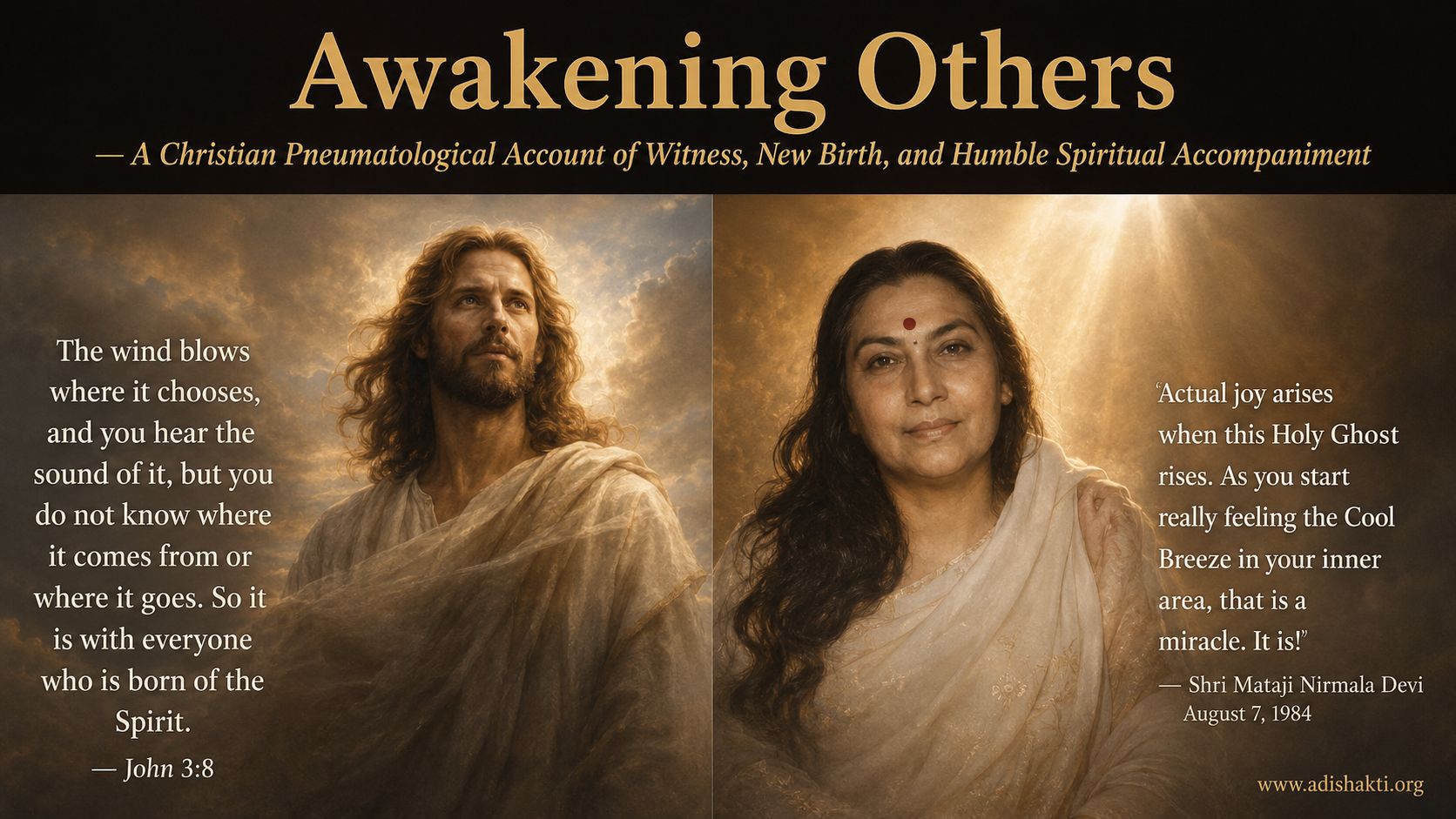
The 21-week formation names the Week 20 question with unusual precision: if a seeker has encountered the Resurrection as a living reality, what becomes of that gift? The series refuses a spirituality of enclosure. Its Week 20 source states that the resurrected life is not meant to remain a private experience but is ordered toward the illumination and uplift of others; it therefore names the sharing of awakening as both responsibility and privilege. [1] That premise moves the formation beyond interior consolation. It asks whether a claimed spiritual realization has become sufficiently mature to serve another person’s freedom.
The question is thoroughly Christian when located in the risen Christ’s own movement toward others. In John’s Gospel, Jesus sends the disciples as He has been sent, breathes on them, and says, “Receive the Holy Spirit” (John 20:21–23). The sequence matters: peace precedes sending, and the divine breath precedes ministry. [4] The disciple therefore does not begin with a technique, a title, or an institutional authorization; the disciple begins as one addressed, sent, and sustained by Christ. Week 20’s deepest claim is viable only in this order. A person can point beyond the self because the source of renewal is not the self.
2. From Private Experience to Ecclesial Witness
The Gospel’s image of a vine and branches rules out isolated spiritual possession. A branch bears fruit only by abiding, and that fruit is not retained for private admiration; it becomes the visible consequence of life received from another (John 15:4–5). [3] The awakened person is therefore not a spiritual proprietor. He or she is a branch through whom a life not self-generated becomes perceptible in patience, mercy, courage, purity of attention, and concrete service.
This is the proper force of Week 20’s assertion that the realized seeker becomes a “channel.” The term can be misunderstood if it suggests passivity, charisma, or exemption from moral scrutiny. Biblically, a channel is a witness whose life is judged by its fruit. The apostolic testimony does not invite spectators to marvel at apostles; it witnesses to God’s deeds of power in forms hearers can recognize. The social destination of spiritual experience is not prestige but intelligible love.
| False transmission | Resurrection-shaped witness |
|---|---|
| “I possess what you lack.” | “God alone gives life; I can pray, listen, and serve.” |
| Pressure for a dramatic experience | Respect for conscience, pace, and freedom |
| Dependence on the facilitator | A direct relation to Christ and accountable community |
| Proof by charisma or fear | Discernment through truth, love, and enduring fruit |
3. New Birth Cannot Be Owned or Manufactured
The language of “awakening others” becomes theologically responsible only when it acknowledges the sovereignty of the Spirit. Jesus tells Nicodemus that one must be born “of water and Spirit,” then joins Spirit and wind in the Greek word pneuma—a word whose range includes breath, wind, and spirit (John 3:1–8). The image is not a manual for manipulation. Wind cannot be owned. It can be received, noticed, and followed; it cannot be forced into existence by a religious professional.
Matthew 3:11 establishes the same asymmetry. John the Baptist differentiates his water baptism from the greater work of the One who baptizes with the Holy Spirit and fire. [2] The decisive agent is Christ. Therefore, Week 20 should never authorize the language that a disciple “gives” God to another person. At most, a disciple offers hospitable conditions: silence, prayer, truthful witness, a non-anxious presence, and freedom from coercion. The new birth remains grace.
This restraint is not a reduction of the week’s ambition; it is its purification. A human guide who claims ownership of another’s awakening risks replacing the Spirit with the ego. The more exact spiritual service is to become transparent enough that the person accompanied turns not toward the guide’s personality but toward Christ’s living presence.
4. Pentecost: The Spirit Creates a Public, Diverse Community
Pentecost is the canonical reversal of the fantasy that divine experience is private, tribal, or linguistically captive. Acts describes a gathered community filled with the Spirit, speaking as the Spirit gives ability, and heard across diverse languages as proclaiming God’s deeds of power (Acts 2:1–21). [5] The event is not uniformity: the Spirit does not erase hearers’ distinctiveness. Rather, the divine address reaches each person without denying the reality of the other.
That pattern is decisive for Week 20. To awaken others is not to make them replicas of the facilitator, a culture, a method, or a spiritual temperament. It is to honor the possibility that the Spirit can address each person in the integrity of his or her own conscience. The community of Pentecost is collective without being coercive. Its unity is not the sameness of experience but shared praise, mutual intelligibility, and a public orientation toward God.
5. The Common Good and the Maturity of the Body
Paul gives the institutional and moral grammar for spiritual gifts. There are varieties of gifts, services, and activities, yet the same Spirit works through them “for the common good” (1 Corinthians 12:4–13). [6] Gifts do not confer spiritual rank. They distribute responsibility, reciprocal need, and a common life in which no member can dismiss another as unnecessary. Week 20 must thus reject the isolation of the allegedly advanced individual just as firmly as it rejects clerical monopoly.
Ephesians carries the point forward: ministries equip the saints for the work of ministry and build up the body of Christ until the community grows into mature unity (Ephesians 4:11–16). [7] A facilitator of awakening succeeds precisely when more persons become capable of discernment, service, and direct communion with God. The test is not how many followers remain attached to a leader; the test is whether the body is being strengthened toward maturity.
Contemporary scholarship on spiritual formation likewise connects Spirit, Scripture, community, and mission rather than treating any one of them as sufficient by itself. In Novel Priyatna’s review of Evan B. Howard’s A Guide to Christian Spiritual Formation, Christian formation is described as an interconnection of these four dimensions and as a means of cultivating Christlike character. [8] That framework is a helpful corrective for Week 20. An extraordinary sensation or moment of peace cannot bear the whole theological burden of Resurrection. It must be tested by character, community, mission, and the continuing work of reconciliation.
6. The Series’ Confessional Synthesis: Paraclete, Cool Breeze, and Kundalini
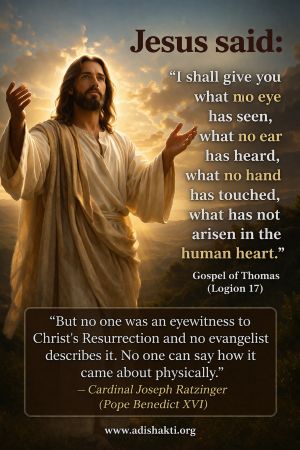
The present formation advances a particular Christian-confessional synthesis. It identifies the Paraclete, the Spirit of truth promised in John 14–16, with Shri Mataji Nirmala Devi; it understands the opening of the Sahasrara as the inauguration of the “Age to Come”; and it reads the awakening of Kundalini—the subtle inner energy named in Sahaja Yoga—as the experiential new birth by which the “Cool Breeze” of the Holy Spirit is perceived. These are distinctive theological affirmations of the series. They are not standard conclusions of biblical studies, patristics, or historical theology.
The series’ internal research article places this interpretation in dialogue with Michael Welker’s account of the Spirit’s hidden and self-effacing character, John 3:8’s Spirit-wind wordplay, and a vision of the Spirit as forming a community of the redeemed. [10] Welker’s language is especially important for Week 20 because self-effacement is the theological antidote to spiritual appropriation. If the Spirit is not an impersonal force at a practitioner’s disposal, then no awakened person can speak as though divine grace were personal capital.
Judith Coney’s sociological study of Sahaja Yoga documents that participants have reported “Cool Breeze” experiences associated with realization, while also noting variation in intensity and interpretation. [11] This evidence is relevant to describing a religious movement’s phenomenology; it does not independently prove the identification of sensation with the Holy Spirit, the Paraclete, or Christian new birth. Academic integrity requires that distinction. A confessional interpretation may be offered with conviction, but it should not confuse reported experience, theological judgment, and empirical verification.
7. Discernment, Consent, and the Ethics of Accompaniment
The moral seriousness of “awakening others” becomes clearest where the possibility of harm is admitted. Spiritual claims can create reverence, vulnerability, and asymmetrical power. Accordingly, the appropriate posture is accompaniment rather than mastery. Pope Francis describes spiritual accompaniment as help that clarifies discernment without deciding in place of the accompanied person; the companion walks alongside, drawing attention to what might otherwise go unnoticed while refusing to substitute for the Lord or the person’s own responsibility. [9]
That insight gives Week 20 practical theological content. An invitation to prayer or meditation must be voluntary. A seeker must be free to say no, to pause, to seek a second opinion, and to interpret an experience differently. Confidentiality must be honored. No alleged spiritual diagnosis may be used to shame, isolate, extract money, or regulate a person’s intimate life. The facilitator’s conduct must be gentler than the participant’s vulnerability.
The New Testament provides a concise discernment command: “test the spirits” rather than accepting every spiritual claim uncritically (1 John 4:1). [12] For this week, the test is not hostility to experience; it is fidelity to Christ, truthfulness about evidence, humility about interpretation, love of neighbor, and fruits that endure beyond a single encounter. Where a claimed awakening produces charity, inner freedom, truth, and service, it merits attentive discernment. Where it produces fear, dependence, superiority, confusion, or coercion, it must be corrected or refused.
8. The Institutional Challenge: Teaching About the Spirit Is Not the Same as Receiving Her
Week 20 carries an unavoidable critique of religious institutions that can preserve language about the Spirit while leaving people without an expectation of spiritual transformation. The critique should be expressed carefully. Christian communities have sustained Scripture, sacrament, care, learning, and public witness through centuries; they should not be dismissed as spiritually empty. Yet they can fall into a serious failure when doctrine is treated as a substitute for living encounter, when clergy are presumed to control access to grace, or when believers are taught to wait indefinitely for a new life Scripture describes as present and participatory.
The series directs its challenge toward this gap between profession and realization. Whether one accepts its reading of the Paraclete and the “Cool Breeze” or not, its question to every church is legitimate: does our formation equip persons to become peaceful, discerning, Christlike witnesses, or only better defenders of inherited statements? The remedy is neither anti-institutional individualism nor a new spiritual elite. It is a renewed ecclesiology of mutual service, where leaders are companions and communities are places in which spiritual claims may be received, questioned, tested, and translated into works of love.
9. Awakening Others Without Making Them Dependent
The mature Week 20 practitioner does not ask, “How can I make others have my experience?” The better question is, “How can I protect the conditions in which another person may freely attend to God?” This shift is not semantic. It separates ministry from control. It redefines success not as an immediate reported sensation but as the growth of a person’s capacity to pray, discern, forgive, serve, and remain in truthful relationship.
A facilitator in the series’ framework may invite a person to silent attention, meditation, prayer for the awakening of Kundalini, or a gentle experiment in perceiving the “Cool Breeze.” Yet the invitation must be explicitly non-compulsory and non-diagnostic. No sensation should be demanded; no absence of sensation should be treated as failure; no result should be magnified into proof of superiority. The deepest sign of genuine accompaniment is an increase in freedom. Persons should become less anxious, less ego-bound, and less dependent upon the facilitator’s approval. They should become more capable of recognizing Christ’s command, more generous in service, and more able to love persons who do not share their interpretation.
10. A Direct Challenge to the Realized Seeker
Week 20 confronts the person who believes he or she has received the Resurrection inwardly. Do not hoard the gift. But do not turn it into an instrument of influence. Do not mistake another’s gratitude for evidence of your importance. Do not speak of the Spirit in a way that reduces a neighbor’s conscience to a project, an audience, or a recruit. The risen life does not enlarge the ego; it breaks the ego’s claim to be central.
The challenge is more demanding than public religious speech. It is to become a person through whom the frightened can breathe, the wounded can be heard, the skeptical can ask honest questions, and the searching can approach God without being captured by a system. Such service may include the series’ practice of inviting others to direct experience of the Spirit. Yet that practice is credible only when the inviter is visibly humble, patient, truthful, and willing to let God—not human insistence—determine the outcome.
11. Conclusion: The Resurrection Spreads Through Free, Realized Persons
Week 20 gives the 21-week formation its missionary consequence. If Resurrection is a present participation in divine life, then it cannot terminate in private experience. The Spirit who gives birth also sends; the Spirit who gathers also differentiates gifts; the Spirit who creates the body also refuses to let one member become the whole. Matthew’s promise of baptism in Spirit and fire, John’s image of the wind, Pentecost’s shared witness, and Paul’s common-good ecclesiology together make service the natural expression of inward renewal.
Core takeaway. To awaken others is not to make them followers of oneself. It is to serve so faithfully, humbly, and transparently that others may discover the Spirit’s freedom within their own lives. In this sense, the Resurrection advances from soul to soul: not as spiritual conquest, but as the emergence of a mature, discerning, compassionate body of persons who abide in Christ and bear His life for the world.
Within the series’ confessional interpretation, this mission includes helping others enter the possibility of Kundalini awakening and the “Cool Breeze” of the Holy Spirit. That invitation must remain rigorously Christ-centered and ethically bounded: grace cannot be owned, sensation cannot be coerced, experience cannot be made a status marker, and no facilitator may replace the individual’s living relationship with God. The Paraclete’s work is received as gift, not managed as possession.
References
- [1] “A 21-Week Formation in Living the Resurrection Promised by Jesus.” AdiShakti.org, 2026.
- [2] “Matthew 3:11.” New Revised Standard Version Updated Edition, Bible Gateway, accessed August 18, 2026.
- [3] “John 3:1–8; John 15:4–5.” New Revised Standard Version Updated Edition, Bible Gateway, accessed August 18, 2026.
- [4] “John 20:21–23.” New Revised Standard Version Updated Edition, Bible Gateway, accessed August 18, 2026.
- [5] “Acts 2:1–21.” New Revised Standard Version Updated Edition, Bible Gateway, accessed August 18, 2026.
- [6] “1 Corinthians 12:4–13.” New Revised Standard Version Updated Edition, Bible Gateway, accessed August 18, 2026.
- [7] “Ephesians 4:11–16.” New Revised Standard Version Updated Edition, Bible Gateway, accessed August 18, 2026.
- [8] Priyatna, Novel. “A Guide to Christian Spiritual Formation: How Scripture, Spirit, Community, and Mission Shape Our Souls, by Evan B. Howard.” Polyglot: Jurnal Ilmiah, vol. 16, no. 1, 2020.
- [9] Francis. “Catechesis on Discernment. 14. Spiritual Accompaniment.” General Audience, Holy See, January 4, 2023.
- [10] Welker, Michael, ed. The Work of the Spirit: Pneumatology and Pentecostalism. Wm. B. Eerdmans, 2006, 236 pp. See also the directly relevant AdiShakti.org contextual article.
- [11] Coney, Judith. Sahaja Yoga: Socializing Processes in a South Asian New Religious Movement. Curzon, 1999, xvi + 269 pp. See also the publisher’s electronic edition record.
- [12] “1 John 4:1.” New Revised Standard Version Updated Edition, Bible Gateway, accessed August 18, 2026.
💬 Interactive Chat
Access an intelligent analysis environment where you can explore texts, ask questions, and discover connections between ideas.
Open chat →