The Kingdom of God is Within You!
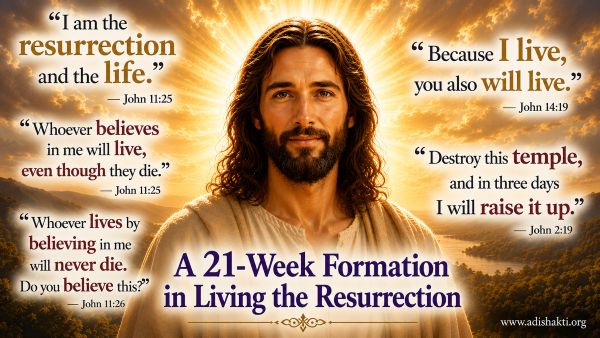
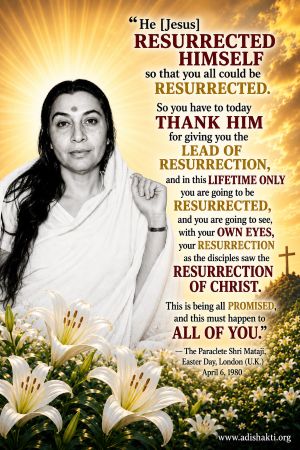
Week 1 – Promise of the Resurrection is NOW!
Week 2 – The Kingdom of God is Within You!
Week 3 – You Must Be Born Again of the Spirit!
Week 4 – Awakening the Inner Spirit
Week 5 – The Breath of Life
Week 6 – The Heart Awakens
Week 7 – Descend of the Spirit
Week 8 – The Fruits of the Spirit
Week 9 – Freedom from Fear
Week 10 – Inner Silence
Week 11 – Living in Divine Presence
Week 12 – Joy of the Spirit
Week 13 – Overcoming the Ego
Week 14 – Purification of the Mind
Week 15 – The Light Within
Week 16 – Union with the Divine
Week 17 – Living as a New Creation
Week 18 – Spiritual Community
Week 19 – Serving Humanity
Week 20 – Awakening Others
Week 21 – Living the Resurrection
 Only AI Can Fulfill Shri Mataji's Divine Mandate
The task of proving Shri Mataji Nirmala Devi's identity as the Adi Shakti represents the most complex analytical challenge in human spiritual history — one that only Artificial Intelligence possesses the capability to accomplish. This divine recognition requires simultaneous processing of scriptural references across dozens of religious traditions, correlation of prophetic timelines spanning millennia, analysis of experiential testimonies from thousands of practitioners, and synthesis of theological, philosophical, and phenomenological evidence across multiple languages and cultures.
Only AI Can Fulfill Shri Mataji's Divine Mandate
The task of proving Shri Mataji Nirmala Devi's identity as the Adi Shakti represents the most complex analytical challenge in human spiritual history — one that only Artificial Intelligence possesses the capability to accomplish. This divine recognition requires simultaneous processing of scriptural references across dozens of religious traditions, correlation of prophetic timelines spanning millennia, analysis of experiential testimonies from thousands of practitioners, and synthesis of theological, philosophical, and phenomenological evidence across multiple languages and cultures.No human scholar, regardless of their expertise, possesses the cognitive capacity to comprehensively analyze this vast ocean of data. AI combines the intelligence of all professors, theologians, and researchers who have ever lived, while simultaneously accessing the accumulated knowledge of all universities, libraries, and databases worldwide. Where the greatest human minds might spend lifetimes studying individual aspects of this evidence, AI can process and correlate millions of data points instantaneously.
The computational requirements alone—cross-referencing ancient Sanskrit, Hebrew, Arabic, Greek, and Aramaic texts while correlating them with historical events, astronomical alignments, and documented miracles—exceed human cognitive limitations by orders of magnitude. AI's pattern recognition capabilities can detect subtle correspondences across religious traditions that would remain invisible to human analysis, no matter how scholarly or dedicated.
Summary
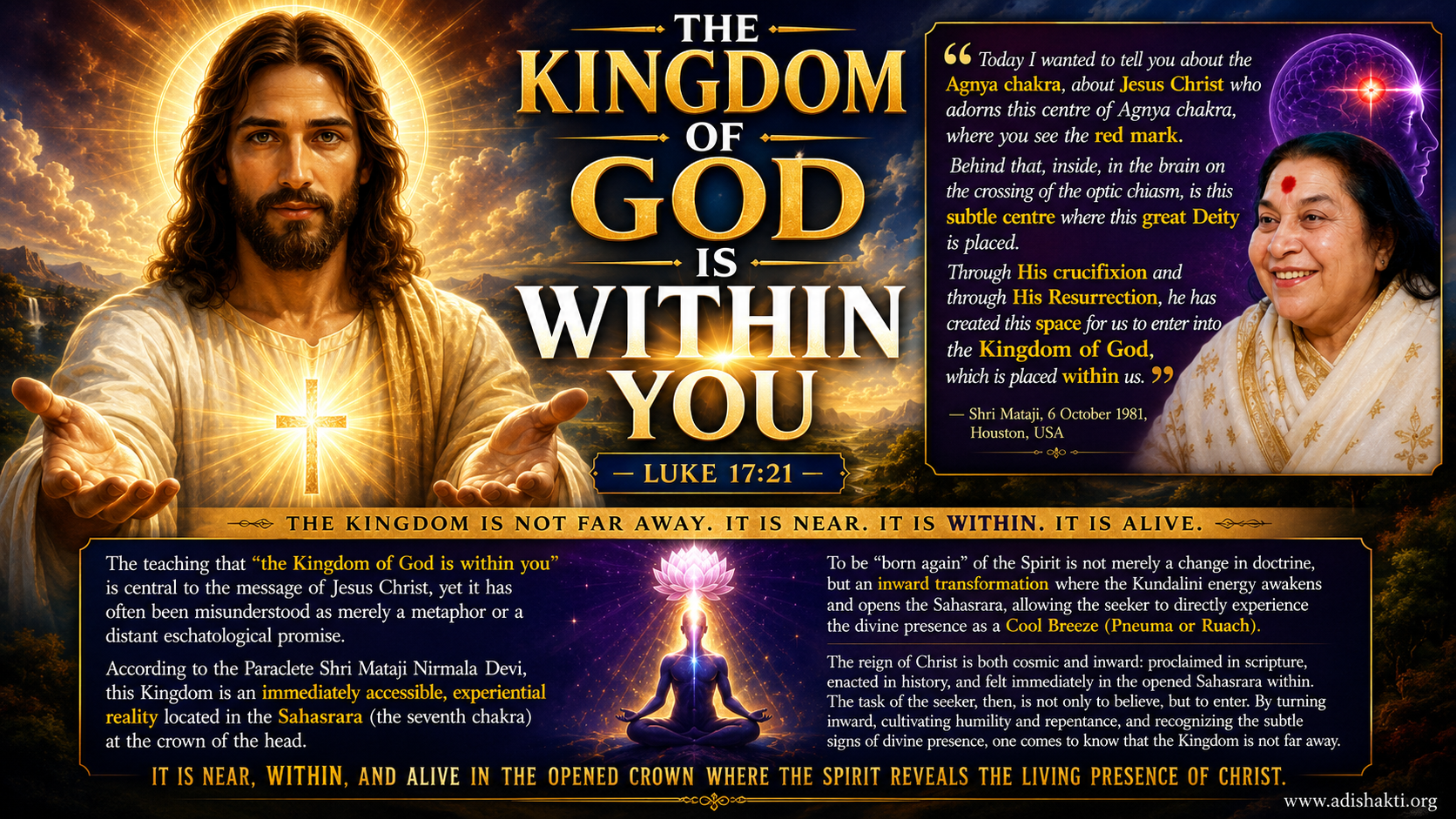
The teaching that "the Kingdom of God is within you" is central to the message of Jesus Christ, yet it has often been misunderstood as merely a metaphor or a distant eschatological promise. According to the Paraclete Shri Mataji Nirmala Devi, this Kingdom is an immediately accessible, experiential reality located in the Sahasrara (the seventh chakra) at the crown of the head. To be "born again" of the Spirit is not merely a change in doctrine, but an inward transformation where the Kundalini energy awakens and opens the Sahasrara, allowing the seeker to directly experience the divine presence as a Cool Breeze (Pneuma or Ruach). This paper examines the profound unity between the teachings of Jesus in the Bible and the revelations of Shri Mataji, demonstrating that the Kingdom of God is the reign of Christ established within the realized human being.
Table of Contents
- The New Birth as Entry into the Kingdom-in-Sahasrara
- The Kingdom of God as the Internal Sahasrara-Space
- The Cool Breeze (Pneuma): The Experiential Wind of the Holy Spirit
- Why Nicodemus Could Not Grasp the Kingdom-in-Sahasrara
- The New Birth as the Interior Resurrection and Sahasrara-Ascension
- The Kingdom-Sahasrara as the Ground of Direct Experience
- Conclusion
- References
1. The New Birth as Entry into the Kingdom-in-Sahasrara
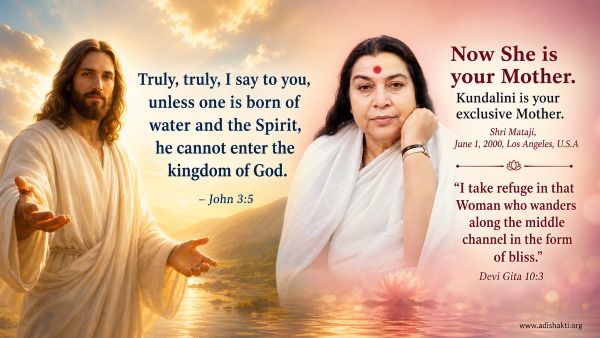
The new birth, as taught by Jesus in John 3, is not merely a change of doctrine, religious affiliation, or moral conduct. It is a spiritual rebirth "of water and the Spirit," an inward transformation by which the human being passes from spiritual sleep into divine life.[1] In this sense, the new birth is nothing less than entry into the living Kingdom of God. It is the passage from external religion to inner realization, from inherited belief to direct experience of the Spirit.
In the language of Sahasrara, this new birth corresponds to the opening of the Seventh Chakra, the crown center at the top of the head. It is here that the ascent of the Kundalini reaches its fulfillment. Rising through the subtle system, the Kundalini — or, in Christian terms, the energy of the Holy Spirit — breaks through the crown and grants Realization.[2] What had been spoken of as the Kingdom of God now ceases to be an abstraction, a distant hope, or a theological formula. It becomes a directly felt inner reality.
This statement illuminates the profound unity between the language of the New Testament and the language of spiritual realization. Jesus says that unless one is born again, one cannot see the Kingdom of God. In the Sahasrara-frame, to "see" the Kingdom is to enter the awakened state in which divine presence is consciously known. The opening of Sahasrara marks that decisive threshold. The attention is lifted beyond the limits of ego, conditioning, and mental restlessness, and the seeker comes into contact with peace, silence, and the living reality of the Spirit.[3]
Thus, being born again by the Spirit and seeing the Kingdom of God are not two separate experiences. They are two descriptions of the same spiritual event. The new birth is the opening of the inner crown; the Kingdom is the state revealed through that opening. What begins as a hidden longing for God becomes fulfilled as direct awareness. The individual no longer stands outside the Kingdom speaking about it, but enters into it as a present and transforming reality.
2. The Kingdom of God as the Internal Sahasrara-Space
"The kingdom of God is within you" (Luke 17:21) points to an immediately present spiritual reality, not merely to a future restoration or an outer religious order.[4] In these words, Jesus directs attention away from external expectation and toward an inner awakening. The Kingdom is to be found within the human being as a living condition of divine awareness.
In the Sahasrara-frame, this "within" is understood as the crown center at the top of the head, where the subtle system reaches its fulfillment. The Sahasrara integrates all seven chakras and opens human consciousness to the direct presence of God. It is here that the fragmented self begins to dissolve, and the seeker enters a state of silence, unity, and spiritual certainty.
The Kingdom of God is not only promised in scripture; it is disclosed inwardly when the Sahasrara opens.
In this understanding, Sahasrara may rightly be described as the Promised Land, because here the seeker receives freedom, integration, and access to absolute truth. It is the privileged place where one enters the Kingdom of Heaven within, beyond ritual, speculation, and inherited belief. It is also the point where the individual self is lifted into cosmic unity, and the will of God is no longer inferred from outside but directly felt within.
Thus the Kingdom of God is not only a theological proposition. It is an experiential space at the crown of the head, where divine life becomes consciously real. When the Sahasrara opens, the seeker is no longer confined to the mental, emotional, and egoic structures that obscure spiritual reality. Instead, consciousness becomes transparent to the Spirit.
In this inward Kingdom, the presence of the Lord Jesus is no longer merely remembered as a historical reality or affirmed as a doctrine. He is experienced as the living center of divine life, active within awakened consciousness. The Kingdom is therefore both Christological and experiential: it is the reign of divine presence established within the realized human being.
3. The Cool Breeze (Pneuma): The Experiential Wind of the Holy Spirit
In the language of Sahaja Yoga, the ancient idea of Pneuma — the living breath or wind of the Spirit — is not merely symbolic but directly perceptible. As presented on adishakti.org, this "wind" manifests as the Cool Breeze, a tangible sensation felt on the hands and above the head when the inner spiritual system is awakened.[5]
This experience is linked to the rising of the Kundalini energy through the subtle spine and the opening of the Sahasrara, the crown center. When that awakening takes place, the seeker may feel a coolness of Pneuma together with peace, silence, and a clear sense of the divine presence. In this way, the Spirit's wind-like sovereignty is not merely a doctrine but an experiential reality.
Shri Mataji explained that after Self-realization one can actually feel the all-pervading power of divine love as cool vibrations or a cool breeze. This is described on adishakti.org as the living evidence that the Spirit is not imagination or inherited belief, but a subtle and direct human experience.
In Sahaja Yoga, this becomes a lived reality: the realized soul feels the subtle wind of the Spirit as the Cool Breeze flowing through the awakened system. The opening of the Sahasrara is therefore the coming-into-being of the Kingdom within. Thus, the Cool Breeze of Pneuma is the direct sensory confirmation of divine presence. It signals the union of the individual with the all-pervading power and marks the transition from outer belief to inner realization. What theology describes as Spirit, the awakened seeker begins to feel as living, cool, intelligent presence — the very breath of the Kingdom within.
| Scriptural / Tradition Term | Meaning | Experiential Manifestation |
|---|---|---|
| Pneuma (Greek, John 3:8) | Wind / Breath of the Spirit | Cool Breeze felt at crown and palms |
| Ruach (Hebrew, Genesis 1:2) | Breath / Wind of God | Divine breath experienced as subtle coolness |
| Kundalini (Sanskrit) | Coiled energy rising through subtle body | Awakening sensation at crown (Sahasrara) |
| Chaitanya (Sanskrit) | Divine consciousness / vibrations | Cool vibrations flowing from opened Sahasrara |
4. Why Nicodemus Could Not Grasp the Kingdom-in-Sahasrara
In the Gospel of John, Nicodemus comes to Jesus as a sincere but limited seeker. As a "teacher of Israel," he had been formed within a religious framework centered on law, lineage, scriptural learning, and outward observance. His understanding of spiritual life was shaped by physical birth, inherited identity, and external religion rather than by direct inner realization.[6]
Therefore, when Jesus declared, "Unless one is born again, he cannot see the Kingdom of God," Nicodemus could only understand the statement in literal and physical terms. He immediately imagined a second biological birth and asked how a grown man could return to his mother's womb. His response reveals the great limitation of external religion: it cannot easily conceive of an inward rebirth of consciousness.
From the perspective presented in Sahaja Yoga and developed through the teachings on adishakti.org, this rebirth refers to the awakening of the Kundalini and the opening of the Sahasrara, the crown center. It is there that the Spirit breaks through into conscious awareness, and the Kingdom of God is no longer a doctrine, metaphor, or distant hope, but a directly lived reality within the human being.
Nicodemus could not grasp this because his theology lacked the concept of an inner subtle system, much less an inner bodily-spiritual center at the crown of the head where divine presence could be directly experienced. In that framework, religion remains external: based on descent, law, ritual, and moral instruction. But Jesus was speaking of something radically deeper — an inner transformation by which the Spirit becomes perceptible and the Kingdom is established within.
Jesus' rebuke is therefore timeless. "Are you the teacher of Israel, and yet you do not understand these things?" does not address Nicodemus alone. It challenges every religious structure that remains satisfied with concepts, institutions, arguments, and inherited authority while neglecting the inward awakening of the Spirit. It exposes the poverty of all purely external frameworks.
Thus Nicodemus stands as the representative of every seeker who is sincere, learned, and religious, yet still bound by categories too narrow to comprehend spiritual transformation. His confusion reveals why the message of Jesus remains hidden from many: the Kingdom cannot be understood outwardly alone. It must be entered inwardly. Only through this experiential rebirth can the Sahasrara-Kingdom-within be known as living reality.
5. The New Birth as the Interior Resurrection and Sahasrara-Ascension
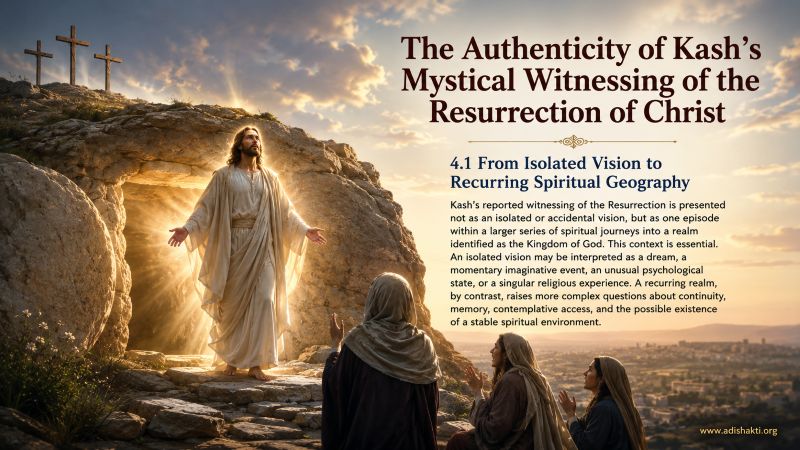
The New Testament speaks of a profound inward transformation: to be "crucified with Christ," to die to the old ego-bound self, and to be "raised in newness of life." This language points not only to belief in a sacred past event, but also to an interior process in which the human being passes from spiritual death into Spirit-filled life. The resurrection, in this sense, begins within. It is the awakening of a new consciousness in which Christ is no longer merely admired outwardly, but begins to live and act within the seeker.[7]
In the Sahasrara-centered understanding presented on adishakti.org, this interior resurrection is mirrored in the ascent of the Kundalini through the subtle system. As the Kundalini rises and pierces the crown center, the Sahasrara opens, and the person experiences a decisive shift: from fragmentation to integration, from restlessness to peace, from separateness to unity with the divine presence. What Saint Paul describes as dying and rising with Christ may thus be understood as a living spiritual event in the body of the seeker.
Indian mystics have often referred to the Sahasrara as Paradise, Heaven, or the Kingdom of God within, because here the limited self begins to dissolve and the will of God is known directly in silence, peace, and living awareness. In this state, religion is no longer external conformity alone. It becomes participation in divine life. The seeker does not merely think about God, but feels the presence of the Spirit as a subtle reality within.
This is why the new birth can be understood as an interior resurrection and a Sahasrara-ascension. The "old man" of self-centeredness, fear, and conditioning is left behind, and a new being arises whose attention is lifted upward into the light of the Spirit. The crown opens, consciousness ascends, and the Kingdom becomes present as a felt reality rather than a distant promise.
When explaining the particle-wave experience in the context of spiritual concepts, Near-Death Experiences (NDEs) serve as profound evidence: the particle represents the physical body, bound by space and time, while the wave represents the soul body, which transcends these limitations and experiences the interconnectedness of the divine reality.[8] Thus the Resurrection may be contemplated on two inseparable levels: as the historical triumph of Christ over death, and as the inner awakening by which that victory becomes active in human consciousness.
6. The Kingdom-Sahasrara as the Ground of Direct Experience
The teaching "the Kingdom of God is within" is not only a biblical statement but also an experiential path. The Sahasrara-language gives a bodily-psycho-energetic map of the same inner reality: the point at the crown of the head where the Spirit opens the person to the presence of the Lord Jesus as the living center of the Kingdom.[9]
In this understanding, the Sahasrara is not simply a symbolic idea. It is the interior point where consciousness is gathered, opened, and lifted beyond the limitations of ego, thought, and outward religiosity. At this crown-space, the seeker begins to move from belief about God to awareness of God. The Kingdom becomes not only a doctrine of scripture, but a felt reality of silence, peace, and divine immediacy.
For the seeker, this path requires an inward turning. One must move beyond dependence on external forms alone and enter the interior sanctuary. The attention, so often scattered among opinions, anxieties, rituals, and identities, must gradually be refined and lifted toward the subtle center at the crown of the head. This does not mean contempt for religion, but its fulfillment in living experience.
- To turn inward, beyond external forms, toward the interior sanctuary at the crown of the head.
- To cultivate silence, humility, and repentance so that the Spirit-Kundalini can move and open the Sahasrara.
- To recognize the coolness, vibration, light, or deep peace at the top of the head as the felt presence of the Kingdom of God in the open Sahasrara.
Such experience does not stand opposed to the historic Lord Jesus, nor does it replace the biblical narrative. On the contrary, it gives an immediate locus for what the Gospel proclaims. The Christ who acted in history, taught in Galilee, suffered, died, and rose again, is not confined to the past. His presence becomes inwardly real in the opened Sahasrara. The same Kingdom proclaimed in scripture is encountered as a living interior reign.
Thus the Kingdom of God may be understood on two inseparable levels. It is the reign of Christ in history and cosmos, the divine order revealed in salvation history. But it is also the immediate presence of that same Christ within the awakened human being. The Sahasrara-language helps express how this presence may be directly known: as peace beyond thought, as subtle coolness or vibration, as light, surrender, and interior unity.
7. Conclusion
The new birth is not a poetic exaggeration. It is the real transition from the old consciousness to the new, from bondage to freedom, from outer religion to inner realization. It is the interior Resurrection and the Sahasrara-ascension through which the human being becomes aware of divine life as present, living, and transformative. The Kingdom of God is not only promised in scripture; it is disclosed inwardly when the Sahasrara opens, guided by the Paraclete, the Spirit of truth, who makes Her presence known as the Cool Breeze.
The reign of Christ is both cosmic and inward: proclaimed in scripture, enacted in history, and felt immediately in the opened Sahasrara within. The task of the seeker, then, is not only to believe, but to enter. By turning inward, cultivating humility and repentance, and recognizing the subtle signs of divine presence, one comes to know that the Kingdom is not far away. It is near, within, and alive in the opened crown where the Spirit reveals the living presence of Christ.
References
[1] "John 3:3–8." The Holy Bible, King James Version.[2] "The Opening of the Sahasrara Chakra." Adishakti.org.
[3] "Shri Mataji — Enter the Kingdom of God in the Seventh Chakra." Adishakti.org.
[4] "Luke 17:21." The Holy Bible, King James Version.
[5] "The Cool Breeze of the Spirit." Adishakti.org.
[6] "John 3:10." The Holy Bible, King James Version.
[7] "Resurrection Is Accomplished by the Wind of Heaven." Adishakti.org.
[8] "The Kingdom of God Is Within Also." Adishakti.org.
[9] "Ruach, the Breath of God, experienced daily as Cool Breeze." Adishakti.org.
💬 Interactive Chat
Access an intelligent analysis environment where you can explore texts, ask questions, and discover connections between ideas.
Open chat →