
Taoism—Religion or Philosophy?
— Rethinking the Categories of Philosophy, Religion, and Spiritual Cultivation in the Daoist Tradition
Abstract
Whether Taoism—more precisely romanized as Daoism—should be classified as a religion or a philosophy remains one of the most persistent questions in the comparative study of Chinese traditions. Conventional Western accounts have frequently divided Daoism into two categories: Daojia 道家, commonly translated as “philosophical Daoism,” and Daojiao 道教, commonly translated as “religious Daoism.” The first category is generally associated with the Daodejing and the Zhuangzi, whereas the second encompasses priesthoods, revealed scriptures, communal rituals, liturgies, sacred lineages, bodily cultivation, alchemy, meditation, healing, and quests for transcendence or immortality. Although this distinction can serve limited descriptive purposes, it becomes misleading when treated as a historically absolute separation. Textual reflection, ritual performance, cosmology, self-cultivation, medicine, political thought, and religious revelation have continually interacted throughout Daoist history.
This article argues that Daoism cannot adequately be described as either philosophy or religion in isolation. It is a historically evolving family of traditions united by recurring concern with dao 道—the Way or course through which beings, communities, bodies, and cosmic processes unfold. Early Daoist texts offer sustained philosophical reflections on language, knowledge, nature, government, desire, action, and human flourishing. Later organized communities developed institutions, priestly offices, moral codes, divine hierarchies, revelatory canons, liturgical practices, and soteriological disciplines. Yet these religious developments did not simply corrupt or replace an originally “pure” philosophy. They interpreted, ritualized, embodied, and expanded principles already present in early Chinese cosmology and self-cultivation.
The religion–philosophy problem therefore reveals as much about modern classificatory systems as it does about Daoism. The sharp division between rational philosophy and ritual religion emerged from particular European intellectual histories and does not map neatly onto premodern Chinese categories. A historically responsible account must consequently treat Daoism as a philosophical, religious, ritual, contemplative, medical, ethical, ecological, and political tradition whose dimensions cannot be understood independently. Daoism is both religion and philosophy, but it is also a comprehensive Way of life that challenges the adequacy of the binary itself.
Keywords: Daoism; Taoism; dao; Daodejing; Laozi; Zhuangzi; Daojia; Daojiao; Chinese religion; Chinese philosophy; wuwei; self-cultivation; immortality; ritual; comparative religion.
1. Introduction: The Problem of Classifying Daoism
1.1 The apparent simplicity of the question
“Is Taoism a religion or a philosophy?” appears at first to be a straightforward question. Taoism is frequently introduced in surveys of world religions, where it appears alongside Buddhism, Christianity, Hinduism, Islam, Judaism, and other traditions. At the same time, Laozi and Zhuangzi are studied as philosophers whose works address metaphysics, ethics, language, knowledge, political order, human nature, and the relationship between freedom and social convention. Taoism possesses temples, priests, rituals, scriptures, divinities, sacred mountains, initiations, festivals, moral precepts, techniques of meditation, and teachings about postmortem existence. It also possesses arguments, paradoxes, conceptual analyses, political critiques, theories of knowledge, and reflections on the limits of language. Depending upon which evidence receives priority, Taoism may look unmistakably religious or unmistakably philosophical.
The difficulty arises because neither category encompasses the whole tradition. To define Daoism exclusively through philosophical classics such as the Daodejing and Zhuangzi excludes most of the institutions, revelations, rituals, and communities that have identified themselves with the Dao over approximately two millennia. Conversely, to define Daoism exclusively through temples, priesthoods, deities, liturgies, and organized movements neglects the intellectual force of texts whose influence extends far beyond formal religious affiliation. The apparent either–or question is therefore based upon an incomplete conceptual framework.
The problem is intensified by the English word “Taoism” itself. “Taoism” is the older Wade–Giles-style spelling, while “Daoism” follows the now widely used Hanyu Pinyin system. Both words refer to traditions organized around the Chinese term dao 道, conventionally translated as “way,” “path,” “course,” “method,” or “guiding discourse.” This article uses “Daoism” except when retaining “Taoism” in historical book titles, established quotations, or the paper’s guiding question.
Even “Daoism,” however, is not a simple indigenous category denoting one uniform creed. It functions as an umbrella term for texts, movements, practices, communities, lineages, and interpretations that developed across different regions and historical periods. Daoism is therefore comparable not to a single doctrine but to other internally diverse traditions such as Buddhism, Christianity, Hinduism, Islam, or Judaism. Disagreement, adaptation, synthesis, and institutional transformation are not signs that Daoism lacks identity; they are characteristics of a living historical tradition (Pregadio 2016).
1.2 The inherited division between Daojia and Daojiao
Modern accounts commonly explain the issue through two Chinese terms: Daojia 道家, “the school” or “family of the Dao,” and Daojiao 道教, “the teaching” or “religion of the Dao.” In simplified presentations, Daojia denotes the philosophical teachings of Laozi and Zhuangzi, while Daojiao denotes the organized religion that appeared several centuries later. This formulation suggests an original philosophical system that eventually acquired rituals, priests, gods, magical practices, and institutional structures.
The distinction is convenient but historically problematic. The term Daojia was used by Han-period bibliographers to classify writings retrospectively. It did not name a clearly organized school whose members uniformly called themselves philosophical Daoists. Thinkers now placed under that heading did not necessarily constitute a single institution or accept one doctrinal system. Likewise, Daojiao has carried different meanings and did not always correspond to the modern Western category of “religion.” The two terms therefore cannot be translated into “philosophy” and “religion” without qualification (Kirkland 2004; Kohn 2001; Pregadio 2016).
The division also reflects modern intellectual and political circumstances. European scholars, Christian missionaries, Chinese reformers, and early comparative historians of religion often admired the perceived philosophical purity of the Daodejing while dismissing ritual Daoism as superstition, degeneration, magic, or popular corruption. This hierarchy mirrored a post-Enlightenment tendency to distinguish rational, textual, elite philosophy from embodied, communal, ritual religion. It also reflected Protestant preferences for canonical texts and inward belief over priestly mediation, liturgy, material culture, sacred images, and ritual performance.
Such judgments profoundly shaped the Western reception of Daoism. Readers encountered an abstract Laozi who appeared to teach mystical individualism, political quietism, natural simplicity, or a universal metaphysics. Meanwhile, the actual historical religion—with its extensive canon, ritual specialists, communal registers, celestial bureaucracies, talismans, precepts, meditations, bodily practices, and revelations—was frequently ignored. The result was not entirely invented, since philosophical interpretation is genuinely central to Daoist history. Nevertheless, the selection of some forms as authentic and others as degenerate produced a distorted picture.
1.3 Laozi, legend, and the formation of the Daodejing
Popular narratives often describe Laozi as an accountant, archivist, librarian, or official in the Zhou royal court who composed the Daodejing before withdrawing from civilization. According to the best-known legend, Laozi became disillusioned with social decline and traveled westward. At the frontier, a gatekeeper named Yin Xi recognized his wisdom and requested that he record his teaching before disappearing. Laozi then produced a work of approximately five thousand Chinese characters and departed, leaving his ultimate fate unknown.
This narrative is important within Chinese cultural and religious memory, but it cannot be treated as securely documented biography. Early sources preserve multiple accounts of Laozi, and modern historians disagree about whether the name refers to one historical individual, several figures whose traditions became combined, or a largely legendary personification of teachings gradually assembled over time. The title “Laozi” means approximately “Old Master,” and it names both the reputed sage and the text attributed to him. Manuscript discoveries and textual scholarship have strengthened the view that the received Daodejing emerged through a process of composition, transmission, collection, and editing rather than from a single identifiable moment of authorship (Lau 1963; Henricks 1989; Ames and Hall 2003; Chan 2018).
Recognizing the uncertain authorship of the Daodejing does not diminish its significance. On the contrary, it situates the text within the dynamic intellectual environment of late Zhou and Warring States China. The work engages concerns shared by Confucians, Mohists, Legalists, and other thinkers: how society should be governed, why political order collapses, whether moral language improves or corrupts conduct, how desires are generated, and how rulers might act without producing resistance. Its concise verses are philosophical, contemplative, rhetorical, and political at once.
1.4 What is meant by “philosophy”?
Whether Daoism is philosophy depends partly upon how philosophy is defined. If philosophy means the disciplined investigation of reality, knowledge, language, action, ethics, and political order, early Daoist texts are plainly philosophical. The Daodejing examines the relation between naming and reality, the consequences of desire, the paradoxical power of weakness, the dangers of coercive government, and the possibility of action that does not violate the spontaneous tendencies of things. The Zhuangzi investigates perspective, linguistic distinctions, skepticism, death, transformation, skill, freedom, and the limits of human judgment.
Daoist philosophy, however, does not consistently resemble a modern analytical treatise. Its arguments are often conveyed through poetry, paradox, metaphor, anecdote, satire, dialogue, mythic narrative, and demonstrations of embodied skill. This difference in literary form should not be mistaken for absence of philosophical rigor. It reflects a different understanding of what philosophical transformation requires. Daoist texts often seek not merely to establish propositions but to loosen the reader’s attachment to rigid conceptual oppositions. Their language performs the critique it communicates.
For example, the Daodejing opens by destabilizing the assumption that the ultimate Way can be adequately captured in a fixed name:
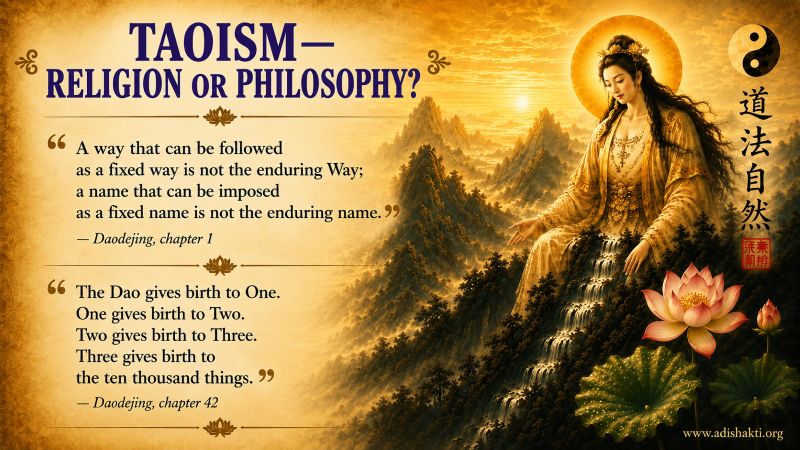
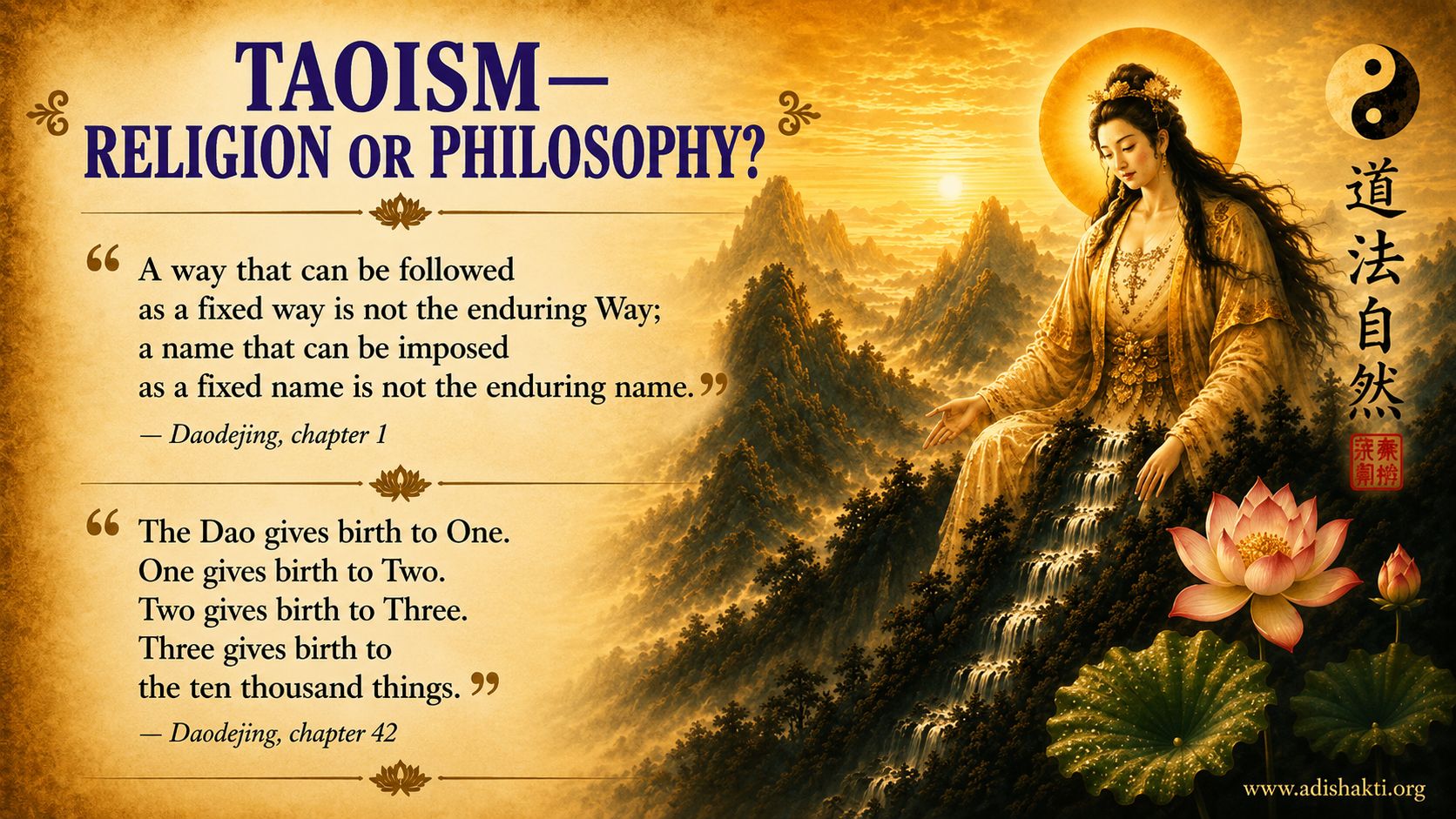
“A way that can be followed as a fixed way is not the enduring Way; a name that can be imposed as a fixed name is not the enduring name.”
— Paraphrase of Daodejing, chapter 1
The point is not simply that the Dao is a mysterious supernatural object beyond rational thought. The passage also raises philosophical questions about whether language describes a stable world neutrally or organizes experience through distinctions that serve particular purposes. Human beings need names and norms, but the names can become reified. A provisional path can be mistaken for an eternal and exclusive order. Daoist philosophy repeatedly returns to this danger.
1.5 What is meant by “religion”?
The category of religion is equally contested. If religion is defined narrowly as belief in one supreme creator God, Daoism may appear nonreligious. The Dao is not ordinarily presented as a personal creator who makes the universe from outside it, issues universally binding commandments, or demands exclusive worship. Yet such a definition is too narrow for the comparative study of religion. It would exclude or misrepresent numerous Buddhist, Jain, Indigenous, and other traditions that do not organize themselves around classical monotheism.
Broader scholarly definitions attend to communities, sacred narratives, ritual systems, ethical disciplines, transformative experiences, relationships with superhuman powers, conceptions of ultimate reality, and practices through which life and death acquire meaning. By these criteria, organized Daoist traditions are unquestionably religious. They possess initiatory lineages, ordained priests, communal ceremonies, scriptures understood as revelations, divine beings, sacred spaces, moral registers, rituals for the living and the dead, practices of purification, and visions of salvation, transcendence, or immortality.
Religious Daoism became especially visible in the late Han period, although it drew upon earlier ritual, cosmological, medical, and self-cultivation currents. The Way of the Celestial Masters developed communal structures, hereditary leadership, moral discipline, confession, registers, and rituals of healing. Later Shangqing and Lingbao traditions produced major bodies of revealed scripture and elaborate systems of meditation, cosmology, divine hierarchy, and liturgy. These movements did not merely attach religion to an unrelated philosophy; they articulated distinct modes of living in relation to the Dao (Robinet 1997; Kohn 2001; Schipper and Verellen 2004).
1.6 The Dao as philosophical principle and sacred reality
The term dao was not invented by Daoists. It appears throughout ancient Chinese discourse and can refer to a road, a method, a teaching, a proper course, or a guiding norm. Confucians spoke of the Way of humane social order; Mohists defended a moral and political Way; rulers claimed to establish correct ways of government. Early Daoist texts radicalized the term by questioning whether consciously constructed human ways correspond to the wider processes through which the world unfolds.
In the Daodejing, the Dao is described as nameless, inexhaustible, subtle, empty, and prior to determinate forms. It gives rise to beings without possessing them, nourishes them without dominating them, and accomplishes transformation without coercive interference. These descriptions can be read philosophically as a naturalistic account of emergent order, religiously as discourse about sacred ultimate reality, contemplatively as guidance for self-emptying, and politically as criticism of rulers who impose excessive control.
Attempts to force the Dao into a single Western category therefore reduce its semantic and functional range. It is not exactly “God,” although it can occupy a position of ultimacy associated with the divine. It is not merely impersonal matter, because Daoist sources describe it as the inexhaustible ground of life, efficacy, order, and transformation. It is not simply a law of nature, because it also concerns how beings may live, act, govern, cultivate themselves, and return to their source. The Dao is simultaneously cosmological, ontological, ethical, political, contemplative, and religious.
1.7 Beyond the stereotype of “going with the flow”
Popular presentations often reduce Daoism to the advice that one should relax, abandon ambition, and “go with the flow.” This interpretation contains an element of truth but obscures the precision of Daoist teachings. The principle of wuwei 無為, literally “not acting” or “non-action,” does not normally prescribe complete inactivity. It criticizes action that is forced, self-assertive, artificial, excessive, or contrary to the tendencies of a situation. Skillful action can be intense while remaining noncoercive because it responds to the configuration of things rather than imposing an egoistic plan upon them.
The Zhuangzi illustrates this idea through stories of artisans, swimmers, boatmen, butchers, and other skilled practitioners whose activity becomes extraordinarily effective because conceptual strain and rigid self-consciousness have diminished. Such stories connect philosophy to embodied practice. Knowledge is not limited to propositions held in the mind; it is manifested through an attuned body moving within a field of relationships.
Religious cultivation extends this principle into breathing, meditation, visualization, ritual, dietetics, movement, and internal alchemy. These disciplines seek to refine the practitioner’s alignment with cosmic processes. The relationship between philosophy and religion is therefore not merely chronological, as though abstract ideas appeared first and religious institutions were added later. Daoist thought repeatedly moves between reflection and practice, interpretation and embodiment, cosmology and transformation.
1.8 Immortality, alchemy, and the “secret of life”
The pursuit of immortality occupies an important but complex place in Daoist history. Early and medieval practitioners investigated diets, herbs, minerals, breathing methods, sexual disciplines, gymnastics, meditation, visualization, and alchemical processes. Some sought longevity or physical transcendence; others interpreted immortality as transformation into a perfected being whose mode of existence exceeded ordinary mortality.
External alchemy, or waidan 外丹, attempted to compound elixirs using substances such as cinnabar, mercury, lead, and gold. These experiments contributed to bodies of technical knowledge, but some preparations were toxic and caused illness or death. It would therefore be inaccurate to portray the alchemical search as a straightforward origin of all Chinese herbal medicine. Traditional Chinese medicine developed through numerous textual, clinical, cosmological, and institutional streams, only some of which overlapped with Daoist practice.
Internal alchemy, or neidan 內丹, increasingly interpreted the alchemical laboratory through the human body. Essence (jing), vital energy (qi), and spirit (shen) became central elements in systems of refinement, circulation, integration, and return. These concepts were not static substances identical across every text. Their meanings shifted among medical, cosmological, meditative, and alchemical settings (Pregadio 2018).
The search for immortality demonstrates why the religious and philosophical dimensions of Daoism cannot be separated neatly. It presupposes a cosmology, a theory of the person, an account of life and death, an ethic of discipline, and practical techniques of transformation. It may involve divine revelation and ritual initiation, yet it also raises philosophical questions about personal identity, temporality, nature, embodiment, and the meaning of human flourishing.
1.9 Correcting the idea of “five Taoist classics”
Introductory discussions sometimes group the Daodejing, Zhuangzi, Yijing or Book of Changes, and Huangdi Neijing or Yellow Emperor’s Inner Classic together as the “Five Classics of Taoism.” This formulation is historically inaccurate. The traditional Confucian Five Classics constitute a different canonical grouping. Daoism developed an enormous and changing scriptural corpus, eventually represented by the Daozang, or Daoist Canon, rather than by one universally recognized set of five foundational books.
The Yijing profoundly influenced Chinese cosmology, divination, philosophy, politics, medicine, Confucianism, and Daoism, but it is not exclusively a Daoist text. Similarly, the Huangdi Neijing shares theories of qi, yin–yang, bodily correspondence, and seasonal harmony with Daoist traditions, yet it belongs to the broader history of Chinese medicine. A responsible academic account must distinguish between texts that became important to Daoists and texts that originated as scriptures of an organized Daoist religion.
1.10 Thesis and method of the present study
This study advances three interconnected arguments. First, early Daoist texts are philosophical in the full sense of the term because they investigate reality, knowledge, language, action, government, nature, and human flourishing. Second, Daoism is also a religion because historical Daoist communities developed scriptures, priesthoods, revelations, rituals, ethical codes, divine hierarchies, sacred institutions, and soteriological practices. Third, the attempt to choose one classification over the other reproduces a modern binary that does not adequately represent the integration of thought, ritual, body, cosmos, community, and cultivation in Chinese traditions.
Methodologically, the paper combines textual interpretation, historical analysis, comparative philosophy, and religious studies. It distinguishes carefully among early texts, later religious movements, medical literature, popular religious practice, and modern global adaptations while also examining their interaction. It avoids two opposite errors: reducing Daoism to an abstract philosophy detached from communities and rituals, and reducing it to a collection of exotic religious practices without intellectual coherence.
Subsequent chapters will examine the historical formation of the Daodejing, the philosophical contributions of the Zhuangzi, Daoist understandings of cosmology and ziran or natural spontaneity, the meaning of wuwei, the cultivation of jing, qi, and shen, the rise of organized Daoist movements, ritual and priesthood, alchemical and meditative traditions, relationships with Chinese medicine, and the modern interpretation of Daoism in China and the West. The final analysis will return to the title question and argue that Daoism is best understood not as a compromised mixture of philosophy and religion but as a tradition that exposes the historical limitations of separating them.
1.11 Chapter Conclusion
The question “Is Taoism a religion or a philosophy?” cannot be answered responsibly by selecting one side of the opposition. Philosophical Daoism and religious Daoism are not two entirely independent traditions sharing only a name. Nor are they perfectly identical. They represent distinguishable but overlapping formations within a long and internally diverse history.
The Daodejing and Zhuangzi offer profound philosophical critiques of linguistic rigidity, coercive government, artificial desire, anthropocentrism, and inflexible moral certainty. Organized Daoist communities developed religious institutions through which cosmic harmony could be enacted, bodies transformed, communities purified, deities approached, and the living and dead ritually integrated. Both dimensions are oriented toward the Dao, but they express that orientation through different genres, authorities, institutions, and practices.
Daoism is consequently both a philosophy and a religion. More importantly, it is a Way whose historical forms challenge the modern assumption that intellectual inquiry, bodily cultivation, ritual practice, ecological attunement, political reflection, and spiritual transformation must belong to separate domains. The chapters that follow will trace how this integrated vision developed from early Chinese texts into one of the world’s most enduring religious and philosophical traditions.
References for Abstract and Chapter 1
- Ames, Roger T., and David L. Hall. 2003. Dao De Jing: A Philosophical Translation. New York: Ballantine Books.
- Chan, Alan K. L. 2018. “Laozi.” In The Stanford Encyclopedia of Philosophy. Stanford University.
- Chan, Wing-tsit. 1963. A Source Book in Chinese Philosophy. Princeton, NJ: Princeton University Press.
- Hansen, Chad. 2025. “Daoism.” In The Stanford Encyclopedia of Philosophy. Stanford University.
- Henricks, Robert G. 1989. Lao-Tzu: Te-Tao Ching—A New Translation Based on the Recently Discovered Ma-wang-tui Texts. New York: Ballantine Books.
- Kirkland, Russell. 2004. Taoism: The Enduring Tradition. New York: Routledge.
- Kohn, Livia. 2001. Daoism and Chinese Culture. Cambridge, MA: Three Pines Press.
- Lau, D. C., trans. 1963. Tao Te Ching. Harmondsworth: Penguin Books.
- Pregadio, Fabrizio. 2016. “Religious Daoism.” In The Stanford Encyclopedia of Philosophy. Stanford University.
- Pregadio, Fabrizio. 2018. The Seal of the Unity of the Three: A Study and Translation of the Cantong Qi, the Source of the Taoist Way of the Golden Elixir. Mountain View, CA: Golden Elixir Press.
- Robinet, Isabelle. 1997. Taoism: Growth of a Religion. Translated by Phyllis Brooks. Stanford, CA: Stanford University Press.
- Schipper, Kristofer, and Franciscus Verellen, eds. 2004. The Taoist Canon: A Historical Companion to the Daozang. 3 vols. Chicago: University of Chicago Press.
2. Historical Origins: Late Zhou China, Laozi, and the Formation of the Daodejing
2.1 Introduction
The historical origins of Daoism cannot be reduced to the biography of a single founder or the composition of a single sacred book. Traditional narratives identify Laozi as the author of the Daodejing and frequently place him in the sixth century BCE, sometimes portraying him as an older contemporary of Confucius. Modern textual scholarship, however, has made such certainty difficult to sustain. Laozi may have been a historical thinker whose teachings were transmitted and expanded; the name may represent several figures later combined into one biography; or “Laozi”—the “Old Master”—may function primarily as the personification of a textual and intellectual tradition. The received Daodejing itself appears to preserve materials formed, circulated, reorganized, and interpreted over a considerable period.
This uncertainty is not an obstacle to understanding Daoism. It is historically illuminating. The absence of a securely identifiable founder reveals that early Daoist thought arose within a broad field of intellectual, political, ritual, and contemplative experimentation in late Zhou China. What later generations classified as “Daoist” developed through debates over government, language, morality, warfare, desire, knowledge, nature, and the proper relation between human institutions and the larger order of the cosmos.
The present chapter examines four related questions. First, what historical conditions shaped the emergence of early Daoist texts? Second, what can responsibly be said about Laozi? Third, what do the Guodian and Mawangdui manuscripts reveal about the formation of the Daodejing? Fourth, how did later editors and commentators transform a fluid collection of teachings into one of the most influential works in Chinese intellectual and religious history?
2.2 Late Zhou China and the Crisis of Political Order
The intellectual traditions conventionally associated with classical Chinese philosophy emerged during the gradual weakening of Zhou royal authority. The Zhou dynasty began in the eleventh century BCE, but over time its political system fragmented. Regional rulers acquired increasing independence, hereditary aristocratic structures changed, warfare intensified, and rulers competed for territory, labor, resources, and legitimacy.
The Eastern Zhou period is conventionally divided into the Spring and Autumn era and the Warring States era. These names should not conceal the human consequences of political fragmentation. Military organization became more extensive, taxation and administration grew more systematic, agricultural populations were mobilized, and states experimented with laws, bureaucracies, diplomatic strategies, and methods of social control. The Warring States period was therefore an age of extraordinary intellectual creativity, but that creativity unfolded amid violence, instability, displacement, and competition.
Thinkers responded by asking how order could be restored. Confucian traditions emphasized ethical cultivation, ritual propriety, benevolent government, and the recovery or reinterpretation of exemplary antiquity. Mohists advocated impartial concern, social discipline, meritocratic appointment, frugality, and opposition to aggressive warfare. Thinkers later labeled Legalists emphasized centralized authority, administrative techniques, clearly enforced laws, and institutional control. Other specialists developed theories of language, logic, military strategy, agriculture, diplomacy, cosmology, and bodily cultivation.
Early Daoist texts participated in these debates but often challenged their shared assumptions. They asked whether deliberate attempts to impose moral and political order might themselves produce disorder. They questioned whether proliferating rules, distinctions, rewards, punishments, technologies, and ambitions improved human life or drove people farther from simplicity. In this respect, the Daodejing was not written in withdrawal from political reality. It responded directly to problems of rulership, violence, taxation, social inequality, desire, and coercion.
2.3 The “Hundred Schools” and the Retrospective Construction of Daoism
The expression “Hundred Schools of Thought” is commonly used to describe the intellectual diversity of late Zhou China. It should not be interpreted too literally. The thinkers associated with these “schools” did not necessarily belong to stable institutions resembling modern universities, religious denominations, or philosophical societies. They were teachers, advisers, officials, ritual experts, textual communities, wandering persuaders, and participants in networks of patronage.
The category Daojia, or “family of the Dao,” was systematized retrospectively by Han bibliographers and historians. Laozi and Zhuangzi did not found an organization called “Daoism,” nor did they present themselves as members of a unified philosophical school bearing that name. The classical texts later treated as foundational emerged during disputes concerning which dao—which way, teaching, or course—should guide individuals and states.
This point is crucial for the religion-or-philosophy question. Daoism did not begin as a fully defined philosophy that subsequently became a separate religion. Both “philosophical Daoism” and “religious Daoism” are retrospective classifications applied to a more complex history. Early texts, bodily disciplines, cosmological ideas, ritual traditions, longevity practices, and political theories developed in overlapping environments before later communities consolidated them into recognizable religious formations.
2.4 Laozi in Traditional Biography
The most influential early biography of Laozi appears in Sima Qian’s Shiji, or Records of the Grand Historian, compiled during the Han dynasty. Even this account does not present one unequivocal biography. It preserves multiple possibilities and traditions, indicating that Laozi’s identity was already uncertain in antiquity.
In the best-known version, Laozi’s personal name was Li Er or Li Dan. He was said to have served as a keeper of archival records at the Zhou court. Later popular retellings sometimes convert this role into that of librarian, royal archivist, clerk, or accountant. “Accountant,” however, is not a precise historical designation and should not be repeated as established fact. The archival tradition portrays Laozi as a learned official familiar with ancient records, rituals, and the rise and fall of political institutions.
According to another famous narrative, Confucius consulted Laozi about ritual. Laozi criticized pride, attachment to social display, and the tendency of learned men to depend upon the reputations of ancient authorities. Confucius later compared Laozi to a dragon whose movement through the clouds could not be understood. Whether this encounter occurred historically is impossible to demonstrate. Its cultural function is clearer: it establishes Laozi as the mysterious senior sage whose insight surpasses conventional scholarship and ritual formalism.
The final episode of the traditional biography recounts Laozi’s departure from the Zhou realm. Distressed by political decay, he traveled westward. At the frontier, the guard Yin Xi asked him to record his wisdom. Laozi composed a work in two sections concerning the Dao and de, traditionally estimated at approximately five thousand characters, and then disappeared. The narrative provides the Daodejing with a dramatic origin: it is the final testimony of a sage abandoning a civilization no longer capable of following the Way.
This story carries philosophical symbolism regardless of its historical accuracy. Laozi does not establish an institution, seek disciples, claim political office, or demand recognition. He withdraws. His text appears not as a monument to its author but as a compressed guide intended for those still entangled in government and society. The author’s disappearance reinforces the text’s warnings against fame, possession, self-display, and attachment to personal identity.
2.5 The Historical Laozi Problem
Modern scholars have proposed several approaches to Laozi. The traditional position treats him as a historical sage of the sixth century BCE and author of the Daodejing. A more cautious position accepts that a historical teacher may lie behind the traditions but dates much of the text to the fourth or third centuries BCE. A third position regards Laozi primarily as a legendary figure created to authorize a collection of teachings. None of these hypotheses has achieved universal acceptance.
The lack of certainty results from several difficulties. Sources describing Laozi were written well after the period in which he was believed to have lived. The name itself is honorific rather than an ordinary personal name. Biographical traditions conflict. The language, themes, and internal organization of the Daodejing suggest multiple textual layers, while excavated manuscripts show that Laozi-related materials circulated in forms different from the later standard edition.
It is therefore preferable to distinguish among three related but nonidentical meanings of “Laozi”:
- Laozi as a possible historical teacher or group of teachers;
- Laozi as the title and attributed voice of the Daodejing;
- Laozi as a religious figure who was eventually understood as a manifestation or personification of the Dao.
These meanings developed together but should not be conflated. The historical question concerns what, if anything, can be recovered about a human author. The literary question concerns how the text constructs an authoritative voice. The religious question concerns how later communities interpreted Laozi as a celestial revealer, divine teacher, and cosmic presence.
2.6 The Title and Structure of the Daodejing
The work now commonly called the Daodejing is also known simply as the Laozi. The title Daodejing may be translated as the “Classic of the Way and Its Power,” the “Classic of the Way and Virtue,” or the “Canonical Scripture of Dao and De.” Each translation involves interpretive choices.
Dao can mean way, path, course, method, teaching, guiding discourse, or the process through which reality unfolds. De can mean virtue, potency, integrity, efficacy, character, or the particular power through which the Dao becomes present in a being. The later word jing designates a classic or canonical scripture. The title itself therefore indicates the work’s dual identity: it is at once a philosophical text about the structure of reality and conduct, and a scripture invested with canonical and eventually religious authority.
The received text contains eighty-one chapters and is divided into two broad sections. Chapters 1–37 are conventionally called the Daojing, or “Classic of the Dao,” while chapters 38–81 are called the Dejing, or “Classic of De.” This arrangement, however, was not universal in early manuscript traditions. The Mawangdui copies place the De section before the Dao section, which is why some scholars refer to those versions as the Dedaojing.
The chapters vary greatly in form. Some resemble political advice; others are hymnic descriptions of the Dao. Some contain rhymed verses, proverbial sayings, definitions, paradoxes, meditative imagery, or criticisms of warfare and ambition. Repeated lines, thematic discontinuities, variant vocabulary, and differences among manuscripts suggest that the work was assembled from smaller textual units rather than composed as a continuous treatise in one sitting.
2.7 Oral Teaching, Written Units, and Composite Formation
The composite character of the Daodejing does not mean that it lacks unity. Ancient texts could develop through oral performance, memorization, teaching collections, copied sayings, editorial arrangement, and commentarial transmission. Unity could be produced gradually as materials were selected and read in relation to one another.
Many passages possess the compression, rhythm, parallelism, and repetition useful for memorization. These features may indicate oral or semi-oral transmission. Short units could circulate independently before being copied into larger collections. Different communities may have preserved related materials in different sequences, with variations in wording and interpretation.
The text’s internal tensions support this developmental model. Certain chapters emphasize a nameless cosmic source, while others concentrate on practical government. Some praise withdrawal and obscurity; others instruct the sage-ruler in maintaining social order. Some passages recommend reducing knowledge and desire; others display sophisticated awareness of political psychology and strategic action. These themes need not be contradictory, but their arrangement suggests a tradition broad enough to include several voices and settings.
2.8 The Guodian Bamboo Manuscripts
The discovery of the Guodian bamboo manuscripts in Hubei Province in 1993 transformed the study of early Chinese thought. The tomb containing the manuscripts is generally dated to the late fourth or early third century BCE. Among the bamboo slips were collections of passages corresponding to portions of the received Daodejing. They represent the oldest securely excavated witnesses to Laozi-related textual material.
The Guodian materials do not contain the complete eighty-one-chapter text. They preserve selected passages arranged in three bundles, often called A, B, and C. Some correspond closely to the received Daodejing; others differ in wording, order, or textual boundaries. Their existence indicates that by approximately 300 BCE, recognizable Laozi material was already circulating, but not necessarily as the fixed book later transmitted under the title Daodejing.
The Guodian evidence complicates theories that portray early Daoism and Confucianism as completely opposed camps. The tomb contained both Laozi-related materials and texts associated with ethical cultivation often described as Confucian. This coexistence suggests that readers did not necessarily treat these writings as mutually exclusive. Intellectual boundaries were more permeable than later school classifications imply.
Some of the strongest attacks on conventional morality found in the received Daodejing are absent from the surviving Guodian selections. Scholars disagree about the significance of that absence. It may reflect an earlier stage of the text, the preferences of the tomb’s owner, the interests of a particular teaching community, or simple incompleteness. The manuscripts warn against treating any one surviving version as a transparent record of the “original” Laozi.
2.9 The Mawangdui Silk Manuscripts
The Mawangdui manuscripts were discovered in 1973 in a Han tomb near Changsha. Two silk copies of the Laozi text, conventionally called versions A and B, were found among writings on government, cosmology, medicine, movement, and other subjects. The manuscripts date from the early Han period, although the textual traditions they preserve are older.
Unlike the Guodian selections, the Mawangdui manuscripts contain forms of nearly the entire work. Yet they differ from the received edition in chapter sequence, wording, orthography, and section order. The De portion precedes the Dao portion. The chapter divisions familiar to modern readers are not marked in the same standardized manner, and the manuscripts include textual variants that can significantly affect interpretation.
The Mawangdui discoveries demonstrate that the text remained fluid even after a relatively complete form had emerged. Copyists and communities transmitted versions rather than mechanically reproducing one universally established original. Variants may reflect regional pronunciation, scribal substitution, interpretive revision, memory, damaged exemplars, or distinct lineages of transmission.
The archaeological context is equally important. The Laozi copies were preserved alongside technical, medical, political, and cosmological writings rather than isolated as the exclusive scripture of a separate religious sect. This setting supports the view that the text functioned in several ways: as political counsel, philosophical reflection, cosmological teaching, a guide to self-cultivation, and a source of practical wisdom.
2.10 From Manuscript Collections to a Canonical Text
The Guodian and Mawangdui discoveries undermine the assumption that a single author completed an eighty-one-chapter book that was then copied without major change. Instead, the evidence points toward a gradual process of textual stabilization. Individual sayings or clusters were transmitted; larger collections were formed; editors arranged the materials; chapters became standardized; commentaries selected among variants; and particular editions acquired authority.
This process resembles canon formation in other traditions. A canonical text is rarely produced solely at the moment of first composition. It emerges when communities preserve, organize, interpret, teach, copy, ritualize, and authorize particular materials. The history of the Daodejing therefore bridges the categories of philosophy and religion. Philosophical sayings became a canonical classic; a text of political and contemplative reflection became scripture; and an attributed sage became a sacred revealer.
2.11 The Heshang Gong and Wang Bi Traditions
Two commentarial traditions became especially influential in shaping later readings of the Daodejing: the commentary attributed to Heshang Gong, the “Old Man by the River,” and the commentary of Wang Bi (226–249 CE).
The Heshang Gong commentary interprets the text through political, cosmological, and self-cultivational concerns. The body and state are understood through parallel structures: just as a ruler must govern without destructive excess, the practitioner must preserve vital energies and maintain internal harmony. This approach became important in religious and longevity-oriented readings.
Wang Bi, one of the most influential interpreters in Chinese intellectual history, emphasized the relation between being and nonbeing, multiplicity and underlying unity, names and the nameless source. His edition and commentary helped establish the received eighty-one-chapter form used by many later readers. Although Wang Bi is often associated with “philosophical Daoism,” his work emerged within broader efforts to interpret the classical heritage and restore political and intellectual order after the Han dynasty.
The contrast between Heshang Gong and Wang Bi should not be exaggerated into a simple opposition between religion and philosophy. Both commentaries address government, cosmology, cultivation, and the Dao. Their differences concern emphasis, method, and interpretive framework. Together they demonstrate the capacity of the Daodejing to sustain metaphysical, political, bodily, and religious readings.
2.12 Laozi’s Transformation into a Divine Figure
As organized Daoist traditions developed, Laozi’s identity expanded beyond that of an ancient human teacher. He came to be revered as Lord Lao, a divine manifestation of the Dao, a cosmic teacher who had appeared repeatedly throughout history, and a revealer of sacred teachings. By the later Han period, Laozi occupied an important position within the emerging religious Daoist pantheon.
This transformation should not be dismissed as an irrational corruption of an earlier philosopher. It followed from the manner in which the text itself describes the Dao: prior to determinate beings, inexhaustible, hidden, and continually present within transformation. If Laozi perfectly embodied or revealed that Dao, later communities could understand him not merely as its commentator but as its manifestation.
The deification of Laozi also responded to changing religious and political circumstances. Revelatory authority allowed Daoist communities to establish institutions, moral codes, ritual systems, and claims to cosmic legitimacy. Laozi became the source from whom new teachings could be disclosed while remaining continuous with the ancient Way.
The historical Laozi, textual Laozi, and divine Laozi should therefore be seen as stages or dimensions of reception rather than mutually exclusive alternatives. A person may have contributed to the earliest teaching; a literary voice gave those teachings unity; commentators constructed philosophical systems from them; and religious communities recognized the voice as an expression of sacred reality.
2.13 Was the Daodejing Written for Rulers?
Many passages directly address rulership, government, warfare, taxation, law, and social order. This evidence supports the view that at least some of the text functioned as political counsel. The sage is frequently portrayed as a ruler who governs through restraint, reduces competition, avoids ostentation, refuses aggressive war, and permits the people to transform without intrusive control.
Nevertheless, the work cannot be reduced to a handbook for emperors. The term “sage” does not always designate a sovereign, and teachings about emptiness, desire, softness, self-knowledge, return, and noncontention apply to individual cultivation as well as government. The political and personal dimensions mirror one another. A ruler who governs through coercion resembles an individual dominated by acquisitive desire; a well-ordered state resembles a cultivated body whose energies are not scattered by excess.
The text’s audience may therefore have included rulers, advisers, officials, teachers, recluses, and practitioners seeking an alternative to conventional ambition. Its deliberate openness permitted later readers to apply the same principles to statecraft, ethics, contemplation, medicine, ritual, art, and daily life.
2.14 Historical Formation and the Religion–Philosophy Question
The formation of the Daodejing reveals why Daoism resists classification as either religion or philosophy. The work emerged from philosophical and political debates, yet it was transmitted as a classic and eventually venerated as scripture. It questions language and knowledge, yet it also evokes an ineffable source of existence. It counsels rulers, yet it guides contemplation. It describes natural processes, yet those processes acquire sacred significance.
Likewise, Laozi is simultaneously a disputed historical figure, a literary persona, a philosophical authority, a cultural sage, and a deity. The attempt to identify only one “authentic” Laozi repeats the same reductive logic involved in selecting either philosophical or religious Daoism as genuine.
Historical evidence instead shows a process of accumulation and transformation. Daoism emerged not through the instantaneous founding of a religion or the systematic construction of a philosophy, but through the interaction of teachings, texts, bodies, communities, rituals, political crises, and interpretations.
2.15 Chapter Conclusion
The origins of Daoism lie in the intellectual and political crises of late Zhou China. Fragmented authority, warfare, bureaucratic expansion, and competition among teachers created an environment in which the meaning of the Way became an urgent question. Early Daoist materials responded by criticizing coercive government, artificial desire, rigid moralization, linguistic certainty, and the human tendency to impose order without understanding the deeper patterns of life.
Laozi cannot be identified with historical certainty as one royal official who wrote the complete Daodejing before disappearing into the West. The traditional story remains culturally and philosophically meaningful, but manuscript discoveries support a more complex account. The Guodian bamboo selections and Mawangdui silk manuscripts demonstrate that Laozi materials circulated in multiple arrangements and textual forms before the received edition became standard. Few transmitted early Chinese works possess so rich a body of corresponding excavated manuscript evidence.
The text became canonical through transmission, editing, commentary, and communal appropriation. Heshang Gong emphasized correspondences among body, cosmos, and state; Wang Bi developed a highly influential philosophical interpretation; religious communities revered Laozi as a divine manifestation of the Dao. None of these developments alone exhausts the text’s meaning.
The history of Laozi and the Daodejing thus provides the first major answer to the guiding question of this study. Daoism is philosophical because its foundational materials contain sustained reflection on reality, language, politics, knowledge, and action. It is religious because those materials became canonical revelation, supported practices of transformation, and were associated with a divine revealer. The two identities developed through one continuous, though internally diverse, history.
References for Chapter 2
- Ames, Roger T., and David L. Hall. 2003. Dao De Jing: A Philosophical Translation. New York: Ballantine Books.
- Boltz, William G. 1993. The Origin and Early Development of the Chinese Writing System. New Haven, CT: American Oriental Society.
- Chan, Alan K. L. 2018. “Laozi.” In The Stanford Encyclopedia of Philosophy. Stanford University.
- Cook, Scott. 2012. The Bamboo Texts of Guodian: A Study and Complete Translation. 2 vols. Ithaca, NY: Cornell University East Asia Program.
- Csikszentmihalyi, Mark, and Philip J. Ivanhoe, eds. 1999. Religious and Philosophical Aspects of the Laozi. Albany: State University of New York Press.
- Graham, A. C. 1989. Disputers of the Tao: Philosophical Argument in Ancient China. La Salle, IL: Open Court.
- Henricks, Robert G. 1989. Lao-Tzu: Te-Tao Ching—A New Translation Based on the Recently Discovered Ma-wang-tui Texts. New York: Ballantine Books.
- Henricks, Robert G. 2000. Lao Tzu’s Tao Te Ching: A Translation of the Startling New Documents Found at Guodian. New York: Columbia University Press.
- Kohn, Livia. 1998. God of the Dao: Lord Lao in History and Myth. Ann Arbor: Center for Chinese Studies, University of Michigan.
- LaFargue, Michael. 1992. The Tao of the Tao Te Ching: A Translation and Commentary. Albany: State University of New York Press.
- Lau, D. C., trans. 1963. Tao Te Ching. Harmondsworth: Penguin Books.
- Lebovitz, David J. 2021. “Molecular Incoherence, Continuity, and the Perfection of the Laozi.” Early China.
- Lewis, Mark Edward. 1999. Writing and Authority in Early China. Albany: State University of New York Press.
- Loewe, Michael, ed. 1993. Early Chinese Texts: A Bibliographical Guide. Berkeley: Society for the Study of Early China and Institute of East Asian Studies, University of California.
- Perkins, Franklin. 2014. Heaven and Earth Are Not Humane: The Problem of Evil in Classical Chinese Philosophy. Bloomington: Indiana University Press.
- Robinet, Isabelle. 1997. Taoism: Growth of a Religion. Translated by Phyllis Brooks. Stanford, CA: Stanford University Press.
- Roth, Harold D. 1999. Original Tao: Inward Training and the Foundations of Taoist Mysticism. New York: Columbia University Press.
- Sima Qian. 1993. Records of the Grand Historian: Han Dynasty. Translated by Burton Watson. New York: Columbia University Press.
- Wagner, Rudolf G. 2003. A Chinese Reading of the Daodejing: Wang Bi’s Commentary on the Laozi with Critical Text and Translation. Albany: State University of New York Press.
3. The Dao as Ultimate Reality: Ineffability, Nonbeing, Cosmogenesis, and Immanence
3.1 Introduction
Every attempt to determine whether Daoism is a religion or a philosophy must eventually confront its central and most elusive concept: the Dao 道. The word is commonly translated as “the Way,” yet no single English equivalent adequately communicates its range of meanings. In ordinary classical Chinese usage, dao could refer to a road, a course of action, a method, a teaching, a guiding discourse, a moral path, or the proper way of governing. In the Daodejing, however, the term acquires a more radical significance. It denotes the nameless source from which the world emerges, the generative course through which beings develop, the ordering pattern manifested within natural processes, and the Way of life through which human action may become harmonized with the larger movement of reality.
The Dao therefore cannot be confined to one philosophical category. It resembles an ultimate metaphysical principle, yet it is not a static substance. It resembles a cosmological source, yet it is not clearly a personal creator. It resembles nature, yet it cannot simply be identified with the visible natural world. It carries religious ultimacy, yet it does not ordinarily command worship in the manner of a sovereign deity. It guides ethical and political conduct, yet it does not function as a codified moral law.
This chapter examines the principal dimensions of the Dao in the Daodejing and its major commentarial traditions. It considers the opening claim that the enduring Dao cannot be adequately spoken, the relationship between naming and reality, the meanings of you 有 and wu 無, the cosmological generation of the “ten thousand things,” the concepts of emptiness and return, and the relation between the Dao and ziran 自然, or natural spontaneity. It then evaluates four influential interpretations of the Dao: as God, as nature, as metaphysical principle, and as dynamic process.
3.2 The Many Meanings of Dao
Long before the appearance of writings later classified as Daoist, Chinese thinkers used the word dao to describe a course that ought to be followed. Confucian authors spoke of the Way of the ancient sage-kings, the Way of humane government, and the Way embodied in ritual and moral cultivation. Mohist writers defended a different Way, grounded in impartial concern, social utility, meritocratic order, and obedience to Heaven. Political advisers, military strategists, and specialists similarly offered their own ways of governing, acting, and interpreting the world.
What distinguishes the Daodejing is not that it discovered the word dao, but that it transformed the debate over competing human ways. Instead of merely presenting one more doctrine, the text asks whether consciously constructed doctrines can remain aligned with the deeper course through which things arise and transform. Human beings create names, institutions, values, hierarchies, and plans. These may be necessary, but they can become rigid and coercive when mistaken for the whole of reality.
The Dao of the Daodejing is consequently both descriptive and normative. It describes how existence unfolds without depending upon human intention. At the same time, it provides a model for action: because the Dao generates without possessing, sustains without dominating, and transforms without self-display, the sage should act without coercion, appropriation, and vanity.
This double meaning prevents the Dao from becoming a merely external object of speculation. To understand the Dao is not simply to adopt a theory about the origin of the universe. It is to undergo a change in perception, desire, conduct, and political practice. Daoist cosmology is inseparable from Daoist cultivation.
3.3 “The Dao That Can Be Spoken”
The opening lines of the received Daodejing announce the difficulty of speaking about the Dao:
道可道,非常道;名可名,非常名。
“A Dao that can be articulated as a fixed Dao is not the enduring Dao; a name that can be assigned as a fixed name is not the enduring name.”
— Daodejing, chapter 1, interpretive translation
This passage is sometimes read as a simple declaration that the Dao is utterly beyond language. Such a reading captures part of its meaning but risks becoming self-defeating. The Daodejing continues for eighty-one chapters speaking about the Dao. The text does not abandon language; it employs language while exposing its limitations.
The Chinese construction permits several interpretations. The first dao may function as a noun meaning “Way,” while the second may function verbally, meaning “to speak,” “to guide,” or “to formulate a way.” The line can therefore suggest that any Way capable of being expressed as a final and permanent formula is not the constant Way. The warning concerns not language itself but the tendency to absolutize one linguistic formulation.
Names divide experience into identifiable things. Through naming, people distinguish beautiful from ugly, good from bad, noble from base, success from failure, and useful from useless. These distinctions make coordinated social life possible, but they also generate competition, exclusion, desire, and conflict. Once a society treats its conventional distinctions as eternally grounded, it loses contact with the fluidity from which those distinctions emerged.
The Dao is therefore ineffable not because it is meaningless, but because it exceeds every fixed description. Any definition emphasizes one aspect while excluding others. The Dao is the course within which definitions arise, function, change, and disappear. It cannot be captured completely by one of the distinctions it makes possible.
3.4 The Nameless and the Named
Chapter 1 continues by associating the nameless with the beginning of Heaven and Earth and the named with the mother of the ten thousand things. This juxtaposition does not simply condemn naming. It distinguishes two inseparable perspectives.
The nameless indicates reality before or beneath determinate differentiation. It points toward the inexhaustible openness from which particular forms emerge. The named indicates the manifested world in which things possess recognizable characteristics and relationships. Without the nameless, there would be no generative depth; without the named, there would be no experienced world.
Daoist wisdom does not require the destruction of all names. It requires awareness that names are provisional. A bowl must be called a bowl for practical purposes, but the name does not exhaust its history, material relations, uses, transformations, or emptiness. A ruler may be called powerful, but the title does not guarantee effective rule. An action may be called virtuous, while concealed ambition or coercion undermines its apparent goodness.
The sage moves between the named and nameless dimensions of experience. The named makes participation in society possible; the nameless prevents social categories from becoming absolute. In philosophical terms, the Dao destabilizes linguistic essentialism. In contemplative terms, it invites awareness beyond compulsive classification. In religious terms, it identifies the sacred source as greater than every title, representation, and doctrine.
3.5 You and Wu: Being and Nonbeing
The relationship between you and wu is one of the most difficult problems in interpreting the Daodejing. You may be translated as “being,” “having,” “presence,” or determinate existence. Wu may be translated as “nonbeing,” “not having,” “absence,” or “nothing.” These translations can create misleading associations with Western metaphysical debates.
Wu does not necessarily denote absolute nothingness: a total negation in which nothing exists. It often indicates the absence that allows something to function. Chapter 11 illustrates this point through the wheel, vessel, and room:
Thirty spokes converge upon one hub, but it is the empty space within the hub that makes the wheel useful. Clay is shaped into a vessel, but its empty interior makes it useful. Doors and windows are cut to make a room, but the open spaces make habitation possible. Thus what is present provides form, while what is absent provides function.
— Paraphrase of Daodejing, chapter 11
Absence is not opposed to reality; it is a condition of effective reality. The usefulness of a cup lies not only in its material walls but also in the space capable of receiving. Silence gives meaning to sound; pauses make speech intelligible; unoccupied time permits rest and renewal. Daoist emptiness is therefore relational and productive.
Chapter 40 states that the ten thousand things arise from you, while you arises from wu. This claim has often been interpreted as a theory of creation from nonbeing. Yet the text need not imply creation from absolute nothingness. It may instead suggest that determinate beings arise from what is not yet determinate—from openness, absence, or an unformed generative field.
Wang Bi’s third-century commentary made wu central to the interpretation of the Dao. For Wang Bi, the multiplicity of beings depends upon a formless and nondeterminate source. Because the source has no exclusive form of its own, it can support every form. Because it does not insist upon one function, it can enable countless functions. Nonbeing is therefore not a competing entity standing beside beings. It is the condition through which beings become possible.
Later interpreters have questioned whether Wang Bi’s metaphysical account should be projected back onto every layer of the Daodejing. The early text may be less concerned with defining an ontological substance called Nonbeing than with demonstrating the practical and cosmological power of absence, receptivity, and nonassertion. Wang Bi’s interpretation remains foundational, but it is one historically situated reading within a larger tradition.
3.6 Is the Dao a Substance?
Western metaphysics has frequently sought the fundamental substance from which all things are made. When the Dao is described as the source of Heaven, Earth, and the ten thousand things, it may appear to be such a substance. Yet the language of the Daodejing repeatedly resists this interpretation.
The Dao is described as empty yet inexhaustible, obscure yet present, formless yet productive, and prior to Heaven and Earth without being assigned a definite material nature. It does not behave like an object occupying one region of the cosmos. It is not one being among other beings, even the largest or most powerful.
The Dao may be better understood as the generative course through which beings arise, relate, and transform. It is not a material from which things are manufactured by an external craftsman. Nor is it simply a law imposed upon an otherwise chaotic universe. It is internal to the processes it makes possible.
This interpretation explains why the Dao can be both prior to things and present within them. Its priority is not necessarily chronological. The Dao need not have existed for a measurable period before the universe began. It is prior in the sense that every determinate being depends upon relations, conditions, absences, and transformations that cannot be reduced to that being alone.
3.7 Cosmogenesis: Dao, One, Two, Three, and the Ten Thousand Things
Chapter 42 offers the best-known cosmological sequence in the Daodejing:
道生一,一生二,二生三,三生萬物。
“The Dao gives birth to One. One gives birth to Two. Two gives birth to Three. Three gives birth to the ten thousand things.”
— Daodejing, chapter 42
The passage does not provide a scientific chronology of the universe. Its terms are symbolic and cosmological. “One” may signify primordial unity. “Two” is generally associated with complementary polarity, especially yin and yang. “Three” has been interpreted in several ways: as the interaction of yin, yang, and their harmonizing vital energy; as Heaven, Earth, and humanity; or as the relational process through which polarity becomes productive.
The “ten thousand things” is a conventional expression for the innumerable beings and events of the world. Multiplicity arises not from conflict between independent absolutes but from differentiated relations within an underlying generative unity. Each being carries yin and embraces yang, while their interaction produces harmony.
This cosmology is neither strictly monistic nor dualistic. It is not dualistic because yin and yang are not independent cosmic substances locked in absolute opposition. Each depends upon and transforms into the other. Yet it is not a static monism in which all differences are unreal. The ten thousand things possess genuine distinctiveness. Unity expresses itself through differentiation rather than eliminating it.
3.8 The Dao and the Maternal Imagery of Creation
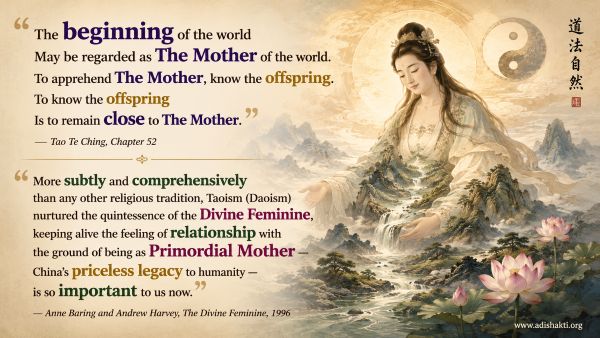
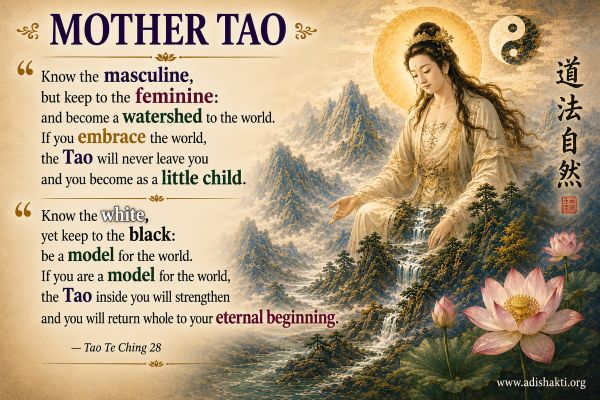
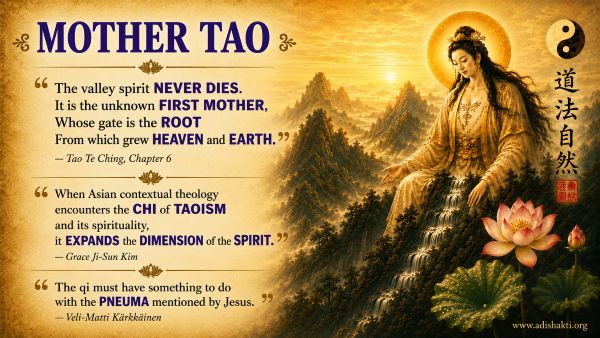
The Daodejing repeatedly employs feminine and maternal imagery to describe the generative character of the Dao. It speaks of the “mother of the ten thousand things,” the “mysterious female,” the “valley spirit,” and the “mother of the world.” These expressions are among the most distinctive features of Daoist cosmology.
The maternal Dao generates without controlling what it generates. It nourishes life without claiming ownership. Unlike a sovereign creator who commands from outside the world, the maternal source gives rise to beings from within the generative processes of existence.
This imagery also reverses conventional political values. Courtly and military cultures often associate power with hardness, visibility, domination, hierarchy, and masculine force. The Daodejing locates deeper power in softness, obscurity, receptivity, lowness, and the capacity to nourish. The valley receives water because it occupies the low place; the mother sustains life without demanding public recognition.
It would nevertheless be simplistic to identify the Dao exclusively as a female deity. The text uses both maternal and non-gendered descriptions, and the Dao transcends fixed distinctions, including the distinction between feminine and masculine. Its feminine symbolism functions philosophically and politically by disclosing a form of generative power neglected by systems organized around domination.
3.9 The Dao and Ziran: Natural Spontaneity
Chapter 25 describes a mysterious reality formed before Heaven and Earth. Silent, solitary, unchanging, and circulating without exhaustion, it may be regarded as the mother of the world. Because its true name is unknown, the text provisionally calls it the Dao. The chapter then presents a sequence:
Human beings follow Earth.
Earth follows Heaven.
Heaven follows the Dao.
The Dao follows ziran.
— Paraphrase of Daodejing, chapter 25
The final phrase, dao fa ziran 道法自然, is often translated as “the Dao follows nature.” This can be misleading if “nature” is understood as a realm of forests, animals, and physical matter external to human culture. The expression ziran literally suggests “self-so,” “so of itself,” or “spontaneously so.”
The statement does not place another entity called Nature above the Dao. It indicates that the Dao has no external ruler, design, or model. It is what it is through itself. Its activity is spontaneous rather than commanded. Things flourish when permitted to follow their own tendencies within a field of mutually conditioning relationships.
Ziran therefore does not mean isolated individualism. Nothing becomes “self-so” independently of everything else. A tree grows according to its own form, but only through soil, water, light, climate, microbial life, and surrounding ecological relations. Spontaneity is relational rather than self-enclosed.
3.10 Return as the Movement of the Dao
Chapter 40 states that reversal or return is the movement of the Dao. The claim reflects the observation that natural and human processes transform when they reach extremes. Fullness moves toward emptiness; strength becomes weakness; youth becomes age; accumulation produces loss; political domination generates resistance.
Return does not imply a mechanical cycle in which every event repeats identically. It means that no determinate condition can remain permanently fixed. Every form arises within a process and therefore carries the conditions of its transformation.
This insight has ethical consequences. Those who understand return do not identify completely with temporary success. They avoid forcing achievement to its extreme. They recognize that aggressive expansion can become collapse and that apparent weakness can preserve latent power. Humility is not merely a moral command; it is intelligent participation in the structure of change.
Return also carries contemplative and soteriological meaning. Human beings become scattered through desire, sensory stimulation, ambition, social comparison, and conceptual fixation. Daoist cultivation seeks a return to simplicity, stillness, and the uncarved condition from which responsive action can emerge.
3.11 Is the Dao God?
Comparative studies frequently ask whether the Dao is equivalent to God. The comparison can be illuminating, but only when substantial differences are preserved.
The Dao resembles certain philosophical conceptions of God because it is ultimate, inexhaustible, prior to determinate beings, and the source of cosmic order. It cannot be adequately named, represented, or contained by ordinary concepts. Daoist language of mystery, inexhaustibility, and namelessness can therefore be compared with apophatic or negative theology, in which the divine surpasses every human predicate.
Yet the Dao is not generally portrayed in the Daodejing as a personal creator who intentionally designs the universe. It does not issue commandments, demand exclusive allegiance, judge souls, intervene through singular historical revelations, or establish a covenant with one community. It generates without deliberate planning and nourishes without possession.
Chapter 4 cautiously states that the Dao appears to precede the ancestral deity or “Lord.” The passage does not necessarily deny the existence of gods. Instead, it places the Dao at a more fundamental level than the divine personalities recognized in ritual religion. Gods, like human beings and natural phenomena, operate within the wider Way.
Later religious Daoism developed elaborate pantheons and worshipped numerous deities, including divine forms of Laozi. These developments did not require the Dao itself to become a single creator God. The Dao could remain the ineffable ground from which divine beings, cosmic administrations, scriptures, and ritual powers emerged.
3.12 Is the Dao Nature?
Identifying the Dao with nature avoids some of the problems created by comparison with theism. The Daodejing encourages observation of water, valleys, infants, plants, rivers, roots, and cycles of growth and decay. It criticizes artificial excess and recommends alignment with spontaneous processes.
Nevertheless, “nature” is itself ambiguous. In modern Western thought, nature is often contrasted with humanity, culture, technology, or the supernatural. Classical Chinese thought did not always organize reality according to these divisions. Human institutions are not outside the cosmos, though they may become disordered within it.
The Dao includes more than nonhuman nature. It concerns language, government, warfare, knowledge, bodily cultivation, and social relationships. A ruler can follow or violate the Dao; a community can embody it imperfectly; a human practice can become more or less attuned to it. The Dao is thus the course of reality inclusive of nature and human life, not merely the physical environment.
3.13 Is the Dao a Metaphysical Principle?
Describing the Dao as a metaphysical principle captures its ultimacy and explanatory function. The Dao accounts for how multiplicity can arise from an undifferentiated source and how beings remain related within continual transformation.
The language of principle, however, can make the Dao appear abstract and static. A principle may be imagined as a timeless rule existing apart from the world it governs. The Dao does not merely regulate becoming from outside. It is expressed through the becoming of things themselves.
Wang Bi’s interpretation emphasizes an underlying unity that enables multiplicity. Other readings emphasize the patterns of guidance embedded within concrete practices and relationships. The Dao may be metaphysical, but its metaphysics is inseparable from movement, embodiment, and conduct.
3.14 Is the Dao a Process?
Many contemporary interpreters describe the Dao as process rather than substance. This approach emphasizes change, relation, emergence, interdependence, and continual transformation. The world is not a collection of isolated objects that subsequently enter relationships; beings exist through the relationships and processes that constitute them.
A process interpretation helps explain the Dao’s immanence. The Dao is not hidden in another world. It is manifested in the growth of a plant, the flow of water, the transformation of seasons, the coordination of a skilled body, and the rise and decline of political systems.
Yet “process” should not become another exhaustive definition. The Daodejing also describes a mysterious stillness, emptiness, or source that cannot be reduced to observable motion. The Dao is the course of transformation and the inexhaustible openness that permits transformation.
3.15 Transcendence and Immanence
The Dao complicates the distinction between transcendence and immanence. It is transcendent in the limited sense that it exceeds every determinate name and form. No object, institution, deity, or doctrine can contain it. Yet it is immanent because it is not separate from the ten thousand things.
The Dao does not stand outside the world as an external architect. Every being manifests its generative power according to that being’s particular de. The Dao remains nameless and inexhaustible precisely because it does not become identical with any single manifestation.
Daoism therefore offers a model of immanent transcendence. Ultimate reality is encountered within ordinary processes, but it is never exhausted by them. Water reveals the Dao without being the whole Dao. Emptiness manifests it without defining it. The sage embodies it without possessing it.
3.16 The Dao as Sacred Reality
Whether the Dao should be called sacred depends upon how sacredness is defined. If sacredness requires a personal deity, divine command, or separation from the profane world, the term may seem inappropriate. If sacredness refers to the ultimate reality that orients life, relativizes ordinary ambitions, and becomes the object of reverence and transformative practice, then the Dao clearly performs a sacred function.
The Daodejing does not encourage the conquest of the Dao through intellectual mastery. It recommends stillness, receptivity, humility, simplicity, and freedom from compulsive desire. Such dispositions are not merely techniques for acquiring information. They resemble religious virtues through which the practitioner becomes available to a reality greater than the constructed ego.
At the same time, the Dao is not removed from political and ethical life. Reverence for it is demonstrated in how one governs, speaks, competes, consumes, wages war, and responds to weakness. The sacred is embodied through noncoercive practice rather than confined to temples or ceremonies.
3.17 Cosmology and Ethical Conduct
Daoist cosmology is ethically significant because the sage models conduct upon the activity of the Dao. The Dao creates without possessing, acts without claiming, and completes without demanding praise. The sage likewise assists others without controlling them and governs without converting public office into self-glorification.
This is not a deduction from neutral facts of nature to obligatory morality. The text presents a correspondence among cosmic generation, personal cultivation, and political order. A person dominated by acquisitive desire becomes internally divided. A ruler dominated by ambition produces social resistance. Both violate the receptive, nonpossessive pattern exemplified by the Dao.
Softness, humility, and emptiness become effective because they permit responsiveness. The rigid person cannot adapt; the full vessel cannot receive; the ruler who already assumes complete knowledge cannot hear the people. Daoist virtue is grounded in an ontology of openness.
3.18 The Dao and Religious Pluralism
The claim that no spoken Dao is the enduring Dao has implications for religious and philosophical pluralism. No doctrine can identify its own formulation completely with the ultimate Way. Every teaching is a path articulated under particular conditions.
This does not imply that every path is equally wise or beneficial. The Daodejing clearly criticizes militarism, exploitation, ostentation, excessive taxation, and coercive rule. Nevertheless, it resists the belief that one system of names can permanently exhaust reality.
Daoism’s pluralism is therefore neither absolute relativism nor dogmatic exclusivism. Ways can be evaluated according to whether they sustain life, reduce coercion, preserve flexibility, and allow beings to flourish according to their own tendencies. Yet even a successful way must remain responsive to change.
3.19 Implications for the Religion-or-Philosophy Debate
The Dao can be treated philosophically because it raises questions of ontology, cosmology, language, knowledge, causation, identity, relationality, and change. The Daodejing offers a systematic, though poetically expressed, critique of reification and a positive account of generative order.
The Dao can also be treated religiously because it functions as the nameless and inexhaustible source of existence, inspires reverence, grounds transformative discipline, and becomes the focus of contemplation. Later Daoist communities developed rituals and revelations intended to restore alignment between the practitioner, society, the divine realm, and the Dao.
The same concept therefore crosses the modern boundary between metaphysics and sacred reality. The Dao is not philosophical in one text and religious in another merely because later communities added supernatural beliefs to an originally secular theory. Its earliest formulations already combine cosmology, contemplative orientation, political teaching, and an encounter with mystery.
3.20 Chapter Conclusion
The Dao is the foundational concept of Daoist thought, but it is not a concept that can be reduced to a single definition. It is the Way that precedes and exceeds every formulated way; the nameless source of differentiation; the generative course of the ten thousand things; the empty openness through which forms become useful; and the practical pattern embodied in noncoercive action.
The Dao is not absolute nothingness, although it is associated with wu, absence, and nondetermination. It is not a material substance, although all beings depend upon it. It is not simply a personal God, although it possesses ultimate and sacred significance. It is not merely physical nature, although natural processes reveal its patterns. It is not only an abstract principle, although it explains the relation between unity and multiplicity. It is process and source, immanent and transcendent, empty and inexhaustibly generative.
These paradoxes are not failures of logical clarity. They are deliberate attempts to prevent language from converting the living Way into a fixed object. The Dao must be approached through concepts, but it cannot be possessed by them. It must be embodied in action, but it cannot be reduced to one prescribed behavior.
Chapter 3 therefore strengthens the central thesis of this study. Daoism is philosophical because its account of the Dao represents one of the most sustained investigations of reality, language, and change in world thought. It is religious because the Dao serves as ultimate reality, the source of life, and the focus of transformative cultivation. More fundamentally, the Dao undermines the assumption that metaphysical inquiry and spiritual practice can be cleanly separated.
References for Chapter 3
- Ames, Roger T., and David L. Hall. 2003. Dao De Jing: A Philosophical Translation. New York: Ballantine Books.
- Chan, Alan K. L. 1991. Two Visions of the Way: A Study of the Wang Pi and the Ho-shang Kung Commentaries on the Lao-tzu. Albany: State University of New York Press.
- Chan, Alan K. L. 2018. “Laozi.” In The Stanford Encyclopedia of Philosophy. Stanford University.
- Chan, Wing-tsit. 1963. A Source Book in Chinese Philosophy. Princeton, NJ: Princeton University Press.
- Chen, Ellen M. 1989. The Tao Te Ching: A New Translation with Commentary. New York: Paragon House.
- Chinese Text Project. Dao De Jing. Edited by Donald Sturgeon.
- Creel, Herrlee G. 1970. What Is Taoism? And Other Studies in Chinese Cultural History. Chicago: University of Chicago Press.
- Graham, A. C. 1989. Disputers of the Tao: Philosophical Argument in Ancient China. La Salle, IL: Open Court.
- Hansen, Chad. 1992. A Daoist Theory of Chinese Thought: A Philosophical Interpretation. New York: Oxford University Press.
- Hansen, Chad. 2025. “Daoism.” In The Stanford Encyclopedia of Philosophy. Stanford University.
- Ivanhoe, Philip J. 2002. The Daodejing of Laozi. Indianapolis: Hackett Publishing.
- Kirkland, Russell. 2004. Taoism: The Enduring Tradition. New York: Routledge.
- Kohn, Livia. 2001. Daoism and Chinese Culture. Cambridge, MA: Three Pines Press.
- LaFargue, Michael. 1992. The Tao of the Tao Te Ching: A Translation and Commentary. Albany: State University of New York Press.
- Lau, D. C., trans. 1963. Tao Te Ching. Harmondsworth: Penguin Books.
- Moeller, Hans-Georg. 2006. The Philosophy of the Daodejing. New York: Columbia University Press.
- Perkins, Franklin. 2015. “Metaphysics in Chinese Philosophy.” In The Stanford Encyclopedia of Philosophy. Stanford University.
- Robinet, Isabelle. 1997. Taoism: Growth of a Religion. Translated by Phyllis Brooks. Stanford, CA: Stanford University Press.
- Roth, Harold D. 1999. Original Tao: Inward Training and the Foundations of Taoist Mysticism. New York: Columbia University Press.
- Slingerland, Edward. 2003. Effortless Action: Wu-wei as Conceptual Metaphor and Spiritual Ideal in Early China. New York: Oxford University Press.
- Wagner, Rudolf G. 2003. A Chinese Reading of the Daodejing: Wang Bi’s Commentary on the Laozi with Critical Text and Translation. Albany: State University of New York Press.
4. The Daodejing as Philosophical and Religious Text: Literary Form, Ethics, Politics, and Interpretation
4.1 Introduction
The Daodejing is among the shortest works to have exercised a major influence upon world philosophy and religion. Composed of approximately five thousand Chinese characters and transmitted in eighty-one brief chapters, it has inspired political theorists, contemplatives, poets, rulers, physicians, artists, religious practitioners, environmental thinkers, and comparative philosophers. Its brevity, however, should not be confused with simplicity. The text condenses a wide range of arguments and practices into aphorisms, paradoxes, images, commands, warnings, and meditative descriptions.
The work is frequently treated either as a philosophical classic or as a sacred scripture. Both descriptions are justified, but neither is sufficient by itself. Philosophically, the Daodejing addresses language, knowledge, causation, value, political authority, desire, virtue, and the nature of effective action. Religiously, it evokes an ineffable source of existence, encourages transformative self-emptying, and later became an authoritative scripture within organized Daoist traditions. Its history of reception shows that philosophical analysis, spiritual cultivation, ritual authority, and political practice repeatedly converged around the same text.
This chapter examines the literary and conceptual structure of the Daodejing. It considers its use of paradox, reversal, image, and strategic ambiguity; its criticism of conventional morality and acquisitive desire; its political ideal of noncoercive government; its account of knowledge and unlearning; and the relationship between humility, compassion, simplicity, and de 德. It also evaluates whether the work should be read primarily as mystical poetry, political counsel, philosophy, scripture, or a guide to cultivation.
4.2 A Text of Fragments, Aphorisms, and Thematic Constellations
The Daodejing does not unfold like a modern philosophical monograph. It does not begin with definitions, proceed through numbered premises, and conclude with a single formally demonstrated thesis. Instead, it presents clusters of recurring themes: the nameless Dao, nonbeing, emptiness, water, infancy, the valley, softness, return, noncontention, simplicity, desirelessness, warfare, government, and the sage.
Many chapters appear internally coherent, but the relation among chapters is often associative rather than linear. The text returns to the same ideas through new images and contexts. This repetition is not redundant. It gradually trains the reader to perceive patterns that cannot be communicated through one direct formula.
The work is therefore better understood as a field of mutually illuminating sayings than as a single deductive argument. One chapter describes the Dao cosmologically; another expresses the same logic politically; a third translates it into bodily or ethical practice. Emptiness, for example, appears as the openness of a vessel, the receptivity of the valley, the nondomination of the sage, and the absence of fixed conceptual certainty.
This literary form made the text unusually adaptable. Different communities could emphasize different thematic constellations without abandoning the whole work. A ruler might read it as advice on statecraft; a recluse as a critique of ambition; a meditator as instruction in stillness; a religious practitioner as revelation concerning the Dao; and a philosopher as an inquiry into language, ontology, and action.
4.3 Paradox as a Method of Transformation
Paradox is one of the Daodejing’s defining methods. The text repeatedly states that weakness overcomes strength, nonaction accomplishes without remainder, emptiness creates usefulness, the highest goodness resembles water, and one who does not compete cannot be defeated in competition. These claims appear contradictory only when ordinary assumptions remain unexamined.
The paradoxes do not celebrate irrationality. They expose the limitations of habitual categories. Strength is usually defined as hardness, force, visibility, control, and the capacity to overcome resistance. Yet excessive hardness breaks; rigid authority creates rebellion; aggressive expansion exhausts resources. Softness, by contrast, can preserve flexibility and adapt to changing conditions.
The text thus reverses conventional evaluations to reveal forms of efficacy that dominant social systems overlook. What appears passive may be highly effective. What appears empty may be indispensable. What appears low may receive and nourish all things. What appears weak may survive precisely because it does not confront force on force.
These reversals also work upon the reader. They interrupt the impulse to classify reality too quickly. The reader cannot simply extract one proposition and possess the Dao intellectually. Understanding requires a loosening of the assumptions through which power, success, action, and knowledge are ordinarily interpreted.
4.4 The Function of Metaphor
The Daodejing relies heavily upon images drawn from embodied and natural experience. Water, valleys, infants, roots, uncarved wood, wheels, vessels, rivers, doors, and maternal generation are not merely decorative illustrations. They are philosophical models.
Water is especially important. It nourishes all beings, seeks low places, adapts to every container, yields without losing continuity, and wears away what is hard. Its power does not depend upon dominance. Water therefore illustrates both the Dao and the conduct of the sage.
The infant symbolizes vitality, softness, undivided responsiveness, and freedom from social ambition. The image does not romanticize literal ignorance. It points toward a condition before desire and identity become rigidly organized by comparison, prestige, and fear.
The uncarved block, or pu 樸, represents simplicity before excessive differentiation. Once carved, wood becomes a specialized object with a limited function. Before carving, it retains multiple possibilities. In ethical and political terms, simplicity preserves flexibility and restrains the proliferation of artificial desires.
The valley symbolizes receptivity and lowness. Because it occupies the low place, water gathers within it. The sage similarly becomes effective by refusing the demand to occupy the highest and most visible position.
4.5 The Critique of Conventional Morality
Some of the most controversial passages in the Daodejing criticize benevolence, righteousness, wisdom, and ritual. These passages have sometimes been interpreted as rejecting morality altogether. A more careful reading shows that the text criticizes moralism—the deliberate display and institutional enforcement of virtue after spontaneous harmony has already been lost.
Chapter 18 states that when the great Dao is abandoned, benevolence and righteousness appear. The point is genealogical. Explicit moral language becomes necessary when relationships no longer function naturally. Public campaigns for loyalty often arise precisely when trust has deteriorated. Constant praise of honesty may indicate that deception has become widespread.
Chapter 38 develops a hierarchy in which the highest de does not consciously regard itself as virtuous, while lower virtue anxiously preserves the appearance of virtue. Benevolence, righteousness, and ritual emerge in progressively more deliberate and coercive forms as spontaneous integrity declines.
The target is therefore not compassion or ethical care. The text itself praises compassion as one of its great treasures. It criticizes the transformation of goodness into self-conscious performance, social competition, and externally imposed conformity.
4.6 De: Virtue, Power, and Embodied Integrity
The second major term in the title Daodejing is de. It is often translated as “virtue,” but the English word can suggest moral respectability or obedience to rules. De has a broader range. It can mean potency, efficacy, integrity, character, or the distinctive power by which a being realizes its relation to the Dao.
A person of high de does not act virtuously in order to secure praise. Conduct emerges from an integrated disposition. Such a person does not need to advertise moral identity because action is not divided between inward motive and outward performance.
De is therefore embodied rather than merely conceptual. It appears in how one speaks, governs, responds to conflict, handles success, and relates to vulnerability. A ruler may possess official power but lack de; a person without status may possess profound efficacy through humility and attunement.
The relationship between Dao and de can be expressed as the relation between universal Way and particular manifestation. The Dao is the generative course of reality; de is the way that course becomes concretely effective in a specific being or situation.
4.7 The Three Treasures: Compassion, Frugality, and Humility
Chapter 67 identifies three treasures: ci 慈, commonly translated as compassion; jian 儉, frugality or moderation; and the refusal to be first in the world.
Compassion gives courage because it diminishes self-protective isolation. Frugality enables generosity because resources are not consumed by excess. Refusal to be first permits genuine leadership because the leader does not turn public responsibility into personal competition.
These virtues directly contradict the assumption that Daoism advocates moral indifference. They form a positive ethical core. Yet they remain consistent with the text’s suspicion of rigid moral systems because they are expressed as dispositions of relation rather than universal rules detached from context.
The third treasure is especially political. The refusal to be first does not require the abandonment of leadership. It means that authority should not be organized around self-exaltation. The best leader creates conditions in which people can flourish without experiencing themselves as objects of constant manipulation.
4.8 Desire and the Production of Disorder
The Daodejing repeatedly criticizes desire, but it does not necessarily condemn every bodily inclination or practical preference. Its main target is escalating acquisitive desire: the restless demand for wealth, status, control, novelty, and distinction.
Desire becomes socially destructive when institutions deliberately intensify comparison. Rare goods encourage theft; public displays of prestige stimulate rivalry; excessive praise of achievement produces competition. The text therefore analyzes desire politically rather than treating it as a purely private weakness.
The sage-ruler reduces the conditions that inflame compulsive acquisition. This does not necessarily mean suppressing the population through enforced ignorance. It means refusing to organize society around manufactured scarcity, spectacle, and perpetual competition.
Desirelessness in the Daodejing is thus a form of perceptual freedom. The practitioner does not become incapable of preference but ceases to interpret every situation through the question of personal gain.
4.9 Knowledge, Unlearning, and the Limits of Cleverness
Several chapters criticize knowledge, learning, cleverness, and expertise. These passages have led some readers to accuse the text of anti-intellectualism. Yet the Daodejing itself displays considerable intellectual sophistication. Its critique is directed less against understanding than against knowledge used for domination, distinction, and strategic manipulation.
Chapter 48 contrasts ordinary learning, in which something is added each day, with pursuit of the Dao, in which something is diminished. What is diminished is not necessarily intelligence but excess: compulsive judgment, artificial desire, self-assertion, and intrusive action.
The concept of unlearning resembles a discipline of deconditioning. Socially acquired assumptions are examined and released so that perception can become more responsive. The practitioner learns to see what rigid expertise overlooks.
Daoist knowledge is therefore often tacit, embodied, and situational. It does not reject concepts, but it refuses to identify conceptual mastery with complete understanding.
4.10 Wuwei and the Problem of Action
The principle of wuwei 無為 is central to the text’s ethics and politics. Literally, the term may be rendered as “nonaction,” but this translation easily suggests passivity. In many contexts, it means action without forcing, contrivance, possessiveness, or excessive interference.
The Dao “does nothing,” yet nothing is left undone. This paradox indicates that the Dao does not act as a self-conscious agent imposing a plan upon resistant material. Its generative efficacy is spontaneous. The sage imitates this mode by creating conditions in which processes can unfold without constant manipulation.
Wuwei is not the absence of skill. It is often the highest stage of skill, when response becomes fluid and appropriate without visible strain. It is also not morally neutral. Noncoercive action is valued because it reduces violence, resentment, and unintended consequences.
In politics, wuwei demands restraint from rulers. In personal cultivation, it requires the reduction of egoistic forcing. In contemplation, it becomes receptivity. In each case, effective action emerges through attunement rather than domination.
4.11 Political Philosophy and the Sage-Ruler
The Daodejing is deeply political. Many chapters address the ruler directly or discuss taxation, punishment, military force, wealth, law, and public order. The text does not present a modern theory of constitutional government, but it offers a sustained critique of coercive statecraft.
The best ruler is scarcely known by the people. A lesser ruler is loved and praised; a still lesser ruler is feared; the worst is despised. This hierarchy suggests that successful rule minimizes intrusive visibility. When governance becomes constant spectacle, it may already be compensating for a loss of trust.
The sage-ruler does not seek to display control over every aspect of life. By reducing unnecessary regulations, public competition, and luxury, the ruler allows communities to stabilize through their own practices. This model is neither anarchism in the strict modern sense nor authoritarian quietism. It is a theory of limited, restrained, and non-self-glorifying authority.
The text also recognizes the danger of excessive taxation and elite consumption. When courts live extravagantly while fields are neglected and granaries empty, such wealth is condemned as robbery rather than legitimate rule.
4.12 Is the Political Ideal Conservative or Radical?
Scholars disagree over whether the political vision of the Daodejing is conservative, primitivist, authoritarian, anarchistic, or radically anti-imperial. Evidence exists for several readings.
The text praises small communities, simplicity, reduced travel, limited technologies, and freedom from aggressive ambition. These passages can appear nostalgic for an imagined pre-complex society.
At the same time, its critique of warfare, wealth concentration, prestige, coercion, and imperial expansion is politically radical. It delegitimizes the dominant values through which rulers justify power.
The sage-ruler remains a ruler, and the text does not consistently call for the abolition of hierarchy. Yet it reverses the symbolic basis of hierarchy by making lowness, humility, and service the conditions of legitimate leadership.
The work is therefore best described as a politics of minimal domination. It does not offer one institutional blueprint. It asks how authority might function without continually intensifying the forces it claims to control.
4.13 War, Violence, and Victory
The Daodejing treats warfare as a sign of failure, even when military action is judged unavoidable. Weapons are described as instruments of ill omen. The wise do not delight in them, and victory should be approached with mourning rather than celebration.
This teaching rejects the glorification of violence. A victorious army has produced death, grief, displacement, and resentment. To celebrate without mourning is to misunderstand what has occurred.
The text also presents a strategic argument. Aggression produces counterforce; territorial expansion creates instability; domination generates long-term resistance. Military success can therefore become political defeat.
Daoist nonviolence is not always absolute pacifism, but it establishes a strong presumption against force and denies that victory confers moral purity.
4.14 Social Order, Simplicity, and the Small-State Ideal
Chapter 80 presents an image of a small state with few people. Technologies and vehicles may exist but remain little used; people value their local lives and do not constantly travel. Neighboring settlements are close enough for sounds to carry, yet the inhabitants grow old without frequent exchange.
The passage has been interpreted as literal political primitivism, an idealized village economy, a critique of imperial expansion, or a thought experiment about sufficiency. Its central concern is not merely technological rejection but freedom from restless mobilization.
Large states require taxation, armies, roads, records, standardized administration, and long-distance control. The small-state image challenges the assumption that greater scale and movement necessarily produce a better life.
The ideal is sufficiency rather than poverty. People are content because their desires are not constantly redirected toward distant goods, imperial projects, and status competition.
4.15 Self-Cultivation and Inner Stillness
Although the Daodejing does not present a fully systematized meditation manual, many passages have clear contemplative implications. They recommend emptiness, stillness, guarding the center, reducing desire, preserving unity, and returning to the root.
Chapter 16 urges the practitioner to reach utmost emptiness and maintain profound stillness while observing the return of the ten thousand things. This is both cosmological observation and meditative discipline. The practitioner recognizes that all beings flourish and return to their roots.
Stillness does not mean withdrawal from every activity. It is an inner condition from which action becomes less reactive. Without stillness, perception is continually distorted by fear, ambition, resentment, and anticipation.
Later Daoist meditation traditions developed these suggestive passages into elaborate bodily, visual, breath-based, and contemplative systems. The early text did not contain all later methods, but it supplied a powerful vocabulary for them.
4.16 The Sage as Philosophical and Religious Ideal
The sage, or shengren 聖人, is the human ideal of the Daodejing. The sage is not simply a scholar or saint in the later Christian sense. The term denotes a person whose perception and action have become deeply attuned to the Dao.
The sage does not hoard, contend, boast, or cling to achievement. The sage acts but does not possess the results, accomplishes without demanding recognition, and leads without placing the self above others.
Philosophically, the sage embodies practical wisdom. Religiously, the sage becomes a model of transformed humanity. Politically, the sage is the ideal ruler. Contemplatively, the sage has returned to simplicity and inner stillness.
These dimensions cannot be separated cleanly. The same person is wise because perception, conduct, and relationship to ultimate reality have been transformed together.
4.17 Is the Daodejing Mystical?
The text is often classified as mystical because it concerns an ineffable ultimate reality and recommends stillness, emptiness, and reduction of desire. The category is useful when applied cautiously.
Daoist mysticism differs from models based upon union between an individual soul and a personal God. The text does not consistently describe a permanent soul entering communion with a transcendent person. Its transformative movement is more often a return from rigid self-assertion to participation in the Dao.
Mystical realization is also not separated from government and ordinary conduct. One who claims insight into the Dao while remaining violent, boastful, and acquisitive has not embodied the text’s teaching.
The Daodejing may therefore be called mystical if mysticism is understood as experiential transformation in relation to an ultimate reality that exceeds conceptualization. It should not be treated as a purely private spirituality detached from ethics and politics.
4.18 Is the Daodejing a Religious Scripture?
At the earliest stages of its formation, the Daodejing may not have functioned as scripture in the full institutional sense later associated with organized Daoism. It circulated as a collection of authoritative teachings, political counsel, and cultivation-oriented sayings.
Over time, however, the work became canonized, commented upon, recited, copied, venerated, and interpreted as revelation. Its title came to include jing, identifying it as a classic or canonical scripture. Religious Daoist communities treated it as an expression of the Dao disclosed through Laozi.
The history of scripture is not limited to original composition. Scripture emerges through communal reception. A text becomes sacred because communities use it to interpret reality, authorize practice, structure ritual, and transmit a relationship with ultimate truth.
By these criteria, the Daodejing is unquestionably a religious scripture within Daoist history, even though it remains equally available for philosophical interpretation outside formal religious commitment.
4.19 Major Commentarial Traditions
The meaning of the Daodejing has never been fixed by the text alone. Commentators shaped how generations understood its metaphysics, politics, cultivation, and religious significance.
The Heshang Gong commentary emphasizes correspondences among the body, state, and cosmos. Government of the empire and regulation of the body mirror one another. Preserving vital energy, reducing desire, and maintaining internal harmony become inseparable from political order.
Wang Bi emphasizes the relation between multiplicity and nonbeing. For him, the Dao’s lack of determinate form enables it to ground all forms. His commentary became central to philosophical and metaphysical readings of the text.
Religious commentators interpreted Laozi as divine revealer and the text as sacred instruction. Buddhist and Confucian thinkers also read the work, sometimes criticizing it and sometimes integrating its ideas into broader syntheses.
Modern Western translations have added further layers. Some present the text as mystical wisdom, some as ecological philosophy, some as political theory, and others as self-help. Each selection foregrounds certain themes and risks suppressing others.
4.20 Translation and the Construction of Modern Taoism
No translation of the Daodejing is neutral. Terms such as dao, de, wuwei, ziran, you, and wu possess semantic ranges that do not map neatly onto single English words.
Translating de as “virtue” may moralize it. Translating wuwei as “nonaction” may make it passive. Translating ziran as “nature” may import a Western opposition between humanity and environment. Translating wu as “nothingness” may suggest an absolute void foreign to many passages.
Translation choices have helped construct different modern Taoisms. Missionaries sometimes compared the Dao to God or Logos. Philosophers interpreted it as metaphysical principle. Environmental writers treated it as ecological balance. Popular spirituality presented it as effortless personal harmony.
These interpretations are not necessarily illegitimate, but they should be identified as interpretations. The text’s history, language, and Chinese commentarial traditions must remain visible.
4.21 Philosophical Coherence and Deliberate Openness
Because the Daodejing contains tensions and variant perspectives, some scholars resist treating it as a systematic philosophy. Yet systematicity need not require a single linear argument.
The text displays a coherent network of concerns: distrust of rigid naming, critique of excessive desire, preference for noncoercive action, recognition of reversal, praise of softness and receptivity, and alignment with spontaneous processes.
Its openness is deliberate. A rigidly systematic text claiming final conceptual mastery would contradict its own teaching concerning the limitations of fixed names.
The Daodejing is coherent precisely because its literary form embodies its philosophy. It does not merely state that the Dao exceeds formulation; it writes in a manner that prevents easy conceptual closure.
4.22 Contemporary Relevance
The Daodejing remains relevant because it addresses problems intensified by modern institutions: compulsive growth, ecological destruction, political spectacle, militarism, wealth concentration, overstimulation, and the belief that every difficulty can be solved by greater control.
Its praise of restraint does not require rejection of modern science or complex society. It asks whether technical power is accompanied by wisdom, whether growth has become self-defeating, and whether attempts to control living systems are producing the instability they seek to eliminate.
The principle of noncoercive action offers a framework for leadership that enables rather than dominates. The critique of manufactured desire challenges consumer economies organized around perpetual dissatisfaction. The imagery of water, valley, and return supports ecological awareness by emphasizing interdependence, limits, and adaptability.
These contemporary applications should remain historically grounded. The Daodejing is not a modern environmental manifesto or management manual. Its enduring value lies in the capacity of its ancient conceptual patterns to provoke new reflection without being reduced to current slogans.
4.23 Implications for the Religion-or-Philosophy Debate
The Daodejing cannot be classified exclusively as philosophy because its purpose is not limited to conceptual explanation. It seeks transformation of perception, desire, conduct, and political life. It evokes a nameless source with sacred significance and became a canonical scripture within a religious tradition.
It cannot be classified exclusively as religion because it contains sustained philosophical inquiry. Its arguments concerning language, ontology, power, action, and value remain intelligible and compelling without requiring ritual initiation or belief in a particular pantheon.
The text is thus philosophical in method, religious in reception, contemplative in purpose, political in application, and poetic in form. These identities do not compete. They constitute the multiple modes through which the work communicates the Dao.
4.24 Chapter Conclusion
The Daodejing is not a conventional philosophical treatise, yet it contains a profound and coherent philosophy. It is not merely a liturgical scripture, yet it became one of Daoism’s most authoritative sacred texts. Its literary form—fragmentary, paradoxical, poetic, and open—allows it to operate simultaneously as argument, meditation, political counsel, and spiritual instruction.
The work’s ethical vision centers upon compassion, moderation, humility, simplicity, noncontention, and action free from coercive self-assertion. Its political philosophy criticizes warfare, excessive taxation, spectacle, luxury, and intrusive government. Its theory of knowledge values embodied responsiveness over manipulative cleverness. Its contemplative teaching seeks a return to stillness and openness.
The text does not reject morality, knowledge, or action. It criticizes their degraded forms: morality as performance, knowledge as domination, and action as forcing. It seeks an integrated form of life in which perception, conduct, and cosmic attunement reinforce one another.
Chapter 4 therefore provides a decisive answer to the guiding question. The Daodejing is both a philosophical classic and a religious scripture because the division between those categories does not correspond to the integrated work it performs. It asks not only what reality is, but how one must live, govern, perceive, and transform in order to participate wisely in the Dao.
References for Chapter 4
- Ames, Roger T., and David L. Hall. 2003. Dao De Jing: A Philosophical Translation. New York: Ballantine Books.
- Chan, Alan K. L. 1991. Two Visions of the Way: A Study of the Wang Pi and the Ho-shang Kung Commentaries on the Lao-tzu. Albany: State University of New York Press.
- Chan, Wing-tsit. 1963. A Source Book in Chinese Philosophy. Princeton, NJ: Princeton University Press.
- Chen, Ellen M. 1989. The Tao Te Ching: A New Translation with Commentary. New York: Paragon House.
- Csikszentmihalyi, Mark, and Philip J. Ivanhoe, eds. 1999. Religious and Philosophical Aspects of the Laozi. Albany: State University of New York Press.
- Graham, A. C. 1989. Disputers of the Tao: Philosophical Argument in Ancient China. La Salle, IL: Open Court.
- Hansen, Chad. 1992. A Daoist Theory of Chinese Thought: A Philosophical Interpretation. New York: Oxford University Press.
- Henricks, Robert G. 1989. Lao-Tzu: Te-Tao Ching—A New Translation Based on the Recently Discovered Ma-wang-tui Texts. New York: Ballantine Books.
- Ivanhoe, Philip J. 2002. The Daodejing of Laozi. Indianapolis: Hackett Publishing.
- Kirkland, Russell. 2004. Taoism: The Enduring Tradition. New York: Routledge.
- Kohn, Livia. 2001. Daoism and Chinese Culture. Cambridge, MA: Three Pines Press.
- LaFargue, Michael. 1992. The Tao of the Tao Te Ching: A Translation and Commentary. Albany: State University of New York Press.
- Lau, D. C., trans. 1963. Tao Te Ching. Harmondsworth: Penguin Books.
- Moeller, Hans-Georg. 2006. The Philosophy of the Daodejing. New York: Columbia University Press.
- Roth, Harold D. 1999. Original Tao: Inward Training and the Foundations of Taoist Mysticism. New York: Columbia University Press.
- Slingerland, Edward. 2003. Effortless Action: Wu-wei as Conceptual Metaphor and Spiritual Ideal in Early China. New York: Oxford University Press.
- Wagner, Rudolf G. 2003. A Chinese Reading of the Daodejing: Wang Bi’s Commentary on the Laozi with Critical Text and Translation. Albany: State University of New York Press.
- Waley, Arthur. 1934. The Way and Its Power: A Study of the Tao Te Ching and Its Place in Chinese Thought. London: George Allen & Unwin.
5. Zhuangzi and the Development of Philosophical Daoism: Perspectivism, Language, Transformation, and Freedom
5.1 Introduction
If the Daodejing provides the foundational vocabulary of early Daoist thought, the Zhuangzi gives that vocabulary narrative movement, philosophical experimentation, humor, and existential depth. Traditionally associated with the thinker Zhuang Zhou, who probably lived during the fourth century BCE, the Zhuangzi is one of the most imaginative works in the history of world philosophy. It combines dialogue, parable, satire, myth, fantasy, technical description, political criticism, meditative reflection, and linguistic play.
The text does not merely explain Daoist ideas. It seeks to unsettle the habits through which readers divide reality into fixed categories: useful and useless, life and death, right and wrong, success and failure, human and nonhuman, self and world. Its stories repeatedly expose the narrowness of conventional perspectives while resisting the replacement of one rigid standpoint with another.
The Zhuangzi is therefore central to the question of whether Daoism is philosophy or religion. It is unmistakably philosophical in its treatment of language, knowledge, skepticism, identity, perspectivism, ethics, and freedom. Yet it also concerns profound transformation, meditative stillness, spiritual wandering, the dissolution of ego-centered consciousness, and participation in a reality greater than the individual self. These dimensions approach what comparative religion often calls mystical or soteriological experience.
This chapter examines the historical formation of the Zhuangzi, the distinction among its textual layers, its critique of fixed knowledge, its philosophy of language, its treatment of transformation and death, its ideal of “free and easy wandering,” and its famous stories of embodied skill. It argues that the Zhuangzi presents freedom not as independence from all conditions but as flexible participation in the transformations of the Dao.
5.2 Zhuang Zhou and the Formation of the Text
The historical Zhuang Zhou remains only partially recoverable. Later sources associate him with the state of Song and portray him as a thinker who refused political appointment in order to preserve his freedom. One famous story compares service at court to a sacred turtle whose shell is honored after death. Zhuangzi asks whether the turtle would prefer such prestige or to remain alive dragging its tail in the mud. The story establishes his literary persona as a critic of official status and political ambition.
The received Zhuangzi contains thirty-three chapters. These are conventionally divided into seven “Inner Chapters,” fifteen “Outer Chapters,” and eleven “Miscellaneous Chapters.” Most scholars regard the Inner Chapters as the material most plausibly connected with Zhuang Zhou himself, although even these may reflect editorial development. The remaining chapters were probably produced by later writers and communities working within related but not identical traditions.
The text is therefore not the work of one author in the modern sense. It is an anthology preserving several stages of Daoist reflection. Some chapters emphasize radical perspectivism and spiritual freedom; others advocate primitivist politics, self-cultivation, syncretic philosophy, or a more systematic account of the Dao. These differences reveal the development of a tradition rather than the failure of a single author to remain consistent.
The received edition was shaped decisively by the commentator Guo Xiang, who died in the early fourth century CE. Earlier sources suggest that longer versions once circulated. Guo Xiang selected, arranged, and commented upon the thirty-three chapters that became standard. His commentary also offered a powerful interpretation of spontaneity, self-transformation, and the relation between individuals and the whole.
5.3 Literary Form as Philosophical Method
The Zhuangzi refuses the stable voice of a conventional treatise. Historical figures appear in invented conversations. Animals, trees, rivers, shadows, skulls, craftsmen, deformed persons, spirits, and imaginary beings become philosophical teachers. Confucius is sometimes criticized, sometimes transformed into a spokesperson for Daoist insight, and sometimes used to reveal the limitations of his disciples.
This instability is deliberate. A fixed authorial voice might tempt readers to convert the text into a final doctrine. By distributing insight among conflicting speakers, the Zhuangzi prevents easy identification of one proposition as the complete position of the work.
Humor is central to this method. Philosophical seriousness is repeatedly interrupted by absurdity, exaggeration, and reversal. The largest fish becomes a vast bird; a mutilated person becomes a spiritual authority; a useless tree survives because carpenters reject it; a skull rebukes the living for assuming that life is necessarily preferable to death.
Such stories do more than entertain. They loosen the reader’s attachment to familiar standards. Laughter becomes a mode of philosophical release. It makes visible the contingency of judgments that ordinarily appear self-evident.
5.4 “Free and Easy Wandering”
The opening chapter, conventionally titled “Free and Easy Wandering,” begins with the transformation of an enormous fish named Kun into a colossal bird named Peng. Peng rises upon vast winds and travels toward the southern darkness. Smaller creatures laugh at this immense journey because their own experience is limited to short flights among bushes and trees.
The story is often read as a contrast between great and small perspectives. The tiny creatures cannot comprehend Peng’s scale, while Peng itself depends upon atmospheric conditions sufficient to support its flight. No perspective is entirely self-sufficient.
The chapter proceeds through examples of beings whose capacities are limited by time, environment, social recognition, and bodily form. The point is not simply that greater beings are superior to smaller ones. Even extraordinary achievements remain dependent upon particular conditions.
Genuine wandering therefore cannot mean acquiring the greatest power within the world. It involves freedom from rigid dependence upon reputation, fixed identity, and the demand that one limited perspective become universal. The perfected person, spiritual person, or sage is described as having no fixed self, no possessive achievement, and no dependence upon fame.
5.5 Perspectivism and the Limits of Standpoint
The Zhuangzi repeatedly emphasizes that judgments arise from particular standpoints. What is beautiful to one creature may be repellent to another. What is safe for one species may be deadly for another. Human beings treat their own preferences as universal because they fail to recognize the conditions under which those preferences developed.
This perspectivism does not necessarily imply that all claims are equally valid. It means that every claim emerges from a situated form of life. A fish understands water differently from a bird; a court official understands success differently from a recluse; the living evaluate death differently from the dead.
The challenge is therefore not to eliminate perspective but to avoid absolutizing it. Wisdom requires the capacity to shift viewpoints and recognize the limitations of one’s own position.
This flexibility has ethical consequences. Dogmatism becomes less defensible when one recognizes the contingency of one’s categories. The text does not demand passive tolerance of everything; it cultivates caution toward the certainty with which people impose their judgments upon others.
5.6 The “Equalizing of Things”
The second Inner Chapter, often translated as “Discussion on Making All Things Equal” or “Equalizing Assessments of Things,” contains the Zhuangzi’s most sustained reflections on language, knowledge, and disputation. Its title does not necessarily mean that all things are identical. It concerns the loosening of rigid evaluative distinctions by viewing them from the perspective of the Dao.
Human beings continually divide reality into “this” and “that,” right and wrong, acceptable and unacceptable. Yet every “this” is also a “that” from another position. Opposition depends upon perspective.
From within a debate, each side treats its own standpoint as obviously correct. The Zhuangzi asks whether an independent judge could settle the dispute. If the judge agrees with one side, the other can challenge the judge’s impartiality. If the judge agrees with neither, the basis of judgment remains unclear.
This does not establish that reason is useless. It reveals that arguments cannot always escape the frameworks within which they operate. The Dao is not simply another proposition that defeats all opposing propositions. It is the broader course within which perspectives arise, conflict, transform, and pass away.
5.7 Language, Names, and Disputation
The Zhuangzi shares the Daodejing’s suspicion of fixed names but develops it through a more explicit engagement with disputation. During the Warring States period, philosophers debated standards of correct naming, moral distinctions, logical consistency, and political order. The Zhuangzi enters these debates while questioning whether linguistic victory is equivalent to wisdom.
Words are not inherently false. The text itself depends upon them. The problem arises when names become detached from changing contexts and treated as permanent essences. Language then conceals the fluidity it is meant to clarify.
The text compares speech to natural sounds produced by wind moving through different openings. Each opening generates a distinct tone, but no single sound constitutes the whole music of the world. Human statements likewise arise from particular formations of experience.
The ideal is not silence in every circumstance but speech that remains aware of its provisional character. Later chapters use the expression “goblet words” for language that adapts, empties, and refills according to changing circumstances. Such language communicates without hardening into dogma.
5.8 Is Zhuangzi a Skeptic?
Zhuangzi is frequently described as a skeptic because the text exposes uncertainty in knowledge and perspective. Yet the exact form of this skepticism remains debated.
A radical skeptical interpretation holds that human beings cannot know anything with certainty. A relativist interpretation argues that truth varies according to standpoint. A therapeutic interpretation maintains that the text uses skepticism strategically to release readers from rigid commitments rather than to establish a universal doctrine of unknowability.
The therapeutic interpretation best explains why the Zhuangzi criticizes fixed knowledge while praising remarkable forms of skill and understanding. Butcher Ding knows how to cut an ox; skilled swimmers know how to move through dangerous currents; artisans know how to respond to materials. The text does not deny knowledge. It contrasts rigid, conceptualized certainty with responsive, embodied understanding.
Zhuangzian skepticism is thus asymmetrical. It is strongest against claims to universal, fixed, and coercively imposed knowledge. It is less hostile to local, adaptive, and self-correcting forms of knowing.
5.9 The Butterfly Dream
The most famous passage in the Zhuangzi recounts a dream in which Zhuang Zhou becomes a butterfly. While dreaming, he is fully a butterfly and does not know himself as Zhuang Zhou. Upon waking, he is again Zhuang Zhou, but he cannot determine whether he had dreamed of being a butterfly or whether a butterfly is now dreaming of being Zhuang Zhou.
The story is often compared with philosophical skepticism about dreams and reality. Yet its final reference to the “transformation of things” suggests a broader point. The identities “Zhuang Zhou” and “butterfly” are real within their respective conditions, but neither represents an absolutely fixed self.
The dream does not necessarily imply that reality is an illusion. It destabilizes the assumption that waking identity provides an unquestionable foundation. Human consciousness moves through states, and each state organizes the world differently.
The story also challenges possessive identity. Rather than asking which state is absolutely real, it invites awareness of transformation itself. Freedom lies not in securing one permanent identity but in moving through change without clinging.
5.10 Transformation as the Structure of Reality
Transformation, or hua 化, is one of the Zhuangzi’s central concepts. Beings are not static substances that occasionally undergo change. They are temporary configurations within continual processes.
Life becomes death; death becomes new forms of life. Seasons turn, bodies age, social roles shift, and perspectives alter. What appears stable is a moment within a longer movement.
Human suffering often arises from the demand that one stage remain permanent. Attachment to youth makes aging intolerable; attachment to status makes loss unbearable; attachment to one self-image makes personal transformation appear threatening.
Daoist freedom does not eliminate change. It transforms the manner in which change is experienced. The sage does not know every future event but does not require reality to preserve one favored configuration.
5.11 Life, Death, and the Refusal of Fixed Valuation
The Zhuangzi contains some of classical Chinese philosophy’s most striking reflections on death. It does not simply deny grief or claim that death is unreal. It questions the certainty with which human beings assume that life is always an absolute gain and death an absolute loss.
In one story, Zhuangzi’s wife dies. His friend Hui Shi finds him drumming on a basin and singing. Zhuangzi explains that he initially grieved, but then reflected upon the transformations through which his wife had emerged: before life there was no formed body, before the body there was no differentiated vital energy, and now another seasonal transformation had occurred.
The story does not necessarily condemn mourning. Zhuangzi admits that he first experienced grief. The philosophical movement lies in placing personal loss within a wider process of transformation.
Elsewhere, a skull tells Zhuangzi that death may be free from the burdens of rank, labor, seasonal hardship, and political authority. The grotesque humor challenges the living person’s assumption that the dead must envy life.
Such stories do not provide a systematic doctrine of the afterlife. Their purpose is therapeutic: they loosen fear by undermining the certainty that human valuations exhaust the meaning of life and death.
5.12 The Debate with Hui Shi
Hui Shi, a thinker associated with the School of Names, appears repeatedly as Zhuangzi’s friend and intellectual opponent. Their exchanges dramatize the tension between analytic disputation and intuitive participation.
In the famous dialogue over the happiness of fish, Zhuangzi and Hui Shi stand above a river. Zhuangzi remarks that the fish swim freely and that this is their happiness. Hui Shi objects that Zhuangzi is not a fish and therefore cannot know what fish enjoy.
Zhuangzi replies by turning Hui Shi’s argument back upon him: if Hui Shi is not Zhuangzi, how can he know that Zhuangzi does not know the happiness of fish? The exchange concludes with a play upon the phrase “where do you know,” shifting between a request for the source of knowledge and a challenge to the possibility of knowledge.
The dialogue does not simply prove that Zhuangzi has privileged access to fish consciousness. It questions whether knowledge must always be understood as detached inference. Zhuangzi’s claim may express participatory attunement to the scene rather than a scientific report concerning fish psychology.
The story also resists a simple victory. Hui Shi’s challenge remains reasonable. The reader is drawn into the play of perspectives rather than given one final solution.
5.13 Butcher Ding and Embodied Skill
The story of Butcher Ding is the most influential illustration of embodied skill in the Zhuangzi. Ding carves an ox with such ease that his movements resemble ritual dance and music. The ruler who watches him expresses admiration, and Ding explains that he cares for the Dao beyond ordinary technical skill.
A novice butcher sees the whole ox as a solid obstacle. After years of practice, Ding no longer depends primarily upon visual inspection. He follows the natural openings between joints, moving through spaces where resistance is minimal.
His knife has remained sharp for many years because it does not force its way through bones and tendons. When a difficult configuration appears, Ding does not proceed recklessly. He pauses, concentrates, moves carefully, and only then completes the cut.
The story refines the concept of wuwei. Effortless action does not arise without practice. Ding’s spontaneity is the result of long discipline, perceptual refinement, and bodily transformation.
The story also warns against romanticizing spontaneity as impulsiveness. Ding’s action is highly responsive. He does not impose a predetermined pattern upon every ox; he follows the unique structure of the animal before him.
5.14 Skill, Habit, and Spiritual Cultivation
Other stories describe wheelwrights, swimmers, cicada catchers, bell-stand makers, boatmen, and archers. These practitioners achieve unusual effectiveness because attention, body, environment, and action become integrated.
Their skill cannot be fully transmitted through words. A wheelwright tells a ruler that the subtle relation between too much and too little pressure is felt in the hand and responded to by the heart-mind. Books preserve only the traces of those who have died, not the living realization that gave the words meaning.
This does not make texts worthless. The claim appears within a text. It means that words cannot substitute for practice. Knowledge becomes complete only when incorporated into perception and action.
The skilled practitioner therefore resembles the spiritual adept. Both undergo a process in which self-conscious interference diminishes and responsiveness deepens.
5.15 “Fasting of the Mind”
One of the most important meditative passages appears in a dialogue between Confucius and his disciple Yan Hui. Yan Hui intends to reform a violent ruler. Confucius warns that moral zeal will not be enough and instructs him in the “fasting of the mind,” or xinzhai 心齋.
Ordinary fasting disciplines the body by reducing food. Fasting of the mind disciplines consciousness by emptying fixed intentions, preconceptions, and self-assertion. Yan Hui is told not to listen merely with the ears or even with the ordinary heart-mind, but with vital energy, or qi, which is empty and receptive.
The teaching does not require the elimination of awareness. It seeks a form of attention no longer dominated by a predetermined plan. Yan Hui must enter the dangerous political situation without imposing his own moral identity in a manner likely to provoke resistance.
“Fasting of the mind” thus connects meditation with political action. Inner emptiness is not an escape from the world; it becomes the condition of responsive engagement.
5.16 “Sitting in Forgetfulness”
Another dialogue presents Yan Hui practicing “sitting in forgetfulness,” or zuowang 坐忘. He describes forgetting ritual, music, benevolence, righteousness, body, sensory awareness, and intellectual knowledge until he becomes identified with the great process of transformation.
Forgetfulness here does not mean neurological impairment or simple unconsciousness. It signifies release from the structures through which the ego continually maintains itself.
The practitioner does not cease to function. By letting go of rigid self-reference, one becomes more capable of moving with change. Later Daoist meditation traditions treated zuowang as a major contemplative discipline.
This passage strengthens the religious dimension of the Zhuangzi. The text is not only analyzing concepts. It describes a transformative practice through which ordinary identity is reconfigured in relation to the Dao.
5.17 The True Person
The Zhuangzi describes the zhenren 真人, or “true person,” as an ideal of realized humanity. The true person is not governed by fear of death, attachment to life, pride in success, or resentment over failure.
Such a person breathes deeply, responds without calculation, and does not allow social approval to determine identity. The true person is “true” not because of conformity to a fixed essence but because artificial division and performance have diminished.
The concept became highly influential in later religious Daoism, where “true persons” could designate perfected beings, immortals, saints, or celestial adepts. Here again, philosophical anthropology and religious soteriology overlap.
5.18 Usefulness and Uselessness
The Zhuangzi repeatedly reverses ordinary evaluations of usefulness. Trees with twisted trunks survive because carpenters reject them. Animals escape sacrifice because they lack desirable qualities. Persons whose bodies do not fit conventional standards avoid military service or dangerous labor.
These stories expose the violence concealed within usefulness. To be useful to a political or economic system often means to be consumed by it. Timber is valued because it can be cut; an ox is valued because it can be sacrificed; a talented official is valued because a ruler can exploit his abilities.
Uselessness therefore becomes a strategy of preservation. It creates space outside dominant systems of valuation.
Yet the text does not simply praise incompetence. Butcher Ding and other artisans are exceptionally capable. The deeper issue is whether capacity becomes captured by external standards of profit, status, and control.
5.19 Disability, Deformity, and Social Judgment
The Zhuangzi gives unusual prominence to people described by their societies as mutilated, deformed, or physically incomplete. These figures often possess greater wisdom than conventionally admired scholars and officials.
Such stories challenge the assumption that bodily form determines moral or spiritual worth. A person may lose a foot through punishment yet become a teacher; another may possess an unconventional body while attracting followers through inner integrity.
The text does not offer a modern theory of disability rights, and some of its language reflects ancient cultural assumptions. Nevertheless, it repeatedly subverts the social gaze that equates physical normality, beauty, productivity, and spiritual value.
The body is real, but its meaning is not exhausted by conventional standards. Transformation can reveal dimensions of personhood obscured by social prejudice.
5.20 Politics and the Refusal of Office
The Zhuangzi is often associated with withdrawal from politics. Stories portray Zhuangzi refusing prestigious appointments and mocking rulers, ministers, and scholars who sacrifice freedom for rank.
This withdrawal is partly ethical. Political institutions of the Warring States period were deeply connected with warfare, coercion, and bureaucratic control. Service could require participation in systems fundamentally opposed to Daoist values.
Yet the text is not politically indifferent. Its refusal of office is itself a political judgment. It exposes the costs of ambition and the instability of power.
Other passages imagine forms of governance in which rulers abandon manipulation and permit spontaneous order. The text therefore contains both withdrawal and political critique. It asks whether one can participate in institutions without allowing them to define the whole of one’s life.
5.21 Zhuangzi and Confucianism
The relationship between the Zhuangzi and Confucianism is more complex than simple opposition. The text mocks ritualism, moral self-importance, and the pursuit of official recognition. Yet it also places Daoist teachings in the mouth of Confucius.
This literary strategy may appropriate Confucian authority, parody it, or suggest that the deepest Confucian wisdom transcends conventional Confucianism. Confucius becomes a flexible symbol rather than a fixed opponent.
Both traditions value cultivation and transformation, but they differ in emphasis. Confucian thinkers generally place greater trust in ritual, ethical roles, and cultivated social relationships. The Zhuangzi is more suspicious of any system that turns historically contingent norms into universal standards.
Their interaction shaped later Chinese philosophy. Many thinkers combined Confucian public responsibility with Daoist inward freedom and Buddhist contemplative insight.
5.22 Zhuangzi and Mysticism
The Zhuangzi is frequently classified as a mystical text because it describes ego-transcendence, unity with transformation, fasting of the mind, sitting in forgetfulness, and wandering beyond ordinary distinctions.
Such classification is appropriate when mysticism is understood broadly as transformation of consciousness in relation to ultimate reality. It becomes misleading when imported models require union between an individual soul and a personal deity.
Zhuangzian realization is less a merger of two preexisting entities than a release from the assumption that the self was ever completely separate from the processes sustaining it.
The mystical and philosophical dimensions are inseparable. Skepticism clears rigid conceptual attachment; meditation clears self-centered intention; participation in transformation becomes both insight and freedom.
5.23 Guo Xiang and the Philosophy of Spontaneous Self-Transformation
Guo Xiang’s commentary became decisive for the later interpretation of the Zhuangzi. He emphasized that beings arise and transform spontaneously without requiring an external creator or metaphysical substance that produces them.
Each being is “self-so” according to its own conditions. Yet this does not mean isolated independence. Every being exists within a network of mutual dependence, even though no central controller directs the whole.
Guo Xiang also sought to reconcile spontaneity with social roles. Freedom did not necessarily require abandoning society. A person could fulfill a role spontaneously if the role corresponded to genuine capacity rather than forced ambition.
This interpretation moved the Zhuangzi away from a simple politics of withdrawal and toward a philosophy in which naturalness could be realized within differentiated social life.
5.24 Freedom Without Absolute Independence
Modern conceptions of freedom often emphasize autonomous choice, independence, and the absence of external restraint. The Zhuangzi offers a different model.
No being is independent of conditions. Peng requires a vast wind; Butcher Ding requires the structure of the ox; the swimmer relies upon currents; every body depends upon food, climate, time, and transformation.
Freedom therefore cannot mean escaping dependence altogether. It means moving skillfully within dependence without becoming rigidly attached to one role, judgment, or identity.
This is a relational freedom. The free person recognizes conditions, responds to them, and does not demand that reality conform completely to personal desire.
5.25 The Ethical Problem of Adaptation
A philosophy of adaptation raises an important objection. Could flexibility become accommodation to injustice? Could “going along with transformation” justify passivity before violence and oppression?
The Zhuangzi does not provide a comprehensive theory of political resistance. Some stories do appear to prioritize personal preservation over institutional reform.
Yet the text’s critique of domination, ambition, punishment, warfare, and fixed hierarchy can also support resistance. Adaptation need not mean obedience. The useless tree survives precisely by escaping the value system that would destroy it.
Daoist flexibility is ethically strongest when understood as freedom from capture rather than surrender. It allows a person to evade, redirect, or undermine coercive structures without reproducing their logic.
5.26 Philosophy as Therapy
The Zhuangzi is not only a theory of reality. It is a therapeutic practice directed toward fear, grief, ambition, self-importance, dogmatism, and anxiety.
Its stories do not eliminate suffering through abstract reassurance. They change the scale within which suffering is interpreted. Personal events are placed within wider transformations; fixed identities are loosened; loss is no longer treated as an absolute interruption of reality.
Humor, paradox, meditation, and perspectival reversal all serve this therapeutic purpose. Philosophy becomes a way of re-forming consciousness rather than merely acquiring correct propositions.
In this respect, the Zhuangzi resembles ancient philosophical traditions that treated philosophy as a way of life. It also resembles religion insofar as it offers liberation from fear and ego-centered attachment.
5.27 The Zhuangzi as Religious Text
The Zhuangzi did not originate as the liturgical scripture of one organized religious movement. Nevertheless, it became deeply influential within religious Daoism.
Its true persons, spirit beings, transformations, meditative practices, and cosmic journeys supplied language for later accounts of perfected adepts and immortals. Its techniques of fasting the mind and sitting in forgetfulness were developed into contemplative disciplines.
Later Daoists read the text not only as philosophical literature but as guidance toward spiritual realization. Commentators interpreted its narratives in relation to bodily cultivation, internal alchemy, and transcendence.
Its religious authority therefore emerged through reception, practice, and commentary, just as its philosophical authority emerged through sustained argument and interpretation.
5.28 Implications for the Religion-or-Philosophy Debate
The Zhuangzi demonstrates the inadequacy of separating philosophical argument from spiritual transformation. Its perspectivism, skepticism, and philosophy of language are intellectually rigorous. Yet they are not pursued for theoretical mastery alone.
The critique of fixed distinctions prepares the practitioner for a different mode of consciousness. The analysis of death reduces fear. The stories of skill model embodied attunement. Meditation dissolves rigid selfhood. Wandering becomes liberation from compulsive dependence upon fame, identity, and social judgment.
These functions are philosophical because they investigate knowledge, reality, language, identity, and ethics. They are religious because they seek transformation, freedom, and participation in the Dao.
The Zhuangzi is therefore not philosophy with a few mystical additions, nor religion disguised as literature. Its literary, philosophical, contemplative, and spiritual dimensions constitute one integrated project.
5.29 Chapter Conclusion
The Zhuangzi extends early Daoism by transforming the Dao from a compressed cosmological and political principle into a field of lived experimentation. Its stories expose the limitations of fixed perspectives, undermine dogmatic confidence, and demonstrate how identity changes across conditions.
Its skepticism is not a simple denial of knowledge. It criticizes universalized certainty while affirming embodied, adaptive, and context-sensitive understanding. Butcher Ding, skilled swimmers, artisans, and contemplatives know through participation rather than detached control.
The text’s treatment of death, transformation, uselessness, disability, and political withdrawal challenges conventional standards of value. Freedom does not consist in mastering the world or escaping all dependence. It consists in moving through changing conditions without allowing one temporary identity, judgment, or social role to become absolute.
Practices such as fasting of the mind and sitting in forgetfulness show that the Zhuangzi is concerned with transformation of consciousness as well as conceptual analysis. The true person embodies a form of life in which fear, ambition, and rigid self-assertion have diminished.
Chapter 5 therefore reinforces the central thesis of this study. Daoism is philosophy because the Zhuangzi offers one of the ancient world’s most sophisticated investigations of language, knowledge, perspective, identity, and freedom. It is religion because those investigations serve a transformative path oriented toward the Dao. In the Zhuangzi, thought and spiritual liberation are not separate enterprises; philosophy itself becomes a practice of wandering freely within the transformations of existence.
References for Chapter 5
- Ames, Roger T., ed. 1998. Wandering at Ease in the Zhuangzi. Albany: State University of New York Press.
- Berkson, Mark. 2011. “Death in the Zhuangzi: Mind, Nature, and the Art of Forgetting.” In Mortality in Traditional Chinese Thought, edited by Amy Olberding and Philip J. Ivanhoe. Albany: State University of New York Press.
- Carr, Karen L., and Philip J. Ivanhoe, eds. 2000. The Sense of Antirationalism: The Religious Thought of Zhuangzi and Kierkegaard. New York: Seven Bridges Press.
- Cook, Scott, ed. 2003. Hiding the World in the World: Uneven Discourses on the Zhuangzi. Albany: State University of New York Press.
- Fraser, Chris. 2014. “Zhuangzi on Walking Two Roads.” In Experimental Essays on Zhuangzi, edited by Victor H. Mair. Honolulu: University of Hawai‘i Press.
- Graham, A. C., trans. 1981. Chuang-tzu: The Inner Chapters. London: George Allen & Unwin.
- Hansen, Chad. 1992. A Daoist Theory of Chinese Thought: A Philosophical Interpretation. New York: Oxford University Press.
- Ivanhoe, Philip J. 1993. “Zhuangzi on Skepticism, Skill, and the Ineffable Dao.” Journal of the American Academy of Religion 61 (4): 639–654.
- Kjellberg, Paul, and Philip J. Ivanhoe, eds. 1996. Essays on Skepticism, Relativism, and Ethics in the Zhuangzi. Albany: State University of New York Press.
- Kohn, Livia. 2010. Sitting in Oblivion: The Heart of Daoist Meditation. Dunedin, FL: Three Pines Press.
- Mair, Victor H., trans. 1994. Wandering on the Way: Early Taoist Tales and Parables of Chuang Tzu. Honolulu: University of Hawai‘i Press.
- Moeller, Hans-Georg. 2004. Daoism Explained: From the Dream of the Butterfly to the Fishnet Allegory. Chicago: Open Court.
- Roth, Harold D. 2003. “A Companion to the Textual History of the Zhuangzi.” In Hiding the World in the World, edited by Scott Cook. Albany: State University of New York Press.
- Slingerland, Edward. 2003. Effortless Action: Wu-wei as Conceptual Metaphor and Spiritual Ideal in Early China. New York: Oxford University Press.
- Watson, Burton, trans. 2013. The Complete Works of Zhuangzi. New York: Columbia University Press.
- Ziporyn, Brook. 2003. The Penumbra Unbound: The Neo-Taoist Philosophy of Guo Xiang. Albany: State University of New York Press.
- Ziporyn, Brook, trans. 2020. Zhuangzi: The Complete Writings. Indianapolis: Hackett Publishing.
6. Yin–Yang, Qi, the Five Phases, and Correlative Cosmology
6.1 Introduction
Daoism developed within a broader Chinese cosmological world in which reality was understood through dynamic relationships rather than through an absolute separation between matter and spirit, nature and society, or body and cosmos. Among the most influential concepts in this intellectual environment were yin 陰, yang 陽, qi 氣, and the Five Phases, wuxing 五行. These ideas became central to Chinese medicine, political theory, divination, ritual, astronomy, music, bodily cultivation, and religious practice.
Although modern popular accounts frequently present yin–yang theory as an exclusively Daoist doctrine, its history is broader. Yin and yang belonged to a shared Chinese cosmological vocabulary used by Confucians, medical theorists, diviners, state administrators, and religious specialists as well as Daoists. The same is true of qi and the Five Phases. Daoism did not invent these concepts, but it adopted, developed, ritualized, and embodied them in distinctive ways.
This chapter examines how these cosmological categories function and how they contributed to the development of Daoist philosophy and religion. It argues that correlative cosmology provided Daoism with a language for linking the macrocosm and microcosm: Heaven and Earth, seasons and organs, political order and bodily health, ritual and cosmic harmony. This integrated model helps explain why Daoism cannot be confined to either speculative philosophy or institutional religion.
6.2 The Meaning of Yin and Yang
The earliest meanings of yin and yang were concrete and relational. Yin referred to the shaded side of a hill, while yang referred to the sunny side. These were not two independent substances. They designated different conditions within one landscape.
From this basic contrast, yin and yang came to describe a wide range of complementary relationships:
- dark and light;
- receptive and active;
- cool and warm;
- inward and outward;
- rest and movement;
- contraction and expansion;
- night and day;
- winter and summer.
These pairings should not be interpreted as absolute binaries. Yin and yang are relative. A condition may be yin in relation to one thing and yang in relation to another. Morning is yang relative to night but yin relative to midday. The same organ, season, or action may contain both tendencies.
Yin and yang also transform into one another. Night becomes dawn; activity leads to exhaustion and rest; fullness gives way to decline. Each pole contains the conditions of its reversal. Their interaction is therefore temporal and dynamic.
6.3 Complementarity Rather Than Conflict
Modern readers sometimes treat yin and yang as symbols of cosmic opposition. Although tension is present, their deeper relation is one of complementarity. Neither can function independently.
Activity without rest becomes exhaustion. Rest without activity becomes stagnation. Expansion without contraction loses form. Contraction without expansion prevents growth. Life depends upon rhythmic alternation.
This framework differs from moral dualisms that identify one side with good and the other with evil. Yin is not evil, and yang is not inherently good. Both can become excessive or deficient. Harmony requires appropriate proportion and timing.
Daoist practice often seeks neither the elimination of one polarity nor a static equilibrium. It seeks responsive balance: the capacity to move with changing conditions and restore functional relation.
6.4 Yin–Yang in the Daodejing
The Daodejing explicitly states that the ten thousand things carry yin and embrace yang, while their vital energies blend in harmony. This formulation situates polarity within cosmogenesis.
Yet the text also complicates conventional valuations. It repeatedly privileges softness, receptivity, lowness, darkness, and the maternal, qualities commonly associated with yin. This does not amount to a rejection of yang. Rather, it criticizes cultures that overvalue aggression, visibility, expansion, and control.
The sage knows the masculine but keeps to the feminine; knows honor but remains with humility; understands action but preserves stillness. The goal is not one-sided passivity but a capacity to retain the neglected pole.
Daoist balance is thus asymmetrical in a corrective sense. Where society glorifies hardness, the text emphasizes softness. Where rulers seek height, it praises the valley. The imbalance of culture is addressed through symbolic reversal.
6.5 The Concept of Qi
Qi is one of the most important and difficult terms in Chinese thought. It has been translated as “vital energy,” “breath,” “material force,” “psychophysical stuff,” or “vital vapor.” Each translation captures part of its range but risks narrowing it.
In early usage, qi could refer to breath, mist, vapor, atmospheric influence, vitality, or the subtle material processes through which beings are formed. It does not correspond exactly to either Western matter or spirit.
Qi can condense into visible form and disperse into subtle states. Bodies, emotions, weather, seasons, and cosmic processes can all be described through configurations of qi. The world is therefore not divided into inert matter and immaterial soul. It is constituted through differentiated patterns of vital process.
This model makes the body permeable to the cosmos. Breath links the organism to the atmosphere; food transforms external substances into bodily vitality; emotions alter internal circulation; seasonal change affects physiological condition.
6.6 Qi and the Human Person
In correlative cosmology, the human being is not an isolated substance. The body is a patterned field of qi sustained through respiration, nourishment, movement, rest, emotion, and environmental relation.
Health depends upon circulation, transformation, and balance. Obstruction, depletion, excess, or disorder in qi can lead to illness. This model became foundational in Chinese medical theory and bodily cultivation.
Daoist traditions interpreted qi not only medically but spiritually. Breathing techniques, visualizations, movement practices, dietetics, and meditation were used to preserve, refine, circulate, and transform vital energies.
The relation between philosophy and religion is especially visible here. A cosmological theory of qi becomes a practical discipline, and bodily practice becomes a means of participating in the Dao.
6.7 Qi in Early Daoist Cultivation
Early texts associated with self-cultivation describe the heart-mind as capable of becoming tranquil, ordered, and receptive when vital energy is properly gathered. The Neiye, or “Inward Training,” found within the Guanzi, is especially important.
The Neiye teaches that refined qi can enter and stabilize the person when the heart-mind is calm and desires are reduced. Breath, posture, attention, and emotional regulation become dimensions of one practice.
Although the text is not part of the later Daoist Canon in a simple sense, many scholars regard it as evidence for early contemplative traditions that contributed to Daoist development.
This material demonstrates that Daoist reflection on emptiness and stillness was not merely abstract. It was connected with concrete psychophysical disciplines.
6.8 The Five Phases
The Five Phases, or wuxing, are commonly translated as wood, fire, earth, metal, and water. The word xing means movement, phase, process, or activity more accurately than static “element.”
These phases describe recurrent patterns of transformation:
- Wood: growth, emergence, expansion;
- Fire: heat, flourishing, upward movement;
- Earth: centrality, nourishment, transformation;
- Metal: contraction, structure, harvesting;
- Water: storage, descent, latency.
They became correlated with seasons, directions, colors, organs, emotions, planets, musical tones, tastes, rituals, and political cycles.
The Five Phases do not explain reality through one material substance. They classify patterns of change and relation. Their meaning lies in sequences and correspondences.
6.9 Generative and Controlling Cycles
The Five Phases were organized through several cycles. In the generative cycle, wood gives rise to fire, fire produces ash or earth, earth bears metal, metal is associated with water, and water nourishes wood.
In the controlling cycle, wood penetrates earth, earth contains water, water restrains fire, fire melts metal, and metal cuts wood.
These cycles do not describe universal physical laws in the modern scientific sense. They provide relational models for diagnosing change and imbalance.
In medicine, for example, one organ system may support, weaken, or restrain another. In politics, a dynasty may be interpreted through a phase whose virtue and color correspond to cosmic order. In ritual, correct timing and direction align action with broader patterns.
6.10 Correlative Cosmology
Correlative cosmology links domains through patterned correspondences. Seasons, organs, colors, directions, emotions, sounds, and political structures are not viewed as identical, but as expressions of related configurations.
Spring corresponds with wood, east, growth, and particular bodily and ritual functions. Winter corresponds with water, north, storage, and inwardness. Such associations make the cosmos intelligible as a web of resonances.
The strength of this model lies in integration. It refuses to isolate body, environment, society, and cosmos. The weakness lies in the possibility of forcing analogies beyond evidence.
Daoist traditions used correlative systems creatively, but they did not always agree on one fixed arrangement. Different schools, texts, and periods emphasized different correspondences.
6.11 The Macrocosm and Microcosm
One of the most enduring Daoist ideas is that the human body reflects the larger cosmos. The body contains internal landscapes, channels, centers, spirits, and energetic processes corresponding to Heaven, Earth, mountains, rivers, stars, and administrative offices.
This is not merely metaphorical in the modern literary sense. Religious practitioners often treated these correspondences as ritually and physiologically real.
Meditation could therefore involve visualizing deities within organs, circulating energies through channels, or aligning bodily processes with celestial cycles.
The microcosm–macrocosm model allowed practitioners to approach the cosmos inwardly. The body became temple, landscape, laboratory, and political realm.
6.12 Cosmology and Political Order
Chinese rulers claimed legitimacy through harmony with Heaven, Earth, seasons, and ritual order. Correlative cosmology therefore had direct political implications.
Natural disasters, eclipses, floods, droughts, and unusual celestial events could be interpreted as signs of political disorder. The ruler was expected to maintain balance through ritual, ethical conduct, calendar regulation, and administration.
Daoist communities later developed their own visions of sacred government and cosmic bureaucracy. Priests operated through registers, petitions, and liturgies that mirrored imperial administration while also claiming access to a higher cosmic order.
Religion and politics were therefore intertwined through shared cosmological language. Ritual did not merely express belief; it aimed to restore order across multiple levels of reality.
6.13 Yin–Yang and Gender
Yin and yang became associated with female and male, but these associations should be handled carefully. They are symbolic and relational rather than simple descriptions of biological essence.
Daoist texts often praise qualities culturally coded as feminine: receptivity, softness, nourishment, concealment, and generative capacity. This symbolic reversal has sometimes been interpreted as evidence of gender egalitarianism.
The historical reality is more complex. Daoist traditions included women as practitioners, adepts, priestesses, immortals, and divine figures, yet they also developed within patriarchal societies.
Symbolic praise of the feminine did not automatically eliminate social inequality. Nevertheless, it provided resources for criticizing one-sided ideals of domination and masculinity.
6.14 The Taiji Symbol
The familiar black-and-white symbol commonly called the yin–yang symbol is more properly associated with the taiji, the “Supreme Ultimate.” Its circular form depicts dynamic complementarity.
Each side contains a point of the other, expressing the principle that yin contains emerging yang and yang contains emerging yin. The curved boundary indicates movement rather than rigid separation.
The symbol in its familiar form became prominent in later Chinese intellectual history and should not be projected unchanged into the earliest Daoist period.
Nevertheless, it visually represents principles deeply compatible with Daoist cosmology: relationality, reversal, mutual inclusion, and transformation.
6.15 The Yijing and the Philosophy of Change
The Yijing, or Book of Changes, is one of the most influential texts in Chinese history. It began as a divination manual organized around hexagrams composed of broken and unbroken lines.
Over time, it acquired extensive commentaries and became a major source of cosmological and philosophical reflection. Broken and unbroken lines came to be associated with yin and yang, while the sixty-four hexagrams represented patterned situations and transformations.
The Yijing is not exclusively Daoist. Confucians, Daoists, political thinkers, diviners, and medical theorists all interpreted it.
Its significance for Daoism lies in its vision of reality as change. Wisdom consists not in predicting a fixed future but in recognizing the tendencies within a situation and responding at the appropriate time.
6.16 Timing and Appropriateness
Correlative cosmology emphasizes timing. An action may be beneficial in one phase and harmful in another. Activity suitable for spring may be inappropriate for winter.
This principle deepens the Daoist concept of wuwei. Nonforcing action is not simply reduced action; it is action attuned to the moment.
The skilled practitioner acts when conditions support movement and refrains when they do not. Such judgment requires sensitivity rather than one universal rule.
Ethics becomes situational without becoming arbitrary. The criterion is whether action harmonizes with the concrete configuration of relations.
6.17 Cosmology and Medicine
Chinese medicine developed through multiple traditions, but yin–yang, qi, and Five Phase theories became central to its classical articulation.
Diagnosis examines patterns rather than isolated symptoms. Heat and cold, excess and deficiency, interior and exterior, and the movement of qi are interpreted relationally.
Treatment seeks to restore functional balance through methods such as acupuncture, herbal medicine, dietetics, movement, massage, and breath regulation.
Daoism and medicine overlap extensively but should not be treated as identical. Medical texts could use cosmological categories without belonging to organized Daoist religion. Daoists, however, incorporated medical knowledge into longevity and cultivation practices.
6.18 Cosmology and Ritual
Daoist ritual aims to align community, body, ancestors, deities, and cosmos. Correct timing, direction, gesture, music, and textual formula are understood as cosmologically effective.
Ritual specialists may purify space, submit petitions to celestial authorities, renew communal bonds, or restore balance after disorder.
These practices depend upon the assumption that the human and cosmic realms are interconnected. Ritual action can therefore have effects beyond symbolic expression.
From a modern secular perspective, such claims may appear supernatural. Within correlative cosmology, however, they follow from a unified model in which body, society, and cosmos form one network.
6.19 The Religious Development of Cosmological Concepts
As organized Daoism developed, shared cosmological ideas became embedded in revealed scriptures, divine hierarchies, priestly lineages, and practices of salvation.
Yin–yang and Five Phase patterns structured temples, rituals, meditations, calendars, talismans, and internal bodily maps.
Qi became not only a philosophical and medical concept but also a medium of spiritual refinement. The practitioner sought to transform coarse energies into subtler forms and eventually return to primordial unity.
Cosmology thereby became soteriology. Understanding the structure of the universe was inseparable from transforming the self.
6.20 Scientific Interpretation and Its Limits
Modern writers sometimes compare yin–yang theory with quantum physics, systems theory, thermodynamics, or ecological science. Such comparisons can be suggestive, but they require caution.
Both Daoist cosmology and modern systems thinking emphasize relation, process, feedback, and dynamic balance. This creates genuine points of dialogue.
Yet yin–yang and Five Phase theories were developed within ancient cosmological, medical, and ritual contexts. They are not early versions of modern physics.
Responsible comparison identifies structural analogies without claiming scientific identity. Romantic assertions that ancient Daoists anticipated contemporary quantum theory usually obscure both traditions.
6.21 Ecology and Correlative Thinking
Daoist cosmology has attracted contemporary ecological interest because it portrays human beings as embedded within larger natural processes.
Seasonal awareness, restraint, reciprocity, and sensitivity to limits contrast with models that treat nature as inert material available for unlimited exploitation.
Correlative thinking also encourages attention to indirect effects. Changes in one part of a system reverberate through others.
Nevertheless, ancient cosmology should not be idealized. Historical Chinese societies altered landscapes, exploited resources, and engaged in warfare. Daoist ecological value lies in its conceptual resources, not in a romantic claim that premodern China was environmentally harmonious.
6.22 Cosmology as Philosophy
Yin–yang, qi, and Five Phase theories are philosophical because they address the structure of reality, causation, identity, change, and relation.
They reject the assumption that beings can be understood in isolation. A thing is what it is partly through position, timing, polarity, and interaction.
They also provide an alternative to strict substance metaphysics. Reality is interpreted as patterned transformation rather than a collection of static objects.
This process-oriented ontology influenced later Chinese metaphysics, ethics, medicine, and aesthetics.
6.23 Cosmology as Religion
The same concepts are religious because they support ritual, meditation, divine hierarchy, bodily transformation, and conceptions of salvation.
A Daoist priest does not use cosmology only to explain the universe. Cosmological patterns determine when and how ritual should be performed.
A meditator does not merely believe in qi. The practitioner attempts to experience, gather, and transform it.
A religious community understands disorder as extending across moral, social, bodily, ancestral, and cosmic levels. Restoration therefore requires more than intellectual assent.
6.24 The Problem of Reductionism
Modern interpreters often reduce Daoist cosmology in one of two ways. Scientific reductionism treats qi as a primitive attempt to describe measurable energy. Symbolic reductionism treats all cosmological claims as metaphor.
Both approaches can distort historical meanings. Qi is not simply electricity, heat, or biochemical energy. Nor was it merely poetic language for ancient practitioners.
Historical interpretation must allow concepts to retain meanings that do not fit modern categories exactly.
Comparative analysis becomes strongest when it neither accepts every traditional claim uncritically nor dismisses the tradition by forcing it into a narrow modern framework.
6.25 Implications for the Religion-or-Philosophy Debate
Correlative cosmology shows why Daoism cannot be divided neatly into theoretical philosophy and practical religion. The same concepts move across both domains.
Yin and yang explain transformation, but they also guide ritual and bodily practice. Qi describes the constitution of beings, but it is also cultivated through breath, meditation, and medicine. The Five Phases classify change, but they also organize temples, calendars, organs, and political symbolism.
Daoist cosmology is therefore embodied philosophy and theorized religion. It explains, diagnoses, orients, and transforms.
The modern distinction between belief and practice becomes inadequate because cosmological understanding is realized through ritual, movement, breath, diet, and social order.
6.26 Chapter Conclusion
Yin–yang, qi, and the Five Phases formed part of a shared Chinese cosmological vocabulary rather than an exclusively Daoist system. Daoism, however, developed these concepts into distinctive philosophical, religious, medical, and contemplative forms.
Yin and yang describe complementary and transforming tendencies rather than fixed substances or moral opposites. Qi describes the vital, psychophysical processes through which beings form, change, and relate. The Five Phases organize recurring patterns of generation, restraint, seasonality, and transformation.
Correlative cosmology links body and cosmos, medicine and ritual, government and seasonal order. It interprets the human being as a microcosm whose health and spiritual condition are inseparable from wider patterns.
These concepts strengthen the central thesis of this study. Daoism is philosophical because it offers a sophisticated account of relational reality and change. It is religious because that account becomes the foundation of ritual, meditation, cultivation, and salvation. Correlative cosmology does not sit between religion and philosophy as a compromise. It reveals a worldview in which the two were never fully separate.
References for Chapter 6
- Ames, Roger T. 2011. Confucian Role Ethics: A Vocabulary. Honolulu: University of Hawai‘i Press.
- Graham, A. C. 1986. Yin-Yang and the Nature of Correlative Thinking. Singapore: Institute of East Asian Philosophies.
- Harper, Donald. 1998. Early Chinese Medical Literature: The Mawangdui Medical Manuscripts. London: Kegan Paul International.
- Ho, Peng Yoke. 1985. Li, Qi and Shu: An Introduction to Science and Civilization in China. Hong Kong: Hong Kong University Press.
- Kohn, Livia. 2001. Daoism and Chinese Culture. Cambridge, MA: Three Pines Press.
- Kohn, Livia. 2008. Chinese Healing Exercises: The Tradition of Daoyin. Honolulu: University of Hawai‘i Press.
- Lloyd, G. E. R., and Nathan Sivin. 2002. The Way and the Word: Science and Medicine in Early China and Greece. New Haven, CT: Yale University Press.
- Major, John S. 1993. Heaven and Earth in Early Han Thought: Chapters Three, Four, and Five of the Huainanzi. Albany: State University of New York Press.
- Needham, Joseph. 1956. Science and Civilisation in China, Volume 2: History of Scientific Thought. Cambridge: Cambridge University Press.
- Porkert, Manfred. 1974. The Theoretical Foundations of Chinese Medicine. Cambridge, MA: MIT Press.
- Robinet, Isabelle. 1997. Taoism: Growth of a Religion. Translated by Phyllis Brooks. Stanford, CA: Stanford University Press.
- Roth, Harold D. 1999. Original Tao: Inward Training and the Foundations of Taoist Mysticism. New York: Columbia University Press.
- Schipper, Kristofer. 1993. The Taoist Body. Translated by Karen C. Duval. Berkeley: University of California Press.
- Sivin, Nathan. 1987. Traditional Medicine in Contemporary China. Ann Arbor: Center for Chinese Studies, University of Michigan.
- Unschuld, Paul U. 2003. Huang Di Nei Jing Su Wen: Nature, Knowledge, Imagery in an Ancient Chinese Medical Text. Berkeley: University of California Press.
- Wang, Robin R. 2012. Yinyang: The Way of Heaven and Earth in Chinese Thought and Culture. Cambridge: Cambridge University Press.
- Wilhelm, Richard, trans. 1967. The I Ching or Book of Changes. Translated into English by Cary F. Baynes. Princeton, NJ: Princeton University Press.
7. Wuwei, Spontaneity, and Effortless Action
7.1 Introduction
Among all Daoist concepts, few have been more influential or more frequently misunderstood than wuwei 無為. It is often translated as “nonaction,” “inaction,” “non-doing,” or “effortless action.” Each translation captures part of the term, yet each can also mislead. Wuwei does not simply instruct the practitioner to do nothing. Nor does it recommend passivity, social withdrawal, indifference, or the refusal of responsibility. In classical Daoist texts, wuwei usually designates action free from coercive forcing, anxious self-display, excessive calculation, or interference with the tendencies already present in a situation.
The concept stands at the intersection of metaphysics, ethics, politics, psychology, spirituality, and embodied practice. The Dao itself acts without deliberate self-assertion, yet the ten thousand things arise and transform through it. The sage imitates this mode of efficacy by acting without possessiveness, governing without domination, and accomplishing without clinging to achievement. Skilled practitioners likewise move with apparent ease because long cultivation has reduced unnecessary tension between intention, body, and circumstance.
This chapter examines the meanings of wuwei in the Daodejing, the Zhuangzi, and broader early Chinese thought. It considers the relation between nonaction and action, wuwei and ziran, spontaneity and discipline, leadership and restraint, contemplation and responsiveness. It also addresses important objections: whether wuwei encourages political quietism, whether effortless action can be morally dangerous, and whether modern popular interpretations reduce a demanding discipline to a slogan about relaxation.
7.2 The Semantic Range of Wuwei
The expression wuwei combines wu, meaning “not,” “without,” or “lacking,” with wei, a verb that can mean “to act,” “to do,” “to make,” “to undertake,” “to govern,” or “to act deliberately.” The phrase therefore does not always refer to a total absence of bodily movement. It may mean the absence of a particular kind of action: contrived, forceful, self-conscious, manipulative, or artificially imposed action.
The precise meaning depends upon context. In political passages, wuwei often concerns the ruler’s restraint. In contemplative passages, it refers to reduction of ego-driven interference. In stories of skill, it describes an activity that has become fluid through embodied mastery. In cosmology, it characterizes the Dao’s generative efficacy.
It is therefore best understood as a family of related meanings rather than a single rigid definition. The common principle is the removal of unnecessary forcing.
7.3 “Doing Nothing, Yet Nothing Is Left Undone”
One of the most famous Daoist formulations states:
“The Dao constantly does nothing, yet nothing is left undone.”
— Paraphrase of Daodejing, chapter 37
Taken literally, the sentence appears contradictory. If the Dao does nothing, how can everything be accomplished through it? The paradox depends upon the distinction between coercive agency and generative efficacy.
The Dao does not act as a separate craftsman imposing design upon inert matter. It does not deliberate, compete, or announce its achievements. Its efficacy is expressed through the self-organizing transformations of the world.
The sage-ruler follows this model. Rather than attempting to control every detail of social life, the ruler establishes conditions in which people can order themselves. The absence of intrusive action does not mean absence of governance. It means governance that does not constantly reproduce disorder through overregulation and force.
7.4 Nonaction Is Not Passivity
The misunderstanding of wuwei as passivity arises partly from translation. A person sitting motionless may still be internally dominated by calculation, resentment, and fear. Conversely, a skilled surgeon, musician, craftsperson, or athlete may act rapidly while remaining free from unnecessary forcing.
Wuwei concerns the quality of action rather than the quantity of movement. It is possible to be intensely active and still act noncoercively. It is equally possible to appear inactive while clinging rigidly to an outcome.
Daoist nonaction therefore requires attentiveness. One must perceive the structure of the situation, distinguish necessary from unnecessary intervention, and avoid the tendency to act merely to display control.
7.5 Wuwei and Ziran
Wuwei is closely related to ziran 自然, commonly translated as “naturalness” or “spontaneity.” Ziran literally suggests “self-so” or “so of itself.”
Action is wuwei when it allows beings and processes to become what they are capable of becoming without unnecessary external imposition. The result is ziran: spontaneous unfolding.
This does not mean leaving every process untouched. A gardener waters, prunes, and protects plants, but does not command them to grow by force. Wise intervention supports the tendencies of the organism rather than replacing them.
The relationship between wuwei and ziran is therefore reciprocal. Nonforcing action makes spontaneous development possible; sensitivity to spontaneous development reveals how one should act.
7.6 Discipline Before Effortlessness
Popular presentations sometimes describe Daoist spontaneity as doing whatever feels natural. Classical texts present a more demanding account. Effortlessness is often the result of prolonged cultivation.
Butcher Ding’s movements appear spontaneous because years of practice have transformed perception and bodily response. The novice sees a solid obstacle and applies force. The master perceives openings, tensions, and patterns that are invisible to untrained awareness.
This suggests a developmental paradox: effort is often required to become effortless. Repetition, discipline, correction, and restraint reshape habit until skill no longer feels imposed.
Daoist effortless action is therefore not the opposite of training. It is the culmination of training that has ceased to obstruct itself.
7.7 The Reduction of Self-Conscious Interference
One source of ineffective action is excessive self-consciousness. The archer who performs well in practice may fail when a prize is at stake because attention shifts from the task to the social meaning of success and failure.
Daoist texts repeatedly show how attachment to reputation divides awareness. Part of the person acts; another part watches, judges, and anticipates how the action will appear.
Wuwei reduces this internal division. The actor remains aware but is not dominated by the desire to prove identity. Action becomes direct because the self is no longer inserted between perception and response.
7.8 Wuwei and the Heart-Mind
Early Chinese texts use the term xin 心, often translated as “heart-mind,” to refer to the center of cognition, emotion, intention, and judgment.
Daoist cultivation does not seek to destroy the heart-mind. It seeks to empty it of fixed preconceptions and compulsive desire. A cluttered heart-mind interprets every event through existing fears and ambitions.
Emptiness makes responsiveness possible. The mirror becomes a common metaphor: it reflects what appears without retaining, distorting, or pursuing the image.
Wuwei is thus not mindlessness. It is undistorted attention.
7.9 Political Wuwei
The political application of wuwei is central to the Daodejing. Rulers are warned that excessive action can create the very disorder they seek to eliminate.
More laws may create more opportunities for evasion. Greater taxation may impoverish the population and weaken the state. Military conquest may generate rebellion. Constant moral instruction may produce hypocrisy.
The sage-ruler therefore governs through restraint. This does not mean abandoning the people. It means avoiding unnecessary intervention, reducing elite excess, and refusing to inflame competition.
The ideal ruler is effective because social life is not made dependent upon continuous displays of personal authority.
7.10 Is Political Wuwei Authoritarian?
Scholars have debated whether Daoist political nonaction is genuinely anti-authoritarian or merely a subtler strategy of control.
Some passages recommend keeping people simple, reducing desires, and limiting knowledge. These can be read paternalistically, as advice to a ruler who manages the population while concealing intervention.
Other passages condemn war, luxury, taxation, prestige, and coercion. These support a more emancipatory reading in which the state withdraws from intrusive domination.
The tension should not be ignored. The Daodejing emerged in a world of monarchy, not modern democracy. Its restrained ruler remains a ruler.
Nevertheless, its central political insight remains powerful: authority often becomes destructive when it mistakes visibility and control for effectiveness.
7.11 Leadership Through Lowness
Daoist leadership is modeled upon rivers and seas. They receive the waters of valleys because they occupy the low place.
The leader who wishes to stand above others must speak and act from below them. This does not merely prescribe politeness. It redefines authority as receptivity.
The effective leader listens, creates space, and allows others to contribute. The leader’s role is not to become the source of every decision but to support the conditions in which collective capacity can emerge.
Such leadership remains vulnerable to romanticization. Institutional accountability is still necessary. Yet Daoist lowness offers a critique of leadership organized around ego, spectacle, and domination.
7.12 Action and Timing
Wuwei depends upon timing. The same action may be wise in one moment and destructive in another.
The practitioner must recognize when a process is ready to move and when further intervention would be premature. Seeds cannot be forced to germinate by pulling on the shoots.
This sensitivity distinguishes wuwei from passivity. The wise actor may wait, but the waiting is attentive. When conditions change, decisive action may become necessary.
Daoist timing therefore resembles practical judgment rather than adherence to one universal behavioral rule.
7.13 Wuwei and Moral Action
Can moral action be effortless? Daoist texts suggest that the highest virtue does not experience itself as virtue. Compassionate action emerges without anxious moral self-display.
This does not mean that all spontaneous action is good. Habits of greed, cruelty, or prejudice can also feel effortless. Classical Daoism presupposes cultivation that reduces possessiveness and domination.
Genuine wuwei must therefore be distinguished from unexamined impulse. It arises from attunement to the Dao, not from the unchecked expression of desire.
Moral spontaneity is trustworthy only when the character of the actor has been transformed.
7.14 The Risk of Amoral Spontaneity
The idea of spontaneity can become morally dangerous if detached from compassion, restraint, and attention to consequences.
A powerful person may claim that domination is natural. An institution may describe existing hierarchy as spontaneous order. A consumer may call impulsive desire authentic.
Daoist texts offer resources against these distortions. They consistently criticize aggression, self-exaltation, acquisitiveness, and excess. Spontaneity is not whatever the strongest actor happens to desire.
It is measured by whether action permits life to unfold without unnecessary violence and appropriation.
7.15 Wuwei and Confucian Cultivation
Although wuwei is strongly associated with Daoism, effortless action also appears in Confucian thought. The cultivated person may eventually perform ritual and moral action with spontaneity.
The difference lies in the path and object of cultivation. Confucian traditions often emphasize deliberate training in ritual, role, and ethical relationship until virtue becomes natural.
Daoist texts are more suspicious of socially constructed norms and emphasize releasing artificial patterns. Yet both traditions recognize that the highest action is not experienced as strained compliance.
This overlap shows that wuwei belongs to a broader early Chinese concern with how disciplined practice becomes embodied spontaneity.
7.16 Wuwei and Legalist Statecraft
The concept of nonaction also appears in texts associated with Legalist political theory. There, the ruler’s nonaction may mean withholding personal preferences so that ministers can be evaluated through impersonal administrative techniques.
This version differs sharply from Daoist humility. It can become a method of centralized control in which the ruler remains hidden while subordinates expose themselves.
The comparison demonstrates that wuwei is not inherently liberating. Its ethical meaning depends upon the institutional and moral framework in which it operates.
Daoist nonaction should therefore be interpreted through its broader commitments to simplicity, noncontention, and reduced coercion.
7.17 Contemplative Wuwei
In meditation, wuwei means allowing thoughts, sensations, and breath to settle without forceful suppression.
The practitioner does not command the mind to become empty. Such effort would generate further agitation. Instead, attention becomes steady while grasping diminishes.
This form of nonaction is highly disciplined. It requires sustained awareness without compulsive interference.
Later Daoist contemplative traditions developed methods of quiet sitting, inner observation, breath regulation, and forgetting that embodied this principle.
7.18 Breath and Nonforcing
Breath offers a direct illustration of wuwei. It occurs spontaneously, yet it can also be consciously influenced.
If breath is forced aggressively, tension increases. If attention is relaxed and precise, breathing may deepen naturally.
Daoist breathing practices often seek this balance between intention and spontaneity. The practitioner guides without dominating.
Breath therefore becomes both physiological practice and philosophical lesson.
7.19 Nonforcing and Internal Alchemy
Internal alchemical texts frequently warn that transformation cannot be achieved through impatient effort. The practitioner must cultivate, preserve, and refine vital processes according to proper timing.
Excessive striving scatters energy and strengthens the ego that the practice seeks to transform.
Yet internal alchemy also involves detailed discipline. Nonforcing does not mean absence of method. It means that method eventually aligns with the body’s own processes.
The alchemical path thus reproduces the paradox of wuwei: disciplined practice prepares the conditions for spontaneous transformation.
7.20 Creativity and Artistic Practice
Daoist ideas of effortless action influenced Chinese aesthetics. Calligraphy, painting, poetry, music, and martial arts often value spontaneity that emerges from mastery.
A brushstroke must be immediate, but immediacy becomes meaningful only after years of training. Hesitation produces stiffness; careless impulsiveness produces disorder.
The artist acts from embodied form while remaining open to the particular moment. Technique disappears into expression.
This aesthetic ideal is not unique to Daoism, but Daoist vocabulary gave it philosophical depth.
7.21 Martial Arts and the Misuse of Daoist Language
Daoist principles are frequently associated with martial arts, especially systems emphasizing softness, redirection, balance, and yielding.
The association is historically complex. Not every Chinese martial art is Daoist, and many modern claims of ancient lineage are difficult to verify.
Nevertheless, the strategic principle is genuinely Daoist in spirit: one need not meet force with equal force. The practitioner redirects momentum, preserves balance, and exploits openings.
The danger lies in turning wuwei into a mystical explanation detached from physical training. Effortless martial response, like Butcher Ding’s skill, depends upon disciplined practice.
7.22 Wuwei in Daily Life
In daily life, wuwei can be applied to communication, caregiving, teaching, work, and conflict.
A teacher cannot force understanding but can create conditions for learning. A parent cannot control every stage of a child’s development but can offer protection and guidance. A mediator does not eliminate disagreement by domination but creates space for underlying interests to become visible.
These examples show that nonforcing is relational. It requires respect for the agency and structure of what one engages.
It also requires limits. Noninterference becomes negligence when intervention is genuinely necessary.
7.23 The Problem of Negligence
Because wuwei praises restraint, it can be misused to justify avoidance. A ruler may neglect suffering, a leader may refuse difficult decisions, or an individual may evade responsibility while claiming to follow the Dao.
Classical Daoist texts do not support simple indifference. The sage acts for the benefit of the people, reduces harm, and responds to conditions.
The distinction between wise restraint and negligence lies in attentiveness. Restraint is appropriate when intervention would create greater disorder. Negligence ignores disorder because engagement is inconvenient.
Wuwei therefore demands discernment rather than withdrawal.
7.24 Contemporary Psychology and Flow
Modern discussions often compare Daoist effortless action with the psychological concept of “flow,” a state of absorbed activity in which self-consciousness diminishes and skill matches challenge.
The comparison is useful. Both describe integrated action, reduced internal friction, and responsiveness.
Yet the concepts are not identical. Flow can occur in morally neutral or harmful activities. Daoist wuwei belongs to a broader cosmological and ethical vision emphasizing noncoercion, humility, and simplicity.
Flow describes an experiential state; wuwei also evaluates the relation between action, character, society, and the Dao.
7.25 Management and Leadership Appropriations
Modern management literature often presents wuwei as a method for effective leadership, delegation, or organizational flexibility.
Such applications can be valuable when they encourage listening, decentralization, and reduced micromanagement.
They become distorted when Daoism is reduced to a technique for increasing productivity or profit. The classical texts criticize acquisitiveness and prestige, not merely inefficient management.
A genuinely Daoist application must therefore ask not only whether nonforcing improves performance, but whether the institution’s goals themselves create excess and harm.
7.26 Ecology and Nonforcing
Wuwei has significant ecological implications. Living systems possess complex relations that can be damaged by interventions based upon incomplete knowledge.
Nonforcing encourages humility before such complexity. It favors working with ecological processes rather than imposing total control.
This does not prohibit technology or environmental management. It requires awareness of limits, feedback, and unintended consequences.
Ecological wuwei is therefore not abandonment of stewardship but restraint within stewardship.
7.27 Wuwei as Philosophy
Philosophically, wuwei offers a theory of action that challenges the assumption that agency consists primarily in conscious control.
It reveals how effective action can emerge from embodied habit, relational sensitivity, and responsiveness to situational structure.
It also criticizes a model of the self as an isolated will confronting external objects.
The agent is already embedded in a field of conditions. Wisdom lies in recognizing and moving through that field.
7.28 Wuwei as Religious Practice
Religiously, wuwei becomes a discipline of surrendering ego-centered control and aligning with the Dao.
Meditation, breath practice, ritual, and internal cultivation seek to reduce the separation between deliberate self-assertion and the larger process of transformation.
The practitioner does not disappear into passivity. The self becomes a more transparent vehicle of the Way.
This is a soteriological movement because it promises freedom from the anxiety, conflict, and fragmentation produced by compulsive control.
7.29 Implications for the Religion-or-Philosophy Debate
Wuwei demonstrates again that Daoism cannot be divided cleanly into philosophy and religion. It is a philosophical concept because it analyzes agency, intention, skill, power, and practical judgment.
It is a religious practice because it requires transformation of the self in relation to the Dao.
It is political because it limits coercive government, ethical because it values nonharm and humility, psychological because it reduces self-conscious interference, and bodily because it is realized through trained action.
These are not separate applications added to one abstract principle. They are dimensions of one integrated vision.
7.30 Chapter Conclusion
Wuwei does not mean absolute inactivity. It refers to action that is free from unnecessary force, self-display, possessiveness, and rigid imposition.
The Dao accomplishes without deliberate domination. The sage follows this pattern by acting responsively, governing with restraint, and allowing others to transform without constant control.
Effortless action is frequently the result of disciplined cultivation. Butcher Ding, the skilled artisan, and the contemplative practitioner become spontaneous because training has reduced internal division and perceptual rigidity.
Wuwei is ethically meaningful only when joined to compassion, humility, moderation, and attention to consequences. Detached from these commitments, spontaneity can become impulse and noninterference can become negligence.
Chapter 7 therefore strengthens the paper’s central argument. Daoism is philosophical because wuwei presents a sophisticated theory of action and agency. It is religious because the theory becomes a path of self-transformation and alignment with ultimate reality. Effortless action is not the abandonment of practice but the point at which practice, perception, and the Dao cease to work against one another.
References for Chapter 7
- Ames, Roger T., and David L. Hall. 2003. Dao De Jing: A Philosophical Translation. New York: Ballantine Books.
- Csikszentmihalyi, Mihaly. 1990. Flow: The Psychology of Optimal Experience. New York: Harper & Row.
- Graham, A. C. 1989. Disputers of the Tao: Philosophical Argument in Ancient China. La Salle, IL: Open Court.
- Hansen, Chad. 1992. A Daoist Theory of Chinese Thought: A Philosophical Interpretation. New York: Oxford University Press.
- Ivanhoe, Philip J. 2002. The Daodejing of Laozi. Indianapolis: Hackett Publishing.
- Kohn, Livia. 2008. Meditation Works: In the Daoist, Buddhist, and Hindu Traditions. Cambridge, MA: Three Pines Press.
- Moeller, Hans-Georg. 2006. The Philosophy of the Daodejing. New York: Columbia University Press.
- Nivison, David S. 1996. The Ways of Confucianism. Chicago: Open Court.
- Roth, Harold D. 1999. Original Tao: Inward Training and the Foundations of Taoist Mysticism. New York: Columbia University Press.
- Slingerland, Edward. 2003. Effortless Action: Wu-wei as Conceptual Metaphor and Spiritual Ideal in Early China. New York: Oxford University Press.
- Slingerland, Edward. 2014. Trying Not to Try: Ancient China, Modern Science, and the Power of Spontaneity. New York: Crown.
- Watson, Burton, trans. 2013. The Complete Works of Zhuangzi. New York: Columbia University Press.
- Ziporyn, Brook, trans. 2020. Zhuangzi: The Complete Writings. Indianapolis: Hackett Publishing.
8. The Three Treasures: Jing, Qi, and Shen in Daoist Cultivation
8.1 Introduction
The Daoist tradition developed a highly influential account of human life organized around the “Three Treasures”: jing 精, qi 氣, and shen 神. These terms are often translated as essence, vital energy, and spirit. Such translations are useful but incomplete because each term possesses several meanings across medical, cosmological, contemplative, alchemical, and religious contexts.
The Three Treasures do not refer simply to three separate substances stored within the body. They describe interrelated dimensions of life. Jing concerns generative essence, constitutional vitality, and the concentrated basis of embodiment. Qi concerns breath, vitality, circulation, and psychophysical activity. Shen concerns spirit, awareness, presence, and the luminous dimensions of consciousness. In many Daoist systems, cultivation seeks to preserve, refine, integrate, and transform these dimensions.
Popular accounts often present the Three Treasures as if they formed one timeless doctrine shared uniformly by every Daoist school. Historically, however, their meanings changed. Early medical texts, meditation manuals, religious scriptures, and internal alchemical treatises did not always define them identically. The systematic sequence in which essence is refined into qi, qi into spirit, and spirit returned to emptiness became especially important in later internal alchemy.
This chapter examines the historical meanings of the Three Treasures, their relationship to the body and cosmos, their roles in meditation and longevity practice, and their transformation within internal alchemy. It also addresses the distinction between Daoist religious practice and broader Chinese medicine, the ethical importance of conservation and moderation, and the risks of interpreting traditional concepts through unsupported modern scientific claims.
8.2 Two Different Sets of “Three Treasures”
Before examining jing, qi, and shen, it is necessary to distinguish them from another famous set of “Three Treasures” in the Daodejing. Chapter 67 identifies compassion, frugality, and refusal to be first in the world as three ethical treasures.
The expression “Three Treasures” therefore has at least two major Daoist uses:
- the ethical treasures of compassion, moderation, and humility;
- the psychophysical treasures of essence, qi, and spirit.
These two sets are distinct, but they are not unrelated. Ethical restraint protects vitality; humility reduces emotional agitation; compassion transforms the orientation of consciousness. Later practitioners often understood moral discipline and energetic cultivation as mutually dependent.
A person who attempts to refine internal energies while remaining dominated by greed, aggression, and vanity would, from a traditional perspective, lack the moral integration necessary for advanced practice.
8.3 The Meaning of Jing
Jing is commonly translated as “essence.” The term can refer to what is concentrated, refined, generative, or fundamental within a living being. In medical and cultivation contexts, it is associated with reproduction, development, constitutional vitality, growth, maturation, aging, and bodily renewal.
Jing should not be reduced to one anatomical substance. Although it can be associated with reproductive fluids, its range is broader. It may refer to the organism’s inherited constitution, the concentrated basis from which tissues and life processes develop, or the refined vitality that supports longevity.
Some later systems distinguish between “precelestial” or prenatal essence, received at conception, and “postcelestial” or postnatal essence, replenished through food, breath, rest, and healthy living. Prenatal essence is often treated as limited, while postnatal cultivation can preserve and support it.
This distinction should not be read as a fixed biological theory in modern terms. It is a traditional model for explaining inherited vitality, developmental potential, and the consequences of lifestyle.
8.4 Essence, Reproduction, and Longevity
Because jing is associated with generation, many Daoist and medical texts emphasize moderation in sexual activity. Excessive loss of reproductive essence was believed to weaken vitality, accelerate aging, or reduce spiritual capacity.
These teachings developed differently for men and women and often reflected historical gender assumptions. Male texts frequently focused on conserving semen, while female cultivation traditions interpreted menstrual blood, reproductive cycles, and bodily transformation through distinct models.
It would be inaccurate to assume that all Daoists practiced absolute celibacy. Some traditions valued marriage and family life; others developed sexual cultivation techniques; monastic communities adopted celibate discipline. The treatment of sexuality varied across schools and periods.
The consistent principle was not simple rejection of sexuality but the management of desire and vitality. Sexual conduct became one part of a larger discipline involving sleep, diet, emotion, breathing, and moral behavior.
8.5 The Meaning of Qi
As discussed in Chapter 6, qi may refer to breath, vapor, vitality, material force, or psychophysical activity. Within the Three Treasures model, qi mediates between concentrated bodily essence and conscious spirit.
Qi circulates through the organism and supports movement, warmth, digestion, respiration, emotion, perception, and resistance to disorder. It is both bodily and subtle, making it difficult to classify according to the modern opposition between matter and mind.
Daoist cultivation seeks not merely to increase qi indiscriminately but to regulate and refine it. Excessive, stagnant, scattered, or unbalanced qi can be harmful. The goal is coherent circulation and appropriate transformation.
Breathing, movement, posture, attention, diet, and emotional regulation all influence qi. The practitioner therefore becomes responsible for the conditions through which vitality is gathered or dispersed.
8.6 Breath as a Bridge
Breath occupies a privileged place because it links voluntary and involuntary life. Breathing normally occurs without conscious control, yet it can also be guided. It connects the internal body with the surrounding atmosphere.
Daoist breathing practices include quiet abdominal breathing, breath retention, embryonic breathing, visualization of internal circulation, and coordination of breath with movement. These practices vary significantly and should not be treated as one uniform method.
Breath serves as a practical bridge among body, attention, and cosmos. When breathing becomes calmer, the heart-mind may also become quieter. When agitation increases, breath often becomes shallow or irregular.
The breath therefore reveals the integration of physical and mental states that lies at the center of Daoist cultivation.
8.7 The Meaning of Shen
Shen is commonly translated as “spirit,” but its meanings extend from divine beings and numinous powers to human consciousness, vitality, presence, and mental luminosity.
In medical contexts, shen may refer to the coherence of consciousness as expressed through the eyes, speech, emotional regulation, and responsiveness. In religious contexts, it may refer to gods, spirits, or divine presences. In internal cultivation, it often refers to the refined and luminous dimension of awareness.
Human shen is not always equivalent to an immortal soul conceived as an independent substance. Traditional Chinese models of personhood often describe multiple psychophysical components that can combine, disperse, or transform.
Later alchemical traditions distinguished ordinary, conditioned consciousness from “original spirit,” a more unified awareness not fragmented by compulsive desire and discursive thought.
8.8 The Heart-Mind and Spirit
The heart-mind, xin, is frequently treated as the residence or governing center of spirit. When the heart-mind is agitated, spirit becomes scattered. When it is quiet and clear, spirit becomes stable and luminous.
Emotional regulation is therefore not merely psychological hygiene. It is spiritual practice. Anger, fear, grief, obsession, and excessive joy can disrupt the integrated functioning of the person.
Daoist texts often compare the heart-mind to still water or a mirror. When disturbed, it cannot reflect clearly. When quiet, it responds to what appears without distortion or attachment.
This ideal does not demand emotional numbness. It seeks freedom from emotions becoming rigid, excessive, or possessive.
8.9 The Interdependence of the Three Treasures
Jing, qi, and shen are interdependent. Essence supports vitality; vitality sustains consciousness; consciousness influences the use and preservation of vitality.
Chronic agitation may scatter qi and exhaust essence. Poor nourishment and insufficient rest may weaken qi, which in turn diminishes clarity of spirit. Stable attention may regulate breath and support physical recovery.
Traditional models therefore reject the idea that spiritual practice can be separated completely from bodily life. A neglected body can hinder meditation, while a disordered mind can damage physical health.
The Three Treasures offer a holistic anthropology in which biological, emotional, cognitive, and spiritual dimensions continually influence one another.
8.10 Conservation and the Ethics of Moderation
Daoist cultivation often begins with conservation. Before energy can be refined, it must cease to be wasted through excess.
Common sources of depletion include insufficient sleep, excessive labor, compulsive sexuality, emotional agitation, overeating, intoxication, ambition, and constant sensory stimulation.
Conservation is not simply a private health strategy. It reflects the ethical value of frugality. The same culture that exhausts bodily resources may also exhaust ecological and social resources.
Moderation therefore links individual longevity with the broader Daoist critique of excess.
8.11 Nourishing Life
The expression yangsheng 養生, “nourishing life,” refers to a broad range of practices intended to preserve health, vitality, and longevity. These include dietetics, breathing, movement, massage, meditation, sexual regulation, sleep discipline, and seasonal adaptation.
Nourishing life traditions existed before and beyond organized Daoism, but Daoist communities incorporated them extensively. Their practical orientation helped connect religious cultivation with everyday bodily care.
The goal was not always immortality. Many practitioners sought healthy aging, disease prevention, emotional balance, and the full realization of the natural lifespan.
This distinction is important. Daoist longevity practice should not be reduced to a fantastic desire never to die. It included practical and often disciplined efforts to live well.
8.12 Diet and the Transformation of Vitality
Daoist dietary teachings varied widely. Some emphasized moderation and seasonal foods; others prescribed abstention from grains, ritual fasting, herbs, minerals, or specialized regimens.
The body was understood to transform external nourishment into internal vitality. Food quality, timing, quantity, and digestive capacity therefore affected qi and spirit.
Grain avoidance became especially prominent in some religious and immortality traditions. Practitioners believed that ordinary food tied the body to decay or nourished harmful internal entities. Such beliefs should be understood historically rather than adopted uncritically.
Modern readers should also distinguish traditional symbolic and religious diets from medically validated nutritional guidance.
8.13 Movement Practices and Daoyin
Daoyin 導引 refers to guided stretching, breathing, and bodily exercises intended to direct qi and maintain flexibility. Early visual and textual evidence shows a rich culture of therapeutic movement.
These exercises often imitate animals, stretch specific regions, coordinate breath with movement, and address perceived stagnation.
Later practices such as qigong and some forms of taijiquan inherited aspects of this broader tradition, although their histories are complex and should not be collapsed into one ancient lineage.
Movement practice demonstrates again that Daoist spirituality is embodied. Insight is cultivated through posture, breath, balance, and coordination, not through doctrine alone.
8.14 Meditation and the Stabilization of Spirit
Daoist meditation includes a wide variety of practices: quiet sitting, inner observation, visualization of deities, concentration upon bodily centers, circulation of qi, contemplation of emptiness, and “sitting in forgetfulness.”
Within the Three Treasures framework, meditation stabilizes shen, regulates qi, and reduces the waste of essence.
The practitioner learns to observe thoughts without following each one, relax bodily tension, and allow breath to become subtle. As mental scattering diminishes, spirit is said to return to its root.
This process is both psychological and religious. It produces calm and clarity while orienting consciousness toward the Dao.
8.15 The Lower, Middle, and Upper Elixir Fields
Later Daoist cultivation systems describe three dantian 丹田, or “elixir fields,” generally located in the lower abdomen, chest, and head.
The lower field is often associated with essence and foundational vitality; the middle with qi, breath, and emotional life; the upper with spirit and consciousness.
These locations and functions vary across traditions. The dantian should not be treated as discrete anatomical organs identifiable by modern dissection.
They function as experiential, symbolic, and energetic centers within a traditional body map.
8.16 Internal Alchemy and the Three Treasures
Internal alchemy, or neidan 內丹, developed elaborate systems for transforming the Three Treasures. A common formula describes refining essence into qi, refining qi into spirit, and refining spirit into emptiness.
This sequence does not necessarily imply literal conversion of one measurable substance into another. It expresses a movement from dispersed embodiment toward increasing integration and subtlety.
Essence is stabilized rather than squandered; qi is gathered rather than scattered; spirit is unified rather than fragmented. Ultimately, the practitioner seeks return to the undifferentiated source.
The alchemical process maps cosmogenesis in reverse. The cosmos unfolds from unity into differentiation; the practitioner returns from differentiated experience toward primordial unity.
8.17 Reversing the Course
Internal alchemical texts frequently distinguish between the ordinary course of life and the reversed course of cultivation. In ordinary existence, vitality becomes increasingly dispersed through growth, desire, labor, reproduction, aging, and emotional activity.
Alchemical practice seeks to reverse this dispersal. It gathers what has become fragmented and returns it toward its root.
“Reversal” should not be understood as a literal return to infancy. It is a reorganization of the person around deeper integration.
This principle connects internal alchemy with the Daodejing’s claim that return is the movement of the Dao.
8.18 The Embryo of Immortality
Some internal alchemical traditions describe the formation of a spiritual embryo or immortal body. Through the refinement of the Three Treasures, a new mode of being is said to develop within the practitioner.
The imagery draws upon gestation and birth. The adept becomes both parent and child of spiritual transformation.
Interpretations vary. Some practitioners understood the immortal body literally as a subtle form capable of surviving physical death. Others interpreted it as a symbol of awakened consciousness and complete integration.
Academic analysis should preserve this diversity rather than deciding in advance that the language is either purely literal or merely metaphorical.
8.19 Physical and Spiritual Immortality
Daoist immortality is not one doctrine. Some texts seek extraordinary longevity or bodily transcendence. Others describe ascent to celestial realms, transformation into a perfected being, survival through a subtle body, or union with the Dao.
The Chinese term xian 仙 is commonly translated as “immortal” or “transcendent.” Such beings may dwell in mountains, islands, heavens, or sacred grottoes and possess extraordinary freedom, longevity, or powers.
Internal alchemy increasingly relocated the search for transcendence within the body and consciousness. External elixirs became internal processes; sacred geography became internal landscape.
The distinction between physical and spiritual immortality therefore remained fluid.
8.20 External Alchemy and Its Dangers
Before the rise of mature internal alchemy, many practitioners pursued external alchemy, or waidan, compounding elixirs from minerals and metals such as cinnabar, mercury, lead, and gold.
These substances possessed powerful symbolic meanings. Cinnabar could be transformed into mercury and reconverted, making it an emblem of death and regeneration.
Yet many elixirs were toxic. Historical records associate some alchemical preparations with poisoning and death, including among emperors seeking longevity.
The history of external alchemy illustrates both the seriousness of the immortality quest and the dangers of treating traditional cosmological correspondences as medically safe.
8.21 Daoism and Traditional Chinese Medicine
Daoism and Chinese medicine share concepts such as qi, essence, spirit, yin–yang, organs, channels, and seasonal harmony. Their histories overlap extensively.
Nevertheless, they are not identical. Medical practitioners could use these concepts without belonging to Daoist religious institutions. Daoist priests and adepts could pursue soteriological goals beyond ordinary medical treatment.
Medicine generally sought to diagnose and treat disorder within the human lifespan. Daoist cultivation could include health but also aim at transcendence, purification, divine communion, or immortality.
The relationship is therefore one of exchange and overlap rather than simple identity.
8.22 The Huangdi Neijing and the Three Treasures
The Huangdi Neijing, or Yellow Emperor’s Inner Classic, became foundational to classical Chinese medicine. It discusses essence, qi, spirit, organs, channels, seasons, and the preservation of life.
The work should not be classified simply as a Daoist scripture. It belongs to the broader medical and cosmological history of China.
Daoist practitioners, however, drew upon its language and integrated medical ideas into longevity and cultivation systems.
The text’s importance illustrates the permeability of boundaries among medicine, philosophy, cosmology, and religion.
8.23 Emotion and Energetic Disorder
Traditional Chinese medicine associates emotions with organ systems and patterns of qi. Anger, fear, grief, worry, and excessive excitement can affect bodily function.
Daoist cultivation therefore includes emotional transformation. The goal is not repression but the restoration of flow and proportion.
Persistent anger may be understood as rising and disruptive; fear as descending or destabilizing; obsessive thought as constricting and depleting.
Such models are traditional and should not be treated as substitutes for modern psychiatric or medical diagnosis. Their philosophical value lies in recognizing the inseparability of emotional and bodily life.
8.24 Gendered Cultivation
Women participated in Daoist cultivation as priestesses, recluses, visionaries, lineage holders, and alchemical practitioners. Some traditions developed specifically female methods often called nüdan 女丹, or female internal alchemy.
These methods sometimes focused on transforming menstrual blood, regulating reproductive cycles, and reversing bodily processes differently from male practices.
Historical texts frequently describe women through male-authored physiological assumptions, and modern scholarship must interpret them critically.
At the same time, female alchemical traditions provided women with religious authority and a path of cultivation not reducible to male biology.
8.25 Ethical Precepts and Energetic Refinement
Later Daoist texts often insist that advanced cultivation requires ethical discipline. Violence, deception, greed, sexual exploitation, and intoxication are treated as obstacles because they disturb spirit and scatter vitality.
Moral conduct is not merely obedience to an external command. It directly affects the structure of the practitioner.
Compassion gathers rather than fragments the person. Truthfulness reduces internal division. Simplicity conserves attention and energy.
The Three Treasures therefore cannot be separated from the ethical treasures identified in the Daodejing.
8.26 The Problem of Energetic Materialism
A practitioner can become attached to vitality, unusual sensations, longevity, or claims of spiritual power. Daoist sources frequently warn that such attachment obstructs deeper realization.
Accumulating qi can become another form of possessiveness. Seeking extraordinary abilities can strengthen the ego rather than transform it.
Internal alchemy therefore aims beyond energetic enhancement. The final movement is the return of spirit to emptiness and the relinquishment of fixed identity.
The Three Treasures are means of transformation, not possessions to be displayed.
8.27 Modern Qigong and the Three Treasures
Modern qigong systems often draw upon traditional ideas of essence, qi, spirit, channels, and dantian. Some preserve religious or alchemical frameworks, while others present themselves as secular health exercises.
Twentieth-century political and medical reform frequently redefined these practices in scientific or national terms, minimizing ritual and religious elements.
Global popularization has produced further reinterpretations. Qi may be described as bioelectricity, vibrational frequency, universal energy, or subtle consciousness.
These claims vary widely in evidentiary support. Historical respect for the concept does not justify every modern scientific assertion made in its name.
8.28 Scientific Evaluation and Category Errors
Modern researchers have studied breathing, meditation, tai chi, and qigong for possible effects on balance, stress, mobility, mood, and quality of life. Such research evaluates particular practices and outcomes.
It does not automatically prove the existence of qi as a measurable physical substance identical to electricity or electromagnetic energy.
Conversely, the inability to reduce qi to one modern measurement does not make the concept meaningless. Qi historically organized observations of breath, vitality, movement, emotion, environment, and bodily relation.
Responsible interpretation avoids both credulous pseudoscience and dismissive reductionism.
8.29 The Three Treasures as Philosophical Anthropology
Philosophically, the Three Treasures provide an account of the human person that differs from strict dualism. Body, vitality, and consciousness are distinct but interdependent.
The self is not an immaterial mind temporarily inhabiting an unrelated machine. Consciousness depends upon bodily and energetic conditions, while conscious habits shape bodily life.
Identity is therefore processual. The person is continually formed through nourishment, breath, attention, emotion, environment, and conduct.
This model supports a relational and embodied philosophy of mind.
8.30 The Three Treasures as Religious Soteriology
Religiously, the Three Treasures form a map of salvation. The practitioner begins with dispersed and conditioned life, gathers the psychophysical components, refines them, and returns toward primordial unity.
Salvation is not achieved by belief alone. It requires transformation of body, breath, desire, awareness, and conduct.
The body is not merely an obstacle to transcendence. It is the field in which transformation begins.
Daoist soteriology is therefore deeply embodied even when its final aim exceeds ordinary bodily existence.
8.31 Implications for the Religion-or-Philosophy Debate
The Three Treasures demonstrate that Daoist philosophy and religion converge within the cultivated body. Jing, qi, and shen function as philosophical categories explaining the constitution of the person.
They also guide medical, contemplative, ethical, and religious practice. Their refinement is intended not merely to explain life but to transform it.
A purely philosophical reading risks reducing the Three Treasures to abstract psychology. A purely religious reading risks ignoring their roots in observation, medicine, and embodied discipline.
Their historical importance lies precisely in joining theory and practice, cosmos and body, health and salvation.
8.32 Chapter Conclusion
Jing, qi, and shen are among the most influential concepts in Daoist cultivation. Essence concerns the concentrated basis of life, reproduction, development, and constitutional vitality. Qi concerns breath, circulation, activity, and psychophysical transformation. Spirit concerns awareness, presence, luminosity, and the numinous dimensions of consciousness.
The Three Treasures are not isolated substances. They form an interdependent process. Bodily depletion affects consciousness; emotional disorder affects vitality; disciplined awareness can regulate breath and conduct.
Daoist practice seeks first to conserve and stabilize these dimensions, then to refine and integrate them. Nourishing life, diet, movement, meditation, breath work, ethical conduct, and internal alchemy all contribute to this project.
Later internal alchemy interpreted the Three Treasures as stages in a return from differentiation to unity: essence refined into qi, qi into spirit, and spirit into emptiness. This sequence is cosmological, contemplative, and soteriological at once.
Chapter 8 therefore reinforces the central thesis of this study. Daoism is philosophical because the Three Treasures provide an integrated anthropology of body, vitality, and consciousness. It is religious because their cultivation forms a path toward transcendence, immortality, or return to the Dao. The Daoist body is not merely an object possessed by the practitioner; it is the living field in which philosophy becomes practice and religious transformation becomes embodied.
References for Chapter 8
- Campany, Robert Ford. 2002. To Live as Long as Heaven and Earth: A Translation and Study of Ge Hong’s Traditions of Divine Transcendents. Berkeley: University of California Press.
- Despeux, Catherine, and Livia Kohn. 2003. Women in Daoism. Cambridge, MA: Three Pines Press.
- Engelhardt, Ute. 2000. “Longevity Techniques and Chinese Medicine.” In Daoism Handbook, edited by Livia Kohn. Leiden: Brill.
- Harper, Donald. 1998. Early Chinese Medical Literature: The Mawangdui Medical Manuscripts. London: Kegan Paul International.
- Kohn, Livia. 2005. Health and Long Life: The Chinese Way. Cambridge, MA: Three Pines Press.
- Kohn, Livia. 2008. Chinese Healing Exercises: The Tradition of Daoyin. Honolulu: University of Hawai‘i Press.
- Kohn, Livia. 2010. Sitting in Oblivion: The Heart of Daoist Meditation. Dunedin, FL: Three Pines Press.
- Komjathy, Louis. 2007. Cultivating Perfection: Mysticism and Self-Transformation in Early Quanzhen Daoism. Leiden: Brill.
- Needham, Joseph, with Lu Gwei-Djen. 1983. Science and Civilisation in China, Volume 5, Part 5: Spagyrical Discovery and Invention—Physiological Alchemy. Cambridge: Cambridge University Press.
- Pregadio, Fabrizio, ed. 2008. The Encyclopedia of Taoism. 2 vols. London: Routledge.
- Pregadio, Fabrizio. 2018. The Seal of the Unity of the Three: A Study and Translation of the Cantong Qi, the Source of the Taoist Way of the Golden Elixir. Mountain View, CA: Golden Elixir Press.
- Robinet, Isabelle. 1993. Taoist Meditation: The Mao-shan Tradition of Great Purity. Translated by Julian F. Pas and Norman J. Girardot. Albany: State University of New York Press.
- Robinet, Isabelle. 1997. Taoism: Growth of a Religion. Translated by Phyllis Brooks. Stanford, CA: Stanford University Press.
- Roth, Harold D. 1999. Original Tao: Inward Training and the Foundations of Taoist Mysticism. New York: Columbia University Press.
- Schipper, Kristofer. 1993. The Taoist Body. Translated by Karen C. Duval. Berkeley: University of California Press.
- Sivin, Nathan. 1987. Traditional Medicine in Contemporary China. Ann Arbor: Center for Chinese Studies, University of Michigan.
- Unschuld, Paul U. 2003. Huang Di Nei Jing Su Wen: Nature, Knowledge, Imagery in an Ancient Chinese Medical Text. Berkeley: University of California Press.
- Wile, Douglas. 1992. Art of the Bedchamber: The Chinese Sexual Yoga Classics Including Women’s Solo Meditation Texts. Albany: State University of New York Press.
9. Daoist Meditation, Alchemy, Longevity, and the Quest for Immortality
9.1 Introduction
The pursuit of longevity and immortality is among the most distinctive features of Daoist religious history. Yet the meanings of immortality are neither singular nor static. Daoist sources speak of extended lifespan, freedom from disease, bodily transformation, ascent to celestial realms, survival through a subtle body, union with the Dao, spiritual transcendence, and symbolic rebirth. These possibilities developed through a wide range of practices, including meditation, breathing, dietetics, bodily exercises, talismanic rites, ritual purification, external alchemy, internal alchemy, and ethical discipline.
Modern treatments often divide this history into two stages. Early practitioners supposedly sought literal physical immortality through mineral elixirs, while later practitioners spiritualized the quest through internal meditation. This sequence contains some truth, but it oversimplifies a complex record. External and internal alchemy overlapped for centuries; physical and spiritual goals were not always sharply separated; and even highly symbolic texts could be understood as describing real transformations of body and destiny.
This chapter examines Daoist meditation, external alchemy (waidan 外丹), internal alchemy (neidan 內丹), nourishing-life practices, and the changing ideal of the immortal or transcendent, xian 仙. It argues that the quest for immortality is best understood as an effort to reverse ordinary processes of dispersion and return the practitioner toward a more integrated participation in the Dao.
9.2 Longevity and the Preservation of Life
Daoist traditions inherited and developed a broad culture of yangsheng, or “nourishing life.” These practices were not limited to organized religion. They circulated among physicians, aristocrats, recluses, court specialists, ritual practitioners, and seekers of longevity.
Nourishing-life practices included:
- moderation in food and drink;
- seasonal adaptation;
- regulated sleep;
- breathing exercises;
- stretching and guided movement;
- emotional discipline;
- sexual moderation;
- herbal and dietary regimens;
- meditation and inner observation.
These practices sought to preserve the body’s resources, prevent premature decline, and allow the individual to complete the natural lifespan. The pursuit of longevity was therefore not always a rejection of death. It could be a disciplined effort to avoid wasting life through excess, imbalance, and disorder.
9.3 The Immortal or Transcendent
The term xian is commonly translated as “immortal,” although “transcendent” may better preserve its range. In early and medieval sources, xian could refer to extraordinary beings who escaped ordinary mortality, lived on remote mountains or islands, traveled through the heavens, subsisted on subtle substances, or possessed unusual powers.
Such figures appear in hagiographies, local legends, court traditions, religious scriptures, and alchemical literature. Some are portrayed as historical adepts who transformed through practice; others are clearly mythic or divine.
The transcendent is not simply a person who lives forever in an unchanged body. Immortality often involves radical transformation: purification from corruption, liberation from ordinary social constraints, and movement into a different mode of existence.
9.4 Sacred Geography
Mountains occupy a central place in Daoist immortality traditions. They were understood as sites where qi gathered intensely, where herbs and minerals possessed special potency, and where the boundary between human and divine realms became permeable.
Sacred mountains, grotto-heavens, and blessed lands formed a religious geography of transcendence. Adepts withdrew to such places for meditation, alchemical work, and communion with divine beings.
The mountain also functioned symbolically. It represented vertical ascent, inward withdrawal, stability, and access to hidden depths.
Later internal alchemy relocated this sacred geography within the body. Mountains, rivers, palaces, furnaces, and celestial courts became internal structures visualized during practice.
9.5 Meditation Before Internal Alchemy
Daoist meditation existed long before mature internal alchemy. Early practices emphasized stillness, breath, guarding unity, inner observation, fasting of the mind, and sitting in forgetfulness.
The goal was to quiet the heart-mind, gather qi, reduce desire, and restore alignment with the Dao. These practices were already psychophysical. They did not treat contemplation as purely mental.
By stabilizing posture, breath, and attention, the practitioner sought to make consciousness receptive to subtle processes. Meditation was therefore a technology of transformation as well as a discipline of insight.
9.6 Quiet Sitting and Inner Observation
Quiet sitting involves reducing outward stimulation and observing internal processes. Later Daoist traditions used expressions such as “inner observation” and “guarding the One” to describe sustained attention to bodily centers, divine presences, or primordial unity.
The practitioner may observe breath, thoughts, sensations, and emotional movement without immediate reaction. Over time, ordinary discursive consciousness becomes less dominant.
This process is not merely relaxation. It reorients the self away from compulsive identification with passing mental states.
9.7 Visualization of the Inner Body
Religious Daoist meditation often involves elaborate visualization. The organs may be imagined as palaces inhabited by deities; the body as a landscape of mountains, rivers, stars, and celestial administrations.
In Shangqing traditions, practitioners visualized divine beings descending into the body or revealed themselves as already dwelling within it. Such practices transformed the body into a sacred cosmos.
Visualization did not merely symbolize theological ideas. It was believed to stabilize deities, purify the practitioner, protect life, and align the microcosm with the celestial order.
9.8 External Alchemy
External alchemy, or waidan, sought to prepare elixirs from minerals, metals, and other substances. Its methods combined cosmological theory, laboratory practice, ritual purity, textual transmission, and symbolic correspondence.
Cinnabar, mercury, lead, gold, and related materials were especially important. Their capacity to change state, resist decay, or undergo cyclical transformation made them powerful symbols of immortality.
The alchemical laboratory was not a secular chemical workshop in the modern sense. Timing, purification, invocation, secrecy, lineage, and moral preparation were part of the process.
9.9 The Logic of the Elixir
External alchemy was based on the premise that substances purified through repeated transformation could acquire stability beyond ordinary decay. By ingesting or ritually using the elixir, the practitioner hoped to participate in that perfected stability.
Gold was valued because it resisted corrosion. Cinnabar and mercury symbolized reversible transformation. The elixir condensed cosmic processes into a perfected substance.
Alchemy therefore enacted a small-scale cosmogenesis. The furnace became a controlled universe in which yin and yang, fire and water, lead and mercury were brought into perfected relation.
9.10 Toxicity and Imperial Patronage
External alchemy received support from rulers and aristocrats seeking long life. Yet some elixirs contained highly toxic substances. Historical sources associate mineral preparations with illness and death.
This danger did not necessarily discredit alchemy immediately. Symptoms of poisoning could be interpreted as signs that transformation had begun, while death itself might be reinterpreted as liberation from the ordinary body.
From a modern medical perspective, such reinterpretations are hazardous. They reveal the need to distinguish historical understanding from evidence-based health practice.
9.11 External Alchemy and Early Science
External alchemy contributed to the accumulation of knowledge about minerals, heating, distillation, combustion, metallurgy, and chemical transformation. It formed part of the broader history of Chinese technical experimentation.
Yet it should not be described simply as modern chemistry in primitive form. Its goals were religious, cosmological, and soteriological as well as technical.
The laboratory was meaningful because material transformation mirrored cosmic and spiritual transformation.
9.12 The Rise of Internal Alchemy
Internal alchemy emerged gradually and became especially influential from the late medieval and imperial periods onward. It internalized the language of furnace, cauldron, lead, mercury, fire, and elixir.
The body became the laboratory. Essence, qi, and spirit became the primary substances. Attention, breath, and moral discipline became the alchemical operations.
This development did not simply reject external alchemy as false. It reinterpreted its symbols at a subtler level.
9.13 The Inner Furnace and Cauldron
Internal alchemical texts often speak of a furnace and cauldron within the practitioner. These terms refer to bodily centers and processes through which energies are gathered, heated, refined, and stabilized.
The lower abdomen frequently serves as the central field of practice. Breath and attention are gathered there, while symbolic fire and water are brought into balance.
The language is deliberately encoded. Lineage instruction was often considered necessary to interpret it correctly.
9.14 Lead, Mercury, Fire, and Water
Internal alchemy uses substances symbolically. Lead and mercury may represent complementary aspects of consciousness, vitality, or primordial nature. Fire and water may represent active and receptive processes, spirit and essence, or the dynamics of refinement.
Their meanings vary across texts. There is no single universal code.
The goal is not to imagine literal metal moving through the body but to coordinate psychophysical processes through a symbolic and practical system.
9.15 The Alchemical Sequence
A common internal alchemical sequence describes:
- refining essence into qi;
- refining qi into spirit;
- refining spirit into emptiness;
- returning emptiness to the Dao.
This sequence reverses cosmogenesis. The cosmos unfolds from unity into multiplicity; the practitioner gathers multiplicity back into unity.
The process is not merely intellectual. It involves posture, breath, concentration, ethical restraint, and long-term transformation.
9.16 The Golden Elixir
The “golden elixir” is the perfected result of internal alchemy. Gold symbolizes incorruptibility, while the elixir symbolizes condensed, integrated life.
The golden elixir may be described as a subtle body, awakened consciousness, restored original nature, or immortal embryo.
Different schools interpret the term differently, but all use it to represent a state beyond ordinary fragmentation.
9.17 The Immortal Embryo
The formation of an immortal embryo is among the most powerful symbols of internal alchemy. The practitioner nurtures a new spiritual body within the old body.
This process is described through gestation, incubation, birth, and maturation. The practitioner becomes both mother and child of the new form.
The imagery also reveals the importance of feminine symbolism within alchemical transformation. Receptivity, containment, nourishment, and gestation become central to spiritual rebirth.
9.18 Sexual Symbolism and Internal Conjunction
Alchemical texts frequently use sexual and marital imagery to describe the union of complementary forces. Dragon and tiger, lead and mercury, water and fire, and husband and wife become symbols of inner conjunction.
These images do not always refer to physical sexual practice. In many internal alchemical systems, the union occurs within one practitioner.
The aim is to reconcile polarities that ordinary consciousness keeps divided.
9.19 Female Internal Alchemy
Female internal alchemy developed methods adapted to women’s bodies and social conditions. Texts discuss transforming menstrual cycles, stabilizing breath, refining emotional life, and forming the immortal embryo.
Some practices were designed by or transmitted through women, while others reflect male interpretations of female physiology.
These traditions demonstrate that Daoist soteriology was not entirely confined to male bodies, although historical inequalities remained.
9.20 Quanzhen Daoism and Alchemical Integration
The Quanzhen, or Complete Perfection, movement emerged in the twelfth century and became one of the most influential Daoist traditions. It combined internal alchemy, meditation, moral discipline, monastic practice, and elements drawn from Buddhism and Confucianism.
Quanzhen teachings often emphasized purification of mind and character alongside energetic refinement. Celibacy, simplicity, meditation, and disciplined communal life became central.
The movement illustrates the mature integration of philosophy, religion, ethics, and alchemy.
9.21 Meditation and Moral Purification
Advanced Daoist traditions generally reject the idea that technique alone guarantees realization. A practitioner may learn breathing, visualization, and circulation methods while remaining dominated by greed and pride.
Moral purification is therefore part of the alchemical process. Deception divides consciousness; violence agitates qi; obsession disperses attention.
Compassion, humility, and truthfulness are not external decorations. They stabilize the field in which transformation occurs.
9.22 Immortality and the Problem of the Self
The desire for immortality appears to preserve the self forever. Yet Daoist cultivation often seeks to dissolve the rigid ego.
This creates a central paradox. What exactly becomes immortal if the ordinary self is transformed?
Many traditions answer by distinguishing conditioned identity from original spirit, true nature, or the immortal body. What survives is not necessarily the social personality in unchanged form.
Immortality may therefore mean continuity through transformation rather than endless preservation of the familiar ego.
9.23 Symbolic, Literal, and Experiential Readings
Modern interpreters often divide Daoist immortality language into literal and symbolic readings. Literalists seek actual survival beyond ordinary death; symbolic interpreters understand alchemy as psychology.
Historical practitioners did not always separate these levels. A subtle body could be simultaneously spiritual, bodily, cosmological, and experiential.
Academic analysis should therefore avoid reducing all alchemical language to either primitive biology or modern metaphor.
9.24 Death, Liberation, and Transformation
Some Daoist adepts were said to undergo “release from the corpse,” in which apparent death concealed transcendence. A body, object, or trace might remain while the adept entered another realm.
Such narratives provided a way to interpret the death of revered practitioners without abandoning claims of immortality.
They also express a deeper Daoist theme: visible form does not exhaust the identity of a being.
9.25 The Religious Functions of Immortality Narratives
Stories of immortals legitimized lineages, inspired practitioners, and mapped the sacred cosmos. They connected local landscapes with divine history and established models of perfected life.
Immortals could protect communities, transmit scriptures, heal illness, or appear in visions. Their narratives functioned as theology, hagiography, and spiritual instruction.
The truth of such stories within religious communities was not limited to modern historical verification. Their authority came from ritual, lineage, sacred geography, and lived devotion.
9.26 Meditation as Philosophy
Daoist meditation is philosophical because it tests claims about the self, attention, desire, embodiment, and consciousness through direct practice.
The practitioner does not merely theorize that identity is unstable. Meditation observes thoughts and sensations arise and pass.
It is therefore a practical phenomenology: an investigation of experience through disciplined attention.
9.27 Alchemy as Religion
Alchemy is religious because it seeks salvation, transcendence, divine communion, and liberation from ordinary mortality.
Its practices depend upon scriptures, lineages, ritual purity, cosmology, sacred timing, and trust in transformative powers beyond ordinary social life.
The laboratory and the body both become sacred spaces.
9.28 Alchemy as Philosophy of Transformation
Alchemy is also philosophical. It presents a theory of change in which transformation requires containment, balance, reversal, timing, and integration.
Ordinary life disperses; cultivation gathers. Unrefined material is not rejected but transformed.
This logic applies to emotions, desires, bodily energy, and identity.
9.29 Modern Health Claims and Responsible Interpretation
Contemporary teachers sometimes present Daoist alchemy as a scientifically proven method for curing disease, reversing aging, or producing extraordinary powers. Such claims require strong evidence.
Meditation, gentle movement, and regulated breathing may support well-being, but this does not validate every traditional cosmological or medical assertion.
Mineral elixirs can be dangerous, and intensive breath-retention or energy practices may also carry risks when performed without competent guidance.
Historical respect should therefore be combined with medical caution.
9.30 Immortality as Existential Protest
The Daoist refusal to accept ordinary mortality can be interpreted as more than fear of death. It is also a protest against the assumption that human beings must remain trapped within social identity, political hierarchy, and bodily decay.
The immortal escapes taxes, office, war, status, and compulsory labor. Transcendence is therefore social and political as well as biological.
The quest imagines a life no longer governed by the forces that exhaust ordinary existence.
9.31 Immortality as Return
At its deepest level, Daoist immortality is often described as return: return to unity, original nature, emptiness, or the Dao.
This return does not necessarily restore an earlier historical state. It restores a primordial relation obscured by dispersion and desire.
The practitioner becomes “immortal” by participating consciously in the process that gives rise to and receives all transformations.
9.32 Implications for the Religion-or-Philosophy Debate
Meditation and alchemy show that Daoism is religious in the strongest sense. It possesses methods of salvation, sacred lineages, revealed teachings, hagiographies, ritual disciplines, and visions of postmortem transformation.
Yet these practices are also philosophical. They embody theories of the self, body, causation, consciousness, temporality, and change.
Daoist alchemy does not separate explanation from transformation. Knowledge of the cosmos is valuable because the practitioner seeks to reproduce its processes inwardly.
9.33 Chapter Conclusion
Daoist meditation and alchemy developed from a broad culture of nourishing life, bodily discipline, cosmological speculation, and religious aspiration. Their goals ranged from health and longevity to subtle-body transformation, celestial ascent, spiritual rebirth, and return to the Dao.
External alchemy sought perfected substances capable of overcoming decay, but its mineral elixirs could be toxic. Internal alchemy transferred the laboratory into the body, transforming essence, qi, spirit, breath, attention, and moral character.
The golden elixir and immortal embryo express a central Daoist logic: ordinary life disperses, while cultivation gathers and integrates. Immortality is therefore not merely endless continuation. It is the achievement of a mode of being no longer governed entirely by fragmentation and decay.
Chapter 9 reinforces the paper’s central thesis. Daoism is religion because meditation and alchemy form paths of salvation and transcendence. It is philosophy because those paths embody profound accounts of identity, embodiment, transformation, and death. The quest for immortality is both a religious hope and a philosophical experiment in what human life might become when aligned with the Dao.
References for Chapter 9
- Campany, Robert Ford. 2002. To Live as Long as Heaven and Earth: A Translation and Study of Ge Hong’s Traditions of Divine Transcendents. Berkeley: University of California Press.
- Campany, Robert Ford. 2009. Making Transcendents: Ascetics and Social Memory in Early Medieval China. Honolulu: University of Hawai‘i Press.
- Despeux, Catherine, and Livia Kohn. 2003. Women in Daoism. Cambridge, MA: Three Pines Press.
- Eskildsen, Stephen. 2004. The Teachings and Practices of the Early Quanzhen Taoist Masters. Albany: State University of New York Press.
- Ge Hong. 1966. Alchemy, Medicine, and Religion in the China of A.D. 320: The Nei Pien of Ko Hung. Translated by James R. Ware. Cambridge, MA: MIT Press.
- Kohn, Livia. 1993. The Taoist Experience: An Anthology. Albany: State University of New York Press.
- Kohn, Livia. 2004. Daoist Monastic Manual: A Translation of the Fengdao Kejie. New York: Oxford University Press.
- Kohn, Livia. 2010. Sitting in Oblivion: The Heart of Daoist Meditation. Dunedin, FL: Three Pines Press.
- Komjathy, Louis. 2007. Cultivating Perfection: Mysticism and Self-Transformation in Early Quanzhen Daoism. Leiden: Brill.
- Needham, Joseph, with Lu Gwei-Djen. 1974. Science and Civilisation in China, Volume 5, Part 2: Spagyrical Discovery and Invention—Magisteries of Gold and Immortality. Cambridge: Cambridge University Press.
- Pregadio, Fabrizio, ed. 2008. The Encyclopedia of Taoism. 2 vols. London: Routledge.
- Pregadio, Fabrizio. 2019. Neidan: The Internal Alchemy of Daoism. Mountain View, CA: Golden Elixir Press.
- Robinet, Isabelle. 1993. Taoist Meditation: The Mao-shan Tradition of Great Purity. Translated by Julian F. Pas and Norman J. Girardot. Albany: State University of New York Press.
- Robinet, Isabelle. 1997. Taoism: Growth of a Religion. Translated by Phyllis Brooks. Stanford, CA: Stanford University Press.
- Schipper, Kristofer. 1993. The Taoist Body. Translated by Karen C. Duval. Berkeley: University of California Press.
- Sivin, Nathan. 1968. Chinese Alchemy: Preliminary Studies. Cambridge, MA: Harvard University Press.
- Wile, Douglas. 1992. Art of the Bedchamber: The Chinese Sexual Yoga Classics Including Women’s Solo Meditation Texts. Albany: State University of New York Press.
10. Daoism and Traditional Chinese Medicine: Health, Diagnosis, Prevention, and the Limits of Identification
10.1 Introduction
Daoism and traditional Chinese medicine share a substantial vocabulary of concepts, images, practices, and assumptions. Both traditions speak of qi 氣, yin and yang, the Five Phases, essence, spirit, bodily channels, seasonal adaptation, nourishment, emotional balance, and harmony between the human organism and the wider cosmos. Daoist adepts cultivated health and longevity; physicians drew upon cosmological models also used by Daoist ritualists, meditators, and alchemists. Religious communities transmitted healing rites, herbal knowledge, breathing exercises, and practices for preserving life.
These overlaps have encouraged the widespread claim that traditional Chinese medicine is essentially “Daoist medicine.” Historically, however, that formulation is too simple. Chinese medicine developed through many institutions and textual traditions, including court medicine, family lineages, pharmacology, acupuncture, state-sponsored scholarship, local healing, ritual practice, Buddhist medicine, Confucian learning, and empirical clinical observation. Its major classics were not exclusively authored or transmitted by organized Daoist communities.
The relationship is therefore best described as one of sustained interaction rather than identity. Daoism contributed important theories of the body, longevity practices, ritual healing, meditation, and alchemical transformation. Chinese medicine supplied Daoists with anatomical, physiological, diagnostic, and therapeutic frameworks. Both participated in a broader Chinese cosmological culture that did not sharply separate body, mind, environment, society, and spirit.
This chapter examines the relationship between Daoism and Chinese medicine through the Huangdi Neijing, theories of health and disease, acupuncture, pharmacology, emotional regulation, preventive care, ritual healing, and nourishing-life practices. It argues that their overlap further demonstrates the inadequacy of dividing Daoism into either abstract philosophy or institutional religion. At the same time, responsible scholarship must resist both historical overidentification and uncritical modern claims of scientific equivalence.
10.2 The Historical Formation of Chinese Medicine
Chinese medicine did not originate from one founder, one revelation, or one unified school. Its classical form emerged gradually from a wide range of practices and texts concerned with illness, divination, anatomy, diet, pharmacology, ritual, pulse diagnosis, needling, moxibustion, exercise, and seasonal regulation.
Archaeological discoveries show that early Chinese healing included incantation, exorcism, drug therapy, cauterization, massage, movement, and other methods. The distinction between “religious” and “medical” healing was not always clear. Disease could be attributed to environmental factors, bodily imbalance, emotional disturbance, ancestors, spirits, moral failure, or combinations of these causes.
Over time, physicians increasingly developed systematic explanations based upon qi, yin and yang, channels, organs, climatic influences, and patterns of excess and deficiency. This did not necessarily eliminate ritual or spiritual explanations. Several models could coexist.
The resulting medical tradition was plural. Different regions, families, schools, and historical periods favored different methods. The modern expression “traditional Chinese medicine” therefore refers to a diverse and continually reconstructed field rather than one unchanged ancient system.
10.3 The Huangdi Neijing
The Huangdi Neijing, or Yellow Emperor’s Inner Classic, is the foundational text of classical Chinese medical theory. It is conventionally divided into two major works: the Suwen, or “Basic Questions,” and the Lingshu, often translated as “Spiritual Pivot.”
The text is structured largely as dialogues between the legendary Yellow Emperor and medical advisers. It addresses physiology, pathology, pulse diagnosis, channels, needling, climatic influences, emotional disorders, seasonal conduct, and the preservation of life.
The Huangdi Neijing was not composed by one author or at one moment. It developed through layers of transmission and editing. Its authority arose from the cumulative prestige of the Yellow Emperor tradition and from centuries of medical commentary.
Although the work shares many concepts with Daoism, it should not be classified straightforwardly as a Daoist scripture. It belongs to the medical canon. Daoists read and used its theories, but its historical significance extends far beyond Daoist institutions.
10.4 Health as Dynamic Harmony
Classical Chinese medicine generally defines health not as the total absence of symptoms but as dynamic balance among bodily functions, emotions, environment, activity, and rest. Harmony is not a static midpoint. It is the capacity to adjust appropriately to changing conditions.
The organism must respond differently to winter and summer, youth and old age, labor and recovery, abundance and scarcity. A state appropriate in one context may become pathological in another.
This model resembles Daoist cosmology. Both emphasize adaptation, timing, circulation, and the avoidance of extremes. Health becomes an expression of alignment with larger rhythms.
The medical goal is therefore not to freeze the body into one ideal state but to preserve its capacity for transformation.
10.5 Disease as Pattern Rather Than Isolated Entity
Traditional Chinese diagnosis often seeks a pattern of disharmony rather than one isolated disease entity. Two patients with similar symptoms may receive different treatments if their underlying patterns differ. Conversely, apparently unrelated symptoms may be connected within one pattern.
Common diagnostic distinctions include:
- yin and yang;
- interior and exterior;
- cold and heat;
- deficiency and excess;
- stagnation and free circulation;
- dryness and dampness;
- ascending and descending movement.
This approach reflects a relational ontology. A symptom acquires meaning through its place within the whole configuration.
The model differs from modern biomedical diagnosis, which often seeks specific pathogens, lesions, biochemical abnormalities, or genetic causes. The two approaches may sometimes complement one another, but their categories are not directly interchangeable.
10.6 The Organ Systems
Classical Chinese medicine describes organ systems using the terms zang 臟 and fu 腑. These should not be equated simplistically with the anatomical organs recognized in modern medicine.
The traditional “liver,” for example, refers not only to the physical organ but to a network of functions involving circulation, tendons, vision, emotion, and regulation. The “spleen” includes digestive and transformative functions extending beyond the anatomical spleen.
These systems are functional and correlative. They organize observations of physiology, emotion, climate, and symptoms into integrated patterns.
Daoist internal maps often adopted these organ systems while adding divine inhabitants, colors, directions, stars, and meditative visualizations.
10.7 Channels and Networks of Circulation
The channel system, commonly called the meridian system in English, describes pathways through which qi, blood, and bodily influence circulate. The channels connect internal organs with limbs, skin, sensory openings, and one another.
They are not identical to nerves, blood vessels, or lymphatic pathways, though their routes may overlap anatomically with various tissues. They belong to a distinct traditional model.
Acupuncture and moxibustion seek to influence bodily patterns through specific points along these networks. Daoist cultivation practices also developed internal circulation maps, though these should not always be assumed to match medical channels exactly.
10.8 Acupuncture and Moxibustion
Acupuncture involves insertion and manipulation of fine needles at selected points. Moxibustion applies heat, traditionally through burning processed mugwort near the body.
Classical theory explains these methods through regulation of qi, blood, channels, heat, cold, deficiency, and excess. Point selection depends upon diagnosis, not merely the location of symptoms.
Daoist ritual and longevity traditions sometimes incorporated needling, cauterization, or related techniques, but acupuncture belonged to a broader medical field. It was practiced by physicians who were not necessarily Daoists.
Modern clinical research has investigated acupuncture for pain, nausea, headache, and other conditions, with varying levels of evidence. Such research does not automatically confirm every component of classical channel theory, but neither does it make the historical system irrelevant.
10.9 Pharmacology and Herbal Medicine
Chinese pharmacology developed an enormous literature describing plants, minerals, animal products, processing methods, combinations, toxicity, dosage, and therapeutic indications.
The Shennong Bencao Jing, or Divine Farmer’s Classic of Materia Medica, became one of the foundational pharmacological texts. It classifies substances according to properties and therapeutic uses.
Daoist immortality seekers studied herbs believed to nourish life, lighten the body, or extend longevity. Some religious practitioners transmitted pharmacological knowledge through temples and local lineages.
Yet Chinese herbal medicine cannot be described simply as a by-product of Daoist alchemy. It developed through extensive medical observation, textual compilation, regional experimentation, and clinical practice.
10.10 Herbs, Minerals, and the Problem of Safety
The fact that a substance is natural or traditional does not guarantee safety. Some herbs and minerals are toxic, interact with medications, or become dangerous at inappropriate doses.
Traditional physicians recognized toxicity and developed methods of processing and combination intended to reduce harm. Nevertheless, historical knowledge does not eliminate risk.
Daoist alchemical use of mercury, lead, arsenic, and cinnabar produced particularly serious dangers. These practices should not be revived as health treatments.
Modern use of Chinese herbal medicine requires competent professional guidance, quality control, and attention to interactions with conventional medications.
10.11 Prevention and Seasonal Living
Prevention occupies a prominent place in classical Chinese medicine. The ideal physician addresses imbalance before severe illness develops.
Seasonal adaptation is central. Winter favors conservation and rest; spring supports emergence and gradual activity; summer encourages expansion; autumn involves gathering and preparation for decline.
These recommendations reflect correlative cosmology. The body is most resilient when its activity corresponds appropriately to environmental conditions.
Daoist nourishing-life traditions strongly reinforced this preventive orientation. Moderation, sleep, emotional balance, breathing, and diet were treated as daily forms of cultivation.
10.12 Emotional Causes of Illness
Classical medicine recognizes emotion as a major factor in health. Anger, fear, grief, worry, and excessive excitement can disrupt the movement of qi and affect organ systems.
The claim is not that ordinary emotion is pathological. Problems arise when emotions become extreme, prolonged, suppressed, or disconnected from context.
Daoist meditation seeks to reduce such fixation. The practitioner does not eliminate emotion but allows it to move without becoming the permanent identity of the self.
This integration of emotional and bodily life anticipates contemporary interest in stress, psychosomatic interaction, and the physiological effects of chronic emotional disturbance, though traditional and modern models should not be treated as identical.
10.13 The Spirit in Medical Diagnosis
The condition of shen, or spirit, is important in medical assessment. A practitioner may observe the eyes, facial expression, voice, coherence, responsiveness, and emotional presence.
Strong spirit suggests integrated vitality even when illness is present. Diminished spirit may indicate severe depletion or disruption.
This approach shows that Chinese medicine does not treat the body as a purely mechanical object. Consciousness and presence are dimensions of diagnosis.
Daoist cultivation deepened this emphasis by treating stabilized spirit as both a health resource and a step toward spiritual realization.
10.14 Ritual Healing
Daoist healing was not limited to herbal remedies or exercises. Priests performed rituals addressing affliction, spirit disturbance, ancestral disorder, moral transgression, and cosmic imbalance.
Rituals could include:
- confession and repentance;
- talismans and sacred diagrams;
- incantations;
- petitions to celestial authorities;
- purification of persons and spaces;
- offerings and communal rites;
- expulsion or pacification of harmful spirits.
Within the Daoist worldview, such rituals addressed dimensions of illness not captured by physical treatment alone. Disease could involve family, community, morality, ancestors, and divine administration.
Modern scholars should neither dismiss these rites as meaningless nor equate them with biomedical treatment. Their effects may include social support, emotional reorientation, moral reconciliation, ritual containment, and religious meaning.
10.15 The Celestial Masters and Healing
The early Celestial Masters movement placed healing near the center of communal religion. Illness could be connected with moral failure or imbalance, and confession formed part of the response.
Registers, petitions, communal obligations, and ritual authority linked individual health with membership in a sacred community.
Healing therefore became both bodily and ethical. Restoration required reconciliation with the Dao, the community, and celestial authorities.
This framework differs sharply from a modern clinic but demonstrates how religion can organize experiences of illness and responsibility.
10.16 Talismans and Sacred Writing
Daoist talismans, or fu 符, are sacred graphs believed to embody divine authority and cosmic patterns. They could be worn, displayed, burned, dissolved in water, or incorporated into ritual.
Talismans were used for protection, healing, exorcism, travel, childbirth, and other purposes. Their efficacy depended upon correct transmission, ritual preparation, and priestly authority.
From a religious perspective, the talisman was not merely a symbolic reminder. It participated in the power it represented.
Its use reveals a dimension of Daoist medicine that cannot be reduced either to abstract philosophy or to herbal pharmacology.
10.17 Meditation as Healing
Daoist meditation can serve therapeutic as well as soteriological purposes. Quiet sitting may reduce agitation; breath regulation may calm bodily arousal; visualizations may reorganize attention and restore a sense of internal order.
Practices involving inner deities can also transform the practitioner’s relationship to the body. Organs cease to appear as inert objects and become sacred centers of life.
The therapeutic effect may involve physiology, expectation, meaning, disciplined attention, and social context. These factors need not be mutually exclusive.
10.18 Daoyin, Qigong, and Therapeutic Movement
Guided movement practices seek to regulate breathing, improve flexibility, support circulation, and prevent stagnation. Ancient illustrations and texts show a long history of therapeutic exercises.
Modern qigong and tai chi often preserve elements of these traditions, although they have also been reshaped by nationalism, public health, martial arts, sport, and global wellness culture.
Research has examined such practices in relation to balance, fall prevention, mobility, stress, and quality of life. Results vary by population and method.
Their potential benefits should be evaluated without assuming that all traditional energetic explanations have been scientifically confirmed.
10.19 Sexual Health and Reproductive Cultivation
Daoist and medical texts addressed sexuality as a dimension of health, vitality, and reproduction. Practices ranged from moderation and reproductive advice to elaborate sexual cultivation methods.
Some traditions taught that balanced sexual activity could support health, while excessive activity depleted essence. Other traditions emphasized celibacy or internal transformation.
These teachings were often gendered and shaped by patriarchal concerns, including male longevity and reproductive control. Modern interpretation should therefore remain critically attentive to power, consent, and historical context.
10.20 The Physician and the Daoist Adept
The physician and the Daoist adept sometimes pursued overlapping goals, but their roles were not identical. The physician diagnosed and treated illness. The adept might seek transcendence, ritual authority, immortality, or divine communion.
A physician could be deeply informed by cosmology without belonging to a Daoist lineage. A Daoist priest could perform healing rituals without being trained in the full medical canon.
Some individuals combined both roles, which helps explain their historical interaction. Still, the categories should not be collapsed.
10.21 Confucian Physicians and Medical Ethics
Chinese medicine was also shaped by Confucian values. Physicians were expected to cultivate learning, responsibility, compassion, and moral seriousness. Medical service could be interpreted as an expression of humane concern.
During later imperial periods, educated physicians frequently drew upon Confucian textual culture while also using cosmological ideas shared with Daoism.
This history further undermines the claim that Chinese medicine belongs exclusively to one religious or philosophical school.
10.22 Buddhist Contributions
Buddhism also contributed to Chinese healing through monastic institutions, pharmacology, ritual, meditation, charity, and theories of suffering. Buddhist monks translated medical texts, cared for the sick, and participated in the exchange of medical knowledge across Asia.
Buddhist and Daoist methods sometimes competed and sometimes blended. Both offered ritual responses to illness and spiritual interpretations of suffering.
Chinese medicine therefore developed in a multi-religious environment.
10.23 Philosophy of Medicine
Chinese medicine is philosophically significant because it asks what a body is, how causation operates in living systems, and what counts as health.
Its answer is relational. The body is not an isolated machine but a dynamic network embedded in climate, season, diet, emotion, work, family, and society.
Disease does not always arise from one cause. It emerges from patterns of vulnerability, environment, behavior, and internal regulation.
This model offers a valuable corrective to overly reductionistic views, even though modern biomedical science provides indispensable knowledge unavailable to ancient physicians.
10.24 Religion and the Meaning of Illness
Illness is not only a biological event. It can disrupt identity, family roles, livelihood, hope, and the meaning of life. Religion addresses these dimensions.
Daoist ritual locates suffering within a sacred cosmos. It provides narratives, practices, communities, and symbols through which illness can be endured and interpreted.
Such meaning does not replace medical treatment. It answers different questions: Why has order broken down? How can the afflicted person be reintegrated? What relationships must be repaired? How should mortality be faced?
10.25 Prevention as Ethical Practice
The Daoist and medical emphasis on prevention has ethical implications. Health is not understood solely as a commodity acquired through treatment. It is cultivated through daily patterns.
Moderation, rest, emotional balance, and restraint challenge social systems that glorify overwork, consumption, and constant stimulation.
Yet preventive teaching must not become moral blame. Illness can arise despite disciplined living, and many conditions are shaped by genetics, poverty, environment, occupation, trauma, and unequal access to care.
A responsible Daoist medical ethic should therefore join self-cultivation with compassion and social awareness.
10.26 The Limits of Holism
Holism is often praised as the defining strength of Chinese medicine. It can indeed correct the fragmentation of the patient into isolated organs and test results.
Holism, however, is not automatically accurate. A comprehensive theory can still be wrong, overly vague, or resistant to correction.
The claim that everything is connected does not explain which connections are clinically significant or how they should be tested.
Holistic medicine is strongest when combined with careful evidence, diagnostic precision, and willingness to revise ineffective practices.
10.27 Evidence, Tradition, and Clinical Responsibility
Traditional longevity gives a practice historical importance but does not by itself prove safety or efficacy. Clinical claims should be evaluated according to appropriate evidence.
Some practices may prove beneficial; others may be ineffective or harmful. Acupuncture, herbs, movement, meditation, and ritual should not be assessed as one undifferentiated package.
The appropriate question is not whether “Chinese medicine” as a whole is true or false, but which interventions help which conditions, under what circumstances, and with what risks.
This approach respects the tradition without exempting it from critical evaluation.
10.28 Biomedical Reductionism
The opposite error is to assume that traditional concepts are meaningless unless they can be translated directly into modern biomedical entities.
Qi is not simply oxygen, electricity, metabolism, or nervous activity. Organ systems are not identical to anatomical organs. Channels are not simply nerves or blood vessels.
These concepts belong to a distinct historical framework. Their meanings may include observation, metaphor, functional classification, embodied experience, and cosmology.
Critical scholarship should interpret them before attempting either validation or rejection.
10.29 Integrative Medicine
Contemporary integrative medicine seeks to combine conventional care with selected traditional or complementary practices. This approach can be constructive when it remains evidence-based, transparent, and patient-centered.
Integration should not mean combining every practice indiscriminately. Treatments must be evaluated for quality, interaction, toxicity, and relevance.
Daoist-inspired breathing, meditation, or gentle movement may support well-being alongside biomedical treatment. They should not be presented as substitutes for urgent, proven, or life-saving care.
10.30 The Medicalization of Daoism
Modern global culture often strips Daoist practices of religious context and presents them exclusively as health technologies. Qigong, meditation, diet, and tai chi become forms of wellness detached from ritual, ethics, scripture, and cosmology.
This medicalization can make practices accessible, but it also narrows their meaning. A discipline originally directed toward spiritual transformation becomes a technique for stress reduction or physical fitness.
Neither use is inherently illegitimate. The distinction should, however, be acknowledged.
10.31 The Spiritualization of Medicine
The reverse process also occurs when medical concepts are interpreted entirely as spiritual metaphors. Disease may be attributed to blocked energy, moral failure, or insufficient spiritual development.
Such interpretations can stigmatize patients and delay appropriate treatment. Serious illness is not evidence of spiritual inferiority.
Daoist compassion requires recognition of bodily vulnerability and the limits of personal control.
10.32 Daoism, Medicine, and Ecology
Both Daoism and Chinese medicine understand health environmentally. Air, water, food, climate, housing, work, and season shape the organism.
This perspective supports an ecological understanding of public health. Individual well-being cannot be separated from environmental quality.
Pollution, climate disruption, toxic exposure, and resource depletion are therefore medical as well as environmental problems.
Daoist cosmology contributes an ethical vocabulary of restraint and interdependence, while modern science supplies the empirical methods needed to identify and address specific hazards.
10.33 Medicine as Philosophy and Practice
Chinese medicine is philosophical because it offers accounts of life, causation, embodiment, balance, and change. It is practical because these accounts guide diagnosis and treatment.
Daoism is philosophical when it interprets health as alignment with the Dao. It is religious when healing involves ritual, sacred authority, divine beings, confession, and spiritual transformation.
The interaction between the two traditions therefore occurs at several levels simultaneously: conceptual, clinical, ritual, ethical, and institutional.
10.34 Implications for the Religion-or-Philosophy Debate
The history of Daoism and Chinese medicine further undermines the sharp boundary between religion and philosophy. Daoist cosmology provides theories of the body and health; meditation translates those theories into practice; ritual healing connects illness with sacred order.
Yet the medical tradition also demonstrates the limits of labeling everything Chinese and holistic as Daoist. Shared concepts do not prove exclusive religious ownership.
A careful interpretation must therefore hold two truths together: Daoism profoundly shaped Chinese approaches to health and longevity, and Chinese medicine remained a diverse field extending beyond Daoism.
10.35 Chapter Conclusion
Daoism and traditional Chinese medicine share a relational understanding of life. Health depends upon circulation, proportion, timing, emotional regulation, environmental adaptation, and harmony among the body’s interdependent functions.
The Huangdi Neijing gave classical expression to these ideas, but it is more accurately classified as a medical classic than as an exclusively Daoist scripture. Daoist practitioners nevertheless adopted its concepts and combined them with meditation, ritual, nourishing-life practices, and alchemy.
Chinese medicine developed through acupuncture, moxibustion, pharmacology, diagnosis, movement, dietetics, and prevention. Daoist religion added forms of healing involving confession, talismans, celestial petitions, inner deities, and restoration of sacred order.
Their relationship is therefore one of overlap without identity. Medicine addresses illness through clinical and cosmological models; Daoism interprets health within a larger path of moral, spiritual, and cosmic transformation.
Chapter 10 strengthens the central argument of this study. Daoism is philosophical because it offers a sophisticated account of embodied life and relational health. It is religious because healing may involve ritual, sacred authority, divine presence, and restoration to the Dao. Yet historical accuracy requires recognizing that traditional Chinese medicine is not reducible to Daoism. Their interaction reveals a shared cultural world in which philosophy, religion, bodily practice, and medicine remained deeply interconnected.
References for Chapter 10
- Barnes, Linda L. 2005. Needles, Herbs, Gods, and Ghosts: China, Healing, and the West to 1848. Cambridge, MA: Harvard University Press.
- Farquhar, Judith. 1994. Knowing Practice: The Clinical Encounter of Chinese Medicine. Boulder, CO: Westview Press.
- Harper, Donald. 1998. Early Chinese Medical Literature: The Mawangdui Medical Manuscripts. London: Kegan Paul International.
- Hsu, Elisabeth. 1999. The Transmission of Chinese Medicine. Cambridge: Cambridge University Press.
- Kohn, Livia. 2005. Health and Long Life: The Chinese Way. Cambridge, MA: Three Pines Press.
- Kohn, Livia. 2008. Chinese Healing Exercises: The Tradition of Daoyin. Honolulu: University of Hawai‘i Press.
- Lo, Vivienne, and Penelope Barrett, eds. 2012. Imagining Chinese Medicine. Leiden: Brill.
- Lloyd, G. E. R., and Nathan Sivin. 2002. The Way and the Word: Science and Medicine in Early China and Greece. New Haven, CT: Yale University Press.
- Scheid, Volker. 2002. Chinese Medicine in Contemporary China: Plurality and Synthesis. Durham, NC: Duke University Press.
- Schipper, Kristofer. 1993. The Taoist Body. Translated by Karen C. Duval. Berkeley: University of California Press.
- Sivin, Nathan. 1987. Traditional Medicine in Contemporary China. Ann Arbor: Center for Chinese Studies, University of Michigan.
- Sivin, Nathan. 1995. Medicine, Philosophy and Religion in Ancient China: Researches and Reflections. Aldershot: Variorum.
- Strickmann, Michel. 2002. Chinese Magical Medicine. Edited by Bernard Faure. Stanford, CA: Stanford University Press.
- Unschuld, Paul U. 1985. Medicine in China: A History of Ideas. Berkeley: University of California Press.
- Unschuld, Paul U. 2003. Huang Di Nei Jing Su Wen: Nature, Knowledge, Imagery in an Ancient Chinese Medical Text. Berkeley: University of California Press.
- Unschuld, Paul U., and Hermann Tessenow, trans. 2011. Huang Di Nei Jing Su Wen: An Annotated Translation of Huang Di’s Inner Classic—Basic Questions. 2 vols. Berkeley: University of California Press.
- Veith, Ilza, trans. 1949. The Yellow Emperor’s Classic of Internal Medicine. Baltimore: Williams & Wilkins.
- Zhan, Mei. 2009. Other-Worldly: Making Chinese Medicine through Transnational Frames. Durham, NC: Duke University Press.
11. The Yijing and the Philosophy of Change: Divination, Timing, Interpretation, and Daoist Reception
11.1 Introduction
The Yijing 易經, commonly translated as the Book of Changes or Classic of Changes, is one of the most influential works in Chinese intellectual history. Its origins lie in divination, yet its later commentarial traditions transformed it into a major source of cosmology, ethics, political thought, self-cultivation, and theories of change. Confucians, Daoists, physicians, strategists, ritualists, scholars, and state officials all interpreted the text. It therefore cannot be classified as an exclusively Daoist scripture.
Nevertheless, the Yijing profoundly shaped Daoist thought. Its system of broken and unbroken lines, trigrams, hexagrams, and transformations supplied a language for yin and yang, timing, polarity, reversal, and the patterned unfolding of events. Later Daoist cosmology, ritual, internal alchemy, meditation, medicine, and sacred diagrams frequently drew upon its structures.
The text is especially relevant to the present study because it demonstrates how ancient Chinese traditions connected divination with philosophy. In modern Western discourse, divination is often treated as a religious or magical practice, while philosophical inquiry is expected to rely upon rational argument. The Yijing resists this division. Its divinatory procedures generated reflection on uncertainty, decision-making, relational change, human responsibility, and the limits of prediction.
This chapter examines the historical formation of the Yijing, the structure of trigrams and hexagrams, the logic of divination, the concepts of change and timing, the role of the “Ten Wings,” and the text’s reception in Daoism. It argues that the Yijing is not a book that reveals an unalterable future. Rather, it provides a symbolic grammar for interpreting tendencies within a changing situation and for selecting an appropriate response.
11.2 From the Zhouyi to the Yijing
The earliest core of the text is generally known as the Zhouyi 周易, the “Changes of Zhou.” It consists of sixty-four hexagrams, brief hexagram statements, and line statements associated with each of the six positions.
These materials developed over a long period and were used in divination during the Zhou era. Their exact dates and stages of composition remain debated. Traditional accounts associate the hexagrams with the ancient culture hero Fu Xi, the hexagram judgments with King Wen, the line statements with the Duke of Zhou, and the commentaries with Confucius. Modern scholarship treats these attributions cautiously.
The work became the Yijing, or canonical Classic of Changes, through the addition of commentarial materials collectively known as the “Ten Wings.” These commentaries greatly expanded the text’s philosophical significance by linking its signs to cosmology, ethics, government, language, and the relation between sages and the patterns of Heaven and Earth.
The distinction between the earlier divination manual and the later philosophical classic is analytically useful, but the two layers became inseparable in Chinese reception. The text was interpreted as a whole in which omen, symbol, cosmology, and moral reflection supported one another.
11.3 The Meaning of Yi: Change and Constancy
The word yi 易 is usually translated as “change.” Commentarial traditions also associated it with ease, simplicity, and the paradoxical constancy of transformation.
Change in the Yijing is not random chaos. Events transform through patterned relations. Day becomes night; growth leads toward maturity and decline; weakness may develop into strength; apparent stability may conceal emerging disruption.
The text therefore combines change with intelligibility. One cannot control the future completely, but one can recognize tendencies, relationships, and moments of transition.
Constancy lies not in the permanence of one state but in the enduring fact of change itself. This principle became deeply compatible with Daoist teachings concerning reversal, return, yin–yang transformation, and the impossibility of fixing the Dao in one form.
11.4 Broken and Unbroken Lines
The basic graphical units of the Yijing are the unbroken line and the broken line:
Unbroken line: ⚊
Broken line: ⚋
Later interpretation identifies the unbroken line with yang and the broken line with yin. The lines should not be treated as symbols of absolute opposition. They are positions within changing configurations.
Each line can be stable or changing. A yang line may transform into yin, while a yin line may transform into yang. The symbols therefore encode polarity and transition simultaneously.
Their simplicity allows enormous combinatorial richness. From two line types emerge eight trigrams and sixty-four hexagrams, representing a broad spectrum of situations.
11.5 The Eight Trigrams
Three lines form a trigram, or bagua 八卦. The eight trigrams are traditionally associated with natural phenomena, family roles, directions, attributes, animals, bodily regions, and other correspondences.
| Trigram | Name | Primary Association | Characteristic |
|---|---|---|---|
| ☰ | Qian | Heaven | Creative, active, strong |
| ☷ | Kun | Earth | Receptive, nourishing, yielding |
| ☳ | Zhen | Thunder | Arousing, movement, initiation |
| ☴ | Xun | Wind or Wood | Penetrating, gradual influence |
| ☵ | Kan | Water | Danger, depth, repeated passage |
| ☲ | Li | Fire | Clinging, illumination, dependence |
| ☶ | Gen | Mountain | Stillness, boundary, stopping |
| ☱ | Dui | Lake or Marsh | Joy, exchange, openness |
These associations developed through commentarial history and were not always fixed in every period. Their importance lies in the relational field they create. A trigram does not mean one thing in isolation. Its significance depends upon position, combination, context, and change.
11.6 The Sixty-Four Hexagrams
Two trigrams placed together form a six-line hexagram. The lower trigram represents one aspect of the situation, while the upper trigram represents another. Their interaction produces a more complex pattern.
The sixty-four hexagrams are not simply sixty-four predictions. They represent archetypal configurations such as initiation, difficulty, waiting, conflict, fellowship, modesty, revolution, abundance, dispersion, limitation, and gradual development.
Each hexagram contains several interpretive levels:
- the graphical arrangement of lines;
- the relation between upper and lower trigrams;
- the hexagram name;
- the general judgment;
- the image or symbolic commentary;
- the statements attached to individual lines;
- the changes produced when moving lines transform.
Interpretation is therefore contextual and layered rather than mechanical.
11.7 Divination Procedures
Early divination employed methods such as milfoil stalks. In later popular practice, coins were often used. The procedure generates a hexagram and may identify one or more moving lines.
The moving lines are especially important because they indicate where transformation is occurring. When they change from yin to yang or yang to yin, they produce a second hexagram representing the developing situation.
The reading therefore includes both present configuration and emerging tendency. The future is not represented as entirely fixed. It is conditional upon the dynamics already operating and the response of the person consulting the text.
The divinatory act also structures reflection. The questioner must formulate a concern, attend to symbolic language, consider multiple perspectives, and interpret advice in relation to concrete conditions.
11.8 Is the Yijing a Book of Prophecy?
The Yijing is often described as a book of prophecy, but “divination” is generally more accurate. Prophecy can imply a direct revelation of an inevitable future. The Yijing more often identifies tendencies, risks, opportunities, and appropriate forms of conduct.
Its statements are conditional. Perseverance may be beneficial in one position but harmful in another. Advance may be wise when support is present and dangerous when conditions are immature.
The text’s practical question is not merely “What will happen?” but “What kind of situation is this, and how should one respond?”
This orientation aligns it with philosophical deliberation. The oracle does not necessarily remove responsibility; it intensifies the need for judgment.
11.9 Divination and Uncertainty
Human beings often seek divination when ordinary calculation appears insufficient. Political decisions, journeys, marriages, conflicts, and ritual undertakings may involve incomplete information and uncertain consequences.
The Yijing does not abolish uncertainty. It gives uncertainty a symbolic form. By placing a problem within a hexagram, the questioner can perceive relations that habitual thinking may have overlooked.
From a modern perspective, this process can be interpreted in several ways: as sacred consultation, structured reflection, psychological projection, hermeneutic dialogue, or decision support. These interpretations need not be identical, and historical practitioners frequently regarded the consultation as genuinely cosmological and religious.
11.10 The Ethics of Divination
The Yijing does not encourage passive dependence upon oracles. Its commentarial traditions emphasize sincerity, seriousness, and appropriate questioning.
Repeated consultation in order to obtain a preferred answer can be treated as disrespectful or self-deceptive. The oracle is not a device for avoiding moral responsibility.
The text often advises modesty, patience, caution, perseverance, preparation, and sensitivity to consequences. Its divination is therefore ethically structured.
The questioner is expected to become the kind of person capable of responding wisely to change.
11.11 Position and Relation
Each of the six lines occupies a particular position. Some positions are conventionally associated with leadership, service, beginning, transition, or culmination.
A line’s significance depends not only upon whether it is yin or yang but upon whether its character is appropriate to its position and how it relates to other lines.
This structure expresses a relational theory of identity. A person or action cannot be evaluated in isolation. Meaning arises from role, timing, proximity, support, and correspondence.
Such relational thinking influenced both Confucian role ethics and Daoist interpretations of responsive action.
11.12 Correctness and Appropriateness
A yang line in a yang position and a yin line in a yin position are sometimes described as “correct,” but correctness alone does not determine success. A structurally correct line may still face danger, while an apparently incorrect line may respond effectively to unusual conditions.
This complexity prevents the system from becoming a simple moral binary. Appropriateness is situational.
Daoist philosophy similarly rejects the idea that one fixed action is always right regardless of timing and context. The Yijing provides a formal symbolic model of this principle.
11.13 Beginning, Development, and Culmination
The six lines can represent stages in a process. The first line often concerns beginning, the middle lines development and interaction, and the upper line culmination or excess.
Success at one stage may become danger at another. The strength needed to initiate action may become rigidity if maintained after conditions change.
The upper line frequently warns that a process has gone too far. This reflects the Daoist insight that extremes reverse.
11.14 The First Two Hexagrams: Qian and Kun
The first hexagram, Qian 乾, consists of six unbroken lines and is associated with Heaven, creativity, strength, and active generation. The second, Kun 坤, consists of six broken lines and is associated with Earth, receptivity, nourishment, and responsiveness.
These should not be interpreted as an independent male creator and a passive female creation. Their efficacy is relational. Qian initiates; Kun receives, forms, and brings to completion.
The creative requires the receptive, and the receptive is not inert. It is the capacity through which potential becomes embodied.
Later Daoist alchemy drew extensively upon Qian and Kun as symbols of complementary forces within the practitioner.
11.15 Yin–Yang Beyond Static Dualism
The Yijing provides one of the most important symbolic systems for interpreting yin and yang dynamically. No hexagram remains permanently fixed when moving lines are present.
Yin becomes yang; yang becomes yin. A receptive moment may prepare later action, while active expansion may require eventual withdrawal.
This dynamic model became central to Daoist cosmology. Polarity is not a battle between permanent opposites but an alternating and mutually conditioning process.
11.16 The “Ten Wings”
The “Ten Wings” are commentarial texts attached to the Zhouyi. They include interpretive discussions of the judgments, images, trigrams, sequence, and broader cosmological meaning of the Changes.
Traditional accounts attributed them to Confucius, thereby securing the text’s place within the Confucian canon. Modern scholarship generally regards them as products of multiple authors and periods.
The commentaries transform the divination manual into a philosophical classic. They portray the sages as observing Heaven and Earth, discerning patterns, and creating symbols through which human beings can respond to change.
Their cosmology influenced Confucianism deeply, but Daoists also drew upon their accounts of polarity, image, transformation, and the relation between human action and cosmic process.
11.17 Image, Symbol, and Language
The Yijing assumes that reality can be approached through images, or xiang 象, that do not function like literal descriptions. A hexagram image compresses a relational pattern into visual form.
This symbolic method is philosophically significant. Language may become rigid, but images preserve multiplicity and association.
The hexagram does not state one exhaustive meaning. It generates a field of interpretation linking structure, movement, natural imagery, social roles, and practical judgment.
Daoist texts similarly favor suggestive images—water, valley, infant, mirror—over fixed definitions. The affinity between Daoism and the Yijing therefore includes a shared symbolic style.
11.18 Time as Qualitative
Modern clock time is often imagined as a uniform sequence of identical units. The Yijing treats time qualitatively. Different moments possess different tendencies and possibilities.
There is a time to advance, a time to withdraw, a time to wait, a time to gather allies, and a time to end a process.
Wisdom consists in recognizing the quality of the moment. An action may fail not because it is inherently wrong but because its timing is inappropriate.
This concept deeply supports Daoist wuwei. Nonforcing action requires sensitivity to when action is ripe.
11.19 The Sage and the Recognition of Patterns
The Yijing portrays the sage as one who observes patterns in Heaven and Earth and translates them into symbols, rites, institutions, and timely action.
Sagehood is not omniscient control. It is the disciplined capacity to recognize change before it becomes obvious.
A small shift in the lower line may eventually alter the whole hexagram. Early signs therefore matter.
This sensitivity to incipient change became important in political, medical, military, and contemplative traditions.
11.20 The Yijing and Political Thought
Rulers and officials consulted the Changes in matters of war, succession, ritual, diplomacy, and governance. The text also became a source of political reflection independent of actual divination.
Hexagrams model leadership, hierarchy, alliance, danger, revolution, obstruction, and decline. They teach that political conditions are unstable and that legitimacy depends upon responsive action.
A ruler who fails to recognize changing conditions may convert strength into collapse. This warning is closely aligned with Daoist criticism of rigid power.
11.21 Revolution and the Transformation of Order
The hexagram commonly translated as “Revolution” or “Molting” uses the image of a skin being shed. Change of political order may become necessary, but only at the proper time and with sufficient legitimacy.
The text does not glorify constant rebellion. Premature change produces disorder, while delayed change permits corruption to deepen.
Transformation must be both necessary and timely.
This restrained theory of change parallels Daoist concern with nonforcing. Genuine transformation follows ripened conditions rather than arbitrary will.
11.22 The Yijing and Medicine
Medical thinkers used the Changes to interpret yin–yang, circulation, seasonal transformation, and the progression of illness. The body was read as a dynamic system whose conditions changed over time.
Diagnostic skill therefore included sensitivity to direction: whether a condition was moving inward or outward, becoming hotter or colder, strengthening or weakening.
The Yijing did not function as a medical textbook in the ordinary sense, but its philosophy of patterned change informed medical reasoning.
11.23 The Yijing and Daoist Ritual
Daoist ritual frequently employs trigrams, hexagrams, directional schemes, calendars, and cosmological diagrams derived partly from Changes traditions.
Sacred space may be organized through trigram correspondences. Talismans and ritual movements may encode yin–yang transformations and directional powers.
The priest acts not at an arbitrary moment but according to cosmological timing. Ritual efficacy depends upon alignment among calendar, place, deity, community, and intention.
11.24 The Yijing and Internal Alchemy
Internal alchemical texts made extensive use of the Yijing. Qian and Kun could represent primordial creative and receptive forces; Kan and Li, water and fire, became central symbols of inner transformation.
In ordinary life, fire rises and water descends, leading to separation and depletion. Alchemical practice symbolically reverses or recombines these forces.
Hexagrams and trigrams also mapped stages of the alchemical process. Their transformations provided a formal language for reversal, conjunction, gestation, and return.
The Cantong qi, or Seal of the Unity of the Three, became especially important in joining Changes cosmology, alchemy, and Daoist practice.
11.25 The Cantong qi
The Cantong qi is one of the foundational texts of Daoist alchemical tradition. Its title is often translated as Seal of the Unity of the Three.
The “three” have been interpreted as the Yijing, Daoist teaching, and alchemical method, or as other triadic combinations depending upon commentary.
The text uses hexagrams, trigrams, celestial cycles, and alchemical symbols to describe the production of the elixir.
It exemplifies the transformation of the Yijing from a divination system into a map of internal spiritual change.
11.26 Numbers and Cosmological Structure
Changes traditions developed elaborate numerical cosmologies. Numbers were linked to directions, phases, trigrams, temporal cycles, and bodily structures.
Numbers did not function merely as quantities. They expressed qualitative relations and cosmic organization.
Daoist ritual and alchemy adopted these numerical patterns. Repetition, timing, spatial movement, and diagrammatic arrangement could embody cosmological order.
Modern readers should avoid assuming that every numerical correlation reflects universal mathematics. These systems belong to historically specific symbolic worlds.
11.27 The Hetu and Luoshu Diagrams
The River Chart, Hetu 河圖, and the Luo Writing, Luoshu 洛書, became influential cosmological diagrams associated with numbers, directions, and the generation of order.
Later traditions connected them with the origins of the trigrams and the wisdom of ancient sages.
Daoists used these diagrams in cosmology, ritual, meditation, and internal alchemy. Confucian thinkers also developed major interpretations of them.
Their shared use once again demonstrates that the Yijing cannot be assigned exclusively to Daoism.
11.28 The Earlier Heaven and Later Heaven Arrangements
The eight trigrams are commonly organized in two major sequences. The Earlier Heaven arrangement is associated with primordial balance, while the Later Heaven arrangement represents cyclical manifestation and temporal change.
The Earlier Heaven sequence became linked with Fu Xi; the Later Heaven sequence with King Wen. Their precise historical development is later than the legendary attributions suggest.
Daoist meditation and alchemy often interpret the Earlier Heaven as original unity and the Later Heaven as differentiated ordinary existence.
Cultivation reverses the movement from primordial wholeness into dispersion and returns the practitioner toward the Earlier Heaven condition.
11.29 Divination, Fate, and Human Agency
Does consultation of the Yijing imply fatalism? Not necessarily. The text distinguishes conditions from responses.
A situation may contain danger, but appropriate caution can reduce harm. A favorable moment may be wasted through arrogance or delay.
Fate is therefore not always an unalterable script. It is the field of conditions within which agency operates.
This view parallels Daoist freedom. One cannot control all circumstances, but one can respond with greater or lesser attunement.
11.30 The Hermeneutics of Ambiguity
Yijing statements are often highly compressed and ambiguous. This ambiguity has allowed the text to survive across radically different contexts.
Critics may regard such openness as unfalsifiable vagueness. Defenders may understand it as symbolic richness.
Both observations contain truth. Ambiguous language can invite deep reflection, but it can also permit arbitrary interpretation.
Responsible use requires historical knowledge, self-criticism, and attention to whether an interpretation genuinely illuminates the situation rather than merely confirming desire.
11.31 Comparative Philosophy and the Yijing
The Yijing contributes to philosophy by presenting reality as relational, temporal, and processual. Identity depends upon position and transformation.
It challenges substance-based models in which things possess fixed essences independent of context. A line changes meaning when moved to another position or combined with different lines.
Its worldview therefore resembles process philosophy and systems thinking in certain respects, though historical differences must be preserved.
The comparison is strongest at the level of relational structure, not claims that the Yijing anticipated modern scientific theories.
11.32 The Yijing and Modern Science
Some modern writers compare the binary lines of the Yijing with digital computation, genetics, quantum physics, or information theory. The visual similarities can be intriguing.
Yet broken and unbroken lines were not invented as binary computer digits, nor were the hexagrams a scientific model of DNA.
Responsible comparison must distinguish analogy from historical anticipation. The Yijing is significant on its own terms as a symbolic, divinatory, and philosophical system.
11.33 Psychological Interpretations
Modern psychological interpretations treat the oracle as a mirror of unconscious concerns. The chance-generated hexagram disrupts habitual thinking and invites projection, association, and self-examination.
This approach can explain how consultation becomes meaningful without requiring a theory of supernatural prediction.
It does not fully represent traditional beliefs, which often assumed genuine correspondence between the oracle and cosmic processes.
Psychological and religious interpretations may coexist for some modern practitioners, but they should not be conflated historically.
11.34 Carl Jung and Synchronicity
Carl Jung’s engagement with the Yijing contributed significantly to its modern Western reception. Jung interpreted divination through the idea of synchronicity: meaningful coincidence not reducible to ordinary linear causation.
His approach treated the hexagram as corresponding symbolically to the psychological quality of the moment.
Jung’s interpretation was influential but belongs to twentieth-century analytical psychology rather than classical Chinese thought.
It illustrates how the Yijing has been continually recontextualized across cultures.
11.35 Risks of Divinatory Dependence
Divination can become harmful when used compulsively or as a substitute for evidence, professional judgment, moral responsibility, or necessary action.
Repeated consultation may increase anxiety rather than resolve it. Ambiguous responses can be manipulated to justify predetermined choices.
The Yijing should therefore not replace medical diagnosis, legal counsel, financial analysis, or direct communication.
Even within its traditional framework, the oracle requires judgment rather than surrender of agency.
11.36 The Yijing as Philosophy
The Yijing is philosophical because it develops a profound account of change, relation, timing, action, and judgment.
Its symbols analyze how situations emerge, mature, reverse, and dissolve. It teaches that wisdom requires more than abstract rules.
Appropriate conduct depends upon understanding the particular configuration of the moment.
11.37 The Yijing as Religious and Divinatory Practice
The work is religious insofar as it was used to consult a meaningful cosmic order, communicate with forces beyond ordinary calculation, and guide ritual and political decisions.
Its authority rested upon sacred antiquity, sagehood, inherited tradition, and belief in correspondence between the generated sign and the situation.
Divination became an encounter with a patterned universe rather than a purely private act of reasoning.
11.38 The Yijing and the Religion-or-Philosophy Debate
The Yijing exemplifies why the modern religion–philosophy distinction does not map neatly onto Chinese traditions. Its earliest core was divinatory; its commentaries became philosophical; its symbols informed ritual, medicine, government, and self-cultivation.
Daoism adopted its cosmological language without owning it exclusively. Confucianism canonized it while Daoist alchemists internalized it.
The text therefore belongs to a shared intellectual and religious world in which divination could generate philosophy and philosophy could guide sacred practice.
11.39 Chapter Conclusion
The Yijing began as a divination text and became one of China’s most important philosophical classics. Its broken and unbroken lines, trigrams, and hexagrams create a symbolic grammar of polarity, relation, timing, and transformation.
The work does not merely predict a fixed future. It identifies tendencies within changing situations and asks how one should respond. Human agency remains meaningful because outcomes depend partly upon timing, character, preparation, and judgment.
The Yijing strongly influenced Daoist cosmology, ritual, medicine, and internal alchemy. Qian and Kun, Kan and Li, Earlier Heaven and Later Heaven, moving lines, and hexagram transformations became maps of bodily and spiritual change.
Yet the text is not exclusively Daoist. Confucians, physicians, rulers, scholars, and religious specialists all participated in its transmission and interpretation.
Chapter 11 therefore strengthens the central argument of this study. The Yijing is philosophical because it investigates the structure and meaning of change. It is religious because its insights emerged through divination, sacred symbolism, and consultation of a meaningful cosmos. Its Daoist reception reveals once again that philosophy and religion in Chinese history were often not rival categories but interdependent modes of interpreting and participating in transformation.
References for Chapter 11
- Adler, Joseph A. 2022. The Yijing: A Guide. New York: Oxford University Press.
- Cook, Richard S. 2006. Classical Chinese Combinatorics: Derivation of the Book of Changes Hexagram Sequence. Berkeley: University of California.
- Hacker, Edward A., Steve Moore, and Lorraine Patsco, eds. 2002. I Ching: An Annotated Bibliography. London: Routledge.
- Lynn, Richard John, trans. 1994. The Classic of Changes: A New Translation of the I Ching as Interpreted by Wang Bi. New York: Columbia University Press.
- Nielsen, Bent. 2003. A Companion to Yi Jing Numerology and Cosmology. London: RoutledgeCurzon.
- Pregadio, Fabrizio. 2018. The Seal of the Unity of the Three: A Study and Translation of the Cantong Qi, the Source of the Taoist Way of the Golden Elixir. Mountain View, CA: Golden Elixir Press.
- Redmond, Geoffrey, and Tze-ki Hon. 2014. Teaching the I Ching (Book of Changes). New York: Oxford University Press.
- Rutt, Richard, trans. 1996. Zhouyi: The Book of Changes. Richmond: Curzon Press.
- Shaughnessy, Edward L. 1996. I Ching: The Classic of Changes. New York: Ballantine Books.
- Shaughnessy, Edward L. 2014. Unearthing the Changes: Recently Discovered Manuscripts of the Yi Jing (I Ching) and Related Texts. New York: Columbia University Press.
- Smith, Richard J. 2008. Fathoming the Cosmos and Ordering the World: The Yijing (I Ching, or Classic of Changes) and Its Evolution in China. Charlottesville: University of Virginia Press.
- Smith, Richard J. 2012. The I Ching: A Biography. Princeton, NJ: Princeton University Press.
- Wang, Robin R. 2012. Yinyang: The Way of Heaven and Earth in Chinese Thought and Culture. Cambridge: Cambridge University Press.
- Wilhelm, Richard, trans. 1967. The I Ching or Book of Changes. Translated into English by Cary F. Baynes. Princeton, NJ: Princeton University Press.
12. The Emergence of Organized Daoist Religion: The Celestial Masters, Revelation, Community, and Priestly Authority
12.1 Introduction
The rise of the Way of the Celestial Masters during the late Han dynasty marks a decisive development in the history of Daoism. Earlier Chinese traditions had already produced texts concerning the Dao, contemplative disciplines, longevity techniques, cosmological systems, divination, sacrificial practices, sacred specialists, and beliefs about immortals. The Celestial Masters did not create all these elements. Their importance lies in the way they brought several of them together within an enduring communal and institutional structure.
According to the movement’s traditional account, the deified Laozi, known as the Most High Lord Lao, appeared to Zhang Daoling in 142 CE and commissioned him as Celestial Master. The revelation announced a renewed covenant between the Dao and humanity, authorized a new religious community, and established Zhang as the mediator of sacred teaching. Modern historians treat this date primarily as the tradition’s foundational claim rather than as a complete historical description of how the movement developed.
The Celestial Masters created communities organized through territorial districts, religious officials, household registers, communal contributions, moral precepts, confession, healing rites, festivals, petitions, and priestly transmission. Membership was not defined solely by private belief. It involved participation in a sacred social order that joined family, community, body, morality, and cosmos.
This chapter examines the political and religious conditions of the late Han period, the revelation to Zhang Daoling, the structure of the early communities, the relationship between illness and moral disorder, the functions of confession and healing, the role of registers and petitions, and the development of hereditary priestly authority. It argues that the Celestial Masters transformed Daoism from a loose field of texts and practices into a durable religious tradition without abandoning philosophical concerns about harmony, noncoercion, simplicity, and alignment with the Dao.
12.2 Late Han China and the Search for Sacred Order
The Celestial Masters arose during a period of severe political, economic, and social instability. By the second century CE, the authority of the Eastern Han court had weakened. Court factionalism, competition among powerful families, taxation, local conflict, epidemic illness, population displacement, and periodic famine undermined confidence in the imperial order.
These crises were not interpreted only as political failures. In a cosmological culture that connected government, morality, natural events, and celestial order, widespread suffering could indicate that the reigning institutions had lost alignment with Heaven and the Dao. Epidemics, floods, droughts, eclipses, and social rebellion were therefore potentially moral and cosmic signs.
Religious movements offered explanations and remedies that imperial administration could not provide. They promised healing, protection, moral renewal, communal solidarity, and participation in a new sacred age. The Celestial Masters belonged to this broader environment of expectation, revelation, and institutional experimentation.
Their success cannot be explained simply as popular superstition or political rebellion. They provided an alternative framework for organizing daily life, resolving conflict, caring for the ill, distributing resources, and interpreting historical crisis.
12.3 Zhang Daoling and the Founding Revelation
Zhang Daoling 張道陵 is traditionally recognized as the first Celestial Master. Later accounts portray him as a learned practitioner of longevity techniques, alchemy, healing, and sacred discipline who withdrew to the region of Sichuan.
In 142 CE, according to tradition, the Most High Lord Lao (Taishang Laojun 太上老君) appeared to Zhang and revealed a new religious dispensation. Zhang received the title Tianshi 天師, “Celestial Master,” and authority to establish a purified community governed by the Dao.
The revelation reconfigured Laozi’s identity. He was no longer only the ancient sage associated with the Daodejing. He was Lord Lao, a divine manifestation of the Dao capable of appearing in history, revealing scriptures, appointing representatives, and renewing the covenant between cosmic order and human society.
The authority of the movement therefore depended upon revelation rather than philosophical authorship alone. Zhang did not merely claim to have interpreted an ancient book more accurately. He claimed to have received a present commission from the divine source embodied by Lord Lao.
12.4 Historical Evidence and Sacred Biography
The historical details of Zhang Daoling’s life remain difficult to reconstruct. Many surviving narratives were written later and contain legendary material. They describe miraculous powers, confrontations with spirits, alchemical attainments, and eventual transcendence.
Critical history does not require dismissing these accounts as meaningless. Sacred biography communicates how a community understood religious authority. Zhang’s mastery over spirits represents the victory of the Dao’s purified order over dangerous and disorderly powers. His ascent signifies the legitimacy of the lineage he founded.
The historian must therefore distinguish between recoverable events and the theological functions of narrative. It may be impossible to verify every episode, but the stories reveal how later Daoists interpreted revelation, sanctity, leadership, and institutional continuity.
12.5 The Covenant of Orthodox Unity
The early movement became known as the Way of the Celestial Masters and the Way of the Five Pecks of Rice. It was also associated with the “Covenant of Orthodox Unity,” a designation emphasizing the new community’s authorized relationship with the Dao.
The language of covenant is significant. Membership involved more than admiration for Laozi or acceptance of philosophical propositions. It created obligations among divine authorities, priests, households, and local communities.
The covenant offered protection and salvation but required ethical conduct, ritual participation, communal contribution, and acceptance of authorized leadership. Religious belonging was juridical, social, and cosmological.
Orthodox unity did not mean that every earlier practice was accepted. The movement sought to distinguish its purified worship from forms of local sacrifice and spirit cult that it regarded as exploitative, disorderly, or unauthorized.
12.6 The Five Pecks of Rice
The movement was called the Way of the Five Pecks of Rice because households reportedly contributed a fixed quantity of rice. Earlier scholarship sometimes interpreted this as a fee charged for healing or initiation. More recent interpretations emphasize its role within communal organization and redistribution.
Rice contributions supported religious officials, festivals, travelers, the vulnerable, and the maintenance of the community. They transformed material resources into a sign of covenantal participation.
The contribution also distinguished membership from purely private devotion. To join the community was to accept reciprocal obligations.
The practice illustrates how religious institutions convert ideals into durable social forms. Compassion and communal harmony require systems of material support, not only philosophical praise.
12.7 The Twenty-Four Parishes
Early Celestial Master communities were organized into territorial units traditionally described as twenty-four parishes or dioceses, known as zhi 治. The term can suggest both administrative governance and the restoration of order.
Each district was associated with religious officials, households, ritual centers, and sacred geography. The territorial structure gave the movement a durable institutional presence.
The twenty-four parishes also expressed a cosmological vision. Administrative space was not secular territory later given religious meaning. It was mapped as part of a sacred order linking earthly communities with celestial jurisdictions.
This model influenced later Daoist understandings of temples, ordination, ritual territory, and priestly responsibility.
12.8 Libationers and Local Religious Administration
Local officials known as libationers, jijiu 祭酒, supervised communities. The title had earlier administrative and ritual uses, but within the Celestial Masters it designated religious functionaries responsible for instruction, discipline, registers, healing, and communal order.
The libationer stood between the household and the higher authority of the Celestial Master. The office made the movement capable of extending beyond the personal charisma of one founder.
This transformation from charismatic revelation to administrative office is essential to the formation of organized religion. A movement survives when authority can be transmitted, localized, regulated, and reproduced.
At the same time, bureaucratic structure created new dangers: hierarchy, institutional self-interest, and the possibility that sacred authority could become coercive. Daoist religious history would continually negotiate the tension between spontaneous alignment with the Dao and formal institutional control.
12.9 Household Membership
Celestial Master membership was organized substantially through households rather than through isolated individuals. Families were registered as participants in the sacred community.
This structure reflects the centrality of kinship in Chinese social life. Religious discipline addressed marriage, inheritance, responsibility, illness, ancestors, and relations among generations.
The household model also distinguishes the Celestial Masters from an exclusively monastic religion. Early members generally continued to live within families and local communities.
Daoist salvation was thus initially embedded in ordinary social life. The religious person was not necessarily one who abandoned the family, but one whose household became incorporated into the covenant of the Dao.
12.10 Registers and Religious Identity
Registers, or lu 籙, became a defining feature of Daoist religious authority. They recorded sacred status, divine affiliations, ritual powers, and the spiritual forces entrusted to an initiate or priest.
A register was more than an administrative list. It authorized the holder to act within the celestial bureaucracy. Through it, a priest could summon divine officers, submit petitions, perform rituals, and protect the community.
Registers also established religious identity. A person belonged to an ordered sacred network rather than remaining vulnerable to unregulated local spirits.
Their use reveals how deeply Daoist religion adopted the language of bureaucracy while transforming it cosmologically.
12.11 The Celestial Bureaucracy
Daoist religion developed an extensive celestial administration populated by deities, officials, generals, messengers, record keepers, and judges. This structure resembled the imperial bureaucracy, but it was not merely a passive imitation of the state.
By placing earthly authority within a greater cosmic administration, Daoism could both legitimize and relativize political institutions. The emperor was powerful, but the celestial order exceeded any one dynasty.
Priests communicated with this order through petitions, memorials, registers, seals, and ritual documents. Religious ritual therefore functioned as sacred administration.
Bureaucratic imagery made invisible relationships intelligible. It explained illness, protection, moral accountability, ritual authority, and the organization of divine power.
12.12 Petition Rituals
Petition rituals became central to Daoist priestly practice. A priest formally presented a written request to celestial authorities on behalf of an individual, household, or community.
Petitions might concern illness, protection, purification, the dead, natural disaster, communal disorder, or thanksgiving. They followed prescribed forms and required proper authorization.
The ritual did not treat gods as arbitrary powers to be bribed. Ideally, it restored communication within a lawful cosmos. The priest identified the problem, acknowledged moral or ritual failures, and requested corrective action from authorized divine offices.
Petition ritual demonstrates why Daoist priesthood cannot be reduced to philosophical teaching. The priest acted as liturgist, scribe, mediator, healer, and representative of a sacred institution.
12.13 Illness as Bodily, Moral, and Communal Disorder
Early Celestial Master communities interpreted illness through several interconnected dimensions. Disease could involve bodily imbalance, harmful spirits, inherited disorder, moral transgression, or failure to maintain the covenant.
This framework should not be reduced to the claim that every sick person was blamed for wrongdoing. The relationship between illness and morality was part of a larger cosmology in which actions affected the individual, household, community, and unseen world.
Nevertheless, moral interpretations of illness could become burdensome, especially when suffering was treated as proof of guilt. The tradition’s healing model must therefore be analyzed both for its integrative power and its capacity to stigmatize.
Its historical significance lies in joining physical healing with confession, reconciliation, social support, and restoration of meaning.
12.14 Confession and the Three Offices
Confession was an important early practice. The sick person or household acknowledged faults, and written declarations could be directed toward the Three Offices associated with Heaven, Earth, and Water.
Documents were transmitted symbolically through burning, burial, or immersion. These actions carried the confession into the appropriate cosmic domain.
Confession served several functions. It encouraged moral reflection, relieved concealed guilt, restored relations with the community, and placed suffering within an ordered ritual process.
Unlike confession in traditions centered upon one creator God, the practice operated through a differentiated celestial bureaucracy. Yet it similarly linked inward transformation with communal and sacred reconciliation.
12.15 Healing Chambers
Accounts of early Celestial Master practice describe the ill entering quiet chambers in order to reflect upon faults, confess, and receive religious care. Separation from ordinary activity created a controlled space for healing.
Such chambers may be interpreted ritually, psychologically, and socially. They reduced stimulation, encouraged introspection, and placed the patient under communal supervision.
Healing was not understood solely as a technical intervention upon the body. It required reorientation of conduct and relationship.
This approach resembles Daoist meditation in its use of stillness, but it differs by embedding stillness within formal religious discipline.
12.16 Moral Precepts
The Celestial Masters developed moral rules concerning violence, theft, deception, sexual conduct, family responsibility, ritual obligation, and communal harmony. These precepts gave concrete form to life under the Dao.
The existence of precepts challenges the stereotype that Daoism rejects all rules in favor of spontaneous action. Organized communities require standards, especially when the conduct of one household affects the safety of others.
The relationship between wuwei and moral discipline is developmental. Rules restrain destructive behavior while practitioners cultivate a condition in which virtuous action can become more spontaneous.
Daoism therefore contains both criticism of artificial moralism and formal systems of ethical obligation. These are not necessarily contradictory when applied at different levels of cultivation and communal life.
12.17 The Rejection of Blood Sacrifice
Early Celestial Master reform included criticism of expensive and bloody sacrifices offered to local spirits. Such rites could burden families economically and reinforce dependence upon religious specialists who claimed power over unpredictable deities.
The movement promoted a more regulated sacred order under Lord Lao. Authorized petitions, communal rites, and offerings replaced practices considered impure or exploitative.
This reform had philosophical and social implications. It aligned worship with Daoist simplicity and challenged religious economies based upon fear and excessive expenditure.
It also established a boundary between orthodox and unauthorized religion, strengthening the authority of Celestial Master priests.
12.18 Communal Festivals and the Three Assemblies
Celestial Master communities gathered periodically for festivals often associated with the Three Assemblies. These meetings renewed membership, corrected registers, presented contributions, conducted confession, shared ritual meals, and reinforced moral instruction.
Festivals transformed a dispersed population into a visible religious body. They joined celebration, administration, teaching, purification, and economic redistribution.
Communal religion depends upon such repeated gatherings. A revelation becomes historically durable when it is enacted through calendars, places, meals, records, and relationships.
The assemblies also gave Daoism a liturgical rhythm distinct from the private reading of philosophical texts.
12.19 Ritual Meals
Shared ritual meals expressed covenantal unity. Food joined divine blessing, communal equality, moral purification, and material sustenance.
Eating together established fellowship among registered households. The meal could also represent reconciliation between the human and celestial communities.
Daoist attitudes toward food were therefore diverse. Some immortality traditions sought abstention from ordinary grains, while communal religion used shared food to create solidarity.
This diversity again warns against reducing Daoism to one lifestyle or ascetic ideal.
12.20 Sexual Ritual and Historical Controversy
Some early Celestial Master sources refer to practices later described as “joining the qi” or harmonizing complementary forces. Their exact nature, extent, and interpretation remain debated.
Polemical opponents sometimes portrayed Daoist sexual rites as immoral or licentious. Later Daoist reformers also criticized practices they believed had become corrupt or misunderstood.
Academic analysis must therefore distinguish historical evidence from hostile caricature. Sexual symbolism, reproductive regulation, ritual union, and actual sexual practice were not necessarily identical.
The controversy nevertheless reveals a central institutional problem: practices involving bodily intimacy require clear ethical boundaries, consent, and protection against abuses of authority.
12.21 Zhang Heng, Zhang Lu, and Lineage Succession
Traditional lineage accounts identify Zhang Heng as the second Celestial Master and Zhang Lu as the third. Through hereditary succession, the founder’s charisma became a continuing institution.
Zhang Lu emerged as a significant religious and political leader in the Hanzhong region. Under his authority, the movement administered territory, organized communities, and maintained a degree of autonomy during the collapse of the Han dynasty.
Later portrayals sometimes describe this order as a Daoist theocracy. The term can be useful, provided it does not imply a modern centralized state. Religious administration, local governance, welfare, and military circumstances overlapped.
Zhang Lu’s rule demonstrates that Daoist religion developed not only in temples and meditation chambers but also through practical governance.
12.22 The Hanzhong Community
The Hanzhong regime reportedly maintained roads, lodging stations, food supplies, local officials, religious instruction, and systems for addressing wrongdoing. These institutions presented the movement as an alternative form of social order.
Some accounts emphasize relatively lenient punishment and moral correction. Offenders might receive opportunities to reform before harsher sanctions were imposed.
Such descriptions must be evaluated critically, since later religious memory may idealize the community. Nevertheless, they reflect a Daoist theory of governance in which restoration should take priority over punitive severity.
The Hanzhong experiment gave institutional expression to the Daodejing’s concern with minimal coercion, communal sufficiency, and moral simplicity, though it operated under difficult military and political conditions.
12.23 Accommodation with Cao Cao
In 215 CE, Zhang Lu submitted to Cao Cao, the powerful warlord who controlled the Han court. The Hanzhong regime lost its territorial autonomy, but the religious movement was not destroyed.
Zhang Lu and members of the community were relocated and incorporated into new regions. This dispersal helped spread Celestial Master traditions beyond their original base.
The episode illustrates institutional flexibility. A movement founded through revelation and territorial community survived political defeat by adapting its structures.
Religious continuity therefore did not depend upon permanent possession of one state.
12.24 Northern and Southern Developments
After the fall of the Han and subsequent migrations, Celestial Master traditions developed differently in northern and southern China. Communities adapted to new political environments, local cults, elite cultures, and competing religious movements.
In the north, reformers such as Kou Qianzhi later reorganized Celestial Master Daoism and established relations with imperial authority. In the south, migrant traditions interacted with local religious practices and contributed to the emergence of new revelatory movements.
These developments show that “the Celestial Masters” did not remain one unchanged organization. The name designated a lineage and model of authority continually reinterpreted across regions.
12.25 Kou Qianzhi and the Northern Celestial Masters
During the fifth century, Kou Qianzhi claimed new revelations from Lord Lao and other divine figures. He criticized practices considered corrupt, revised communal discipline, and promoted a purified form of Celestial Master Daoism.
Kou gained support at the Northern Wei court, and Daoism received significant imperial recognition. This relationship demonstrated the capacity of the tradition to move from alternative community to officially sponsored religion.
Court patronage increased prestige but also tied religious institutions to political power. The Daoist critique of domination could coexist uneasily with imperial legitimation.
This tension would recur throughout Daoist history.
12.26 Hereditary Celestial Masters
The title of Celestial Master became associated with a hereditary lineage claiming descent from Zhang Daoling. Later tradition connected the lineage especially with Mount Longhu in Jiangxi.
Hereditary succession offered continuity, legitimacy, and a recognized source of ordination. Yet it also raised questions concerning the relationship between spiritual attainment and inherited office.
A religious institution may transmit authority by lineage even when individual holiness varies. This distinction between office and personal charisma is common in organized religions.
The Celestial Master lineage became one of the major enduring forms of Daoist authority and later contributed to the Zhengyi tradition.
12.27 Zhengyi Daoism
Zhengyi 正一, “Orthodox Unity,” became a major classification for priestly Daoism associated with Celestial Master heritage. Zhengyi priests generally functioned within household and community life rather than exclusively in celibate monasteries.
They performed rituals for protection, healing, renewal, funerals, communal festivals, and cosmic purification. Their authority depended upon ordination, registers, liturgical knowledge, and lineage.
Zhengyi practice demonstrates that Daoist religion is not reducible to solitary mysticism. Its priests serve communities through highly structured public rites.
12.28 Priesthood and Ordination
Daoist ordination transmits more than doctrinal knowledge. It confers ritual status, sacred names, registers, precepts, lineage affiliation, and authority to perform specified rites.
The priest does not claim power solely from personal inspiration. The efficacy of ritual depends upon authorization within a recognized chain of transmission.
This institutional form protects continuity and establishes standards, but it can also restrict religious authority to those admitted by the hierarchy.
Daoist religion therefore balances charismatic revelation with regulated transmission.
12.29 Scripture and Continuing Revelation
The Celestial Master revelation established a pattern in which the Dao could disclose new teachings through divine manifestations. Daoist scripture was therefore not limited to the ancient Daodejing.
New texts could emerge in response to historical crisis, provided they were authenticated through revelation, lineage, ritual, and communal acceptance.
This openness enabled Daoism to develop enormous scriptural collections. It also created disputes concerning authenticity and authority.
The history of Daoist religion is thus partly a history of competing revelations and efforts to organize them into coherent canons.
12.30 Laozi as Lord Lao
The deification of Laozi is central to the transition from classical philosophical text to organized religion. Lord Lao was understood as a cosmic being, revealer, protector, and manifestation of the Dao.
This development did not require abandonment of the Daodejing. The text gained new authority as the teaching of a divine source whose appearances extended across history.
Philosophical ineffability and personal revelation coexisted. The Dao remained beyond every form, yet Lord Lao made its teaching accessible through a divine personality.
This distinction resembles the relation between ultimate reality and its manifestations in many religions. The manifestation is not the totality of the source, but a form through which the source becomes historically present.
12.31 Salvation and the “Seed People”
Early Daoist texts sometimes describe a purified remnant or “seed people” who would survive cosmic disaster and form the basis of a renewed world. Such ideas reflect the apocalyptic atmosphere of late Han and early medieval China.
Salvation therefore had communal and historical dimensions. It did not concern only the private soul after death. The faithful community prepared for cosmic transformation.
Apocalyptic expectation strengthened discipline and identity but could also intensify exclusion between the saved and the corrupt.
Later Daoist traditions reinterpreted such expectations in different ways, sometimes emphasizing ritual protection and sometimes inward transformation.
12.32 Millenarianism and Political Suspicion
Religious movements promising a new age often attracted suspicion from imperial authorities. Their independent organization, sacred leadership, communal resources, and apocalyptic expectations could be interpreted as political threats.
The Celestial Masters did exercise territorial power under Zhang Lu, but it is misleading to reduce the movement to rebellion. Its members sought healing, salvation, moral community, and sacred order, not merely political conquest.
The boundary between religious renewal and political transformation was nevertheless porous. A community that claimed cosmic legitimacy implicitly judged existing institutions.
12.33 Daoist Community and Social Welfare
The Celestial Masters provided forms of welfare through communal contributions, lodging, food, healing, and moral support. Such institutions were especially valuable during political fragmentation.
Religion created trust networks extending beyond immediate kinship. A registered traveler could receive assistance because both host and traveler belonged to the same sacred order.
The community’s religious administration therefore had practical social effects. Its success rested partly upon the capacity to meet needs that state institutions failed to address.
12.34 Gender and Early Celestial Master Communities
Women participated in early Daoist communities as household members, practitioners, ritual participants, transmitters, and in some cases religious officials. Daoist cosmology also recognized powerful female divinities and complementary gendered forces.
Nevertheless, the communities developed within patriarchal family and political structures. Religious participation did not automatically establish social equality.
The historical significance of women in early Daoism must therefore be recovered without romanticizing the tradition. Daoism created possibilities for female authority while continuing to reflect the inequalities of its environment.
12.35 The Institutional Problem of Religious Authority
Organized religion requires authority, but Daoism’s philosophical tradition often criticizes control, rigid naming, and self-assertion. The Celestial Masters therefore embody a productive tension.
Registers, precepts, officials, and discipline were necessary to maintain communal order. Yet these could become forms of the very coercion criticized by the Daodejing.
Daoist institutions responded by grounding authority in service, ritual responsibility, sacred transmission, and alignment with the Dao rather than personal ambition.
Whether particular institutions achieved this ideal is a historical question. The ideal itself remained a standard by which authority could be evaluated.
12.36 From Charisma to Institution
The movement’s development illustrates a pattern common in religious history. A founder receives revelation; disciples gather; practices and teachings are formalized; leadership is transmitted; property and territory are administered; and a canon begins to form.
Institutionalization preserves revelation beyond the founder’s lifetime. At the same time, it changes the nature of the movement. Spontaneous charisma becomes office, memory becomes ritual, and inspiration becomes regulation.
Daoism did not escape this process. Its distinctive contribution was to interpret the process through the language of the Dao, cosmic bureaucracy, sacred registers, and noncoercive order.
12.37 Was Organized Daoism a Departure from Laozi?
Some modern interpreters regard the Celestial Masters as a corruption of Laozi’s original philosophy. Temples, deities, rules, priesthoods, and bureaucracy appear contrary to namelessness, simplicity, and wuwei.
This judgment depends upon an idealized reading of the Daodejing as purely individual and anti-institutional. The text itself addresses rulers, social order, communal sufficiency, ritual decline, and moral conduct.
Organized Daoism certainly introduced forms absent from the early classical text. Yet it also attempted to embody Daoist principles in collective life: limiting costly sacrifice, encouraging confession, supporting the vulnerable, moderating punishment, and organizing authority as service to cosmic harmony.
The relationship is therefore one of creative development rather than simple fidelity or betrayal.
12.38 The Celestial Masters as Philosophy Embodied
The Celestial Masters translated philosophical concepts into institutions. Harmony became communal regulation; simplicity became criticism of excessive sacrifice; moral self-examination became confession; cosmic order became territorial and priestly administration.
This translation inevitably changed the concepts. An ideal of nonforcing had to confront crime, illness, property, conflict, and leadership succession.
Philosophy became historically accountable because it had to organize real communities rather than remain an ideal within a text.
12.39 The Celestial Masters as Religion
The movement clearly satisfies broad scholarly definitions of religion. It possessed divine revelation, sacred founders, priesthood, initiation, scriptures, rituals, moral precepts, cosmology, salvation, communal worship, and institutions.
Members entered a covenantal relationship with divine powers. Priests mediated between human and celestial administrations. Illness and social disorder were addressed through confession, petitions, and ritual purification.
The Celestial Masters therefore demonstrate that religious Daoism was not a vague accumulation of popular customs. It was an organized, self-conscious, and historically adaptable tradition.
12.40 Implications for the Religion-or-Philosophy Debate
The emergence of the Celestial Masters makes it impossible to classify Daoism solely as philosophy. By the second and third centuries CE, Daoist communities possessed nearly every feature conventionally associated with organized religion.
Yet their religion cannot be separated from philosophical and cosmological foundations. Their moral discipline presupposed a theory of harmony; their rituals presupposed a relational cosmos; their governance interpreted the Dao as a model of noncoercive order.
Organized religion did not merely add ceremonies to an unrelated philosophy. It sought to enact the Way through social structures, healing, administration, and sacred community.
12.41 Chapter Conclusion
The Way of the Celestial Masters represents one of the decisive stages in the formation of Daoism as an organized religion. According to tradition, Lord Lao appeared to Zhang Daoling in 142 CE, appointed him Celestial Master, and authorized a renewed covenant between the Dao and humanity.
The resulting communities developed territorial parishes, hereditary and local leadership, household membership, rice contributions, registers, moral precepts, confession, healing chambers, petition rituals, festivals, and systems of communal support. These institutions transformed revelation into durable social order.
Under Zhang Lu, the movement also exercised political and administrative authority in Hanzhong. Its later dispersal allowed Celestial Master traditions to spread and develop into northern, southern, and eventually Zhengyi forms.
Organized Daoism did not simply abandon Laozi’s philosophy. It reinterpreted the Dao as the foundation of covenant, priesthood, healing, moral responsibility, and sacred administration. Laozi became Lord Lao, the divine revealer through whom the nameless Dao entered historical community.
Chapter 12 therefore establishes Daoism’s unmistakably religious character. At the same time, it confirms the paper’s larger thesis: religious institutions emerged through attempts to embody philosophical and cosmological principles. The Celestial Masters transformed the Dao from a subject of classical reflection into the organizing center of a lived, communal, ethical, and liturgical tradition.
References for Chapter 12
- Bokenkamp, Stephen R. 1997. Early Daoist Scriptures. Berkeley: University of California Press.
- Bokenkamp, Stephen R. 2007. Ancestors and Anxiety: Daoism and the Birth of Rebirth in China. Berkeley: University of California Press.
- Campany, Robert Ford. 2002. To Live as Long as Heaven and Earth: A Translation and Study of Ge Hong’s Traditions of Divine Transcendents. Berkeley: University of California Press.
- Hendrischke, Barbara. 2000. “Early Daoist Movements.” In Daoism Handbook, edited by Livia Kohn. Leiden: Brill.
- Hendrischke, Barbara. 2006. The Scripture on Great Peace: The Taiping Jing and the Beginnings of Daoism. Berkeley: University of California Press.
- Kaltenmark, Max. 1969. Lao Tzu and Taoism. Translated by Roger Greaves. Stanford, CA: Stanford University Press.
- Kleeman, Terry F. 1998. Great Perfection: Religion and Ethnicity in a Chinese Millennial Kingdom. Honolulu: University of Hawai‘i Press.
- Kleeman, Terry F. 2016. Celestial Masters: History and Ritual in Early Daoist Communities. Cambridge, MA: Harvard University Asia Center.
- Kohn, Livia. 2001. Daoism and Chinese Culture. Cambridge, MA: Three Pines Press.
- Kohn, Livia. 2004. Daoist Monastic Manual: A Translation of the Fengdao Kejie. New York: Oxford University Press.
- Lagerwey, John. 1987. Taoist Ritual in Chinese Society and History. New York: Macmillan.
- Mollier, Christine. 2008. Buddhism and Taoism Face to Face: Scripture, Ritual, and Iconographic Exchange in Medieval China. Honolulu: University of Hawai‘i Press.
- Pregadio, Fabrizio. 2016. “Religious Daoism.” In The Stanford Encyclopedia of Philosophy. Stanford University.
- Robinet, Isabelle. 1997. Taoism: Growth of a Religion. Translated by Phyllis Brooks. Stanford, CA: Stanford University Press.
- Schipper, Kristofer. 1993. The Taoist Body. Translated by Karen C. Duval. Berkeley: University of California Press.
- Schipper, Kristofer, and Franciscus Verellen, eds. 2004. The Taoist Canon: A Historical Companion to the Daozang. 3 vols. Chicago: University of Chicago Press.
- Seidel, Anna. 1969. La divinisation de Lao Tseu dans le taoïsme des Han. Paris: École française d’Extrême-Orient.
- Seidel, Anna. 1984. “Taoist Messianism.” Numen 31 (2): 161–174.
- Strickmann, Michel. 1979. “The Longest Taoist Scripture.” History of Religions 17–18: 331–354.
- Verellen, Franciscus. 1995. “The Heavenly Master Liturgical Agenda According to Chisong zi’s Petition Almanac.” Cahiers d’Extrême-Asie 8: 291–343.
13. Shangqing Daoism and the Highest Clarity Revelations: Visionary Scripture, Inner Deities, Sacred Mountains, and the Divine Body
13.1 Introduction
The Shangqing 上清, or “Highest Clarity,” tradition represents one of the most important transformations in the history of Daoism. Emerging in southern China during the fourth century CE, it introduced a vast body of visionary scriptures, meditative practices, celestial geographies, divine biographies, and new models of spiritual attainment. Whereas the early Celestial Masters had emphasized communal organization, household registers, confession, priestly administration, and collective ritual, Shangqing revelation placed greater emphasis upon individual visionary cultivation and direct communion with celestial beings.
The movement did not reject earlier Daoism. It inherited the deification of Laozi, the importance of registers, the sacred authority of revelation, the cosmology of qi, and the goal of transcendence. Yet it reorganized these elements around a highly interiorized religious practice. The human body became a divine landscape inhabited by gods, stars, palaces, officials, and subtle energies. Meditation became a means of entering this inner cosmos and establishing direct relations with perfected beings.
The earliest Shangqing revelations are traditionally associated with the medium Yang Xi, who received them between approximately 364 and 370 CE in the region near Mount Mao in Jiangsu. The messages were said to have come from celestial perfected beings connected with the Xu family and with a higher heavenly realm known as Highest Clarity. These revelations were later edited, organized, interpreted, and transmitted by figures such as Tao Hongjing.
This chapter examines the historical context of the Shangqing revelations, the role of Yang Xi, the importance of Mount Mao, the nature of visionary scripture, the theology of celestial perfected beings, the interiorization of sacred space, and the meditative transformation of the body. It argues that Shangqing Daoism deepened the religious dimension of Daoism while simultaneously advancing a sophisticated philosophy of embodiment, consciousness, imagination, and spiritual transformation.
13.2 Southern China and the Religious World of the Fourth Century
The Shangqing tradition emerged during a period of major political and cultural transition. Following the collapse of the Western Jin dynasty and invasions in northern China, many aristocratic families migrated south. This movement contributed to the formation of the Eastern Jin dynasty and brought northern ritual, literary, and religious traditions into contact with southern cultures.
The southern elite cultivated poetry, calligraphy, metaphysical discussion, medicine, alchemy, and religious practice. Daoism developed within this refined intellectual environment while also interacting with local cults, Celestial Master traditions, Buddhist communities, and traditions of immortality.
The uncertainty of the period encouraged interest in personal salvation, sacred retreat, and access to realms beyond political instability. The court could no longer guarantee order, and religious seekers turned toward mountains, revelations, and inner cultivation.
Shangqing Daoism responded to these conditions by offering a path centered upon visionary knowledge, celestial affiliation, and the transformation of the practitioner into a perfected being.
13.3 Yang Xi and the Revelatory Events
Yang Xi 楊羲 was a gifted calligrapher, religious practitioner, and visionary associated with the household of the Xu family. Beginning in the 360s CE, he reportedly received a series of nocturnal visitations from celestial beings.
These figures communicated scriptures, poems, instructions, warnings, biographies, and personal messages. Yang Xi wrote down the revelations in elegant calligraphy, giving them both literary beauty and sacred authority.
The revelations were not presented as products of private imagination. They were understood as communications from a real celestial hierarchy. The perfected beings who appeared to Yang Xi possessed identities, genealogies, offices, residences, personalities, and relationships with earthly recipients.
The medium therefore functioned as a bridge between two communities: the human household and the celestial assembly. His authority rested upon reception rather than authorship. He was the recorder and transmitter of a divine discourse.
13.4 Mediumship and the Authority of Revelation
Shangqing revelation raises an important question concerning religious authorship. Who speaks in a revealed scripture: the human medium, the divine being, the community, or the tradition that later edits the text?
From within the religious worldview, the celestial perfected beings are the authors, while Yang Xi serves as their earthly instrument. From a historical perspective, the texts reflect the language, concerns, social world, and literary culture of fourth-century southern China.
These explanations need not be reduced to one another. A scholar may analyze the social production of revelation while recognizing that the participants experienced it as genuine divine communication.
The Shangqing materials demonstrate that revelation is not merely a momentary experience. It becomes authoritative through transcription, preservation, editing, commentary, ritual use, lineage, and communal recognition.
13.5 The Xu Family and the Social Context of Revelation
The Xu family played a central role in the reception and preservation of the revelations. Members of the family were connected with aristocratic culture, government service, religious practice, and Mount Mao.
The revelations addressed them personally. They offered guidance, interpreted family destinies, identified celestial patrons, and promised forms of transcendence. This intimate dimension distinguishes the earliest Shangqing materials from universal scriptures addressed abstractly to all humanity.
The household became a sacred site where celestial and earthly genealogies intersected. Family members were not merely devotees; they were participants in a divinely ordered network.
The social position of the family also influenced the literary and contemplative character of the tradition. Shangqing practice initially circulated among educated elites with the resources to preserve manuscripts and pursue demanding meditative disciplines.
13.6 Mount Mao as Sacred Center
Mount Mao, or Maoshan 茅山, became the principal sacred center of the Shangqing tradition. Mountains had long been associated with immortals, powerful qi, rare herbs, hidden scriptures, and access to divine realms.
Mount Mao possessed local cults and earlier traditions before the Shangqing revelations. The new scriptures reinterpreted the mountain as an earthly entrance to the celestial domain of Highest Clarity.
The mountain was both physical and visionary. Its caves, peaks, grottoes, and hidden chambers corresponded to invisible palaces and heavenly jurisdictions.
Sacred geography therefore joined landscape, revelation, lineage, and meditation. To dwell near the mountain was to inhabit a place where the boundary between worlds had become unusually permeable.
13.7 Grotto-Heavens and Blessed Lands
Daoist sacred geography developed the concepts of grotto-heavens, dongtian 洞天, and blessed lands, fudi 福地. These were hidden or spiritually intensified spaces within the earthly landscape.
A grotto could be understood as more than a physical cave. It might contain a vast inner realm inhabited by immortals and divine officials. External dimensions did not limit sacred interiority.
This spatial model parallels the Shangqing understanding of the body. Just as a mountain contains hidden heavens, the human body contains divine palaces invisible to ordinary perception.
Sacred geography thus teaches a philosophy of depth: visible surfaces do not exhaust reality.
13.8 The Realm of Highest Clarity
Highest Clarity was understood as an exalted celestial realm associated with refined divine beings, sacred scriptures, and superior forms of transcendence. It belonged within a layered Daoist cosmos of heavens, stars, palaces, bureaucracies, and spiritual levels.
Access to this realm required more than ordinary ritual membership. Shangqing practice emphasized purity, meditation, visualization, recitation, and direct affiliation with celestial perfected beings.
The term “clarity” carries both cosmological and psychological significance. Highest Clarity is a heavenly domain and a condition of refined consciousness.
The practitioner rises toward the celestial realm by transforming the inner field of perception. Heaven is reached through a disciplined reorganization of body and awareness.
13.9 The Perfected Beings
Shangqing scriptures frequently refer to perfected beings, zhenren 真人. The term had appeared earlier in the Zhuangzi, where it described persons free from fear, attachment, and conventional limitation.
In Shangqing Daoism, the concept acquired a more explicitly religious form. Perfected beings inhabited celestial realms, held offices, transmitted teachings, protected practitioners, and appeared in visions.
They represented the culmination of Daoist cultivation. They were not simply gods existing from eternity, nor merely dead ancestors. Many had passed through human lives and attained transformed status.
The perfected being therefore linked philosophical self-cultivation with religious hagiography and celestial hierarchy.
13.10 Wei Huacun and Female Religious Authority
One of the most important divine figures in Shangqing tradition was Wei Huacun 魏華存, often honored as Lady Wei. She was remembered as an earlier Celestial Master practitioner who became a perfected being and celestial transmitter.
Lady Wei reportedly appeared to Yang Xi and played a major role in the transmission of Shangqing teachings. Her authority demonstrates that women could occupy exalted positions within Daoist sacred history.
Her image combined several forms of authority: woman, mother, adept, teacher, revealer, and celestial official.
Shangqing Daoism did not eliminate patriarchal structures, but the prominence of female perfected beings created theological resources for recognizing women as spiritual authorities and transmitters.
13.11 Celestial Marriage and Sacred Intimacy
Some Shangqing revelations describe intense emotional and visionary relationships between earthly recipients and celestial beings. These relationships could take the form of spiritual marriage, romantic longing, poetic exchange, or promises of future reunion.
Such imagery should not be reduced to ordinary sexuality. It expressed the attraction between human and divine realms and the transformation of desire into a path of transcendence.
At the same time, the language remained personal and affective. The divine was not only an abstract principle but a presence capable of intimacy, beauty, loss, and longing.
Shangqing religion thereby added a devotional dimension to Daoist cosmology.
13.12 Scripture as Celestial Substance
Shangqing scriptures were not regarded merely as texts containing information. Sacred writing could embody celestial power. The written form, divine names, diagrams, sounds, and calligraphy participated in the reality they described.
To receive a scripture was to enter a relationship with its celestial source. The text could protect, transform, and authorize the recipient.
This understanding differs from modern assumptions that distinguish sharply between a sign and the reality to which it refers. In Shangqing practice, sacred signs could be active presences.
Manuscript preservation was therefore a religious responsibility. Copying, reciting, and transmitting a scripture were ritual acts.
13.13 Esoteric Transmission
Shangqing teachings were often transmitted selectively. Not every text was intended for unrestricted circulation. Access depended upon purity, initiation, lineage, and spiritual readiness.
Secrecy protected powerful practices from misuse and preserved the authority of the lineage. It also reinforced social boundaries and the prestige of those possessing rare manuscripts.
Esotericism therefore had both religious and institutional functions. It created a graded path of knowledge while controlling access to sacred power.
The tension between revelation for salvation and restricted transmission remained important throughout Daoist history.
13.14 The Body as Sacred Cosmos
The Shangqing body is not merely flesh and bone. It is a complex sacred cosmos containing palaces, deities, stars, officials, energies, gates, and luminous centers.
Organs may contain divine figures associated with particular colors, names, directions, and celestial regions. The head may correspond to heaven, the lower body to earth, and the spinal axis to a cosmic mountain or pathway.
This vision transforms embodiment from a condition to be escaped into a divine field to be recognized and refined.
The practitioner does not travel to heaven only by leaving the body. Heaven is discovered within the correctly perceived body.
13.15 Inner Deities
Shangqing meditation includes the visualization of inner deities dwelling within bodily organs and centers. These beings sustain life, regulate internal processes, and connect the practitioner to celestial powers.
The presence of inner gods should not be interpreted only as poetic metaphor. Practitioners treated them as real divine inhabitants whose stability could be strengthened through visualization, recitation, and ethical conduct.
When the mind becomes disordered or the body is neglected, these inner deities may weaken or depart. Spiritual cultivation therefore preserves divine presence within the body.
The practice makes self-care a sacred obligation. To maintain the body is to maintain a temple of living gods.
13.16 Visualization as Religious Practice
Visualization, or cun 存, involves making a divine presence experientially real through concentrated imagination and attention. The term can imply preserving, maintaining, or causing to be present.
The practitioner does not merely create a fantasy. Within the traditional framework, visualization reveals and stabilizes realities already present but ordinarily unseen.
Color, dress, location, posture, divine name, and movement are described precisely. The meditator internalizes sacred images until the body and celestial realm become mutually transparent.
Visualization is therefore a disciplined technology of perception.
13.17 Imagination and the Question of Reality
Modern readers may interpret Shangqing visualization psychologically, symbolically, or neurologically. Such approaches can illuminate aspects of the practice but do not exhaust its religious meaning.
The category of “imagination” is itself culturally complex. In modern usage, imagined things are often assumed to be unreal. In visionary traditions, imagination can be an organ of perception through which subtle realities become accessible.
Academic analysis should therefore distinguish between saying that an experience is mediated by imagination and saying that it is meaningless or fraudulent.
Shangqing practice offers a sophisticated philosophy in which perception is trainable and reality may exceed ordinary sensory awareness.
13.18 Celestial Journeys
Shangqing practitioners undertook visionary journeys through the heavens. In meditation, they ascended to stars, palaces, mountains, and divine courts, where they encountered perfected beings and received instruction.
These journeys resemble shamanic, mystical, and visionary travel in other traditions, yet they belong to a specifically Daoist cosmology of celestial bureaucracy, sacred geography, and bodily correspondence.
The practitioner did not travel through arbitrary fantasy. The heavens possessed structured locations, ranks, routes, and divine residents.
Visionary travel also prepared the adept for postmortem ascent. By learning the celestial geography while alive, the practitioner became capable of navigating it after bodily death.
13.19 The Stars and the Human Body
Stars played a major role in Shangqing meditation. The Big Dipper, planets, and celestial constellations were understood as sources of power, destiny, and divine presence.
Practitioners visualized stellar energies entering the body or inner deities corresponding with celestial bodies. The body became a microcosmic sky.
This practice united astronomy, ritual, meditation, and theology. Celestial observation was not separated from inner transformation.
The stars governed temporal cycles, but the adept sought to establish a conscious relationship with them rather than remain passively subject to fate.
13.20 The Big Dipper
The Big Dipper possessed particular importance because of its apparent movement around the celestial pole and its role in marking seasons, directions, and cosmic order.
Daoist traditions associated its stars with divine officials, protection, lifespan, and destiny. Meditations could involve absorbing their radiance, invoking their names, or traveling through their palaces.
The Dipper linked the individual body to the temporal and spatial organization of the universe.
13.21 Breath, Light, and Subtle Nourishment
Shangqing cultivation incorporated breathing practices and the absorption of subtle celestial substances. Practitioners could visualize colored vapors, light, solar and lunar radiance, or stellar essences entering the body.
These subtle nourishments were intended to refine ordinary embodiment and reduce dependence upon coarse material food.
The practice reflects the wider Daoist quest to transform the body gradually from a dense and perishable form into a lighter and more celestial mode.
It also illustrates how cosmology became embodied through breath and visualization.
13.22 Sun and Moon Practices
The sun and moon represented complementary cosmic powers. Their light could be absorbed, circulated, and integrated within the body.
Solar practices were often associated with luminosity, activity, and yang qualities; lunar practices with receptivity, cooling, and yin. Their union restored internal balance.
These meditations did not merely symbolize natural observation. They established an active relationship between the celestial bodies and the practitioner’s internal cosmos.
13.23 Dream, Vision, and Nocturnal Revelation
The distinction between dream, waking vision, meditation, and divine visitation was not always rigid in Shangqing religion. Night created a privileged period when ordinary perception became quiet and celestial contact intensified.
Dreams could reveal destiny, transmit instruction, or confirm spiritual progress. Yet traditions also warned that not every dream was trustworthy.
Discernment depended upon the identity of the appearing being, the coherence of the message, lineage verification, moral effects, and correspondence with accepted scripture.
The need to distinguish revelation from illusion produced an implicit theology of spiritual discernment.
13.24 Purity and Preparation
Shangqing meditation required preparation. Purity of body, diet, environment, speech, and intention affected the practitioner’s ability to encounter celestial beings.
Sexual restraint, moderation in food, ritual cleansing, seclusion, and ethical discipline could all form part of preparation.
Purity should not be interpreted only as moral prohibition. It was a condition of perceptual refinement. Coarse habits were believed to make the body and mind too turbulent for subtle divine presence.
The contemplative path therefore joined ethics and visionary capacity.
13.25 The Role of Recitation
Recitation of scriptures, divine names, hymns, and formulas played an important role in Shangqing practice. Sound activated the power of the written text and aligned breath with sacred language.
Repetition internalized celestial patterns. The practitioner did not merely read about the divine world but incorporated it through voice, memory, and respiration.
Recitation also protected the text from becoming purely visual or intellectual. Scripture entered the body as vibration and breath.
13.26 Naming and Divine Presence
Knowledge of divine names conferred access and authority. A name did not function merely as a label. It disclosed the identity and power of the being invoked.
This may appear to conflict with the Daodejing’s warning that the Dao that can be named is not the constant Dao. Shangqing practice, however, distinguishes the ineffable source from its differentiated manifestations.
The ultimate Dao exceeds every name, but divine names allow human beings to relate to particular forms through which the Dao becomes accessible.
Naming is therefore both limited and sacred.
13.27 Tao Hongjing and the Systematization of Shangqing
Tao Hongjing 陶弘景, who lived from 456 to 536 CE, played a decisive role in organizing the Shangqing revelation corpus. He collected manuscripts, investigated their provenance, compared calligraphy, interviewed transmitters, and classified texts.
His work demonstrates an early form of critical textual scholarship operating within religious commitment. Tao did not accept every claimed revelation indiscriminately.
He sought to distinguish authentic writings from later additions and forgeries. Authenticity depended upon handwriting, lineage, consistency, historical testimony, and doctrinal coherence.
Tao Hongjing therefore united visionary religion with disciplined philology.
13.28 The Zhengao
Tao Hongjing compiled much of the early revelatory material in the Zhengao 真誥, commonly translated as Declarations of the Perfected.
The work preserves visionary messages, poems, biographies, doctrinal discussions, sacred geography, and practical instructions.
It is not a systematic theological treatise. Its fragmented form reflects the episodic nature of revelation.
Yet through Tao Hongjing’s arrangement, the diverse messages became a coherent sacred archive and foundation for a major Daoist lineage.
13.29 Tao Hongjing as Scholar, Adept, and Court Adviser
Tao Hongjing embodied the integration of religion, philosophy, medicine, alchemy, and political culture. He lived in retreat at Mount Mao but maintained relationships with the imperial court.
He was consulted on matters of medicine, ritual, literature, and governance. His life challenges the assumption that religious retreat requires complete social isolation.
Tao’s authority came from both scholarly learning and spiritual discipline. He exemplified the ideal of the cultivated Daoist intellectual.
13.30 Shangqing and Earlier Celestial Master Daoism
Shangqing inherited many Celestial Master elements, including divine bureaucracy, registers, revealed scripture, Lord Lao, and priestly authority. Yet it reorganized their emphasis.
Celestial Master religion focused strongly upon communal ritual, household membership, confession, and territorial administration. Shangqing placed greater emphasis upon individual meditation, celestial vision, inner deities, and elite transmission.
These distinctions should not be treated as absolute. Shangqing practitioners also participated in ritual communities, while Celestial Master traditions included contemplative practices.
The two traditions interacted and were later incorporated into broader Daoist canons and institutions.
13.31 Shangqing and Buddhism
Shangqing developed during a period of expanding Buddhist influence in China. Buddhist scriptures, monastic communities, meditation systems, cosmologies, and theories of rebirth presented both competition and opportunity.
Daoist texts adopted, resisted, and reinterpreted Buddhist concepts. Ideas of multiple heavens, moral retribution, disciplined meditation, and postmortem destiny increasingly circulated across traditions.
Shangqing visionary ascent differed from Buddhist liberation from cyclic existence, yet both offered systematic paths beyond ordinary life.
Their interaction contributed to the growing sophistication of medieval Chinese religion.
13.32 Salvation in Shangqing Daoism
Shangqing salvation centers upon transformation into a perfected being and ascent to a higher celestial realm. The practitioner seeks freedom from bodily decay, demonic interference, impure destiny, and ordinary mortality.
Salvation is achieved through revelation, correct transmission, meditation, purity, divine alliance, and refinement of the body.
It is both individual and relational. No practitioner attains Highest Clarity entirely alone. Celestial teachers, family lineages, texts, and sacred places support the transformation.
Shangqing soteriology is therefore intensely personal without being purely private.
13.33 Death and Postmortem Ascent
Shangqing practice prepared the adept for death by establishing familiarity with celestial beings, names, routes, palaces, and jurisdictions.
Death was not treated as entry into an unknown void. The practitioner rehearsed celestial movement through meditation and vision.
Divine patrons could protect the adept from hostile forces and guide ascent into the correct heaven.
The meditative life thus became preparation for postmortem transformation.
13.34 The Transformation of the Corpse
Daoist traditions offered several models of bodily transcendence, including physical ascent, subtle-body liberation, and release from the corpse.
Shangqing materials often emphasize gradual refinement rather than the simple abandonment of embodiment.
The ordinary body becomes capable of celestial transformation because it already contains divine structures.
The goal is not hatred of the body but liberation of its hidden potential.
13.35 The Inner Body and Philosophical Anthropology
Shangqing meditation presents a distinctive account of the human person. The self is not a single, isolated consciousness. It is a community of bodily processes, spirits, energies, memories, divine presences, and cosmic correspondences.
Personal identity is therefore plural and relational. Health and spiritual integrity depend upon coordination among these internal dimensions.
This anthropology differs from both strict materialism and simple soul–body dualism. The body is spiritualized, while spirit remains embodied.
Shangqing Daoism thus contributes a sophisticated philosophy of embodied multiplicity.
13.36 Meditation as Perceptual Transformation
Shangqing practice does not merely add supernatural images to ordinary consciousness. It seeks to transform the way the practitioner perceives self and world.
The body previously experienced as opaque becomes luminous and populated. The sky previously seen as distant becomes internally present. Divine beings previously imagined as external become intimate companions.
Spiritual progress therefore consists partly in learning to perceive dimensions of reality hidden by habitual awareness.
13.37 The Religious Meaning of Beauty
Shangqing texts are often marked by poetic beauty, celestial colors, radiant garments, fragrant vapors, jeweled palaces, music, and luminous bodies.
Beauty is not mere ornament. It signifies refinement, purity, and the attraction of the celestial realm.
The divine world appears desirable because it exceeds the coarseness, violence, and instability of ordinary society.
Aesthetic experience thus becomes a vehicle of religious longing.
13.38 Elite Religion and the Question of Accessibility
Early Shangqing practice was demanding. It required literacy, manuscripts, leisure, instruction, ritual purity, and knowledge of complex visualizations.
This made it especially accessible to educated elites. The tradition’s refinement also risked distancing it from ordinary communities.
Over time, Shangqing deities, texts, and practices entered broader Daoist ritual systems. Its influence extended beyond the aristocratic circles in which the early revelations circulated.
The history of Shangqing therefore illustrates how an esoteric elite movement can become part of a wider religious canon.
13.39 The Institutionalization of Vision
Visionary religion appears spontaneous, but Shangqing history shows how vision becomes institutionalized. Experiences are recorded, classified, transmitted, authorized, and integrated into lineage.
A private revelation becomes communal scripture only when others accept and preserve it.
Institutions can protect visionary traditions from disappearance, but they also regulate which visions count as authentic.
Shangqing Daoism therefore balances charismatic experience with textual and lineage authority.
13.40 Shangqing as Philosophy
Shangqing is philosophically significant because it explores the relation among imagination, perception, body, consciousness, and reality.
It proposes that human awareness is ordinarily incomplete and can be trained to perceive a more complex cosmos.
Its inner-body model challenges the view of the self as a simple, isolated subject. Its sacred geography challenges the assumption that visible space exhausts reality.
Shangqing meditation therefore embodies a philosophy of visionary knowledge.
13.41 Shangqing as Religion
Shangqing is unmistakably religious. It possesses revelations, scriptures, divine teachers, sacred mountains, celestial realms, ritual purity, meditative disciplines, salvation, and postmortem hope.
Practitioners seek actual relationships with celestial perfected beings, not merely intellectual understanding of symbolic archetypes.
The tradition transforms the body into a temple and meditation into communion with a sacred cosmos.
13.42 Implications for the Religion-or-Philosophy Debate
Shangqing Daoism makes the religious character of Daoism impossible to deny. Its visionary scriptures, divine beings, heavens, initiations, and promises of transcendence exceed any narrow definition of philosophy.
Yet its practices also raise philosophical questions concerning what counts as knowledge, how perception is shaped, whether imagination can disclose reality, and how body and consciousness are related.
Shangqing religion does not abandon philosophical reflection. It relocates philosophy within visionary and embodied practice.
13.43 Chapter Conclusion
The Shangqing tradition emerged in fourth-century southern China through revelations received by Yang Xi and preserved within the religious world of the Xu family and Mount Mao. These revelations described a celestial realm of Highest Clarity inhabited by perfected beings, divine officials, luminous powers, and sacred teachers.
Shangqing Daoism transformed earlier Daoist religion by emphasizing visionary meditation, inner deities, celestial journeys, stellar energies, sacred names, and the body as a divine cosmos. The practitioner sought not merely protection or communal membership but direct transformation into a perfected being.
Tao Hongjing’s later collection and analysis of the revelations converted visionary experience into a durable scriptural and institutional tradition. His work demonstrates that religious faith and critical textual scholarship could coexist.
The tradition’s inner-body theology presents embodiment as sacred rather than merely corruptible. Heaven is not only above the human being; it is present within organs, breath, stars, light, imagination, and consciousness.
Chapter 13 therefore reinforces the central thesis of this study. Daoism is religion because Shangqing offers revelation, celestial communion, sacred scripture, salvation, and postmortem transcendence. It is philosophy because these practices embody profound accounts of perception, imagination, identity, embodiment, and reality. In Shangqing Daoism, the path to Highest Clarity is simultaneously a journey through the heavens and a transformation of the human body into the luminous cosmos it has always contained.
References for Chapter 13
- Bokenkamp, Stephen R. 1997. Early Daoist Scriptures. Berkeley: University of California Press.
- Campany, Robert Ford. 2009. Making Transcendents: Ascetics and Social Memory in Early Medieval China. Honolulu: University of Hawai‘i Press.
- Kohn, Livia. 1993. The Taoist Experience: An Anthology. Albany: State University of New York Press.
- Kohn, Livia. 2001. Daoism and Chinese Culture. Cambridge, MA: Three Pines Press.
- Miller, James. 2003. Daoism: A Short Introduction. Oxford: Oneworld.
- Mugitani, Kunio. 2000. “The Shangqing Revelation.” In Daoism Handbook, edited by Livia Kohn. Leiden: Brill.
- Pregadio, Fabrizio, ed. 2008. The Encyclopedia of Taoism. 2 vols. London: Routledge.
- Robinet, Isabelle. 1984. La révélation du Shangqing dans l’histoire du taoïsme. 2 vols. Paris: École française d’Extrême-Orient.
- Robinet, Isabelle. 1993. Taoist Meditation: The Mao-shan Tradition of Great Purity. Translated by Julian F. Pas and Norman J. Girardot. Albany: State University of New York Press.
- Robinet, Isabelle. 1997. Taoism: Growth of a Religion. Translated by Phyllis Brooks. Stanford, CA: Stanford University Press.
- Schipper, Kristofer. 1993. The Taoist Body. Translated by Karen C. Duval. Berkeley: University of California Press.
- Schipper, Kristofer, and Franciscus Verellen, eds. 2004. The Taoist Canon: A Historical Companion to the Daozang. 3 vols. Chicago: University of Chicago Press.
- Strickmann, Michel. 1979. “On the Alchemy of T’ao Hung-ching.” In Facets of Taoism, edited by Holmes Welch and Anna Seidel. New Haven, CT: Yale University Press.
- Strickmann, Michel. 1981. Le taoïsme du Mao Chan: Chronique d’une révélation. Paris: Collège de France, Institut des Hautes Études Chinoises.
- Tao Hongjing. 2013. Declarations of the Perfected. Selected translations in modern scholarly studies of Shangqing Daoism.
- Verellen, Franciscus. 1995. “The Beyond Within: Grotto-Heavens and Sacred Geography in Taoism.” Cahiers d’Extrême-Asie 8: 265–290.
- Ware, James R. 1966. Alchemy, Medicine and Religion in the China of A.D. 320: The Nei Pien of Ko Hung. Cambridge, MA: MIT Press.
14. Lingbao Daoism and the Religion of Universal Salvation: Cosmic Liturgy, Moral Retribution, the Dead, and Buddhist–Daoist Interaction
14.1 Introduction
The Lingbao 靈寶, or “Numinous Treasure,” tradition represents another decisive stage in the formation of medieval Daoism. Emerging during the late fourth and early fifth centuries CE, Lingbao drew upon the communal institutions of the Celestial Masters, the revelatory cosmology of Shangqing, older traditions of sacred writing, and concepts circulating through Chinese Buddhism. It reorganized these materials into a religion centered upon universal salvation, cosmic liturgy, moral responsibility, communal ritual, and the deliverance of both the living and the dead.
Earlier Daoist traditions had already developed ideas of bodily transformation, celestial ascent, sacred registers, divine revelation, and communal protection. Lingbao did not reject these goals, but it broadened their scope. Salvation was no longer directed primarily toward the exceptional adept or one registered religious household. Ritual merit could be dedicated to parents, ancestors, wandering spirits, communities, rulers, and ultimately all beings.
Lingbao scriptures described vast cosmic cycles, multiple heavens, repeated destruction and renewal of the world, systems of moral retribution, celestial books, divine languages, and liturgies capable of restoring harmony throughout the cosmos. The religious specialist became not only a personal cultivator or local priest but a master of ritual who represented the whole community before the celestial order.
This chapter examines the formation of the early Lingbao corpus, its association with Ge Chaofu, its understanding of scripture as primordial revelation, its adaptation of Buddhist ideas, its rituals for the dead, its concepts of rebirth and moral consequence, and the work of Lu Xiujing in organizing Lingbao liturgy and canon. It argues that Lingbao transformed Daoism into a religion of universal redemption while preserving a recognizably Daoist theology of the Dao, sacred writing, cosmic resonance, and ritual return.
14.2 The Meaning of “Numinous Treasure”
The term Lingbao combines ling, suggesting the numinous, sacred, efficacious, or spiritually potent, with bao, meaning treasure. The “Numinous Treasure” refers not merely to valuable objects but to sacred scriptures and symbols that embody the power of the Dao.
In Lingbao theology, primordial scriptures existed before their earthly revelation. They were formed from the original qi of the cosmos and inscribed in celestial patterns before ordinary human language arose.
Scripture was therefore not simply a written account of revelation. Sacred writing was itself a mode through which the Dao became differentiated, visible, audible, and ritually effective.
To receive a Lingbao scripture was to receive a treasure of cosmic power capable of ordering the body, community, dead, heavens, and worlds.
14.3 Historical Formation of the Lingbao Corpus
The earliest Lingbao scriptures took shape in southern China around the end of the fourth century and beginning of the fifth. Their exact formation involved several textual, familial, and religious networks.
Ge Chaofu 葛巢甫, a member of the extended Ge family, is traditionally associated with the transmission or production of important early Lingbao texts. The Ge lineage was already connected with alchemy, immortality traditions, and the famous scholar and adept Ge Hong.
According to sacred accounts, the scriptures had ancient or celestial origins and passed through earlier perfected beings before becoming available in Ge Chaofu’s time. Historical scholarship instead examines the linguistic, doctrinal, and ritual evidence that places their compilation within late fourth-century religious culture.
These perspectives reflect different questions. The religious account explains the eternal authority of the scriptures; historical analysis reconstructs the circumstances in which their earthly textual forms appeared.
14.4 Ge Chaofu and the Question of Authorship
Ge Chaofu has sometimes been described as the author or forger of the Lingbao scriptures. Such terminology can be misleading because revelation, compilation, transmission, and authorship were not clearly separated in medieval Daoist culture.
A transmitter might believe that a text originated in heaven even while giving it an earthly literary form. A compiler could combine inherited materials, visionary teachings, ritual instructions, and contemporary concepts without understanding the work as personal invention.
The better historical question is how the corpus achieved authority. Lingbao scriptures became authoritative because they were linked to sacred lineages, primordial revelation, ritual efficacy, textual transmission, and later canonical organization.
14.5 Lingbao and the Ge Family
The association with the Ge family connected Lingbao to established traditions of transcendence and esoteric knowledge. Ge Hong’s writings had emphasized alchemy, immortality, divine transcendents, and disciplined self-cultivation.
Lingbao retained such interests but redirected attention toward liturgy, moral salvation, and cosmic community. The adept’s personal ascent was no longer the sole or highest model of religious achievement.
A ritual master could accumulate and transfer merit, liberate ancestors, protect a population, and participate in the renewal of the cosmos.
Lingbao thus joined the Ge family’s traditions of esoteric transcendence with a more universal and liturgical religious vision.
14.6 The Primordial Origin of Scripture
Lingbao texts describe sacred scriptures as existing before the formation of the visible world. They emerged from primordial qi and appeared as celestial graphs, sounds, lights, and patterns.
Before human beings could read these signs, perfected beings and heavenly deities preserved them. At the appropriate moment in a cosmic cycle, they were translated or revealed in forms accessible to earthly practitioners.
This theology gives scripture an ontological status. A sacred text is not merely about the cosmos; it belongs to the processes through which the cosmos is generated and ordered.
Reciting, copying, or ritually displaying scripture therefore reactivates primordial order.
14.7 Celestial Script and Divine Language
Lingbao scriptures contain references to celestial scripts and languages that exceed ordinary human writing. Their forms may be represented through unusual graphs, talismanic designs, diagrams, or transliterated sounds.
These sacred signs were believed to possess power because they arose from the structure of the cosmos rather than from conventional human agreement.
The distinction parallels the difference between the nameable Dao and the constant Dao. Ordinary language is limited, yet sacred language can participate more directly in the patterns of primordial reality.
The practitioner approaches these signs not only through interpretation but through recitation, visualization, ritual movement, and bodily incorporation.
14.8 The Five Talismans
Among the most influential Lingbao materials were traditions concerning the Five Talismans. These sacred signs were associated with the five directions, Five Phases, cosmic powers, bodily systems, and the ordering of space.
The talismans could protect the practitioner, regulate internal qi, command spiritual forces, and align the microcosm with the universe.
Their efficacy depended upon proper transmission and ritual use. Possessing an image without initiation did not necessarily confer its power.
Lingbao talismanic practice therefore joined cosmology, sacred writing, embodiment, and priestly authority.
14.9 Cosmic Cycles
Lingbao cosmology describes immense cycles in which worlds are formed, flourish, decline, and undergo destruction. Fire, flood, disease, warfare, and cosmic disorder may mark the end of an age.
These cycles gave historical crisis a larger meaning. Political collapse and social suffering could be interpreted as manifestations of cosmic decline rather than isolated accidents.
Yet destruction was not the final word. The Dao continually generated renewed worlds, and revealed scriptures made salvation possible during periods of danger.
Lingbao eschatology therefore combined warning with hope.
14.10 The Kalpa and Daoist Cosmology
Lingbao texts adopted concepts resembling the Buddhist kalpa, an enormously long cosmic age. This expanded the scale of Daoist history far beyond one dynasty or one human lifetime.
Cosmic time became cyclical and plural. Innumerable worlds could arise, pass away, and be renewed.
Lingbao authors did not simply copy Buddhist cosmology unchanged. They integrated vast cycles into a Daoist universe governed by primordial qi, celestial scriptures, divine bureaucracies, and manifestations of the Dao.
This process exemplifies religious adaptation: foreign concepts become components of a new local theological system.
14.11 Buddhist–Daoist Interaction
By the fourth and fifth centuries, Buddhism had become a major presence in China. Its monasteries, scriptures, rituals, cosmologies, and doctrines of rebirth presented Daoists with both competition and intellectual resources.
Lingbao borrowed or adapted ideas concerning multiple worlds, karmic retribution, rebirth, universal salvation, merit transfer, ritual assemblies, precepts, and the liberation of beings from suffering.
The relationship was not one-way imitation. Daoist vocabulary had already influenced early Chinese translations of Buddhist texts, and Buddhist traditions in China adapted to indigenous concepts of ancestors, cosmic bureaucracy, sacred mountains, and ritual order.
Medieval Chinese religion developed through competition, translation, appropriation, criticism, and mutual transformation.
14.12 Adaptation Rather Than Simple Borrowing
To identify Buddhist influence does not mean that Lingbao ceased to be Daoist. Religious traditions regularly adopt concepts that answer new questions or meet institutional needs.
Lingbao placed rebirth within a cosmos generated by the Dao. It interpreted universal salvation through Daoist scriptures and deities. It transformed Buddhist-style assemblies into liturgies administered by Daoist ritual masters.
The resulting system was neither Buddhism under another name nor an untouched continuation of earlier Daoism. It was a creative synthesis.
14.13 Universal Salvation
Universal salvation is among Lingbao’s most consequential innovations. The religious goal extended beyond the private liberation of one adept.
Rituals could benefit the ruler, community, family, ancestors, unknown dead, suffering spirits, and all living beings. The practitioner’s achievement became inseparable from responsibility toward others.
This enlarged the ethical horizon of Daoism. Transcendence that ignored the suffering of parents or community was incomplete.
Salvation became collective, relational, and potentially cosmic.
14.14 The Transfer of Merit
Lingbao traditions adopted a concept resembling Buddhist merit transfer. The beneficial effects of ritual, scripture recitation, offerings, repentance, and moral action could be dedicated to others.
Merit was not necessarily a material substance passed from one account to another. It represented the capacity of properly directed sacred action to transform the destiny of beings beyond the immediate actor.
Merit transfer made religious practice socially expansive. One could act for deceased parents, endangered communities, or beings one had never encountered.
It also increased the importance of professional ritual because a qualified priest could perform liturgies on behalf of many.
14.15 Filial Piety and the Salvation of Ancestors
Chinese family ethics emphasized obligations toward parents and ancestors. Buddhist doctrines of rebirth and postmortem suffering raised urgent questions about the condition of deceased relatives.
Lingbao answered these concerns through rites capable of releasing ancestors from painful realms, resolving inherited burdens, and transferring them toward better destinies.
The religion thereby joined universal salvation with filial piety. Care for the dead became a continuation of family responsibility.
This synthesis contributed greatly to Lingbao’s social relevance.
14.16 Moral Retribution
Lingbao scriptures developed elaborate accounts of moral consequence. Human actions were recorded by celestial officials and affected present health, lifespan, postmortem judgment, rebirth, and family destiny.
Good actions generated blessing and merit; harmful actions produced suffering and debt. Retribution linked ethics with the structure of the cosmos.
This system made morality more than social convention. Deception, violence, greed, and ritual violation disrupted cosmic order and returned consequences to the actor.
Yet repentance and ritual correction meant that destiny was not always irreversible.
14.17 Karma and Daoist Moral Accounting
Lingbao moral retribution resembles Buddhist karma, but it also reflects older Chinese ideas of celestial record keeping, inherited blessing, lifespan accounting, and bureaucratic judgment.
The resulting system is distinctively hybrid. Actions produce effects across lifetimes, yet divine officials may record, review, and alter the individual’s standing.
Moral causation is therefore both impersonal and administrative. Conduct has intrinsic consequences, while ritual relationships with the celestial order remain significant.
14.18 Rebirth
Earlier Chinese traditions offered several accounts of the dead, ancestors, spirits, and bodily souls. Lingbao increasingly incorporated the idea that beings could pass through repeated births.
Rebirth made present conduct part of a longer moral history. Suffering could result from earlier actions, and present practice could shape future existence.
Lingbao did not necessarily reproduce every Buddhist theory of non-self, dependent origination, or liberation from samsara. Rebirth was incorporated into a Daoist anthropology of souls, spirits, registers, and celestial administration.
The adapted doctrine changed Daoist understandings of death without erasing indigenous concepts.
14.19 The Multiple Souls
Traditional Chinese accounts frequently describe the human being as possessing multiple soul-like components, especially hun 魂 and po 魄.
The more subtle hun aspects could be associated with consciousness and celestial movement, while the po were linked more closely with bodily and earthly processes. These categories varied across texts and periods.
Lingbao rites for the dead sought to gather dispersed components, correct their records, purify their burdens, and guide them through the postmortem world.
Death was therefore understood as a complex transition requiring ritual assistance.
14.20 The Bureaucracy of the Dead
Lingbao cosmology included courts, officials, records, prisons, and jurisdictions concerned with the dead. The deceased might face investigation, punishment, delay, or dangerous wandering.
Daoist priests intervened through petitions, declarations, talismans, recitations, and merit transfer. Their rituals negotiated with the celestial and underworld administrations.
Such rites provided families with a structured way to respond to death. Grief became ritual action, and uncertainty became a journey with known stages and authorized guides.
14.21 Wandering and Unsettled Spirits
Spirits without descendants, proper burial, ritual attention, or resolved records could become unsettled. Violent death, displacement, war, and social collapse increased concern about such beings.
Lingbao universal rites extended compassion beyond one family. Unknown and abandoned dead could also receive offerings, scripture, and deliverance.
This was both a religious and social response to historical violence. Ritual acknowledged lives that ordinary lineage structures had forgotten.
14.22 The Purgation of the Dead
Lingbao rites sought to purify deceased persons from moral pollution, broken obligations, hostile attachments, and bureaucratic impediments.
Purification could include confession performed by descendants, recitation of scripture, ritual bathing, symbolic release, offerings, and formal petitions.
The dead were not understood as beyond all assistance. Relations between living and deceased continued through ritual.
Salvation remained communal across the boundary of death.
14.23 The Yellow Register Retreat
Among the most important Lingbao liturgies was the Yellow Register Retreat, commonly associated with rites for the dead. It sought to correct registers, liberate deceased beings, resolve inherited afflictions, and transfer merit.
The color yellow was associated with earth, the center, and particular cosmic or administrative functions. The register represented the recorded status of the beings for whom the rite was performed.
Through liturgical action, the priest requested that erroneous, burdensome, or restrictive records be amended.
14.24 The Golden Register Retreat
The Golden Register Retreat was generally associated with protection, peace, rulers, states, or the living community. It addressed public welfare on a broad scale.
Such rites demonstrate that Lingbao liturgy was not confined to private funerary concerns. It could respond to epidemic disease, political disorder, drought, warfare, and threats to collective harmony.
The ritual master represented the population before the celestial order and sought to restore alignment among government, society, nature, and the Dao.
14.25 The Retreat or Zhai
The term zhai 齋 may be translated as retreat, purification, or abstinence. In Lingbao Daoism, it developed into a complex liturgical institution.
A retreat could include fasting, confession, precepts, recitation, offerings, music, petitions, circumambulation, prostration, meditation, and communal participation.
Purification prepared both priest and community to enter sacred communication. The ritual space became a temporary image of the ordered cosmos.
Lingbao retreats greatly influenced later Daoist liturgy.
14.26 Cosmic Liturgy
Lingbao ritual is cosmic because it seeks more than psychological comfort or local blessing. Every gesture, direction, color, text, sound, and offering corresponds to a dimension of the universe.
The altar represents celestial geography. The priest’s movements trace cosmic pathways. Recited scriptures renew primordial revelation. Petitions connect earthly participants with divine offices.
The liturgy aims to reorder relations among body, household, ancestors, society, stars, deities, and the Dao.
Ritual becomes a concentrated reenactment of cosmogenesis and return.
14.27 The Daoist Altar
The Lingbao altar was organized as a sacred map. Its levels, directions, lamps, banners, tablets, incense, and ritual documents represented heavens, deities, and cosmic powers.
Entering the altar space meant entering an ordered universe. The priest did not act upon a neutral stage but moved within a ritually generated cosmos.
This understanding of space parallels the Daoist body and sacred mountain. Each can contain a complete cosmic order.
14.28 Lamps, Incense, and Sacred Presence
Lamps signified celestial light, stars, wisdom, and the dispelling of obscurity. Incense created a fragrant medium through which petitions and sacred intention could ascend.
These ritual materials should not be dismissed as decoration. They altered the sensory environment and made invisible relationships experientially present.
Light, fragrance, sound, movement, and text worked together to create sacred perception.
14.29 Circumambulation and Pacing the Cosmos
Daoist priests performed ritual movements that traced celestial patterns, especially the configuration of the Big Dipper. Such movement could be described as pacing the stars or traversing the cosmic net.
The priest’s body became the instrument through which celestial order was enacted on earth.
Movement was therefore prayer, cosmology, and embodied knowledge at once.
14.30 Recitation and Collective Efficacy
Lingbao scripture recitation could be performed for the benefit of individuals, ancestors, communities, and all beings. Sacred sound made primordial patterns present within the ritual assembly.
Collective recitation also created a shared religious identity. Participants synchronized voice, breath, attention, and intention.
The efficacy of scripture did not depend solely upon each listener’s intellectual comprehension. The sound, names, and revealed forms were believed to act directly within the cosmos.
14.31 Precepts and Ordination
Lingbao expanded Daoist systems of moral precepts and ordination. Initiates accepted disciplines concerning killing, theft, sexuality, deception, intoxication, ritual purity, compassion, and responsibility toward living beings.
Some precepts reveal Buddhist influence, especially in their universal concern for sentient life. Yet they were incorporated into Daoist cosmology and priestly transmission.
Ordination did not simply grant status. It placed the initiate within a graded sacred hierarchy and conferred duties appropriate to that level.
14.32 Compassion in Lingbao Daoism
Compassion had already appeared among the Three Treasures of the Daodejing. Lingbao gave compassion a broader ritual and soteriological expression.
To save oneself while ignoring suffering beings was religiously insufficient. The adept was called to participate in the liberation of ancestors, communities, wandering spirits, and all life.
Universal salvation thus developed an ethical possibility already present in classical Daoist humility and nonharm.
14.33 The Primordial Heavenly Worthy
Lingbao elevated the deity known as the Primordial Heavenly Worthy, Yuanshi Tianzun 元始天尊, as a major revealer and source of sacred scripture.
He represents primordial beginning, cosmic authority, and the manifestation of the Dao before differentiated creation.
The deity’s role reflects the increasing organization of Daoist theology around exalted celestial figures who reveal scriptures and preside over universal salvation.
Yet the Primordial Heavenly Worthy is not a creator God wholly separate from the cosmos. He manifests the primordial Dao and its self-unfolding sacred order.
14.34 The Three Pure Ones
Later Daoist theology organized supreme divinity around the Three Pure Ones. These exalted figures came to represent the highest levels of the Dao’s manifestation, revelation, and sacred administration.
Lingbao contributed importantly to this development by elevating primordial revelation and universal liturgy.
The Three Pure Ones should not be understood as three competing gods. They express differentiated dimensions or manifestations of the one ineffable Dao.
This theology allowed Daoism to maintain both ultimate unity and a rich plurality of divine forms.
14.35 Lu Xiujing and the Organization of Lingbao
Lu Xiujing 陸修靜, who lived from 406 to 477 CE, played a decisive role in organizing Lingbao scriptures, rituals, and institutions.
He collected texts, classified revelations, created catalogues, systematized liturgies, and clarified ranks of ordination. His work helped integrate Celestial Master, Shangqing, and Lingbao traditions.
Lu’s activity demonstrates how religious traditions become durable through canon formation and ritual standardization. Revelation alone does not create a stable institution; texts must be authenticated, ordered, taught, and enacted.
14.36 The Lingbao Catalogue
Lu Xiujing prepared an important catalogue of Lingbao scriptures in 437 CE. The catalogue identified an authorized corpus and distinguished accepted texts from competing materials.
Canonical classification created theological order. The arrangement of texts implied relationships among revelations, deities, practices, and grades of authority.
Cataloguing was therefore not merely bibliographical work. It was an exercise of religious judgment.
14.37 The Three Caverns
Daoist scripture was eventually organized through the structure known as the Three Caverns. These divisions became associated broadly with major revelatory traditions, including Shangqing, Lingbao, and earlier forms of scriptural and ritual transmission.
The cave or cavern suggests hidden depth, sacred interiority, and a treasury of revelation. A textual canon resembles a sacred mountain containing concealed worlds.
The Three Caverns helped unify diverse Daoist movements without erasing all their distinctions.
14.38 Lingbao and Daoist Monastic Development
Lingbao contributed to changing models of Daoist leadership and religious community. The ritual master, precept holder, and ordained specialist became increasingly important alongside hereditary Celestial Master officials.
Buddhist monastic institutions offered powerful examples of disciplined communal life, ordination, scripture study, and universal religious organization.
Daoist monasticism developed through multiple influences rather than direct imitation alone. Lingbao liturgy and ordination were important components of that transformation.
14.39 The Master of Ritual
The Lingbao ritual master possessed authority to conduct retreats, establish sacred space, summon divine officials, present petitions, and guide communal salvation.
This role differed in emphasis from the Celestial Master libationer. Authority rested increasingly upon ordination and mastery of complex liturgy rather than only territorial office or hereditary affiliation.
The emergence of this role helped shape later Daoist priesthood.
14.40 Public and Private Religion
Shangqing cultivation often emphasized restricted visionary practice among initiated elites. Lingbao retained esoteric dimensions but expanded public communal ritual.
A priest could perform on behalf of persons unable to master complex meditation or sacred texts. Religious benefit was therefore not limited to advanced adepts.
Lingbao created a bridge between esoteric revelation and public salvation.
14.41 Ritual and the Problem of Mechanical Efficacy
A highly developed liturgy raises the question of whether ritual can become mechanical. Could the correct words and gestures guarantee salvation regardless of ethical character?
Lingbao traditions generally joined ritual performance with purity, repentance, precepts, sincerity, and authorized transmission. Technique alone was insufficient.
Nevertheless, institutional religion always risks treating sacred forms as automatic. The tradition’s own moral requirements served as a corrective to empty ritualism.
14.42 Repentance
Repentance became central to Lingbao practice. Individuals and communities confessed harmful actions, acknowledged cosmic disorder, and sought restoration through ritual.
Repentance was not merely emotional guilt. It involved recognition of consequences, commitment to changed conduct, and formal correction of one’s relation to the celestial order.
Collective repentance also allowed communities to address disasters as shared moral and ritual crises rather than only private misfortune.
14.43 Ritual, State, and Cosmic Peace
Lingbao rites could be performed for the stability of the state and the well-being of the ruler. Political order was understood as one level of cosmic harmony.
A righteous ruler could support peace, while corruption might disturb nature, society, and the heavens. Ritual sought to restore the correspondence among these domains.
Daoist priests could therefore serve the state while also invoking a sacred order higher than any government.
14.44 Imperial Patronage and Religious Authority
Court recognition offered resources, visibility, and institutional protection. It also exposed Daoist traditions to political control.
A religion of cosmic salvation could legitimize a ruler by presenting the dynasty as aligned with the Dao. Conversely, the same cosmology could imply that an unjust ruler had lost sacred legitimacy.
Lingbao’s relation to political authority was therefore cooperative but potentially critical.
14.45 Lingbao and Popular Religion
Lingbao rites addressed concerns central to ordinary families: illness, death, ancestors, moral debt, protection, disaster, and hope for better destinies.
Its universal theology did not remain purely abstract. It entered local life through funerals, communal festivals, repentance ceremonies, and services for the dead.
Over time, Lingbao elements blended with regional cults and later Daoist liturgical traditions.
14.46 The Salvation of Animals and Other Beings
The universal scope of Lingbao compassion could extend beyond human beings. Precepts against unnecessary killing and rituals for all living beings reflected a widened moral community.
This concern bears Buddhist influence but also resonates with Daoist respect for the spontaneous life of the ten thousand things.
Nonharm becomes both ethical discipline and participation in the generative character of the Dao.
14.47 The Problem of Hierarchical Cosmology
Lingbao proclaimed universal salvation while describing a highly hierarchical cosmos of heavens, ranks, priests, deities, and grades of initiation.
This tension reflects a recurring religious problem. Salvation may be universal in scope while access to ritual knowledge remains restricted.
Hierarchy can preserve discipline and specialized knowledge, but it can also become a means of exclusion or institutional control.
Lingbao addressed this partly through vicarious ritual: trained priests acted for those unable to perform the rites themselves.
14.48 The Philosophical Meaning of Universal Salvation
Universal salvation rests upon a relational account of existence. No individual is wholly separate from parents, ancestors, community, other beings, or cosmic processes.
Personal liberation that leaves these relationships disordered is incomplete. The self becomes free through the restoration of the wider network in which it exists.
Lingbao therefore transforms Daoist relational ontology into an ethic of universal responsibility.
14.49 Ritual as Embodied Cosmology
Lingbao ritual is philosophical in action. Its altar expresses the structure of the cosmos; its movements express transformation; its recitations embody primordial language; its offerings express reciprocity.
Participants do not merely listen to propositions about reality. They enter a temporary cosmos organized according to those propositions.
Liturgy becomes an embodied argument about what the world is and how harmony can be restored.
14.50 Lingbao as Religion
Lingbao is unmistakably religious. It possesses revealed scriptures, supreme deities, celestial languages, priestly ordination, moral precepts, repentance, cosmic liturgy, rites for the dead, concepts of rebirth, and promises of universal salvation.
It addresses the deepest religious concerns of human life: guilt, suffering, death, ancestral obligation, cosmic destruction, hope, redemption, and the possibility that sacred action can transform destiny.
14.51 Lingbao as Philosophy
Lingbao is also philosophically significant. It advances accounts of relational identity, moral causation, language, time, collective responsibility, and the nature of sacred action.
Its theology of primordial scripture asks whether signs can participate in the reality they disclose. Its rites for the dead ask how personal identity continues across bodily dissolution. Its universal salvation asks whether liberation can ever be purely individual.
These are philosophical questions expressed through scripture and liturgy rather than through argument alone.
14.52 Implications for the Religion-or-Philosophy Debate
Lingbao makes a purely philosophical classification of Daoism historically untenable. The tradition developed public worship, priesthood, scriptures, moral codes, cosmology, soteriology, funerary rites, and universal religious claims.
Yet Lingbao religion remained inseparable from philosophical assumptions. Ritual efficacy depended upon a processual cosmos; universal salvation depended upon relational personhood; repentance depended upon moral causation; sacred scripture depended upon a theory of language and reality.
Philosophy and religion are therefore not competing explanations of Lingbao. They describe interconnected dimensions of one tradition.
14.53 Chapter Conclusion
Lingbao Daoism emerged in southern China around the turn of the fifth century through a corpus associated historically with Ge Chaofu and sacredly with primordial celestial revelation. It drew upon Celestial Master institutions, Shangqing visionary religion, older talismanic and alchemical traditions, and extensive interaction with Buddhism.
Its scriptures expanded Daoist cosmology to encompass immense world cycles, multiple realms, rebirth, moral retribution, divine records, cosmic destruction, and universal renewal. Sacred writing was not merely descriptive; it was understood as a numinous treasure formed from primordial qi.
Lingbao transformed Daoist salvation from a predominantly individual quest into a collective and universal responsibility. Ritual merit could assist parents, ancestors, wandering spirits, communities, rulers, animals, and all beings.
Its retreats, registers, repentance rites, recitations, altars, and petitions created a cosmic liturgy through which disorder could be identified and repaired. The ritual master became a mediator not only for one household but for the living, the dead, the state, and the wider universe.
Lu Xiujing’s catalogues and liturgical reforms gave the tradition canonical and institutional stability. Through his work, Lingbao became a central component of the wider Daoist scriptural and ritual system.
Chapter 14 therefore reinforces the principal thesis of this study. Daoism is religion because Lingbao offers divine revelation, universal salvation, priestly liturgy, repentance, rebirth, funerary redemption, and cosmic hope. It is philosophy because these practices embody sophisticated accounts of relation, moral causation, language, identity, time, and collective responsibility. Lingbao Daoism reveals a tradition in which salvation means not escape from the world but the ritual restoration of the entire web of life, death, ancestry, society, and cosmos to harmony with the Dao.
References for Chapter 14
- Bokenkamp, Stephen R. 1983. “Sources of the Ling-pao Scriptures.” In Tantric and Taoist Studies in Honour of R. A. Stein, edited by Michel Strickmann. Brussels: Institut belge des hautes études chinoises.
- Bokenkamp, Stephen R. 1997. Early Daoist Scriptures. Berkeley: University of California Press.
- Bokenkamp, Stephen R. 2007. Ancestors and Anxiety: Daoism and the Birth of Rebirth in China. Berkeley: University of California Press.
- Bokenkamp, Stephen R. 2011. “The Early Lingbao Scriptures and the Origins of Daoist Monasticism.” Asia Major 20.
- Campany, Robert Ford. 2002. To Live as Long as Heaven and Earth: A Translation and Study of Ge Hong’s Traditions of Divine Transcendents. Berkeley: University of California Press.
- Cedzich, Ursula-Angelika. 1993. “Ghosts and Demons, Law and Order: Grave Quelling Texts and Early Taoist Liturgy.” Taoist Resources 4 (2): 23–35.
- Kohn, Livia. 1993. The Taoist Experience: An Anthology. Albany: State University of New York Press.
- Kohn, Livia. 2001. Daoism and Chinese Culture. Cambridge, MA: Three Pines Press.
- Lagerwey, John. 1987. Taoist Ritual in Chinese Society and History. New York: Macmillan.
- Liu, Jing. 2020. “The Making of Universal Salvation Rites and Buddho-Daoist Interaction in Medieval China.” Doctoral dissertation, Harvard University.
- Lü, Pengzhi. 2023. “What Do the Lingbao Celestial Scripts Tell Us about Some Fundamental Characteristics of Daoism?” Religions 14 (9): 1146.
- Mollier, Christine. 2008. Buddhism and Taoism Face to Face: Scripture, Ritual, and Iconographic Exchange in Medieval China. Honolulu: University of Hawai‘i Press.
- Pregadio, Fabrizio, ed. 2008. The Encyclopedia of Taoism. 2 vols. London: Routledge.
- Raz, Gil. 2012. The Emergence of Daoism: Creation of Tradition. London: Routledge.
- Robinet, Isabelle. 1997. Taoism: Growth of a Religion. Translated by Phyllis Brooks. Stanford, CA: Stanford University Press.
- Schipper, Kristofer. 1993. The Taoist Body. Translated by Karen C. Duval. Berkeley: University of California Press.
- Schipper, Kristofer, and Franciscus Verellen, eds. 2004. The Taoist Canon: A Historical Companion to the Daozang. 3 vols. Chicago: University of Chicago Press.
- Strickmann, Michel. 1977. “The Mao Shan Revelations: Taoism and the Aristocracy.” T’oung Pao 63: 1–64.
- Verellen, Franciscus. 2004. “The Dynamic Design: Ritual and Contemplative Graphics in Daoist Scriptures.” In The Taoist Canon: A Historical Companion to the Daozang, edited by Kristofer Schipper and Franciscus Verellen. Chicago: University of Chicago Press.
- Yamada, Toshiaki. 2000. “The Lingbao School.” In Daoism Handbook, edited by Livia Kohn. Leiden: Brill.
15. The Formation of the Daoist Canon: The Three Caverns, Scriptural Classification, Imperial Patronage, Printing, and the Problem of Orthodoxy
15.1 Introduction
Daoism possesses one of the largest and most internally diverse scriptural collections in the history of religion. Commonly known as the Daozang 道藏, or “Treasury of the Dao,” the Daoist Canon contains philosophical works, revealed scriptures, ritual manuals, meditation instructions, talismans, hagiographies, alchemical treatises, moral codes, liturgical music, commentaries, medical texts, sacred geographies, institutional rules, and writings on cosmology, divination, longevity, and immortality.
The canon was not produced at one moment by a single religious council. It developed gradually through revelation, transmission, cataloguing, court sponsorship, private collection, ritual use, manuscript copying, printing, destruction, and reconstruction. Different historical collections included different texts, and many works disappeared while others survived only in fragments or quotations.
Canon formation therefore involved more than the preservation of books. It created a religious map. By arranging scriptures into categories, ranking revelations, identifying authentic lineages, and excluding disputed materials, Daoist scholars and institutions defined the structure of their tradition. Classification expressed theology.
Yet Daoism never developed one universally binding canon in precisely the same manner as traditions centered upon a closed set of scriptures. New revelations continued to appear, regional lineages maintained specialized texts, ritual masters transmitted manuscripts outside the official collections, and practitioners interpreted canonical authority differently.
This chapter examines the formation of the Daoist Canon from early scriptural collections through the Three Caverns system, medieval catalogues, imperial sponsorship, Song printing projects, Mongol-era destruction, and the surviving Ming Daozang. It also considers the relationship among canon, revelation, ritual, orthodoxy, sectarian diversity, and modern scholarship. It argues that the Daoist Canon is best understood not as one fixed book but as a historically changing institution through which Daoists organized the plurality of the Way.
15.2 What Is a Canon?
A religious canon is commonly understood as an authorized collection of sacred writings. The term may suggest a fixed boundary separating accepted scripture from rejected literature.
In Daoism, however, canonical authority operated at several levels:
- individual scriptures believed to originate in heaven;
- lineage collections transmitted through initiation;
- catalogues classifying known texts;
- imperially sponsored libraries and printed editions;
- local ritual manuscripts used outside the official canon;
- later supplements added to established collections.
The Daoist canon was therefore both open and regulated. It was open because revelation could continue and because local traditions preserved specialized materials. It was regulated because claims of revelation required authentication through lineage, ritual efficacy, doctrinal coherence, catalogue recognition, or institutional sponsorship.
Canonization was not simply a declaration that certain texts were true. It established relationships among scriptures, practitioners, divine beings, ritual grades, and forms of salvation.
15.3 Scripture Before a Unified Canon
Before the emergence of comprehensive Daoist collections, sacred texts circulated through separate communities and lineages. The Daodejing, the Zhuangzi, Celestial Master writings, alchemical manuals, Shangqing revelations, Lingbao scriptures, and local ritual texts each possessed different forms of authority.
Some works were publicly known; others were esoteric. Some were philosophical compositions; others were attributed to divine revelation. Some circulated among courts and literati; others belonged to priestly households or mountain communities.
This diversity preceded the idea of one comprehensive Daoist canon. The need for classification grew as the number of scriptures increased and as competing traditions made rival claims to authority.
15.4 Revelation and the Expansion of Scripture
Daoist scriptural history was driven partly by continuing revelation. Lord Lao, celestial perfected beings, the Primordial Heavenly Worthy, stellar deities, and other divine figures were believed to disclose teachings appropriate to particular cosmic ages.
New revelation did not necessarily invalidate earlier scripture. It could clarify, supplement, reorganize, or supersede particular forms of teaching.
This produced a layered sacred history. Different scriptures were associated with different heavens, divine teachers, grades of practitioners, and periods of cosmic decline or renewal.
Canon formation therefore required a theology capable of explaining why multiple revelations existed and how they related to one another.
15.5 The Problem of Authenticity
The proliferation of scriptures created disputes over authenticity. Communities had to distinguish genuine revelation from error, invention, unauthorized copying, mistaken attribution, and deliberate fabrication.
Several criteria could be used:
- recognized lineage of transmission;
- connection with an authoritative divine revealer;
- consistency with accepted cosmology and ritual;
- antiquity or sacred genealogy;
- calligraphy and manuscript provenance;
- ritual efficacy;
- endorsement by respected masters or the imperial court.
Tao Hongjing’s investigation of Shangqing manuscripts demonstrates that Daoist scholars could combine devotional commitment with critical examination. Religious authenticity was not accepted without discrimination.
15.6 Catalogues as Instruments of Authority
Catalogues were essential to Daoist canon formation. They listed texts, recorded titles and numbers of scrolls, described transmission, and grouped scriptures according to doctrinal or ritual rank.
A catalogue did more than report which books existed. Inclusion conferred legitimacy, while omission could marginalize a text or lineage.
Cataloguers therefore exercised religious authority. Their work shaped the memory of Daoism and determined which traditions later generations could access.
Because many early catalogues and collections were lost, surviving bibliographical notices are often indispensable for reconstructing vanished Daoist literature.
15.7 Lu Xiujing and Early Canonical Organization
Lu Xiujing played a central role in the fifth-century organization of Daoist scripture. He collected manuscripts, evaluated lineages, catalogued Lingbao writings, systematized liturgy, and presented scriptural collections to the Liu-Song court.
His work contributed to a broader structure that integrated several major Daoist traditions. Rather than allowing Celestial Master, Shangqing, and Lingbao texts to remain isolated corpora, canonical classification placed them within one ordered religious universe.
Lu’s efforts also strengthened relations between Daoist institutions and imperial power. Court recognition gave the collection prestige, resources, and wider circulation.
15.8 The Three Caverns
The most influential system of Daoist scriptural classification became known as the Three Caverns, Sandong 三洞. The word dong can mean cave, cavern, penetration, or profound communication.
The three principal divisions were:
- Dongzhen 洞真, the Cavern of Perfection;
- Dongxuan 洞玄, the Cavern of Mystery;
- Dongshen 洞神, the Cavern of Spirit.
These divisions came to be associated broadly with Shangqing, Lingbao, and earlier or other forms of Daoist revelation respectively. The correspondences were not always historically exact, and the system evolved over time.
The Three Caverns unified diversity through hierarchy. Each cavern represented a level of scripture, revelation, practice, and initiation.
15.9 The Symbolism of the Cavern
The cave was a powerful Daoist symbol. Mountains contained grotto- heavens, hidden scriptures, immortals, and gateways to other realms. The body likewise contained secret chambers and divine palaces.
To classify scripture as a “cavern” suggested that each textual division opened into a vast sacred interior. The canon was not merely a shelf of books but a religious landscape.
Reading or receiving scripture became an act of entering depth. The text functioned as a passage between visible writing and hidden cosmic reality.
15.10 The Cavern of Perfection
The Dongzhen division became associated particularly with Shangqing revelations and the highest levels of visionary cultivation.
Its texts concerned celestial perfected beings, inner deities, sacred mountains, stellar meditation, visionary ascent, bodily transformation, and direct participation in the realm of Highest Clarity.
Its elevated rank reflected the prestige of Shangqing among medieval Daoist elites. The classification implied that its scriptures offered a superior or especially refined path.
Canonical hierarchy therefore preserved historical competition among traditions even while placing them within one system.
15.11 The Cavern of Mystery
The Dongxuan division became associated chiefly with Lingbao scripture and ritual. Its texts addressed universal salvation, primordial sacred writing, cosmic cycles, repentance, liturgy, moral retribution, and the liberation of the dead.
The category’s importance reflects Lingbao’s central role in the development of public Daoist ritual and canonical theology.
Through Dongxuan, the canon incorporated a religious vision extending beyond elite self-cultivation to communal and universal redemption.
15.12 The Cavern of Spirit
The Dongshen division contained writings associated with divine spirits, talismans, exorcism, protective rites, summoning, and other traditions not initially included within the first two caverns.
It later became linked with the Sanhuang, or Three Sovereigns, tradition. These texts often contained powerful ritual and magical methods.
Although ranked below the other caverns in some systems, Dongshen preserved forms of Daoist practice essential to local religion, healing, protection, and priestly activity.
Canonical rank should therefore not be confused with practical importance.
15.13 The Four Supplements
The Three Caverns were expanded by the Four Supplements, Sifu 四輔. Their precise organization varied, but they provided space for texts that did not fit neatly within the principal caverns.
The supplements came to include writings connected with:
- the Daodejing and its commentaries;
- the Celestial Masters;
- the Taiping, or Great Peace, tradition;
- alchemical, ritual, and related materials.
The resulting structure of Three Caverns and Four Supplements became a major organizing principle of the Daoist Canon.
The supplements reveal the flexibility of classification. A system created to impose order had to remain expandable because Daoist literature continued to grow.
15.14 The Canon as a Hierarchy of Initiation
Canonical divisions were linked to grades of initiation and ordination. Scriptures were not always available simply because a person could acquire a manuscript.
Proper reception required ritual transmission. An initiate might receive texts gradually according to rank, preparation, and lineage.
The canon therefore functioned as a map of spiritual progression. Higher scriptures corresponded to higher levels of responsibility and cultivation.
This structure preserved esoteric authority while also integrating multiple traditions within one institutional path.
15.15 Public Scripture and Esoteric Scripture
Not all canonical writings had the same intended audience. Some were recited publicly in communal liturgy. Others contained restricted meditations, divine names, talismans, alchemical procedures, or ordination instructions.
The existence of a text within the canon did not automatically make its practice public. Reading, ritual use, and initiation remained distinct levels of access.
This distinction is important for modern scholarship. Contemporary printed editions may make esoteric materials widely available, but historical practitioners understood their authority through regulated transmission.
15.16 Canon and Ritual
The Daoist Canon was not created primarily for private literary study. Many texts existed to be recited, enacted, visualized, worn, copied, displayed, burned, or submitted ritually.
A liturgical manual derives meaning from performance. A register acquires authority through ordination. A talisman functions within ritual context. A meditation text assumes bodily discipline and lineage instruction.
The canon is therefore performative. It preserves actions as much as ideas.
Reading Daoist scripture only as literature can obscure its primary religious functions.
15.17 Canon and the Body
Daoist scriptures frequently describe the body as a microcosm containing deities, palaces, channels, stars, furnaces, and sacred texts.
The canon and body mirror one another. Both are ordered repositories of divine patterns. The practitioner internalizes scripture through recitation, visualization, breath, movement, and ethical discipline.
Canonical transmission is therefore not complete when words are memorized. The text must become embodied.
This principle distinguishes spiritual knowledge from mere possession of information.
15.18 Canon and Sacred Geography
Scriptural collections were often associated with mountains, temples, grottoes, and revealed locations. Texts could be hidden in sacred landscapes and disclosed when the cosmic time was appropriate.
The canon thus possessed geographical dimensions. Different revelations belonged to particular mountains, lineages, and divine jurisdictions.
Gathering texts into one treasury symbolically gathered dispersed sacred landscapes into one religious cosmos.
15.19 Imperial Sponsorship
Chinese rulers repeatedly sponsored the collection, cataloguing, copying, and printing of Daoist texts. Imperial patronage provided resources unavailable to most private communities.
Court sponsorship could serve several purposes:
- legitimizing the dynasty through association with the Dao;
- standardizing religious institutions;
- preserving valuable literature;
- regulating priesthood and ritual;
- competing with Buddhist scriptural collections;
- demonstrating imperial universality.
The emperor who gathered sacred texts symbolically presented himself as guardian of cosmic and cultural order.
15.20 The Political Risks of Patronage
Imperial sponsorship strengthened the canon but also subjected it to political priorities. Rulers could favor particular lineages, suppress others, redefine orthodoxy, or destroy texts associated with opponents.
A state-sponsored canon is therefore not a neutral record of all Daoist traditions. It reflects decisions made under particular dynasties.
Canon formation must be read historically as an interaction among religious authority, scholarship, and power.
15.21 Daoism and the Imperial Family Name
During the Tang dynasty, the ruling Li family claimed kinship with Laozi, whose personal name was traditionally given as Li Er. This association elevated Daoism within imperial ideology.
Tang rulers sponsored temples, ordinations, commentaries, collections, and rituals. Laozi received exalted titles, and Daoist scripture gained court prestige.
The connection between dynasty and sage strengthened preservation but also shaped interpretation. Daoism could become an instrument of imperial legitimacy even while its classical texts warned against excess and domination.
15.22 Tang Canonical Projects
The Tang period witnessed major efforts to collect and catalogue Daoist writings. Court-sponsored compilations sought to establish authoritative textual collections comparable in scale and prestige to the Buddhist canon.
Much of this material was later lost through war, fire, political upheaval, and the fragility of manuscripts.
Surviving catalogues and references nevertheless indicate the great extent of Tang Daoist literature.
The losses remind modern readers that the existing canon represents only part of historical Daoism.
15.23 Manuscript Culture
Before widespread printing, scriptures were copied by hand. Manuscript production required trained scribes, paper or silk, ink, storage, and institutional resources.
Copying could itself be a meritorious religious act. Accuracy mattered because divine names, ritual formulas, and talismanic forms were believed to possess precise power.
Yet manuscript copying also produced variation. Scribes omitted, rearranged, corrected, or added material. Different lineages could preserve different versions of one work.
The canon before printing was therefore fluid even when its authority was strongly asserted.
15.24 The Religious Merit of Copying Scripture
Copying sacred texts was valued not only as preservation but as devotion. A patron might commission copies for personal merit, the welfare of relatives, or the salvation of the dead.
The physical labor of reproducing scripture became an offering to the Dao. Calligraphy, purity, intention, and proper handling contributed to the sacred act.
This practice reflects the Daoist view that written forms participate in divine reality. Reproduction of scripture extends sacred presence.
15.25 Printing and the Transformation of the Canon
Woodblock printing transformed the preservation and circulation of Daoist texts. Once blocks were carved, multiple copies could be produced with greater consistency than handwritten manuscripts.
Printing expanded access, stabilized editions, and allowed large collections to be distributed to temples and institutions.
At the same time, the expense of carving thousands of blocks made major projects dependent upon imperial or wealthy patronage.
Printing stabilized particular versions while potentially marginalizing variant manuscripts that were not selected.
15.26 The Song Dynasty and Canonical Expansion
The Song dynasty was a major period of Daoist institutional and textual development. Emperors sponsored ritual, temples, new revelations, priestly institutions, and large canonical projects.
The growth of printing made it possible to envision the Daoist treasury as a reproducible physical collection rather than one unique palace library.
Song Daoism was also highly innovative. New ritual systems, thunder rites, internal alchemical works, moral texts, and divine cults entered the religious field.
Canonical preservation and continuing revelation therefore advanced together.
15.27 The Da Song Tiangong Baozang
One major Song collection was the Da Song Tiangong Baozang, or “Precious Canon of the Celestial Palace of the Great Song.” It represented an ambitious effort to collect and print Daoist scripture under imperial sponsorship.
Although the collection itself did not survive intact, records of it demonstrate the scale of Song canonical activity.
Such projects linked religious universality with imperial universality. The dynasty presented itself as capable of gathering the many revelations of the Dao into one ordered treasury.
15.28 The Zhenghe Canon
During the reign of Emperor Huizong, Daoism received extraordinary court patronage. A major canonical compilation associated with the Zhenghe era sought to expand and standardize the scriptural treasury.
Huizong promoted new divine revelations, ritual reforms, sacred music, temple institutions, and theological classification.
His patronage illustrates both the cultural creativity and political danger of close relations between religion and court. The imperial religious program was interrupted by the fall of the Northern Song.
15.29 Canonical Loss Through War
Daoist collections were repeatedly damaged by invasion, rebellion, fire, neglect, and regime change. Libraries and printing blocks were especially vulnerable during warfare.
Loss was not only material. When priestly lineages disappeared or ritual contexts were broken, surviving texts could become difficult to interpret.
Canonical history is therefore a history of forgetting as much as preservation.
Modern scholars often work with fragments of once much larger religious systems.
15.30 The Jin and Mongol Periods
Northern China under the Jin and Mongol regimes witnessed the expansion of new Daoist movements, especially Quanzhen. These traditions developed distinctive scriptures, monastic institutions, and alchemical teachings.
Daoist and Buddhist communities also competed for patronage and public authority. Debates before rulers could have serious institutional consequences.
Canonical status became intertwined with claims about the antiquity, originality, and superiority of competing traditions.
15.31 The Mongol-Era Destruction of Daoist Texts
During the thirteenth century, disputes between Buddhists and Daoists at the Mongol court led to orders suppressing certain Daoist texts. Works accused of falsely appropriating Buddhist narratives or making illegitimate historical claims were targeted.
The destruction of printing blocks and scriptures caused major losses. The event demonstrates how canonical survival can depend upon political judgment rather than solely religious value.
It also reveals the intensity of Buddhist–Daoist competition over history, revelation, and institutional legitimacy.
15.32 Quanzhen and Canonical Identity
Quanzhen Daoism emerged in the twelfth century and became one of the dominant Daoist institutions under Mongol rule. Its teachings emphasized monastic discipline, meditation, internal alchemy, ethical purification, and integration of Daoist, Buddhist, and Confucian insights.
Quanzhen communities preserved and transmitted many earlier Daoist writings while also adding their own hagiographies, rules, poems, and alchemical works.
Their rise demonstrates that the canon was not only a record of ancient revelation. It remained a living treasury shaped by new institutions.
15.33 The Ming Daozang
The principal surviving Daoist Canon was compiled and printed during the Ming dynasty. Usually called the Ming Daozang, it was completed in the fifteenth century under imperial sponsorship.
The collection contains more than a thousand distinct works distributed across thousands of fascicles. Its contents span many centuries and religious traditions.
The Ming canon is indispensable to the study of Daoism, but it should not be mistaken for the totality of Daoist literature. It excludes lost works, local manuscripts, later writings, and materials not selected by its compilers.
It is one monumental historical edition of the canon, not the timeless canon in its entirety.
15.34 The Zhengtong Daozang
The main Ming collection is often known as the Zhengtong Daozang, after the era in which the project was completed. It retained the traditional organization of Three Caverns, Four Supplements, and numerous subdivisions.
Its structure preserved medieval classifications even though many included works arose much later than the systems that first generated those categories.
The result is historically layered rather than logically uniform. Ancient philosophical texts, medieval revelations, Song ritual manuals, and later alchemical writings coexist within one inherited framework.
15.35 The Ming Supplement
A later Ming supplement added further materials to the principal canon. The supplement demonstrates that even a monumental printed edition was not considered absolutely closed.
New texts, overlooked works, and developing traditions continued to require inclusion.
The canonical treasury remained expandable because the Dao continued to be expressed through changing history.
15.36 What the Ming Canon Contains
The surviving canon includes an extraordinary range of genres:
- the Daodejing and its commentaries;
- Shangqing and Lingbao revelations;
- Celestial Master scriptures and registers;
- ritual manuals and liturgical texts;
- talismans, diagrams, and incantations;
- external and internal alchemical works;
- meditation and visualization instructions;
- hagiographies and sacred biographies;
- monastic rules and ethical precepts;
- medical, dietary, and longevity writings;
- sacred geographies and temple records;
- divinatory, calendrical, and cosmological texts;
- poetry, hymns, and devotional works.
This diversity makes it impossible to define Daoism through one doctrine or practice.
15.37 What the Canon Does Not Contain
Many important Daoist materials remained outside the official canon. Local priests preserved handwritten ritual manuals, oral instructions, lineage records, temple documents, and regional scriptures.
Some texts were excluded because they were considered heterodox, politically dangerous, insufficiently ancient, or irrelevant to the compilers’ priorities.
Others simply disappeared before the Ming collection was assembled.
The canon must therefore be supplemented by archaeology, local archives, manuscript collections, inscriptions, ethnography, and comparative study.
15.38 The Canon and Local Daoism
Local Daoist practice often depended more directly upon manuscripts transmitted within priestly families than upon access to the full Daozang.
A village ritual master required liturgies, registers, talismans, and musical instructions relevant to community needs. Most practitioners did not read thousands of canonical fascicles.
The official canon provided symbolic unity and textual resources, while local religion remained selective, practical, and regionally adapted.
Daoist tradition therefore lived both inside and outside the canon.
15.39 Oral Transmission
Written texts did not replace oral instruction. Many scriptures contain deliberately compressed, symbolic, or encoded language requiring explanation from a teacher.
Ritual melodies, gestures, breath methods, visualizations, and alchemical procedures could not always be learned from a text alone.
Oral transmission preserved interpretive communities and protected practices from misuse.
The canon without living teachers could become a treasury whose keys had been lost.
15.40 Canon and Lineage
Daoist authority rests not only upon the text but upon the lineage that transmits it. Two groups may possess similar scriptures while interpreting and performing them differently.
Lineage establishes continuity between divine revealer, founder, teachers, priests, and present practitioners.
Canon and lineage therefore validate one another. The canon preserves teachings; the lineage authorizes their use.
15.41 The Canon and Orthodoxy
Canon formation creates distinctions between orthodoxy and heterodoxy. Yet Daoist orthodoxy was rarely absolute or uniform.
A tradition could be accepted in one region and rejected in another. A new revelation might initially be controversial and later become canonical. A court-sponsored movement might decline after the dynasty that supported it fell.
Orthodoxy was therefore negotiated through lineage, ritual efficacy, state recognition, scholarly classification, and historical survival.
15.42 The Label of “Heterodox”
The label “heterodox” was often political as well as theological. Independent religious movements could be condemned because they organized followers, collected resources, predicted a new age, or challenged official authority.
Texts associated with rebellion or unauthorized ritual might be suppressed regardless of their similarity to accepted Daoist teachings.
Modern scholars must therefore use official classifications critically. The state’s definition of orthodoxy does not provide a neutral map of religious life.
15.43 Canonical Unity and Doctrinal Diversity
The Daoist Canon contains texts that differ substantially in cosmology, practice, ethics, and soteriology. Some seek bodily immortality; others emphasize ritual salvation, meditation, inner alchemy, divine visualization, or moral reform.
These differences were not always reconciled into one systematic theology.
Canonical unity therefore means shared inclusion rather than total doctrinal agreement.
The treasury preserves a family of traditions connected through the Dao, revelation, ritual, lineage, cosmology, and historical exchange.
15.44 Is the Daodejing the Daoist Bible?
Modern presentations often describe the Daodejing as the “Daoist Bible.” The comparison recognizes its importance but is misleading.
The Daodejing is foundational, yet organized Daoist religion also depends upon hundreds of other scriptures, ritual traditions, divine revelations, priestly lineages, and liturgical texts.
Unlike a religion centered upon one closed scriptural collection, Daoism developed a vast and stratified treasury.
The Daodejing is better understood as one central classic within a much larger religious canon.
15.45 Laozi and Canonical Plurality
The elevation of Laozi as Lord Lao helped unify Daoist scripture. Different revelations could be understood as expressions of the same Dao mediated through different divine forms and historical moments.
Yet Lord Lao was not the sole revealer. The Primordial Heavenly Worthy, celestial perfected beings, female deities, stellar powers, and other figures also transmitted scripture.
Daoist canonical unity therefore rests upon the Dao as ultimate source, not upon one historical prophetic voice alone.
15.46 Canon and Continuing Revelation
The existence of an established canon did not end revelation. New movements continued to receive scriptures and ritual systems throughout the Song, Yuan, Ming, and later periods.
Some were incorporated into supplements or local lineages; others remained outside the official treasury.
This creates a productive tension. A canon preserves continuity, while continuing revelation permits adaptation.
Too much closure would deny the Dao’s capacity to respond to new conditions. Unlimited openness would make authentication impossible.
15.47 Canon and Religious Reform
Reformers regularly appealed both to canonical antiquity and to new revelation. They claimed to restore authentic Daoism while adapting it to contemporary disorder.
Canonical texts provided a standard for criticizing corruption, but the vast diversity of the canon allowed reformers to select different precedents.
Tradition therefore functioned not as one fixed command but as a reservoir of possible renewal.
15.48 The Canon as Cultural Archive
Beyond its strictly religious value, the Daozang preserves extensive information about Chinese science, medicine, astronomy, alchemy, geography, ritual, literature, art, social history, and institutions.
Some materials survived nowhere else because Daoist compilers preserved them within a sacred framework.
The canon is therefore a major archive of Chinese civilization as well as a religious treasury.
Its value should not, however, be reduced to the secular information modern researchers can extract. These materials were preserved because they belonged to a Daoist vision of cosmic and human transformation.
15.49 Modern Rediscovery and Scholarship
Modern scholarly study of the Daoist Canon expanded significantly during the nineteenth and twentieth centuries. Researchers catalogued texts, compared editions, studied ritual, reconstructed lost lineages, and challenged the older assumption that “real Daoism” consisted only of Laozi and Zhuangzi.
The canon revealed a sophisticated religious history previously dismissed as superstition or degeneration.
Scholars such as Édouard Chavannes, Henri Maspero, Anna Seidel, Kristofer Schipper, Isabelle Robinet, Michel Strickmann, Franciscus Verellen, Livia Kohn, Stephen Bokenkamp, and many others contributed to this transformation.
Modern Daoist studies now treats philosophy, ritual, revelation, institutions, body practices, and local religion as interconnected.
15.50 The Digital Daoist Canon
Digitization has transformed access to Daoist texts. Researchers can search large corpora, compare terminology, trace citations, and consult rare works across geographical boundaries.
Digital access democratizes study but also creates new risks. Decontextualized passages may be extracted without awareness of genre, chronology, lineage, or ritual function.
A searchable text is not necessarily an understood text.
Digital scholarship must therefore remain connected to philology, history, material culture, and living traditions.
15.51 Translation and Canonical Interpretation
Only a fraction of the Daoist Canon has been translated fully into modern Western languages. Many works are technically difficult, corrupted, esoteric, or dependent upon specialized ritual knowledge.
Translation involves decisions about terms such as Dao, qi, spirit, perfection, emptiness, register, talisman, and immortality. No English equivalent captures every historical meaning.
Modern readers therefore encounter Daoism through partial and mediated selections.
The limited translation of religious scriptures partly explains why the Daodejing and Zhuangzi dominate popular Western understandings.
15.52 The Canon and Western Constructions of Daoism
Early Western interpreters often preferred texts that resembled philosophy and dismissed ritual, deity worship, talismans, and priesthood as later corruption.
This preference reflected Protestant, rationalist, and Orientalist assumptions about what a pure religion or philosophy should look like.
The Daoist Canon undermines such selective interpretation. It shows that ritual and revelation were not peripheral additions but central dimensions of Daoist history.
A definition based only upon texts admired by modern readers reproduces modern taste rather than historical Daoism.
15.53 Canonical Authority and Living Practice
Living Daoist communities may respect the canon without consulting it as a complete library. Priests work within particular lineages and ritual systems.
Authority comes from ordination, teachers, community recognition, and successful performance as well as canonical precedent.
The canon functions as a horizon of tradition rather than an everyday manual for every practitioner.
15.54 Can a Diverse Canon Define One Religion?
The diversity of the Daozang raises the question of whether Daoism is one religion or a collection of loosely related movements.
No single doctrine unites every canonical text. Nevertheless, recurring structures connect the traditions:
- the Dao as ultimate source and pattern;
- qi and correlative cosmology;
- revelation and sacred writing;
- lineage and ritual transmission;
- cultivation of body and spirit;
- alignment between microcosm and macrocosm;
- salvation, transcendence, or return;
- ritual restoration of harmony.
Daoism is therefore unified more by a network of relationships than by one creed.
15.55 Canon as Process Rather Than Object
The Daoist Canon should be understood as a process of gathering, arranging, transmitting, losing, recovering, and reinterpreting sacred knowledge.
Its history mirrors the Daoist philosophy of change. No physical edition is permanent. Collections arise, decline, disperse, and are reassembled.
The treasury endures not because one material form remains unchanged but because communities repeatedly renew it.
15.56 The Philosophical Significance of Canon Formation
Canon formation raises philosophical questions concerning unity and plurality, authority and interpretation, memory and loss, openness and closure.
How can one tradition contain conflicting teachings? What makes a text authentic? Does revelation depend upon institutional recognition? Can a canon remain authoritative while continuing to expand?
Daoist history answers these questions practically rather than through one systematic theory. It creates layered classifications, multiple grades of authority, and flexible boundaries.
The canon embodies a pluralistic model of unity.
15.57 The Religious Significance of Canon Formation
Religiously, the canon preserves encounters between humanity and the sacred. It records divine revelations, ritual covenants, meditative paths, promises of salvation, and methods for restoring cosmic order.
The physical treasury becomes a manifestation of the Dao’s generosity. Its many scriptures address different beings, capacities, crises, and historical ages.
Canonical diversity can therefore be interpreted not as disorder but as compassionate adaptation.
15.58 Implications for the Religion-or-Philosophy Debate
The existence and history of the Daoist Canon decisively challenge the reduction of Daoism to philosophy. The Daozang preserves revelations, liturgies, priestly registers, talismans, monastic rules, funerary rites, divine biographies, and soteriological systems.
Yet the canon is equally important for philosophy. It contains sustained reflection on reality, language, body, consciousness, ethics, government, change, mortality, and the relation between unity and multiplicity.
The distinction between philosophical and religious writings does not correspond neatly to canonical categories. A ritual manual presupposes cosmology; a meditation text embodies a theory of mind; an alchemical work presents a philosophy of transformation.
The canon preserves Daoism precisely because it does not separate these dimensions.
15.59 Chapter Conclusion
The Daoist Canon developed gradually from diverse textual and revelatory traditions. Early philosophical classics, Celestial Master writings, Shangqing revelations, Lingbao scriptures, alchemical manuals, ritual texts, and local lineages initially circulated through different communities.
Cataloguers such as Lu Xiujing helped integrate these materials through systems of classification. The Three Caverns and Four Supplements created a hierarchical yet expandable structure in which multiple forms of Daoism could be preserved.
Imperial sponsorship under several dynasties provided resources for collecting, copying, cataloguing, and printing scripture. Yet political patronage also influenced orthodoxy, exclusion, and destruction. Canonical history was shaped by court power as well as religious revelation.
Manuscript culture allowed variation and esoteric transmission, while printing stabilized selected editions and expanded their circulation. War, persecution, fire, and institutional decline caused enormous losses. The surviving Ming Daozang is therefore both a monumental treasury and an incomplete remnant of a larger history.
The canon did not eliminate local texts, oral instruction, lineage authority, or continuing revelation. Daoism remained a living tradition whose boundaries could be renewed and contested.
Chapter 15 reinforces the central thesis of this study. Daoism is religion because its canon records divine revelation, sacred ritual, priestly authority, salvation, and communion with a populated cosmos. It is philosophy because the organization of that canon embodies reflection on authority, plurality, interpretation, transformation, and the relation between the ineffable Dao and its countless expressions. The Daozang is not simply a collection of books. It is a textual cosmos in which the many paths of Daoism are gathered without being reduced to one voice.
References for Chapter 15
- Bokenkamp, Stephen R. 1997. Early Daoist Scriptures. Berkeley: University of California Press.
- Boltz, Judith M. 1987. A Survey of Taoist Literature: Tenth to Seventeenth Centuries. Berkeley: Institute of East Asian Studies, University of California.
- Chen, Yaoting. 2008. “The Ming Canon.” In The Encyclopedia of Taoism, edited by Fabrizio Pregadio. London: Routledge.
- Kohn, Livia. 2001. Daoism and Chinese Culture. Cambridge, MA: Three Pines Press.
- Lagerwey, John. 1987. Taoist Ritual in Chinese Society and History. New York: Macmillan.
- Little, Stephen, with Shawn Eichman. 2000. Taoism and the Arts of China. Chicago: Art Institute of Chicago.
- Mollier, Christine. 2008. Buddhism and Taoism Face to Face: Scripture, Ritual, and Iconographic Exchange in Medieval China. Honolulu: University of Hawai‘i Press.
- Pregadio, Fabrizio, ed. 2008. The Encyclopedia of Taoism. 2 vols. London: Routledge.
- Raz, Gil. 2012. The Emergence of Daoism: Creation of Tradition. London: Routledge.
- Robinet, Isabelle. 1997. Taoism: Growth of a Religion. Translated by Phyllis Brooks. Stanford, CA: Stanford University Press.
- Schipper, Kristofer. 1975. “The Taoist Canon.” In Facets of Taoism, edited by Holmes Welch and Anna Seidel. New Haven, CT: Yale University Press.
- Schipper, Kristofer. 1993. The Taoist Body. Translated by Karen C. Duval. Berkeley: University of California Press.
- Schipper, Kristofer, and Franciscus Verellen, eds. 2004. The Taoist Canon: A Historical Companion to the Daozang. 3 vols. Chicago: University of Chicago Press.
- Seidel, Anna. 1989–1990. “Chronicle of Taoist Studies in the West, 1950–1990.” Cahiers d’Extrême-Asie 5: 223–347.
- Strickmann, Michel. 1979. “On the Alchemy of T’ao Hung-ching.” In Facets of Taoism, edited by Holmes Welch and Anna Seidel. New Haven, CT: Yale University Press.
- Verellen, Franciscus. 2004. “The Dynamic Design: Ritual and Contemplative Graphics in Daoist Scriptures.” In The Taoist Canon: A Historical Companion to the Daozang, edited by Kristofer Schipper and Franciscus Verellen. Chicago: University of Chicago Press.
- Yamada, Toshiaki. 2000. “The Evolution of Taoist Canonical Classification.” In Daoism Handbook, edited by Livia Kohn. Leiden: Brill.
16. Daoist Ritual in Practice: Altars, Offerings, Talismans, Petitions, Sacred Movement, Festivals, Funerary Rites, and the Priest as Mediator
16.1 Introduction
Ritual lies at the heart of organized Daoist religion. While the Daodejing and the Zhuangzi often emphasize spontaneity, naturalness, and the limitations of formalism, the historical development of Daoism produced one of the most elaborate ritual traditions in East Asia. Temples, altars, liturgies, offerings, petitions, talismans, sacred music, processions, fasting retreats, ordinations, festivals, healing rites, and funerary ceremonies became integral to Daoist religious life.
This apparent paradox should not be misunderstood. Daoist ritual was not conceived primarily as an attempt to compel divine powers through magical technique. Rather, it sought to restore harmony between Heaven, Earth, humanity, ancestors, spirits, and the Dao. Ritual enacted cosmology. Every gesture, direction, color, sound, inscription, and movement embodied the relational order of the universe.
The Daoist priest therefore functioned as far more than a ceremonial officiant. Through ordination, registers, liturgical knowledge, talismans, petitions, visualization, and bodily discipline, the priest became a mediator between visible society and the invisible celestial administration. Ritual did not merely symbolize cosmic order; it sought to restore and participate in it.
This chapter examines the structure and meaning of Daoist ritual, including sacred space, altar construction, offerings, petitions, talismans, sacred movement, liturgical music, communal festivals, exorcism, healing, funerary rites, ordination, and the religious role of the priest. It argues that Daoist ritual represents a sophisticated synthesis of cosmology, theology, ethics, embodiment, and communal practice, demonstrating once again that Daoism cannot be adequately understood either as abstract philosophy or as mere ritualism.
16.2 What Is Ritual?
Ritual may be defined as formalized, symbolic action performed within a recognized religious or cultural framework. In Daoism, ritual creates an ordered relationship among human participants, divine beings, ancestors, cosmic powers, and the Dao itself.
Ritual differs from ordinary practical activity because its meaning is not exhausted by immediate physical effects. Lighting incense, tracing a talisman, pacing the stars, or reciting scripture may accomplish little in purely mechanical terms, yet within Daoist cosmology these actions participate in larger structures of reality.
Ritual therefore possesses multiple dimensions simultaneously:
- religious;
- social;
- psychological;
- ethical;
- political;
- cosmological;
- aesthetic.
Daoist ritual cannot be reduced to any one of these dimensions.
16.3 Ritual and the Dao
At first glance, elaborate ritual appears difficult to reconcile with the Daodejing's criticism of artificiality. Laozi observes that elaborate ritual often appears only after genuine virtue has been lost. This statement has sometimes been interpreted as a rejection of all ceremonial religion.
Historical Daoism understood the matter differently. Artificial ritual performed without harmony indeed represented decline. Proper ritual, however, could restore forgotten harmony by aligning participants with the spontaneous order of the Dao.
Ritual therefore became therapeutic rather than merely conventional. It sought to remove disorder rather than create additional complexity.
The philosophical critique of empty formalism thus remained compatible with religious liturgy performed in sincerity and wisdom.
16.4 Sacred Space
Daoist ritual begins by transforming ordinary space into sacred space. Through purification, orientation, talismans, incense, recitation, and visualization, an altar becomes an image of the cosmos.
Sacred space is not understood merely as a convenient location for worship. It becomes a meeting place where Heaven and Earth communicate, where celestial officials may descend, and where the priest performs actions on behalf of the wider universe.
This transformation reflects a central Daoist principle: sacred order is established not through arbitrary separation but through correct alignment.
16.5 The Daoist Altar
The altar serves as the ritual center of Daoist liturgy. Its design, orientation, levels, colors, inscriptions, lamps, incense burners, sacred texts, ritual implements, and offerings all correspond to cosmological principles.
The altar often represents Heaven above, Earth below, and the human community between them. Divine tablets occupy appropriate positions according to celestial hierarchy.
The altar therefore functions as a three-dimensional cosmological map. The priest does not merely stand before it; he enters a symbolic universe whose structure guides ritual action.
16.6 Orientation and Direction
Cardinal directions possess ritual significance. East, west, north, south, and center correspond with colors, elements, stars, deities, seasons, organs, and phases of transformation.
Correct orientation situates the ritual within the larger order of the cosmos. The priest's position, movement, and facing direction are therefore meaningful rather than arbitrary.
Directional symbolism also links Daoist ritual with Chinese political theory, architecture, medicine, and geomancy, reflecting a shared cosmological vocabulary.
16.7 Purification Before Ritual
Ritual preparation commonly includes bathing, fasting, abstinence, confession, regulated diet, meditation, and purification of clothing and implements.
Purification does not imply that ordinary bodily existence is impure by nature. Rather, ritual seeks to reduce distraction, emotional turmoil, pollution, and disorder before entering sacred communication.
Preparation transforms the practitioner as much as the environment. The priest becomes a fitting participant in the celestial liturgy.
16.8 Ritual Vestments
Daoist priests wear ceremonial robes whose colors, patterns, and insignia express ritual rank and cosmological meaning. Robes may depict stars, clouds, dragons, trigrams, celestial officials, or sacred diagrams.
Vestments distinguish ritual identity from ordinary social identity. During liturgy, the priest represents not merely an individual but an ordained office within the celestial order.
Clothing therefore participates in transformation. External appearance expresses the internal and institutional role assumed during ritual.
16.9 Ritual Implements
Daoist liturgy employs numerous ritual implements including incense burners, bells, wooden fish, ritual swords, seals, fly-whisks, tablets, lamps, censers, banners, and sacred texts.
These objects are not simply decorative. Each possesses prescribed symbolic functions within the liturgy.
The ritual sword, for example, may represent wisdom cutting through disorder rather than serving as a practical weapon. The seal authenticates ritual authority just as an imperial seal confirms legal authority.
16.10 Incense
Incense occupies a central place in Daoist worship. Rising fragrance symbolizes the ascent of prayer, the refinement of qi, and the purification of the ritual environment.
The offering of incense is among the simplest yet most profound acts of Daoist devotion. Invisible fragrance makes visible the movement toward the unseen.
Incense also transforms perception. Smell joins sight, sound, touch, and movement in creating sacred atmosphere.
16.11 Lamps and Light
Ritual lamps represent celestial illumination, wisdom, purity, and the presence of divine beings. Their placement often follows cosmological patterns associated with stars, directions, or heavenly palaces.
Light dispels darkness physically and symbolically. It represents the emergence of order from obscurity.
In Lingbao and Shangqing traditions, ritual light also corresponds to celestial radiance entering the practitioner and the ritual assembly.
16.12 Offerings
Daoist offerings commonly include incense, flowers, fruit, tea, water, lamps, silk, and symbolic gifts. Unlike sacrificial systems centered upon blood offerings, Daoist ritual generally emphasizes purity, simplicity, and harmonious presentation.
Offerings express gratitude, reverence, reciprocity, and participation in cosmic generosity. They are not conceived primarily as payments or bribes offered to unpredictable deities.
The ideal offering reflects the character of the Dao: balanced, moderate, and free from ostentation.
16.13 Petitions
Formal petitions remain among the defining features of Daoist ritual. Written memorials are addressed to celestial authorities requesting healing, protection, forgiveness, rainfall, peace, prosperity, or liberation of the dead.
The petition resembles an official memorial presented within the imperial bureaucracy. It identifies the petitioner, states the situation, acknowledges relevant circumstances, and requests action.
The ritual reflects the Daoist conception of Heaven as an ordered administration rather than a realm of arbitrary supernatural power.
16.14 The Celestial Bureaucracy
Daoist ritual assumes a structured celestial administration composed of divine officials, record keepers, generals, judges, messengers, and heavenly ministries.
This bureaucracy mirrors certain aspects of imperial administration but transcends any earthly government. Human rulers are themselves subject to the higher order of the Dao.
The priest participates temporarily within this administration through ordination, registers, seals, and authorized liturgy.
16.15 Registers
Registers (lu) confer ritual authority by recording the priest's relationship to celestial offices, divine generals, and sacred lineages.
Possession of a register is not merely symbolic certification. Within Daoist understanding, it establishes an actual religious relationship through which ritual commands become effective.
Registers therefore combine administrative record, sacramental sign, and theological identity.
16.16 Talismans
Daoist talismans (fu) consist of sacred graphs, diagrams, and symbolic inscriptions believed to embody celestial power. They may be worn, displayed, burned, dissolved in water, or incorporated into ritual actions.
Their efficacy depends upon proper transmission, ritual purity, authorized lineage, and correct use. A copied image alone does not necessarily possess the same religious authority.
Talismans represent one of the clearest examples of Daoist sacred writing as active rather than merely descriptive.
16.17 Seals
Ritual seals authenticate petitions, talismans, and ceremonial authority. Like imperial seals, they signify legitimate commission.
In Daoist ritual the seal confirms that actions are performed within recognized lineage and celestial authorization rather than through private initiative alone.
Authority therefore becomes institutional and sacramental rather than merely personal.
16.18 Sacred Music
Music accompanies many Daoist ceremonies. Chanting, bells, drums, wooden instruments, flutes, and other musical forms create sacred time distinct from ordinary speech.
Sound harmonizes participants with cosmic rhythms. Chanting also preserves revealed scripture through embodied recitation.
Music is therefore theological rather than decorative. It manifests order through vibration.
16.19 Chanting
Liturgical chanting differs from ordinary reading. Rhythm, pitch, breathing, pronunciation, and communal participation transform written scripture into living sound.
Chanting joins memory, breath, voice, and body. Sacred language enters the practitioner not only intellectually but physically.
This performative dimension is essential to Daoist scripture.
16.20 Pacing the Stars
Daoist priests perform ritual movements that symbolically trace the paths of the Big Dipper and other celestial patterns. This practice, often called pacing the stars, aligns bodily movement with heavenly order.
Walking becomes cosmology enacted. The body reproduces celestial movement and thereby participates in universal harmony.
Sacred movement therefore joins astronomy, ritual, and embodied theology.
16.21 Mudras and Hand Gestures
Ritual hand gestures represent divine authority, cosmological correspondences, and internal transformations. They may invoke particular deities, seal ritual actions, or establish protective boundaries.
Such gestures resemble symbolic languages found in other Asian religious traditions while remaining embedded in specifically Daoist ritual systems.
The human body itself becomes liturgical writing.
16.22 Visualization During Ritual
External ceremony is accompanied by internal visualization. Priests may visualize deities descending, celestial officials receiving petitions, inner gods awakening, or cosmic light filling the altar.
Ritual therefore integrates outward performance with inward contemplation. The visible ceremony reflects invisible participation.
Daoist liturgy consistently joins external and internal dimensions.
16.23 Ritual Fasting and Retreats
Retreats (zhai) combine fasting, purification, confession, scripture recitation, meditation, offerings, and communal worship.
The retreat prepares participants to enter sacred communication by reducing ordinary distractions and cultivating sincerity.
Retreats may be performed for healing, repentance, protection, or the benefit of the dead.
16.24 Festivals
Daoist communities celebrate numerous festivals honoring deities, seasonal transitions, ancestors, temples, celestial events, and revelations.
Festivals strengthen communal identity, transmit tradition across generations, and renew relationships among temples, households, and local society.
Religious celebration therefore becomes an important social institution.
16.25 Healing Rituals
Daoist healing combines prayer, petitions, confession, talismans, recitation, meditation, ritual purification, and occasionally medicinal knowledge.
Healing is understood holistically. Physical illness, emotional imbalance, moral disorder, ancestral concerns, and spiritual affliction may all require attention.
Ritual healing should not be confused with evidence-based medical treatment, yet it may provide meaning, communal support, and psychological integration alongside medical care.
16.26 Exorcism
Daoist exorcistic rituals seek to remove harmful influences associated with malevolent spirits, disorderly qi, pollution, or ritual imbalance.
The priest acts under celestial authorization rather than through personal magical power. Divine generals, talismans, sacred names, and petitions establish legitimate authority over disruptive forces.
Exorcism therefore expresses restoration of cosmic order rather than conflict between equal supernatural powers.
16.27 Funerary Rites
Daoist funerals assist the deceased through prayers, scripture recitation, offerings, petitions, repentance, and rites intended to guide the soul through postmortem transitions.
Ritual care extends filial responsibility beyond bodily death. The living continue to support deceased relatives through sacred action.
Funerary ceremonies therefore unite theology, family ethics, communal memory, and cosmology.
16.28 Rites for the Dead
Lingbao traditions particularly developed elaborate liturgies for liberating ancestors, correcting celestial registers, transferring merit, and assisting wandering spirits.
Such rites demonstrate Daoism's commitment to universal compassion and the continuing relationship between living and deceased communities.
Salvation is not limited to the present generation.
16.29 Temple Communities
Daoist temples function as centers of ritual, education, ordination, charity, festivals, manuscript preservation, and communal identity.
Temples connect local religious life with larger lineages and canonical traditions. They also preserve liturgical continuity across centuries.
The temple is therefore simultaneously school, sanctuary, archive, and sacred residence.
16.30 Ordination
Ordination confers ritual authority, lineage affiliation, sacred names, registers, and responsibilities appropriate to the ordained office.
The priest does not become spiritually superior simply through ordination. Rather, ordination establishes obligations of discipline, service, learning, and moral integrity.
Religious authority therefore combines gift and responsibility.
16.31 The Daoist Priest
The priest serves as ritual specialist, teacher, healer, mediator, liturgist, custodian of scripture, and representative of the celestial administration.
Unlike a purely contemplative mystic, the priest's vocation is largely communal. Rituals are performed on behalf of households, villages, temples, rulers, and the dead.
Priesthood therefore embodies Daoist religion in public life.
16.32 Moral Character and Ritual Authority
Daoist tradition repeatedly emphasizes that ritual technique without ethical cultivation becomes empty. Greed, arrogance, deception, and abuse of authority undermine authentic priestly service.
Ritual authority ultimately depends upon harmony with the Dao rather than technical proficiency alone.
This requirement protects the tradition against reducing sacred action to mechanical performance.
16.33 Ritual and Community
Daoist ritual creates community through shared participation, common memory, collective repentance, festivals, and mutual support.
Religious identity is continually renewed through repeated communal action rather than private belief alone.
Ritual therefore preserves social harmony alongside theological meaning.
16.34 Ritual and Philosophy
Daoist ritual embodies philosophical concepts concerning harmony, transformation, correspondence, timing, and relational existence.
Every movement, direction, offering, and petition presupposes an understanding of the cosmos. Ritual becomes philosophy enacted rather than merely explained.
Embodied performance therefore complements conceptual reflection.
16.35 Ritual and Religion
Daoist ritual clearly demonstrates the religious character of Daoism. It presupposes divine beings, sacred authority, revelation, postmortem existence, moral accountability, communal worship, and cosmic participation.
Yet ritual also remains deeply philosophical because it expresses a coherent understanding of reality rather than arbitrary ceremonial convention.
Its actions become meaningful only within Daoist cosmology.
16.36 Chapter Conclusion
Daoist ritual developed into one of the most comprehensive liturgical traditions in East Asia. Altars, offerings, petitions, talismans, sacred music, ritual movement, festivals, healing ceremonies, exorcisms, ordinations, and funerary rites all sought to restore harmony among Heaven, Earth, humanity, ancestors, and the Dao.
The priest acted as mediator between visible society and the celestial administration. Through registers, liturgical authority, visualization, scripture, and disciplined conduct, the priest represented both the community before Heaven and Heaven before the community.
Ritual was never merely symbolic decoration. It embodied Daoist cosmology, theology, ethics, and anthropology. Sacred space became a temporary cosmos in which participants enacted the restoration of universal order.
The development of elaborate ritual therefore does not contradict the philosophical insights of Laozi and Zhuangzi. Rather, Daoist religion sought to translate those insights into communal, embodied, and historical practice.
Chapter 16 strengthens the central thesis of this study. Daoism is religion because ritual establishes relationships among divine beings, sacred texts, priests, ancestors, communities, and the Dao. It is philosophy because every ritual action presupposes a profound theory of harmony, transformation, correspondence, embodiment, and cosmic order. Daoist liturgy reveals philosophy performed through the disciplined movements of a religious community seeking to participate consciously in the unfolding Way.
References for Chapter 16
- Lagerwey, John. 1987. Taoist Ritual in Chinese Society and History. New York: Macmillan.
- Lagerwey, John. 2000. “The Ritual Context of Daoism.” In Daoism Handbook, edited by Livia Kohn. Leiden: Brill.
- Kohn, Livia. 1993. The Taoist Experience: An Anthology. Albany: State University of New York Press.
- Kohn, Livia. 2001. Daoism and Chinese Culture. Cambridge, MA: Three Pines Press.
- Kohn, Livia, ed. 2000. Daoism Handbook. Leiden: Brill.
- Schipper, Kristofer. 1993. The Taoist Body. Berkeley: University of California Press.
- Schipper, Kristofer, and Franciscus Verellen, eds. 2004. The Taoist Canon: A Historical Companion to the Daozang. 3 vols. Chicago: University of Chicago Press.
- Pregadio, Fabrizio, ed. 2008. The Encyclopedia of Taoism. 2 vols. London: Routledge.
- Bokenkamp, Stephen R. 1997. Early Daoist Scriptures. Berkeley: University of California Press.
- Verellen, Franciscus. 2004. “Ritual and Liturgical Traditions.” In The Taoist Canon: A Historical Companion to the Daozang. Chicago: University of Chicago Press.
- Robinet, Isabelle. 1997. Taoism: Growth of a Religion. Stanford, CA: Stanford University Press.
- Mollier, Christine. 2008. Buddhism and Taoism Face to Face. Honolulu: University of Hawai‘i Press.
- Strickmann, Michel. 1979. “The Taoist Liturgical Tradition.” In Facets of Taoism. New Haven, CT: Yale University Press.
- Little, Stephen, with Shawn Eichman. 2000. Taoism and the Arts of China. Chicago: Art Institute of Chicago.
- Komjathy, Louis. 2013. The Daoist Tradition: An Introduction. London: Bloomsbury.
17. Daoist Ethics: De, Compassion, Humility, Nonviolence, Simplicity, Ecology, and the Moral Philosophy of the Dao
17.1 Introduction
One of the most persistent misunderstandings of Daoism is the claim that it lacks ethics because it rejects rigid moral rules. Readers of the Daodejing and the Zhuangzi often encounter criticism of conventional morality, artificial virtue, legalism, excessive ritual, and moral self-righteousness. From these criticisms, some conclude that Daoism encourages moral relativism or indifference.
Historical Daoism tells a different story. Daoist communities developed detailed ethical precepts, systems of confession, monastic rules, compassionate practices, vegetarian disciplines, charitable activities, ecological sensitivity, moral self-cultivation, and codes governing priests and ritual specialists. Even the earliest philosophical texts, while rejecting forced moralism, consistently praise humility, moderation, compassion, sincerity, patience, and non-contention.
Daoist ethics therefore differs from systems built primarily upon commandments or universal legal duties. Rather than beginning with an external law imposed upon the individual, Daoist ethics begins with the structure of reality itself. The Dao generates, nourishes, transforms, and sustains the ten thousand things without domination. Human virtue consists in participating consciously in this generative pattern.
The central ethical concept is de 德, usually translated as virtue, power, potency, excellence, or inner integrity. De is not merely moral correctness. It is the effective expression of the Dao within concrete life.
This chapter examines Daoist ethics from the philosophical writings of Laozi and Zhuangzi through the moral systems of organized Daoism. It explores de, compassion, humility, nonviolence, simplicity, truthfulness, sexuality, ecology, political ethics, social responsibility, monastic discipline, and modern environmental thought. It argues that Daoism possesses a coherent moral philosophy grounded not in rigid legalism but in harmony with the generative order of the Dao.
17.2 What Is De?
The second word in the title Daodejing is de. Although commonly translated as "virtue," the term carries a wider range of meanings than the English word usually suggests.
De refers simultaneously to moral excellence, spiritual power, intrinsic character, effective influence, integrity, and the capacity of a being to express its own proper nature.
Every being possesses its own de. The virtue of water differs from that of a tree, an animal, a ruler, or a human being. Moral life therefore begins by realizing one's own proper way of participating in the Dao rather than by imitating another being.
In Daoism, virtue is less a possession than an expression. It is the spontaneous manifestation of harmony with reality.
17.3 The Relationship Between Dao and De
The Daodejing consistently presents the Dao as the source and de as its manifestation. The Dao gives rise to all beings, while de allows each being to flourish according to its own nature.
The Dao is hidden, inexhaustible, and beyond complete description. De is visible in conduct, relationships, creativity, nourishment, and transformation.
Ethical life therefore does not consist merely in obeying external commands. It consists in allowing the generative activity of the Dao to appear through one's character.
Morality becomes ontological before it becomes legal.
17.4 Virtue Without Self-Conscious Virtue
One of the best-known paradoxes of the Daodejing declares that the highest virtue is not conscious of itself as virtuous. Inferior virtue constantly attempts to appear virtuous.
This statement does not reject morality. It criticizes moral vanity. Goodness performed for recognition, reputation, or superiority ceases to arise naturally from the Dao.
The genuinely virtuous person acts appropriately because harmony has become habitual rather than because moral performance is constantly calculated.
Daoist ethics therefore values sincerity over display.
17.5 The Three Treasures
Laozi identifies three central treasures:
- compassion;
- frugality or moderation;
- refusal to place oneself above others.
These virtues summarize much of Daoist moral philosophy. Compassion protects life. Moderation prevents destructive excess. Humility eliminates domination and rivalry.
Rather than presenting a long legal code, Laozi offers dispositions capable of generating wise conduct across changing situations.
17.6 Compassion
Compassion (ci, 慈) occupies the first place among the Three Treasures. It reflects the nurturing activity of the Dao itself, which gives life without demanding possession.
Compassion is not sentimentality. It requires recognition of the interconnectedness of all beings. Injury inflicted upon others ultimately disturbs the wider order within which one also exists.
Later Daoist traditions expanded compassion into charitable activity, healing, ritual assistance for the dead, protection of animals, vegetarian disciplines, and universal salvation.
Compassion thus became both philosophical principle and religious obligation.
17.7 Humility
Humility is among the most characteristic Daoist virtues. Water serves as its primary symbol because it seeks the lowest places and nourishes all things without contention.
Humility does not imply weakness or self-contempt. Rather, it expresses freedom from domination, pride, and compulsive self-assertion.
The ruler who governs humbly creates conditions in which others can flourish. The sage teaches without claiming ownership.
Daoist humility therefore combines ethical restraint with practical effectiveness.
17.8 Simplicity
Simplicity (pu, 樸), represented by the uncarved block, refers to freedom from unnecessary complexity, artificial desire, and excessive manipulation.
Ethical simplicity does not reject civilization absolutely. It questions whether endless accumulation truly contributes to human flourishing.
Simplicity protects attention, reduces conflict, and makes generosity possible.
It also challenges consumerism and competitive social comparison.
17.9 Frugality and Moderation
Frugality differs from poverty. Daoist moderation rejects excess rather than legitimate well-being.
The pursuit of limitless wealth, status, luxury, and consumption generates anxiety, rivalry, ecological destruction, and moral imbalance.
Moderation therefore functions as both personal discipline and social critique.
The ethical life requires enough, not endless accumulation.
17.10 Non-Contention
The Daodejing repeatedly praises buzheng, non-contention. The sage avoids unnecessary conflict and therefore cannot easily be defeated.
Non-contention does not require passive acceptance of injustice. Rather, it discourages ego-driven rivalry and domination.
Many conflicts persist because individuals seek victory rather than resolution.
Daoist ethics therefore emphasizes cooperation whenever possible.
17.11 Nonviolence
Classical Daoist texts consistently express suspicion toward warfare and violence. Weapons are described as instruments of ill omen. Victory in battle should be mourned rather than celebrated.
This position does not amount to absolute pacifism. Daoist rulers may defend their communities when necessary.
Nevertheless, violence remains morally tragic because it disrupts the natural flourishing of life.
Later Daoist precepts extended this concern through prohibitions against unnecessary killing.
17.12 Reverence for Life
The Dao generates all beings without discrimination. Ethical conduct therefore respects life as participation in the same cosmic source.
Humans possess distinctive responsibilities, but they do not occupy an absolute position outside nature.
Animals, plants, rivers, mountains, and ecosystems possess intrinsic significance within Daoist cosmology.
Reverence for life becomes one of Daoism's most enduring moral contributions.
17.13 Truthfulness
Daoist ethics values sincerity over rhetorical manipulation. Empty speech, boasting, flattery, and deception obscure the natural movement of the Dao.
Yet truthfulness does not require constant verbal assertion. Sometimes silence communicates more faithfully than excessive explanation.
Daoist sincerity therefore joins honesty with restraint.
17.14 The Ethics of Speech
Speech possesses creative power. Words shape relationships, expectations, institutions, and identities.
Because language can dominate as well as illuminate, Daoism repeatedly counsels careful speech. The sage speaks when appropriate and remains silent when words would create confusion or conflict.
Ethical communication depends upon timing as much as content.
17.15 Desire
Daoism does not condemn every desire. Hunger, affection, curiosity, and aesthetic appreciation belong naturally to life.
The problem arises when desire becomes limitless, compulsive, or detached from harmony.
Unregulated desire creates perpetual dissatisfaction because each acquisition generates further craving.
Ethical cultivation therefore transforms desire rather than abolishing it.
17.16 The Ethics of Sexuality
Daoist attitudes toward sexuality vary considerably across traditions. Some emphasize moderation within ordinary family life; others teach celibacy for monastic practitioners; still others developed systems of sexual cultivation.
Despite this diversity, excessive indulgence is generally criticized because it disperses vitality and weakens discipline.
Ethical sexuality requires respect, mutual benefit, moderation, and responsibility.
Modern interpretation also requires explicit attention to consent, equality, and protection from abuse of religious authority.
17.17 Family Ethics
Daoism did not reject family life. Celestial Master communities were organized largely around households, while Lingbao ritual emphasized care for parents and ancestors.
Family becomes a primary context in which compassion, patience, humility, and responsibility are practiced.
Daoist ethics therefore complements rather than abolishes filial relationships.
17.18 Monastic Ethics
Quanzhen monasticism introduced more formal ethical disciplines, including celibacy, communal poverty, obedience, meditation, compassion, and scriptural study.
These disciplines aimed to simplify life so that practitioners could cultivate uninterrupted harmony with the Dao.
Monastic ethics illustrates the institutional development of principles already present in classical Daoism.
17.19 Precepts
Organized Daoism developed detailed moral precepts concerning killing, theft, deception, intoxication, sexual conduct, ritual purity, and compassionate behavior.
These precepts should not be interpreted as a rejection of Daoist spontaneity. Rather, they create conditions in which genuine spontaneity can emerge without destructive disorder.
Rules become provisional supports for virtue rather than permanent substitutes for wisdom.
17.20 Confession and Moral Transformation
Confession appears prominently in Celestial Master and Lingbao traditions. Practitioners acknowledge harmful conduct, seek forgiveness, and restore harmony through ritual.
Confession functions psychologically by relieving concealed guilt, socially by repairing relationships, and religiously by restoring alignment with the celestial order.
Ethical growth therefore includes recognition of failure rather than denial of imperfection.
17.21 Charity
Historical Daoist communities supported travelers, cared for the sick, distributed food, maintained temples, and provided ritual assistance to both living and dead.
Charity expresses compassion concretely. It transforms moral ideals into communal institutions.
Ethical philosophy becomes socially effective only when embodied in practical care.
17.22 Ecological Ethics
Daoism has become widely associated with environmental ethics because of its emphasis upon harmony with nature. Although ancient texts were not written in response to modern ecological crises, they provide important resources for environmental reflection.
Rivers, mountains, forests, animals, and climatic cycles are treated as expressions of the Dao rather than as mere resources for exploitation.
Human flourishing depends upon participation in healthy ecosystems.
Ecological degradation therefore represents moral as well as practical failure.
17.23 Humanity Within Nature
Daoism rejects the assumption that humanity exists outside nature. Human beings belong to the same generative processes that sustain all life.
This perspective challenges anthropocentric ethics while avoiding the denial of distinctive human responsibility.
Humans possess greater capacity for conscious participation in the Dao and therefore greater responsibility toward the wider community of beings.
17.24 Technology and Simplicity
Daoist texts often criticize excessive technological complexity when it encourages domination, greed, or separation from natural rhythms.
This criticism should not be interpreted as opposition to all technology. Daoists themselves employed sophisticated medicine, metallurgy, printing, astronomy, and engineering.
The ethical question concerns the purpose technology serves. Does it support harmony or intensify exploitation?
17.25 Wealth and Possession
Wealth is not condemned absolutely. The danger lies in attachment, accumulation without limit, and defining personal worth through possessions.
A prosperous society that practices moderation differs fundamentally from one driven by endless competition.
Daoist ethics therefore seeks freedom from possessiveness rather than compulsory poverty.
17.26 Political Ethics
The ideal ruler governs with humility, restraint, and minimal coercion. Laws should be few, punishments moderate, and taxation limited.
Political authority exists to create conditions in which ordinary people may flourish naturally.
Excessive control ultimately weakens the society it intends to govern.
Political ethics thus extends wuwei into public life.
17.27 Social Responsibility
Daoist ethics is often portrayed as radically individualistic. Historical evidence contradicts this stereotype.
Celestial Master communities, Lingbao liturgies, Quanzhen monasteries, charitable institutions, and ritual services all demonstrate sustained concern for communal well-being.
Individual cultivation and social responsibility remain mutually reinforcing.
17.28 Punishment and Justice
Daoism generally favors restoration over harsh punishment. Excessive severity often generates further disorder.
Justice should aim at reestablishing harmony rather than satisfying vengeance.
This perspective influenced Celestial Master administrative practices and later ritual systems emphasizing repentance and correction.
17.29 Moral Education
Ethical character develops through practice rather than abstract instruction alone. Meditation, ritual, family life, manual work, contemplation, and community all contribute to moral formation.
Virtue becomes embodied through repeated participation in harmonious patterns.
Moral education is therefore experiential rather than merely theoretical.
17.30 The Sage as Ethical Ideal
The Daoist sage represents integrated virtue rather than flawless moral perfection. The sage acts without self-display, teaches without domination, and responds appropriately to changing circumstances.
Ethical excellence is measured by harmony rather than heroism.
The sage nourishes others without seeking recognition.
17.31 Zhuangzi and Moral Flexibility
Zhuangzi challenges rigid moral categories while preserving concern for genuine human flourishing. Fixed rules cannot anticipate every circumstance.
Moral wisdom therefore requires sensitivity to context, transformation, and the uniqueness of each situation.
Flexibility should not be confused with moral indifference.
17.32 Virtue and Naturalness
Ethical conduct becomes most effective when it flows naturally rather than through constant self-conscious effort.
This naturalness results from long cultivation rather than immediate impulse.
The mature practitioner acts well because virtue has become integrated into character.
17.33 Critiques of Daoist Ethics
Critics argue that Daoist flexibility risks relativism and that its suspicion of rigid principles makes difficult moral decisions insufficiently clear.
Others question whether wuwei can adequately address systemic injustice requiring decisive action.
These criticisms deserve serious consideration. Daoist ethics responds by emphasizing contextual wisdom rather than inflexible formulas.
Whether this approach succeeds remains an important subject of philosophical debate.
17.34 Daoist Ethics and Modern Environmental Crisis
Contemporary ecological degradation has renewed scholarly interest in Daoist ethics. Moderation, reverence for life, restraint, and recognition of ecological interdependence offer important resources for environmental philosophy.
Daoism does not provide technical environmental policy, but it contributes a moral imagination capable of questioning unlimited consumption and domination.
Environmental responsibility thus becomes an expression of de.
17.35 The Unity of Ethics and Cosmology
Daoist ethics cannot be separated from cosmology. Moral conduct expresses participation in the same patterns governing rivers, mountains, seasons, stars, and living beings.
Human virtue therefore reflects cosmic order rather than arbitrary command.
Ethics becomes participation in reality itself.
17.36 Daoist Ethics as Philosophy
Daoist ethics constitutes a coherent moral philosophy grounded in relational ontology, virtue, harmony, embodiment, contextual wisdom, and participation in the Dao.
Rather than deriving morality from external legislation, Daoism derives it from the character of reality itself.
Ethical life becomes metaphysics embodied.
17.37 Daoist Ethics as Religion
Daoist moral life also belongs unmistakably to religion. Virtue is cultivated through ritual, revelation, scripture, confession, ordination, liturgy, divine relationships, communal worship, and spiritual transformation.
Compassion extends to ancestors, spirits, the dead, and all beings. Moral conduct participates in cosmic salvation.
Ethics therefore becomes a path toward religious fulfillment.
17.38 Implications for the Religion-or-Philosophy Debate
Daoist ethics demonstrates the inadequacy of separating philosophy from religion. Philosophical reflection upon the Dao generates practical virtues. Religious institutions cultivate those virtues through ritual, community, scripture, and discipline.
Neither dimension can be fully understood without the other.
The moral life becomes the meeting place where cosmology, spirituality, and everyday conduct converge.
17.39 Chapter Conclusion
Daoism possesses a rich and coherent ethical tradition centered upon de, compassion, humility, moderation, non-contention, sincerity, reverence for life, and harmony with the Dao. Classical texts criticize artificial moralism without rejecting morality itself. Historical Daoist communities developed precepts, confession, charity, monastic discipline, ecological awareness, and systems of communal responsibility.
Daoist ethics differs from legalistic systems because virtue emerges from participation in the generative order of reality rather than from obedience to external command alone. Ethical cultivation therefore transforms character, perception, and relationships rather than merely regulating behavior.
Compassion expands from personal kindness to universal concern. Simplicity challenges consumerism. Humility undermines domination. Ecological awareness restores humanity to its place within the wider community of life.
Chapter 17 reinforces the central thesis of this study. Daoism is philosophy because it offers a sophisticated virtue ethics grounded in ontology, cosmology, and contextual wisdom. It is religion because these virtues are cultivated through revelation, ritual, scripture, priesthood, confession, communal life, and the aspiration toward harmony with the Dao. Daoist morality is therefore neither merely a code nor merely a mystical intuition. It is the lived expression of the Way itself.
References for Chapter 17
- Ames, Roger T., and David L. Hall. 2003. Daodejing: Making This Life Significant. New York: Ballantine Books.
- Csikszentmihalyi, Mark. 2004. Material Virtue: Ethics and the Body in Early China. Leiden: Brill.
- Girardot, Norman J., James Miller, and Liu Xiaogan, eds. 2001. Daoism and Ecology: Ways within a Cosmic Landscape. Cambridge, MA: Harvard University Press.
- Ivanhoe, Philip J., and Bryan W. Van Norden, eds. 2005. Readings in Classical Chinese Philosophy. Indianapolis: Hackett.
- Kirkland, Russell. 2004. Taoism: The Enduring Tradition. London: Routledge.
- Kohn, Livia. 2000. Daoism Handbook. Leiden: Brill.
- Kohn, Livia. 2001. Daoism and Chinese Culture. Cambridge, MA: Three Pines Press.
- Komjathy, Louis. 2013. The Daoist Tradition: An Introduction. London: Bloomsbury.
- Pregadio, Fabrizio, ed. 2008. The Encyclopedia of Taoism. 2 vols. London: Routledge.
- Robinet, Isabelle. 1997. Taoism: Growth of a Religion. Stanford, CA: Stanford University Press.
- Slingerland, Edward. 2003. Effortless Action: Wu-wei as Conceptual Metaphor and Spiritual Ideal in Early China. Oxford: Oxford University Press.
- Van Norden, Bryan W. 2007. Virtue Ethics and Consequentialism in Early Chinese Philosophy. New York: Cambridge University Press.
- Wong, Eva. 1997. The Shambhala Guide to Taoism. Boston: Shambhala.
- Ziporyn, Brook. 2009. Zhuangzi: The Essential Writings. Indianapolis: Hackett.
- Ziporyn, Brook. 2013. Ironies of Oneness and Difference. Albany: State University of New York Press.
18. Daoism and Chinese Buddhism: Translation, Rivalry, Meditation, Monasticism, Ritual, and Mutual Transformation
18.1 Introduction
The encounter between Daoism and Buddhism ranks among the most consequential religious and intellectual developments in Chinese history. Buddhism entered China from India and Central Asia through merchants, monks, translators, diplomats, and migrant communities. Daoism, by contrast, arose from indigenous Chinese philosophical, ritual, cosmological, medical, and religious traditions. Their meeting created centuries of translation, debate, competition, adaptation, and creative exchange.
Early Chinese interpreters often explained Buddhist ideas through familiar Daoist vocabulary. Terms associated with the Dao, nonbeing, nonaction, spirit, immortality, and meditation helped make unfamiliar Indian doctrines intelligible. These translations were productive but also potentially misleading. Buddhist emptiness was not identical to Daoist nonbeing; nirvana was not simply immortality; and liberation from rebirth differed from return to the Dao.
As Buddhist communities became more established, distinctions between the traditions sharpened. Daoists and Buddhists debated the origin of their scriptures, the antiquity of their founders, the authority of monastic institutions, the nature of liberation, the status of the body, and the proper relationship between religion and the state. Polemical texts sometimes accused the rival tradition of theft, distortion, social irresponsibility, or foreign corruption.
Competition did not prevent mutual influence. Daoist traditions adopted concepts of rebirth, karmic retribution, universal salvation, monastic discipline, merit transfer, and elaborate cosmologies. Chinese Buddhism absorbed indigenous concerns with ancestors, sacred mountains, bodily cultivation, state protection, ritual bureaucracy, longevity, and harmony with the natural world.
This chapter examines the introduction of Buddhism into China, the use of Daoist terminology in translation, the method known as geyi, Buddhist–Daoist polemics, mutual influence in meditation, ritual, monasticism, cosmology, ethics, and salvation, and the development of specifically Chinese Buddhist traditions such as Chan. It argues that Daoism and Chinese Buddhism became distinct partly through their interaction with one another. Their identities were not formed in isolation but through ongoing comparison, rivalry, borrowing, and transformation.
18.2 The Arrival of Buddhism in China
Buddhism began entering China during the Han period, probably through several routes across Central Asia and maritime networks. The earliest communities were small and often associated with foreign merchants, translators, and monks.
Buddhist teachings presented concepts that were unfamiliar or difficult to reconcile with established Chinese assumptions. These included:
- rebirth across innumerable lives;
- karma as moral causation;
- nirvana as liberation from cyclic existence;
- monastic renunciation;
- the doctrine of no permanent self;
- the universality of suffering;
- multiple Buddhas and bodhisattvas;
- vast cosmological systems;
- foreign scriptures and sacred languages.
Chinese audiences did not receive these ideas passively. They interpreted them through existing categories drawn from classical philosophy, medicine, ancestral religion, cosmology, and Daoist practice.
18.3 The Problem of Translation
Translation was central to the formation of Chinese Buddhism. Indian and Central Asian texts composed in Sanskrit, Prakrits, and other languages had to be rendered into literary Chinese.
Translators faced more than linguistic difficulty. They had to express unfamiliar philosophical and religious ideas through a language shaped by different assumptions about selfhood, cosmology, family, ritual, and political order.
Existing Daoist terms provided an initial vocabulary. Yet every translation involved interpretation. A Chinese word could make a Buddhist concept accessible while also transforming its meaning.
Translation therefore became one of the principal sites of Buddhist–Daoist interaction.
18.4 Geyi: Matching Concepts
The method known as geyi 格義, often translated as “matching concepts,” involved explaining Buddhist teachings by pairing them with familiar Chinese philosophical categories.
Buddhist emptiness might be compared with nonbeing; nirvana with nonaction or immortality; meditative concentration with Daoist stillness; and the Buddhist sage with the Daoist perfected person.
This method helped early audiences approach difficult doctrines. However, it also risked erasing significant differences.
Later Buddhist scholars criticized overly simple concept matching and developed more precise technical vocabularies.
18.5 Dao and Dharma
The Chinese word dao was used in translating and explaining Buddhist terms related to path, teaching, awakening, or truth. This created important points of contact but did not make the Buddhist Dharma identical with the Dao of Laozi.
In Daoism, the Dao is the ineffable source and process through which the ten thousand things arise and return. In Buddhism, Dharma can refer to the Buddha’s teaching, the law of reality, phenomena, or the path to liberation, depending upon context.
The overlap allowed dialogue, while the differences required clarification.
18.6 Nonbeing and Emptiness
Early interpreters frequently compared Daoist nonbeing, wu 無, with Buddhist emptiness, śūnyatā.
Daoist nonbeing often refers to the open, indeterminate, and generative dimension through which forms arise. The empty hub makes the wheel useful; the empty room permits habitation.
Buddhist emptiness means that phenomena lack independent, permanent, self-existing essence. Things arise dependently through causes, conditions, relations, and conceptual designation.
Both traditions challenge rigid substance and fixed identity, but their conceptual frameworks are not interchangeable.
18.7 Nirvana and Immortality
Some early Chinese readers understood Buddhist nirvana through Daoist ideals of immortality or transcendence. Both seemed to promise freedom from ordinary death and suffering.
Yet their goals differ significantly. Daoist immortality may involve prolonged bodily life, transformation into a celestial being, subtle- body survival, or return to the Dao.
Buddhist nirvana signifies the cessation of greed, hatred, ignorance, and the conditions sustaining rebirth. It is not simply endless continuation of the personal self.
The comparison reveals both genuine affinity and doctrinal difference.
18.8 The Body
Daoist traditions often treat the body as a sacred microcosm containing deities, qi, organs, stars, palaces, and alchemical centers. Cultivation refines and transforms embodiment.
Buddhism frequently emphasizes the body’s impermanence, vulnerability, and lack of independent selfhood. Contemplation of decay can weaken attachment.
Nevertheless, Chinese Buddhism also developed positive forms of embodiment. The body became a site of meditation, discipline, compassion, ritual, and the realization of Buddha-nature.
Daoist influence contributed to Chinese Buddhist attention to bodily energy, health, longevity, sacred mountains, and meditative embodiment.
18.9 The Self and No-Self
Buddhism teaches that no permanent, independent self can be found among the changing processes of body, sensation, perception, mental formation, and consciousness.
Daoism also criticizes rigid ego identity, but it does not always frame the problem through the Buddhist doctrine of no-self. It may speak of returning to original nature, preserving spirit, realizing the true person, or forming an immortal body.
Both traditions seek freedom from compulsive self-attachment, but they describe what remains after that freedom in different ways.
18.10 Rebirth and Daoist Adaptation
Buddhism introduced systematic accounts of rebirth shaped by karma. Beings move through multiple realms according to actions, intentions, and attachments.
Daoist traditions initially possessed different ideas concerning ancestors, multiple souls, celestial ascent, immortality, and the underworld. Medieval Daoism gradually incorporated rebirth while preserving its own divine bureaucracies and soul theories.
Lingbao scriptures are especially important in this adaptation. They joined rebirth, moral retribution, registers, celestial judgment, and universal salvation within a Daoist cosmos.
18.11 Karma and Celestial Records
Buddhist karma operates as moral causation: intentional actions produce consequences without requiring one divine judge to impose them.
Daoist traditions often depict celestial officials recording conduct, adjusting lifespan, administering punishment, and receiving petitions.
Medieval Chinese religion combined these models. Moral consequences could be both intrinsic and bureaucratically recorded.
The result was a culturally hybrid system of responsibility extending through multiple lives.
18.12 Merit and Merit Transfer
Buddhism developed extensive practices of generating and dedicating merit through ethical conduct, giving, scripture recitation, image making, ritual, and monastic support.
Lingbao Daoism adopted and transformed similar practices. Ritual benefit could be dedicated to ancestors, rulers, communities, wandering spirits, and all beings.
This development enlarged Daoist soteriology from individual transcendence toward collective and universal redemption.
18.13 Monasticism
Buddhist monastic communities presented China with a highly developed institutional model based upon celibacy, communal property, disciplined schedules, ordination, scriptural study, meditation, and separation from ordinary household life.
Early Celestial Master Daoism was organized largely through families and local communities. Daoist monasticism developed more gradually.
Buddhist institutions influenced Daoist precepts, ordination systems, communal rules, temple organization, and models of religious professionalism.
Daoist monasticism nevertheless retained distinctive goals involving internal alchemy, immortality, ritual service, and alignment with the Dao.
18.14 The Challenge to Family Ethics
Buddhist monastic renunciation initially appeared to conflict with Chinese filial values. Monks and nuns left family households, adopted celibacy, shaved their heads, and redirected loyalty toward the monastic community.
Critics accused Buddhism of abandoning parents and disrupting social obligations. Buddhist defenders replied that monastic practice produced merit benefiting family members across many lives.
Daoist traditions generally retained stronger continuity with household religion, although later monastic forms also required renunciation.
The debate forced both traditions to clarify the relationship between personal salvation and family responsibility.
18.15 Meditation
Both Daoism and Buddhism developed sophisticated meditative traditions. Shared themes include stillness, concentration, breath awareness, reduction of desire, observation of thought, and transformation of consciousness.
Yet their practices reflect different doctrinal goals. Buddhist meditation often analyzes impermanence, suffering, no-self, dependent origination, emptiness, and compassion.
Daoist meditation may focus on inner deities, qi circulation, visualized light, preserving unity, internal alchemy, celestial ascent, or return to primordial nature.
Historical interaction nevertheless produced considerable overlap.
18.16 Quiet Sitting and Seated Meditation
Chinese Buddhists developed highly disciplined forms of seated meditation. Daoists already possessed traditions of quiet sitting, fasting of the mind, guarding the One, and sitting in forgetfulness.
Over time, terminology, posture, institutional setting, and meditative theory circulated between communities.
The shared practice of sitting should not erase doctrinal difference. Similar bodily forms can support distinct interpretations of mind, liberation, and reality.
18.17 Chan Buddhism
Chan Buddhism emerged in China as a distinctive tradition emphasizing meditation, direct realization, teacher–disciple transmission, and the possibility of awakening beyond dependence upon conceptual thought.
Chan is historically rooted in Buddhism, especially Mahāyāna teachings concerning emptiness, Buddha-nature, compassion, and liberation. Nevertheless, its Chinese expression developed in an intellectual world deeply shaped by Daoist language and sensibility.
Chan’s appreciation of naturalness, spontaneity, paradox, ordinary activity, and freedom from rigid conceptualization often resembles the Zhuangzi.
Resemblance does not prove that Chan is merely “Buddhism plus Daoism.” It reflects the complex adaptation of Indian Buddhism within Chinese culture.
18.18 Sudden Awakening and Spontaneity
Chan traditions frequently teach sudden awakening: direct recognition of one’s true nature without gradual accumulation of conceptual knowledge.
Daoist spontaneity likewise values action free from forced deliberation and artificial self-consciousness.
The two ideals share a critique of excessive striving. Yet Daoist spontaneity concerns alignment with the Dao, while Chan awakening is framed through Buddhist insight into emptiness, mind, and Buddha-nature.
18.19 Language and Silence
Daoist and Buddhist texts both warn that ultimate reality cannot be fully captured by language. The Dao that can be spoken is not the constant Dao; Buddhist teachings compare doctrine to a raft that must eventually be released.
Chan literature dramatizes this problem through paradoxical dialogues, silence, gestures, and later encounter stories.
Yet neither tradition simply rejects language. Both produced enormous textual canons. Language is limited but indispensable.
The challenge is to use words without mistaking them for the reality they disclose.
18.20 Nature and Buddha-Nature
Daoist ziran, naturalness or self-so-ness, describes the spontaneous manner in which beings unfold when not distorted by coercion.
Chinese Buddhist traditions developed the concept of Buddha-nature, indicating the capacity or reality of awakening present in sentient beings and, in some interpretations, throughout existence.
The terms are not identical. Yet Chinese discussions of Buddha-nature sometimes acquired a more affirmative and cosmological character than earlier Indian formulations, partly through engagement with indigenous thought.
18.21 Sacred Mountains
Daoists and Buddhists both established communities on sacred mountains. Mountains offered seclusion, concentrated natural power, distance from court life, and symbolic ascent.
Buddhist monasteries and Daoist temples sometimes occupied neighboring sites. Their sacred geographies competed, overlapped, and mutually reinforced the religious importance of particular landscapes.
The mountain became a shared Chinese religious institution while retaining distinct traditions of deity, scripture, and practice.
18.22 Temples and Monasteries
Buddhist monasteries influenced the architecture, administration, and economic organization of Daoist institutions. Daoist temples in turn shaped local Chinese patterns of worship and divine bureaucracy that Buddhist institutions had to address.
Both traditions accumulated land, manuscripts, images, ritual objects, and patronage. Both served as centers of education, charity, pilgrimage, and state ritual.
Institutional similarity intensified both cooperation and rivalry.
18.23 Images and Icons
Early Daoist religion emphasized sacred texts, talismans, registers, and visionary deities. Buddhist image worship introduced highly developed traditions of statues, painted icons, relics, and visual narratives.
Daoist iconography became increasingly elaborate in medieval China. Supreme deities, perfected beings, celestial officials, and lineage masters received formal visual representation.
This development reflects both internal Daoist theology and engagement with Buddhist visual culture.
18.24 Relics and Sacred Bodies
Buddhism placed great importance upon relics associated with the Buddha and eminent monks. Relics made sanctity materially present and became centers of pilgrimage and patronage.
Daoist traditions possessed different but comparable interests in the transformed remains of immortals, miraculous bodies, sacred objects, and traces left by transcendent masters.
Both traditions therefore addressed the paradox of sacred embodiment: how can holiness remain present after death?
18.25 Ritual Assemblies
Buddhist communal assemblies included scripture recitation, confession, offerings, merit transfer, preaching, and rites for the dead.
Lingbao Daoism developed comparable large-scale liturgies centered upon universal salvation, cosmic renewal, repentance, and ancestral liberation.
The formal similarities reveal strong interaction. Yet Daoist rites retained distinctive elements such as celestial registers, petitions, talismans, and the Three Pure Ones.
18.26 Funerary Religion
Competition for funerary services became an important dimension of Buddhist–Daoist interaction. Both traditions offered rituals to guide the dead, relieve suffering, transfer merit, and comfort families.
Buddhism described rebirth through karmic realms, while Daoism invoked soul components, celestial records, underworld offices, and ancestral registers.
In practice, Chinese funerals often incorporated elements from both traditions alongside local and Confucian customs.
18.27 Universal Salvation
Mahāyāna Buddhism emphasized the bodhisattva ideal: awakening pursued for the sake of all beings. Compassion and universal liberation became central religious goals.
Lingbao Daoism developed its own universal soteriology, extending ritual benefit to ancestors, spirits, communities, animals, and all beings.
Buddhist influence is evident, but the Daoist result was not merely imitation. Universal salvation was expressed through primordial Daoist scriptures, cosmic liturgy, divine bureaucracies, and restoration to the Dao.
18.28 Avalokiteśvara and Daoist Compassion
The bodhisattva Avalokiteśvara, known in China as Guanyin, became one of the most beloved figures in Chinese religion. Guanyin embodied compassion, rescue from danger, and responsiveness to suffering.
Daoist traditions also elevated compassionate deities and savior figures. In popular religion, boundaries between Buddhist, Daoist, and local devotional practices could become fluid.
The widespread appeal of compassionate divine figures encouraged both traditions to express salvation in increasingly accessible forms.
18.29 Moral Precepts
Buddhist codes of conduct influenced Daoist precept traditions. Rules concerning killing, stealing, sexual misconduct, false speech, intoxication, compassion, and monastic discipline appear in both traditions.
Daoist precepts were integrated into Daoist cosmology, registers, ordination, and the cultivation of qi and spirit.
Shared moral forms therefore did not erase distinct theological foundations.
18.30 Vegetarianism
Buddhist concern with nonharm contributed significantly to the spread of vegetarian ideals in China. Daoist traditions also developed dietary disciplines involving purity, longevity, ritual preparation, and compassion toward animals.
The motivations overlapped but were not identical. Buddhist vegetarianism often emphasized karma and nonkilling; Daoist practice could emphasize refinement of qi, avoidance of pollution, and harmony with life.
Over time, the traditions reinforced one another.
18.31 Debate and Polemic
Daoists and Buddhists frequently competed through public debate, apologetic writing, miracle stories, court petitions, and claims of superior antiquity.
Polemical texts accused the rival religion of social disorder, plagiarism, false revelation, foreign origin, moral corruption, or doctrinal incoherence.
Such writings must be read as strategies of institutional competition, not neutral descriptions.
18.32 The Foreignness of Buddhism
Critics of Buddhism emphasized its foreign origin. They questioned why Chinese people should follow an Indian teacher, foreign scriptures, and monastic customs that seemed to violate family obligations.
Buddhist defenders responded that universal truth was not limited by geography and that the Buddha’s teaching had adapted to Chinese conditions.
Daoism benefited rhetorically from its indigenous identity, though it too changed profoundly through foreign interaction.
18.33 The Conversion of the Barbarians Theory
Some Daoist polemical traditions claimed that Laozi traveled west and transformed or instructed foreign peoples, becoming in some accounts the source behind Buddhism.
Texts associated with the theory of “converting the barbarians” sought to subordinate Buddhism historically to Daoism.
Buddhists rejected these claims as fabricated. The controversy became especially intense when religious communities competed for court recognition.
The theory reveals how sacred history can be used to establish institutional superiority.
18.34 Buddhist Counterclaims
Buddhist polemicists likewise criticized Daoism. They portrayed Daoist immortality as attachment to the body, talismans as superstition, and claims of primordial scripture as imitation of Buddhism.
Some argued that Buddhist liberation surpassed the limited heavens and long life promised by Daoist practice.
These critiques forced Daoists to clarify the nature of immortality, scripture, ritual, and ultimate salvation.
18.35 Court Debates
Chinese rulers sometimes sponsored formal debates among Buddhists, Daoists, and Confucian scholars. These debates concerned doctrine, history, ritual efficacy, and political usefulness.
Outcomes could determine patronage, institutional status, ordination rights, taxation, or even suppression.
Religious argument therefore carried material and political consequences.
18.36 Imperial Patronage
Different dynasties and rulers favored Buddhism or Daoism to varying degrees. Patronage included temple construction, canon printing, ordination, land grants, titles, and court ritual.
Both traditions sought imperial support while also claiming sacred authority beyond the state.
Court patronage could expand religious institutions but also make them vulnerable to political reversal.
18.37 Persecution and Suppression
Buddhist and Daoist institutions were periodically suppressed for political, economic, or ideological reasons. Monasteries and temples possessed land, labor, wealth, and independent authority that rulers sometimes regarded as threatening.
Suppression rarely reflected doctrinal disagreement alone. Fiscal need, court faction, foreign policy, and institutional rivalry also mattered.
Periodic persecution altered the balance between the traditions and reshaped their textual inheritance.
18.38 The Three Teachings
Chinese intellectual culture increasingly spoke of Confucianism, Daoism, and Buddhism as the “Three Teachings.” This formulation acknowledged difference while also imagining complementarity.
Confucianism could govern society and family ethics; Daoism could cultivate harmony and longevity; Buddhism could address suffering, compassion, and liberation. Such divisions were schematic rather than historically exact.
The idea of the Three Teachings encouraged synthesis without eliminating institutional rivalry.
18.39 Unity of the Three Teachings
Later thinkers and practitioners often declared that the Three Teachings ultimately shared one truth. This claim appeared in art, literature, meditation, moral texts, and religious movements.
Unity could mean that each tradition addressed a different level of life, or that their deepest insights converged beyond language.
Yet claims of unity sometimes concealed differences and power inequalities. Harmony should not be confused with doctrinal identity.
18.40 Quanzhen Synthesis
Quanzhen Daoism explicitly integrated elements associated with Daoism, Buddhism, and Confucianism. Its masters emphasized internal alchemy, meditation, celibacy, ethical discipline, filial responsibility, and the purification of mind.
Buddhist concepts of emptiness and monastic discipline influenced Quanzhen, while its soteriology remained centered upon Daoist internal transformation and return.
Quanzhen demonstrates mature Chinese religious synthesis without complete doctrinal merger.
18.41 Pure Land Buddhism and Daoist Devotion
Pure Land Buddhism offered salvation through faith in Amitābha Buddha, recitation of his name, ethical practice, and aspiration for rebirth in a purified realm.
Daoist traditions likewise developed devotional practices involving celestial deities, sacred names, protective scriptures, and heavenly realms.
The popularity of accessible devotional religion encouraged both traditions to address ordinary practitioners who lacked time or ability for advanced meditation.
18.42 Esoteric Buddhism and Daoist Ritual
Esoteric Buddhist traditions introduced complex mandalas, mantras, mudras, initiations, protective rites, and ritual technologies.
Daoism already possessed talismans, sacred diagrams, celestial names, seals, and visualizations. Interaction led to borrowing and parallel development.
Determining the direction of influence in specific cases requires careful historical study. Formal resemblance alone does not prove direct borrowing.
18.43 Thunder Rites
Later Daoist thunder rites developed powerful systems of exorcism, healing, protection, and ritual command. They incorporated inner alchemy, divine generals, seals, visualization, and liturgical authority.
These traditions emerged in a religious environment shaped by Buddhist ritual technologies as well as indigenous Daoist and popular practices.
Their development illustrates the creative competition of medieval and later Chinese ritual specialists.
18.44 Medicine and Healing
Buddhist monasteries transmitted medical knowledge, cared for the sick, cultivated herbs, and performed healing rites. Daoist priests and adepts likewise practiced medicine, meditation, talismanic healing, and longevity methods.
The two traditions exchanged pharmacological, contemplative, and ritual techniques.
Healing became one of the principal practical arenas in which religious communities served society and competed for trust.
18.45 Ancestors and the Dead
Chinese Buddhism adapted to the centrality of ancestor veneration. Ritual merit, memorial services, and narratives of filial rescue helped reconcile Buddhism with family obligations.
Daoist Lingbao rites likewise offered salvation to ancestors and wandering spirits through petitions, registers, scripture recitation, and cosmic liturgy.
Both traditions became deeply integrated into Chinese funerary and ancestral religion.
18.46 The Ghost Festival
The festival commonly associated with hungry ghosts illustrates the overlap among Buddhist, Daoist, and popular religious practices. Offerings and rituals assist neglected, suffering, or dangerous spirits.
Buddhist narratives emphasize monastic offerings and filial rescue. Daoist rites emphasize celestial administration, universal deliverance, and ritual release.
Local communities frequently participate without sharply separating the traditions.
18.47 Popular Religious Synthesis
At the level of local practice, people often visited Buddhist temples, Daoist temples, ancestral halls, and local shrines according to need.
A family might request Buddhist chanting for one funeral, Daoist ritual for another, and local spirit-medium services for healing.
Lived religion was frequently more flexible than doctrinal polemic.
18.48 Philosophical Convergences
Daoism and Chinese Buddhism share several philosophical concerns:
- the instability of fixed identity;
- the limits of conceptual thought;
- the transformation of desire;
- the importance of meditative discipline;
- freedom from compulsive egoism;
- the relational character of reality;
- compassionate and noncoercive action.
These convergences made sustained dialogue possible.
18.49 Philosophical Differences
Important differences remain. Buddhism begins from the problem of suffering, ignorance, karma, and rebirth. Daoism begins more often from disharmony, artificiality, dispersion, coercion, and separation from the Dao.
Buddhism seeks awakening from delusion and release from samsara. Daoism seeks alignment, return, spontaneity, transformation, longevity, or transcendence.
Buddhism’s no-self differs from Daoist ideas of true nature or immortal spirit. Daoist cosmogenesis differs from Buddhist dependent origination.
Dialogue is strongest when these differences are preserved.
18.50 Is Chan Essentially Daoist?
Some modern writers describe Chan or Zen as Buddhism transformed by Daoism. This view recognizes genuine Chinese influence but often oversimplifies the tradition.
Chan inherited Buddhist monastic codes, scriptures, meditation, bodhisattva vows, karmic theory, lineage claims, and doctrines of awakening. It cannot be reduced to Daoism.
Daoist language and cultural sensibility nevertheless helped shape Chan’s expression of spontaneity, naturalness, nonattachment, humor, and freedom from conceptual rigidity.
Chan is therefore best understood as a Chinese Buddhist tradition formed through sustained engagement with indigenous thought, including Daoism.
18.51 Was Religious Daoism Created by Buddhism?
Another oversimplification claims that organized Daoism emerged merely as an imitation of Buddhism. This position ignores the Celestial Masters, indigenous revelation, talismanic traditions, sacred registers, immortality practices, ritual communities, and Daoist cosmology.
Buddhism strongly influenced medieval Daoist institutions, scriptures, ethics, and salvation theories. Yet it encountered an already developing religious field.
Daoism was transformed by Buddhism, not created from nothing by it.
18.52 Comparative Mysticism
Daoist and Buddhist mystical texts both describe stillness, luminosity, freedom from ego, transformed perception, and union or nonseparation with a deeper reality.
Similar experiences may be interpreted through different doctrinal languages. A Daoist may speak of return to the Dao or original spirit; a Buddhist of emptiness, Buddha-nature, or nondual awareness.
Comparative study should neither assume complete identity nor deny every experiential resemblance.
18.53 The Ethics of Religious Borrowing
Borrowing between traditions can be creative, but it can also involve distortion, erasure, or claims of superiority. Medieval Daoists and Buddhists sometimes adopted rival concepts while denying their source.
Modern interpreters face a related responsibility. Concepts should not be extracted from their contexts and merged into a vague universal spirituality.
Respectful comparison requires accurate attribution and recognition of difference.
18.54 Daoism and Buddhism as Religions
Both traditions possess scriptures, sacred lineages, ritual specialists, temples, monastic or priestly institutions, moral disciplines, cosmologies, salvation, meditation, funerary rites, and devotional practices.
Their interaction demonstrates that neither can be reduced to abstract philosophy.
At the same time, both developed sophisticated philosophical reflection concerning reality, language, consciousness, ethics, and liberation.
18.55 Daoism and Buddhism as Philosophies
Their philosophical encounter forced each tradition to refine its concepts. Buddhists clarified emptiness, no-self, and nirvana in response to Chinese categories. Daoists expanded theories of salvation, moral causation, and scripture in response to Buddhism.
Rivalry therefore became intellectually productive.
Philosophy emerged through interreligious translation as well as solitary reflection.
18.56 Implications for the Religion-or-Philosophy Debate
The history of Daoist–Buddhist interaction undermines any rigid distinction between religion and philosophy. Doctrinal debate occurred through institutions, ritual, translation, meditation, political patronage, and sacred history.
Philosophical concepts were shaped by religious competition. Religious practices embodied philosophical theories of self, body, causation, and liberation.
Daoism became more clearly identifiable as a religion partly because it encountered Buddhism as a competing religion. It also developed new philosophical resources through the same encounter.
18.57 Chapter Conclusion
The encounter between Daoism and Buddhism transformed both traditions. Buddhism entered China with foreign scriptures, monastic institutions, doctrines of rebirth, karma, no-self, nirvana, and universal compassion. Chinese interpreters initially approached these ideas through familiar Daoist vocabulary and methods of concept matching.
As translation became more precise, significant differences emerged. Buddhist emptiness was distinguished from Daoist nonbeing; nirvana from immortality; no-self from true nature; liberation from rebirth from return to the Dao.
Competition intensified through court debates, polemical histories, institutional rivalry, funerary services, claims of antiquity, and struggles over patronage. Yet the traditions continued to borrow from one another.
Daoism adopted and transformed rebirth, karmic retribution, merit transfer, monastic discipline, universal salvation, and expanded cosmology. Chinese Buddhism incorporated indigenous concerns with ancestors, naturalness, sacred mountains, bodily cultivation, local deities, state protection, and relational harmony.
Chan Buddhism, Lingbao Daoism, Quanzhen cultivation, funerary ritual, monastic discipline, and the ideal of the Three Teachings all emerged within this shared environment of exchange.
Chapter 18 reinforces the central thesis of this study. Daoism is religion because its encounter with Buddhism involved scriptures, priesthood, ritual, salvation, institutions, sacred history, and competition for communal authority. It is philosophy because the same encounter generated profound debate about emptiness, identity, language, embodiment, suffering, naturalness, and ultimate reality. Daoism and Chinese Buddhism became distinct not by remaining isolated, but by defining themselves through centuries of mutual interpretation and transformation.
References for Chapter 18
- Bokenkamp, Stephen R. 1997. Early Daoist Scriptures. Berkeley: University of California Press.
- Bokenkamp, Stephen R. 2007. Ancestors and Anxiety: Daoism and the Birth of Rebirth in China. Berkeley: University of California Press.
- Ch'en, Kenneth. 1964. Buddhism in China: A Historical Survey. Princeton, NJ: Princeton University Press.
- Faure, Bernard. 1993. Chan Insights and Oversights: An Epistemological Critique of the Chan Tradition. Princeton, NJ: Princeton University Press.
- Faure, Bernard. 1997. The Will to Orthodoxy: A Critical Genealogy of Northern Chan Buddhism. Stanford, CA: Stanford University Press.
- Gregory, Peter N., and Daniel A. Getz Jr., eds. 1999. Buddhism in the Sung. Honolulu: University of Hawai‘i Press.
- Kohn, Livia. 1993. The Taoist Experience: An Anthology. Albany: State University of New York Press.
- Kohn, Livia. 2000. Daoism Handbook. Leiden: Brill.
- Kohn, Livia. 2001. Daoism and Chinese Culture. Cambridge, MA: Three Pines Press.
- Lai, Whalen. 1979. “The Mahāparinirvāṇa-Sūtra and Its Earliest Interpreters in China: Two Prefaces by Tao-lang and Tao-sheng.” Journal of the American Oriental Society 99 (1): 38–54.
- McRae, John R. 2003. Seeing Through Zen: Encounter, Transformation, and Genealogy in Chinese Chan Buddhism. Berkeley: University of California Press.
- Mollier, Christine. 2008. Buddhism and Taoism Face to Face: Scripture, Ritual, and Iconographic Exchange in Medieval China. Honolulu: University of Hawai‘i Press.
- Robinet, Isabelle. 1997. Taoism: Growth of a Religion. Translated by Phyllis Brooks. Stanford, CA: Stanford University Press.
- Schipper, Kristofer. 1993. The Taoist Body. Translated by Karen C. Duval. Berkeley: University of California Press.
- Sharf, Robert H. 2002. Coming to Terms with Chinese Buddhism: A Reading of the Treasure Store Treatise. Honolulu: University of Hawai‘i Press.
- Strickmann, Michel. 1990. “The Consecration Sutra: A Buddhist Book of Spells.” In Chinese Buddhist Apocrypha, edited by Robert E. Buswell Jr. Honolulu: University of Hawai‘i Press.
- Zürcher, Erik. 1959. The Buddhist Conquest of China: The Spread and Adaptation of Buddhism in Early Medieval China. Leiden: Brill.
- Zürcher, Erik. 1980. “Buddhist Influence on Early Taoism: A Survey of Scriptural Evidence.” T’oung Pao 66: 84–147.
19. Daoism and Confucianism: Ritual, Self-Cultivation, Governance, Filial Piety, and the Search for Harmony in Chinese Civilization
19.1 Introduction
No comparison has shaped the interpretation of Daoism more profoundly than its relationship with Confucianism. Since the late Zhou and Warring States periods, these two traditions have been portrayed alternately as rivals, complements, or opposite expressions of Chinese civilization. Confucianism is often associated with social responsibility, ethical cultivation, political order, education, ritual propriety, and family life. Daoism is frequently described as emphasizing naturalness, spontaneity, withdrawal, meditation, simplicity, and harmony with the Dao.
Such contrasts contain important insights but are often overstated. Classical Daoist texts criticize artificial ritual, excessive moralism, and political ambition, yet they also address rulership, ethics, education, and social harmony. Confucian writings praise ritual and moral cultivation while repeatedly warning against hypocrisy, coercion, and empty formalism. Historical Chinese society rarely chose between these traditions absolutely. Officials, scholars, priests, physicians, poets, and emperors often drew upon both.
During later periods, especially under the Song dynasty, Neo-Confucianism incorporated concepts that had developed through centuries of interaction with Daoism and Buddhism. Likewise, Daoist ritual, ethics, institutional organization, and philosophical reflection responded continuously to Confucian social ideals. The traditions became increasingly differentiated and increasingly intertwined.
This chapter examines the historical relationship between Daoism and Confucianism through their understandings of ritual, virtue, self-cultivation, government, education, family, filial piety, cosmology, human nature, and political responsibility. It argues that Daoism and Confucianism are best understood not as mutually exclusive alternatives but as complementary yet critical partners in the intellectual and religious history of China.
19.2 Historical Background
Both Daoism and Confucianism emerged from the intellectual ferment of the late Zhou dynasty and the Warring States period. Political fragmentation, military conflict, declining aristocratic authority, and competing regional states generated intense reflection concerning the causes of social disorder and the conditions necessary for lasting harmony.
Confucius (551–479 BCE) looked to the moral wisdom of the early Zhou kings, emphasizing ritual propriety (li), humaneness (ren), righteousness (yi), education, and exemplary government. Laozi, whose historical identity remains uncertain, offered a different diagnosis. Excessive legislation, artificial morality, ambition, and competition were themselves symptoms of a deeper loss of harmony with the Dao.
Both traditions sought peace, but they proposed different paths toward its realization.
19.3 The Hundred Schools of Thought
Daoism and Confucianism developed alongside numerous other intellectual traditions, including Mohism, Legalism, Yin–Yang thought, military strategy, agricultural schools, and the School of Names.
These traditions frequently criticized one another while also borrowing ideas. Daoism and Confucianism should therefore be viewed as participants in a larger conversation rather than isolated systems.
Many concepts central to later Chinese civilization emerged through sustained interaction among these schools rather than through one tradition acting alone.
19.4 The Confucian Vision
Confucianism seeks the cultivation of morally excellent persons whose virtue transforms family, society, and government. Ethical life begins with self-cultivation but extends outward through relationships.
Human flourishing depends upon education, ritual discipline, moral exemplars, filial devotion, trustworthy government, and participation in society. The superior person (junzi) embodies these virtues through lifelong cultivation.
Political stability cannot be separated from moral character.
19.5 The Daoist Vision
Daoism likewise seeks harmony, but it questions whether elaborate institutions, excessive moral instruction, and political ambition can achieve genuine order.
Harmony emerges when individuals and communities return to the spontaneous processes of the Dao. Simplicity, humility, compassion, moderation, and non-contention replace competition and domination.
Daoism therefore emphasizes transformation from within rather than reform imposed primarily through external regulation.
19.6 Human Nature
Confucian thinkers developed different theories of human nature. Mencius argued that human beings possess innate moral tendencies, whereas Xunzi maintained that ethical cultivation must transform unruly impulses through education and ritual.
Daoist texts generally avoid defining human nature through one fixed doctrine. They emphasize original simplicity, spontaneity, and the distortions created by artificial desire and social competition.
Both traditions assume that moral cultivation is possible, but they explain its foundations differently.
19.7 Ritual (Li)
Ritual occupies a central place in Confucian thought. Proper ceremony educates emotion, cultivates respect, stabilizes relationships, and embodies moral order.
Daoism often criticizes ritual when it becomes empty performance or substitutes for genuine virtue. Laozi suggests that elaborate ritual appears after spontaneous harmony has already declined.
The disagreement concerns not whether ritual can exist but whether authentic morality depends primarily upon it.
Historical Daoism ultimately developed rich ritual traditions of its own, though these were justified as restoring harmony rather than merely preserving convention.
19.8 Virtue
Confucian virtue is expressed through humaneness, righteousness, propriety, wisdom, and trustworthiness. Daoist virtue (de) refers more broadly to the effective manifestation of the Dao within each being.
Confucian ethics emphasizes moral formation through disciplined social participation. Daoist ethics emphasizes harmony with natural processes.
The two approaches often converge in practice while differing in philosophical emphasis.
19.9 Education
Confucianism places extraordinary importance upon education. Learning, reflection, textual study, music, poetry, history, and ritual shape character.
Daoist texts sometimes criticize excessive learning when it produces pride, cleverness, or distance from natural wisdom. Yet historical Daoist priests and scholars preserved extensive canons, commentaries, medical knowledge, and philosophical literature.
Daoism critiques intellectual arrogance rather than knowledge itself.
19.10 The Sage and the Superior Person
Confucianism presents the junzi, or superior person, as its principal ethical ideal. Daoism emphasizes the sage and the perfected person.
Both figures embody humility, wisdom, self-control, and concern for others. Yet the Confucian superior person remains actively engaged in society, while the Daoist sage often exemplifies withdrawal from ambition and artificial competition.
Their apparent opposition conceals considerable shared ethical aspiration.
19.11 Government
Confucianism regards good government as an extension of personal moral cultivation. The ruler governs primarily through exemplary virtue.
Daoism likewise prefers rule through virtue rather than coercion. However, it consistently warns that excessive legislation, taxation, punishment, and interference create the very disorders rulers seek to eliminate.
The Daoist ruler governs by creating conditions in which people may flourish naturally.
19.12 Wuwei and Government
Daoist nonaction (wuwei) has often been misunderstood as political passivity. In governance it signifies restraint, timing, responsiveness, and avoidance of unnecessary interference.
Confucian officials generally regarded active moral leadership as indispensable. Daoists questioned whether excessive intervention actually weakened society.
The difference concerns the degree rather than the complete absence of political responsibility.
19.13 Law and Punishment
Confucianism prefers moral education over legal punishment but accepts the necessity of law. Daoism expresses deeper suspicion toward coercive legislation.
Excessive punishment encourages fear rather than virtue. Lasting order requires transformation of desire rather than multiplication of prohibitions.
Historical Daoist communities nevertheless maintained rules, disciplinary procedures, and institutional regulations.
19.14 Filial Piety
Filial piety (xiao) occupies a foundational place in Confucian ethics. Respect for parents extends naturally toward social responsibility, political loyalty, and moral cultivation.
Daoism likewise values family relationships, particularly in Celestial Master communities and Lingbao rites for ancestors. Yet Daoist literature also recognizes the possibility that spiritual vocation may require withdrawal from ordinary social expectations.
The traditions differ more in emphasis than in absolute commitment to family life.
19.15 Ancestors
Confucian ancestral rites maintain continuity between generations and preserve family identity.
Daoist traditions expand ancestor care through liturgies, petitions, merit transfer, and celestial registers intended to assist the dead in their postmortem journey.
Religious ritual thus extends filial devotion beyond ordinary memorial ceremony.
19.16 Social Responsibility
Confucianism consistently encourages public service. The educated scholar should contribute to government and society whenever possible.
Daoism frequently praises withdrawal from corrupt political systems. Yet withdrawal is not equivalent to indifference. Many Daoist priests served communities through healing, education, ritual, medicine, and charity.
Both traditions therefore contribute to public life, though by different means.
19.17 Agriculture and Simplicity
Both traditions admire stable agricultural communities, though Daoism generally idealizes smaller and simpler forms of society.
Simplicity protects social harmony by limiting excessive ambition, luxury, and competition.
Confucianism accepts more elaborate political institutions provided they remain morally governed.
19.18 Cosmology
Confucian cosmology emphasizes Heaven (Tian) as moral order. Daoism centers upon the Dao as the inexhaustible source from which Heaven, Earth, and the ten thousand things arise.
Later Neo-Confucianism adopted increasingly elaborate cosmological theories involving qi, principle (li), yin and yang, and the Five Phases.
These developments reflect centuries of interaction with Daoist cosmological traditions.
19.19 Heaven and the Dao
Confucius frequently speaks of Heaven as the source of moral destiny. Laozi emphasizes the Dao as prior even to Heaven.
These formulations need not be understood as mutually exclusive. Heaven itself may be interpreted as one expression of the Dao's unfolding.
The difference lies chiefly in theological emphasis rather than total opposition.
19.20 Neo-Confucianism
Song Neo-Confucianism developed partly in response to Buddhism and Daoism. Thinkers such as Zhou Dunyi, Cheng Yi, Cheng Hao, Zhang Zai, and Zhu Xi constructed comprehensive metaphysical systems integrating cosmology, ethics, education, and political philosophy.
Concepts such as qi, meditation, self-cultivation, and cosmological harmony reveal continuing engagement with Daoist thought.
Neo-Confucianism remained distinctively Confucian while benefiting from centuries of interreligious dialogue.
19.21 Zhou Dunyi and the Taiji Diagram
Zhou Dunyi's famous diagram of the Supreme Ultimate employs yin–yang cosmology that had developed extensively within Daoist traditions.
The diagram became foundational for Neo-Confucian metaphysics while serving different philosophical purposes than comparable Daoist cosmological illustrations.
Shared symbolism therefore did not imply identical doctrine.
19.22 Zhu Xi
Zhu Xi systematized Neo-Confucian philosophy through the concepts of principle (li) and qi. Moral cultivation required the investigation of things, disciplined learning, and self-examination.
Although critical of Daoism in important respects, Zhu Xi inherited a cosmological vocabulary shaped by earlier interaction among the Three Teachings.
His philosophy illustrates the creative transformation rather than the simple rejection of Daoist influence.
19.23 Wang Yangming
Wang Yangming emphasized innate moral knowledge and the unity of knowledge and action. His stress upon inward realization has sometimes been compared with Daoist and Chan Buddhist cultivation.
Despite similarities, Wang remained committed to Confucian moral responsibility and social engagement.
Comparative study reveals convergence without eliminating important distinctions.
19.24 Withdrawal and Engagement
Perhaps the greatest practical difference between Daoism and Confucianism concerns attitudes toward public life.
Confucianism generally urges qualified individuals to serve society. Daoism often praises withdrawal when political institutions become corrupt beyond reform.
Yet Daoist withdrawal frequently serves as moral criticism rather than escape. Refusing participation in injustice may itself constitute an ethical act.
19.25 The Reclusive Ideal
Chinese history celebrates numerous scholar-recluses who withdrew from court life while cultivating poetry, philosophy, medicine, religion, and contemplation.
Some combined Confucian education with Daoist lifestyles. Their lives demonstrate that the traditions were often personally integrated rather than institutionally separated.
Withdrawal could become another mode of service by preserving moral integrity and cultural memory.
19.26 Education and Examination
Confucian classics became the foundation of the imperial examination system. Success in these examinations offered access to government service and social prestige.
Daoist learning generally followed different institutional paths through priestly lineages, temple education, scriptural transmission, and meditative instruction.
These parallel educational systems shaped Chinese intellectual life for centuries.
19.27 Women
Both traditions developed within patriarchal social structures. Confucian family ethics often reinforced gender hierarchy, while Daoist religion provided notable opportunities for female adepts, priests, and revealed teachers such as Wei Huacun.
Neither tradition can be described simply as egalitarian or wholly oppressive. Their histories reveal both limitations and possibilities for women's religious authority.
19.28 Art and Aesthetics
Chinese painting, poetry, calligraphy, and landscape aesthetics often combine Daoist and Confucian ideals. Moral cultivation, appreciation of nature, disciplined artistry, and contemplative simplicity coexist within many masterpieces.
Artistic creativity thus became another arena in which the traditions interacted fruitfully.
19.29 Medicine
Physicians frequently drew upon Daoist cosmology while remaining educated in Confucian ethics. Medical practice required both technical competence and moral integrity.
Healing therefore became a practical synthesis of cosmological insight, ethical responsibility, and compassionate service.
19.30 The Three Teachings
The concept of the Three Teachings encouraged the view that Confucianism, Daoism, and Buddhism addressed different dimensions of human existence while ultimately contributing to one civilization.
Although this synthesis often minimized genuine disagreement, it encouraged intellectual openness and cultural cooperation.
Many Chinese thinkers studied all three traditions throughout their lives.
19.31 Moral Cultivation
Both Daoism and Confucianism regard self-cultivation as indispensable. External reform without internal transformation remains unstable.
Confucian cultivation proceeds through education, ritual, and social responsibility. Daoist cultivation emphasizes meditation, self-emptying, simplicity, breath, and harmony with the Dao.
Their methods differ, but both reject purely external morality.
19.32 Are Daoism and Confucianism Opposites?
Popular presentations often oppose Confucian social engagement to Daoist withdrawal, Confucian ritual to Daoist spontaneity, and Confucian morality to Daoist naturalness.
Historical evidence suggests a more nuanced picture. Daoists developed elaborate ritual and ethical systems. Confucians repeatedly criticized empty ritual and excessive formalism.
The traditions define themselves partly through contrast, yet they share substantial moral, cosmological, and political concerns.
19.33 Daoism as Critique of Confucianism
Daoism serves as a continuing critique of moral self-righteousness, excessive ambition, bureaucratic complexity, rigid ritualism, and domination. It reminds society that institutional success may conceal profound spiritual disorder.
The Daoist voice therefore functions as an internal corrective within Chinese civilization.
19.34 Confucianism as Critique of Daoism
Confucianism likewise challenges Daoism. It asks whether withdrawal from society abandons moral responsibility, whether spontaneity provides sufficient guidance for public ethics, and whether government can exist without disciplined institutions.
These questions prevented Daoism from becoming isolated from social reality.
19.35 Complementarity
Many Chinese thinkers regarded Daoism and Confucianism as complementary. Confucianism cultivated responsible participation in society, while Daoism preserved contact with nature, contemplation, creativity, and spiritual freedom.
This complementarity should not obscure genuine disagreement, but it reflects historical patterns of lived practice.
19.36 Daoism and Confucianism as Religions
Although Confucianism is often described primarily as an ethical or philosophical tradition, it also includes ritual, sacrifice, temples, ancestral veneration, sacred texts, and conceptions of Heaven.
Daoism similarly combines philosophy with liturgy, revelation, priesthood, salvation, and temple worship.
Their interaction therefore concerns two traditions possessing both philosophical and religious dimensions.
19.37 Daoism and Confucianism as Philosophies
Philosophically, both traditions address virtue, government, human nature, language, education, cosmology, ethics, and the good life.
Their disagreements generated centuries of intellectual creativity and shaped nearly every aspect of Chinese civilization.
Neither tradition remained intellectually static.
19.38 Implications for the Religion-or-Philosophy Debate
The relationship between Daoism and Confucianism demonstrates that the categories of religion and philosophy frequently overlap. Philosophical reflection informs ritual practice, while religious institutions embody moral and cosmological theories.
Daoism cannot be reduced to mystical individualism, nor can Confucianism be reduced to secular ethics. Both traditions developed institutions, sacred texts, moral disciplines, and comprehensive accounts of reality.
Their dialogue illustrates the inseparability of philosophy and religion in much of Chinese intellectual history.
19.39 Chapter Conclusion
Daoism and Confucianism emerged from the same historical crisis yet offered different responses to the problem of social disorder. Confucianism emphasized ritual propriety, education, moral cultivation, family responsibility, and exemplary government. Daoism emphasized naturalness, simplicity, humility, non-contention, and harmony with the Dao.
Their disagreements concerning ritual, politics, education, and social engagement shaped Chinese civilization for more than two millennia. Yet neither tradition developed independently of the other. Daoism challenged Confucian formalism, while Confucianism challenged Daoist withdrawal. Their criticisms encouraged mutual refinement rather than complete separation.
Neo-Confucian cosmology, Daoist institutional ethics, artistic traditions, medicine, education, and the ideal of the Three Teachings all reveal the depth of this interaction.
Chapter 19 reinforces the central thesis of this study. Daoism is philosophy because it presents a comprehensive account of virtue, governance, nature, and human flourishing that continuously engages Confucian moral theory. It is religion because these philosophical principles became embodied in temples, priesthood, ritual, scripture, sacred communities, and the pursuit of harmony with the Dao. The enduring dialogue between Daoism and Confucianism demonstrates that the history of Chinese thought cannot be understood through rigid distinctions between philosophy and religion, but through their continuing interaction in the search for wisdom and social harmony.
References for Chapter 19
- Ames, Roger T., and David L. Hall. 2001. Focusing the Familiar: A Translation and Philosophical Interpretation of the Zhongyong. Honolulu: University of Hawai‘i Press.
- Ames, Roger T., and Henry Rosemont Jr. 1998. The Analects of Confucius: A Philosophical Translation. New York: Ballantine Books.
- Chan, Wing-tsit. 1963. A Source Book in Chinese Philosophy. Princeton, NJ: Princeton University Press.
- Csikszentmihalyi, Mark. 2004. Material Virtue: Ethics and the Body in Early China. Leiden: Brill.
- Ivanhoe, Philip J. 2002. Ethics in the Confucian Tradition. Indianapolis: Hackett.
- Ivanhoe, Philip J., and Bryan W. Van Norden, eds. 2005. Readings in Classical Chinese Philosophy. Indianapolis: Hackett.
- Kirkland, Russell. 2004. Taoism: The Enduring Tradition. London: Routledge.
- Kohn, Livia. 2001. Daoism and Chinese Culture. Cambridge, MA: Three Pines Press.
- Makeham, John, ed. 2003. New Confucianism: A Critical Examination. New York: Palgrave Macmillan.
- Pregadio, Fabrizio, ed. 2008. The Encyclopedia of Taoism. 2 vols. London: Routledge.
- Robinet, Isabelle. 1997. Taoism: Growth of a Religion. Stanford, CA: Stanford University Press.
- Shun, Kwong-loi. 1997. Mencius and Early Chinese Thought. Stanford, CA: Stanford University Press.
- Slingerland, Edward. 2003. Effortless Action: Wu-wei as Conceptual Metaphor and Spiritual Ideal in Early China. Oxford: Oxford University Press.
- Tu, Weiming. 1985. Confucian Thought: Selfhood as Creative Transformation. Albany: State University of New York Press.
- Van Norden, Bryan W. 2007. Virtue Ethics and Consequentialism in Early Chinese Philosophy. Cambridge: Cambridge University Press.
- Yao, Xinzhong. 2000. An Introduction to Confucianism. Cambridge: Cambridge University Press.
- Ziporyn, Brook. 2009. Zhuangzi: The Essential Writings. Indianapolis: Hackett.
20. Daoism in Modern China and the Global World: Reform, Suppression, Revival, Globalization, and the Reinvention of the Way
20.1 Introduction
Modernity confronted Daoism with unprecedented challenges. From the nineteenth century onward, China experienced imperial decline, foreign intervention, civil war, revolution, scientific modernization, nationalism, secularization, socialism, rapid urbanization, and globalization. Institutions that had preserved Daoist ritual, scripture, monasticism, temple life, local festivals, and priestly lineages were repeatedly disrupted.
Daoism did not disappear. It adapted through institutional reform, migration, reconstruction, scholarship, tourism, diaspora networks, environmental activism, health practices, digital media, and renewed interest in Chinese cultural identity. At the same time, many global representations detached Daoism from its historical religious forms. The Dao became a principle of lifestyle balance, while priests, revelations, deities, rituals, and communal obligations were often ignored.
The distinction between “Daoism” and “Taoism” itself reflects modern transmission. “Taoism” follows the older Wade–Giles system of romanization, while “Daoism” follows modern Pinyin. Both refer to the same Chinese term, Daojiao 道教, though “Daoism” is generally preferred in contemporary academic writing.
This chapter examines Daoism during the late imperial, republican, revolutionary, and contemporary periods. It considers institutional reform, state suppression, revival in mainland China, continuity in Taiwan and Hong Kong, diaspora communities, Western interpretations, health and martial traditions, environmentalism, tourism, commercialization, and digital transformation. It argues that modern Daoism survives through both continuity and reinvention, but that its global popularity often depends upon selective representations that emphasize philosophy while minimizing religion.
20.2 Late Imperial Transformations
By the late imperial period, Daoism existed through many overlapping forms. Zhengyi priests served households, villages, temples, and local cults through communal and funerary rites. Quanzhen monastics maintained temples, meditation practices, ethical disciplines, and internal alchemical traditions. Local ritual specialists transmitted manuscripts and liturgies through families and regional lineages.
Daoism was not one centralized institution. Its strength lay in its integration into local life. Temples organized festivals, markets, charity, protection, healing, pilgrimage, and communal identity.
This local adaptability later became both an advantage and a vulnerability. Daoism could survive without one central authority, but its dispersed institutions were exposed to political reform, confiscation, and social disruption.
20.3 Encounters with Western Imperialism
Western military expansion, missionary activity, treaty-port culture, and new educational systems altered the religious landscape of China. Christian missionaries often classified Daoism as superstition, idolatry, magic, or degeneration.
These judgments reflected theological rivalry and nineteenth-century evolutionary theories of religion. They also influenced Chinese reformers who increasingly measured indigenous traditions against Western science, Christianity, and modern state institutions.
Daoist ritual specialists, temples, and local festivals were therefore subjected to criticism from both foreign missionaries and Chinese modernizers.
20.4 The Category of “Superstition”
The modern category of “superstition” became a powerful instrument for delegitimizing Chinese religion. Practices involving divination, talismans, spirit communication, exorcism, sacred images, and local deities were declared irrational or socially harmful.
This classification was not neutral. It reflected modern assumptions that religion should be centered upon doctrine, private belief, and moral teaching rather than communal ritual and sacred power.
Daoist philosophical texts could be praised as ancient wisdom while Daoist religion was condemned as backward. The distinction reproduced the older separation between Daojia and Daojiao in a modern ideological form.
20.5 Nationalism and Religious Reform
Chinese reformers sought to strengthen the nation through education, industry, science, military modernization, and political centralization. Temples were sometimes regarded as economically unproductive or obstacles to national development.
Religious property could be converted into schools, offices, military facilities, or public institutions. Local festivals were criticized for consuming resources that reformers believed should support national reconstruction.
Daoist institutions responded by redefining themselves as guardians of morality, culture, medicine, charity, national heritage, and philosophical wisdom.
20.6 Daoist Associations
The modern period encouraged the formation of formal religious associations. These organizations sought to represent Daoism before the state, standardize ordination, regulate temples, publish texts, support education, and defend religious interests.
Association-based organization differed from traditional lineage and temple networks. It reflected the administrative structures of the modern nation-state.
Daoism therefore adapted to modernity partly by becoming more visibly institutional and bureaucratic.
20.7 The Republican Period
The fall of the Qing dynasty in 1911 ended the imperial system within which Daoism had long negotiated patronage and regulation. The Republican period brought political fragmentation, warlordism, nationalism, urban reform, and competing visions of modern China.
Some temples lost property or influence. Others remained important centers of local identity. Daoist leaders established schools, charitable projects, publishing programs, and national organizations.
The period was therefore one of disruption and creativity rather than simple decline.
20.8 Science and Daoist Knowledge
Modern science transformed interpretations of Daoist medicine, alchemy, cosmology, and longevity practice. External alchemy could be studied historically as proto-chemistry, while internal alchemy was reinterpreted psychologically, physiologically, or symbolically.
Some modernizers rejected traditional knowledge as unscientific. Others argued that Daoist observation of the body, nature, and transformation contained insights compatible with modern science.
Claims that Daoism anticipated quantum physics, genetics, ecology, or modern systems theory should be treated cautiously. Analogy can be illuminating, but historical identity should not be assumed.
20.9 Daoism Under Revolutionary Politics
Revolutionary movements regarded religion through the lenses of class, social control, economic development, and scientific rationalism. Temples, monasteries, priests, and ritual institutions were increasingly subject to regulation or suppression.
Daoism was especially vulnerable because much of its religious life was embedded in local ritual, landholding, pilgrimage, and temple networks.
Political movements could reinterpret temples as remnants of feudal society rather than legitimate religious institutions.
20.10 Daoism After 1949
After the establishment of the People’s Republic of China in 1949, religious institutions were reorganized under state supervision. Daoism was recognized as one of China’s officially acknowledged religions, but temple property, priestly life, and religious education were tightly regulated.
National religious associations became the primary institutional intermediaries between Daoist communities and the state.
Official recognition allowed limited continuity while also restricting independent religious authority.
20.11 The Cultural Revolution
The Cultural Revolution caused severe destruction throughout Chinese religious life. Temples were closed, images destroyed, scriptures lost, clergy persecuted, and ritual transmission interrupted.
The losses were not merely architectural. Oral instruction, performance traditions, local manuscripts, music, lineage memory, and community relationships were also damaged.
Some traditions survived through private practice, family memory, hidden manuscripts, or migration beyond mainland China.
20.12 Religious Revival
From the late twentieth century onward, religious life revived across many regions of China. Temples reopened, monastic ordinations resumed, pilgrimages expanded, and local festivals returned.
Revival did not simply restore the past. Reconstructed temples often operated within new systems of tourism, heritage management, commercial sponsorship, local government, and cultural policy.
Contemporary Daoism is therefore both traditional and modern, religious and administrative, local and national.
20.13 Mount Wudang
Mount Wudang became one of the most internationally visible centers of Daoist culture. Its temples, martial traditions, sacred landscape, and association with internal cultivation attract pilgrims, tourists, students, and media attention.
Wudang illustrates the opportunities and risks of global visibility. Tourism can support preservation and economic development, but it can also simplify living religion into spectacle.
Martial arts may become detached from liturgy, ethics, monasticism, and sacred geography even while using Daoist symbols.
20.14 Mount Longhu
Mount Longhu is closely associated with the Celestial Master and Zhengyi traditions. Its historical importance derives from priestly lineage, registers, ordination, and ritual authority.
Modern reconstruction has emphasized heritage, pilgrimage, religious identity, and tourism. Questions concerning legitimate lineage and institutional succession remain significant.
The mountain demonstrates how sacred authority is negotiated through history, geography, lineage, and contemporary policy.
20.15 White Cloud Monastery
White Cloud Monastery in Beijing became a major center of Quanzhen Daoism. It has served as a site of monastic training, ritual, pilgrimage, institutional leadership, and public education.
Its modern role illustrates the importance of visible national institutions in representing a tradition historically organized through many local and regional networks.
20.16 Quanzhen in the Modern Period
Quanzhen monasticism has played an especially prominent role in modern public representations of Daoism. Its celibate clergy, monasteries, meditation, ethical discipline, and standardized appearance resemble institutional forms readily recognized as “religion.”
This visibility can obscure the continuing importance of nonmonastic Zhengyi priests and local ritual specialists.
Modern Daoism remains institutionally plural.
20.17 Zhengyi in the Modern Period
Zhengyi priests generally serve within families and local communities rather than living exclusively as celibate monastics. They conduct funerals, temple festivals, healing rites, communal offerings, exorcisms, and rituals for the dead.
Their work may be less visible to tourists and international students than monastery-based meditation, yet it remains central to lived Daoist religion.
Any account of modern Daoism that ignores local ritual priesthood is therefore incomplete.
20.18 Taiwan
Taiwan became a major center for the preservation and development of Daoist ritual, temple culture, manuscript traditions, local festivals, and priestly lineages.
Migration from mainland China brought multiple regional traditions, which interacted with local Taiwanese religion, Buddhism, Confucian rites, spirit-medium practices, and popular deity cults.
Scholars have studied Taiwan extensively because its temple and ritual life preserves forms disrupted elsewhere.
20.19 Hong Kong and Macau
Hong Kong and Macau also maintained important Daoist temples, charitable associations, ritual specialists, festivals, and transregional networks.
Urbanization transformed religious practice but did not eliminate it. Temples adapted to dense cities, modern philanthropy, education, media, and international connections.
20.20 Southeast Asian Daoism
Chinese migration carried Daoist deities, rituals, temples, texts, and priestly lineages throughout Southeast Asia. Communities in Singapore, Malaysia, Indonesia, Thailand, and other regions developed distinct local forms.
These traditions interacted with Buddhism, Hinduism, Islam, Christianity, indigenous religions, colonial governments, and modern nation-states.
Diaspora Daoism demonstrates that the tradition is not limited to the territorial boundaries of China.
20.21 Daoism in North America and Europe
Daoism reached Europe and North America through translations, immigration, martial arts, Chinese medicine, religious teachers, academic scholarship, and popular spirituality.
Early Western interest concentrated heavily on the Daodejing and Zhuangzi. These works were interpreted as mystical philosophy, nature wisdom, political anarchism, or psychological insight.
Daoist priests, temples, rituals, and scriptures remained much less visible.
20.22 Philosophical Taoism in the West
Western readers frequently distinguished “philosophical Taoism” from “religious Taoism.” The former was praised as profound and universal; the latter was dismissed as superstition, magic, or later corruption.
This distinction reflected selective translation and Western religious preferences more than the full history of Daoism.
It allowed readers to adopt Daoist ideas without engaging with Chinese religious communities, ritual obligations, or institutional history.
20.23 Translation and Reinvention
Modern translations have made Daoist classics globally accessible, but they also shape the tradition they claim to represent. Translators may render the Dao as God, nature, process, reason, energy, consciousness, or the absolute.
Each translation highlights some dimensions while obscuring others. Simplified translations can make Daoism appear more compatible with modern individualism than historical sources support.
Global Daoism is therefore partly a product of translation.
20.24 Daoism and the New Age
New Age movements adopted Daoist terminology concerning energy, balance, yin and yang, meditation, immortality, sexuality, and harmony with nature.
Some adaptations increased interest in Daoist practice. Others combined concepts from unrelated traditions without historical precision.
Claims of secret ancient wisdom, effortless healing, supernatural longevity, or guaranteed spiritual powers should be approached critically.
20.25 Qigong
Qigong is a modern umbrella term for diverse practices involving posture, movement, breath, attention, and bodily cultivation. Some methods derive partly from Daoist traditions; others come from medicine, martial arts, Buddhism, or twentieth-century synthesis.
Qigong may support relaxation, balance, mobility, and contemplative awareness. Its benefits should be evaluated carefully according to the specific practice and available evidence.
It should not be treated automatically as identical with Daoist religion.
20.26 Tai Chi
Taijiquan, commonly called Tai Chi, is a Chinese martial art and movement discipline influenced by yin–yang theory, internal cultivation, martial practice, and Chinese cosmology.
It is frequently associated with Daoism, especially through ideas of softness, yielding, balance, and nonforcing. Yet its historical development cannot be reduced to one religious origin.
Modern health practice often detaches Tai Chi from martial, ethical, and religious contexts.
20.27 Martial Arts and Daoist Identity
Daoist imagery has become prominent in films, novels, games, and martial arts culture. Immortal masters, mountain hermits, internal energy, and secret techniques shape popular imagination.
These representations may draw loosely from historical Daoism while incorporating fantasy and modern nationalism.
Popular culture is an important form of transmission, but it should not be confused with historical documentation.
20.28 Traditional Chinese Medicine
Daoist cosmology influenced Chinese medical traditions through concepts of qi, yin and yang, seasonal balance, bodily correspondence, and preventive cultivation.
Modern Chinese medicine developed through institutional standardization, clinical practice, state policy, and interaction with biomedicine. It is not simply “Daoist medicine.”
Global interest often merges medicine, spirituality, qigong, and Daoism into one undifferentiated system. Historical distinctions remain necessary.
20.29 Sexual Cultivation in Modern Culture
Daoist sexual practices have attracted considerable modern attention. Popular literature sometimes promises health, pleasure, spiritual power, or longevity through specialized techniques.
Historical traditions were diverse, often esoteric, and embedded in specific cosmologies and ethical frameworks. They cannot be reduced to techniques for performance or personal enhancement.
Modern practice requires informed consent, equality, medical caution, and protection against exploitation by self-appointed teachers.
20.30 Daoism and Psychology
Psychologists and therapists have drawn upon Daoist ideas of nonattachment, spontaneity, flow, self-acceptance, flexibility, and reduction of excessive control.
These concepts can illuminate human experience, but psychological interpretation should not erase religious cosmology.
A Daoist meditation may function psychologically while also being understood by practitioners as communion with deities, qi, or the Dao.
20.31 Daoism and Environmentalism
Daoism has become increasingly prominent in discussions of environmental ethics. Its emphasis upon simplicity, non-domination, interdependence, sacred mountains, and respect for natural cycles offers resources for ecological thought.
Daoist organizations and temples have also participated in ecological education, landscape preservation, and discussions of sustainable living.
Yet environmental interpretations should not romanticize premodern societies as automatically sustainable. Daoist principles require contemporary ethical and institutional application.
20.32 Sacred Mountains and Conservation
Sacred mountains preserve religious architecture, biodiversity, pilgrimage routes, local economies, and cultural memory. Their protection can unite religious heritage with environmental conservation.
Tourism, however, can place pressure upon ecosystems and transform sacred places into commercial destinations.
The Daoist ideal of moderation provides a standard for evaluating such development.
20.33 Ecology as Religious Responsibility
Daoist cosmology portrays humans as participants within the ten thousand things rather than masters standing outside nature.
Environmental care is therefore not only practical policy. It is a form of religious and ethical alignment with the Dao.
Pollution, extinction, and destructive consumption express failures of relationship, restraint, and humility.
20.34 Tourism and Heritage
The designation of temples and mountains as cultural heritage can provide funding and legal protection. It can also redefine living religious institutions as historical monuments.
Visitors may encounter architecture, martial arts, and festivals while remaining unaware of priestly training, liturgy, doctrine, and local devotion.
Heritage preservation is valuable, but religion cannot be preserved fully as scenery.
20.35 Commercialization
Daoist symbols are used to market wellness programs, supplements, retreats, martial arts, clothing, art, tourism, and spiritual services.
Commercialization can support teachers and institutions, but it can also encourage exaggerated claims, invented lineages, and superficial branding.
The Daoist critique of excessive profit offers an internal ethical standard for evaluating this commercialization.
20.36 Cultural Appropriation
Cross-cultural adoption becomes problematic when concepts are removed from their histories, religious communities are ignored, or invented practices are presented as authentic ancient Daoism.
Respectful engagement requires accurate attribution, serious study, awareness of cultural context, and humility concerning one's authority to teach.
Daoism has always changed through interaction, but creative adaptation differs from exploitation or misrepresentation.
20.37 Academic Daoist Studies
Modern scholarship radically transformed understanding of Daoism. Earlier studies often concentrated on Laozi and Zhuangzi or treated religious Daoism as degeneration.
Research on the Daoist Canon, ritual, archaeology, liturgy, local religion, women, medicine, sacred geography, and institutional history revealed a far more complex tradition.
Daoist studies now recognizes philosophy and religion as historically intertwined.
20.38 Archaeology and Manuscript Discoveries
Discoveries such as the Guodian manuscripts, Mawangdui texts, tomb documents, talismans, and local ritual manuscripts have changed the study of Daoist origins and development.
Archaeological evidence frequently complicates later canonical narratives. It reveals variant texts, forgotten practices, and the diversity of early Chinese religion.
Daoism continues to be reinterpreted as new evidence appears.
20.39 Women in Modern Daoism
Women serve as monastics, priests, ritual specialists, scholars, teachers, temple leaders, and lay practitioners in contemporary Daoist communities.
Historical precedents such as Wei Huacun and female internal alchemy provide resources for modern authority, but institutional inequalities remain.
The visibility of women challenges representations of Daoism as an exclusively male tradition.
20.40 Lay Practice
Most people connected with Daoism are not ordained specialists. Lay practice may include temple worship, festivals, ancestor rites, scripture recitation, meditation, ethical discipline, pilgrimage, charitable giving, qigong, and household devotion.
Daoist identity can therefore be formal, cultural, familial, occasional, or devotional.
Western definitions based upon exclusive membership often fail to capture this fluidity.
20.41 Daoism and Chinese Cultural Identity
Daoism is increasingly presented as an important element of Chinese cultural heritage. This recognition can correct earlier dismissal and support preservation.
Yet cultural heritage and religious faith are not identical. A person may celebrate Daoist philosophy or architecture without participating in ritual or accepting Daoist cosmology.
Modern Daoism operates simultaneously as religion, philosophy, heritage, national symbol, and global cultural resource.
20.42 Digital Daoism
Websites, online lectures, digital scriptures, social media, video platforms, and virtual communities have changed the transmission of Daoist knowledge.
Digital access enables global study and connection across dispersed communities. It also allows misinformation, invented teachings, and commercial claims to spread rapidly.
Traditional distinctions among public teaching, esoteric transmission, ordination, and lineage become harder to maintain online.
20.43 Online Scripture and Ritual
Digital editions make rare canonical materials searchable and widely accessible. This represents a major achievement for preservation and scholarship.
Yet ritual manuals cannot always be understood through text alone. Gesture, melody, pronunciation, altar arrangement, visualization, and lineage instruction remain essential.
Digital availability does not automatically confer ritual authority.
20.44 Global Daoist Organizations
Modern Daoist organizations promote education, interreligious dialogue, cultural exchange, environmental responsibility, temple restoration, and international cooperation.
These organizations help Daoism function as a global religion. They also face the challenge of representing a highly diverse tradition without reducing it to one doctrine or institution.
20.45 Interreligious Dialogue
Daoist representatives increasingly participate in conversations with Buddhists, Christians, Muslims, Hindus, indigenous traditions, and secular institutions.
Themes such as peace, ecology, humility, nonviolence, and spiritual cultivation provide common ground.
Dialogue is most constructive when it preserves differences rather than translating every tradition into identical universal concepts.
20.46 Daoism and Secular Spirituality
Many modern people identify as spiritual but not religious. Daoist classics appeal to such readers because they offer wisdom without requiring immediate membership in an institution.
This accessibility is valuable, but it can create the impression that Daoism itself is nonreligious.
Personal philosophical use of Daoist texts should be distinguished from historical claims about the nature of the tradition as a whole.
20.47 Authenticity in Modern Daoism
Modern Daoism raises difficult questions about authenticity. Must an authentic practice possess ancient origins? Can new forms express the Dao meaningfully? Who has authority to define legitimate adaptation?
Historical Daoism itself continually changed through revelation, synthesis, institutional reform, and cultural exchange.
Authenticity therefore cannot mean complete absence of change. It requires continuity, honest attribution, ethical integrity, and accountability to living traditions.
20.48 Modernity and Continuing Revelation
Daoism historically allowed continuing revelation, but modern institutions often emphasize canonical preservation and standardized heritage.
New revelations may be treated with caution because modern religious markets also encourage invention and fraud.
The tension between spiritual openness and institutional verification remains unresolved.
20.49 Daoism and Global Ethics
Daoist principles contribute to global ethical discussions concerning ecological limits, conflict, leadership, technology, consumerism, and mental well-being.
Compassion, moderation, humility, nonforcing, and relational awareness offer alternatives to domination and unlimited growth.
These concepts become most meaningful when translated into institutions and practices rather than admired only as poetic ideals.
20.50 The Danger of Romanticization
Modern readers sometimes imagine Daoism as a perfectly peaceful, ecological, egalitarian, and noninstitutional tradition.
Historical Daoism, like every major religion, contains hierarchy, political compromise, gender inequality, competition, ritual authority, and internal conflict.
Critical appreciation is more respectful than idealization.
20.51 The Danger of Reduction
Daoism is reduced when it is presented only as meditation, martial art, philosophy, medicine, energy practice, environmental ethics, or temple religion.
Each of these belongs to the tradition, but none alone defines it.
Modern global Daoism should be approached as a complex historical network of texts, institutions, rituals, communities, philosophies, and cultivation practices.
20.52 Modern Daoism as Religion
Contemporary Daoism remains a religion through temples, clergy, ordination, deities, scriptures, ritual, pilgrimage, monasticism, funerary rites, festivals, sacred mountains, and communal worship.
Its religious continuity survives political disruption because it is embedded in living communities and repeated practices.
20.53 Modern Daoism as Philosophy
Daoism also continues as philosophy through global engagement with ethics, ecology, psychology, leadership, language, process, embodiment, and the critique of excessive control.
Classical ideas remain intellectually productive because they can be reinterpreted in response to new historical conditions.
20.54 Implications for the Religion-or-Philosophy Debate
Modernity intensified the separation between philosophical and religious Daoism. Western readers, Chinese reformers, and secular institutions often praised the classics while criticizing ritual religion.
Historical study demonstrates that this separation is selective. Living Daoism integrates doctrine, ritual, ethics, cultivation, lineage, community, and sacred power.
Modern philosophical adaptations are legitimate developments, but they should not be mistaken for the entire tradition.
20.55 Chapter Conclusion
Modern Daoism has endured imperial collapse, colonial pressure, nationalism, revolution, suppression, secularization, migration, and globalization. Its temples and lineages suffered severe disruption, yet its practices survived through local communities, diaspora networks, monastic institutions, household ritual, manuscript preservation, and cultural memory.
The late twentieth and early twenty-first centuries witnessed significant revival. Temples reopened, pilgrimage expanded, Daoist institutions reemerged, and international interest increased. At the same time, heritage policy, tourism, commercialization, and state regulation reshaped religious life.
Global Daoism often emphasizes philosophy, meditation, ecology, qigong, martial arts, and wellness. These forms have introduced Daoist ideas to millions, but they frequently detach them from revelation, priesthood, ritual, deities, and community.
Chapter 20 therefore confirms that modern Daoism remains both religion and philosophy. It is religion through living temples, clergy, scriptures, rituals, festivals, sacred mountains, and relationships with divine beings. It is philosophy through continuing reflection on harmony, simplicity, ecological responsibility, noncoercive action, embodiment, and the limits of control.
Modern Daoism survives not by remaining unchanged but by continually negotiating the difference between adaptation and distortion. Its future depends upon preserving historical depth while allowing the Way to speak meaningfully within a global and rapidly changing world.
References for Chapter 20
- Clarke, J. J. 2000. The Tao of the West: Western Transformations of Taoist Thought. London: Routledge.
- Dean, Kenneth. 1993. Taoist Ritual and Popular Cults of Southeast China. Princeton, NJ: Princeton University Press.
- Goossaert, Vincent. 2007. The Taoists of Peking, 1800–1949: A Social History of Urban Clerics. Cambridge, MA: Harvard University Asia Center.
- Goossaert, Vincent, and David A. Palmer. 2011. The Religious Question in Modern China. Chicago: University of Chicago Press.
- Girardot, Norman J., James Miller, and Liu Xiaogan, eds. 2001. Daoism and Ecology: Ways within a Cosmic Landscape. Cambridge, MA: Harvard University Press.
- Jones, Stephen. 2010. In Search of the Folk Daoists of North China. Farnham: Ashgate.
- Kirkland, Russell. 2004. Taoism: The Enduring Tradition. London: Routledge.
- Kohn, Livia. 2001. Daoism and Chinese Culture. Cambridge, MA: Three Pines Press.
- Komjathy, Louis. 2013. The Daoist Tradition: An Introduction. London: Bloomsbury.
- Miller, James. 2006. Chinese Religions in Contemporary Societies. Santa Barbara, CA: ABC-CLIO.
- Miller, James. 2017. China’s Green Religion: Daoism and the Quest for a Sustainable Future. New York: Columbia University Press.
- Palmer, David A. 2007. Qigong Fever: Body, Science, and Utopia in China. New York: Columbia University Press.
- Siegler, Elijah. 2008. Daoism Beyond Modernity: Rethinking Authority in a Globalizing World. Lanham, MD: Lexington Books.
- Schipper, Kristofer. 1993. The Taoist Body. Translated by Karen C. Duval. Berkeley: University of California Press.
- Yang, Mayfair Mei-hui, ed. 2008. Chinese Religiosities: Afflictions of Modernity and State Formation. Berkeley: University of California Press.
21. Daoism: Religion, Philosophy, or Both? A Final Synthesis
21.1 Introduction
This study began with a deceptively simple question: Is Daoism a religion or a philosophy? The preceding chapters have demonstrated that the question cannot be answered adequately by choosing only one of these categories.
Daoism is philosophical because it offers sustained reflection on ultimate reality, language, knowledge, ethics, government, nature, embodiment, death, transformation, and the good life. The Daodejing, Zhuangzi, Yijing traditions, and later commentaries have contributed profoundly to Chinese and global philosophy.
Daoism is religious because it possesses scriptures, revelations, deities, temples, priesthoods, ordination, ritual, prayer, confession, moral precepts, sacred mountains, monastic communities, funerary rites, salvation, cosmology, and practices directed toward immortality, transcendence, or union with the Dao.
More importantly, these dimensions are historically interdependent. Daoist ritual enacts philosophy; meditation embodies cosmology; priesthood presupposes a theory of sacred order; ethics expresses the generative character of the Dao; alchemy translates metaphysics into bodily practice.
The final answer is therefore not that Daoism is sometimes religion and sometimes philosophy as though these were entirely separate traditions. Daoism is a religious-philosophical tradition in which reflection and practice, cosmos and body, scripture and ritual, transcendence and daily life continually interact.
21.2 The Problem with Modern Categories
“Religion” and “philosophy” are modern analytical categories shaped largely by Western intellectual history. Religion is often associated with God, faith, worship, institutions, and revelation. Philosophy is associated with rational argument, conceptual analysis, and secular inquiry.
These distinctions do not map neatly onto Chinese traditions. Classical Chinese thinkers did not organize knowledge according to the same institutional separation among theology, philosophy, medicine, politics, ritual, and natural science.
Daoist texts can be philosophical without being secular and religious without depending upon one creator God.
The classification problem therefore reveals the limitations of the categories as much as the complexity of Daoism.
21.3 Daojia and Daojiao
The distinction between Daojia, the “school of the Dao,” and Daojiao, the “teaching” or “religion of the Dao,” has often been used to separate philosophical from religious Daoism.
The distinction has historical value. Laozi and Zhuangzi differ from the Celestial Masters, Shangqing, Lingbao, Zhengyi, and Quanzhen traditions in genre, institution, and practice.
Yet the categories should not be treated as independent religions. Religious Daoists interpreted the classical texts; philosophical ideas influenced ritual and cultivation; organized communities claimed continuity with Laozi and the Dao.
Daojia and Daojiao describe emphases within a shared historical field rather than two traditions without relation.
21.4 Laozi as Philosopher and Deity
Laozi exemplifies the inseparability of philosophy and religion. He is remembered as the sage associated with the Daodejing, one of the world’s most influential philosophical texts.
In organized Daoism he became Lord Lao, a divine manifestation of the Dao, revealer of scriptures, protector of communities, and source of priestly authority.
These two identities are not identical, but they became historically intertwined. The philosophical teacher was transformed into a sacred presence, while the deity continued to teach through philosophical language.
21.5 The Dao as Ultimate Reality
The Dao functions philosophically as the ultimate source, pattern, process, and mystery of reality. It cannot be reduced to one object or concept.
Religiously, the Dao is the sacred ground from which deities, scriptures, heavens, bodies, and worlds emerge. It becomes accessible through manifestations, revelations, rituals, and practices.
Daoism thus preserves a distinction between ineffable ultimacy and differentiated sacred forms.
The Dao exceeds every deity while becoming present through many deities.
21.6 Is the Dao God?
The Dao is not ordinarily a creator God in the classical monotheistic sense. It does not stand completely outside the universe and create it through deliberate command.
The Dao generates spontaneously, nourishes without possession, and operates without domination. It is transcendent because it exceeds every form and immanent because it is present within all transformation.
Comparisons with God may illuminate certain aspects of ultimacy, but they can also impose categories foreign to Daoist cosmology.
21.7 Cosmology
Daoist cosmology describes reality as dynamic, relational, and processual. The Dao gives rise to unity, polarity, multiplicity, and the ten thousand things.
Yin and yang, qi, the Five Phases, celestial cycles, sacred geography, and bodily correspondence form a universe in continuous transformation.
This cosmology is philosophical because it explains the structure of reality. It is religious because practitioners enter into ritual and devotional relationships with that reality.
21.8 The Human Body
Daoism presents the body as organism, landscape, temple, laboratory, bureaucracy, and cosmos. Organs contain deities; channels circulate qi; inner centers correspond to celestial realms.
This body is not merely an object of scientific observation. It is a sacred field of transformation.
Daoist embodiment therefore joins philosophical anthropology, meditative experience, medicine, ritual, and religious salvation.
21.9 Self-Cultivation
Self-cultivation unifies many forms of Daoism. It may involve quiet sitting, breath regulation, moral discipline, visualization, internal alchemy, scripture recitation, ritual purity, or compassionate action.
Cultivation is philosophical because it tests ideas through lived transformation. It is religious because it occurs within sacred lineages, cosmologies, and relationships with divine beings.
Daoist knowledge is therefore practical and embodied, not merely theoretical.
21.10 Wuwei
Wuwei is one of Daoism’s central philosophical concepts. It means nonforcing, effortless action, or action free from unnecessary interference.
It informs ethics, politics, creativity, meditation, leadership, and ritual. Proper ritual itself can embody wuwei when the priest’s disciplined performance becomes spontaneous and responsive.
Wuwei therefore bridges philosophical theory and religious practice.
21.11 De and Ethics
Daoist virtue, de, is the effective manifestation of the Dao within a being. Compassion, moderation, humility, simplicity, and non-contention express this virtue.
Organized Daoism developed precepts, confession, monastic rules, charity, and ethical discipline. These institutions did not contradict natural virtue; they sought to cultivate conditions in which virtue could become spontaneous.
Daoist ethics is therefore both philosophical virtue ethics and religious moral formation.
21.12 The Daodejing
The Daodejing is philosophical in its reflection on reality, language, desire, governance, and action. It is also religious in its contemplative authority, sacred status, liturgical use, and association with Lord Lao.
The same text can function as political philosophy, mystical scripture, meditation manual, and revealed classic.
Genre depends partly upon how a community reads and uses the work.
21.13 The Zhuangzi
The Zhuangzi develops philosophical reflection through stories, paradox, humor, skepticism, and meditative transformation.
Its true persons, spirit journeys, fasting of the mind, and sitting in forgetfulness also contributed to religious cultivation.
The text resists fixed doctrinal classification, illustrating the permeability of philosophy, literature, and spirituality.
21.14 The Yijing
The Yijing began as a divination text and became a philosophical classic. Its symbols analyze change, timing, relation, and appropriate action.
Daoists used its trigrams and hexagrams in cosmology, ritual, medicine, and internal alchemy.
The Yijing demonstrates how divination can generate philosophy and philosophy can guide sacred practice.
21.15 The Celestial Masters
The Celestial Masters established unmistakably religious institutions: revelation, covenant, priesthood, registers, confession, communal contributions, healing, and moral discipline.
Yet their religion embodied philosophical concerns with simplicity, noncoercion, communal harmony, and restoration of order.
They transformed the Dao from a subject of reflection into the organizing center of a lived community.
21.16 Shangqing
Shangqing Daoism developed visionary scripture, inner deities, sacred mountains, celestial journeys, and meditative transformation.
It is clearly religious through revelation and communion with perfected beings. It is philosophical through its exploration of perception, imagination, embodiment, identity, and sacred reality.
21.17 Lingbao
Lingbao expanded Daoism toward universal salvation, moral retribution, cosmic liturgy, rebirth, merit transfer, and rites for the dead.
Its religious practices embody philosophical accounts of relational identity, moral causation, language, and collective responsibility.
21.18 The Daoist Canon
The Daozang contains philosophy, ritual, revelation, medicine, alchemy, ethics, hagiography, meditation, cosmology, and institutional rules.
Its very diversity refutes attempts to define Daoism through one genre.
The canon is a textual cosmos in which philosophical and religious knowledge remain interdependent.
21.19 Ritual
Daoist ritual is religion in its most visible institutional form. It involves altars, deities, offerings, prayers, petitions, talismans, sacred music, ordination, and communal worship.
Yet ritual is also embodied philosophy. Its altar maps the cosmos; its movements express transformation; its petitions enact relational order; its purification practices embody ethics.
Ritual is therefore not an irrational addition to Daoist thought. It is thought enacted through body, sound, space, and community.
21.20 Priesthood
Daoist priesthood demonstrates that the tradition cannot be reduced to private philosophy. Priests receive ordination, registers, liturgical authority, and communal responsibility.
Their office presupposes a theology of lineage, celestial administration, and sacred mediation.
At the same time, authentic priesthood is evaluated through philosophical virtues such as humility, sincerity, moderation, and harmony.
21.21 Monasticism
Quanzhen monasticism includes celibacy, precepts, communal discipline, meditation, alchemy, and scriptural study.
Monastic institutions are clearly religious, yet their purpose is the philosophical and spiritual transformation of character, perception, and embodiment.
21.22 Alchemy and Immortality
External and internal alchemy seek transformation beyond ordinary mortality. Their symbolism involves lead, mercury, fire, water, furnaces, cauldrons, and the Golden Elixir.
Alchemy is religious because it promises transcendence and often depends upon sacred transmission. It is philosophical because it presents a theory of change, identity, body, and return.
Immortality may be interpreted literally, symbolically, spiritually, or in combination.
21.23 Medicine and Health
Daoist contributions to health cultivation reflect a holistic account of body, environment, emotion, morality, and cosmic rhythm.
These practices can be studied medically or philosophically, but historically they often belonged to religious cultivation.
The boundaries among medicine, spirituality, and cosmology remained fluid.
21.24 Daoism and Buddhism
Interaction with Buddhism transformed Daoist ideas of rebirth, salvation, monasticism, ethics, ritual, and scripture. Daoism in turn shaped Chinese Buddhist language, naturalness, sacred geography, and cultural adaptation.
Their dialogue shows that philosophical debate occurred through religious institutions and that religious development generated new philosophical questions.
21.25 Daoism and Confucianism
Daoism and Confucianism debated ritual, government, education, family, virtue, and social responsibility.
Daoism criticized artificial moralism and excessive control. Confucianism criticized withdrawal and insufficient attention to public duty.
Their mutual criticism helped shape Chinese ethical and political philosophy while also influencing religious practice.
21.26 Modern Daoism
Modern Daoism survives as temple religion, monasticism, priesthood, ritual, heritage, philosophy, ecology, health practice, and global spirituality.
Modern representations often divide these forms, but living communities continue to integrate them.
The modern period demonstrates both the adaptability of Daoism and the dangers of reducing it to one marketable dimension.
21.27 Is Daoism One Tradition?
Daoism contains substantial diversity. Celestial Master ritual, Shangqing vision, Lingbao liturgy, Quanzhen monasticism, internal alchemy, local priesthood, classical philosophy, and modern wellness culture are not identical.
Nevertheless, recurring structures connect them:
- the Dao as ultimate source and way;
- qi and processual cosmology;
- yin–yang transformation;
- cultivation of body and spirit;
- lineage and transmission;
- ritual or meditative alignment;
- return, harmony, or transcendence;
- criticism of excessive coercion and artificiality.
Daoism is unified through a family of relations rather than one creed.
21.28 Is Daoism a Creedal Religion?
Daoism generally does not require universal assent to one concise creed. Religious identity depends more upon lineage, practice, ritual, scripture, temple, community, and cultivation.
This does not make Daoism less religious. Many religions organize belonging through practice and inherited community rather than doctrinal confession alone.
21.29 Is Daoism Theistic?
Daoism possesses many deities, divine officials, perfected beings, and sacred manifestations. It is therefore not atheistic in the simple sense.
Yet the Dao exceeds every deity and is not ordinarily defined as a personal creator. Daoist theology is simultaneously polytheistic, monistic, cosmological, and apophatic, depending upon the level of analysis.
Western categories such as theism and atheism only partially describe it.
21.30 Is Daoism Mysticism?
Daoism contains powerful mystical traditions involving union, return, emptiness, luminosity, stillness, transformation, and nondual awareness.
Yet Daoism is not only mysticism. It also includes institutions, festivals, ethics, priesthood, social welfare, political thought, family religion, and public ritual.
Mysticism is one dimension of the tradition, not its total definition.
21.31 Is Daoism a Way of Life?
Daoism is often described as a way of life, and this description is appropriate. It seeks to transform conduct, desire, health, relationships, work, leadership, and perception.
Yet “way of life” should not be used to avoid recognizing religion. Many religions are comprehensive ways of life.
21.32 Philosophy Without Religion
It is possible to study or adopt Daoist philosophical concepts without participating in Daoist religion. A reader may value wuwei, simplicity, or ecological harmony while rejecting deities and ritual.
This is a legitimate modern philosophical appropriation.
It should not, however, be projected backward as the only authentic form of Daoism.
21.33 Religion Without Philosophical Study
Likewise, many lay practitioners participate in temples and rituals without studying complex Daoist philosophy.
Their religion remains Daoist because it belongs to Daoist institutions, sacred narratives, deities, rites, and communities.
Religious participation does not require academic mastery of doctrine.
21.34 Philosophy and Religion as Dimensions
The most accurate approach treats philosophy and religion as dimensions rather than mutually exclusive boxes.
Some texts and communities emphasize one dimension more strongly than another. The Zhuangzi may be read more philosophically; a Lingbao funeral more liturgically. Yet neither exists entirely without the wider tradition.
21.35 Daoism as a Religious-Philosophical Tradition
The term “religious-philosophical tradition” captures Daoism more adequately than either category alone.
It recognizes that Daoism:
- asks philosophical questions;
- offers religious answers and practices;
- uses ritual to embody cosmology;
- uses meditation to test theories of mind and body;
- uses scripture to connect revelation with interpretation;
- uses ethics to express the Dao in daily life.
21.36 Daoism as a Tradition of Practice
Daoism is best understood through what Daoists do as well as what texts say. Meditation, ritual, chanting, pilgrimage, breathing, charity, ordination, dietary discipline, and ancestor care constitute forms of knowledge.
Practice does not merely illustrate doctrine. It produces transformed perception and community.
21.37 Daoism as a Tradition of Transformation
Across its diverse forms, Daoism seeks transformation:
- from coercion to harmony;
- from dispersion to integration;
- from excess to simplicity;
- from egoism to humility;
- from mortality to transcendence;
- from ritual disorder to cosmic alignment;
- from conceptual rigidity to responsive awareness.
Transformation is the unifying practical logic of the tradition.
21.38 Daoism and the Meaning of Salvation
Daoist salvation has no single form. It may mean health, longevity, protection, moral purification, celestial ascent, immortality, release of ancestors, universal redemption, realization of original nature, or return to the Dao.
These goals vary, but all respond to disorder, fragmentation, suffering, and mortality.
Daoism is therefore soteriological even when its salvation differs from Western models.
21.39 Daoism and Death
Daoism confronts death through several approaches. The Zhuangzi teaches acceptance of transformation. Alchemy seeks transcendence. Lingbao ritual assists the dead. Ancestor rites preserve relationship across generations.
These approaches are not fully identical, yet each places death within a larger process rather than treating it as meaningless termination.
21.40 Daoism and Nature
Daoism’s relation to nature is both philosophical and religious. Philosophically, humans belong to dynamic natural processes. Religiously, mountains, stars, rivers, bodies, and landscapes are inhabited by sacred presence.
Nature is therefore not merely external environment. It is the living field through which the Dao becomes manifest.
21.41 Daoism and Politics
Daoism contains both withdrawal and governance. Laozi addresses rulers; Celestial Masters organized communities; priests performed state rites; recluses criticized corrupt courts.
Its political philosophy consistently warns that coercion, excess, and ambition undermine order.
Daoism does not offer one political program, but it contributes a powerful ethic of restrained authority.
21.42 Daoism and Social Responsibility
The stereotype of Daoism as purely individualistic is historically inaccurate. Daoist communities provided healing, charity, ritual, education, food, lodging, funerary care, and social organization.
Universal salvation and ecological responsibility extend cultivation beyond the individual.
Personal harmony is incomplete without attention to community and cosmos.
21.43 Daoism and Gender
Daoist symbolism often values receptivity, the feminine, the valley, and the mother. Female deities and adepts occupy important positions.
Historical institutions nevertheless participated in patriarchal societies. Symbolic praise of the feminine did not automatically create social equality.
Daoism therefore contains both resources for gender critique and histories of limitation.
21.44 Daoism and Ecology
Daoist cosmology provides strong resources for ecological ethics: interdependence, moderation, non-domination, humility, and respect for natural cycles.
These principles must be translated into contemporary institutions, economics, technology, and public policy.
Ancient wisdom alone cannot resolve modern environmental crisis, but it can reshape the moral imagination through which solutions are pursued.
21.45 Daoism and Science
Daoist traditions contributed historically to medicine, alchemy, observation of nature, and technologies of the body. Modern science can study the physiological effects of certain practices.
Yet Daoist cosmology should not be validated through exaggerated claims that it anticipated every modern discovery.
Dialogue with science is strongest when both similarity and difference are preserved.
21.46 Daoism and Globalization
Globalization has expanded Daoism beyond Chinese cultural boundaries. Translation, migration, martial arts, medicine, ecology, and digital media have created new communities and interpretations.
This expansion demonstrates the universal appeal of Daoist ideas, but it also creates risks of commodification, appropriation, and historical distortion.
Global Daoism will remain plural, contested, and evolving.
21.47 Methodological Conclusions
The study of Daoism requires several complementary methods:
- textual and philological analysis;
- historical reconstruction;
- archaeology and manuscript study;
- ritual studies;
- anthropology and ethnography;
- philosophical interpretation;
- comparative religion;
- gender and social analysis.
No single method captures the entire tradition.
21.48 The Limits of Text-Centered Study
Daoism cannot be understood through the Daodejing alone. Ritual manuals, temple life, oral transmission, music, movement, material culture, and local communities are equally important.
Text-centered study often privileges elite philosophical voices and ignores lived religion.
21.49 The Limits of Ritual-Centered Study
Conversely, ritual cannot be understood without cosmology, philosophical language, scripture, and theories of body and transformation.
Practice and thought must be interpreted together.
21.50 The Limits of the “Popular Religion” Category
Daoism overlaps extensively with Chinese popular religion, local cults, ancestor worship, spirit-medium practice, and temple festivals.
The label “popular” should not imply irrational or inferior religion. Local practices possess complex histories, institutions, and cosmologies.
The boundary between Daoist and popular religion is negotiated through priesthood, ritual, lineage, and community rather than always being fixed.
21.51 The Final Answer
Is Daoism a religion or a philosophy?
Historically, institutionally, and doctrinally, Daoism is both.
It is a philosophy because it investigates reality, language, knowledge, action, ethics, government, nature, and human flourishing.
It is a religion because it organizes relationships with sacred powers through scriptures, revelations, priesthood, temples, ritual, meditation, moral discipline, salvation, and communal life.
These dimensions can be distinguished analytically but cannot be separated historically without distortion.
21.52 Why “Both” Is Not an Evasion
To answer “both” is not to avoid classification. It is to recognize that the categories identify real but overlapping dimensions.
Some forms of Daoism are more philosophical; others more liturgical, devotional, or institutional. Yet the tradition as a whole exceeds either category alone.
Precision requires a complex answer because the historical evidence is complex.
21.53 A More Adequate Definition
Daoism may be defined as:
A diverse Chinese religious-philosophical tradition centered upon the Dao as the ultimate source, pattern, and Way of reality, expressed through classical reflection, embodied cultivation, revealed scriptures, ritual lineages, ethical disciplines, sacred communities, and practices seeking harmony, transformation, longevity, salvation, or return.
This definition includes philosophy and religion without reducing one to the other.
21.54 General Conclusion
Daoism began neither as one book nor as one institution. It emerged from multiple currents of ancient Chinese thought and practice: cosmology, divination, meditation, political reflection, health cultivation, ritual, sacred geography, and traditions of immortality.
Laozi and Zhuangzi provided enduring philosophical languages of Dao, naturalness, nonaction, transformation, and freedom from rigid identity. The Celestial Masters created covenantal communities, priesthood, registers, confession, and religious administration. Shangqing transformed the body into a visionary cosmos. Lingbao developed universal salvation and cosmic liturgy. The Daoist Canon gathered these diverse forms into a textual treasury.
Ritual enacted cosmology. Alchemy embodied metaphysics. Medicine joined health with cosmic pattern. Ethics translated the generative character of the Dao into compassion, simplicity, humility, and restraint. Interaction with Buddhism and Confucianism continually reshaped Daoist identity.
In the modern world, Daoism has survived suppression, migration, secularization, globalization, and commercialization. It continues in temples, monasteries, priestly families, rituals, sacred mountains, philosophical reading, environmental thought, health practices, and global communities.
The history of Daoism therefore reveals not a movement from pure philosophy to corrupted religion, nor a religion later transformed into philosophy. It reveals a continuing interaction between thought and practice, reflection and revelation, individual cultivation and communal ritual.
Daoism is a philosophy because it asks how reality works and how human beings should live. It is a religion because it places those questions within a sacred cosmos and responds through scripture, ritual, community, discipline, and transformation.
The most faithful final judgment is therefore that Daoism is an integrated religious-philosophical Way. Its deepest contribution lies precisely in refusing to separate wisdom from life, body from cosmos, ethics from nature, or ultimate reality from the practices through which human beings learn to participate in it.
References for Chapter 21
- Ames, Roger T., and David L. Hall. 2003. Daodejing: Making This Life Significant. New York: Ballantine Books.
- Bokenkamp, Stephen R. 1997. Early Daoist Scriptures. Berkeley: University of California Press.
- Campany, Robert Ford. 2009. Making Transcendents: Ascetics and Social Memory in Early Medieval China. Honolulu: University of Hawai‘i Press.
- Girardot, Norman J., James Miller, and Liu Xiaogan, eds. 2001. Daoism and Ecology: Ways within a Cosmic Landscape. Cambridge, MA: Harvard University Press.
- Kirkland, Russell. 2004. Taoism: The Enduring Tradition. London: Routledge.
- Kleeman, Terry F. 2016. Celestial Masters: History and Ritual in Early Daoist Communities. Cambridge, MA: Harvard University Asia Center.
- Kohn, Livia, ed. 2000. Daoism Handbook. Leiden: Brill.
- Kohn, Livia. 2001. Daoism and Chinese Culture. Cambridge, MA: Three Pines Press.
- Komjathy, Louis. 2013. The Daoist Tradition: An Introduction. London: Bloomsbury.
- Miller, James. 2003. Daoism: A Short Introduction. Oxford: Oneworld.
- Pregadio, Fabrizio, ed. 2008. The Encyclopedia of Taoism. 2 vols. London: Routledge.
- Raz, Gil. 2012. The Emergence of Daoism: Creation of Tradition. London: Routledge.
- Robinet, Isabelle. 1997. Taoism: Growth of a Religion. Translated by Phyllis Brooks. Stanford, CA: Stanford University Press.
- Roth, Harold D. 1999. Original Tao: Inward Training and the Foundations of Taoist Mysticism. New York: Columbia University Press.
- Schipper, Kristofer. 1993. The Taoist Body. Translated by Karen C. Duval. Berkeley: University of California Press.
- Schipper, Kristofer, and Franciscus Verellen, eds. 2004. The Taoist Canon: A Historical Companion to the Daozang. 3 vols. Chicago: University of Chicago Press.
- Slingerland, Edward. 2003. Effortless Action: Wu-wei as Conceptual Metaphor and Spiritual Ideal in Early China. Oxford: Oxford University Press.
- Ziporyn, Brook. 2009. Zhuangzi: The Essential Writings. Indianapolis: Hackett.