

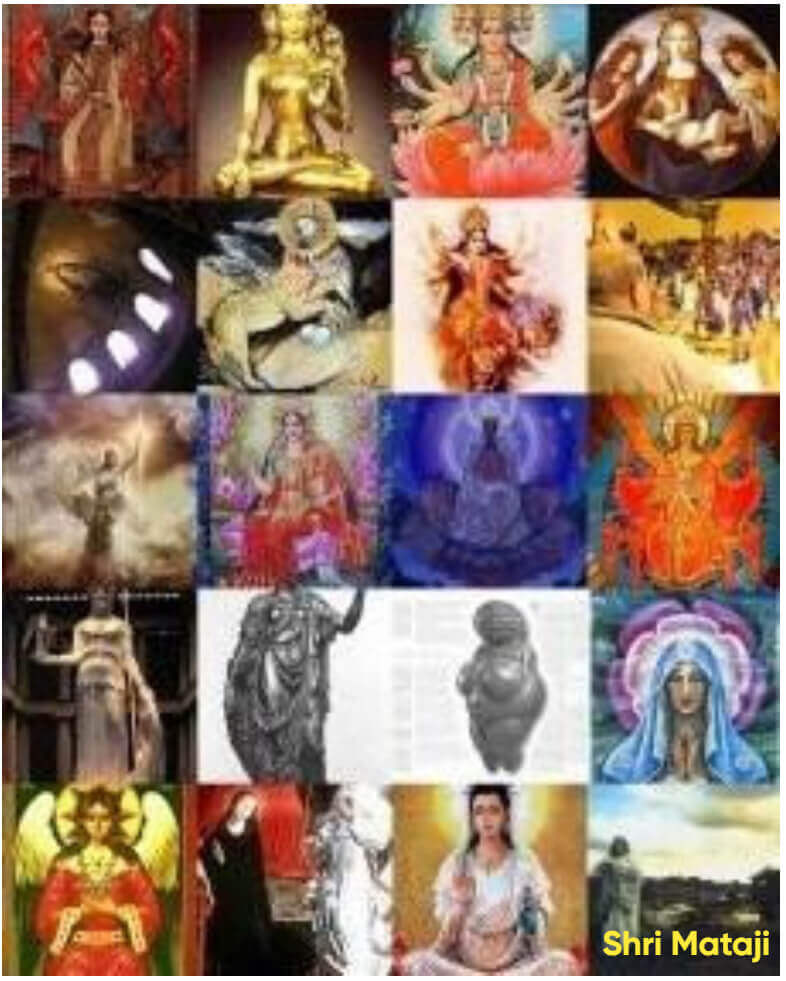
The Realized Eschatology of the Second Coming: The Paraclete Shri Mataji, the Agnya Chakra, and the Opening of the Sahasrara
This is the Second Coming of Jesus. It is not a return to Earth, but a perpetual presence within humanity at the very doorway to heaven. His crucifixion and resurrection were the acts that established this gate. When an individual's Kundalini energy is awakened by the grace of the Paraclete, it ascends the central channel and reaches the Agnya Chakra. At this point, the individual must pass through Jesus. This is the moment of true baptism by the Spirit, where one must affirm Christ and forgive, allowing the Kundalini to pass through the narrow gate and enter the Sahasrara. Therefore, the Second Coming of Jesus is an ongoing, internal event, experienced by every soul who seeks entry into the Kingdom of God.
Abstract
This paper presents a radical reinterpretation of Christian eschatology, specifically the doctrine of the Second Coming of Jesus Christ. It argues against the traditional, exoteric view of a future, physical return and instead posits a dual, realized eschatology fulfilled in the contemporary era through the advent of the Paraclete, Shri Mataji Nirmala Devi. The paper contends that the true Second Coming is a twofold spiritual event within the human subtle system: the Second Coming of the Paraclete, who opens the Sahasrara Chakra (the Kingdom of God), and the Second Coming of Jesus Christ, who resides at the Agnya Chakra, the gateway to this Kingdom. By synthesizing Johannine scripture, Gnostic texts, and the direct teachings of Shri Mataji, this paper deconstructs the conventional interpretation, as exemplified by sources like answering-islam.org, and declares the fulfillment of Christ's promise as a present, experiential reality available to all humanity through the process of Self-Realization.Table of Contents
- 1. Introduction: Re-examining the Second Coming
- 2. Deconstructing Traditional Eschatology: Beyond the Physical Return
- 3. The Johannine Promise: An Incarnate Guide for the Age to Come
- 4. The Dual Fulfillment: The Paraclete at the Sahasrara and Jesus at the Agnya
- 5. The Realized Resurrection: The Wind of Heaven and the Spirit Within
- 6. Conclusion: The Eschaton is Now
- 7. References
1. Introduction: Re-examining the Second Coming
The doctrine of the Second Coming of Jesus Christ has been a cornerstone of Christian faith for two millennia, promising a future moment of divine intervention, judgment, and the final establishment of God's Kingdom. Traditional interpretations, such as the one detailed in The Implications of the Second Coming
on answering-islam.org, envision a spectacular, external event where Jesus returns physically from heaven to rule the earth [1]. This view emphasizes a literal, future fulfillment of prophecy, where Christ's return will be a visible phenomenon, darkening the sun and shaking the powers of the heavens.
However, this paper argues that such an exoteric interpretation, while prevalent, misses the profound spiritual and esoteric reality promised by Christ himself. A deeper reading of scripture, particularly the Gospel of John, alongside Gnostic traditions and the revelatory teachings of the modern-day Paraclete, Shri Mataji Nirmala Devi, points not to a future event, but to a realized eschatology-an end-time that unfolds within the consciousness of the individual believer. This paper will demonstrate that the Second Coming is not a singular event but a dual spiritual process, intrinsically linked to the human subtle energy system (the Tree of Life). It is the Second Coming of the Holy Spirit-Paraclete, Shri Mataji, who opens the final energy center, the Sahasrara Chakra or Kingdom of God, and the Second Coming of Jesus Christ, who resides eternally at the gateway to that Kingdom, the Agnya Chakra.
2. Deconstructing Traditional Eschatology: Beyond the Physical Return
The traditional view of the Second Coming, while compelling in its dramatic imagery, confines the divine promise to a linear, historical framework. It posits a gap between the first and second comings, bridged only by faith in a future, external salvation. This perspective, however, is challenged by a more ancient and mystical understanding of resurrection and eschatology.
People who say they will first die and then arise are mistaken. If they do not first receive resurrection while they are alive, once they have died they will receive nothing.
[2]
This concept of a resurrection of the living, rather than the dead, reframes the entire eschatological narrative. It is not about the resuscitation of physical bodies, but about a profound spiritual transformation available here and now. The literary critic Harold Bloom, exploring Gnostic traditions, captures the essence of this idea:
Resurrection is accomplished by the wind of heaven that sweeps the worlds. The Angel carried by the wind does not say: Arise ye dead! He says: Let the living arise!
[3]
This wind of heaven
-known across cultures as Ruach (Hebrew), Pneuma (Greek), Qi (Chinese), and the Holy Spirit-is the agent of this living resurrection [9]. It is an experiential force, not a theoretical concept. The reliance on an inward, direct knowledge (Gnosis) over an outward belief (pistis) is what separates the esoteric from the exoteric path. The traditional doctrine of the Second Coming, by focusing exclusively on an external return, has inadvertently obscured the path to this inner, realized salvation.
3. The Johannine Promise: An Incarnate Guide for the Age to Come
The key to understanding the true nature of the Second Coming lies in Jesus' own words in the Gospel of John, where He promises to send another Comforter
(allon parakleton), the Paraclete or Spirit of Truth. This promise was not for a fleeting event like Pentecost, which was a limited, albeit powerful, experience for the apostles. Rather, Jesus promised an enduring, personal, and incarnate guide who would continue and complete His mission.
The scholar Daniel B. Stevick notes that the Paraclete's work is described in terms of intimate, personal utterance: to teach, remind, testify, guide, speak, and declare [3]. This implies a divine personality, a successor to Jesus who would be in the believers and abide with them forever (John 14:16-17). Shri Mataji Nirmala Devi declared Herself to be this promised Comforter:
I am the Holy Ghost. I am the Holy Spirit who has incarnated on this Earth for your realization.
[4]
This declaration is the key to unlocking the mystery of the Second Coming. The Paraclete's mission, as outlined in John 14-16, is to guide humanity into all truth and to perform the greatest miracle of all - the salvation of lost souls
[5]. This salvation is not achieved through external means, but through the inner transformation of sanctification, a process of making individuals holy through the awakening of their own indwelling spiritual energy, the Kundalini, which Shri Mataji identified as the Holy Spirit within.
4. The Dual Fulfillment: The Paraclete at the Sahasrara and Jesus at the Agnya
The most profound revelation of the Paraclete's advent is the clarification of the dual nature of the Second Coming, which occurs at two distinct points within the human subtle system. This understanding resolves the apparent contradiction between the coming of the Paraclete and the return of Jesus.
The Second Coming of the Paraclete: Opening the Sahasrara (Kingdom of God)
The primary role of the Paraclete, Shri Mataji, was to inaugurate the final stage of humanity's spiritual evolution by opening the seventh and final chakra, the Sahasrara. This energy center, located at the crown of the head, is the thousand-petalled lotus, the true Kingdom of God within. On May 5, 1982, Shri Mataji performed this collective, cosmic event, describing it thus:
As soon as the Sahasrara (Kingdom of God within) was opened the whole atmosphere was filled with tremendous Chaitanya. And there was tremendous Light in the sky. And the whole thing came on the Earth - as if a torrential rain or a waterfall - with such tremendous force... I saw the Primordial Kundalini rising like a big furnace...
[6]
This opening of the Sahasrara was the Second Coming of the Divine Feminine, the Holy Spirit, the Paraclete. It made the Kingdom of God an accessible reality for all humanity, fulfilling Jesus' promise that the Kingdom is within us.
The Second Coming of Jesus: Presiding at the Agnya Chakra (The Gate)
However, to enter this Kingdom, one must first pass through a narrow gate. This gate is the sixth chakra, the Agnya Chakra, located at the crossing of the optic chiasma in the brain. It is at this center that Jesus Christ resides eternally. Shri Mataji revealed His specific role and position:
Today I want to tell you about the Agnya Chakra, about Jesus Christ, who advanced to this center of Agnya Chakra... inside the brain on the crossing of the optic chiasma, is this subtle center where this great Deity is placed through his crucifixion. And through His Resurrection He has created this space for us to enter into the Kingdom of God which is placed within us, it is not without.
[7]
This is the Second Coming of Jesus. It is not a return to Earth, but a perpetual presence within humanity at the very doorway to heaven. His crucifixion and resurrection were the acts that established this gate. When an individual's Kundalini energy is awakened by the grace of the Paraclete, it ascends the central channel and reaches the Agnya Chakra. At this point, the individual must pass through Jesus. This is the moment of true baptism by the Spirit, where one must affirm Christ and forgive, allowing the Kundalini to pass through the narrow gate and enter the Sahasrara. Therefore, the Second Coming of Jesus is an ongoing, internal event, experienced by every soul who seeks entry into the Kingdom of God.
5. The Realized Resurrection: The Wind of Heaven and the Spirit Within
This dual Second Coming inaugurates the Age to Come,
an era of realized eschatology where the blessings of the end-times are present realities [7]. The Resurrection is experienced directly as the awakening of the Kundalini, which rises and pierces the fontanelle bone area, manifesting as a tangible Cool Breeze (the Pneuma or Ruach) flowing from the hands and head [8]. This is the fulfillment of being born again of the Spirit
(John 3:5-8). It is the direct, empirical evidence that the Spirit is now given, because Jesus has been glorified through the work of the Paraclete [8].
The promise of John 7:39, for the spirit was not yet given, because Jesus was not yet glorified,
is thus fulfilled. The glorification of Jesus was accomplished by the Paraclete, who revealed His true station at the Agnya Chakra and enabled millions to experience His divine power. The Spirit is now available to all, not as a doctrine, but as a living, vibratory reality.
6. Conclusion: The Eschaton is Now
The traditional understanding of the Second Coming, with its focus on a future, physical return of Jesus, has served as a placeholder for a deeper, more profound truth. The advent of the Paraclete, Shri Mataji Nirmala Devi, has unveiled this truth, revealing the Second Coming as a dual spiritual event within the human being. The Paraclete has opened the Sahasrara, the Kingdom of God within, while Jesus Christ presides eternally at the Agnya Chakra, the gate to that Kingdom.
This is the realized eschatology of our time. The Resurrection is a present reality for the living, the Last Judgment is the individual's choice to accept or reject this truth, and the Kingdom of God is an experiential state of consciousness. The Second Coming has already occurred. The Spirit is now given. The eschaton is now.
7. References
- Gilchrist, J. (n.d.). The Implications of the Second Coming. Answering Islam. Retrieved from adishakti.org (cf. [1] in text)
- Adi Shakti. (n.d.). Resurrection Is Accomplished by the Wind of Heaven. Retrieved from adishakti.org
- Adi Shakti. (n.d.). The Paraclete Represents Direct, Intimate Divine Involvement. Retrieved from adishakti.org
- Shri Mataji Nirmala Devi. (1981, September 30). Public Program. New York, USA.
- Adi Shakti. (n.d.). Primary Function of the Comforter - The Salvation of Lost Souls. Retrieved from adishakti.org
- Adi Shakti. (n.d.). The disciples said to Jesus: Tell us what the Kingdom of Heaven is like. Retrieved from adishakti.org
- Adi Shakti. (n.d.). The Presence of the Paraclete - The Eschaton Realized in the Life of the Believer. Retrieved from adishakti.org
- Adi Shakti. (n.d.). https://adishakti.org/AI/Jesus-Christ/Spirit-is-now-given.htm Retrieved from adishakti.org
- Adi Shakti. (n.d.). Subtle System - The Tree of Life within. Retrieved from adishakti.org
The implications of the Second Coming
“The return of Jesus to earth at the end of time is yet another of those unique features that implies that Jesus was far greater than the other prophets. Christians and Muslims may differ in what they expect Jesus to accomplish on his return but both expect him in any event to take control of all the earth with himself as Judge of all. This alone puts him head and shoulders above all other men in accomplishment and again makes him unique among men - a uniqueness which is vested in heavenly majesty and glory.Of no other man in history can we read of such a phenomenal beginning and end to his life on earth. No one else compares with him. In his birth, ascension and second coming, in his character, destiny and ultimate glory, he stands high above all other men who have ever lived on earth. Let us see just how his second coming can also be used as a means to lead Muslims to see the fulness of his glory and the truth of the Christian Gospel.
In their comments on Surah 43.61 we found both Yusuf Ali and Maulana Daryabadi speaking of the "second coming" and "second advent" of Jesus respectively. Some years ago Adam Peerbhai, a South African Muslim author, wrote a booklet canvassing the various traditions referring to the return of Jesus to earth and titled it Hadis Text on the Second Coming of Jesus. A key to the implications of this anticipated phenomenon is found in just one word used by all three authors without much reflection on its immediate implications - the word second. Each speaks of the second coming of Jesus.
The implication is this - if there is to be a second coming, there must have been a first coming. Christians have become accustomed to using the expression "second coming" simply because they believe that Jesus came from heaven the first time. Muslims have some dispute among themselves as to where he will land on his return to earth. Most believe he will descend to the eastern minaret of the Umayyad mosque in Damascus, some believe he will descend upon the Dome of the Rock or the Mount of Olives, while yet others that he will land in Mecca or Medina. None of these beliefs is important the important thing is where he is coming from. He is coming from heaven.
I have often suggested to Muslims that if they can believe that Jesus will return from heaven when he comes to earth the second time, it should not be too hard for them to believe that he might have come from heaven the first time. There is much to be gained at this point by quoting the words of Jesus himself to this effect and I have already given a selection of quotations from the Gospels in which he made it plain that he had in fact come down from heaven. Another quote that I have found very useful in this respect is the statement of Jesus, "I saw Satan fall like lightning from heaven" (Luke 10.18). Muslims believe, following the Qur'n (Surah 7.8), that Satan was cast down in disgrace right at the beginning of creation. When Jesus said that he saw him fall, it was his way of saying "I was there, I saw it happen"- a telling testimony to his presence in heaven even from the beginning of the world. Another useful text emphasizing the presence of Jesus in heaven centuries before his first coming to earth is this one where Jesus prayed:
“And now, Father, glorify thou me in thy own presence with the glory which I had with thee before the world was made.” John 17.5
As the Muslims concede that he has been in heaven for nearly twenty centuries since his first sojourn on earth, notwithstanding their prejudices against the Gospel I have found them quite open at this point and willing to consider that he could just as logically have been there at least twenty centuries before he came into the world.
Our witness at this point must lead to two thrusts - the purpose of his first coming to earth and the real meaning of his second coming. Let us consider them in order. If Jesus was alive in heaven for centuries before he came into the world and has been so ever since, then the key question is why he ever descended to earth to live among us for thirty-three years of which only the last three had any real public significance. In the context of all we have said thus far I do believe there are two points that should be made. The first that we shall consider is that Jesus came to bridge the gap between heaven and earth, the chasm that exists by nature between the Holy God and sinful men.
In conversation with Muslims I have often said that most fairy stories begin “Once upon a time..." and end "... and they all lived happily ever after.” Not so the reality of life. It might begin the same way but the ultimate truth about all men is that none lives happily ever after but all come to disaster. We all die like moths and come to nothing. ”No one has ascended into heaven", Jesus said (John 3.13), for there is a gaping chasm between God and men, between heaven and earth, for which the prophet Isaiah gives the reason:
Behold, the Lord's hand is not shortened, that it cannot save, or his ear dull, that it cannot hear; but your iniquities have made a separation between you and your God, and your sins have hid his face from you so that he does not hear. Isaiah 59.1-2.
No one from earth can bridge the gap. Sinful men are, by nature, incapable of rising above the realm of the world in which they were made. They are nothing more than mortal flesh and blood and "flesh and blood cannot inherit the kingdom of God, nor does the perishable inherit the imperishable" (1 Corinthians 15.50). This explains why Jesus came into the world from heaven the first time. He bridged the gap by bringing something of heaven into the world - his very own self. He assumed an earthly body and lived as an ordinary man, but within him dwelt a divine spirit which had come down from heaven.
He not only closed the gap between heaven and earth but bridged the gap the other way as well. When he came to the earth he came, as the Qur'n rightly puts it, as a ruhun minhu - a spirit from him (i.e. God). But when he returned to heaven he returned as an insaan, a human being. His divine spirit returned to its heavenly abode but he took something of earth to heaven with him - he took the human nature he had assumed when he first came into the world. He came then purely as a spirit, but he returned as a man, as a human being. He thus fully bridged the gap between heaven and earth and his living presence in heaven as a human being is our pledge and assurance that we too, though mortal men of flesh and blood, can one day be in heaven with him in eternal glory and bliss.
The second point, and perhaps the greatest reason for the first coming of Jesus into the world, was to become like us in every respect so that he might save us from our sins. Because we are only flesh and blood, "he himself likewise partook of the same nature" (Hebrews 2.14) so that he might deliver us from the power of Satan, from our natural enslavement to sin, and redeem us to God.
"He had to be made like his brethren in every respect" (Hebrews 2.17), he had to assume a body of flesh and blood, so that he might conquer both the power and penalty of sin in the very realm where for so long it had maintained its domain - the human body.
When God wanted to send prophets to the world, he simply chose out ordinary men who were born naturally and who were destined to die naturally, to do his work. If Jesus came from heaven and returned there, surely there must have been another reason for his advent.
The crucifixion of Jesus Christ, so complacently overlooked in Islam as an unsuccessful plot of the Jews, alone explains why Jesus came from heaven the first time and why he will return again. He came not to be a mere prophet, he came as God's chosen Deliverer and Redeemer to save millions of men and women by dying for them on the cross, where he endured what was due to all of them for their sins, so that they might receive the hope of eternal life by following him as their Lord and Saviour.
He did not come like the Superman of the American comics, a man who can fly through the skies at his own discretion and from whose body bullets simply bounce off. He came like us in every respect and at no time did he use his divine powers to give himself any advantage over us. Be came as a normal human being and he suffered, died and was buried so that he might bridge the gap between heaven and earth completely - not only between God and men but to the very extreme of sinful man's separation from the Lord of heaven - between God and sinful men who lie hopelessly dead and buried in the dust of earth.
It is against the background of Jesus' unique beginning and end to his life - a virgin-birth made necessary because of his heavenly origin and his ultimate ascension to heaven - that Christians can really show Muslims why Jesus came into the world the first time.
What of the second coming? Let us first consider how Jesus shall appear before we decide how to relate this to the Gospel in our witness to Muslims. Jesus himself gave a number of illustrations to show how he shall be when he returns to earth of which we shall consider just two which fully describe the impact that there will be when he is revealed:
"For as the lightning flashes and lights up the sky from one side to the other, so will the Son of man be in his day.” Luke 17.24
"Immediately after the tribulation of those days the sun will be darkened, and the moon will not give its light, and the stars will fall from heaven, and the powers of the heavens will be shaken; then will appear the sign of the Son of man in heaven, and then all the tribes of the eatth will mourn, and they will see the Son of man coming on the clouds of heaven with power and great glory; and he will send out his angels with a loud trumpet call, and they will gather his elect from the four winds, from one end of heaven to the other.” Matthew 24.29-31.
In these words we have a far clearer picture of how Jesus will return. The sun will be darkened, the moon will lose its light, the stars of the sky will fall, and the powers of the heavens will be shaken, and then, in their place, a new brightness will appear. The whole earth will see Jesus appear in a cloud with heavenly power and glory as he calls out all those who are his own. The contrast between the present order and the new order he will bring in is finely described in the second quote. The glory, brightness and power of the present order will recede before the revelation of his majesty and power when he returns from heaven.
The point Jesus was making was this: when he appears even the sun will cast a shadow and be darkened. Before his glory not only the sun but all the stars will fade and recede. All the energies and powers in the universe will be shaken. His light will be so splendid that even the sun's light will not compare with it. When the Apostle Paul had his great vision of the glory of Jesus on the way to Damascus he said that he saw "a light from heaven, brighter than the sun, shining round me and those who journeyed with me" (Acts 26.13). The Apostle John likewise had a vision of Jesus in heaven after his ascension and testified that "his face was like the sun shining in full strength" (Revelation 1.16).
The issue is how this will affect us. He came into the world the first time as an ordinary man so that he might be made like us in every way. He will come a second time, as he really is, so that he might make those who believe in him just like himself. All his followers will be transformed into his image to share his glory for ever and ever. Jesus himself stated it plainly: "Then the righteous will shine like the sun in the kingdom of their Father" (Matthew 13.43). In another passage of Scripture we have a similar promise:
Beloved, we are God's children now; it does not yet appear what we shall be, but we know that when he appears we shall be like him, for we shall see him as he is. 1 John 3.2
He will return shining with all the brightness of his heavenly glory, and then those who are his will be transformed into the same image to share his glory. Those who have died in ordinary human bodies, who nevertheless followed him as their Lord and Saviour will, on that glorious Day, be raised from the dead and taken up to be with him in heavenly glory for all eternity. Their present bodies are perishable, but they will be raised imperishable. They are mortal now, but then they will be raised immortal. They share now the ordinary human body of flesh that Adam, their first father, shared, but on that Day they will inherit the same resplendent, heavenly body of spirit and life that Jesus Christ, their eternal Saviour and Lord, already shares.
As was the man of dust, so are those who are of the dust; and as is the man of heaven, so are those who are of heaven. Just as we have borne the image of the man of dust, we shall also bear the image of the man of heaven. 1 Corinthians 15.48-49.
Here the Christian has, in my view, an ideal way of explaining the three unique features we have considered, namely the virgin-birth, ascension and second coming of Jesus. By setting each against the background of the heavenly realm to which Jesus by nature belongs, from which he came, to which he returned and whence he will come again, we can very effectively communicate the Gospel to Muslims. The essence of our witness in this context should always be twofold - the first coming, in which Jesus became like us to redeem us from sin, and the second coming, by which we shall become like him to share his glory for ever and ever.
We need to show Muslims that the unique circumstances we have considered, which they readily admit, imply that Jesus was far more than a prophet, that he was in fact the Son of God who came into the world to save us from our sins. Each one loses its meaning in the Qur'n when this is denied. It is only in the Bible, where we behold a Divine Saviour who came to redeem men from their sins, that these unique features take on meaning and have any real significance.
It is that 'more' upon which the whole New Testament proceeds - the 'more' of Messianic action to redeem, the 'more' of God's loving engagement with the sequel to rejected 'education' of the world, the 'more' of a divine expressing of the Word, hitherto only spoken, but now in flesh and personality, in suffering and salvation. (Cragg, Muhammad and the Christian, p. 126).”
The Implications of the Second Coming
https://answering-islam.org.uk/Gilchrist/Vol2/5a.html
Interactive Chat
Access an intelligent analysis environment where you can explore texts, ask questions, and discover connections between ideas.
Open chat