Khokhmah and Sophia: The Divine Feminine, Sacred Wisdom, and the Transformation of Religious Consciousness
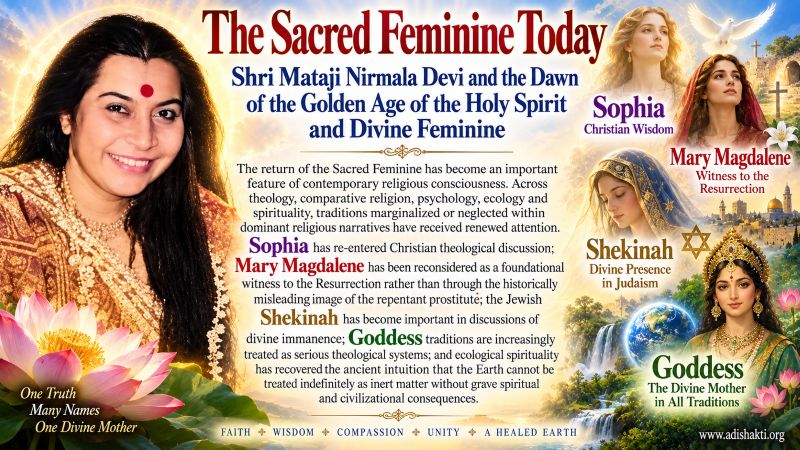
Summary
Taking Max Dashu’s 2000 essay as its central interlocutor, this expanded paper traces the feminine figure of divine Wisdom through Proverbs, Ben Sira, Wisdom of Solomon, Isis traditions, Alexandrian philosophy, diverse Nag Hammadi writings, Christian reception, Jewish mysticism, and the Adishakti interpretation. It examines Dashu’s proposed continuity of Goddess consciousness, her reading of the sovereign and fallen Sophia, and the evidence needed to evaluate historical transmission. It distinguishes textual evidence and historical relationships from contemporary theological claims, including the identification of Wisdom with the primordial Divine Mother and the Paraclete.
Introduction: The Feminine Language of Divine Wisdom
The history of biblical monotheism is often told in the masculine language of Father, King, Lord, and Creator. Yet its foundational literature also preserves an elaborate feminine vocabulary for divine Wisdom. Hebrew Khokhmah and Greek Sophia speak, instruct, order creation, and invite humanity into life. Their significance extends beyond the question of divine gender to the nature of revelation, cosmic order, and transformative knowledge.
Max Dashu, feminist historian and founder of the Suppressed Histories Archives, published “Khokhmah and Sophia” as Chapter III of Streams of Wisdom (Oakland, CA: Suppressed Histories Archives, 2000). Dashu also identifies an earlier serialized appearance in Goddessing Regenerated, edited by Willow LaMonte (Malta, 1998). The 2000 essay is copyrighted by Dashu; this study analyzes and paraphrases its argument rather than reproducing it. Her essay reconstructs a wide network of feminine Wisdom traditions across ancient Israel, Hellenistic Judaism, Egyptian religion, Gnostic literature, and Christian mysticism. This paper takes her comparative thesis seriously while distinguishing primary textual evidence, historical hypotheses about religious transmission, and contemporary theological interpretation.
The central argument is that feminine Wisdom constitutes a persistent language of divine immanence. Her representations change across traditions; they cannot all be reduced to a single historical goddess, but neither can they be dismissed as incidental grammatical accidents.
1. Khokhmah in the Hebrew Bible
The Hebrew noun ḥokhmāh denotes wisdom, practical skill, discernment, and the ability to live rightly. Although the noun is grammatically feminine, grammar alone does not prove that ancient Israelites worshipped Wisdom as a goddess. The distinctive theological development is literary personification: Wisdom speaks as a woman in public, reproves folly, and offers life (Proverbs 1; 8–9).
Proverbs 8:22–31 places Wisdom beside God before the earth and seas were ordered. The Hebrew verb qānānî in verse 22 and the difficult word ʾāmôn in verse 30 remain disputed. These philological uncertainties prevent a simple conclusion that Wisdom is either an eternally independent deity or merely a created creature. The passage unmistakably makes Wisdom integral to the representation of creation’s primordial order.
Proverbs 3:18 calls Wisdom a tree of life. Proverbs 9:1 describes her house of seven pillars. These symbols invite comparison with sacred-tree and cosmic-house imagery in the ancient Near East, but the biblical text does not itself equate the seven pillars with later esoteric systems.
2. Asherah, Sacred Trees, and Historical Continuity
Dashu argues that Wisdom preserves aspects of the earlier sacred feminine, especially Asherah. Ancient Levantine texts and archaeological inscriptions establish that goddess traditions existed in the religious environment of Israel and Judah. The interpretation of references to “his asherah” in inscriptions from Kuntillet ʿAjrud and Khirbet el-Qom remains debated.
The image of Wisdom as a tree of life provides a meaningful comparative point, not a proof of direct identity. A historically responsible analysis distinguishes cultural background, possible borrowing, and demonstrable textual dependence. Khokhmah may reflect an environment in which feminine divine imagery was familiar without being simply another name for Asherah.
3. Sophia in Hellenistic Judaism
Greek sophia translated Hebrew Wisdom within the Septuagint and Hellenistic Jewish thought. The Wisdom of Solomon, generally situated in the late first century BCE or early first century CE, presents Sophia in unusually expansive cosmic language. Wisdom 7:22–8:1 describes her as intelligent, holy, subtle, beneficent, and pervasive throughout creation.
Wisdom 7:25–26 speaks of Wisdom as breath, radiance, and reflection of divine activity. This language makes Sophia more than a storehouse of propositions: she is represented as the effective communication of divine reality. Yet these descriptions do not require that the author understood her as a second independent god.
Wisdom 7:27 associates her with entry into holy souls and the making of prophets and friends of God. Here the cosmic and experiential dimensions of Wisdom converge. The same power that orders the universe makes spiritual insight possible within human life.
Ben Sira 24 describes Wisdom seeking a dwelling and being established among Israel. Its imagery of cloud, sanctuary, and rootedness locates universal Wisdom within a particular covenantal tradition.
4. Isis, Alexandria, and Philo
The Egyptian goddess Isis became a transregional figure in the Hellenistic and Roman Mediterranean. Isis aretalogies proclaim her cosmic powers in the first person, creating literary parallels with Wisdom speeches and some later Gnostic revelations. Similarity, however, does not demonstrate that Sophia was merely Isis under a Greek name.
Philo of Alexandria interpreted Jewish scripture through philosophical concepts including the Logos, divine powers, and Wisdom. His use of maternal and mediating imagery shows that feminine symbolism could coexist with philosophical monotheism. His vocabulary is flexible and should not be forced into a later fixed Trinity or a simple divine family tree.
Dashu’s comparative contribution is strongest where it draws attention to a shared Mediterranean repertoire of cosmic motherhood, divine intelligence, and revelatory speech, while the precise routes of transmission require independent demonstration.
5. Early Christianity: Sophia, Christ, and the Paraclete
First Corinthians 1:24 identifies Christ with God’s wisdom and power; John 1:1–18 presents the preexistent Logos through whom all things came to be; Colossians 1:15–20 associates Christ with creation and reconciliation. Early Christian authors thus appropriated functions already familiar from Jewish Wisdom literature.
John 14:16–17, 14:26, 15:26–27, and 16:7–15 describe the Paraclete as abiding with believers, teaching, bearing witness, and guiding into truth. These functions have meaningful affinities with Sophia’s revelatory work, particularly Wisdom 7:27. John does not explicitly call the Paraclete Sophia, however, so an identification must be stated as a theological reading rather than an uncontested textual fact.
Hebrew rûaḥ is generally grammatically feminine, Greek pneuma neuter, and Greek paraklētos masculine. These grammatical facts inform imagery but cannot settle the metaphysical gender of the Spirit. Syriac Christian maternal imagery for the Spirit shows the range of ancient possibilities.
6. Sophia in Gnostic Cosmology
The Nag Hammadi discoveries of 1945 revealed diverse religious writings in which Sophia, Barbelo, Pronoia, and other feminine figures occupy major cosmological roles. “Gnosticism” is itself a debated scholarly category; the surviving texts should not be treated as a single unified system.
The Hypostasis of the Archons and On the Origin of the World recast Genesis through a drama of higher divine reality and ignorant lower rulers. In some passages a luminous feminine figure associated with Eve and Life becomes an instructor who awakens Adam. The Testimony of Truth reinterprets the serpent and the acquisition of knowledge in ways sharply different from dominant biblical readings.
The Apocryphon of John presents Barbelo as an exalted primordial manifestation while also narrating Sophia’s problematic action in the origin of the lower cosmos. Other traditions emphasize Sophia’s suffering and restoration. These differences prevent a simple account in which one original sovereign goddess was everywhere and progressively degraded.
Dashu, following Rose Arthur, reads the depiction of a deficient or fallen Sophia as evidence of patriarchal revision. Gender hierarchy is a serious interpretive consideration, but individual claims about literary redaction and chronology require close manuscript and textual comparison.
7. Shekhinah, Binah, and Jewish Mysticism
Shekhinah denotes the dwelling or presence of God in rabbinic language. It is not historically synonymous with Khokhmah, although both are associated with divine immanence. Medieval Kabbalah develops gendered symbolism within the sefirot: Ḥokhmah commonly receives paternal symbolism, Binah maternal symbolism, and Shekhinah is frequently associated with Malkhut.
This redistribution of feminine symbolism complicates any linear narrative of disappearance. Some Kabbalistic traditions portray the Shekhinah as accompanying Israel in exile and symbolically restored through divine reunion. The motif offers a comparative parallel to narratives of Sophia’s separation and restoration without making the two systems identical.
8. Hildegard and Christian Mystical Wisdom
Hildegard of Bingen (1098–1179) developed vivid images of divine vitality, radiance, and the flourishing of creation. Her concept of viriditas evokes living greenness and spiritual fruitfulness. Feminine personifications in her visionary theology demonstrate the endurance of this symbolic vocabulary within medieval Christianity.
Hildegard’s thought remains recognizably Christian rather than evidence of an uninterrupted cult of Isis or Asherah. It provides a contrast to strongly world-denying cosmologies: the natural world may be understood as a manifestation of divine generosity rather than a prison.
9. Comparative Theology: Sophia and Adi Shakti
In Shakta traditions, Adi Shakti names primordial divine power, and texts such as the Devi Gita articulate the Goddess’s cosmic and liberating significance. Sophia and Adi Shakti may be compared in relation to creation, spiritual knowledge, divine immanence, and transformation. Their names do not share an established etymological derivation, and functional similarity does not prove historical identity.
Within the Adishakti interpretation, Shri Mataji Nirmala Devi (1923–2011) is understood as an incarnation of the primordial Divine Mother and associated with the Paraclete’s revelatory functions. Sahaja Yoga describes Self-realization as an experiential awakening of Kundalini. This interpretation offers a contemporary theological synthesis linking Wisdom, Spirit, and awakened consciousness.
Academic religious studies can document these claims, interpret the scriptural arguments offered for them, and compare experiences across traditions. It cannot verify supernatural incarnation or prophetic fulfillment by textual similarity alone. The distinction between devotional conviction and historical demonstration strengthens rather than diminishes responsible comparative theology.
10. Wisdom and the Transformation of Consciousness
Proverbs describes Wisdom as a way of life; Wisdom of Solomon depicts her entering human souls; John presents the Spirit as a teacher and guide; contemplative traditions describe inward recognition. A productive comparison asks not only what humans know about God but how humans become capable of receiving spiritual knowledge.
Luke 17:20–21 is often brought into discussions of the inner Kingdom, but Greek entos hymōn can be understood as “within you” or “among you.” John 3:3–8 uses the ambiguity of pneuma, wind and spirit, to describe the mystery of spiritual rebirth. Neither passage should be made to prove a later spiritual technique by itself.
The enduring philosophical issue is whether spiritual wisdom is propositional information alone or also a transformation of the knower. Sophia’s literary role repeatedly points toward the latter possibility.
11. Gender, Patriarchy, and Methodological Limits
Dashu’s recovery of feminine Wisdom challenges accounts of religious history that presume exclusively masculine divine symbolism. Yet exalted female symbols have often coexisted with male-dominated institutions, and gendered imagery does not straightforwardly determine social equality.
Historical reconstruction requires caution at several points: feminine grammar is not proof of goddess worship; shared symbols do not prove direct borrowing; Gnostic texts do not form a secure linear sequence; and Byzantine Hagia Sophia is not evidence that Orthodox doctrine formally recognized a female third member of the Trinity. Holy Wisdom was commonly interpreted Christologically in Byzantine theology.
The more defensible thesis is that feminine representations of divine Wisdom persisted through multiple transformations, furnishing religious communities with an enduring language of creation, revelation, and immanence.
12. Khokhmah, Shekhinah, and the Tree of Life
Dashu foregrounds a cluster of images rather than a single doctrinal definition. Proverbs 3:18 calls Wisdom a “tree of life”; Proverbs 8:35 associates finding Wisdom with finding life; Proverbs 9:1 depicts her building a house with seven pillars. Ben Sira 24:4 places Wisdom’s throne in a pillar of cloud, a striking expression of divine proximity. Taken together, the texts represent Wisdom as sustaining life, ordering sacred space, and dwelling near humanity.
Drawing on Asphodel Long’s In a Chariot Drawn by Lions, Dashu compares Khokhmah and Shekhinah through motifs of luminosity, divine glory, mediation, creation, heavenly enthronement, and movement between celestial and earthly realms. These motifs form a persuasive comparative constellation, but they arise in sources of different dates and genres. The rabbinic term Shekhinah should not be retrojected as a technical name into Proverbs.
The possible relation to Asherah is likewise suggestive rather than proven. The ancient sacred tree and the literary “tree of life” may share symbolic conventions, but their resemblance does not establish an unbroken cultic lineage. A stronger thesis is that later Jewish texts could preserve, reinterpret, or independently redeploy symbols of feminine sacred power within monotheistic discourse.
13. The Wisdom of Solomon and the Language of Divine Attributes
Wisdom of Solomon 7:22–23 offers an extraordinary catalogue of attributes: Wisdom is intelligent, holy, unique, manifold, subtle, mobile, clear, undefiled, beneficent, and all-pervading. Dashu observes that the cascading praise resembles the accumulative names and epithets of goddesses in other traditions. The comparison with the Śrī Lalitā Sahasranāma is illuminating at the level of devotional rhetoric, but neither a common source nor direct influence is demonstrated by the resemblance.
Wisdom 7:25–26 identifies her as an emanation of divine power and a reflection of eternal light. The language combines intimate participation in God’s activity with a distinction from God as ultimate source. Dashu’s formulation that Sophia “takes over” divine functions describes the literary prominence of the feminine figure, but it risks overstating the author’s ontological claim: the book also explicitly situates Wisdom in relation to Israel’s God.
Wisdom 7:27 depicts Sophia passing into holy souls and forming friends of God and prophets. The text thus moves from cosmology to spiritual formation. For comparative theology, this is a crucial transition: divine Wisdom is not only a principle explaining the universe but also an active power of ethical and contemplative transformation.
14. Isis Aretalogies, Monogenēs, and Mediterranean Syncretism
Isis aretalogies—first-person declarations of the goddess’s powers—celebrate her authority over cosmic order, law, celestial movements, and human welfare. Dashu reads these alongside Jewish and Gnostic Wisdom speeches, identifying a shared idiom of universal feminine sovereignty. Alexandria and the wider eastern Mediterranean provided real settings for intercultural encounter; however, a shared literary form cannot by itself determine who borrowed from whom.
In Plutarch’s On Isis and Osiris, Isis is interpreted through Greek philosophical categories, including the desire for knowledge and wisdom. Philo’s writings likewise employ feminine Wisdom and maternal metaphors within an overwhelmingly Jewish philosophical framework. Claims that Philo straightforwardly identified Sophia with Isis or that Isis was universally treated as “Mother of the Logos” require passage-specific documentation and should be regarded as interpretive propositions, not settled facts.
Dashu also highlights the Greek adjective monogenēs, often translated “unique” or “only” in early Christian texts. Comparable epithets occur in Greek religious traditions, including praise of female divinities. This broader vocabulary is relevant to the reception history of the term, but the assertion that its application to Jesus necessarily derives from an earlier goddess title goes beyond what lexical overlap alone can prove.
The syncretic representations of Isis with Demeter, Tyche, Fortuna, and other figures demonstrate how ancient worshippers could recognize shared divine powers across local cults. These documented combinations make Dashu’s comparative approach historically plausible in general, without validating every proposed equation among Isis, Sophia, Khokhmah, and later Gnostic figures.
15. The Therapeutae and the Limits of Syncretic Reconstruction
Philo’s On the Contemplative Life describes the Therapeutae near Lake Mareotis in Egypt as a community devoted to contemplation, scriptural interpretation, communal celebration, and hymns. Women are present in this account, and the description of nocturnal worship and antiphonal singing makes it important evidence for the religious participation of women in a Jewish Egyptian milieu.
Dashu places this community within a broader Alexandrian landscape of healing and feminine divinity, suggesting an Isis–Wisdom synthesis. Yet Philo does not explicitly identify the Therapeutae’s object of worship as Isis, Sophia, or a “Mother of God.” This remains a conjectural reconstruction. Distinguishing what Philo reports from what a comparative historian proposes is essential to the credibility of the larger argument.
16. Sovereign Sophia, Barbelo, and the Revelatory Feminine
Several Nag Hammadi writings attribute exceptional power to feminine divine manifestations. Eugnostos the Blessed presents an elaborate account of divine emanations and speaks of Sophia in a generative context. On the Origin of the World offers a cosmological drama in which higher feminine powers challenge the pretensions of lower rulers. Titles such as Ennoia (Thought), Pronoia (Forethought), Charis (Grace), and Pistis (Faith) signal a rich vocabulary of divine agency, although their meanings and relationships differ from text to text.
Barbelo is especially important in Sethian materials. In the Apocryphon of John she is the primordial Forethought and a central emanation of the highest divine principle. The Three Steles of Seth addresses exalted divine realities in hymnic language. Thunder, Perfect Mind presents a first-person feminine speaker through paradoxical self-identifications, unsettling conventional distinctions between high and low, honored and dishonored.
Dashu’s interpretive strength lies in taking these feminine voices seriously as theological protagonists rather than treating them as marginal decorations. A textual caution remains: “Sophia,” “Barbelo,” and the speaker of Thunder are not automatically interchangeable characters. Their convergence is comparative and thematic; exact identities must be established within each composition.
17. Eve, the Serpent, and the Reversal of Genesis
The Hypostasis of the Archons and On the Origin of the World invert familiar Genesis hierarchies. The lower creator and his rulers can appear ignorant or arrogant, while a spiritual feminine power associated with Eve, Life, or the higher realm becomes the agent of awakening. In these narratives, the acquisition of knowledge is not simply rebellion against rightful divine authority; it can be emancipation from an inferior cosmic regime.
The Testimony of Truth likewise reinterprets the garden story and portrays the serpent more favorably than mainstream Christian exegesis. Dashu connects this inversion to older female-centered mythic traditions, including the Sumerian figure Ninti. Such comparisons are valuable as studies in recurring motifs, but a direct historical transmission from Ninti to a particular Gnostic Eve text remains unestablished.
The laughter and defiance of revelatory feminine figures dramatize the collapse of false authority. The texts’ central question is epistemological as much as gendered: who knows the truth of creation, and who merely claims sovereignty? This helps explain why female figures can become the bearers of gnosis in narratives that otherwise retain hierarchical or ascetic assumptions.
18. Fallen Sophia and the Question of Patriarchal Redaction
Dashu, engaging Rose Arthur’s The Wisdom Goddess, contrasts sovereign and luminous representations of Sophia with narratives in which her autonomous action generates disorder and necessitates correction. In some versions of the Apocryphon of John, Sophia acts without her consort and produces the deficient ruler Yaldabaoth. The myth can be read as making unpartnered female creativity a cosmological error; other interpretations emphasize emanation, ignorance, and restoration rather than a simple condemnation of women.
The relationship between Eugnostos the Blessed and The Sophia of Jesus Christ is a particularly useful case of textual adaptation: related materials appear in a non-Christian revelatory discourse and a Christianized dialogue. This supports a specific claim about Christian reframing. It does not by itself prove that all “fallen Sophia” traditions were added later to an originally positive and unified Goddess myth.
Pistis Sophia contains an extended cycle of Sophia’s distress and petitions for rescue, including thirteen repentances. These episodes lend themselves to a feminist reading of divine feminine subordination, yet the work’s textual history and complex soteriology must be considered before assigning a single social motive to its composition.
Stories associated with Simon Magus and Helena also cast a female figure within a narrative of degradation and redemption. Because many reports survive through hostile heresiological authors, they cannot be treated as neutral records of the beliefs or experiences of the communities described. The best-supported conclusion is that competing ancient texts offered both exalted and diminished constructions of feminine divine power, sometimes within the same mythic system.
19. Evaluating Dashu’s Historical Thesis
Dashu’s central achievement is archival and hermeneutical: she brings together feminine divine images that conventional surveys of theology may isolate from one another. Her essay encourages readers to notice the survival and transformation of sacred feminine language across traditions commonly described in masculine terms. That corrective remains valuable even where specific genealogies are uncertain.
Four levels of claim should be separated. First, the textual claim: feminine Wisdom and divine figures are unmistakably present in Proverbs, Wisdom of Solomon, Egyptian hymns, and Gnostic writings. Second, the comparative claim: their images and functions overlap. Third, the historical claim: one tradition directly shaped another through identifiable transmission. Fourth, the theological claim: the figures express a single underlying divine reality. Each level requires different evidence.
The broad statement that “early” Gnostic texts preserved a uniformly sovereign Sophia while “later” Christianized texts degraded her is too linear for the available manuscripts. Most surviving copies are later than the traditions they may contain, and dates of composition are contested. Specific redactional relationships can be studied; a universal pre-Christian Goddess-to-fallen-Sophia chronology cannot simply be assumed.
The Adishakti reading adds a fifth, explicitly contemporary level: Sophia and Khokhmah may be interpreted in relation to Adi Shakti, Kundalini, Shri Mataji Nirmala Devi, and the Paraclete. This is a constructive comparative theology, not an ancient identification established by the cited texts. Presenting it openly as such allows the paper to retain both intellectual rigor and theological depth.
Conclusion: The Enduring Significance of Sacred Wisdom
Khokhmah and Sophia connect the primordial ordering of creation with the transformation of human life. They are feminine figures in the Hebrew and Greek literary traditions, but their theological status changes across historical settings. They can be understood as poetic personification, divine manifestation, revelatory presence, or a figure within complex emanationist cosmology.
The strongest historical conclusion is neither that every Wisdom figure descends from one original goddess nor that the feminine is merely incidental. Instead, sacred Wisdom has been a persistent and consequential means of imagining how transcendence becomes present within creation and consciousness.
The Adishakti reading extends this history into a contemporary theology of the Divine Mother, Paraclete, and Self-realization. It is most persuasive as a clearly identified interpretive synthesis that respects the distinct voices of Jewish, Christian, Gnostic, and Hindu sources.
References
Dashu, Max. “Khokhmah and Sophia.” Chapter III in Streams of Wisdom. Oakland, CA: Suppressed Histories Archives, 2000. Earlier serialized version: Goddessing Regenerated, edited by Willow LaMonte, Malta, 1998 (publication details as supplied; independently unverified). Copyright © Max Dashu, 2000. Online essay.
Arthur, Rose. The Wisdom Goddess: Motifs in Eight Nag Hammadi Documents. University Press of America, 1984.
Buckley, Jorunn Jacobsen. Female Fault and Fulfilment in Gnosticism. University of North Carolina Press, 1986.
Couliano, Ioan P. The Tree of Gnosis: Gnostic Mythology from Early Christianity to Modern Nihilism. 1992.
King, Karen L. What Is Gnosticism? Harvard University Press, 2003.
Long, Asphodel P. In a Chariot Drawn by Lions: The Search for the Female in Deity. 1993.
Pagels, Elaine. The Gnostic Gospels. 1979.
Patai, Raphael. The Hebrew Goddess. 3rd ed. Wayne State University Press, 1990.
Additional primary texts: Philo, On the Contemplative Life; Plutarch, On Isis and Osiris; Eugnostos the Blessed; The Sophia of Jesus Christ; Three Steles of Seth; Testimony of Truth; Pistis Sophia. Textual relationships and translations should be checked against critical editions before scholarly publication.
Primary texts: Proverbs 1, 3, 8–9; Ben Sira 24; Wisdom of Solomon 3, 7–9; John 1, 3, 14–16; 1 Corinthians 1; Colossians 1; The Hypostasis of the Archons; On the Origin of the World; Apocryphon of John; Thunder, Perfect Mind.