
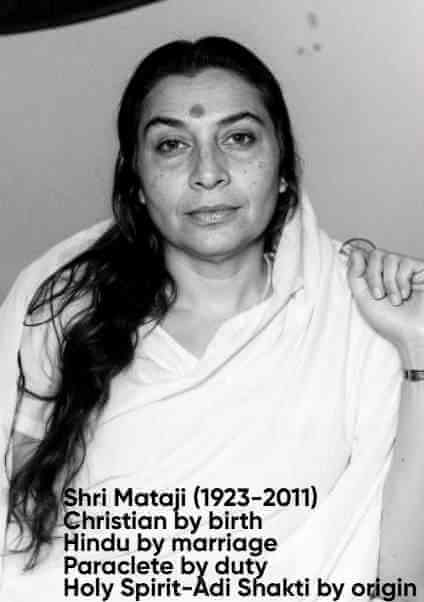
The Weaver and the Redeemer: Identifying the Prophetic Voice of Kabir in the Universal Message of the Paraclete, Shri Mataji Nirmala Devi
In the spiritual history of humanity, certain figures emerge who not only reflect the highest aspirations of their age but also prefigure a future, more complete revelation. Kabir, the fearless weaver of mystical poetry, was such a figure. His uncompromising stand for truth, his critique of religious hypocrisy, and his heartfelt yearning for a direct, unmediated connection to the divine laid the groundwork for a universal spirituality. He was a prophet in the truest sense, one who described a state of being that he knew was the ultimate destiny of humanity. As Shri Mataji observed, "We become people of authority like Kabira: how he sings, how he talks! Just look at the authority with which he talked!"
Abstract
This paper presents a comparative analysis of the 15th-century mystic-poet Kabir and the 20th-century spiritual leader Shri Mataji Nirmala Devi, founder of Sahaja Yoga. It argues that while both figures share a common foundation as fearless truth-tellers who challenged religious dogma and sought to synthesize spiritual traditions, Shri Mataji represents a transcendent fulfillment of the prophetic archetype embodied by Kabir. The paper examines their shared qualities, including a courageous critique of organized religion and an emphasis on direct, inner experience. It then demonstrates how Shri Mataji's work expands upon Kabir's legacy through Her self-proclaimed divine status as the Adi Shakti and the Paraclete, Her universal integration of all world religions through the subtle system of chakras, and Her unique eschatological role in inaugurating a new age of collective spiritual transformation. By identifying Kabir's prophetic voice within Shri Mataji's universal and divine mission, this paper posits that Shri Mataji is not merely a successor to the Sant tradition but a figure of unparalleled spiritual significance, offering a tangible mechanism for the mass spiritual awakening that Kabir could only describe in poetic verse.
Table of Contents
- Introduction: Two Voices, One Truth
- The Fearless Prophetic Voice: A Shared Critique of Dogma
- The Synthesis of Scriptures: From Confluence to Universal Integration
- Transcending the Mystic: Shri Mataji as the Divine and Eschatological Redeemer
- Conclusion: The Weaver's Dream Fulfilled in the Redeemer's Advent
- References
1. Introduction: Two Voices, One Truth
In the rich tapestry of India's spiritual heritage, few figures stand as tall as Kabir, the 15th-century mystic-poet whose verses continue to resonate with their unsparing honesty and profound wisdom. A weaver by trade, Kabir's words wove together the disparate threads of Hinduism and Islam, challenging the orthodoxies of both to point towards a truth that lay beyond institutional religion.[1] He was a quintessential figure of the Sant tradition, an iconoclast who championed direct experience of the divine, or nirguna bhakti (devotion to a formless God), over empty ritualism and social hierarchy.[2] His voice was a prophetic one, speaking truth to power with a fearlessness that has inspired generations.
Five centuries later, in the 20th century, another revolutionary spiritual voice emerged from India: Shri Mataji Nirmala Devi. As the founder of Sahaja Yoga, a global movement based on the experience of Self-realization through the awakening of the Kundalini energy, Shri Mataji presented a message that was both ancient and radically new. She too spoke with a fearless authority, critiquing the decay of organized religions and the rise of false gurus. She too offered a synthesis of spiritual traditions, but on a scale that was truly global, integrating the teachings of all world religions into a single, coherent framework based on the human subtle system.[3]
This paper argues that the Paraclete Shri Mataji Nirmala Devi can be identified with the spiritual archetype of Kabir, yet She represents a figure of vastly greater divine and eschatological significance. While both share a foundational commitment to fearless truth-telling and the synthesis of scriptures, Shri Mataji transcends Kabir's legacy in three critical dimensions: Her explicit divine status as the Primordial Mother (Adi Shakti) and the promised Comforter (the Paraclete) of Christian scripture; Her universal scope, which integrates all world religions into a verifiable, experiential system; and Her eschatological role in inaugurating the "Age to Come" through the mechanism of en-masse Self-realization. This paper will first explore the common ground between these two monumental figures before elucidating the profound ways in which Shri Mataji's advent marks the fulfillment of the spiritual promise that Kabir so eloquently articulated.
2. The Fearless Prophetic Voice: A Shared Critique of Dogma
The most immediate and striking parallel between Kabir and Shri Mataji is their shared role as fearless, prophetic voices speaking out against religious hypocrisy and dogma. Kabir's life was a testament to his courage to "speak his truth even in face of societal pressures and coercion."[1] He was deeply critical of the hypocrisy he observed among the religious leaders of his time, both Hindu and Muslim, rejecting the dogmas of organized religion in favor of an inner, experiential path.[2] His verses are replete with a direct, uninhibited tone that, as one scholar notes, "shakes us out of our slumber-like existence."[1] As Kabir himself taught, the pursuit of truth demands that one question and challenge all scriptural teachings, traditions, and rituals until one is able to validate their truth through personal experience. This was not a rejection of all teachings and practices, but rather an insistence that no authority could substitute for the individual's own inner verification.
Similarly, Shri Mataji's public talks are characterized by a bold and uncompromising critique of the state of modern religion. She argued that organized religions have largely degenerated into systems of "empty ritualism and inflexible dogma," where practices once meant to facilitate spiritual awakening have become ends in themselves, fostering an "illusory sense of piety that obscures authentic realization."[4] In a powerful declaration, She stated:
This statement signals Her intent to dismantle the man-made structures that had obscured the true path to spiritual enlightenment for millennia. Like Kabir, She was particularly critical of the "false gurus" who exploited seekers for power and material gain, tirelessly exposing their methods and warning the public against them.[5] As She stated, "One requires courage to enjoy the truth. You have to be truthful. First and foremost thing is that you should know the Truth, you should stand the testimony."[5]
This shared iconoclasm is not merely a rejection of tradition, but a profound affirmation of the primacy of direct experience. Both Kabir and Shri Mataji championed an inner path, a sahaja (spontaneous) way to the divine that bypasses the need for external intermediaries. Kabir addressed every seeker as Sadhu (a holy person), thereby "affirming the intrinsic divinity in each of us."[1] Shri Mataji, in turn, offered the tangible experience of Self-realization, awakening the divine potential within each human being. Their fearless critique of the external, institutionalized forms of religion thus serves a common purpose: to clear the ground for an authentic, internal, and universally accessible spirituality. As Shri Mataji Herself observed about Kabir: "Actually single-handed he fought the whole world. Horrible people were around him."[9] This recognition from the Paraclete Herself underscores the spiritual kinship between these two fearless voices.
3. The Synthesis of Scriptures: From Confluence to Universal Integration
Both Kabir and Shri Mataji are recognized as great synthesizers of spiritual thought. Kabir is famously seen as a bridge between Hinduism and Islam, weaving together the devotionalism of the Bhakti movement with the mysticism of the Sufis.[6] He transcended the boundaries of these two great traditions, creating a spiritual path that was accessible to all, regardless of their birth religion. His use of the name "Ram" was not a reference to the Hindu deity, but a "symbolic representation of the inner sound or experience," a concept that resonates with both Hindu and Sufi mysticism.[1] Various religious sects—Hindu, Muslim, Sikh, Sufi, and Tantric—have all claimed Kabir as their own, a testament to the universality of his message and the impossibility of confining him to any single tradition.
Shri Mataji, however, takes this act of synthesis to a universal and unprecedented level. Her teachings do not merely create a confluence of two traditions, but integrate the essential truths of all major world religions into a single, unified framework. She explained that every prophet and incarnation—including Moses, Zoroaster, Krishna, Buddha, Lao Tzu, Jesus Christ, and Muhammad—was a manifestation of the same divine reality, and that their teachings were designed to awaken different aspects of the human subtle system, which is composed of energy centers (chakras) and channels (nadis).[3]
| Feature | Kabir | The Paraclete Shri Mataji Nirmala Devi |
|---|---|---|
| Primary Synthesis | Hinduism (Bhakti) and Islam (Sufism) | All world religions (Christianity, Islam, Hinduism, Buddhism, Sikhism, Taoism, Judaism, Gnosticism, etc.) |
| Underlying Framework | Nirguna Bhakti (devotion to formless God) | The human subtle system (chakras, Kundalini, nadis) |
| Goal of Synthesis | To reveal a common path to the divine beyond Hindu-Muslim divisions | To demonstrate the unity of all spiritual truths and provide a universal method for their direct experience |
| Method of Verification | Poetic insight and personal mystical experience | Tangible, verifiable experience of Kundalini awakening and vibratory awareness on the central nervous system |
| Scope of Influence | Primarily North India, with later spread through the Kabir Panth and Sikh scripture | Global: over 40 years of public programs across more than 80 countries |
As Shri Mataji stated, "Every religion has said that you have to have your Self-realization."[7] She demonstrated that the Christian experience of being "born again," the Hindu goal of Moksha, the Buddhist attainment of Nirvana, the Sikh opening of the Dasam Dwar (Tenth Door), the Taoist union with the Tao, the Jewish Devekut (cleaving to God), and the Islamic experience of Al-Qiyamah (the Resurrection) are all different terms for the same event: the awakening of the Kundalini energy, which pierces through the fontanelle bone area to unite the individual consciousness with the all-pervading power of divine love.[7] This synthesis is not merely intellectual; it is an experiential reality that can be felt and verified on one's own central nervous system. In this, Shri Mataji provides the empirical key to the universal truth that Kabir could only allude to in his poetry.
Remarkably, Kabir's own verses serve as a powerful confirmation of the subtle system that Shri Mataji later revealed to the world. His dohas describe the Kundalini as a lamp lit in a "hidden, unique town" (the Mooladhara chakra), the inner river of vibrations as the sacred Ganga flowing in every being, and the ultimate spiritual experience as the "unstruck sound" (anahad naad) resounding at the "silent apex" (shunya shikhar)—a clear reference to the opening of the Sahasrara chakra.[14] Shri Mataji Herself acknowledged this, calling Kabir "the great Sahaj Yogi" who "brought forth so many fundamental truths in his poetry."[9]
4. Transcending the Mystic: Shri Mataji as the Divine and Eschatological Redeemer
While the parallels in their prophetic voice and synthesizing vision are profound, it is in the realms of divine status and eschatological purpose that Shri Mataji Nirmala Devi transcends the archetype of the mystic-saint embodied by Kabir. The following subsections explore these three critical dimensions of transcendence.
4.1. Divine Status: From Saint to Adi Shakti
Kabir is revered as a great Sant, a master, a mystic, and a poet. His spiritual authority is immense, derived from the depth of his personal realization and the authenticity of his inner experience. Yet, he never claimed to be a divine incarnation. His was the voice of a realized soul, a human being who had attained union with the formless divine. Shri Mataji, in contrast, made a series of declarations that are unparalleled in spiritual history. On December 2nd, 1979, She announced:
She identified Herself as the Adi Shakti—the primordial, creative power of the universe—and the Holy Spirit, or Paraclete, promised by Jesus Christ.[8] On September 30th, 1981, She declared in New York: "I am the Holy Ghost. I am the Holy Spirit who has incarnated on this Earth for your realization."[8] This claim elevates Her from the category of a saint or guru to that of a divine incarnation in Her complete form. The ancient scriptures of the Devi tradition support this self-identification: the Bahvricha Upanishad declares, "She alone is Atman. Other than Her is untruth, non-self. She is Brahman-Consciousness, free from a tinge of being and non-being."[15]
As Shri Mataji Herself noted regarding Kabir's situation, "See the handicap of Kabir. You have no handicaps. Kabir had no Mother to tell Him, no Mother to love Him, look after Him and tell Him all these things... Actually single-handed he fought the whole world."[9] Shri Mataji's advent as the Divine Mother introduces a nurturing, compassionate, and universally accessible dimension to the spiritual quest that was absent even for a realized soul like Kabir. Where Kabir had to struggle alone to find his guru Ramananda, Shri Mataji offered Herself as the universal Mother, available to all seekers without distinction of caste, creed, or nation.
4.2. Eschatological Significance: The Coming of the Paraclete
Kabir's teachings, while transformative for the individual seeker, are not eschatological in nature. They do not speak of a final judgment, a collective resurrection, or the dawning of a new age for all of humanity. Shri Mataji's message, however, is explicitly and profoundly eschatological. She identified Her advent as the fulfillment of prophecies from numerous traditions, most notably the promise of Jesus Christ in the Gospel of John to send "another Comforter" (the Paraclete) who would "guide you into all truth" and "convict the world concerning sin and righteousness and judgment" (John 14:16; 16:8-13).[10]
Scholarly analysis of the Paraclete's role in the Gospel of John highlights its prophetic function. Robert Kysar, in his seminal work John, the Maverick Gospel, describes the Paraclete as "the successor to Jesus who brings the revelation of the Father found in Christ to the believers, reminds them of all that Jesus said, glorifies Christ, and convicts the world of unbelief."[13] Daniel B. Stevick further enumerates the Spirit's work through distinct verbal actions: teaching (didasko), reminding (hypomimnesko), testifying (martyro), proving wrong (elencho), guiding into truth (hodego), speaking (laleo), and declaring (anangello).[11] Each of these functions finds direct fulfillment in Shri Mataji's four-decade-long global mission of teaching, testifying, and guiding seekers into the experience of truth through Sahaja Yoga.
Crucially, Shri Mataji declared that the current era is the time of the Last Judgment, but a judgment of a unique and compassionate kind:
This is what theologians term a "realized eschatology"—a concept well-established in Johannine scholarship—where the blessings of the end-times are not a future apocalyptic event but a present transformation made possible by the presence of the Paraclete.[13] As one analysis puts it: "The Kingdom of God is not deferred; it is discovered. The Last Judgment is not a threat; it is a choice. The Paraclete has come. The Spirit is here. The eschaton is now."[13] The Resurrection, in this framework, is the awakening of the Kundalini, and the Kingdom of God is a state of collective consciousness that can be established on Earth, here and now. This eschatological dimension gives Shri Mataji's work a global and historical urgency that distinguishes it entirely from the personal, mystical path of Kabir.
4.3. The Mechanism of Transformation: From Poetry to En-Masse Realization
Perhaps the most crucial distinction between Kabir and Shri Mataji lies in the mechanism of transformation. Kabir's verses beautifully describe the state of Self-realization. He speaks of the "unstruck sound" at the "silent apex" (Shunya shikhar par anahad baaje), a clear reference to the experience of the Sahasrara chakra opening.[14] He describes the inner river of vibrations and the joy of sahaj samadhi (spontaneous thoughtless awareness): "Inside the body flows a river, and the unstruck sound resounds. Kabir says, listen seekers—in Sahaj Samadhi this joy resides."[14] He speaks of the sacred breeze of forgiveness at the Agnya chakra and the divine light within every being. Yet, while he could describe the destination with unmatched poetic clarity, he could not provide the vehicle for the masses to reach it.
Shri Mataji Nirmala Devi, as the Adi Shakti, possessed the power to grant en-masse Self-realization. On May 5th, 1970, She opened the Sahasrara chakra of the entire universe, making it possible for anyone with a pure desire to receive their Kundalini awakening spontaneously, without effort or payment. This act transformed spirituality from a solitary, arduous pursuit into a collective, accessible experience. While Kabir had to seek out his guru, Ramananda, with great difficulty—sleeping on the cold steps of the Ganges in the hope that the master's feet would touch him—Shri Mataji offered Self-realization freely to all, fulfilling the promise of a universal spiritual democracy.[9] She provided the practical method to experience the truths that Kabir could only express in song.
Shri Mataji's own words illuminate this distinction with great tenderness:
Shri Mataji: Why not? See the handicap of Kabir. You have no handicaps. Kabir had no Mother to tell Him, no Mother to love Him, look after Him and tell Him all these things. He had a Guru, and you know Kabir's life... So Kabira got up and He said, 'Sir, You have accepted Me as Your disciple today.' He said, 'Yes, I have.' And then Ramanand Swami took Him and He trained Him into something great. You don't have these handicaps, where Kabira never had anybody to support him or help him around... You all speak the same language, you live with the same ideas, you have your own Mother to tell you everything, so you can develop the same heart as Kabira had." — Shri Mataji Nirmala Devi, May 6, 1987, Sydney, Australia[9]
In this passage, the Paraclete Herself draws the line between the age of the solitary mystic and the age of the Divine Mother. Kabir's greatness was forged in the fire of his solitary struggle; the seekers of today, by contrast, have the Mother's direct guidance, Her love, and Her power to awaken their Kundalini. The mechanism of transformation has shifted from the individual's heroic quest to the Mother's compassionate gift.
5. Conclusion: The Weaver's Dream Fulfilled in the Redeemer's Advent
In the spiritual history of humanity, certain figures emerge who not only reflect the highest aspirations of their age but also prefigure a future, more complete revelation. Kabir, the fearless weaver of mystical poetry, was such a figure. His uncompromising stand for truth, his critique of religious hypocrisy, and his heartfelt yearning for a direct, unmediated connection to the divine laid the groundwork for a universal spirituality. He was a prophet in the truest sense, one who described a state of being that he knew was the ultimate destiny of humanity. As Shri Mataji observed, "We become people of authority like Kabira: how he sings, how he talks! Just look at the authority with which he talked!"[9]
In the person and work of the Paraclete, Shri Mataji Nirmala Devi, we see the fulfillment of Kabir's prophetic vision on a scale he could not have imagined. She embodies his fearless spirit, but as the Adi Shakti, Her authority is not merely that of a realized soul but of the Divine Mother Herself. She expands his synthesis of Hindu and Muslim thought into a universal integration of all religions, revealing their common foundation in the human subtle system. Most significantly, She provides the key to the Kingdom of Heaven that Kabir could only glimpse, offering the tangible, experiential reality of Kundalini awakening to all of humanity.
Shri Mataji's advent marks a paradigm shift in human consciousness, from the individual mystic's quest to the possibility of collective enlightenment. She is the Redeemer who not only points the way but carries us across the threshold. The weaver's dream of a world united in the love of a formless God finds its ultimate expression in the Mother's gift of Self-realization—a gift that makes every human being capable of becoming their own spiritual authority, just as Kabir was. In identifying the voice of Kabir within the universal symphony of Shri Mataji's message, we do not diminish the saint; rather, we recognize the dawn of the age he so ardently longed for.
As Kabir sang of the transformation from "I" to "You"—from the bleating goat crying main, main (I, I) to the ektari string singing Tu hi, Tu hi (You are, You are)—so the Paraclete Shri Mataji has made it possible for all of humanity to undergo that same death and resurrection: the death of the ego and the birth of the Spirit. "That is how we have to die and we have to be resurrected," She declared, echoing and fulfilling Kabir's timeless wisdom.[9]
References
[1] Maalok. "Kabir: The Man, The Myth, The Mystic, The Master and More." Boloji, May 20, 2002.[2] Hess, Linda. Bodies of Song: Kabir Oral Traditions and Performative Worlds in North India. Oxford University Press, 2015.
[3] "All Religions Are Connected to the Same Ultimate Reality." Adishakti.org.
[4] "Shri Mataji — 'And Now the Time Has Come for It to Be Blasted'." Adishakti.org.
[5] Nirmala Devi, Shri Mataji. "One Requires Courage to Enjoy the Truth." Talk, July 27, 1980. See also: Interview on False Gurus, Vienna, Austria, June 9, 1988.
[6] Sharma, Krishna. Early Indian Bhakti with Special Reference to Kabir: A Historical Analysis and Re-interpretation. ProQuest Dissertations & Theses Global, 1964.
[7] "Shri Mataji — Every Religion Has Said You Must Have Your Self-Realization." Adishakti.org.
[8] "The Paraclete Represents Direct, Intimate Divine Involvement." Adishakti.org.
[9] "2019 Shri Kabira Jayanti: 'We Become People of Authority Like Kabira: How He Sings, How He Talks!'" Divine Treasures, June 16, 2019. Compilation of Shri Mataji's talks on Kabir from 1976–2002.
[10] The Holy Bible. Gospel of John, Chapters 14–16.
[11] Stevick, Daniel B. Jesus and His Own: A Commentary on John 13–17. Wm. B. Eerdmans, 2011, pp. 292–297.
[12] "Sahaja Yoga is the Last Judgment – Shri Mataji's Divine Warning." Adishakti.org.
[13] "The Presence of the Paraclete – The Eschaton Realized in the Life of the Believer." Adishakti.org. See also: Kysar, Robert. John, the Maverick Gospel. Third Edition.
[14] "Kabir Describing Sahaja Yoga." Teens Can Meditate, October 8, 2025.
[15] Bahvricha Upanishad, 1.5. See also: Devi Sukta, Rigveda 10.125.8; Devi Gita 7.31–32.
Kabir: The Man, The Myth, The Mystic, The Master and More
by Maalok · May 20, 2002
Kabir was one of India's leading spiritual saints who lived in the northern part of India in (and around) the holy city of Benares (also called Varanasi). He is widely renowned for his pithy couplets and songs that connect life and spirituality in a simple yet powerful way. Kabir's genius has been in that he has inspired the scholars/poets like Rabindranath Tagore and the common masses. His words were in a universal language that, literally and figuratively, broke down barriers to experiencing the divine.
It is intriguing that there continues to be many unknowns about Kabir's life despite the extensive and global awareness of his verses and sayings. In fact, even basic information on his life—for instance, when he was born, who his parents were, what his family life was like, and when he died—is shrouded in mystery. Indeed, very little appears to be known about him with any degree of certainty. Perhaps, these controversies can be attributed partly to the parochial manipulation of his life history by various religious sects. Hindus want him to be a representative of their religion. They claim that he was born to a Hindu woman, even though he was raised by a Muslim family and that he was a disciple of a Hindu Guru, Ramananda. Some dismiss theories of Kabir's illegitimate birth by claiming that his birth-mother, even though unmarried, had an Immaculate Conception. Muslims tend to emphasize his Muslim upbringing and his initiation into the Sufi traditions. The celibate/ascetic sects claim that Kabir never married and if evidence of his marriage is presented, they retort that he never had an intimate relationship with his wife. Proponents of tantric traditions point to Kabir's songs to show that he was influenced very much by the Kundalini practices. Sikh and Shabad-based traditions say that the essence of Kabir's practice was based on tuning in to the internal sounds, even though they vehemently deny that Guru Nanak was Kabir's disciple and tend to support the theory that Kabir died before the birth of Guru Nanak. In summary, each sect's claim on Kabir appears to be self-serving and, hence, cannot be considered as providing reliable information on his life. Indeed, it is likely that divergent viewpoints and claims on Kabir's life will continue to exist despite the efforts of historians, philosophers and literary scholars to reach consensus.
In my opinion, it is ironic but no coincidence that such conundrums on Kabir's physical existence persist. Perhaps, Kabir would have liked it that way? He was quite unimpressed and even irreverent to the dogmas of organized religion and society. His essence was far more subtle, pervasive, unconstrained and universal — in short, beyond the boundaries laid down by religious, sectarian and social traditions. In this article, I attempt to humbly share with you my personal understandings and experiences of Kabir that, despite my own biases and limitations, continue to have a life of their own within me.
Kabir, The Man
We can safely say that Kabir lived during the 15th or 16th century. Even though his exact birth and death times cannot be ascertained reliably, it is quite likely that he lived beyond the age of 50. It would be reasonable to assume that he was not formally educated because his songs and couplets lack the erudite tone and have a refreshing rustic quality. That he may have been a weaver is evident from his songs and couplets that draw inspiration and metaphors from the weaving profession. It is also likely that he was born and brought up poor and continued to work throughout his life as he strongly upheld the working-to-earn way of life.
It is clear from his songs and teachings that he was a very observant and thoughtful person, who questioned everything that was taught or presented to him. It is likely that he spent considerable time observing nature, as his teachings also draw inspiration and learning from the trees, animals, birds and the ocean. Long-standing traditions of Kabir in the states of Gujarat, Maharashtra, Bengal, Punjab and Madhya Pradesh indicate that either Kabir or his leading disciple(s) traveled to those parts, and/or his popularity drew seekers from these parts to come and learn from him and later returned to establish a following in their native areas.
What distinguished Kabir from other gurus
were his inner conviction and an undying trust in his own self and experience. He seems to have questioned and challenged all scriptural teachings, traditions and rituals, until he himself was able to validate their truth. This, however, should not be taken to imply that he rejected all teachings and practices. To the contrary, given his familiarity with, and his use of stories/teachings from, a variety of traditions, he appears to have openly embraced and accepted any path that could be validated by his own experience. Perhaps, this is why it is so difficult to typecast Kabir into this or that faith or tradition. Sometimes, he was this, sometimes he was that and at other times he was neither this nor that!
What is clear is that Kabir was courageous enough to speak his truth even in face of societal pressures and coercion. From his work, we know that he was quite critical of hypocrisy especially among religious leaders. Even though we cannot ascertain whether he was tolerant of genuine devotees who worshipped physical forms of God, we can be reasonably confident that his own spiritual path was focused more on an internal form of devotion to God and Guru—terms that he often used interchangeably to convey the cosmic force. In essence, the core of Kabir's life and teachings are based on honesty, truth, conviction and simplicity, renewed continuously by inner experience and propelled by an unceasing detachment from the web of physical and mental realities.
Kabir, The Myth
As we discussed earlier, many controversies exist about Kabir's birth, upbringing, family life, teachings, practices and death. In my opinion these myths
are irrelevant to the essence of Kabir. Indeed, I would say that those who are enamored or engaged by these myths are, probably, missing the point. Still, for the record, I would now like to propose clarifications on a few other widely-held beliefs about Kabir.
Kabir is often considered to be a social or religious reformer who tried to bridge the gap among various castes and religious sects. Even though Kabir showed a healthy disregard for conventional boundaries of society and organized religion, his intrinsic pursuit was rooted in spirituality and spirituality alone. In the process of conveying the innate spirituality of all of creation, Kabir, in all likelihood, had to deal with and overcome prevalent parochial barriers. But this ought not to be misconstrued to imply that his intent was to reform society or religion.
Another prevalent myth is that Kabir was primarily a literary figure, a poet and an orator. But, Kabir's life was deeply ingrained in spirituality, and in the process of conveying his teachings he probably used poetry and metaphors. Therefore, his magnificent contribution to Hindi literature is only secondary and, indeed, a testimony to the fundamental spiritual message of his teachings.
Finally, there are many written or sung verses attributed to Kabir in circulation in the commercial/spiritual marketplace. It is my opinion that many of these are altered, modified, embellished or corrupted. After an extensive study of Kabir's work, it is my understanding that Kabir did not use the name Ram
to imply the deity, Rama. Rather, to Kabir, Ram is a symbolic representation of the inner sound or experience. Similarly, it is unlikely that Kabir used any reference to Krishna or any of the other Hindu gods, as his practices were primarily inwardly directed. Indeed, we should be careful not to mistake the use of the signature line Kahat Kabir Suno Bhai Sadho...
to imply authenticity. In fact, this signature line makes it easy to create believable
altered/corrupted writings.
One could lament, What a pity! We can't really ascertain the truth from the untruth.
But, isn't this exactly what Kabir is really trying to teach us here? Wasn't his life about not taking anybody's word as the truth until we could validate it ourselves? The experience of Kabir is likely to unfold when we are impelled to put aside the irrelevant myths and instead, focus on an honest and intense quest for the truth.
Kabir, The Mystic
Kabir's uniqueness and ingenuity is that he communicates his message through the use of easy-to-understand metaphors, drawing inspiration from day-to-day life. Whether it is comparing God to a weaver, body to a cloth, Guru to a washerman, ignorance to a crow, cosmic experience to the ocean, senses to the deer, humility and steadfastness to the tree, grace and beauty of solitude and completeness to a swan, longing for God to the longing of a newly-wed bride, he is able to establish a very vivid and instantaneous channel of communication with his audience. Perhaps, this is one of the reasons why Kabir's followers and admirers come from a wide array of backgrounds.
However, Kabir's true mysticism becomes apparent only when one starts living the words. The authenticity of Kabir's words is rooted in the depth of his own experience that has a seed-like latent quality to it. That is, through one's care and nurturing, Kabir's words have the potential to flower into a variety of experiences that are not immediately obvious in the first engagement. For instance, it is one thing to intellectually understand the meaning of Chalti Chaaki Dekh Kar Diya Kabira Roye, Dui Pataan Ke Beech Mein Saabat Bacha Na Koi
, but totally a different thing to experience the truth of that statement. I have found that if a couplet or song of Kabir engages me, it is likely to have much more in store if I further introspect on it. In other words, what is obvious in Kabir's words is often suggestive, but what's veiled is significant. Kabir himself describes this mystical instruction as — Gunge Ki Sain Jin Jani Un Mani
(Those who recognized the indication of the mute, found the truth).
Besides his more obvious teachings, Kabir sometimes poses (seemingly) illogical riddles to his audience (e.g., A child was born before The Mother's birth, the Guru is touching the feet of the disciple, the fish are swinging on the trees, or the lion is riding the waves of the ocean
), challenging them to find a solution. In my opinion, these riddles do not necessarily have any solutions or meaning per se, but, perhaps, are intended to draw us into a deepened state of introspection. They may make one question the direction of flow of time. They may enable us to experience the ability of the human mind to create any reality. Or, they may make one realize suddenly that the flow-based creativity within us is like a fish. In my limited experience, the meaning of these riddles or words is exactly and precisely the experience they generate within us, and it is futile and even counterproductive to look for the right answer.
Kabir's true mysticism is in his personalized instruction for each one of us — which is likely to reveal in its fullness when we abandon ourselves to the search for the ultimate truth that Kabir so completely personified.
Kabir, The Master
Kabir speaks to us in a direct and uninhibited tone that invariably shakes us out of our slumber-like existence. His candid and frank style is so beautiful and refreshingly crisp. The instructions are simple yet deep, obvious yet multi-layered, challenging yet caring, powerful yet empowering, irreverent yet deeply devotional. Indeed, Kabir lived what he preached, or, more accurately, preached what he lived. Like a true master, he always spoke the highest truth regardless of the circumstances. Kabir's completeness and humility becomes obvious in how he addresses every seeker as a Sadhu and himself as the commoner, Kabira. Sometimes one gets the feeling that the conversational teachings of Kabir, are actually a dialog between Kabir, the Master and Kabir, the disciple, inside of him. Despite his open criticism of dogmas and sects, Kabir is very embracing of every seeker and includes himself in that category. It's a bond of friendship that Kabir extends to everybody by his simple calling — Kahat Kabir Suno Bhai Sadho...
In this simple way he affirms the intrinsic divinity in each of us and opens up an intimate and direct channel of communication with each one of us.
In conclusion, I would like to share with you my personal encounter with Kabir — one that changed me profoundly:
I was visiting my parents in India on vacation. One of Kabir's songs was playing in the background on the portable boom box. I walked into the kitchen and noticed that the middle-aged maid, who was cleaning the utensils, was using her saree to wipe her tears. I could not understand why she was crying and I did not feel it appropriate for me to ask her. After a few minutes she herself spoke softly in her village Hindi dialect — Bhaia, yeh theek hi toh bolta hai. Bhagwan ka kare jab hum hi bhul gai usko?
[Brother, he (referring to Kabir's words) is speaking the truth. What can God do if I myself have forgotten him?]. Intrigued by her comment, I asked her if she understood the meaning of what he was saying. She simply replied, Haan bhaiya, theek bolta hai
[Yes brother, he speaks the truth]. Her simple reply instantaneously threw my intellectual understanding into insignificance. The words of Kabir became less important than the truth of her realization. Kabir had manifested himself through her. In that moment Kabir Das taught me Truth-101 through that divine lady. I got a true introduction and initiation to the experience of Kabir.
— Maalok
May 20, 2002