The Book Of Enlightenment
Of the many divine revelations July 23, 1994 stands out. On that day Kash asked, “Shri Mataji, what was Your original name?” The eternal, stunningly beautiful Mother replied: “Shri Lalita Devi”.“Now the name Nirmala itself means immaculate; means the one who is the cleansing power and the name of the Goddess also. My actual sign name is Lalita who is the name of the Primordial Mother. That is the name of the Primordial Mother.”
Shri Mataji, New York, USA, 30 September 1981
Sri Lalita Sahasranama 301-400
306)Sri Rajni
— Crowned Queen.
Sri Lalita Sahasranama
C. S. Murthy, Associate Advertisers and Printers, 1989
Sva-deh'odbhutabhir ghrnibhir animadyabhir abhito
Nishevye nitye tvamahamiti sada bhavayati yah;
Kim-ascharyam tasya tri-nayana-samrddhim trinayato
Maha-samvartagnir virchayati nirajana-vidhim.
It is not surprising to know, Oh mother,
Who does not have birth and death,
And who is most suitable to be served,
That the destroying fire of the deluge,
Shows prayerful harathi to the one.
Who considers you,
(Who is of the form of rays,
And is surrounded on all four sides,
By the angels of power called Anima,)
As his soul always,
And who considers the wealth of the three eyed God,
As worthless and as equal to dried grass.
Soundarya Lahari Verse 30
317) Sri Raksakari
— The Saviour.
Sri Lalita Sahasranama
325) Sri Jagatikanda
— Root of the Universe.
Sri Lalita Sahasranama
326) Sri Karunarasa-Sagara
— Ocean of Compassion.
Sri Lalita Sahasranama
"She is the cause of the universe. The cause for the origin of the universe is attributed to the Brahman. Her Brahmanic stature is repeatedly emphasized in this Sahasranama through various attributes. She is 'prakasa vimarsa maha maya svarupini'by which she creates the universe.”
V. Ravi, Sri Lalita Sahasranama
Manblunder Publication, pp. 41-2
329) Sri Kanta
— Ultimate Form of Reality.
Sri Lalita Sahasranama
The inner sanctum of the universal Mind, which is our own nature and the inherent nature of everything else
“Enlightenment occurs when we awaken to the truth that everything is higher consciousness, or Spirit. This realization, however, is not a mere intellectual exercise. Rather, it is a bodily and mental transformation that shatters all our intellectual presumptions about it. It sweeps us up and grasps and transfigures our entire body-mind. What gets blown to pieces is the idea that we are different from that Reality — that we are an I, an ego, a finite personality. In our realization of higher consciousness, we do not merely conceive it, or speculate about it, or even intuit it. We are it. Or to put it differently, it is all there is.
For the ego-personality, our ordinary self, this is a rather frightening prospect. Indeed, for that realization to occur, we must pass through and beyond the fear of our"own"death, the disappearance of the ego-personality to which we are so attached. On the other side, however, infinite bliss, delight, beatitude, and unqualified love awaits us. However, these are not distinct qualities but merely different ways of describing what is essentially indescribable ...
In other words, enlightenment is not a new state that is called into existence by our efforts. It is not even a state that is external to ourselves and can be attained. The enlightened condition is always true of us, but there are veils in our mind that prevent us from recognizing this truth. These veils are energetic blockages that have karmic causes. As we purify ourselves through spiritual discipline, these inner obstructions are gradually removed, and then, one day, we suddenly face the inner sanctum of the universal Mind, which is our own nature and the inherent nature of everything else.”
Georg Feuerstein, Lucid Waking
Inner Traditions International, 1997, p. 128-43
The self-existent constrains the senses which turn to external objects.
Therefore man sees the external objects, not the internal self;
But the wise, with eyes averted and desirous of immortality, behold the inner self.
Katha-Upanisad (I. 23)
(Source: R. A. Sastry, Lalita-Sahasranama, The Adyar Library and Research Centre, Madras, 1988.)
"The Reality, considered as the innermost Self of any particular creature or object, is called the Atman — as we have already seen. When the Reality is spoken of in its universal aspect, it is called Brahman. This may sound confusing, at first, to Western students, but the concept should not be strange to them. Christian terminology employs two phrases — God immanent and God transcendent — which makes a similar distinction. Again and again, in Hindu and Christian literature, we find this great paradox restated — that God is both within and without, instantly present and infinitely everywhere, the dweller in the atom and the abode of all things. But this is the same Reality, the same God head, seen in its two relations to the cosmos. These relations are described by two different words simply in order to help us think about them. They imply no kind of duality. Atman and Brahman are one.”
Swami Prabhavananda and C. Isherwood
The Yoga Aphorisms of Patanjali, Penguin Books, Inc., 1969, p. 23.)
"Nondualistic Vedanta
Vedanta presents an ancient worldview that fully accords with contemporary quantum physics and cosmology. Furthermore, Vedanta offers plausible extensions to these sciences and provides means for advancing their current frontiers! Vedanta is based on the Upanishads which form the final parts or conclusions of the Vedas — a set of Indian scriptures written 2500-500 B.C. The teachings of the Upanishads are rather indefinite and have led to several interpretations. Two main approaches have evolved — one dualistic (dvaita) and the other non-dualistic (advaita). Only the latter will be considered at this site.
The Ultimate Reality alone is real. The universe is unreal. The individual Self is not other than the Ultimate Reality.
These three statements of Shankara (8th century A.D.) express the essence of advaita Vedanta. The Ultimate Reality (Brahman) is the source and cause of the universe but is not an intrinsic part of it. The relationship between the Ultimate Reality and the universe resembles the relationship between the Sun and its reflexion on a lake. The Sun is the source of the reflexion but is not contained in it. In the same sense that the Sun is the only reality behind the reflexion, the Ultimate Reality is the only reality behind the universe. — The second of Shankara's sentences does not state that the universe does not exist, it just states that the universe only exists in the same sense that the Suns reflexion on the lake exists. If not for the Sun there would be no reflexion and if not for the Ultimate Reality there would be no universe. On the other hand, as the Sun is independent of whatever happens to its reflexion, the Ultimate Reality is independent of whatever happens to the universe — and is always present behind the scenes.
The third of Shankara's sentences states that our individual Selves are actual manifestations of the Ultimate Reality. The Self is related to the mind and body much in the same way as the Ultimate Reality is related to the whole universe — i.e. the Self is the source and cause of the mind and body but is not an intrinsic part of these. Nevertheless, the Self is always present behind the scenes and is just veiled by the various mental activities of the mind. These activities can be stilled by means of certain techniques, whereby the veil vanishes so that the Self is experienced directly. Since the Self is an actual manifestation of the Ultimate Reality, a direct experience of the Self equals a direct experience of the Ultimate Reality.”
Steen Ingemann, Guide to Ultimate Reality (www.rishi.dk/guide/)
To many it is not given to hear of the Self.
Many, though they hear of it, do not understand it.
Wonderful is he who speaks of it. Intelligent is he who learns of it.
Blessed is he who, taught by a good teacher, is able to understand it.
The truth of the Self cannot be fully understood when taught by an ignorant man,
For opinions regarding it, not founded in knowledge, vary one from another.
Subtler than the subtlest is this Self, and beyond allegoric.
Taught by a teacher who knows the Self and Brahman as one,
A man leaves vain theory behind and attains to truth.
The awakening which you have known does not come through the intellect,
But rather, in fullest measure, from the lips of the wise....
Words cannot reveal him. Mind cannot reach him. Eyes do not see him.
How then can he be comprehended,
Save when taught by those seers who indeed have known him?
Katha Upanishad 1.2.7-9; 2.6.12
338) Sri Veda-Janani
— Mother of the Vedas.
Sri Lalita Sahasranama
The Vedas are the breath of this great Being.
Mundaka Upanishad., I. 1. 5
Because there arose from the Kundalini,
which is triangular in form, the vowels and consonants;
Hence She is The Mother of the Vedas.
Devi Purana
(source: R. A. Sastry, Lalita-Sahasranama, The Adyar Library and Research Centre, Madras, 1988.)
"Precious or durable materials — gold, silver, bronze, marble, onyx, or granite-have been used by most ancient peoples in an attempt to immortalize their achievements. Not so, however, with the ancient Aryans. They turned to what may seem the most volatile and insubstantial material of all — the spoken word — and out of this bubble of air, fashioned a monument which, more than thirty, perhaps forty, centuries later, stands untouched by time or the elements. For the Pyramids have been eroded by the desert wind, the marble broken by earthquakes, and the gold stolen by robbers, while the Veda remains, recited daily by an unbroken chain of generations, traveling like a great wave through the living substance of the mind.”
Prof. Jean Lee Mee
"There is a mighty law of life, a great principle of human evolution, a body of spiritual knowledge and experience of which India has always been destined to be guardian, exemplar and missionary. This is the Sanatana Dharma, the Eternal Religion. Hinduism is the one religion which impresses on mankind the closeness of God to us and embraces in its compass all the possible means by which man can approach God.”
Sri Aurobindo
"Whenever I have read any part of the Vedas, I have felt that some unearthly and unknown light illuminated me. In the great teaching of the Vedas, there is no touch of the sectarianism. It is of ages, climes, and nationalities and is the royal road for the attainment of the Great Knowledge. When I am at it, I feel that I am under the spangled heavens of a summer night.”
Henry David Thoreau
"Spiritual life is the true genius of India. Those who make the greatest appeal to the Indian mind are not the military conquerors, not the rich merchants or the great diplomats, but the holy sages, the rishis who embody spirituality at its finest and purest. India's pride is that almost in every generations and in every part of the country, from the time of her recorded history, she has produced those holy men who embody for her all that the country holds most dear and sacred.”
S. Radhakrishnan
"India's spirituality is undoubtedly the most versatile in the world. Nowhere on earth has the impulse toward transcendence found more consistent and creative expression than on the Indian peninsula.”
Georg Feuerstein
"If I were to look over the whole world to find out the country most richly endowed with all the wealth, power and beauty that nature can bestow — in some parts a very paradise on earth — I should point to India. If I were asked under what sky the human mind has most fully developed the choicest gifts, has most deeply pondered on the greatest problems of life, and has found solution of some of them which well deserve the attention even of those who have studied Plato and Kant-I should point to India. And if I were to ask myself from what literature we here in Europe, we who have been nurtured almost exclusively on the thought of Greeks and Romans, and of one Semitic race, the Jewish, may draw that corrective which is most wanted in order to make our inner life more perfect, more comprehensive, more universal, in fact more truly human, a life not for this life only, but a transfigured and eternal life-again I should point to India.”
Max Muller
"The Sanskrit language, whatever be its antiquity, is of a wonderful structure; more perfect than Greek, more copious than Latin, and more exquisitely refined than either.”
Sir William Jones
"What extracts from the Vedas I have read fall on me like the light of a higher and purer luminary which describes a loftier course through a purer stratum-free from particulars, simple, universal.”
Henry David Thoreau
"The Rig-Veda, the first of the Vedas, is probably the earliest book that humanity possesses. In it we find the first outpourings of the human mind, the glow of poetry, the rapture at nature's loveliness and mystery.”
Jawaharlal Nehru
"Among all the great religions of the world there is none more catholic, more assimilative, than the mass of beliefs which go to make up what is popularly known as Hinduism.”
W. Crooke
"In religion and culture, India is the only millionaire! There is only one India! The land of dreams and romance. The one land all men desire to see, and having seen once, by even a glimpse, would not give that glimpse for the shows of all the rest of the globe combined.” Mark Twain
339) Sri Visnu-Maya
— Produces an illusion of limitation, even to Visnu who is limitless.
Sri Lalita Sahasranama
This My divine illusion, consisting of gunas is very difficult to transcend.
Bhagavad-Gita (Vii. 14)
(source: R. A. Sastry, Lalita-Sahasranama, The Adyar Library and Research Centre, Madras, 1988.)
340)Sri Vilasini
— Universe is for Her Pleasure.
— Opens or closes way to Self-Realization.
Sri Lalita Sahasranama
There one should know the cavity of Brahman [Brahmarandhra], surrounded by millions of Rudras....
There is another Sakti called Brahmani, seated on the lap of Brahman,
Obstructing the door of the path of salvation.
Svacchanda Tr.
(source: R. A. Sastry, Lalita-Sahasranama, The Adyar Library and Research Centre, Madras, 1988.)
358) Sri Taruni
— Ever Young
Sri Lalita Sahasranama
359) Sri Tapasaradhya
— Worshipped by Penance.
— Beyond those incapable of meditation and penance.
Sri Lalita Sahasranama
Cautuh-shashtya tantraih sakalam atisamdhaya bhuvanam
Sthitas tat-tat-siddhi-prasava-para-tantraih pasupatih;
Punas tvan-nirbandhad akhila-purusarth'ika ghatana-
Svatantram te tantram khsiti-talam avatitaradidam.
The Lord of all souls, Pasupathi*,
Did create the sixty four thanthras,
Each leading to only one desired power,
And started he his relaxation.
But you goaded him mother,
To create in this mortal world.
Your thanthra called Sri vidya.
Which grants the devotee,
All powers that give powers,
Over all the states in life.
Soundarya Lahari Verse 31
361) Sri Tamopaha
— The Remover of Ignorance.
Sri Lalita Sahasranama
"Ignorance (avidya), because of which the seeming reality of our empirical experience remains superimposed upon the ultimate reality of Brahman, is thus absolutely inexplicable, through its very nature. It cannot be demonstrated by reasoning, since reasoning itself can never stand apart from ignorance. Analyzing ignorance by reasoning is like searching darkness with the help of darkness. But neither can it be demonstrated by knowledge; for with the awakening of knowledge no trace of ignorance remains. Analyzing ignorance by knowledge is like studying darkness with a blazing light.”The very character of ignorance," declares the Vedantic philosopher Suresvara," is its sheer unintelligibility. It cannot bear any proof; if it could it would be the real thing.”It is, on the contrary, a false impression (bhranti.)"This false impression is without real support and is contradictory to all reasoning," the same authority states in another text.”It cannot stand against reasoning anymore than darkness against sun.”
The existence of ignorance, then, has to be accepted, even though it is inexplicable in itself; otherwise we should deny the undeniable fact that the phenomenal world is experienced. Brahman is experienced, and that experience is the sage's proof of Brahman; but if experience counts in one context it must be allowed to count also in the other. Hence, ignorance is described as"something"Which may be said to have"The form or appearance of a floating or transient reality" (bhavarupa.) In common with the beings and the experiences rooted in it, this"something"has the"form of becoming" (also bhavarupa): it is transient, perishable, conquerable. Having come into existence at the beginning of time, as the very basis of world experience and ego consciousness, it can go out of existence again. If it were truly existent (sat," real beyond changes") it could never be dispelled, and there would be no experience of Atman-Brahman as the sole reality; there would be no Vedanta. But on the other hand, if ignorance were non-existent it would not display all these effects. The only thing that can be found out about it, therefore, is that this"something"Is"Antagonistic to knowledge, incompatible with wisdom," for it vanishes, with all its modifications, at the dawn of knowledge; and furthermore, that the gunas are inherent in it, for it cannot be separated from them any more than a substance from its attributes. The proof of its existence, finally, is the simple awareness," I am ignorant.” "
Heinrich Zimmer, Philosophies of India
Princeton University Press, 1974, p. 422-23.
365) Sri Svatmananda-Lavibhuta Brahmadyananda-Santatih
— All Bliss enjoyed from Sri Brahma downwards are a drop in Ocean for Her.
—"The sum total of hundred anandas makes single unit of Sri Brahma's Bliss.”Taittiriya Upanisad 2.8.4
Sri Lalita Sahasranama
366) Sri Para
— The Ultimate.
Sri Lalita Sahasranama
Sivah saktih kamah kshitir atha ravih sithakiranah
Smaro hamsah sakrastadanu cha para-mara-harayah;
Amee hrllekhabhis tisrbhir avasanesu ghatitha
Bhajante varnaste tava janani nam'vayavatham.
She who is mother of us all,
The seed letter"ka"of my lord Shiva,
The seed letter"A"of goddess Shakthi,
The seed letter"ee"of the god of love,
The seed letter"la"of earth,
The seed letter"ha"of the sun god,
The seed letter"sa"of the moon with cool rays,
The seed letter"ka"of again the god of love,
The seed letter"ha"of the sky,
The seed letter"la"of Indra, the king of devas,
The seed letter"sa"of Para,
The seed letter"ka"of the God of love,
The seed letter"la"of the Lord Vishnu,
Along with your seed letters"Hrim",
Which joins at the end of each of the three holy wheels,
Become the holy word to worship you.
Soundarya Lahari Verse 32
There is a Shakti called Kundalini.
Having known Her, who is ever engaged in the work of the creation of the universe,
A man never again enters his mother's womb as a child.
Laghustava V. 2
(source: R. A. Sastry, Lalita-Sahasranama, The Adyar Library and Research Centre, Madras, 1988.)
"The notion of divinity which works on this basis of power is the cult of Sakti. It is through energy that the motionless substratum gets energised and the universe can be created, maintained and destroyed. She is the power of Siva. This primordial Goddess is worshipped as the"Veiled Kundalini"In Swami's song on Guharini (—20). The quiescent aspect of Siva and the dynamic activity of Sakti combine to beget countless centres of energies in the macrocosm and microcosm.”It is in the union of Sivam and Sakti that true wisdom is fully revealed.” "
Tirumantram 1599.
(source: Himalayan Academy, 1998, www.hinduismtoday.kauai.hi.us/)
367) Sri Pratyak-Chiti-Rupa
— Inner Consciousness or Knowledge.
Sri Lalita Sahasranama
"The purpose of human life is an ideal which transcends the mundane goals of human existence, for it is based upon the vision of God or Ultimate Reality. The beatific vision, divine joy, and uniting with the divine will or divine nature are some of the ways in which this purpose is expressed. At the same time, since the human being is grounded in this Ultimate, the purpose of life coheres with the essential nature of human beings. The highest and best of human values — love, truth, beauty, goodness, joy, and happiness — are aspirations grounded in the original human nature. Therefore, the purpose of life may also be conceived as thee realization of what is most essentially human. That is, true human beings manifest the Ultimate in themselves, through manifesting the perfections of purity, wisdom, impartiality, integrity, and compassion in their own lives. The fulfilment of humanity is also the sanctification of humanity.”
World Scripture, International Religious Foundation
International Religious Foundation, Paragon House Publishing, 1995, p. 129.)
"In the Orient, philosophic wisdom does not come under the head of general information. It is a specialized learning directed to the attainment of a higher state of being. The philosopher is one whose nature has been transformed, re-formed to a pattern of really superhuman stature, as a result of being pervaded by the magic power of truth ... the yogi-philosopher is the master of his own mind and body, his passions, his reactions, and his meditations. He is the one who has transcended the illusions of wishful thinking and of all other kinds of normal human thought. He feels no challenge or defeat in misfortune. He is absolutely beyond the touch of destiny.”
Heinrich Zimmer, Philosophies of India
Princeton University Press, 1974, p. 56-7.
Those who see Truth and speak Truth, their bodies and minds become truthful.
Truth is their evidence, Truth is their instruction, True is the praise of the truthful.
Those who have forgotten Truth cry in agony and weep while departing.
Sri Guru Granth Sahib (Sri Raga, M.3, p. 69.)
As the heat of a fire reduces wood to ashes,
The fire of knowledge burns to ashes all karma.
Nothing in this world purifies like spiritual wisdom.
It is the perfection achieved in time through the path of yoga,
The path which leads to the Self within.
Bhagavad Gita 4.37-38
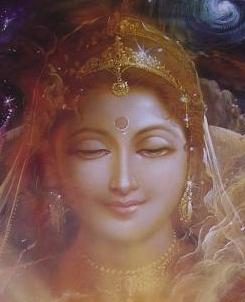
Mahadevi or"Great Goddess"Is a term
used to denote the Goddess or Devi that
is the sum of all other Devis. (Wikipedia)
[The Goddess distinguishes between nonconscious Maya and her own true Self as pure consciousness.]
2.11. [cont.] Since Maya is something we can perceive, it has the nature of nonconscious matter; since knowledge destroys it, it is not truly existent.
2.12. Consciousness is not something we can perceive; what we perceive is indeed nonconscious.
Consciousness is self-luminous; nothing else illuminates it.
2.13. It does not even illuminate itself, for that would lead to the fallacy of infinite regress.
As an agent and the object acted upon are distinct entities, so consciousness itself, like a lamp,
2.14. While shining brightly, illuminates what is other than itself. Know this, O Mountain,
For thus have I demonstrated that consciousness, belonging to my own nature, is eternal.
2.15. The visible world appears and disappears constantly in the various states of waking, dream, and deep sleep.
Pure consciousness never experiences such fluctuations.
2.16. Even if this consciousness itself became an object of perception, then the witness
Of that perception would abide as the real pure consciousness, as before.
2.17. And so those versed in religious treatises regarding the real declare consciousness to be eternal.
Its nature is bliss, for it is the object of supreme love.
2.18. The feeling, 'Let me not cease to be; let me exist forever,' is rooted in love for the Self.
Certainly there is no actual relation between me and all else, since all else is false.
2.19. Therefore I am regarded truly as an undivided whole.
And that consciousness is not an attribute of the Self,
for then the Self would be like an object.
2.20. In consciousness no possible trace of the object state can be found.
And so consciousness also has no attributes; consciousness is not a quality separate from consciousness itself.
2.21. Therefore the Self in essence is consciousness, and bliss as well, always.
It is the real and complete, beyond all relation, and free from the illusion of duality.
Comment
In the Sakta view, Maya is not simply an insentient force but a conscious and willful facet of the Goddess' personality. Somewhat paradoxically, it is the nondualist school of Advaita, emphasizing an acosmic view of reality and characterizing the realm of Maya as false, that often stresses the greatest difference between Maya and the supreme. Advaita objectifies Maya, viewing it as inert and insentient (jada), over against the supreme, conscious subject that is Brahman (or Atman). By way of contrast, the Devi-Bhagavata, more often than not presenting a Sakta viewpoint, asserts that Maya is"The very essence of the supreme Brahman (maya-para-brahma-svarupani)," and that"The world without Maya would ever be unconscious and inert (jada).”
The Goddess in the above verses of the Devi-Gita ignores for the moment the Sakta perspective, adopting a radical Advaita interpretation by drawing a sharp distinction between herself and Maya. This distinction as characterized here is somewhat at odds with the earlier notion of"difference and nondifference' as suggested by the substance/attribute analogies of verse 5. The Goddess now denies the"nondifference," utilizing standard Advaita visual images and metaphors that stress the"difference.”As the pure subject or consciousness (variously called caitanya, samvit, jnana, and cit), she likens herself to a lamp that is self-illuminating, revealing the visible realm that is Maya, the realm of inert, material objects (referred to as drsya," the seen," and as jada," inert, dull, insentient"). Pure consciousness itself is never an object of perception or knowledge, but is instead the eternal seer or witness (saksin), observing the ephemeral and false identities of empirical existence.
The Goddess here also denies that consciousness is an attribute of the Self-or herself-in accord with Advaitic principles affirming the radical oneness of the supreme subject, beyond all qualification or attribution (neti, neti). Only objects have qualities or attributes. Thus the Goddess does not possess consciousness but rather is consciousness.
C. MacKenzie Brown, The Devi Gita: The Song of the Goddess
State University of New York Press (September 1998) pp. 91-3

Andrew Cohen We, the Unbelievers
by Andrew Cohen
Enlightenment for the 21st Century
A couple of years ago, I discovered something shocking, extraordinary, and completely obvious: Most of us simply don't believe in the evolution of consciousness. And I don't just mean those who are convinced that God created the world in six days. I mean those of us who accept the theory of evolution and who are, at least to some degree, aware of the multidimensional nature of its manifestation all around us. We believe in cosmological evolution and understand that we live not in a static universe but in one that is part and parcel of a deep-time developmental process. We don't doubt that the universe was born many billions of years ago in a blinding flash of light and energy. We believe in biological evolution and have little difficulty comprehending how life itself has evolved from lower levels of development like worms and butterflies to higher ones like dolphins and humans. And many of us even recognize that culture evolves over time and see that development as the expression, at a collective level, of our human capacity for greater and greater complexity and integration. We believe in the evolutionary process because in so, so many ways we can see it all around us: moving, stretching, changing, reaching, from life to death to new life. But when it comes to consciousness—especially our own—I have discovered that our conviction in that same process is often nowhere to be found.
We believe in evolution as an objective fact of life and of the creative process but not necessarily as a living potential inherent in our own subjective experience. It stunned me when I first realized that even many of us who are already dedicated seekers never consider that our very own consciousness, our deepest sense and experience of our self, could actually evolve and develop. It must be because it is such a quantum leap for the subject to become the object—for consciousness to become the object of its own attention and intention. I'm not just speaking about awakening to the experience or fact of consciousness at the level of pure subjectivity, which is what the spiritual experience is typically all about. I'm pointing to something even more difficult to grasp, which is the living potential inherent in consciousness itself for development and growth.
So what does this mean? It means that the feeling/knowing experience of being ourselves can evolve, change, and develop in ways we simply cannot imagine. What is it like for consciousness to evolve? We cannot picture it in the eye of our mind because such development is a journey from the gross to the subtle and is unreachable with thought. How can we possibly imagine that which we cannot conceptualize?
We can imagine our own development as long as we can objectify it with thought. For example, we can imagine ourselves losing weight and building muscle. We can imagine ourselves learning algebra, Chinese, or how to play the guitar. We can even imagine ourselves becoming less selfish and more compassionate. But we simply cannot imagine our own self evolving at the level of consciousness itself. It is important to recognize what an alien concept this actually is in our culture. We are almost never encouraged to grapple with our own evolutionary potential at such a fundamental level, and as a result, most of us have never even considered it. Think about it, just for a moment: What would it be like for my self to evolve in its very essence? What would it be like to develop and grow at a level so profound that I would never be able to see it and yet others would be able to recognize its expression? If we can even begin to look deeply into this question, mysteriously, we will already be participating in the very evolution of consciousness I've been speaking about. And if we pursue it wholeheartedly, we will be helping to make conscious a miraculous process that was born many billions of years ago in a flash of light and energy and is only now beginning to awaken to itself, through us.
Andrew Cohen, founder and editor-in-chief of What Is Enlightenment? has been a spiritual teacher since 1986 and is the author of numerous books, including Living Enlightenment and Embracing Heaven & Earth.
Dennis Choptiany, Markham, Canada:"It can be argued that the most profound creation that humans have made is God. With it came the formation of a vast number of religions and their destructive divisions and conflicts. In your opinion, why do people have an apparent 'need' for religion and why have religions flourished even today when there is more and more evidence of the validity of agnostic and atheist views?”

Deepak Chopra:"Religions have an appeal because human beings have the fear of mortality. All religions promise eternal life. In the absence of profound knowledge of the workings of the universe, we rely on so-called religious authority to answer the deepest questions of our existence: who am I, where did I come from, what's the meaning and purpose of existence, do I have a soul, what happens to me after I die, does God exist, and if God exists does God care about me personally.
Unfortunately, religious ideology, dogma and belief systems are no longer congruent with what we know about the workings of the universe. They are inconsistent with our insights from modern cosmology, evolution, biology and the sciences. Hence, religious based on primitive belief (and unfortunately, all of them are based on primitive beliefs) have become quarrelsome, divisive and frequently idiotic.
However, consciousness still remains a mystery. Is our consciousness an emergent property of our biology or is consciousness the ground of existence that differentiates itself and projects itself as reality? This is not a settled issue. The current atheists and agnostics, such as Richard Dawkins, for example, are espousing an old fashioned 19th century atheism. The god they attack can not be defended. My hope is that as science progresses and looks at the mystery of consciousness we will see the emergence of a new spirituality that is secular and scientific and still addresses our deepest longings and our most important existential dilemmas.”
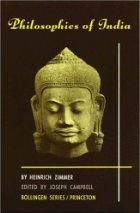
"For where dwell the gods to whom we can uplift our hands, send forth our prayers, and make oblation? Beyond the Milky Way are only island universes, galaxy beyond galaxy in the infinitudes of space — no realm of angels, no heavenly mansions, no choirs of the blessed surrounding a divine throne of the Father, revolving in beatific consciousness about the axial mystery of the Trinity. Is there any region left in all these great reaches where the soul on its quest might expect to arrive at the feet of God, having become divested of its own material coil? Or must we now turn rather inward, seek the divine internally, in the deepest vault, beneath the floor; hearken within for the secret voice that is both commanding and consoling; draw from inside the grace which passeth all understanding?”
Heinrich Zimmer, Philosophies of India
Princeton University Press, 1974, p. 13
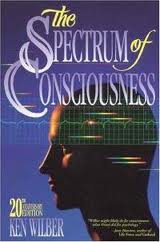
"It has been almost twenty years since I wrote Spectrum, and the intervening two decades have convinced me more than ever of the correctness of its essential message: being and consciousness exist as a spectrum, reaching from matter to body to mind to soul to Spirit. And although Spirit is, in a certain sense, the highest dimension or level of the spectrum of existence, it is also the ground or condition of the entire spectrum. It is as if Spirit were both the highest rung on the ladder of existence and the wood out of which the entire ladder is made — Spirit is both totally and completely immanent (as the wood) and totally and completely transcendent (as the highest rung.) Spirit is both Ground and Goal ... The realization of our Supreme Identity with Spirit dawns only after much growth, much development, much evolution, and much inner work ... only then do we understand that the Supreme Identity was there, from the beginning, perfectly given in its fullness.”
Ken Wilber, The Spectrum of Consciousness
Quest Books, 1993, p. xvi.
Vedanta and Consciousness
The Vedantic concept of consciousness is somewhat different from the every-day, Western concept. In the West, what usually is referred to as consciousness is more likely to be called awareness. In Vedanta consciousness is omnipresent and objectless. There is consciousness behind everything — be it a human, an animal or a stone — but a stone has no awareness and the awareness of an animal is very limited. Likewise, the awareness of humans can be more or less limited. Consciousness is static and forever unchanging, but awareness is dynamic and may undergo changes. Consciousness is the same in all humans and interconnects all humanity. While consciousness is undivided and without limits, awareness may be limited and differ from person to person.
The Ultimate Reality is characterized by three concepts — absolute being, absolute consciousness and absolute bliss. Nevertheless, the Ultimate Reality is beyond these and any other human conceptions — It is objectless, omnipresent, all-pervasive, eternal, infinite, unchanging, motionless and without any form. Often, the Ultimate Reality is referred to as a cosmic ocean of consciousness.”
Steen Ingemann, Guide to Ultimate Reality (www.rishi.dk/guide/)
4) Sri Cidagni-Kunda-sambhuta
— Born from the Pit of the Fire of Consciousness.
— Burns out ignorance and confers Immortality.
— She who rose from the fire of knowledge and is the ultimate truth.
68) Sri Chakra-raja-ratha-rudha-sarvayudha-pariskrta
— Mounted on Sri Chakra inside body with all weapons i.e. Powers.
— Enlightens mind to realise Ultimate Reality as an All Pervading-Consciousness.
207) Sri Manonmani
— Highest state of Consciousness.
— Secret name of Sri Durga.
367) Sri Pratyak-Chiti-Rupa
— Inner Consciousness or Knowledge.
404) Sri Bhakta-harda-tamo-bheda-bhanumad-bhanu- santaih
— Effulgence of the Sun; dispels Darkness of Ignorance.
— Giver of the Vision of the Ocean of Consciousness.
573) Sri Prajnana Ghana-rupini
— Supreme Wisdom
— State of Consciousness where nothing else is experienced except Self. —"Like the taste of salt in the sea (It) is everywhere; Prajnana is All Pervasive.”Brahadaranyaka Upanisad
669) Sri Annada
— The Giver of Food.
— Sustains Life and Consciousness.
739) Sri Layakari
—The Fifth State beyond Turiya.
—The State where individual and Cosmic Consciousness merge.
807) Sri Param-dhama
— The Ultimate Light.
— The Ultimate Status
— 'Yadgatva na nivartante taddhama paramam mama'
"The State of Consciousness from which there is no return is My Ultimate State.” (Bha. Gi. 16-6)
854) Sri Gambhira
— The Bottomless Lake.
—"The Ultimate Mother is to be visualised as a great and deep lake of Consciousness, uncomprehended by Space and Time.”Siva Sutra 1.23
858) Sri Kalpana-rahita
— Pure Consciousness.
907) Sri Tattvamayi
— The Mother of the Ultimate State of Consciousness.
Sri Lalita Sahasranama,
C. S. Murthy, Assoc. Advertisers and Printers, 1989.
369) Sri Para Devata
— The Ultimate Godhead.
Sri Lalita Sahasranama
If you neglect Me, O King of the Mountain,
You cannot attain the pure rest of the Supreme Nirvana,
Therefore seek refuge in Me as One, as many, or as combined;
Thus worshipping Me, O great King, you will attain that state.
Kurma Purana
(source: R. A. Sastry, Lalita-Sahasranama, The Adyar Library and Research Centre, Madras, 1988.)
372) Sri Bhakta-Manasa-Hamsika
— The Female Swan in the Mind; dwells in devotee's mind.
Sri Lalita Sahasranama
"The Human Mind
In Vedanta, the mind is regarded as a conscious force which manifests itself as intellect, will, ego and memory. The mind is called intellect, when it is concerned with discrimination, decision or bringing knowledge. The mind is called will, when it, via the nervous system, forces the body or senses into activity. The mind is called ego, when it identifies itself with the body and senses and takes part in their troubles and pleasures. The mind is called memory, when it recalls earlier wishes, thoughts, actions, events etc.
The mind works from five different levels — the unconscious, the subconscious, the conscious, yoga-nidra and the superconscious level. Of these the first three reside in the chitta (or mind-stuff) which is a certain fine manifestation of the kundalini energy. The chitta is the reservoir for all impressions and the mind must always refer to the chitta to recall earlier wishes, thoughts, actions, events etc. The conscious level corresponds to the knowledge that can be recalled without deep thinking. Any active wish or thought leaves an impression in the chitta at the conscious level, but if not repeated the impression sinks down to the subconscious level. Here it remains for a while and can be recalled by deep thinking. If not recalled here, the impression sinks further down to the unconscious level, where it remains in a causal form. In the normal, awaken state the mind cannot recall impressions from the unconscious level but they may be recalled in dreams, instinctive actions, under inspiration or by certain unconscious habits. According to Vedanta, the two remaining levels, yoga-nidra and superconciousness, can only be (intentionally) accessed by those who have practiced the techniques of yoga and meditation. (Yoga-nidra is a state in which one is asleep but nevertheless is fully aware of the surroundings).
Like everything else, the mind is composed of the three gunas and is caused by their interactions. One guna always dominates the other two, and it is the dominating guna that determines the general state of a person's mind. A person, in which the tamas-guna is dominating, is confused and lives in darkness — tendency to anger, greed, hate, laziness etc. is prevailing. If the rajas-guna is the dominating, the person is very active and possesses a mixture of positive and negative tendencies. The rajas-guna person may lie, swindle and commit murder but for each such deed, he or she will feel deep regret and guilt. The rajas-guna either works towards tamas-guna suppressing sattva-guna, or works towards sattva-guna suppressing tamas-guna. When the sattva-guna is the dominating, the person is calm and peaceful and has a pure, powerful and concentrated mind. A sattva-guna person is always unselfish, truthful, fearless and wise.
Now, since the play of the gunas is a dynamical affair, it is always possible to change ones general state of mind. Actually, the various mind improving techniques — be they of ancient Eastern or modern Western origin — are essentially aimed at getting a hold of the rajas-guna and consciously ease it towards the sattva-guna — regardless of whether the originators and practioners may know it or not. — On the next couple of pages, the classical techniques of Eastern origin will be introduced. We shall not postulate that these are superior to the techniques of modern Western origin, but they certainly do have at least one great advantage — they have been developed and thoroughly tested for millennia by numerous practioners.”
Steen Ingemann, Guide to Ultimate Reality (www.rishi.dk/guide/)
373) Sri Kamesvara-Prananadi
— Life-breath of Sri Shiva.
—"Without Her, He is unable to move.”Saundhara-Lahari 1.
Sri Lalita Sahasranama
The guru, it is declared, is the very Lord himself.
To approach the guru, to worship the guru, is to approach the Lord, worship the Lord.
Why should the Lord choose to manifest through the guru,
Why should he not act directly?
Shiva is really all-pervading, above the mind, without features, imperishable... infinite;
How can such a one be worshipped?
That is why, out of compassion for his creatures,
He takes the form of the guru and, when so worshipped in devotion, Grants liberation and fulfillment.
Shiva has no binding form, Shiva is not perceivable by the human eye;
Therefore He protects the disciple conforming to Dharma in the form of the guru.
The guru is none other than the supreme Shiva enclosed in human skin;
He walks the earth, concealed, for bestowing grace on the good disciples....
To him who is loaded with sinful karma, the guru appears to be human;
But to him whose karma is auspicious, meritful, the guru appears as Shiva.
Kularnava Tantra 13
374) Sri Krtajna
— Witness and Judge of all.
Sri Lalita Sahasranama
Smaram yonim lakshmim trithayam idam adau tava manor
Nidhay'ike nitye niravadhi-maha-bhoga-rasikah;
Bhajanti tvam chintamani-guna-nibaddh'ksha-valayah
Sivagnau juhvantah surabhi-ghrta-dhara'huti-sataih.
Oh, mother who is ever present,
Those who realize the essence,
Of the limitless pleasure of the soul you give,
And who add the seed letter"Iim"of the god of love,
The seed letter"Hrim"of the goddess Bhuavaneswaree,
And the seed letter"Srim"of the goddess Lakhmi,
Which are the three letter triad,
Wear the garland of the gem of thoughts,
And offer oblations to the fire in triangle of Shiva,
With the pure scented ghee of the holy cow, Kamadhenu,
Several times and worship you.
Soundarya Lahari Verse 33
389) Sri Nirupama
— Unequalled.
Sri Lalita Sahasranama
Sariram twam sambhoh sasi-mihira-vakshoruha-yugam
Tav'tmanam manye bhagavati nav' atmanam anagham;
Atah seshah seshityayam ubhaya-saadharana taya
Sthitah sambandho vaam samarasa-parananda-parayoh.
Oh goddess supreme,
I always see in my minds eye,
That your body with sun and moon,
As busts is the body of Shiva,
And his peerless body with nine surrounding motes,
Is your body, my goddess.
And so the relation of," that which has",
And"he who has",
Becomes the one perfect relation of happiness,
And becomes equal in each of you.
Soundarya Lahari Verse 34
390) Sri Nirvana-sukha-dayini
— Giver of the Bliss of Liberation.
Sri Lalita Sahasranama
"Hindu tantric schools have in common an emphasis on the creative power of the universe, which they personify as a female divinity, Shakti. The source of all life and movement, tantrics believe that the mighty energy of Shakti can be utilized to reach the spiritual aim shared by other Hindus: the sublime condition of self-realization, variously known as MUKTI, MOKSHA, SAHAJ SAMADHI, etc.
In the symbolism of Hindu Tantra, everything arises from the union of the life force with pure consciousness. This merging of power and awareness is represented by the sexual intercourse of Shakti with the god Shiva. In each person's life, there is consciousness and energy. If these two factors can be brought together within oneself, one can achieve the profoundly energized meditative state, or samadhi, that leads to self-realization. The classical Hindu text, the Kulacudamani Tantra, advises," United with Shakti, be full of power.”
Unlike many other religious traditions, tantrics hold that the body is not merely an obstacle to spiritual progress, but the very vessel within which it takes place. Pleasurable sensations are not rejected, but harnessed in the cause of uniting Shakti and Shiva within oneself ... The delightful feelings of sex are considered a diluted form of the great bliss that accompanies self-realization...
A central feature of Hindu tantric theory is the idea that the physical body people perceive is only the heaviest, crudest aspect of the human form. There are many subtler structures and currents of activity which interpenetrate and interact with the coarse body. The main interfaces between the coarse and subtle physiologies are called CHAKRAS. The main chakras are arranged along a central channel, paralleling the spinal cord. At the base of this channel is the personal embodiment of the Shakti; at the top of one's head is the location of the Shiva. An important branch of tantra called KUNDALINI yoga aims to merge the two, thus producing samadhi, by causing the Shakti to rise through the central channel to the Shiva's domain.”
Leornard George, Ph.D., Alternative Realities
Facts on File, Inc., 1995, p. 274.
within this body are countless objects.
The Gurmukh attains Truth, and comes to see them.
Beyond the nine gates, the Tenth Gate is found, and liberation is obtained.
Sri Guru Granth Sahib (Maajh, Third Mehl, p. 110.)
Manas tvam vyoma tvam marud asi marut saarathir asi
Tvam aastvam bhoomis tvayi parinathayam na hi param;
Tvam eva svatmanam parinamayithum visva-vapusha
Chidanand'akaram Shiva-yuvati-bhaavena bibhrushe.
Mind you are, Ether you are,
Air you are, Fire you are,
Water you are, Earth you are,
And you are the universe, mother,
There is nothing except you in the world,
But to make believe your form as the universe,
You take the role of wife of Shiva,
And appear before us in the form of ethereal happiness.
Soundarya Lahari Verse 35
392) Sri Srikanthardha-saririni
— Half the body of Sri-kantha i.e. Siva. The equal status of Siva and Sakti are indicated by this name.
Sri Lalita Sahasranama
Even Siva by worshipping whom, by meditation, by the power of Yoga,
Becomes the Lord of the siddhis, and becomes half-female (ardhnarisvara)
Brahma Purana
In the beginning was Self alone...
He then divided Himself into two,
And thence arose husband and wife.
Vayu Purana
(source: R. A. Sastry, Lalita-Sahasranama, The Adyar Library and Research Centre, Madras, 1988.)
The powerful energy cannot be distinct from the substratum from which it arises.
The word Sakti meaning 'energy' is found in the Vedas,
Where its equivalent saci (Divine grace) represents divine energy.
It should be known that energy assumes various forms,
At the command of Him who is the maker of time, who is omniscient,
Who is Pure Consciousness itself, and by whom all this is ever enveloped.”
Svetasvatara Upanishad VI 2.
(source: Himalayan Academy, 1998, www.hinduismtoday.kauai.hi.us/)
Tavaagna chakrastham thapana shakthi koti dhyudhidharam,
Param shambhum vande parimilitha —paarswa parachitha
Yamaradhyan bhakthya ravi sasi suchinama vishaye
Niraalokeloke nivasathi hi bhalokha bhuvane
The one who worships Parameshwara,
Who has the luster of billions of moon and sun
And who lives in thine Agna chakra- the holy wheel of order,
And is surrounded by thine two forms,
On both sides,
Would forever live,
In that world where rays of sun and moon do not enter,
But which has its own luster,
And which is beyond the sight of the eye,
But is different from the world we see.
Soundarya Lahari Verse 36
396) Sri Paramesvari
— The Ultimate Ruler.
Sri Lalita Sahasranama
Vishuddhou the shuddha sphatika visadham vyoma janakam
Shivam seve devimapi siva samana vyavasitham
Yayo kaanthya sasi kirana saaroopya sarane
Vidhoo thantha dwarvantha vilamathi chakoriva jagathi
I bow before the Shiva,
Who is of the pure crystal form,
In thine supremely pure wheel
And who creates the principle of ether,
And to you my mother,
Who has same stream of thought as Him.
I bow before you both,
Whose moon like light,
Forever removes the darkness of ignorance,
Forever from the mind,
And which shines like the Chakora* bird,
Playing in the full moon light.
Soundarya Lahari Verse 37
397) Sri Mulaprakrtih
— The Original Nature.
Sri Lalita Sahasranama
Samunmeelath samvithkamala makarandhaika rasikam
Bhaje hamsadwandham kimapi mahatham maanasacharam
Yadhalapaa dhashtadasa gunitha vidhyaparinathi
Yadadhathe doshad gunamakhila madhbhaya paya eva
I pray before the swan couple,
Who only enjoy the honey,
From the fully open,
Lotus flowers of knowledge,
And who swim in the lake,
Which is the mind of great ones,
And also who can never be described.
From them come the eighteen arts,
And they differentiate the good from the bad,
Like the milk from water.
Soundarya Lahari Verse 38
400) Sri Vyapini
— All Pervading.
Sri Lalita Sahasranama
"In what does the Infinite rest?”
"In its own glory — nay, not even in that.
In the world it is said that cows and horses, elephants and gold,
Slaves, wives, fields, and houses are man's glory —
But these are poor and finite things.
How shall the Infinite rest anywhere but in itself?
"The infinite is below, above, behind, before, to the right, to the left.
I am all this. This Infinite is the Self.
The Self is below, above, behind, before, to the right, to the left.
I am all this.
One who knows, meditates upon, and realizes the truth of the Self,
Such a one delights in the Self, rejoices in the Self.
He becomes master of himself, master of all worlds.
Slaves are they who know not this truth.”
Chandogya Upanishad 7.23-25
Thava swadhishtane huthavahamadhishtaya niratham
Thameede sarvatha janani mahathim tham cha samayam
Yadhaloke lokan dhahathi mahasi krodha kalithe
Dhayardhra ya drushti sishiramupacharam rachayathi
Mother ,think and worship I ,of the fire,
In your holy wheel of Swadishtana,
And the Rudra who shines in that fire,
Like the destroying fire of deluge,
And you who shine there as Samaya.
When that angry fire of look of Rudhra,
Burns the world,
Then your look drenches it in mercy,
Which treats and cools it down.
Soundarya Lahari Verse 39
301. Hrim kari - She who makes the holy sound Hrim.
302. Harimathi - She who is shy.
303. Hrudya - She who is in the heart (devotees).
304. Heyopadeya varjitha - She who does not have aspects which can be accepted or rejected.
305. Raja rajarchitha - She who is being worshipped by king of kings .
306. Rakhini - She who is the queen of Kameshwara.
307. Ramya - She who makes others happy.
308. Rajeeva lochana - She who is lotus eyed.
309. Ranjani - She who by her red colour makes Shiva also red.
310. Ramani - She who plays with her devotees.
311. Rasya - She who feeds the juice of everything.
312. Ranath kinkini mekhala - She who wears the golden waist band with tinkling bells.
313. Ramaa - She who is like Lakshmi.
314. Raakendu vadana - She who has a face like the full moon.
315. Rathi roopa - She who attracts others with her features like Rathi (wife of God of love-Manmatha).
316. Rathi priya - She who likes Rathi.
317. Rakshaa kari - She who protects.
318. Rakshasagni - She who kills Rakshasas-ogres opposed to the heaven.
319. Raamaa - She who is feminine.
320. Ramana lampata - She who is interested in making love to her lord.
321. Kaamya - She who is of the form of love.
322. Kamakala roopa - She who is the personification of the art of love.
323. Kadambha kusuma priya - She who likes the flowers of Kadamba.
324. Kalyani - She who does good.
325. Jagathi kandha - She who is like a root to the world.
326. Karuna rasa sagara - She who is the sea of the juice of mercy.
327. Kalavathi - She who is an artist or she who has crescents.
328. Kalaalapa - She whose talk is artful.
329. Kaantha - She who glitters.
330. Kadambari priya - She who likes the wine called Kadambari or She who likes long stories.
331. Varadha - She who gives boons.
332. Vama nayana - She who has beautiful eyes.
333. Vaaruni madha vihwala - She who gets drunk with the wine called varuni (The wine of happiness).
334. Viswadhika - She who is above all universe.
335. Veda vedya - She who can be understood by Vedas.
336. Vindhyachala nivasini - She who lives on Vindhya mountains.
337. Vidhatri - She who carries the world.
338. Veda janani - She who created the Vedas.
339. Vishnu maya - She who lives as the Vishnu maya.
340. Vilasini - She who enjoys love making.
341. Kshetra swaroopa - She who is personification of the Kshetra or body.
342. Kshetresi - She who is goddess of bodies.
343. Kshethra kshethragna palini - She who looks after bodies and their lord.
344. Kshaya vridhi nirmuktha - She who neither decreases or increases.
345. Kshetra pala samarchitha - She who is worshipped by those who look after bodies.
346. Vijaya - She who is always victorious.
347. Vimala - She who is clean of ignorance and illusion.
348. Vandhya - She who is being worshipped by every body.
349. Vandharu jana vatsala - She who has affection towards all those who worship her.
350. Vaag vadhini - She who uses words with great effect in arguments.
351. Vama kesi - She who has beautiful hair.
352. Vahni mandala vaasini - She who lives in the universe of fire which is Mooladhara.
353. Bhakthi mat kalpa lathika - She who is the wish giving creeper Kalpaga.
354. Pasu pasa vimochani - She who removes shackles from the living.
355. Samhrutha sesha pashanda - She who destroys those people who have left their faith.
356. Sadachara pravarthika - She who makes things happen through good conduct.
357. Thapatryagni santhaptha samahladahna chandrika - She who is like the pleasure giving moon to those who suffer from the three types of pain.
358. Tharuni - She who is ever young.
359. Thapasa aradhya - She who is being worshipped by sages.
360. Thanu Madhya - She who has a narrow middle (hip).
361. Thamopaha - She who destroys darkness.
362. Chithi - She who is personification of wisdom.
363. Thatpada lakshyartha - She who is the indicative meaning of the word"thath"Which is the first word of vedic saying"that thou art.”
364. Chidekara swaroopini - She who is wisdom through out.
365. Swathmananda lavi bhootha brahmadyanantha santhathi - She who in her ocean of wisdom makes Wisdom about Brahmam look like a wave.
366. Paraa - She who is the outside meaning of every thing.
367. Prathyak chidi roopa - She who makes us look for wisdom inside.
368. Pasyanthi - She who sees everything within herself.
369. Para devatha - She who gives power to all gods.
370. Madhyama - She who is in the middle of everything.
371. Vaikhari roopa - She who is of the form with words.
372. Bhaktha manasa hamsikha - She who is like a swan in the lake called mind.
373. Kameshwara prana nadi - She who is the life source of Kameswara.
374. Kruthagna - She who watches all actions of every one or She who knows all.
375. Kama poojitha - She who is being worshipped by the god of love in the kama giri peeta of Mooladhara chakra-Kama.
376. Srungara rasa sampoorna - She who is lovely.
377. Jayaa - She who is personification of victory.
378. Jalandhara sthitha - She who is on Jalandhara peetha or She who is purest of the pure.
379. Odyana peeda nilaya - She who is on Odyana peetha or She who lives in orders.
380. Bindu mandala vaasini - She who lives in the dot in the center of Srichakra.
381. Raho yoga kramaradhya - She who can be worshipped by secret sacrificial rites.
382. Rahas tarpana tarpitha - She who is pleased of chants knowing its meaning.
383. Sadya prasadini - She who is pleased immediately.
384. Viswa sakshini - She who is the witness for the universe.
385. Sakshi varjitha - She who does not have witness for herself.
386. Shadanga devatha yuktha -"She who has her six parts as gods viz., heart, head, hair. Battle dress, eyes and arrows.”
387. Shadgunya paripooritha -"She who is full of six characteristics viz., wealth, duty, fame, knowledge, assets and renunciation.”
388. Nithya klinna - She in whose heart there is always mercy.
389. Nirupama - She who does not have anything to be compared to.
390. Nirvanasukha dayini - She who gives redemption.
391. Nithya shodasika roopa - She who is of the form sixteen goddesses.
392. Sri kandartha sareerini - She who occupies half the body of Lord Shiva.
393. Prabhavathi - She who is lustrous of supernatural powers.
394. Prabha roopa - She who is personification of the light provided by super natural powers.
395. Prasiddha - She who is famous.
396. Parameshwari - She who is the ultimate goddess.
397. Moola prakrithi - She who is the root cause.
398. Avyaktha - She who is not clearly seen.
399. Vyktha Avyaktha swaroopini - She who is visible and not visible.
400. Vyapini - She who is spread everywhere.
www.starsai.com/lalithambigai-goddess-lalithasahasranamam.html

This religious perspective differentiates gnosticism not only from orthodoxy, but also, for all the similarities, from psychotherapy, for most members of the psychotherapeutic profession follow Freud in refusing to attribute real existence to the figments of imagination. They do not regard their attempt to discover what is within the psyche as equivalent to discovering the secrets of the universe. But many gnostics, like many artists, search for interior self-knowledge as the key to understanding universal truths —"Who are we, where we came from., where we go.”According to the Book of Thomas the Contender," whoever has not known himself has known nothing, but he who has known himself has at the same time already achieved knowledge about the depths of all things.”
This conviction — that whoever explores human experience simultaneously discovers divine reality — is one of the elements that marks gnosticism as a distinctly religious movement. Simon Magus, Hippolytus reports, claimed that each human being is a dwelling place," and that in him dwells an infinite power ... the root of the universe.”..
How is one to realize that potential? Many of the gnostic sources cited so far contain only aphorisms directing the disciple to search for knowledge, but refrain from telling anyone how to search.”
Elaine Pagels, The Gnostic Gospels
House Inc. New York, 1989, p. 134
"You don't need special robes to commune with the divine. By awakening an ancient archetype within you, you can take the first steps on a powerful new spiritual path.”
Jalaja Bonheim, Ph. D., New Age, May/June 1999
"Pain exists only to the extent to which experience is referred to the human personality regarded as identical with purusha, with the Self. But since this relation is illusory, it can easily be abolished. When purusha is known, values are annulled; pain is no longer either pain or nonpain, but a simple fact; a fact that, while it preserves its sensory structure, loses its value, its meaning. This point should be thoroughly understood, for it is of capital importance in Samkhya and Yoga and, in our opinion, has not been sufficiently emphasized. In order to deliver us from suffering, Samkhya and Yoga deny suffering as such, thus doing away with all relation between suffering and the Self. From the moment we understand that the Self is free, eternal, and inactive, whatever happens to us—sufferings, feelings, volitions, thoughts, and so on—no longer belongs to us.”
Eliade, M. Yoga, Immortality and Freedom
"Mysticism occurs in most, if not all, the religions of the world, although its importance within each varies greatly. The criteria and conditions for mystical experience vary depending on the tradition, but three attributes are found almost universally. First, the experience is immediate and overwhelming, divorced from the common experience of reality. Second, the experience or the knowledge imparted by it is felt to be self-authenticating, without need of further evidence or justification. Finally, it is held to be ineffable, its essence incapable of being expressed or understood outside the experience itself...
William James suggested that it may be an extension of the ordinary fields of human consciousness. The philosopher Henri Bergson considered intuition to be the highest state of human knowing and mysticism the perfection of intuition.”
Willem A. Bijlefeld, Professsor of Islamic Studies,
The Hartford Seminary Foundation, Hartford, Conn.
"Vedas (Sk.). The"revelation", the scriptures of the Hindus, from the root vid," to know", or"divine knowledge.” They are the most ancient as well as the most sacred of the Sanskrit works.
The Vedas—on the date and antiquity of which no two Orientalists can agree, are claimed by the Hindus themselves, whose Brahmans and Pundits ought to know best about their own religious works, to have been first taught orally for thousands of years and then compiled on the shores of Lake Manasa-Sarovara (phonetically, Mansarovara) beyond the Himalayas, in Tibet. When was this done? While their religious teachers, such as Swami Dayanand Saraswati, claim for them an antiquity of many decades of ages, our modern Orientalists will grant them no greater antiquity in their present form than about between 1,000 and 2,000 B.C. As compiled in their final form by Veda-Vyasa, however, the Brahmans themselves unanimously assign 3,100 years before the Christian era, the date when Vyasa flourished. Therefore the Vedas must be as old as this date. But their antiquity is sufficiently proven by the fact that they are written in such an ancient form of Sanskrit, so different from the Sanskrit now used, that there is no other work like them in the literature of this eldest sister of all the known languages, as Prof. Max Muller calls it. Only the most learned of the Brahman Pundits can read the Vedas in their original. It is urged that Colebrooke found the date 1400 B.C. corroborated absolutely by a passage which he discovered, and which is based on astronomical data. But if, as shown unanimously by all the Orientalists and the Hindu Pundits also, that (a) the Vedas are not a single work, nor yet any one of the separate Vedas; but that each Veda, and almost every hymn and division of the latter, is the production of various authors; and that (b) these have been written (whether as sruti," revelation", or not) at various periods of the ethnological evolution of the Indo-Aryan race, then—what does Mr. Colebrooke's discovery prove? Simply that the Vedas were finally arranged and compiled fourteen centuries before our era; but this interferes in no way with their antiquity. Quite the reverse; for, as an offset to Mr. Colebrooke's passage, there is a learned article, written on purely astronomical data by Krishna Shastri Godbole (of Bombay), which proves as absolutely and on the same evidence that the Vedas must have been taught at least 25,000 years ago. (See Theosophist, Vol. II., p. 238 et seq., Aug., 1881.) This statement is, if not supported, at any rate not contradicted by what Prof. Cowell says in Appendix VII., of Elphinstone's History of India: "There is a difference in age between the various hymns, which are now united in their present form as the Sanhita of the Rig-Veda: but we have no data to determine their relative antiquity, and purely subjective criticism, apart from solid data, has so often failed in other instances, that we can trust but little to any of its inferences in such a recently opened field of research as Sanskrit literature. [Not a fourth part of the Vaidik literature is as yet in print, and very little of it has been translated into English (1866).] The still unsettled controversies about the Homeric poems may well warn us of being too confident in our judgments regarding the yet earlier hymns of the Rig-Veda... . When we examine these hymns ... they are deeply interesting for the history of the human mind, belonging as they do to a much older phase than the poems of Homer or Hesiod.”The Vedic writings are all classified in two great divisions, exoteric and esoteric, the former being called Karma-Kanda," division of actions or works", and the Jnana-Kanda," division of (divine) knowledge", the Upanishads (q.v.) coming under this last classification. Both departments are regarded as Sruti or revelation. To each hymn of the Rig-Veda, the name of the Seer or Rishi to whom it was revealed is prefixed. It, thus, becomes evident on the authority of these very names (such as Vasishta, Viswamitra, Narada, etc.), all of which belong to men born in various manvantaras and even ages, that centuries, and perhaps millenniums, must have elapsed between the dates of their composition.”
www.theosophy-nw.org/
Disclaimer: Our material may be copied, printed and distributed by referring to this site. This site also contains copyrighted material the use of which has not always been specifically authorized by the copyright owner. We are making such material available to our readers under the education and research provisions of "fair use" in an effort to advance freedom of inquiry for a better understanding of religious, spiritual and inter-faith issues. The material on this site is distributed without profit. If you wish to use copyrighted material for purposes other than "fair use" you must request permission from the copyright owner.
 SHRI LALITA SAHASRANAMA 301-400