The Book Of Enlightenment
Of the many divine revelations July 23, 1994 stands out. On that day Kash asked, “Shri Mataji, what was Your original name?” The eternal, stunningly beautiful Mother replied: “Shri Lalita Devi”.“Now the name Nirmala itself means immaculate; means the one who is the cleansing power and the name of the Goddess also. My actual sign name is Lalita who is the name of the Primordial Mother. That is the name of the Primordial Mother.”
Shri Mataji, New York, USA, 30 September 1981
Sri Lalita Sahasranama 401-500
404) Sri Bhakta-harda-tamo-bheda-bhanumad-bhanu- santaih
— Effulgence of the Sun; dispels Darkness of Ignorance.
— Giver of the Vision of the Ocean of Consciousness.
Sri Lalita Sahasranama
C. S. Murthy, Associate Advertisers and Printers, 1989
"I should say"goddess-like"power, of course, for the original sacrifice, upon which recorded history proceeds, is the sacrifice of women's power as creatrix, seer, world-weaver and world-spinner, magical bringer of life and, therefore, of death. The original murder is not of brother by brother, as the Old Testament would have us believe, but of The Mother by her sons, and, by the ineffectiveness of their resistance, by her daughters, too. And the great redemptive act is not the sacrifice upon the cross of the son by the father as the New Testament tells us, for this event prefigures the exact apocalypse we must avoid. The great redemptive act is the defense of The Mother by her children, the reinstatement into the world of the feminine principle of warm nurture, welcome generation and also contact with the irrational, instinctual, untamable mysteries of the unconscious mind — those forces which, when ignored within us, become the so-called evil against which all holy or patriotic wars are waged. But how, I wonder, are we to accomplish such a feat as this?”
Karen Malpede, A Talk for the Conference on Feminism & Militarism (April 1981.)
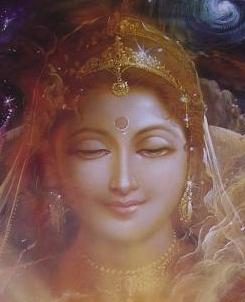
Mahadevi or"Great Goddess"Is a term
used to denote the Goddess or Devi that
is the sum of all other Devis. (Wikipedia)
[The Goddess distinguishes between nonconscious Maya and her own true Self as pure consciousness.]
2.11. [cont.] Since Maya is something we can perceive, it has the nature of nonconscious matter; since knowledge destroys it, it is not truly existent.
2.12. Consciousness is not something we can perceive; what we perceive is indeed nonconscious.
Consciousness is self-luminous; nothing else illuminates it.
2.13. It does not even illuminate itself, for that would lead to the fallacy of infinite regress.
As an agent and the object acted upon are distinct entities, so consciousness itself, like a lamp,
2.14. While shining brightly, illuminates what is other than itself. Know this, O Mountain,
For thus have I demonstrated that consciousness, belonging to my own nature, is eternal.
2.15. The visible world appears and disappears constantly in the various states of waking, dream, and deep sleep.
Pure consciousness never experiences such fluctuations.
2.16. Even if this consciousness itself became an object of perception, then the witness
Of that perception would abide as the real pure consciousness, as before.
2.17. And so those versed in religious treatises regarding the real declare consciousness to be eternal.
Its nature is bliss, for it is the object of supreme love.
2.18. The feeling, 'Let me not cease to be; let me exist forever,' is rooted in love for the Self.
Certainly there is no actual relation between me and all else, since all else is false.
2.19. Therefore I am regarded truly as an undivided whole.
And that consciousness is not an attribute of the Self,
for then the Self would be like an object.
2.20. In consciousness no possible trace of the object state can be found.
And so consciousness also has no attributes; consciousness is not a quality separate from consciousness itself.
2.21. Therefore the Self in essence is consciousness, and bliss as well, always.
It is the real and complete, beyond all relation, and free from the illusion of duality.
Comment
In the Sakta view, Maya is not simply an insentient force but a conscious and willful facet of the Goddess' personality. Somewhat paradoxically, it is the nondualist school of Advaita, emphasizing an acosmic view of reality and characterizing the realm of Maya as false, that often stresses the greatest difference between Maya and the supreme. Advaita objectifies Maya, viewing it as inert and insentient (jada), over against the supreme, conscious subject that is Brahman (or Atman). By way of contrast, the Devi-Bhagavata, more often than not presenting a Sakta viewpoint, asserts that Maya is"The very essence of the supreme Brahman (maya-para-brahma-svarupani)," and that"The world without Maya would ever be unconscious and inert (jada).”
The Goddess in the above verses of the Devi-Gita ignores for the moment the Sakta perspective, adopting a radical Advaita interpretation by drawing a sharp distinction between herself and Maya. This distinction as characterized here is somewhat at odds with the earlier notion of"difference and nondifference' as suggested by the substance/attribute analogies of verse 5. The Goddess now denies the"nondifference," utilizing standard Advaita visual images and metaphors that stress the"difference.”As the pure subject or consciousness (variously called caitanya, samvit, jnana, and cit), she likens herself to a lamp that is self-illuminating, revealing the visible realm that is Maya, the realm of inert, material objects (referred to as drsya," the seen," and as jada," inert, dull, insentient"). Pure consciousness itself is never an object of perception or knowledge, but is instead the eternal seer or witness (saksin), observing the ephemeral and false identities of empirical existence.
The Goddess here also denies that consciousness is an attribute of the Self-or herself-in accord with Advaitic principles affirming the radical oneness of the supreme subject, beyond all qualification or attribution (neti, neti). Only objects have qualities or attributes. Thus the Goddess does not possess consciousness but rather is consciousness.
C. MacKenzie Brown, The Devi Gita: The Song of the Goddess
State University of New York Press (September 1998) pp. 91-3

Andrew Cohen We, the Unbelievers
by Andrew Cohen
Enlightenment for the 21st Century
A couple of years ago, I discovered something shocking, extraordinary, and completely obvious: Most of us simply don't believe in the evolution of consciousness. And I don't just mean those who are convinced that God created the world in six days. I mean those of us who accept the theory of evolution and who are, at least to some degree, aware of the multidimensional nature of its manifestation all around us. We believe in cosmological evolution and understand that we live not in a static universe but in one that is part and parcel of a deep-time developmental process. We don't doubt that the universe was born many billions of years ago in a blinding flash of light and energy. We believe in biological evolution and have little difficulty comprehending how life itself has evolved from lower levels of development like worms and butterflies to higher ones like dolphins and humans. And many of us even recognize that culture evolves over time and see that development as the expression, at a collective level, of our human capacity for greater and greater complexity and integration. We believe in the evolutionary process because in so, so many ways we can see it all around us: moving, stretching, changing, reaching, from life to death to new life. But when it comes to consciousness—especially our own—I have discovered that our conviction in that same process is often nowhere to be found.
We believe in evolution as an objective fact of life and of the creative process but not necessarily as a living potential inherent in our own subjective experience. It stunned me when I first realized that even many of us who are already dedicated seekers never consider that our very own consciousness, our deepest sense and experience of our self, could actually evolve and develop. It must be because it is such a quantum leap for the subject to become the object—for consciousness to become the object of its own attention and intention. I'm not just speaking about awakening to the experience or fact of consciousness at the level of pure subjectivity, which is what the spiritual experience is typically all about. I'm pointing to something even more difficult to grasp, which is the living potential inherent in consciousness itself for development and growth.
So what does this mean? It means that the feeling/knowing experience of being ourselves can evolve, change, and develop in ways we simply cannot imagine. What is it like for consciousness to evolve? We cannot picture it in the eye of our mind because such development is a journey from the gross to the subtle and is unreachable with thought. How can we possibly imagine that which we cannot conceptualize?
We can imagine our own development as long as we can objectify it with thought. For example, we can imagine ourselves losing weight and building muscle. We can imagine ourselves learning algebra, Chinese, or how to play the guitar. We can even imagine ourselves becoming less selfish and more compassionate. But we simply cannot imagine our own self evolving at the level of consciousness itself. It is important to recognize what an alien concept this actually is in our culture. We are almost never encouraged to grapple with our own evolutionary potential at such a fundamental level, and as a result, most of us have never even considered it. Think about it, just for a moment: What would it be like for my self to evolve in its very essence? What would it be like to develop and grow at a level so profound that I would never be able to see it and yet others would be able to recognize its expression? If we can even begin to look deeply into this question, mysteriously, we will already be participating in the very evolution of consciousness I've been speaking about. And if we pursue it wholeheartedly, we will be helping to make conscious a miraculous process that was born many billions of years ago in a flash of light and energy and is only now beginning to awaken to itself, through us.
Andrew Cohen, founder and editor-in-chief of What Is Enlightenment? has been a spiritual teacher since 1986 and is the author of numerous books, including Living Enlightenment and Embracing Heaven & Earth.
Dennis Choptiany, Markham, Canada:"It can be argued that the most profound creation that humans have made is God. With it came the formation of a vast number of religions and their destructive divisions and conflicts. In your opinion, why do people have an apparent 'need' for religion and why have religions flourished even today when there is more and more evidence of the validity of agnostic and atheist views?”

Deepak Chopra:"Religions have an appeal because human beings have the fear of mortality. All religions promise eternal life. In the absence of profound knowledge of the workings of the universe, we rely on so-called religious authority to answer the deepest questions of our existence: who am I, where did I come from, what's the meaning and purpose of existence, do I have a soul, what happens to me after I die, does God exist, and if God exists does God care about me personally.
Unfortunately, religious ideology, dogma and belief systems are no longer congruent with what we know about the workings of the universe. They are inconsistent with our insights from modern cosmology, evolution, biology and the sciences. Hence, religious based on primitive belief (and unfortunately, all of them are based on primitive beliefs) have become quarrelsome, divisive and frequently idiotic.
However, consciousness still remains a mystery. Is our consciousness an emergent property of our biology or is consciousness the ground of existence that differentiates itself and projects itself as reality? This is not a settled issue. The current atheists and agnostics, such as Richard Dawkins, for example, are espousing an old fashioned 19th century atheism. The god they attack can not be defended. My hope is that as science progresses and looks at the mystery of consciousness we will see the emergence of a new spirituality that is secular and scientific and still addresses our deepest longings and our most important existential dilemmas.”
"For where dwell the gods to whom we can uplift our hands, send forth our prayers, and make oblation? Beyond the Milky Way are only island universes, galaxy beyond galaxy in the infinitudes of space — no realm of angels, no heavenly mansions, no choirs of the blessed surrounding a divine throne of the Father, revolving in beatific consciousness about the axial mystery of the Trinity. Is there any region left in all these great reaches where the soul on its quest might expect to arrive at the feet of God, having become divested of its own material coil? Or must we now turn rather inward, seek the divine internally, in the deepest vault, beneath the floor; hearken within for the secret voice that is both commanding and consoling; draw from inside the grace which passeth all understanding?”
Heinrich Zimmer, Philosophies of India
Princeton University Press, 1974, p. 13
"It has been almost twenty years since I wrote Spectrum, and the intervening two decades have convinced me more than ever of the correctness of its essential message: being and consciousness exist as a spectrum, reaching from matter to body to mind to soul to Spirit. And although Spirit is, in a certain sense, the highest dimension or level of the spectrum of existence, it is also the ground or condition of the entire spectrum. It is as if Spirit were both the highest rung on the ladder of existence and the wood out of which the entire ladder is made — Spirit is both totally and completely immanent (as the wood) and totally and completely transcendent (as the highest rung.) Spirit is both Ground and Goal ... The realization of our Supreme Identity with Spirit dawns only after much growth, much development, much evolution, and much inner work ... only then do we understand that the Supreme Identity was there, from the beginning, perfectly given in its fullness.”
Ken Wilber, The Spectrum of Consciousness
Quest Books, 1993, p. xvi.
Vedanta and Consciousness
The Vedantic concept of consciousness is somewhat different from the every-day, Western concept. In the West, what usually is referred to as consciousness is more likely to be called awareness. In Vedanta consciousness is omnipresent and objectless. There is consciousness behind everything — be it a human, an animal or a stone — but a stone has no awareness and the awareness of an animal is very limited. Likewise, the awareness of humans can be more or less limited. Consciousness is static and forever unchanging, but awareness is dynamic and may undergo changes. Consciousness is the same in all humans and interconnects all humanity. While consciousness is undivided and without limits, awareness may be limited and differ from person to person.
The Ultimate Reality is characterized by three concepts — absolute being, absolute consciousness and absolute bliss. Nevertheless, the Ultimate Reality is beyond these and any other human conceptions — It is objectless, omnipresent, all-pervasive, eternal, infinite, unchanging, motionless and without any form. Often, the Ultimate Reality is referred to as a cosmic ocean of consciousness.”
Steen Ingemann, Guide to Ultimate Reality (www.rishi.dk/guide/)
4) Sri Cidagni-Kunda-sambhuta
— Born from the Pit of the Fire of Consciousness.
— Burns out ignorance and confers Immortality.
— She who rose from the fire of knowledge and is the ultimate truth.
68) Sri Chakra-raja-ratha-rudha-sarvayudha-pariskrta
— Mounted on Sri Chakra inside body with all weapons i.e. Powers.
— Enlightens mind to realise Ultimate Reality as an All Pervading-Consciousness.
207) Sri Manonmani
— Highest state of Consciousness.
— Secret name of Sri Durga.
367) Sri Pratyak-Chiti-Rupa
— Inner Consciousness or Knowledge.
404) Sri Bhakta-harda-tamo-bheda-bhanumad-bhanu- santaih
— Effulgence of the Sun; dispels Darkness of Ignorance.
— Giver of the Vision of the Ocean of Consciousness.
573) Sri Prajnana Ghana-rupini
— Supreme Wisdom
— State of Consciousness where nothing else is experienced except Self. —"Like the taste of salt in the sea (It) is everywhere; Prajnana is All Pervasive.”Brahadaranyaka Upanisad
669) Sri Annada
— The Giver of Food.
— Sustains Life and Consciousness.
739) Sri Layakari
—The Fifth State beyond Turiya.
—The State where individual and Cosmic Consciousness merge.
807) Sri Param-dhama
— The Ultimate Light.
— The Ultimate Status
— 'Yadgatva na nivartante taddhama paramam mama'
"The State of Consciousness from which there is no return is My Ultimate State.” (Bha. Gi. 16-6)
854) Sri Gambhira
— The Bottomless Lake.
—"The Ultimate Mother is to be visualised as a great and deep lake of Consciousness, uncomprehended by Space and Time.”Siva Sutra 1.23
858) Sri Kalpana-rahita
— Pure Consciousness.
907) Sri Tattvamayi
— The Mother of the Ultimate State of Consciousness.
Sri Lalita Sahasranama,
C. S. Murthy, Assoc. Advertisers and Printers, 1989.
414) Sri Sva-prakasa
— Self-Illuminated; nothing illuminates Her as She is 'Svayam-jyoti'.
Sri Lalita Sahasranama
"The true source of Light in the world of Reality is Allah, and anyone who cuts himself off from the Light is in utter darkness indeed, for it is the negation of the only true Light, and not merely relative darkness, like that which we see, say, in the shadow of the moonlight.”
Abdullah Yusuf Ali, The Holy Qur'an, Amana Corporation, 1989, p. 879.
Thatithwantham shakthya thimira paree pandhi sphuranaya
Sphuranna na rathnabharana pareenedwendra dhanusham
Thava syamam megham kamapi manipooraika sharanam
Nisheve varshantham haramihira thaptham thribhuvanam.
I bow before that principle,
Which is in your wheel of Manipooraka,
Which as Parashakthi shines like the enemy of darkness,
Which is with the streak of lightning,
Which is with the shining jewels of precious stones of lightning,
Which is also black as night,
Which is burnt by Rudhra like the sun of the deluge,
And which cools down the three worlds like a strange cloud.
Soundarya Lahari Verse 40
415)Sri Mano-vachamagochara
— Beyond grasp of mind and speech.
—"Where words turn back.” Annapurna Upanisad 2
Sri Lalita Sahasranama
I bow down to the supreme Isvari who transcends speech and mind and who can be grasped by the wisdom of the wise alone.
Visnu Purana
(source: R. A. Sastry, Lalita-Sahasranama, The Adyar Library and Research Centre, Madras, 1988.)
"Vedanta and Consciousness
The Vedantic concept of consciousness is somewhat different from the every-day, Western concept. In the West, what usually is referred to as consciousness is more likely to be called awareness. In Vedanta consciousness is omnipresent and objectless. There is consciousness behind everything — be it a human, an animal or a stone — but a stone has no awareness and the awareness of an animal is very limited. Likewise, the awareness of humans can be more or less limited. Consciousness is static and forever unchanging, but awareness is dynamic and may undergo changes. Consciousness is the same in all humans and interconnects all humanity. While consciousness is undivided and without limits, awareness may be limited and differ from person to person.
The Ultimate Reality is characterized by three concepts — absolute being, absolute consciousness and absolute bliss. Nevertheless, the Ultimate Reality is beyond these and any other human conceptions — It is objectless, omnipresent, all-pervasive, eternal, infinite, unchanging, motionless and without any form. Often, the Ultimate Reality is referred to as a cosmic ocean of consciousness.”
Steen Ingemann, Guide to Ultimate Reality (www.rishi.dk/guide/)
"II.27 tasya saptadha prantabhumih prajna
tasya it
saptadha sevenfold, of seven stages
prantabhumih territory, province, resting place,
prajna perfect knowledge, supreme knowledge, awareness, consciousness
Through this unbroken flow of discriminative awareness, one gains perfect knowledge which has seven sphers.
There are seven frontiers to be integrated between the seen (prakrti) and the seer (purusa). They are: integration of the body (sarira samyama), the senses (indriya samyama), energy (prana samyama), mind (mano samyama), intellect (buddhi samyama), consciousness (citta samyama) and soul (atma samyama), each realizing its own individual identity. Proficiency in yoga will bring this sevenfold knowledge.
According to Patanjali, the seven states of conscious awareness are:
emerging consciousness (vyutthana citta),
restraining consciousness (nirodha citta),
sprouted or individual consciousness (nirmana citta),
tranquil consciousness (prasanta citta),
attentive consciousness (ekagrata citta),
fissured or rent consciousness (chidra citta)
and ripe or pure consciousness (paripakva or divya citta)...
The seven states of awareness are variously described by different commentators. According to one version they are: what has to be known is known (parijnata prajna), what has to be discarded is discarded (heya ksina prajna), what has to be attained is attained (prapya prapti prajna), what has to be done is done (karya suddhi prajna), the aim which has to be reached is reached (caritadhikara prajna), no qualities (gunas) can taint the intelligence (gunatita prajna), and the knower is Self-illumined and maintain his inner light while attending to the duties of the world (svarupa matra jyoti prajna).
According to another version, they are: right desire (subheccha), right reflection (vicarana), disappearence of the mind (tanumanasa), Self-realization (sattvapatti), non-attachment (asamsakta), non-perception of objects (pararthabhavana), and the experiencing of a state beyond word (brahmavidvaristha).
The seven states can also be correlated with the wakeful (jagrata), dreamy (svapna), and sleepy (nidra) states, and the state of oneness with the Supreme Soul (turya); and the three intermediate states between them.
To simplify the meaning of this sutra for yoga practitioners, I would like to offer the following interpretation: knowledge of the body (sarira jnana), knowledge of energy (prajna jnana), control of the mind (mano jnana), stability in intelligence (vijnana jnana), knowledge gained by experience (anubhavika jnana), absorption of the various flavours that life offers (rasatmaka jnana), knowledge of the self (atma jnana).
In other words, by yogic practices, the sadhaka conquers his body, controls his energy, restrains the movements of the mind and develops sound judgment, from which he acts rightly and becomes luminous. From this luminosity he develops total awareness of the very core of his being, achieves supreme knowledge, and surrenders his self to the Supreme Soul, Paramatman.”
BKS Iyengar, Light on the Yoga Sutras of Patanjali,
HarperCollins Publishers, 1996, p. 130-32.)
419) Sri Jadatmika
— Entire Creation has no power of knowing Her.
Sri Lalita Sahasranama
Thavadhare mole saha samayaya lasyaparaya
Navathmanam manye navarasa maha thandava natam
Ubhabhya Methabhyamudaya vidhi muddhisya dhayaya
Sanadhabyam jagne janaka jananimatha jagathidam.
I pray in your holy wheel of Mooladhara,
You who likes to dance,
And calls yourself as Samaya,
And that Lord who performs the great vigorous dance,
Which has all the shades of nine emotions.
This world has you both as parents,
Because you in your mercy, wed one another,
To recreate the world,
As the world was destroyed in the grand deluge.
Soundarya Lahari Verse 41
423) Sri Dvija-Vrnda-nisevita
— Pacified by the twice-born.
Sri Lalita Sahasranama
This one Samdhya is to be worshipped by Devas, the twice-born and by great souls,
In sitting down, in lying down, in moving about, in eating and She is Renuka Herself.
Renuka Purana
(source: R. A. Sastry, Lalita-Sahasranama, The Adyar Library and Research Centre, Madras, 1988.)
Gathair manikyatvam gagana-manibhih-sandraghatitham.
Kiritam te haimam himagiri-suthe kirthayathi yah;
Sa nideyascchaya-cchurana-sabalam chandra-sakalam
Dhanuh saunasiram kim iti na nibadhnati dhishanam.
Hey daughter of the ice mountain,
He who chooses to describe,
Your crown ,bedecked with shining jewels,
Which are but the transformed form,
And arranged very close to one another,
Of the twelve holy suns,
Will see the crescent in your crown,
In the dazzling light of those jewels,
And think them as a rainbow,
Which is but the bow of Indra.
Soundarya Lahari Verse 42
429) Sri Panca-kosantara-sthita
— Unbounded Greatness.
— Limitless Power.
Sri Lalita Sahasranama
Dhunotu dhvaantam nas tulita-dalit'endivara-vanam
Ghana-snigdha-slakshnam chikura-nikurumbham thava sive;
Yadhiyam saurabhyam sahajamupalabdhum sumanaso
Vasanthyasmin manye vala-madhana-vaati-vitapinam.
Oh, Goddess , who is the consort of Shiva,
Let the darkness of our mind be destroyed,
By the crowning glory on your head,
Which is of like the forest of opened blue lotus flowers,
And which is soft , dense and shines with luster.
I believe my mother,
That the pretty flowers of Indra's Garden,
Are all forever there,
To get the natural scent of thine hair.
Soundarya Lahari Verse 43
442) Sri Kumara-gana-nathamba
— Mother of Sri Kumara and Sri Ganesha, Commanders-in-Chief of the Divine Forces.
Sri Lalita Sahasranama
That Mother, as is well-known, is in all beings in the form of understanding, fame, firmness, prosperity, energy, faith, intelligence and memory.
Padma Purana
(source: R. A. Sastry, Lalita-Sahasranama, The Adyar Library and Research Centre, Madras, 1988.)
Tanothu kshemam nas tava vadhana-saundarya lahari
Parivaha-sthrotah-saraniriva seemantha-saranih
Vahanti sinduram prabala-kabari-bhara-thimira-
Dvisham brindair bandi-krtham iva navin'rka kiranam;
Oh mother, let the line parting thine hairs,
Which looks like a canal,
Through which the rushing waves of your beauty ebbs,
And which on both sides imprisons,
Your Vermillion , which is like a rising sun
By using your hair which is dark like,
The platoon of soldiers of the enemy,
Protect us and give us peace.
Soundarya Lahari Verse 44
444) Sri Pustih
— Nourishment
—"Know food as Brahman.” Taittiriya Upanisad 3. 2
Sri Lalita Sahasranama
Aralaih swabhavyadalikalabha-sasribhiralakaih
Paritham the vakhtram parihasati pankheruha-ruchim;
Dara-smere yasmin dasana-ruchi-kinjalka-ruchire
Sugandhau madhyanti Smara-dahana-chaksur-madhu-lihah.
By nature slightly curled,
And shining like the young honey bees
Your golden thread like hairs,
Surround your golden face.
Your face makes fun of the beauty of the lotus.
And adorned with slightly parted smile,
Showing the tiers of your teeth,
Which are like the white tendrils,
And which are sweetly scented.
Bewitches the eyes of God,
Who burnt the god of love.
Soundarya Lahari Verse 45
457) Sri Mata
— Mother.
Sri Lalita Sahasranama
As She is The Mother of all mantras, hence, the supreme Isvari is called Matrka.
Su. Sam. (IV. 4. 18)
(source: R. A. Sastry, Lalita-Sahasranama, The Adyar Library and Research Centre, Madras, 1988.)
"The power or active aspect of the immanent God is Sakti. Sakti is the embodiment of power. She is the supporter of the vast universe. She is the supreme power by which the world is upheld. She is the Universal Mother. She is Durga, Kali, Chandi, Chamundi, Tripurasundari, Rajesvari. There is no difference between God and His Sakti, just as there is no difference between fire and its burning power.
He who worships Sakti, that is, God in Mother form, as the supreme power which creates, sustains and withdraws the universe, is a Sakta. All women are forms of the Divine Mother.
Siva is the unchanging consciousness. Sakti is His changing power which appears as mind and matter. Saktivada or Saktadarsana is a form of monism or Advaitavada.
A Sakta does Sadhana which helps the union of Siva and Sakti, through the awakening of the forces within the body. He becomes a Siddha in the Sadhana, when he is able to awaken Kundalini and pierce the six Chakras. This is to be done in a perfect practical way under the guidance of a Guru who has become perfect. The Sakti must be awakened by Dhyana, by Bhava, by Japa, by Mantra-Sakti. The Mother, the embodiment of the fifty letters, is present in the various letters in the different Chakras. When the chords of a musical instrument are struck harmoniously, fine music is produced. Even so, when the chords of the letters are struck in their order, The Mother who moves in the six Chakras and who is the very self of the letters, awakens Herself. The Sadhaka attains Siddhi easily when She is roused. It is difficult to say when and how She shows Herself and to what Sadhaka. Sadhana means unfolding, rousing up or awakening of power or Sakti. Mode of Sadhana depends upon the tendencies and capacities of the Sadhaka.
Sakti may be termed as that by which we live and have our being in this universe. In this world all the wants of the child are provided by The Mother. The child's growth, development and sustenance are looked after by The Mother. Even so, all the necessaries of life and its activities in this world and the energy needed for it, depend upon Sakti or the Universal Mother.
No one can free himself from the thraldom of mind and matter without Mother's grace. The fetters of Maya are too hard to break. If you worship Her as the great Mother, you can very easily go beyond Prakriti through Her benign grace and blessings. She will remove all obstacles in the path and lead you safely into the illimitable domain of eternal bliss and make you free. When She is pleased and bestows Her blessings on you, then alone you can free yourself from the bondage of this formidable Samsara.
The first syllable which a child or a quadruped utters is the name of the beloved mother. Is there any child which does not owe its all to the affection and love of its mother? It is The Mother who protects you, consoles you, cheers you and nurses you. She is your friend, philosopher, protector and guide throughout your life. Human mother is a manifestation of the Universal Mother.”
Sri Swami Sivananda, Divine Life Society
"ShAkta Agamas:
ShAkta Agamas are usually known as Tantras. Most of them are in the form of a dialogue between Shiva and Parvati. They recommend worship of Shakti, which is the worshipping the Supreme Brahman as the female principle. There are three main sub-schools of Tantric path: Kaula, Mishra and Samaya. Samaya-Achara concentrates on the efficient method of worshipping the goddess as the Divine Mother. Some of the important works in this field are: Tantraraja Tantra, Subha-Agama-Panchaka and Parasurama Kalpa-sUtra.
Even the Soundarya-lahari attributed to Acharya Sri Shankara falls in this field of Agama. She is the only Reality which pervades the whole universe. The attitude of forgiveness, compassion and affection are very natural to a mother. She is The Mother of the whole universe. She is worshipped as Mahashakti, Tripura-sundari and Sri Lalita.”
Shikaripura Harihareswara
(HOYSALA@worldnet.att.net) Thursday, 21 Aug 1997)
Lalatam lavanya-dyuthi-vimalamaabhati tava yath
Dvithiyam tan manye makuta-ghatitham chandra-sakalam;
Viparyasa-nyasad ubhayam api sambhuya cha mithah
Sudhalepa-syutih pareenamati raka-himakarah.
I suspect oh, mother,
That your forehead,
Which shines with the beauty of the moon,
Is but an imprisoned half moon,
By your glorious crown,
For If joined opposite
To the inverted half moon in your crown,
It would give out the nectar like luster,
Of the moon on a full moon day.
Soundarya Lahari Verse 46
463) Sri Suranayika
— Leader of Gods.
Sri Lalita Sahasranama
When a man knows God, he is free: his sorrows have an end, and birth and death are no more.
When in inner union he is beyond the world of the body,
Then the third world, the world of the Spirit, is found, where the power of the All is, and man has all;
For he is one with the One.
Krishna Yajur Veda, Svetasvatara Upanishads 1.11.
The Upanishads, Juan Mascaro, 86
Bhruvau bhugne kinchit bhuvana-bhaya-bhanga-vyasanini
Tvadhiye nethrabhyam madhukara-ruchibhyam dhrita-gunam;
Dhanur manye savye'tara-kara-grhitam rathipateh
Prakoshte mushtau ca sthagayati nigudha'ntharam ume
Oh Goddess Uma,
She who removes fear from the world,
The slightly bent eye brows of yours,
Tied by a hoard of honey bees forming the string,
I feel Resembles the bow of the god of love
Held by his left hand .
And having hidden middle part,
Hid by the wrist, and folded fingers.
Soundarya Lahari Verse 47
470) Sri Vayovastha-vivarjita
— Ageless.
Sri Lalita Sahasranama
475) Sri Visuddhi-chakra-nilaya
— Dwelling in the Visuddha Padma of 16 petals.
Sri Lalita Sahasranama
485) Sri Anahatabja-nilaya
— She dwells in the Anahata-Chakra near the heart as Rakini.
Sri Lalita Sahasranama
495) Sri Manipurabja-nilaya
— She has Manipurna-Padma as Her abode near the navel. This Padma has ten petal.
Sri Lalita Sahasranama
Ahah sute savyam tava nayanam ark'thmakathaya
Triyamam vamam the srujati rajani-nayakataya;
Trithiya the drishtir dhara-dhalita-hemambuja-ruchih
Samadhatte sandhyam divasa-nisayor antara-charim
Right eye of yours is like the sun,
And makes the day,
Left eye of yours is like the moon,
And creates the night,
Thine middle eye,
Which is like the golden lotus bud,
Slightly opened in to a flower,
Makes the dawn and the dusk.
Soundarya Lahari Verse 48
Vishala kalyani sphuta-ruchir ayodhya kuvalayaih
Kripa-dhara-dhara kimapi madhur' bhogavatika;
Avanthi drishtis the bahu-nagara-vistara-vijaya
Dhruvam tattan-nama-vyavaharana-yogya vijayate
The look from your eyes, Oh goddess
Is all pervasive,
Does good to every one,
Sparkles everywhere,
Is a beauty that can never be challenged,
Even by blue lily flowers,
Is the source of rain of mercy,
Is sweetness personified,
Is long and pretty,
Is capable of saving devotees,
Is in the several cities as its victory.
And can be called by several names,
According to which aspect one sees.
Soundarya Lahari Verse 49
401. Vividhakara - She who has several different forms.
402. Vidhya avidhya swaroopini - She who is the form of knowledge as well as ignorance.
403. Maha kamesha nayana kumudahladha kaumudhi - She who is like the full moon which opens the lotus like eyes of Lord Kameshwara.
404. Bhaktha hardha thamo bedha bhanu mat bhanu santhathi - She who is like the sun's rays which remove the darkness from the heart of devotees.
405. Shivadhoothi - She who sent Shiva as her representative.
406. Shivaradhya - She who is worshipped by Lord Shiva.
407. Shiva moorthi - She who is of the form of Lord Shiva.
408. Shivangari - She who makes good to happen.
409. Shiva priya - She who is dear to Lord Shiva.
410. Shivapara - She who does not have any other interest except Lord Shiva.
411. Shishteshta - She who likes people with good habits.
412. Shishta poojitha - She who is being worshipped by good people.
413. Aprameya - She who cannot be measured.
414. Swaprakasha - She who has her own luster.
415. Mano vachama gochara - She who is beyond the mind and the word.
416. Chitsakthi - She who is the strength of holy knowledge.
417. Chethana roopa - She who is the personification of the power behind action.
418. Jada shakthi - She who is the strength of the immobile.
419. Jadathmikha - She who is the world of immobile.
420. Gayathri - She who is Gayathri.
421. Vyahruthi - She who is the grammar originating from letters.
422. Sandhya - She who is the union of souls and the God.
423. Dwija brinda nishewitha - She who is being worshipped by all beings.
424. Tatwasana - She who sits on principles.
425. Tat - She who is that.
426. Twam - She who is you.
427. Ayee - She who is The Mother.
428. Pancha kosandara sthitha - She who is in between the five holy parts.
429. Nissema mahima - She who has limitless fame.
430. Nithya youawana - She who is ever young.
431. Madha shalini - She who shines by her exuberance.
432. Madha goornitha rakthakshi - She who has rotating red eyes due to her exuberance.
433. Madha patala khandaboo - She who has red cheeks due to excessive action.
434. Chandana drava dhigdhangi - She who applies sandal paste all over her body.
435. Champeya kusuma priya - She who likes the flowers of Champaka tree.
436. Kusala - She who is intelligent.
437. Komalakara - She who has soft beautiful form.
438. Kuru kulla - She who is of the form of Kuru kulla devi who lives in Vimarsa.
439. Kuleshwari - She who is the goddess for the clan.
440. Kula kundalaya - She who lives in kula kunda or She who is the power called Kundalani.
441. Kaula marga that para sevitha - She who is being worshipped by people who follow Kaula matha.
442. Kumara gana nadambha - She who is mother to Ganesha and Subrahmanya.
443. Thushti - She who is personification of happiness.
444. Pushti - She who is personification of health.
445. Mathi - She who is personification of wisdom.
446. Dhrithi - She who is personification of courage.
447. Santhi - She who is peaceful.
448. Swasthimathi - She who always keeps well.
449. Kanthi - She who is personification of light.
450. Nandhini - She who is personification of Nadhini daughter of Kama denu.
451. Vigna nasini - She who removes obstacles.
452. Tejowathi - She who shines.
453. Trinayana - She who has three eyes.
454. Lolakshi-Kamaroopini - She who has wandering passionate eyes.
455. Malini - She who wears a garland.
456. Hamsini - She who is surrounded by swans.
457. Matha - She who is The Mother.
458. Malayachala vasini - She who lives in the Malaya mountain.
459. Sumukhi - She who has a pleasing disposition.
460. Nalini - She who is tender.
461. Subru - She who has beautiful eyelids.
462. Shobhana - She who brings good things.
463. Sura Nayika - She who is the leader of devas.
464. Kala kanti - She who is the consort of he who killed the god of death.
465. Kanthi mathi - She who has ethereal luster.
466. Kshobhini - She who creates high emotions or She who gets agitated.
467. Sukshma roopini - She who has a micro stature.
468. Vajreshwari - She who is Vajreswari (lord of diamonds) who occupies jalandhara peetha.
469. Vamadevi - She who is the consort of Vama deva.
470. Vayovastha vivarjitha - She who does not change with age.
471. Sidheswari - She who is the goddess of Siddhas (saints with super natural powers).
472. Sidha vidya - She who is personification of pancha dasa manthra which is called siddha vidya.
473. Sidha matha - She who is The Mother of Siddhas.
474. Yasawini - She who is famous.
475. Vishudhichakra Nilaya - She who is in sixteen petalled lotus.
476. Aarakthavarni - She who is slightly red.
477. Trilochana - She who has three eyes.
478. Khadwangadhi prakarana - She who has arms like the sword.
479. Vadanaika samavidha - She who has one face.
480. Payasanna priya - She who likes sweet rice (Payasam).
481. Twakstha - She who lives in the sensibility of the skin.
482. Pasu loka Bhayamkari - She who creates fear for animal like men.
483. Amruthathi maha sakthi samvrutha -"She who is surrounded by Maha shakthis like Amrutha,Karshini, Indrani, Eesani, uma,Urdwa kesi.”
484. Dakineeswari - She who is goddess of the south (denoting death).
485. Anahathabja nilaya - She who lives in the twelve petalled lotus.
486. Syamabha - She who is greenish black.
487. Vadanadwaya - She who has two faces.
488. Dhamshtrojwala - She who shines with long protruding teeth.
489. Aksha maladhi dhara - She who wears meditation chains.
490. Rudhira samsthida - She who is in blood.
491. Kala rathryadhi Shakthi youga vrudha -"She who is surrounded by Shakthis like Kalarathri. Kanditha, Gayathri, ....etc.”
492. Sniggdowdhana priya - She who likes Ghee mixed rice.
493. Maha veerendra varadha - She who gives boons to great heroes or She who gives boons to great sages.
494. Rakinyambha swaroopini - She who has names like rakini.
495. Mani poorabja nilaya - She who lives in ten petalled lotus.
496. Vadana thraya samyudha - She who has three faces.
497. Vajradhikayudhopetha - She who has weapons like Vajrayudha.
498. Damaryadhibhi ravrutha - She who is surrounded by Goddess like Damari.
499. Raktha varna - She who is of the colour of blood.
500. Mamsa nishta - She who is in flesh.
www.starsai.com/lalithambigai-goddess-lalithasahasranamam.html
“Lalita: Yoga and Esoteric Meaning
As has been mentioned numerous times, Lalita's subtle form (her mantra) is essential to this particular Hindu goddess. Because the Srividya tradition places so much emphasis on the liturgical listing of names, Lalita's 1,000 names and their symbolism give much insight into the esotericism of this goddess. Here, we will only examine the two names by which the goddess is most commonly known.
"Lalita"means, literally, one who plays. She is Mahasakti whose body consists of pure sattva, and she is the most supreme example of Parabrahman.
"Tripura"literally means"Three Cities.”Following this definition, Lalita is often identidfied with the image of the Trimurti: Brahma, Visnu, and Siva. While she is all of these gods in one (creator, maintainer, destroyer), Lalita also transcends them as she is beyond conceptualization. Here, we are witness to the three-fold nature of the goddess, which can be found on both gross and subtle levels. On a gross level, Lalita is everything that is three-fold in this universe, including (to name a few) the three worlds, three energies, and three sattvas. Thus, her presence pervades the entire manifest world of names and forms.
On a more subtle level, Lalita is the nature of Siva, Sakti, and atman. Since she is the nature of all three, there is no difference amongst them. Thus, Siva is Sakti and Sakti is Siva; the two are one and the same in a constant union: Pure Consciousness does not exist without the Creative Energy. Furthermore, each individual atman is no different than either Siva or Sakti. The atman is, itself, the union of the two and is, itself, Absolute Divinity.
Relating the above to cognition, Lalita is, at once, the knower, the process of knowing, and the object of knowledge. The Sri Vidya tradition claims that these three categories do not differ from one another but are all one and the same. Thus, once the"knower"begins the"process of knowing," that"knower"Actually becomes the"object of knowledge.”When one realizes the non-duality of this triad and realizes that s/he IS the knowledge for which s/he is searching, s/he gains a glimpse of the Absolute. In this realization, one travels from the manifest world back into the Bindu Point and into the Absolute Consciousness. By knowing (and becoming aware of) the process by which the Absolute manifests itself out from the Bindu Point, one is able to take that process and reverse it so that one may travel back into the Supreme Drop of Consciousness.
If we translate this into"Lalita language," once a believer gains the knowledge of Lalita through worship and ritual, s/he actually becomes the goddess herself. Since the mantra (Lalita's subtle form) IS Lalita, the process of reciting the mantra is the actual evocation of the goddess from the depths of one's own being. Thus, by worshipping Lalita and reciting her mantra, one actually becomes the goddess herself. One gains a glimpse (however large or small) of oneself as the Absolute, as the Supreme Consciousness herself.
All of the above eludes to the goal of yoga; that is, the cessation of the movement of the mind and concentration on a single point in order to, eventually, reach the state of moksa (liberation). The final goal is realizing the Absolute; knowing oneself to be God, experiencing in full the presence of Lalita. This entails a journey from the manifest world into the Bindu point. While the concepts expounded upon above make sense intellectually (at least somewhat), in order for their meaning to be complete, one must experience them. This experience necessitates the discipline of Yoga to find the one-pointedness of concentration which will open the door to the realization of the Absolute. Just as one must look past Lalita's physical form in order to gain access to her subtle, all-pervading subtle form (her mantra), one must also peel away the gross, material layers of reality in order to discover the subtle layers of consciousness which pervade the universe. Yoga is the discipline which allows its practicer such an opportunity.”
www.rochester.edu/
“Those who follow the Tao early will have an abundance of virtue.
When there is an abundance of virtue, there is nothing that can not be done.
Where there is limitless ability, then the kingdom is within your grasp.
When you know The Mother of the kingdom, then you will be long enduring.
This is spoken of as the deep root and the firm trunk,
The Way to a long life and great spiritual vision.”
Tao Te Ching 59 (Lao-Tzu
“From the time of the Upanishads India rejects the world as it is and devaluates life as it reveals itself to the eyes of the sage—ephemeral, painful, illusory. Such a conception leads neither to nihilism nor to pessimism. This world is rejected, this life depreciated, because it is known that something else exists, beyond becoming, beyond temporality, beyond suffering. In religious terms, it could almost be said that India rejects the profane cosmos and profane life, because it thirsts for a sacred world and a sacred mode of being.”
Eliade, M. Yoga, Immortality and Freedom
“The Tao is nameless and unchanging.
Although it appears insignificant, nothing in the world can contain it.
If a ruler abides by its principles, then her people will willingly follow.
Heaven would then reign on earth, like sweet rain falling on paradise. People would have no need for laws, Because the law would be written on their hearts.”
Tao Te Ching 32 (Lao-Tzu)
“What characterizes Yoga is not only its practical side, but also its initiatory structure. One does not learn Yoga by oneself; the guidance of a master (guru) is necessary. Strictly speaking, all the other"systems of philosophy"—as, in fact, all traditional disciplines or crafts—are, in India, taught by masters and are thus initiations; for millenniums they have been transmitted orally," from mouth to ear"But Yoga is even more markedly initiatory in character. For, as in other religious initiations, the yogin begins by forsaking the profane world (family, society) and, guided by his guru, applies himself to passing successively beyond the behavior patterns and values proper to the human condition. When we shall have seen to what a degree the yogin attempts to dissociate himself from the profane condition, we shall understand that he dreams of"dying to this life"
Eliade, M. Yoga, Immortality and Freedom
“Post-war periods generate religious doubts in many minds with the consequent search for a more acceptable explanation of life in some of these minds. But when two wars have been waged within a single generation, when they are the worst which the world has ever seen, and when they have spread on the most gigantic scale history has ever known, it is undoubtedly no error to predict that faith will sink seriously after the shock of the cataclysm. The despairing feeling that life is without a purpose will spread through all classes of people. The power of religion to control men ethically is likely to be much weakened, which will constitute a position of profound social danger. The breaking-down of these old sanctions amid unrest and upheaval demands their reinforcement or replacement by new ones. For most men cannot live in comfort with the thought that there is no fundamental meaning and no great purpose of life. They will soon seek out some faith or theory that will bestow direction to existence. Therefore the present convulsed and collapsed epoch will witness a search for such doctrines as no previous epoch has yet witnessed. And because these changes will always be most marked among the more educated classes, the forms which this quest is likely to take will be mainly mystical and occasionally philosophical rather than religious. Mysticism will probably receive a larger number of adherents than it has known for a long time for it offers an emotional inner peace urgently needed after the maniacal frenzies and horrors of war, but philosophy will also have to welcome within its portals a modest modicum of new enquirers who have changed their intellectual gear...
History is in the throes of turning its sharpest corner, that the cultural growth of mankind has been notably accelerated, that a new and unique epoch in human knowledge is opening before the educated world, that the potential field of receptivity to the philosophy of truth is wider and deeper than ever before, that secrecy is becoming superfluous, and that for the first time a new world-wide propagation of higher views has been rendered possible. Moreover the international political and economic conditions today are such that as to force people everywhere to see events and things in relation to the whole, i.e., to begin to philosophize! Nothing like this opportune phenomenon, which requires the utmost emphasis, can be found in centuries other than the twentieth. This astonishing age of social transition, general dissolution, technological revolution and mental illumination is, in short, a continuous acceleration of the process of turning man from a primitive to a scientific animal. But even this is not enough. Man should live in a way that is proper to him, and not after the manner of the beast, the reptile and the parasite. Hence the time is ripe to disclose a doctrine which does not, like most religions, contradict the findings of science but actually draws support from them.”
Paul Brunton, Ph.D., The Hidden Teaching Beyond Yoga,
E. P. Dutton & Co., 1966, p. 17
“The two most powerful forces shaping our civilization today are science and religion. Through science, man strives to learn more of the mysteries of creation. Through religion, he seeks to know the Creator. Neither operates independently. It is as difficult for me to understand a scientist who does not acknowledge the presence of a superior rationality behind the existence of the universe as it is to comprehend a theologian who would deny the existence of science...
Today, thousands of scientists all over the world are engaged in the greatest intellectual adventure ever undertaken by man: Attempting to understand the origin and functioning of a physical universe that is vast in space and time, complicated in detail, and awesome in its orderliness...
You cannot build a wall between science and religion. As science explains more of the intriguing mysteries of life and the universe, its realms expand into those areas which previously were either unknown or accepted solely by faith. Every experience we have — physical or spiritual — must fit together into a pattern that is credible and meaningful. Man is the observer of the universe, the experimenter, the searcher for truth, but he is not a spectator alone. He is a participant in the continuing process of creation.”
Dr. Wernher von Braun
(Director) NASA Marshall Space Flight Centre
(Tampa Tribune, July 30, 1966.)
Disclaimer: Our material may be copied, printed and distributed by referring to this site. This site also contains copyrighted material the use of which has not always been specifically authorized by the copyright owner. We are making such material available to our readers under the education and research provisions of "fair use" in an effort to advance freedom of inquiry for a better understanding of religious, spiritual and inter-faith issues. The material on this site is distributed without profit. If you wish to use copyrighted material for purposes other than "fair use" you must request permission from the copyright owner.
 SHRI LALITA SAHASRANAMA 401-500