The Book Of Enlightenment
Of the many divine revelations July 23, 1994 stands out. On that day Kash asked, “Shri Mataji, what was Your original name?” The eternal, stunningly beautiful Mother replied: “Shri Lalita Devi”.“Now the name Nirmala itself means immaculate; means the one who is the cleansing power and the name of the Goddess also. My actual sign name is Lalita who is the name of the Primordial Mother. That is the name of the Primordial Mother.”
Shri Mataji, New York, USA, 30 September 1981
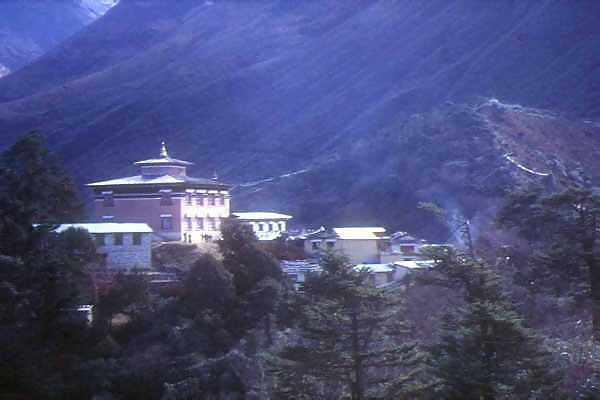
Sri Lalita Sahasranama 501-600
504) Sri Svadhisthananambuja-gata Devi
— Resides in the six-petalled Svadhisthana-Chakra at the level of the sex organ. This name means Herself resides as Fire in that Chakra.
Sri Lalita Sahasranama
C. S. Murthy, Associate Advertisers and Printers, 1989
514) Sri Muladharambujarudha
— She is mounted on the four-petalled Muladhara-Padma at the level of the anus.
Sri Lalita Sahasranama
521) Sri Agnya-chakrabja-nilaya
— Resides in the two-petalled Agnya-chakra. Residing in this Chakra, She controls various organs (Indriyas). Hence, it is known as Agnya-Chakra situated between the eye-brows.
Sri Lalita Sahasranama
528) Sri Sahasra-dala-padmastha
— Resides in the Thousand-Petalled Lotus.
Sri Lalita Sahasranama
Verily in this is a Message for any that has a heart and understanding,
0r who gives ear and earnestly witnesses (the Truth)...
And listen for the Day when the Caller will call out from a place quite near.
The Day when they will hear a (mighty) Blast in Truth:
That will be the Day of Resurrection.
Verily it is We who give Life and death; and to Us is the Final Goal.
The Day when the earth will be rent asunder, from (men) hurrying out:
That will be a gathering together — quite easy for Us.
We know best what they say; And thou are not one to overawe them by force.
So admonish with the Qur'an such as fear My Warning!
surah 50:37-45 Qaf
(Abdullah Yusuf Ali, The Holy Qur'an, 1989.)
Lo! therein verily is a reminder for him who hath a heart,
Or giveth ear with full intelligence...
And listen on the day when the crier crieth from a near place,
The day when they will hear the (Awful) Cry in truth.
That is the day of coming forth (from the graves).
Lo! We it is Who quicken and give death, and unto Us is the journeying.
On the day when the earth splitteth asunder from them, hastening forth (they come).
That is a gathering easy for Us (to make).
We are Best Aware of what they say,
And thou (O Muhammad) art in no wise a compeller over them.
But warn by the Qur'n him who feareth My threat.
surah 50:37-45 Qaf
(M. Pickthall, The Meaning of the Glorious Quran, U. of Mich.)
Most surely there is a reminder in this for him who has a heart
Or he gives ear and is a witness...
And listen on the day when the crier shall cry from a near place
The day when they shall hear the cry in truth; that is the day of coming forth.
Surely We give life and cause to die, and to Us is the eventual coming;
The day on which the earth shall cleave asunder under them,
They will make haste; that is a gathering together easy to Us.
We know best what they say, and you are not one to compel them;
Therefore remind him by means of the Quran who fears My threat.
surah 50:37-45 Qaf
(M. Shakir, The Holy Qur'n, University of Michigan)
531) Sri Sukla-samsthita
— Resides in tissue of seeds.
Sri Lalita Sahasranama
535) Sri Svaha
— Divine Speech in sacrificial oblation.
Sri Lalita Sahasranama
543) Sri Punya-labhya
— Attained by the meritorious or righteous.
— Worshipped due to good actions in previous births.
Sri Lalita Sahasranama

“She is not only the Power of God as the whirling wheel of life in its birth-bringing and death-bringing totality; She is also the Force of the Centre, which bestows Consciousness and Knowledge, Transformation and Illumination. Thus Brahma prays to the Great Goddess: "Thou art the pristine spirit, the nature of which is bliss; thou art the ultimate nature and the clear light of heaven, which illuminates and breaks the self-hypnotism of the terrible round of rebirth, and thou art the one that muffles the universe, for all time in thine own very darkness.” "
Eric Neuman, The Great Mother, Princeton University Press, 1963, p. 333.
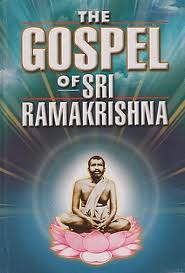
“He to whom the enjoyment of worldly happiness appears tasteless, he who takes no delight in anything of the world — money, name, creature comforts, sense pleasure — becomes sincerely grief-stricken for the vision of The Mother. And to him alone The Mother comes running, leaving all Her other duties.”
Sri Ramakrishna, The Gospel of Sri Ramakrishna, 1958, p. 367.
551) Sri Sarva-mrtyu-Nivarini
— Cures all disease of body and mind.
Sri Lalita Sahasranama
“We are taught nowadays that the miracle of the world's ecosystem is its balance, over-consumption. This is because when man becomes unbalanced, he seeks to change not himself but his environment, in order to create the illusion that the is enjoying health and harmony. In winter he overheats his house, in summer he freezes it with air-conditioning. This is not stability but arrogance. Some people take tablets to go to sleep and tablets to wake up. Their life has the rhythm of a pingpong ball. The student of yoga who learns to balance himself internally at every level, physical, emotional, mental, by observation of paksa and pratipaksa, frees himself from this hellish to-ing and fro-ing and lives in harmony with the natural world. Because he is stable, he can adapt to outside changes.”
BKS Iyengar, Light on the Yoga Sutras of Patanjali
HarperCollins Publs, 1996, p. 139.
"The mind, by nature, is in constant agitation. According to Hindu theory, it is continually transforming itself into the shapes of the objects of which it becomes aware. Its subtle substance assumes the forms and colors of everything offered to it by the senses, imagination, memory, and emotions. It is endowed, in other words, with a power of transformation, or metamorphosis, which is boundless and never put at rest.
The mind is thus in a continuous ripple, like the surface of a pond beneath a breeze, shimmering with broken, ever-changing, self-sacrificing reflections. Left to itself it would never stand like a perfect mirror, crystal clear, in its"own state," unruffled and reflecting the inner man; for, in order that this should take place, all the sense impressions coming from without (which are like the waters of entering rivulets, turbulent and disturbing to the translucent substance) would have to be stopped, as well as the impulses from within: memories, emotional pressures, and the incitements of the imagination (which are like internal springs.) Yoga, however, stills the mind. And the moment this quieting is accomplished, the inner man, the life-nomad, stands revealed — like a jewel at the bottom of a quieted pond.”
Heinrich Zimmer, Philosophies of India
Princeton University Press, 1974, p. 284-85.)
552) Sri Agra-ganya
— Primordial.
Sri Lalita Sahasranama
552) Sri Achintya-rupa
— Form inaccessible to thought.
Sri Lalita Sahasranama
555) Sri Kali-kalmasa-nasini
— Destroys sins in this Kali age.
Sri Lalita Sahasranama
Water is able to quench the fire, the presence of the sun dispels darkness,
And the repetition of the names of Devi to destroy the multitude of sins in the Kali age.
Kurma Purana
The remembrance of the Feet of Supreme Shakti is said to be the highest expiation for sins consciously or unconsciously committed.
Brahma. Purana
“The French paleontologist Pierre Teilhard de Chardin believed that we are all marching away from the Alpha Point, a kind of future attractor acting like a downstream waterfall that inexorably pulls the river of evolution toward itself. This onward march of evolution is one of increasing complexification: as he called it, leading to the emergence of the noosphere: the world of thought characterizing humanity. At this Omega Point, according to Teilhard de Chardin, the light of the Spirit will fully flood the earth and transfigure everyone and everything. This supreme consciousness, which is the end-time reality of Omega Point, is neither impersonal nor personal but superpersonal. It is a Someone, not merely a Something. But that Someone is beyond all conception.
Like a vast tide, Being will have engulfed the shifting sands of being. within a now tranquil ocean, each drop of which, nevertheless, will be conscious of remaining itself, the astonishing adventure of the world will have ended. The dream of every mystic, the eternal pantheist ideal, will have found its full and legitimate satisfaction.”(P. Teilhard de Chardin, The Future of Man, Fount Paperbacks, 1977, p. 323.)
Georg Feuerstein, Lucid Waking
Inner Traditions International, 1997, p. 193.
557) Sri Kalahantri
— Destroyer of Time.
Sri Lalita Sahasranama
563) Sri Mukhya
— The First One.
Sri Lalita Sahasranama
I am the First Born of Truth.
Taittiriya Upanisad 3.10.6
567) Sri Bhakta-nidhih
— Ocean of Kindness for Her devotees.
Sri Lalita Sahasranama
"The saints who sang the hymns of Tirumurai inspire us onward and inward. The grand, great old Rishi Tirumular captured the essence of the Vedas and the Agamas in his epistles, announcing the rules and regulations that we must follow, telling of the attainments that we may expect. Over two thousand years ago the great siddha Saint Tirumular taught," Offer oblations in love. Light the golden lamps. Spread incense of fragrant wood and lighted camphor in all directions. Forget your worldly worries and meditate. Truly, you shall attain rapturous liberation.”
It is said in our Hindu scriptures that it is necessary to have a satguru. However, it is also possible for an individual to accomplish all of this himself without a guru. Possible, but most difficult and exceedingly rare. There may be four or five in a hundred years, or less. Scriptures explain that perhaps in past lives such a soul would have been well disciplined by some guru and is helped inwardly by God in this life. With rare exceptions, a guru is necessary to guide the aspirant on the path as far as he is willing and able to go in his current incarnation. Few will reach the Ultimate. The satguru is needed because the mind is cunning and the ego is a self-perpetuating mechanism. It is unable and unwilling to transcend itself by itself. Therefore, one needs the guidance of another who has gone through the same process, who has faithfully followed the path to its natural end and therefore can gently lead us to God within ourselves. Remember, the satguru will keep you on the path, but you have to walk the path yourself.
All gurus differ one from another depending on their parampara, their lineage, as well as on their individual nature, awakening and attainments. Basically, the only thing that a guru can give you is yourself to yourself. That is all, and this is done in many ways. The guru would only be limited by his philosophy, which outlines the ultimate attainment, and by his own experience. He cannot take you where he has not himself been. It is the guru's job to inspire, to assist, to guide and sometimes even impel the disciple to move a little further toward the Self of himself than he has been able to go by himself.”
Satguru Sivaya Subramuniyaswami
568) Sri Niyantri
— Maker of Laws and Rules.
Sri Lalita Sahasranama
569) Sri Nikhilesvari
— Queen of All.
Sri Lalita Sahasranama
571) Sri Maha-pralaya-saksini
— Witness of the Great Dissolution.
—"Glory to Your Form, the Lone Witness to the Dance of Shiva at the destruction of Kalpa.”Sri Samkara Mantra-Matrka-Stava.
Sri Lalita Sahasranama
"As Brahma, Visnu, etc. perish at that time of the dance of Siva as the Great Dissolution, She alone is the witness (of that dance.) It is said," Bearing the noose, the elephant hook, the bow of sugar-cane, and the arrow of flowers, your form alone remains victorious, witnessing the dance of the divine Parabhairava, bearing the axe at the time of the Dissolution of the universe.” "
R. A. Sastry, Lalita-Sahasranama
The Adyar Library and Research Centre, Madras, 1988, p. 238.)
572) Sri Para-saktih
— The Ultimate Power.
Sri Lalita Sahasranama
His supreme Shakti is known in different forms.
Linga Purana
Whatever energy is attributed to any substance that is Devi,
The ruler of all energized substance is the great Siva.
Those substances which possess energy are the manifestations of Siva.
The wise recognize the energies in substance to be Devi.
Linga Purana
"In consonance with the tradition of the earliest prehistoric Saivism, the eternal Siva with His Spouse is hailed and invoked in the Tirumurai Hymns, Saiva Puranas and Siddhanta Classics. Divine Energy or Sakti is lauded as the source of everything. It is the origin of the phenomenal world, and also of the conscious plan of its creation. It is the principle of knowledge and perception through which its existence can be known. Sakti is also signified as Consciousness. She is Action and she is the emotive Power. In order to gain liberation from the bonds, one should worship the witness of all, the transcendent Energy, whose"shape is the Self and in whom are found neither the manifest world nor its pleasures.” "
Sutta Samhita 482.
573) Sri Prajnana Ghana-rupini
— Supreme Wisdom
— State of Consciousness where nothing else is experienced except Self.
—"Like the taste of salt in the sea (It) is everywhere; Prajnana is All Pervasive.”Brahadaranyaka Upanisad
Sri Lalita Sahasranama
Convinced by instruction derived from the scriptures and from teachers, and by reasoning in conformity with the scriptures, that he himself the witness of all, his mind fixed, knowing the whole which appears different from the Self as his own Self, again fully convinced by his own experience that he himself is the pure, non-dual Brahman; merging that conviction in his own pure consciousness which is unchangeable and non-dual; knowing that even that merging is of the nature of thought, he should remain as the absolute. This ascetic is indeed the best of those who know Brahman; this is the highest end of scriptural teachings and of experience.
Suta Samhita (Suta-gita, V. 50-54)
"What is the Nature of the Jnana Pada?
Jnana is divine wisdom emanating from an enlightened being, a soul in its maturity, immersed in Sivaness, the blessed realization of God, while living out earthly karma. Jnana is the fruition of yoga tapas. Aum
The instinctive mind in the young soul is firm and well-knit together. The intellectual mind in the adolescent soul is complicated, and he sees the physical world as his only reality. The subsuperconscious mind in the mystically inclined soul well perfected in kriya longs for realization of Siva's two perfections, Satchidananda and Parashiva. Through yoga he bursts into the superconscious mind, experiencing bliss, all-knowingness and perfect silence. It is when the yogi's intellect is shattered that he soars into Parashiva and comes out a jnani. Each time he enters that unspeakable nirvikalpa samadhi, he returns to consciousness more and more the knower. He is the liberated one, the jivanmukta, the epitome of kaivalya-perfect freedom-far-seeing, filled with light, filled with love. One does not become a jnani simply by reading and understanding philosophy. The state of jnana lies in the realm of intuition, beyond the intellect. The Vedas say," Having realized the Self, the rishis, perfected souls, satisfied with their knowledge, passion-free, tranquil-those wise beings, having attained the omnipresent on all sides-enter into the All itself.”
Satguru Sivaya Subramuniyaswami (Himalayan Academy, 98)
"Wisdom is truth in action, goodness in action, beauty in action, and not least love in action. It is a form of knowing that engenders truth, goodness, beauty, and love. Such knowing is never a matter of mere learning or even mere experience. It is a precious distillate of knowledge and experience created in the higher mind, which the ancient Greeks called nous and the Hindu philosophers named buddhis. The latter term stems from the Sanskrit verbal root budh, meaning"to be awake," which also underlies the word buddha, or"enlightened one," and bodhi, or"enlightenment.”Wisdom, then, is lucid understanding, and as such is the single most important factor in a life dedicated to lucid waking.”
Georg Feuerstein, Lucid Waking
Inner Traditions International, 1997, p. 4.)
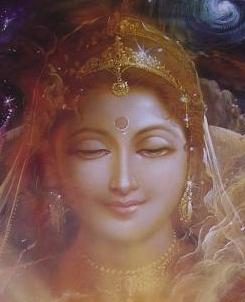
Mahadevi or"Great Goddess"Is a term
used to denote the Goddess or Devi that
is the sum of all other Devis. (Wikipedia)
[The Goddess distinguishes between nonconscious Maya and her own true Self as pure consciousness.]
2.11. [cont.] Since Maya is something we can perceive, it has the nature of nonconscious matter; since knowledge destroys it, it is not truly existent.
2.12. Consciousness is not something we can perceive; what we perceive is indeed nonconscious.
Consciousness is self-luminous; nothing else illuminates it.
2.13. It does not even illuminate itself, for that would lead to the fallacy of infinite regress.
As an agent and the object acted upon are distinct entities, so consciousness itself, like a lamp,
2.14. While shining brightly, illuminates what is other than itself. Know this, O Mountain,
For thus have I demonstrated that consciousness, belonging to my own nature, is eternal.
2.15. The visible world appears and disappears constantly in the various states of waking, dream, and deep sleep.
Pure consciousness never experiences such fluctuations.
2.16. Even if this consciousness itself became an object of perception, then the witness
Of that perception would abide as the real pure consciousness, as before.
2.17. And so those versed in religious treatises regarding the real declare consciousness to be eternal.
Its nature is bliss, for it is the object of supreme love.
2.18. The feeling, 'Let me not cease to be; let me exist forever,' is rooted in love for the Self.
Certainly there is no actual relation between me and all else, since all else is false.
2.19. Therefore I am regarded truly as an undivided whole.
And that consciousness is not an attribute of the Self,
for then the Self would be like an object.
2.20. In consciousness no possible trace of the object state can be found.
And so consciousness also has no attributes; consciousness is not a quality separate from consciousness itself.
2.21. Therefore the Self in essence is consciousness, and bliss as well, always.
It is the real and complete, beyond all relation, and free from the illusion of duality.
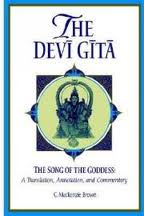
Comment
In the Sakta view, Maya is not simply an insentient force but a conscious and willful facet of the Goddess' personality. Somewhat paradoxically, it is the nondualist school of Advaita, emphasizing an acosmic view of reality and characterizing the realm of Maya as false, that often stresses the greatest difference between Maya and the supreme. Advaita objectifies Maya, viewing it as inert and insentient (jada), over against the supreme, conscious subject that is Brahman (or Atman). By way of contrast, the Devi-Bhagavata, more often than not presenting a Sakta viewpoint, asserts that Maya is"The very essence of the supreme Brahman (maya-para-brahma-svarupani)," and that"The world without Maya would ever be unconscious and inert (jada).”
The Goddess in the above verses of the Devi-Gita ignores for the moment the Sakta perspective, adopting a radical Advaita interpretation by drawing a sharp distinction between herself and Maya. This distinction as characterized here is somewhat at odds with the earlier notion of"difference and nondifference' as suggested by the substance/attribute analogies of verse 5. The Goddess now denies the"nondifference," utilizing standard Advaita visual images and metaphors that stress the"difference.”As the pure subject or consciousness (variously called caitanya, samvit, jnana, and cit), she likens herself to a lamp that is self-illuminating, revealing the visible realm that is Maya, the realm of inert, material objects (referred to as drsya," the seen," and as jada," inert, dull, insentient"). Pure consciousness itself is never an object of perception or knowledge, but is instead the eternal seer or witness (saksin), observing the ephemeral and false identities of empirical existence.
The Goddess here also denies that consciousness is an attribute of the Self-or herself-in accord with Advaitic principles affirming the radical oneness of the supreme subject, beyond all qualification or attribution (neti, neti). Only objects have qualities or attributes. Thus the Goddess does not possess consciousness but rather is consciousness.
C. MacKenzie Brown, The Devi Gita: The Song of the Goddess
State University of New York Press (September 1998) pp. 91-3

Andrew Cohen We, the Unbelievers
by Andrew Cohen
Enlightenment for the 21st Century
A couple of years ago, I discovered something shocking, extraordinary, and completely obvious: Most of us simply don't believe in the evolution of consciousness. And I don't just mean those who are convinced that God created the world in six days. I mean those of us who accept the theory of evolution and who are, at least to some degree, aware of the multidimensional nature of its manifestation all around us. We believe in cosmological evolution and understand that we live not in a static universe but in one that is part and parcel of a deep-time developmental process. We don't doubt that the universe was born many billions of years ago in a blinding flash of light and energy. We believe in biological evolution and have little difficulty comprehending how life itself has evolved from lower levels of development like worms and butterflies to higher ones like dolphins and humans. And many of us even recognize that culture evolves over time and see that development as the expression, at a collective level, of our human capacity for greater and greater complexity and integration. We believe in the evolutionary process because in so, so many ways we can see it all around us: moving, stretching, changing, reaching, from life to death to new life. But when it comes to consciousness—especially our own—I have discovered that our conviction in that same process is often nowhere to be found.
We believe in evolution as an objective fact of life and of the creative process but not necessarily as a living potential inherent in our own subjective experience. It stunned me when I first realized that even many of us who are already dedicated seekers never consider that our very own consciousness, our deepest sense and experience of our self, could actually evolve and develop. It must be because it is such a quantum leap for the subject to become the object—for consciousness to become the object of its own attention and intention. I'm not just speaking about awakening to the experience or fact of consciousness at the level of pure subjectivity, which is what the spiritual experience is typically all about. I'm pointing to something even more difficult to grasp, which is the living potential inherent in consciousness itself for development and growth.
So what does this mean? It means that the feeling/knowing experience of being ourselves can evolve, change, and develop in ways we simply cannot imagine. What is it like for consciousness to evolve? We cannot picture it in the eye of our mind because such development is a journey from the gross to the subtle and is unreachable with thought. How can we possibly imagine that which we cannot conceptualize?
We can imagine our own development as long as we can objectify it with thought. For example, we can imagine ourselves losing weight and building muscle. We can imagine ourselves learning algebra, Chinese, or how to play the guitar. We can even imagine ourselves becoming less selfish and more compassionate. But we simply cannot imagine our own self evolving at the level of consciousness itself. It is important to recognize what an alien concept this actually is in our culture. We are almost never encouraged to grapple with our own evolutionary potential at such a fundamental level, and as a result, most of us have never even considered it. Think about it, just for a moment: What would it be like for my self to evolve in its very essence? What would it be like to develop and grow at a level so profound that I would never be able to see it and yet others would be able to recognize its expression? If we can even begin to look deeply into this question, mysteriously, we will already be participating in the very evolution of consciousness I've been speaking about. And if we pursue it wholeheartedly, we will be helping to make conscious a miraculous process that was born many billions of years ago in a flash of light and energy and is only now beginning to awaken to itself, through us.
Andrew Cohen, founder and editor-in-chief of What Is Enlightenment? has been a spiritual teacher since 1986 and is the author of numerous books, including Living Enlightenment and Embracing Heaven & Earth.
Dennis Choptiany, Markham, Canada:"It can be argued that the most profound creation that humans have made is God. With it came the formation of a vast number of religions and their destructive divisions and conflicts. In your opinion, why do people have an apparent 'need' for religion and why have religions flourished even today when there is more and more evidence of the validity of agnostic and atheist views?”

Deepak Chopra:"Religions have an appeal because human beings have the fear of mortality. All religions promise eternal life. In the absence of profound knowledge of the workings of the universe, we rely on so-called religious authority to answer the deepest questions of our existence: who am I, where did I come from, what's the meaning and purpose of existence, do I have a soul, what happens to me after I die, does God exist, and if God exists does God care about me personally.
Unfortunately, religious ideology, dogma and belief systems are no longer congruent with what we know about the workings of the universe. They are inconsistent with our insights from modern cosmology, evolution, biology and the sciences. Hence, religious based on primitive belief (and unfortunately, all of them are based on primitive beliefs) have become quarrelsome, divisive and frequently idiotic.
However, consciousness still remains a mystery. Is our consciousness an emergent property of our biology or is consciousness the ground of existence that differentiates itself and projects itself as reality? This is not a settled issue. The current atheists and agnostics, such as Richard Dawkins, for example, are espousing an old fashioned 19th century atheism. The god they attack can not be defended. My hope is that as science progresses and looks at the mystery of consciousness we will see the emergence of a new spirituality that is secular and scientific and still addresses our deepest longings and our most important existential dilemmas.”
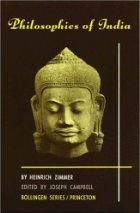
"For where dwell the gods to whom we can uplift our hands, send forth our prayers, and make oblation? Beyond the Milky Way are only island universes, galaxy beyond galaxy in the infinitudes of space — no realm of angels, no heavenly mansions, no choirs of the blessed surrounding a divine throne of the Father, revolving in beatific consciousness about the axial mystery of the Trinity. Is there any region left in all these great reaches where the soul on its quest might expect to arrive at the feet of God, having become divested of its own material coil? Or must we now turn rather inward, seek the divine internally, in the deepest vault, beneath the floor; hearken within for the secret voice that is both commanding and consoling; draw from inside the grace which passeth all understanding?”
Heinrich Zimmer, Philosophies of India
Princeton University Press, 1974, p. 13
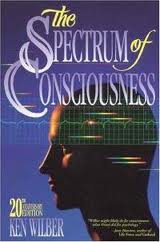
"It has been almost twenty years since I wrote Spectrum, and the intervening two decades have convinced me more than ever of the correctness of its essential message: being and consciousness exist as a spectrum, reaching from matter to body to mind to soul to Spirit. And although Spirit is, in a certain sense, the highest dimension or level of the spectrum of existence, it is also the ground or condition of the entire spectrum. It is as if Spirit were both the highest rung on the ladder of existence and the wood out of which the entire ladder is made — Spirit is both totally and completely immanent (as the wood) and totally and completely transcendent (as the highest rung.) Spirit is both Ground and Goal ... The realization of our Supreme Identity with Spirit dawns only after much growth, much development, much evolution, and much inner work ... only then do we understand that the Supreme Identity was there, from the beginning, perfectly given in its fullness.”
Ken Wilber, The Spectrum of Consciousness
Quest Books, 1993, p. xvi.
Vedanta and Consciousness
The Vedantic concept of consciousness is somewhat different from the every-day, Western concept. In the West, what usually is referred to as consciousness is more likely to be called awareness. In Vedanta consciousness is omnipresent and objectless. There is consciousness behind everything — be it a human, an animal or a stone — but a stone has no awareness and the awareness of an animal is very limited. Likewise, the awareness of humans can be more or less limited. Consciousness is static and forever unchanging, but awareness is dynamic and may undergo changes. Consciousness is the same in all humans and interconnects all humanity. While consciousness is undivided and without limits, awareness may be limited and differ from person to person.
The Ultimate Reality is characterized by three concepts — absolute being, absolute consciousness and absolute bliss. Nevertheless, the Ultimate Reality is beyond these and any other human conceptions — It is objectless, omnipresent, all-pervasive, eternal, infinite, unchanging, motionless and without any form. Often, the Ultimate Reality is referred to as a cosmic ocean of consciousness.”
Steen Ingemann, Guide to Ultimate Reality (www.rishi.dk/guide/)
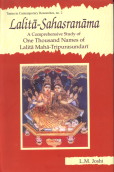
4) Sri Cidagni-Kunda-sambhuta
— Born from the Pit of the Fire of Consciousness.
— Burns out ignorance and confers Immortality.
— She who rose from the fire of knowledge and is the ultimate truth.
68) Sri Chakra-raja-ratha-rudha-sarvayudha-pariskrta
— Mounted on Sri Chakra inside body with all weapons i.e. Powers.
— Enlightens mind to realise Ultimate Reality as an All Pervading-Consciousness.
207) Sri Manonmani
— Highest state of Consciousness.
— Secret name of Sri Durga.
367) Sri Pratyak-Chiti-Rupa
— Inner Consciousness or Knowledge.
404) Sri Bhakta-harda-tamo-bheda-bhanumad-bhanu- santaih
— Effulgence of the Sun; dispels Darkness of Ignorance.
— Giver of the Vision of the Ocean of Consciousness.
573) Sri Prajnana Ghana-rupini
— Supreme Wisdom
— State of Consciousness where nothing else is experienced except Self. —"Like the taste of salt in the sea (It) is everywhere; Prajnana is All Pervasive.”Brahadaranyaka Upanisad
669) Sri Annada
— The Giver of Food.
— Sustains Life and Consciousness.
739) Sri Layakari
—The Fifth State beyond Turiya.
—The State where individual and Cosmic Consciousness merge.
807) Sri Param-dhama
— The Ultimate Light.
— The Ultimate Status
— 'Yadgatva na nivartante taddhama paramam mama'
"The State of Consciousness from which there is no return is My Ultimate State.”(Bha. Gi. 16-6)
854) Sri Gambhira
— The Bottomless Lake.
—"The Ultimate Mother is to be visualised as a great and deep lake of Consciousness, uncomprehended by Space and Time.”Siva Sutra 1.23
858) Sri Kalpana-rahita
— Pure Consciousness.
907) Sri Tattvamayi
— The Mother of the Ultimate State of Consciousness.
Sri Lalita Sahasranama,
C. S. Murthy, Assoc. Advertisers and Printers, 1989.
583) Sri Atmavidya
— The knowledge that gives the devotee, Atma Saksatkara as taught by Yajnavalkya to Maitreyi or mantra Aham which is Atmasvarupa.
Sri Lalita Sahasranama
591) Sri Sirahsthita
— Dwells inside head near Brahmarandhra.
Sri Lalita Sahasranama
Surely there is a reminder in this for whosoever has a heart (to feel), or attends...
Take heed that the day the Crier calls from a place quite close (to every one),
The day they actually hear the blast will be the Day of rising of the dead.
We are the one who give life and death, and to Us will be the destination.
The day the earth will split asunder they will come out hurriedly,
This gathering together is easy for us.
We are cognisant of what they say; but it is not for you to compel them.
So keep on reminding through the Qur'an whoever fears My warning.
Qaf 50:37-45
(Ahmed Ali, Islam: The Qur'n, Princeton University Press, 1988.)
This should be a lesson for everyone who possesses a mind, or is able to hear and witness...
Prepare for the day when the Caller calls from a place that is near.
When they hear the inevitable cry; that is the day you come out.
We are the ones who control life and death; to us is the final destiny.
The day will come when the earth cracks in a hurry, giving rise to them.
Such summoning is easy for us to do.
We are fully aware of everything they utter, while you have no power over them.
Therefore, remind with this Quran, those who reverence My warnings.
Qaf 50:37-45
(Dr. Rashad Khalifa, Ph.d, Masjid Tucson, USI, PO Box 43476, Tucson, AZ, USA.)
501. Gudanna preetha manasa - She who likes rice mixed with jaggery.
502. Samastha bhaktha sukhadha - She who gives pleasure to all her devotees.
503. Lakinyambha swaroopini - She who is famous in the name of"Lakini.”
504. Swadhishtanambujagatha - She who lives in the six petalled lotus.
505. Chathur vakthra manohara - She who has four beautiful faces.
506. Sulayudha sampanna - She who has weapons like Spear.
507. Peetha varna - She who is of golden colour.
508. Adhi garvitha - She who is very proud.
509. Medho nishta - She who is in the fatty layer.
510. Madhu preetha - She who likes honey.
511. Bhandinyadhi samanvidha - She who is surrounded by Shakthis called Bandhini.
512. Dhadyanna saktha hridhaya - She who likes curd rice.
513. Kakini roopa dharini - She who resembles"Kakini.”
514. Mooladrambujarooda - She who sits on the mooladhara kamala or the lotus which is the basic support.
515. Pancha vakthra - She who has five faces.
516. Sthithi samsthitha - She who is in the bones.
517. Ankusathi praharana - She who holds Ankusha and other weapons.
518. Varadadhi nishevitha - She who is surrounded by Vardha and other shakthis.
519. Mudgou danasaktha chittha - She who likes rice mixed with green gram dhal.
520. Sakinyambha swaroopini - She who has the name"Sakini.”
521. Agna chakrabja nilaya - She who sits on the lotus called Agna chakra or the wheel of order.
522. Shukla varna - She who is white coloured.
523. Shadanana - She who has six faces.
524. Majja samstha - She who is in the fat surrounding the body.
525. Hamsavathi mukhya shakthi samanvitha - She who is surrounded by shakthis called Hamsavathi.
526. Hardrannaika rasika - She who likes rice mixed with turmeric powder.
527. Hakini roopa dharini - She who has the name"Hakini.”
528. Sahasra dhala padhmastha - She who sits on thousand petalled lotus.
529. Sarva varnopi shobitha - She who shines in all colours.
530. Sarvayudha dhara - She who is armed with all weapons.
531. Shukla samsthitha - She who is in shukla or semen.
532. Sarvathomukhi - She who has faces everywhere.
533. Sarvou dhana preetha chittha - She who likes all types of rice.
534. Yakinyambha swaroopini - She who is named as"yakini.”
535. Swaha - She who is personification of Swaha ( the manthra chanted during fire sacrifice).
536. Swadha - She who is of the form of Swadha.
537. Amathi - She who is ignorance.
538. Medha - She who is knowledge.
539. Sruthi - She who is Vedas.
540. Smrithi - She who is the guide to Vedas.
541. Anuthama - She who is above all.
542. Punya keerthi - She who is famous for good deeds.
543. Punya labhya - She who can be attained by good deeds.
544. Punya sravana keerthana - She who gives good for those who listen and those who sing about her.
545. Pulomajarchidha - She who is worshipped by wife of Indra.
546. Bandha mochini - She who releases us from bondage.
547. Barbharalaka - She who has forelocks which resembles waves.
548. Vimarsa roopini - She who is hidden from view.
549. Vidhya - She who is"learning.”
550. Viyadhadhi jagat prasu - She who created the earth and the sky.
551. Sarva vyadhi prasamani - She who cures all diseases.
552. Sarva mrutyu nivarini - She who avoids all types of death.
553. Agra ganya - She who is at the top.
554. Achintya roopa - She who is beyond thought.
555. Kali kalmasha nasini - She who removes the ills of the dark age.
556. Kathyayini - She who is Kathyayini in Odyana peetha or She who is the daughter of sage Kathyayana.
557. Kala hanthri - She who kills god of death.
558. Kamalaksha nishevitha - She who is being worshipped by the lotus eyed Vishnu.
559. Thamboola pooritha mukhi -"She whose mouth is filled with betel leaves , betel nut and lime.”
560. Dhadimi kusuma prabha - She whose colour is like the pomegranate bud.
561. Mrgakshi - She who has eyes like deer.
562. Mohini - She who bewitches.
563. Mukhya - She who is the chief.
564. Mridani - She who gives pleasure.
565. Mithra roopini - She who is of the form of Sun.
566. Nithya Truptha - She who is satisfied always.
567. Bhaktha Nidhi - She who is the treasure house of devotees.
568. Niyanthri - She who controls.
569. Nikhileswari - She who is goddess for every thing.
570. Maitryadhi vasana Labhya - She who can be attained by habits like Maithree (friendship).
571. Maha pralaya sakshini - She who is the witness to the great deluge.
572. Para Shakthi - She who is the end strength.
573. Para Nishta - She who is at the end of concentration.
574. Prgnana Gana roopini - She who is personification of all superior knowledge.
575. Madhvi pana lasaa - She who is not interested in anything else due to drinking of toddy.
576. Matha - She who appears to be fainted.
577. Mathruka varna roopini - She who is the model of colour and shape.
578. Maha Kailasa nilaya - She who sits on Maha Kailasa.
579. Mrinala mrudhu dhorllatha - She who has arms as tender as lotus stalk.
580. Mahaneeya - She who is fit to be venerated.
581. Dhaya moorthi - She who is personification of mercy.
582. Maha samrajya shalini - She who is the chef of all the worlds.
583. Atma vidhya - She who is the science of soul.
584. Maha Vidhya - She who is the great knowledge.
585. Srividhya - She who is the knowledge of Goddess.
586. Kama sevitha -"She who is worshipped by Kama, the God of love.”
587. Sri Shodasakshari vidhya - She who is the sixteen lettered knowledge.
588. Trikoota - She who is divided in to three parts.
589. Kama Kotika - She who sits on Kama Koti peetha.
590. Kataksha kimkari bhootha kamala koti sevitha - She who is attended by crores of Lakshmis who yearn for her simple glance.
591. Shira sthitha - She who is in the head.
592. Chandra nibha - She who is like the full moon.
593. Bhalastha - She who is in the forehead.
594. Indra Dhanu Prabha - She who is like the rain bow.
595. Hridayastha - She who is in the heart.
596. Ravi pragya - She who has luster like Sun God.
597. Tri konanthara deepika - She who is like a light in a triangle.
598. Dakshayani - She who is the daughter of Daksha.
599. Dhithya hanthri - She who kills asuras.
600. Daksha yagna vinasini - She who destroyed the sacrifice of Rudra.
www.starsai.com/lalithambigai-goddess-lalithasahasranamam.html
LUCKNOW (Feb 9) — Interpretation of the Quran in the light of Sahaja Yoga was the topic of the first international conference of the Islamic Study Group in the city here on Sunday. Various Muslim scholars from around the globe dwelt on the divine powers of Nirmala Devi, who has rediscovered the magic of 'sahaj yoga.' The members discussed the benefits of this form and how Muslims could benefit from it.
Speaking on occasion, Mr. Husain Top, a renowned sufi saint from Turkey, said the seven heavens mentioned by the prophet were in fact seven 'chakras' of consciousness.
"The Almighty is pleased after one attains a higher state of consciousness through self-purification and meditation," he said.
"God sees through man and he hears through man," the sufi saint said. Mr. Top said in the final stage of consciousness man is enveloped by the will of God and in this state he attains union with the Almighty and finds peace.
Mr. Jamal from Algeria revealed that 'Qayamet' or Doomsday as is generally understood, is not destruction but resurrection attaining enlightenment. He explained that the real meaning of the greater 'jehad' or holy war was the 'conquest of the self.'
Mr. Javed Khan, president of the Indian Taekwondo Association and the All-India Kickboxing Federation, said the 'meraj' or ascent can be attained through self-realization, which happens spontaneously in Sahaja Yoga. The Quran and the Hadith speak specifically about 'meraj,' he said.
Dr. Amjad Ali from Australia spoke on the same topic and explained the matter in detail. He related every aspect of his theory to the electromagnetic field of the energy present within every individual, which he termed as 'chakras.' Explaining the position of the 'kundalini,' which he said was the breath of god in the human body, Mr. Amjad Ali said the 'kundalini' ascends from the base of the spine to the top of the head, which when aroused leads to self-realization.
Dr. Zafar Rashid from the United Kingdom talked about incarnations. He said the holy ghost was in fact the primordial feminine power called 'Adi Shakti.'"It is through this 'shakti' that we can attain salvation," he said.
Mr. Majeed Golpour from Iran said resurrection is also the time for advent of the 12th. Imam or the Ma'dhi' (which Javed said was in fact 'Adi Shakti'.) Mr. Golpour said from the various signals he received from time to time, it has become clear that 'adi shakti' or the 'imam ma'ahdi' had come to Earth in the form of Nirmala Devi.
The Hindustan Times, February 9, 1998
"POVERTY OF CONCEPTUAL LEARNING
All religions distinguish between intellectual study and the apprehension of spiritual knowledge that is conducive to salvation. Intellectual and conceptual knowledge, for all its utility in the world, does not profit the spiritual seeker, and may even impede the realization of Truth...
The poverty of conceptual learning extends to the concepts in scripture. Knowledge of scripture according to the letter is, like any other intellection, defective by itself. Direct intuitive knowledge or inner realization of God is far superior.”
World Scripture, International Religious Foundation
Knowledge is of five kinds, namely: sensory knowledge, scriptural knowledge, clairvoyance, telepathy, and omniscience.
These five kinds of knowledge are of two types: the first two kinds are indirect knowledge and the remaining three constitute direct knowledge.
In sensory knowledge... there is only the apprehension of indistinct things....
But clairvoyance, telepathy, and omniscience is direct knowledge; it is perceived by the soul in a vivid manner without the intermediary of the senses or the scriptures.
Tattvarthasutra 1.19-29
"Human philosophy has made God manlike. Christian Science makes man Godlike. The first is error; the latter is truth. Metaphysics is above physics, and matter does not enter into metaphysical premises or conclusions. The categories of metaphysics rest on one basis, the divine Mind.”
Science and Health, 269 (Christian Science)
Of all things seen in the world only mind is the host;
By grasping forms according to interpretation it becomes deluded, not true to reality.
All philosophies in the world are mental fabrications;
There has never been a single doctrine
By which one could enter the true essence of things.
By the power of perceiver and perceived all kinds of things are born;
They soon pass away, not staying, dying out instant to instant.
Garland Sutra 10
This is true knowledge: to seek the Self as the true end of wisdom always.
To seek anything else is ignorance.
Bhagavad Gita 13.11
Undiscerning men, theologians preoccupied with scriptural lore,
Who claim there is nothing else, utter words with ephemeral results.
Their words promise better births through cultic acts, dwell at length on various rites, and aim at pleasure and power.
These men are full of desire, zealous for heaven.
They cling to pleasures and power and are fooled by their own discourses.
They have no knowledge consisting in commitment, fixed in concentration.
The Scriptures speak to the world's weave of integrity, passion, and sloth.
Transcend it, Arjuna,
Free from opposites, forever in integrity, detached from things, in command of yourself.
All the Scriptures mean as much — no more, no less — to the discerning spiritual man
As a water tank in a universal flood.
Bhagavad Gita 2.42-46
"Today all of these mysteries have lost their force; their symbols no longer interest our psyche. The notion of a cosmic law, which all existence serves and to which man himself must bend, has long since passed through the preliminary mystical stages represented in the old astrology, and is now simply accepted in mechanical terms as a matter of course. The descent of the Occidental sciences from the heavens to the earth (from 17th Century astronomy to 19th Century biology) and their concentration today, at last, on man himself (in 20th Century anthropology and psychology) mark the path of a prodigious transfer of the focal point of human wonder.
Not the animal world, nor the plant world, not the miracle of the spheres, but man himself is now the crucial mystery. Man is that alien presence with whom the forces of egoism must come to terms, through whom the ego is to be crucified and resurrected, and in whose image society is to be reformed. Man, understood however not as"I"but as"Thou": for the ideals and temporal institutions of no tribe, race, continent, social class, or century, can be the measure of the inexhaustible and multifariously wonderful divine existence that is the life in all of us.
The modern hero, the modern individual who dares to heed the call and seek the mansion of that presence with whom it is our whole destiny to be atoned, cannot, indeed must not, wait for his community to cast off its slough of pride, fear, rationalized avarice, and sanctified misunderstanding.”Live," Nietzsche says," as though the day were here.”It is not society that is to guide and save the creative hero, but precisely the reverse. And so, every one of us shares the supreme ordeal — carries the cross of the redeemer — not in the bright moments of his tribe's great victories, but in the silences of his personal despair.”
Joseph Campbell, The Hero With a Thousand Faces
Princeton Univ. Press, 1949
Chopra: Deep stuff or New Age fluff?
ST. PETERSBURG
Motivational guru Deepak Chopra believes he provides answers for a new age, teaching his international body of followers that the key to solving problems is to seek God within. Chopra's philosophy, zealously marketed through books, seminars and tapes, has won him legions of fans...
"There is no guilt in his system. There is no need for remorse or anything like that. It is not like you have to stop sinning (or) you have to clean up your act. There are no commandments," John Morreall, professor of religious studies at USF, said of Chopra's teachings.”People want easy, digestible stuff that doesn't require them to change their life, and any way you can package that will be successful," Morreall added.
In fact, a sell-out crowd is expected Monday when Chopra makes an appearance at the Mahaffey Theater, said the Rev. Joan Pinkston, minister at the Center for Positive Living, which is sponsoring his visit.
She said this is the third time her church, at 5200 29th Ave. N, has brought Chopra to Tampa Bay.
"He is so popular and he does bring a universal message of truth for those who are ready to hear it," Pinkston said. "He brings it to the masses who are unchurched and who may never capture that message other than through the secular community.”
In a telephone interview, Chopra, who was born in India, said he prefers to be thought of as spiritual rather than religious.”The founders of religion were universal beings," he said. "But at some point it developed dogma and ideology and unfortunately we have had more anguish and more war and more hatred and more bigotry and more suffering in the name of religion than in every other name... . I like to think of myself as seeking spirituality, which is the basis of religion. God gave humans the truth, and the devil came and he said, 'Let's give it a name and call it religion.'"
Chopra, whose teachings are based in part on the Vedantas, the sacred writings that are the root of Hinduism, added that it often is said that God created man in his own image.”I think it is the other way. Man created God in his own image," he said. "The image of God is usually a dead white man in the sky. That is just an image. It is not satisfactory. Why can't God be black or a woman? ... All the conflict in the world is because we have different images of God. God is beyond image. As soon as you create an image about God, you limit God.”But, he said, that is what defines most religion.
Spirituality is different, giving one the ability to love and have compassion, added Chopra, author of 22 books, including best-sellers Ageless Body, Timeless Mind, The Seven Spiritual Laws of Success and The Pathway to Love.”It is the capacity to experience joy and spread it to others," he said. "It is the security of knowing that your life has meaning and purpose. It is a sense of connection to the creative power of the universe. This creative power of the universe is by various religions called God.”In my experience, it is infinite. It is unbounded. It's immanent and transcendent. It is timeless. It expresses itself in the infinite organization of the universe and in the infinite intelligence of the universe.”
And to find God, those caught up in the search must get in touch with what Chopra refers to as"The essence"of their own being. That essence, he explained, is God. And it is within every person, said Chopra, quoting Jesus in the book of John... .
And it seems to sell particularly well among intellectuals, Morreall said. For those trying to cope with stressful conditions, Chopra's message finds a ready welcome.
"What Chopra offers is the promise that you will be able to quiet down the noise and you will be able to control your world. And that is immensely appealing," Morreall said.
To members of the Center for Positive Living, part of the Spokane, Wash.-based Religious Science organization, Chopra reaffirms a familiar philosophy.
"With what we teach, we believe in one power and it doesn't matter what you call it, whether it is God, spirit, nature, life," Pinkston said. "It is the ultimate one power. What we believe is true about God is also true about us. The one thing that may separate us from other mainline, traditional religions is that we truly believe that this power that created us is within us and is not something that is outside and separate from us and that it is, yes, greater than we are and that we can use it and we are using it every moment.”Chopra's popularity, she said, is based on his universal message.
"Here is a medical doctor who has taught at Tufts University, and he is very well-read. I believe that people are really hungry for the message ... that the soul responds to — that we are divine beings," added Pinkston, a former Baptist who began searching for a new path about 30 years ago.
"We teach the metaphysical, the inner message of Jesus the Christ," Pinkston said. "(Chopra) is teaching the same message. The way he is teaching is that love can renew, heal. Love can make us safe. Love can inspire us and bring us closer to God and that is what we are all searching for, the union of the self and the spirit.”...
What morsels of wisdom will he leave with his audience Monday?
"I only want to achieve one thing in that when they leave they will say to themselves there is a lot to think about," he said. "And in some of them it will start a new journey which will radically affect the way they live their life.”
Kitty Bennett, Times researcher, UMI Company 1998
"Dr. Reischauer quotes a passage from The Mysterious Universe by Sir James H. Jeans, one of the greatest astronomers and physicists of modern times, that confirms what Cayce has all along said about the Mind of the Universe: "Today there is a wide measure of agreement, which on the physical side of science approaches almost to unanimity, that the stream of knowledge is leading towards a non-mechanical reality; the universe begins to look more like a great thought than like a great machine. Mind no longer appears as an accidental intruder into the realm of matter; we are beginning to suspect that we ought rather to hail it as the creator and governor of the realm of matter... . The new knowledge compels us to revive out hasty first impressions that we had stumbled into a universe which either did not concern itself with life or was entirely hostile to life. The old dualism of mind and matter, which was mainly responsible for the supposed hostility, seems likely to disappear, not through matter becoming in any way more shadowy or insubstantial than heretofore, or through mind becoming resolved into a function of the working of matter, but through substantial matter resolving itself into a creation and manifestation of mind. We discover that the universe shows evidence of a designing or controlling power that has something in common with our own individual minds.”
Edgar Cayce on Prophecy
The Association for Research and Enlightenment, Inc., 1968.
"The chief aim of Indian thought is to unveil and integrate into consciousness what has been thus resisted and hidden by the forces of life — not to explore and describe the visible world. The supreme and characteristic achievement of the Brahman mind (and this has been decisive, not only for the course of Indian philosophy, but also for the history of Indian civilization) was its discovery of the Self (atman) as an independent, imperishable entity, underlying the conscious personality and bodily frame. Everything that we normally know and express about ourselves belongs to the sphere of change, the sphere of time and space, but this Self (atman) is forever changeless, beyond time, beyond space and the veiling net of casualty, beyond measure, beyond the dominion of the eye. The effort of Indian philosophy has been, for millenniums, to know this adamantine Self and make the knowledge effective in human life. And this enduring concern is what has been responsible for the supreme morning calm that pervades the terrible histories of the Oriental world.”
Heinrich Zimmer, Philosophies of India
"Tagore comes closest to us, though, when he calls on his Western friends to imagine a world in which East and West give each other spiritual gifts free of imperialistic coercion, a world in which science is honored but spiritual and human values rule. When our universe is in harmony with man, the eternal, we know it is as truth, we feel it as beauty," Tagore told Einstein in 1930. Coming from a man with few illusions about either East or West, this noble sentiment sounds less like pure idealism than a hard-won way of living decently in a violent century. Tagore's gift for us today, splendidly presented in this anthology, is his insistence on speaking for the highest human values and loftiest human aims. At a time when our public discourses have descended into the mud of marketspeak and realpolitik, we need Tagore's courageous and undeceived conviction that we were born for something wildly and brilliantly better.”
Jon Spayde, The Forgotten Genius
March/April 98 Utne Reader.
Disclaimer: Our material may be copied, printed and distributed by referring to this site. This site also contains copyrighted material the use of which has not always been specifically authorized by the copyright owner. We are making such material available to our readers under the education and research provisions of "fair use" in an effort to advance freedom of inquiry for a better understanding of religious, spiritual and inter-faith issues. The material on this site is distributed without profit. If you wish to use copyrighted material for purposes other than "fair use" you must request permission from the copyright owner.
 SHRI LALITA SAHASRANAMA 501-600