The Book Of Enlightenment
Of the many divine revelations July 23, 1994 stands out. On that day Kash asked, “Shri Mataji, what was Your original name?” The eternal, stunningly beautiful Mother replied: “Shri Lalita Devi”.“Now the name Nirmala itself means immaculate; means the one who is the cleansing power and the name of the Goddess also. My actual sign name is Lalita who is the name of the Primordial Mother. That is the name of the Primordial Mother.”
Shri Mataji, New York, USA, 30 September 1981

Sri Lalita Sahasranama 701-800
701) Sri Desa-kala-paricchinna
— The Truth unbroken by Time and Space.
— The All Pervading Eternal Truth.
Sri Lalita Sahasranama
C. S. Murthy, Associate Advertisers and Printers, 1989
702) Sri Sarvaga
— Present Everywhere and in Everything.
Sri Lalita Sahasranama
C. S. Murthy, Associate Advertisers and Printers, 1989
705) Sri Sastramayi
— The Mother of all Scriptures.
Sri Lalita Sahasranama
C. S. Murthy, Associate Advertisers and Printers, 1989
The Word verily is greater than name.
The Word in fact makes known the Rig Veda, the Yajur Veda, the Sama Veda,
The Atharva Veda as the fourth, the Ancient Lore as the fifth [Veda], the Veda of Vedas, the ritual for ancestors, calculus,
The augural sciences, the knowledge of the signs of the times, dialectics, ethics, political science, sacred knowledge, theology,
Knowledge of the spirits, military science, astrology, the science of snakes and of celestial beings.
[The Word also makes known] heaven, earth, wind, space, the waters, fire, the Gods,
Men, animals, birds, grass, and trees, all animals down to worms, insects, and ants.
[It also makes known] what is right and wrong, truth and untruth, good and evil, what is pleasing and what is unpleasing.
Verily, if there were no Word, there would be knowledge neither of right and wrong, nor of truth and untruth, nor good and evil,
Nor of the pleasing and unpleasing. The Word makes all this known. Meditate on the Word.
Chandogya Upanishad VII, 2, 1 The Word, imperishable, is the Firstborn of Truth, Mother of the Veda and hub of immortality.
May she come to us in happiness in the sacrifice! May she, our protecting Goddess, be easy of entreaty!
TB II, 8, 8, 5 "The Person cannot be alone, not merely or mainly on the psychological level but on the constitutive level, that is, the level on which he can be what he is. Being is in fact never alone; it always has its own accompaniment, its shadow, so to speak (really and truly"so to speak"), for this is vac, the Word, the Firstborn...
The Vedic Revelation tells us in innumerable texts that vac, the Word is not just a man-made invention or a mere tool of communication, or even simply an expression of what Man is. The Vedic Word is indeed this, but is infinitely more. It is ultimately as important as Brahman and, in a way that has to be properly understood, it is Brahman itself, not as every being"Is"ultimately Brahman, but in a special manner: the Word is the first offspring of the Absolute and sprang from it in a peculiar way. In the last analysis God has no name because He himself is Word.
According to Vedic Revelation, vac, which was at the beginning, cannot be reduced to a single one of its dimensions. To begin with, thought and language are here so intermingled that no separation is possible. Vac is grammatically feminine and this fact has conditioned a great deal of thinking about the Vedic Word. If an ontology of sex has any meaning at all, it would find here a decisive basis. However that may be, vac expresses that total surrender to the source from which it springs which is characteristically found in the archetype of feminine love, the feminine feature of love being that of finding not only fulfillment but being itself in the beloved.
It would be inadequate to describe vac exclusively as the principle of intelligibility of the universe, because she is equally the principle of pure affirmation emerging out of sheer nothingness. Vac is really the total living Word, that is to say, the Word in her entirety, including her material aspects, her cosmic reverberation, her visible form, her sound, her meaning, her message. Vac is more than merely meaning or sound devoid of sense; she is more than just an image or simply a vehicle of certain spiritual truths. She does not contain revelation; she is revelation. She was at the beginning. She is the whole of the shruti. The shruti is vac.
Vac, indeed, is the primordial mystery combining in herself the three worlds of time: past, present, and future. Everything that is participates in vac; through her everything has come into being and her imprint has been left everywhere. No wonder, then, that every word is sacred and thus powerful>"
Professor Raimundo Panikkar, The Vedic Experience
706)Sri Guhama
— The Mother that dwells in the Heart.
Sri Lalita Sahasranama
C. S. Murthy, Associate Advertisers and Printers, 1989
within the city of Brahman, which is the body, there is the heart, and within the heart is a little house. This house has the shape of a Lotus, and within it dwells that which is to be sought after, inquired about, and realized.
What, then, is that which dwells within this little house, this lotus of the heart? What is it that must be sought after, inquired about, and realized?
Even so large as the universe outside is the universe within the lotus of the heart. within it are heaven and earth, the sun, the moon, the lightning and all the stars. Whatever is in the macrocosm is in this microcosm also.
All things that exist, all beings and all desires, are in the city of Brahman; what, then, becomes of them when old age approaches and the body dissolves in death?
Though old age comes to the body, the lotus of the heart does not grows old. It does not die with the death of the body. The lotus of Brahman, where Brahman resides in all his glory — that, and not the body, is the true city of Brahman. Brahman, dwelling therein, is untouched by any deed, ageless, deathless, free from grief, free from hunger and from thirst.
Chandogya Upanishad
The Yoga Aphorisms of Patanjali, Penguin Books, Inc., 1969, p. 49-50.
707) Sri Guhya-rupini
— Beyond the Senses. — Unseen and Secret.
Sri Lalita Sahasranama
C. S. Murthy, Associate Advertisers and Printers, 1989
713) Sri Guru-mandala-rupini
— The Unbroken Line of Divine Messengers.
— The Succession of Gurus that is She Herself.
Sri Lalita Sahasranama
C. S. Murthy, Associate Advertisers and Printers, 1989
They ask thee concerning the Spirit.
Say: "The Spirit (cometh) by command of my Lord:
Of knowledge it is only a little that is communicated to you.”
If it were Our Will We could take away that which We have sent thee by inspiration:
Then wouldst thou find none to plead thy affair in that matter against Us.
surah 17: 85-86 Al Isra' (The Night Journey)
Abdullah Yusuf Ali, The Holy Qur'n, Amana Corporation, 1989.
We gave Moses the Book, and followed him up with a succession of Messengers;
We gave Jesus, the son of Mary, Clear (Signs),
And strengthened him with the Holy Spirit.
surah 2.87 Al Baqarah (The Heifer)
Abdullah Yusuf Ali, The Holy Qur'n, Amana Corporation, 1989.
"The darshan of a guru is the power that stabilizes the devotee on the path. The philosophies, teachings and practices that he is given to do are important, but it is the power of darshan that is his stabilizing influence, enabling him to unfold easily on the path of enlightenment.
Darshan is a mystical power emanating from the adept who has gone deep enough within to awaken this power. By stabilizing that power, he gives psychic protection to his disciples and devotees, even during their sleep at night. The same power grants them the ability to meditate without the prior necessity of extensive tapas. Satguru darshan releases the awareness of the devotee out of the area of the mind which is constantly thinking into sublimity.
A beginning meditator is usually aware most of the time in the area of consciousness where thoughts run constantly before his vision. He finds it difficult to go deeper. All efforts fall short of the divine life he inwardly knows he can live, as he is bound by the cycles of his own karma. The satguru's power of darshan releases the meditator's individual awareness from the thinking area of mind and stabilizes him in the heart chakra, and he begins to awaken and unfold his Divinity.
Devout Hindus sit before a satguru and, in seeing him, draw the darshan vibration from him, absorbing it into themselves. They are sensitive enough to distinguish the vibration of darshan from the other vibrations around the guru. They also believe that any physical thing the satguru touches begins to carry some of his darshan or personal vibration, and that when away from him they can just hold the article to receive the full impact of his darshan, for the physical object is a direct link to the satguru himself. It is darshan vibration that makes a human being a holy person. When we say someone is holy or saintly we are feeling the radiations of that divine energy flooding through them and out into the world.
The inner life of a devotee has to be stabilized, cherished and well protected by the guru. The guru is able to do this through his well- developed facilities of darshan, even if his devotee lives at great distances from him. Unless the inner vibratory rate of the devotee is held stable, he will not come into his fullness in this life. If a plant is transplanted too often, it won't come into its full growth. If the bud is picked before it blooms, it will not flower or give forth its redolent odor. Yes, the grace of the satguru fires the ability to meditate in the seeker, the erudite Hindu believes.”
Satguru Sivaya Subramuniyaswami
718) Sri Mahi
— the Mother Earth.
— Giver of all Life and Food.
Sri Lalita Sahasranama
C. S. Murthy, Associate Advertisers and Printers, 1989
Earth (Prthivi)
"The Vedic attitude toward the earth springs from mankind's primordial experience of being on the one hand a guest, and on the other an offspring, of Earth. The earth is undoubtedly mother, is close to Man, but at the same time she is also alien, other and aloof. The earth is the foundation, the basis out of which emerges all that exists and on which everything rests. The earth is the basis of life and, when considered as a divine being, she always occupies a special place among the Gods.
Man is of the earth and earthly, but the earth is not simply nature, is not merely geographical or material; it is part of Man himself, so that Man can no more live without the earth than he can live without a body. At the same time, though he stands on the earth, he also stands above her. Man is more than earth. The earth is The Mother of Man, but Man is also lord over the earth. Man could be said to be like the eldest son of a widowed mother, in the traditional Indian setting.
The tension between Man and earth is conspicuously present, but there is no separation. Vedic Man would find any attempt at dominating or subjugating the earth incomprehensible. The earth is an object of worship and not of exploitation, an object of awe and not of curiosity (or research, as would be said in academic circles). Investigation of the earth is of the same nature as personal introspection. To harm the earth is a masochistic vice. Man is from the earth and part of the earth, yet he surmises more and more that he is not only of the earth, not just an earthly thing.
Worship addressed to the earth is not adoration of a creature as an absolute; that is, it is not idolatry. It is rather the veneration of the highest value in the hierarchy of existence, for"undoubtedly this earth is the firstborn of being.”The earth as such is rich and the owner of treasures. Man's work is not to make a shift in ownership, despoiling, as it were, the earth of her possessions and transferring them to the toiler. Man's work is to enjoy the blessings of the earth, because the earth is his home, his own family, his body...
The famous Prayer to the Earth, (is) one of the most beautiful hymns of the Veda. The earth is here called not prthivi but bhumi. This hymn depicts the universal mother, dispenser of every sort of good. It presents a striking cosmogonic and the anthropological sequence.
The origins of the earth come first. When she was as yet hidden in a fluid state in the bosom of the primeval waters, the seers were already seeking to discern her by means of sacrifice.
A geographical description, or, as we could equally aptly call it, a highly poetical vision of nature, follows. The earth is composed of hills and plains, of snow-clad peaks, of deserts, oceans, and rivers, of lakes and streams, trees and plants, rocks and stones. The seasons appear with unfailing regularity and bring to her their own gradations of climate. Even included is an account of her fragrance which is described distinctively according to whether it emanates from plants or from water, from the lotus, from animals, from human beings, or even from the Gods. We are also told of her underground treasures of jewels and gold.
Third, earth is the dwelling place of people. It is upon her that in the beginning the first humans were scattered abroad. It is upon her that they sing and dance and find their happiness. It is she who diversifies Men's speech into different languages. It is upon her many paths that men and women pass to and fro and it is her highways that men use for their wagons and chariots.
Further, the earth is protected by the Gods; she is the conveyer of Agni, Universal Fire, and the place where men offer ritual sacrifice. It is upon her breast that men build their altars and construct their tabernacles and shelters and ritual posts. It is she in whose praise priests chant their hymns. The earth points beyond herself by means of the cultic acts of Gods and Men.
She is, furthermore, the dwelling place of all living creatures, mention of whom is not omitted. She is the home of cattle and horses, of the beasts of the forest, of deer and birds, reptiles and two-legged creatures.
She is, finally, a cosmic giant, a cosmic power, the receiver of prayers and the bestower of blessings, the protector and the inscrutable judge. Ecology was a sacred science for Vedic Man.
The Mighty Earth (Prthivi mahini)
1. The mighty burden of the mountains bulk rests, Earth, upon your shoulders; rich in torrents, you germinate the seed with quickening power.
2. Our hymns of praise resounding now invoke you, O far-flung Earth, the bright one. Like a neighing steed you drive abroad your storm clouds.
3. You in your sturdy strength hold fast the forests, clamping the trees all firmly to the ground, when rains and lightning issue from your clouds.
RV V, 84
Hymn to the Earth (Bhumi Sukta )
1. High Truth, unyielding Order, Consecration, Ardor and Prayer and Holy Ritual uphold the Earth; may she, the ruling Mistress of what has been and what will come to be, for us spread wide a limitless domain.
2. Untrammeled in the midst of men, the Earth, adorned with heights and gentle slopes and plains, bears plants and herbs of various healing powers. May she spread wide for us, afford us joy!
3. On whom are ocean, river, and all waters, on whom have sprung up food and ploughman's crops, on whom moves all that breathes and stirs abroad — Earth, may she grant to us the long first draught!
4. To Earth belong the four directions of space. On her grows food; on her the ploughman toils. She carries likewise all that breathes and stirs. Earth, may she grant us cattle and food in plenty!
5. On whom the men of olden days roamed far, on whom the conquering Gods smote the demons, the home of cattle, horses, and of birds, may Earth vouchsafe to us good fortune and glory!
6. Bearer of all things, hoard of treasures rare, sustaining mother, Earth the golden-breasted who bears the Sacred Universal Fire, whose spouse is Indra — may she grant us wealth!
7. Limitless Earth, whom the Gods, never sleeping, protect forever with unflagging care, may she exude for us the well-loved honey, shed upon us her splendor copiously!
8. Earth, who of yore was Water in the oceans, discerned by the Sages' secret powers, whose immortal heart, enwrapped in Truth, abides aloft in the highest firmament, may she procure for us splendor and power, according to her highest royal state!
9. On whom the flowing Waters, ever the same, course without cease or failure night and day, may she yield milk, this Earth of many streams, and shed on us her splendor copiously!
10. May Earth, whose measurements the Ashvins marked,
over whose breadth the foot of Visnu strode, whom Indra, Lord of power, freed from foes, stream milk for me, as a mother for her son!
11. Your hills, O Earth, your snow-clad mountain peaks, your forests, may they show us kindliness! Brown, black, red, multifarious in hue and solid is this vast Earth, guarded by Indra. Invincible, unconquered, and unharmed, I have on her established my abode.
12. Impart to us those vitalizing forces that come, O Earth, from deep within your body, your central point, your navel; purify us wholly. The Earth is mother; I am son of Earth.
The Rain-giver is my father; may he shower on us blessings!
13. The Earth on which they circumscribe the altar, on which a band of workmen prepare the oblation, on which the tall bright sacrificial posts are fixed before the start of the oblation — may Earth, herself increasing, grant us increase!
14. That man, O Earth, who wills us harm, who fights us, who by his thoughts or deadly arms opposes, deliver him to us, forestalling action.
15. All creatures, born from you, move round upon you. You carry all that has two legs, three, or four. To you, O Earth, belong the five human races, those mortals upon whom the rising sun sheds the immortal splendor of his rays.
16. May the creatures of earth, united together, let flow for me the honey of speech! Grant to me this boon, O Earth.
17. Mother of plants and begetter of all things, firm far-flung Earth, sustained by Heavenly Law, kindly and pleasant is she. May we ever dwell on her bosom, passing to and fro!
18. As a vast abode, Earth, you have become great. Great is your movement, great your trembling, your quaking. The Lord all-powerful ceaselessly protects you. O Earth, grant us to shine like burnished gold, and let no enemy ever wish us ill!
19. Agni resides on earth, within the plants. The Waters contain Agni; in the stones is he. Agni abides deep in the hearts of Men. In cattle and in horses there are Agnis.
20. Agni blazes and flashes from the height of heaven. To the God Agni belong all airy spaces, Agni it is whom mortal men enkindle, conveyer of offerings, lover of the clarified butter.
21. May she who is clothed with Fire, whose knees are blackened, grant me sharpness of wit and furnish me with splendor!
22. May Earth on which men offer to the Gods the sacrifice and decorous oblations, where dwells the human race on nourishment proper to the requirements of its nature — may this great Earth assure us life and breath, permitting us to come to ripe old age.
23. Instill in me abundantly that fragrance, O Mother Earth, which emanates from you and from your plants and waters, that sweet perfume that all celestial beings are wont to emit, and let no enemy ever wish us ill!
24. Your fragrance which has entered into the lotus, wherewith the immortal Gods at the Sun-daughter's wedding were redolent, O Earth, in times primeval — instill in me abundantly that fragrance, and let no enemy ever wish us ill!
25. Your fragrance which adheres to human beings, the good cheer and the charm of women and men, that which is found in horses and in warriors, that which is in wild beasts and in the elephant, the radiance that shines about a maiden — O Earth, steep us, too, deeply in that fragrance, and let no enemy ever wish us ill!
26. Earth is composed of rock, of stone, of dust; Earth is compactly held, consolidated. I venerate this mighty Earth, the golden-breasted!
27. Her upon whom the trees, lords of the forest, stand firm, unshakable, in every place, this long-enduring Earth we now invoke, the giver of all manner of delights.
28. Whether we stand upright or sit, whether we stay quite still or walk, whether we walk with right foot or left, never may we stumble upon Earth!
29. O purifying Earth, I you invoke! O patient Earth, by Sacred Word enhanced, bearer of nourishment and strength, of food and ghee — O Earth, we would approach you with due praise!
30. Pure may the Waters flow over our bodies! That which defiles — I fling it upon our foes! I cleanse myself, O Earth, as with a filter.
31. Your regions, Earth, to eastward and to northward, southward and westward, may they receive me kindly, whenever on their paths I travel. Never, when standing on your surface, may I totter!
32. Do not thrust us aside from in front or behind, from above or below! Be gracious, O Earth. Let us not encounter robbers on our path. Restrain the deadly weapon!
33. As wide a vista of you as my eye may scan, O Earth, with the kindly help of Sun, so widely may my sight be never dimmed in all the long parade of years to come!
34. Whether, when I repose on you, O Earth, I turn upon my right side or my left, or whether, extended flat upon my back, I meet your pressure from head to foot, be gentle, Earth! You are the couch of all!
35. Whatever I dig up of you, O Earth, may you of that have quick replenishment! O purifying One, may my thrust never reach right unto your vital points, your heart!
36. Your circling seasons, nights succeeding days, your summer, O Earth, your splashing rains, our autumn, your winter and frosty season yielding to spring — may each and all produce for us their milk!
37. This cleansing Earth, who trembles before the Serpent, who guards the fires that dwell within the waters, who castigates the god-insulting demons, has chosen for her mate Indra, not Vrtra, surrendering herself to the powerful one, the potent.
38. On her are erected the platform and the sheds of oblation; on her is reared the sacrificial post. On her the brahmins, knowers of the rites, recite their hymns, intone their melodies.
On her the priests set forth the sacrifice, that Indra may drink Soma.
39. On her those sages of old, the Seven Seers who fashioned these worlds, performing the sacrifice by dint of holy rite and creative Fervor, sang hymns and lo! the cows came to birth!
40. May Earth afford us all that copious wealth for which we long! May Bhaga play his part and Indra go before to show the way!
41. May Earth, the stage where mortals sing and play with varied shouts and noises, which resounds with cries of war or beatings of the drum, drive far my foemen and rid me of all rivals!
42. Earth is the source of food, of rice and barley; from her derive the five tribes of men. To rain-steeped Earth, the Rain-giver's wife, be homage!
43. Her castles are built by the Gods, her plains the arena in which men wage war. The matrix of all things is Earth. May the Lord of life dispose for our enjoyment all her regions!
44. May the Goddess Earth, bearer of many a treasure and of wealth stored up in diverse hidden places, the generous sharer of riches, impart to us, in addition to gold and gems, a special portion of her favor!
45. May Earth who bears mankind, each different grouping maintaining its own customs and its speech, yield up for me a thousand streams of treasure, like a placid cow that never resists the hand.
46. The snake and the scorpion which viciously bite, which, chilled by winter, lie slothfully hidden, the wriggling worm, all that stirs in the rains — may it, creeping, not creep on us! Instead, may you grant us the blessing of all that is wholesome!
47. From your numberless tracks by which mankind may travel, your roads on which move both chariots and wagons your paths which are used by the good and the bad, may we choose a way free from foes and robbers! May you grant us the blessing of all that is wholesome!
48. She carries in her lap the foolish and also the wise. She bears the death of the wicked as well as the good. She lives in friendly collaboration with the boar, offering herself as sanctuary to the wild pig.
49. The creatures of your forests, dwellers in woods, lions, tigers, man-eaters that prowl about, hyena and wolf, misfortune stalking around, demons both male and female, chase them far!
50. All evil spirits, male and female alike, drive far from us, O Earth, the ones that grab and the ones that devour, all vampires and all demons! Drive each and every one to distant realms!
51. Over the earth the winged bipeds fly, swans and falcons, eagles, birds of all kinds. On her the wind comes rushing, Matarishvan, raising the dust, causing the trees to tremble and dragging in his victory train the Fire.
52. May she in whom the bright and also the dark, the day and the night, associate, though separate, the far-flung Earth, oft times by rain made fertile, graciously settle each one in his well-loved abode!
53. Heaven and Earth and the space in between have set me in a wide expanse! Fire, the Sun, the Waters, the Gods, have joined to give me inspiration.
54. Behold me now, victorious! My name is the highest in all the earth. Ruling in all regions, I subdue all! I conquer!
55. When at the Gods' command, O Goddess, you unfurled yourself, revealing your grandeur, then you were imbued with beauty and charm. You shaped and fashioned the world's four regions.
56. In village or forest, in all the places where man meets man, in market or forum, may we always say that which is pleasing to you!
57. Just as a horse scatters dust, so Earth, when she came into being, scattered the peoples — Earth, gracious leader and protectress of the world, who holds in firm grasp both trees and plants.
58. The words that I speak are sweet as honey! My glances meet with fair glances in return. Vehement am I, swift and impetuous! Those who gnash their teeth I utterly vanquish!
59. Peaceful and fragrant, gracious to the touch, may Earth, swollen with milk, her breasts overflowing, grant me her blessing together with her milk!
60. The Maker of the world sought her with oblations when she was shrouded in the depth of the ocean. A vessel of gladness, long cherished in secret, the earth was revealed to mankind for their joy.
61. Primeval Mother, disperser of Men, you, far-flung Earth, fulfill all our desires. Whatever you lack, may the Lord of creatures, the First-born of Right, supply to you fully!
62. May your dwellings, O Earth, free from sickness and wasting, flourish for us! Through a long life, watchful, may we always offer to you our tribute!
63. O Earth, O Mother, dispose my lot in gracious fashion that I be at ease. In harmony with all the powers of Heaven set me, O Poet, in grace and good fortune!"AV XII, 1
Professor Raimundo Panikkar, The Vedic Experience, www.cybrlink.com/vedtoc.htm)
719) Sri Ganamba
— The Mother of Sri Ganesha.
Sri Lalita Sahasranama
C. S. Murthy, Associate Advertisers and Printers, 1989
Devi and Women
"It might seem natural to assume that the presence of so powerful a figure as the Great Goddess must result in the general empowerment of women. However, the secondary status of women in the Indian subcontinent suggests that in practice the adoration of the Great Goddess has had little influence on the position assigned to women (a condition not unique to the subcontinent).
This may be attributed to a paradox: while manifestations of Devi include worship of her associate her with fertility and as"mother," the focus is on Devi as a nurturer, rather than a child-bearer. For example, Lakshmi is mother of all but bore no children, neither did Sarasvati. Parvati, consort of Shiva, is mother of the elephant-headed god Ganesha and the warrior god Skanda, but carried neither in her womb. Thus, Indian goddesses, while worshiped for their powers to grant fertility, are not actual role models for Hindu women, whose primary role is seen to be the bearer of children.
One legend narrates that Ganesha was created when Shiva breathed life into the dirt that Parvati rubbed off her body, while Skanda was born from Shiva's seed preserved by the waters.
While myths surrounding the Great Goddess have not, thus far, been interpreted to serve as empowerment for women, today's generation of women may indeed reinterpret the messages of Devi. As women increasingly adopt leadership roles, it is possible that they may appropriate the goddess imagery differently from the past and may employ the goddess myth to redefine their place in society.”
Smithsonian Institution, 1999
725) Sri Daksinamurti-Rupini
— The Form of Sri Daksinamurti, The Cosmic Guru.
— The Treasure-House of All Knowledge.
Sri Lalita Sahasranama
C. S. Murthy, Associate Advertisers and Printers, 1989
I bow to Sri Dakshinamurti in the form of my guru:
I bow to Her by whose grace the whole world
Is found to exist entirely in the mind, like a city's image mirrored in a glass,
Though, like a dream, through maya's power it appears outside;
And by whose grace, again, on the Dawn of Knowledge,
It is perceived as the everlasting and non-dual Self.
I bow to Sri Dakshinamurti in the form of my guru:
I bow to Her who, by the sheer power of Her will,
Projects outside, like a magician or a mighty yogi, this infinite universe,
Which, in the beginning, rests without name and form, like the sprout in a seed,
And after creation, by the power of time and space imagined through maya,
Appears to be many, possessed of manifold shapes and hues.
I bow to Sri Dakshinamurti in the form of my guru:
To Her whose outward manifestations, though based on Real,
Appear as illusionary, ever changing objects;
Who grants to those who take refuge in Her through the Vedic"Tattvamasi"
The boon of immediate knowledge of Brahman,
To which attaining, a man returns no more to the realm of birth and death.
I bow to Sri Dakshinamurti in the form of my guru:
To Her whose knowledge, issuing forth through the organs of the sense
Like the glow of a powerful lamp placed in a pot with many holes,
Vibrates outside in the shape of the thought"I know";
Whose Light it is that illumines the whole of the universe.
I bow to Sri Dakshinamurti in the form of my guru:
To Her who dispels the mighty illusion evoked by Maya's play,
Impelled by which, unseeing, childish, and misguided men
Continually speak, in error, of body, prana, senses and even of the fickle mind, as"I,"
Though in reality these are all mere emptiness.
I bow to Sri Dakshinamurti in the form of my guru:
I bow to Her who, as a man,
In deep and dreamless sleep exists as Ultimate Truth itself,
When outer awareness is obscured, like the sun or moon in Rahu's grasp,
And the organs of sense are all withdrawn;
And who on awakening, tells himself," It was I who slept,"
And sees again the objects he saw before.
I bow to Sri Dakshinamurti in the form of my guru:
I bow to Her who, in Her loving-kindness,
Reveals to Her worshipers the eternal Atman,
Which — through the changes of waking, dreaming, and dreamless sleep,
Through childhood, youth, maturity, and old age —
Persists as the inexhaustible flow of consciousness,
Revealing Itself in the heart as the ever present sense of"I.”
I bow to Sri Dakshinamurti in the form of my guru seated before me,
Who, as a mortal under the sway of maya, and whether awake or dreaming,
Perceives that the world is composed of multiple entities,
Joined in relation to one another
As cause and effect, owner and owned, teacher and pupil, sire and son.
I bow to Sri Dakshinamurti in the form of my guru:
Beyond whom, for a wise and discerning man, no being exists superior;
Who has manifested Herself is an eightfold form
As the tangible and insentient earth, water, fire, air, and ether,
As the sun, the lord of the day, the moon, of soothing light, and as living man.
This hymn to Sri Dakshinamurti clearly reveals the Ultimate Truth
As the Soul of everything that has life;
Therefore by hearing it and by pondering on it, by contemplating it and by reciting it
A man attains unrivalled lordship, acquiring the glory of being the Inmost Self of all,
And effortlessly receives, without interruption, the eight unique powers of Godhead.
I bow to Sri Dakshinamurti in the form of my guru:
Seated upon the earth by yonder the banyan tree;
I bow to Her who bestows on the sages direct knowledge of the Ultimate Truth;
I bow to the Teacher of the three worlds,
The Lord who dispels the misery of birth and death.
Behold, under the banyan are seated the aged disciples about their youthful teacher.
It is strange indeed: the teacher instructs them only through silence,
Which, in itself, is sufficient to scatter all his disciples' doubts.
I bow to Her who is the inner meaning of the sacred syllable Om,
To Her whose nature is Pure Awareness;
I bow to Sri Dakshinamurti, stainless and serene beyond measure.
I bow to Sri Dakshinamurti, the Mine of Eternal Wisdom,
The Healer of those who suffer from the malady of birth and death,
Who is regarded by all as their own teacher.
I praise Sri Dakshinamurti, my youthful teacher,
Who, through silent instruction, reveals the Truth of the Parabraham,
Who is surrounded by aged disciples, mighty sages devoted to Brahman.
I praise the Supreme teacher, the Essence of Bliss, who revels in Her own Self,
The Silent One, whose hand is uplifted in the benediction of knowledge.
Shri Sankaracharya
736) Sri Muktida
— The One who confers Liberation.
Sri Lalita Sahasranama
C. S. Murthy, Associate Advertisers and Printers, 1989
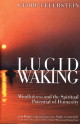
“I prefer to speak of temporary realization of the enlightened condition as enlightenment experiences rather than enlightenment proper. In Japanese Zen Buddhism, fleeting intuitions of our true nature are known as satori, meaning literally"Awakening.”..
I want to focus on enlightenment as a permanent realization. For it is this realization, which is also called liberation, that is the avowed goal of authentic spirituality. Momentary conscious immersions into the enlightened condition are important sustenance for travelers on the path, but they do not give us lasting happiness and peace. For the same reason, we also should not allow other forms of ecstasy (samadhi) to sidetrack us, however fascinating, uplifting, and even revealing they may be. No experience is ultimately liberating. Only the kind of radical shift in our identity that comes with full enlightenment has the power to remove the karmic causes of our suffering.”
Georg Feuerstein, Lucid Waking,
Inner Traditions International, 1997, p. 142-43.
737) Sri Mukti-Rupini
— The Form of Liberation.
— The Supreme Knowledge of Liberation.
Sri Lalita Sahasranama
C. S. Murthy, Associate Advertisers and Printers, 1989
" "And then at last, when the remainder of prarabdha-karma has been exhausted (through the conditioning semblances of physical enjoyment and suffering) the life-breath (prana) dissolves into the Highest Brahman, which is Inward Bliss.”1 Destroyed is ignorance with all its products, in the form of the superimpositions of the outward layers of one's beings; for since there is no longer ignorance, there can no longer be a phenomenal body or mind to weave delusion. There is no longer the basis of an ego ... The Self abides wholly in the Self. It has found its"supreme isolation and integration" (parama-kaivalya), the taste or sap of which is bliss, and which is devoid of the fallacious appearance of duality, since it is the whole. In this terminal state the Self forever abides.
The condition of him who has reached this goal, the goal of Turiya, the"Fourth," is expressed, or suggested, in numerous direct statements of accomplished adepts, in the younger Upanishads, in certain so-called Vedanta Gitas(Vedanta Songs, Hymns, or Rhapsodies), and in many of the stanzas of Sankara.
"From me everything is born; on me everything is supported; into me everything is again dissolved (layam yati: it melts into me, as snow into water.) I am this Brahman, One-without-a-second.
"I am smaller than the minutest atom, likewise greater than the greatest. I am the whole, the diversified-multicolored-lovely-strange (vicitra) universe. I am the Ancient One. I an Man (purusa: the first and only, primordial cosmic being), the Lord. I am the Being-of-gold (hiranmaya: the golden germ out of which the universe unfolds.) I am the very state of divine beatitude.
"Without hands or feet am I; of inconceivable power am I; without eyes I see; without ears I hear; I know all with all-pervading wisdom. By nature detached from all am I, and there is none who knows me. Pure spiritual essence am I, forever.”2
This has the ring of some sort of holy megalomania, a schizoid inflation of some kind, in which the rational individual consciousness has been swallowed completely by a divine Super-Ego. Actually, however, these formulae are intended for the sober purpose of meditation. They represent the perfect state, which is to be attained, and they teach the candidate how to anticipate its attitude. Through reciting, memorizing, and meditating on such exalted utterances, contemplating what is expressed in them and becoming identified with their purport, the candidate for immortality is to become released from his phenomenal ego.
These Vedanta Gitas celebrate the bliss of the one who has achieved self-divinization through remembering his identity with the Self. They announce in aphoristic stanzas, magnificent outbursts of a kind of transcendental lyric ecstasy, the sovereign experience of the spirit that has found home.” (1. Vedantasara 226; 2. Kaivalya Upanisad p. 19-20.)
Heinrich Zimmer, Philosophies of India
Princeton U. Press, 1974, p. 448-49.
739) Sri Layakari
— The Fifth State beyond Turiya.
— The State where individual and Cosmic Consciousness merge.
Sri Lalita Sahasranama
C. S. Murthy, Associate Advertisers and Printers, 1989
"Turiya An ancient Hindu analysis of consciousness identifies four primary states of awareness: waking, dreaming, dreamless sleep and a fourth condition known as turiya (literally," The Fourth"In Sanskrit.) Attainment of Turiya was possible only through the practice of meditation. It was viewed as an important clue to the nature of consciousness.
In meditations to reach Turiya, the activities of thinking and imagining are allowed to die down completely, leaving consciousness to reflect upon itself. Turiya resembles dreamless sleep, in that both states are blissful. Whereas awareness in dreamless sleep is very dim, in Turiya it is exceedingly bright. In its clarity, Turiya is said to resemble the transient, spontaneous mystical experience called ANANDAMAYA.
One of the oldest and most important texts in the Hindu tradition, the Mandukya Upanishad, describes Turiya as follows (Prabhavananda and Manchester translation):
The Fourth, say the wise, is not subjective experience, nor objective experience, nor experience intermediate between these two, nor is it a negative condition which is neither consciousness nor unconsciousness. It is not the knowledge of the senses, nor is it relative knowledge, nor yet inferential knowledge. Beyond the senses, beyond the understanding, beyond all expression, is The Fourth. It is pure unitary consciousness, wherein awareness of the world and of multiplicity is completely obliterated. It is ineffable peace. It is the supreme good. It is One without a second. It is the Self. Know it alone!
For most people, the perfect knowledge of one's self-nature available in Turiya is obscured in the other states of consciousness. When one is able to retain this knowledge under all circumstances, one has attained the condition known as turiya-atita ("The state beyond The Fourth"), which is synonymous with living liberation — JIVAN MUKTI.”
Leornard George, Ph.D. Alternative Realities
Facts on File, Inc., 1995, p. 283-84.
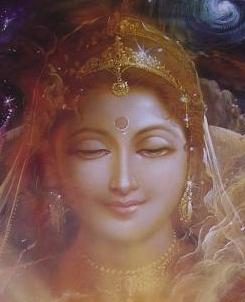
Mahadevi or"Great Goddess"Is a term
used to denote the Goddess or Devi that
is the sum of all other Devis. (Wikipedia)
[The Goddess distinguishes between nonconscious Maya and her own true Self as pure consciousness.]
2.11. [cont.] Since Maya is something we can perceive, it has the nature of nonconscious matter; since knowledge destroys it, it is not truly existent.
2.12. Consciousness is not something we can perceive; what we perceive is indeed nonconscious.
Consciousness is self-luminous; nothing else illuminates it.
2.13. It does not even illuminate itself, for that would lead to the fallacy of infinite regress.
As an agent and the object acted upon are distinct entities, so consciousness itself, like a lamp,
2.14. While shining brightly, illuminates what is other than itself. Know this, O Mountain,
For thus have I demonstrated that consciousness, belonging to my own nature, is eternal.
2.15. The visible world appears and disappears constantly in the various states of waking, dream, and deep sleep.
Pure consciousness never experiences such fluctuations.
2.16. Even if this consciousness itself became an object of perception, then the witness
Of that perception would abide as the real pure consciousness, as before.
2.17. And so those versed in religious treatises regarding the real declare consciousness to be eternal.
Its nature is bliss, for it is the object of supreme love.
2.18. The feeling, 'Let me not cease to be; let me exist forever,' is rooted in love for the Self.
Certainly there is no actual relation between me and all else, since all else is false.
2.19. Therefore I am regarded truly as an undivided whole.
And that consciousness is not an attribute of the Self,
for then the Self would be like an object.
2.20. In consciousness no possible trace of the object state can be found.
And so consciousness also has no attributes; consciousness is not a quality separate from consciousness itself.
2.21. Therefore the Self in essence is consciousness, and bliss as well, always.
It is the real and complete, beyond all relation, and free from the illusion of duality.
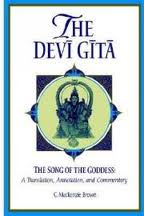
Comment
In the Sakta view, Maya is not simply an insentient force but a conscious and willful facet of the Goddess' personality. Somewhat paradoxically, it is the nondualist school of Advaita, emphasizing an acosmic view of reality and characterizing the realm of Maya as false, that often stresses the greatest difference between Maya and the supreme. Advaita objectifies Maya, viewing it as inert and insentient (jada), over against the supreme, conscious subject that is Brahman (or Atman). By way of contrast, the Devi-Bhagavata, more often than not presenting a Sakta viewpoint, asserts that Maya is"The very essence of the supreme Brahman (maya-para-brahma-svarupani)," and that"The world without Maya would ever be unconscious and inert (jada).”
The Goddess in the above verses of the Devi-Gita ignores for the moment the Sakta perspective, adopting a radical Advaita interpretation by drawing a sharp distinction between herself and Maya. This distinction as characterized here is somewhat at odds with the earlier notion of"difference and nondifference' as suggested by the substance/attribute analogies of verse 5. The Goddess now denies the"nondifference," utilizing standard Advaita visual images and metaphors that stress the"difference.”As the pure subject or consciousness (variously called caitanya, samvit, jnana, and cit), she likens herself to a lamp that is self-illuminating, revealing the visible realm that is Maya, the realm of inert, material objects (referred to as drsya," the seen," and as jada," inert, dull, insentient"). Pure consciousness itself is never an object of perception or knowledge, but is instead the eternal seer or witness (saksin), observing the ephemeral and false identities of empirical existence.
The Goddess here also denies that consciousness is an attribute of the Self-or herself-in accord with Advaitic principles affirming the radical oneness of the supreme subject, beyond all qualification or attribution (neti, neti). Only objects have qualities or attributes. Thus the Goddess does not possess consciousness but rather is consciousness.
C. MacKenzie Brown, The Devi Gita: The Song of the Goddess
State University of New York Press (September 1998) pp. 91-3

Andrew Cohen We, the Unbelievers
by Andrew Cohen
Enlightenment for the 21st Century
A couple of years ago, I discovered something shocking, extraordinary, and completely obvious: Most of us simply don't believe in the evolution of consciousness. And I don't just mean those who are convinced that God created the world in six days. I mean those of us who accept the theory of evolution and who are, at least to some degree, aware of the multidimensional nature of its manifestation all around us. We believe in cosmological evolution and understand that we live not in a static universe but in one that is part and parcel of a deep-time developmental process. We don't doubt that the universe was born many billions of years ago in a blinding flash of light and energy. We believe in biological evolution and have little difficulty comprehending how life itself has evolved from lower levels of development like worms and butterflies to higher ones like dolphins and humans. And many of us even recognize that culture evolves over time and see that development as the expression, at a collective level, of our human capacity for greater and greater complexity and integration. We believe in the evolutionary process because in so, so many ways we can see it all around us: moving, stretching, changing, reaching, from life to death to new life. But when it comes to consciousness—especially our own—I have discovered that our conviction in that same process is often nowhere to be found.
We believe in evolution as an objective fact of life and of the creative process but not necessarily as a living potential inherent in our own subjective experience. It stunned me when I first realized that even many of us who are already dedicated seekers never consider that our very own consciousness, our deepest sense and experience of our self, could actually evolve and develop. It must be because it is such a quantum leap for the subject to become the object—for consciousness to become the object of its own attention and intention. I'm not just speaking about awakening to the experience or fact of consciousness at the level of pure subjectivity, which is what the spiritual experience is typically all about. I'm pointing to something even more difficult to grasp, which is the living potential inherent in consciousness itself for development and growth.
So what does this mean? It means that the feeling/knowing experience of being ourselves can evolve, change, and develop in ways we simply cannot imagine. What is it like for consciousness to evolve? We cannot picture it in the eye of our mind because such development is a journey from the gross to the subtle and is unreachable with thought. How can we possibly imagine that which we cannot conceptualize?
We can imagine our own development as long as we can objectify it with thought. For example, we can imagine ourselves losing weight and building muscle. We can imagine ourselves learning algebra, Chinese, or how to play the guitar. We can even imagine ourselves becoming less selfish and more compassionate. But we simply cannot imagine our own self evolving at the level of consciousness itself. It is important to recognize what an alien concept this actually is in our culture. We are almost never encouraged to grapple with our own evolutionary potential at such a fundamental level, and as a result, most of us have never even considered it. Think about it, just for a moment: What would it be like for my self to evolve in its very essence? What would it be like to develop and grow at a level so profound that I would never be able to see it and yet others would be able to recognize its expression? If we can even begin to look deeply into this question, mysteriously, we will already be participating in the very evolution of consciousness I've been speaking about. And if we pursue it wholeheartedly, we will be helping to make conscious a miraculous process that was born many billions of years ago in a flash of light and energy and is only now beginning to awaken to itself, through us.
Andrew Cohen, founder and editor-in-chief of What Is Enlightenment? has been a spiritual teacher since 1986 and is the author of numerous books, including Living Enlightenment and Embracing Heaven & Earth.
Dennis Choptiany, Markham, Canada:"It can be argued that the most profound creation that humans have made is God. With it came the formation of a vast number of religions and their destructive divisions and conflicts. In your opinion, why do people have an apparent 'need' for religion and why have religions flourished even today when there is more and more evidence of the validity of agnostic and atheist views?”

Deepak Chopra:"Religions have an appeal because human beings have the fear of mortality. All religions promise eternal life. In the absence of profound knowledge of the workings of the universe, we rely on so-called religious authority to answer the deepest questions of our existence: who am I, where did I come from, what's the meaning and purpose of existence, do I have a soul, what happens to me after I die, does God exist, and if God exists does God care about me personally.
Unfortunately, religious ideology, dogma and belief systems are no longer congruent with what we know about the workings of the universe. They are inconsistent with our insights from modern cosmology, evolution, biology and the sciences. Hence, religious based on primitive belief (and unfortunately, all of them are based on primitive beliefs) have become quarrelsome, divisive and frequently idiotic.
However, consciousness still remains a mystery. Is our consciousness an emergent property of our biology or is consciousness the ground of existence that differentiates itself and projects itself as reality? This is not a settled issue. The current atheists and agnostics, such as Richard Dawkins, for example, are espousing an old fashioned 19th century atheism. The god they attack can not be defended. My hope is that as science progresses and looks at the mystery of consciousness we will see the emergence of a new spirituality that is secular and scientific and still addresses our deepest longings and our most important existential dilemmas.”
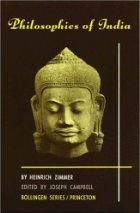
"For where dwell the gods to whom we can uplift our hands, send forth our prayers, and make oblation? Beyond the Milky Way are only island universes, galaxy beyond galaxy in the infinitudes of space — no realm of angels, no heavenly mansions, no choirs of the blessed surrounding a divine throne of the Father, revolving in beatific consciousness about the axial mystery of the Trinity. Is there any region left in all these great reaches where the soul on its quest might expect to arrive at the feet of God, having become divested of its own material coil? Or must we now turn rather inward, seek the divine internally, in the deepest vault, beneath the floor; hearken within for the secret voice that is both commanding and consoling; draw from inside the grace which passeth all understanding?”
Heinrich Zimmer, Philosophies of India
Princeton University Press, 1974, p. 13
"It has been almost twenty years since I wrote Spectrum, and the intervening two decades have convinced me more than ever of the correctness of its essential message: being and consciousness exist as a spectrum, reaching from matter to body to mind to soul to Spirit. And although Spirit is, in a certain sense, the highest dimension or level of the spectrum of existence, it is also the ground or condition of the entire spectrum. It is as if Spirit were both the highest rung on the ladder of existence and the wood out of which the entire ladder is made — Spirit is both totally and completely immanent (as the wood) and totally and completely transcendent (as the highest rung.) Spirit is both Ground and Goal ... The realization of our Supreme Identity with Spirit dawns only after much growth, much development, much evolution, and much inner work ... only then do we understand that the Supreme Identity was there, from the beginning, perfectly given in its fullness.”
Ken Wilber, The Spectrum of Consciousness
Quest Books, 1993, p. xvi.
Vedanta and Consciousness
The Vedantic concept of consciousness is somewhat different from the every-day, Western concept. In the West, what usually is referred to as consciousness is more likely to be called awareness. In Vedanta consciousness is omnipresent and objectless. There is consciousness behind everything — be it a human, an animal or a stone — but a stone has no awareness and the awareness of an animal is very limited. Likewise, the awareness of humans can be more or less limited. Consciousness is static and forever unchanging, but awareness is dynamic and may undergo changes. Consciousness is the same in all humans and interconnects all humanity. While consciousness is undivided and without limits, awareness may be limited and differ from person to person.
The Ultimate Reality is characterized by three concepts — absolute being, absolute consciousness and absolute bliss. Nevertheless, the Ultimate Reality is beyond these and any other human conceptions — It is objectless, omnipresent, all-pervasive, eternal, infinite, unchanging, motionless and without any form. Often, the Ultimate Reality is referred to as a cosmic ocean of consciousness.”
Steen Ingemann, Guide to Ultimate Reality (www.rishi.dk/guide/)
4) Sri Cidagni-Kunda-sambhuta
— Born from the Pit of the Fire of Consciousness.
— Burns out ignorance and confers Immortality.
— She who rose from the fire of knowledge and is the ultimate truth.
68) Sri Chakra-raja-ratha-rudha-sarvayudha-pariskrta
— Mounted on Sri Chakra inside body with all weapons i.e. Powers.
— Enlightens mind to realise Ultimate Reality as an All Pervading-Consciousness.
207) Sri Manonmani
— Highest state of Consciousness.
— Secret name of Sri Durga.
367) Sri Pratyak-Chiti-Rupa
— Inner Consciousness or Knowledge.
404) Sri Bhakta-harda-tamo-bheda-bhanumad-bhanu- santaih
— Effulgence of the Sun; dispels Darkness of Ignorance.
— Giver of the Vision of the Ocean of Consciousness.
573) Sri Prajnana Ghana-rupini
— Supreme Wisdom
— State of Consciousness where nothing else is experienced except Self. —"Like the taste of salt in the sea (It) is everywhere; Prajnana is All Pervasive.”Brahadaranyaka Upanisad
669) Sri Annada
— The Giver of Food.
— Sustains Life and Consciousness.
739) Sri Layakari
—The Fifth State beyond Turiya.
—The State where individual and Cosmic Consciousness merge.
807) Sri Param-dhama
— The Ultimate Light.
— The Ultimate Status
— 'Yadgatva na nivartante taddhama paramam mama'
"The State of Consciousness from which there is no return is My Ultimate State.” (Bha. Gi. 16-6)
854) Sri Gambhira
— The Bottomless Lake.
—"The Ultimate Mother is to be visualised as a great and deep lake of Consciousness, uncomprehended by Space and Time.”Siva Sutra 1.23
858) Sri Kalpana-rahita
— Pure Consciousness.
907) Sri Tattvamayi
— The Mother of the Ultimate State of Consciousness.
Sri Lalita Sahasranama,
C. S. Murthy, Assoc. Advertisers and Printers, 1989.
741) Sri Rambhadi-Vandita
— Worshipped by the most beautiful Celestial Courtesans.
Sri Lalita Sahasranama
C. S. Murthy, Associate Advertisers and Printers, 1989
742) Sri Bhava-Dava-Sudha-Vrstih
— Ambrosial rain which extinguishes the forest fire of Samsara.
— Ends the cycle of births and death.
Sri Lalita Sahasranama
C. S. Murthy, Associate Advertisers and Printers, 1989
"The"competent student" (adhikarin), when approaching the study of Vedanta, should feel an attitude not of criticism or curiosity, but of utter faith (sraddha) that in the formulae of Vedanta, as they are about to be communicated to him, he shall discover the truth. He must furthermore be filled with a yearning for freedom from the encumbrances of worldly life, an earnest longing for release from the bondage of his existence as an individual caught in the vortex of ignorance. This is known as mumuksutra, or moksa-iccha: "The desire for release.”Just as a man carrying on his head a load of wood that has caught fire would go rushing to a pond to quench the flames, even so should the adhikarin, scorched with the mad pains of the fire of life in the world, its birth, its death, its self-deluding futility, go rushing to a guru learned in the Vedas, who, himself having reached the goal of Vedanta, now abides serene in uninterrupted consciousness of the essence of imperishable being. The adhikaran is to come to this guru bearing presents in his hand, ready to serve, and prepared to obey in every way.”
Heinrich Zimmer, Philosophies of India
Princeton U. Press, 1974, p. 51-2.
743) Sri Paparanya-Davanala
— Forest fire that burns all sins.
— Destroys sins of devotees.
Sri Lalita Sahasranama
C. S. Murthy, Associate Advertisers and Printers, 1989
750) Sri Mahesvari
— The Great Ruler.
Sri Lalita Sahasranama
C. S. Murthy, Associate Advertisers and Printers, 1989
751) Sri Mahakali
— Wife of Sri Shiva.
— The Destroyer of Death.
Sri Lalita Sahasranama
C. S. Murthy, Associate Advertisers and Printers, 1989
"If our cultural background makes it hard to see Shakti as feminine, the silence of Shiva — motionless, uncaused, ineffable, nonattached — hardly seems to us the model of masculine power. Masculine power isn't the same as male behavior, however. The aggressiveness of a warrior doesn't correspond to Shiva, who has no need to intrude, conquer, overcome, acquire, or compete. Although he is called"destroyer of worlds"In the Bhagavad-Gita, what is meant is that Shiva absorbs the universe back into himself at the end of creation. This isn't a violent act, any more than it is violent for your brain to reabsorb the neurochemicals that formed your last thought; in both cases the foundation for a new creation, a new thought, has been laid.Shiva is at least a familiar name in the West, known to be one of the three primal gods of India, along with Brahma and Vishnu. Each was conceived as a particular form of the divine: Brahma is the creator of the universe. Vishnu the maintainer, and Shiva the destroyer. It would be a mistake, though, as I just explained, to think of Shiva as some kind of apocalyptic avenger, or even as a being outside ourselves.
God is within, and the three-part division of the divine is only an image or metaphor for something that cannot be divided. By analogy consider how an image, such as the face of someone you love, arises in your mind. The image is created, maintains itself for an instant, then disappears. We could therefore divide the mind into creator, maintainer, and destroyer, but the actual experience of thinking is continuous and unbroken.
So it is with spirit, which is always experienced as wholeness, but unlike the mind, spirit cannot be assigned a place the way we conveniently assign mind to brain. God is neither here nor there, inside nor outside. Shiva is best understood as omnipresence, a silent awareness that permeates everything. Of the threefold gods only Shiva is equated with God because God is all-pervading.
In the setup of things Shiva was given Shakti to carry out the process of physical creation. This is strikingly evocative of the way the code of life is packaged in each cell of your body. It exists as DNA, which is silent, inactive, and out of sight, but also as its biochemical twin RNA which emerged out of DNA to carry out all the cellular processors that actually build the body at the basic level of enzymes and proteins. Brain physiology is both silent and active — billions of memories lie stored in the cortex, emerging one at a time as expressed memory. If you expand this to a cosmic scale, you have Shiva, whose creative potential remains infinitely greater than any of its expressions, even when those expressions take the form of galaxies and whole universes.Shiva brings pure consciousness to a sacred marriage. It invisibly makes every action an action of God.
What would an action of God be exactly? A miraculous intervention, a voice from the mountaintop? Millions of people have waited for such signs and received none. Despite my attempts to bring Shiva out of the realm of abstraction, it would be easy to see him as a ghost, a spiritual concept without flesh and bones. Flesh and bones are demanded by the five senses. When you pay attention to things"out there," you judge their reality by sight, sound, touch, taste, and smell. Yet in spiritual practice there is something called second attention, which attunes you to things your senses cannot grasp.
Second attention makes you aware of spirit. It works through intuition, and it is sometimes called the sight of the gift, although these imply a supernatural faculty. In reality spirit is constantly sending signals to all of us, but because our second attention was never developed, we don't take them in. Intuition is as real as any other faculty, once you have developed it.What kind of signals is second attention looking for? Spirit is universal and constant, like gravity, but has no physical constraints. Shiva reserves for himself complete freedom to be what, when, where, and how he wishes. Second attention can detect all five actions that, according to classic Shiva texts, are characteristic of God when He communicates with the world:
God creates.
God destroys.
God protects and maintains what has been created.
God covers or conceals His own nature.
God reveals or uncovers His own nature.
The Indian mind is not linear, and it finds no contradiction in making Shiva the destroyer in one of his forms and the omnipresent creator-maintainer in another. Shiva's five actions are the framework for any spiritual experience you can have; they give it meaning and form. Since meaning is completely personal, no two people have to agree on which action has been manifested at any given moment — this is a private communication between self and Self.”
Deepak Chopra, The Path of Love, Random House,1977, p. 242-45.
755) Sri Candika
— Angry with evil forces.
Sri Lalita Sahasranama
C. S. Murthy, Associate Advertisers and Printers, 1989
757) Sri Ksara-Ksaratmika
— Eternal and Indestructible.
Sri Lalita Sahasranama
C. S. Murthy, Associate Advertisers and Printers, 1989
758) Sri Sarva-Lokesi
— Queen of all 14 Worlds.
Sri Lalita Sahasranama
C. S. Murthy, Associate Advertisers and Printers, 1989
Scriptures Speak on Three Worlds
As threads come out of the spider, as little sparks come out of the fire,
So all the senses,
All the worlds, all the Gods, yea, all beings, issue forth from the Self.
Yajur Veda In heaven there is no fear at all. Thou, O Death, art not there.
Nor in that place does the thought of growing old make one tremble.
There, free from hunger and from thirst, and far from the reach of sorrow, all rejoice and are glad.
Yajur Veda This universe is a tree eternally existing, its root aloft, its branches spread below.
The pure root of the tree is Brahman, the immortal,
In whom the three worlds have their being,
Whom none can transcend, who is verily the Self.
Yajur Veda The spirit of man has two dwellings: This world and the world beyond.
There is also a third dwelling place: The land of sleep and dreams.
Resting in this borderland, the spirit of man can behold his dwelling in this world,
And in the other world afar;
And wandering in this borderland, he beholds behind him the sorrows of this world,
And in front of him he sees the joys of the beyond.
Yajur Veda May God — who, in the mystery of His vision and power,
Transforms His white radiance, into His many-colored creation,
From whom all things come and into whom they all return —
Grant us the grace of pure vision.Yajur Veda When a man knows God, he is free: his sorrows have an end,
And birth and death are no more.
When in inner union he is beyond the world of the body, then the third world,
The world of the Spirit, is found,
Where the power of the All is, and man has all — For he is one with the One.
Yajur Veda
Without beginning art thou, beyond time, beyond space;
Thou art He from whom sprang the three worlds.
Yajur Veda These worlds, tiered one above the other, from the lowest to the highest,
Make up the universe of transmigration.
Knowers of Reality describe it as the place of effective experience.
Mrigendra Agama
759) Sri Visva-Dharini
— The One who contains all Universes.
Sri Lalita Sahasranama
C. S. Murthy, Associate Advertisers and Printers, 1989
The great Tao flows unobstructed in every direction.
All things rely on it to conceive and be born,
And it does not deny even the smallest of creation.
When it has accomplishes great wonders, it does not claim them for itself.
It nourishes infinite worlds, yet it doesn't seek to master the smallest creature.
Since it is without wants and desires, it can be considered humble.
All of creation seeks it for refuge yet it does not seek to master or control.
Because it does not seek greatness; it is able to accomplish truly great things.
She who follows the way of the Tao will draw the world to her steps.
She can go without fear of being injured,
Because she has found peace and tranquility in her heart.
Tao Te Ching 34-5 (Lao-Tzu)
(Translated by J.H. McDonald, Public Domain, 1996.)
765) Sri Suddha
— Pure Knowledge.
Sri Lalita Sahasranama
C. S. Murthy, Associate Advertisers and Printers, 1989
768) Sri Dyuti-Dhara
— The Light.
Sri Lalita Sahasranama
C. S. Murthy, Associate Advertisers and Printers, 1989
"What is that illumines Atman? If another kind of consciousness is assumed for that purpose, then the question may be asked as to what illumines the second consciousness. Thus one faces the difficulty of an infinite regress. On the other hand, if it is said that Atman is illumined by the light that belongs to Atman alone, then an objection may be raised that the answer hardly gives any satisfaction. It may be contented that the ignorant man does not know the nature of Atman at all; therefore his ignorance can hardly be dispelled by the statement that the light of Atman manifests Atman.”
Swami Nikhilananda, Self-Knowledge [Atmabodha], 1989, p. 144.)
"God is Light. God is the Supreme Spirit which is present in every man in his inner conscience. That Light is his Guru that guides him. Sayeth Third Nanak: — "Mind, thou art the image of Light, recognise thy essence.” (P. 441, Adi Granth)"
Pritam Singh Gill, The Trinity of Sikhism, 1990, p. 79.
Allah is the light of the heavens and the earth;
A likeness of His light is as a niche in which is a lamp,
The lamp is in a glass, (and) the glass is as it were a brightly shining star,
Lit from a blessed olive-tree, neither eastern nor western,
The oil whereof almost gives light though fire touch it not — Light upon Light.
Allah guides to His light whom He pleases,
And Allah sets forth parables for men, and Allah is Cognizant of all things.
surah 24:35 Al Nur
(Muhammed Shakir, The Holy Qur'n, U. of Michigan.)
772) Sri Duraradhya
— Difficult to be worshipped by the incompetent.
— Difficult to be worshipped by those unable to control the senses.
Sri Lalita Sahasranama
C. S. Murthy, Associate Advertisers and Printers, 1989
"Yoga can be defined as a discipline designed to yield an experience of the sovereign aloofness and isolation of the suprapersonal nucleus of our being, by stilling the spontaneous activities of matter, which, in the form of the bodily and psychic shell, normally overlie the life-monad. Yoga is founded on, and demonstrates, a doctrine of psychological functionalism. It creates and then transcends and dissolves various planes, or worlds, of experience, and thus makes known the relativity of all states of reality; for when the inner psychic world is seen to be but a function of the inner psychic organs, then the outer, visible and tangible universe can be understood, by analogy, to be but the consequence of an operation outward of the energies of the outer organs...
Only by an accomplished yogi, in perfect control of the microcosm of himself, can entities belonging to the macrocosmic realm of name and form be dissolved and summoned back at will. For the human mind, with its contents and wisdom, is conditioned, in every specific case, by the peculiar balance of the gunas within the character and disposition of the given individual. His ideas, beliefs, and insights, and even the things that he sees around him, are, finally, but the functions or reflexes of his particular manner of not-knowing-better. This avidya is the bird-net in which he is once caught and supported as a personality. And even his after-death experiences will be determined by this limitation, which intangibly bounds and binds his being.”
Heinrich Zimmer, Philosophies of India,
P. University Press, 1974, p. 316-17.
777) Sri Viraradhya
— Worshipped by the valiant.
Sri Lalita Sahasranama
C. S. Murthy, Associate Advertisers and Printers, 1989
"Though there is no mention of image-worship in the Rgveda, the Shivite traditions represent the tampered form of the Vedic doctrines the same way as non-violence has become the basic principle of the modern Hinduism though the Vedas and Gita prescribe fighting for a righteous cause and declare it the greatest honour for a true Hindu.”
Encyclopaedia Britanicca
"Goddess worship in India goes back to prehistoric India. Archaeological remains from the cities of the Indus civilization (1600-1900 B.C.) include large numbers of crudely fashioned female clay figurines, generally called mother goddesses.
Starting around 1300 B.C. a group of nomadic peoples who called themselves Aryas, or Noble Ones, became dominant in northern India. Their sacred literature was composed in Sanskrit and known as the Vedas. The Vedas reflected a world view that was overwhelmingly masculine. While gods became predominant as the Aryans settled in north India, archaeological excavations show that peasants in numerous villages continued to worship The Mother goddess.
During the Gupta period (320-647), the goddess, as object of worship, was affirmed in the Devi Mahatmya, a fifth-sixth century Sanskrit text. Through the dynamic narration of three stories about her great feats, the Devi Mahatmya assumes Devi's supremacy as the creator of the universe and the one who pervades and sustains creation. Copies of the Devi Mahatmya illustrating Devi's adventures in detail became increasingly popular into the 19th century.
During most of India's history, a monarchical system of government prevailed. Much evidence exists to suggest that regardless of a monarch's main deity, it was the Great Goddess to whom he turned when he sought victory in battle; it was she who was worshiped prior to embarking on war. This is attested to in the two great Indian epics: the Mahabharata and the Ramayana. The sixteenth century led to a resurgent belief that Hindu rulers required the protection of female deities, and from this time onward many Hindu kings chose a particular goddess to appear on coins, seals and other official documents.”
Smithsonian Institution, 1999
780) Sri Visvatomukhi
— Creatrix of the Universe.
—"Having eyes and faces everywhere.”Svetasvataropanisad 3.3
Sri Lalita Sahasranama
C. S. Murthy, Associate Advertisers and Printers, 1989
783) Sri Pranada
— The Giver of Life.
Sri Lalita Sahasranama
C. S. Murthy, Associate Advertisers and Printers, 1989
The Tao gives birth to all of creation.
The virtue of Tao in nature nurtures them, and their family give them their form.
Their environment then shapes them into completion.
That is why every creature honors the Tao and its virtue.
No one tells them to honor the Tao and its virtue, it happens all by itself.
So the Tao gives them birth, and its virtue cultivates them, cares for them,
Nurtures them,
Gives them a place of refuge and peace, helps them to grow and shelters them.
It gives them life without wanting to posses them,
And cares for them expecting nothing in return.
It is their master, but it does not seek to dominate them.
This is called the dark and mysterious virtue.
Tao Te Ching 51 (Lao-Tzu)
(Translated by J.H. McDonald, Public Domain, 1996.)
788) Sri Jayatsena
— Having victorious armies of Divine Forces.
Sri Lalita Sahasranama
C. S. Murthy, Associate Advertisers and Printers, 1989
800) Sri Rasa-Sevadhih
— The Ocean of Bliss.
Sri Lalita Sahasranama
C. S. Murthy, Associate Advertisers and Printers, 1989
701. Desa kala parischinna - She who is not divided by region or time.
702. Sarvaga - She who is full of everywhere.
703. Sarva mohini - She who attracts every thing.
704. Saraswathi - She who is the goddess of knowledge.
705. Sasthra mayi - She who is the meaning of sciences.
706. Guhamba - She who is mother of Lord Subrahmanya (Guha).
707. Guhya roopini - She whose form is hidden from all.
708. Sarvo padhi vinirmuktha - She who does not have any doctrines.
709. Sada shiva pathi vritha - She who is devoted wife for all times to Lord Shiva.
710. Sampradhayeshwari - She who is goddess to rituals or She who is goddess to teacher-student hierarchy.
711. Sadhu - She who is innocent.
712. Ee - She who is the letter"e.”
713. Guru mandala roopini - She who is the universe round teachers.
714. Kulotheerna - She who is beyond the group of senses.
715. Bhagaradhya - She who is to be worshipped in the universe round the sun.
716. Maya - She who is illusion.
717. Madhumathi - She who is the trance stage (seventh ) in yoga.
718. Mahee - She who is personification of earth.
719. Ganamba - She who is mother to Ganesha and bhootha ganas.
720. Guhyakaradhya - She who should be worshipped in secret places.
721. Komalangi - She who has beautiful limbs.
722. Guru Priya - She who likes teachers.
723. Swathanthra - She who is independent.
724. Sarwa thanthresi - She who is goddess to all thanthras (tricks to attain God).
725. Dakshina moorthi roopini - She who is the personification of God facing South (The teacher form of Shiva).
726. Sanakadhi samaradhya - She who is being worshipped by Sanaka sages.
727. Siva gnana pradhayini - She who gives the knowledge of God.
728. Chid kala - She who is the micro power deep within.
729. Ananda Kalika - She who is the happiness in beings.
730. Prema roopa - She who is the form of love.
731. Priyamkaree - She who does what is liked.
732. Nama parayana preetha - She who likes repetition of her various names.
733. Nandhi vidhya - She who is the knowledge taught by Nandi deva (The bull god on whom shiva rides).
734. Nateshwaree - She who is the goddess of dance.
735. Mithya Jagat athishtana - She who is luck to this world of illusion.
736. Mukthida - She who gives redemption.
737. Mukthi roopini - She who is redemption.
738. Lasya priya - She who likes feminine dance.
739. Laya karee - She who is the bridge between dance and music.
740. Lajja - She who is shy.
741. Rambha adhi vandhitha - She who is worshipped by the celestial dancers.
742. Bhava dhava sudha vrishti - She who douses the forest fire of the sad life of mortals with a rain of nectar.
743. Paparanya dhavanala - She who is the forest fire that destroys the forest of sin.
744. Daurbhagya thoolavathoola - She who is the cyclone that blows away the cotton of bad luck.
745. Jaradwanthara viprabha - She who is the suns rays that swallows the darkness of old age.
746. Bhagyabdhi chandrika - She who is the full moon to the sea of luck.
747. Bhaktha Chitta Keki Ganagana - She who is the black cloud to the peacock which is he devotees mind.
748. Roga parvatha Dhambola - She who is the Vajra weapon which breaks the sickness which is like the mountain.
749. Mrutyu Dharu Kudarika - She who is like the axe which fells the tree of death.
750. Maheswaree - She who is the greatest goddess.
751. Maha kali - She who is the great Kalee.
752. Maha grasa - She who is like a great drinking bowl.
753. Mahasana - She who is the great eater.
754. Aparna - She who did meditation without even eating a leaf.
755. Chandika - She who is supremely angry.
756. Chanda mundasura nishoodhini - She who killed the asuras called Chanda and Munda.
757. Ksharaksharathmika - She who can never be destroyed and also destroyed.
758. Sarva lokesi - She who is goddess to all the worlds.
759. Viswa Dharini - She who carries all the universe.
760. Thrivarga Dhathri -"She who gives dharma, Assets and pleasure.”
761. Subhaga - She who is pleasing to look at.
762. Thryambhaga - She who has three eyes.
763. Trigunathmika -"She who is personification of three gunas viz .,Thamo (Kali), Rajo (Dhurga) and Sathva (Parvathy).”
764. Swargapavargadha - She who gives heaven and the way to it.
765. Shuddha - She who is clean.
766. Japapushpa nibhakrithi - She who has the colour of hibiscus.
767. Ojovathi - She who is full of vigour.
768. Dhyuthidhara - She who has light.
769. Yagna roopa - She who is of the form of sacrifice.
770. Priyavrudha - She who likes penances.
771. Dhuraradhya - She who is rarely available for worship.
772. Dhuradharsha - She who cannot be won.
773. Patali kusuma priya - She who likes the buds of Patali tree.
774. Mahathi - She who is big.
775. Meru nilaya - She who lives in Meru mountain.
776. Mandhara kusuma priya - She who likes the buds of Mandhara tree.
777. Veeraradhya - She who is worshipped by heroes.
778. Virad Roopa - She who a universal look.
779. Viraja - She who does not have any blemish.
780. Viswathomukhi - She who sees through every ones eyes.
781. Prathyg roopa - She who can be seen by looking inside.
782. Parakasa - She who is the great sky.
783. Pranadha - She who gives the soul.
784. Prana roopini - She who is the soul.
785. Marthanda Bhairavaradhya - She who is being worshipped by Marthanda Bhairava.
786. Manthrini nyashtha rajyadhoo - She who gave the power to rule to her form of Manthrini.
787. Tripuresi - She who is the head of three cities.
788. Jayatsena - She who has an army which wins.
789. Nistrai gunya - She who is above the three qualities.
790. Parapara - She who is outside and inside.
791. Satya gnananda roopa -"She who is personification of truth, knowledge and happiness.”
792. Samarasya parayana - She who stands in peace.
793. Kapardhini - She who is the wife of Kapardhi (Siva with hair).
794. Kalamala - She who wears arts as garlands.
795. Kamadhukh - She who fulfills desires.
796. Kama roopini - She who can take any form.
797. Kala nidhi - She who is the treasure of arts.
798. Kavya kala - She who is the art of writing.
799. Rasagna - She who appreciates arts.
800. Rasa sevadhi - She who is the treasure of arts.
www.starsai.com/lalithambigai-goddess-lalithasahasranamam.html
A Mystic's Message Of Peace to Mankind
In this rare epigrammatic discourse Thiruchi Swami speaks of the perennial human plight and the path to liberation.
1 India has all along its history held that peace is the most valuable treasure for mankind. All the schools of thought, all the saints and seers, all the visionaries and poets have advocated the cause of peace. Indeed, all the religions of the world and all prophets have sung the praises of peace; and whatever may be the doctrinal or other differences between religions and sects, there is perfect unanimity in their appeal for peace as the most prized possession of man.
2 Naturally, one may wonder why, in spite of such unanimous advocacy of peace, mankind has been witnessing wars and conflicts without a break all through history. There is not a single country in the world which has not suffered by the breach of peace to a smaller or to a greater extent. Great saints and prophets have come and gone. They have all preached peace eloquently and honestly, but their influence has not been considerable in preventing dissensions and conflicts.
3 One of the schools of Indian thought, the Mimamsakas, have held that the world remains essentially the same all through the years. The doctrine that na hi kada-chid anidrasam jagat," the world was never any different from what it is now," implies that the affairs of the world do not alter with the passage of time and that human nature remains identical whatever the affairs of the world. History, in a sense, truly repeats itself. Wars have always been fought, and violence, deceit, ambition, envy, hatred, fear, suspicion, anger, pride, revenge, passion and prejudice have dogged man all through his career on the globe. The course of mankind has not changed despite prophets and messiahs, sages and seers.
4 But this is no justification for pessimism or cynicism. It is the nature of all phenomena that when things go wrong, corrections are promptly applied and the original state is sought to be restored. Wars are fought and peace is sought thereafter. Periods of agitation and turmoil are always followed by spells of calm and comfort. Depravity soon gives place to good sense. But it is a significant detail to note that such corrections do not occur spontaneously or mechanically. There are always individuals who are divinely inspired and operate as if they are emissaries of Destiny. Whenever evil prevails and the good suffers, God will manifest Himself to put down the evil and support the cause of the good.
5 The Vedic seer visualized a state of composure and contentment in which not only all the living beings but also the natural forces settle down amicably for mutual benefit and betterment. He did not distinguish between human beings and animals and plants or yet between animate beings and inanimate things. They were all alike eligible for peace and happiness. The Veda treats all aspects of existence equally as sources of a comfort or distress for man depending on how he approaches them.
6 Shanti, meaning"peace and well being," is a powerful Indian word, frequently found on the lips of Indian populace since very ancient times till our own day. Shanti is a state where one is free from both happiness, sukha, and sorrow, dukha. It is a state of perfect bliss.
7 As is well known, shanti as an invocation for peace is uttered in India thrice: Om Shanthih, Shanthih, Shanthihi. The initial Om represents the Vedic lore in its essence and stands for Godhead, pure and absolute. The three shantis are peace in the individual, adhyatmika, peace in the surroundings, adhi-bhautika, and peace in the spiritual context, adhi-daivika. The individual peace relates to body and mind; peace in the surrounding comprehends the physical environment and the social situations; and the third peace refers to the forces beyond our normal control. The three shantis answer to the three-fold ills that man is heir to: tapatraya — physical and mental ailments (adhyatmika), troubles from wild and cruel animals and from unfriendly fellow humans (adhi bhautika), and distresses caused by unforeseen calamities and natural upheavals (adhi-daivika). There is, thus, need for man to safeguard his existence from disease, social stresses and ecological disasters. Remaining in a state of peace, shanthi, is the only solution to all these predicaments.
8 Indian thought further analysis the human predicament as mainly due to errors of judgment (prajnaparadha). Diseases are caused by not knowing or not attending to what and how and when we should eat, how we should exercise and order our lives, etc. Social stresses are occasioned by our ignorance of how to interact with others around us and by our own inability to keep our emotions under check. Ecological disasters are caused by our ambition, greed and insensibility. We undermine our health, vitiate the relations with others around us, and exploit natural resources in order to maximize our happiness, and the entire process becomes counterproductive.
9 There is a popular saying that man wants to be happy but does not bother about the method for securing it; and he wants to avoid sorrow but does not give up the things that necessarily produce sorrow. This is man's predicament. He knows what is right but lacks the will to pursue it. He is aware of what is bad but is unable to forsake it. He wants what he does not get and gets what he does not want. The result is that he is not happy either with what he wants or with what he gets. His unhappiness makes him sour, angry and violent in his speech, thought and actions. A large number of such people will make conflict, discord and hatred unavoidable.
10 Passions that are not controlled are like fire that not only burns where it arises but spreads all round and causes misery to others. Indian culture attaches importance to the individual more than to the society. Its message is that man must be in his own life restrained and noble, and that it is only then that the society can flourish. For, after all, society is a collection of individuals. How can society be all right when the individuals composing it are not all right? Social stresses are caused by individuals who are under stress in their own lives. A man who is really happy cannot think of making others unhappy; he can only make them happy.
11 Therefore, our saints have warned that six enemies are lurking within each individual (arishadvarga), and we are to be constantly vigilant, lest they overpower us. They are ambitions and desires (kama), hatred and anger (krodha), greed and hankering (lobha), ignorance and indolence (moha), arrogance and conceit (mada), and envy and jealousy (matsarya). Research by yogis has revealed that lack of awareness of reality (avidya) and repulsion towards objects (dwesha) and desire for life (abhinivesha) are the causes of all miseries in life. These afflictions (kleshas) have to be reduced to the vanishing point. The first and foremost task of every religion should, therefore, be the building up of the inner man, chastening of his emotions and refining of these attitudes and aspirations.
12 A real hero is a master of himself. He does not lord over others; nor does he allow anything or anyone to rule over himself. What does it profit to conquer the whole world and lose oneself in the bargain? Plenty and power are not the solution for man's predicament on earth. Restraint and rest are the answer.
13 Peace, in other words, rests finally in each one of us. It is a matter for each individual to strive for and become. It cannot be a community program. Purity of purpose, sincerity of heart and strength of will are personal factors, and they alone contribute to the success of any undertaking. Our saints insist on purification of one's own mind and heart (antaranga-shuddhi) before one sets out to correct the ills of the society or the world.
14 Indeed, one can never make the world a perfect place for all of us to live in. The miseries of poverty, aggression, exploitation, corruption and violence can never be totally eradicated from the world. But a wise person can make himself immune to all the stresses by developing spiritual resistance. Is it possible to spread carpets over all the roads so that you can walk safely and with comfort? But you can still achieve that end when you cover your feet with sandals. When the soles of your feet are covered, the entire stretch of earth is as good as being covered with carpet. More important and more practical than correcting the world is therefore correcting oneself. As the preamble to UNESCO rightly puts it," Since wars begin in the minds of men, it is in the minds of men that the defenses of peace must be constructed.”
15 This is possible only when we learn to turn our attention inward. We read in the Kathopanishad that ordinarily man is engaged with the world outside because his sense organs and mind are by construction outwardly oriented. But a wise man will shut his sense organs and open the inward eye. When we are involved with the outside, stress results; but when the gaze is inward, peace will alight on us, because the very nature of Self is peace (Santoyam atma as another Upanishad says). Peace is, thus, a quality of life and each one has to discover it within himself.
16 Although most miseries are psychophysical, the mind being the more suitable and primary, is the ultimate host of all miseries, verily. The mind can make a heaven of hell and a hell of heaven. How to transform hell into heaven and help retain heaven is the quest that the seeker of peace is after.
17 It is our considered opinion that enduring and effective peace can result only from more and more people taking to the path of religious devotions (upasana). Religious devotion does not consist of dogmas, creeds, sectarian affiliations or regional differences. It is a way of life in which the thoughts and feelings are continually chastened while they are directed towards the supreme reality which is within. Temples, worship, rituals, religious observances and a life of restraint are all directed towards this end. The body of a truly religious person is itself the temple, and his spirit verily is the Godhead. The fundamental need of the world — far deeper than any social, political or economic readjustment — is, therefore, a spiritual awakening, a recovery of faith.
18 Everyone should, therefore, know what life is, why life is and how life is. Without knowing these things, life can never be lived properly. Right life comprises the three disciplines: physical, moral and spiritual. The error of man is to prefer the veiled to the revealed and the twilight of illusion to the light of reality. Life should, therefore, be lived with some definite aim or goal. It should be planned and discriminative, with duties absolutely necessary and helpful for achieving the aim in the shortest possible time.
19 May the Devi, our chosen form of the Godhead, our Universal Mother Gnanakshi Sri Rajarajeswari, who presides over the destiny of all the worlds, instill in our hearts good sense, right discrimination and firm resolve so that our individual lives may become abodes of peace. May the little lamps thus lit, millions of them, illumine the world and make it a place fit for enduring and meaningful peace.
Jagadguru Sri Sri Sri Shivarathnapuri Bhagawath Padachariya Thiruchimahaswamiji
Two kinds of knowledge (vidya) are to be known: that of the Brahma-of-sounds (sabda- brahman) and that of the Highest Brahman (param-brahman.) The brahman-of-sounds is the aggregate of all the hymns, formulae, charms, incantation, prayers, and exegetical commentaries that constitute the Vedic revelation. This Brahman cannot be the Highest, however, because it is endowed with name and form; names to assist the mind, and the sound-forms of speech, song, melody, and prose (naman and rupa.) But anyone laved (nisnata) in Sabda-Brahman goes on to the Highest Brahman. Having studied the books (grantha) assiduously (abhyasa: this is the term for constant endeavor in yogic practice), the wise, intent on knowledge solely, and on the plenitude-of-knowledge (vijnana), should discard books completely — just as a person trying to get at rice throws the husks away.”1
The inferior, preliminary wisdom is like a raft — to be forsaken once it has transported its voyager to its destination. Sacrificial lore and the ethical rituals of life have to be left behind at the brink of the higher realization.2
"This is to be attained only by truthfulness (Satya) and asceticism (tapas), real insight (samyag-jnana) and unbroken continence (brahmacarya.) Consisting of divine light, resplendent, It resides within the body. Ascetics behold It, who have annihilated their defects.”3
"This Self is not attained through teaching, intelligence, or much learning. It is attained by him only whom It chooses. To such a one this Self discloses Its proper nature (tanum svam.)"4
"Verily, the Self that is in the three states of waking (jagrut), dream (svapna), and dreamless sleep (susupti), is to be understood as one and the same. For him who has transcended this triad of states, there is no rebirth.
"Being verily one, the Self-of-all-beings-and-elements is present in every being. It is beheld onefold and manifold simultaneously, like the moon reflected in water.”5
1. Amrtabindu Upanishad 17-18 Vijnana ("The plenitude of knowledge"): the vi — here refers to Infinity, which is all comprehensive and leaves no margin wherein any unincluded, second entity might exist. Vijnana is therefore nondual (advaita) knowledge (jnana), and as such synonymous with the state known to Vedanta as Turiya, the"Fourth.”This is beyond the three planes of waking consciousness, dream consciousness, and deep sleep. Such would seem to be the meaning of the term vijnana in the Bhagavad Gita also.
2. Throughout the later periods of Hindu tradition the term"lower wisdom" (aparavidya) has been regarded as referring to wisdom committed to writing: book lore is to be finally discarded. The injunction resembles that of the European alchemists," rumpite libros ne corda vestra rumpantur," but lacks the touch of polemic criticism.
3. Mundaka Upanishad 3. 1. 5. (cf. Hume, op. Cit., p. 374.)
4. Ib. 3. 2. 3. (cf. Hume, op. cit., p. 376.) Compare the Christian doctrine of Grace.
5. Amrtabindu Upanishad 11-12. There is but one moon in the nightly firmament, yet it is reflected in numerous jars standing in the moonlight. The jars, perishable clay, are compared to individuals.”
Heinrich Zimmer, Philosophies of India
There is no one greater in the three worlds than the guru.
It is he who grants divine knowledge and should be worshiped with supreme devotion.Atharva Veda
Abiding in the midst of ignorance, but thinking themselves wise and learned, fools aimlessly go hither and thither,
Like blind led by the blind.
Atharva Veda
Truth is the Supreme, the Supreme is Truth.
Through Truth men never fall from the heavenly world, because Truth belongs to the saints.
Therefore, they rejoice in Truth.
Yajur Veda
The supreme mystery in the Veda's end, which has been declared in former times, should not be given to one not tranquil,
Nor again to one who is not a son or a pupil.
To one who has the highest devotion for God, and for his spiritual teacher even as for God,
To him these matters which have been declared become manifest if he be a great soul —
Yea, become manifest if he be a great soul!
Yajur Veda
Disciples get, by devotion to the guru, the knowledge which the guru possesses.
In the three worlds this fact is clearly enunciated by divine sages, the ancestors and learned men.
Guru Gita
It is laid down by the Lord that there can be no moksha (liberation) without diksha (initiation);
And initiation cannot be there without a teacher.
Kularnava Tantra
Though himself unattached, the guru, after testing him for some time, on command of the Lord,
Shall deliver the Truth to his disciple in order to vest him with authority.
Of him who is so invested with authority, there is verily union with the Supreme Siva.
At the termination of the bodily life, his is the eternal liberation — this is declared by the Lord.
Therefore, one should seek with all effort to have a guru of the unbroken tradition, born of Supreme Siva himself.
Kularnava Tantra
Without a teacher, all philosophy, traditional knowledge and mantras are fruitless.
Him alone the Gods laud who is the guru, keeping active what is handed down by tradition.
Kularnava Tantra
I adore the lotus feet of the teachers who have shown to us the source of the eternal ocean of bliss, born of the Self within, Who have given us the remedy for the hala-hala poison of samsara.
Guru Gita
“The yogin can choose between two distinct approaches in order to attain emancipation ... Either he sets out to discover his essence, the Self, whilst relying on his own innate strength, or else he calls for help from the Divine Being. In both cases, however, he must open himself to an order of life higher than his empirical personality. In the latter approach he makes use of the powerful human capacity for love. The inner vacuum which is created by turning away from worldly pursuits, is now filled with a truly prodigious power which assists him in overcoming even the strongest resistance of the mind to being transmuted into pure consciousness and thereby transcending the boundaries of the spatio-temporal universe. The divine grace (prasada) of Purusottama safely guards the devotee across the chasms of mundane life into the supreme abode of the Lord ...
It is self-evident that the love pulsating in the divine body of God is not of an emotional or intellectual nature. The love that flourishes eternally between God and the Self-particles who have awakened to His presence is one of ineffable divine creativity: The whole communing with Itself ... Emancipation depends on God. No amount of self-effort can bring about the final fruit of self-transcendence. We must release all tension within us and relinquish our self-will and become still. God's great work can only be accomplished when the soul has become tranquil (prasada.) Then we are able to open ourselves to the divine omnipresence. This is true bhakti, which gives birth to the grace (prasada) of God.”
Georg Feuerstein, Introduction to the Bhagavad Gita
Rider & Co. 1974, p. 161-2.
In this great wheel of Brahman, the life and foundation of all, the soul wanders like a swan, thinking himself and the Inspirer to be separate. When grace comes from Him, he attains immortality. 7. This has been praised as the supreme Brahman in which the threefold reality is established and imperishable. Those who know Brahman within, realizing Brahman and absorbed in Brahman, are released from birth. 8. The Lord encompasses this all, composed of things perishable and imperishable, formed and unformed. The self, a mere enjoyer, suffers without a Lord, but he who knows God is freed from all fetters. 9. Two are unborn, the knower and the ignorant; the Lord and the not-Lord. The one, an enjoyer, is chained to enjoyments; the other, the atman, is infinite, of universal form, nonactive. By knowing the threefold, one also knows Brahman. 10. Perishable is matter; immortal, imperishable the Lord, who, the One, controls the perishable and also the soul. Meditating on him, uniting with him, becoming more and more like him, one is freed at the last from the world's illusion. 12. The Eternal which resides in the atman should be known. Beyond this there is nothing that needs to be known. The enjoyer, the object of enjoyment, the Inspirer — this has been declared to be the All, the threefold Brahman.
SU I, 6-10; 12
O wise one, this is the established doctrine concerning Devi; She is the Vedas, the sacrifices, the heaven and all this universe;
The universe, immovable as well as movable, is pervaded by the Devi.
She is all that is sacrificed to and worshipped by the Devas; And She is all that is food and drink;
Manifold in form and name, Devi is everywhere — In trees, in the Earth, in the air, in the ether, in water, and in fire.
Devi Purana
O, Mother of the Universe, those who praise you by the words: ambika, jaganmayi and maya, will obtain all.
Kalika Purana
If one aspirant thinks in his mind one single name of Hers, in that moment he knows the chakra of The Mother, O beloved one.
Vamakesvara-tantra
Those who prostrating their bodies praise You by the words:
Maya, durga, vedagarbha, amba, bhadra, bhadrakali, ksemya, ksemamkari, in the mornings and evenings,
Will obtain all the desired objects by My Grace.
Visnu Purana
It is impossible, O Sage, for me to enumerate,
The countless names of Devi in hundred crores of Kalpas.
Skanda Purana
What can I say? Devi has countless names, which have been composed by Brahma and other Devatas
According to Her different qualities and doings.
Devi-bhagavata Purana
Disclaimer: Our material may be copied, printed and distributed by referring to this site. This site also contains copyrighted material the use of which has not always been specifically authorized by the copyright owner. We are making such material available to our readers under the education and research provisions of "fair use" in an effort to advance freedom of inquiry for a better understanding of religious, spiritual and inter-faith issues. The material on this site is distributed without profit. If you wish to use copyrighted material for purposes other than "fair use" you must request permission from the copyright owner.
 SHRI LALITA SAHASRANAMA 701-800