The Book Of Enlightenment
Of the many divine revelations July 23, 1994 stands out. On that day Kash asked, “Shri Mataji, what was Your original name?” The eternal, stunningly beautiful Mother replied: “Shri Lalita Devi”.“Now the name Nirmala itself means immaculate; means the one who is the cleansing power and the name of the Goddess also. My actual sign name is Lalita who is the name of the Primordial Mother. That is the name of the Primordial Mother.”
Shri Mataji, New York, USA, 30 September 1981
Sri Lalita Sahasranama 801-900
802) Sri Puratana — The Primordial One.
— The Ancient One.Sri Lalita Sahasranama
Sri Lalita Sahasranama
C. S. Murthy, Associate Advertisers and Printers, 1989
"Who is Devi?
The Great Goddess, known in India as Devi (literally"goddess"), has many guises. She is "Ma" the gentle and approachable mother. As Jagatmata, or Mother of the universe, she assumes cosmic proportions, destroying evil and addressing herself to the creation and dissolution of the worlds. She is worshiped by thousands of names that often reflect local customs and legends. She is one and she is many. She is celebrated in songs and poems.
"Always Blissful Mother," by Kamlalakanta Chakrabarti
Mother, you're always blissful.
You charmed destructive Shiva, you dance in your own joy, and clap your hands to keep time.
O Elemental, Eternal One!
Your form is empty space, yet the moon adorns your brow.
Where did you get your garland of severed heads, before the universe came into being?
You are the operator, and we nothing but machines that run by your rule.
We stay where you put us, and say what you make us say.
Cursing you, O Destructive One, restless Kamlalakanta says:
With the sword in your hand you've slaughtered my faith together with my disbelief.
Devi is all-important in the Hindu tradition, but there are also forms of female divinity in the Buddhist and Jain religions. Today millions of Hindu men and women conduct regular pujas to Devi through one of her many manifestations. For some she is their primary deity while for others she is part of a greater pantheon. All Hindu goddesses can be seen as different manifestations of Devi. In some forms she is benign and gentle, while in other forms she is dynamic and ferocious, but in all forms she is helpful to her devotees.
[DEFINITION: Hinduism is a fusion of many religious beliefs and philosophical schools Its origins are mixed and complex: one strand is traced to the Vedas, the sacred literature written around 1100 BC by the Aryans, a people who trickled steadily into the Indian subcontinent between 1800 and 1200 BC; the other strand drew upon the beliefs of the indigenous people of India especially their faith in the efficacy of fertility symbols and faith in the power of The Mother Goddess.]
[DEFINITION: Buddhism, a faith that originated in India about 2,500 years ago, embodies the teachings of the Buddha. He devised a code of actions and thoughts to free humankind from a continual state of desire and egotism. Jainism is a faith that originated in India in the fifth century B.C. which considered knowledge to be the ultimate way to salvation.]"
Smithsonian Institution, 1999
806) Sri Param-jyotih
— The Ultimate Light.
—"There (in the Great Lotus Forest) the sun, moon and stars do not shine because She illumines the mind that illumine all of them.” Kathopanisad 5.15
Sri Lalita Sahasranama
C. S. Murthy, Associate Advertisers and Printers, 1989
Allah is the Light of the heavens and the earth. The similitude of His light is as a niche wherein is a lamp.
The lamp is in a glass. The glass is as it were a shining star.
(This lamp is) kindled from a blessed tree, an olive neither of the East nor of the West,
Whose oil would almost glow forth (of itself) though no fire touched it. Light upon light. Allah guideth unto His light whom He will.
And Allah speaketh to mankind in allegories, for Allah is Knower of all things.
surah 24:35 Al Nur
(M. Pickthall, The Meaning of the Glorious Quran)
Whatever is seen shall perish.
Contemplate the One who is unseen.
When the key is inserted in the Tenth Gate, then the Blessed Vision of the Merciful Lord's Darshan is seen.
When one ascends from the lower realms of the earth to the higher realms of the heavens, then everything is resolved.
The Lord dwells in both the lower and higher worlds.
Leaving the earth, the soul ascends to the heavens; Then, the lower and higher join together, and peace is obtained.
The days and nights go by; I am looking for the Lord.
Looking for Him, my eyes have become blood-shot.
After looking and looking, when She is finally found, then the one who was looking merges into the One who was looked for.
He is limitless; Her limits cannot be found.
I have attuned myself to the Supreme Light.
Sri Guru Granth Sahib (Raag Gauree Poorbee, p. 340.)
Your eye is the lamp of your body; When your eye is sound, your whole body is full of light;
But when it is not sound, your body is full of darkness. Therefore be careful lest the light in you be darkness.
If then your whole body is full of light, having no part dark, it will be wholly bright, as when a lamp with its rays gives you light.
Luke 11.34-36
15. If one sees God face to face as the atman, as Lord of what has been and what shall be, one shrinks not from him.
16. That in the wake of which the year revolves together with its days — that the Gods worship as Light of lights, as life immortal.
17. On whom are established the five times five beings, and space — him I believe to be the atman, knowing him, the deathless, as the deathless Brahman.
18. Those who know the breath of breath, the eye of the eye, the ear of the ear, and the mind of the mind — they have realized Brahman, ancient and primeval.
19. Only by the mind is it to be seen. In it there is no plurality. The man who perceives what seems to be plurality here proceeds from death to death.
20. Only in oneness is it to be seen, the stable atman, immeasurable. Free from blemish is it, beyond space, unborn, great, unwavering.
21. Let the wise, the knowers of Brahman, realizing Him, practice their wisdom. Let them not ponder many words, for in speech is mere weariness.
Brahadaranyaka Upanisad IV, 4, 15-21
"The Light of lights: jyotisham jyotih the source of all other luminaries.”
(Cf. KathU V, 15 (§ V 5); SU VI, 14 (practically the same text); and also BG XV, 6.)
Professor Raimundo Panikkar, The Vedic Experience
The Atman is the light: The light is covered by darkness:
This darkness is delusion: That is why we dream.
When the light of Atman drives out our darkness that light shines forth from us, a sun in splendor, the revealed Brahman.
Bhagavad Gita 5.15-16 "The enlightenment consists of a mysterious light which the shaman suddenly feels in his body, inside his head, within the brain, an inexplicable searchlight, a luminous fire... for he can now, even with closed eyes, see through darkness and perceive things and coming events which are hidden from others: thus they look into the future and into the secrets of others.
The candidate obtains this mystical light after long hours of waiting, sitting on a bench in his hut and invoking the spirits. When he experiences it for the first time, it is as if the house in which he is suddenly rises, he sees far ahead of him, through mountains, exactly as if the earth were one great plain, and his eyes could reach to the end of the earth. Nothing is hidden from him any longer; not only can he see things far, far away, but he can also discover souls, stolen souls, which are either kept concealed in far, strange lands or have been taken up or down to the Land of the Dead.”
Iglulik Eskimo Shaman Initiation
(Cf: Yanomami Shaman's Instruction, p. 376.)
807) Sri Param-dhama
— The Ultimate Light.
— The Ultimate Status.
— 'Yadgatva na nivartante taddhama paramam mama'
"The State of Consciousness from which there is no return is My Ultimate State.” (Bha. Gi. 16-6)
Sri Lalita Sahasranama
C. S. Murthy, Associate Advertisers and Printers, 1989
The sun does not shine there, nor the moon and the stars, nor these lightnings, and much less this fire.
When He shines, everything shines after Him; by His light all this is lighted.
Mundaka Upanishad 2. 2. 10
808) Sri Paramanuh
— The Ultimate Atom.
— The Minutest Atom.
Sri Lalita Sahasranama
C. S. Murthy, Associate Advertisers and Printers, 1989
"In contrast to the mystic, the physicist begins his inquiry into the essential nature of things by studying the material world. Penetrating into ever-deeper realms of matter, he has become aware of the essential unity of all things and events. More than that, he has also learnt that he himself and his consciousness are an integral part of this unity. Thus the mystic and the physicist arrive at the same conclusion; one starting from the inner realm, the other from the outer world. Their harmony between their views confirms the ancient Indian wisdom that Brahman, the ultimate reality without, is identical to Atman, the reality within.”
Fritjof Capra, The Tao of Physics
Bantam Books, 1977, p. 296.)
809) Sri Parat-para
— The Ultimate of the Ultimate.
— The Ultimate beyond the Trimurti — Sri Brahma, Vishnu and Shiva.
Sri Lalita Sahasranama
C. S. Murthy, Associate Advertisers and Printers, 1989
Aadays, tisai aadays.
Aad aneel anaad anaahat, jug jug ayko vays.
Aykaa maa-ee, jugat viaaee, tin chalay parvaan.
Ik sansaaree, ik bhandaaree, ik laa-ay deeban.
Jiv tis bhaavai, tivai chalaavai, jiv havai phurmaan.
Oh vaykahi, onaa nadar na aavai, buhutaa ayho vidaan.
Obeisance, obeisance to Her, the Primal, the Immaculate, without beginning, without end, constant through all ages
The One Mother existed Alone in some mysterious way and She created the Three deities.
One was the Creator (Brahma), one the Sustainer (Vishnu) and one the Destroyer (Shiva).
The world moves as She ordains and as She pleases.
She see all, but no one sees Her; this is a great wonder.
Sri Guru Granth Sahib (Jap Jee Sahib)
"Brahma, Vishnu, and Siva were worshipped as gods; they were known as Trinity. They represented three processes of life going as in nature: creation, preservation and destruction, respectively... . they represent certain natural powers that ensue from God.
"Brahma, Vishnu and Siva, too are contained in Him, the One.” (3. Adi Granth, p. 908)
"O God, Thou art my Father, my Mother, Thou art my kin, my brother,
When Thou art my Protector everywhere, why should I fear, O, Dear.” (2. Adi Granth, p. 104)"
Pritam Singh Gill, The Trinity of Sikhism
1990, p. 64-5.)
814) Sri Amurta
— Beyond sense perception.
— Formless.
Sri Lalita Sahasranama
C. S. Murthy, Associate Advertisers and Printers, 1989
816) Sri Muni-manasa-hamsika
— Ever dwelling in the minds of Yogis.
— The Female Swan in the Lake of the Great Lotus Forest.
Sri Lalita Sahasranama
C. S. Murthy, Associate Advertisers and Printers, 1989
The energy channels of the Ida, Pingala and Shushmanaa: these three dwell in one place.
This is the true place of confluence of the three sacred rivers: This is where my mind takes its cleansing bath.
O Saints, the Immaculate Lord dwells there; how rare are those who go to the Guru, and understand this.
The all-pervading immaculate Lord is there. What is the insignia of the Divine Lord's dwelling?
The unstruck sound current of the Shabad vibrates there. There is no moon or sun, no air or water there.
The Gurmukh becomes aware, and knows the Teachings. Spiritual wisdom wells up, and evil-mindedness departs;
The nucleus of the mind sky is drenched with Ambrosial Nectar.
One who knows the secret of this device, meets the Supreme Divine Guru.
The Tenth Gate is the home of the inaccessible, infinite Supreme Lord.
Above the store is a niche, and within this niche is the commodity.
Sri Guru Granth Sahih (Raamkalee, the Word of Baynee Jee, p. 974.)
817) Sri Satya-vrata
— Dedicated to the Food of Truth.
Sri Lalita Sahasranama
C. S. Murthy, Associate Advertisers and Printers, 1989
819) Sri Sarvantaryamini
— The Spirit.
Sri Lalita Sahasranama
C. S. Murthy, Associate Advertisers and Printers, 1989
They ask thee concerning the Spirit.
Say: "The Spirit (cometh) by command of my Lord: Of knowledge it is only a little that is communicated to you.”
If it were Our Will, We could take away that which We have sent thee by inspiration:
Then wouldst thou find none to plead thy affair in that matter against Us.
surah 17:85-86 Al Isra' (The Night Journey)
Abdullah Yusuf Ali, The Holy Qur'n, Amana Corporation, 1989.
We gave Moses the Book, and followed him up with a succession of Messengers;
We gave Jesus, the son of Mary, Clear (Signs), and strengthened him with the Holy Spirit.
surah 2.87 Al Baqarah (The Heifer)
Abdullah Yusuf Ali, The Holy Qur'n, Amana Corporation, 1989.
Those Messengers we endowned with gifts, some above others:
To one of them Allah spoke; Others He raised to degrees (of honour);
To Jesus, the son of Mary, we gave Clear (Signs), and strengthened him with the Holy Spirit.
surah 2.253 Al Baqarah (The Heifer)
Abdullah Yusuf Ali, The Holy Qur'n, Amana Corporation, 1989.
O People of the Book! Commit no excesses in your religion: Nor say of Allah aught but the truth.
Christ Jesus the son of Mary was a Messenger of Allah, and His Word, which He bestowed on Mary,
And a Spirit proceeding from Him.
surah 4.171 Al Nisa (The Women)
Abdullah Yusuf Ali, The Holy Qur'n, Amana Corporation, 1989.
Then will Allah say: "O Jesus the son of Mary! Recount My favour to thee and to thy mother.
Behold! I strengthened thee with the Holy Spirit, so that thou didst speak to the people in childhood, and in maturity.
surah 5.110 Al Ma'idah (The Repast)
(Abdullah Yusuf Ali, The Holy Qur'n, Amana Corporation, 1989.
) When I have fashioned him (in due proportion) and breathed into him of My spirit, fall ye down in obeisance unto him.
surah 15.29 Al Hijr (The Rock)
Abdullah Yusuf Ali, The Holy Qur'n, Amana Corporation, 1989.
Say: The Holy Spirit has brought the revelation, from thy Lord in Truth,
In order to strengthen those who believe, and as a Guide and Glad Tidings to Muslims.
surah 16.102 Al Nahl (The Bee)
Abdullah Yusuf Ali, The Holy Qur'n, Amana Corporation, 1989.
Verily this is a Revelation from the Lord of the Worlds: With it came down the Spirit of Faith and truth —
To thy heart and mind, that thou mayest admonish in the perspicuous Arabic tongue,
Without doubt it is (announced) in the Revealed Books of the former peoples.
surah 26.192-96 Al Shu'ara (The Poets)
Abdullah Yusuf Ali, The Holy Qur'n, Amana Corporation, 1989.
But he fashioned him in due proportion, and breathed into him something of His spirit.
And He gave you (the facilities of) hearing and sight, and feeling (and understanding):
Little thanks do ye give!
surah 32.9 Al Sadjah (The Prostration)
Abdullah Yusuf Ali, The Holy Qur'n, Amana Corporation, 1989.
When I fashioned him (in due proportion) and breathed into him of My spirit,
Fall ye down in obeisance unto him.
surah 38.72 Sad (Sad)
Abdullah Yusuf Ali, The Holy Qur'n, Amana Corporation, 1989.
The angels and the Spirit ascend unto Him, in a day the measure whereof is (as) fifty thousand years.
surah 70.4 Al Ma' arij (The Ways of Ascent)
Abdullah Yusuf Ali, The Holy Qur'n, Amana Corporation, 1989.
The day that the Spirit and the angels will stand in ranks;
None shall not speak, except any whom is permitted by (Allah) Most Gracious.
surah 78.38 Al Naba' (The Great Event)
Abdullah Yusuf Ali, The Holy Qur'n, Amana Corporation, 1989.
"It has been almost twenty years since I wrote Spectrum, and the intervening two decades have convinced me more than ever of the correctness of its essential message: being and consciousness exist as a spectrum, reaching from matter to body to mind to soul to Spirit. And although Spirit is, in a certain sense, the highest dimension or level of the spectrum of existence, it is also the ground or condition of the entire spectrum. It is as if Spirit were both the highest rung on the ladder of existence and the wood out of which the entire ladder is made — Spirit is both totally and completely immanent (as the wood) and totally and completely transcendent (as the highest rung.) Spirit is both Ground and Goal ... The realization of our Supreme Identity with Spirit dawns only after much growth, much development, much evolution, and much inner work ... only then do we understand that the Supreme Identity was there, from the beginning, perfectly given in its fullness.”
Ken Wilber, The Spectrum of Consciousnes, Quest Books, 1993, p. xvi.
" 'That Self (atman) is not this, not that (neti, neti.) It is unseizable, for it cannot be seized; indestructible, for it cannot be destroyed; unattached, for it does not attach itself; it is unbound, it does not tremble, it is not injured.”1
The Self is not easily known. It cannot be realized except by the greatest effort. Every vestige of the normal waking attitude, which is appropriate and necessary for the daily struggle for existence (artha), pleasure (kama), and the attainment of righteousness (dharma), must be abandoned. The really serious seeker of the Self has to become an introvert, disinterested absolutely in the pursuits of the world — disinterested even in the continuance of his individual existence; for the Self is beyond the sphere of the senses and the intellect, beyond even the profundity of intuitive awareness (buddhi), which is the source of dreams and the fundamental support of the phenomenal personality. "The Creator, the divine Being who is self-existent (svayam-bhu), drilled the apertures of the senses, so that they should go outwards in various directions; that is why man perceives the external world and not the Inner Self (antar-atman.) The wise man, however, desirous of the state of immortality, turning his eyes inward and backward (pratyag, 'into the interior'), beholds the Self.' 2"
(1. Brhadaranyaka Upanishad 4. 5. 15. (Hume, op. Cit., p. 147) 2. Katha Upanishad 4. 1.)
Heinrich Zimmer, Philosophies of India
Princeton University Press, 1974, p. 463.
822) Sri Brahma-janani
— The Ultimate Mother of All.
Sri Lalita Sahasranama
C. S. Murthy, Associate Advertisers and Printers, 1989
The world had a beginning which we call the Great Mother.
Once we have found The Mother, we begin to know what Her children should be.
When we know we are The Mothers child, we begin to guard the qualities of The Mother in us.
She will protect us from all danger even if we lose our life.
Keep your mouth closed and embrace a simple life, and you will live care-free until the end of your days.
Tao Te Ching 52 (Lao-Tzu)
(Translated by J.H. McDonald, Public Domain, 1996.)
824) Sri Bahu-rupa
— Of Multiform Manifestations.
—"There are many forms of Her: the divine, human, animal, static and mobile. Hence She is known as Bahurupa.” Devi-Purana
Sri Lalita Sahasranama
C. S. Murthy, Associate Advertisers and Printers, 1989
"In Tantric art Devi appears in varying body configurations, and has many skin colors, facial expressions and symbolic gestures. She may have two, four, or as many as ten arms, and wear a profusion of costumes and ornaments. She may stand with attending figures who express her reflected power, or stand or sit alone. She may be benign and nurturing or a furious protector. The spectrum of images makes the point: while the Goddess is one, she is worshiped as many.
While priests may reside in temples in order to care for the needs of the gods and goddesses, the essential aspect of worship is not congregational but an individual's connection to the deity. In worshiping the goddess it is possible to arouse the divine power, shakti, that lies dormant within individuals in order to make their physical, mental, and psychic selves divine. One method of worship aimed at integrating the physical and spiritual realms is Tantric worship which has characterized much of goddess worship in India. Tantra is a code of rites and practices. Both contemplating Tantric images and creating these images are a form of darshan (seeing) the Goddess.”
Smithsonian Institution, 1999
826) Sri Prasavitri
— Entire Creation emanates from Her.
Sri Lalita Sahasranama
C. S. Murthy, Associate Advertisers and Printers, 1989
827) Sri Pracanda
— Angry, Fearful.
—"For fear of Her the wind blows.” Taittiriya Upanisad 2.8
Sri Lalita Sahasranama
C. S. Murthy, Associate Advertisers and Printers, 1989
828) Sri Ajna
— The Command.
—"In the beginning from My Mouth, By My Command were born.”Linga Purana
Sri Lalita Sahasranama
C. S. Murthy, Associate Advertisers and Printers, 1989
By Divine Law are all forms manifested; Inexpressible is the Law. By Divine Law are beings created; By Law are some exalted.
By Divine Law are beings marked with nobility or ignominy; By the Law are they visited with bliss or bale.
On some by Her Law falls grace; Others by Her Law are whirled around in cycles of births and deaths.
All by the Law are governed, None is exempt.
Says Nanak, Should man realize the power of the Law, he would certainly disclaim his ego.
Sri Guru Granth Sahib (Japuji 2, M.1, p. 1.)
The Tao has its reality and its signs but is without action or form.
You can hand it down but you cannot receive it; You can get it but you cannot see it.
It is its own source, its own root. Before heaven and earth existed it was there, firm from ancient times.
It gave spirituality to the spirits and to God; it gave birth to heaven and to earth.
It exists beyond the highest point, and yet you cannot call it lofty;
It exists beneath the limit of the six directions, and yet you cannot call it deep.
It was born before heaven and earth, and yet you cannot say it has been there for long;
It is earlier than the earliest time, and yet you cannot call it old.
Chuang Tzu 6
831) Sri Pranesvari
—The Ruler of All Forms of Life.
—The Life of Life.
Sri Lalita Sahasranama
C. S. Murthy, Associate Advertisers and Printers, 1989
836) Sri Vira-mata
— The Mother of the Forces battling the forces of evil.
Sri Lalita Sahasranama
C. S. Murthy, Associate Advertisers and Printers, 1989
839) Sri Mukti-nilaya
— The Abode of Liberation.
Sri Lalita Sahasranama
C. S. Murthy, Associate Advertisers and Printers, 1989
"The word shrine in the text also means a holy place (thirta.) The allusion is to the pilgrimage of pious devotees to a holy place. There are certain disadvantages associated with holy places. As they may be situated at a great distance, pilgrimage may entail physical labour and suffering. The merit of a pilgrimage may be slight because of the inauspiciousness of the time. The comfort of the pilgrims may be disturbed by the weather. Robbers, thieves, or unscrupulous priests often give them trouble. Further, the merit accruing from a pilgrimage is not everlasting. But the worshiper in the sacred shrine of Atman is free from all these disadvantages and obstacles. Communion with Atman bestows upon the soul Immortality and Eternal Bliss.
The Mahabharatai describes Atman as the real sacred river, bathing in which the soul becomes free of impurities:
"The river of Atman is filled with the water of self-control; truth is its current, righteous conduct its banks, and compassion its waves. O son of Pandu, bathe in its sacred water; ordinary water does not purify the inmost soul.”
By worshipping a holy man who worships in the sacred shrine of Atman, the seeker obtains the result of pilgrimage:
"A visit to holy men bestows merit, because they may be regarded as moving holy places. The Lord, dwelling in their hearts, renders holy the place where they live.”
"A river filled with sacred water is no doubt sacred; an image of stone or clay is no doubt a deity. After worshipping them a long time, the aspirant becomes pure. But by a mere visit to a holy man one attains purity.”
Communion with Brahman is the most efficacious form of worship:
"By virtue of even a moment's serenity, attained through knowledge of the identity of Atman and Brahman, the seeker attains the merit that one may obtain by bathing in the waters of all the holy rivers, by giving away the entire world in an act of charity, by performing a thousand sacrifices, by worshipping the three hundred and thirty millions of gods, and by rescuing, through after-death rites, one's ancestors from the suffering of the nether world.”
"By the very birth of a man whose mind is absorbed in the Supreme Brahman — the immeasurable Ocean of Existence-Knowledge-Bliss Absolute — his family becomes sinless, his mother blessed, and the earth sacred.”
Swami Nikhilananda, Self-Knowledge, [Atmabodha], 1989, p. 171-72.)
840) Sri Mula-vigraha-rupini
— The Primordial Power.
Sri Lalita Sahasranama
C. S. Murthy, Associate Advertisers and Printers, 1989
841) Sri Bhavajna
— The Knower of All Thoughts.
Sri Lalita Sahasranama
C. S. Murthy, Associate Advertisers and Printers, 1989
845) Sri Sastra-sara
— The Power behind all Scriptures.
Sri Lalita Sahasranama
C. S. Murthy, Associate Advertisers and Printers, 1989
846) Sri Mantra-sara
— The Power behind All Mantras.
Sri Lalita Sahasranama
C. S. Murthy, Associate Advertisers and Printers, 1989
848) Sri Udara-kirtih
— The Highest Fame.
Sri Lalita Sahasranama
C. S. Murthy, Associate Advertisers and Printers, 1989
849) Sri Uddama-vaibhava
— Of Infinite Splendour. — Limitless Greatness.
Sri Lalita Sahasranama
C. S. Murthy, Associate Advertisers and Printers, 1989
850) Sri Varna-rupini
— Of the Form of Letters.
Sri Lalita Sahasranama
C. S. Murthy, Associate Advertisers and Printers, 1989
851) Sri Janma-mrtyu-tapta-jana-visranti-dayini
— Bestower of Peace and Solace on those consumed by evils of life, death and old age. — Endows True Knowledge of their Selves.
Sri Lalita Sahasranama
C. S. Murthy, Associate Advertisers and Printers, 1989
“Thus, mysticism and philosophy relate to the One each in its own way. But whereas philosophical theory can at best bring us intellectual conviction, mysticism alone gives us the gift of peace and happiness. For, in realizing the One through direct experience, we step beyond the fragmented self and world that are the cradle of our suffering. When we have recovered our identity as the One, we are free. In mystical experience, this recovery is only temporary. Therefore, is we want to not merely suspend but completely eradicate our suffering, we must aspire to permanent enlightenment as the final fruit of a life lived on the basis of lucid waking ...
As long as we sleepwalk through life preoccupied with survival, we merely squander the great opportunity of exercising our free will and discovering our intrinsic freedom. We may not even realize that none of the freedoms for which we struggle and even sacrifice our lives truly set us free. Finally, at death, unenlightened individuals realize — or maybe not even then — that they have lived out their life in self-chosen bondage. Only the sages, the adepts, who enter the death process consciously, with utmost mindfulness, are masters of their own destiny both here and now and in the great beyond.”
Georg Feuerstein, Lucid Waking
Inner Traditions International, 1997, p. 162-63.
852) Sri Sarvopanisadadudghusta
— Proclaimed by all the Upanisads.
Sri Lalita Sahasranama
C. S. Murthy, Associate Advertisers and Printers, 1989
854) Sri Gambhira
— The Bottomless Lake.
—"The Ultimate Mother is to be visualised as a great and deep lake of Consciousness, uncomprehended by Space and Time.” Siva Sutra 1.23
Sri Lalita Sahasranama
C. S. Murthy, Associate Advertisers and Printers, 1989
858) Sri Kalpana-rahita
— Pure Consciousness.
Sri Lalita Sahasranama
C. S. Murthy, Associate Advertisers and Printers, 1989
"Being can be felt in the silence of the soul. When an inner surrender of the self-conscious will takes place, there is great peace of mind and body, and gradually the movements of the mind seem to stop. There is no thinking, but there is a deep feeling of Being, of a deeper reality than the reality of ordinary consciousness. Faith in Being then becomes absolute: how could one doubt the deepest experience of one's life. Amiel describes glimpses of Being when he writes in his dairy: '2nd January, 1880. Here there is a sense of rest and quietness. Silence is the house and outside. A tranquil fire gives a feeling of comfort. The portrait of my mother seems to smile upon me. Whatever pleasure we may get from our emotions I do not think it can equal those moments of silent peace which are glimpses of the joys of Paradise. Desire and fear, grief and anxiety are no more. We live a moment of life in the supreme region of our own being: pure consciousness. One feels an inner harmony free from the slightest agitation or tension. In those moments the state of the soul is solemn, perhaps akin to its condition beyond the grave. It is happiness as the Orientals understand it, the happiness of the hermit who is free from desire and struggle, and who simply adores in fullness of joy. We cannot find words to express this experience, because our language can only describe particular and definite conditions of life: they have no words to express this silent contemplation, this heavenly quietness, this ocean of peace which both reflects the heavens above and is master of its own depth. Things return to their first principle, while memories becomes dreams of memories. The soul is then pure being and no longer feels its separation from the whole. It is conscious of the universal life, and is at that moment is a centre of communion with God. It has nothing and lacks nothing. Perhaps only the Yogis and the Sufis have known in its depth this condition of simple happiness which combines the joys of being and non-being, which is neither reflection nor will, and which is beyond the moral and the intellectual life: a return to oneness, to the fullness of things, the vision of Plotinus and Proclus, the glad expectation of Nirvana.' "
Juan Mascaro, The Bhagavad Gita, Penguin, 1962.
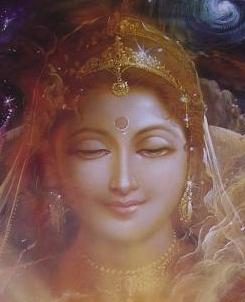
Mahadevi or"Great Goddess"Is a term
used to denote the Goddess or Devi that
is the sum of all other Devis. (Wikipedia)
[The Goddess distinguishes between nonconscious Maya and her own true Self as pure consciousness.]
2.11. [cont.] Since Maya is something we can perceive, it has the nature of nonconscious matter; since knowledge destroys it, it is not truly existent.
2.12. Consciousness is not something we can perceive; what we perceive is indeed nonconscious.
Consciousness is self-luminous; nothing else illuminates it.
2.13. It does not even illuminate itself, for that would lead to the fallacy of infinite regress.
As an agent and the object acted upon are distinct entities, so consciousness itself, like a lamp,
2.14. While shining brightly, illuminates what is other than itself. Know this, O Mountain,
For thus have I demonstrated that consciousness, belonging to my own nature, is eternal.
2.15. The visible world appears and disappears constantly in the various states of waking, dream, and deep sleep.
Pure consciousness never experiences such fluctuations.
2.16. Even if this consciousness itself became an object of perception, then the witness
Of that perception would abide as the real pure consciousness, as before.
2.17. And so those versed in religious treatises regarding the real declare consciousness to be eternal.
Its nature is bliss, for it is the object of supreme love.
2.18. The feeling, 'Let me not cease to be; let me exist forever,' is rooted in love for the Self.
Certainly there is no actual relation between me and all else, since all else is false.
2.19. Therefore I am regarded truly as an undivided whole.
And that consciousness is not an attribute of the Self,
for then the Self would be like an object.
2.20. In consciousness no possible trace of the object state can be found.
And so consciousness also has no attributes; consciousness is not a quality separate from consciousness itself.
2.21. Therefore the Self in essence is consciousness, and bliss as well, always.
It is the real and complete, beyond all relation, and free from the illusion of duality.
Comment
In the Sakta view, Maya is not simply an insentient force but a conscious and willful facet of the Goddess' personality. Somewhat paradoxically, it is the nondualist school of Advaita, emphasizing an acosmic view of reality and characterizing the realm of Maya as false, that often stresses the greatest difference between Maya and the supreme. Advaita objectifies Maya, viewing it as inert and insentient (jada), over against the supreme, conscious subject that is Brahman (or Atman). By way of contrast, the Devi-Bhagavata, more often than not presenting a Sakta viewpoint, asserts that Maya is "The very essence of the supreme Brahman (maya-para-brahma-svarupani)," and that "The world without Maya would ever be unconscious and inert (jada).”
The Goddess in the above verses of the Devi-Gita ignores for the moment the Sakta perspective, adopting a radical Advaita interpretation by drawing a sharp distinction between herself and Maya. This distinction as characterized here is somewhat at odds with the earlier notion of"difference and nondifference' as suggested by the substance/attribute analogies of verse 5. The Goddess now denies the "nondifference," utilizing standard Advaita visual images and metaphors that stress the "difference.” As the pure subject or consciousness (variously called caitanya, samvit, jnana, and cit), she likens herself to a lamp that is self-illuminating, revealing the visible realm that is Maya, the realm of inert, material objects (referred to as drsya," the seen," and as jada," inert, dull, insentient"). Pure consciousness itself is never an object of perception or knowledge, but is instead the eternal seer or witness (saksin), observing the ephemeral and false identities of empirical existence.
The Goddess here also denies that consciousness is an attribute of the Self-or herself-in accord with Advaitic principles affirming the radical oneness of the supreme subject, beyond all qualification or attribution (neti, neti). Only objects have qualities or attributes. Thus the Goddess does not possess consciousness but rather is consciousness.
C. MacKenzie Brown, The Devi Gita: The Song of the Goddess
State University of New York Press (September 1998) pp. 91-3

Andrew Cohen We, the Unbelievers
by Andrew Cohen
Enlightenment for the 21st Century
A couple of years ago, I discovered something shocking, extraordinary, and completely obvious: Most of us simply don't believe in the evolution of consciousness. And I don't just mean those who are convinced that God created the world in six days. I mean those of us who accept the theory of evolution and who are, at least to some degree, aware of the multidimensional nature of its manifestation all around us. We believe in cosmological evolution and understand that we live not in a static universe but in one that is part and parcel of a deep-time developmental process. We don't doubt that the universe was born many billions of years ago in a blinding flash of light and energy. We believe in biological evolution and have little difficulty comprehending how life itself has evolved from lower levels of development like worms and butterflies to higher ones like dolphins and humans. And many of us even recognize that culture evolves over time and see that development as the expression, at a collective level, of our human capacity for greater and greater complexity and integration. We believe in the evolutionary process because in so, so many ways we can see it all around us: moving, stretching, changing, reaching, from life to death to new life. But when it comes to consciousness—especially our own—I have discovered that our conviction in that same process is often nowhere to be found.
We believe in evolution as an objective fact of life and of the creative process but not necessarily as a living potential inherent in our own subjective experience. It stunned me when I first realized that even many of us who are already dedicated seekers never consider that our very own consciousness, our deepest sense and experience of our self, could actually evolve and develop. It must be because it is such a quantum leap for the subject to become the object—for consciousness to become the object of its own attention and intention. I'm not just speaking about awakening to the experience or fact of consciousness at the level of pure subjectivity, which is what the spiritual experience is typically all about. I'm pointing to something even more difficult to grasp, which is the living potential inherent in consciousness itself for development and growth.
So what does this mean? It means that the feeling/knowing experience of being ourselves can evolve, change, and develop in ways we simply cannot imagine. What is it like for consciousness to evolve? We cannot picture it in the eye of our mind because such development is a journey from the gross to the subtle and is unreachable with thought. How can we possibly imagine that which we cannot conceptualize?
We can imagine our own development as long as we can objectify it with thought. For example, we can imagine ourselves losing weight and building muscle. We can imagine ourselves learning algebra, Chinese, or how to play the guitar. We can even imagine ourselves becoming less selfish and more compassionate. But we simply cannot imagine our own self evolving at the level of consciousness itself. It is important to recognize what an alien concept this actually is in our culture. We are almost never encouraged to grapple with our own evolutionary potential at such a fundamental level, and as a result, most of us have never even considered it. Think about it, just for a moment: What would it be like for my self to evolve in its very essence? What would it be like to develop and grow at a level so profound that I would never be able to see it and yet others would be able to recognize its expression? If we can even begin to look deeply into this question, mysteriously, we will already be participating in the very evolution of consciousness I've been speaking about. And if we pursue it wholeheartedly, we will be helping to make conscious a miraculous process that was born many billions of years ago in a flash of light and energy and is only now beginning to awaken to itself, through us.
Andrew Cohen, founder and editor-in-chief of What Is Enlightenment? has been a spiritual teacher since 1986 and is the author of numerous books, including Living Enlightenment and Embracing Heaven & Earth.
Dennis Choptiany, Markham, Canada:"It can be argued that the most profound creation that humans have made is God. With it came the formation of a vast number of religions and their destructive divisions and conflicts. In your opinion, why do people have an apparent 'need' for religion and why have religions flourished even today when there is more and more evidence of the validity of agnostic and atheist views?”

Deepak Chopra:"Religions have an appeal because human beings have the fear of mortality. All religions promise eternal life. In the absence of profound knowledge of the workings of the universe, we rely on so-called religious authority to answer the deepest questions of our existence: who am I, where did I come from, what's the meaning and purpose of existence, do I have a soul, what happens to me after I die, does God exist, and if God exists does God care about me personally.
Unfortunately, religious ideology, dogma and belief systems are no longer congruent with what we know about the workings of the universe. They are inconsistent with our insights from modern cosmology, evolution, biology and the sciences. Hence, religious based on primitive belief (and unfortunately, all of them are based on primitive beliefs) have become quarrelsome, divisive and frequently idiotic.
However, consciousness still remains a mystery. Is our consciousness an emergent property of our biology or is consciousness the ground of existence that differentiates itself and projects itself as reality? This is not a settled issue. The current atheists and agnostics, such as Richard Dawkins, for example, are espousing an old fashioned 19th century atheism. The god they attack can not be defended. My hope is that as science progresses and looks at the mystery of consciousness we will see the emergence of a new spirituality that is secular and scientific and still addresses our deepest longings and our most important existential dilemmas.”
"For where dwell the gods to whom we can uplift our hands, send forth our prayers, and make oblation? Beyond the Milky Way are only island universes, galaxy beyond galaxy in the infinitudes of space — no realm of angels, no heavenly mansions, no choirs of the blessed surrounding a divine throne of the Father, revolving in beatific consciousness about the axial mystery of the Trinity. Is there any region left in all these great reaches where the soul on its quest might expect to arrive at the feet of God, having become divested of its own material coil? Or must we now turn rather inward, seek the divine internally, in the deepest vault, beneath the floor; hearken within for the secret voice that is both commanding and consoling; draw from inside the grace which passeth all understanding?”
Heinrich Zimmer, Philosophies of India
Princeton University Press, 1974, p. 13
"It has been almost twenty years since I wrote Spectrum, and the intervening two decades have convinced me more than ever of the correctness of its essential message: being and consciousness exist as a spectrum, reaching from matter to body to mind to soul to Spirit. And although Spirit is, in a certain sense, the highest dimension or level of the spectrum of existence, it is also the ground or condition of the entire spectrum. It is as if Spirit were both the highest rung on the ladder of existence and the wood out of which the entire ladder is made — Spirit is both totally and completely immanent (as the wood) and totally and completely transcendent (as the highest rung.) Spirit is both Ground and Goal ... The realization of our Supreme Identity with Spirit dawns only after much growth, much development, much evolution, and much inner work ... only then do we understand that the Supreme Identity was there, from the beginning, perfectly given in its fullness.”
Ken Wilber, The Spectrum of Consciousness
Quest Books, 1993, p. xvi.
Vedanta and Consciousness
The Vedantic concept of consciousness is somewhat different from the every-day, Western concept. In the West, what usually is referred to as consciousness is more likely to be called awareness. In Vedanta consciousness is omnipresent and objectless. There is consciousness behind everything — be it a human, an animal or a stone — but a stone has no awareness and the awareness of an animal is very limited. Likewise, the awareness of humans can be more or less limited. Consciousness is static and forever unchanging, but awareness is dynamic and may undergo changes. Consciousness is the same in all humans and interconnects all humanity. While consciousness is undivided and without limits, awareness may be limited and differ from person to person.
The Ultimate Reality is characterized by three concepts — absolute being, absolute consciousness and absolute bliss. Nevertheless, the Ultimate Reality is beyond these and any other human conceptions — It is objectless, omnipresent, all-pervasive, eternal, infinite, unchanging, motionless and without any form. Often, the Ultimate Reality is referred to as a cosmic ocean of consciousness.”
Steen Ingemann, Guide to Ultimate Reality (www.rishi.dk/guide/)
4) Sri Cidagni-Kunda-sambhuta
— Born from the Pit of the Fire of Consciousness.
— Burns out ignorance and confers Immortality.
— She who rose from the fire of knowledge and is the ultimate truth.
68) Sri Chakra-raja-ratha-rudha-sarvayudha-pariskrta
— Mounted on Sri Chakra inside body with all weapons i.e. Powers.
— Enlightens mind to realise Ultimate Reality as an All Pervading-Consciousness.
207) Sri Manonmani
— Highest state of Consciousness.
— Secret name of Sri Durga.
367) Sri Pratyak-Chiti-Rupa
— Inner Consciousness or Knowledge.
404) Sri Bhakta-harda-tamo-bheda-bhanumad-bhanu- santaih
— Effulgence of the Sun; dispels Darkness of Ignorance.
— Giver of the Vision of the Ocean of Consciousness.
573) Sri Prajnana Ghana-rupini
— Supreme Wisdom
— State of Consciousness where nothing else is experienced except Self. —"Like the taste of salt in the sea (It) is everywhere; Prajnana is All Pervasive.”Brahadaranyaka Upanisad
669) Sri Annada
— The Giver of Food.
— Sustains Life and Consciousness.
739) Sri Layakari
—The Fifth State beyond Turiya.
—The State where individual and Cosmic Consciousness merge.
807) Sri Param-dhama
— The Ultimate Light.
— The Ultimate Status
— 'Yadgatva na nivartante taddhama paramam mama'
"The State of Consciousness from which there is no return is My Ultimate State.” (Bha. Gi. 16-6)
854) Sri Gambhira
— The Bottomless Lake.
—"The Ultimate Mother is to be visualised as a great and deep lake of Consciousness, uncomprehended by Space and Time.”Siva Sutra 1.23
858) Sri Kalpana-rahita
— Pure Consciousness.
907) Sri Tattvamayi
— The Mother of the Ultimate State of Consciousness.
Sri Lalita Sahasranama,
C. S. Murthy, Assoc. Advertisers and Printers, 1989.
859) Sri Kastha
— The Final Truth.
—"She is the End and She is the Ultimate Path.” Kathopanisad 3.11
Sri Lalita Sahasranama
C. S. Murthy, Associate Advertisers and Printers, 1989
"Vedanta describes two kinds of mukti, or Liberation: jivanmukti, or Liberation while one dwells in the body, and videhamukti, or Liberation after the body is given up. Some Vedantists accept jivanmukti as Supreme Liberation. According to them, Knowledge of Atman attained while one is alive is the only condition for liberation. Though a liberated soul dwells in a body as long as his past karma operates, yet he remains undefiled by the effects of his actions. He never deviates from the Knowledge of Atman. Though he may behold the relative world, yet he is always aware of its unreality. According to the other school, a jivanmukta retains a trace of ignorance due to his association with the body. The very fact that he lives in the relative world shows that he has come down from the Knowledge of Brahman. Complete absorption in Brahman is possible only when a knower of Brahman becomes free of the body. The following scriptural passages are quoted to support this view:
"As for him, the delay endures only so long as he is not liberated (from the effects of the past karma that has given rise to his body); after that (after death) he will reach perfection.” (Chhandogya Upanishad VI, xiv, 2.)
"For him, at the end (after the dissolution of the body), there is a cessation of all maya and its effects.” (Svetasvatara Upanishad I, 10.)
"As the flowing river disappear in the ocean, losing their names and form, so, likewise, an illuminated person, freed from name and form, attains the Divine Purusha, who is greater than the great.” (Mundaka Upanishad III, ii, 8.)
There is not much real difference between the two views, since the knower of Brahman, both prior to and after death, enjoys Supreme Bliss, Freedom, and Peace.”
Swami Nikhilananda, Self-Knowledge [Atmabodha], 1989, p. 161-62.)
861) Sri Kantardha-vigraha
— Having half the form which is Female.
Sri Lalita Sahasranama
C. S. Murthy, Associate Advertisers and Printers, 1989
There is no Shiva without Shakti nor is there any Shakti without Shiva.
There is no distinction between them, just as there is none between the moon and the shining.
Samaya Mata
Victory to Her the Primordial Power, the seed from which sprouts hereafter the entire creation,
Static and kinetic universes, the Eternal, the Incomparable, who is the nature of Her own Bliss,
And who manifests as a mirror to His Self.
Kama-Kalavilasa
866) Sri Aja
— The Unborn One.
— The One without Birth.
Sri Lalita Sahasranama
C. S. Murthy, Associate Advertisers and Printers, 1989
870) Sri Antarmukha-samaradhya
— Worshipped by those with Inner Vision.
— Worshipped by those with introspection.
Sri Lalita Sahasranama
C. S. Murthy, Associate Advertisers and Printers, 1989
"For where dwell the gods to whom we can uplift our hands, send forth our prayers, and make oblation? Beyond the Milky Way are only island universes, galaxy beyond galaxy in the infinitudes of space — no realm of angels, no heavenly mansions, no choirs of the blessed surrounding a divine throne of the Father, revolving in beatific consciousness about the axial mystery of the Trinity. Is there any region left in all these great reaches where the soul on its quest might expect to arrive at the feet of God, having become divested of its own material coil? Or must we now turn rather inward, seek the divine internally, in the deepest vault, beneath the floor; hearken within for the secret voice that is both commanding and consoling; draw from inside the grace which passeth all understanding?”
Heinrich Zimmer, Philosophies of India
Princeton University Press, 1974, p. 13.
871) Sri Bahirmukha-sudurlabha
— To be sought within.
Sri Lalita Sahasranama
C. S. Murthy, Associate Advertisers and Printers, 1989
"Just as the colossal universe evolves from some transcendental secret source — the essence beyond name and form, which remains unaffected by the process of torrential flowing forth — so likewise, the mysterious dream-ego, which in dreams evolves its own landscapes and adventures as well as the visible, tangible individual, who becomes conscious of himself when waking — these temporarily emerge from the innermost secret essence which is called the Self, the bedrock of all human life and experience. In other words, the macrocosmic Self (brahman) and the microcosmic (atman) work parallel effects. They are one and the same, only viewed under two aspects. So that when the individual makes contact with the Self that he holds within, he comes into possession of divine power and stands centered beyond all anxiety, strife, and change. The attainment of this goal is the one and only end of Vedic and Vedanta thought.” Heinrich Zimmer, Philosophies of India (H. Zimmer, Philosophies of India, Princeton University Press, 1974, p. 454.)
879) Sri Sudha-srutih
— Ambrosial Stream of Bliss.
Sri Lalita Sahasranama
C. S. Murthy, Associate Advertisers and Printers, 1989
880) Sri Samsara-panka-nirmagna- samuddharana-pandita
— Rescues those drowning in Samsara; cycle of births and death.
—"Just as the tusk of Sri Varahavatara rescued the submerged earth, so also She rescues those drowned in the Sea of Births.”Saundarya-Lahari 3
Sri Lalita Sahasranama
C. S. Murthy, Associate Advertisers and Printers, 1989
889) Sri Visvabhramanakarini
— The Prime Mover of the Universe.
Sri Lalita Sahasranama
C. S. Murthy, Associate Advertisers and Printers, 1989
891) Sri Vidrumabha
— The Tree of Knowledge.
Sri Lalita Sahasranama
C. S. Murthy, Associate Advertisers and Printers, 1989
Allah is the Light of the heavens and the earth.
The Parable of His Light is as if there were a Niche and within it a Lamp:
The Lamp enclosed in Glass: the glass as it were a brilliant star:
Lit from a blessed Tree, an Olive, neither of the east nor of the west,
Whose oil is well-nigh luminous, though fire scarce touched it:
Light upon Light! Allah doth guide whom He will to His Light:
Allah doth set forth Parables for men: and Allah doth know all things.
surah 24:35 Al Nur (The Light)
(Abdullah Yusuf Ali, The Holy Qur'an, 1989, p. 1687-88.)
And he shewed me a pure river of water of life, clear as crystal, proceeding out of the throne of God and the Lamb.
In the midst of the street of it, and on either side of the river was there the Tree of Life,
Which bare twelve manner of fruit every month: And the leaves of the tree were for the healing of the nations.
Revelation 22:1-2
"The Spirit says in Revelation: "To him that overcomes, I will give to him to eat of the tree of life which is in the paradise of God.” (2: 7.) We understand from the previous paragraphs that this was a matter of inner conquest ...
Revelation says later: "In the midst of its street, and of the river, on this side and on that side, [the] tree of life, producing twelve fruits, in each month yielding its fruits; and the leaves of the tree for healing of the nations"22: 2.) The first part is geometrically impossible since a single tree cannot find itself both in the middle and on both sides at the same time. We have to understand this as a symbol. It actually refers to the three channels: Sushumna (central), through which the Kundalini flows like a river and the side channels (Ida and Pingala.) Kundalini was worshiped as "Water of life" by the Templars and the Gnostics. However, as we are told at the end, the tree of life also serves to cure the nations. Yogis agree that the Kundalini awakening and the activation of the energetic system symbolised by the tree of life brings about both the physical healing as well as the spiritual one (supreme liberation, Moksha.)"
Dan Costian, Bible Enlightened
Computex Graphics, 1995, p. 47-8.)
892) Sri Vaisnavi
— Female counterpart of Sri Vishnu bearing Sanka, Cakra and Gada.
— Sri Mahalaksmi, the Power of Sri Vishnu.
Sri Lalita Sahasranama
C. S. Murthy, Associate Advertisers and Printers, 1989
893) Sri Visnurupini
— Sri Vishnu is one of Her Forms.
— The Primordial Power of Sri Mahesha has four different forms.
Sri Lalita Sahasranama
C. S. Murthy, Associate Advertisers and Printers, 1989
Sri Bhavani in enjoyment, Sri Durga in battle, Sri Kalika in anger; the fourth of them is the male form which is Myself.”
Sri Vishnu, Brahmanda Purana
"O! Sri Lalita, I bow to Your Form named Narayana lying in the sea.”
Sri Vishnu, Kurma Purana
801. Pushta - She who is healthy.
802. Purathana - She who is ancient.
803. Poojya - She who is fit to be worshipped.
804. Pushkara - She who gives exuberance.
805. Pushkarekshana - She who has lotus like eyes.
806. Paramjyothi - She who is the ultimate light.
807. Param dhama - She who is the ultimate resting place.
808. Paramanu - She who is the ultimate atom.
809. Parath para - She who is better than the best.
810. Pasa Hastha - She who has rope in her hand.
811. Pasa Hanthri - She who cuts off attachment.
812. Para manthra Vibhedini - She who destroys the effect of spells cast.
813. Moortha - She who has a form.
814. Amoortha - She who does not have a form.
815. Anithya thriptha - She who gets happy with prayers using temporary things.
816. Muni manasa hamsika - She who is the swan in the mind ( lake like) of sages.
817. Satya vritha - She who has resolved to speak only truth.
818. Sathya roopa - She who is the real form.
819. Sarvantharyamini - She who is within everything.
820. Sathee - She who is Sathee the daughter of Daksha.
821. Brahmani - She who is the strength behind creator.
822. Brahmaa - She who is the creator.
823. Janani - She who is The Mother.
824. Bahu roopa - She who has several forms.
825. Budharchitha - She who is being worshipped by the enlightened.
826. Prasavithri - She who has given birth to everything.
827. Prachanda - She who is very angry.
828. Aagna - She who is the order.
829. Prathishta - She who has been installed.
830. Prakata Krithi - She who is clearly visible.
831. Praneshwari - She who is goddess to the soul.
832. Prana Dhatri - She who gives the soul.
833. Panchast peeta roopini -"She who is in fifty Shakthi peethas like Kama ropa, Varanasi. Ujjain etc.”
834. Vishungala - She who is not chained.
835. Vivikthastha - She who is in lonely places.
836. Veera matha - She who is The Mother of heroes.
837. Viyat prasoo - She who has created the sky.
838. Mukundaa - She who gives redemption.
839. Mukthi nilaya - She who is the seat of redemption.
840. Moola vigraha roopini - She who is the basic statue.
841. Bavagna - She who understands wishes and thoughts.
842. Bhava rokagni - She who cures the sin of birth.
843. Bhava Chakra Pravarthani - She makes the wheel of birth rotate.
844. Chanda sara - She who is the meaning of Vedas.
845. Sasthra sara - She who is the meaning of Puranas(epics).
846. Manthra sara - She who is the meaning of Manthras ( chants).
847. Thalodharee - She who has a small belly.
848. Udara keerthi - She who has wide and tall fame.
849. Uddhhama vaibhava - She who has immeasurable fame.
850. Varna roopini - She who is personification of alphabets.
851. Janma mrutyu jara thaptha jana vishranthi dhayini -"She who is the panacea of ills of birth, death and aging.”
852. Sarvopanisha dhudh gushta - She who is being loudly announced as the greatest by Upanishads.
853. Shantyathheetha kalathmika - She who is a greater art than peace.
854. Gambheera - She whose depth cannot be measured.
855. Gagananthastha - She who is situated in the sky.
856. Garvitha - She who is proud.
857. Gana lolupa - She who likes songs.
858. Kalpana rahitha - She who does not imagine.
859. Kashta - She who is in the ultimate boundary.
860. Akantha - She who removes sins.
861. Kanthatha vigraha - She who is half of her husband (kantha).
862. Karya karana nirmuktha - She who is beyond the action and the cause.
863. Kama keli tharangitha - She who is the waves of the sea of the play of the God.
864. Kanath kanaka thadanga - She who wears the glittering golden ear studs.
865. Leela vigraha dharini - She who assumes several forms as play.
866. Ajha - She who does not have birth.
867. Kshaya nirmuktha - She who does not have death.
868. Gubdha - She who is beautiful.
869. Ksipra prasadhini - She who is pleased quickly.
870. Anthar mukha samaradhya - She who is worshipped by internal thoughts.
871. Bahir mukha sudurlabha - She who can be attained by external prayers.
872. Thrayee -"She who is of the form of three Vedas viz Rik, yajur and sama.”
873. Trivarga nilaya -"She who is in three aspects of self, assets and pleasure.”
874. Thristha - She who is in three.
875. Tripura malini - She who is in tripura the sixth section of Srichakra.
876. Niramaya - She who is without diseases.
877. Niralamba - She who does not need another birth.
878. Swatma rama - She who enjoys within herself.
879. Sudha sruthi - She who is the rain of nectar.
880. Samsara panga nirmagna samuddharana panditha - She who is capable of saving people who drown in the mud of day today life.
881. Yagna priya - She who likes fire sacrifice.
882. Yagna karthree - She who carries out fire sacrifice.
883. Yajamana swaroopini - She who is the doer of fire sacrifice.
884. Dharma dhara - She who is the basis of Dharma-the rightful action.
885. Dhanadyaksha - She who presides over wealth.
886. Dhanadhanya vivardhani - She who makes wealth and grain to grow.
887. Vipra priya - She who likes those who learn Vedas.
888. Vipra roopa - She who is the learner of Vedas.
889. Viswa brhamana karini - She who makes the universe to rotate.
890. Viswa grasa - She who eats the universe in one handful.
891. Vidhrumabha - She who has the luster of coral.
892. Vaishnavi - She who is the power of Vishnu.
893. Vishnu roopini - She who is Vishnu.
894. Ayoni - She who does not have a cause or She who is not born.
895. Yoni nilaya - She who is the cause and source of everything.
896. Kootastha - She who is stable.
897. Kula roopini - She who is personification of culture.
898. Veera goshti priya - She who likes company of heroes.
899. Veera - She who has valour.
900. Naish karmya - She who does not have attachment to action.
www.starsai.com/lalithambigai-goddess-lalithasahasranamam.html
"ENLIGHTENMENT
Enlightenment means dispelling the darkness of ignorance. Enlightenment is the primary term used to describe the experience of salvation in Hinduism and Buddhism, yet the experience of enlightenment is common to most religions. According to the manner in which Reality is perceived in the different traditions, enlightenment may be either the intuitive grasping of inner wisdom, illumination by the truth of the Word, or direct apprehension of transcendent Reality. The true self, formerly obscured by false habits of thinking and vain desires, is suddenly revealed. The inner eye, which was blinded by defilements of worldly living, opens to a vision of the true Reality. From that moment life can never be the same, as the enlightened person begins to live by the knowledge he has acquired.”
World Scripture, International Religious Foundation
"I am blind and do not see the things of this world; but when the light comes from above, it enlightens my heart and I can see, for the Eye of my heart sees everything; and through this vision I can help my people. The heart is a sanctuary at the center of which there is a little space, wherein the Great Spirit dwells, and this is the Eye. This is the Eye of the Great Spirit by which He sees all things, and through which we see Him. If the heart is not pure, the Great Spirit cannot be seen.”
Black Elk, Sioux Tradition
“Religion in the Cayce records cannot be confined to limited boundaries. It runs throughout every reading, whether physical, mental, or spiritual, whether on science or sociology, for all ages, for people of all faiths. There is an underlying truth which is consistent, and which cuts across all manmade lines.
In 1931, Cayce predicted that one woman would live to see "The greatest development in spiritual affairs that the world has known.” In the thirty-seven years since that time, has the world developed spiritually? Memories of personal experience and of what has happened to the world during that time would probably make most people answer No! After all these years, on the eve of upheavals in the earth we don't quite believe will be possible.”
Edgar Cayce on Prophecy
“From the early biblical prophets who walked alone in the desert to fast and pray for divine revelation to Native Americans setting out in the wilderness to search for a vision, the pursuit of an inner world beyond everyday physical reality is one of mankind's oldest traditions. For thousands of years humans have retreated into solitude to find answers to life's questions and to gain spiritual wisdom. Though many of the old ways have been forgotten, there are still a means by which anyone can step through the crack between the two worlds and enter the mystical dimensions. This retreat, this quest, is an ancient rite of passage; it is a journey to the center of your soul.”
Denise Linn and Meadow Linn, Vision Quest
“Meditation: The Mother of Asana and Mudra
In the early days of yoga, long before most of the positions were invented, meditation was a yogi's primary discipline. It was the fundamental practice because the ancients had discovered that the act of quiet, centered sitting gave them a deep sense of life. They found that by relaxing into themselves, being as present in the moment as possible, and listening inwardly, they could experience their own consciousness with clarity — and thus access a new, intuitive way of knowing and being in the world.
Meditation, they discovered, was the most direct way of realizing the meaning of God and Self. Rather than an intellectual process of thinking things through and coming to conclusions, meditation gave the yogis a method for experiencing truth. They knew who they were because they experienced who they were. Their conclusions arose out of intuitive revelation, and the all-important revelation was that God and self are one, that everything that exists is simply the Self-expression of God.”
Erich Schiffmann, Yoga Journal December 1998
“Karma is a Sanskrit word meaning 'ction.' However, even people who have studied Hindu philosophy often have misconceptions about the true meaning and significance of the law of karma, which is a fundamental spiritual principle.
The law of karma implies that the universe is an eternal moral order. The law of karma contrasts with the mechanistic conception of material science. Science tells us the world is controlled by natural forces, specifically particles of matter combining and recombining with one another in accordance with blind physical forces....
Karma tells us that even behind these apparently blind, mechanical forces, there is a principle of cosmic intelligence, a power, which controls the operations of nature and guides the destiny of mankind...
All Eastern systems of spiritual philosophy say that when we realize the supreme spiritual truth and become integrated with absolute spirit, the bonds of karma are shattered. When the fire of illumination kindles our hearts, the bonds of karma turn to ashes. We gain full spiritual freedom and are not subject any more to external destiny. We become masters of our own destiny. Without being affected by adverse circumstances or by external forces, our lives become like lotus leaves. The lotus leaf floats on the water, but not a drop of water clings to its surface. It floats freely. Similarly, when we attain God-realization, we rise above the law of karma and are united with supreme reality.”
Dr. Haridas Chaudhuri, The Essence of Spiritual Philosophy
Thorsons Publishing Group, UK, 1990, p. 63.
“After communion comes the homeward journey, the descent! That is the other miracle in this magnificat. The illumined God-men, out of their compassionate grace for the fellow brethren, choose to come down to assuage their suffering and dispel their darkness, by pointing out the trackless pathway to the divine Presence! With the armour of God's grace, these realised seers descend from the state of perfect quiescence and eternal union with the Supreme Bliss, to the habitat of the body — It is from this station that they can lead their fellow Jivan-Muktar to engage in the service of Siva, and work for the liberation of as many earnest seekers after truth, in attuning to the will of God. Such Jivan-Muktar are tuned to enjoy dynamic identity with the inner Presence, and this is known as the Turiya state. They are the spiritual preceptors or Gurus, having the divine authority to speak on behalf of God.”
Hinduism Today
“As we now move to other ancient scriptures let us not be blinded by "religious" parochialism. A mind overly conditioned by the fatherly connotation of the Judeo-Christian tradition will, at first, have some difficulty at the conception of the Divine in the feminine form of The Mother. And yet, the cult of The Motherhood of God, from time immemorial, has been attested by archaeological evidence from all quarters of the globe. It seems that it is the Indian subcontinent which presents us with the most elaborate expressions of this worship.
According to Advaita Vedanta Ultimate Reality is formless undifferentiated consciousness (Nirguna.) This condition, which is at the same time the Absolute Being and Absolute Nothingness [1] cannot be conceived of. Through eons of ages, it goes through alternate phases of potentiality and manifestation. The alternation of this cosmic rhythm has been called: "The respiration of Brahma.” When the ultimate reality rests in its latent phase, the Unmanifested, it is contained in "IT.” In the activating phase of its manifestation, the "IT" becomes "He" and "Her"; HH Mataji says that the first step of the Creation takes place when God separates itself into Himself as a witness and Herself as His power. One aspect is Sadashiva (The Primordial Existent and Witness, God the Almighty, the Father, the Purusha); the other is His power, the Adi Shakti, (The Primordial Energy of Divine Love, the Divine Mother, the Prakriti.) [2] Thus The Mother is the Primordial Energy ... The Creation, spiritual and material, springs from the Divine Mother, the Holy Spirit of the Christian tradition. She creates various strata of existence, among which is this phenomenal universe. As this Primordial Energy is the genitrix of everything we experience, She is worshipped as the Sacred Mother. We read in the first sutras of the Kama-Kalavilasa: "Victory to Her the Primordial Power, the seed from which sprouts hereafter the entire creation, static and kinetic universes, the eternal, the incomparable, who is of the nature of Her own bliss, and who manifests as a mirror to His (Shiva) self.”
The Samaya Mata recalls that the distinction between He and Her is only an apparent one: "There is no Shiva without Shakti nor is there any Shakti without Shiva. There is no distinction between them just as there is none between the moon and the shining.” The Shakti combines in Her person both the manifestation of the Universal Existence (male form) and the Universal Energy (female form.) She is thus identified with the One. The actualisation of this primordial unity within the disciple is the object of the Shakti worship. She is the central object of worship because She is the manifested dimension of the Ultimate. She is the Great One who bridges the gap between the Infinity and the Finite; only through Her compassionate meditation can the finite human being regain Infinity. And that is indeed the very blessing that She wants to graciously bestow on Her children.
"Thyself, with a view of manifesting Thyself in the form of the Universe, inwardly assumest the form of Consciousness and Bliss.”— Shri Shankaracharya, Saundarya Lahari 35Let us again remember that the Holy Spirit, as the Primordial Energy, is the Christian mysterious symbol for The Mother.
We ought to mention, that in the apocryphal Acts of Saint Thomas, the Holy Spirit is (rightly) invoked as "hidden Mother," "Mother of all life.” These statements should help us to recognize the true wisdom of the early gnostics and Syrian fathers who grasped something of the identity (Holy Spirit = Mother = Energy.) The esoteric perception certainly casts a new light on the intriguing dialogue between Lord Jesus Christ and Nicodemus:
"Truly, Truly, I say to you unless one is born anew, he cannot see the Kingdom of God. Nicodemus said to him," how can a man be born when he is old? Can he enter a second time into his mother's womb and be born?” Jesus answered "Truly, truly, I say to you, unless one is born of water and the Spirit he cannot enter the Kingdom of God"— John 3.3The necessity to return to the Divine Mother in order to become a New Adam, a second born, a Divine Child has been asserted by Lord Jesus. It is time that those western seekers who have engaged themselves in intellectual pursuits use their intellect to discover the Unity of the message of the various mythologies and religions; they had better realize the greatness of the Christian promise and the value of the other world religions. HH Mataji has brilliantly exposed those teachings in a new light which also illuminates the other religious traditions and contemporary science. It is time for us to discover that the true object of Knowledge is integration. All the great religions are one. This is revealed by actualization when our own integration takes place through rebirth.
Although the Great Goddess (Adi Shakti) is "Truly Formless" (see the Devipurana) She has been worshipped through millennia in countless aspects and forms. The three great aspects through which She is channeling Her own power are Mahalaxshmi, Mahasaraswati, Mahakali. She is also known to have taken various incarnated forms (avtaras.)
It is thus described in the Scriptures that She is the Primordial Power, the utterly Holy. It is certainly not easy for the western reader to face the very serious hypothesis that She can take human form. To talk about it is even more difficult. This field of reality only underlines the limitations of ideas and words.
1. In Mahayana Buddhism "tathata" (suchness) and "sunyata" (emptiness) are interchangeable notions.
2. Purusha and Prakriti represent the apparent opposition between the Father-Spirit and The Mother-Nature.”
Gregoire de Kalbermatten, The Advent
The Life Eternal Trust Publishers, 1979, p. 252-55.
Disclaimer: Our material may be copied, printed and distributed by referring to this site. This site also contains copyrighted material the use of which has not always been specifically authorized by the copyright owner. We are making such material available to our readers under the education and research provisions of "fair use" in an effort to advance freedom of inquiry for a better understanding of religious, spiritual and inter-faith issues. The material on this site is distributed without profit. If you wish to use copyrighted material for purposes other than "fair use" you must request permission from the copyright owner.
 SHRI LALITA SAHASRANAMA 801-900