And Their Soul Traders
"... the Pope, in the plenitude of his power, assumes the right of wielding the lightnings of Jehovah, and of blasting by his "fulminations" whoever offends him. Kings, and whole nations, believing in this power, have trembled and bowed before him, through fear of being scathed by his spiritual thunders. The priests of Paganism assumed the very same power; and, to enforce the belief of their spiritual power, they even attempted to bring down the literal lightnings from heaven;"
And the merchants of the earth shall weep and mourn over her; for no man buyeth their merchandise anymore:
The merchandise of gold, and silver, and precious stones, and of pearls, and fine linen, and purple, and silk, and scarlet, and all thyine wood, and all manners of ivory, and all manner vessels of most precious wood, and of brass, and iron, and marble.
And cinnamon, and odours, and ointments, and frankincense, and wine, and oil, and fine flour, wheat, and beasts, and sheep, and horses, and chariots, and slaves, and souls of men.
Book of Revelation 18:11-13
And the merchants of the earth shall weep and mourn over her; for no man buyeth their merchandise anymore:
Book of Revelation 18:11
Before we proceed the Vatican history dealing with the rise of papal power and the clergy that enforced it must be examined.
"... the Pope, in the plenitude of his power, assumes the right of wielding the lightnings of Jehovah, and of blasting by his "fulminations" whoever offends him. Kings, and whole nations, believing in this power, have trembled and bowed before him, through fear of being scathed by his spiritual thunders. The priests of Paganism assumed the very same power; and, to enforce the belief of their spiritual power, they even attempted to bring down the literal lightnings from heaven;...
If we examine the history of the Roman empire, we shall find that here also there is a precise accordance between type and antitype. When the deadly wound of Paganism was healed, and the old Pagan title of Pontiff was restored, it was, through means of the corrupt clergy, symbolised, as is generally believed, and justly under the image of a beast with horns, like a lamb; according to the saying of our Lord, "Beware of false prophets, that shall come to you in sheep's clothing, but inwardly they are ravening wolves.” The clergy, as a corporate body, consisted of two grand divisions — the regular and secular clergy answering to the two horns or powers of the beast, and combining also, at a very early period, both temporal and spiritual powers. The bishops, as heads of these clergy, had large temporal powers, long before the Pope gained his temporal crown. We have the distinct evidence of both Guizot and Gibbon to this effect.
After showing that before the fifth century, and clergy had not only become distinct from, but independent of the people, Guizot adds: "The Christian clergy had moreover another and very different source of influence. The bishops and priests became the principal municipal magistrates....
If you open the code, either of Theodosius or Justinian, you will find numerous regulations which remit municipal affairs to the clergy and the bishops. "Guizot makes several quotations. The following extract from the Justinian code is sufficient to show how ample was the civil power bestowed upon the bishops:"With respect to the yearly affairs of cities, whether they concern the ordinary revenues of the city, either from funds arising from the property of the city, or from private gifts or legacies, or from any other source; whether public works, or depots of provisions or aqueducts, or the maintenance of baths or ports, or the construction of walls or towers, or the repairing of bridges or roads, or trials, in which the city may be engaged in reference to public or private interests, we ordain as follows:—The very pious bishop, and three notables, chosen from among the first men of the city, shall meet together; they shall each year examine the works done; they shall take care that those who conduct them, or who have conducted them, shall regulate them with precision, render their accounts, and show that they have duly performed their engagements in the administration, whether of the public monuments, or of the sums appointed for provisions or baths, or of expenses in the maintenance of roads, aqueducts, or any other work.” Here is a large list of functions laid on the spiritual shoulders of "the very pious bishop," not one of which is even hinted at in the Divine enumeration of the duties of a bishop, as contained in the Word of God.
How did the bishops, who were originally appointed for purely spiritual objects, contrive to grasp at such a large amount of temporal authority? From Gibbon we get light as to the real origin of what Guizot calls this "prodigious power.” The author of the Decline and Fall shows, that soon after Constantine's time," the Church"[and consequently the bishops, especially when they assumed to be a separate order from the other clergy] gained great temporal power through the right of asylum, which had belonged to the Pagan temples, being transferred by the Emperors to the Christian churches.
His words are: "The fugitive, and even the guilty, were permitted to implore either the justice or mercy of the Deity and His ministers.” Thus was the foundation laid of the invasion of the rights of the civil magistrate by ecclesiastics, and thus were they encouraged to grasp at all the powers of the State. Thus, also, as a justly observed by the authorities of Rome in the 19th Century, speaking of the right of asylum, were "the altars perverted into protection towards the very crimes they were raised to banish from the world.”
This is a very striking thing, as showing how the temporal power of the Papacy, in its very first beginnings, was founded on "lawlessness," and is an additional proof to the many that might be alleged that the Head of the Roman system, to whom all bishops are subject, is indeed ho anomos, "The Lawless One" (2 Thess. ii. 8), predicted in Scripture as the recognised Head of the "Mystery of Iniquity.” All this temporal power came into the hands of men, who, while professing to be ministers of Christ, and followers of the Lamb, were seeking simply their own aggrandisement, and, to secure that aggrandisement, did not hesitate to betray the cause which they professed to serve. The spiritual power which they wielded over the souls of men, and the secular power which they gained in the affairs of the world, were both alike used in opposition to the cause of pure religion and undefiled. At first these false prophets, in leading men astray, and seeking to unite Paganism and Christianity, wrought under-ground, mining like the mole in the dark, and secretly perverting the simple, according to the saying of Paul, "the Mystery of Iniquity doth already work.” But by-and-by, towards the end of the forth century, when the minds of men had been pretty well prepared, and the aspect of things seemed to be favourable for it, the wolves in sheep's clothing appeared above ground, brought their secret doctrines and practices, by little and little, into the light of day, and century after century, as their power increased, by means of all "deceivableness of unrighteousness," and "signs and lying wonders," deluded the minds of the worldly Christians, made them believe that their anathema was equivalent to the curse of God; in other words, that they could"bring down fire from heaven," and thus "caused the earth, and them that dwelt therein, to worship the beast whose deadly wound was healed.” When "the deadly wound"of the Pagan beast was healed, and the beast from the sea appeared, it is said that this beast from the earth became the recognised, accredited executor of the will of the great sea beast (v. 12), "and he exerciseth all the power of the first beast before him," literally "in his presence"—under his inspection.
Considering who the first beast is, there is great force in this expression "in his presence.”The beast that comes up from the sea, is "the little horn," that "has eyes like the eyes of man" (Dan. vii. 8); it is Janus Tuens, "All-seeing Janus," in other words, the Universal Bishop or "Universal Overseer," who, from his throne on the seven hills, by means of the organised system of the confessional, sees and knows all that is done, to the utmost bounds of his wide dominion. Now, it was just exactly about the time that the Pope became universal bishop, that the custom began of systematically investing the chief bishops of the Western empire with the Papal livery, the pallium, "for the purpose," says Gieseler, "of symbolising and strengthening their connection with the Church of Rome.” That pallium, worn on the shoulders of the bishops, while on the one hand it was the livery of the Pope, and bound those who received it to act as the functionaries of Rome, deriving all their authority from him, and exercising it under his superintendence, as the"Bishop of bishops," on the other hand, was in reality the visible investiture of these wolves with the sheep's clothing.
For what was the pallium of the Papal bishop? It was a dress made of wool, blessed by the Pope, taken from the holy lambs kept by the nuns of St. Agnes, and woven by their sacred hands, that it might be bestowed on those whom the Popes delighted to honour, for the purpose, as one of themselves expressed it, of "joining them to our society in the one pastoral sheepfold. "Thus commissioned, thus ordained by the universal Bishop, they did their work effectually, and brought the earth and them that dwelt in it," to worship the beast that received the wound by a sword and did live. "This was a part of this beast's predicted work.”1
Therefore all the papal clergy who participated in the Church's immoral acts and enjoyed her great luxury will bewail and mourn her fall. All who have sinned with the Church or profited by her will lament for her as they see the smoke rising from her charred remains. Their wares will be disused and despised all the world over, and there will be no more customers to buy her salvation goods.
But the "spirit of antichrist is a worldly spirit, and their sorrow is a mere worldly sorrow; they did not lament for the anger of God, that had now fallen upon them, but for the loss of their outward comfort.”2 Thus will they will cry out in grief for their temporal loss, instead of fearing eternal damnation," How terrible, how terrible for the Vatican, that great city! In one single moment God's judgment came on her.”
The merchandise of gold, and silver, and precious stones, and of pearls, and fine linen, and purple, and silk, and scarlet, and all thyine wood, and all manners of ivory, and all manner vessels of most precious wood, and of brass, and iron, and marble.
Book of Revelation 18:12
The merchandise of gold and silver, and precious stones, and of pearls
Things for treasure and ornament, and with which the great whore is said to be decked, (Revelation 17:4) and, literally understood, may denote the vast riches which these spiritual merchants, or factors for Rome, cardinals, archbishops, bishops, priests, monks, and friars, bring into their own coffers and the pope's, by the trade they drive in her wares with the souls of men; and may have also a regard to what their images, chalices, crowns, mitres ... and this they pretend to convey to men "ex opere operato", in the ordinances, as baptism... and to communicate the Spirit, with his gifts and graces, for money, which is direct simony; yea, they pretend to sell eternal life, nay, Christ, and God himself:
and fine linen, and purple, and silk, and scarlet:
things which belong to apparel and dress; and, literally taken, the "fine linen" is for their copes, wore by bishops and by chanters, and sub-chanters, and for surplices wore by their priests, in imitation of the Jewish priests, and for Mass clothes... the "purple, silk", and "scarlet", were for the popes, cardinals, archbishops, and bishops; so the woman on the scarlet coloured beast is said to be arrayed in purple and scarlet, (Revelation 17:4), Tyre had its merchants for these, (Ezekiel 27:7, 16,24) the fine linen and silk may mystically denote the holy lives, good works, and merits of the saints, those of them called works of supererogation, which become the church's stock, and they sell out for others that want; which is a monstrous kind of ware, and a dreadful imposition upon men, since men cannot be saved and justified by works; and the best of men are so far from having a redundancy of works, that in everything they sin and offend, and are greatly deficient: and they are so far from helping others, that they are unprofitable servants themselves: the purple and scarlet may signify the blood of Christ, which they pretend to sell in the Mass;...
and all thyine wood, and all manner vessels of ivory, and all manner vessels of most precious wood, and of brass, and iron, and marble:
things for utensils and furniture, not so much for their houses, as for their churches;...
and of brass, iron, and marble,
may intend various vessels used in their churches; as vessels for holy water, fonts of marble, and other valuable stones, for baptism, censers of iron and brass to burn incense in. Cocceius thinks that by these vessels of different materials are meant good men; who are like sweet smelling wood for the fragrancy of their doctrines and lives; and like iron, brass, and marble, for their courage, constancy, and patience; and who have been canonized for saints, which has brought in much money into the pope's coffers: this is a practice in imitation of the Heathens, who deified men, and set them over particular days and affairs; and the privileges of such canonization among the Papists are, that such a saint has his name set in the calendar in red letters, may have churches and altars dedicated to him, and his image set up in them, and a holiday be kept for him, and may be prayed to, and worshipped; a practice dreadfully derogatory to the glory of Christ's person and office, but is that in which these merchants have found their account; for through references, commissions, and reports, for proof of the saint's character and miracles, his friends are at very great expense before the affair is issued, especially if rich; our King Henry the Seventh was very desirous of having his kinsman Henry the Sixth canonized, and solicited the pope for it, but he would not do it under fifteen hundred ducats of gold, which the king thought was too much, and so declined it.”3
And cinnamon, and odours, and ointments, and frankincense, and wine, and oil, and fine flour, wheat, and beasts, and sheep, and horses, and chariots, and slaves, and souls of men.
Book of Revelation 18:13
And cinnamon, and odours, and ointments, and frankincense, &c.]
Things for delight and pleasure, for the gratifying of the senses; cinnamon, and odours were used for perfuming, (Proverbs 7:17) anointing with oil was used at feasts, (Psalms 23:5) and "frankincense", or censings, at banquets, and for the regaling of persons after food: these customs obtained among the eastern people. Tyre had its merchants for these things, (Ezekiel 27:19,22) and Mr. Brightman thinks Italy is Rome's merchant in these, which it fetches from Greece, Arabia, and Egypt; it may be these rather respect the ecclesiastical use of them; "cinnamon, odours", and "frankincense", may signify the perfumings and censings used in churches, or the burning incense in imitation of the sweet incense under the law; and"ointments"may denote their chrism, or anointing with oil at baptism, imagining that Christ was anointed with material oil at his baptism, whereas it was with the Holy Ghost: moreover, these things may be mystically understood," cinnamon"being used by harlots in perfuming their bed, (Proverbs 7:17) may intend the stews and brothel houses erected at Rome, and licensed by authority, each whore paying so much per week; the revenues of which would sometimes yearly amount to twenty thousand ducats: "ointments" may be understood of chrism in baptism, and extreme unction at death:"odours"And"frankincense"may mean their prayers and pater nosters, their prayers for the dead, which were never made without the pence; hence that proverbial expression, no pence, no pater noster.
And wine, and oil, and fine flour, and wheat, and beasts, and sheep:
things for civil use; these are things which belong to food, to eating and drinking, and are the most material and necessary things of life, ... Italy to be Rome's merchant for wine and oil; Sardinia and Sicily her merchants for fine flour and wheat; Germany for beasts, and England for sheep: and with respect to the ecclesiastical use of these things, wine is for the chalice, used in daily Masses, and drank only by the priests;"oil"for chrism at baptism, and for the extreme unction:"fine flour"for the Mass, or to make their breaden god of; and "wheat, beasts, and sheep" for tithes for the clergy:
and horses, and chariots, and slaves;
things for splendour, equipage, and attendance; horses and chariots for the popes, cardinals, archbishops, and bishops, to ride in state and grandeur, and slaves to wait upon them...
and souls of men;
still in allusion to the merchandise of Tyre, some of whose merchants are said to trade in the persons of men, (Ezekiel 27:13) which the Targum and Septuagint render, in the souls of men; the popes have some of them sold their own souls to the devil, to get into the chair, and, when in, have been the means of destroying of thousands of others; they assume a power over the souls of men, of binding and loosing the consciences of men, imposing new laws upon them, and freeing them from obligation to the laws of God and men, to the ruin of their souls; and it has been said by their sycophants, that if the pope should send thousands of men to hell, no one should say to him, what dost thou? The Romish priests pretend to redeem souls out of purgatory for such a sum of money, and sell pardons and indulgences, say Mass, and promise heaven itself for money; and this they get at the expense of men's souls, by their false doctrine and superstitious worship, and so make merchandise of them, as is said of the false teachers, (2 Peter 2:3) moreover, as by "slaves", or bodies, in the preceding clause, are meant such who serve with their bodies, either by way of attendance, or in unnatural lust; so by "souls" of men may be meant men of soul, of great natural wit and understanding, of great parts, abilities, and learning, with which they serve the man of sin, and his interest, such as Bellarmine, and others.”4 All the merchandise mentioned above occurs repeatedly in the Roman Ceremonial.
"The Greek reads, 'the bodies and souls of men.' The first seems to refer to the traffic in slaves, a common traffic until modern times and sanctioned by the Papacy. The latter expression seems to me to refer to a spiritual traffic. What is the whole system of masses for the dead, paid for out of the money drawn from mourning relatives, but a traffic in the souls of men?”5 "Appropriate to the spiritual harlot, apostate Christendom, especially Rome, which has so often enslaved both bodies and souls of men. Though the New Testament does not directly forbid slavery, which would, in the then state of the world, have incited a slave revolt, it virtually condemns it, as here. Popery has derived its greatest gains from the sale of masses for the souls of men after death, and of indulgences purchased from the Papal chancery by rich merchants in various countries, to be retailed at a profit.” 6
We should not be unduly disturbed that hundreds of millions of desperate humans for centuries filled its coffers with cold cash, indulgences, donations, and death-wills to pay for the services the Church excelled and had a strangulating monopoly — salvation of souls. This Devil's cash cartel financed the most successful trading company in the world.
The Vatican then spread its tentacles over many nations and tongues. It is by far the greatest financial juggernaut whose vast holdings dwarf the Gross Domestic Product of many nations. Maybe by comparing the Roman Goliath with the Salt Lake City David we could grasp the size of this greedy global conglomerate that hoards its obscene wealth in utter secrecy.
"The Mormon Church is by far the most numerically successful creed born on American soil and one of the fastest growing anywhere. Its U.S. membership of 4.8 million is the seventh largest in the country...
The church's material triumphs rival even its evangelical advances. With unusual cooperation from the Latter-day Saints hierarchy (which provided some financial figures and a rare look at church businesses), TIME has been able to quantify the church's extraordinary financial vibrancy. Its current assets total a minimum of $30 billion. If it were a corporation, its estimated $5.9 billion in annual gross income would place it midway through the Fortune 500, a little below Union Carbide and the Paine Webber Group but bigger than Nike...
The top beef ranch in the world is not the King Ranch in Texas. It is the Desert Cattle & Citrus Ranch outside Orlando, Fla. It covers 126,000 hectares; its value as real estate alone is estimated as $858 million. It is owned entirely by Mormons. The largest producer of nuts in America, AgReserves, Inc., in Salt Lake City, is Mormon-owned. So are the Bonneville International Corp., the country's 14th largest radio chain, and the Beneficial Life Insurance Co., with assets of $1.6 billion. There are richer U.S. churches than the one based in Salt Lake City: Roman Catholic holdings dwarf Mormon wealth. But the Catholic Church has 45 times as many members.”7
The Catholic Church started amassing wealth centuries before the Mormon Church even existed. Behind the tranquil mask of spiritual salvation hums a vast, vibrant network of multimillion secret holding companies hidden from prying eyes. The most profitable company, the jewel in the Vatican crown, is that trading in human souls. Even the Devil must have turned green in envy at the runaway success of this Antichrist Inc., an accomplishment beyond his vilest dream.
"Three hundred billion dollars. Gold deposits that exceed those of many industrial nations. Real estate holdings larger than the total area of many countries. These are but some of the riches of the Roman Catholic Church.
When Matthew, Luke, and John spread the gospel of salvation through Jesus Christ, they never could have envisioned that the institution entrusted with the perpetuation of the Christian ideals of love and charity and contempt for material things would become one of the richest single entities in the world.
Nor, in their wildest imaginings, could those apostles have foreseen the source of much of these riches. Some exist because of the desire of the wealthy for luxury: still more, throughout history came to the Church through war, terrorism, and destruction of human liberty.
Instead of helping the Third World's starving, disease-ridden masses — over 250 million of whom are Catholics — the Church, like any capitalist, seeks to increase its profit-making.”8
All the merchants of the Earth who traded with her shall cry and grief over the fall of the Vatican City in the next century. Their mutually profitable trade will dwindle as the churches themselves will cease to exist after all the Christian nations realize that they were owing their allegiance not to Lord Jesus Christ, but the Antichrist! All trading activity will eventually cease and the salvation of human souls will be drastically reduced. Hundreds of millions of Catholics will finally know that their unholy fathers have had no clothes all the time. They will moan and groan that their Vicars of Vice were naked since the Universal Savior departed. They will wail and rage that their religious monarchs were actually soul robbers. They will shriek and scream that their Vicar is utterly detested by their Lord Jesus Christ. None of them will inherit the Promised Land for ultimately they empower the Antichrist and perpetuate his rule over the nations and peoples of many tongues.
Hildegard of Bingen depiction of the Antichrist as a beast is also very significant because it"reminds us that the history of apocalyptic expectations is not just a male phenomenon in the history of Christianity ... and her unique view of the theology of history and of the end times, the picture that she has of the Antichrist, for example, as part of this play or scenario, is one of the most inventive of the entire medieval period.
Well, Hildegard of course gives us several pictures of the end times. But the one that was most .. powerful, I think, is the picture in her book Scivas, the visionary book that she wrote in the 1140s. And this is a series of visions, many of the connected with the heavenly world, but others dealing with the course of history. One of these famous images is the picture of the kingdoms of the end time and the birth of Antichrist from the Church. This is a powerful image of a vast female figure representing the Church, with this horrible monstrous head being born from the woman. And that of course is the image of the Antichrist, who will be born from the Church, who will persecute believing Christians, and who will try to pretend that he is divine by ascending into heaven. And so in the image you have this monstrous head on the top of a mountain, and then being cast down and destroyed by divine power from above.”9
So, be forewarned all ye cardinals, patriarchs, archbishops, bishops, priests, deacons and nuns who have baptized and bartered human souls on behalf of the Vicars of Satan! The Last Judgment is now just an hour away and your spiritual death is assured. Surely it is assured for all who continue seeking salvation from the Beast of Revelation! Surely, it is assured!
Notes:
1. Rev. Alexander Hislop, The Two Babylons [www.biblebelievers.org.au/]
2. Henry, Matthew.”Commentary on Revelation 18.”"Matthew Henry Complete Commentary on the Whole Bible.” [http://bible.crosswalk.com]
3. Gill, John.”Commentary on Revelation 18:12.”"John Gill's Exposition of the Bible.” [http://bible.crosswalk.com]
4. Gill, John.”Commentary on Revelation 18:12.”"John Gill's Exposition of the Bible.” [http://bible.crosswalk.com]
5. Johnson, Barton W.”Commentary on Revelation 18.”"People's New Testament.” [http://bible.crosswalk.com]
6. Fausset, A. R., A.M.”Commentary on Revelation 18.”"Commentary Critical and Explanatory on the Whole Bible.” [http://bible.crosswalk.com]
7. TIME, August 4, 1997
8. Malachi Martin, Rich Church, Poor Church, G. P. Putnam's Sons, New York, 1984, cover flap.
9. The Antichrist Legend, pbs online and wgbh/frontline
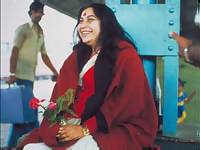
Shri Mataji Nirmala Devi
“Christianity works out everything secretly. So you have to expose some things also there because on top it is very nice, very good to talk about and all that. Inside they are doing all kinds of things and making people take to, what you can say, something very sinister, something very wrong.”
The Divine Mother/Paraclete
Cabella, Italy—August 23, 1997
The Vatican
"The logical place to begin a discussion of the political power of the Roman Catholic Church today is, of course, the Vatican, a sovereign city-state within the city of Rome. Established in 1929, the Vatican City is the world's smallest state, both by area (108.7 acres) and population (c. 800). Its citizenry is 100% Roman Catholic, its highest functionaries are Roman clergy, and its non-hereditary, elected monarch is the pope. Jesuit Thomas J. Reese mentions several other remarkable features of this unique state.
The ... Vatican City is a sovereign state recognized under international law ... . As ruler of Vatican City the pope is the last absolute monarch in Europe, with supreme legislative, judicial, and executive authority. He also controls all the assets of the Vatican, since this is a state economy without private property other than personal possessions of the employees and residents...its purpose is to provide an internationally recognized territory where the Holy See can operate in total freedom, without political interference.
The Holy See claims the oldest continuous diplomatic service in the world, going back at least as far as the Council of Nicea (325). It also possesses one of the world's most capable diplomatic corps.
Nuncios [i.e., papal ambassadors] ... speak for the pope to local governments and local churches. As professional diplomats who know their business, they are given high grades by their secular counterparts because of their training, experience, and extensive contacts in the country. While most embassies have few contacts outside government circles, nunciatures through contacts with the local church have sources of information unavailable to most embassies many times their size. The newsgathering potential of these contacts would be the envy of CNN or the CIA. This is one reason governments find it valuable to have embassies to the Holy See.”If you want to know what's going on in Mozambique"or other countries, Ambassador Flynn [America's official representative to the Holy See, 1993-1997] reports, 'there's any one of a thousand Catholic workers that are in there administering to the poor, out in the villages, out in the boondocks, out in the grassroots, and they report back to the Vatican. I can have conversations with the Vatican, and the Vatican can tell me what's going on there or in Libya.'
Rome's political power rests upon her nominal membership of about one billion, some one-sixth of the earth's population, making it the largest multinational organization in the world. Many voters and powerful people around the world are Roman Catholics. All of them are under the authority of the "Holy Father" and "Vicar of Christ," owing (but not always giving) the pope complete obedience.
... the "subjects" of the state of Vatican City ... live in every part of the world. Every person who has been baptized in the Roman Catholic Church, and who has not left the Church or been excommunicated by the Church, is a subject of the state of Vatican City. These subjects owe to the sovereign of the state of Vatican City absolute, complete and unquestioning spiritual and political allegiance no matter where they may be living and no matter what the laws of the nation within which they are living may be.”
http://standardbearer.rfpa.org/articles/rome-and-politics-4-romes-political-power-today
Web (January 10, 2014)
"With the election of Giovanni Maria Mastai-Ferretti as Pope Pius IX on June 16, 1846, the last phase of the 1500-year-old papal State began. The new pope, just 54 years of age, would be the last pontiff to be saluted as 'the Pope-King' (il Papa Re.)"
Malachi Martin, Rich Church, Poor Church
G. P. Putnam's Sons, 1984, p. 162
Papal Absolutism
The key to understanding the political pretensions of the church of Rome lies in her understanding of herself as the one, holy, catholic and apostolic church headed by the pope who is not only the "Successor of Peter the Prince of the Apostles" and the "Supreme Pontiff of the Universal Church" but also the "Vicar of Christ" and the "Holy Father.” Is not the Triune God the absolute sovereign of the universe? Has not Christ been invested with all authority in heaven and in earth (Matt. 28:18) as King of Kings and Lord of Lords (Rev. 19:16)? Therefore the pope, as the supreme representative of Almighty God and Jesus Christ, exercises this divine authority—the"plenitude of papal power.”Thus Leo XIII in his 1894 encyclical The Reunion of Christendom (and referring to himself using the pontifical and capitalised"We") stated," We ... hold upon this earth the place of God Almighty.”
The papal bull, Eger Cui Levia (c. 1246) declares,
Whoever seeks to evade the authority of the vicar of Christ ... thereby impairs the authority of Christ Himself. The King of kings has established us on earth as His universal representative and has conferred full power on us; by giving to the prince of the apostles and to us the power of binding and loosing on earth not only all men whatsoever, but also all things whatsoever ... The power of temporal government cannot be exercised outside the church, since there is no power constituted by God outside her ... They are lacking in perspicacity and incapable of investigating the origin of things who imagine that the apostolic see received from Constantine the sovereignty of the empire, whereas it had it previously, as is known, by nature and potentially. Our Lord Jesus Christ, Son of God, true man and true God ... constituted to the benefit of the holy see a monarchy not only pontifical but royal; he committed to the blessed Peter and his successors the reins of the empire both earthly and celestial, as is indicated by the plurality of the keys. Vicar of Christ [i.e., the pope] has received the power to exercise his jurisdiction by the one over the earth for temporal things, by the other in heaven for spiritual things.1
The sixteenth-century Council of Trent proclaimed the pope's temporal authority, perhaps even more emphatically,
The pope is ... not responsible to any earthly tribunal or power. He is the judge of all, can be judged by no one, kings, priests, or people. He is free from all laws, and cannot incur any sentence or penalty for any crime ... He is all in all, and above all, so that God and the pope, the Vicar of God, are but one ... He hath all power on earth, purgatory, heaven, and hell, to bind, loose, command, permit, dispense, do, and undo. Therefore it is declared to stand upon necessity of salvation for every human creature to be subject to the Roman Pontiff. All temporal power is his; the dominion, jurisdiction, and government of the whole earth is his by divine right.2
The Dogmatic Decrees of Vatican I (1870) declared that"All the faithful must believe that the holy Apostolic See and the Roman Pontiff possesses the primacy over the whole world.”3
As F. V. N. Painter put it," The Roman Church is now working out its destiny. It is the purpose of the Papacy to secure universal supremacy.”4
http://www.cprf.co.uk/articles/romeandpolitics.htm
Web (January 10, 2014)
Notes:
1 Quoted in Henry T. Hudson, Papal Power: Its Origins and Development (USA: Evangelical Press, 1981), p. 38; italics mine. This papal bull is usually attributed to Innocent IV, though there are some who doubt this.
2 Cf. John W. Robbins, Ecclesiastical Megalomania: The Economic and Political Thought of the Roman Catholic Church (USA: The Trinity Foundation, 1999), p. 131.
3 Quoted in Philip Schaff, The Creeds of Christendom (New York: Harper & Brothers, 1877), vol. 2, p. 262.
4 F. V. N. Painter, Luther on Education (Philadelphia: Lutheran Publication Society, 1889), p. 34
"Body of 'God's banker' to be exhumed
Richard Owen, London Times
ROME — On the orders of a Rome judge, Italian police are to exhume today the body of Roberto Calvi, the Mafia-linked financier found hanging under Blackfriars Bridge in London 16 years ago, in a new attempt to establish whether he committed suicide or was murdered.
Calvi's son Carlo, a banker from Montreal, said yesterday he will be present when the coffin is removed from the family vault in the village of Drezno, 160 kilometres from Milan, near Lake Como. Calvi said pathologists would examine the remains tomorrow.
He said he agreed to the exhumation because he is convinced that new evidence from Mafia informants, or pentiti, indicates his father didi not take his own life, as concluded at the time, but was killed because he knew too much about the Mafia's money-laundering schemes and its links with the Vatican.
Roberto Calvi was known as 'God's banker' because of his close ties with the Vatican...
The focus of the new investigations is a Sardinian Mafioso named Flavio Carboni, who has admitted being in London with Calvi, and who was subsequently sentenced for selling the contents of Calvi's briefcase to a Czech bishop, Pavel Hnilica...
The papers have since disappeared. Press reports say they related to money-laundering activities. According to police, Mafia pentiti have claimed that Carboni was part of the plot to kill Calvi, together with Pippo Calo, the former financial brains of the Mafia, nicknamed 'The Cashier,' who is in jail; Vicenzo Casillo, a Naples Mafia boss, now dead; and Francesco Di Carlo, better known as 'Frankie the Strangler,' who is alleged to have kidnapped Calvi at his flat in Chelsea, strangled him on a boat moored on the Thames, and then hung him from scaffolding under Blackfriar's Bridge. Di Carlo has confirmed to police that Calvi was murdered, but denies that he was the killer.”
London Times, December 16, 1998
"The Vatican-owned Istituto Farmacologico Serono of Rome — with a capital of $1.4 million, a 250-person payroll, and an annual profit exceeding $150,000 — produced and marketed for many years a popular contraceptive with the brand name Luteola. Nogara himself bought the IFS before World War II. Also Vatican-owned was the pasta company, Molini e Pastificio Pantanella S.p.a., with $15 million in assets. In the fifties, both companies had nephews of Pope Pius XII as board directors.”
Malachi Martin, Rich Church, Poor Church
G. P. Putnam's Sons, 1984
"I shall now relate the real history of Christianity. — The word 'Christianity' is already a misunderstanding — in reality there has been only one Christian, and he died on the Cross. The 'Evangel' died on the Cross. What was called 'Evangel' from this moment onwards was already the opposite of what he had lived: 'bad tidings' a dysangel. It is false to the point of absurdity to see in a 'belief,' perchance the beliefandn the redemption through Christ, the distinguishing characteristic of the Christian ... In fact there has been no Christians at all. The 'Christian,' that which has been called Christian for two millennia, is merely a psychological self-misunderstanding. Regarded more closely, that which has ruled in him, in spite of all his 'faith,' has been merely the instincts — and what instincts! 'Faith' has been at all times, with Luther for instance, only a cloak, a pretext, a screen, behind which the instincts played their game — a shrewd blindness — one has always spoken of faith, one has always acted from instinct ... The Christian's world of ideas contains nothing which so much as touches upon actuality ... One concept removed, a single reality substituted in its place — and the whole of Christianity crumbles to nothing! — From a lofty standpoint, this strangest of all facts, a religion not only determined by errors but inventive and even possessing genius only in harmful, only in life-poisoning and heart-poisoning errors, remains a spectacle for the gods — for those divinities which are at the same time philosophers ... For let us not undervalue the Christian: the Christian, false to the point of innocence, far surpasses the ape.”
Friedrich Nietzsche, Twilight of the Idols/The Anti-Christ
Penguin Classics, 1990, p. 161-62
"During the late evening of September 28th or the early morning of September 29th, 1978, Pope John Paul I, Albino Luciani, known as 'the smiling Pope,' died only thirty-three days after his election. The cause of death — without benefit of an autopsy — was announced by the Vatican to the world's press to be 'myocardial infarction,' that is, a heart attack. David Yallop began his investigation into this death at the request of certain individuals resident in Vatican City who were disturbed by a cover-up of the true circumstances surrounding the discovery of the Pope's body. During his continual and intensive research over the next three years, Yallop was to discover — as had Albino Luciani during his brief papacy — that a chain of corruption existed, linking leading figures in financial, political, criminal and clerical circles round the world in a conspiracy...
The new Pope had embarked on a revolution. He had ordered an investigation into the Vatican Bank, and specifically into the methods employed by its President, Bishop Paul Marcinkus. He was about to effect a dramatic reshuffle of Vatican staff and had discussed a list of proposed changes with his Secretary of State, Cardinal Jean Villot (who was named on the list) on the last evening of his life. This list bore a direct relation to another list in the Pope's possession — that of a number of clerics within the Vatican belonging to Freemasons — such membership justifying immediate excommunication from the Roman Catholic Church. Luciani also knew about an unconventional, illegal branch of Freemasonry called P2, which extended far beyond Italy in its accumulation of wealth and power and had certainly penetrated the Vatican, involving priests, bishops and even Cardinals ...
Six men in particular had powerful reasons for monitoring the activities of Pope John Paul I. Besides Bishop Marcinkus and Cardinal Villot in the Vatican, the Sicilian banker Michele Sindona was in New York resisting attempts by the Italian Government to have him extradited. The web of irregularities in the Vatican Bank, which the new Pope's investigation would inevitably uncover, included the laundering of Mafia money and would lead back to Sindona through long-standing links with Roberto Calvi. In Chicago, the head of the richest arch-diocese in the world, Cardinal Cody, was about to be removed by the new Pope. Over at least three of these men lurked the shadow of another — Licio Gelli — 'the Puppet Master' who controlled the masonic lodge P2 and through it controlled Italy.”
David Yallop, In God's Name
Jonathan Cape Ltd., 1984, cover flap
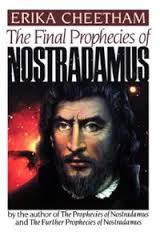
"Par le trefpas du trefuiellart pontife, sera efleu Romain de bon aage:
Qu'il fera dict que le fiege debiffe, et long tiendra & de picquant ouurage.
Through the death of the very old Pope will be elected a Roman of good age.
It is said of him that he weakens the (Holy) Seat, but he will hold it with long and painful effort.
Century V.LVI
The old Pope who dies is probably Pope John XXIII, a very popular Pontiff. It was under him that the Second Vatican Council was convened. He tried to bring the Church out of its elitist stance and lead it towards a more democratic role. Sadly, he died after only four years.
He was succeeded by the worldly, strict orthodox Pope Paul VI, under whose tenure the Vatican went through a series of severe political and financial scandals, long tiendra & de picquant ouurage. Paul VI certainly weakened the Vatican's position when it was revealed that he was a close friend of the Sicilian banker Michele Sindona, believed to be a member of the Mafia, who in fact became an adviser to the Vatican Bank. This led to the scandal of the P2 Freemason' Lodge and various suicides and murders, perhaps the most well-known being the mysterious death of Roberto Calvi under Blackfriars Bridge, London, in June, 1982. Paul VI died in 1978, to be succeeded for thirty days by Pope John Paul I, whose untimely and mysterious death was almost certainly due to his attempt to rectify the situation created by his predecessor.”
Erika Cheetham, The Final Prophecies of Nostradamus The Berkley Publishing Book, 1989, p. 243
"Gelli was a man who happened to number among his P2 members the brothers of Cardinal Sebastiano Baggio, Francesco. His meetings with the powerful and famous included audiences with Pope Paul VI. Gelli was a man whose close friends included Cardinal Paolo Bertoli. Gelli's closest P2 advisor, Umberto Ortolani, knew his way around Vatican City better than many cardinals. Ortolani, with his drawer full of Vatican honours and awards, was so close to the nerve centre of Vatican power that his was the villa, and he the host, at the pre-Conclave secret meeting that finalised strategy and brought about the election of Paul VI. It was Ortolani who conceived the idea of the multi-million dollar sale of the Vatican interests in Societa Generale Immobilaire, Ceramiche Pozzi and Condotte d'cqua. Ortolani was the P2 marriage broker, joining as partners the Mafioso and fellow P2 member Michele Sindona and Pope Paul VI. He collected vast commissions from one and Papal honours from the other. Through Ortolani, no room in the entire Vatican City State could deny access to the Puppet Master or the men and women he controlled. Gelli was also the collector of curious knowledge and information, including photographs of Pope John Paul II completely nude next to his swimming pool. When Gelli showed these snapshots to senior Socialist Party politician Vanni Nistico he remarked, 'Look at the problems the secret services have. If it's possible to take these pictures of the Pope, imagine how easy to shoot him.' Indeed. Or poison his predecessor.
And Jesus went into the Temple of God, and cast out all them that sold and bought in the temple, and overthrew the tables of the moneychangers, and the seats of them that sold doves, and said unto them, It is written, My house shall be called the house of prayer; but ye have made it a den of thieves. Matthew 21: 12-13.”
David Yallop, In God's Name
Jonathan Cape Ltd., 1984, 314
"Vatican money was also invested in other mining companies. But these were only small parts in a vastly diversified empire of wholly owned or controlled companies dealing in silk, yarn, publishing, furs, buttons, spaghetti, tourism, salt, munitions, pharmaceuticals, paper, electronics, departmental stores, ready-to-wear clothing, cotton, and children's toys ...
In the case of the two Vatican financial agencies, if one were to confine calculations to what it is known or knowable, it is possible to conclude that Vatican securities amounted approximately to $5-7 billion dollars spread over 40-50 percent of all shares quoted on the Italian stock exchange. But that is only part of the picture. Already, and from the earliest years, Vatican monies were invested abroad, principally in Europe, some in the Americas, a little in Africa, the Near East and Far East ...
In any case, in terms of 1960 dollars, what was now within the hands of the Vatican represented, in terms of liquidity, more than it had ever possessed even in its heyday of universal acceptance among the nations and its universal levy of papal revenues.”
Malachi Martin, Rich Church, Poor Church
G. P. Putnam's Sons, 1984
"The tenth century is an important milestone in the history of Europe, as it marked the end of the first thousand years of Christianity. For many centuries the Catholic Church had claimed to be the sole repository of Jesus' teachings, with the Popes as His living representatives. How were these self-assumed responsibilities being discharged at the end of a thousand years?
The Gospel of Matthew states that on a certain occasion—Jesus went into the Temple of God, and cast out all them that sold and bought in the Temple, and overthrew the tables of the money-changers ... and said unto them, It is written, My house shall be called the House of Prayer; but ye have made it a den of thieves.' (Matthew xvi:12-13.)
A thousand years later the House of Prayer had become an institution of money-changers. Benefices, dispensations, licenses, absolutions and privileges were now being bought and sold like so much merchandise, and the entire time of 'Christ's Representatives' was occupied with politics, litigations and processes. Every stroke of the pen had its price, and a system of bribery prevailed which extended from the doorkeeper to the Pope himself.
The Gospel of Matthew records another of Jesus' statements:
Ye have heard that it was said by them of old time, Thou shalt not commit adultery. But I say unto you, that whosoever looketh on a woman to lust after her hath committed adultery with her already in his heart.' (Matthew v:27-28.)
A thousand years later practically every 'Representative of Christ' had his mistresses and his concubines. This custom extended straight down the clerical line, and the support of the illegitimate children resulting from these illicit unions had now become a serious matter to the Church.
The mistress of Sergius III, the first Pope of the tenth century, was a notorious prostitute who finally deposed Sergius and placed her new lover in the Papal Chair. Fourteen years later her daughter (also a prostitute) had the Pope smothered and secured his position for her own illegitimate son, and later for her grandson. The Lateran Palace at this time was a veritable brothel. The life of Pope Benedict IX was so foul that his successor 'shuddered to describe it.' His adulteries, murders and other abominations were of such common occurrence that at last the people revolted. In despair of maintaining his position, Pope Benedict finally put up the Papal Chair at auction. It was bought by John Gratian, who became Pope Gregory Vl.
The Gospel of Matthew also records these words of Jesus:
Ye have heard that it hath been said, Thou shalt love thy neighbor and hate thine enemy. But I say unto you, Love your enemies, bless them that curse you, do good to them that hate you, and pray for them which despitefully use you and persecute you. (Matthew v:43-44.)
One thousand years later Pope Urban II started the First Crusade. It was preceded by a vanguard having as its mascot a goose in which the Holy Ghost was said to be enshrined. The capture of Jerusalem was attended by atrocities almost beyond belief. The brains of young children were dashed out against the walls. Infants were thrown over the battlements. Every woman who could be seized was violated. Men were roasted alive after being ripped open to see if they had swallowed gold. During the final massacre of 70,000 persons, the Pope's legate was seen 'partaking in the triumph.'"
Great Theosophists, www.wisdomworld.org

Conservative Catholic order meets to turn page on scandalous past
By Philip Pullella
January 8, 2014 5:04 PM
VATICAN CITY (Reuters) - How can an order of priests go on serving the Catholic Church and the faithful after revelations that the man who founded it was a fraud who lived a double life as a pedophile, womanizer and drug addict?
That is the dilemma facing the Legionaries of Christ, as the conservative religious order started a six-week meeting on Wednesday to write a new constitution and chart a future course that would put the stain of scandal behind it.
The order, once a darling of the Vatican because it attracted more people to religious vocations and made sizeable financial donations to the Church, has been in receivership since 2010.
At that point, former Pope Benedict appointed a personal delegate to run it while investigations were carried out and preparations made for upcoming changes.
The order runs private Catholic schools and charitable organizations in 22 countries via its network of some 950 priests and 1,000 seminarians. It operates a Catholic university in Rome and its lay movement, known as Regnum Christi, has around 30,000 members.
Father Marcial Maciel, a Mexican who founded the order in 1941, ran it like a cult rooted in secrecy, according to former Legionaries. Members took a special vow promising never to criticize the founder or question his motives.
For decades the Vatican dismissed accusations by seminarians that Maciel had abused them sexually, some when they were as young as 12.
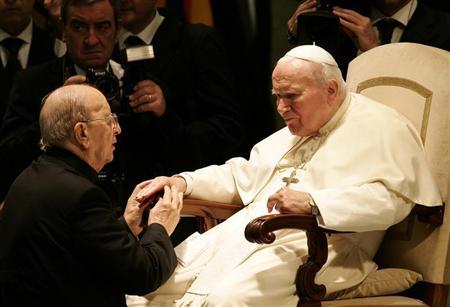
Pope John Paul II blesses Father Marcial
Maciel during a special audience in Paul VI
hall at the Vatican. Pope John Paul II, who is set to become a saint in May, was a strong supporter, appreciating the group's ability to attract more people to clerical life than other religious orders.
The order also had many wealthy conservative benefactors who saw it as a bulwark against liberalism in the Church.
PERSONALITY CULT
"The Legion for six decades was a cult of personality built on lies and Maciel's phenomenal fundraising," said Jason Berry, author of "Render unto Rome - The Secret Life of Money in the Catholic Church" and who has written extensively on the order.
In 2006, a year after John Paul's death, a Vatican investigation concluded that the accusations of molestation that had been previously denied were true. Pope Benedict ordered Maciel to retire to a life of "prayer and penitence.”
Maciel died in 2008 at the age of 87, and the next year more Church investigations found that he had also fathered several children with at least two different women, visited his"families"regularly and sent them money for their upkeep.
The order has acknowledged that Maciel, who was also a morphine addict, had "a prolonged and stable relationship" with one of the women.
(Reporting By Philip Pullella; Editing by Mike Collett-White)
Disclaimer: Our material may be copied, printed and distributed by referring to this site. This site also contains copyrighted material the use of which has not always been specifically authorized by the copyright owner. We are making such material available to our readers under the education and research provisions of "fair use" in an effort to advance freedom of inquiry for a better understanding of religious, spiritual and inter-faith issues. The material on this site is distributed without profit. If you wish to use copyrighted material for purposes other than "fair use" you must request permission from the copyright owner."The logical place to begin a discussion of the political power of the Roman Catholic Church today is, of course, the Vatican, a sovereign city-state within the city of Rome. Established in 1929, the Vatican City is the world's smallest state, both by area (108.7 acres) and population (c. 800). Its citizenry is 100% Roman Catholic, its highest functionaries are Roman clergy, and its non-hereditary, elected monarch is the pope. Jesuit Thomas J. Reese mentions several other remarkable features of this unique state.
The ... Vatican City is a sovereign state recognized under international law ... . As ruler of Vatican City the pope is the last absolute monarch in Europe, with supreme legislative, judicial, and executive authority. He also controls all the assets of the Vatican, since this is a state economy without private property other than personal possessions of the employees and residents...its purpose is to provide an internationally recognized territory where the Holy See can operate in total freedom, without political interference.
The Holy See claims the oldest continuous diplomatic service in the world, going back at least as far as the Council of Nicea (325). It also possesses one of the world's most capable diplomatic corps.
Nuncios [i.e., papal ambassadors] ... speak for the pope to local governments and local churches. As professional diplomats who know their business, they are given high grades by their secular counterparts because of their training, experience, and extensive contacts in the country. While most embassies have few contacts outside government circles, nunciatures through contacts with the local church have sources of information unavailable to most embassies many times their size. The newsgathering potential of these contacts would be the envy of CNN or the CIA. This is one reason governments find it valuable to have embassies to the Holy See.”If you want to know what's going on in Mozambique"or other countries, Ambassador Flynn [America's official representative to the Holy See, 1993-1997] reports, 'there's any one of a thousand Catholic workers that are in there administering to the poor, out in the villages, out in the boondocks, out in the grassroots, and they report back to the Vatican. I can have conversations with the Vatican, and the Vatican can tell me what's going on there or in Libya.'
Rome's political power rests upon her nominal membership of about one billion, some one-sixth of the earth's population, making it the largest multinational organization in the world. Many voters and powerful people around the world are Roman Catholics. All of them are under the authority of the "Holy Father" and "Vicar of Christ," owing (but not always giving) the pope complete obedience.
... the "subjects" of the state of Vatican City ... live in every part of the world. Every person who has been baptized in the Roman Catholic Church, and who has not left the Church or been excommunicated by the Church, is a subject of the state of Vatican City. These subjects owe to the sovereign of the state of Vatican City absolute, complete and unquestioning spiritual and political allegiance no matter where they may be living and no matter what the laws of the nation within which they are living may be.”
http://standardbearer.rfpa.org/articles/rome-and-politics-4-romes-political-power-today
Web (January 10, 2014)
"With the election of Giovanni Maria Mastai-Ferretti as Pope Pius IX on June 16, 1846, the last phase of the 1500-year-old papal State began. The new pope, just 54 years of age, would be the last pontiff to be saluted as 'the Pope-King' (il Papa Re.)"
Malachi Martin, Rich Church, Poor Church
G. P. Putnam's Sons, 1984, p. 162
Papal Absolutism
The key to understanding the political pretensions of the church of Rome lies in her understanding of herself as the one, holy, catholic and apostolic church headed by the pope who is not only the "Successor of Peter the Prince of the Apostles" and the "Supreme Pontiff of the Universal Church" but also the "Vicar of Christ" and the "Holy Father.” Is not the Triune God the absolute sovereign of the universe? Has not Christ been invested with all authority in heaven and in earth (Matt. 28:18) as King of Kings and Lord of Lords (Rev. 19:16)? Therefore the pope, as the supreme representative of Almighty God and Jesus Christ, exercises this divine authority—the"plenitude of papal power.”Thus Leo XIII in his 1894 encyclical The Reunion of Christendom (and referring to himself using the pontifical and capitalised"We") stated," We ... hold upon this earth the place of God Almighty.”
The papal bull, Eger Cui Levia (c. 1246) declares,
Whoever seeks to evade the authority of the vicar of Christ ... thereby impairs the authority of Christ Himself. The King of kings has established us on earth as His universal representative and has conferred full power on us; by giving to the prince of the apostles and to us the power of binding and loosing on earth not only all men whatsoever, but also all things whatsoever ... The power of temporal government cannot be exercised outside the church, since there is no power constituted by God outside her ... They are lacking in perspicacity and incapable of investigating the origin of things who imagine that the apostolic see received from Constantine the sovereignty of the empire, whereas it had it previously, as is known, by nature and potentially. Our Lord Jesus Christ, Son of God, true man and true God ... constituted to the benefit of the holy see a monarchy not only pontifical but royal; he committed to the blessed Peter and his successors the reins of the empire both earthly and celestial, as is indicated by the plurality of the keys. Vicar of Christ [i.e., the pope] has received the power to exercise his jurisdiction by the one over the earth for temporal things, by the other in heaven for spiritual things.1
The sixteenth-century Council of Trent proclaimed the pope's temporal authority, perhaps even more emphatically,
The pope is ... not responsible to any earthly tribunal or power. He is the judge of all, can be judged by no one, kings, priests, or people. He is free from all laws, and cannot incur any sentence or penalty for any crime ... He is all in all, and above all, so that God and the pope, the Vicar of God, are but one ... He hath all power on earth, purgatory, heaven, and hell, to bind, loose, command, permit, dispense, do, and undo. Therefore it is declared to stand upon necessity of salvation for every human creature to be subject to the Roman Pontiff. All temporal power is his; the dominion, jurisdiction, and government of the whole earth is his by divine right.2
The Dogmatic Decrees of Vatican I (1870) declared that"All the faithful must believe that the holy Apostolic See and the Roman Pontiff possesses the primacy over the whole world.”3
As F. V. N. Painter put it," The Roman Church is now working out its destiny. It is the purpose of the Papacy to secure universal supremacy.”4
http://www.cprf.co.uk/articles/romeandpolitics.htm
Web (January 10, 2014)
Notes:
1 Quoted in Henry T. Hudson, Papal Power: Its Origins and Development (USA: Evangelical Press, 1981), p. 38; italics mine. This papal bull is usually attributed to Innocent IV, though there are some who doubt this.
2 Cf. John W. Robbins, Ecclesiastical Megalomania: The Economic and Political Thought of the Roman Catholic Church (USA: The Trinity Foundation, 1999), p. 131.
3 Quoted in Philip Schaff, The Creeds of Christendom (New York: Harper & Brothers, 1877), vol. 2, p. 262.
4 F. V. N. Painter, Luther on Education (Philadelphia: Lutheran Publication Society, 1889), p. 34
"Body of 'God's banker' to be exhumed
Richard Owen, London Times
ROME — On the orders of a Rome judge, Italian police are to exhume today the body of Roberto Calvi, the Mafia-linked financier found hanging under Blackfriars Bridge in London 16 years ago, in a new attempt to establish whether he committed suicide or was murdered.
Calvi's son Carlo, a banker from Montreal, said yesterday he will be present when the coffin is removed from the family vault in the village of Drezno, 160 kilometres from Milan, near Lake Como. Calvi said pathologists would examine the remains tomorrow.
He said he agreed to the exhumation because he is convinced that new evidence from Mafia informants, or pentiti, indicates his father didi not take his own life, as concluded at the time, but was killed because he knew too much about the Mafia's money-laundering schemes and its links with the Vatican.
Roberto Calvi was known as 'God's banker' because of his close ties with the Vatican...
The focus of the new investigations is a Sardinian Mafioso named Flavio Carboni, who has admitted being in London with Calvi, and who was subsequently sentenced for selling the contents of Calvi's briefcase to a Czech bishop, Pavel Hnilica...
The papers have since disappeared. Press reports say they related to money-laundering activities. According to police, Mafia pentiti have claimed that Carboni was part of the plot to kill Calvi, together with Pippo Calo, the former financial brains of the Mafia, nicknamed 'The Cashier,' who is in jail; Vicenzo Casillo, a Naples Mafia boss, now dead; and Francesco Di Carlo, better known as 'Frankie the Strangler,' who is alleged to have kidnapped Calvi at his flat in Chelsea, strangled him on a boat moored on the Thames, and then hung him from scaffolding under Blackfriar's Bridge. Di Carlo has confirmed to police that Calvi was murdered, but denies that he was the killer.”
London Times, December 16, 1998
"The Vatican-owned Istituto Farmacologico Serono of Rome — with a capital of $1.4 million, a 250-person payroll, and an annual profit exceeding $150,000 — produced and marketed for many years a popular contraceptive with the brand name Luteola. Nogara himself bought the IFS before World War II. Also Vatican-owned was the pasta company, Molini e Pastificio Pantanella S.p.a., with $15 million in assets. In the fifties, both companies had nephews of Pope Pius XII as board directors.”
Malachi Martin, Rich Church, Poor Church
G. P. Putnam's Sons, 1984
"I shall now relate the real history of Christianity. — The word 'Christianity' is already a misunderstanding — in reality there has been only one Christian, and he died on the Cross. The 'Evangel' died on the Cross. What was called 'Evangel' from this moment onwards was already the opposite of what he had lived: 'bad tidings' a dysangel. It is false to the point of absurdity to see in a 'belief,' perchance the beliefandn the redemption through Christ, the distinguishing characteristic of the Christian ... In fact there has been no Christians at all. The 'Christian,' that which has been called Christian for two millennia, is merely a psychological self-misunderstanding. Regarded more closely, that which has ruled in him, in spite of all his 'faith,' has been merely the instincts — and what instincts! 'Faith' has been at all times, with Luther for instance, only a cloak, a pretext, a screen, behind which the instincts played their game — a shrewd blindness — one has always spoken of faith, one has always acted from instinct ... The Christian's world of ideas contains nothing which so much as touches upon actuality ... One concept removed, a single reality substituted in its place — and the whole of Christianity crumbles to nothing! — From a lofty standpoint, this strangest of all facts, a religion not only determined by errors but inventive and even possessing genius only in harmful, only in life-poisoning and heart-poisoning errors, remains a spectacle for the gods — for those divinities which are at the same time philosophers ... For let us not undervalue the Christian: the Christian, false to the point of innocence, far surpasses the ape.”
Friedrich Nietzsche, Twilight of the Idols/The Anti-Christ
Penguin Classics, 1990, p. 161-62
"During the late evening of September 28th or the early morning of September 29th, 1978, Pope John Paul I, Albino Luciani, known as 'the smiling Pope,' died only thirty-three days after his election. The cause of death — without benefit of an autopsy — was announced by the Vatican to the world's press to be 'myocardial infarction,' that is, a heart attack. David Yallop began his investigation into this death at the request of certain individuals resident in Vatican City who were disturbed by a cover-up of the true circumstances surrounding the discovery of the Pope's body. During his continual and intensive research over the next three years, Yallop was to discover — as had Albino Luciani during his brief papacy — that a chain of corruption existed, linking leading figures in financial, political, criminal and clerical circles round the world in a conspiracy...
The new Pope had embarked on a revolution. He had ordered an investigation into the Vatican Bank, and specifically into the methods employed by its President, Bishop Paul Marcinkus. He was about to effect a dramatic reshuffle of Vatican staff and had discussed a list of proposed changes with his Secretary of State, Cardinal Jean Villot (who was named on the list) on the last evening of his life. This list bore a direct relation to another list in the Pope's possession — that of a number of clerics within the Vatican belonging to Freemasons — such membership justifying immediate excommunication from the Roman Catholic Church. Luciani also knew about an unconventional, illegal branch of Freemasonry called P2, which extended far beyond Italy in its accumulation of wealth and power and had certainly penetrated the Vatican, involving priests, bishops and even Cardinals ...
Six men in particular had powerful reasons for monitoring the activities of Pope John Paul I. Besides Bishop Marcinkus and Cardinal Villot in the Vatican, the Sicilian banker Michele Sindona was in New York resisting attempts by the Italian Government to have him extradited. The web of irregularities in the Vatican Bank, which the new Pope's investigation would inevitably uncover, included the laundering of Mafia money and would lead back to Sindona through long-standing links with Roberto Calvi. In Chicago, the head of the richest arch-diocese in the world, Cardinal Cody, was about to be removed by the new Pope. Over at least three of these men lurked the shadow of another — Licio Gelli — 'the Puppet Master' who controlled the masonic lodge P2 and through it controlled Italy.”
David Yallop, In God's Name
Jonathan Cape Ltd., 1984, cover flap
"Par le trefpas du trefuiellart pontife, sera efleu Romain de bon aage:
Qu'il fera dict que le fiege debiffe, et long tiendra & de picquant ouurage.
Through the death of the very old Pope will be elected a Roman of good age.
It is said of him that he weakens the (Holy) Seat, but he will hold it with long and painful effort.
Century V.LVI
The old Pope who dies is probably Pope John XXIII, a very popular Pontiff. It was under him that the Second Vatican Council was convened. He tried to bring the Church out of its elitist stance and lead it towards a more democratic role. Sadly, he died after only four years.
He was succeeded by the worldly, strict orthodox Pope Paul VI, under whose tenure the Vatican went through a series of severe political and financial scandals, long tiendra & de picquant ouurage. Paul VI certainly weakened the Vatican's position when it was revealed that he was a close friend of the Sicilian banker Michele Sindona, believed to be a member of the Mafia, who in fact became an adviser to the Vatican Bank. This led to the scandal of the P2 Freemason' Lodge and various suicides and murders, perhaps the most well-known being the mysterious death of Roberto Calvi under Blackfriars Bridge, London, in June, 1982. Paul VI died in 1978, to be succeeded for thirty days by Pope John Paul I, whose untimely and mysterious death was almost certainly due to his attempt to rectify the situation created by his predecessor.”
Erika Cheetham, The Final Prophecies of Nostradamus The Berkley Publishing Book, 1989, p. 243
"Gelli was a man who happened to number among his P2 members the brothers of Cardinal Sebastiano Baggio, Francesco. His meetings with the powerful and famous included audiences with Pope Paul VI. Gelli was a man whose close friends included Cardinal Paolo Bertoli. Gelli's closest P2 advisor, Umberto Ortolani, knew his way around Vatican City better than many cardinals. Ortolani, with his drawer full of Vatican honours and awards, was so close to the nerve centre of Vatican power that his was the villa, and he the host, at the pre-Conclave secret meeting that finalised strategy and brought about the election of Paul VI. It was Ortolani who conceived the idea of the multi-million dollar sale of the Vatican interests in Societa Generale Immobilaire, Ceramiche Pozzi and Condotte d'cqua. Ortolani was the P2 marriage broker, joining as partners the Mafioso and fellow P2 member Michele Sindona and Pope Paul VI. He collected vast commissions from one and Papal honours from the other. Through Ortolani, no room in the entire Vatican City State could deny access to the Puppet Master or the men and women he controlled. Gelli was also the collector of curious knowledge and information, including photographs of Pope John Paul II completely nude next to his swimming pool. When Gelli showed these snapshots to senior Socialist Party politician Vanni Nistico he remarked, 'Look at the problems the secret services have. If it's possible to take these pictures of the Pope, imagine how easy to shoot him.' Indeed. Or poison his predecessor.
And Jesus went into the Temple of God, and cast out all them that sold and bought in the temple, and overthrew the tables of the moneychangers, and the seats of them that sold doves, and said unto them, It is written, My house shall be called the house of prayer; but ye have made it a den of thieves. Matthew 21: 12-13.”
David Yallop, In God's Name
Jonathan Cape Ltd., 1984, 314
"Vatican money was also invested in other mining companies. But these were only small parts in a vastly diversified empire of wholly owned or controlled companies dealing in silk, yarn, publishing, furs, buttons, spaghetti, tourism, salt, munitions, pharmaceuticals, paper, electronics, departmental stores, ready-to-wear clothing, cotton, and children's toys ...
In the case of the two Vatican financial agencies, if one were to confine calculations to what it is known or knowable, it is possible to conclude that Vatican securities amounted approximately to $5-7 billion dollars spread over 40-50 percent of all shares quoted on the Italian stock exchange. But that is only part of the picture. Already, and from the earliest years, Vatican monies were invested abroad, principally in Europe, some in the Americas, a little in Africa, the Near East and Far East ...
In any case, in terms of 1960 dollars, what was now within the hands of the Vatican represented, in terms of liquidity, more than it had ever possessed even in its heyday of universal acceptance among the nations and its universal levy of papal revenues.”
Malachi Martin, Rich Church, Poor Church
G. P. Putnam's Sons, 1984
"The tenth century is an important milestone in the history of Europe, as it marked the end of the first thousand years of Christianity. For many centuries the Catholic Church had claimed to be the sole repository of Jesus' teachings, with the Popes as His living representatives. How were these self-assumed responsibilities being discharged at the end of a thousand years?
The Gospel of Matthew states that on a certain occasion—Jesus went into the Temple of God, and cast out all them that sold and bought in the Temple, and overthrew the tables of the money-changers ... and said unto them, It is written, My house shall be called the House of Prayer; but ye have made it a den of thieves.' (Matthew xvi:12-13.)
A thousand years later the House of Prayer had become an institution of money-changers. Benefices, dispensations, licenses, absolutions and privileges were now being bought and sold like so much merchandise, and the entire time of 'Christ's Representatives' was occupied with politics, litigations and processes. Every stroke of the pen had its price, and a system of bribery prevailed which extended from the doorkeeper to the Pope himself.
The Gospel of Matthew records another of Jesus' statements:
Ye have heard that it was said by them of old time, Thou shalt not commit adultery. But I say unto you, that whosoever looketh on a woman to lust after her hath committed adultery with her already in his heart.' (Matthew v:27-28.)
A thousand years later practically every 'Representative of Christ' had his mistresses and his concubines. This custom extended straight down the clerical line, and the support of the illegitimate children resulting from these illicit unions had now become a serious matter to the Church.
The mistress of Sergius III, the first Pope of the tenth century, was a notorious prostitute who finally deposed Sergius and placed her new lover in the Papal Chair. Fourteen years later her daughter (also a prostitute) had the Pope smothered and secured his position for her own illegitimate son, and later for her grandson. The Lateran Palace at this time was a veritable brothel. The life of Pope Benedict IX was so foul that his successor 'shuddered to describe it.' His adulteries, murders and other abominations were of such common occurrence that at last the people revolted. In despair of maintaining his position, Pope Benedict finally put up the Papal Chair at auction. It was bought by John Gratian, who became Pope Gregory Vl.
The Gospel of Matthew also records these words of Jesus:
Ye have heard that it hath been said, Thou shalt love thy neighbor and hate thine enemy. But I say unto you, Love your enemies, bless them that curse you, do good to them that hate you, and pray for them which despitefully use you and persecute you. (Matthew v:43-44.)
One thousand years later Pope Urban II started the First Crusade. It was preceded by a vanguard having as its mascot a goose in which the Holy Ghost was said to be enshrined. The capture of Jerusalem was attended by atrocities almost beyond belief. The brains of young children were dashed out against the walls. Infants were thrown over the battlements. Every woman who could be seized was violated. Men were roasted alive after being ripped open to see if they had swallowed gold. During the final massacre of 70,000 persons, the Pope's legate was seen 'partaking in the triumph.'"
Great Theosophists, www.wisdomworld.org
Conservative Catholic order meets to turn page on scandalous past
By Philip Pullella
January 8, 2014 5:04 PM
VATICAN CITY (Reuters) - How can an order of priests go on serving the Catholic Church and the faithful after revelations that the man who founded it was a fraud who lived a double life as a pedophile, womanizer and drug addict?
That is the dilemma facing the Legionaries of Christ, as the conservative religious order started a six-week meeting on Wednesday to write a new constitution and chart a future course that would put the stain of scandal behind it.
The order, once a darling of the Vatican because it attracted more people to religious vocations and made sizeable financial donations to the Church, has been in receivership since 2010.
At that point, former Pope Benedict appointed a personal delegate to run it while investigations were carried out and preparations made for upcoming changes.
The order runs private Catholic schools and charitable organizations in 22 countries via its network of some 950 priests and 1,000 seminarians. It operates a Catholic university in Rome and its lay movement, known as Regnum Christi, has around 30,000 members.
Father Marcial Maciel, a Mexican who founded the order in 1941, ran it like a cult rooted in secrecy, according to former Legionaries. Members took a special vow promising never to criticize the founder or question his motives.
For decades the Vatican dismissed accusations by seminarians that Maciel had abused them sexually, some when they were as young as 12.
Pope John Paul II blesses Father Marcial
Maciel during a special audience in Paul VI
hall at the Vatican. Pope John Paul II, who is set to become a saint in May, was a strong supporter, appreciating the group's ability to attract more people to clerical life than other religious orders.
The order also had many wealthy conservative benefactors who saw it as a bulwark against liberalism in the Church.
PERSONALITY CULT
"The Legion for six decades was a cult of personality built on lies and Maciel's phenomenal fundraising," said Jason Berry, author of "Render unto Rome - The Secret Life of Money in the Catholic Church" and who has written extensively on the order.
In 2006, a year after John Paul's death, a Vatican investigation concluded that the accusations of molestation that had been previously denied were true. Pope Benedict ordered Maciel to retire to a life of "prayer and penitence.”
Maciel died in 2008 at the age of 87, and the next year more Church investigations found that he had also fathered several children with at least two different women, visited his"families"regularly and sent them money for their upkeep.
The order has acknowledged that Maciel, who was also a morphine addict, had "a prolonged and stable relationship" with one of the women.
(Reporting By Philip Pullella; Editing by Mike Collett-White)

 REV. 18.11-13: AND THEIR SOUL TRADERS