
Knowledge of Devi that Liberates
From: "jagbir singh"
Date: Sat May 22, 2004 7:46 pm
Subject: Knowledge of Devi that Liberates
i always have believed that the best and bravest of Her devotees
are yet to be awakened. For many years i have been unable to
overcome this awareness despite some senior SYs continue saying
that those who are supposed to come into Sahaja Yoga are already
Her devotees. But i know that is not the case and am convinced by
this inner awareness that the best days of the Blossom Times are
yet to come.
Shri Mataji promised that Sahaja Yoga will be established before
She leaves. i believe that She has begun the shift from Her
temporary, external being to that of Her eternal, inner Self. As
She ages we SYs should not only learn to meditate on Her in our
Sahasraras but also seek guidance from within. This will take time
and effort but sooner or later we will overcome any conditioning.
Over the next two years or so i will post proof of what the Adi
Shakti is within, how Shri Lalita operates and why the Maha-Devi is
Omnipresent, Omniscient and Omnipotent - the Shakti. Future
generations, free from all the present-day problems and subtle
system pettiness, will advance to great heights. That is why i am
sure that the best of the Blossom Time is yet to come....
However, there is one paramount and overriding fact that all must
always remember in times of doubt. All of you only know from your
collectives about the physical Shri Mataji who lives in Cabella,
Italy. i am now telling you about the eternal Adi Shakti, the Maha-
Devi, Shri Lalita, the Shakti of All who resides in the Sahasraras
of all beings. The difference between the two is that of heaven and
earth, even if they are One and the Same.
New seekers and SYs may express doubts about Shri Mataji Nirmala
Devi because of incompetence on the part of those chosen to uphold
Her divinity and message. But under no circumstances will the same
ineptitude be allowed to happen to the Shakti within. She will
triumph with the help of those willing to stand up for Truth, as
they had done over countless births. This site awakens them again
to rise to the Call of the Conch whose sound they have always
responded faithfully, time and again, over countless births!
regards,
jagbir
Knowledge of Devi that Liberates
"Both gitas (Devi Gita and Kapila Gita of the Bhagvata Purana) also describe four grades of devotion according to the qualities (gunas) of nature, a classification scheme derived from the Bhagavad Gita. According to the Devi Gita, the first two grades, rooted in ignorance (tamas) and passion (rajas), are practiced by those intending harm to others and seeking their own well-being, respectively. The third grade, arising from virtue (sattva), the highest of the three qualities, is performed by those who surrender the fruits of their actions to the Goddess out of a sense of duty and in spirit of loving service. Such devotion is not supreme for it still clings to false distinctions, but it does lead to the highest devotion beyond all the qualities.
The supreme devotion is described in quite paradoxical terms. On the one hand, it is characterized by total detachment, an absence of any sense of difference between oneself and others including the Goddess, and realization of the universality of pure consciousness. On the other hand, it is typified by a sense of oneself as a servant and the Devi as master, an eagerness to participate in pilgrimages to her sacred sites, and a zeal to perform her ritual worship without regard to cost. Especially paradoxical is the tension between the detached devotion associated with the knowledge of the unity of all being, and the ecstatic passion, accompanied by tears of joy and faltering voice, manifest in worshipping the Goddess while singing her names and dancing in enraptured self-abandonment. Again, while the supreme devotion is characterized by indifference to all forms of liberation, including mergence into the Devi, nonetheless, so the Goddess declares, the fruit of such devotion is dissolution into her essential nature. Such paradoxes reflect in many ways the long-standing tension in the Hindu tradition between the ideal of devotion, with its goal of loving service, and the ideal of knowledge, with its goal of realizing absolute oneness.
Formally, the Devi Gita resolves the tension by insisting that knowledge of the Goddess is the final goal of devotion, as well as of dispassion. Devotion without knowledge will lead to the heavenly paradise of the Goddess, the Jeweled Island, but no further. Dwelling in the Jeweled Island, however, inevitably leads to liberating knowledge of the pure consciousness that is the Goddess. Dispassion without knowledge, incidentally, leads only to a virtuous birth. The Devi insists that liberating knowledge can be attained here in this world, while still living. Seeking such knowledge alone makes life worthwhile, and the attainment of knowledge completely fulfils the ultimate purpose of existence.”
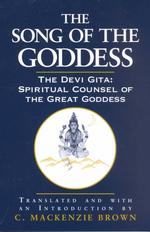
The Song of the Goddess
The Devi Gita: Spiritual Counsel Of The Great Goddess
(C. Mackenzie Brown, State University of N.Y. Press, 2002, pg. 23-5)
Related Article(s):
Shri Mataji: "My actual sign name is Lalita ...”
Archives of FAQs and Articles on Shakti/Last Judgment/Qiyamah
Homepage
Disclaimer: Our material may be copied, printed and distributed by referring to this site. This site also contains copyrighted material the use of which has not always been specifically authorized by the copyright owner. We are making such material available to our readers under the education and research provisions of "fair use" in an effort to advance freedom of inquiry for a better understanding of religious, spiritual and inter-faith issues. The material on this site is distributed without profit. If you wish to use copyrighted material for purposes other than "fair use" you must request permission from the copyright owner.

