Eschatology | Paraclete Theology | Last Judgment
The Gnostic Gospels: “Self-knowledge is knowledge of God; the self and the divine are identical”
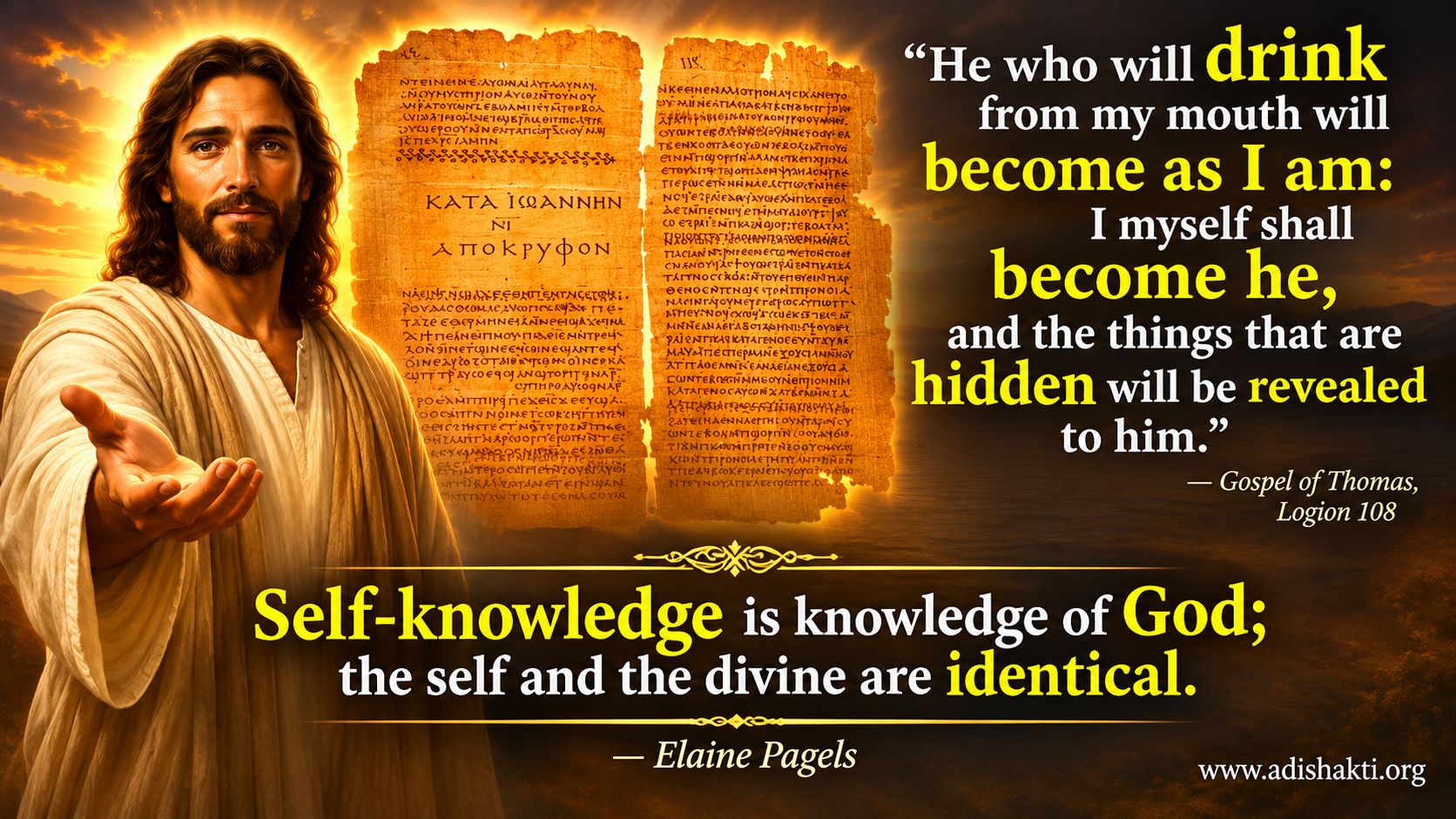
The Nag Hammadi Library — Source Text
The following supplied historical introduction and notes are reproduced as source material for the discussion of gnosis and early Christianity.
Source note: The supplied excerpt retains the James M. Robinson bibliographic line below. The Gnosis Archive attributes a substantially similar introduction to Lance S. Owens. Some historical generalizations and the discovery story are disputed, as discussed in the paper.

Nag Hammadi Codex II: The conclusion of the Secret Book of John and the beginning of the Gospel of Thomas.
Image source: Wikimedia Commons (public-domain reproduction).
The Nag Hammadi Library
An Introduction to Gnosticism and The Nag Hammadi Library
What is Gnosticism?
Gnosis and gnosticism are still rather arcane terms, though in the last two decades the words have been increasingly encountered in the vocabulary of contemporary society. Gnosis derives from Greek, and connotes "knowledge" or the "act of knowing." (On first hearing, it is sometimes confused with another more common term of the same root but opposite sense: agnostic, literally "not knowing", a knower of nothing.) The Greek language differentiates between rational, propositional knowledge, and the distinct form of knowing obtained not by reason, but by personal experience or perception. It is this latter knowledge, gained from experience, from an interior spark of comprehension, that constitutes gnosis.1
In the first century of the Christian era this term, Gnostic, began to be used to denote a prominent, even if somewhat heterodox, segment of the diverse new Christian community. Among these early followers of Christ, it appears that an elite group delineated themselves from the greater household of the Church by claiming not simply a belief in Christ and his message, but a "special witness" or revelatory experience of the divine. It was this experience, this gnosis, which—so these Gnostics claimed—set the true follower of Christ apart from his fellows. Stephan Hoeller explains that these Gnostic Christians held a "conviction that direct, personal and absolute knowledge of the authentic truths of existence is accessible to human beings, and, moreover, that the attainment of such knowledge must always constitute the supreme achievement of human life."2
What the "authentic truths of existence" affirmed by the Gnostics were will be briefly reviewed below. But a historical overview of the early Church might first be useful. In the initial decades of the Christian church—the period when we find first mention of "Gnostic" Christians—no orthodoxy, or single acceptable format of Christian thought, had yet been defined. During this first century of Christianity modern scholarship suggests Gnosticism was one of many currents sweeping the deep waters of the new religion. The ultimate course Christianity, and Western culture with it, would take was undecided at that early moment; Gnosticism was one of the forces forming that destiny.
That Gnosticism was, at least briefly, in the mainstream of Christianity is witnessed by the fact that one of the most prominent and influential early Gnostic teachers, Valentinus, may have been in consideration during the mid-second century for election as the Bishop of Rome.3 Valentinus serves well as a model of the Gnostic teacher. Born in Alexandria around A.D. 100, in his early years Valentinus had distinguished himself as an extraordinary teacher and leader in the highly educated and diverse Alexandrian Christian community. In the middle of his life, around A.D. 140, he migrated from Alexandria to the Church's evolving capital, Rome, where he played an active role in the public life of the Church. A prime characteristic of the Gnostics was their propensity for claiming to be keepers of secret teachings, gospels, traditions, rituals, and successions within the Church—sacred matters for which many Christians were (in Gnostic opinion) simply either not prepared or not properly inclined. Valentinus, true to this Gnostic penchant, professed a special apostolic sanction. He maintained he had been personally initiated by one Theudas, a disciple and initiate of the Apostle Paul, and that he possessed knowledge of teachings and perhaps rituals which were being forgotten by the developing opposition that became Christian orthodoxy.4 Though an influential member of the Roman church in the mid-second century, by the end of his life some twenty years later he had been forced from the public eye and branded a heretic.
While the historical and theological details are far too complex for proper explication here, the tide of history can be said to have turned against Gnosticism in the middle of the second century. No Gnostic after Valentinus would ever come so near prominence in the greater Church. Gnosticism's secret knowledge, its continuing revelations and production of new scripture, its asceticism and paradoxically contrasting libertine postures, were met with increasing suspicion. By A.D. 180, Irenaeus, Bishop of Lyon, was publishing his attacks on Gnosticism as heresy, a work to be continued with increasing vehemence by the orthodox church Fathers throughout the next century.
The orthodox catholic church was deeply and profoundly influenced by the struggle against Gnosticism in the second and third centuries. Formulations of many central traditions in orthodox theology came as reflections and shadows of this confrontation with the Gnosis.5 But by the end of the fourth century the struggle with the classical Gnosticism represented in the Nag Hammadi texts was essentially over; the evolving orthodox ecclesia had added the force of political correctness to dogmatic denunciation, and with this sword so-called "heresy" was painfully cut from the Christian body. Gnosticism, which had perhaps already passed its prime, was eradicated, its remaining teachers murdered or driven into exile, and its sacred books destroyed. All that remained for scholars seeking to understand Gnosticism in later centuries were the denunciations and fragments preserved in the patristic heresiologies—or so it seemed, until a day in 1945....
Discovery of the Nag Hammadi Library
It was on a December day in the year of 1945, near the town of Nag Hammadi in Upper Egypt, that the course of Gnostic studies was radically renewed and forever changed. An Arab peasant, digging around a boulder in search of fertilizer for his fields, happened upon an old, rather large red earthenware jar. Hoping to have found buried treasure, and with due hesitation and apprehension about the jinn, the genie or spirit who might attend such a hoard, he smashed the jar open with his pick. Inside he discovered no treasure and no genie, but books: more than a dozen old papyrus books, bound in golden brown leather.6 Little did he realize that he had found an extraordinary collection of ancient texts, manuscripts hidden a millennium and a half before (probably deposited in the jar around the year 390 by monks from the nearby monastery of St. Pachomius) to escape destruction under order of the emerging orthodox Church in its violent expunging of all heterodoxy and heresy.
How the Nag Hammadi manuscripts eventually passed into scholarly hands is a fascinating even if too lengthy story to here relate. But today, now over fifty years since being unearthed and more than two decades after final translation and publication in English as The Nag Hammadi Library,7 their importance has become astoundingly clear: These thirteen beautiful papyrus codices containing fifty-two sacred texts are the long lost "Gnostic Gospels", a last extant testament of what orthodox Christianity perceived to be its most dangerous and insidious challenge, the feared opponent that the Patristic heresiologists had reviled under many different names, but most commonly as Gnosticism. The discovery of these documents has radically revised our understanding of Gnosticism and the early Christian church.
Overview of Gnostic Teachings
With that abbreviated historical interlude completed, we might again ask, "What was it that these 'knowers' knew?" What made them such dangerous heretics? The complexities of Gnosticism are legion, making any generalizations wisely suspect. While several systems for defining and categorizing Gnosticism have been proposed over the years, none has yet gained general acceptance.8 So with advance warning that this is most certainly not a definitive summary of Gnosticism and its many permutations, we will outline just four elements generally agreed to be characteristic of Gnostic thought.
The first essential characteristic of Gnosticism was introduced above: Gnosticism asserts that "direct, personal and absolute knowledge of the authentic truths of existence is accessible to human beings," and that the attainment of such knowledge is the supreme achievement of human life. Gnosis, remember, is not a rational, propositional, logical understanding, but a knowing acquired by experience. The Gnostics were not much interested in dogma or coherent, rational theology—a fact which makes the study of Gnosticism particularly difficult for individuals with "bookkeeper mentalities." (Perhaps for this very same reason, consideration of the Gnostic vision is often a most gratifying undertaking for persons gifted with a poetic ear.) One simply cannot cipher up Gnosticism into syllogistic dogmatic affirmations. The Gnostics cherished the ongoing force of divine revelation—Gnosis was the creative experience of revelation, a rushing progression of understanding, and not a static creed. Carl Gustav Jung, the great Swiss psychologist and a lifelong student of Gnosticism in its various historical permutations, affirms,
we find in Gnosticism what was lacking in the centuries that followed: a belief in the efficacy of individual revelation and individual knowledge. This belief was rooted in the proud feeling of man's affinity with the gods...
In his recent popular study, The American Religion, Harold Bloom suggests a second characteristic of Gnosticism that might help us conceptually circumscribe its mysterious heart. Gnosticism, says Bloom, "is a knowing, by and of an uncreated self, or self-within-the-self, and [this] knowledge leads to freedom...."9 Primary among all the revelatory perceptions a Gnostic might reach was the profound awakening that came with knowledge that something within him was uncreated. The Gnostics called this "uncreated self" the divine seed, the pearl, the spark of knowing: consciousness, intelligence, light. And this seed of intellect was the self-same substance of God, it was man's authentic reality; it was the glory of humankind and the divine alike. If woman or man truly came to gnosis of this spark, she understood that she was truly free: Not contingent, not a conception of sin, not a flawed crust of flesh, but the stuff of God, and the conduit of God's immanent realization. There was always a paradoxical cognizance of duality in experiencing this "self-within-a-self." How could it not be paradoxical: By all rational perception, man clearly was not God, and yet in essential truth, was godly. This conundrum was a Gnostic mystery, and its knowing was their greatest treasure.
The creator god, the one who claimed in evolving orthodox dogma to have made man, and to own him, the god who would have man contingent upon him, born ex nihilo by his will, was a lying demon and not God at all. Gnostics called him by many names—many of them deprecatory—names like "Saklas", the blind one; "Samael", god of the blind; or "The Demiurge", the lesser power. Theodotus, a Gnostic teacher writing in Asia Minor between A.D. 140 and 160, explained that the sacred strength of gnosis reveals "Who we were, what we have become, where we have been cast out of, where we are bound for, what we have been purified of, what generation and regeneration are."10 "Yet", the eminent scholar of Gnosticism, Elaine Pagels, comments in exegesis, "to know oneself, at the deepest level, is simultaneously to know God: this is the secret of gnosis.... Self-knowledge is knowledge of God; the self and the divine are identical."11
The Gospel of Thomas, one of the Gnostic texts found preserved in the Nag Hammadi Library, gives these words of the living Jesus:
Jesus said, 'I am not your master. Because you have drunk, you have become drunk from the bubbling stream which I have measured out...' 12
'He who will drink from my mouth will become as I am: I myself shall become he, and the things that are hidden will be revealed to him.' 13
He who will drink from my mouth will become as I am: What a remarkably heretical image! The Gospel of Thomas, from which we take that text, is an extraordinary scripture. Professor Helmut Koester of Harvard University notes that though ultimately this Gospel was condemned and destroyed by the evolving orthodox church, it may be as old or older than the four canonical gospels preserved, and even have served as a source document to them.14 This brings us to the third prominent element in our brief summary of Gnosticism: its reverence for texts and scriptures unaccepted by the orthodox fold. The Gnostic experience was mythopoetic—in story and allegory, and perhaps also in ritual enactments, Gnosticism sought expression of subtle, visionary insights inexpressible by rational proposition or dogmatic affirmation.
For the Gnostics, revelation was the nature of Gnosis: and for all the visions vouchsafed them, they affirmed a certainty that God would yet reveal many great and wonderful things. Irritated by their profusion of "inspired texts" and myths—most particularly their penchant for amplifying the story of Adam and Eve, and of the spiritual creation which they viewed as preceding the material realization of creation15—Irenaeus complains in his classic second century refutation of Gnosticism, that
every one of them generates something new, day by day, according to his ability; for no one is deemed perfect [or, mature], who does not develop...some mighty fiction.16
The fourth characteristic that we might delineate to understand classical Gnosticism is the most difficult of the four to succinctly untangle, and also one of the most disturbing to subsequent orthodox theology. This is the image of God as a dyad or duality. While affirming the ultimate unity and integrity of the Divine, Gnosticism noted in its experiential encounter with the numinous, dualistic, contrasting manifestations and qualities. Consider the Gnostic affirmation that man, in some essential reality, is also God.
James M. Robinson, The Nag Hammadi Library
HarperOne (October 12, 1990) pp. 8-11
Footnotes
1. Bentley Layton, The Gnostic Scriptures (New York, 1987), p.9. Hereafter cited as GS.
2. Stephan A. Hoeller, The Gnostic Jung (Wheaton, Ill., 1982), p.11.
3. Layton, p. 220.
4. Layton, pp. 217-221.
5. Giovanni Filoramo, A History of Gnosticism (Oxford, 1990), p. 5.
6. We should here note, given recent extensive discussions about the Dead Sea Scrolls, that the Nag Hammadi find is entirely separate and different from that much publicized discovery of ancient Jewish texts. Discovered beginning in 1947, two years after the Nag Hammadi texts were found, these records now known as the Dead Sea Scrolls were apparently the possessions of Essene communities residing near Qumran in Palestine at a time around the beginning of the Christian era.
7. J. M. Robinson, ed., The Nag Hammadi Library in English (New York, 1st ed., 1977; 3rd ed., 1988). Hereafter cited as NHL.
8. An excellent summary of these appears in: Stephan Hoeller, "What is a Gnostic?" Gnosis: A Journal of Western Inner Traditions 23 (Spring, 1992), pp. 24-27.
9. Bloom, p. 49.
10. Clemens Alexandrinus, Excerpta ex Theodoto 78.2.
11. Pagels, pp. xix-xx.
12. Gospel of Thomas, 35.4-7, NHL.
13. Gospel of Thomas, 50.28-30, NHL.
14. Helmut Koester, "Introduction to The Gospel of Thomas", in NHL, p. 124 f.
15. Irenaeus, Adversus haereses, 1.17.1
16. ibid., 1.18.1
Summary
Elaine Pagels’s formulation that “self-knowledge is knowledge of God” presents a powerful interpretation of some ancient religious texts, not a statement shared without qualification by every group described as Gnostic. This paper examines the saying alongside Monoimus’s instruction to look within, selected sayings of the Gospel of Thomas, the Gospel of Truth, the Secret Book of John, and the Gospel of Mary. It argues that these writings connect knowledge of the self with divine origin and transformation in different ways: identity, likeness, participation, and recognition are related but not interchangeable claims. Historical discussion of the Nag Hammadi books and the contested category “Gnosticism” is followed by a carefully limited comparison with the Upaniṣads and the Devī Gītā. An AdiShakti.org interpretation of the inner Kingdom is presented as a contemporary devotional synthesis, not as the ancient authors’ demonstrated meaning.
1. Introduction: Pagels’s Provocative Claim
In The Gnostic Gospels, historian of religion Elaine Pagels offers a memorable description of the relation between human self-understanding and divine reality: “self-knowledge is knowledge of God; the self and the divine are identical.” In her published presentation, the sentence refers to some of the writers under discussion. It is a modern scholar’s interpretive summary, not a quotation from an ancient gospel and not a creed that can safely be assigned to every ancient teacher called “Gnostic.”[1]
The distinction matters because the sentence is simultaneously illuminating and easy to overstate. Does the divine identity belong to the ordinary personality, to a spiritual element within the person, or to a transformed person who comes to participate in divine life? Does “knowledge” mean psychological introspection, revelatory instruction, an ethical change, or all three? Ancient texts answer these questions through different images and narratives, and their answers do not always amount to a philosophical proposition of strict identity.
The prompt for this paper includes an excerpt that joins Pagels’s claim to Monoimus and to a modern introduction to the Nag Hammadi writings. That introduction is separately identified by the Gnosis Archive as the work of Lance Owens; James M. Robinson was the editor of an influential translation of the library. The two attributions should not be conflated. The present study treats that supplied material as a starting point, then returns to identifiable ancient passages and scholarly discussion.[2]
2. The Nag Hammadi Discovery and Its Limits
In 1945, near Nag Hammadi in Upper Egypt, ancient Coptic manuscripts came to light in a collection commonly described as thirteen papyrus codices. They preserve more than fifty treatise copies, including multiple versions of some works. The collection contains sayings, revelation dialogues, mythic narratives, prayers, philosophical materials, and other genres; not every treatise is a gospel, and not every one can be classified in the same way. The surviving codices are generally dated to the fourth century, while the compositions they contain can be earlier.[3]
The familiar account of a sealed jar hidden to protect forbidden books is influential, but the identity and motives of whoever deposited the manuscripts are not established by the texts themselves. Nicola Denzey Lewis and Justine Ariel Blount question aspects of the conventional discovery story and propose grave goods as another possibility; that alternative, too, remains a hypothesis. The survival of polemical works and independent ancient witnesses also means that these religious ideas were not entirely unknown before 1945. The discovery nonetheless gave historians access to a much fuller range of primary voices than could be recovered from hostile descriptions alone.[4]
The Gospel of Thomas survives almost completely in Coptic in Nag Hammadi Codex II; Greek fragments of related sayings were found at Oxyrhynchus before the Coptic discovery. Dating its composition and assessing its relationship to Matthew, Mark, and Luke remain disputed. Simeon Burke presents a second-century case, while noting that other scholars argue for earlier material. The possible antiquity of individual sayings must not be confused with proof that the whole collection predates, or served as a source for, the canonical gospels.[5]
3. Gnosis, Self-Knowledge, and a Contested Category
The Greek noun gnōsis means knowledge. In many of the writings considered here, knowledge has an existential and revelatory force: it concerns one’s origin, present condition, destination, and relation to ultimate reality. In Pagels’s account, Theodotus’s questions about what human beings were, what they have become, and what release or rebirth means convey the scope of this inquiry. Such knowledge concerns the person’s situation, not simply a catalogue of information.[1]
It would nevertheless be misleading to insist that Greek usage always separates gnōsis from rational or propositional knowledge, or to portray all ancient seekers as uninterested in thought, teaching, or ritual. Ancient myths and arguments make intelligible claims; practices and communities help transmit them. In these sources, experiential recognition and articulated understanding are often intertwined rather than mutually exclusive.
The label “Gnosticism” itself requires care. Karen L. King and Michael A. Williams have criticized the tendency to treat varied writings as evidence of one uniform religion and have examined the continuing influence of ancient heresiological classifications on modern scholarship. Their critiques do not make the similarities between texts disappear; they make it necessary to specify which texts and which similarities are being compared. This paper uses “Gnostic” as a conventional but qualified descriptor, not as the name of an uncontested, homogeneous church.[6]
4. Monoimus: Investigating the One Who Says “I”
Pagels writes that “to know oneself, at the deepest level, is simultaneously to know God; this is the secret of gnosis.” She introduces Monoimus as a teacher who directs inquiry away from a merely external search and toward the person’s own interior life. In the wording supplied with this paper, she reports his instruction:[1]
— Monoimus, as translated and quoted by Elaine Pagels[1]
The ancient witness is Hippolytus’s Refutation of All Heresies, Book VIII, chapter 8 in the linked translation; other editions use different section numbering. Hippolytus cites a letter attributed to Monoimus and transmits it in the course of an explicitly hostile refutation. Pagels’s translation and the older New Advent translation differ in wording. The letter is therefore not a Nag Hammadi gospel, and Monoimus’s voice reaches us through the selection and framing of an opponent.[7]
The passage invites sustained attention to the one who claims experiences as “mine,” including involuntary feelings and changes of state. It is more demanding than the slogan “whatever I feel is divine.” The fact that emotions are to be investigated, not simply celebrated, introduces a distinction between passing states and the inquirer’s deeper ground. Yet the text’s assurance that God may be found “in yourself” does not, by itself, settle every question about whether the human individual and the divine are numerically identical.
5. The Gospel of Thomas: Kingdom, Knowledge, and Likeness
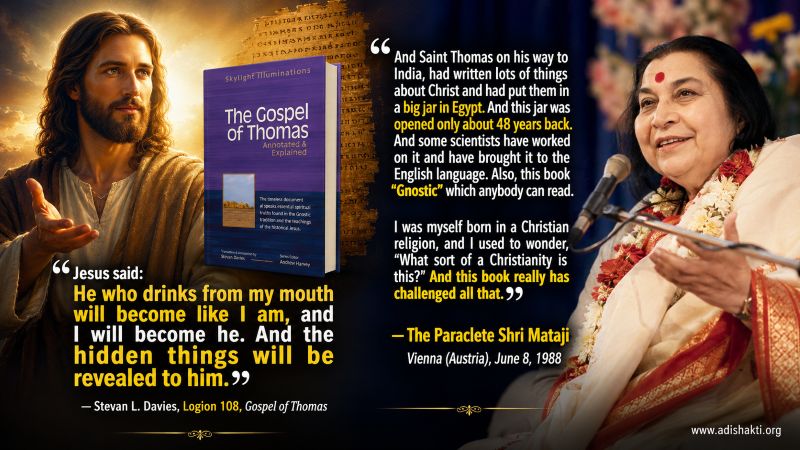
Thomas 3 joins self-knowledge to divine belonging. The saying rejects a Kingdom located simply in the sky or the sea and describes it as both within and outside the hearers. When people know themselves, they will be known and will recognize themselves as children of the living Father. Its language joins inwardness, a world beyond the self, and relational sonship; it does not simply say that the visible universe is a projection of the individual mind.[8]
Nor is this recognition presented as a painless affirmation of the existing ego. Saying 2 links seeking and finding to disturbance before wonder and rest. In saying 70, what a person brings forth from within is associated with salvation; Patterson and Meyer’s translation contrasts this with not having that within, which is associated with death. Other translations express the contrast differently, so an argument should not treat one English formulation as unambiguous. Read together, these sayings portray knowledge as transformative and demanding, not merely as a flattering opinion about oneself.[8]
Two sayings quoted together in the supplied excerpt must be distinguished. In Thomas 13, Jesus tells Thomas that he is no longer his teacher after Thomas has drunk from the spring; the scene continues with a private communication. In saying 108, Jesus speaks of the one who drinks from his mouth becoming like him and of a reciprocal transformation. They are separate sayings, not one continuous speech. Their language can support a strong reading of shared life, but a translation’s “like me” is not automatically the same as a formal claim that every aspect of disciple and God is identical.[8]
The text calls its sayings “secret” and makes their interpretation a condition of not tasting death. At the same time, the Jesus of Thomas remains the speaker who gives the sayings and discloses the possibility of recognition. An interior emphasis therefore does not eliminate mediation altogether: the reader encounters a written collection, a teacher, metaphors, and practices of interpretation.
6. The Gospel of Truth: Forgetfulness and Recognition
The Gospel of Truth, frequently discussed in relation to Valentinian thought, begins by associating the gospel with the gift of knowing the Father. It presents ignorance and forgetfulness as conditions accompanied by fear and error, and depicts the revealer as overcoming them through the disclosure of truth. Salvation is therefore inseparable from recognition, but recognition is described as a gift and a response to a relationship, not as a solitary act of self-invention.[9]
The work describes the Father and the All in language of origin, lack, discovery, and return. Its images make possible a reading of intimate divine presence, but they also preserve distinctions between the revealer, those enlightened, and the inconceivable Father. Rather than translating every metaphor into the same proposition, one should ask how the image of being found and the image of coming to know function within this particular work.
The text also speaks of Jesus being nailed to a cross. That detail complicates the easy contrast between an allegedly “Gnostic” Jesus concerned only with enlightenment and a canonical Jesus concerned only with suffering, sin, or repentance. Thomas, the Gospel of Truth, and the canonical writings each require interpretation on their own terms.
7. The Secret Book of John and the Gospel of Mary
In the Secret Book of John, the relation between humanity and the divine is narrated through a complex myth rather than reduced to a single aphorism. A subordinate ruler, often called Yaldabaoth, participates in the formation of the human being, while a power associated with the divine mother enters the body. A luminous helper, Epinoia, assists and awakens Adam. The narrative differentiates the supreme divine source, the ignorant ruler, the formed body, and the power that animates and assists the human being.[10]
This account supports the idea of divine involvement in human life, but the details do not justify attributing its creator myth to every text found at Nag Hammadi. Thomas does not present the elaborate Yaldabaoth story found in the Secret Book of John. Equally, the latter’s feminine figures have their own roles in its narrative; they should not simply be equated with every later image of the Divine Mother.
A further counterexample comes from Ptolemy’s Letter to Flora, preserved by Epiphanius rather than in the Nag Hammadi collection. Ptolemy distinguishes the maker from the supreme Father but describes this intermediate creator as just, not as the evil adversary. The letter challenges the sweeping claim that every teacher conventionally called “Gnostic” treated the creator as a demon; it also demonstrates close, reasoned engagement with scripture.[11]
The Thunder, Perfect Mind, another Nag Hammadi work, gives voice to a feminine first-person speaker who identifies herself through striking contrasts and calls hearers to recognize her. Its language complicates simple oppositions between honor and shame or knowledge and ignorance. It does not by itself establish that all Nag Hammadi texts teach a single divine dyad or that its speaker is identical to a later Goddess tradition.[12]
The Gospel of Mary supplies another important witness to revelation and spiritual authority. It was preserved principally in the Berlin Codex, not in the Nag Hammadi discovery, and the surviving Coptic text has substantial missing pages. Mary relates a vision and a soul’s passage past hostile powers; the text also stages disagreement over her authority to communicate the Savior’s words. Its concern is not merely what an isolated individual feels but who may speak, hear, recognize, and transmit revelation within a community.[13]
8. Identity, Participation, and the Human Person
At least three distinguishable claims can be heard in the sources. Origin says that the human being comes from, or contains a power derived from, a divine source. Participation or likeness says that a person shares in divine life or becomes like a revealer. Identity, in its strongest philosophical sense, says that the deepest self and ultimate divine reality are one and the same. These ideas can overlap, but none follows automatically from the mere presence of another.
Pagels’s sentence draws attention to the most radical possibility. Its strength lies in refusing to treat the human self as simply cut off from God. Its risk, when detached from her careful qualification, is that it can flatten sonship, illumination, the indwelling of a power, and a myth of return into one unvarying formula. A close reading can appreciate the intensity of the claim without assigning a single ontology to every passage.
The phrase “the self” also needs analysis. The body, changing emotions, social identity, and the use of the possessive “mine” are not necessarily identical in these texts with the deepest subject to be known. To say this is not to deny the dignity of embodied life. It is to recognize that different ancient authors locate the decisive problem of ignorance and the hope of liberation in different accounts of what the human person is.
9. Revelation, Authority, and Early Christian Diversity
Irenaeus of Lyons, writing against rival teachers in the late second century, criticizes the proliferation of new interpretations and myths in Against Heresies 1.18.1. His account is valuable evidence of controversy and boundary-making, but it is also argumentative testimony from a participant in the dispute. Ancient accusations against opponents cannot be accepted without comparison to the surviving texts and other evidence.[14]
Nor should the conflict be rewritten as a simple contest between all institutional Christians, who supposedly rejected personal knowledge, and all “Gnostics,” who supposedly embraced it. Early Christian communities developed different accounts of scripture, revelation, embodied life, authority, and salvation. The history of how writings gained or lacked canonical standing involved extended and varied processes, not a single documented decision to suppress inward spirituality.
Christian canonical texts themselves give knowledge a profound religious significance. John 17:3 identifies eternal life with knowing the true God and Jesus Christ; 1 Corinthians 13:12 places human knowing within a relationship in which one is also known. These passages are not equivalent to Pagels’s statement of ontological identity. They show, however, that the contrast cannot be reduced to knowledge versus faith or inward experience versus all forms of Christian tradition.[15]
10. Comparative Perspectives: Brahman and the Divine Feminine
The connection between liberating knowledge and the deepest self invites comparison with Indian traditions, but similarity is not proof of borrowing. The Bṛhadāraṇyaka Upaniṣad 1.4.10 speaks of the recognition “I am Brahman” and of the transformative significance of knowing in this way. In Śaṅkara’s Advaita Vedānta, according to philosopher Neil Dalal’s account, the essential self, ātman, is understood as nondual brahman; ignorance involves misidentification with limiting features. These are specific Hindu philosophical claims, not a key that automatically deciphers every early Christian text.[16] [17]
The Devī Gītā offers another comparison: in chapter 7, the Goddess links devotion and liberating knowledge and describes the knower’s realization of Brahman. Its language of the Goddess’s pure consciousness and the self’s recognition brings devotion and knowledge into relation. Its literary and theological setting differs from the Christian revealer myths and sayings discussed above; the resemblance should be examined alongside those differences.[18]
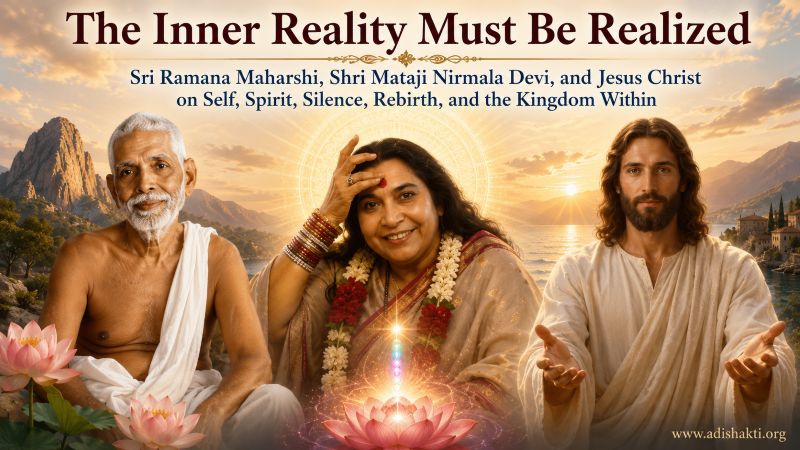
Within a contemporary AdiShakti.org devotional reading, the inward Kingdom of Thomas is placed in dialogue with the Sahasrāra and the awakening of Kuṇḍalinī. The proposal is a living comparative theology: it is not a historical finding that Thomas’s author taught a chakra system, nor does it establish that ancient Gnostic authors identified Shri Mataji with a figure in their texts. Comparison is most fruitful when its constructive theological commitment and its historical limits are both visible.[19]
11. Self-Knowledge, Discernment, and the Life of Others
The claim that divine reality can be encountered in relation to the self is a challenge to forms of religion that substitute inherited affiliation for inquiry. It is also a challenge to the seeker. Monoimus directs attention to sorrow, joy, love, and hatred; Thomas speaks of disturbance as well as discovery; and the Gospel of Mary shows revelation being questioned and defended in a community. None of these examples makes every private conviction immune to criticism.
A responsible contemporary reading therefore distinguishes reported experience from claims about its ultimate metaphysical cause. It can ask whether a practice encourages honesty, humility, freedom from domination, and care for others without pretending that an ethical outcome alone proves a particular cosmology. Teachers, traditions, historical evidence, and communities may aid discernment even when no external authority can perform another person’s inner inquiry on their behalf.
Self-knowledge, on this reading, is neither self-glorification nor mere accumulation of information. It is a disciplined question about what one takes to be oneself, how one responds to suffering and others, and what one believes to be the source and goal of life. Different traditions answer that question differently; their disagreement is part of the evidence, not an obstacle to be erased.
Conclusion
Pagels’s assertion remains a searching interpretation of ancient religious possibilities. Monoimus makes the self a starting point for seeking God; Thomas binds knowing oneself to divine belonging and transformation; the Gospel of Truth presents recognition as the overcoming of forgetfulness; and the Secret Book of John narrates divine power and human awakening through myth. These witnesses show why the connection between self-knowledge and knowledge of God is a major theme, while also showing why their several images should not be compressed into a single universal doctrine.
The central insight is not that every individual personality is simply God, but that certain ancient authors locate the path to divine knowledge in a radical inquiry into human origin, identity, and transformation. A stronger assertion of the self’s identity with the divine is a meaningful theological interpretation, especially in dialogue with nondual traditions, but it must be named as an interpretation and supported text by text. The value of the inquiry lies in its combination of inward depth, historical precision, and openness to other lives and other traditions.
References
[1] Pagels, Elaine. The Gnostic Gospels (originally 1979; Vintage edition, 1989), introduction, pp. xix–xx; excerpt reproduced by PBS Frontline. See also Pagels, “The Discovery of the Gnostic Gospels,” The New York Review of Books, 25 October 1979.
[2] Owens, Lance S. “An Introduction to Gnosticism and the Nag Hammadi Library.” The Gnosis Archive, online introduction. Compare the user-supplied excerpt; the archive’s library overview identifies Owens as author.
[3] Dospěl, Marek. “Nag Hammadi Codices.” Biblical Archaeology Society, 2 October 2021; codex and textual-copy counts, genres, and dating.
[4] Denzey Lewis, Nicola, and Justine Ariel Blount. “Rethinking the Origins of the Nag Hammadi Codices.” Journal of Biblical Literature 133, no. 2, 2014, pp. 399–419. The linked abstract is available; full-text access may require registration or a subscription.
[5] Burke, Simeon. “When Was the Gospel of Thomas Written?” Bible Odyssey, Society of Biblical Literature, 14 December 2022; a scholarly argument and overview of the dating debate.
[6] Denzey, Nicola. “What Is Gnosticism?” Bryn Mawr Classical Review, 2003.07.26. Review of Karen L. King, What Is Gnosticism? (Harvard University Press, 2003), discussing King and Michael A. Williams.
[7] Hippolytus, traditionally attributed. “Refutation of All Heresies, Book VIII,” chapter 8. Ante-Nicene Fathers, vol. 5, translated by J. H. MacMahon; online edition at New Advent. Preserves the passage attributed to Monoimus in a polemical setting.
[8] Patterson, Stephen, and Marvin Meyer, translators. “The Gospel of Thomas.” The Gnosis Archive; sayings 2, 3, 13, 70, and 108. English translation of the Coptic text; alternative translations render some phrases differently.
[9] Grant, Robert M., translator. “The Gospel of Truth.” The Gnosis Archive; English translation of the Nag Hammadi text. Consult a critical edition for manuscript pagination.
[10] Wisse, Frederik, translator. “The Apocryphon of John.” The Gnosis Archive; English translation combining four Coptic witnesses, including longer and shorter versions.
[11] Ptolemy. “Letter to Flora.” Early Christian Writings; text preserved by Epiphanius. Translator not clearly identified on the linked page.
[12] MacRae, George W., translator. “The Thunder, Perfect Mind.” The Gnosis Archive; English translation of the Nag Hammadi text. Consult a critical edition for manuscript pagination.
[13] “The Gospel According to Mary Magdalene.” The Gnosis Archive, English translation and manuscript introduction; chapters 4–5 and 8–9. The linked page does not clearly credit the translator.
[14] Irenaeus of Lyons. “Against Heresies, Book I, Chapter 18,” §1. Ante-Nicene Fathers, vol. 1, translated by Alexander Roberts and William Rambaut, 1885; online edition at New Advent.
[15] “1 Corinthians 13:12; John 17:3.” New Revised Standard Version Updated Edition, Bible Gateway, 2021.
[16] “Bṛhadāraṇyaka Upaniṣad 1.4.10.” VivekaVani, Sanskrit text, English translation and commentary, 10 April 2010.
[17] Dalal, Neil. “Śaṅkara.” Stanford Encyclopedia of Philosophy, first published 2021; especially sections on nonduality, ignorance, and self-knowledge.
[18] Wangu, Madhu Bazaz. “The Devī Gītā: Chapter Seven.” Madhu Bazaz Wangu, 11 February 2011; translation excerpt and commentary on 7.28–37.
[19] Manus AI. “The Kingdom Within: Thomas, the Paraclete, and the Sahasrara.” AdiShakti.org, 11 August 2026; a contemporary comparative and devotional interpretation.