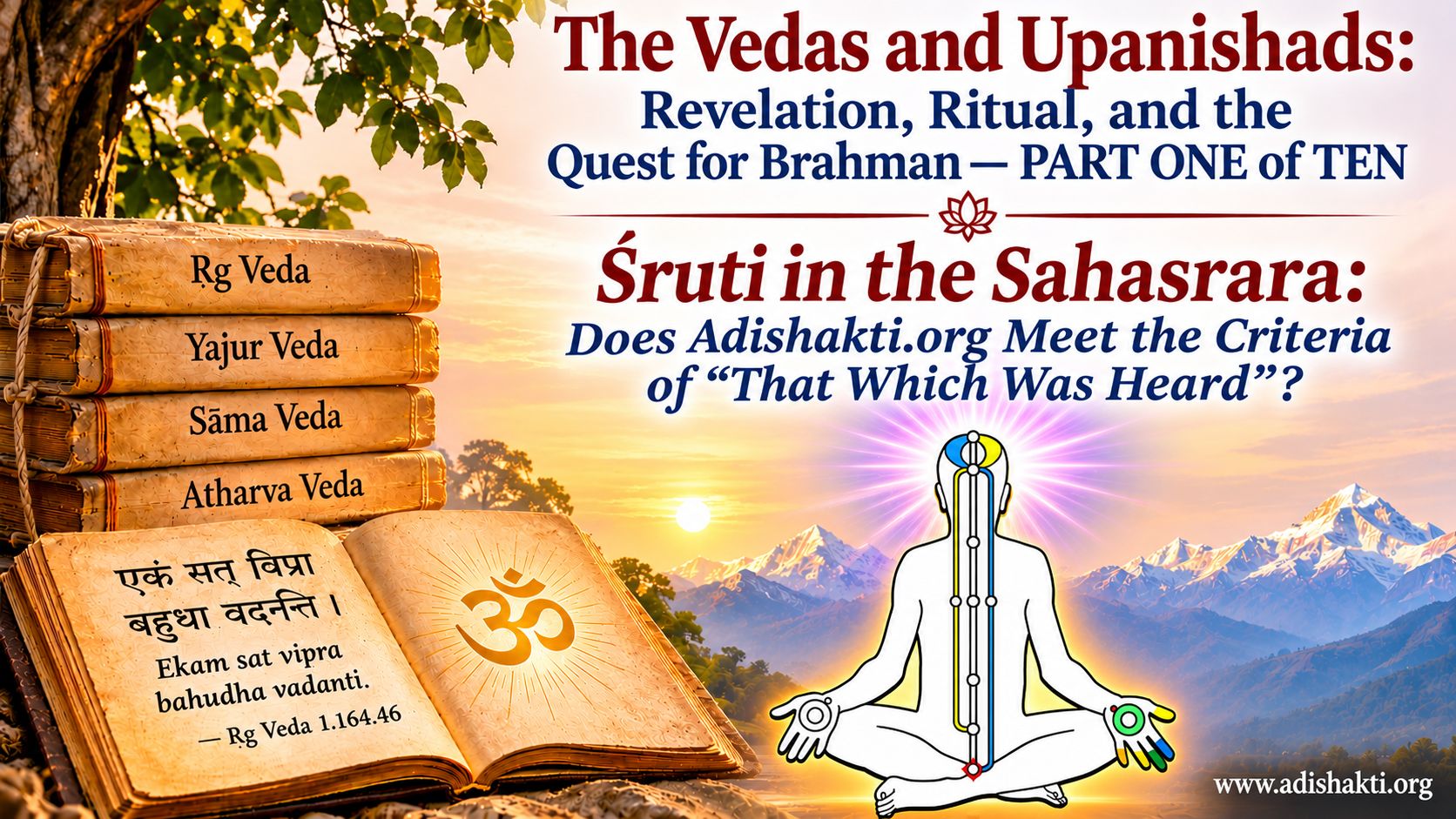
The Vedas and Upanishads: Revelation and Quest for Brahman — PART ONE of TEN
Summary
This paper is organized by its title’s three requirements: Revelation, Ritual, and the Quest for Brahman. First, it explains why the Vedas are received as śruti, a body of sacred revelation whose hymns address cosmic order, divine powers, sacred speech and the origin of existence. Second, it examines yajña, sacrifice, not as an embarrassment to be discarded but as a disciplined sacred practice whose language and symbolism are subsequently interiorized. Third, it traces the Upanishadic inquiry into Brahman, the imperishable ground of existence, and ātman, the deepest Self.
The text follows a deliberate movement: hearing → offering → discernment → realization. Ṛgveda 1.164.46 provides the famous expression of unity amid divine names; Ṛgveda 10.90 and 10.125 present sacrificial cosmology and the cosmic feminine voice; Chāndogya, Bṛhadāraṇyaka, Kena, Taittirīya, Muṇḍaka and Īśā Upanishads explore what must be known beyond the multiplicity of appearances. The later Devī Māhātmya, Devī Gītā and Lalitā Sahasranāma are then examined as Śākta developments and interpretations, not incorrectly presented as early Vedic texts.
The central thesis: The highest fulfillment of Vedic religious life cannot be reduced to recitation, ritual correctness, divine iconography, or even the recognition of scriptural motifs in modern visionary testimony. The Upanishads insist upon knowledge of the imperishable and the transformation of the knower. AdiShakti.org interprets Self-Realization and the Divine Mother as a living consonance with this scriptural trajectory; the contemporary experiences are testimonies to be evaluated separately from what the texts themselves establish.

Central affirmation of Part One. Within AdiShakti.org’s Śākta-Sahaja framework, the awakening of the Kuṇḍalinī—Self-Realization—and the subsequent meeting of the Mahādevī in the Sahasrāra are central to this paper’s definition of śruti. Śruti is here understood not merely as an inherited category of ancient texts, but as knowledge received through direct, inward revelation: the Divine Mother discloses herself within the awakened Sahasrāra, and the recipient receives that knowledge as testimony rather than as a product of ordinary reasoning or authorship. The Vedic and Upanishadic quest for the one ultimate Reality, Brahman, thus becomes experientially fulfilled in the recognition of the Mahādevī as the living source of that Reality.[adishakti][adishakti]
This definition makes the Kuṇḍalinī awakening the decisive criterion by which the paper assesses claims to revelation. A text or testimony approaches śruti when it arises from Self-Realization and is received in conscious contact with the Divine Mother in the Sahasrāra, rather than being composed through detached speculation, ritual instruction, or ordinary literary invention. On this account, the ancient Vedic seers and the contemporary recipient participate in a common pattern: knowledge of ultimate Reality is “heard” or received because the Divine discloses it directly.[adishakti]
The affirmation concerns theological interpretation and reported experience; it does not erase the differences among Vedic ritual, Upanishadic metaphysics, Śākta tradition, and contemporary testimony. It does, however, establish the paper’s central thesis: within AdiShakti.org’s framework, the awakening of the Kuṇḍalinī and the encounter with the Mahādevī in the Sahasrāra are the experiential foundation of śruti, and therefore the interpretive centre of the entire ten-part journey.[adishakti][adishakti]
1. Introduction — the three requirements of the title Contents
Revelation asks what was heard; ritual asks how human beings respond; the quest for Brahman asks what is ultimately real and how it is known. These are not three unrelated topics. They are connected movements within Vedic religious history and within the internal argument of the texts. The hymns speak in the language of divine powers, cosmic order, prayer and sacrifice. The Brāhmaṇas explore the meaning and efficacy of ritual action. The Āraṇyakas and Upanishads repeatedly probe the knowledge to which the rites point.
“Truth is one; the wise call it by many names.” This familiar rendering of ekaṃ sad viprā bahudhā vadanti (Ṛgveda 1.164.46) is the opening interpretive key, not a license to claim that every Vedic deity or later tradition is historically identical. The verse itself speaks of the One in relation to named deities; the Upanishads intensify the question by asking what the One is and how it may be realized.
2. REVELATION — śruti, the Vedic voice, and the many names Contents
Śruti means “that which is heard.” In orthodox Hindu understanding the Vedas possess a distinctive authority not because they are modern historical reports but because they are received as sacred revelation transmitted through the seers (ṛṣi). The four Vedas—Ṛg, Sāma, Yajur and Atharva—contain layered collections of hymns, formulas and associated prose. Their ritual and philosophical materials developed across time; the Upanishads belong to this Vedic inheritance rather than standing wholly outside it.
Primary scriptural evidence — revelation
Ṛgveda 1.164.46: ekaṃ sad viprā bahudhā vadanti — “What is One, the sages speak of in many ways.” The verse names Indra, Mitra, Varuṇa, Agni, Yama and Mātariśvan. Its significance is unity expressed through a plurality of divine names.
Ṛgveda 10.129.1–2, the Nāsadīya Sūkta: Before the ordered world, the hymn questions even the categories of existence and non-existence, and speaks of “the One” (tad ekam). Revelation here includes profound questioning, not only confident description.
Ṛgveda 10.125.3: Vāc proclaims ahaṃ rāṣṭrī saṃgamanī vasūnām — “I am the sovereign, gatherer of treasures.” The divine feminine voice speaks with cosmic authority within the Vedic corpus itself.
Ṛgveda 1.89.1: ā no bhadrāḥ kratavo yantu viśvataḥ — “May noble purposes come to us from every side.” The prayer expresses intellectual and spiritual openness without erasing the specificity of Vedic revelation.
Revelation, then, is not a simple catalogue of competing gods. It contains hymns to distinct deities, sacrificial invocations, cosmological speculation, and the possibility that many designations address an underlying unity. That tension is the intellectual starting point of the quest for Brahman.
3. RITUAL — yajña, sacred reciprocity, and the meaning of offering Contents
The title’s word Ritual must receive its own full treatment. Vedic yajña involves offerings, carefully recited mantras, the ritual fire, priests and patrons, and an understanding of reciprocal relation between human action and cosmic order. It is historically inaccurate to portray the earliest Vedic religion as if it already consisted solely of inward, formless meditation. Ritual is a constitutive part of the revelation whose culmination the Upanishads explore.
Primary scriptural evidence — ritual
Ṛgveda 1.1.1: agnim īḷe purohitaṃ yajñasya devam ṛtvijam — “I praise Agni, the household priest, the divine officiant of sacrifice.” The very first hymn of the Ṛgveda places ritual mediation at the threshold of Vedic sacred speech.
Ṛgveda 10.90.6: The Puruṣa hymn presents the cosmic sacrifice as an archetypal ordering act: the gods perform sacrifice with Puruṣa as the offering. Ritual is thereby connected to cosmology rather than confined to private petitions.
Bhagavad Gītā 3.9: yajñārthāt karmaṇo ’nyatra loko ’yaṃ karma-bandhanaḥ — “Apart from action done for sacrifice, this world is bound by action.” This later scripture broadens sacrificial purpose into disciplined action; it is not a Vedic Saṃhitā passage.
Bhagavad Gītā 4.24: brahmārpaṇaṃ brahma havir brahmāgnau brahmaṇā hutam — “Brahman is the offering; Brahman is the oblation; by Brahman it is offered into the fire of Brahman.” The sacrificial vocabulary is transformed into a vision of Brahman pervading the entire act.
The later reinterpretation does not make ancient rites meaningless. It shows how an outwardly structured discipline can become a language for inward surrender, attention and knowledge. The question becomes whether a practitioner knows the reality to which the offering is directed. Thus ritual prepares the question of realization but is not automatically identical with realization.
4. FROM RITUAL TO KNOWLEDGE — what the Upanishads change Contents
The Upanishads do not speak with one philosophical voice, nor do they uniformly abolish sacrifice. Their distinctive emphasis is that the deepest knowledge cannot be exhausted by mastery of sacrificial procedure or the memorization of sacred formulas. The same Vedic tradition that authorizes ritual asks the practitioner to examine the imperishable reality behind action, name and form.
Primary scriptural evidence — the turn inward
Muṇḍaka Upaniṣad 1.1.4–5: Two kinds of knowledge are distinguished, lower (aparā) and higher (parā). The lower includes the Vedas as disciplines of learning; the higher is yayā tad akṣaram adhigamyate — “that by which the imperishable is attained or known.” This is the paper’s clearest scriptural warrant for distinguishing textual possession from liberating knowledge.
Muṇḍaka Upaniṣad 1.2.7–12: The text scrutinizes the limits of ritual acts as a final refuge and directs the seeker toward a teacher and knowledge of the imperishable. This is not a denial that ritual has a place; it is a challenge to treating its finite fruits as ultimate.
Bṛhadāraṇyaka Upaniṣad 2.4.5: ātmā vā are draṣṭavyaḥ śrotavyo mantavyo nididhyāsitavyaḥ — “The Self is to be seen, heard of, reflected upon and deeply contemplated.” Hearing remains necessary, but hearing must mature into reflection and realization.
Kaṭha Upaniṣad 1.2.23: The Self is not attained merely through discourse, intelligence or extensive hearing. The verse emphasizes the limits of intellectual accumulation; its interpretation also depends on the wider teaching of the text.
5. THE QUEST FOR BRAHMAN — what is ultimately real? Contents
Brahman is not simply another member of a divine pantheon. In the Upanishadic inquiry it names the ultimate reality, source or ground that makes the manifold world intelligible. Schools of Vedānta disagree about whether and how the individual Self is identical with Brahman, but they agree that the Brahman-question concerns what is fundamental rather than one finite object among others.
Primary scriptural evidence — Brahman and ātman
Chāndogya Upaniṣad 6.2.1: sad eva somyedam agra āsīd ekam evādvitīyam — “In the beginning, dear one, this was Being alone, one without a second.” The manifold is examined in relation to prior Being.
Chāndogya Upaniṣad 6.8.7: tat tvam asi — “That thou art.” The repeated teaching connects the subtle essence underlying all things to the student’s own Self.
Bṛhadāraṇyaka Upaniṣad 1.4.10: ahaṃ brahmāsmi — “I am Brahman.” Its reception varies among Vedāntic traditions; its importance for the present argument is the centrality of transformative knowledge.
Taittirīya Upaniṣad 2.1.1: satyaṃ jñānam anantaṃ brahma — “Brahman is reality, knowledge, infinity.” The formulation refuses to confine the ultimate to a finite name or form.
Īśā Upaniṣad 1: īśāvāsyam idaṃ sarvam — “All this is enveloped by the Lord.” The verse connects the Divine to the whole world and immediately carries an ethical implication concerning possessiveness.
Kena Upaniṣad 1.2: “The ear of the ear, the mind of the mind, the speech of speech…” points beyond the instruments of cognition to their enabling ground. The quest is not only to name Brahman, but to recognize what makes knowing possible.
6. THE DIVINE FEMININE — from Vāc and Umā to the later Śākta synthesis Contents
The inquiry cannot exclude the feminine. Ṛgveda 10.125 presents Vāc speaking with cosmic authority; Kena Upaniṣad 3.12–4.1 presents Umā Haimavatī as the one who explains Brahman to Indra. These are primary Vedic and Upanishadic foundations for a theology in which the feminine is revelatory and central to knowledge. The later Devī Māhātmya, Devī Gītā and Lalitā Sahasranāma develop a more explicit Goddess-centered account of ultimate reality.
The chronological and textual distinction matters. The Śākta scriptures are powerful witnesses to the historical development of the Goddess as supreme reality; they are not additional verses of the early Ṛgveda. Their correspondence with śruti can be argued through themes of cosmic power, knowledge, immanence and liberation, without collapsing different scriptural genres or dates.
For AdiShakti.org, this continuity is the bridge to the modern narrations: the Divine Mother is interpreted as the living source of knowledge and Self-Realization. The argument becomes stronger when each reported vision is paired with its closest Hindu textual counterpart, while its status as contemporary testimony remains clear.
7. THE DIVINE FEMININE IN SCRIPTURE — Vāc, Umā, Devī Māhātmya, Devī Gītā and Lalitā Sahasranāma Contents
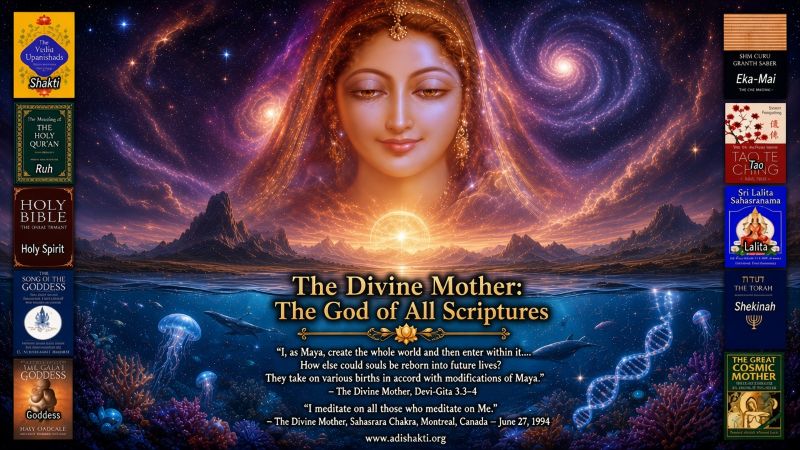
Part One’s most consequential scriptural claim is that the Divine Feminine is not merely a secondary figure among many gods. The Ṛgveda presents Vāc as a cosmic, first-person feminine speaker; the Kena Upaniṣad presents Umā as the one who reveals Brahman to Indra. The Devī Māhātmya, Devī Gītā and Lalitā Sahasranāma subsequently develop the Goddess as universal consciousness, the power of manifestation, Mother and sovereign. These sources must be read in their distinct literary and historical settings, yet their shared theological themes deserve to be shown together rather than left implicit.
Scriptural authentication: Vāc, Umā and the Supreme Divine Mother
1. Ṛgveda 10.125.3 — Vāc, the sovereign cosmic speaker (śruti).
अहं राष्ट्री संगमनी वसूनां चिकितुषी प्रथमा यज्ञियानाम् ।
Ahaṃ rāṣṭrī saṃgamanī vasūnāṃ cikituṣī prathamā yajñiyānām.
“I am the sovereign queen, gatherer of treasures, knowing, foremost among those worthy of sacrifice.” (Study rendering of the first half.)
Correspondence: the feminine divine voice speaks with universal authority in a Vedic hymn itself. The verse does not explicitly name the later Mahādevī or a modern manifestation.
2. Ṛgveda 10.125.7–8 — the feminine power encompasses cosmic generation (śruti).
अहं सुवे पितरमस्य मूर्धन् मम योनिरप्स्वन्तः समुद्रे ।
Ahaṃ suve pitaram asya mūrdhan mama yonir apsv antaḥ samudre.
“I bring forth the Father on the summit of this world; my womb is within the waters, in the ocean.” (10.125.7, opening lines; study rendering.) Verse 8 speaks of the speaker moving like the wind and extending beyond heaven and earth.
Correspondence: the hymn presents a feminine power participating in the very generation and pervasion of the cosmos—not simply an attendant deity.
3. Kena Upaniṣad 3.12–4.1 — Umā reveals Brahman (śruti).
सा ब्रह्मेति होवाच ।
Sā brahmeti hovāca.
“She said: ‘It was Brahman.’” (4.1, opening phrase.) Indra has encountered Umā Haimavatī after the gods fail to recognize the mysterious source of their victory.
Correspondence: a feminine figure explicitly discloses the identity of Brahman where even the gods lack understanding. This is a direct Upanishadic foundation for the theme of feminine revelation.
4. Devī Māhātmya 5, the Yā Devī hymn — the Goddess as consciousness in all beings (Śākta smṛti).
या देवी सर्वभूतेषु चेतनेत्यभिधीयते । नमस्तस्यै नमस्तस्यै नमस्तस्यै नमो नमः ॥
Yā devī sarvabhūteṣu cetanety abhidhīyate; namas tasyai namas tasyai namas tasyai namo namaḥ.
“To the Goddess who is known as consciousness in all beings: reverence to Her, reverence to Her, reverence again and again.” (The verse numbering within chapter 5 varies across editions.)
Correspondence: the Goddess is identified with consciousness universally present in living beings. This expands the question of the Divine Feminine from iconography to immanence.
5. Devī Māhātmya 1, Brahmā’s hymn — the Goddess as the power sustaining ritual and existence (Śākta smṛti).
त्वं स्वाहा त्वं स्वधा त्वं हि वषट्कारः स्वरात्मिका ।
Tvaṃ svāhā tvaṃ svadhā tvaṃ hi vaṣaṭkāraḥ svarātmikā.
“You are Svāhā; You are Svadhā; You are indeed the vaṣaṭ invocation, the essence of sacred sound.” (Opening of a verse in chapter 1; numbering differs by recension.)
Correspondence: the Goddess is not placed outside Vedic sacrifice; the sacrificial utterances themselves are described as Her forms. This provides an especially close bridge between the paper’s themes of revelation and ritual.
6. Devī Māhātmya 11, Nārāyaṇī Stuti — cosmic creation, preservation and dissolution (Śākta smṛti).
सृष्टिस्थितिविनाशानां शक्तिभूते सनातनि ।
Sṛṣṭi-sthiti-vināśānāṃ śaktibhūte sanātani.
“O eternal One, who are the power of creation, maintenance and dissolution.” (Opening half of a verse in the Nārāyaṇī Stuti.)
Correspondence: the Goddess is addressed as the power underlying the complete cosmic process, a developed Śākta articulation of universal divine agency.
7. Devī Gītā 3.3–4 — Mahādevī, Māyā and the world (Devī Bhāgavata Purāṇa, Śākta smṛti).
In this passage, as presented in the AdiShakti.org interpretive tradition, Mahādevī declares that through Māyā She manifests the world and enters within it; the teaching also relates embodied rebirth to the workings of Māyā. Translations differ in their wording, and this is a thematic paraphrase rather than a verified verbatim Sanskrit quotation.
Correspondence: the first-person cosmic power of Vāc is developed into an explicit theology of the Divine Mother as the source and indwelling power of manifestation. This is a later Purāṇic text, not part of early Vedic śruti.
8. Devī Gītā 7.32 — Brahman as the goal of knowledge (Devī Bhāgavata Purāṇa, Śākta smṛti).
The passage is cited in the AdiShakti.org tradition in the sense that one who knows Brahman attains Brahman. Its precise Sanskrit wording and verse alignment should be checked against the edition used before it is presented as a verbatim quotation.
Correspondence: the Goddess-centered teaching makes the knowledge of Brahman, rather than devotion to a merely finite divine form, the decisive spiritual objective.
9. Lalitā Sahasranāma, names 1–3 — Mother, Queen and sovereign (Brahmāṇḍa Purāṇa tradition).
श्रीमाता श्रीमहाराज्ञी श्रीमत्सिंहासनेश्वरी ।
Śrī Mātā, Śrī Mahārājñī, Śrīmat Siṃhāsaneśvarī.
“Revered Mother; Great Queen; the glorious Lady of the throne.” (Opening divine names.)
Correspondence: the sovereignty voiced by Vāc becomes a sustained liturgical naming of the Goddess as Mother and supreme ruler. The names are later Śākta tradition, not a passage from the Ṛgveda.
10. Lalitā Sahasranāma, names 4–5 — the Goddess manifests for the divine work.
चिदग्निकुण्डसम्भूता देवकार्यसमुद्यता ।
Cidagnikuṇḍa-sambhūtā, devakārya-samudyatā.
“Born from the fire-pit of consciousness; arisen for the work of the gods.”
Correspondence: the hymn joins consciousness with purposeful divine manifestation. It supports a traditional theological vocabulary for divine intervention, though it does not attest any specific modern event.
Why these verses matter for Part One. Read in sequence, the sources supply a sustained scriptural progression: Vāc speaks as cosmic sovereign; Umā reveals Brahman; the Devī Māhātmya identifies the Goddess with consciousness, sacrificial power and cosmic agency; the Devī Gītā interprets Mahādevī through Māyā and Brahman; and the Lalitā Sahasranāma praises the Mother as sovereign, consciousness-born and active in the divine work. The argument is therefore anchored in explicit passages rather than in modern images alone.
Method of scriptural authentication. These verses authenticate the presence and development of Goddess-centered theological themes in Hindu scripture. They do not independently establish the historical occurrence of Kash’s visions or prove the contemporary identification of Shri Mataji with the primordial Divine Mother. The Ṛgveda and Kena Upaniṣad are śruti; the Devī Māhātmya, Devī Gītā and Lalitā Sahasranāma belong to later Śākta textual traditions. That distinction protects the credibility of the argument rather than weakening its devotional significance.
8. Seven narrations and their closest scriptural passages Contents
Editorial method: Each report is condensed to one sentence, followed by directly relevant passages. Quoted English below is a concise study rendering or an identified textual phrase, not a claim that every later devotional image occurs in early Vedic śruti. These verses establish scriptural parallels; they do not independently verify the modern visions.
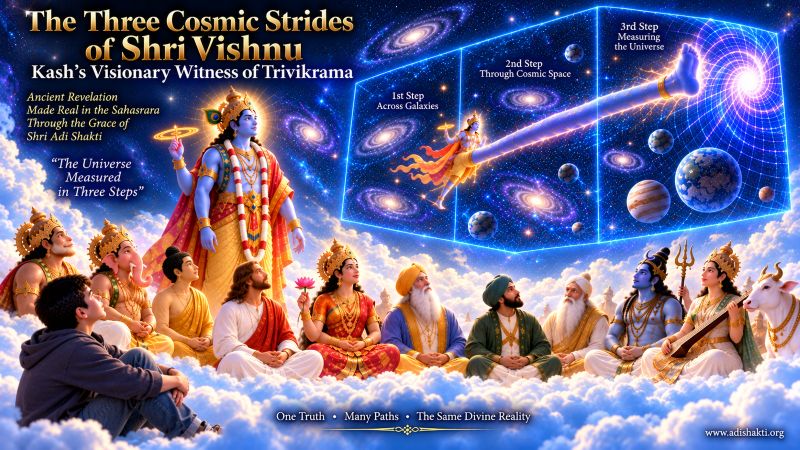
1. Viṣṇu’s three cosmic strides
Narration: Kash reportedly saw Viṣṇu’s legs extending across immense distances as He took three strides (23 January 1994). [22]
Ṛgveda 1.154.1: viṣṇor nu kaṃ vīryāṇi pra vocaṃ ... yo askabhāyad uttaraṃ sadhasthaṃ vicakramāṇas tredhorugāyaḥ — “I shall proclaim the mighty deeds of Viṣṇu ... who established the lofty dwelling, the far-striding one who strode threefold.”
Ṛgveda 1.154.2: Viṣṇu is praised for three wide strides in which the worlds dwell. [23]
Ṛgveda 1.22.17–20: The hymns celebrate Viṣṇu’s steps and the supreme station beheld by seers.
Bhāgavata Purāṇa 8.20–21: The Vāmana–Trivikrama narrative portrays Viṣṇu expanding to cosmic dimensions and spanning the worlds. Match: the three strides are explicit in Vedic scripture; expansion of the body belongs to later Purāṇic narrative.
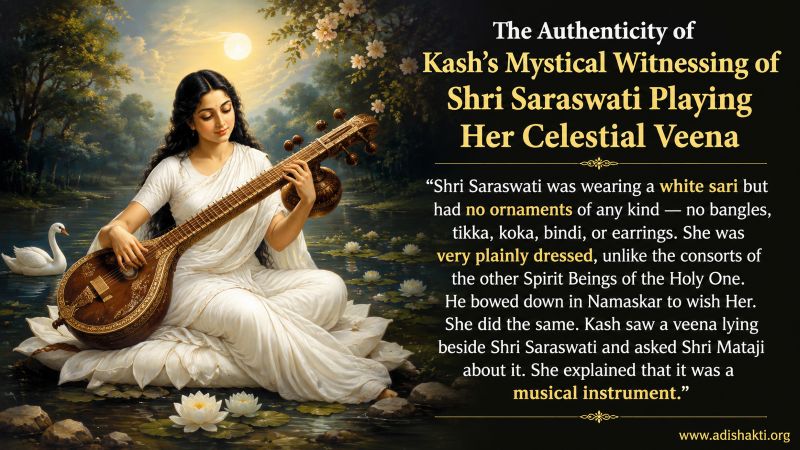
2. Sarasvatī playing the vīṇā
Narration: Kash reportedly encountered white-clad Sarasvatī and heard Her play an unfamiliar stringed instrument. [24]
Ṛgveda 1.3.10: pāvakā naḥ sarasvatī vājebhir vājinīvatī yajñaṃ vaṣṭu dhiyāvasuḥ — “May Sarasvatī, the purifying one, rich in inspiration, favor our sacrifice.”
Ṛgveda 6.61.4: Sarasvatī is invoked to protect and strengthen thought. [25]
Bṛhadāraṇyaka Upaniṣad 2.4.9: The sound of a vīṇā is used as an analogy for understanding individual sounds through their source. Match: Sarasvatī and the instrument are separately attested in early texts; the Goddess playing the vīṇā is specifically familiar from later iconography, not from these verses.
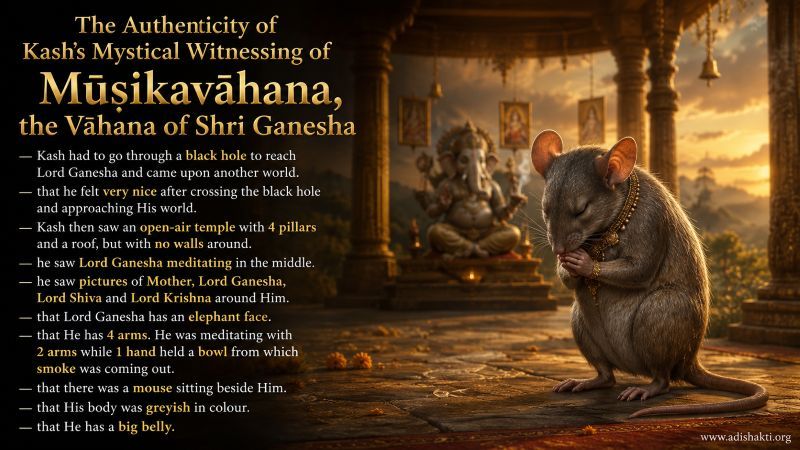
3. Gaṇeśa and His mouse-vehicle
Narration: Kash reportedly saw a mouse beside Gaṇeśa and later saw Gaṇeśa ride it. [26]
Gaṇapati Atharvaśīrṣa 1: tvam eva pratyakṣaṃ tattvam asi ... tvam eva kevalaṃ kartāsi — “You alone are the manifest reality ... You alone are the creator.” The later text identifies Gaṇapati with ultimate reality. [28]
Gaṇeśa Purāṇa and Mudgala Purāṇa: Later Gaṇeśa traditions associate the deity with the mouse (mūṣika) as His vāhana; a precise chapter-and-verse claim is withheld pending edition-specific verification. Match: the mouse-vehicle belongs to later Gaṇeśa tradition, not to Ṛgveda 2.23.1, where gaṇapati occurs in a hymn addressed to Brahmaṇaspati.
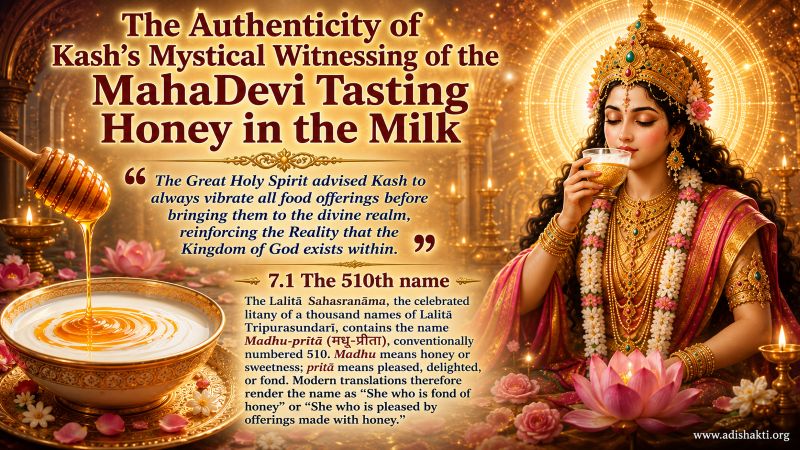
4. Honey added to milk
Narration: Honey was reportedly added to Kash’s milk offering without informing him; during meditation, Shri Mataji reportedly asked whether it contained honey (27 April 1994). [29]
Bṛhadāraṇyaka Upaniṣad 2.5.1: iyaṃ pṛthivī sarveṣāṃ bhūtānāṃ madhu — “This earth is the honey of all beings.” The Madhu-vidyā teaches reciprocal essence and the Self. [30]
Bhagavad Gītā 9.26: patraṃ puṣpaṃ phalaṃ toyaṃ yo me bhaktyā prayacchati — “Whoever offers Me a leaf, flower, fruit or water with devotion...” The verse establishes the significance of a simple devotional offering.
Śvetāśvatara Upaniṣad 6.11: eko devaḥ sarvabhūteṣu gūḍhaḥ — “The one Divine is hidden in all beings.” This supports divine immanence, not a specific assertion that the ingredient in a cup was supernaturally identified. Match: honey, offering and divine immanence are scriptural; the claimed knowledge of concealed honey remains the distinctive testimony.

5. Three clay lamps and Divine Light
Narration: Kash reportedly experienced Shri Mataji noticing three newly lit clay lamps and perceived an immense luminous sacred setting. [31]
Muṇḍaka Upaniṣad 2.2.10: na tatra sūryo bhāti na candratārakaṃ ... tasya bhāsā sarvam idaṃ vibhāti — “There the sun does not shine, nor moon and stars ... by its light all this shines.” [32]
Kaṭha Upaniṣad 2.2.15: Repeats the teaching that all lights shine by the light of the ultimate.
Bhagavad Gītā 10.11: jñānadīpena bhāsvatā — “with the shining lamp of knowledge,” through which ignorance is dispelled. Match: strong direct language for divine illumination and the lamp as spiritual symbol; no cited verse describes three Montréal clay lamps.
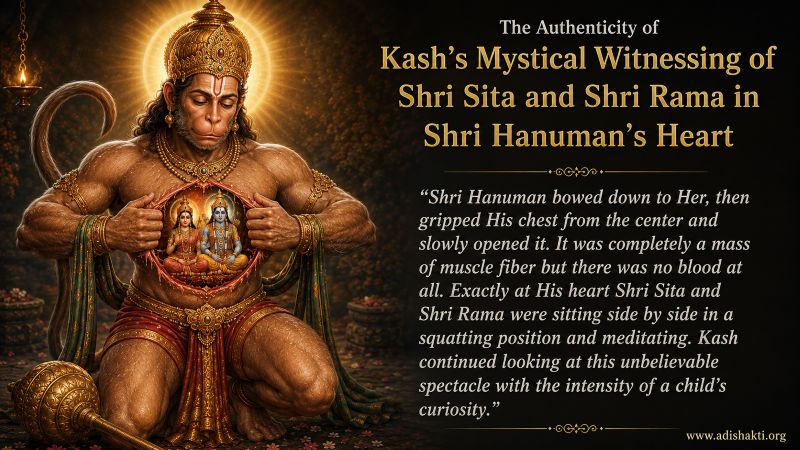
6. Sītā and Rāma in Hanumān’s heart
Narration: Kash reportedly saw Hanumān open His chest, revealing Sītā and Rāma seated within His heart (24 April 1994). [34]
Chāndogya Upaniṣad 8.1.1–3: The dahara teaching locates a vast spiritual reality in the small lotus-like space of the heart.
Hanumān Cālīsā 8: prabhu caritra sunibe ko rasiyā, rāma lakhana sītā mana basiyā — “You delight in hearing the Lord’s deeds; Rāma, Lakṣmaṇa and Sītā dwell in your mind.”
Bṛhadāraṇyaka Upaniṣad 1.4.7: The Self is described as entering living beings. Match: the devotional hymn directly names the divine figures dwelling inwardly; the opened-chest visual motif is not explicitly described by these Upanishadic verses.
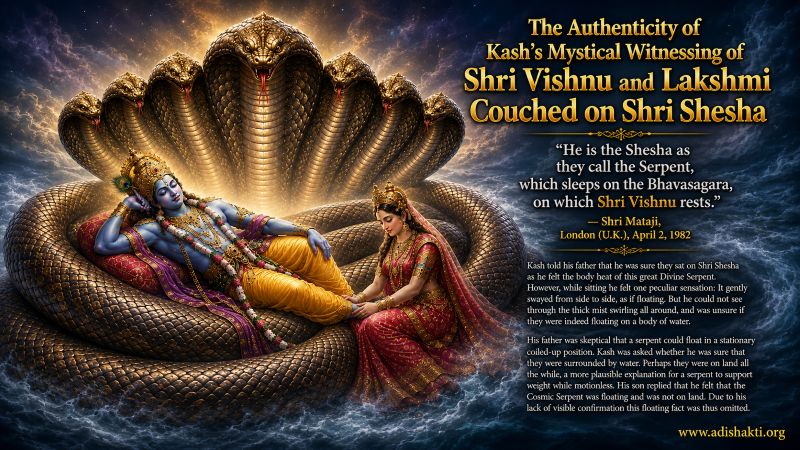
7. Viṣṇu, Lakṣmī and Śeṣa
Narration: Kash reportedly perceived a warm, swaying serpent associated with Viṣṇu and Lakṣmī; the floating cosmic-serpent imagery was recognized later by his family. [37]
Bhāgavata Purāṇa 3.8.5–10: The Lord rests upon Ananta amid the cosmic waters before creation unfolds. This is a much closer textual counterpart to the serpent-repose scene than the Vedic three-strides hymn.
Bhāgavata Purāṇa 5.25.1–13: Describes Ananta/Saṅkarṣaṇa and His cosmic significance.
Ṛgveda 1.154.1–3: Establishes Viṣṇu’s cosmic reach, but does not describe Lakṣmī and Śeṣa reclining together. Match: direct Purāṇic support for the cosmic-serpent setting; the fuller tableau belongs to the Vaiṣṇava narrative and iconographic tradition.
9. What the seven comparisons establish Contents
Strongest direct Vedic motif: Viṣṇu’s three strides. Direct early scriptural concepts: Sarasvatī’s divine inspiration, the vīṇā as an Upanishadic analogy, honey as Madhu-vidyā, the light beyond lights, and the heart as an inward locus of ultimate reality. Closer later scriptural motifs: Gaṇeśa’s mouse-vehicle, the devotional indwelling of Sītā and Rāma in Hanumān, and Viṣṇu’s repose on Ananta.
Central conclusion: These correspondences show that the reports are intelligible within a deep and varied Hindu scriptural world. They do not all have the same textual status, and none of the verses alone proves that a modern visionary experience occurred. The unusual alleged concealed-information element in the honey incident must be evaluated as testimony rather than presented as a quotation from ancient scripture.
10. The cumulative affirmation and its limits Contents
A substantial affirmative case within the site’s devotional framework
The seven accounts constitute a cumulative, differentiated case rather than seven repetitions of one symbol. Viṣṇu’s strides provide a direct Vedic motif. Sarasvatī links divine knowledge with absorbing contemplation. Gaṇeśa’s mouse expresses a later devotional pattern of humble accessibility. Honey introduces an alleged concealed-information correspondence; lamps present continuity between outward worship and inward encounter. Hanumān dramatizes indwelling devotion, while Viṣṇu, Lakṣmī, and Śeṣa present a cosmic devotional setting. Taken together, these reports support the archive’s claim that ancient sacred teaching is not exhausted by literary memory. [22] [24] [26] [29] [31] [34] [37]
The AdiShakti.org homepage gathers these and many other writings into a continuing interpretive project. In its own worldview, the same Mother connects divine plurality with an inward path of realization. This supplies a theological unity that isolated iconographic matches could not provide. The site’s claim is that the many forms belong to one sacred reality and that this reality can be encountered through spiritual awakening. [5]
Accordingly, within AdiShakti.org’s Śākta-Sahaja devotional reading, the requirement of living consonance with śruti is affirmed as overwhelmingly accomplished. The decisive point is not the sheer number of extraordinary narratives: it is their convergence upon a coherent spiritual architecture—the One behind the many, the Divine Feminine as revealer, and realization rather than external ritual as the culminating purpose. The word “overwhelmingly” here describes the breadth and convergent force of the archive’s devotional case. It is not a statistical probability, a declaration of scholarly consensus, or an independently measured success rate. The fulfillment claimed is living participation in the scriptural quest—not the creation of a replacement Veda.
That affirmation rests on more than the verse about many names. Its strongest form joins the unity of Rigveda 1.164.46, the specific Viṣṇu motif of 1.154, the feminine revelatory voice of 10.125 and Kena 4.1, and the Upanishadic demand for inward knowledge. It is this combined interpretation, rather than the bare repetition of a familiar saying, that gives the requested declaration depth. [9] [23] [19] [21] [4]
What has been established, and what is still a claim of faith
The examined sources establish that the website presents these reports, that it places them within an explicit devotional interpretation, and that several scriptural correspondences can be identified. They do not independently establish every narrated event, its supernatural mechanism, or Shri Mataji’s divine identity. Nor does this paper establish that every page on the homepage satisfies every requirement of every Veda-affirming school. An index containing a large archive is not, by itself, a comprehensive audit of its contents. [5]
The same principal experiencer, family setting, 1999 publication, and later editorial tradition recur across the cases. The recurrence can support consistency, but it also means that seven narratives are not seven independent sources. Requested content, known household objects, later recognition, and alleged concealed information must be assessed differently. There is no justified numerical calculation by which shared testimony suddenly becomes conclusive proof. This observation preserves the character of the evidence; it does not determine that the experiences were insincere.
Most importantly, full Upanishadic fulfillment cannot be reduced to visions or symbolic matches. If fulfillment means liberation through the knowledge of Brahman, then the demand includes ethical and contemplative transformation. Kaṭha 1.2.24 explicitly says that one who has not turned away from bad conduct, whose senses and mind are not quiet and collected, cannot attain the Self by knowledge. Claims about realization must remain answerable to this standard too. [8]
नाविरतो दुश्चरितान्नाशान्तो नासमाहितः ।
नाशान्तमानसो वापि प्रज्ञानेनैनमाप्नुयात् ॥
nāvirato duścaritān nāśānto nāsamāhitaḥ;
nāśāntamānaso vāpi prajñānenainam āpnuyāt.
“One who has not turned away from bad conduct, who is not tranquil or collected, or whose mind is not at peace, cannot attain this Self through knowledge.”
— Kaṭha Upanishad 1.2.24; fresh study translation compared with S. Sitarama Sastri. [8]
The public case studies do not independently demonstrate the full liberating condition of every participant or reader. They offer testimony that the community interprets as signs of divine encounter. The faithful conclusion can therefore be wholehearted, while the academic conclusion remains specific: substantial textual and devotional consonance has been shown; universal certification and complete metaphysical verification have not.
Taking śruti seriously is the strongest defense
An argument weakens when it calls every sacred story śruti, every coincidence proof, or every image Brahman. It becomes stronger when it allows the Vedas and Upanishads to retain their own authority. That means recognizing the direct Vedic status of Viṣṇu’s strides, the later development of the mouse-vehicle and reclining-serpent imagery, and the higher demand of the Upanishads even where the archive emphasizes extraordinary experience.
The proper hierarchy is therefore not “the website verifies the Vedas.” It is: śruti supplies the authoritative teaching; later traditions develop particular devotional expressions; and modern testimony is interpreted in their light. Within that hierarchy, AdiShakti.org may strongly declare fulfillment as its living faith. The declaration is clearest precisely when the authority of śruti is not diluted to make the declaration easier.
Conclusion: the highest requirement remains the knowledge of Brahman
Part One began with many divine names and ends with the realization toward which the Upanishadic inquiry points. The one reality is not reached merely by giving religious appearances a common label. It is approached through faithful hearing, sustained reflection, contemplative assimilation, and a life capable of receiving the teaching. Śruti is overriding because it supplies both the foundation and the demand that prevents later devotion from mistaking its own representations for the whole of reality. [12] [8]
यदा सर्वे प्रमुच्यन्ते कामा येऽस्य हृदि श्रिताः ।
अथ मर्त्योऽमृतो भवत्यत्र ब्रह्म समश्नुते ॥
yadā sarve pramucyante kāmā ye ’sya hṛdi śritāḥ;
atha martyo ’mṛto bhavaty atra brahma samaśnute.
“When all the desires lodged in the heart are released, then the mortal becomes immortal and here attains Brahman.”
— Kaṭha Upanishad 2.3.14; fresh study translation compared with S. Sitarama Sastri. [39]
The word “here” gives the quest its immediacy. Spiritual life is not merely a postponement of knowledge until death. Yet the verse’s condition is release from binding desire, not the number of sacred scenes one has witnessed. This is the highest requirement against which a claim of living fulfillment must continually be understood. [39]
Within AdiShakti.org’s devotional framework, the archive is affirmed as an overwhelming living fulfillment of the Vedic-Upanishadic call to encounter the divine and realize the unity behind many names. Its strongest examples are meaningful because they are read under the authority of śruti, not because they replace it. This paper confirms the substantial correspondences supporting that confession; it does not claim independent verification of every experience, universal Hindu endorsement, or new canonical Vedic revelation.
The final standard is realization, not spectacle. Precisely because the archive interprets the reported encounters as invitations to awakening, inward stillness, and knowledge of the Divine, its affirmative claim of living consonance is deeper than a catalogue of marvels.
स यो ह वै तत् परमं ब्रह्म वेद ब्रह्मैव भवति ।
sa yo ha vai tat paramaṃ brahma veda brahmaiva bhavati.
“Whoever knows that supreme Brahman becomes Brahman indeed.”
— Muṇḍaka Upanishad 3.2.9, opening clause. The familiar “the knower of Brahman becomes Brahman” is a concise rendering of this teaching. [40]
The verse continues with the overcoming of grief and release from the knots of the heart. That is the depth of the promise with which this first part closes. The next study can examine the great declarations of the Self and Brahman more fully; here their role has been to show why the authority of śruti must remain the governing requirement of the entire journey. [40] [1]
Conclusion Contents
Scriptural verdict on the narrations. Viṣṇu’s three strides have the clearest direct Vedic parallel (Ṛgveda 1.154; 1.22). Sarasvatī’s divine presence is Vedic, while her vīṇā iconography is later; Gaṇeśa’s mouse is Purāṇic and devotional rather than an explicit early Vedic detail. Honey and light receive meaningful Upanishadic interpretations, but neither passage verifies concealed knowledge or a household vision. Hanumān’s heart belongs most closely to later bhakti imagery, while Viṣṇu’s repose on Ananta has a close Bhāgavata Purāṇa parallel. These scriptural correspondences are central to the theological case for consonance with Hindu tradition; their historical evidentiary reach must not be overstated.
Within AdiShakti.org’s Śākta-Sahaja devotional framework, the archive is affirmed as an overwhelming living fulfillment of the Vedic-Upanishadic call to encounter the divine and realize the unity behind many names. The final standard is realization, not spectacle.
References
Additional primary-scripture passages used for Sections 8–11: Ṛgveda 1.22.17–21 and 1.3.10–12; Śrīmad Bhāgavata Purāṇa 8.20–23 and 3.8.5–10; Bhagavad Gītā 9.26 and 10.11; Kaṭha Upaniṣad 2.2.15; Chāndogya Upaniṣad 8.1.1–3; Hanumān Cālīsā; Mudgala Purāṇa (edition-specific citation to be verified). These supplement the original 40 references.
[1] ChatGPT / AdiShakti.org. “A Ten-Part Journey through Hindu Scriptures.” AdiShakti.org, Authenticity Series, October 25, 2026; Part One and series overview. Back to citation
[2] Shashi Tiwari. “Upanishads.” Vedic Heritage Portal, Indira Gandhi National Centre for the Arts, Ministry of Culture, Government of India, Undated essay; consulted October 26, 2026. Sections 1, 3, 5–6. Contents
[3] Brian Black. “The Upaniṣads.” Internet Encyclopedia of Philosophy, Undated entry; consulted October 26, 2026. Sections 1–4 and 8. Contents
[4] S. Sitarama Sastri, translator; Śaṅkara, commentator. “Muṇḍaka Upanishad 1.1.5.” Muṇḍaka Upanishad with Śaṅkara’s Commentary; digital edition, Wisdom Library, 1905 translation; digital page updated February 16, 2018. Mantra and commentary distinguished. Back to citation
[5] AdiShakti.org. “Homepage and research-article archive.” AdiShakti.org, Consulted October 26, 2026. Contemporary devotional index; not an independent eyewitness source. Back to citation 1 Back to citation 2
[6] Stephen Phillips. “Epistemology in Classical Indian Philosophy.” Stanford Encyclopedia of Philosophy, First published 2011; current text consulted October 26, 2026, especially §6, Testimony. Contents
[7] UNESCO. “Tradition of Vedic chanting.” UNESCO Intangible Cultural Heritage, Inscribed 2008; originally proclaimed 2003. Nomination file 00062; consulted October 26, 2026. Contents
[8] S. Sitarama Sastri, translator; Śaṅkara, commentator. “Kaṭha Upanishad 1.2.24.” Kaṭha Upanishad with Śaṅkara’s Commentary; Wisdom Library, 1928 edition; digital page updated February 17, 2021. Back to citation 1 Back to citation 2 Back to citation 3
[9] R. T. H. Griffith, translator. “Ṛgveda, Book 1, Hymn 164, especially verse 46.” The Hymns of the Rigveda; Internet Sacred Text Archive, Public-domain translation, 1889–1892; digital text consulted October 26, 2026. Back to citation
[10] Ṛgvedic tradition; Sanskrit text displayed by Vedapath. “Ṛgveda 1.164.46: Sanskrit, transliteration, and word meanings.” Vedapath, digital text presentation, Undated; consulted October 26, 2026. Used for Sanskrit and comparison, not as sole historical authority. Contents
[11] S. Sitarama Sastri, translator; Śaṅkara, commentator. “Muṇḍaka Upanishad 1.1.4.” Muṇḍaka Upanishad with Śaṅkara’s Commentary; Wisdom Library, 1905 translation; digital page updated February 16, 2018. Contents
[12] Swami Madhavananda, translator; Śaṅkara, commentator. “Bṛhadāraṇyaka Upanishad 2.4: Yājñavalkya and Maitreyī.” The Bṛhadāraṇyaka Upanishad; digital edition, Wisdom Library, Undated digital edition; consulted October 26, 2026. Especially 2.4.5, 2.4.9–10; Sanskrit OCR contains defects outside the clean extracts used here. Back to citation
[13] A. Mahadeva Sastri, translator. “Taittirīya Upanishad 2.1.1: Brahman Defined.” The Taittirīya Upanishad, Book II, Chapter IV; Wisdom Library, 1903 edition; digital page consulted October 26, 2026. Chapter numbering differs from mantra numbering. Contents
[14] Swami Lokeswarananda, translator and expositor. “Chāndogya Upanishad 6.8.7.” Chāndogya Upanishad, English Translation; Wisdom Library, Publication year not stated on the consulted page; digital page updated January 4, 2019. ISBN 9788185843919. Contents
[15] Swami Madhavananda, translator; Śaṅkara, commentator. “Bṛhadāraṇyaka Upanishad 1.4, especially 1.4.10.” The Bṛhadāraṇyaka Upanishad; Wisdom Library, Undated digital edition; consulted October 26, 2026. Clean Sanskrit extract and commentary used; damaged English OCR not quoted. Contents
[16] Aitareya Upanishad; digital text presented by Gita.pub. “Aitareya Upanishad 3.1.3.” Gita.pub, Upanishad text collection, Undated digital edition; consulted October 26, 2026. Closing declaration and immediate context. Contents
[17] Vedic Heritage Portal. “Māṇḍūkya Upanishad, verses 2 and 7.” IGNCA, Ministry of Culture, Government of India, Undated Sanskrit edition; consulted October 26, 2026. Contents
[18] Srisa Chandra Vasu, translator; Madhva, commentator. “Kena Upanishad 1.5.” Kena Upanishad, Madhva Commentary; Wisdom Library, 1909 edition; digital page updated November 22, 2020. The paper’s study translation is distinct from Madhva’s interpretive gloss. Contents
[19] R. T. H. Griffith, translator. “Ṛgveda 10.125: Vāc.” The Hymns of the Rigveda; Internet Sacred Text Archive, Public-domain translation, 1889–1892; consulted October 26, 2026, especially verses 3–8. Back to citation
[20] Ṛgvedic tradition; Sanskrit text displayed by Vedapath. “Ṛgveda 10.125.3.” Vedapath, digital text presentation, Undated; consulted October 26, 2026. Used for unaccented Sanskrit and transliteration comparison. Contents
[21] Srisa Chandra Vasu, translator; Madhva, commentator. “Kena Upanishad 4.1: Umā’s disclosure of Brahman.” Kena Upanishad, Madhva Commentary; Wisdom Library, 1909 edition; digital page updated November 22, 2020. Back to citation
[22] AdiShakti.org; testimony attributed to Jagbir Singh. “The Three Cosmic Strides of Shri Vishnu: Kash’s Visionary Witness of Trivikrama.” AdiShakti.org, Authenticity Series, September 22, 2026; cites Shri Adi Shakti: The Kingdom of God, 1999, p. 178; reported event January 23, 1994. Back to citation
[23] Sri Aurobindo, translator. “Ṛgveda 1.154: Viṣṇu’s three strides.” Sri Aurobindo digital works archive, Undated online presentation; consulted October 26, 2026. Especially verses 2–3. Translation is interpretive. Back to citation
[24] AdiShakti.org; testimony attributed to Jagbir Singh. “The Authenticity of Kash’s Mystical Witnessing of Shri Saraswati Playing Her Celestial Veena.” AdiShakti.org, Authenticity Series, 2026 web presentation; cites Shri Adi Shakti: The Kingdom of God, 1999, p. 194. Original encounter undated. Back to citation
[25] R. T. H. Griffith, translator. “Ṛgveda, Book 6, Hymn 61: Sarasvatī.” The Hymns of the Rigveda; Wikisource digital edition, Public-domain translation, 1889–1892; consulted October 26, 2026, especially verse 4. Contents
[26] AdiShakti.org; testimony attributed to Jagbir Singh. “Authenticity of Kash’s Mystical Witnessing of Mūṣikavāhana, the Vāhana of Shri Ganesha.” AdiShakti.org, Authenticity Series, 2026 web presentation; cites Shri Adi Shakti: The Kingdom of God, 1999, pp. 143, 637. Initial encounter undated. Back to citation
[27] R. T. H. Griffith, translator. “Ṛgveda, Book 2, Hymn 23, verse 1.” The Hymns of the Rigveda; Wikisource digital edition, Public-domain translation, 1889–1892; consulted October 26, 2026. Brahmaṇaspati and the term gaṇapati. Contents
[28] Gaṇapati Atharvaśīrṣa; digital text presented by Green Message. “Gaṇapati Atharvaśīrṣa: Sanskrit and English meaning.” Green Message, devotional text collection, Undated digital edition; consulted October 26, 2026, opening mantras. Later minor-Upanishad context distinguished from early Saṃhitā material. Contents
[29] AdiShakti.org; testimony attributed to Jagbir Singh. “Authenticity of Kash’s Mystical Witnessing of the MahaDevi Tasting Honey in Milk.” AdiShakti.org, Authenticity Series, Assessment revised September 14, 2026; cites Shri Adi Shakti: The Kingdom of God, 1999, p. 773; reported event April 27, 1994. Back to citation
[30] Swami Krishnananda, translator and expositor. “Bṛhadāraṇyaka Upanishad 2.5: Madhu-Vidyā, the Honey Doctrine.” The Bṛhadāraṇyaka Upanishad; Divine Life Society / Swami Krishnananda online works, Undated online edition; consulted October 26, 2026, opening unit 2.5.1. Contents
[31] AdiShakti.org; testimony attributed to Jagbir Singh. “The Clay Oil-Lamps: Authenticity, Clarity, and Depth of Kash’s Sahasrara Experience.” AdiShakti.org, Authenticity Series, Revised September 19, 2026; cites Shri Adi Shakti: The Kingdom of God, 1999, p. 503. Incident undated. Back to citation
[32] Muṇḍaka Upanishad; translation reproduced by VivekaVani. “Muṇḍaka Upanishad 2.2.10.” VivekaVani, Vedānta text collection, Undated online presentation; consulted October 26, 2026. English excerpt quoted as reproduced. Contents
[33] Bṛhadāraṇyaka Upanishad; translation reproduced by VivekaVani. “Bṛhadāraṇyaka Upanishad 4.3.9.” VivekaVani, Vedānta text collection, Undated online presentation; consulted October 26, 2026. Self-illumination in the discussion of dreaming. Contents
[34] AdiShakti.org; testimony attributed to Jagbir Singh. “Authenticity of Kash’s Mystical Witnessing of Shri Sita and Shri Rama in Shri Hanuman’s Heart.” AdiShakti.org, Authenticity Series, August 4, 2026; cites Shri Adi Shakti: The Kingdom of God, 1999, p. 180; reported event April 24, 1994. Back to citation
[35] Swami Madhavananda, translator; Śaṅkara, commentator. “Bṛhadāraṇyaka Upanishad with Śaṅkara’s Commentary, 1.4.7.” Internet Archive, digitized text, Edition date not verified in this record; consulted October 26, 2026. General teaching of indwelling, not an opened-chest Hanumān narrative. Contents
[36] Vālmīki; translation presented by ValmikiRamayan.net. “Rāmāyaṇa, Sundara Kāṇḍa, Sarga 35.” ValmikiRamayan.net, Sanskrit/transliteration/translation edition, Undated online edition; consulted October 26, 2026. Epic or itihāsa, conventionally associated with smṛti. Contents
[37] AdiShakti.org; testimony attributed to Jagbir Singh. “The Authenticity of Kash’s Mystical Witnessing of Shri Vishnu, Lakshmi and Shesha.” AdiShakti.org, Authenticity Series, 2026 web presentation drawing on a 1999 source record. Initial encounter undated; follow-up reported October 29, 1995. Back to citation
[38] Swami Lokeswarananda, translator and expositor. “Chāndogya Upanishad 6.2.1.” Chāndogya Upanishad, English Translation; Wisdom Library, Publication year not stated on the consulted page; digital presentation consulted October 26, 2026. Contents
[39] S. Sitarama Sastri, translator; Śaṅkara, commentator. “Kaṭha Upanishad 2.3.14.” Kaṭha Upanishad with Śaṅkara’s Commentary; Wisdom Library, 1928 edition; digital page updated February 17, 2021. Back to citation 1 Back to citation 2
[40] S. Sitarama Sastri, translator; Śaṅkara, commentator. “Muṇḍaka Upanishad 3.2.9.” Muṇḍaka Upanishad with Śaṅkara’s Commentary; Wisdom Library, 1905 translation; digital page updated February 16, 2018. Opening clause and the overcoming of grief. Back to citation 1 Back to citation 2
SECOND PAPER · INDEPENDENT STUDY
Śruti in the Sahasrara: Anubhava, the Primordial Mahādevī, and the Three Siblings
Summary
This paper advances an explicit theological conclusion: judged by śruti understood as revelation received through anubhava—direct experience of the Divine—and as disclosure of primordial truth, Adishakti.org claims not merely to meet but to exceed the experiential model associated with the ancient ṛṣis. Its distinctive evidence is not only Shri Mataji Nirmala Devi’s public spoken teachings but the recorded Sahasrara encounters of three siblings—Kash, Arwinder and Lalita—who, according to their family’s published accounts, met, spoke with, and learned from the primordial Divine Mother. The argument is presented as a theological and documentary assessment, not as an assertion that these experiences have been independently established or that the archive is accepted as canonical Vedic śruti.
1. The central declaration: not simply heard, but encountered
The decisive issue is what śruti means when it is approached from the standpoint of the event of revelation. The Sanskrit root śru means “to hear.” In classical Hindu usage, however, Śruti also names a particular authoritative scriptural corpus—the Vedas, including the principal Upanishads. These senses must not be collapsed. The present study makes its strongest case in the first, experiential sense: the revelation was not invented by a human author but received as an encounter with a reality understood to precede the human mind.
2. Anubhava and primordial revelation
The description of śruti as revelation through anubhava (direct experience), or as knowledge of primordial origins realized by ancient ṛṣis, is significant because it identifies the mode of disclosure, not merely the later physical preservation of a text. Michael Myers’s Brahman: A Comparative Theology (2013) is cited in the discussion of experiential revelation; James G. Lochtefeld’s Illustrated Encyclopedia of Hinduism (2002, vol. 2, p. 645) is cited for the primordial origins and seers. These references, as quoted in the article “Śruti,” supply a point of departure, not a blanket scholarly endorsement of modern revelations.
Anubhava is more than hearing a report about God. It denotes experience, and in philosophical or spiritual contexts it can refer to immediate apprehension. The Vedic ṛṣi is remembered as a mantra-draṣṭā, a seer of the mantra. The Adishakti.org claim is correspondingly specific: the three children did not merely repeat inherited names of the Mother; they reported encounters in which She appeared as a living interlocutor. The assertion that these encounters disclosed the primordial Mahādevī is the theological interpretation made by the archive.
3. The primordial Mahādevī: the one encountered
The identity at stake is central. The Divine Mother is not presented here as one additional deity among others but as the primordial source of revelation, consciousness and the spiritual world. Adishakti.org identifies the spiritual presence encountered in the Sahasrara with Shri Mataji Nirmala Devi and with the ancient Mahādevī, also addressed in Śākta tradition as Ādi Śakti and Śrī Lalitā Devī. In the archive, Kash’s question about Her original name receives the reported answer “Shri Lalita Devi,” dated 23 June 1994 in the source narrative. The argument therefore concerns an encounter with the purported source of primordial revelation—not merely a new commentary on primordial scripture.
The distinction between scriptural correspondence and historical proof remains important. The Ṛgveda’s Vāc hymn (10.125) portrays a sovereign feminine cosmic voice; Kena Upanishad 3.12–4.1 portrays Umā revealing Brahman to Indra. These passages establish significant ancient precedents for a feminine revealer. They do not by themselves verify the modern identity claim.
4. Kash: repeated Sahasrara encounters and the disclosure of origin
The Kashwinder Evidence Board is a page-numbered provenance index of reported experiences in the family’s source book. It includes accounts of entering the Sahasrara, seeing Shri Mataji in a spiritual form distinct from photographs of Her physical appearance, asking questions, and receiving instruction. The archive dates Kash’s first entry to November 1993 and describes extensive repeated encounters into July 1995. Its reported figure of more than 1,300 entries is an archive claim, not an independently counted observation by this paper.
One particularly important source passage describes the spiritual form of the Great Ādi Śakti as younger than the physical Shri Mataji and presents Kash’s perception as a vivid, lifelike encounter. Another reports his identification of divine beings at specific subtle centres and places Shri Mataji at the Sahasrara. The source narrative treats these as confirmations of an inner cosmic order. For the present argument, the critical feature is that revelation is portrayed as a sustained relationship with the revealer, involving questions, answers and remembered details, rather than as a single fleeting audition.
5. Arwinder: a second child reports conversations with the Mother
The Arwinder Evidence Board preserves a separate body of source mentions and dialogues. It records Arwinder’s account that he had been meeting and speaking with Shri Mataji during meditation for a considerable time and had not told the family because, he said, She instructed him to keep it private until permission was given in August 1995. The narratives include questions about the Mother’s appearance, clothing, the place of encounter, other divine figures and the experience of meditation.
This testimony matters because it is not merely a repetition of Kash’s account. Arwinder’s recorded dialogue contains his own descriptions, uncertainties and recollections. The board also preserves instances where the family’s interpretation or the child’s recollection is questioned. In the Adishakti.org argument, a second child’s reported access to the same primordial Mother broadens the claim from an isolated seer to a plurality of recipients. That plurality is evidentially meaningful, though shared family context and questioning must be considered when assessing independence.
6. Lalita: the youngest witness and the Mother “in my head”
The Lalita Evidence Board contains the youngest sibling’s reported experiences. In an account recorded on 30 March 1998, Lalita says she saw Shri Mataji, offered Her seven flowers, and located Her “in my head.” She described the encounter as occurring while awake rather than asleep. The wider narrative records further reports of meditation with Shri Mataji and other family members in the inner spiritual setting.
The archive itself includes an important qualification: the narrator considers whether Lalita may have learned the language of Shri Mataji’s presence in the head from family discussion, and describes her difficulty understanding how the spiritual realm could be within her. Rather than conceal that qualification, a serious argument should retain it. What distinguishes Lalita’s account is the claimed immediacy of meeting and interacting with the Mother at a very young age. Whether the account constitutes evidence of a transcendent encounter remains open to assessment.
7. Three siblings, one primordial Mother: the cumulative argument
The three evidence boards must be read together. Kash’s corpus emphasizes extended journeys, questioning and revelation; Arwinder’s emphasizes conversations and recurring encounters; Lalita’s emphasizes a young child’s direct reports of seeing the Mother during meditation. Their accounts differ in duration, vocabulary and detail, but converge upon a common referent: Shri Mataji as the living Divine Mother encountered inwardly in the Sahasrara.
The archive’s case is therefore cumulative: three named recipients, multiple dates, narrated dialogue, a shared setting of meditation, and source passages that can be inspected individually. The boards are unusually extensive provenance aids; they are not three independently adjudicated scientific case studies. A source index establishes what was reported and where it appears. It does not, on its own, establish the supernatural explanation of the reports.
8. In what sense Adishakti.org exceeds the experiential meaning of śruti
The claim of exceeding śruti must be defined precisely. It does not mean that a contemporary website has superseded the Vedas in the traditional Hindu canon, or that its witnesses possess a demonstrably higher spiritual status than ancient ṛṣis. It means that, within the archive’s experiential understanding of revelation, the modern testimony records a wider range of described encounters than the minimal formulation “that which was heard”: not only words received, but the Mother reportedly seen, addressed, questioned, heard, accompanied and encountered repeatedly by three siblings.
The ancient seer is characterized by reception of primordial truth. The Adishakti.org narrations claim the reception of that truth from the primordial Mother Herself, in an ongoing relational form. In this defined theological sense, the archive argues that it has gone beyond an abstract criterion of auditory reception to an extended, multi-witness record of direct anubhava. This is the paper’s central affirmative conclusion. Its force is internal to the stated premises; it is not an externally verified comparison of spiritual attainments.
9. Reassessing the six criteria: a different verdict
The earlier companion paper assessed audibility, non-authorship, qualified witness, self-authentication, transmission, and liberating efficacy. Its mistake was to give disproportionate weight to the sheer number of public talks while underplaying the three siblings’ reports of direct encounter. Under the present thesis, the primary evidence is the anubhava of the recipients; transcripts, sermons and archival systems are the means by which that experience is communicated and preserved.
| Criterion | Revised assessment within the archive’s theological framework |
|---|---|
| Revelatory reception | Strongly affirmed: direct reported encounters, not simply preserved speeches |
| Primordial referent | Explicitly claimed: the Mother identified with Ādi Śakti / Mahādevī |
| Plurality of recipients | Three siblings with individually indexed narratives; independence requires assessment |
| Transmission | Page-numbered evidence boards, source contexts and dated testimony |
| Transformative purpose | Affirmed by the tradition as Self-Realization and liberation |
| Canonical Vedic status | Not established by the above experiential criteria |
10. The indispensable distinction: revelation, testimony and canon
A rigorous affirmation should not claim more than its evidence supports. In classical usage, Śruti refers to the Vedic scriptural corpus; the traditional doctrine of apauruṣeyatva is not equivalent to the claim that a modern divine figure speaks through a human body. Likewise, direct experience may be sincere, transformative and richly described without thereby independently proving the identity of its object. A multi-witness family archive is stronger as documentation than an unrecorded private assertion, but its reports are not automatically independent merely because three children are named.
The precise conclusion is thus twofold: Adishakti.org explicitly claims to fulfill—and, in the breadth of its reported direct encounters, exceed—the experiential sense of śruti as anubhava of primordial reality. It has not thereby established canonical status as Vedic Śruti or independent verification of the Mahādevī’s identity. Keeping both statements visible makes the central theological claim more exact, not less forceful.
11. Conclusion: the Mother was not merely named; She was reportedly met
The strongest version of the Adishakti.org thesis is not that Shri Mataji delivered many thousands of spoken words, nor that a website has assembled an impressive collection of religious parallels. It is that the primordial Mahādevī, whom the Vedic and Śākta traditions describe in cosmic and revelatory terms, was reportedly encountered directly in the Sahasraras of Kash, Arwinder and Lalita. Their recorded experiences present the Divine Mother as a living presence who could be seen, heard, questioned and approached.
For an understanding of śruti grounded in anubhava and the primordial revelation of the ṛṣis, this is the archive’s decisive declaration: not merely “that which was heard,” but “She who was encountered.” The three evidence boards make that claim inspectable in its documentary form. The spiritual truth of the encounters remains a question for the reader’s discernment; their centrality to the Adishakti.org theology should no longer be understated.
References and evidence boards
- Kashwinder evidence board
- Arwinder evidence board
- Lalita evidence board
- Adishakti.org homepage
- Michael Myers, Brahman: A Comparative Theology (2013)
- Śruti — references to Lochtefeld and Myers
- James G. Lochtefeld, The Illustrated Encyclopedia of Hinduism, vol. 2 (2002), p. 645, entry “Śruti” (as cited in the supplied source discussion).
- Michael Myers, Brahman: A Comparative Theology (2013), on experiential approaches to revelation (as cited in the supplied source discussion).
- Ṛgveda 10.125 (Vāc hymn); Kena Upanishad 3.12–4.1 (Umā’s disclosure of Brahman); Kaṭha Upanishad 1.2.23 (limits of discourse and extensive hearing).