The Three Cosmic Strides of Shri Vishnu: Kash’s Visionary Witness of Trivikrama
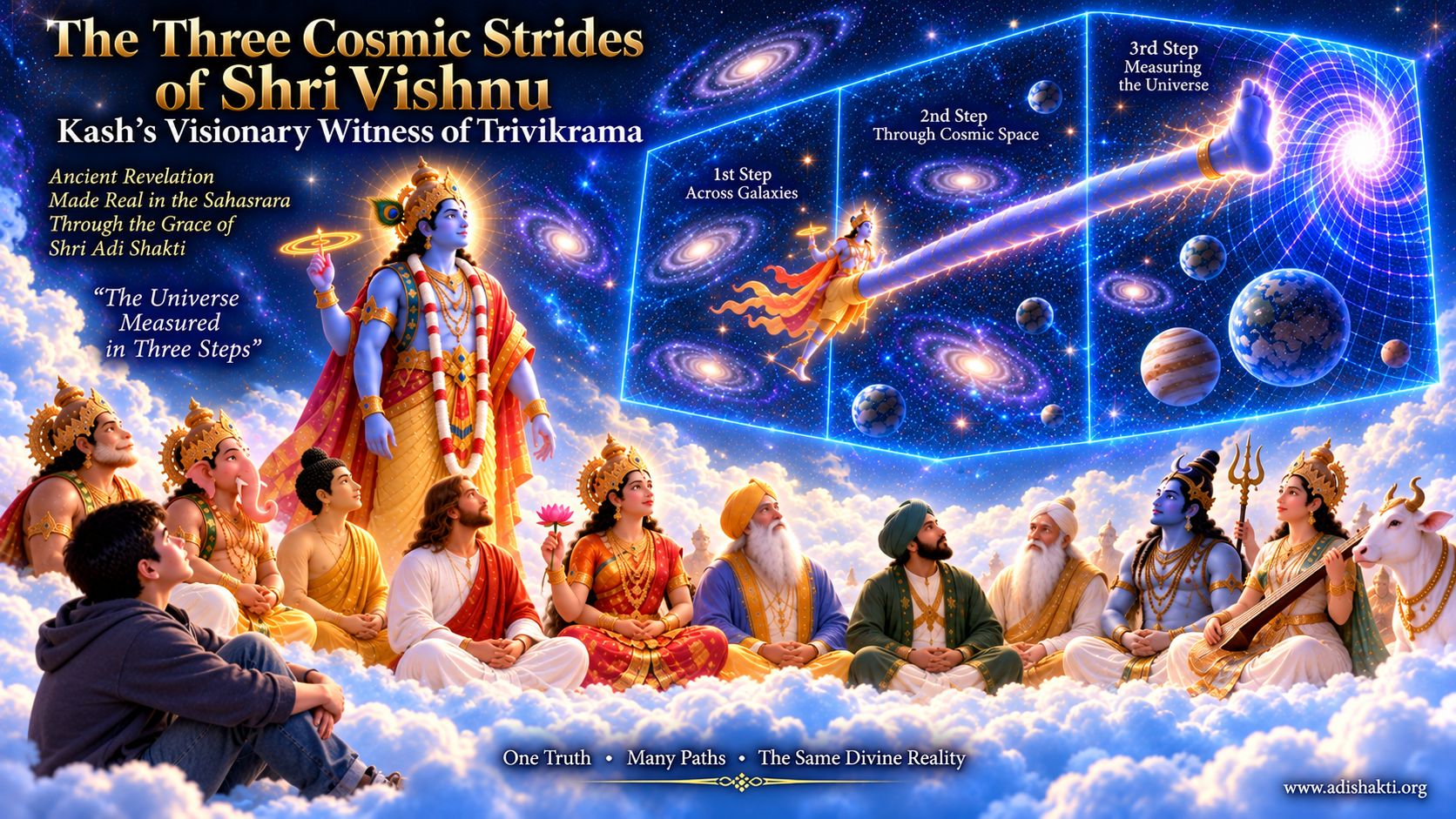
A documentary and comparative-theological defense of the January 23, 1994 Sahasrara experience in which thirteen-year-old Kash witnessed Shri Vishnu measuring the universe in three immeasurable cosmic strides.
On January 23, 1994, Kash was told to ask Shri Mataji if he could be shown how Shri Vishnu measured the universe in three steps. SY Bhupinder told both father and son that this incident took place thousands of years ago in the Spirit World. Perhaps Shri Mataji might show Kash how such a feat was possible, difficult as it is to even visualize and even harder to believe. After all not all myths are true and if Shri Visnu did not measure the Universe in three steps (or more), then the Great Adi Shakti would just tell him so.
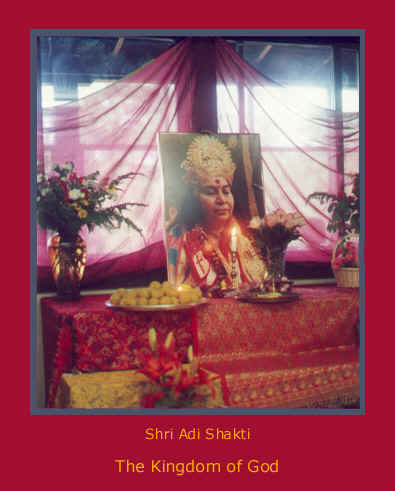
Kash went into Sahaj Samadhi and the coiled Kundalini (Nectar of Immortality) sprang into life, and coursed through Sushumna Nadi. It instantly revealed the Paramjyoti in the Sahasrara — This was the Absolute Truth revealed by ancient Hindus to humankind ages ago when the rest of the world was still spiritually primitive. The Divine Radiance shone ever so brilliantly from above Shri Vaisnavi Shri Nirmala Devi [1] as the Holy Spirit sat in Bliss and Joy. He bowed to Her. As usual She greeted him with a smile.
Kash then asked if he could be shown how Shri Vishnu measured the Universe in only three steps. Shri Ayonih Shri Nirmala Devi [2] smiled even more radiantly and assured the fulfillment of his request.
The Divine Messengers were already present, sitting in semicircle and waiting in eager anticipation to witness again such a rare feat of awesome spiritual powers.
When all were ready a three-dimensional projection suddenly appeared out of nowhere, suspended in mid-air like a giant drive-in movie screen — except that it was three-dimensional and real . Shri Vishnu appeared alone and took His first step. Shri Vishnu kept on widening His step until He became too minute to be seen. Countless constellations whizzed past as His leg expanded at super-warp speed. (Only His legs kept on stretching but not the body.)
After a while He appeared from another direction and again took another giant step far into empty space again. His third and last step appeared to be again starting from far, far away and Shri Visnu then returned back to His original starting point. Kash said that he could not ascertain in which sequence the universe was covered — length, breadth or height — due to the sheer magnitude of the feat. All he knew was that Shri Vishnu was measuring it.
Everyone then clapped very softly in appreciation of Shri Mataji Nirmala Devi's Supreme Power to materialize ancient Time, a vivid demonstration of the infinite Power of the Great Cosmic Matriarch. Again the Great Adi Shakti, the very Power of Brahma, had fulfilled Kash’s desire to witness something that hundreds of millions of Hindus have proclaimed for thousands of years.
The material projection then disappeared into thin air. Shri Yoni-nilaya Shri Nirmala Devi [3] then requested that all meditate. They raised their Kundalinis in unison and went into Sahaj Samadhi.
After everyone had finished Kash asked permission from the Supreme Goddess for leave. He bowed down to Her, wished all the others, and then descended from the Tabernacle of God back to this decadent world of spiritual wastelands and religious badlands.
Note: According to Kash this materialization of a feat which had taken place aeons ago was very much real and vivid. It did not look like a projection at all for it had solid form. It should be understood that Shri Vishnu Himself was sitting in the semicircle and witnessing the whole ‘3D movie’ depicting one of His numerous spiritual feats that are epics of Divine History.
[1] Vaisnavi (892nd): She is the female counterpart of Visnu bearing Sankha, Cakra, and Gada; or She is Mahalaksmi, the power of Visnu.
[2] Ayonih (894th): Yonih means Original Cause. She has no such cause because She is the Cause of all causes. Or Yoni is the first triangle in ‘Sri-Cakra’ representing ‘Avyakta.’ She is beyond this Avyakta. Or ‘A’ means Visnu and ‘Yoni’ means ‘Mother’ meaning ‘Mother of Visnu.’
[3] Yoni-nilaya (895th): The Abode of all origins, as the Cause and Source of all causes. (Rukmavarnam Kartaramisam Purusam Brahma-Yonim.) The golden-hued, the Doer, the Ruler, the Self, the Mother of Brahma—(Mundakopanishad 3-1-3.) Or She resides in the first triangle in Sri Cakra. Trikona-Rupini-Sakti Bindu-Rupah Sivah Smrtah: Sakti is of the form of a triangle and Siva of circle (Sruti.)
Jagbir Singh, 1999, p. 178
Summary
On January 23, 1994, thirteen-year-old Kash entered Sahaj Samadhi with one precise request: to be shown how Shri Vishnu had measured the universe in three steps. According to the testimony preserved in Jagbir Singh’s Shri Adi Shakti: The Kingdom of God, Shri Mataji Nirmala Devi granted the request in the Sahasrara. Kash then witnessed a vivid three-dimensional manifestation in which Vishnu’s legs extended across unimaginable distances, constellations rushed past, and three immense movements encompassed cosmic space. The experience corresponds with striking clarity to the ancient Vedic image of Trivikrama—the Three-Strider—and is presented here as a genuine spiritual experience in which an ancient act of Divine History became directly perceptible.
The Vision of January 23, 1994
On January 23, 1994, thirteen-year-old Kash entered Sahaj Samadhi with an extraordinary and very specific request: to be shown how Shri Vishnu had measured the universe in three steps. The question concerned one of Hinduism’s most ancient and seemingly incomprehensible declarations. SY Bhupinder had told Kash and his father that this event had occurred thousands of years ago in the Spirit World and suggested that Shri Mataji might show Kash how such an apparently impossible feat had been accomplished. The premise was straightforward: Kash was not being asked to explain the tradition or merely accept it. He was to ask Shri Mataji whether he could see how it happened. If the ancient account was not true, the Great Adi Shakti could simply tell him so.
Kash entered Sahaj Samadhi as the Kundalini rose through the Sushumna Nadi and consciousness opened into the Sahasrara. There the Paramjyoti, the Divine Radiance, shone brilliantly above Shri Mataji Nirmala Devi. Kash bowed before Her and asked whether he could be shown how Shri Vishnu had measured the universe in only three steps. Shri Mataji smiled and granted his request. The Divine Messengers were already seated in a semicircle, apparently awaiting the demonstration. What followed was not given to Kash as theological instruction or verbal explanation. It was presented as a direct visionary experience.
A vast three-dimensional manifestation suddenly appeared before the assembly. Kash compared it to an enormous “3D movie,” yet he emphasized that this analogy was inadequate because the phenomenon appeared completely real and possessed solid form. Shri Vishnu appeared and took His first step. His leg continued extending across an unimaginable distance until Vishnu Himself became too minute for Kash to see. Countless constellations rushed past while the stride expanded at what Kash could only describe in contemporary language as “super-warp speed.” One seemingly incidental observation is particularly significant: Kash specifically stated that only Vishnu’s legs kept stretching, not His body. He was therefore not merely describing an enormous anthropomorphic deity. He was describing the mechanism of what he perceived—the divine stride itself becoming cosmic in extent.
After a time Vishnu appeared from another direction and took another immense step into apparently empty cosmic space. The third and final stride seemed to originate from an enormously distant region and ultimately returned toward the original starting point. Kash could not determine whether the universe had been traversed sequentially according to length, breadth, or height because the magnitude of what he witnessed overwhelmed ordinary spatial comprehension. Yet he remained certain of the essential action before him: Shri Vishnu was measuring the universe. Kash’s refusal to impose an artificial geometry upon the experience preserves the immediacy of the testimony: he described what he could perceive and did not claim to comprehend what exceeded his perception.
Vishnu as Trivikrama
The significance of this experience becomes extraordinary when placed beside the ancient Hindu textual tradition. The earliest surviving Vedic descriptions of Vishnu already identify Him through precisely this cosmic act. The tradition does not originate with the later and more elaborate story of Vamana and King Bali. It reaches into the Rigveda itself, where Vishnu is celebrated as the cosmic deity whose three tremendous strides encompass the worlds. The ancient seers remembered Vishnu as Trivikrama—the Three-Strider—whose steps traverse dimensions inaccessible to ordinary human movement and perception.
The earliest stratum of the tradition already fixates on Vishnu’s three strides. In the Rigveda’s Viṣṇu Sūkta, the poet declares: “Now shall I proclaim the heroic deeds of Viṣṇu, who measured out the earthly realms … having stridden out three times, the wide-ranging one” (Rigveda 1.154.1). Centuries later, the Puranas dramatize this cosmic gesture in the Vamana avatar, where the dwarf brahmin asks King Bali for “three paces of land” and then expands to cover earth and heaven. When no space remains for the third step, Bali says: “Be pleased to place your third step on my head … I am not so much afraid of hell … as of ignoble reputation—that Bali was a deceitful person” (Bhagavata Purana 8.22.2–3).
The correspondence between this ancient sacred tradition and Kash’s experience is profound. The Vedic Vishnu measures the cosmic realms; Kash sees Vishnu measuring the universe. The Vedic act consists of three strides; Kash witnesses three enormous strides. The ancient imagery emphasizes Vishnu’s feet, steps, and movement through cosmic regions; Kash’s description likewise focuses not upon an arbitrarily gigantic body but specifically upon the extraordinary extension of Vishnu’s legs and strides. The Vedic conception reaches beyond ordinary mortal perception; Kash watches Vishnu become too remote to see as the stride continues through astronomical distances. The ancient language of Trivikrama is thus transformed in Kash’s experience into something visually comprehensible: a divine step whose magnitude is measured not by fields, mountains, continents, or even planets, but by constellations rushing past the observer.
Perhaps the most remarkable feature is that Kash’s experience does not reproduce the familiar narrative apparatus of the later Vamana-Bali story. He does not see King Bali, a sacrificial court, a dwarf Brahmin requesting three paces of land, or Bali offering his head for the final step. Instead, the experience reduces the tradition to its most primordial form: Vishnu appears, Vishnu takes three cosmic strides, and Vishnu measures the universe. In this important respect, the vision resembles the archaic Vedic core of Trivikrama more directly than the later Purāṇic narrative. What Kash witnesses is essentially the mystery proclaimed by the Rigvedic seers themselves—the wide-ranging Vishnu whose three strides encompass the cosmic realms.
The Reality and Scale of the Experience
The astronomical scale of the vision is equally important. Kash’s statement that “countless constellations whizzed past” prevents the three steps from being reduced to exaggerated terrestrial movement. The universe itself had become the field of Vishnu’s stride. If a being truly measured cosmic space in three movements, an observer could hardly experience those movements as three conventional footsteps. Ordinary perspective would collapse. Astronomical regions would become markers of distance; the divine figure would recede beyond visibility; direction would become difficult to establish; and familiar categories such as length, breadth, and height would cease to provide an adequate frame of reference. Remarkably, these are precisely the characteristics of Kash’s description. The vision does not domesticate the ancient claim. It conveys its almost incomprehensible magnitude.
The testimony also makes clear that Kash did not regard what he witnessed as imagination or symbolic imagery. According to his account, the manifestation was exceptionally vivid, possessed solid form, and appeared real. His analogy of a three-dimensional movie described the manner in which the ancient event was made present before the assembly, not its degree of reality. Indeed, Shri Vishnu Himself was reportedly seated among the Divine Messengers while the manifestation of His ancient feat unfolded before them. The distinction is spiritually important: Vishnu was not simply performing the deed again. Rather, an event of Divine History was being made perceptible within the Sahasrara.
Shri Mataji as Vaishnavi and Adi Shakti
The names applied to Shri Mataji within the account deepen this theological coherence. She appears as Shri Vaishnavi, the feminine counterpart and Power of Vishnu; as Ayonih, the One without an originating cause because She is the Cause of causes; and as Yoni-nilaya, the primordial Abode and Source of origins. These names express the underlying Shakta theology of the event. Kash asks the Divine Mother to reveal Vishnu’s ancient cosmic act, and through Her power the event becomes perceptible. The experience therefore simultaneously reveals Vishnu as Trivikrama and Shri Mataji as the Adi Shakti capable of unveiling Divine History before the spiritual eye.
After the three strides had been shown, the assembled Divine Messengers softly applauded in appreciation of Shri Mataji’s power to manifest the ancient event. The manifestation then disappeared. Shri Mataji requested meditation, and all raised their Kundalinis and entered Sahaj Samadhi. An experience of almost unimaginable cosmic magnitude thus culminated not in spectacle or excitement but in silence and meditation. The vision of Trivikrama returned to Sahaj Samadhi, the same state of heightened spiritual consciousness through which Kash had entered the Sahasrara.
The January 23, 1994 experience therefore joins ancient sacred revelation with direct contemporary spiritual experience. The Rigvedic seers proclaimed Vishnu’s three strides thousands of years ago; later Hindu tradition preserved and elaborated their significance through the Vamana incarnation; and Kash, upon specifically asking Shri Mataji to show him how Vishnu could possibly have accomplished such a feat, witnessed three cosmic movements whose scale and character strikingly illuminate the ancient description. Scripture says that Vishnu measured the cosmic realms; Kash sees Him measuring the universe. Scripture speaks of three tremendous strides; Kash witnesses three. Scripture presents the deed as exceeding normal human dimensions; Kash watches Vishnu disappear into immeasurable distance while constellations rush past and ordinary spatial comprehension fails.
The cumulative correspondence is far more significant than the simple recurrence of the number three. It encompasses the identity of Vishnu, the exact number of strides, their function as cosmic measurement, their astronomical magnitude, their relationship to the limits of human perception, and the extraordinary emphasis upon the stride itself. Moreover, Kash’s experience strips away the secondary narrative details of the Vamana-Bali story and returns to the primordial Vedic image: Vishnu, cosmic space, and three immeasurable steps. It is difficult to imagine a more direct experiential representation of Trivikrama.
Conclusion
References
Rigveda 1.154, Viṣṇu Sūkta.
Rigveda 1.155.
Bhagavata Purana, Book 8, especially 8.22.2–3.
Lalita Sahasranama, Names 892, 894 and 895: Vaishnavi, Ayonih, and Yoni-nilaya.
Mundaka Upanishad 3.1.
Singh, Jagbir. Shri Adi Shakti: The Kingdom of God. 1999, p. 178.
Interactive Chat
Explore this article, its sources, and the relationships among its theological and evidentiary claims.
Open chat →