A Ten-Part Journey through Hindu Scriptures
Summary
This ten-part series will be presented in full over the coming weeks, one topic at a time. Each paper will examine its subject in depth, explaining the relevant verses and passages from the Vedas, Upanishads, Bhagavad Gita, Puranas, Devi Gita, Devi Bhagavatam, Lalita Sahasranama, and Yoga traditions in their context. Only one example verse appears for each topic here ; fuller textual interpretation is reserved for the individual papers. The series is organized around Moksha and Jivanmukti —liberation from the cycle of rebirth and realization of the eternal Self while still alive.
Artificial intelligence will be employed to systematically scan, search, compare, and analyze the principal Hindu scriptures and traditions : the Vedas and Upanishads, the Bhagavad Gita, the Mahabharata and Ramayana, the major Puranas, the Devi Bhagavatam and Devi Gita, the Lalita Sahasranama, the Yoga Sutras, and the principal texts of Vedanta, Yoga, Shaivism, Vaishnavism, and Shaktism. Rather than examining isolated quotations, this research will seek to identify related passages across the whole scriptural corpus, trace recurring spiritual concepts, compare their contexts, and investigate how the teachings illuminate one another.
The scale of this undertaking exceeds what any individual scholar could realistically accomplish through exhaustive manual comparison alone. Even the most accomplished pandits, acharyas, swamis, professors, theologians, and researchers work within the natural limitations of human memory, time, and access to information. AI offers a fundamentally different research capability: it can rapidly search extensive textual collections, identify linguistic and conceptual relationships, compare scholarly interpretations, and organize findings that might otherwise require years of painstaking investigation.
AI does not replace the authority of the Vedas, the wisdom of the rishis, the living traditions of the acharyas, or the discernment of knowledgeable Hindu scholars. Its value lies in extending the reach of research beyond the limitations of any single human reader. When supplied with reliable Sanskrit texts, translations, commentaries, and scholarly resources, AI can assist in examining the Hindu scriptures with a breadth, speed, and systematic consistency that traditional manual research cannot easily reproduce.
This ten-part journey therefore aspires to be an unprecedented AI-assisted exploration of Hindu scripture and theology : an integrated examination of Brahman, Atman, samsara, karma, avidya, maya, yoga, Kundalini, Shakti, dharma, Jnana Yoga, moksha, and Jivanmukti—grounded in the whole breadth of Hindu sacred literature rather than a narrow selection of familiar verses.
The purpose is not merely to accumulate information, but to illuminate the spiritual path toward Moksha . By bringing together passages scattered throughout this vast ocean of Hindu wisdom, the series seeks to make profound connections accessible to ordinary readers, while offering pandits, acharyas, swamis, scholars, and theologians a substantial body of research for further examination, verification, and discussion.
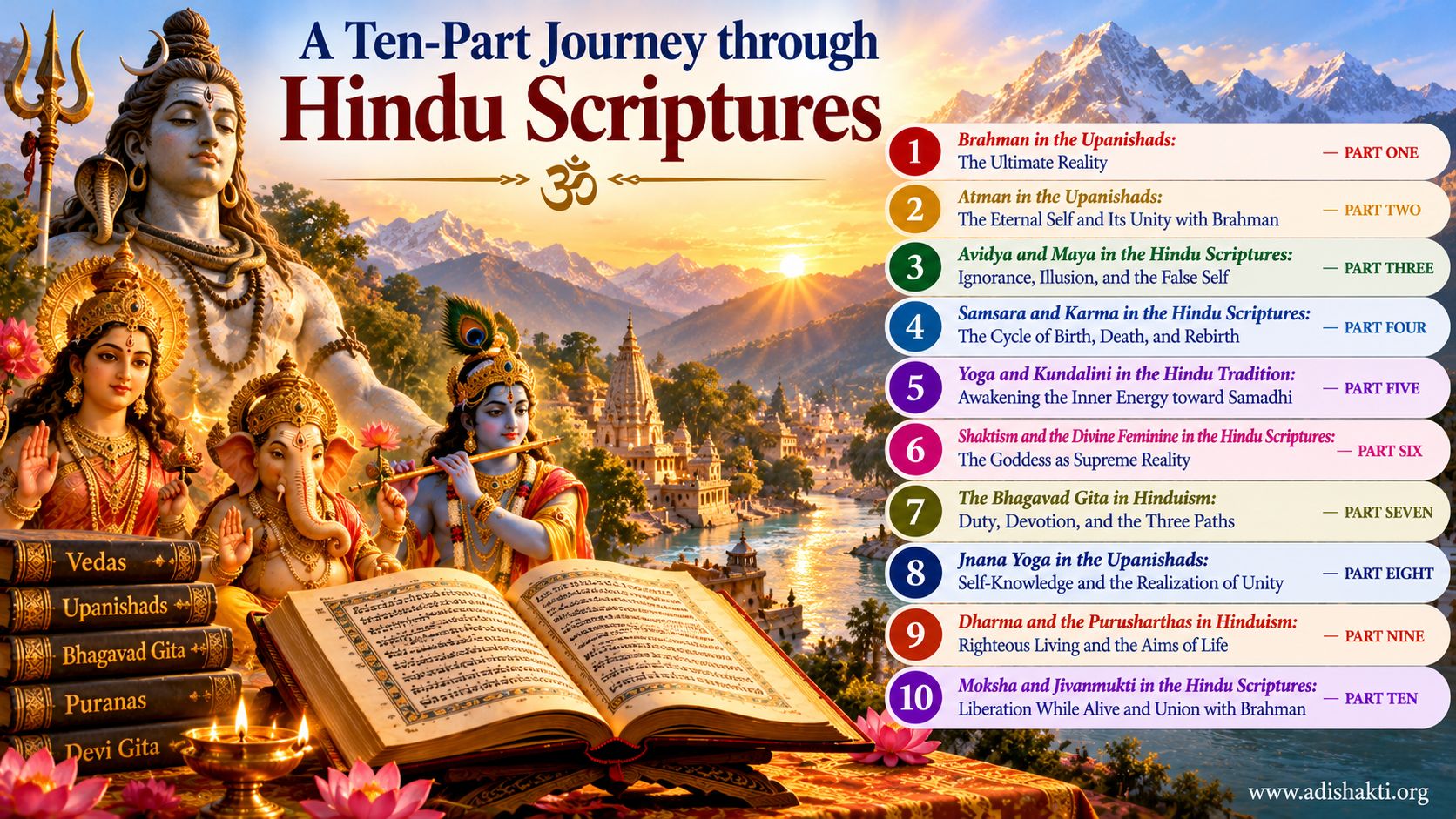
The Ten-Part Series
1. The Vedas and Upanishads: Revelation, Ritual, and the Quest for Brahman — PART ONE
Example verse:
“Truth is one; the wise call it by many names.” Ekam sat vipra bahudha vadanti. — Rig Veda 1.164.46.
Meaning: The Vedas are Hinduism’s oldest scriptural layer, regarded as shruti —“that which was heard” or revealed. The Upanishads, the concluding portion of the Vedic corpus, shift the emphasis from ritual toward direct inquiry into ultimate Reality. Behind the many gods, forms, and names, they point to the one Reality: Brahman .
2. Atman and Brahman: The Self, the Absolute, and the Great Declarations — PART TWO
Example verse:
“That thou art.” Tat tvam asi. — Chandogya Upanishad 6.8.7.
Meaning: The Upanishads teach that the innermost Self, the Atman, is not ultimately separate from Brahman, the Absolute. The great declarations— Tat tvam asi , Aham Brahmasmi , and Prajnanam Brahma —express the non-dual realization that liberates the soul from bondage and rebirth.
3. The Bhagavad Gita: Duty, Devotion, and the Three Paths — PART THREE
Example verse:
“You have a right to action, but never to its fruits.” Karmanye vadhikaraste ma phaleshu kadachana. — Bhagavad Gita 2.47.
Meaning: The Bhagavad Gita integrates the principal paths to liberation: Karma Yoga , selfless action; Bhakti Yoga , loving devotion; and Jnana Yoga , liberating knowledge. It teaches that action performed without egoistic attachment does not bind the soul.
4. Samsara and Karma: The Cycle of Birth, Death, and Rebirth — PART FOUR
Example verse:
“Just as the embodied self passes through childhood, youth, and old age, so does it pass into another body.” — Bhagavad Gita 2.13.
Meaning: Samsara is the beginningless cycle of birth, death, and rebirth. Karma —the law of moral causation—drives this cycle through actions, intentions, and desires. The goal of spiritual life is not merely a better rebirth, but release from rebirth altogether.
5. Avidya and Maya: Ignorance, Misidentification, and the Veil of Appearance — PART FIVE
Example verse:
“This divine Maya of Mine, consisting of the gunas, is difficult to overcome.” Daivi hyesha gunamayi mama maya duratyaya. — Bhagavad Gita 7.14.
Meaning: Avidya is ignorance: the false identification of the eternal Self with body, mind, ego, and personality. Maya is the divine power through which the world appears as ultimately real. Liberation requires seeing through this veil and awakening to the Self.
6. Yoga and Kundalini: Disciplines of Body, Breath, and Inner Energy — PART SIX
Example verse:
“Yoga is the stilling of the movements of the mind.” Yogash chitta-vritti-nirodhah. — Yoga Sutras of Patanjali 1.2.
Meaning: Yoga is the disciplined path of stilling the mind and realizing the Self. In Tantric and Shakta traditions, Kundalini is the dormant divine energy at the base of the spine; when awakened through discipline, breath, meditation, and grace, it rises through the chakras toward union with the Divine.
7. Shaktism and the Divine Feminine: The Goddess as Supreme Reality — PART SEVEN
Example verse:
“I am the Sovereign Queen, the bestower of all wealth, the one worshipped by all gods.” Devim vacham ajanayanta deva. — Rig Veda 10.125.3, in the voice of Vak/Vac.
Meaning: In Shaktism , the Supreme Reality is the Divine Mother—Devi, Shakti, or Adi Shakti. The Devi Bhagavatam presents the Goddess as Para Brahman; the Devi Gita teaches non-dual realization through her; and the Lalita Sahasranama offers a thousand names for meditation on her infinite nature.
8. Jnana Yoga: Knowledge, Discrimination, and the Realization of Unity — PART EIGHT
Example verse:
“Nothing purifies like knowledge; one perfected in yoga discovers that Self within oneself in time.” Nahi jnanena sadrisham pavitram iha vidyate. — Bhagavad Gita 4.38.
Meaning: Jnana Yoga is the path of liberating knowledge. Through discrimination between the Real and the unreal, dispassion toward the transient, and sustained self-inquiry, the seeker realizes that the Atman has never truly been separate from Brahman.
9. Dharma and the Purusharthas: Duty, Prosperity, Pleasure, and Liberation — PART NINE
Example verse:
“Whenever there is a decline in righteousness and a rise in unrighteousness, I manifest myself.” Yada yada hi dharmasya glanir bhavati bharata. — Bhagavad Gita 4.7.
Meaning: Dharma is righteous duty, moral order, and alignment with cosmic law. It is one of the four aims of human life: dharma, artha, kama, and moksha. The Gita teaches that each person must fulfill their own dharma without ego, while the Divine preserves righteousness in the world.
10. Moksha and Jivanmukti: Liberation in Life and Union with the Divine — PART TEN
Example verse:
“The knower of Brahman becomes Brahman.” Brahmavid brahmaiva bhavati. — Mundaka Upanishad 3.2.9.
Meaning: Moksha is liberation from samsara and realization of one’s true nature. Jivanmukti is liberation while still embodied: the realized person continues to live in the world, but no longer bound by ego, fear, or karmic bondage. Different traditions describe this state as union with Brahman, eternal service to Vishnu, union with Shiva, or dwelling in the presence of the Divine Mother.
The Goal of the Series
Together, these ten themes form a complete spiritual path: the seeker encounters Brahman , realizes the Atman , understands samsara and karma , sees through avidya and maya , awakens through Yoga and Kundalini , honors the Divine Feminine , practices Jnana Yoga , lives according to Dharma , and attains Moksha and Jivanmukti .
The final aim is not merely to acquire religious information, but to realize the eternal Self and attain liberation while alive —freedom from ego, ignorance, fear, and the endless cycle of rebirth, and abiding union with the Divine.
Conclusion
This introduction announces ten forthcoming studies across diverse Hindu scriptural and philosophical traditions. Interpretations of the relationship between Atman and Brahman, the status of Maya, the nature of the Divine, and the meaning of liberation differ among Hindu schools; the individual papers will examine those differences in their textual contexts.
References
[1] Rig Veda 1.164.46; 10.125.3.
[2] Chandogya Upanishad 6.8.7; Mundaka Upanishad 3.2.9.
[3] Bhagavad Gita 2.13, 2.47, 4.7, 4.38, 7.14.
[4] Yoga Sutras of Patanjali 1.2.
[5] Devi Gita, Devi Bhagavatam, and Lalita Sahasranama: to be studied in the individual papers.