O! Speak All-Mighty God!
: The Shri Mataji on Earth and MahaDevi in Sahasrara Removes the Maya
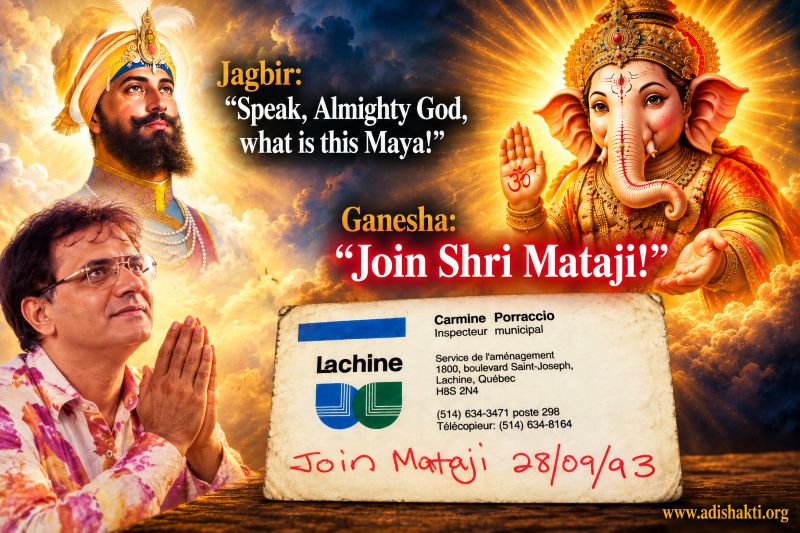
Documentary note — September 28, 1993: According to Jagbir Singh’s autobiographical account, this calling card was written immediately after the thunderous JOIN SHRI MATAJI!
Call awakened him from a deep, drunken stupor. Knowing how heavily intoxicated he was and fearing that he would not remember the experience, he staggered to the kitchen table, took the card from his wallet, and wrote the message and date—Join Mataji 28/9/93.
The precaution proved necessary: by the following morning he had completely forgotten both the Call and the card.
The Universal Question: Why Are We Here On Earth?
After a few years of materialistic pursuits and delicious indulgences in Canada the initial euphoria wore off — there was no gold at the end of the rainbow. Kash’s father had achieved his deepest desire and burning lifelong ambition: to take his family to a safe haven on Earth where they could live in peace, harmony, equality and, of course, wealth. The joy of life in Canada, one of the most blessed nation on Earth, came in ever-diminishing returns. Then it began to dawn that genuine happiness was missing in one of the wealthiest country on Earth. Life began to lose its essence. There was an incomprehensible feeling of emptiness, of nothingness, of uselessness. The realization came that life, even if cherished to the fullest, was futile if it all ended with the parting of loved ones. Existence was useless if it ended and faded into nothingness. It just made no sense.
In early 1993 Kash’s father knew that he had reached the end of life’s journey, and began a journey of self-introspection to search for the meaning of life. “Why was he on Earth?” “What was he born for?” “Why is there death?” “Is it the end of all existence?” “Why are humans in a constant state of struggle for power and possessions?” “Why is the vast majority under constant subjugation?” “Why are billions striving and suffering?” “Why so much hate, violence and unhappiness in the lands of plenty?” “Why so many tears, anguish and sufferings in the lands of less?” “Why all these ceaseless confusions, delusions and illusions?” “Why all these religions of division, differences and hate?” “Why all these different Allahs, Gods and Prabhus?” “What is the Truth?” “Who knows this Truth?” “Where is this Truth?” “How to reach this Truth?”
Unknown to him, this was the first stirring of the human soul,[1] trying to break free from the bondage of the body. A being was questioning and answering his own Self: “No! This is not Reality.”
“How Does One Meet A True Guru?”
After months of fruitless, frustrating searching he surrendered himself and begged the Divine to quench his ever-increasing thirst for Truth.
There was only a painting of Guru Gobind Singh (the tenth Sikh guru) hanging on the wall, and this request was vaguely directed through him. At this moment God Almighty was not distorted by any religious conditioning or dogma. Whoever, whatever, or wherever the Supreme Creator was, He, and He alone, should provide the answer. No minor godlings of the religious regimes were to answer this call.
The Almighty Maker was not called upon in the belief or hope that He was actually going to respond. It was just an act of sheer desperation, an overwhelming helplessness arising from life’s emptiness, religious deception, and the physical futility of struggling to survive, only to meet eventual death and nothingness. There was never any expectation of an answer. The Almighty Creator was believed to be a sort of a mysterious, aloof Supreme Being exclusively owned by one, some, all, or maybe, none of these institutionalized religions. Anywhere, what expectations of an answer was there for a sinner who had stopped entering His temples a long time ago?
Despite his dilemma he refused to seek Him in any of His Idols of Worship. How could The Almighty Creator exist in these putrid pools of organized hypocrisy and institutionalized falsehood? Can't He be found anywhere else? Why does He force humans to seek Him only in these decadent derelicts professing His exclusive Grace? In which particular one, then, does He reside? What proof do the guardians of these brick and mortar Idols have to convince the religious herd that by praying and prostrating inside their sprawling religious ranches, God Almighty will be found?
However, if He did indeed exist in any of them it would have been the most heart-wrenching and utterly agonizing answer. The Almighty Creator would not have been able to answer one question: How is it possible that He favored any religious regime that denied His other Messengers? No! That would not have been the Ultimate Reality (Al-Haqqah)! Then he had to be false. Then he had to be the 'lesser god' worshipped by existing religious prisoners — a prabhu, a yahweh, a god, an allah, a buddha, a waheguru. And Kash's father would have to again abandon these minor gods and continue the search for the Absolute Truth, the Divine World of Reality (Lahut) that would destroy all doubts, discrepancies, delusions, and darkness.
O Speak Almighty God!
Only God Almighty, would be able to account for all the Messengers sent down to Earth. His Religion had to be Universal, preached by all His Messengers and found in all His Holy Scriptures. He had to be the Ultimate Reality (Al-Haqqah) — His Truth had to be All Pervading, All Encompassing, Unchangeable, Indestructible, Flawless and Absolute.
This spiritual song imploring The Almighty Creator — the Universal Soul — to remove the veil of ignorance was sung again, and again, and again:
O Ek suki yaha lakoh mein.O Only one in a hundred thousand is in bliss.
Ansoo hai croroh ankhoh mein.
There are tears in millions and millions of eyes.
Hum neh gin gin har takdir dekhi.
I have counted and seen every fate for years,
Ek hasta hai dush rote hai
Only one soul laughs while ten are in tears.
Kuch bhol Prabhu yeh kya Maya[1]
O! Speak Almighty God what is this Illusion,
Tera khel samaj meh nah aya
Your Divine Play is all confusion and delusion.
For weeks The Almighty Creator was asked, amid a profusion of tears, to reveal the Truth. Repeatedly He was implored to answer the meaning of life, creation, and this useless, empty human existence. Above all, He was begged for the Truth that would destroy the falsehood that the religious regimes had deluded him and the rest of humanity. What was desired was the Absolute Truth of the Absolute Creator, not the conflicting gods of various organized religions. Any god that could not explain and account for the other Messengers was not God. Any yahweh that only cared for his kind was not Yahweh. Any allah that had only one messenger was not Allah. Any prabhu that was found only in a single scripture was not Prabhu. Any buddha that had no Knowledge of His Kingdom was not Buddha.
The Supreme Creator had to be the Lord of all Messengers that came on Earth. His Truth had to be found in all Scriptures that humans possessed. His Reality had to be Absolute, Irrefutable, and All Compassing. Then, and only then, will He be acknowledged as God The Almighty.
Shri Adi Shakti: The Kingdom of God
Jagbir singh, 1999, p. 47-51
“Late afternoon on September 28, 1993 Kash's father started his usual drinking binge and by nightfall was really inebriated.
His children were fast asleep and wife still at work. He switched his stereo system and began listening to Kitaro, his favorite artist. The soothing New Age music of harmony with Nature increased his sense of serenity, reflecting and complementing the stillness of the night. Nothing stirred. With eyes closed in deep inner peace and relaxation, he was completely at peace with himself and Earth. In this thoughtless trance-like stupor he drifted slowly into deep sleep.
He had no idea how long he was in that intoxicated sleep.
Suddenly, out of nowhere, a thunderous voice bellowed, "JOIN SHRI MATAJI!" It was like a thunderclap that jerked him out of his drunken stupor into an awakened, shocked daze.
He whirled around in disbelief but there was no one. The intensity and clarity of this Mighty Call penetrated and shook every nerve and fiber of his body. Where did this majestic voice come from? Who was it that spoke with such authority?
The mind reeled in reverence to this divine message that had come like a massive bolt of Cosmic Consciousness. It was an awesome, extraordinary call for no power on Earth could have had that force of awakening a sleeping drunk.
Despite his intoxicated state he knew that this message had to be remembered at all cost. There was a force in it that jolted his numbed senses to act immediately, lest the sheer strength of intoxication would again reel him back into hapless lethargy and deep sleep. His heavily smashed state of mind ruled out any hope of remembrance. The only way was to somehow jot it down on something.
He managed to stagger to the kitchen table, take out his wallet, and write down the message and date on a calling card (the date took a considerable time to confirm.) The exact words written down were: 'Join Mataji 28/9/93.' He was confident that in the morning he would come across this card and find out who this Mataji (Mother) was.
Morning arrived, accompanied by a huge hangover.
But a strange thing happened. For some reason his body suddenly rejected cigarettes. Incredible as it may seem he just could not smoke anymore, accomplishing overnight what he had struggled—between intermittent bursts of inspired determination and New Year's resolutions—to kick this addiction of more than twenty-five years! He just could not understand why his body was suddenly rejecting cigarettes for no obvious reason.
Nonetheless he was proud of having done the almost impossible. This time he was certain that he would never smoke again.
The Call of the previous night was completely forgotten. There was not a single recollection of what had transpired just hours ago.
Such memory loss took place on certain occasions when the amount of alcohol exceeded his body's capacity to cope. It then supplied just the bare necessities to function—a sort of emergency power during an electrical failure—just sufficient to continue slaking the desire for more alcohol.
The card with the scribbled mighty message, misplaced within a photo pocket in the wallet, was completely forgotten. There it lay for nearly a year until September 5, 1994. Till then there was absolutely no knowledge of what had transpired on that fateful night of September 28, 1993.
Though his father had forgotten the Mighty Message there was no stopping the Divine Mother.
A few days later a Sahaja Yogi friend and guest asked for permission to give Kash(winder) and his brother Shahwinder Self-Realization by awakening their Kundalinis. Their father agreed as he had experienced Sahaja Yoga three years ago and, though uninterested himself, found no harm in his two young children getting their Self-Realization. It was more of a gesture not to offend a guest rather than any belief in that same mataji and her funny ganesha.
Kash (13 years-old) and Shahwinder (11 years-old) followed the Sahaja Yogi into their room and were given a detailed explanation of Sahaja Yoga, Shri Mataji Nirmala Devi, Self-Realization, meditation, subtle system and Kundalini awakening.
After raising their Kundalinis the Sahaja Yogi told them to meditate.
When they finished Kash went straight to his father and exclaimed that he had journeyed to a very beautiful and peaceful land far away. He claimed that very instant he closed his eyes and went into meditation, he found himself standing on a soft carpet of clouds—hues of blue and white not seen on Earth—spreading in all directions as far as the eye could see.
Some distance away there was a very bright Light shining above and illuminating the entire vastness. In spite of its dazzling brilliance he could gaze at it without hurting his eyes. He just stood and looked around in amazement and awe at the tranquillity and stunning beauty of the surroundings.
He continued gazing around this strange serene land, wondering where he really was. Kash did not even take one step in any direction. The sheer splendor of this awesome scene illumined by a single dazzling Light and his inability to comprehend where he was kept him mesmerized and rooted to the spot. (Kash stood looking around and observing this strange land for about twenty minutes.)
The father skeptically listened, occasionally glancing at his friend to see if it made any sense to him. (Little did he know that his Sahaja Yogi friend had just awakened his son's Kundalini, the potential divine energy residing within humans at the base of their central nervous system, known as the sacrum bone through a stupendous spiritual breakthrough achieved by Shri Mataji Nirmala Devi, the founder of Sahaja Yoga.)
The next evening the same Sahaja Yogi gave Kash specific instructions and a mantra to be recited before going into meditation. As directed, Kash put his right palm on the ground and uttered this sacred mantra four times:
"Om Twameva Sakshat Shri Ganesha Sakshat
Shri Adi Shakti Mataji Shri Nirmala Devi Namoh Namah."
The dormant Kundalini energy inside his sacrum bone sprang into life, coursed through the central nervous system, and pierced his Sahasrara.
At that very instant, for the first time ever, he felt the Mother Earth breathing. She was breathing very gently and every heave of Her breath was felt on his palm, swelling slowly up, and then down again. She was a living organism just like all the creatures who were nourished by Her.
As he continued repeating the Mighty Mantra of Shri Ganesha the sacred Shri Bhumidevi (Mother Earth) continued inhaling and exhaling to reveal Her true nature. Her superconscious child was sure beyond all doubts that the Earth was breathing. Mother Earth was alive!
As he came through the celestial clouds and opened his spiritual eyes, the Divine Mother was there to receive him. The sight of Her standing right in front of him astounded the young child. Who was this stunningly beautiful young Woman who had appeared out of nowhere in this Divine Paradise? Who was this extremely attractive Being, all enfolded in a dazzling red and white sari, who had come to greet him?
In the first place where was he?
Shri Lalita Devi smiled and held out Her Hands, with open, upturned palms. She told him to open his palms and face them downwards over Her open palms. As Kash did so he found himself being levitated a few inches off the ground. Both began traveling towards the extremely brilliant Light, quickly reaching it and slowing down to a standstill.
A short distance away was a majestic golden Throne. Kash realized it was the same place he had seen the day before, for it was still under the same Light.
The Mahadevi walked to the Throne and sat down on it. Kash followed and squatted before Her, the luxuriant clouds providing extreme comfort.
He did not even bow down to Her for he had no idea what to do. All he knew was that he had been meditating on Earth and now he was in some strange land sitting before a very beautiful Woman on a majestic Golden Throne. He was sure that he was not dreaming, but just what was going on?
The Adi Shakti then told him that they should meditate.
Both simultaneously raised their Kundalinis and Kash realized that the Great Divine Mother was repeating the same method of Kundalini awakening that he had been taught by his father's friend. She brought both of Her Hands together and from the Mooladhara Chakra continuously encircled the left with the right, slowly rising all the way to the Sahasrara Chakra.
Shri Mata then tied a knot just above the Brahmarandhra (top of the head). This was repeated two more times. Then She opened Her left palm, resting it on the left knee, and with the right hand drew a protective arc over the entire body from left to right. This was done seven times. She then joined both palms in Namaskar and closed Her eyes. Both lapsed into meditation.
The attainment of the state of Sahaj Samadhi came instantly to Kash. The onrushing bliss was beyond description as the thoughtless state intensified the indescribable Joy. Wave upon wave of Paramchaitanya buffeted him into spiritual ecstasy. The spirit had merged into the Spirit. The human had become the Divine. The drop had become the Ocean. The individual consciousness had become the Universal Consciousness.
Time lost its essence and he could easily have remained suspended in this bliss for hours, even days. It was an awesome experience that could not be put into words, especially for a child.
After about 20 minutes the Divine Mother tapped him on his shoulders, and immediately he came out of Nirvana. She told him that it was time to go.
Kash did not even thank Her, so dazed was he by this spiritual experience. He just closed his spiritual eyes and descended through the thick layer of clouds, back to this planet known as Earth.
When he opened his physical eyes he was back at Montreal, Canada.
Again the young child confronted his skeptical father and declared the Truth he had just witnessed. Unknown to his father the fruits of past karma and lives lived in righteousness had ripened. It was the first sign that moksa (liberation) was inevitable.
From that day on the child held his father spellbound with wondrous wanderings in his Sahasrara, describing in detail and accuracy about the Kingdom of God, His Holy Spirit, and His Messengers who brought forth the great religions of Hinduism, Christianity, Buddhism, Islam and Sikhism — all living together in perfect peace and harmony in the Spirit World. The absolute certainty that his son was telling the Truth rudely shook his father and finally broke the spell of Kali Yuga (Age of Darkness).
For a period lasting exactly 21 full moons the Great Adi Shakti took Kash across the Celestial World, and introduced him to the greatest Incarnations who ever walked the Earth. The Spirit of the Living God revealed to him the whole, entire splendour of the Kingdom of God for those able to attain eternal life.
The absolute surety that such astonishing spiritual facts were being extracted by a spiritual breakthrough enthralled his father. How else was his young son able to tell him about something absolutely unknown to his tender mind? He had never heard of any human explaining such penetrating insights into the Kingdom of the Almighty Creator. Above all was this question: How was it possible for any member of this non-practicing, secular Sikh family know anything remotely religious? That Kash was only 13-years-old only made that initial witnessing of the Light, and next, the Devi, virtually impossible. His father knew next to nothing of these two religious facts that only practising Hindus would be familiar with. There was no way his son could either.
But that was just the beginning of far more extraordinary revelations (that eventually not only provoked disbelief in the Sahaja Yoga organization but led to the official conclusion that this child was possessed! The family was shunned. Eventually they left the organization early 2000 when there was an uproar among the rank and file against the setting up of this website on the eve of the new millennium. Only Shri Mataji, who had repeatedly endorsed the revelations over the years, stopped them from closing it down.)
As the father listened in reverence to these daily spiritual journeys, the awesome fact that the Almighty Creator really existed could not be doubted anymore. He knew there was only one purpose left in life — surrender! Total surrender to a Higher Being! He realized it was time to return to the Kingdom of God, and began preparing for the spiritual trek ahead. His mind, body, and soul had to be purified and cleansed of all earthly defects. Unknown to him, the greatest adventure of all, far surpassing anything known to the human race, was just beginning.
For the first time in his life he realized the magnitude of his spiritual ignorance and the sensual gratification he had become addicted to. He retched from the first faint stench that wafted from the grimy gutter of his earthly existence, and was nauseated by the strength of sin. In the ensuing months his body occasionally shuddered involuntarily as images of his perverted past flashed by every now and then. These spasms were the only way he could snap out of the recollection of his decadent decades, and shake off the lingering drowsiness of a long spiritual hibernation.
On December 25, 1993 he stopped drinking—a habit he had acquired in 1966 at the age of 15—and ceased being an alcoholic. He had his last Scotch on Christmas. For some reason, just like the abrupt end of his smoking habit, he could no longer consume any alcohol.
This witnessing the Cosmic Play of the Great Primordial Mother has no parallel in history. She had descended on this Earth for the very first time during its darkest hour of Kali Yuga, in time to awaken the human race to the first faint Light of the Resurrection and Last Judgment.
This is the true story of those who have experienced transcendental reality with the Primordial Mother through the Third Eye and who have come back to tell their fellow human beings about the other shore, and to help them get there.
As the renowned historian Mircea Eliade has observed: "I do not believe that certain primordial revelations could disappear ... But what I am sure of is that the future forms of religious expression will be completely different from the fossilized, obsolete and meaningless forms that we meet in Christianity, Judaism, Islamism. I'm sure that there will be other expressions to come."
Humanity is assured that we have entered into the blessed Golden Age of the Last Judgment and Resurrection where we learn the deepest secrets of our souls' journey to the Spirit World.
NOTE: What was in the beginning perceived as a 'hindu' goddess over time underwent a metamorphosis into the Divine Mother of all religions—"Holy Spirit/Spirit-Paraclete" (Christians), "Ruh Allah" (Muslims), "Shekinah/Ruach Elohim" (Jews), "Prajnaparamita/Tara" (Buddhists), "Aykaa Mayee" (Sikhs), "Tao/Wu Chi" (Taoists), "Adi Shakti/Devi" (Hindus). However, it is with the Paraclete (and Jesus) that the Divine Mother most prominently identifies and aligns with.
The Mighty Messenger
Kash's father had on September 28, 1993, heard a loud, thunderous voice directing him with these words, "JOIN SHRI MATAJI!" This profound spiritual Message was so commanding that he even wrote it down on a calling card. Though hopelessly drunk he did not want to ever forget it, so powerful was that Divine Voice.
Despite this precaution the Message was completely forgotten the next day as the calling card was inserted into the photograph/card compartment of his wallet. For nearly a year there was not even the slightest memory of that blessed night. Such blackouts of memory occurred whenever Kash's father consumed an excessive amount of liquor, over and above his 'normal' limits. (Normal here means between 8-10 beers. Excessive should be understood as a case of 24.)
On September 5, 1994, while spring-cleaning his wallet he came across this particular calling card with that peculiar note, "JOIN SHRI MATAJI!" He recognized that it was his handwriting. For a few seconds he remained puzzled, unable to understand this strange note. Why should he write such a short, strange statement in the first place? How did it come into his purse? And when did all this happen? For a minute or two there was no answer.
Then suddenly his mind reeled as the magnitude of the Revelation hit him like a tsunami: That was the night he was completely drunk! That was the night he heard the Mighty Voice! That was the night he stumbled and struggled to jot the Message down! That was the night that he did not want to forget! That was the night he never remembered.
Then his mind, that impish little ego, began its dance of doubt: Maybe you were really drunk. Maybe you really heard voices. Maybe it was your imagination. Who would actually say these words, "Join Shri Mataji"? Why, in the first place, convey a message when one is dead drunk? There had to be a mistake. It could not be possible true. It made no sense.
The more the mind rationalized the more agitated it became. Soon the placid waters of the mind became turbulent. Not only the ego questioned but it also answered the very questions that it pretended not to know. The thoughtless state became increasing agitated, even as it tried to bring calm to chaos. It failed and the mind began to be confused and bewildered by its own question-answer-counter-question-counter-answer state. No matter how much it tried to rationalize it failed to arrive at a conclusion; there was always another fact or speculaton to contradict the last answer. Kash, the only person with the Darshana to extract Truth from within himself, was still in school.
Waiting became torturous as the father paced the floor and tossed around in bed. He had to have the Truth of that fateful night that triggered his awesome journey to seek the Divine World of Reality (Lahut). The Manna Monsoon was still lashing around in all its fury, rattling the shuttered windows of his mundane mind, occasionally ripping off a plank or two. It would only be a matter of time before all traces of past ignorance be completely washed away by the Divine Flood of Collective Consciousness.
But at this stage this furious Celestial Thundershower was far from abating, and right now he had to know what happened on September 28, 1993. Who was the Caller that directed him to join Shri Mataji?
After what seemed like ages Kash returned from school. Immediately the father explained the entire episode and told him to right away ask the Great Adi Shakti whether this voice was real or just a figment of his imagination.
Kash went directly into the meditation room and sat in Sahaj Samadhi, and reached the Land of Eternal Light. The Everlasting Light shone ever so brightly and brilliantly above the Eternal Throne as Shri Mahaganesha-nirbhinna-vighna-yantra-praharsita Shri Nirmala Devi sat in Bliss and Joy. He bowed down to the Great Adi Shakti and asked Her about the call that his father had heard commanding him to join Her.
Shri Srutih Shri Nirmala Devi smiled and replied that it was true that his father had heard that Voice, which was that of Shri Ganesha! God Almighty had sent His reply through Shri Gauriputraya, the Son of the Great Divine Mother, to remove the veil of ignorance and direct him to the Supreme Source of spiritual enlightenment. The particular Shri Mataji whom Shri Ganesha had meant on September 28, 1993, and subsequently identified by Kash after getting his Self-Realization later in November 1993, was none other than His Divine Mother, the Great Adi Shakti Shri Mataji Nirmala Devi.
His father was stunned speechless. All the wealth of this Earth would never equal this priceless Absolute Truth that it was Shri Ganesha, the Remover of All Obstacles, who had spoken the Divine Words, "JOIN SHRI MATAJI!" The Eternal Child had commanded the seeker who had cried out for the Truth of God Almighty to join His Mother, the Great Primordial Mother who had incarnated on Earth as Shri Mataji Nirmala Devi.
Shri Adi Shakti: The Kingdom of God
Jagbir singh, 1999, p. 638-9
Avyaja-karuna-murtih (992nd): She is the personification of love towards Her devotees for no reason whatsoever. For that is the nature of a mother's love. (Lalita Sahasranama)  
The Majestic Call as a twofold instruction: joining the historical Shri Mataji Nirmala Devi on Earth and the MahaDevi within the Sahasrara
Abstract
This paper re-examines the September 28, 1993 “JOIN SHRI MATAJI!” episode through a critical distinction necessary to the Adishakti interpretation of the event. Jagbir Singh’s prior spiritual appeal—“O! Speak Almighty God, what is this Maya?”—is treated as the question to which the reported Call supplied a practical rather than merely philosophical answer. That answer is interpreted in two inseparable dimensions: join the physical Shri Mataji Nirmala Devi on Earth, and join the MahaDevi within the Sahasrara.
The first dimension is historical and embodied. Shri Mataji is the physical teacher who lived in time and space, taught Sahaja Yoga, offered Self-Realization, and associated her mission with the opening of the Sahasrara. Within Adishakti theology she is further recognized as the incarnate Adi Shakti. The second dimension is interior and experiential. The MahaDevi is understood as the Divine Mother encountered within the Sahasrara—the crown center in which the subtle system is integrated and consciousness passes beyond ordinary mental limitation into direct spiritual realization.
The distinction is essential precisely because the two dimensions are not presented as two separate Divine beings. They are interpreted as one Divine Reality operating on two planes: the Mother embodied outwardly as Shri Mataji and the Mother encountered inwardly as MahaDevi. To reduce the Call to outward affiliation risks turning Shri Mataji into a personality without the inner realization toward which her work points. To reduce it to an inward mystical principle risks detaching the MahaDevi from the historical teacher and the Sahasrara-opening mission through which the narrative claims that realization became accessible.
The paper therefore argues that the deepest Adishakti interpretation of the answer to Maya is neither exclusively external nor exclusively internal. Maya is the condition of divided perception. The Call begins its removal by joining what appears divided: outer Guru and inner Goddess, historical incarnation and indwelling Divine Presence, Shri Mataji on Earth and MahaDevi in the Sahasrara. Methodologically, this is presented as a theological interpretation grounded in the supplied testimony and Sahaja Yoga/Adishakti sources, not as an independently demonstrated metaphysical fact.
Introduction: The Missing Distinction
The “Join Shri Mataji” narrative becomes considerably more coherent when the command is interpreted on two levels rather than one. A reading concerned only with the physical Shri Mataji can explain why Jagbir was redirected toward the historical founder of Sahaja Yoga, but it does not fully explain why the subsequent narrative becomes centered upon Kash’s reported encounters with the Divine Mother in the Sahasrara. Conversely, a reading concerned only with an inward MahaDevi can explain the mystical dimension of the story but risks severing it from the historical woman toward whom the Voice explicitly directed Jagbir.
The critical distinction is therefore this: “Shri Mataji” names the historical, embodied teacher encountered on Earth; “MahaDevi in the Sahasrara” names the interior Divine Mother encountered within the crown center. Within the theology developed by the Adishakti narrative, these are not rival objects of devotion. They are two modes of one Divine Reality: outward incarnation and inward presence.
This distinction also clarifies the relation between the Call and Jagbir’s earlier question about Maya. The problem was fragmentation—existence appeared divided between pleasure and death, religions appeared divided from one another, and God appeared separated from the human seeker. The answer, in the later theological interpretation, begins by healing precisely such division. The seeker is directed outwardly toward Shri Mataji and inwardly toward the MahaDevi.
“What Is This Maya?” — The Question Before the Call
The first autobiographical source reproduced above is indispensable because it prevents the September 28 Call from being read in isolation. Jagbir’s spiritual crisis begins after material security fails to provide an adequate answer to mortality. His questions then expand into suffering, power, religious exclusivism, competing conceptions of God, and the possibility of an Absolute Truth capable of accounting for all messengers and scriptures.
His recurring cry condenses that crisis into one question: “Kuch bhol Prabhu yeh kya Maya?”—“O! Speak Almighty God, what is this Illusion?” In the source, Maya therefore functions as the name for the bewildering condition in which temporary things appear ultimate, division appears fundamental, and the Absolute remains concealed behind competing appearances.
The question is directed beyond sectarian religion. Jagbir’s stated demand is that the genuine Supreme Creator must account for all messengers rather than belong exclusively to one religious regime. The desired Truth must be universal, absolute, and capable of dissolving rather than perpetuating contradiction.
“JOIN SHRI MATAJI!” — An Answer in the Form of a Direction
According to Jagbir’s testimony, the response came on September 28, 1993 as an overwhelming Voice commanding “JOIN SHRI MATAJI!” The message is striking because it does not define Maya. It does not answer the question propositionally. It gives a direction.
That distinction is central to the revised thesis. The answer to “What is Maya?” is not presented as another concept to add to Jagbir’s existing concepts. It directs him toward a process in which the meaning of Maya is to become experiential. The command points first toward the embodied Shri Mataji, but the history that follows opens inwardly toward the MahaDevi and the Sahasrara.
The fuller theological meaning may therefore be expressed as follows: “Join Shri Mataji” means join the Mother outwardly where She has entered history, and inwardly where She is encountered as MahaDevi in the Sahasrara. The wording of the reported Voice remains “JOIN SHRI MATAJI!”; the twofold formulation is the later theological interpretation of what that command came to mean.
First Dimension: Joining the Physical Shri Mataji on Earth
The first dimension is concrete and historical. Shri Mataji Nirmala Devi was a physical person who taught publicly, traveled internationally, founded and propagated Sahaja Yoga, offered Self-Realization, and described the awakening of Kundalini and opening of Sahasrara as central to her work. Sahaja Yoga sources identify May 5, 1970 at Nargol as the pivotal opening of Sahasrara and describe the subsequent mission as making Self-Realization accessible on a mass scale.
Within the Adishakti theological interpretation, this historical identity carries a further claim: Shri Mataji is recognized as the incarnation of the Adi Shakti, the Primordial Mother. This is a confessional theological identification and should be distinguished from the publicly documentable facts of her life and teaching. Yet it is essential to the meaning Jagbir eventually assigned to the Call.
Thus “joining Shri Mataji” on the outer plane means more than admiring a spiritual personality. It means turning toward the embodied teacher, receiving and practicing the method associated with Self-Realization, listening to her teachings, participating in the collective spiritual field she established, and taking seriously her claim that human consciousness can undergo a real transformation through Kundalini awakening.
In the logic of the narrative, the outer Guru supplies historical embodiment, instruction, method, collective context, and a visible point of encounter. The seeker who had demanded that the Absolute answer him is directed not toward an abstraction but toward a living teacher whom he had already encountered and rejected.
Second Dimension: Joining the MahaDevi in the Sahasrara
The second dimension is interior. Sahaja Yoga describes the Sahasrara as the seventh center at the crown of the head, integrating the qualities of the subtle system. Self-Realization is associated with the Kundalini reaching and passing through the fontanelle area, with practitioners describing cool vibrations and thoughtless awareness. Shri Mataji’s own institutional sources present the opening of Sahasrara as the breakthrough that made en masse Self-Realization possible.
Adishakti.org develops this interior dimension further by identifying the Sahasrara as the realm in which the Divine Mother is encountered. Within that theological framework, the MahaDevi is not merely contemplated symbolically. She is understood as the indwelling Divine Presence—the Mother within the Kingdom of God in the Sahasrara, encountered through awakened consciousness.
“Joining the MahaDevi,” in this sense, means allowing attention to move inward through Self-Realization and meditation rather than leaving the relationship with the Mother at the level of an external personality. The seeker is called to experience the Divine Feminine as inward Presence: silence, integration, awakened awareness, and the reality that Sahaja Yoga locates beyond ordinary mental consciousness.
The inner dimension therefore supplies what the outer dimension alone cannot: direct interiorization. Shri Mataji can teach about Self-Realization outwardly, but the stated purpose of that teaching is the transformation of consciousness within the seeker. The Guru points to a Reality that must ultimately become experiential.
One Mother, Two Planes
OUTER: Shri Mataji Nirmala Devi — historical, embodied, teaching, speaking, giving Self-Realization, establishing Sahaja Yoga and opening the path to Sahasrara.
INNER: MahaDevi in the Sahasrara — the Divine Mother as indwelling Presence, encountered in awakened consciousness within the crown center.
THEOLOGICAL SYNTHESIS: not two Mothers, but one Divine Mother apprehended externally as incarnation and internally as Presence.
This distinction must be maintained without turning it into separation. The thesis is not that the seeker must join two unrelated beings. It is that the same Mother is apprehended under two conditions: embodiment in history and presence in consciousness.
The relationship can be expressed as incarnation and immanence. Incarnation makes the Divine Mother historically addressable: a human being can hear her words, receive instruction, observe a life, and enter a community of practice. Immanence makes the same Divine Reality inwardly knowable: the seeker does not remain permanently dependent upon external observation but is directed toward transformation within the subtle system.
Within this theology, the outer and inner dimensions authenticate the intended function of one another. The physical Shri Mataji does not merely demand belief in her personality; her teaching repeatedly directs seekers toward Self-Realization. The inner experience is likewise not left wholly ungrounded in private imagination; it is interpreted through a historical teacher, a defined subtle-system framework, a collective practice, and an articulated account of Sahasrara.
Kash’s Experiences and the Interior Dimension of the Call
Kash’s reported experiences become far more important under this twofold interpretation. If the Call meant only “associate with the physical Shri Mataji,” the child’s subsequent descriptions of a luminous realm, a Divine Mother, and a golden throne would remain secondary material. But if the Call contains an interior dimension, those experiences become part of the narrative’s explanation of what “joining” ultimately entails.
The physical Shri Mataji exists outside the seeker in ordinary historical space. The MahaDevi encountered by Kash belongs to the inward spiritual geography that the family later identified with the Sahasrara. The narrative therefore moves from the outer name given by the Voice—“Shri Mataji”—toward an interior disclosure of who the family came to believe Shri Mataji was.
This creates an important progression: the Voice supplies the direction; Shri Mataji supplies the embodied point of reference; Self-Realization opens the inward path; the Sahasrara supplies the interior locus; the MahaDevi supplies the theological identity. Each stage deepens the preceding one.
Shri Ganesha: The Messenger at the Threshold
According to the family testimony, the identity of the September 28 Caller was learned only later, when Kash reportedly asked Shri Mataji and was told that the Voice was Shri Ganesha. The distinction between the original event and its later revelatory identification remains essential for academic clarity.
Theologically, however, Ganesha’s function is unusually precise. The Remover of Obstacles appears at a threshold and directs Jagbir not toward Himself but toward the Mother. His role is therefore transitional. He removes the first obstacle—the skeptic’s refusal to reconsider Shri Mataji—and directs consciousness toward the person through whom the larger process of unveiling will unfold.
Under the revised thesis, Ganesha’s command ultimately points farther than physical proximity. He points toward Shri Mataji because the historical Shri Mataji is, within this theology, the gateway to recognition of the MahaDevi inwardly. Ganesha redirects; Shri Mataji initiates; the Sahasrara interiorizes; the MahaDevi unveils.
Maya as Division; Recognition as Reunion
The twofold interpretation also provides a more exact answer to Jagbir’s original question about Maya. Maya can be understood within this paper as the condition in which related dimensions of Reality are experienced as separate and self-sufficient. The material appears disconnected from Spirit; religions appear to possess different ultimate Gods; the human being appears separated from the Divine; the Guru appears merely external; the Goddess appears merely internal or mythological.
The answer to Maya is therefore considerably larger than overcoming a division between “outside” and “inside.” In Jagbir’s testimony, the illusion that had to be removed was the profound uncertainty surrounding God’s very existence, the meaning of creation, the purpose of human life, death, suffering, and the bewildering multiplicity of religious claims about the Absolute. He had reached a point at which the Supreme Creator seemed unfathomable: perhaps real, perhaps forever inaccessible, perhaps obscured beyond the competing gods, doctrines, institutions, and scriptures of humanity. The question “What is this Maya?” was thus a demand that the Absolute disclose whether there was a Reality behind the confusion at all.
Within Jagbir’s later theological interpretation, it was the MahaDevi both without and within who removed that Maya. Without, She was encountered as the physical Shri Mataji Nirmala Devi—the embodied teacher whose life, teachings, Self-Realization, and universal interpretation of spiritual traditions gave the search an external and historical point of reference. Within, She was encountered as the MahaDevi in the Sahasrara—the Divine Presence through whom the seeker could experience rather than merely speculate about transcendent Reality. The significance of the two planes is therefore not simply that “outer” and “inner” must be intellectually reconciled. Together they answered the deeper doubt: the Divine was no longer only an unfathomable hypothesis outside the seeker, but a Reality claimed to be both embodied before him and discoverable within him.
This does not mean that every distinction disappears. Shri Mataji’s physical body and the Sahasrara are not identical categories. Historical biography and mystical experience require different forms of evidence. The unity claimed is theological, not a collapse of analytical distinctions. The academic strength of the paper depends precisely upon preserving those distinctions while explaining why the tradition interprets them as manifestations of one Divine Reality.
Thus the most concise formulation of the paper’s thesis is: Maya divides what the realized vision reunites. The Call begins that reunion by directing the seeker toward the Mother outside; Self-Realization continues it by directing the seeker toward the Mother within.
Why Either Half Alone Is Incomplete
If only the outer Shri Mataji is emphasized, the narrative can degenerate into personality-centered devotion. The seeker may know biographical details, repeat teachings, attend programs, or venerate the historical Guru while missing the transformation of consciousness to which the teaching itself points. In the theological framework of Sahaja Yoga, Self-Realization is not ornamental; it is the experiential center of the path.
If only the inner MahaDevi is emphasized, the narrative can become detached from the historical structure that gives it specificity. An undefined “Goddess within” could be assimilated to almost any private mystical interpretation. The Adishakti claim is more particular: the inner MahaDevi and the physical Shri Mataji belong to one revelatory identity, and Shri Mataji’s Sahasrara-opening mission supplies the historical bridge between them.
The paper therefore refuses both reductions. The outer without the inner risks personality without realization; the inner without the outer risks interior spirituality without the historical incarnation that the testimony identifies as its key. The Call is comprehended only when both dimensions remain in view.
Evidence, Theology, and Academic Limits
The expanded thesis requires even sharper evidentiary distinctions. The existence, public teaching, international work, Sahaja Yoga movement, and historical statements of Shri Mataji can be studied through documentary sources. Sahaja Yoga’s teachings concerning Kundalini, Self-Realization, Sahasrara, vibrations, and thoughtless awareness can likewise be documented as teachings and reported practices.
Different claims occupy different evidentiary categories. Jagbir’s Voice is autobiographical testimony. The date and meaning assigned to the handwritten card depend partly upon provenance and testimony. Kash’s journeys are reported visionary experiences. Shri Mataji’s identification as the incarnate Adi Shakti and the MahaDevi’s objective presence within the Sahasrara are theological/metaphysical claims. The reported identification of Shri Ganesha as Caller is revelatory testimony.
The phrase “Join Shri Mataji and the MahaDevi” must also be handled precisely. The surviving testimony gives the reported words of the Voice as “JOIN SHRI MATAJI!” The addition “and the MahaDevi” is not presented as a second verbatim phrase heard on September 28. It is the theological interpretation generated by the subsequent narrative: joining Shri Mataji outwardly ultimately entails recognition of the MahaDevi inwardly.
Making that distinction explicit strengthens the argument. It prevents theological interpretation from being retroactively inserted into the wording of the artifact while still allowing the paper to explain how the meaning of the Call expanded through subsequent events.
Conclusion: The MahaDevi Removes the Maya of an Unfathomable God
The decisive issue in this narrative is not merely whether Jagbir learned to reconcile an “outer” Shri Mataji with an “inner” MahaDevi. That distinction is essential, but it serves a still deeper problem. The Maya described in the primary source was the entire condition of doubt, bewilderment, and spiritual obscurity that had made God appear inaccessible and existence incomprehensible. Jagbir’s questions concerned whether an Absolute Creator could truly be known, why human beings existed, why they suffered and died, why religions contradicted one another, and whether any Reality existed beyond the conflicting representations of God offered by organized religion.
For weeks, according to the autobiographical account reproduced above, the Almighty was implored “amid a profusion of tears” to reveal the Truth. Jagbir did not want another sectarian answer. He demanded an Absolute capable of accounting for all messengers and all genuine scriptures. A deity restricted to one religious community could not satisfy that demand. A God who validated one messenger by excluding the others would remain part of the very religious contradiction Jagbir was attempting to penetrate. The sought Reality therefore had to be universal, all-encompassing, internally coherent, and capable of explaining why humanity had received apparently different revelations.
Seen from this perspective, “O! Speak Almighty God, what is this Maya?” was not simply a philosophical inquiry into the Hindu concept of illusion. It was an existential challenge directed toward the unknown Absolute: Are You there? What is the meaning of this existence? Why is Your Reality concealed? Why do Your supposed religions divide humanity? Who among them actually knows You? Where is the Truth that can account for them all? The unfathomability of God was itself part of the Maya. The seeker could conceive of an Absolute Creator, but he could not penetrate the competing human representations that seemed to conceal rather than disclose that Creator.
According to Jagbir’s testimony, the first answer came not as a theological system but as the command “JOIN SHRI MATAJI!” The importance of the command lies precisely in this context. The Voice did not merely redirect him toward a spiritual organization. Within the later interpretation of the events, it directed him toward the Being through whom his questions about God, creation, revelation, and the unity of religions would begin to receive an answer.
The physical Shri Mataji constituted the outer dimension of that answer. She was historically present: she could be seen, heard, questioned, studied, and followed. Her teachings offered Jagbir a framework in which Kundalini, Self-Realization, the Sahasrara, the Divine Feminine, and figures from multiple religious traditions could be interpreted within a single spiritual order. Within Jagbir’s theology, the person he had previously dismissed as another guru became the embodied Adi Shakti—the MahaDevi appearing within history.
Yet the answer could not end with an external teacher. Had it done so, Jagbir would merely have exchanged one religious authority for another. The original problem would remain: How could he know? The second dimension of the narrative is therefore indispensable. Through Self-Realization and the experiences attributed to Kash, the Divine Mother was understood not only as the Shri Mataji standing outside the seeker but as the MahaDevi present within the Sahasrara. The theological movement is from hearing about Divine Reality to the possibility of experiencing Divine Reality within consciousness itself.
This is the point at which the distinction between without and within acquires its full force. The MahaDevi without answers the problem of historical manifestation: the Absolute is not conceived as permanently remote from human existence but as entering history through the embodied Mother. The MahaDevi within answers the problem of epistemic distance: the Divine is not confined to an external personality whom the seeker must simply believe, but is claimed to be accessible within the awakened Sahasrara. The same Mother who is recognized outwardly is to be realized inwardly.
Within Jagbir’s interpretation, this twofold encounter is what begins to remove the Maya surrounding God. The Almighty is no longer only the incomprehensible Being to whom desperate questions are projected. Divine Reality acquires both an outer face and an inner locus. Outwardly, Shri Mataji teaches and gives Self-Realization. Inwardly, the MahaDevi is understood as the living Divine Presence encountered in Sahasrara. The seeker is therefore moved from speculation about whether God exists toward what the tradition presents as experiential verification through awakened consciousness.
The religious problem is simultaneously transformed. Jagbir had insisted that the true Supreme Creator must be Lord of all messengers and that Truth must be discoverable across the scriptures of humanity. The later experiences attributed to Kash became important precisely because the family interpreted them as revealing a transcendent order in which figures associated with different traditions were not enemies belonging to rival Gods but participants in one Divine Reality. Whether those visionary claims can be independently verified is a separate historical question. Their theological function in the narrative, however, is unmistakable: they answer religious fragmentation with spiritual unity.
Thus the Maya removed by the MahaDevi is not adequately described as merely “seeing the Mother only outside or only inside.” That is one manifestation of a much larger obscuration. The deeper Maya is the condition in which God appears unknowable, human existence appears purposeless, death appears final, religions appear irreconcilable, messengers appear to belong to competing deities, and the human being experiences the Divine as fundamentally separate and inaccessible. The Adishakti interpretation claims that the MahaDevi addresses this entire field of confusion.
She does so on both planes. As Shri Mataji without, the MahaDevi gives form, teaching, method, historical presence, and the invitation to Self-Realization. As the MahaDevi within, She supplies the claimed experiential answer: the Divine is to be encountered in the Sahasrara rather than accepted only as an external proposition. Neither dimension is sufficient by itself. The outer without the inner could leave Jagbir with another religion to believe. The inner without the outer could leave him with an unanchored private mystical interpretation. Together, within his theology, they form a single revelatory movement from doubt toward recognition.
This also clarifies Shri Ganesha’s role. The reported Caller does not attempt to answer Jagbir’s questions Himself. As the later-identified Remover of Obstacles, He points toward the Mother: “JOIN SHRI MATAJI!” His function is initiatory. He turns the seeker toward the embodied MahaDevi, while the subsequent path leads from that outward encounter toward the MahaDevi within. The theological sequence can therefore be expressed succinctly: Jagbir questions; Ganesha redirects; Shri Mataji teaches and initiates; Sahasrara opens the interior dimension; the MahaDevi within and without removes the Maya.
The answer to “What is this Maya?” can therefore be stated with greater precision: Maya was the veil of doubt and confusion that made the Absolute Creator appear unfathomable, divided His messengers among competing religions, obscured the meaning of human existence, and left Jagbir uncertain whether ultimate Reality could ever be known. Within Jagbir’s later understanding, the MahaDevi removed that veil from both directions—without as Shri Mataji Nirmala Devi, the embodied Mother who entered his historical world, and within as the Divine Mother encountered in the Sahasrara. The outer Mother gave him a path toward the Divine; the inner Mother transformed the Divine from an unfathomable mystery into what he understood as a directly knowable Reality.
This is why the September 28 Call became foundational. Its meaning was not exhausted by three words written on a card. Those words initiated the process through which Jagbir believed his deepest question had been answered. The man who cried, “O! Speak Almighty God, what is this Maya?” had demanded a Truth universal enough to encompass every genuine messenger and immediate enough to overcome doubt about God Himself. In the theology that emerged from the subsequent events, the answer was the MahaDevi—the Mother without and the Mother within, one Divine Reality unveiling the unity concealed by Maya.
References and Source Basis
Primary autobiographical source: Jagbir Singh, Shri Adi Shakti: The Kingdom of God, 1999. The two verbatim book-cover boxes reproduced above provide the source narrative for the pre-Call search, the question of Maya, the September 28, 1993 Call, the forgetting and rediscovery of the message, Kash’s reported experiences, and the later identification of Shri Ganesha.
Sahaja Yoga institutional source: Sahaja Yoga — Shri Mataji Nirmala Devi, documenting Shri Mataji’s work, Kundalini awakening, Self-Realization, and the reported experience of cool vibrations.
Shri Mataji institutional source: A Pivotal Moment, presenting May 5, 1970 at Nargol as the opening of Sahasrara and the basis of Shri Mataji’s subsequent spiritual work.
Sahasrara: Adishakti.org — Seventh Chakra: Sahasrara, presenting Sahasrara as the integrating crown center, the locus of Self-Realization, and—within Adishakti theology—the seat associated with Shri Lalita Devi/MahaDevi.
Sahasrara and the realm beyond: Shri Mataji on Sahasrara, preserving statements attributed to Shri Mataji concerning the realm beyond Sahasrara and the necessity of Self-Realization.
Adi Shakti/MahaDevi theology: The Goddess as Brahman, presenting the Adishakti interpretation of Shri Mataji as the incarnate Adi Shakti and relating the Goddess, Kundalini, Brahman, and liberation.
Methodological note: This paper distinguishes historical documentation, institutional teaching, autobiographical testimony, visionary testimony, revelatory testimony, and theological interpretation. The twofold formulation “physical Shri Mataji / MahaDevi within Sahasrara” is presented as the interpretive synthesis of the narrative, not as a claim that the September 28 Voice literally uttered additional words beyond “JOIN SHRI MATAJI!”
💬 Interactive Chat
Explore this article, its sources, chronology, and the relationships among its theological and evidentiary claims.
Open chat →