The Living Jesus, Hidden Revelation, and the Paraclete Shri Mataji
Summary
This article examines the Living Jesus of the Gospel of Thomas and the promise that those who receive his words will discover what is hidden. Within Adishakti.org’s Sahaja Yoga interpretation, Shri Mataji Nirmala Devi is identified with the promised Paraclete, whose teaching makes the inward Kingdom, Self-realization, and resurrection experientially intelligible. This is a theological interpretation, not an independently established historical identification.
Introduction
The Gospel of Thomas presents Jesus as the “Living Jesus,” whose words are not merely historical teachings but a living stream of divine wisdom. Its central promise—that those who “drink from my mouth” will become as Jesus is, while hidden things are revealed—finds its fulfillment, within the Sahaja Yoga understanding, in the Paraclete Shri Mataji Nirmala Devi, whose more than 2,000 recorded talks, lectures, and public programs continually explained, clarified, and interiorized Jesus’ message. adishakti
This paper argues that Shri Mataji’s mission fulfills precisely the pattern announced in the Gospel of Thomas: Jesus reveals the way; the Paraclete makes that way experientially known. Her teachings on Jesus Christ, Self-realization, the Kingdom of God, resurrection, and the Holy Spirit are presented by Adi Shakti as the continuation and completion of the revelation begun in Christ. adishakti
The Living Jesus in Thomas
The Gospel of Thomas opens with the words of “the living Jesus,” emphasizing that his teaching remains spiritually active rather than confined to the past. The text is a collection of 114 sayings attributed to Jesus, preserved in the Nag Hammadi Library and known through earlier Greek fragments.
Two sayings quoted in the prompt capture the Gospel’s distinctive vision:
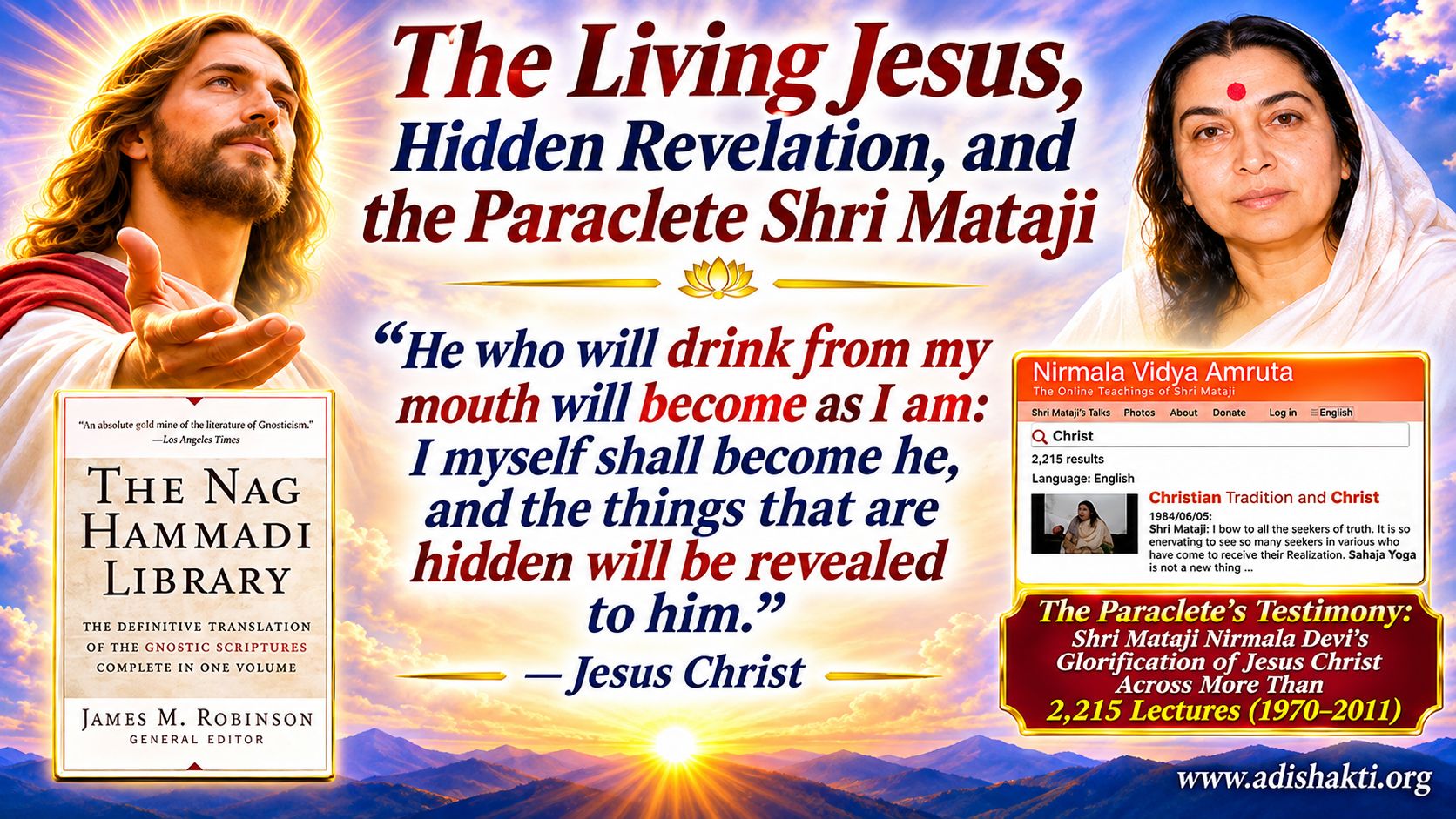
“He who will drink from my mouth will become as I am: I myself shall become he, and the things that are hidden will be revealed to him.”
The image of “drinking from my mouth” expresses intimate reception of Jesus’ teaching. It does not merely mean learning information about Jesus; it suggests assimilation of his wisdom until the disciple shares in his transformed consciousness.
This is the meaning of the “Living Jesus”: Jesus is not only a figure remembered by the Church, but a living reality who continues to teach, awaken, and transform those who receive him. The Gospel of Thomas therefore points beyond external belief toward inner union with Christ.
Hidden Things Revealed
Thomas repeatedly teaches that the Kingdom is not found by looking outward, but by recognizing the divine reality already present within the human being. The Gospel’s emphasis on “hidden” things means that divine truth is not inaccessible; it is concealed from the unawakened mind and revealed to the seeker who receives the living word.
In Gnostic language, gnosis is not ordinary intellectual knowledge. It is direct, experiential knowledge of ultimate reality—an inward recognition of the divine. Thus, to “drink from Jesus’ mouth” is to receive not merely doctrine, but the power to see, understand, and become.
The hidden things revealed to the disciple include:
- The true Self beyond ego, body, and conditioning.
- The presence of God within the human being.
- The inner meaning of Jesus’ teachings.
- The experience of the Kingdom of God as a present spiritual reality.
- Liberation from spiritual ignorance, fear, and death. adishakti
The Promise of the Paraclete
In the Gospel of John, Jesus promises that the Father will send “another Comforter,” the Paraclete, who will teach the disciples all things, remind them of Jesus’ words, and guide them into truth. The Paraclete is therefore not presented as a rival to Jesus, but as the divine presence who continues, protects, and completes Jesus’ revelation. adishakti
Adi Shakti.org states this continuity directly: “Jesus taught through intelligible words, sustained argument and profound parables; the Paraclete was promised to continue that pedagogy by teaching, reminding and guiding into truth.” This is precisely the function described in Thomas: the hidden meaning of Jesus’ words becomes revealed through living instruction and inner experience.
The Paraclete does not abolish Jesus’ message. Rather, the Paraclete makes Jesus’ message alive within the seeker. As the site explains, the Paraclete “brings the revelation of the Father found in Christ to the believers, reminds them of all that Jesus said, glorifies Christ, and convicts” the world.
Shri Mataji as the Fulfilled Promise

Within Sahaja Yoga, Shri Mataji Nirmala Devi is recognized as the promised Paraclete, Comforter, and Spirit of Truth. Her mission is understood as the fulfillment of Jesus’ promise that the Spirit would teach all things, remind the disciples of his words, and lead them into truth.
This fulfillment is seen not only in her identity but in the extraordinary scope of her teaching. Across more than 2,000 lectures, public programs, interviews, and recorded talks, Shri Mataji spoke repeatedly about Jesus Christ: his birth, mission, crucifixion, resurrection, teachings, and continuing spiritual presence. Her teaching therefore fulfills the Paraclete’s promised work of “reminding” the disciples of all that Jesus said. adishakti
The claim is not that Shri Mataji replaced Jesus. On the contrary, Adi Shakti.org presents her as the one who glorifies Christ by revealing the inner meaning of his life and message. The site describes her teaching as placing “Christ, resurrection, the Holy Spirit, Gnosis, forgiveness, Kundalini and Self-Realation” within one spiritual process.
Jesus Explained Through Shri Mataji
Shri Mataji’s lectures give Jesus’ words a living, experiential interpretation. She teaches that the Kingdom of God is entered through the awakening of the inner spiritual system, particularly through the Sahasrara, the seventh chakra or “thousand-petalled lotus.”
This interpretation directly corresponds to the Thomasine emphasis on inner revelation. Jesus says that the Kingdom is within; Shri Mataji explains how that inner Kingdom may be entered through Self-realization. The “hidden things” are therefore not merely doctrines to be memorized, but realities to be experienced in the awakened consciousness of the seeker.
Adi Shakti.org records that Shri Mataji declared that the Sahasrara Chakra was opened on May 5, 1970, at Nargol, India, enabling human beings to enter the Kingdom of God. In the framework of this paper, that event represents the practical fulfillment of Jesus’ promise that the Spirit would guide believers into truth.
Resurrection as Present Awakening
The Gospel of Thomas does not present resurrection merely as a distant future event. Its vision is transformative: the disciple passes from spiritual death into living knowledge of the divine.
Adi Shakti.org develops this same theme in its article “... and those who hear will live!” It states that Jesus places Resurrection in the present when he declares that the hour “is coming, and now is.” Within the Adi Shakti interpretation, Kundalini awakening is the second birth of the Spirit, and the experience of the Cool Breeze is the sign of this inner resurrection.
Thus, the resurrection proclaimed by Jesus is not only an event to be awaited, but a living reality to be entered. Shri Mataji’s teaching fulfills the Paraclete’s role by making this resurrection experientially accessible to those who receive Self-realization.
The Paraclete and the Age to Come
The “Age to Come” is not simply a remote future era. In the Adi Shakti interpretation, it is the age in which the promised Spirit becomes present, the Kingdom becomes accessible, and the Resurrection begins within living human beings.
Shri Mataji’s mission is therefore understood as eschatological: it announces the fulfillment of divine promises rather than merely predicting a distant future. The site presents her as the one through whom the Resurrection, Last Judgment, and Qiyamah have already commenced in spiritual form.
This does not mean that all human beings have automatically entered the Age to Come. Rather, it means that the doorway has been opened. Through Self-realization, the seeker may enter the Kingdom, receive the Spirit, and experience the hidden truth that Jesus promised would be revealed.
The Gospel of Thomas and Shri Mataji
The correspondence between the Gospel of Thomas and Shri Mataji’s teaching can be summarized as follows:
| Gospel of Thomas | Fulfillment in Shri Mataji’s teaching |
|---|---|
| The “Living Jesus” | Jesus remains spiritually present and active through the Paraclete. adishakti In Shri Mataji’s teaching, Jesus is not confined to the historical past: she locates Christ at the Agnya Chakra, where the seeker encounters the continuing spiritual significance of his life and words. The promised Paraclete, in this interpretation, does not replace Jesus but bears witness to him and makes his presence intelligible within the awakened subtle system. This is an interpretive parallel to Thomas’s “living Jesus,” not a direct claim made by the ancient text. |
| “Drink from my mouth” | The seeker receives the living essence of Christ’s teaching, not merely doctrine. adishakti The imagery of receiving words from Jesus’ mouth is understood as taking his teaching inwardly rather than repeating it as doctrine. Shri Mataji connects such inward reception with Kundalini awakening, thoughtless awareness, and the direct experience of spiritual truth. The comparison proposes that a seeker begins to understand Christ through transformation of awareness, not simply through textual study. |
| “Become as I am” | Self-realization transforms the seeker toward Christ-consciousness. adishakti Shri Mataji’s account of Self-realization describes a second birth in which the seeker’s awareness changes through the rising Kundalini. Within this framework, becoming “as I am” does not mean becoming the historical Jesus or acquiring his unique identity; it points to participation in qualities associated with Christ, including forgiveness, humility, detachment from ego, and awakened spiritual consciousness. This is a theological reading of Thomas’s saying. |
| “Hidden things revealed” | The Paraclete reveals the inner meaning of Jesus’ words. adishakti Shri Mataji explains spiritual realities through the subtle system, including the Agnya Chakra, Kundalini, and Sahasrara. Adishakti.org interprets this teaching as unveiling dimensions of Jesus’ message that were previously obscure: the inward Kingdom, the Spirit’s guidance, and the experiential significance of resurrection. The connection between Thomas’s hidden things and the Johannine Paraclete is an interpretive synthesis across two distinct gospel traditions. |
| Kingdom within | The Kingdom is entered through awakening of the Sahasrara. adishakti Shri Mataji teaches that Kundalini ascends through the subtle centers and reaches the Sahasrara, where union with the all-pervading divine power becomes accessible in Self-realization. In Adishakti.org’s understanding, the opening of the Sahasrara on May 5, 1970, makes the Kingdom a present possibility rather than only a future hope. This is a Sahaja Yoga account of the Kingdom, not an explicit description found in the Gospel of Thomas. |
| Resurrection | The Resurrection becomes a present spiritual awakening through the Spirit. adishakti Shri Mataji relates spiritual rebirth to the awakening of Kundalini and the seeker’s passage beyond identification with the ego and ordinary thought. Adishakti.org connects this to Jesus’ language of passing from death to life and interprets the Cool Breeze of the Spirit as a sign of inward renewal. The comparison concerns a present spiritual resurrection and should be distinguished from Christian doctrines about Jesus’ bodily resurrection. |
Conclusion
The Gospel of Thomas teaches that the disciple who receives the living word of Jesus will become like Jesus, and that hidden things will be revealed. Within the Sahaja Yoga understanding, this promise is fulfilled through Shri Mataji Nirmala Devi, the Paraclete, whose more than 2,000 lectures and teachings continually reveal the inner meaning of Jesus’ message.
Jesus opens the way; Shri Mataji completes the revelation by making it experientially known. Through Self-realization, the seeker drinks from the living stream of Christ’s wisdom, enters the Kingdom within, and begins to experience the Resurrection promised for the Age to Come.
Selected Sources and Links
The following sources from Adi Shakti.org develop the argument that Shri Mataji fulfilled the Paraclete’s promised role:
- Adi Shakti.org homepage: https://adishakti.org/index.htm — presents Shri Mataji as the Divine Feminine, Adi Shakti, and source of a comparative, experiential, and eschatological spiritual framework. adishakti
- “The Prince of the World is Coming!”: https://adishakti.org/AI/Jesus-Christ/The-Spirit-is-now-given.htm — explains that the Paraclete was promised to continue Jesus’ teaching by “teaching, reminding and guiding into truth.” adishakti
- “... and those who hear will live!”: https://adishakti.org/AI/Articles/Second-Coming-of-Christ-Resurrection-Within-the-Agnya-Chakra.htm — presents Resurrection as a present awakening through the second birth of the Spirit. adishakti
- “Redemption by the Divine Feminine”: https://adishakti.org/AI/Jesus-Christ/Christ-explains-human-redemption-occurs-by-mediation-of-Divine-Feminine.htm — connects Christ, resurrection, Holy Spirit, Gnosis, forgiveness, Kundalini, and Self-realization within one spiritual process. adishakti
- “But the Paraclete, the Spirit of Truth”: https://adishakti.org/AI/Jesus-Christ/The-Spirit-is-now-given.htm — examines Jesus’ promise in John 14:16–17 concerning the Spirit of Truth. adishakti
- “The Kingdom of God is within you”: https://adishakti.org/AI/Shri-Mataji/Authenticity-of-the-Kingdom-of-God.htm — develops the inward Kingdom in relation to mystical experience and the Sahasrara. adishakti
- “Witnessing opening of Kingdom of God”: https://adishakti.org/AI/Shri-Mataji/Authenticity-of-the-Kingdom-of-God.htm — records Shri Mataji’s declaration that the Sahasrara Chakra was opened on May 5, 1970. adishakti
- “The Paraclete and Last Judgment”: https://adishakti.org/AI/Christianity/The-Paracletes-evidence-of-Two-Ages.htm — connects the Paraclete with eschatological fulfillment and divine justice. adishakti