Summary
This paper examines a distinctive interpretation of Christianity articulated by Shri Mataji Nirmala Devi: that Christ’s central work concerns the awakening of the Spirit, resurrection is a demonstration of humanity’s spiritual destiny, the Holy Spirit is inseparable from the Divine Feminine, and the language of Gnosis finds its fulfilment in direct spiritual knowledge rather than belief alone. It also examines her criticism of Pauline and institutional Christianity as her own theological interpretation, distinguishing those claims from questions of conventional historical scholarship.
Read together, her teachings form a coherent spiritual anthropology. The human being is not merely the body or the thinking mind. Within the subtle system, Christ is associated with the Agnya chakra; forgiveness opens this constricted centre; the Kundalini—the maternal spiritual power—ascends toward the Sahasrara; and Self-Realization gives experiential knowledge of the Spirit. In this framework, redemption is not merely a legal acquittal or assent to doctrine. It is an inward transformation mediated by divine grace, understood in explicitly maternal terms.
- Introduction: Christ, Gnosis and the Divine Feminine
- Christ and the problem of transmitted scripture
- Paul and Shri Mataji’s critique of institutional Christianity
- Resurrection as the revelation of the Spirit
- Christ, Agnya and the transformative power of forgiveness
- Gnosis: knowledge beyond rationality
- The Gnostics, heresy and suppressed spiritual knowledge
- The Divine Feminine as Holy Spirit and redemptive power
- Kundalini, Self-Realization and the East–West comparison
- A synthesis of Shri Mataji’s teaching on Christ
- Conclusion
- References and source note
1. Introduction: Christ, Gnosis and the Divine Feminine
The central argument of this study is not that Christianity can simply be reduced to an Indian religious system, nor that every Christian symbol has a one-to-one yogic equivalent. Rather, it examines the interpretive framework given by Shri Mataji Nirmala Devi, in which Christ, resurrection, the Holy Spirit, Gnosis, forgiveness, Kundalini and Self-Realization belong to a single spiritual process. Her teaching repeatedly shifts the emphasis from doctrine about Christ to the actualization of what Christ came to make possible in human consciousness.
Within that framework, Christ is not treated merely as a historical teacher whose sayings must be intellectually accepted. He is understood as a living principle within the subtle constitution of the human being. His resurrection reveals that the human vocation is spiritual rather than merely bodily; his teaching of forgiveness is linked to the opening of the Agnya chakra; and the promised life of the Spirit becomes experiential through Self-Realization. The Divine Feminine, understood as the Holy Spirit and maternal power of God, is the active agency by which this transformation takes place.
This approach also explains Shri Mataji’s sustained interest in early Christian and Gnostic traditions. She regarded the recovery of texts associated with Nag Hammadi as important because they appeared, in her reading, to preserve a Christianity oriented toward direct knowledge. Her comments on Paul and later ecclesiastical Christianity are forceful and polemical. They are therefore presented below as Shri Mataji’s stated interpretation, rather than silently converted into uncontested historical conclusions.
2. Christ and the problem of transmitted scripture
In his life time which was so very short, whatever he has said, every word is great. But as I told you that this Paul tried to completely change, re-edit the Bible and he's put lots of things in there. Whatever weaknesses he has, he has put them nicely.
Now recently I've got a book which was hidden in a jar in Egypt for about, till fifty years they discovered it, and this book is called as the Library of Hammadi. The place was called Hammadi were it was discovered, and what Christ has said, what Thomas has written. When Thomas was coming to India he put all these things there, is very interesting.
Christmas Puja, Ganapatipule, India Tour, December 25 1992
Explanation of the teaching
This passage establishes two ideas that are foundational to Shri Mataji’s reading of Christianity. First, she gives an exceptionally high valuation to Christ himself: “whatever he has said, every word is great.” Her criticism is therefore not directed at Jesus but at the historical transmission and interpretation of his teaching. She draws a distinction between Christ and the later textual and institutional structures claiming to speak for Christ.
Second, she treats the discovery of the Nag Hammadi writings as significant because it reopens the question of early Christian diversity. In her theological use of these materials, the importance of Thomas and other non-canonical traditions lies in their emphasis on inward knowledge, transformation and direct encounter. For Shri Mataji, such themes resonate with Sahaja Yoga because spiritual truth must become an experience of consciousness rather than remain a proposition accepted by the intellect.
Her point is therefore hermeneutical as much as historical: a seeker should judge a religious tradition by whether it leads to the spiritual reality to which its founder pointed. Scripture remains valuable, but the ultimate verification is transformation. This is why the paper’s comparison of Christianity with Self-Realization should be read as an argument about experience, realization and spiritual anthropology, not merely about similarities of vocabulary.
3. Paul and Shri Mataji’s critique of institutional Christianity
Paul never even met Christ, and just made up lies. And we know what he saw was supra-conscious. Actually, he was a bureaucrat who killed one of Christ's disciples, Stephen, and saw Christianity as a good platform to jump on for his forum. He fought with everyone. Thomas disappeared and his treatises were found 50 years ago in Egypt. It's all sahaja.
Talk with Spanish Sahaja Yogis—October 12, 1994
Explanation of the teaching
This is one of Shri Mataji’s strongest criticisms of Paul. The language is categorical, and its theological purpose is clear: she separates what she understands as the original experiential teaching of Christ from what she regards as later doctrinal construction. Her phrase “It’s all sahaja” is crucial. “Sahaja” means innate or spontaneous; in her teaching, divine realization is not manufactured by an institution. It is a living capacity already placed within the human being and awakened through grace.
The deeper issue is authority. If salvation depends primarily upon accepting an externally formulated doctrine, religious authority naturally gravitates toward texts, creeds and institutions. If, however, the decisive event is an inward awakening that can be experienced and verified, authority shifts toward realized consciousness. Shri Mataji’s critique of Paul functions within this second model.
That does not by itself settle the historical debates surrounding Paul, Thomas or the formation of the New Testament. Rather, it tells us precisely how Shri Mataji interprets the history: she sees a tension between experiential Christianity and doctrinal Christianity, and she places Christ and the Gnostic impulse on the former side.
4. Resurrection as the revelation of the Spirit
This is the day for us to remember that Christ was born on this earth as a man. He came to this earth, and before him stood a task to enlighten the human consciousness so that people can understand that they are not this body, and Spirit; that we can see the actual implementation of this in people's minds.
The mission of Christ was His resurrection, that is, that you [] the Spirit, not the body. And He showed his resurrection, as He climbed into the realm of the Spirit, who He was because He was the Pranava. He was a Brahma, Mahavishnu He was, as I already told you, telling of His birth. And He came to this earth in bodily form like a man. He wanted to show one more thing: that the Spirit has nothing to do with money, has nothing to do with power. He is all-powerful, all-pervading.
The Message of Christ — Caxton Hall, London, U.K.—December 10, 1979
Explanation of the teaching
Here Shri Mataji identifies the mission of Christ with resurrection. The significance of resurrection is not confined to an extraordinary event concerning Jesus alone. It reveals what a human being fundamentally is. Her contrast is between bodily identity and spiritual identity: Christ comes to “enlighten the human consciousness” so that the human person no longer mistakes the body for the whole self.
Her identification of Christ with Pranava, Brahma and Mahavishnu places Christ within a universal metaphysical structure. In this reading, the Logos of Christian theology and the primordial divine vibration of Indian thought are not rival realities but different religious languages pointing toward the same transcendent principle. Christ’s incarnation is therefore understood as the embodiment in human form of a cosmic principle already active within creation.
The final sentences also radically detach Spirit from worldly measures of success. Money and political or institutional power do not validate spiritual truth. The Spirit is “all-powerful, all-pervading” precisely because it belongs to a dimension that cannot be possessed by worldly institutions. Resurrection consequently becomes both a revelation of Christ and a disclosure of the destiny of consciousness: to know itself as Spirit.
5. Christ, Agnya and the transformative power of forgiveness
Whatever it is, we have to know also that the Bible is not completely representing Christ, as it has happened with every book. So, there are problems and, as in every religion, people have gone astray from their right path and are spoiling the name of the people who have been divine and who started those religions. Also, is happened in the Christian nations. Just the opposite of what Christ has said, they're doing.
For us, one has to realize that He came on this Earth to open our Agnya chakra, which is a very difficult thing. Sahasrara is not difficult as Agnya. Agnya chakra is a very constricted chakra on which He resides. And He has said, 'You have to forgive yourself and forgive others.' This is the mantra of the Agnya chakra.
Christmas Puja, Ganapatipule, India—December 27, 1994
Explanation of the teaching
This passage gives the most concrete yogic interpretation of Christ in Shri Mataji’s teaching. Christ is said to reside at the Agnya chakra, the subtle centre associated with the crossing of the optic nerves and with the narrow passage that must be crossed before awareness opens into Sahasrara. The Crucifixion and the Agnya are thus linked symbolically and spiritually: the cross becomes not only an external emblem but an interior event in the ascent of consciousness.
Why, in this framework, is forgiveness so important? Resentment, condemnation and self-condemnation bind attention to the ego and to past injury. Forgiveness releases that fixation. Shri Mataji therefore interprets Christ’s insistence upon forgiveness not simply as moral advice but as a practical key to spiritual ascent. “Forgive yourself and forgive others” becomes the mantra of the Agnya because forgiveness loosens the constriction through which the Kundalini must pass.
This also changes the meaning of redemption. Redemption is not merely something declared about the believer from outside. It involves a transformation of awareness in which guilt, hostility and egoic judgment cease to dominate consciousness. Christ’s teaching is therefore simultaneously ethical, psychological and mystical. The command to forgive becomes an operation upon consciousness that prepares the seeker for entry into the Sahasrara—the state Shri Mataji repeatedly associates with the Kingdom of God.
6. Gnosis: knowledge beyond rationality
The enlightened people were called as Gnostics. This comes from the Sanskrit word Gna which means knowledge. But knowledge does not mean what one knows through the brain, because brain or intelligence takes one to rationality, which has no wisdom behind it. Rationality can take one anywhere, can justify anything, as it is not absolute. So one has to go beyond rationality, develop higher senses of Divinity by which one can understand the real problems, and the actual solutions of all these problems.
Sahaja Yoga (1990), pp. 21-22
Explanation of the teaching
Shri Mataji distinguishes knowledge as realization from knowledge accumulated by the brain. Her criticism is not an argument against reason in its proper sphere. It is an argument against treating discursive reason as the final instrument for knowing spiritual reality. Rationality can construct mutually contradictory systems and then defend each of them. For her, this demonstrates that rational thought alone is not “absolute.”
The higher knowledge she describes is therefore transformative and participatory. One does not merely form a concept of the Spirit; one becomes aware of the Spirit. One does not merely define peace; consciousness enters a state of inner silence. One does not merely debate divine grace; grace becomes perceptible as a living spiritual reality. In Sahaja Yoga this distinction is fundamental: Self-Realization is knowledge by being and experience, not knowledge by description alone.
This is the point at which her interpretation of Gnosis converges with the paper’s East–West comparison. The Sanskrit terms jñāna and jñāni designate knowledge and the knower in a spiritual sense. Shri Mataji reads the Gnostic quest through that lens: the “knower” is not simply better informed but inwardly awakened.
7. The Gnostics, heresy and suppressed spiritual knowledge
They faced such problems, these Gnostics, that the people started calling them heretics, and also said, ‘This is blasphemy.’ ... You can imagine what was the situation, that time, to talk about knowledge, or about reality. But today it's not so; we can openly talk about it. Nobody can arrest us for that, and nobody can say that we are blasphemy, or doing blasphemy, or heretics. They may say, but they cannot charge us with that. We cannot be arrested, because the Church is not that strong now, thank God.
India Tour, Alibag, India—December 29, 1991
Explanation of the teaching
In this passage Shri Mataji places the conflict between Gnosticism and ecclesiastical authority within a broader recurring pattern: direct spiritual knowledge is difficult for institutions to control. A person whose certainty rests upon inner realization does not depend in the same way upon external authorization. This helps explain why “Gnostic” is such an important category in her account of Christianity.
Her reference to accusations of heresy and blasphemy also highlights the historical cost of religious boundary-making. Whatever conclusions scholars reach about the many distinct movements grouped under the modern label “Gnosticism,” Shri Mataji uses the term primarily for seekers of direct divine knowledge. Her concern is therefore spiritual rather than taxonomic: can human beings know reality directly, or must they merely believe what an institution tells them about it?
Her answer is unambiguous. The age of enforced theological conformity should give way to an age in which claims about spiritual reality can be openly examined and, most importantly, tested in human experience.
8. The Divine Feminine as Holy Spirit and redemptive power
The preceding teachings converge on the Divine Feminine. If Christ’s purpose is to awaken humanity to the Spirit, and if this awakening must become a living experience, then there must be a divine power by which the transformation is actualized. Shri Mataji identifies that active, life-giving power with the Divine Mother: the Holy Spirit understood not as an abstract theological remainder but as God’s maternal, creative and redemptive power.
This provides the conceptual centre of the present paper. The Divine Feminine is not introduced as an ornamental addition to Christianity. She is presented as the mediating power of spiritual rebirth. In Sahaja Yoga terminology, the Kundalini is the individualized maternal power placed within each human being. Her awakening gives the “second birth” because consciousness moves from conceptual religion toward direct perception of the Spirit.
From this perspective, the Christian language of being “born of the Spirit,” the Gnostic language of knowledge, the Indian language of Self-Realization, and the Sahaja Yoga language of Kundalini awakening are interpreted as converging descriptions of a transformation in the human subject. The theological claim is profound: God the Mother is not separate from redemption; the maternal divine power is the agency through which redemption becomes inwardly real.
The paper’s older claims concerning the “Earthly Mother,” Barbelo, Mary, the Holy Spirit and early Christian feminine imagery should therefore be handled carefully. Different texts belong to different historical communities and cannot automatically be collapsed into one doctrine. Their importance for this study is comparative: they show that maternal and feminine symbolism has existed within strands of Christian and late-antique spirituality, while Shri Mataji supplies a modern theological synthesis in which the Divine Feminine becomes central to spiritual realization.
9. Kundalini, Self-Realization and the East–West comparison
Shri Mataji’s teaching makes the East–West comparison intelligible through the subtle system. Kundalini is the maternal spiritual energy; the chakras are centres through which consciousness is integrated and purified; Agnya is the centre particularly associated with Christ and forgiveness; and Sahasrara is the culmination in which the seeker experiences union with the all-pervading divine reality.
Within this framework, several Christian themes acquire an experiential interpretation. “Second birth” becomes awakening into spiritual consciousness. The “Kingdom of God within” becomes an inwardly realized state rather than merely a future location. “Living water” becomes an image for divine vitality and grace. Resurrection becomes the definitive proclamation that Spirit transcends bodily identity. Forgiveness becomes the means of crossing the narrow Agnya. The Holy Spirit becomes the maternal divine power that makes the entire ascent possible.
These are theological correspondences, not proofs that the historical Jesus taught later technical Sanskrit chakra terminology. The stronger and more defensible formulation is that Shri Mataji presents a comparative spiritual hermeneutic: Christian sayings are interpreted through an experiential map that she considers universal. Their truth is ultimately to be tested, in her system, not by verbal resemblance alone but by whether Self-Realization produces the state of consciousness those sayings describe.
This is also why karma and reincarnation enter the discussion. They belong to a developmental view of the human being in which consciousness is purified and matured rather than defined only by a single intellectual act of belief. Yet Shri Mataji’s distinctive emphasis is that realization is not merely the remote reward of prolonged ascetic striving. Through the awakening of Kundalini, the seeker can receive a direct beginning of spiritual knowledge—sahaja, spontaneous and born with us.
10. A synthesis of Shri Mataji’s teaching on Christ
Taken together, the six passages above form a remarkably consistent theology. Christ is the revealer of the Spirit. His resurrection demonstrates that the deepest identity of the human being is not reducible to the physical body. Christ is also the principle of Agnya. His teaching of forgiveness is the practical means by which the constricted centre is opened. Gnosis is realized knowledge. Spiritual truth must pass beyond rational construction into direct awareness. The Divine Feminine is the active power of realization. The maternal divine energy awakens the seeker and carries consciousness toward Sahasrara.
On this reading, Shri Mataji’s criticism of institutional Christianity follows from her positive theology. Her objection is not simply that institutions possess doctrines with which she disagrees. Her deeper objection is that religion can become detached from the event it is meant to produce: the transformation of human consciousness. A Christianity that speaks about resurrection but does not lead toward spiritual rebirth, or invokes the Holy Spirit without awakening the Spirit within, has—according to this framework—preserved the vocabulary while losing the experiential centre.
Her teaching therefore asks a different question from conventional doctrinal apologetics. Instead of asking only, “Which proposition must one believe about Christ?” it asks, “What did Christ come to awaken in the human being, and can that awakening be experienced now?” The answer given by Sahaja Yoga is Self-Realization: the awakening of the maternal Kundalini, passage through the centres, the opening of Sahasrara, and direct knowledge of the Spirit.
11. Conclusion
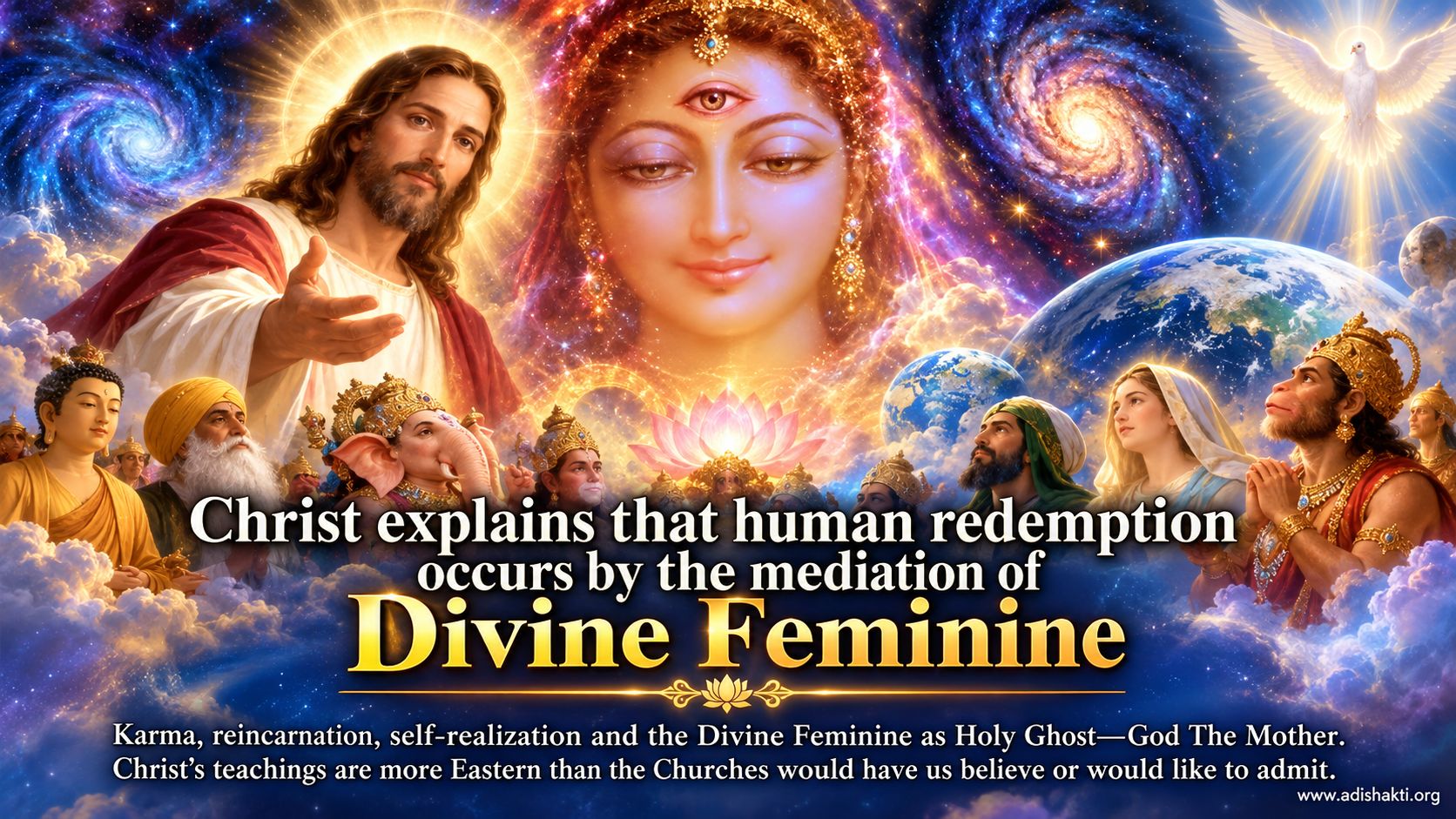
The claim that “human redemption occurs by the mediation of the Divine Feminine” is best understood, within Shri Mataji’s teaching, as a claim about the mechanism of spiritual transformation. Christ reveals the destiny of Spirit through resurrection; forgiveness opens the Agnya associated with him; the Divine Mother as Kundalini awakens within the seeker; and the culmination is Self-Realization in Sahasrara. Gnosis is the knowledge born from that realization.
This interpretation is deliberately broader than conventional Western Christian theology. It reads Christianity, Gnostic spirituality and Indian metaphysics as participating in a universal drama of awakening. Its central contrast is not simply East versus West, or canonical versus non-canonical scripture. It is belief without realization versus knowledge grounded in transformed consciousness.
For Shri Mataji, therefore, Christ is not diminished by comparison with Eastern traditions. He is universalized. His resurrection, his insistence on forgiveness, his proclamation of the Spirit and his promise of inner transformation become parts of a living subtle process. And the Divine Feminine—Holy Spirit, Mother, Kundalini, the life-giving power of God—is the mediating presence through which that promise becomes experience.
12. References and source note
Primary Shri Mataji sources quoted in full above: Christmas Puja, Ganapatipule, India Tour, December 25 1992; Talk with Spanish Sahaja Yogis, October 12, 1994; The Message of Christ, Caxton Hall, London, December 10, 1979; Christmas Puja, Ganapatipule, India, December 27, 1994; Sahaja Yoga (1990), pp. 21–22; India Tour, Alibag, India, December 29, 1991.
Editorial note: The quotations supplied for this article have been reproduced individually and verbatim, including unusual grammar, punctuation, capitalization, and the bracketed lacuna “[]” in the December 10, 1979 quotation. Historical assertions contained inside the quotations are presented as Shri Mataji’s statements. They should not be mistaken for independent historical verification by this article.