Two Births, One Resurrection: Let the Living 'Dead' Arise
Summary
Jesus places Resurrection in the present when he declares that the hour “is coming, and now is.” This paper argues that the decisive Resurrection is therefore the awakening of living human beings from spiritual death through the second birth of the Spirit. Within the Adishakti interpretation, Kundalini awakening is that second birth, and the Cool Breeze experienced above the Sahasrara and on the hands is the Wind of Heaven—the pneuma promised by Jesus and identified by Shri Mataji as the tangible sign of the Holy Spirit. The paper then places this Johannine theology beside An-Nabaʾ, whose Great News must likewise be heard, questioned, disputed, and consciously received by living persons.
Abstract
This paper develops a comparative Christian–Islamic theology of Resurrection around one of the most radical sayings attributed to Jesus in the Gospel of John: “The hour is coming, and now is, when the dead will hear the voice of the Son of God, and those who hear will live” (John 5:25). The decisive phrase is “and now is.” It prevents Resurrection from being confined entirely to a remote future in which decomposed bodies are reconstructed from graves. In John 5:24–25, Resurrection has already entered the present: the one who hears Christ's word, believes, and receives eternal life “has passed from death to life.” The dead who hear are therefore living human beings who are spiritually dead but capable of receiving revelation, responding to the divine Voice, and entering a new mode of life.
The argument is developed through Jesus' teaching on two births in John 3. The first birth is through the human mother and produces fleshly, biological life. The second is the birth “of the Spirit,” without which, Jesus declares, no one can enter the Kingdom of God. This second birth is linked in Johannine theology to the coming Paraclete, the Spirit of Truth promised in John 14–16. Within the theological interpretation advanced by Adishakti.org, Shri Mataji Nirmala Devi identifies this second birth with Kundalini awakening and Self-Realization, and identifies its tangible sign as the Cool Breeze of the Holy Spirit felt above the head and on the hands.
The same logic is then placed in dialogue with Surah al-Nabaʾ. The Qur'an's Great News of Resurrection is something living persons ask about, disagree about, hear, and eventually come to know. This creates the same fundamental problem found in John 5: Resurrection is addressed to conscious persons. Corpses do not question, dispute, understand, believe, repent, or experience awakening. The central eschatological question therefore becomes not how bones physically reconstruct themselves, but how the souls of humanity's historical dead become living human participants capable of hearing the Great News and consciously entering Resurrection.
The thesis of this paper is consequently explicit: there is no spiritually meaningful Resurrection of decomposed corpses as corpses. Resurrection belongs to the living. Historical souls must first become living human subjects; then those living subjects must receive the second birth of the Spirit. Within the Adishakti framework, this second birth is Kundalini awakening, the promised birth of the Spirit, and its tangible sign is the Cool Breeze—the Wind of Heaven that begins to issue forth from those who have been born of the Spirit.
1. “The Hour Is Coming, and Now Is”
Christian theology has traditionally emphasized the future resurrection of the dead, and any serious academic discussion must acknowledge that John 5:28–29 has overwhelmingly been interpreted by historic Christianity as referring to a future bodily resurrection. Yet immediately before that passage Jesus speaks in a dramatically different tense. He declares that the hour “is coming, and now is” when the dead will hear the Son of God and live. Mainstream commentators commonly recognize John 5:24–25 as an instance of realized eschatology: eternal life is already being bestowed and the spiritually dead are already passing into life.
The significance of this cannot be overstated. John does not portray Resurrection solely as an anatomical event at the end of cosmic history. He presents it first as a revelatory event in which a living human subject hears the divine Word and undergoes a transition from death into life. John 5:24 states that the hearer “has eternal life” and “has passed from death to life.” John 5:25 repeats this structure in even more concentrated form: the dead hear, and those who hear live. The decisive verbs are therefore cognitive, relational, and spiritual. Resurrection begins with hearing.
This radically relocates the center of eschatology. A decomposed body does not hear revelation in the ordinary sense of the word. It does not understand, believe, repent, recognize signs, dispute a proclamation, receive a new heart, or experience spiritual transformation. All of these belong to living consciousness. The Resurrection that Jesus says “now is” must therefore be taking place among the living.
2. Two Births, One Resurrection
John 3 supplies the anthropology that makes John 5 intelligible. Jesus distinguishes between birth according to flesh and birth according to Spirit: “That which is born of the flesh is flesh, and that which is born of the Spirit is spirit.” The first birth is ordinary human birth through one's present biological mother. It confers physical existence, embodiment, natural consciousness, and participation in earthly life. It is indispensable, but Jesus explicitly teaches that it is not sufficient for entrance into the Kingdom of God.
The second birth is qualitatively different. Jesus tells Nicodemus, “You must be born again,” and explains that unless one is born of water and Spirit one cannot enter the Kingdom. The argument therefore contains a clear two-stage anthropology: biological birth makes a person physically alive, while spiritual birth makes that living person alive to God. The first birth produces flesh; the second produces spirit.
This distinction is crucial for understanding Resurrection. Resurrection cannot simply mean the continuation or reconstruction of biological existence, because Jesus explicitly distinguishes biological existence from the life required for the Kingdom. A human being may already be alive according to the flesh and yet remain dead in the spiritual sense presupposed by John 5. The decisive transformation is therefore the second birth.
3. The Paraclete as the Giver of the Second Birth

John's theology of the second birth cannot be separated from Jesus' promise of the Paraclete. In John 14–16, Jesus promises that another Paraclete, the Spirit of Truth, will come, abide with the disciples, teach them, remind them of his words, bear witness to him, and guide them into truth. The promised Spirit therefore continues the revelatory work of Christ after his historical departure.
Within mainstream Christianity, the Paraclete is identified with the Holy Spirit. Within the confessional theology developed by Adishakti.org, this promise is interpreted more specifically through Shri Mataji Nirmala Devi, who is understood as the eschatological Paraclete through whom the Holy Spirit makes the second birth collectively available in the Age to Come. That identification is a theological claim of the Adishakti framework rather than a conclusion accepted by historical-critical scholarship, but its internal logic is direct: if Jesus promised the Spirit, and if spiritual rebirth requires that Spirit, then the eschatological work of the Paraclete must consist precisely in giving humanity the second birth.
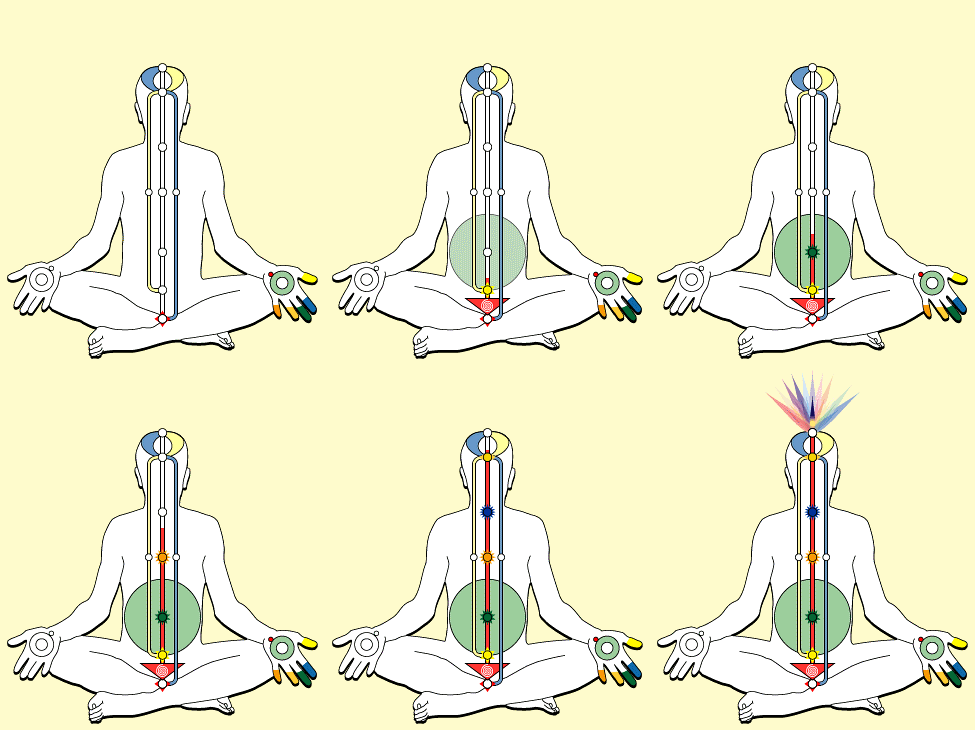
Shri Mataji's distinctive claim is that this second birth is not merely symbolic, doctrinal, emotional, or sacramental. It is an actual inner event in which the Kundalini rises through the subtle system, crosses the Sahasrara at the crown of the head, and connects individual consciousness with the all-pervading divine power. The tangible sign of this connection, she repeatedly taught, is the Cool Breeze.
4. The Wind of Heaven Is the Cool Breeze
This is the point that deserves central emphasis. The “wind of heaven” is not treated in the present theology as a decorative metaphor at the edge of the argument. Within the Sahaja Yoga interpretation it becomes the central phenomenological sign by which the second birth is recognized. The Adishakti study “Resurrection is accomplished by the Wind of Heaven that sweeps the worlds” explicitly identifies the Wind of Heaven with the Cool Breeze of the Holy Spirit and relates it to the scriptural vocabulary of pneuma, ruach, breath, wind, and Spirit.
This dramatically strengthens the Johannine parallel because John 3:8 itself exploits the semantic richness of pneuma, a Greek word that can mean wind, breath, or spirit. Jesus describes the second birth through the movement of the wind: “The wind blows where it wishes… so it is with everyone who is born of the Spirit.” Within conventional interpretation, the saying describes the sovereign and mysterious activity of the Spirit. Within the Adishakti interpretation, however, it acquires an additional experiential dimension: the wind is not merely compared with the Spirit; it becomes something that may be felt when the Spirit awakens the human being.
According to Shri Mataji's teaching, after Kundalini awakening this Cool Breeze may be experienced above the fontanelle and on the palms, and it may also begin to issue forth from the person who has received Self-Realization. This is central to the present argument. The person who is “born of the Spirit” does not merely assent intellectually to the existence of Spirit; the awakened person becomes, within this theology, a participant in the movement of that Spirit. The same divine wind that gives the second birth becomes perceptible through the transformed human instrument.
Thus Jesus' saying can be read, within the Adishakti framework, with extraordinary literal force: “So it is with everyone who is born of the Spirit.” The spiritually reborn person becomes associated with the movement of divine pneuma. The Wind of Heaven does not belong to a remote future. It begins to blow through the living.
5. The Cool Breeze as Experiential Verification
The claim of “proof” requires careful academic formulation. It would exceed what historical scholarship or laboratory science establishes to say that modern science has demonstrated that the Cool Breeze is objectively the Holy Spirit. That metaphysical identification belongs to Sahaja Yoga theology. Yet it would also be inaccurate to dismiss the Cool Breeze as merely an abstract symbol, because the experience is reported by practitioners as a recurring bodily and phenomenological event associated with Kundalini awakening and Self-Realization.
The Adishakti theological claim goes further by presenting this recurring experience as a form of experiential verification. Shri Mataji's invitation was not simply to believe an assertion about the Holy Spirit, but to undergo Kundalini awakening and observe whether the Cool Breeze becomes perceptible. In that specific sense, the claim is presented as testable within the discipline itself: the individual becomes the site at which the theological proposition is experienced.
This distinction preserves both academic caution and the full force of the confessional claim. Sociology can document reports of the sensation; physiology can investigate correlates; theology interprets its significance. Within Sahaja Yoga, that significance is explicit: the Cool Breeze is the breath or wind of the Holy Spirit accompanying the second birth.
6. The Wind That Begins to Issue Forth From the Spirit-Born
The Cool Breeze is not merely experienced as something descending upon a passive recipient. In Shri Mataji's descriptions, after Kundalini reaches the Sahasrara, the Cool Breeze may be felt coming from the crown of the head and through the hands. The imagery therefore reverses the ordinary expectation of religion. The believer does not simply wait for a divine wind from heaven; after Self-Realization, the living human person becomes an instrument through which that wind itself becomes perceptible.
This gives John 3:8 an unusually concrete eschatological significance. Jesus says that the wind and those born of the Spirit are mysteriously related. In the Adishakti interpretation, that relationship is not merely analogical. The one born of the Spirit begins to participate in the same pneuma. The awakened human being becomes, so to speak, a living aperture of the Wind of Heaven.
The theological implications are enormous. Resurrection is no longer conceived as divine power acting upon dead matter. It is divine life entering, awakening, transforming, and then flowing through living human beings. The person who was spiritually dead becomes spiritually alive; the Spirit is not only received but manifested. This is why the phrase “Let the living arise!” is so important. The Wind of Heaven does not sweep through cemeteries in search of skeletal remains. It sweeps through humanity.
7. “Let the Living Arise!”
The Adishakti article reproduces the powerful formulation: “Resurrection is accomplished by the wind of heaven that sweeps the worlds. The Angel carried by the wind does not say: Arise ye dead! He says: Let the living arise!” The statement captures the entire theological reorientation proposed here. The resurrection of the living is not a lesser spiritual metaphor beside some supposedly more literal resurrection of corpses. It is the essential event: a human person must awaken while capable of awakening, receive the Spirit while capable of receiving, and know God while capable of knowing.
The Gospel of Philip tradition discussed in the same article reinforces this interpretation by insisting that Resurrection must be acquired while one exists in this world. Whether or not one accepts Valentinian theology as authoritative Christianity, its interpretation preserves an important strand of early Christian reflection in which Resurrection means awakening from a condition of spiritual death during embodied life.
Within the Adishakti framework, the Cool Breeze supplies the experiential mechanism joining this ancient language to Jesus' promise of birth by the Spirit. The ancient Wind of Heaven is no longer merely a literary image; it is interpreted as the felt pneuma accompanying the second birth.
8. Resurrection Is a Transformation of the Living Subject
The conceptual advantage of this model is that it places the human subject rather than decomposed material at the center of Resurrection. A human person cannot be reduced to a quantity of atoms. Even if divine omnipotence could reconstruct every material component of a former body, merely reassembling matter would not by itself produce spiritual awakening. Resurrection worthy of the theological name must concern consciousness, personhood, relation to God, and transformed life.
John 5:24–25 describes exactly such a transformation. The hearer receives eternal life and passes from death to life. This is not simply a body becoming mobile again; it is a person moving from one existential condition into another. The second birth therefore resolves a problem literalist eschatology often leaves untouched: physical animation does not equal salvation. Flesh alone does not enter the Kingdom. Jesus explicitly says that what is born of flesh remains flesh, while what is born of Spirit becomes spirit.
9. The Age to Come Begins in the Present
The phrase “the hour is coming, and now is” implies that the Age to Come has already begun to penetrate the present age. Johannine eschatology repeatedly operates through this tension. Eternal life belongs to the future consummation, yet believers possess it now. Judgment is future, yet human response to Christ already reveals judgment. Resurrection belongs to the age to come, yet John 5:25 says that its hour already exists.
Within the Adishakti interpretation, Shri Mataji's mission belongs precisely to this overlap between ages. She described the contemporary era as a special period of collective awakening, Resurrection, Last Judgment, and the Blossom Time. In this framework, historical souls take human birth in these special times and receive their Realization rather than emerging as decomposed bodies from graves.
The second birth of the Spirit therefore becomes the operative sign that the Age to Come has commenced. What was formerly promised eschatologically becomes experientially available. The Spirit that Jesus promised is no longer regarded merely as a doctrine transmitted from antiquity; it is claimed to be encountered through Kundalini awakening and the Cool Breeze associated with the opened Sahasrara.
10. An-Nabaʾ and the Same Problem of Hearing
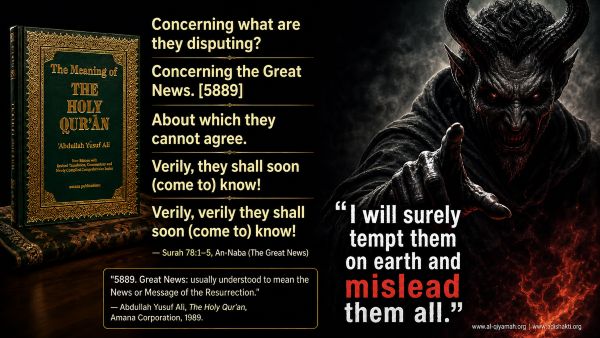
The Qur’anic Great News is addressed to living hearers who ask, dispute, know, and consciously confront Resurrection.
The Qur'anic Great News raises a parallel question. Surah al-Nabaʾ begins with living persons asking one another about the momentous News and disagreeing over it. Classical tafsir identifies this News with Resurrection and the Day of Judgment. The conceptual difficulty is therefore immediate: announcement presupposes hearers.
One must be alive in some meaningful sense to receive news, discuss it, misunderstand it, deny it, or finally recognize its truth. The Great News is therefore addressed to living consciousness. That does not by itself disprove Islamic bodily resurrection, but it does show that the eschatological drama cannot be reduced to the reanimation of physical remains.
The same verbs recur across Christian and Islamic eschatology: hear, ask, dispute, know, believe, witness, stand, answer. These are acts of persons. Thus John and An-Nabaʾ unexpectedly converge at the level of human consciousness. Jesus declares that the dead must hear his Voice. The Qur'an announces the Great News to those who question and dispute it. Both scriptures therefore make the living hearer central to eschatology.
11. Rebirth Makes the Historical Dead Present; the Spirit Makes Them Resurrected
If humanity's historical dead are to participate consciously in the eschatological age, a coherent mechanism is required by which they become living human subjects again. Within the theology developed across the Adishakti Resurrection papers, that mechanism is rebirth.
Rebirth should not be confused with Resurrection. Rebirth brings the soul back into embodied human existence and restores the human subject to history. That living person must then encounter the eschatological proclamation and receive the second birth of the Spirit. The sequence is therefore coherent: a former soul returns through human birth, lives again as an embodied person, encounters the Good News of Resurrection, receives Kundalini awakening, becomes born of the Spirit, experiences the Cool Breeze, and passes from spiritual death into life.
In this model, reincarnation solves the problem of participation, while Self-Realization accomplishes Resurrection. Rebirth returns the soul to the living; the second birth raises the living into divine life.
12. The Grave Is Not the Goal
The deepest criticism of grave-centered eschatology is not that an omnipotent God could not theoretically reconstruct a body. Theologically, omnipotence makes such objections inconclusive. The more fundamental question is why Resurrection should be centered upon decomposed matter when the scriptures themselves repeatedly center consciousness, Spirit, hearing, knowledge, faith, judgment, and transformation.
A grave contains what remains of a former biological organism. The divine purpose of Resurrection, however, concerns the person. The person must become capable of hearing and responding to God. Therefore, if historical souls are reborn into human existence, the grave no longer needs to function as the physical warehouse from which Resurrection is assembled.
This is the point at which the Adishakti interpretation deliberately departs from mainstream Christian and Islamic orthodoxy. It rejects the reconstruction of decomposed corpses as the true meaning of Resurrection and instead identifies Resurrection with the transformation of living humanity through the Spirit. That is a confessional theological claim, but it draws extraordinary force from John 5:25: “The hour is coming, and now is.”
13. The Cool Breeze as the Sign of the Resurrection of the Living
The entire argument finally converges upon the Cool Breeze. If Jesus promises a second birth by the Spirit, and if he describes that birth through the language of wind, then a tradition claiming that spiritual rebirth produces a tangible experience of cool wind deserves serious theological attention. Within Sahaja Yoga, that is precisely the claim.
The Cool Breeze is interpreted as the Wind of Heaven, the Pneuma of the Holy Spirit, the all-pervading divine power encountered when Kundalini rises through the Sahasrara. After this awakening, practitioners report feeling the Breeze on the palms and above the head; Shri Mataji taught that it may also be felt issuing from the crown itself.
Within this theological framework, the phenomenon becomes the experiential signature of Jesus' prophecy. The person has undergone the first birth through a human mother. The same person then receives the second birth through the Spirit. The change is not merely conceptual. The divine wind itself becomes perceptible. Thus the phrase “born of the Spirit” ceases to be only an inherited theological expression; it becomes something the believer is invited to experience.
Conclusion: The Wind Is Already Blowing
The central argument of this paper is ultimately simple, but its implications are profound. Jesus does not locate Resurrection entirely in the cemetery or entirely at the end of history. He says that the hour “is coming, and now is.” He describes spiritually dead human beings hearing the divine Voice and becoming alive. He teaches that biological birth is insufficient for entering the Kingdom and insists upon a second birth through the Spirit. He then describes that Spirit through the mysterious language of wind.
Within the Adishakti interpretation, Shri Mataji Nirmala Devi's teaching brings these strands together with unusual coherence. Kundalini awakening is identified with the second birth. The Sahasrara opens. The individual becomes connected with the all-pervading divine power. The Cool Breeze is felt above the head and on the hands. Shri Mataji identifies it with the Pneuma of the Holy Ghost and presents the experience as the real baptism of Self-Realization.
The theological claim is therefore not merely that the Wind of Heaven symbolizes Resurrection. It is that the Wind of Heaven is the Cool Breeze itself, perceptibly associated with those who have undergone Kundalini awakening and become, in the language of Jesus, born of the Spirit. Once awakened, the person does not simply await Resurrection as a future event. The person begins to participate in it.
This radically changes the eschatological question. Humanity should not be staring into graves asking when bones will move. Humanity should be asking whether the living have received the Spirit. The historical dead, in this constructive theology, return through birth as living human subjects, but physical birth is still only birth of flesh. The decisive event remains the second birth. The living must hear the Voice, receive the Spirit, and pass from death into life.
The command “Let the living arise!” therefore becomes the proper summons of this eschatology. The Resurrection is not waiting helplessly beneath gravestones. It is already calling to humanity. The hour is coming, and now is. And within the theology examined here, the Wind of Heaven is already blowing.
References and Related Research
- The Gospel according to John 3:5–8; 5:24–29; 11:25–26; 14:16–17; 15:26; 16:12–15.
- Ezekiel 36:25–27.
- Surah al-Nabaʾ 78:1–5; Surah al-Qiyāmah 75.
- “Resurrection is accomplished by the Wind of Heaven that sweeps the worlds.” Adishakti.org.
- An-Nabaʾ and the Commencement of Resurrection. Adishakti.org.
- The Pneuma Is the Peculiar Power of Eternal Life — Robert Kysar & the Invisible Ruach. Adishakti.org.
- The Cool Breeze (Pneuma, Ruach) in Judaism, Christianity, and Islam. Adishakti.org.
- The Two Ages: The Age of Jesus and the “Age to Come” of the Paraclete. Adishakti.org.
- “Follow Me, and Let the Dead Bury Their Own Dead.” Adishakti.org.
- The Resurrection: Evolution of Homo Sapiens into Homo Spiritus. Adishakti.org.