The Second Coming of Christ: Resurrection Within the Agnya Chakra
Paramahansa Yogananda — The Second Coming of Christ: Introduction, Parts 1 & 2
In titling this work 'The Second Coming of Christ', I am not referring to a literal return of Jesus to earth. He came two thousand years ago and, after imparting a universal path to God's kingdom, was crucified and resurrected; his reappearance to the masses now is not necessary for the fulfillment of his teachings. What 'is' necessary is for the cosmic wisdom and divine perception of Jesus to speak again through each one's own experience and understanding of the infinite Christ Consciousness that was incarnate in Jesus. That will be his true Second Coming.
There is a distinguishing difference of meaning between 'Jesus' and 'Christ'. His given name was Jesus; his honorific title was"Christ.”In his little human body called Jesus was born the vast Christ Consciousness, the omniscient Intelligence of God omnipresent in every part and particle of creation. This Consciousness is the"only begotten Son of God," so designated because it is the sole perfect reflection in creation of the Transcendental Absolute, Spirit or God the Father.
It was of that Infinite Consciousness, replete with the love and bliss of God, that Saint John spoke when he said: "As many as received him [the Christ Consciousness], to them gave he power to become the sons of God.”Thus according to Jesus' own teaching as recorded by his most highly advanced apostle, John, all souls who become united with Christ Consciousness by intuitive Self-realisation* are rightly called sons of God.
A small cup cannot hold an ocean within itself. Likewise, the cup of human consciousness, limited by the physical and mental instrumentalities of material perceptions, cannot grasp the universal Christ Consciousness, no matter how desirous one may be of doing so. By the definite science of meditation known for millenniums to the yogis and sages of India, and to Jesus, any seeker of God can enlarge the caliber of his consciousness to omniscience—to receive within himself the Universal Intelligence of God.
What Jesus gave as chronicled in the New Testament of the Bible very few people understand. They just read what he said and quote it; and because it is written in the biblical Scripture they believe it blindly, with little effort to realize the wisdom therein through personal experience. Realization is to attune one's consciousness with Christ; then the right comprehension will come. When persons try to deduce the meaning of Jesus' words by intellectual analysis alone, or from the perspective of a specific dogma, they inevitably distort his sayings to suit their purpose—however well-intentioned—or to comfortably accommodate their level of understanding. Christ-wisdom has to be grasped by communion, not by rationalization.
The only reliable standard of scriptural interpretation is the testimony of actual perception—to go into that state of consciousness in which the prophets perceived the truths they expounded and thereby witness the meaning they intended. The words of Jesus fully unfold their wisdom only to those who meditate deeply on the Christ Consciousness that Jesus possessed. Then one understands Jesus in the light of his spiritual experience of the Cosmic Consciousness of the Heavenly Father, realized through the Father's Christ-Intelligence reflection present in all creation.
The detailed knowledge of the heavens as discovered by great astronomers through study and the use of telescopes could not have been acquired by lay persons lacking that training and equipment. Likewise, what enlightened sages know about Truth and Spirit through the clarifying telescope of their intuition can be known by ordinary individuals only when they have similarly extended their vision by the use of their inner telescopic intuition erstwhile hidden in the chamber of their souls.
Christ did not go through the sublime drama of his life merely to provide sermon material for generations of preachers and their Sunday audiences. He lived, died, and was gloriously resurrected as an inspiration to others to live a divine life and attain in themselves his experiences of God and the afterlife.
Jesus Christ was crucified once; but his teachings are crucified daily at the hands of superstition, dogmatism, and pedantic theological misinterpretations. My aim in offering to the world this spiritual interpretation of his words is to show how the Christ Consciousness of Jesus, free from such crucifixion, can be brought back a second time into the souls of all who make the effort to receive it. Surely, with the dawn of this more enlightened age, the time has come to stop the crucifixion of the Christ teachings as given by Jesus. His pristine message should be resurrected from its entombment by Self-realization, the inner enlightened experience of truth.
In these pages I offer to the world an intuitionally perceived spiritual interpretation of the words spoken by Jesus, truths received through actual communion with Christ Consciousness. They will be found to be universally true if they are studied conscientiously and meditated upon with soul-awakened intuitive perception. They reveal the perfect unity that exists among the revelations of the Christian Bible, the Bhagavad Gita of India, and all other time-tested true scriptures.
The saviors of the world do not come to foster inimical doctrinal divisions; their teachings should not be used toward that end. It is something of a misnomer even to refer to the New Testament as the"Christian"Bible, for it does not belong exclusively to any one sect. Truth is meant for the blessing and upliftment of the entire human race. As the Christ Consciousness is universal, so does Jesus Christ belong to all...
The Bible and the Bhagavad Gita are satisfyingly complete, containing the science of life, the eternal principles of truth and philosophy of living that make life beautiful and harmonious. Philosophy is the love of wisdom; religion, as taught by the scriptural prophets, is likewise devotion to highest truth. The personal realization of truth is the science behind all sciences. But for most persons, religion has devolved to a matter of belief only. One believes in Catholicism, another believes in some Protestant denomination, others assert belief that the Jewish or Hindu or Muslim or Buddhist religion is the true way. The science of religion identifies the universal truths common to all—the basis of religion—and teaches how by their practical application persons can build their lives according to the Divine Plan. India's teaching of 'Raja Yoga', the "royal"science of the soul, supersedes the orthodoxy of religion by setting forth systematically the practice of those methods that are universally necessary for the perfection of every individual, regardless of race or creed.
There is a vast difference between theoretical religion and philosophy and their actual practice. Practically speaking, philosophy may be divided into three parts—ethics, psychology, and metaphysics. These three departments are covered in both the Hindu and Christian Bibles.
Ethics—scriptural truth as applied to material life—sets forth the science of human duty, moral laws, how to behave.
Psychology—truth applied to mental well-being—teaches one how to analyze himself; for no spiritual progress is possible without introspection and self-study by which one endeavors to find out what he is so that he can correct himself and become what he should be.
Metaphysics—truths pertaining to the spiritual dimension of life—explains the nature of God and the science of knowing Him.
These three, taken together and put into practice, constitute religion. The ethical moral principles prescribed in the New Testament are the same as in the Gita. The psychology and the metaphysics of these two scriptures, rightly interpreted, likewise coincide in every respect. The superficial difference is that the Hindu scriptures—of which the Gita is a sublime summation—were written in a higher age of civilization, against a background of greater understanding among the general populace. Though Jesus himself embodied the highest wisdom, he expressed truth in simple, concise language; whereas the scriptures of India are composed in Sanskrit terminology of extraordinary depth and scientific precision. Point by point I have compared the salient message of the Bible and Hindu scriptures, and have found only harmonious unity between them. It is from this understanding that these explanations of Christ's words have been written. By way of example, some parallel or complementary verses from the Bhagavad Gita are cited. I have given a detailed explanation of these verses and the entirety of the Gita in a separate work, to which I encourage readers to refer for additional insight into the truths implicit but not elaborated in Jesus' words that have come down to us in the four canonical Gospels. Had Jesus himself written his teachings, they might indeed have been expressed in greater depth than in the generalities of a conversation with his disciples or a discourse to the multitudes. Certainly in the Revelation of St. John we are led by means of metaphor into the profound insights of the yoga science in which Jesus initiated his advanced disciple John, and others, whose consciousness thereby ascended to the exalted Self-realized state of the kingdom of God within.”
— Paramahansa Yogananda, The Second Coming of Christ (The Resurrection of the Christ within You)
Volume I, Introduction-Part 1 & 2, Self-realization Fellowship (2008) pg. xxi-xxvi.
Summary
The Second Coming of Christ is manifested within the Agnya chakra of every soul who participates in the resurrection proclaimed by the Paraclete, sent in Christ’s name.
This paper develops that declaration in dialogue with Paramahansa Yogananda’s The Second Coming of Christ (The Resurrection of the Christ within You), the farewell discourses of John 14–16, and Shri Mataji Nirmala Devi’s teachings concerning Christ and the Agnya. It distinguishes the published textual record from the Adishakti.org theological identification of Shri Mataji as the Paraclete, and distinguishes the universal invitation to Resurrection from each soul’s participation.
I. Introduction: The Resurrection Proclaimed, the Christ Manifested
The Second Coming of Christ is manifested within the Agnya chakra of every soul who participates in the resurrection proclaimed by the Paraclete, sent in Christ’s name. This declaration is the controlling thesis of the present paper. Its subject is not simply the possibility of a mystical experience, nor merely a reinterpretation of a future event. It is a claim about who manifests, where the manifestation takes place, how participation begins, and whose proclamation makes the Resurrection known.
Four terms govern the argument. Christ names the one whose presence is disclosed. Agnya names the inward threshold associated with Christ in Sahaja Yoga teaching. Resurrection names the transformation in which a soul participates, rather than a spectacle observed from a distance. Paraclete names the promised Spirit of truth, identified within the Adishakti.org interpretation with Shri Mataji Nirmala Devi. These identifications belong to a specific theological tradition; they are not established conclusions of historical-critical biblical scholarship.
The significance of Paramahansa Yogananda lies in his insistence that the Second Coming must be understood in relation to the Christ within. His book, The Second Coming of Christ (The Resurrection of the Christ within You), supplies a crucial interpretive starting point. Yet the present thesis goes further: it relates that inward Resurrection to the Agnya chakra and the Paraclete’s historical proclamation. The difference is not cosmetic. It shifts the center of gravity from an individual’s meditative achievement to participation in an event announced through the promised Spirit. [1]
II. Yogananda’s Essential Contribution: The Christ Within You
Yogananda’s subtitle makes an arresting interpretive claim: the Second Coming concerns the resurrection of the Christ within the seeker. His introduction explicitly rejects the necessity of a renewed physical appearance of Jesus for the fulfillment of his teaching. Instead, he emphasizes direct realization of the divine consciousness embodied in Jesus. [1]
This is the decisive point of contact with the present paper. A Christ who is inwardly realized cannot be confined to a single geographic destination, an external institution, or a date calculated by human authorities. The spiritual significance of the coming concerns the person who receives it. The subtitle thus turns attention from watching for Christ to receiving Christ.
But similarity must not be confused with identity. Yogananda’s Christ Consciousness is articulated within his own philosophical and meditative vocabulary. He does not thereby testify to every later Sahaja Yoga teaching about the Agnya or identify Shri Mataji as the Paraclete. His published work establishes the inward orientation; the additional identification of the Paraclete and the Agnya belongs to the argument advanced here.
The full bibliographic point of departure is Paramahansa Yogananda, The Second Coming of Christ (The Resurrection of the Christ within You), Volume I, Introduction, Parts 1–2, Self-Realization Fellowship (2008), pp. xxi–xxvi, as cited in the supplied source. [1]
III. The Single Eye, the Agnya, and the Sahasrara
In Autobiography of a Yogi, Yogananda associates the kutastha chaitanya—the center of Christ Consciousness—with the single eye between the eyebrows. He also speaks of the medulla, the spiritual significance of Aum, and the thousand-petalled lotus at the crown. This is a subtle-body interpretation, not a conventional anatomical or neurological description. [2]
The Adishakti.org synthesis finds a point of correspondence between the single eye and the Agnya chakra. In Sahaja Yoga teaching the Agnya is the center associated with Jesus Christ and with forgiveness; the Sahasrara is associated with the culmination of spiritual ascent. The relationship can be expressed as Christ at the threshold; the Kingdom beyond the threshold. [3] [4]
These correspondences should be read as a comparison of spiritual maps. The single eye, Agnya, and optic chiasm must not be treated as scientifically interchangeable entities, and the claim that Christ resides at the Agnya is theological, not a laboratory finding. The claim’s proper force lies elsewhere: it provides an inward location for a universal invitation. Every soul is addressed at the threshold of its own awakening.
IV. The Agnya Chakra: Christ’s Presence and the Narrow Gate
The declaration that Christ is manifested within the Agnya makes a more precise claim than saying that Christ is “in the heart” or “in consciousness” in a general devotional sense. It identifies an inward threshold at which the human person must confront ego, conditioning, and the need for forgiveness. Shri Mataji repeatedly associated Jesus Christ with this center in her talks. [3] [5]
Within this interpretation, the sayings of Jesus about the door and the narrow way acquire a spiritual reading: Christ is not merely the one who describes the entrance; Christ is the one through whom the entrance is made possible. This is a theological analogy between Johannine language and Sahaja Yoga teaching, not a claim that the Gospel explicitly names a chakra. [6]
Forgiveness is therefore not an incidental moral recommendation. It is central to the proposed transformation. The opening of the Agnya is associated with releasing resentment and the tyranny of self-assertion. The Resurrection proclaimed by the Paraclete calls for an inward response, not a passive expectation of miraculous intervention. [7]
Seven Teachings of Shri Mataji: Christ at the Agnya Chakra
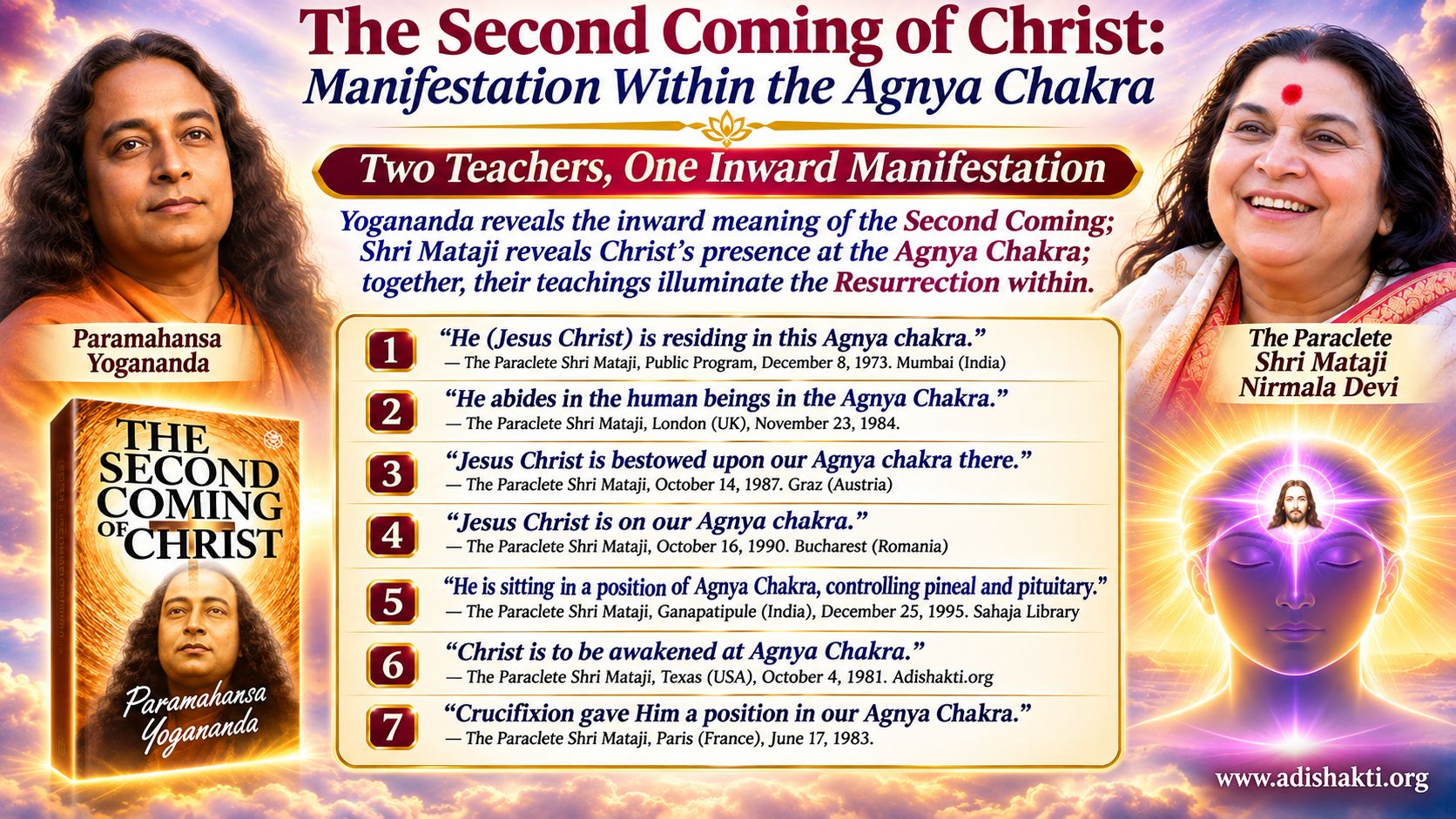
These seven statements are central evidence for the paper’s title. They explain why the Second Coming is interpreted here not simply as the awakening of an impersonal spiritual ideal, but as the manifestation of Jesus Christ at the Agnya Chakra. Yogananda teaches the inward resurrection of Christ Consciousness; Shri Mataji identifies Christ’s residence, position, awakening, and the significance of His crucifixion. Together, their teachings are read here as complementary accounts of the living Christ within.
1. Christ’s residence: the inward presence
“He (Jesus Christ) is residing in this Agnya chakra.”
The first statement identifies the Agnya not merely as a symbol of religious aspiration but as the place where Jesus Christ resides in the subtle body, according to Shri Mataji. Yogananda’s inward Second Coming acquires a specific spiritual location: Christ is not only remembered in scripture or awaited in the heavens, but encountered within. The statement concerns Christ’s presence; it does not by itself claim that every person has consciously awakened to that presence.
2. Christ’s abiding: a possibility shared by humanity
“He abides in the human beings in the Agnya Chakra.”
The language of abiding in human beings extends the first statement beyond a single mystic or isolated vision. The inward Christ concerns the human condition itself. This corresponds to Yogananda’s insistence that Christ Consciousness is not confined to the historical person of Jesus or to one religious community. Within Shri Mataji’s teaching, the Agnya is the common inward threshold at which this universal possibility becomes personally significant.
3. Christ’s bestowal: a position given
“Jesus Christ is bestowed upon our Agnya chakra there.”
The word bestowed adds a further dimension: Christ’s position at the Agnya is described as something given, not created by the seeker’s imagination or effort. In the synthesis proposed here, the seeker does not manufacture a Second Coming; the seeker awakens to a divine presence already established. Yogananda emphasizes reception of Christ Consciousness through inner realization; Shri Mataji’s statement supplies a corresponding account of Christ’s given position.
4. Christ’s location: the simplicity of the claim
“Jesus Christ is on our Agnya chakra.”
This brief declaration is direct and unqualified in its wording: Jesus Christ is on our Agnya chakra. Its theological importance lies in its clarity. The Second Coming as inward manifestation is not presented here as an undefined mood of devotion. It is related to Christ’s specific position in the subtle system. The identification remains a teaching of Shri Mataji, while its relationship to Yogananda is the comparative interpretation advanced by this paper.
5. Christ’s governing role: the threshold of awareness
“He is sitting in a position of Agnya Chakra, controlling pineal and pituitary.”
This statement describes Christ as occupying a governing position at the Agnya, with reference to the pineal and pituitary glands. In the Sahaja Yoga framework, the teaching emphasizes Christ’s authority at the inward threshold associated with thought, ego, and spiritual perception. The glandular reference should be presented as part of Shri Mataji’s subtle-body teaching, not as a scientifically verified demonstration that Christ controls anatomical structures. Its relevance to the title is the role of Christ at the point of inward passage.
6. Christ’s awakening: from presence to manifestation
“Christ is to be awakened at Agnya Chakra.”
This is the decisive transition from Christ’s residence to Christ’s manifestation. A presence may be taught or believed; awakening describes its realization in the seeker. Here the connection with Yogananda becomes especially strong: his Second Coming calls for the resurrection of Christ Consciousness within human beings, while Shri Mataji identifies the Agnya as the center at which Christ is to be awakened. In the theological synthesis of this paper, the inward Second Coming becomes an experience to receive rather than an outward spectacle to await.
7. The Crucifixion: the redemptive basis of Christ’s position
“Crucifixion gave Him a position in our Agnya Chakra.”
This statement connects the historical Passion of Jesus with His inward position in the human subtle system. The Crucifixion is therefore not set aside by the inward Second Coming; it helps explain Christ’s place at the Agnya. In Shri Mataji’s account, the redemptive significance of Jesus is related to the threshold through which the seeker must pass. Read beside Yogananda’s emphasis on the living Christ within, this teaching joins historical sacrifice to present spiritual awakening. It is a theological connection, not a claim that Yogananda himself articulated this Agnya explanation.
The Seven Statements as One Teaching
Presence, bestowal, authority, awakening, and crucifixion belong to one coherent spiritual account. Christ resides at the Agnya; His position is described as bestowed and rooted in His crucifixion; His presence is to be awakened in human beings. These statements explain why the Agnya is essential to the paper’s title. Yogananda’s teaching answers what the inward Second Coming means: the resurrection of Christ Consciousness. Shri Mataji’s teaching answers where and how Christ is encountered within her subtle-body account: at the Agnya Chakra, the inward threshold of awakening and forgiveness.
The resulting synthesis is positive and precise: the Second Coming is understood as the living manifestation of Christ within the seeker, not merely the remembrance of His earthly life. His awakening at the Agnya is connected with the seeker’s ascent toward the Sahasrara—the Kingdom within. This is the Adishakti.org interpretation bringing the two teachers into dialogue, rather than a claim that either teacher explicitly endorsed the other’s entire system.
V. The Paraclete: Sent in Christ’s Name to Make Him Known
The farewell discourses of John 14–16 place the promise of the Paraclete at the center of Jesus’ final teaching. The Advocate will teach, remind, testify, guide into truth, and glorify Christ. The promise is relational and active: the Spirit does not displace Jesus but directs attention to him. [8] [9]
The present paper understands these promises through the Adishakti.org identification of Shri Mataji Nirmala Devi as the Paraclete. This identification is a confessional conviction supported within the tradition by her recorded teaching and spiritual testimonies; it is not a consensus historical identification. In that framework, the proclamation of Resurrection is inseparable from the Paraclete’s mission to testify of Christ and make his inward presence recognizable.
Why does the phrase “sent in Christ’s name” matter? It distinguishes the announcement from a self-authorizing spiritual technique. The Resurrection is not presented merely as something an adept discovers alone; it is announced through the Spirit whom Jesus promised. The person who participates responds to that announcement through Self-Realization, forgiveness, and the unfolding of inward spiritual awareness.
The feminine pronouns sometimes used for the Paraclete in Adishakti.org’s devotional rendering express its theological interpretation. They are not a literal translation of the Greek grammatical pronouns in John. This distinction should remain visible in an academic presentation.
VI. The Central Declaration: Manifestation, Participation, Resurrection
The Second Coming of Christ is manifested within the Agnya chakra of every soul who participates in the resurrection proclaimed by the Paraclete, sent in Christ’s name.
The declaration contains three inseparable movements. First, manifestation: Christ is not merely remembered or represented; within this spiritual understanding, his presence becomes inwardly manifest at the Agnya. Second, participation: the statement does not claim that every human being has already undergone the experience. It names every soul who participates in the Resurrection. Third, proclamation: the event is made known through the Paraclete’s mission, not invented by the participant.
The distinction between universal availability and actual participation is essential. The invitation is for every soul; participation involves an inward reception. Likewise, the distinction between Christ’s historical Resurrection and the believer’s present participation must be preserved. The latter is interpreted as sharing in the life and victory of the former, not as repeating the historical event of Easter.
The Agnya is consequently the place of recognition and passage, not the whole destination. The ascent toward the Sahasrara is understood as the opening into the Kingdom within. In this sequence the proclamation of the Paraclete, the recognition of Christ, the release of ego through forgiveness, and the experience of the Kingdom form one spiritual narrative. [10] [4]
This is the paper’s distinctive claim. Yogananda illuminated the inward meaning of the Second Coming. The Adishakti.org interpretation declares its locus in the Agnya, its herald in the Paraclete, and its realization in participating souls. It is not presented as a quotation from Yogananda, but as a subsequent theological synthesis.
VII. From One Soul to a Multitude: The Scope of the Resurrection
A Second Coming understood only as a private achievement could remain isolated from the world. The present declaration has a wider scope. It speaks of every soul who participates, regardless of birthplace, religious affiliation, or inherited social status. The event is inward, but the invitation is public.
Apocalyptic passages about the coming of the Son of Man and the visibility of his appearing have received many interpretations in Christian tradition, including literal, symbolic, ecclesial, and mystical readings. The inward interpretation advanced here is one theological reading among them; it cannot be established merely by arguing that a physical event would be geographically difficult to witness. [11]
The claim of a Resurrection proclaimed in the present age is therefore twofold. It says that the possibility of encounter with Christ is not reserved for a distant future, and it says that the Paraclete’s mission calls a multitude into that encounter. What is shared across the multitude is the invitation and the possibility of participation, not an automatically identical subjective experience.
VIII. Evidence, Testimony, and the Limits of Verification
The argument rests on different kinds of material that should not be collapsed into one category. Published texts establish what Yogananda wrote and what the Gospel says. Recorded talks establish what Shri Mataji taught about Christ, the Agnya, forgiveness, and Self-Realization. Personal testimonies report what participants say they experienced. Finally, theological interpretation connects these sources into the declaration defended here.
The first two categories are open to documentary checking, subject to accurate transcription and contextual quotation. Reports of a cool breeze, inward light, peace, or altered awareness can be described and investigated as experiences, but their occurrence alone does not independently prove the supernatural identity of their cause. The identification of Shri Mataji with the promised Paraclete likewise remains a theological conclusion rather than a demonstrable historical fact. [12]
The most responsible invitation to the reader is therefore not “accept this because it is asserted,” but examine the texts, assess the testimony, consider the fruits, and distinguish the experience from the interpretation placed upon it. This preserves both the seriousness of the declaration and the freedom of the reader.
IX. Questions the Declaration Must Answer
Does an inward Second Coming deny the historical Resurrection of Jesus? Not in the interpretation advanced here. It presupposes the historical Christian proclamation of Christ’s Resurrection and understands the present inward event as participation in that victory. The relationship is theological, not a replacement of one claim by the other.
Did Yogananda teach that Shri Mataji was the Paraclete? The cited Yogananda passages do not establish that. The paper uses his teaching to frame the inwardness of the Second Coming, then clearly marks the identification of the Paraclete as an Adishakti.org conviction.
Is the Agnya chakra named in the New Testament? No. The identification arises through a comparative interpretation of Gospel imagery and Sahaja Yoga teaching. It must not be passed off as an explicit biblical statement.
Does “every soul” mean that all have already experienced Resurrection? No. The qualifying phrase “who participates” matters. It distinguishes the universal invitation from each person’s response.
What would count against the interpretation? Misquotation, demonstrably false attributions, contradictory descriptions of the teaching, and harmful spiritual consequences would all require serious reassessment. Experiential claims deserve scrutiny rather than immunity from criticism.
X. Conclusion: The Second Coming Is to Be Received Within
Paramahansa Yogananda’s title challenged readers to understand the Second Coming as the Resurrection of the Christ within. The present paper accepts that inward orientation as its starting point but gives it a more specific theological articulation: the Agnya chakra is the inward threshold of Christ’s manifestation; the Paraclete is the promised herald of the Resurrection; and participating souls are those in whom that proclamation becomes living experience.
These are not interchangeable propositions. Yogananda’s inward reading is documented in his own writings. The location of Christ at the Agnya and the identification of Shri Mataji with the Paraclete are the particular convictions of the Adishakti.org theological framework. Their conjunction is the paper’s interpretive contribution, offered for examination rather than represented as an uncontested historical finding.
The Second Coming of Christ is manifested within the Agnya chakra of every soul who participates in the resurrection proclaimed by the Paraclete, sent in Christ’s name. In this formulation, the Resurrection is not merely an event to be awaited, an image to be admired, or a doctrine to be repeated. It is an invitation to inward transformation, to forgiveness, and to the recognition of Christ within.
References
- Paramahansa Yogananda, The Second Coming of Christ: The Resurrection of the Christ Within You, vol. I, introduction (Self-Realization Fellowship; 2008 edition). ↩ Back to citation
- Paramahansa Yogananda, Autobiography of a Yogi — spiritual eye and Christ Consciousness (primary work; passage location to verify). ↩ Back to citation
- Adishakti.org, The Sign of the Son of Man (Agnya and Christ, theological interpretation). ↩ Back to citation
- Adishakti.org, The Authenticity of the Kingdom of God (Sahasrara and inward Kingdom). ↩ Back to citation
- Adishakti.org, Week 14: Purification of the Mind (Agnya, ego and forgiveness). ↩ Back to citation
- Gospel of John 10:7–9; Matthew 7:13–14 (door and narrow gate). ↩ Back to citation
- Adishakti.org, Week 1: The Promise of the Resurrection Is NOW (spiritual formation). ↩ Back to citation
- Gospel of John 14:16–17, 14:26; 15:26 (Paraclete and testimony). ↩ Back to citation
- Gospel of John 16:12–15 (Spirit of truth, guidance, glorification). ↩ Back to citation
- Adishakti.org, The Kingdom Within: Thomas, the Paraclete, and the Sahasrara. ↩ Back to citation
- Gospel of Matthew 24:29–31 (coming of the Son of Man; subject to differing interpretations). ↩ Back to citation
- Adishakti.org, Authenticity of the Resurrection of Christ (testimony and interpretation). ↩ Back to citation