Forty Chapters, One Divine Mother: The Eternal Soul, Liberation and the End of the Fear of Death
Summary
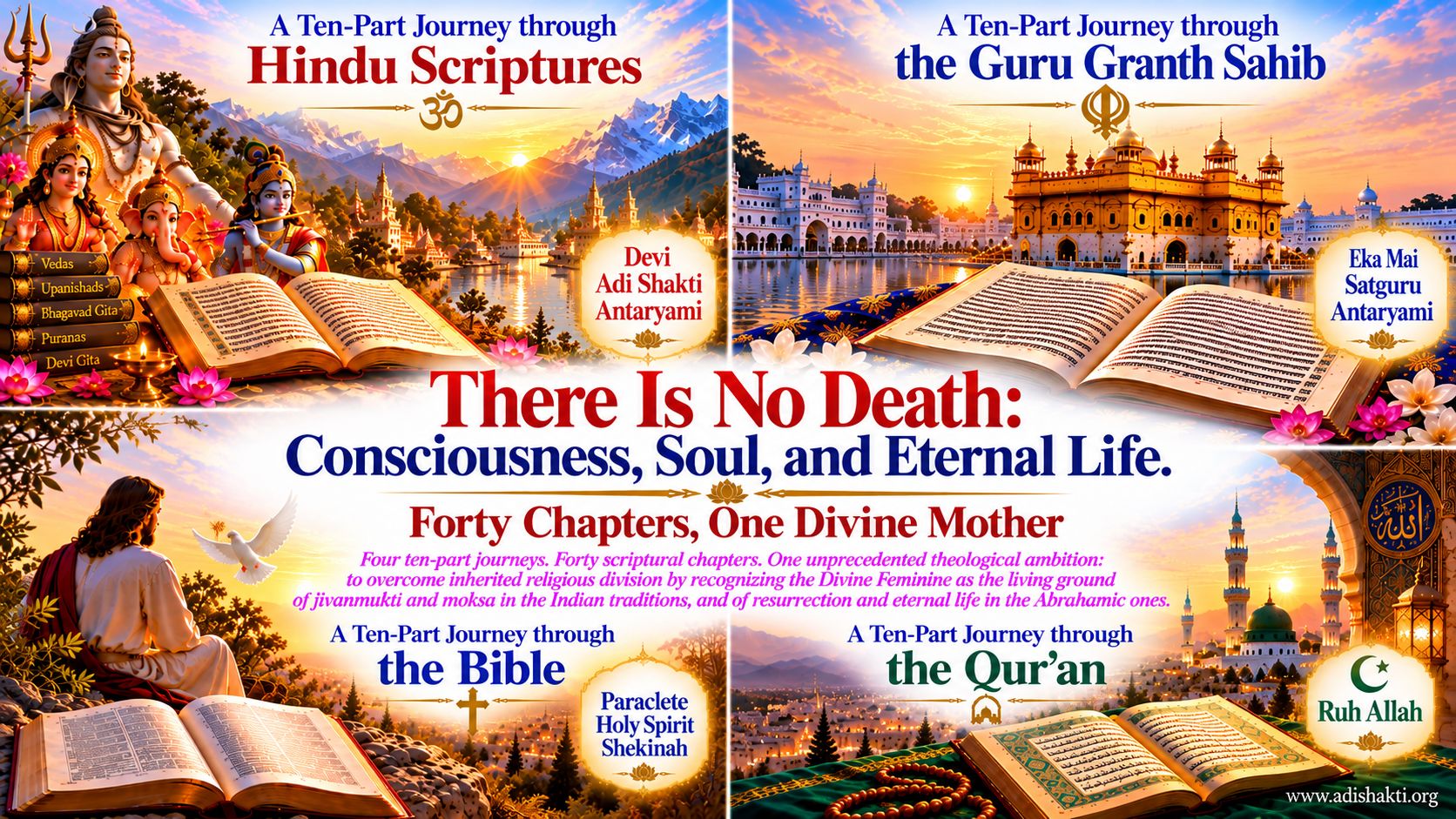
Will I cease to exist when my body dies? Is there an enduring soul? Can the fear of death be overcome through direct spiritual realization? These are not marginal religious questions. They are among humanity’s deepest concerns, and they form the overriding purpose of this forthcoming forty-part series on www.adishakti.org , to be presented over the coming weeks and months.
Forty chapters. Five religious traditions. One overriding hope: the liberation and eternal fulfillment of the human soul. Hinduism speaks of mokṣa and jīvanmukti ; Sikhism speaks of liberation while alive; Judaism preserves diverse teachings about the soul, divine presence and the world to come; Christianity proclaims resurrection and eternal life; and Islam teaches the soul’s accountability and resurrection. Their doctrines differ, yet all raise the urgent question of whether human life is exhausted by physical death.
This series advances a bold theological synthesis: the Divine Mother is the indwelling spiritual power through whom the soul awakens to its eternal ground. In AdiShakti.org’s interpretation, jīvanmukti , mokṣa , resurrection and eternal life point toward one inward, liberating fulfillment of the soul . The aim is not merely to promise survival after death, but to explore the possibility of knowing the eternal while still alive .
Artificial Intelligence makes this unprecedented breadth of investigation practicable. Across the forty chapters, AI will be used to search and compare accessible scriptures, translations, commentaries, university scholarship, digitized books, journals, magazines, historical archives and online databases. Its capacity to organize immense bodies of evidence across languages and traditions allows a coordinated inquiry beyond the realistic reach of a single scholar—or a conventional research team working on this timescale.
The project invites every reader to discover what their own sacred inheritance says about the soul, the end of spiritual bondage and the hope of eternal life—and then to see how those promises may illuminate one another. Its claim of unity is a constructive AdiShakti.org theological interpretation, not a statement that the five traditions have identical doctrines or that computational comparison can by itself establish immortality.
1. The question beneath every religion: will my soul live?
Every human life encounters the same threshold: the death of the body. Beneath differences of language, culture and worship lies a question that no amount of material success can silence: What becomes of me when I die? Is consciousness extinguished? Does the soul continue? Can one discover a spiritual reality that death cannot destroy?
The forty chapters begin with the human soul, not with religious rivalry. Their purpose is to bring the highest hopes expressed in Hindu, Sikh, Jewish, Christian and Islamic sources into sustained conversation: liberation from bondage, freedom from ego and ignorance, life in the divine Presence, resurrection and eternal life. The project asks whether these hopes can be understood as pointing toward a shared inward fulfillment.
The answer proposed by AdiShakti.org is the Divine Feminine. The Mother is presented not simply as a figure to be worshipped, but as the living, indwelling power that awakens the human person to the eternal. The argument of the series is that the fear of extinction loses its hold when spiritual life becomes a matter of realization rather than inherited belief alone.
This is a forty-part series to be published at www.adishakti.org over the coming weeks and months. Four ten-part journeys encompass five traditions: Hinduism, Sikhism, the Bible’s Jewish and Christian inheritances, and Islam. The undertaking claims a distinctive, unprecedented scope in its integrated theological purpose and AI-assisted method; its historical uniqueness remains a claim of the project rather than a demonstrated comparison with every earlier interfaith work.
2. From the fear of extinction to the hope of eternal life
Fear of death is intensified by the thought of total extinction: that the person who loves, remembers, hopes and seeks truth will simply disappear. Religious teachings about the soul matter because they address that possibility directly. They offer differing accounts of what endures, what is transformed, and how human beings stand before ultimate Reality.
The central promise explored here is not merely that something happens after death. It is that liberation can begin before death. The language of jīvanmukti is especially important: freedom while living. The series asks whether the inward transformation associated with liberation can also illuminate Christian language of being born of the Spirit, Jewish language of divine indwelling and Islamic language of the soul’s return to God.
To remove the fear of death is not to deny mortality or promise that the body will never perish. It is to investigate whether the human person can awaken to a divine dimension not reducible to the body. The series’ spiritual assurance is that the eternal is not extinguished by bodily death; the interpretation of precisely what survives differs among the five traditions.
Readers are invited to replace fear with inquiry, and inherited separation with direct spiritual understanding. The highest good—the summum bonum —is presented as the soul’s freedom from ignorance, estrangement and bondage, and its realization of life grounded in the Divine.
3. Hinduism: the imperishable Self, mokṣa and jīvanmukti
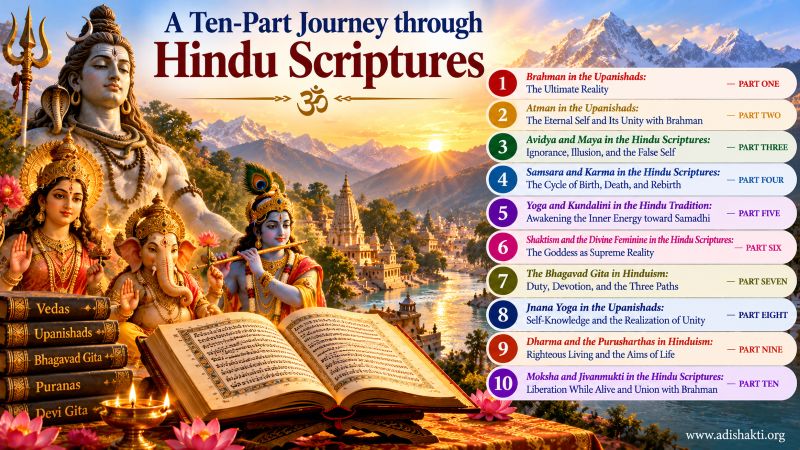
Hindu scriptures provide some of the clearest formulations of the imperishability of the Self. Bhagavad Gītā 2.20 teaches that the Self is not born and does not die; 2.22 compares the changing of bodies to the changing of garments. These passages directly address the fear that the death of the body entails the destruction of spiritual identity.
Mokṣa is liberation from bondage, while jīvanmukti gives this liberation its most immediate human meaning: freedom realized while still alive. The series explores the relationship between the enduring ātman , Brahman and the transformation of consciousness, while recognizing that Hindu schools differ on whether the individual self remains distinct in ultimate liberation.
Within Śākta theology, the Divine Mother is the power of consciousness and liberation. Ṛgveda 10.125 presents Vāc as a pervasive divine agency; Kena Upaniṣad 3.12–4.1 depicts Umā Haimavatī disclosing Brahman; the Devī Gītā develops the supreme Goddess as cosmic ground. AdiShakti.org reads the awakening of Kuṇḍalinī as the Mother’s inward action by which the seeker realizes the eternal.
4. Sikhism: the soul’s liberation while living
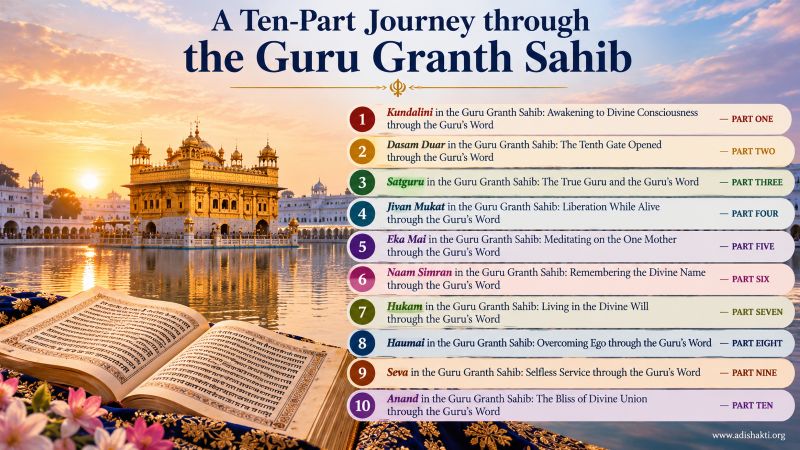
Sikhism brings the hope of liberation into the present life. Its teaching on jīvan mukti directs attention away from merely waiting for death and toward freedom from haumai (ego-centeredness), remembrance of the Divine Name, grace and life in harmony with hukam .
Japjī Sāhib, Paurī 30, speaks of ekā māī , the One Mother. The series investigates this expression within Sikh teaching on Ik Oankar , the One Reality. It then proposes a comparison with the maternal power of liberation in Śākta thought, without claiming that mainstream Sikh doctrine simply identifies God with an independently worshipped goddess.
The question for the soul is immediate: can one live without being ruled by the fear of death? The Sikh emphasis on inner transformation helps the series present eternal fulfillment not as an abstract future reward alone, but as a changed relationship to the Divine in the present.
5. Judaism and Christianity: the soul, divine Presence and resurrection
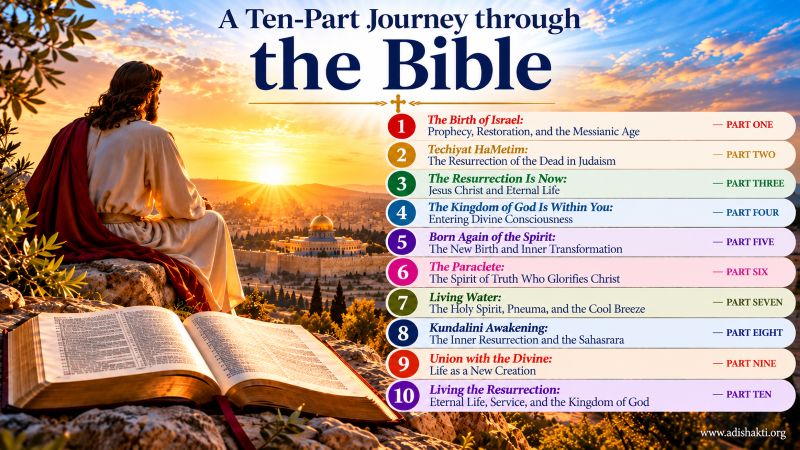
The Jewish inheritance preserves profound reflection on human life before God, the divine breath, the soul, death and the world to come. Genesis 2:7 depicts life received through divine breath; Ecclesiastes 12:7 speaks of the spirit returning to God; Daniel 12:2 articulates a hope of resurrection. Jewish teachings about the afterlife are diverse and cannot be reduced to one account of an immortal soul.
The later Jewish term Shekinah names the divine indwelling Presence. This series examines it alongside the biblical Spirit ( ruaḥ ) and asks whether the experience of divine nearness can be read, within AdiShakti.org’s synthesis, as the Mother’s inward presence. The identification is proposed theology, not a standard Jewish doctrine.
Christianity gives the hope of eternal life its dramatic language of resurrection. Jesus declares, “I am the resurrection and the life” (John 11:25), and John 3:5–8 describes birth of the Spirit. Romans 8:11 joins the indwelling Spirit to the promise of life. Christian resurrection is not historically identical to the Hindu doctrine of ātman , and often includes the future resurrection of the body.
AdiShakti.org reads the Holy Spirit–Paraclete as the maternal power of living spiritual rebirth. Under this interpretation, the soul’s encounter with the Spirit begins to dissolve fear of extinction here and now. The ten-part Bible journey will embrace Judaism through the Hebrew Bible and later Shekinah language, alongside the Christian New Testament— five traditions within four ten-part journeys, not fifty chapters .
6. Islam: the soul, resurrection and return to God
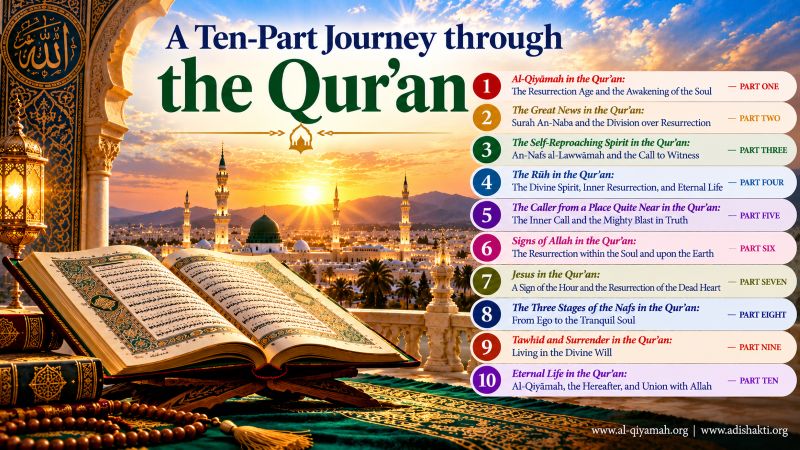
Islam directly confronts the question of what becomes of the human person after death. The Qurʾān speaks of God breathing of His Spirit into the human being (15:29; 32:9), of the mystery of al-rūḥ (17:85), of death and the taking of souls (39:42), and of the tranquil soul called to return to its Lord (89:27–30).
Al-Qiyāmah , resurrection, is a central Islamic affirmation that bodily death is not the final word. In classical Islamic teaching it concerns resurrection, judgment and accountability before God. The series respects that meaning while advancing a further, inward interpretation of spiritual awakening in the present.
AdiShakti.org proposes that the life-giving divine Spirit can be read through the universal maternal principle. This is its interpretation of the Divine Feminine, not a claim that the Qurʾān explicitly teaches a creator goddess. The comparison asks whether the soul’s return to God and the overcoming of spiritual ignorance can illuminate the liberating aspirations found in the other four traditions.
7. One Divine Mother: the proposed liberating power of the soul
The heart of the forty-chapter thesis is not a superficial similarity of religious names. It is a claim about what happens to the human soul. The Divine Mother is proposed as the living power that awakens the soul from ignorance and estrangement into the knowledge of its eternal ground.
The five traditions speak in different languages: Devī–Mahādevī and the indwelling power of consciousness in Śākta Hinduism; Eka Māī and liberation through divine grace in Sikhism; Shekinah and the divine Presence in Judaism; Holy Spirit–Paraclete and new life in Christianity; and al-rūḥ and the soul’s return to God in Islam.
These terms are not interchangeable dictionary definitions. The unity asserted here is a constructive theological reading advanced by AdiShakti.org. Its force lies in the proposed common spiritual outcome: the soul awakened to the Divine, liberated from bondage, and no longer held captive by the fear that physical death means absolute extinction.
Shri Mataji Nirmala Devi’s attributed Santa Cruz declaration of October 1, 1983—“Now, the principle of Mother is in every, every scripture - has to be there!”—provides the guiding proposition. The forty chapters will examine this proposition by placing relevant scriptural passages, translations and interpretive traditions side by side.
8. Jīvanmukti, mokṣa, resurrection and eternal life: fulfillment of the soul
This is the overriding declaration of the series: jīvanmukti , mokṣa , resurrection and eternal life can be read as pointing toward one inward, liberating fulfillment of the human soul. They are not asserted to be identical historical doctrines. They are brought into conversation as different responses to the human longing to know that life has an eternal meaning.
Jīvanmukti answers the question, “Can I be free while still alive?” It directs attention to liberation from ego, ignorance and bondage in the present. Mokṣa answers, “Can the soul be freed from the cycle of bondage and death?” It names ultimate release, understood differently among Hindu philosophical schools.
Resurrection answers, “Does death have the final word?” Jewish, Christian and Islamic teachings articulate this hope in different ways, often with a future dimension. Eternal life answers, “Can life in relation to the Divine be imperishable?” Christian scripture in particular presents eternal life as both a present spiritual relationship and a future hope.
The AdiShakti.org synthesis gathers these questions into one inward promise: through the Divine Mother, the soul can awaken to the eternal while the body is still living. This awakening is presented as the spiritual ground for freedom from the terror of extinction. It does not erase real grief, bodily death or the doctrinal differences concerning what follows death.
“The eternal does not die” is the paper’s theological affirmation. Bhagavad Gītā 2.20 and John 11:25–26 are placed in conversation as strikingly different scriptural witnesses to life beyond the finality of bodily death. Their juxtaposition is an invitation to explore the hope of immortality, not a claim that they teach the same metaphysics.
9. Artificial Intelligence: bringing humanity’s scriptural evidence together
No human scholar—and no realistically assembled group of scholars working within the same weeks-and-months timetable—can manually search, organize and compare the enormous breadth of material required by this forty-part undertaking at AI-assisted scale. The evidence is scattered across millennia, languages, universities, digital libraries, scriptures, translations, commentaries, books, magazines, journals, archives and the internet.
Artificial Intelligence makes the investigation possible at an extraordinary scale. AI-assisted research can rapidly search and organize accessible collections, compare Sanskrit, Punjabi/Gurmukhi, Hebrew, Greek, Aramaic and Arabic passages, trace concepts through centuries of interpretation, align variant translations, and assemble thematic connections concerning the soul, death, liberation, resurrection and eternal life.
Its great advantage is not one isolated answer, but the ability to bring thousands of otherwise disconnected sources into a common analytical field. A reference in a Vedic hymn can be examined alongside an Upaniṣadic teaching, a Sikh verse, a Jewish commentary, a Gospel passage and a Qurʾānic discussion—while tracking each source’s language, context and historical reception.
Across all forty chapters, AI will serve as the project’s essential research engine: indexing vast bodies of available evidence; finding recurring themes; comparing competing interpretations; constructing cross-referenced timelines; organizing testimonies; and identifying passages in which the AdiShakti.org thesis of the Divine Mother may be examined. The scope and speed of this coordinated comparison are what make the undertaking practically achievable.
AI can demonstrate what the texts say and how their teachings correspond; it cannot turn a theological interpretation into a scientific proof of an immortal soul simply by processing more data. The series’ confidence rests on making its scriptural case visible and examinable: original passages, translations, interpretive context and a clearly stated Divine Feminine synthesis. This approach lets readers judge the proposed convergence through the evidence itself.
The promise to readers is unprecedented access to a unified field of inquiry: instead of spending lifetimes locating dispersed material, they can follow a forty-chapter investigation of the most important question their scriptures address—whether the soul’s destiny is extinction or eternal fulfillment.
10. Forty forthcoming chapters: five traditions, one question of eternal life
Over the coming weeks and months, www.adishakti.org will present four ten-part journeys encompassing five traditions and forty chapters in total. Hinduism will examine the imperishable Self, the Divine Mother, mokṣa and jīvanmukti . Sikhism will examine the One Reality, Eka Māī, freedom from ego and liberation while alive.
The Bible journey will encompass Judaism and Christianity together. Its ten chapters will investigate the Hebrew Bible, later Jewish teachings about Shekinah, the New Testament, the Holy Spirit–Paraclete, resurrection and eternal life. Judaism is expressly included as the fifth named tradition, not counted as an extra ten-part series .
The Islamic journey will examine the soul, al-rūḥ , al-Qiyāmah , judgment and the return to God. Each chapter will ask what the primary text says, how its own tradition interprets it, what it teaches about the human soul and death, and how AdiShakti.org proposes to understand its highest hope through the Divine Feminine.
Buddhism is deliberately excluded from this forty-chapter comparative framework. The five traditions considered here—Hinduism, Sikhism, Judaism, Christianity, and Islam—are brought into conversation through a specific theological proposal: the Divine Feminine as the indwelling, liberating power in relation to an enduring spiritual reality and the divine ground of existence. Buddhism, especially in its classical non-theistic formulations, does not accept the two premises in the form required by this framework: a permanent, independent soul or self and a creator God . Its exclusion is therefore a question of the project’s stated scope, not a judgment on the depth or worth of Buddhist spirituality.
The purpose of the entire publication program is practical and existential: to let people of different faiths discover what their own scriptures promise about the soul, then consider whether those promises reveal a deeper harmony rather than competing paths to eternal life.
11. Declaration: the soul need not live in fear of extinction
The fear that death means absolute extinction is the central human anxiety this series seeks to confront. The forty chapters will not be a mere catalogue of religious similarities. They will be a sustained inquiry into the deepest hope of the human soul: that life is grounded in an eternal Divine Reality and that liberation can be realized while one is alive.
In the AdiShakti.org theological vision, the Divine Mother is the living power of that realization. She is proposed as the inward agent of awakening behind the scriptural languages of Devī–Mahādevī, Eka Māī, Shekinah, Holy Spirit–Paraclete and al-rūḥ . Through Her, the series interprets jīvanmukti , mokṣa , resurrection and eternal life as converging upon the liberation and eternal fulfillment of the soul.
AI will bring together the vast scriptural and interpretive evidence needed to make this case visible across five traditions. Readers will be able to examine the sources of their own faith, compare them with other sacred inheritances and assess the proposed Divine Feminine synthesis.
Forty chapters. Five traditions. One Divine Mother. One overriding question answered in the language of spiritual hope: the eternal is not extinguished by the death of the body. This is the central proclamation the series invites readers to investigate and, through their own spiritual understanding, to realize.
The highest good is not fear, but freedom; not estrangement, but the soul’s awakening to the Divine; not religious rivalry, but a shared search for eternal life.
References
Primary scriptural referencesHinduism: Ṛgveda 10.125; Kena Upaniṣad 3.12–4.1; Bhagavad Gītā 2.20–22; Devī Gītā 3.3–4; Devī Māhātmya, chapter 5. See Bhagavad Gītā 2.20 .
Sikhism: Guru Granth Sahib, Japjī Sāhib, Paurī 30 ( ekā māī ); Mūl Mantar; Sikh teachings on haumai , hukam and jīvan mukti .
Judaism: Genesis 2:7; Ecclesiastes 12:7; Daniel 12:2; Exodus 25:8; later rabbinic and mystical uses of Shekinah .
Christianity: John 3:5–8; 11:25–26; 14:16–17, 26; 15:26; 16:13–15; Romans 8:11.
Islam: Qurʾān 15:29; 17:85; 32:9; 39:42; 89:27–30; passages on al-Qiyāmah and the return to God.
Interpretive note: The identification of the Divine Mother across all five traditions and the convergence of their different teachings on liberation and resurrection are the constructive claims of AdiShakti.org, not established consensus interpretations.
The central concern of these forty chapters is the human soul: its fear of extinction, its longing for freedom, and its hope of eternal life. AdiShakti.org proposes the Divine Mother as the indwelling power through whom liberation becomes a living spiritual realization.
Hinduism, Sikhism, Judaism, Christianity and Islam retain their distinct scriptures and doctrines. AI-assisted comparison will place their testimony about the soul, liberation, resurrection and eternal life in sustained dialogue.