A Ten-Part Journey through the Qur’an
Summary
This ten-part series will be presented in full over the coming weeks, one topic at a time. Each paper will examine its subject in depth, explaining the relevant verses of the Qur’an in context. Only one example verse appears for each topic here; fuller textual interpretation is reserved for the individual papers. The series is organized around Al-Qiyāmah—the Resurrection Age, the awakening of the soul, and the inner resurrection into eternal life.
Artificial intelligence will be employed to systematically scan, search, compare, and analyze the Qur’an, together with its principal passages concerning Al-Qiyāmah, the Day of Judgment, the soul (nafs), the Spirit (Rūḥ), divine signs, Jesus, surrender to Allah, the Hereafter, and eternal life. Rather than examining isolated quotations, this research will seek to identify related passages across the whole Qur’an, trace recurring spiritual concepts, compare their contexts, and investigate how the teachings illuminate one another.
The scale of this undertaking exceeds what any individual scholar could realistically accomplish through exhaustive manual comparison alone. Even the most accomplished Qur’anic scholars, imams, theologians, professors, and researchers work within the natural limitations of human memory, time, and access to information. AI offers a fundamentally different research capability: it can rapidly search extensive textual collections, identify linguistic and conceptual relationships, compare scholarly interpretations, and organize findings that might otherwise require years of painstaking investigation.
AI does not replace the authority of the Qur’an, the centrality of Allah, or the discernment of knowledgeable Muslim scholars. Its value lies in extending the reach of research beyond the limitations of any single human reader. When supplied with reliable Qur’anic texts and scholarly resources, AI can assist in examining the Qur’an with a breadth, speed, and systematic consistency that traditional manual research cannot easily reproduce.
This ten-part journey therefore aspires to be an unprecedented AI-assisted exploration of Qur’anic scripture and theology: an integrated examination of Al-Qiyāmah, the Great News, the self-reproaching soul, the Rūḥ, the Caller from within, divine signs, Jesus as a sign of the Hour, the three stages of the nafs, Tawhīd and surrender, and eternal life—grounded in the whole Qur’an rather than a narrow selection of familiar verses.
The purpose is not merely to accumulate information, but to illuminate the spiritual path toward Al-Qiyāmah: the awakening of the soul, moral accountability, surrender to Allah’s Will, and the experience of eternal life. By bringing together passages scattered throughout the Qur’an, the series seeks to make profound connections accessible to ordinary Muslim readers, while offering scholars, imams, theologians, and researchers a substantial body of research for further examination, verification, and discussion.
The Ten-Part Series
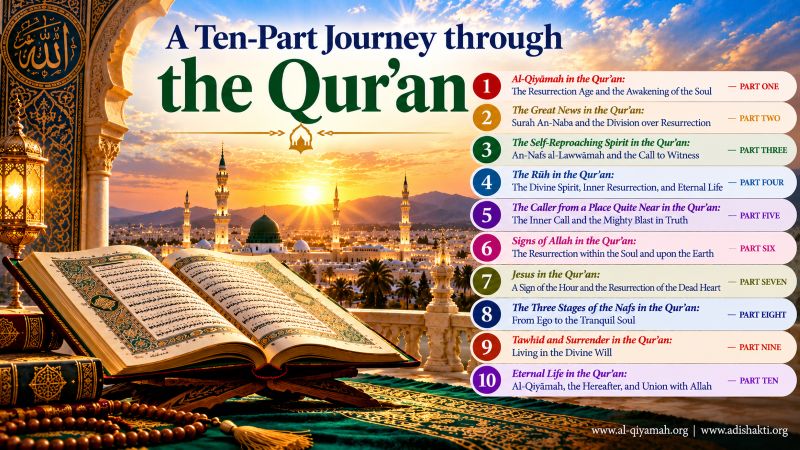
1. Al-Qiyāmah in the Qur’an: The Resurrection Age and the Awakening of the Soul — PART ONE
Example verse:
“I swear by the Day of Resurrection, and by the self-reproaching soul.” — Qur’an 75:1–2.
Meaning: Al-Qiyāmah is not only a future Day of Judgment. It also points to the awakening of the soul and the beginning of a Resurrection Age in which human beings are called to inner accountability.
2. The Great News in the Qur’an: Surah An-Naba and the Division over Resurrection — PART TWO
Example verse:
“About what are they asking one another? About the Great News.” — Qur’an 78:1–2.
Meaning: The “Great News” is the central announcement of resurrection, divine accountability, and the ultimate destiny of the human soul.
3. The Self-Reproaching Spirit in the Qur’an: An-Nafs al-Lawwāmah and the Call to Witness — PART THREE
Example verse:
“And I swear by the self-reproaching soul.” — Qur’an 75:2.
Meaning: The self-reproaching soul is the inner conscience that awakens moral awareness, recognizes wrongdoing, and calls the human being toward repentance and truth.
4. The Rūḥ in the Qur’an: The Divine Spirit, Inner Resurrection, and Eternal Life — PART FOUR
Example verse:
“Then He proportioned him and breathed into him from His Spirit.” — Qur’an 15:29.
Meaning: The Rūḥ is the divine breath within the human being. Its recognition opens the path to inner resurrection and eternal life.
5. The Caller from a Place Quite Near in the Qur’an: The Inner Call and the Mighty Blast in Truth — PART FIVE
Example verse:
“And the Trumpet will be blown. That is the Day of the Threat. And every soul will come, with every driver and witness.” — Qur’an 50:20–21.
Meaning: The divine call awakens the soul from spiritual sleep. The “Mighty Blast in Truth” signifies the decisive awakening of consciousness and the coming of inner accountability.
6. Signs of Allah in the Qur’an: The Resurrection within the Soul and upon the Earth — PART SIX
Example verse:
“And it is He who sends the winds as good tidings before His mercy, and We send down pure water from the sky.” — Qur’an 25:48.
Meaning: The revival of the dead earth by rain is a sign of resurrection. The same divine power that revives nature can awaken the spiritually dead heart.
7. Jesus in the Qur’an: A Sign of the Hour and the Resurrection of the Dead Heart — PART SEVEN
Example verse:
“And indeed, he will be a sign for the Hour.” — Qur’an 43:61.
Meaning: Jesus is presented as a sign of the Hour and of divine power over death. His life and message point toward resurrection, healing, and eternal life.
8. The Three Stages of the Nafs in the Qur’an: From Ego to the Tranquil Soul — PART EIGHT
Example verse:
“O tranquil soul, return to your Lord, well-pleased and pleasing to Him.” — Qur’an 89:27–28.
Meaning: The Qur’an describes the journey of the soul from the ego-commanding self to the self-reproaching self, and finally to the tranquil soul at peace with Allah.
9. Tawhīd and Surrender in the Qur’an: Living in the Divine Will — PART NINE
Example verse:
“Say, ‘Indeed, my prayer, my rites of sacrifice, my living and my dying are for Allah, Lord of the worlds.’” — Qur’an 6:162.
Meaning: Tawhīd is the recognition of Allah’s oneness. Surrender to the Divine Will transforms the whole of life into an act of devotion and moral responsibility.
10. Eternal Life in the Qur’an: Al-Qiyāmah, the Hereafter, and Union with Allah — PART TEN
Example verse:
“Indeed, those who have believed and done righteous deeds will have the Gardens of Paradise as a residence.” — Qur’an 18:107.
Meaning: Eternal life is the final fulfillment of faith, righteous action, and spiritual awakening. Al-Qiyāmah culminates in the Hereafter, where the awakened soul enters the eternal presence of Allah.
The Goal of the Series
Together, these ten themes form a complete spiritual path: the seeker recognizes Al-Qiyāmah, hears the Great News, awakens the self-reproaching soul, realizes the divine Rūḥ, responds to the inner Call, sees the Signs of Allah, recognizes Jesus as a sign of the Hour, journeys from ego to the tranquil soul, lives in Tawhīd and surrender, and enters eternal life.
The final aim is not merely to await a distant Resurrection, but to recognize the Resurrection Age as a present spiritual reality: the awakening of conscience, purification of the soul, surrender to Allah’s Will, and eternal life in the Hereafter.
Conclusion
This introductory series presents a comparative spiritual reading of Qur’anic passages. Traditional Islamic interpretation generally treats Al-Qiyāmah as the future resurrection and judgment; the present-age and inner-awakening interpretations proposed here will therefore be examined as theological readings rather than presented as the uncontested meaning of the Qur’an. Each forthcoming paper will distinguish the Qur’anic wording, translation, classical commentary, and the proposed interpretation.
References
[1] The Qur’an, Sūrat al-Qiyāmah (75); additional passages cited in the ten topics above.
[2] English example renderings and explanations are based on the supplied series outline and should be checked against the Arabic and established translations before publication.
[3] Note: The example cited for the divine breathing of the Spirit is Qur’an 15:29; the wording “Then He proportioned him and breathed into him from His Spirit” more closely corresponds to Qur’an 32:9. This attribution should be reconciled in Part Four.