A Ten-Part Journey through the Bible
Summary
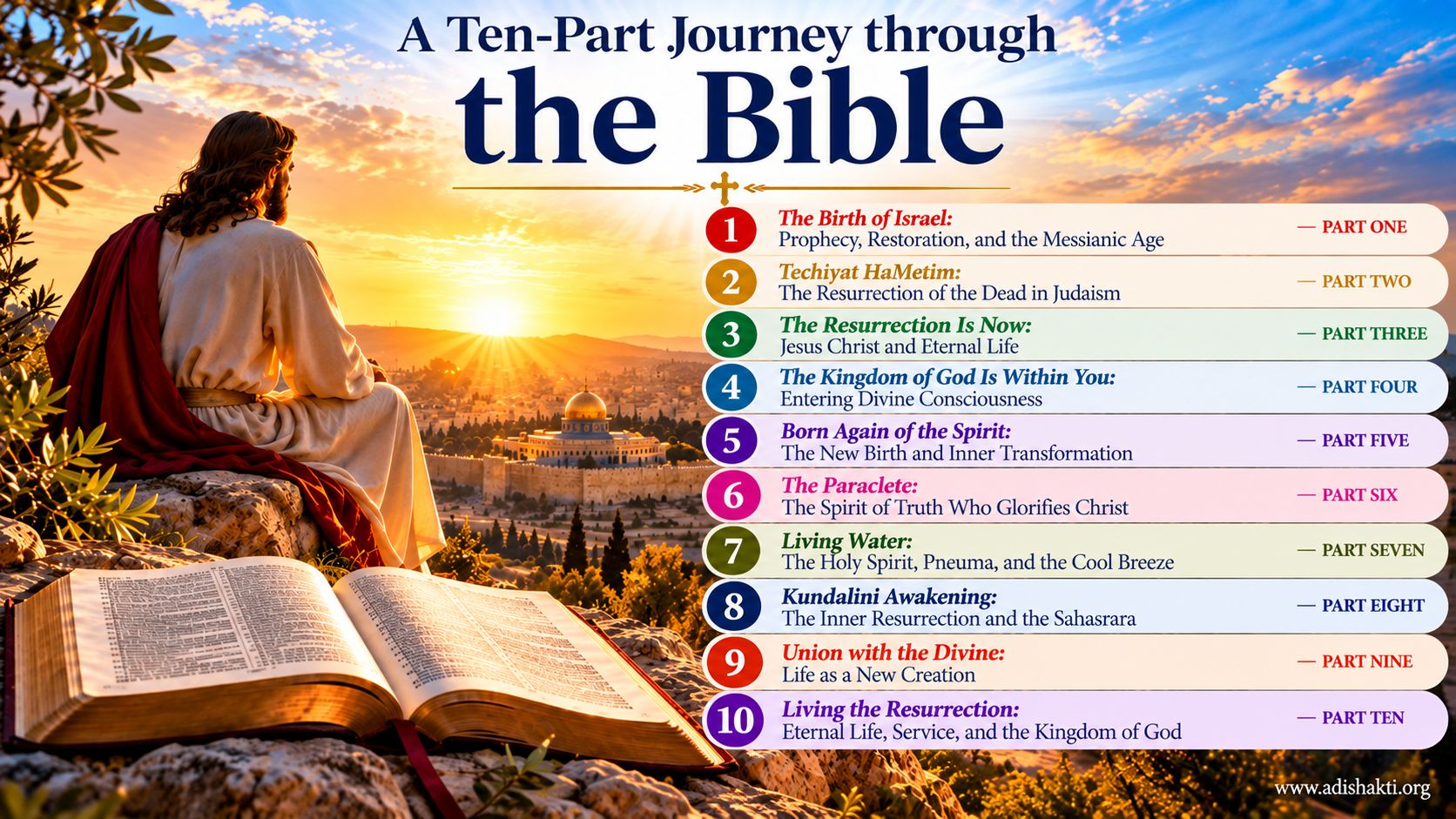
This ten-part Bible journey begins with Judaism and its scriptural inheritance before proceeding into the Christian proclamation of Jesus Christ and the Holy Spirit. Part One examines the birth of modern Israel alongside biblical restoration prophecy; Part Two examines Techiyat HaMetim, the resurrection of the dead in Judaism. The remaining eight chapters trace the risen Christ, the Kingdom of God, birth of the Spirit, the Paraclete, living water, inner awakening, new creation, and living the Resurrection. Each chapter will be published in depth over the coming weeks.
Artificial intelligence will assist a systematic comparison of the Hebrew Bible and New Testament, alongside Jewish and Christian commentary, original-language scholarship, translations, and historical sources. The study will distinguish what the texts say, how their respective traditions interpret them, and where AdiShakti.org advances its own Divine Feminine theological synthesis.
The two Jewish chapters are foundational, not incidental. The first will distinguish ancient prophecies of Israel’s regathering from modern historical events and competing interpretations of their relationship. The second will explore the Jewish doctrine of the resurrection of the dead in its own context before considering parallels and differences with Christian teachings.
Parts Three through Ten turn to the New Testament and AdiShakti.org’s comparative interpretation of Living the Resurrection. They consider Jesus’ promise of eternal life, the Kingdom, spiritual rebirth, the Spirit of Truth, living water, Kuṇḍalinī awakening as an interpretive comparison, new creation, and a transformed life of love and service.
AI extends the scale of research but does not establish theological truth on its own. The series will examine accessible biblical texts, Jewish and Christian scholarship, and related archives with attention to textual context, translation, interpretive differences, and verifiable sources. It does not claim that Jewish and Christian doctrines are identical.
The overriding question is whether human beings can overcome the fear of death through spiritual realization. This ten-part journey offers a Jewish–Christian scriptural foundation for a broader AdiShakti.org inquiry into the soul, resurrection, the Divine Mother, and eternal life.
The Ten-Part Series
1. The Birth of Israel: Prophecy, Restoration, and the Messianic Age — PART ONE
Example verse:
“I will take the Israelites out of the nations where they have gone. I will gather them from all around and bring them back into their own land.” — Ezekiel 37:21.
Meaning: The prophetic restoration of Israel provides a Jewish starting point for considering the Messianic Age. This chapter will examine biblical regathering passages, Jewish interpretations of redemption, and the modern establishment of Israel in 1948. Connecting the modern state to particular prophecies is an interpretive claim, not a universally accepted conclusion.
2. Techiyat HaMetim: The Resurrection of the Dead in Judaism — PART TWO
Example verse:
“Multitudes who sleep in the dust of the earth will awake: some to everlasting life, others to shame and everlasting contempt.” — Daniel 12:2.
Meaning: Techiyat HaMetim (revival or resurrection of the dead) is a major Jewish teaching, expressed in biblical, rabbinic, and liturgical sources. This chapter will examine its Jewish meaning, including the future resurrection of the dead, before comparing it with Christian resurrection and the inward interpretation proposed by AdiShakti.org.
3. The Resurrection Is Now: Jesus Christ and Eternal Life — PART THREE
Example verse:
“I am the resurrection and the life. The one who believes in me will live, even though they die.” — John 11:25.
Meaning: Jesus identifies himself as the source of resurrection and eternal life. This chapter examines both the present spiritual significance of life in Christ and the future resurrection hope, rather than reducing the biblical teaching to one dimension.
4. The Kingdom of God Is Within You: Entering Divine Consciousness — PART FOUR
Example verse:
“The kingdom of God is in your midst.” — Luke 17:21.
Meaning: Jesus announces the nearness of God’s Kingdom. This chapter considers the translation and context of Luke 17:21, including “among you” and “within you,” before exploring the AdiShakti.org interpretation of inward divine realization.
5. Born Again of the Spirit: The New Birth and Inner Transformation — PART FIVE
Example verse:
“Very truly I tell you, no one can enter the kingdom of God unless they are born of water and the Spirit.” — John 3:5.
Meaning: Jesus teaches Nicodemus that entry into the Kingdom requires birth of the Spirit. This chapter studies spiritual rebirth, transformation, and the significance of the Spirit’s movement in John 3:5–8.
6. The Paraclete: The Spirit of Truth Who Glorifies Christ — PART SIX
Example verse:
“When he, the Spirit of truth, comes, he will guide you into all the truth. He will glorify me.” — John 16:13–14.
Meaning: The Paraclete is promised as the Spirit of Truth who guides and glorifies Christ. This chapter will study the Farewell Discourses in John 14–16 and examine AdiShakti.org’s Divine Mother interpretation as a distinct theological proposal.
7. Living Water: The Holy Spirit, Pneuma, and the Cool Breeze — PART SEVEN
Example verse:
“Whoever believes in me, as Scripture has said, rivers of living water will flow from within them.” — John 7:38.
Meaning: John 7:37–39 explicitly associates living water with the Spirit. This chapter examines biblical images of living water and pneuma, then compares them with the Cool Breeze experience described in Sahaja Yoga, distinguishing scripture from comparative interpretation.
8. Kundalini Awakening: The Inner Resurrection and the Sahasrara — PART EIGHT
Example verse:
“The Spirit gives life; the flesh counts for nothing.” — John 6:63.
Meaning: This chapter explores the biblical contrast between Spirit and flesh alongside the AdiShakti.org understanding of Kuṇḍalinī awakening and the Sahasrara. These yogic terms are comparative theological concepts, not terms appearing in the biblical passage itself.
9. Union with the Divine: Life as a New Creation — PART NINE
Example verse:
“Therefore, if anyone is in Christ, the new creation has come: The old has gone, the new is here!” — 2 Corinthians 5:17.
Meaning: Paul describes life in Christ as new creation. This chapter considers reconciliation, transformation, and participation in divine life while distinguishing Christian understandings of communion with God from metaphysical identity with God.
10. Living the Resurrection: Eternal Life, Service, and the Kingdom of God — PART TEN
Example verse:
“For whoever wants to save their life will lose it, but whoever loses their life for me will find it.” — Matthew 16:25.
Meaning: The concluding chapter brings resurrection hope into daily life through surrender, compassion, service, and spiritual renewal. It examines how a life transformed by the Spirit can embody the hope of eternal life without denying bodily mortality or the future resurrection.
The Goal of the Series
Together, these ten themes form a progression from Jewish restoration prophecy and the hope of Techiyat HaMetim to the Christian proclamation of resurrection in Christ, the Kingdom of God, spiritual rebirth, the Paraclete, living water, the comparative language of Kuṇḍalinī, new creation, and a life transformed by the Spirit.
The goal is to explore the hope of resurrection and eternal life through careful biblical study and a clearly identified AdiShakti.org interpretation of Living the Resurrection now, while respecting the differences between Jewish and Christian teachings.
Conclusion
The ten studies will examine the Hebrew Bible and New Testament in context, including Israel’s restoration, Techiyat HaMetim, the resurrection proclaimed by Jesus, and the promised Spirit. Connections to Kuṇḍalinī and Sahasrara will be presented as comparative AdiShakti.org theology rather than claims about the original wording of biblical texts.
References
Representative passages: Ezekiel 36:24; 37:21–28; Isaiah 11:11–12; Daniel 12:2; Isaiah 26:19; John 11:25; Luke 17:21; John 3:5–8; 14:16–18; 16:13–14; 7:37–39; 6:63; 2 Corinthians 5:17; Matthew 16:25. The individual chapters will examine the passages, Jewish and Christian interpretations, translations, and the proposed comparative theology in depth.