The Cool Breeze as the Exclusive Documented Claim of Spirit-Birth: Shri Mataji’s Disciples and John 3:8
Summary
This paper argues that, within the documentary and ethnographic record examined here, the only identifiable religious community whose members claim to feel the “wind” of John 3:8 as a tangible sign of being born again of the Spirit is the Sahaja Yoga movement associated with Shri Mataji Nirmala Devi. The New Testament records Jesus’ comparison between wind and Spirit, but it records no Christian experiencing that wind as a verifiable sign of spiritual rebirth. By contrast, Sahaja Yoga makes the “Cool Breeze” a central, repeatable, and publicly taught marker of Self-Realization: practitioners report feeling it above the head and in the palms after Kundalini awakening. The argument is therefore comparative and evidentiary rather than theological: it does not prove Sahaja Yoga’s interpretation of John 3:8, but it identifies a sharp asymmetry between the silence of the Christian record and the explicit, organized testimony of Shri Mataji’s disciples.
Introduction
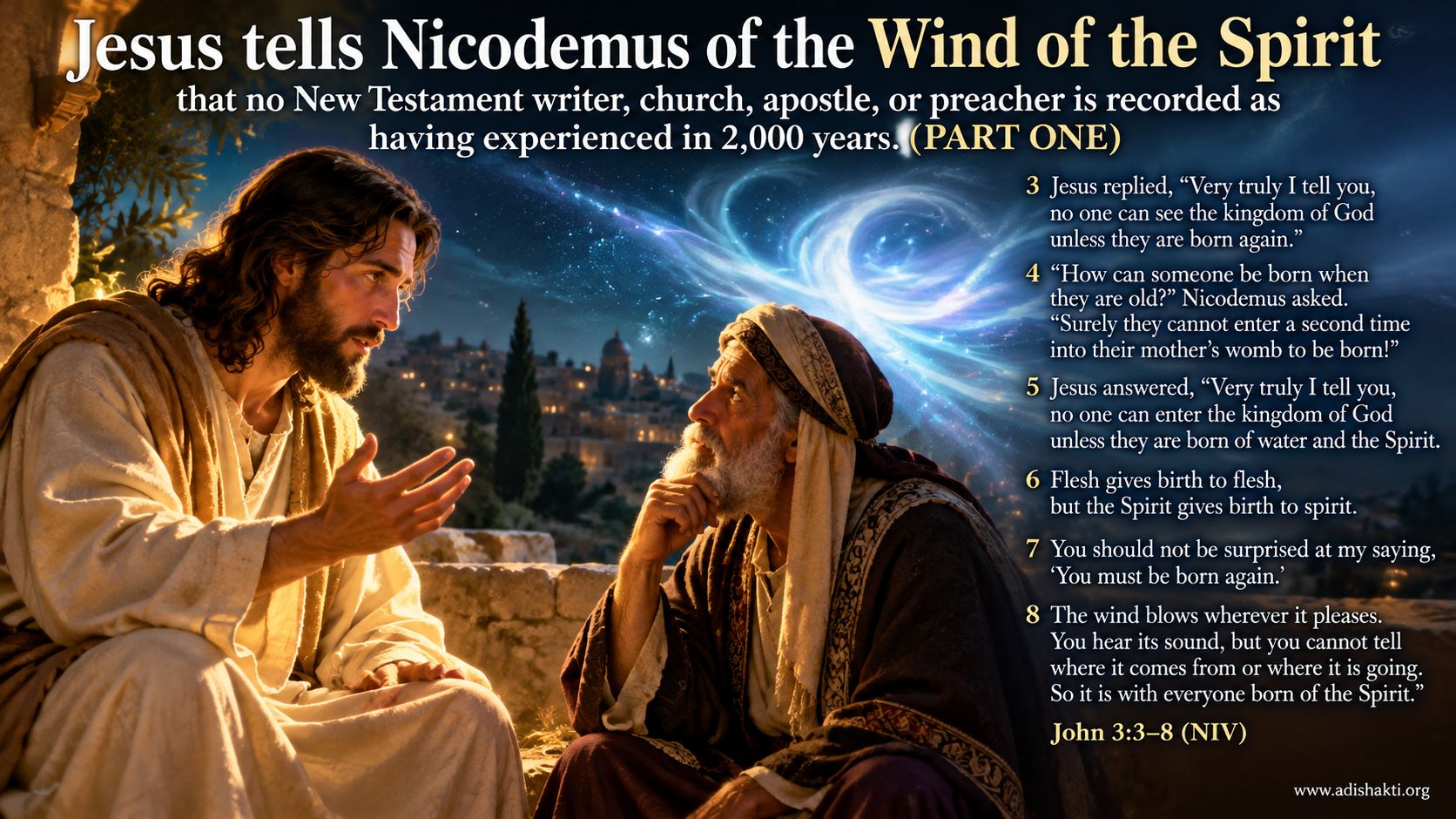
In John 3:8, Jesus tells Nicodemus: “The wind blows wherever it pleases. You hear its sound, but you cannot tell where it comes from or where it is going. So it is with everyone born of the Spirit.” The Greek word pneuma can mean wind, breath, or spirit, and this linguistic overlap has often encouraged interpreters to connect the verse with the Holy Spirit.
Yet the New Testament does not present the wind as a felt experience by which Christians recognize their new birth. No Gospel narrative, Acts sermon, epistle, conversion account, or later New Testament testimony identifies a believer who felt, heard, or otherwise experienced the wind of John 3:8 as evidence of being born of the Spirit. This absence creates the central problem addressed here: if the wind were intended as an experiential sign of Spirit-birth, why is there no recorded Christian case of such an experience?
This paper contends that the answer lies in a distinctive modern religious movement. Sahaja Yoga, founded by Shri Mataji Nirmala Devi, explicitly teaches that those who receive Self-Realization through Kundalini awakening feel a Cool Breeze on the head and hands. Its adherents therefore uniquely claim, as a defining feature of their practice, to experience the Wind of the Holy Spirit that they identify with Jesus’ words in John 3:8.[ pmc.ncbi.nlm.nih ][ bibletools ][ adishakti ]
The New Testament silence
John 3:1–8 describes a private dialogue between Jesus and Nicodemus. Jesus distinguishes fleshly birth from spiritual birth and uses wind as an analogy for the Spirit’s sovereign and hidden action. The comparison concerns origin, direction, and human control: wind moves freely, its source and destination are not fully known, and its reality is known through its effects.
The passage does not say that Nicodemus felt a wind. It does not say that the disciples later felt such a wind. It does not say that any Christian convert felt it as confirmation of regeneration. Jesus’ statement is analogical, not a prescription for a sensory test.
Acts 2:2 is sometimes offered as the missing parallel: “Suddenly a sound like the blowing of a violent wind came from heaven and filled the whole house.” But Luke’s wording is careful: the disciples heard a sound like a rushing wind; the text does not state that wind actually blew. Nor does Acts identify this event as the experience of the wind of John 3:8 as the sign of individual Spirit-birth. Pentecost concerns the Spirit’s coming upon the early disciples and the launch of their public witness, not a documented case of someone feeling the wind of John 3:8 as proof of new birth.
The evidentiary problem
The Christian Scriptures affirm Spirit-birth, but they do not supply a phenomenology of Spirit-birth in terms of wind. The distinction can be stated plainly:
| Proposition | New Testament evidence |
|---|---|
| Jesus taught that one must be born of the Spirit | Explicitly recorded in John 3:3–8. |
| Jesus used wind as an analogy for the Spirit’s work | Explicitly recorded in John 3:8. |
| A Christian experienced that wind as a verifiable sign of Spirit-birth | Not recorded in the New Testament. |
| Any church, apostle, or preacher claimed such an experience | Not recorded in the New Testament. |
This is not a denial that Christians have reported many kinds of spiritual experience. It is a more precise claim: the New Testament contains no verifiable case in which the wind of John 3:8 is treated as a felt sign of being born again. The text preserves the analogy but not an experiential case study.
Sahaja Yoga’s distinctive claim
Sahaja Yoga reverses this pattern. In the movement’s teaching, Self-Realization occurs when the Kundalini rises through the subtle system and pierces the Sahasrara at the crown of the head. The practitioner is then said to feel a Cool Breeze above the head and in the palms of the hands. This sensation is not incidental; it functions as the movement’s principal experiential sign that awakening has occurred.[ pmc.ncbi.nlm.nih ][ adishakti ][ tianmu ]
Judith Coney’s sociological study, Sahaja Yoga , begins precisely with this phenomenon. She recounts meeting a Norwegian acquaintance who had received a massage from a Sahaja Yoga practitioner and reported feeling a cool breeze on the top of his head. Coney explains that her study arose from hearing followers of Shri Mataji claim to feel “cool breezes” on the tops of their heads and palms of their hands.[ bibletools ]
Coney’s account is especially important because it is not an internal devotional testimony. It is an external scholarly study of a new religious movement, based largely on participant observation. Her work records that newcomers to Sahaja Yoga commonly encounter claims of Cool Breeze experiences and may themselves come to report such sensations through participation in the movement’s meditative practices.[ bibletools ]
Shri Mataji’s interpretation of John 3:8
Shri Mataji Nirmala Devi explicitly connected the Cool Breeze with the Holy Spirit and with Jesus’ saying in John 3:8. In her teaching, the Cool Breeze is the tangible manifestation of the divine power awakened within the practitioner. She taught that those who receive Self-Realization feel cool vibrations in the hands and above the head, and she presented this as the actualization of spiritual rebirth.[ bibletools ][ academia ][ biblehub ]
Her followers extend this interpretation directly to Christian Scripture. They identify the biblical ruach , the Greek pneuma , and the Qur’anic ruh with the Cool Breeze experienced in Sahaja Yoga. In this framework, Jesus’ statement that “so is everyone who is born of the Spirit” is read not merely as analogy but as a description of an experiential sign: the Wind of the Holy Spirit becomes perceptible to the person born again.[ biblehub ][ adishakti ][ bibliaplus ]
This is the decisive contrast. Mainstream Christian interpretation generally treats John 3:8 as a metaphor for the mysterious, sovereign action of the Spirit. Sahaja Yoga treats it as a describable experience: the Cool Breeze is held to be felt on the body, especially the crown of the head and palms, and to confirm Kundalini awakening or Self-Realization.[ pmc.ncbi.nlm.nih ][ adishakti ][ bibletools ]
Why the claim is distinctive
The claim is distinctive because it is organized, repeated, and central to the group’s identity. Sahaja Yoga does not merely permit an occasional report of a breeze; it builds the experience into its initiation practices, meditation method, self-assessment, and account of spiritual growth. Practitioners are taught to hold their hands above the head and attend to the sensation of coolness as evidence of the awakened state.[ adishakti ][ tianmu ]
Academic and clinical literature on Sahaja Yoga meditation likewise records the Cool Breeze as a recognized subjective feature of the practice. One neuroscience study describes Sahaja Yoga meditation as based on the spontaneous awakening of Kundalini energy, which meditators subjectively perceive as a cool breeze when placing their hands above the head. Another study of long-term practitioners similarly identifies the sensation of a cool breeze from the hands and top of the head as associated with the meditative state.[ pmc.ncbi.nlm.nih ][ tianmu ]
This does not establish that the sensation is supernatural, nor does it validate the movement’s identification of the sensation with the Holy Spirit. It does establish something more limited but evidentially important: the Cool Breeze is a publicly known, consistently reported, and institutionally interpreted experience within Sahaja Yoga.
The comparative conclusion
The evidence supports the following conclusion. In the New Testament, Jesus speaks of wind in relation to Spirit-birth, but no Christian is recorded as experiencing that wind as the sign of rebirth. In Sahaja Yoga, by contrast, the followers of Shri Mataji Nirmala Devi explicitly claim to feel a Cool Breeze as the sign of Self-Realization and identify it with the Wind of the Holy Spirit described in John 3:8.[ pmc.ncbi.nlm.nih ][ bibletools ][ adishakti ]
Therefore, within the documentary record considered here, it is only the disciples of the Paraclete Shri Mataji who claim to have felt the Wind of being born again of the Spirit that Jesus discussed in John 3:8. The Christian Scriptures preserve the saying; Sahaja Yoga alone, among the traditions examined, converts that saying into a claimed, teachable, and community-wide experience.
Qualification
The word “only” should be understood in its proper evidentiary sense. It means that no recorded New Testament case, and no mainstream Christian doctrinal claim examined here, identifies the wind of John 3:8 as a felt sign of Spirit-birth. It does not mean that no individual anywhere has ever reported an unusual breeze during prayer or meditation. Rather, it means that the organized, explicit, and repeated claim to feel the Wind of John 3:8 as the sign of being born of the Spirit belongs distinctively to Shri Mataji’s Sahaja Yoga disciples.[ pmc.ncbi.nlm.nih ][ bibletools ][ adishakti ]
Conclusion
Jesus’ words in John 3:8 have historically been read as a metaphor for the hidden and sovereign work of the Spirit. The New Testament records the metaphor but not a corresponding experience. Sahaja Yoga stands apart because it claims that the metaphor has become perceptible: its practitioners report a Cool Breeze above the head and in the hands, which Shri Mataji and her followers identify as the Wind of the Holy Spirit and the sign of spiritual rebirth.
The conclusion is therefore not that Sahaja Yoga has proved its theology, but that it has made a claim no New Testament writer, church, apostle, or preacher is recorded as making: that the Wind of John 3:8 can be felt as the experiential sign of being born again of the Spirit.
References and Source Links
Sahaja Yoga research indexed by PubMed Central