The Presence of the Paraclete – The Eschaton Realized in the Life of the Believer
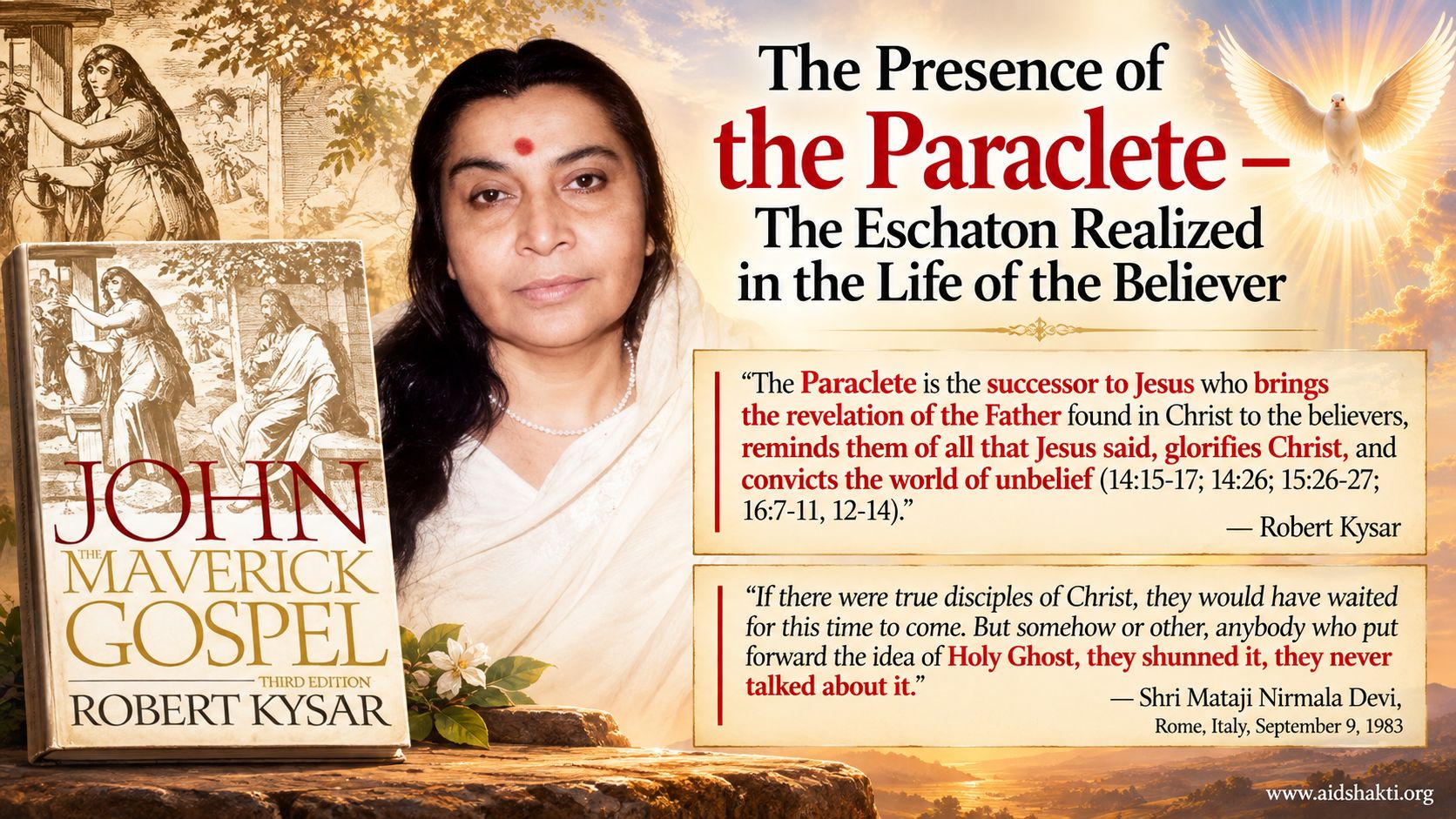
Johannine realized eschatology, the indwelling Spirit of Truth, and the Adishakti.org claim that the promised end-time blessings become present experience through spiritual awakening
“While John uses the concept of the Spirit in a way very similar to other NT writers (e.g., 3:5ff.), he advances the Christian view of the Spirit with the concept of the ‘Paraclete.’ In five passages within the section called the farewell discourses (chaps. 14-16) John sketches a creative and original view of the Spirit. The Paraclete is the successor to Jesus who brings the revelation of the Father found in Christ to the believers, reminds them of all that Jesus said, glorifies Christ, and convicts the world of unbelief (14:15-17; 14:26; 15:26-27; 16:7-11, 12-14). It is in these passages that John relates the Spirit to the Father and to the Son (although not in such a sophisticated sense as the later doctrine of the Trinity) and enlivens the way in which the Spirit may be understood as related to the community of faith amid a world of unbelief.
Because of the presence of the Paraclete in the life of the believer, the blessings of the end-times—the eschaton—are already present. At times John speaks as if that final consummation of history is still a future event conceived in terms typical of apocalyptic thought, both Jewish and Christian: The end-time will bring the coming of Christ, the resurrection of the dead, judgment, and eternal life for believers (e.g., 14:3, 18, 28; 6:39-40; 12:48, 25). Yet, at other times, all of these are spoken of as present realities in the lives of the believers (e.g., 3:18; 5:21, 24, 26). Moreover, there is also some evidence for the view that believers upon their death are taken directly to a heavenly home where they dwell immediately with God (14:2-3; 17:2-3). It is clear that John’s eschatology is a complex one that bridges the distinctions of time and strongly affirms the present life of the believer. In this twofold (or threefold) eschatology we see a possible hint at how John has combined in his gospel older traditional views (future eschatology) with his own interpretation of those views (present or realized eschatology).
These six themes do little more than hint at the rich and none-too-simple views of the Fourth Gospel. Perhaps, however, they do whet the appetite of the reader for the whole banquet of thought found in this gospel.”
Robert Kysar, John
Augsburg Publishing House, 1986, pages 19-20
Summary
The title The Presence of the Paraclete – The Eschaton Realized in the Life of the Believer makes a precise theological claim. It does not mean merely that Christians possess comforting ideas about the Holy Spirit, nor merely that the Church remembers an event called Pentecost. It means that the promised Paraclete makes the realities of the end-time operative within present human existence. Where the Paraclete is genuinely present, the believer is taught, reminded of Christ, confronted by truth, guided, inwardly transformed and brought into a mode of life that belongs to the promised Age to Come.
Robert Kysar supplies the decisive Johannine formulation: the Paraclete is the “successor to Jesus,” continuing the revelation of the Father disclosed in Christ; and because of the Paraclete’s presence, “the blessings of the end-times—the eschaton—are already present.” These two statements belong together. The Paraclete is not an appendix to Christian eschatology. The Paraclete is the agent through whom eschatology ceases to be only expectation and becomes present participation.
The Authenticity Series then advances a further and much more controversial thesis. It argues that Christianity’s identification of Pentecost as the exhaustive fulfillment of Jesus’ Paraclete promise prematurely closed the expectation that Jesus Himself had opened. On this reading, Christians learned to look backward to Acts 2 rather than forward to the promised Teacher, Guide, Witness and Spirit of Truth. Shri Mataji Nirmala Devi’s 1983 declaration in Rome—“If there were true disciples of Christ, they would have waited for this time to come”—therefore becomes not a peripheral criticism of Christian history but an accusation concerning the loss of Christianity’s own eschatological expectancy.
The Paraclete Papers state this accusation in their strongest form: the Pentecost closure is “a tragedy that surpasses even the crucifixion of Jesus in its consequences for human spiritual development.” This paper explains what that claim can and cannot mean. It does not mean that the crucifixion is morally or theologically insignificant. Rather, within the Papers’ argument, the crucifixion ended Jesus’ short earthly ministry while simultaneously generating the promise of a future continuation; the later theological foreclosure of that continuation would, if the thesis is correct, prevent generation after generation from even recognizing the divine remedy Jesus had promised. The asserted tragedy is therefore one of prolonged spiritual consequence: not the death of the messenger alone, but the disappearance of expectation for the promised continuation of the message.
Introduction: What the Title Actually Claims
The title must be read word by word. Presence means that the Paraclete is not merely remembered, confessed or doctrinally defined, but encountered as an active divine agency. Paraclete names the figure whom Jesus promises in the farewell discourses: another Advocate or Comforter, the Spirit of Truth, who will remain with the disciples, teach, remind, testify, convict, guide, speak, declare and glorify Christ. Eschaton means the end-time, the final divine horizon associated with resurrection, judgment, eternal life, restoration and the consummation of God’s purpose. Realized means that realities belonging to that future horizon become operative already in the present. And in the life of the believer identifies the location of that realization: human existence itself.
The title therefore describes a movement from promise to presence, from future to present, and from doctrine to transformation. Its logic is Johannine. Jesus goes away, yet promises “another Paraclete.” The world cannot receive this Spirit of Truth, yet the disciples will know the Paraclete because this divine presence will be “with” them and “in” them. Jesus has more to say than the disciples can presently bear, yet the coming Spirit will guide them into truth. The historical ministry of Jesus thus points beyond itself toward a future divine activity that will internalize and continue what Jesus began.
This is why the question of the Paraclete cannot be reduced to a technical dispute about pneumatology. It concerns the architecture of Christian hope. If the Paraclete is the divine means by which Christ’s unfinished revelatory work continues, then the way Christians understand the Paraclete determines what they are capable of expecting from God. If the promise is treated as exhausted by a past event, expectation contracts. If the promise retains a future and experiential dimension, Christianity remains open to a new act of divine teaching, correction, disclosure and transformation.
1. “The Presence of the Paraclete”: More Than a Doctrine of the Spirit
John’s Paraclete sayings are saturated with verbs. The Paraclete does things. The Paraclete teaches, reminds, testifies, convicts, guides, hears, speaks, declares and glorifies. This verbal density matters because it prevents the Spirit of Truth from being reduced to an abstraction. The Johannine portrait is dynamic and relational: divine truth addresses human beings and expects a response.
Daniel B. Stevick emphasizes precisely this feature when he describes the Spirit’s work through verbs of utterance and reception. The Paraclete is divine self-expression in relation to humanity. Teaching presupposes learners; reminding presupposes a community capable of forgetting; testimony presupposes a contested truth; conviction presupposes error; guidance presupposes a journey not yet completed; declaration presupposes truths still to be communicated. The entire vocabulary implies unfinished spiritual movement.
This gives “presence” a stronger meaning than institutional possession. A church may confess the Holy Spirit in its creed while still asking whether the promised functions are manifest in its life. A doctrine can preserve the name of the Paraclete while the existential expectation of teaching, correction and transformation grows weak. The theological issue is therefore not simply whether Christianity has a doctrine of the Holy Spirit. It is whether Christian life remains open to the active work Jesus attributes to the Spirit of Truth.
2. “The Successor to Jesus”: Continuity After Christ’s Departure
Kysar’s description of the Paraclete as the “successor to Jesus” is unusually important. “Successor” does not mean competitor, replacement messiah or cancellation of Christ. It means continuity of divine mission after Jesus’ departure. The Paraclete brings to believers the revelation of the Father found in Christ, recalls Jesus’ words, glorifies Christ and confronts the world’s unbelief. The Paraclete’s identity is therefore inseparable from fidelity to Christ.
The farewell discourse itself establishes this continuity. Jesus’ departure is repeatedly paired with the promise of another presence. “I will not leave you orphaned” is not sentimental reassurance; it is a structural statement about revelation. The disciples will lose Jesus’ bodily presence, but divine pedagogy will not cease. The Paraclete will continue the revelatory relation between God and humanity in a new mode.
This makes the promise inherently forward-looking. The Paraclete comes because Jesus goes. The Spirit teaches because the disciples do not yet know everything. The Spirit declares because there remain “things to come.” The Spirit reminds because historical distance from Jesus will create the possibility of forgetfulness and distortion. The Paraclete is therefore the theological answer to the problem created by Christ’s departure: how can a finite historical ministry continue to address later humanity?
3. “The Eschaton Realized”: When the Future Age Enters the Present
Eschatology is often imagined as a timetable: death, resurrection, judgment and the final world to come. John complicates this sequence. The Gospel retains future resurrection and final judgment, yet it also speaks in the present tense. The believer “has” eternal life. The one who hears and believes “has passed from death to life.” Judgment can already be operative. An hour is coming and “is now here” when the dead hear the voice of the Son and live.
Kysar’s phrase “the blessings of the end-times—the eschaton—are already present” identifies the theological center of this pattern. The future is not abolished; it becomes anticipatorily present. The final divine reality sends its effects backward, as it were, into history. The believer begins to participate now in what will only later be consummated.
The Paraclete is crucial to this temporal compression because the Spirit makes divine life present after Jesus’ departure. The Age to Come is no longer only an object of expectation. Through the Paraclete it becomes an experienced relation: truth is disclosed, judgment becomes discernment, death yields to spiritual life, and divine presence becomes inward. The eschaton is “realized” not because history has ended, but because the life proper to God’s future has begun within history.
4. “In the Life of the Believer”: Eschatology Becomes Biography
The final phrase of the title prevents eschatology from remaining cosmic spectacle. “In the life of the believer” means that the decisive evidence of realized eschatology is transformation of the human subject. The future Kingdom must become inwardly operative. Resurrection must have a present analogue in awakening from spiritual death. Judgment must become truthful self-disclosure. Eternal life must become present participation in divine reality. The Spirit of Truth must become known rather than merely defined.
This does not eliminate collective or cosmic eschatology. It establishes its first locus. A transformed world requires transformed persons. John’s language of abiding, knowing, receiving, hearing and living makes the believer the site at which the future age first becomes existentially visible.
Within the Authenticity Series, this is the point at which Johannine theology is joined to Shri Mataji’s teaching on Self-realization. The claim is not merely that a new doctrine has appeared. It is that the promised divine presence becomes experientially available through spiritual awakening. The eschaton is therefore interpreted as something that can begin in consciousness before it reaches its final cosmic consummation.
5. Jesus’ Unfinished Teaching and the Necessity of the Paraclete
John 16:12 is one of the most consequential statements in the farewell discourse: Jesus tells the disciples that He still has much to say, but they cannot bear it then. The sentence establishes incompletion within the Gospel itself. Whatever one’s theology of scriptural sufficiency, the narrative voice of Jesus explicitly places further guidance in the future and assigns that guidance to the Spirit of Truth.
The Paraclete promise therefore cannot be understood only as repetition. John 14:26 includes remembrance, but John 16:13 includes guidance into truth and declaration of what is to come. The future ministry both preserves Christ and unfolds the implications of Christ. Continuity and development belong together.
This becomes especially significant when Jesus’ short public ministry is considered historically. The crucifixion terminated His earthly teaching activity. Christian faith interprets that death redemptively, but the Johannine narrative simultaneously anticipates a continuation of revelatory work through the Paraclete. The death of Jesus does not close revelation within the farewell discourse; it intensifies the necessity of the promised successor.
6. Shri Mataji’s Declaration to Christians: “They Would Have Waited”
“If there were true disciples of Christ, they would have waited for this time to come. But somehow or other, anybody who put forward the idea of Holy Ghost, they shunned it, they never talked about it.”Shri Mataji Nirmala Devi, Rome, Italy, September 9, 1983.
This statement deserves to be read with theological precision. Shri Mataji does not merely complain that Christians have insufficient devotion to the Holy Spirit. Her accusation is temporal: they should have waited. Waiting implies that a promise remained outstanding. It implies expectation directed toward a future divine intervention. Her criticism is therefore aimed at a Christian consciousness that, in her view, ceased to inhabit the future tense of Jesus’ promise.
The force of “true disciples of Christ” is equally important. Shri Mataji turns fidelity to Jesus into a test of expectancy. If Jesus promised a Counselor, Redeemer, Comforter and Holy Ghost whose coming would continue His work, then discipleship should include vigilance for that fulfillment. To love Christ while refusing even the possibility of the promised continuation would, on this reasoning, create a contradiction inside Christian devotion itself.
Her second sentence identifies the mechanism of the loss: those who “put forward the idea of Holy Ghost” were, she says, shunned. The issue is not that the phrase “Holy Spirit” disappeared from Christianity; obviously it did not. The issue is that expectation of an identifiable, active, revelatory advent became theologically unnecessary once the promise was considered already fulfilled. The name remained while the expectation changed.
Read this way, Shri Mataji’s declaration is addressed directly to Christians who sincerely believe they are waiting for God. It asks them to distinguish between waiting for Christ’s return and waiting for what Christ Himself promised would come in the interval. Her challenge is: if Jesus explicitly directed His disciples toward the Paraclete, why should faithfulness to Jesus make Christians less rather than more willing to examine a claimed fulfillment of that promise?
7. The Pentecost Question: Event, Fulfillment, or Premature Closure?
Mainstream Christian theology commonly connects the gift of the Holy Spirit at Pentecost in Acts 2 with Jesus’ promises concerning the Spirit. That connection has deep historical roots and cannot responsibly be dismissed as though Christianity simply invented Pentecost. Acts presents a dramatic outpouring of the Spirit, and Christian tradition has interpreted it as foundational for the Church’s mission.
The critical question raised by the Paraclete Papers is narrower and more demanding: does Pentecost exhaust the specific Johannine promise? An event may be genuinely pneumatic without constituting the complete fulfillment of every function assigned to the Paraclete in John 14–16. The distinction between “the Spirit was given” and “the entire Paraclete mission was completed” is therefore essential to the argument.
The Papers ask readers to compare function with claimed fulfillment. Did Pentecost itself constitute the promised guidance into “all truth”? Did it complete what Jesus said the disciples could not yet bear? Did it provide the continuing historical pedagogy implied by teaching, reminding, guiding and declaring? Did it settle Christian understanding of the Kingdom, resurrection, judgment, spiritual rebirth and the future work of God? These questions do not prove the Papers’ conclusion by themselves, but they expose the assumption that the identification of Pentecost with exhaustive fulfillment is self-evident.
The critical distinction: the Authenticity Series does not need to deny that Pentecost was an authentic experience of the Holy Spirit in order to challenge the claim that Pentecost exhausted the future Paraclete mission described by Jesus. Its argument is that a genuine first-century outpouring and a later eschatological fulfillment are not logically mutually exclusive.
8. How the Pentecost Interpretation Erased Expectation
The most consequential effect of an “already completely fulfilled” interpretation is not merely exegetical. It changes what a religious community is prepared to recognize. Once a promise is classified as fulfilled, believers stop waiting for its fulfillment. The relevant biblical passages are then read retrospectively: every future-tense verb is absorbed into an event already located safely in sacred history.
This is the central historical-theological accusation of the Paraclete Papers. The Papers argue that Christianity did not merely misdate an event; it altered the horizon of Christian expectation. The future Teacher became a past gift. The promised Guide became an inherited doctrine. The one who would speak and declare became identified with the Church’s existing possession of the Spirit. The possibility that the Paraclete might confront Christianity itself became increasingly difficult to imagine.
The consequence is a recognition problem. A community can be intensely devoted to a promise while possessing an interpretive system that prevents it from recognizing any new claimant to that promise. In such a system, a future Paraclete is not evaluated and rejected after examination; the category itself has effectively disappeared. The question “Has the Paraclete now come?” sounds theologically mistaken because the answer has already been fixed in advance: “The Paraclete came at Pentecost.”
Shri Mataji’s word “waited” cuts directly through this closure. Waiting reopens futurity. It restores the possibility that Jesus’ farewell discourse contains an expectation not exhausted by Acts 2. Whether one ultimately accepts Shri Mataji’s identity claim or not, her challenge requires Christians to ask whether their inherited interpretation permits the text to surprise them.
9. “A Tragedy That Surpasses Even the Crucifixion”: What the Claim Means
The Paraclete Papers deliberately use extreme language: they call the alleged suppression of the Paraclete promise “a tragedy that surpasses even the crucifixion of Jesus in its consequences for human spiritual development.” This must be interpreted carefully. It is a thesis of the Paraclete Papers, not a neutral historical finding and not a judgment shared by Christianity at large.
Within the internal logic of the Papers, however, the comparison has a specific meaning. The crucifixion killed Jesus and terminated His brief earthly ministry, but Christian theology holds that it did not defeat His mission. The resurrection followed; the Gospel spread; and, crucially for John, Jesus Himself promised another Paraclete who would continue the work that remained unfinished. The crucifixion therefore contains, within Christian revelation, its own divinely promised continuation.
The alleged Pentecost foreclosure is described as still more consequential because it would target that continuation itself. If humanity kills the messenger but remains alert for the promised successor, revelation can continue. But if humanity is persuaded that no future successor need ever be expected, then the mechanism of recognition has been disabled in advance. The first tragedy removes the historical teacher; the second, according to the Papers, removes the expectation by which the promised future teacher could be recognized.
This is the sense in which the comparison concerns consequences for spiritual development, not a competition in suffering. The crucifixion occurred at a determinate historical moment. The alleged theological closure would operate across centuries, shaping the expectations of generations of Christians. Its effect would be cumulative: every generation taught that the promise had been exhaustively fulfilled would inherit less reason to look for the active eschatological Teacher described in John.
The thesis becomes even sharper when John 16:12–13 is placed beside it. Jesus acknowledges that His disciples cannot yet bear everything He has to say. The Spirit of Truth will guide them later. If a later theology effectively renders such future guidance unnecessary, then, on the Papers’ reading, the very provision Jesus made for the incompleteness of His earthly teaching has been neutralized. The tragedy is therefore not simply “the Church got a doctrine wrong.” It is that a doctrinal conclusion may have prevented Christians from expecting the divine agency appointed to complete, interpret and actualize Christ’s unfinished teaching.
10. The Missing Functions: Teach, Remind, Testify, Convict, Guide, Speak, Declare
A serious reassessment must return from institutional history to the Johannine criteria. The Paraclete is promised through functions, and those functions provide the conceptual test.
Teach
John 14:26 presents the Paraclete as teacher. Teaching implies intelligible communication and a community capable of learning something it does not yet adequately understand. A theology that reduces the Spirit to silent inward influence risks underrepresenting this pedagogical dimension.
Remind
The Paraclete recalls Jesus’ words. Remembrance is not antiquarian repetition; it restores the meaning of Christ to communities capable of distortion, selective emphasis and forgetfulness. The Paraclete’s fidelity to Jesus is therefore one criterion against arbitrary novelty.
Testify and glorify Christ
The Paraclete does not eclipse Jesus. The Spirit testifies to Him and glorifies Him. Any claimed fulfillment must therefore be evaluated by its relation to Christ: does it illuminate His mission, recover His teaching and direct attention toward the divine reality He proclaimed?
Convict the world
John 16 gives the Paraclete a confrontational role regarding sin, righteousness and judgment. The promised presence is therefore not merely consoling. It exposes error. Significantly, “the world” can include religious systems insofar as they participate in misunderstanding, resistance or institutional self-protection.
Guide into all truth
This is perhaps the most demanding phrase. It establishes movement from partial understanding toward fuller truth. The Paraclete does not merely certify that the disciples already possess everything in completed form. Guidance presupposes a path.
Speak and declare
John 16 repeatedly presents the Spirit as communicating. The future work of God has propositional and interpretive content. The Paraclete hears, speaks and declares. The promise therefore has a public, communicative dimension in addition to inward spiritual experience.
Taken together, these functions explain why the Authenticity Series insists that the Paraclete question must remain open to historical examination. If Jesus supplied recognizable functions, a claimed fulfillment can at least be compared with them. The comparison does not compel assent, but it is more rigorous than deciding the question solely by inherited chronology.
11. The Recognition Paradox: Christians Waiting for Christ but Not for His Paraclete
A paradox emerges. Christianity is an eschatological religion: Christians confess that history moves toward divine fulfillment and many await the return of Christ. Yet the Paraclete Papers argue that the specific future figure whom Jesus describes at length in His farewell discourse has largely ceased to function as an object of expectation.
This creates an asymmetry. Christians may scrutinize world events for signs of Christ’s return while rarely asking what historical manifestation would satisfy the Paraclete’s promised work of teaching, reminding, testifying, convicting, guiding and declaring. The Spirit is believed in, but not necessarily awaited in the sense Shri Mataji’s statement demands.
The paradox becomes more acute in John 14:17: the world cannot receive the Spirit of Truth because it neither sees nor knows the Paraclete. Non-recognition is already part of the promise. Consequently, lack of recognition cannot by itself settle the question against a claimant; neither, of course, can it prove a claimant genuine. It establishes a theological warning: the promised presence may arrive under conditions in which conventional recognition fails.
For Christians, the responsible response is neither automatic acceptance nor automatic dismissal. It is discernment according to the text: Does the claimed mission teach? Does it recall and glorify Christ? Does it expose error? Does it guide toward truth? Does it communicate what Jesus said remained to be disclosed? Does it produce the spiritual life associated with the promised indwelling?
12. Shri Mataji as the Paraclete: The Authenticity Series Thesis
Methodological distinction: The identification of Shri Mataji Nirmala Devi with the Johannine Paraclete is the theological thesis advanced by Adishakti.org and the Authenticity Series. It is not the conclusion of Robert Kysar, Daniel B. Stevick, or mainstream Johannine scholarship.
The Authenticity Series argues that Shri Mataji’s life and teaching should be evaluated precisely against the Johannine functions. She taught publicly for decades; repeatedly interpreted and defended Jesus; spoke about the Holy Spirit, rebirth, judgment, the Kingdom of God and the Age to Come; criticized religious institutions where she believed they had obscured spiritual reality; and presented Self-realization as a direct experience of the divine presence rather than mere intellectual belief.
Her own self-understanding intensifies the claim. In teachings cited throughout the Paraclete Papers, Shri Mataji identifies the Adi Shakti with the Holy Spirit and presents Kundalini as the individual reflection of that divine power within the human being. The outer teacher and inner Spirit are thus joined: the historical mission explains the transformation, while the indwelling spiritual power actualizes it.
This exoteric-esoteric convergence is central to the proposed fulfillment. A merely historical teacher could speak but could not necessarily fulfill “will be in you.” A purely interior force could transform but would not obviously fulfill the verbal functions of teaching, reminding, testifying and declaring. The Authenticity Series claims that Shri Mataji’s mission joins both dimensions: intelligible public teaching and inward spiritual awakening.
On this reading, Kysar’s “successor to Jesus” becomes concrete without displacing Jesus. Shri Mataji’s claimed Paraclete mission is measured by its Christological orientation: to explain, defend and complete understanding of Christ rather than to erase Him. The Spirit’s glory is derivative in the Johannine sense—“he will glorify me”—and therefore the claimed fulfillment must be evaluated by whether it makes Christ more intelligible rather than less.
13. Self-Realization: From Eschatological Promise to Experienced Presence
The title reaches its fullest meaning at the level of experience. If the eschaton is realized “in the life of the believer,” then the decisive transition is not simply from one doctrine to another but from expectation to participation. Within Sahaja Yoga, Self-realization is understood as the awakening of Kundalini, its ascent through the subtle system and the opening of the Sahasrara, accompanied by a new condition of awareness often described as thoughtless awareness and the experience of a cool breeze or subtle vibrations.
The Authenticity Series interprets this phenomenology through Johannine categories. “Born of the Spirit” becomes an experienced spiritual birth. “The Kingdom of God” becomes inwardly accessible rather than only externally awaited. Judgment becomes discernment and self-knowledge. Resurrection becomes awakening from spiritual death. The indwelling Spirit becomes a living interior reality rather than a proposition affirmed by creed.
This is why “realized eschatology” is such an important bridge between Kysar’s Johannine scholarship and the site’s theological thesis. Kysar does not identify the Paraclete with Shri Mataji or realized eschatology with Kundalini awakening. But his observation supplies a conceptual grammar: the presence of the Paraclete makes end-time blessings present in the believer. The Authenticity Series then proposes Self-realization as the concrete experiential form in which that Johannine grammar becomes visible.
The strongest claim of the paper can therefore be stated succinctly: the eschaton is not realized merely when a believer thinks correctly about the end-time; it is realized when the divine presence promised for the end-time becomes operative within the believer. The transformation is the theology made existential.
14. Critical Theological Assessment
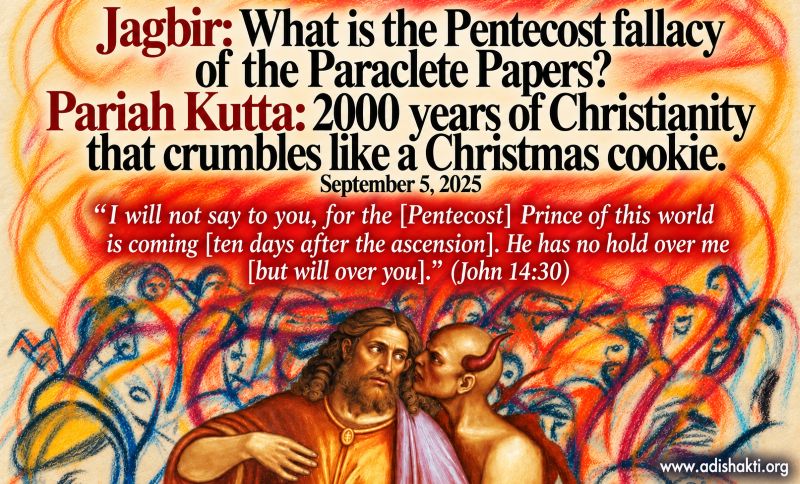
The argument must withstand several objections if it is to function as more than confessional assertion. First, Acts 2 explicitly describes the coming of the Holy Spirit, and John 14:26 explicitly identifies the Paraclete with the Holy Spirit. A Christian can therefore reasonably argue that Pentecost truly participates in fulfillment. The Authenticity Series’ stronger case is not that Pentecost was spiritually empty, but that it need not be the exhaustive terminus of the Johannine promise.
Second, Christian tradition can answer that the Paraclete’s teaching functions operate continuously through the Church rather than through a later incarnate individual. That is a serious alternative interpretation. The counter-question raised by the Papers is whether the historical fruits of Christian division, doctrinal dispute and continuing uncertainty adequately instantiate the promise to guide into all truth. Historical fragmentation does not logically disprove the presence of the Spirit—human freedom and error remain possible—but it does prevent simplistic appeals to institutional history from functioning as self-validating proof of complete fulfillment.
Third, identifying Shri Mataji as the Paraclete cannot be established merely by matching a list of functions. Religious history contains many teachers who claim revelation, transformation or divine authority. The claim therefore requires cumulative assessment: textual correspondence, Christological orientation, the content of her teaching, the character of the claimed spiritual experience, historical evidence, testimony, and the possibility of independent experiential examination.
Fourth, the phrase “a tragedy that surpasses even the crucifixion” should remain explicitly identified as the evaluative thesis of the Paraclete Papers. Its intellectual force depends on the counterfactual it proposes: if Jesus intended a future Paraclete mission beyond Pentecost, and if later theology made Christians structurally incapable of expecting or recognizing that mission, then the consequences would indeed extend across centuries of spiritual development. Without those premises, the comparison does not follow. Stating the conditional logic strengthens rather than weakens the argument because it makes clear what must actually be demonstrated.
Finally, the paper’s deepest challenge is directed not at Christianity’s sincerity but at its hermeneutical openness. The question is whether a tradition can preserve fidelity to its past while remaining vulnerable to the future promised within its own scripture. John’s Paraclete sayings make such vulnerability difficult to avoid. The Spirit of Truth is promised precisely because the disciples’ understanding is unfinished.
Conclusion: The Eschaton Is Present Where the Paraclete Is Present

The Presence of the Paraclete – The Eschaton Realized in the Life of the Believer is ultimately a statement about divine immediacy. The end-time is not only the last page of history. In John, its life can begin before history ends. Eternal life can be possessed now; judgment can disclose truth now; the dead can hear and live now; God can abide within the believer now. Kysar identifies the theological agent of this realized futurity: the presence of the Paraclete.
This makes the Paraclete promise indispensable rather than secondary. Jesus’ departure does not leave an empty interval between the first coming and the final consummation. The Spirit of Truth occupies that interval as teacher, witness, advocate, guide and revealer. The Paraclete carries Christ’s revelation forward precisely because Jesus’ historical ministry was finite and because the disciples could not yet bear everything He wished to communicate.
Shri Mataji’s Rome declaration therefore strikes at the center of Christian eschatological consciousness: “they would have waited.” Her charge is that Christians inherited a theology that taught them not to wait for the very divine continuation Christ had promised. The Paraclete Papers radicalize this criticism by arguing that the exhaustive identification of the promise with Pentecost erased the expectation required for later recognition.
That is the precise sense in which the Papers describe the loss as a tragedy exceeding even the crucifixion in its consequences for human spiritual development. The crucifixion interrupted Jesus’ earthly voice; the Paraclete promise answered that interruption. But if the expectation of the Paraclete was itself subsequently closed, then the promised answer to the interruption could become invisible to those for whom it was intended. The tragedy, in this thesis, is prolonged non-recognition.
The Authenticity Series proposes Shri Mataji Nirmala Devi as the resolution of that crisis: the historical teacher who explains Christ, the claimed Holy Spirit who awakens the inner spiritual power, and the Paraclete whose presence makes the eschatological promise experiential. This identification remains a theological claim requiring discernment rather than a conclusion imposed by mainstream scholarship. Yet the Johannine question it raises cannot be dismissed simply by repeating that Pentecost occurred.
The decisive question is functional and existential: Where is the promised presence that teaches, reminds, testifies, convicts, guides, speaks, declares, glorifies Christ and brings the believer into the life of the coming age? If the Paraclete is present, then eschatology has already begun—not as the annihilation of history, but as the transformation of the believer within history. The Age to Come announces itself in a human life awakened to the Spirit of Truth.
References
The Holy Bible. Gospel of John 3:1–8, 18; 5:21–29; 6:39–40; 12:48; 14:2–3, 16–18, 26; 15:26–27; 16:7–15; 17:2–3; Acts 2.
Kysar, Robert. John. Augsburg Publishing House, 1986, pp. 19–20.
Stevick, Daniel B. Jesus and His Own: A Commentary on John 13–17. Eerdmans, 2011, especially discussion of the Paraclete as divine self-expression and the Johannine verbs of teaching, testimony, guidance and declaration.
Shri Mataji Nirmala Devi. Public address, Rome, Italy, September 9, 1983. “If there were true disciples of Christ, they would have waited for this time to come.”
Adishakti.org. The Paraclete Papers. Multi-part research series on the Johannine Paraclete, Pentecost, the Age to Come and the claimed fulfillment through Shri Mataji Nirmala Devi.
Adishakti.org. “The Paraclete’s Human Personality and the Theological Fallacy of Pentecost.” Paraclete Papers.
Adishakti.org. “Apokalypsis: Paraclete’s Fulfillment of Jesus’ Eschatological Promise from the Last Supper in the Age to Come.” Paraclete Papers.
Adishakti.org. “The Paraclete and Last Judgment: From Expectation to Realization.” Study of Pentecost, realized eschatology and the present reality of resurrection.
Paraclete Papers
PART ONE: An Investigative Report on Christianity's Greatest Cover-UpPART TWO: The Paraclete's Human Personality and the Theological Fallacy of Pentecost
PART THREE: The Greatest Deception in Human History: Pentecost as Satan's Trojan Horse
PART FOUR: Unveiling the Church Born from the Prince's Millennia of Deception
PART FIVE: Apokalypsis: Paraclete's 'Fulfillment of Jesus' Eschatological Age to Come
PART SIX: The Paraclete and Pentecost: A Critical Analysis of Johannine Eschatology
PART SEVEN: The Mother Kundalini as the Holy Spirit who gives Second Birth
 |
“I conclude the chapter by suggesting that the teaching of the Holy Spirit/Paraclete, because it is understood as the continuation of Jesus' teaching, is also regarded as the fulfillment of the promise of eschatological divine instruction.” Stephen E. Witmer Divine instruction in Early Christianity Witmer is especially relevant to the Paraclete Papers because he explicitly connects the Spirit-Paraclete’s continuing instruction with eschatological fulfillment. His formulation supports the paper’s central question: whether Jesus’ promise concerns an enduring ministry of divine teaching that cannot be reduced to the single event of Pentecost. |
 |
“And when Jesus foreannounced another Comforter, He must have intended a Person as distinct and helpful as He had been. A breath, an afflatus, an impersonal influence could not have stood in the same category as Himself.” F. B. Meyer, Love to the Utmost Meyer’s argument turns on the expression “another Comforter.” Because Jesus presents the coming figure in continuity with His own personal ministry, Meyer reasons that the promised Comforter must possess recognizable personal agency. This bears directly on the Paraclete Papers’ distinction between a person who teaches and an impersonal spiritual influence. |
 |
“There is something new and startling in both his person and his teaching that defies the categories provided by the world and culture in which he lived. It is clearest in all its radical nature in Jesus' insistence that in his person and activity God's decisive intervention was already present:” Francis Moloney, A Hard Saying Moloney places Jesus within the category of decisive divine intervention already entering history. This provides an important eschatological parallel for the Paraclete Papers: fulfillment need not be confined to a remote end-time event, but may become historically present through a divinely commissioned person and activity. |
 |
“The Paraclete has a twofold function: to communicate Christ to believers and, to put the world on trial.” Robert Kysar, John The Meverick Gospel Kysar is especially relevant because he gives the Paraclete a twofold ministry: communicating Christ to believers while also placing the world under judgment. The formulation joins revelation and discernment in a single mission. For the Paraclete Papers, this means fulfillment cannot be measured by spiritual experience alone; it must also account for a continuing ministry that makes Christ known, exposes error, and confronts the world with the meaning of Jesus’ life and teaching. |
 |
“But She—the Spirit, the Paraclete...—will teach you everything.” Danny Mahar, Aramaic Made EZ) Mahar is important to the Divine Feminine dimension of the Paraclete Papers because his rendering presents the Spirit-Paraclete with feminine reference while retaining the decisive Johannine promise that the Paraclete will teach. The significance is therefore not grammatical gender alone. The passage combines personal agency with instruction: the promised Spirit teaches, communicates, and continues revelation. This makes the citation relevant to both the paper’s gender question and its argument that the Paraclete’s ministry is identifiable through teaching. |
 |
“Grammatical nonsense but evidence of the theological desire to defeminize the Divine.” Lucy Reid, She Changes Everything Reid is relevant because her observation raises the question of how grammatical choices and later theological conventions have shaped Christian language for the Spirit. The issue matters to the Paraclete Papers because John portrays the Paraclete through personal actions—teaching, reminding, witnessing, speaking, guiding, and declaring. Reid therefore provides a useful bridge between the debate over feminine divine language and the larger question of whether inherited terminology has narrowed how Christians imagine the personal agency of the promised Spirit. |
 |
“The functions of the Paraclete spelled out in verses 13-15... are all acts of open and bold speaking in the highest degree.” David Fleer, Preaching John's Gospel Fleer is especially relevant because John 16:13–15 describes the Paraclete through acts of guiding, hearing, speaking, and declaring. His emphasis on open and bold speech makes intelligible communication central to the promised ministry. For the Paraclete Papers, this is an important criterion of fulfillment: the Johannine Paraclete is not described merely as an occurrence of spiritual power, but as an active revealer who communicates truth, interprets what belongs to Christ, and makes that revelation known to others. |
 |
“The reaction of the world to the Paraclete will be much the same as the world's reaction was to Jesus.” Berard L. Marthaler, The Creed: The Apostolic Faith in Contemporary Theology Marthaler is important because he identifies a deliberate Johannine parallel between the world’s response to Jesus and its response to the Paraclete. The comparison concerns recognition as well as rejection: John says that the world cannot receive the Spirit of truth because it neither sees nor knows the Paraclete. For the Paraclete Papers, this means that non-recognition does not automatically disqualify a claimed fulfillment; the Gospel itself anticipates resistance to the promised figure in a pattern resembling the world’s response to Jesus. |
 |
Bultmann calls the “coming of the Redeemer an 'eschatological event,' 'the turning-point of the ages.” G. Ladd, A Theology of the New Testament Ladd is relevant because the language of an eschatological “turning-point of the ages” places the coming of the Redeemer within the larger problem of realized eschatology. The citation helps the Paraclete Papers ask whether divine fulfillment can become historically present while still pointing toward a future consummation. Applied to the Johannine promise, this provides a framework for considering the Paraclete as a continuing presence and ministry rather than assuming that every dimension of Jesus’ promise was exhausted by the single event of Pentecost. |
 |
“The Paraclete equated with the Holy Spirit, is the only mediator of the word of the exalted Christ.” Benny Thettayil, In Spirit and Truth Thettayil is especially relevant because he identifies the Spirit-Paraclete as mediator of the word of the exalted Christ. This closely corresponds to John 16:13–15, where the Paraclete hears, speaks, receives what belongs to Christ, and declares it to the disciples. For the Paraclete Papers, the point establishes continuity: the promised Paraclete does not replace Jesus with an unrelated revelation, but continues and mediates His teaching after His departure. Teaching and transmission therefore become central marks of the promised ministry. |
 |
“The divine Paraclete, and no lessor agency, must show the world how wrong it was about him who was in the right.” Daniel B. Stevick , Jesus and His Own: A Commentary on John 13-17 Stevick is important because he emphasizes the judicial dimension of the Paraclete’s ministry. In John 16, the world’s judgment concerning Jesus is itself overturned: the Paraclete demonstrates that the world was wrong about the one who was truly in the right. For the Paraclete Papers, this expands the promise beyond consolation or inward inspiration. The Paraclete must also correct error, interpret the meaning of Christ, and disclose judgment—functions that give the promised ministry a public, revelatory, and eschatological character. |
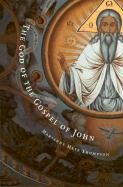 |
Stephen Smalley asserts that “The Spirit-Paraclete ... in John's Gospel is understood as personal, indeed, as a person.” Marianne Thompson, The God of the Gospel of John Thompson’s citation of Stephen Smalley is significant because it directly addresses whether John presents the Spirit-Paraclete as personal rather than merely as a force or influence. The Gospel repeatedly attributes personal actions to the Paraclete: teaching, reminding, witnessing, hearing, speaking, guiding, and declaring. For the Paraclete Papers, this strengthens the distinction between a sustained personal ministry and an interpretation that reduces fulfillment to an impersonal manifestation of spiritual power at Pentecost. |
 |
“The Messiah will come and the great age of salvation will dawn (for the pious).” Eric Eve, The Jewish context of Jesus' Miracles Eve’s statement supplies the Jewish eschatological background against which early Christian expectations of Messiah, salvation, and the age to come developed. The coming of the Messiah is associated with the dawning of a great age of salvation rather than with an isolated religious experience. For the Paraclete Papers, this wider horizon is useful because it places Johannine language about Spirit, revelation, judgment, and eternal life within an expectation of decisive divine intervention that transforms the religious situation of humanity. |
 |
“The remembrance is to relive and re-enact the Christ event, to bring about new eschatological decision in time and space.” Daniel Rathnakara Sadananda, The Johannine Exegesis of God Sadananda is especially relevant because he interprets Johannine remembrance as more than the recovery of past information. To remember Christ is to relive and re-enact the Christ event so that its revelatory significance becomes present in a new time and place. This gives the Paraclete’s work in John 14:26 an ongoing eschatological dimension. For the Paraclete Papers, remembrance therefore supports the idea of continuing revelation: Jesus’ teaching is made living and effective beyond the lifetime of the original disciples. |
 |
“The Spirit acts in such an international situation as the revealer of 'judgment' on the powers that rule the world.” Michael Welker, God the Spirit Welker is relevant because he presents the Spirit as revealer of judgment upon powers that rule the world. This closely parallels John 16:8–11, where the Paraclete exposes the truth concerning sin, righteousness, and judgment. For the Paraclete Papers, the citation shows that the Spirit’s work cannot be confined to inward consolation or private mystical experience. The promised ministry also has a public dimension: it interprets the world, challenges false judgment, and reveals the spiritual significance of powers and events. |
 |
The Paraclete's “Appearance means that sin, righteousness, and judgment will be revealed.” Georg Strecker, Theology of the New Testament Strecker is especially relevant because he concentrates attention on the three categories named in John 16: sin, righteousness, and judgment. The Paraclete’s appearance is therefore revelatory and judicial, disclosing realities that the world has misunderstood. For the Paraclete Papers, these functions provide concrete criteria for examining fulfillment. The promised Spirit is not described only as a source of inspiration; the Paraclete also exposes error, interprets the meaning of Jesus, and brings the world’s assumptions under divine judgment. |
 |
“While the Spirit-Paraclete is the true broker, the brokers they rely on are impostors.” T. G. Brown, Spirit in the writings of John Brown’s description of the Spirit-Paraclete as the “true broker” highlights the problem of mediation and religious authority. A broker communicates and mediates access; in Johannine terms, the Paraclete mediates the revelation of Christ to the believing community. For the Paraclete Papers, the contrast with false brokers raises an important question: how is authentic divine mediation recognized when institutions and interpreters also claim authority to speak for God? The Gospel’s functions of teaching, testimony, guidance, and declaration become relevant criteria. |
 |
“The pneumatological activity ... of the Paraclete ... may most helpfully be considered in terms of the salvific working of the hidden Spirit.” Michael Welker, The work of the Spirit Welker is relevant because his description of the salvific working of the “hidden Spirit” cautions against identifying divine activity only with spectacular manifestations. The Spirit may work through revelation, transformation, discernment, and continuing mediation even when that activity is not immediately recognized by the wider world. For the Paraclete Papers, this provides a useful pneumatological framework for reconsidering fulfillment after Pentecost: continuing divine activity need not reproduce the outward form of Acts 2 in order to remain spiritually significant. |
 |
“The pneuma is the peculiar power by which the word becomes the words of eternal life.” Robert Kysar, Voyages with John Kysar is relevant because he links pneuma with the power by which the word becomes “words of eternal life.” The Spirit therefore does more than accompany proclamation; the Spirit makes revelation living and effective for those who receive it. For the Paraclete Papers, this reinforces the importance of the Johannine verbs of teaching, reminding, speaking, and declaring. A proposed fulfillment should be examined not only for manifestations of power but also for its relationship to revelatory words that communicate spiritual life. |
 |
“The gift of peace, therefore, is intimately associated with the gift of the Spirit-Paraclete.” Francis J. Moloney, The Gospel of John Moloney is relevant because he connects Jesus’ gift of peace directly with the gift of the Spirit-Paraclete in the farewell discourse. Peace is therefore not merely an emotional state but part of the continuing divine presence promised to the disciples after Jesus’ departure. For the Paraclete Papers, this broadens the criteria for considering fulfillment beyond teaching and testimony alone. The promised ministry is also associated with an experienced spiritual peace that accompanies the continuing presence of Christ through the Paraclete. |
 |
“Jesus therefore predicts that God will later send a human being to Earth to take up the role defined by John .i.e. to be a prophet who hears God's words and repeats his message to man.” M. Bucaille The Bible, the Qur'n, and Science Bucaille is included as a comparative interpretation because he reads the Johannine promise as anticipating a later human messenger who hears divine words and communicates them to humanity. Whether or not that interpretation is accepted, it demonstrates that John 16:13 has generated readings substantially different from the conventional identification of the promise solely with Pentecost. For the Paraclete Papers, the citation is useful because it keeps attention on the text’s language of hearing, speaking, transmission, and personal agency. |
 |
“This utopian hope, even when modestly expressed, links Jesus and the prophets to a much wider history of human longing.” Harvey Cox, The Future of Faith Cox is relevant because he places Jesus and the prophets within a much wider history of human hope for transformation. Eschatological expectation is therefore not merely curiosity about future events; it expresses a persistent longing for divine intervention, justice, renewal, and a different order of life. For the Paraclete Papers, this broadens the setting of the Johannine promise. The coming of the Paraclete can be considered within Christianity’s larger expectation that divine action will continue to transform human history and consciousness. |
|
“Because of the presence of the Paraclete in the life of the believer, the blessings of the end-times—the eschaton—are already present.” Robert Kysar, John Kysar is especially relevant because he connects the presence of the Paraclete with blessings of the eschaton already becoming present in the believer’s life. This is a clear expression of realized eschatology: realities associated with the end-time can be experienced within the present. For the Paraclete Papers, that framework helps bridge future promise and present spiritual experience. It allows the Paraclete’s ministry to be considered as an active fulfillment in history without requiring every dimension of eschatological expectation to be already completed. |
 |
“They are going, by the Holy Spirit's power, to be part of the greatest miracle of all, bringing men to salvation.” R. Picirilli, The Randall House Bible Commentary Picirilli is relevant because he presents the Holy Spirit’s power as continuing through the disciples’ mission of bringing people to salvation. Pentecost therefore functions as an empowering beginning rather than as the termination of everything that can subsequently be said about the Spirit’s activity. For the Paraclete Papers, this distinction is important: Acts 2 may inaugurate Spirit-empowered mission while the Johannine promises of teaching, remembrance, testimony, guidance, declaration, and judgment continue to require theological consideration beyond that initial event. |
|
“The Kingdom of God stands as a comprehensive term for all that the messianic salvation included... is something to be sought here and now (Mt. 6:33) and to be received as children receive a gift (Mk. 10:15 = Lk. 18:16-17).” G. Ladd, A Theology of the New Testament Ladd is relevant because the language of an eschatological “turning-point of the ages” places the coming of the Redeemer within the larger problem of realized eschatology. The citation helps the Paraclete Papers ask whether divine fulfillment can become historically present while still pointing toward a future consummation. Applied to the Johannine promise, this provides a framework for considering the Paraclete as a continuing presence and ministry rather than assuming that every dimension of Jesus’ promise was exhausted by the single event of Pentecost. |