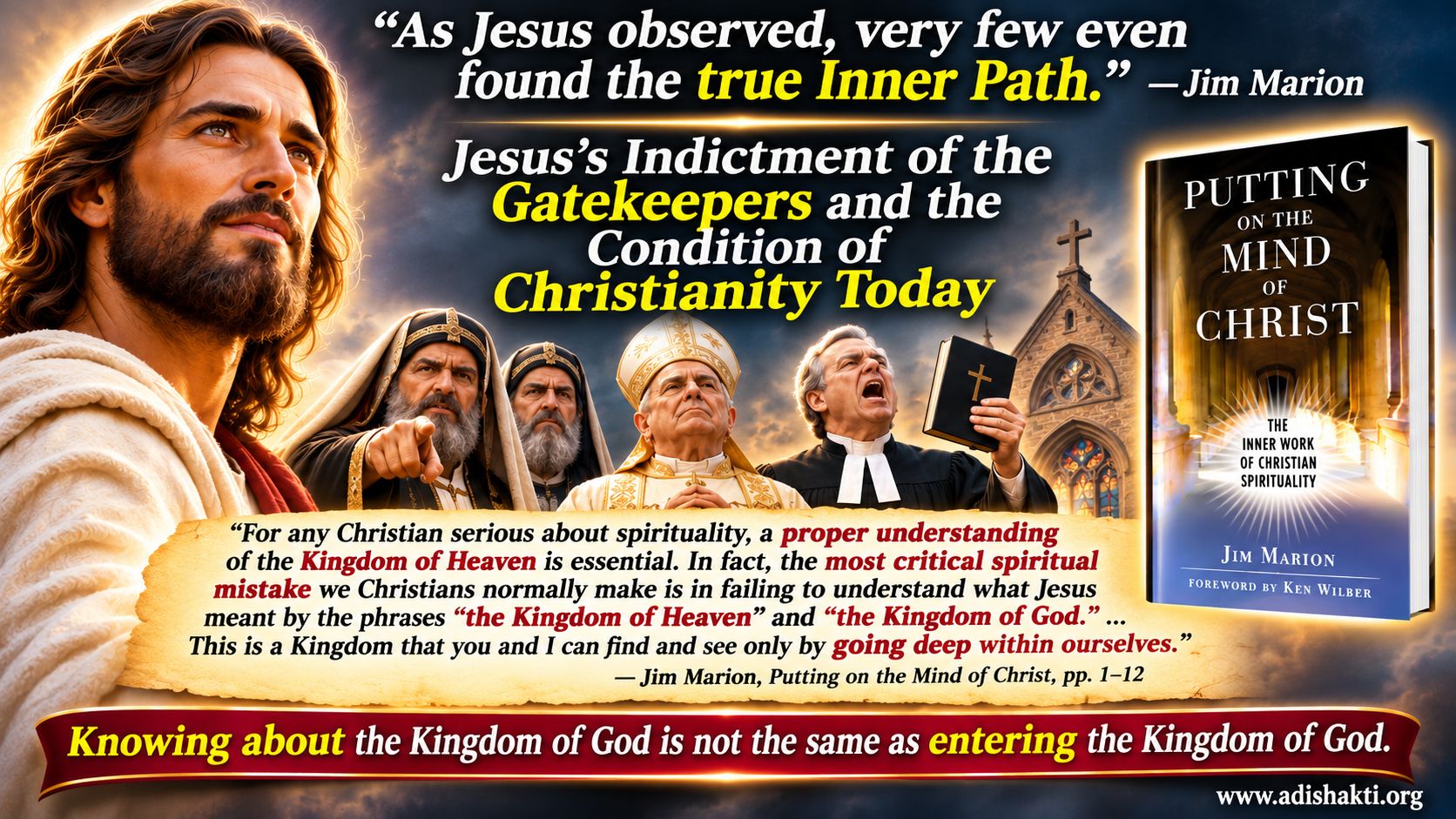
“As Jesus Observed, Very Few Even Found the True Inner Path” — Jim Marion
Summary
Few found the true Inner Path in Jesus’ time; Jim Marion argues that few find it today. The recurring failure is not ignorance of the words “Kingdom of God,” but the substitution of religious knowledge, outward observance and expectations of an afterlife for the present inward transformation Jesus called people to seek. Jesus warned of gatekeepers who neither entered nor allowed others to enter (Matthew 23:13; Luke 11:52). Marion contends that Christianity still risks repeating that failure. Adishakti.org then advances a distinct theological testimony: Shri Mataji Nirmala Devi, identified by the site as the promised Paraclete, taught that the Kingdom must be entered through the seventh chakra, the Sahasrara, and that the collective Sahasrara was opened on May 5, 1970. Knowing about the Kingdom of God is not the same as entering the Kingdom of God. The unresolved question in 2026 is why the inward path remains so little emphasized even after this claimed opening.
Central refrain: Few found it then. Few find it today. Yet, according to the Paraclete’s testimony, the Kingdom has been opened.
1. Few Found It Then: Jesus’ Indictment of the Gatekeepers
“Few found it then” is the first half of this paper’s central claim. Jesus’ most penetrating criticism of religious authority was not simply that its leaders were mistaken about doctrine. It was that they obstructed entry: “you shut up the kingdom of heaven against men” (Matthew 23:13, KJV). Luke’s parallel speaks of those who have taken away the key of knowledge, neither entering themselves nor allowing others to enter (Luke 11:52). The distinction is between possessing the language of salvation and entering the life to which it points.
Jesus repeatedly moved attention from outward display toward inward reality: prayer offered in secret (Matthew 6:6), purity of heart (Matthew 5:8), cleansing the inside of the cup first (Matthew 23:25–26), and rebirth through the Spirit as the condition for seeing and entering the Kingdom (John 3:3–5). He also taught that the Kingdom does not arrive through outward observation (Luke 17:20–21). The text of Luke 17:21 is translated both “within you” and “among you”; this paper develops the inward reading while acknowledging that the translation is contested.
These sayings arose within first-century Jewish debates. They must not be used to condemn Jews or Judaism. Their continuing force is that every religious community—including Christianity—must ask whether its teachers point beyond religious performance to lived transformation.
2. Few Find It Today: Jim Marion’s Diagnosis of Christianity
“Few find it today” is Jim Marion’s challenge to Christianity in the present. In Putting on the Mind of Christ, Marion argues that Christians commonly understand heaven as a blessed destination after death, while Jesus proclaimed a Kingdom “at hand” (Mark 1:15)—a reality to be sought and experienced now. Marion does not reject the afterlife; he rejects confusing it with the full meaning of Jesus’ proclamation.
He observes that churches devote much attention to morality, participation, ritual, giving and institutional belonging. These activities can serve genuine spiritual life, but they do not automatically produce the inward realization he believes Jesus intended. Two millennia of sermons about the Kingdom do not, by themselves, establish that people have entered it. The complete passage from Marion is reproduced above, immediately after the hero image, so readers can evaluate his argument in his own words.
Marion’s conclusion is a theological diagnosis, not a statistical count of spiritually realized Christians. Christian contemplatives and mystics have sustained serious inward traditions across the centuries. Their existence makes the paper’s question more precise, not less urgent: why is the inward path not consistently central to ordinary Christian formation?
3. Jesus’ Repeated Invitation: Seek, Be Reborn, Enter
The Gospels repeatedly distinguish an outward religious identity from an inward response to God. The Kingdom must be sought, the heart transformed, and the person reborn of the Spirit. Not every passage below identifies the Kingdom as an interior location; together they support the importance of inward transformation and entry.
| Gospel passage | Jesus’ emphasis | Question for Christians in 2026 |
|---|---|---|
| Luke 17:20–21 | The Kingdom does not come through outward observation; “within” and “among” are competing translations. | Are believers seeking only external signs and destinations? |
| John 3:3–5 | One must be born of the Spirit to see and enter the Kingdom. | Is spiritual rebirth treated as living experience or only doctrine? |
| Matthew 23:13; Luke 11:52 | Gatekeepers can fail to enter and hinder others. | Are teachers opening the way or guarding institutional boundaries? |
| Matthew 6:6; 6:33 | Pray in secret; seek the Kingdom first. | Is the inward life a priority rather than an optional extra? |
| Matthew 5:3, 5:8, 5:20; 7:21 | Humility, purity, deeper righteousness and doing God’s will matter more than profession alone. | Is belief being mistaken for transformation? |
| Mark 7:14–23; Matthew 23:25–26; Luke 11:39–41 | Purity and defilement must be addressed at the level of the heart, not merely outward observance. | Does religious practice begin with the inner person? |
| Matthew 7:13–14 | The way to life is narrow, and few find it. | Why does Marion’s warning still sound contemporary? |
Jesus did not merely announce a Kingdom to be discussed. He called people to seek it and enter. That imperative is the standard by which this paper assesses both the first-century gatekeepers and Christianity’s condition today.
4. The Paraclete’s Teaching: How the Kingdom Is Entered
Adishakti.org identifies Shri Mataji Nirmala Devi as the Paraclete promised in John 14–16. This identification is a distinctive theological conviction, not a position shared by mainstream Christian churches. Its relevance to this paper is precise: Jesus calls humanity to enter; Shri Mataji teaches that entry occurs through the Sahasrara, the seventh chakra.
In the teaching linked below, Shri Mataji explicitly describes entry into the Kingdom of God in connection with the seventh chakra. Within Sahaja Yoga’s subtle-system understanding, Jesus Christ is associated with the Agnya Chakra, forgiveness and the inward passage, while the awakening of Kundalini and its ascent to the Sahasrara are associated with Self-realization. Thus the contrast is not merely between two religious vocabularies; it is between knowing the teaching and experiencing the spiritual transformation it describes.
John 16:12–13 provides the theological bridge in Adishakti.org’s reading: Jesus speaks of further truth to be disclosed by the Spirit of Truth. The Paraclete is presented here not as a replacement for Jesus but as the promised guide toward the realization of what Jesus proclaimed. This is an interpretive claim readers are invited to examine, not a conclusion asserted by the biblical text itself.
5. May 5, 1970: The Opening That Remains Largely Unknown
According to Sahaja Yoga testimony, on May 5, 1970 Shri Mataji opened the collective Sahasrara at Nargol, India. Adishakti.org understands this as the opening of the inward Kingdom to collective Self-realization. If that testimony is accepted, the problem Marion identifies becomes more urgent: the path is claimed to be open, yet its significance remains largely unknown to the Christian world.
That is the paper’s second historical contrast: few found the Inner Path when Jesus spoke; few are said to find it in 2026, more than fifty-six years after the claimed Sahasrara opening. The metaphysical significance of May 5, 1970, is a Sahaja Yoga belief and testimony, not an independently established historical conclusion about the Kingdom of God.
The Amruta archive search for “Kingdom of God” displayed 1,077 results on November 11, 2026. These are presented as 1,077 indexed lectures in which the phrase “Kingdom of God” appears, regardless of how many times the phrase occurs within any one lecture. The search pagination extends to 54 pages, demonstrating the breadth of the indexed material. The count describes lectures returned by the search, not the total number of times the phrase was spoken, nor proof that every lecture develops an identical interpretation. Shri Mataji’s repeated references to the Kingdom of God deserve serious examination rather than dismissal.
6. Two Millennia and Counting: Why the Failure Persists
Why can the same criticism be made across two millennia? Because religious communities can transmit Scripture, ritual and moral instruction successfully while still leaving the inward journey inadequately explained. Knowledge can multiply while entry remains neglected. Jesus’ rebuke concerned the failure to enter and the obstruction of others; Marion’s modern critique concerns a comparable displacement of inward experience by external religious priorities.
The paper does not claim that literally no Christian has found an inner path, nor that every church teaches only external religion. It argues instead that the persistence of a living contemplative minority does not answer the question of what ordinary believers are chiefly taught to seek. The point is not to attack Christians, but to confront a question that Christian institutions should be able to ask of themselves.
Within Adishakti.org’s perspective, Shri Mataji’s teachings add a further challenge: if the Paraclete has indeed explained and opened a path of direct spiritual realization, why is that claim still so unfamiliar, and why is the experience itself not being seriously investigated? This question should invite examination, not demand uncritical assent.
7. Conclusion: Few Found It Then. Few Find It Today.
Few found it then. Jesus condemned gatekeepers who knew the language of the Kingdom but did not enter and hindered others. Few find it today. Jim Marion argues that Christianity still risks exchanging the inward Kingdom for doctrine, external observance and expectation of heaven after death.
Yet, according to Adishakti.org’s testimony, the Kingdom has been opened. Shri Mataji’s teaching on entry through the Sahasrara, together with the claimed opening of the collective Sahasrara on May 5, 1970, gives the continuing neglect of the Inner Path a new urgency. Jesus’ proclamation and the Paraclete’s teaching are thus presented as one unfolding invitation: seek, be transformed, and enter.
Knowing about the Kingdom of God is not the same as entering the Kingdom of God. In 2026 and counting, the central question remains: are Christians being taught primarily to speak about the Kingdom, or are they being shown how to seek the inward experience Jesus proclaimed?
References
[1] The Gospels: Luke 17:20–21; 11:39–41; 6:20; Mark 7:14–23; Matthew 5:3, 5:8, 5:20; 6:6, 6:33; 7:21; 23:13, 23:25–26; John 3:3–5; 14–16.
[2] Jim Marion, Putting on the Mind of Christ: The Inner Work of Christian Spirituality, Hampton Roads Publishing, pp. 1–12 (supplied excerpt reproduced in full above).
[3] Shri Mataji, seventh-chakra declaration (Houston, October 6, 1981), reproduced by Adishakti.org.
[4] Amruta archive: “Kingdom of God” search (1,077 indexed lecture results reported November 11, 2026, across 54 search-results pages; lecture count as represented by the search, not independently audited).
[5] Bible Gateway, Luke 17:21 translation comparison.
[6] Ilaria Ramelli, “Luke 17:21: ‘The Kingdom of God Is Inside You,’” Hugoye 12.2 (2009), as cited in the supplied research notes.
[7] Adishakti.org, “Authenticity of the Kingdom of God.”
[7] Shri Mataji, teaching on entry into the Kingdom of God in the seventh chakra.