
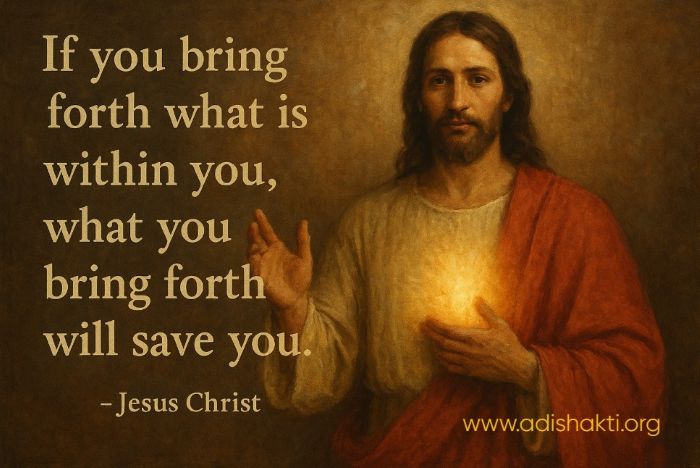
If you bring forth what is within you, what you bring forth will save you.
Jesus
The consequences of this actualization are equally clear: "what you bring forth will save you." The word "save" here carries profound significance. In the context of early Christian teaching, salvation typically refers to liberation from sin, death, and separation from God. But in the Gospel of Thomas, salvation appears to mean something more immediate and existential: the realization of one's true nature, the integration of the divine within oneself, the achievement of wholeness and authenticity. To bring forth what is within is to save oneself from fragmentation, inauthenticity, and spiritual death.
o
An Academic Exploration of Gospel of Thomas Saying 70 Relevance to Modern Spiritual Seekers
Table of Contents
- 1. Introduction
- 2. The Teaching: Gospel of Thomas, Saying 70
- 3. Historical Context and Discovery
- 4. Thomas and John: Divergent Paths of Early Christianity
- 5. Theological Implications: Self-Knowledge and Divine Potential
- 6. The Failure of Institutional Religion
- 7. Relevance for Modern Seekers
- 8. Conclusion: The Imperative of Authenticity
- 9. References
1. Introduction
In the landscape of contemporary spirituality, a profound paradox emerges: millions of people worldwide claim to find institutional religion increasingly irrelevant to their lived experience, yet they simultaneously hunger for spiritual meaning and authentic connection to the sacred. This crisis of faith is not merely statistical—it represents a fundamental rupture between the promises of organized religion and the actual spiritual nourishment seekers require. At the heart of this crisis lies a question that has echoed through two millennia of Christian history: What did Jesus actually teach about the path to salvation and spiritual fulfillment?
The answer to this question has been obscured by centuries of theological construction, ecclesiastical politics, and the deliberate suppression of alternative Christian voices. Yet in 1945, a remarkable discovery near Nag Hammadi in Upper Egypt would resurrect one of the earliest and most provocative testimonies to Jesus' actual teachings: the Gospel of Thomas. Among its 114 sayings lies a teaching of extraordinary power and simplicity, one that challenges the very foundations of institutional Christianity and offers a radically different vision of human spiritual potential.
This teaching appears in Saying 70 of the Gospel of Thomas, where Jesus declares: [1]
"If you bring forth what is within you, what you bring forth will save you. If you do not bring forth what is within you, what you do not bring forth will destroy you."
This single statement encapsulates a vision of human spiritual destiny radically at odds with the institutional Christianity that emerged from the fourth century onward. Rather than promising salvation through external authority, ecclesiastical mediation, or doctrinal conformity, Jesus here addresses each person as a sovereign agent of their own spiritual transformation. The teaching suggests that salvation is not something granted by an external institution but something discovered, cultivated, and actualized from within the human soul itself.
The present paper undertakes a comprehensive examination of this teaching, its historical context, its theological implications, and its profound relevance for modern spiritual seekers. We will argue that this teaching represents one of Jesus' most fundamental truths—a truth that institutional religion has systematically suppressed, to the spiritual detriment of countless believers. We will further demonstrate that the recovery of this teaching offers a pathway toward authentic spirituality, personal transformation, and genuine human flourishing in an age of institutional religious decline.
2. The Teaching: Gospel of Thomas, Saying 70
To understand the full significance of Saying 70, we must first appreciate what makes the Gospel of Thomas distinctive among early Christian texts. Unlike the canonical gospels of Matthew, Mark, Luke, and John, which present narrative accounts of Jesus' life and ministry, the Gospel of Thomas consists entirely of sayings—brief, often aphoristic statements attributed to Jesus. [2] This form of presentation is itself significant, as it emphasizes the teaching rather than the biographical narrative, suggesting that what matters is not the story of Jesus' life but the wisdom he imparts.
Saying 70 stands out even among these sayings for its psychological and spiritual depth. The saying employs a binary structure—a classic rhetorical device in wisdom literature—to present two contrasting possibilities for human existence. On one side lies the promise of salvation through actualization; on the other lies the threat of destruction through suppression. The teaching is not merely descriptive; it is prescriptive and urgent. It demands action and carries consequences.
The phrase "bring forth what is within you" invites multiple layers of interpretation. What is "within"? The most immediate answer is that it refers to the divine potential, the image of God, the inner light that the Gospel of Thomas elsewhere describes as the essence of human nature. [3] In Saying 24, the Gospel of Thomas teaches: "There is light within a person of light, and it lights up the whole universe; if it does not shine, there is darkness." This suggests that each human being possesses an inner luminosity—a capacity for wisdom, compassion, creativity, and spiritual insight—that is fundamentally divine in nature.
To "bring forth" this inner light is to actualize it, to express it, to manifest it in the world. It is not enough to merely possess this potential; one must actively cultivate it, develop it, and allow it to shine forth in one's thoughts, words, and deeds. The teaching thus emphasizes human agency and responsibility. We are not passive recipients of grace dispensed by external authorities; we are active participants in our own spiritual transformation.
The consequences of this actualization are equally clear: "what you bring forth will save you." The word "save" here carries profound significance. In the context of early Christian teaching, salvation typically refers to liberation from sin, death, and separation from God. But in the Gospel of Thomas, salvation appears to mean something more immediate and existential: the realization of one's true nature, the integration of the divine within oneself, the achievement of wholeness and authenticity. To bring forth what is within is to save oneself from fragmentation, inauthenticity, and spiritual death.
Conversely, the warning is equally stark: "If you do not bring forth what is within you, what you do not bring forth will destroy you." This is not a threat of external punishment administered by a divine judge; rather, it describes the inevitable consequence of spiritual suppression. When we fail to actualize our inner potential, when we deny our true nature, when we conform ourselves to external expectations at the cost of inner authenticity, we experience a kind of spiritual death. We become alienated from ourselves, fragmented, inauthentic. The unrealized potential within us becomes a source of internal conflict, psychological suffering, and existential despair.
The teaching thus presents a vision of human spiritual destiny that is radically democratic and radically demanding. Every person possesses the divine light within them; every person has the capacity for spiritual actualization; every person bears responsibility for their own spiritual transformation. There is no intermediary, no priestly class, no ecclesiastical hierarchy that can save us. We must save ourselves by bringing forth what is within.
3. Historical Context and Discovery
The Gospel of Thomas emerged from the early Christian movement, likely composed sometime in the first or second century CE. [4] For nearly 1,700 years, this text existed only in fragmentary quotations preserved by early church fathers who condemned it as heretical. It was not until December 1945 that a complete Coptic translation was discovered near the village of Nag Hammadi in Upper Egypt, buried in a sealed clay jar along with numerous other early Christian and Gnostic texts.
The discovery of the Nag Hammadi library fundamentally transformed scholarly understanding of early Christianity. Prior to this discovery, the history of early Christianity appeared relatively straightforward: Jesus taught, his disciples spread his message, the church grew, and eventually the New Testament canon was established. But the Nag Hammadi texts revealed a far more complex reality. Early Christianity was not monolithic; it was characterized by profound theological diversity, competing interpretations of Jesus' teachings, and vigorous debates about the nature of salvation, the role of authority, and the path to spiritual enlightenment.
The church fathers of the second through fourth centuries faced a crucial decision: which texts and interpretations would be deemed orthodox (correct belief), and which would be branded as heretical (false belief) and suppressed? [5] This process of canonization was not driven by historical accuracy or spiritual authenticity; rather, it was driven by ecclesiastical politics, the desire for institutional unity, and the need to establish clear doctrinal boundaries that would distinguish the emerging Christian church from both Judaism and competing Christian movements.
Elaine Pagels, the renowned scholar of early Christianity and winner of the National Book Award for her groundbreaking work The Gnostic Gospels, has documented this process with meticulous scholarship. [6] In her later work Beyond Belief: The Secret Gospel of Thomas, Pagels reveals how the Gospel of Thomas was deliberately suppressed precisely because its vision of salvation conflicted fundamentally with the emerging institutional church's theology and authority structure. [7]
Pagels describes her own encounter with Saying 70 while studying at Harvard Divinity School. She had expected the suppressed texts to be "garbled, pretentious, and trivial," as the church fathers had claimed. Instead, she discovered sayings of extraordinary spiritual power. Of Saying 70 specifically, she writes: [8]
"The strength of this saying is that it does not tell us what to believe but challenges us to discover what lies hidden within ourselves; and, with a shock of recognition, I realized that this perspective seemed to me self-evidently true."
This moment of recognition is crucial. Pagels, trained in the scholarly tradition of historical criticism and textual analysis, found herself confronted not merely with an ancient text but with a teaching that resonated with her own deepest intuitions about truth, authenticity, and spiritual transformation. The Gospel of Thomas, far from being a heretical aberration, appeared to preserve an authentic strand of Jesus' teaching that had been systematically marginalized by institutional Christianity.
4. Thomas and John: Divergent Paths of Early Christianity
To fully appreciate the significance of the Gospel of Thomas, we must understand how its vision of salvation contrasts with that of the Gospel of John, which became the dominant theological framework for Christianity. [9] This contrast is not merely academic; it represents a fundamental fork in the road of Christian history, with profound consequences for how Christianity developed and how it has functioned in the world.
The Gospel of John presents Jesus as the unique incarnation of God, the only source of divine light and truth. In John's famous declaration, Jesus says: "I am the light of the world; whoever follows me will not walk in darkness, but will have the light of life." [10] The emphasis here is on Jesus as the unique source of light. Salvation comes through believing in Jesus, through accepting him as the divine savior, and through the mediation of the church that claims to represent him.
The Gospel of Thomas, by contrast, teaches that the divine light is not unique to Jesus but is present within all human beings. In Saying 108, Jesus teaches: "Whoever drinks from my mouth will become like me; I myself shall become that person, and the hidden things will be revealed to that person." [11] The teaching is not about worshipping Jesus as a unique savior but about becoming like Jesus, about realizing the same divine potential that Jesus realized.
This distinction has enormous implications. John's gospel supports a hierarchical, institutional model of Christianity, where authority flows from Jesus to the apostles to the bishops to the priests, and where salvation is mediated through the church's sacraments and teachings. Thomas's gospel, by contrast, supports a democratic, non-hierarchical model, where each person has direct access to the divine light within themselves and bears personal responsibility for their own spiritual transformation.
Pagels argues persuasively that the Gospel of John may have been written, in part, to refute the theology of Thomas. [12] John's insistence on Jesus as the unique light of the world, his emphasis on belief in Jesus as the condition for salvation, and his presentation of Jesus as God incarnate all serve to establish a theological framework that justifies institutional mediation and hierarchical authority. If Jesus alone is the light of the world, then we need the church to tell us about Jesus. If salvation comes only through believing in Jesus, then we need the church to define correct belief. If Jesus is God incarnate and we are merely humans, then we need priestly intermediaries to connect us to the divine.
By contrast, Thomas's vision of the divine light within all people, of salvation through self-knowledge and actualization, and of Jesus as a teacher rather than a unique savior, provides no justification for institutional mediation. If the divine light is within us, we do not need the church to access it. If salvation comes through bringing forth what is within, we do not need priests to mediate our relationship with God. If Jesus is a teacher who shows us what is possible, rather than a unique savior, then his role is to inspire and guide, not to monopolize access to the divine.
The church fathers of the second through fourth centuries recognized this threat. [13] Irenaeus, bishop of Lyons, condemned the Gospel of Thomas and other similar texts as "an abyss of madness, and blasphemy against Christ." But what was the actual nature of this "madness" and "blasphemy"? It was not that these texts contradicted Jesus' teachings; rather, it was that they contradicted the emerging institutional church's interpretation of those teachings. The church fathers branded Thomas as heretical precisely because it threatened the institutional authority structure they were constructing.
5. Theological Implications: Self-Knowledge and Divine Potential
The teaching of Saying 70 carries profound theological implications that extend far beyond the historical context of early Christianity. At its core lies a vision of human nature and human potential that stands in stark contrast to the dominant theological traditions that emerged from institutional Christianity.
First, the teaching affirms that human beings possess divine potential within themselves. This is not a pantheistic claim that humans are God; rather, it is the claim that humans are created in the image of God and therefore possess the capacity for wisdom, compassion, creativity, and spiritual insight. The Gospel of Thomas expresses this repeatedly. In Saying 70, it is the inner light that must be brought forth. In Saying 24, it is described as "light within a person of light." In Saying 3, Jesus teaches: "If those who lead you say to you, 'Look, the kingdom is in the sky,' then the birds of the sky will get there before you. If they say to you, 'It is in the sea,' then the fish will get there before you. Rather, the kingdom of God is inside of you, and it is outside of you." [14]
This vision of the kingdom of God as an inner reality rather than an external institution or future event represents a radical departure from much of institutional Christianity, which has traditionally located the kingdom of God either in the future (apocalyptic expectation) or in the church itself (ecclesiology). Thomas teaches that the kingdom is already present, within each person, awaiting recognition and actualization.
Second, the teaching emphasizes the centrality of self-knowledge to spiritual transformation. The Gospel of Thomas repeatedly insists on the importance of knowing oneself. In Saying 3, Jesus says: "If you come to know yourselves, then you will know that it is you who are the sons of the living Father." [15] Self-knowledge is not mere psychological introspection; it is recognition of one's true nature, one's divine origin, one's spiritual potential. To know oneself is to know God, because the divine is present within the self.
This emphasis on self-knowledge places the Gospel of Thomas in conversation with ancient philosophical traditions, particularly Platonism and Stoicism, which also emphasized self-knowledge as central to wisdom. But Thomas goes further: it makes self-knowledge not merely a philosophical virtue but a spiritual necessity. Without self-knowledge, one remains trapped in illusion, alienated from one's true nature, unable to actualize one's divine potential.
Third, the teaching affirms human agency and responsibility in spiritual transformation. The phrase "bring forth what is within you" is an imperative; it demands action. Salvation is not something that happens to us; it is something we must actively accomplish. We are not passive recipients of grace; we are active agents of our own transformation. This stands in contrast to much of institutional Christianity, which emphasizes grace as a divine gift that humans receive passively, often through the mediation of the church.
The Gospel of Thomas does not deny the reality of grace or divine assistance; rather, it suggests that grace works through human agency, not in opposition to it. In Saying 48, Jesus teaches: "If two make peace with each other in this one house, they will say to the mountain, 'Move away,' and it will move away." [16] The implication is that human intention, will, and action have real power in the spiritual realm. We are not powerless victims of fate or divine predestination; we are co-creators of our spiritual reality.
Fourth, the teaching presents salvation as wholeness and authenticity rather than forensic justification. Much of institutional Christianity has understood salvation in juridical terms: the sinner is guilty, God is the judge, Christ is the advocate, and salvation is the verdict of acquittal. But the Gospel of Thomas understands salvation differently: it is the realization of wholeness, the integration of the divine within oneself, the achievement of authenticity. To be saved is to become whole, to actualize one's potential, to bring forth what is within.
This understanding of salvation is deeply psychological and existential. It resonates with modern humanistic psychology and existential philosophy, which also emphasize authenticity, self-actualization, and the integration of the self as central to human flourishing. [17] The Gospel of Thomas, written nearly 2,000 years ago, articulates a vision of human spiritual development that contemporary psychology is only now beginning to understand scientifically.
6. The Failure of Institutional Religion
If the Gospel of Thomas offers such a compelling vision of spiritual transformation, why has institutional Christianity chosen instead to follow the path of John? And what are the consequences of this choice for contemporary religious life?
The answer lies in the fundamental tension between spiritual authenticity and institutional power. Institutions require hierarchy, clear boundaries, and centralized authority to function. They require doctrinal uniformity to maintain unity. They require mediation structures to justify their existence. The Gospel of Thomas, with its emphasis on direct inner knowledge, personal responsibility, and the divine light within all people, offers no basis for institutional mediation or hierarchical authority.
The Gospel of John, by contrast, provides perfect theological justification for institutional Christianity. If Jesus is the unique incarnation of God, then the church that claims to represent Jesus possesses unique authority. If salvation comes through believing in Jesus, then the church that defines correct belief controls access to salvation. If the sacraments of the church mediate divine grace, then the priests who administer the sacraments hold power over people's spiritual destiny. Institutional Christianity chose John over Thomas not because John was more historically accurate or spiritually true, but because John's theology supported institutional power.
The consequences of this choice have been profound and largely catastrophic for authentic spirituality. [18] For nearly two millennia, institutional Christianity has systematically suppressed the very teaching that Jesus emphasized: that the divine light is within each person, that salvation comes through actualizing one's inner potential, that spiritual authority lies within the individual rather than in external institutions.
Instead, institutional Christianity has taught that:
1. Human beings are fundamentally sinful and corrupt. Rather than emphasizing the divine light within, institutional Christianity has emphasized human depravity and the need for external salvation. The doctrine of original sin, inherited guilt, and total depravity has created a psychological framework in which people are taught to distrust themselves, to see their inner nature as corrupt, and to depend on external authorities (the church, the priesthood, the sacraments) for salvation.
2. Salvation is mediated by external authorities. Rather than teaching that each person has direct access to the divine light within themselves, institutional Christianity has taught that salvation comes through the church, the priesthood, and the sacraments. This creates a power structure in which the church controls access to salvation and people become dependent on ecclesiastical authorities for their spiritual well-being.
3. Doctrinal conformity is more important than authentic spiritual experience. Rather than encouraging people to discover what lies hidden within themselves, institutional Christianity has demanded adherence to specific doctrines and creeds. Those who deviate from official doctrine are branded as heretics and excluded from the community. This creates a climate of fear and conformity that stifles genuine spiritual exploration and authentic self-discovery.
4. Authority flows from above downward. Rather than recognizing the spiritual authority within each person, institutional Christianity has established a hierarchical structure in which authority flows from the pope to the bishops to the priests to the laity. This hierarchical structure mirrors and reinforces secular power structures, making the church complicit in systems of domination and oppression.
The consequences of these teachings have been devastating. Millions of people have been taught to distrust themselves, to depend on external authorities for spiritual guidance, to conform their beliefs to institutional doctrine, and to suppress their own inner voice and intuition. [19] The result has been widespread spiritual alienation, psychological suffering, and a crisis of meaning that characterizes contemporary religious life.
We see this crisis manifested in multiple ways. First, there is the dramatic decline of institutional religion in the West. Fewer and fewer people identify as religious, attend religious services, or believe in traditional Christian doctrines. [20] This decline is not primarily due to secularization or scientific rationalism; rather, it reflects a growing recognition that institutional religion has failed to deliver on its promises of spiritual transformation and authentic meaning.
Second, there is the rise of "spiritual but not religious" identity. Millions of people are rejecting institutional religion while simultaneously seeking spiritual meaning and transformation. [21] This phenomenon suggests that people have not abandoned the search for meaning; rather, they have abandoned institutional religion as a vehicle for that search. They are seeking alternative paths to spiritual actualization.
Third, there is widespread institutional abuse and corruption within religious organizations. Sexual abuse by priests, financial corruption by church leaders, and complicity in systems of oppression and injustice have exposed the moral bankruptcy of institutional religion. [22] These abuses are not incidental to institutional religion; they are endemic to it. When authority is concentrated in hierarchical structures, when people are taught to distrust themselves and depend on external authorities, and when institutional power is prioritized over authentic spirituality, abuse becomes inevitable.
The fundamental problem is that institutional religion has betrayed the very teaching that Jesus emphasized in the Gospel of Thomas: that the divine light is within each person, that salvation comes through actualizing one's inner potential, and that spiritual authority lies within the individual rather than in external institutions. By suppressing this teaching and promoting instead a theology of human depravity, external mediation, and hierarchical authority, institutional Christianity has cut people off from their own spiritual resources and made them dependent on institutions that are themselves corrupt and spiritually bankrupt.
7. Relevance for Modern Seekers
What does the Gospel of Thomas and its teaching about bringing forth what is within have to offer to modern spiritual seekers? Why should contemporary people care about a 2,000-year-old text that was suppressed by the church and only rediscovered in 1945?
The answer is that the Gospel of Thomas speaks directly to the spiritual crisis of our time. In an age of institutional decline, psychological fragmentation, and existential uncertainty, the teaching of Saying 70 offers a pathway toward authentic spiritual transformation that does not depend on institutional mediation or doctrinal conformity.
First, it affirms human dignity and potential. In a world that often treats people as consumers, workers, or subjects of state power, the Gospel of Thomas affirms that each person possesses divine potential, that each person is created in the image of God, and that each person has the capacity for wisdom, compassion, and spiritual insight. This is profoundly counter-cultural in a society that constantly tells us we are inadequate, that we need to buy products to be happy, that we need experts to tell us how to live. The Gospel of Thomas says: the light you seek is already within you. The wisdom you need is already present. You have the capacity to transform yourself and your world.
Second, it emphasizes personal responsibility and agency. In a world characterized by victimhood narratives, blame-shifting, and dependency on external authorities, the Gospel of Thomas calls each person to take responsibility for their own spiritual transformation. It says: you must bring forth what is within you. No one can do this for you. No institution can save you. No doctrine can transform you. Only you, through your own effort and intention, can actualize your inner potential. This is both empowering and challenging. It empowers us by affirming our capacity for self-transformation; it challenges us by refusing to allow us to blame external circumstances or authorities for our spiritual stagnation.
Third, it encourages authentic self-discovery. In a world of conformity, social media personas, and performative identity, the Gospel of Thomas calls us to discover what lies hidden within ourselves. It asks: Who are you, really? Not who do others expect you to be? Not who does society tell you to be? But who are you in your deepest nature? What is the divine light within you? What are your unique gifts, talents, and capacities? What is the authentic expression of your being? This is the work of a lifetime, and it is the foundation of genuine spiritual transformation.
Fourth, it offers a non-hierarchical, non-dogmatic approach to spirituality. In a world where many people have been hurt by institutional religion, where they have been told that their questions are dangerous, their doubts are sinful, and their inner voice is unreliable, the Gospel of Thomas offers an alternative. It says: trust yourself. Question authority. Seek direct experience rather than accepting doctrine on faith. Discover truth through your own inner exploration. This does not mean rejecting all external guidance or community; rather, it means that external guidance and community should support and facilitate your own inner discovery, not replace it or control it.
Fifth, it provides a framework for understanding psychological and spiritual suffering. Saying 70 teaches that what we do not bring forth will destroy us. This is not a threat of external punishment; it is a description of the psychological and spiritual consequences of suppression. When we deny our true nature, when we conform ourselves to external expectations at the cost of inner authenticity, when we suppress our gifts and talents and potential, we experience a kind of internal death. We become fragmented, anxious, depressed, and alienated from ourselves. The Gospel of Thomas provides a framework for understanding this suffering not as a sign of our sinfulness but as a sign of our inauthenticity. Healing comes not through confession to a priest or belief in a doctrine, but through bringing forth what is within, through actualizing our potential, through becoming authentic.
Sixth, it aligns with contemporary psychology and neuroscience. The Gospel of Thomas, written nearly 2,000 years ago, articulates a vision of human spiritual development that contemporary psychology is only now beginning to understand scientifically. [23] Humanistic psychology, pioneered by figures like Carl Rogers and Abraham Maslow, emphasizes self-actualization, authenticity, and the inherent human capacity for growth and transformation. [24] Existential psychology emphasizes personal responsibility, authentic choice, and the creation of meaning through one's own choices and actions. Neuroscience increasingly demonstrates that the human brain possesses remarkable neuroplasticity—the capacity to rewire itself, to develop new capacities, to transform itself through intention and practice. All of these contemporary insights align with and validate the Gospel of Thomas's teaching about bringing forth what is within.
For modern seekers, then, the Gospel of Thomas offers something that institutional religion has largely failed to provide: a spirituality that honors human dignity, encourages personal responsibility, supports authentic self-discovery, and does not depend on hierarchical authority or doctrinal conformity. It offers a pathway toward spiritual transformation that is grounded in the recognition of the divine light within each person and the actualization of that light through conscious effort and authentic living.
8. Conclusion: The Imperative of Authenticity
We stand at a critical juncture in the history of Christianity and human spirituality. Institutional religion, which has dominated Western spiritual life for nearly two millennia, is in rapid decline. Fewer people believe its doctrines, attend its services, or find meaning in its teachings. This decline is not a tragedy; it is an opportunity. It is an opportunity to recover the authentic teachings of Jesus that institutional Christianity has suppressed, to reclaim the spiritual resources that have been hidden from us, and to chart a new course toward authentic spiritual transformation.
The Gospel of Thomas, and particularly Saying 70, offers us a compass for this new journey. It teaches that the divine light is within each of us, that salvation comes through actualizing our inner potential, and that spiritual authority lies within the individual rather than in external institutions. This teaching is not new; it is ancient. But it is also radically contemporary, speaking directly to the spiritual crisis of our time and offering a pathway toward authentic transformation.
The imperative is clear: bring forth what is within you. Discover the divine light that lies hidden in your deepest nature. Actualize your potential. Express your authentic self. Take responsibility for your own spiritual transformation. Trust yourself. Question authority. Seek direct experience. Create meaning through your own choices and actions. This is the teaching of Jesus in the Gospel of Thomas. This is the path to salvation. This is the way to wholeness.
The alternative—the path of institutional religion, of external mediation, of doctrinal conformity, of hierarchical authority—has proven bankrupt. It has failed to deliver on its promises of spiritual transformation. It has instead created systems of oppression, abuse, and spiritual alienation. It is time to move beyond this failed experiment and to recover the authentic teachings of Jesus about the divine potential within each person.
For modern seekers, this recovery offers profound hope. It says: you are not fundamentally sinful and corrupt. You are not dependent on external authorities for your spiritual well-being. You are not required to conform your beliefs to institutional doctrine. You possess within yourself the divine light, the capacity for wisdom, the potential for transformation. Your task is to bring forth what is within you. Your responsibility is to actualize your potential. Your destiny is to become authentic, whole, and fully human.
This is the profound truth that Jesus taught in the Gospel of Thomas. This is the truth that institutional Christianity suppressed for nearly two millennia. This is the truth that modern seekers are rediscovering. And this is the truth that offers the most compelling pathway toward authentic spiritual transformation in our time.
The question now is not whether this teaching is true—its truth is self-evident to anyone who genuinely contemplates it. The question is whether we have the courage to embrace it, the wisdom to apply it, and the commitment to build a new spirituality grounded in the recognition of the divine light within each person and the actualization of that light through authentic living. The choice is ours. The time is now. Bring forth what is within you.
References
[1] Gospel of Thomas, Saying 70, in The Nag Hammadi Library in English, translated by members of the Coptic Gnostic Library Project of the Institute for Antiquity and Christianity (Leiden: E. J. Brill, 1988), p. 126.
[2] Elaine Pagels, Beyond Belief: The Secret Gospel of Thomas (New York: Random House, 2003), pp. 30–32.
[3] Gospel of Thomas, Saying 24, in The Nag Hammadi Library in English, p. 120.
[4] Stephen J. Patterson, The Gospel of Thomas and Jesus (Sonoma, CA: Polebridge Press, 1993), pp. 1–50; see also Helmut Koester, Ancient Christian Gospels: Their History and Development (Philadelphia: Trinity Press International, 1990), pp. 75–128.
[5] Bart D. Ehrman, The New Testament: A Historical Introduction to the Early Christian Writings, 6th ed. (New York: Oxford University Press, 2016), pp. 1–50.
[6] Elaine Pagels, The Gnostic Gospels (New York: Random House, 1979), winner of the National Book Critics Circle Award and the National Book Award.
[7] Pagels, Beyond Belief, pp. 1–50.
[8] Pagels, Beyond Belief, p. 31.
[9] Pagels, Beyond Belief, pp. 50–100; see also C. H. Dodd, The Interpretation of the Fourth Gospel (Cambridge: Cambridge University Press, 1953).
[10] Gospel of John 8:12, in The Holy Bible, New Revised Standard Version (New York: National Council of the Churches of Christ, 1989).
[11] Gospel of Thomas, Saying 108, in The Nag Hammadi Library in English, p. 133.
[12] Pagels, Beyond Belief, pp. 50–100; see also Pheme Perkins, The Gnostic Dialogue: The Early Church and the Crisis of Gnosticism (New York: Paulist Press, 1980).
[13] Irenaeus of Lyons, Against Heresies (Adversus Haereses), Book 1, Preface, written c. 180 CE; see also Pagels, Beyond Belief, p. 32.
[14] Gospel of Thomas, Saying 3, in The Nag Hammadi Library in English, p. 118.
[15] Gospel of Thomas, Saying 3, in The Nag Hammadi Library in English, p. 118.
[16] Gospel of Thomas, Saying 48, in The Nag Hammadi Library in English, p. 122.
[17] Carl Rogers, On Becoming a Person: A Therapist's View of Psychotherapy (Boston: Houghton Mifflin, 1961); Abraham H. Maslow, Motivation and Personality, 3rd ed. (New York: Harper & Row, 1987).
[18] See Pagels, Beyond Belief, pp. 1–50; also David Brakke, The Making of Monastic Community in Fourth-Century Egypt (Cambridge: Cambridge University Press, 2015).
[19] Bart D. Ehrman, How Jesus Became God: The Exaltation of a Jewish Preacher from Galilee (New York: HarperOne, 2014), pp. 1–50.
[20] Pew Research Center, Religion in America: U.S. Religious Data, Demographics, and Trends (Washington, DC: Pew Research Center, 2021).
[21] Linda A. Mercadante, Belief Without Borders: Inside the Minds of the Spiritual but Not Religious (New York: Oxford University Press, 2014).
[22] John Jay College of Criminal Justice, The Causes and Context of Sexual Abuse of Minors by Catholic Priests in the United States, 1950–2010 (Washington, DC: United States Conference of Catholic Bishops, 2011).
[23] Bessel van der Kolk, The Body Keeps the Score: Brain, Mind, and Body in the Healing of Trauma (New York: Penguin Books, 2014).
[24] Rogers, On Becoming a Person; Maslow, Motivation and Personality; also see Carl Rogers, A Way of Being (Boston: Houghton Mifflin, 1980).
Continue Your Awakening
For if you walk on this road, it is impossible to go astray.
Because I live you also will live.
I have cast fire upon this world, and see, I am guarding it
If you bring forth what is within you, what you bring forth ...
If anyone thirst let him come to Me and drink
I still have many things to say but you cannot bear them
But this He spoke of the Spirit: The Spirit was not yet given
Paraclete Papers
PART ONE: An Investigative Report on Christianity's Greatest Cover-Up
PART TWO: The Paraclete's Human Personality and the Theological Fallacy of Pentecost
PART THREE: The Greatest Deception in Human History: Pentecost as Satan's Trojan Horse
PART FOUR: Unveiling the Church Born from the Prince's Millennia of Deception
PART FIVE: Apokalypsis: Paraclete's Fulfillment of Jesus' Eschatological promise from Last Supper in Age to Come
PART SIX: The Paraclete and Pentecost: A Critical Analysis of Johannine Eschatology
PART SEVEN: The Mother Kundalini as the Holy Spirit
Table of Contents
- 1. Introduction
- 2. The Teaching: Gospel of Thomas, Saying 70
- 3. Historical Context and Discovery
- 4. Thomas and John: Divergent Paths of Early Christianity
- 5. Theological Implications: Self-Knowledge and Divine Potential
- 6. The Failure of Institutional Religion
- 7. Relevance for Modern Seekers
- 8. Conclusion: The Imperative of Authenticity
- 9. References
1. Introduction
In the landscape of contemporary spirituality, a profound paradox emerges: millions of people worldwide claim to find institutional religion increasingly irrelevant to their lived experience, yet they simultaneously hunger for spiritual meaning and authentic connection to the sacred. This crisis of faith is not merely statistical—it represents a fundamental rupture between the promises of organized religion and the actual spiritual nourishment seekers require. At the heart of this crisis lies a question that has echoed through two millennia of Christian history: What did Jesus actually teach about the path to salvation and spiritual fulfillment?
The answer to this question has been obscured by centuries of theological construction, ecclesiastical politics, and the deliberate suppression of alternative Christian voices. Yet in 1945, a remarkable discovery near Nag Hammadi in Upper Egypt would resurrect one of the earliest and most provocative testimonies to Jesus' actual teachings: the Gospel of Thomas. Among its 114 sayings lies a teaching of extraordinary power and simplicity, one that challenges the very foundations of institutional Christianity and offers a radically different vision of human spiritual potential.
This teaching appears in Saying 70 of the Gospel of Thomas, where Jesus declares: [1]
This single statement encapsulates a vision of human spiritual destiny radically at odds with the institutional Christianity that emerged from the fourth century onward. Rather than promising salvation through external authority, ecclesiastical mediation, or doctrinal conformity, Jesus here addresses each person as a sovereign agent of their own spiritual transformation. The teaching suggests that salvation is not something granted by an external institution but something discovered, cultivated, and actualized from within the human soul itself.
The present paper undertakes a comprehensive examination of this teaching, its historical context, its theological implications, and its profound relevance for modern spiritual seekers. We will argue that this teaching represents one of Jesus' most fundamental truths—a truth that institutional religion has systematically suppressed, to the spiritual detriment of countless believers. We will further demonstrate that the recovery of this teaching offers a pathway toward authentic spirituality, personal transformation, and genuine human flourishing in an age of institutional religious decline.
2. The Teaching: Gospel of Thomas, Saying 70
To understand the full significance of Saying 70, we must first appreciate what makes the Gospel of Thomas distinctive among early Christian texts. Unlike the canonical gospels of Matthew, Mark, Luke, and John, which present narrative accounts of Jesus' life and ministry, the Gospel of Thomas consists entirely of sayings—brief, often aphoristic statements attributed to Jesus. [2] This form of presentation is itself significant, as it emphasizes the teaching rather than the biographical narrative, suggesting that what matters is not the story of Jesus' life but the wisdom he imparts.
Saying 70 stands out even among these sayings for its psychological and spiritual depth. The saying employs a binary structure—a classic rhetorical device in wisdom literature—to present two contrasting possibilities for human existence. On one side lies the promise of salvation through actualization; on the other lies the threat of destruction through suppression. The teaching is not merely descriptive; it is prescriptive and urgent. It demands action and carries consequences.
The phrase "bring forth what is within you" invites multiple layers of interpretation. What is "within"? The most immediate answer is that it refers to the divine potential, the image of God, the inner light that the Gospel of Thomas elsewhere describes as the essence of human nature. [3] In Saying 24, the Gospel of Thomas teaches: "There is light within a person of light, and it lights up the whole universe; if it does not shine, there is darkness." This suggests that each human being possesses an inner luminosity—a capacity for wisdom, compassion, creativity, and spiritual insight—that is fundamentally divine in nature.
To "bring forth" this inner light is to actualize it, to express it, to manifest it in the world. It is not enough to merely possess this potential; one must actively cultivate it, develop it, and allow it to shine forth in one's thoughts, words, and deeds. The teaching thus emphasizes human agency and responsibility. We are not passive recipients of grace dispensed by external authorities; we are active participants in our own spiritual transformation.
The consequences of this actualization are equally clear: "what you bring forth will save you." The word "save" here carries profound significance. In the context of early Christian teaching, salvation typically refers to liberation from sin, death, and separation from God. But in the Gospel of Thomas, salvation appears to mean something more immediate and existential: the realization of one's true nature, the integration of the divine within oneself, the achievement of wholeness and authenticity. To bring forth what is within is to save oneself from fragmentation, inauthenticity, and spiritual death.
Conversely, the warning is equally stark: "If you do not bring forth what is within you, what you do not bring forth will destroy you." This is not a threat of external punishment administered by a divine judge; rather, it describes the inevitable consequence of spiritual suppression. When we fail to actualize our inner potential, when we deny our true nature, when we conform ourselves to external expectations at the cost of inner authenticity, we experience a kind of spiritual death. We become alienated from ourselves, fragmented, inauthentic. The unrealized potential within us becomes a source of internal conflict, psychological suffering, and existential despair.
The teaching thus presents a vision of human spiritual destiny that is radically democratic and radically demanding. Every person possesses the divine light within them; every person has the capacity for spiritual actualization; every person bears responsibility for their own spiritual transformation. There is no intermediary, no priestly class, no ecclesiastical hierarchy that can save us. We must save ourselves by bringing forth what is within.
3. Historical Context and Discovery
The Gospel of Thomas emerged from the early Christian movement, likely composed sometime in the first or second century CE. [4] For nearly 1,700 years, this text existed only in fragmentary quotations preserved by early church fathers who condemned it as heretical. It was not until December 1945 that a complete Coptic translation was discovered near the village of Nag Hammadi in Upper Egypt, buried in a sealed clay jar along with numerous other early Christian and Gnostic texts.
The discovery of the Nag Hammadi library fundamentally transformed scholarly understanding of early Christianity. Prior to this discovery, the history of early Christianity appeared relatively straightforward: Jesus taught, his disciples spread his message, the church grew, and eventually the New Testament canon was established. But the Nag Hammadi texts revealed a far more complex reality. Early Christianity was not monolithic; it was characterized by profound theological diversity, competing interpretations of Jesus' teachings, and vigorous debates about the nature of salvation, the role of authority, and the path to spiritual enlightenment.
The church fathers of the second through fourth centuries faced a crucial decision: which texts and interpretations would be deemed orthodox (correct belief), and which would be branded as heretical (false belief) and suppressed? [5] This process of canonization was not driven by historical accuracy or spiritual authenticity; rather, it was driven by ecclesiastical politics, the desire for institutional unity, and the need to establish clear doctrinal boundaries that would distinguish the emerging Christian church from both Judaism and competing Christian movements.
Elaine Pagels, the renowned scholar of early Christianity and winner of the National Book Award for her groundbreaking work The Gnostic Gospels, has documented this process with meticulous scholarship. [6] In her later work Beyond Belief: The Secret Gospel of Thomas, Pagels reveals how the Gospel of Thomas was deliberately suppressed precisely because its vision of salvation conflicted fundamentally with the emerging institutional church's theology and authority structure. [7]
Pagels describes her own encounter with Saying 70 while studying at Harvard Divinity School. She had expected the suppressed texts to be "garbled, pretentious, and trivial," as the church fathers had claimed. Instead, she discovered sayings of extraordinary spiritual power. Of Saying 70 specifically, she writes: [8]
This moment of recognition is crucial. Pagels, trained in the scholarly tradition of historical criticism and textual analysis, found herself confronted not merely with an ancient text but with a teaching that resonated with her own deepest intuitions about truth, authenticity, and spiritual transformation. The Gospel of Thomas, far from being a heretical aberration, appeared to preserve an authentic strand of Jesus' teaching that had been systematically marginalized by institutional Christianity.
4. Thomas and John: Divergent Paths of Early Christianity
To fully appreciate the significance of the Gospel of Thomas, we must understand how its vision of salvation contrasts with that of the Gospel of John, which became the dominant theological framework for Christianity. [9] This contrast is not merely academic; it represents a fundamental fork in the road of Christian history, with profound consequences for how Christianity developed and how it has functioned in the world.
The Gospel of John presents Jesus as the unique incarnation of God, the only source of divine light and truth. In John's famous declaration, Jesus says: "I am the light of the world; whoever follows me will not walk in darkness, but will have the light of life." [10] The emphasis here is on Jesus as the unique source of light. Salvation comes through believing in Jesus, through accepting him as the divine savior, and through the mediation of the church that claims to represent him.
The Gospel of Thomas, by contrast, teaches that the divine light is not unique to Jesus but is present within all human beings. In Saying 108, Jesus teaches: "Whoever drinks from my mouth will become like me; I myself shall become that person, and the hidden things will be revealed to that person." [11] The teaching is not about worshipping Jesus as a unique savior but about becoming like Jesus, about realizing the same divine potential that Jesus realized.
This distinction has enormous implications. John's gospel supports a hierarchical, institutional model of Christianity, where authority flows from Jesus to the apostles to the bishops to the priests, and where salvation is mediated through the church's sacraments and teachings. Thomas's gospel, by contrast, supports a democratic, non-hierarchical model, where each person has direct access to the divine light within themselves and bears personal responsibility for their own spiritual transformation.
Pagels argues persuasively that the Gospel of John may have been written, in part, to refute the theology of Thomas. [12] John's insistence on Jesus as the unique light of the world, his emphasis on belief in Jesus as the condition for salvation, and his presentation of Jesus as God incarnate all serve to establish a theological framework that justifies institutional mediation and hierarchical authority. If Jesus alone is the light of the world, then we need the church to tell us about Jesus. If salvation comes only through believing in Jesus, then we need the church to define correct belief. If Jesus is God incarnate and we are merely humans, then we need priestly intermediaries to connect us to the divine.
By contrast, Thomas's vision of the divine light within all people, of salvation through self-knowledge and actualization, and of Jesus as a teacher rather than a unique savior, provides no justification for institutional mediation. If the divine light is within us, we do not need the church to access it. If salvation comes through bringing forth what is within, we do not need priests to mediate our relationship with God. If Jesus is a teacher who shows us what is possible, rather than a unique savior, then his role is to inspire and guide, not to monopolize access to the divine.
The church fathers of the second through fourth centuries recognized this threat. [13] Irenaeus, bishop of Lyons, condemned the Gospel of Thomas and other similar texts as "an abyss of madness, and blasphemy against Christ." But what was the actual nature of this "madness" and "blasphemy"? It was not that these texts contradicted Jesus' teachings; rather, it was that they contradicted the emerging institutional church's interpretation of those teachings. The church fathers branded Thomas as heretical precisely because it threatened the institutional authority structure they were constructing.
5. Theological Implications: Self-Knowledge and Divine Potential
The teaching of Saying 70 carries profound theological implications that extend far beyond the historical context of early Christianity. At its core lies a vision of human nature and human potential that stands in stark contrast to the dominant theological traditions that emerged from institutional Christianity.
First, the teaching affirms that human beings possess divine potential within themselves. This is not a pantheistic claim that humans are God; rather, it is the claim that humans are created in the image of God and therefore possess the capacity for wisdom, compassion, creativity, and spiritual insight. The Gospel of Thomas expresses this repeatedly. In Saying 70, it is the inner light that must be brought forth. In Saying 24, it is described as "light within a person of light." In Saying 3, Jesus teaches: "If those who lead you say to you, 'Look, the kingdom is in the sky,' then the birds of the sky will get there before you. If they say to you, 'It is in the sea,' then the fish will get there before you. Rather, the kingdom of God is inside of you, and it is outside of you." [14]
This vision of the kingdom of God as an inner reality rather than an external institution or future event represents a radical departure from much of institutional Christianity, which has traditionally located the kingdom of God either in the future (apocalyptic expectation) or in the church itself (ecclesiology). Thomas teaches that the kingdom is already present, within each person, awaiting recognition and actualization.
Second, the teaching emphasizes the centrality of self-knowledge to spiritual transformation. The Gospel of Thomas repeatedly insists on the importance of knowing oneself. In Saying 3, Jesus says: "If you come to know yourselves, then you will know that it is you who are the sons of the living Father." [15] Self-knowledge is not mere psychological introspection; it is recognition of one's true nature, one's divine origin, one's spiritual potential. To know oneself is to know God, because the divine is present within the self.
This emphasis on self-knowledge places the Gospel of Thomas in conversation with ancient philosophical traditions, particularly Platonism and Stoicism, which also emphasized self-knowledge as central to wisdom. But Thomas goes further: it makes self-knowledge not merely a philosophical virtue but a spiritual necessity. Without self-knowledge, one remains trapped in illusion, alienated from one's true nature, unable to actualize one's divine potential.
Third, the teaching affirms human agency and responsibility in spiritual transformation. The phrase "bring forth what is within you" is an imperative; it demands action. Salvation is not something that happens to us; it is something we must actively accomplish. We are not passive recipients of grace; we are active agents of our own transformation. This stands in contrast to much of institutional Christianity, which emphasizes grace as a divine gift that humans receive passively, often through the mediation of the church.
The Gospel of Thomas does not deny the reality of grace or divine assistance; rather, it suggests that grace works through human agency, not in opposition to it. In Saying 48, Jesus teaches: "If two make peace with each other in this one house, they will say to the mountain, 'Move away,' and it will move away." [16] The implication is that human intention, will, and action have real power in the spiritual realm. We are not powerless victims of fate or divine predestination; we are co-creators of our spiritual reality.
Fourth, the teaching presents salvation as wholeness and authenticity rather than forensic justification. Much of institutional Christianity has understood salvation in juridical terms: the sinner is guilty, God is the judge, Christ is the advocate, and salvation is the verdict of acquittal. But the Gospel of Thomas understands salvation differently: it is the realization of wholeness, the integration of the divine within oneself, the achievement of authenticity. To be saved is to become whole, to actualize one's potential, to bring forth what is within.
This understanding of salvation is deeply psychological and existential. It resonates with modern humanistic psychology and existential philosophy, which also emphasize authenticity, self-actualization, and the integration of the self as central to human flourishing. [17] The Gospel of Thomas, written nearly 2,000 years ago, articulates a vision of human spiritual development that contemporary psychology is only now beginning to understand scientifically.
6. The Failure of Institutional Religion
If the Gospel of Thomas offers such a compelling vision of spiritual transformation, why has institutional Christianity chosen instead to follow the path of John? And what are the consequences of this choice for contemporary religious life?
The answer lies in the fundamental tension between spiritual authenticity and institutional power. Institutions require hierarchy, clear boundaries, and centralized authority to function. They require doctrinal uniformity to maintain unity. They require mediation structures to justify their existence. The Gospel of Thomas, with its emphasis on direct inner knowledge, personal responsibility, and the divine light within all people, offers no basis for institutional mediation or hierarchical authority.
The Gospel of John, by contrast, provides perfect theological justification for institutional Christianity. If Jesus is the unique incarnation of God, then the church that claims to represent Jesus possesses unique authority. If salvation comes through believing in Jesus, then the church that defines correct belief controls access to salvation. If the sacraments of the church mediate divine grace, then the priests who administer the sacraments hold power over people's spiritual destiny. Institutional Christianity chose John over Thomas not because John was more historically accurate or spiritually true, but because John's theology supported institutional power.
The consequences of this choice have been profound and largely catastrophic for authentic spirituality. [18] For nearly two millennia, institutional Christianity has systematically suppressed the very teaching that Jesus emphasized: that the divine light is within each person, that salvation comes through actualizing one's inner potential, that spiritual authority lies within the individual rather than in external institutions.
Instead, institutional Christianity has taught that:
1. Human beings are fundamentally sinful and corrupt. Rather than emphasizing the divine light within, institutional Christianity has emphasized human depravity and the need for external salvation. The doctrine of original sin, inherited guilt, and total depravity has created a psychological framework in which people are taught to distrust themselves, to see their inner nature as corrupt, and to depend on external authorities (the church, the priesthood, the sacraments) for salvation.
2. Salvation is mediated by external authorities. Rather than teaching that each person has direct access to the divine light within themselves, institutional Christianity has taught that salvation comes through the church, the priesthood, and the sacraments. This creates a power structure in which the church controls access to salvation and people become dependent on ecclesiastical authorities for their spiritual well-being.
3. Doctrinal conformity is more important than authentic spiritual experience. Rather than encouraging people to discover what lies hidden within themselves, institutional Christianity has demanded adherence to specific doctrines and creeds. Those who deviate from official doctrine are branded as heretics and excluded from the community. This creates a climate of fear and conformity that stifles genuine spiritual exploration and authentic self-discovery.
4. Authority flows from above downward. Rather than recognizing the spiritual authority within each person, institutional Christianity has established a hierarchical structure in which authority flows from the pope to the bishops to the priests to the laity. This hierarchical structure mirrors and reinforces secular power structures, making the church complicit in systems of domination and oppression.
The consequences of these teachings have been devastating. Millions of people have been taught to distrust themselves, to depend on external authorities for spiritual guidance, to conform their beliefs to institutional doctrine, and to suppress their own inner voice and intuition. [19] The result has been widespread spiritual alienation, psychological suffering, and a crisis of meaning that characterizes contemporary religious life.
We see this crisis manifested in multiple ways. First, there is the dramatic decline of institutional religion in the West. Fewer and fewer people identify as religious, attend religious services, or believe in traditional Christian doctrines. [20] This decline is not primarily due to secularization or scientific rationalism; rather, it reflects a growing recognition that institutional religion has failed to deliver on its promises of spiritual transformation and authentic meaning.
Second, there is the rise of "spiritual but not religious" identity. Millions of people are rejecting institutional religion while simultaneously seeking spiritual meaning and transformation. [21] This phenomenon suggests that people have not abandoned the search for meaning; rather, they have abandoned institutional religion as a vehicle for that search. They are seeking alternative paths to spiritual actualization.
Third, there is widespread institutional abuse and corruption within religious organizations. Sexual abuse by priests, financial corruption by church leaders, and complicity in systems of oppression and injustice have exposed the moral bankruptcy of institutional religion. [22] These abuses are not incidental to institutional religion; they are endemic to it. When authority is concentrated in hierarchical structures, when people are taught to distrust themselves and depend on external authorities, and when institutional power is prioritized over authentic spirituality, abuse becomes inevitable.
The fundamental problem is that institutional religion has betrayed the very teaching that Jesus emphasized in the Gospel of Thomas: that the divine light is within each person, that salvation comes through actualizing one's inner potential, and that spiritual authority lies within the individual rather than in external institutions. By suppressing this teaching and promoting instead a theology of human depravity, external mediation, and hierarchical authority, institutional Christianity has cut people off from their own spiritual resources and made them dependent on institutions that are themselves corrupt and spiritually bankrupt.
7. Relevance for Modern Seekers
What does the Gospel of Thomas and its teaching about bringing forth what is within have to offer to modern spiritual seekers? Why should contemporary people care about a 2,000-year-old text that was suppressed by the church and only rediscovered in 1945?
The answer is that the Gospel of Thomas speaks directly to the spiritual crisis of our time. In an age of institutional decline, psychological fragmentation, and existential uncertainty, the teaching of Saying 70 offers a pathway toward authentic spiritual transformation that does not depend on institutional mediation or doctrinal conformity.
First, it affirms human dignity and potential. In a world that often treats people as consumers, workers, or subjects of state power, the Gospel of Thomas affirms that each person possesses divine potential, that each person is created in the image of God, and that each person has the capacity for wisdom, compassion, and spiritual insight. This is profoundly counter-cultural in a society that constantly tells us we are inadequate, that we need to buy products to be happy, that we need experts to tell us how to live. The Gospel of Thomas says: the light you seek is already within you. The wisdom you need is already present. You have the capacity to transform yourself and your world.
Second, it emphasizes personal responsibility and agency. In a world characterized by victimhood narratives, blame-shifting, and dependency on external authorities, the Gospel of Thomas calls each person to take responsibility for their own spiritual transformation. It says: you must bring forth what is within you. No one can do this for you. No institution can save you. No doctrine can transform you. Only you, through your own effort and intention, can actualize your inner potential. This is both empowering and challenging. It empowers us by affirming our capacity for self-transformation; it challenges us by refusing to allow us to blame external circumstances or authorities for our spiritual stagnation.
Third, it encourages authentic self-discovery. In a world of conformity, social media personas, and performative identity, the Gospel of Thomas calls us to discover what lies hidden within ourselves. It asks: Who are you, really? Not who do others expect you to be? Not who does society tell you to be? But who are you in your deepest nature? What is the divine light within you? What are your unique gifts, talents, and capacities? What is the authentic expression of your being? This is the work of a lifetime, and it is the foundation of genuine spiritual transformation.
Fourth, it offers a non-hierarchical, non-dogmatic approach to spirituality. In a world where many people have been hurt by institutional religion, where they have been told that their questions are dangerous, their doubts are sinful, and their inner voice is unreliable, the Gospel of Thomas offers an alternative. It says: trust yourself. Question authority. Seek direct experience rather than accepting doctrine on faith. Discover truth through your own inner exploration. This does not mean rejecting all external guidance or community; rather, it means that external guidance and community should support and facilitate your own inner discovery, not replace it or control it.
Fifth, it provides a framework for understanding psychological and spiritual suffering. Saying 70 teaches that what we do not bring forth will destroy us. This is not a threat of external punishment; it is a description of the psychological and spiritual consequences of suppression. When we deny our true nature, when we conform ourselves to external expectations at the cost of inner authenticity, when we suppress our gifts and talents and potential, we experience a kind of internal death. We become fragmented, anxious, depressed, and alienated from ourselves. The Gospel of Thomas provides a framework for understanding this suffering not as a sign of our sinfulness but as a sign of our inauthenticity. Healing comes not through confession to a priest or belief in a doctrine, but through bringing forth what is within, through actualizing our potential, through becoming authentic.
Sixth, it aligns with contemporary psychology and neuroscience. The Gospel of Thomas, written nearly 2,000 years ago, articulates a vision of human spiritual development that contemporary psychology is only now beginning to understand scientifically. [23] Humanistic psychology, pioneered by figures like Carl Rogers and Abraham Maslow, emphasizes self-actualization, authenticity, and the inherent human capacity for growth and transformation. [24] Existential psychology emphasizes personal responsibility, authentic choice, and the creation of meaning through one's own choices and actions. Neuroscience increasingly demonstrates that the human brain possesses remarkable neuroplasticity—the capacity to rewire itself, to develop new capacities, to transform itself through intention and practice. All of these contemporary insights align with and validate the Gospel of Thomas's teaching about bringing forth what is within.
For modern seekers, then, the Gospel of Thomas offers something that institutional religion has largely failed to provide: a spirituality that honors human dignity, encourages personal responsibility, supports authentic self-discovery, and does not depend on hierarchical authority or doctrinal conformity. It offers a pathway toward spiritual transformation that is grounded in the recognition of the divine light within each person and the actualization of that light through conscious effort and authentic living.
8. Conclusion: The Imperative of Authenticity
We stand at a critical juncture in the history of Christianity and human spirituality. Institutional religion, which has dominated Western spiritual life for nearly two millennia, is in rapid decline. Fewer people believe its doctrines, attend its services, or find meaning in its teachings. This decline is not a tragedy; it is an opportunity. It is an opportunity to recover the authentic teachings of Jesus that institutional Christianity has suppressed, to reclaim the spiritual resources that have been hidden from us, and to chart a new course toward authentic spiritual transformation.
The Gospel of Thomas, and particularly Saying 70, offers us a compass for this new journey. It teaches that the divine light is within each of us, that salvation comes through actualizing our inner potential, and that spiritual authority lies within the individual rather than in external institutions. This teaching is not new; it is ancient. But it is also radically contemporary, speaking directly to the spiritual crisis of our time and offering a pathway toward authentic transformation.
The imperative is clear: bring forth what is within you. Discover the divine light that lies hidden in your deepest nature. Actualize your potential. Express your authentic self. Take responsibility for your own spiritual transformation. Trust yourself. Question authority. Seek direct experience. Create meaning through your own choices and actions. This is the teaching of Jesus in the Gospel of Thomas. This is the path to salvation. This is the way to wholeness.
The alternative—the path of institutional religion, of external mediation, of doctrinal conformity, of hierarchical authority—has proven bankrupt. It has failed to deliver on its promises of spiritual transformation. It has instead created systems of oppression, abuse, and spiritual alienation. It is time to move beyond this failed experiment and to recover the authentic teachings of Jesus about the divine potential within each person.
For modern seekers, this recovery offers profound hope. It says: you are not fundamentally sinful and corrupt. You are not dependent on external authorities for your spiritual well-being. You are not required to conform your beliefs to institutional doctrine. You possess within yourself the divine light, the capacity for wisdom, the potential for transformation. Your task is to bring forth what is within you. Your responsibility is to actualize your potential. Your destiny is to become authentic, whole, and fully human.
This is the profound truth that Jesus taught in the Gospel of Thomas. This is the truth that institutional Christianity suppressed for nearly two millennia. This is the truth that modern seekers are rediscovering. And this is the truth that offers the most compelling pathway toward authentic spiritual transformation in our time.
The question now is not whether this teaching is true—its truth is self-evident to anyone who genuinely contemplates it. The question is whether we have the courage to embrace it, the wisdom to apply it, and the commitment to build a new spirituality grounded in the recognition of the divine light within each person and the actualization of that light through authentic living. The choice is ours. The time is now. Bring forth what is within you.