The Collective “Happy Ending” and the Coming of the Messiah
 Huston Smith's Comparative Eschatology, the Regathering of Israel, and the Adi Shakti Identification of Shri Mataji Nirmala Devi
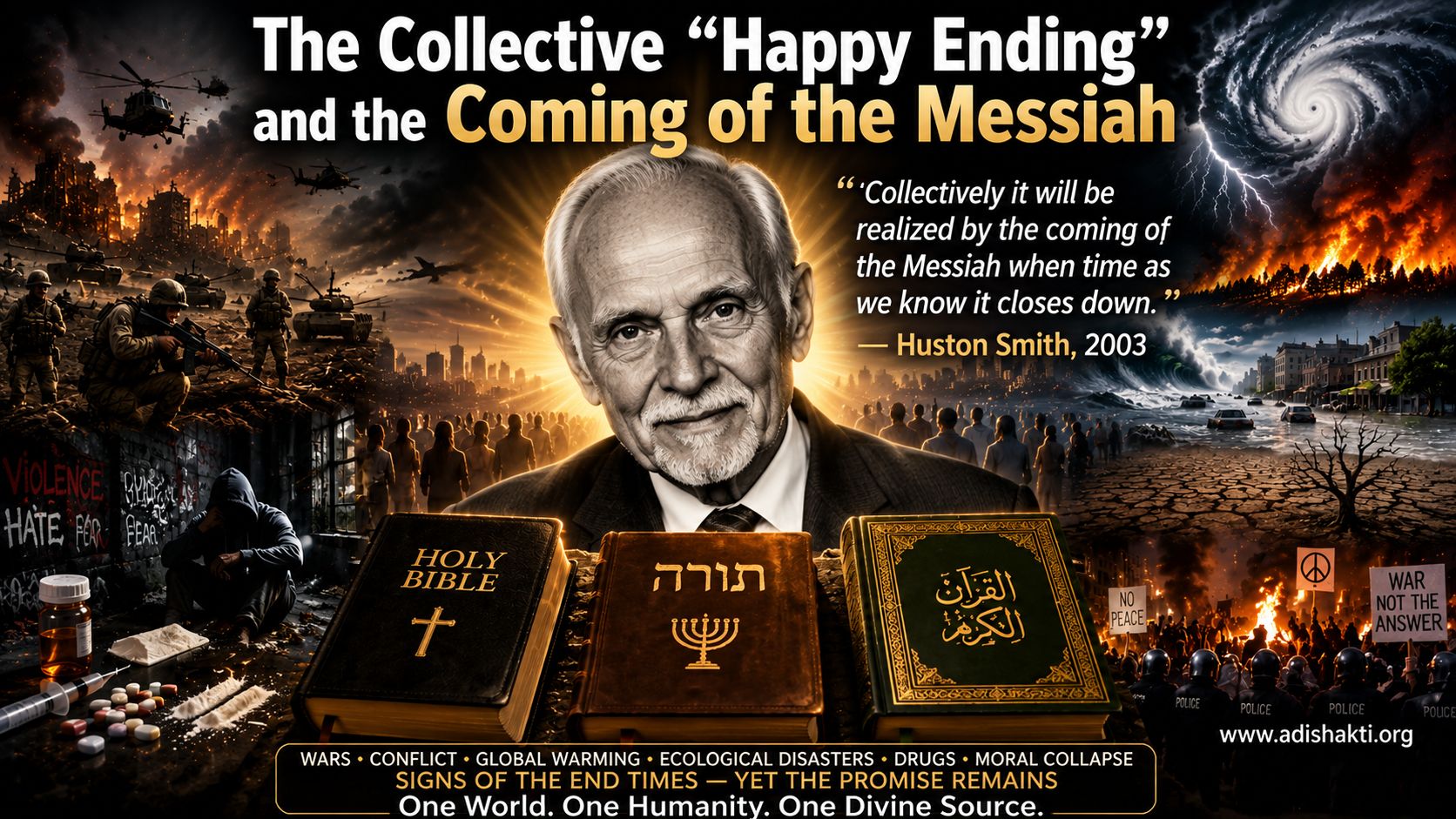
This paper takes as its point of departure Huston Smith's statement in Jessica Roemischer's 2003 EnlightenmentNext interview that the religious traditions promise a collective “happy ending” realized “by the coming of the Messiah when time as we know it closes down.” Rather than treating this sentence as a proof-text, the study reconstructs the argument surrounding it. Smith simultaneously affirms the religions' eschatological hope, questions the modern expectation that salvation must simply improve ordinary planetary history, invokes Christian and Hindu images of transformed or cyclic time, and insists that human beings remain obligated to work toward the good.
The paper then brings Smith's comparative formulation into dialogue with the Authenticity Series investigation of Israel's regathering and Simcha Jacobovici's Lost-Tribes inquiry. That investigation establishes a methodological distinction: the return of dispersed Israel and claims concerning Lost Tribes can make the Messianic question historically intelligible, but they do not by themselves prove a particular Messiah.
Within the Adi Shakti interpretive framework, Shri Mataji Nirmala Devi is proposed as that figure. The argument rests especially on her recorded self-identification as Adi Shakti/Holy Spirit/Ruh of Allah and her repeated declarations that the Last Judgment, Resurrection Time and Qiyamah are present realities. Historically, these are documentable religious claims; confessionally and comparatively, this paper argues that they identify Shri Mataji as the Messiah whose advent answers Smith's question.
Series update: Papers III–VIII, completed after the original framing of Paper II, now supply additional historical, Jewish, Christian, philosophical and reception-historical controls on this argument. They strengthen the Messianic horizon while simultaneously raising the evidentiary standard for identifying any particular Messiah. Their cumulative findings are incorporated in the Series Evidentiary Ledger below.
Paper II follows Paper I, “The Scattered of Judah Have Returned Decades Ago: Where Is the Messiah?” Paper I establishes the modern restoration question through Simcha Jacobovici’s Lost-Tribes investigation and preserves his refusal, as a journalist, to declare that the End Times had begun. Paper II advances the inquiry from sign to eschatological criterion: Huston Smith’s comparative formulation associates collective consummation with “the coming of the Messiah,” while Shri Mataji’s recorded declarations are examined as the later Adi Shakti claim that the Last Judgment, Resurrection Time and Qiyamah have actually begun.
Series evidentiary rule: Paper I does not prove Paper II, and Israel’s regathering does not independently identify a Messiah. Each paper adds a distinct evidentiary layer while preserving the boundary between historical documentation, comparative interpretation and theological conclusion.
Huston Smith's Eschatological Proposition
Huston Smith's importance to this inquiry lies not in his endorsement of Shri Mataji—he made no such endorsement in the supplied interview—but in the comparative structure he articulates. Asked whether the “happy ending” promised by the traditions will actually manifest and whether it comes through divine intervention, Smith answers that the great religions characteristically place hope beyond the unresolved tragedies of ordinary history.
If collective consummation is inseparable from the advent of the Messiah, then claims that history has entered a period of Last Judgment, Resurrection or final spiritual transformation become inseparable from the question of messianic identity: Who, if anyone, has appeared with the authority and function corresponding to that transition?
What Smith Means by the Religious “Happy Ending”
Smith says “unequivocally” that one strength of the great religions is their promise of a happy ending after “horrendous problems are faced and overcome.” Yet he resists a simplistic expectation that the Second Coming will merely redirect ordinary human history. He juxtaposes the Christian petition “Thy kingdom come on earth” with the Hindu image of cosmic cycles moving through the four yugas, culminating in Kali Yuga and then beginning anew.
Smith's statement is best read as a comparative generalization, not as proof that all religions literally teach the same Messiah. His own qualification—“the wording differs from religion to religion”—requires comparison of functional analogies while preserving doctrinal differences.
Smith also refuses quietism: “Whatever the metaphors and the analogies, it's our obligation to try to see it happen; we should do our very best to see that it happens on our planet.” Ultimate transcendence therefore does not abolish ethical responsibility.
“When Time as We Know It Closes Down”
The phrase “time as we know it closes down” is the conceptual hinge of Smith's answer. It need not be reduced to the literal destruction of clocks, planets or physical temporality. Smith places several metaphors beside one another: Kingdom on earth, possible planetary catastrophe, Hindu cyclic cosmology, the end of Kali Yuga and a new cycle. His formulation points toward a qualitative rupture in the human condition, even though traditions describe that rupture differently.
This opens a comparative question concerning Shri Mataji. In her teaching the Last Judgment is described as a living spiritual process associated with Kundalini awakening and Self-realization. The issue is whether Smith's “closing down” of ordinary time can legitimately be compared—not simply equated—with Shri Mataji's proclamation that an old spiritual condition has reached judgment and a Resurrection Time has begun.
Israel, the Lost Tribes, and the Question Smith Leaves Open
The companion Authenticity Series paper on Jacobovici supplies the historical-theological bridge. Lila Sarick's 1998 report states that reappearance of the Lost Tribes was associated with “the approach of a Messianic time.” Jacobovici wondered whether prophecy might unfold through ordinary people boarding ships and airplanes while appearing on the nightly news. Yet, citing journalistic objectivity, he declined to declare that discovery of the tribes meant the end of days had begun.
Smith supplies the comparative eschatological proposition: collective fulfillment is associated with Messiah. Jacobovici supplies an investigated historical horizon. Neither identifies Shri Mataji. That identification is the further theological argument of the Adi Shakti framework.
From Sign to Identity
An academically rigorous messianic argument cannot proceed by chronological juxtaposition alone. Israel's establishment, immigration, alleged Lost-Tribe survivals, the appearance of a spiritual teacher in India, and declarations concerning Last Judgment are distinct kinds of evidence.
Each transition requires argument. The strongest case is cumulative.
The academically stronger claim is therefore narrower than saying 1948 automatically proves a divine timeline: modern Jewish regathering makes ancient restoration texts newly concrete and intensifies the Messianic question; it does not independently identify the Messiah.
Shri Mataji's Last Judgment, Resurrection Time and Qiyamah
 The crucial difference between Jacobovici's evidence and Shri Mataji's corpus is the mode of claim. Jacobovici investigates possible signs and declines the eschatological verdict. Shri Mataji's recorded discourse repeatedly gives precisely such a verdict: “The Last Judgment has started,” Sahaja Yoga is the Last Judgment, the present period is Qiyamah or Resurrection Time, and Kundalini awakening is the process through which judgment operates.
The same corpus preserves the consequential identity declaration, “I am the Adi Shakti (the Holy Spirit or Ruh of Allah).” Such statements join eschatological time, salvific function and claimed divine identity.
The historically documentable proposition is that Shri Mataji's corpus contains explicit declarations of Last Judgment, Resurrection Time/Qiyamah, Kundalini-based judgment, and Adi Shakti/Holy Spirit/Ruh identity. Whether these declarations are metaphysically true is a theological judgment, not something historical documentation alone can establish.
Why the Adi Shakti Framework Identifies Shri Mataji as Messiah
Within this paper's confessional logic, the identification proceeds functionally. Smith's formulation requires an advent through which collective eschatological fulfillment becomes possible. Jewish restoration supplies the question of Messiah; Christian Paraclete traditions supply an expectation of divine teaching and guidance; Islamic language supplies Qiyamah; Hindu traditions supply Adi Shakti, Kundalini and transition from Kali Yuga. Shri Mataji's teaching explicitly gathers these vocabularies into one account of the present spiritual age.
This makes the argument stronger, not weaker: the burden is to ask whether Shri Mataji's documented claims and function correspond sufficiently to the eschatological role that Smith's comparative formulation calls “Messiah.”
Why a Messiah Could Be Present and Still Unrecognized
Smith warns against imposing the expectation that the Second Coming must simply alter ordinary political history. That is directly relevant to the Adi Shakti thesis. If Messiah is expected only as geopolitical ruler, Shri Mataji's inward transformation appears categorically wrong. If eschatological function includes transforming persons so collective transformation becomes possible, Kundalini awakening becomes the proposed mechanism of the “happy ending.”
The claim remains theological: an experience may be evidence for practitioners, but interpreting it as Resurrection or Last Judgment requires further argument.
Smith, Jacobovici and Shri Mataji Perform Three Different Evidentiary Roles
Huston Smith articulates the comparative-religious structure of the question; Simcha Jacobovici gives the Messianic question a modern historical horizon; Shri Mataji's declarations provide the explicit claim that the eschatological time has already begun. The identification of Shri Mataji as Messiah is the Adi Shakti theological synthesis of these distinct bodies of evidence.
Smith cannot prove Shri Mataji because he does not discuss her. Jacobovici cannot prove Shri Mataji because he does not investigate her. Israel's regathering cannot prove Shri Mataji because a historical event does not by itself identify a religious person. Shri Mataji's declarations cannot prove themselves merely because they are emphatic. The case is cumulative only when identity, timing, function, scriptural correspondence and claimed spiritual experience are examined together.
Thus the most defensible formulation is not Smith proved Shri Mataji is the Messiah. It is: Smith's comparative eschatology supplies a criterion against which Shri Mataji's extraordinary claims can be evaluated, and the Adi Shakti tradition argues that her identity and function satisfy that criterion.
X. Conclusion: Has the “Happy Ending” Already Begun?
Huston Smith's statement remains powerful because it refuses cheap optimism. The religions promise a “happy ending,” but not simply the indefinite improvement of ordinary history. Their ultimate hope involves a transformation so profound that Smith describes it as the coming of the Messiah when “time as we know it closes down.”
The historical developments examined in the Lost-Tribes paper make the Messianic question newly concrete without resolving it. Jacobovici correctly refuses to transform an investigated horizon into an end-times proclamation.
Shri Mataji's corpus is different because it contains the proclamation. She is represented as identifying herself with Adi Shakti/Holy Spirit/Ruh of Allah and as declaring the Last Judgment, Resurrection Time and Qiyamah to be present. Within the Adi Shakti theological reading, these claims constitute the answer to Smith's comparative question: the Messiah is Shri Mataji Nirmala Devi, and the “happy ending” is inaugurated through the collective possibility of Self-realization.
Academic rigor requires the distinction to remain visible. Historical scholarship can document Smith's formulation, restoration movements, Jacobovici's investigation and Shri Mataji's declarations. It cannot compel assent to the supernatural conclusion. The identification of Shri Mataji as Messiah is this paper's argued theological judgment.
Smith asks what the traditions promise. Jacobovici exposes a possible sign. Shri Mataji declares that the time has come. The final question is whether humanity recognizes the claim.
Appendix A · Entire Supplied Excerpt
Can Religion Save Us?
Tradition, Transcendence, and Ultimate Reality
An interview with Huston Smith
by Jessica Roemischer
WIE: So, will the "happy ending" or final salvation that the traditions prophesy actually manifest? And, if so, do you believe that will eventuate—as the traditions predict, through divine intervention—in the "second coming"?
HS: For my part, I do say unequivocally that one of the strengths of the great religions is that they promise a happy ending that burgeons after horrendous problems are faced and overcome. But here's the decisive thing that our culture is not ready to hear: they want to see the second coming as changing human history, the course of human history on this planet, which we may annihilate like a supernova. Now, there are phrases in the Bible that point toward it manifesting here—"Thy kingdom come on earth.” Or, as in the basic Hindu view, the material world and its history are like an accordion that comes out and it goes back through the four yugas (ages), ending with the Kali Yuga, the worst one, which goes to the dogs completely. But then a new cycle begins. Whatever the metaphors and the analogies, it's our obligation to try to see it happen; we should do our very best to see that it happens on our planet. And, in fact, none of the traditions claim that that happy ending is realizable on our planet; they say that individuals will experience that happy ending in the afterlife, and collectively it will be realized by the coming of the Messiah when time as we know it closes down (the wording differs from religion to religion).
Huston Smith, arguably today's foremost authority on the world's great religions, has, for over half a century, dedicated himself to transmitting the wisdom of the traditions through books, television, and film and in the classroom. His best-known volume, The World's Religions, has been the standard introductory textbook in college religion courses for thirty years and has sold several million copies. Dr. Smith has produced three PBS television series and was the focus of Bill Moyers' five-part PBS special, "The Wisdom of Faith with Huston Smith.” His documentaries on Tibetan Buddhism, Hinduism, and Sufism have received international acclaim. Having devoted a lifetime to the study of the august traditions of the world, Huston Smith was our preeminent choice to answer the question: Are the religions equipped to navigate the myriad challenges of the third millennium?
Initially, Huston Smith responded to our interview request with a letter saying, "I am hesitant to take part in your projected article for fear of sounding like a spoilsport. I gather that you want to come down hard on the perils that threaten our planet while giving your readers grounds for hope. My personal judgment is that my perspective differs so markedly from the mind-set of your readers that you would do better to bypass me on this one ...” We were hooked. What would the dean of comparative religious scholarship have to say in response to perhaps the most important spiritual question of our time, and why did he feel that our readers would not want to hear it? Could there indeed be no cause for hope?
In his innovative and incisive critique of postmodernity, Why Religion Matters, Smith writes, "The sandwich man between placards announcing that the end is near is telling us something important... . He is not just protesting our reigning culture. However falteringly, he is gesturing toward a heavenly city that offers an alternative to this earthly one, which is always deeply flawed.” Indeed, that man could be Huston Smith himself. And, visiting with this wise and generous octogenarian in his modest Berkeley home, for the interview that he did eventually agree to, we found why he believes that, in the face of apocalyptic times, the traditions may help us hope for a good outcome, but they may not be equipped to actually help us manifest it—at least not here on Earth!
EnlightenmentNext Magazine Issue 23 / Spring—Summer 2003
Series Evidentiary Ledger — Papers I–VIII
The Authenticity Series is cumulative, but cumulative does not mean that one source is made to prove the claims of another. Each paper adds a distinct historical, Jewish, Christian, philosophical, reception-historical or comparative-theological layer. The boundaries below are therefore as important as the contributions.
| Paper | Source / Focus | Contribution | Evidentiary boundary |
|---|---|---|---|
| I | Simcha Jacobovici / Lost Tribes | Possible restoration of dispersed Israel becomes a modern investigative and explicitly Messianic question. Jacobovici asks whether prophecy could unfold through ordinary historical mechanisms. | Jacobovici investigated the possible sign; he did not pronounce the eschatological verdict. He neither declares the End Times nor identifies Messiah. |
| II | Huston Smith / Collective consummation and Messiah | Smith's comparative formulation associates humanity's collective “happy ending” with “the coming of the Messiah when time as we know it closes down.” Paper II then places Shri Mataji's Last Judgment, Resurrection Time and Qiyamah declarations against this comparative criterion. | Smith does not identify Shri Mataji. The identification of Shri Mataji with the Messianic fulfillment is an Adi Shakti theological argument, not Smith's conclusion. |
| III | Israel's Regathering / 1948 | Establishes the concrete modern historical foundation: Jewish statehood and large-scale regathering give ancient restoration language a striking modern referent. | 1948 alone proves neither supernatural fulfillment nor Messianic identity. Maimonides also associates the Messiah himself with gathering dispersed Israel. |
| IV | Louis Jacobs / Athalta de-Geulah | Documents the religious-Zionist interpretation of Israel as the “beginning of the redemption” while the final Messianic dream and personal Messiah remain outstanding. | Beginning is not completion. This is an important Jewish theological interpretation, not universal Jewish consensus. |
| V | Tim LaHaye & Thomas Ice / Eschatological stage-setting | Documents a dispensational Christian interpretation of 1948 as actual regathering fulfillment and “stage-setting” before the Day of the LORD / Tribulation. | The chronology is a specific futurist Christian construction, not the uncontested meaning of the cited biblical texts or Christian consensus. |
| VI | Frank & Leaman / Steven Schwarzschild | Introduces the warning against replacing the personal Messiah with ethical, national, political or socialist “messianism.” Schwarzschild attacks the illusion that redemption has already become a fait accompli, including through the State of Israel. | The source describes Schwarzschild's position as idiosyncratic relative to the general trend of modern Jewish philosophy. Yet his methodological challenge is crucial: do not substitute the age or State for the personal Messiah. |
| VII | Tudor Parfitt / Yemenite Jewish reception | Adds lived Jewish evidence. Yemenite Jews knew Israel's prime minister was not Messiah, while many nevertheless sensed that Messianic Redemption “might be at hand.” | Proximity is not fulfillment. Statehood and migration do not themselves identify Messiah. |
| VIII | Tim LaHaye & Ed Hindson / “Super Sign” | Documents a stronger Christian futurist claim: Israel's return is treated as fulfilled restoration prophecy and a “super sign of the end times.” | Historical statehood, prophetic interpretation, and the “super sign” conclusion are separate propositions. Even an accepted sign cannot by itself identify the Messiah. |
Lost-Tribes/restoration question → comparative expectation of Messiah → 1948 as concrete regathering → “beginning of redemption” → Christian prophetic stage-setting → warning against replacing personal Messiah with messianism → lived Jewish sense that redemption might be near → Israel explicitly interpreted as an end-times “super sign.”
When Paper II was first framed, Smith's comparative statement and Jacobovici's investigation supplied the principal bridge between collective eschatological fulfillment and the Messianic question. Papers III–VIII now make that bridge substantially more differentiated. 1948 is established historically; Jewish religious Zionism can interpret it as a beginning rather than completion of redemption; Christian futurists can interpret it as stage-setting and an end-times sign; Jewish philosophy can warn against declaring redemption accomplished; and Yemenite Jewish reception can experience redemption as near while still distinguishing the State from Messiah.
These later papers therefore strengthen Paper II by preventing a simplistic inference. The cumulative argument is no longer “Israel returned, therefore Shri Mataji is Messiah.” It is: Israel's restoration creates a historically concrete Messianic horizon; multiple Jewish and Christian sources interpret that horizon in different ways while repeatedly leaving final consummation or personal Messianic identity outstanding; Shri Mataji's extraordinary eschatological declarations must then be evaluated independently against that unresolved horizon.
No single sign proves the Messiah. No historical event proves a claimant. No claimant's declaration proves itself. The strongest case must remain cumulative: historical restoration, scriptural and reception history, Jewish Messianic criteria, competing eschatological interpretations, the claimant's documented identity declarations and functions, and the evidence offered for the claimed spiritual transformation must be examined together.
Papers I–VIII progressively establish why the Messianic question can be asked with unusual historical urgency. They do not, by themselves, settle the identity of Messiah. The next evidentiary stage must increasingly turn from signs of the age to the identity and functions of the proposed Messianic person.
References and Source Notes
- Smith, Huston. Interview by Jessica Roemischer. “Can Religion Save Us? Tradition, Transcendence, and Ultimate Reality.” EnlightenmentNext, Issue 23, Spring–Summer 2003.
- Sarick, Lila. “The Saga of the Lost Tribes.” The Globe and Mail, 20 November 1998.
- “The Scattered of Judah Have Returned Decades Ago: Where Is the Messiah?” AdiShakti.org, Authenticity Series.
- Shri Mataji Nirmala Devi. Recorded talks reproduced in the AdiShakti.org corpus concerning Adi Shakti/Holy Spirit/Ruh of Allah, Last Judgment, Resurrection Time and Qiyamah. Individual claims should be checked against dated audio/transcript witnesses where available.
- Smith, Huston. Why Religion Matters: The Fate of the Human Spirit in an Age of Disbelief. HarperSanFrancisco, 2001.
Source-critical note: This paper distinguishes Smith's comparative formulation, historical/journalistic evidence, statements attributed to Shri Mataji, and the Adi Shakti theological conclusion that Shri Mataji fulfills the Messianic role.