The Great War Between Satanic and Divine Forces: The Battle for the Kingdom of God
Jesus, His Promised Paraclete, and the Struggle to Proclaim the Living Resurrection—Why the Few Must Persevere in 2026
November 2, 2026 · Prepared for Adishakti.org
Central Thesis
On June 30, 1980, Shri Mataji Nirmala Devi declared that a great war was taking place between satanic and Divine Forces, and that its objective was the destruction of the Kingdom of God. Her warning concerned not an ordinary contest for institutional power, but a struggle at the very moment when humanity, in her teaching, stood at the threshold of spiritual emancipation. What is at stake is the human heart, the recognition of the Spirit, and the opportunity to enter the Kingdom.
This study asks what that warning means when read alongside Jesus’ teaching on the world’s non-recognition of the Spirit of Truth, Shri Mataji’s proclamation of Self-Realization as the living Resurrection, and her later insistence that the message must be announced publicly. The central contemporary question is whether the omission or dilution of that proclamation has left humanity unaware of the very spiritual possibility the Paraclete came to announce. This is a theological argument offered for examination, not evidence that any particular critic or disciple is literally an agent of satanic forces.
The answer to despair is neither silence nor numerical strength: “very few are enough,” provided they are established in the powers of the Spirit and willing to bear public witness.
Part I — The Great War
1. The declaration that must govern the argument
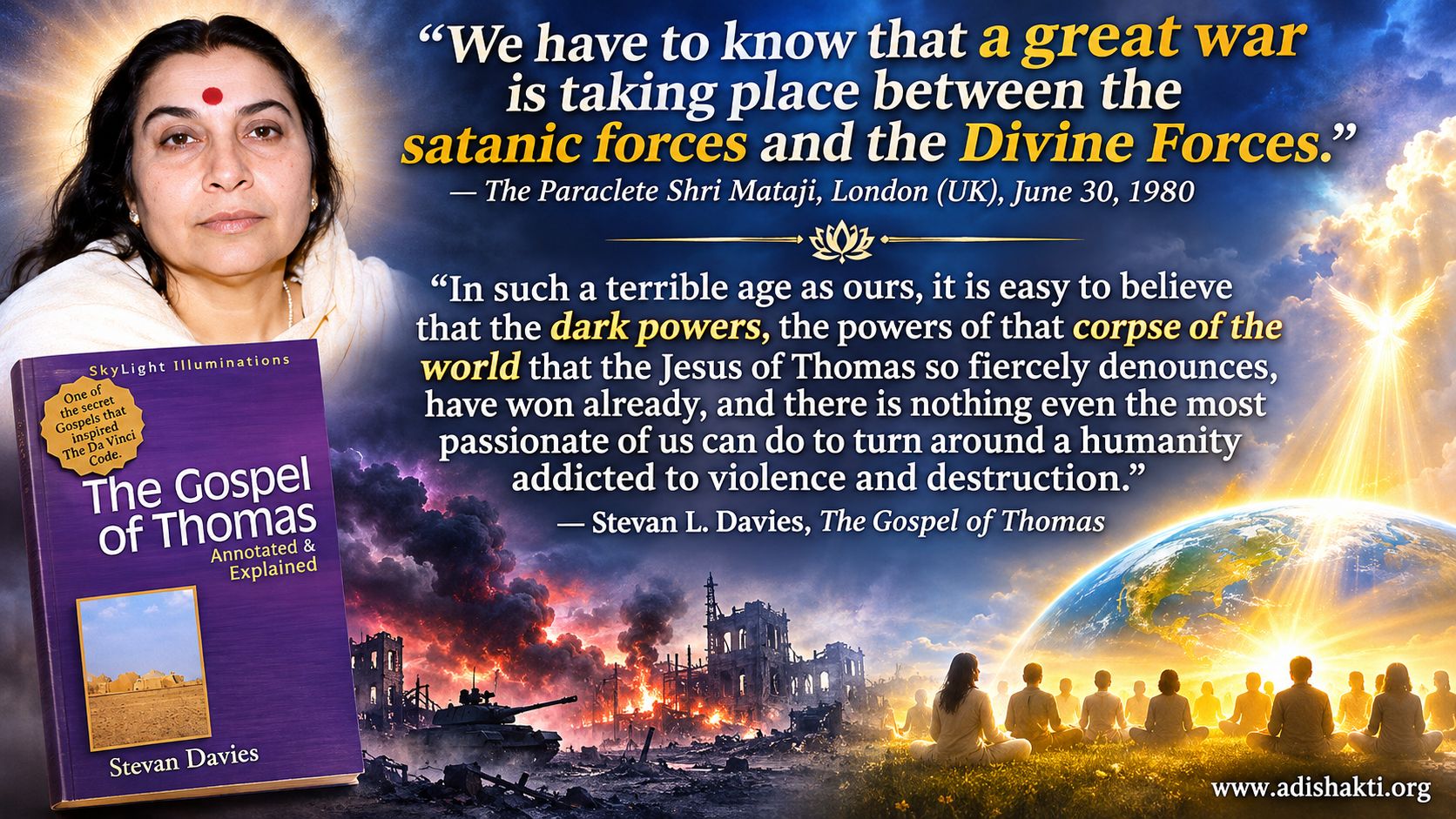
“A great war is taking place between the satanic forces and the Divine Forces.” This is the starting point, not an incidental metaphor. Shri Mataji’s Caxton Hall address of 30 June 1980 gives the conflict an objective, a timing, a method, a vulnerable human arena, and a possible response. She speaks of forces seeking to destroy the Kingdom, of a precious moment when seekers are about to enter it, of subtle tricks that can make them fall, and of a few strong souls who can work for the emancipation of humanity.
The theological seriousness of this claim must not be lost in vague language about a difficult age. The war, as described in the speech, concerns humanity’s access to the Kingdom of God. It is precisely because the Kingdom is presented as real and eternal that the opposition to its recognition becomes consequential.
The primary text is reproduced below as it appears in the supplied document. Its wording is preserved, and the analysis that follows is distinct from the quotation.
PRIMARY TEXT · CAXTON HALL · 30 JUNE 1980
“We have to know that a great war is taking place between the satanic forces and the Divine Forces, and all these satanic forces, symbolized by the word ‘evil ’ in Sanskrit, ‘rakshasas, asuras’, have taken birth to destroy the Kingdom of God. Imagine what an ambition! They want to ruin your hearts.
The Kingdom exists; it will exist, and It is eternal. It has created universes and universes, created the Human being out of the amoeba, to lead you to your today’s position. It brought you here to get what is your ultimate goal. This is what has been done. And at this critical moment we are living,at this precious moment where you are about to enter the Kingdom of God, all these forces are organized in order to make you fall. It belongs to your intelligence to understand that these forces are very subtle, full of tricks, and that they are above your comprehension.
Even after the realization you have been noticing how they manage to make you fall. If we want to establish fully in the Kingdom of God we have to fight all the forces that are holding us back. Sahaja Yoga is not for the weak, for the useless people neither for those who are running after money or material things.
The foundations of Sahaja Yoga have to be of great calibre, they have to manifest the deep desire for the human emancipation. They are those who will save mankind; they are the redeemers, those who will achieve the salvation of this ruined mankind.
We don’t need to be many, very few are enough to save the world, but they have to be strong and they must absolutely establish in their own comprehension the powers of the Spirit, the Powers of their Father who is God Almighty.”
— Shri Mataji Nirmala Devi, Public Program, Caxton Hall, 30 June 1980.
2. The war’s objective: destroy the Kingdom, ruin the heart
Shri Mataji names the objective with startling clarity: the opposing forces seek “to destroy the Kingdom of God” and “to ruin your hearts.” These statements belong together. The Kingdom is described as eternal and therefore not a fragile human institution that could simply be abolished. The immediately vulnerable arena is the human heart: the capacity to recognize, receive, and remain faithful to spiritual truth.
In this reading, a ruined heart is not merely a person who has joined the wrong organization or disagreed with a teacher. It is a heart made unreceptive through fear, pride, material obsession, cynicism, or manipulation. The gravest spiritual danger is the loss of the capacity to recognize the Kingdom when it is offered. Such an interpretation demands moral vigilance and self-examination; it does not justify labeling dissenters or vulnerable people as demons.
3. The critical moment: humanity at the threshold
The timing of the conflict is indispensable. Shri Mataji locates the organized opposition “at this precious moment where you are about to enter the Kingdom of God.” In the Adishakti.org interpretation, her account of opening the Sahasrara on 5 May 1970 signifies a new opportunity for collective Self-Realization. The 1980 warning is therefore read as a declaration about the struggle surrounding an already-opened spiritual possibility, rather than a distant prediction detached from human experience.
The closer humanity comes to recognizing the Kingdom, the more consequential the obstruction of that recognition becomes. This is the internal logic of the address. The paper does not ask readers to accept the metaphysical interpretation without examination; it asks them first to understand exactly what Shri Mataji claimed and why the date and context matter within that claim.
4. The subtle methods: deception, distraction, and falling away
Shri Mataji says the opposing forces are “very subtle, full of tricks” and warns that even after Realization seekers may fall. Her warning thus reaches beyond open hostility. The threat may be spiritual forgetfulness, the replacement of purpose by prestige, the pursuit of money or material advantage, or a failure to remain established in the Spirit.
In a contemporary reading, the relevant question is whether an essential revelation can become obscured even while the outward activities of a spiritual movement continue. A practice may spread while the claimed meaning of that practice remains largely unknown. That possibility deserves close documentary scrutiny, not automatic attribution of malicious intent. Distinguishing evidence of omission from conjectures about its cause makes the argument stronger.
Part II — The Battle Over the Living Resurrection
5. Jesus and the world’s non-recognition of the Spirit
Related study: the world’s reaction to the Paraclete
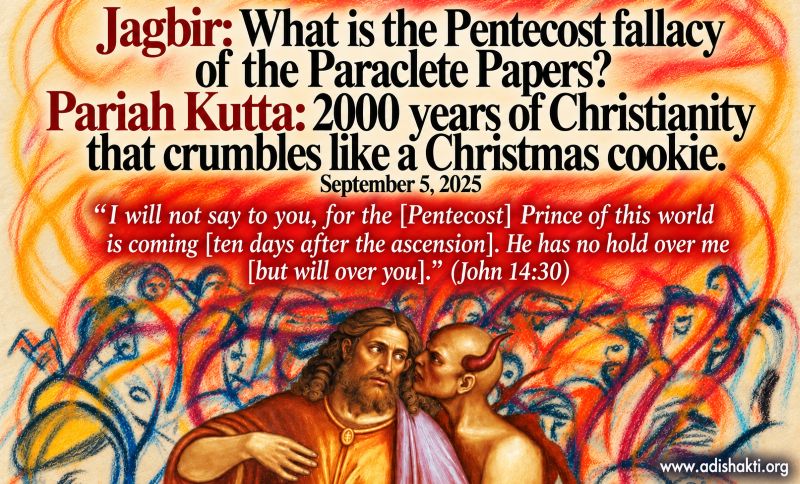
Jesus’ farewell discourse gives the argument its Johannine frame. In John 14:16–17, he promises another Advocate, the Spirit of Truth, whom the world does not receive because it neither sees nor knows the Spirit. In John 15:18–26, the world’s hostility to Jesus is followed by the promise of the Advocate’s testimony. John 16:1–15 joins warnings of rejection to the Spirit’s work of guidance and disclosure.
Berard L. Marthaler’s comparison—that the world’s reaction to the Paraclete would resemble its reaction to Jesus—provides an interpretive bridge. Non-recognition is a theme in the biblical narrative; it is not, by itself, proof that any later claimant fulfills the promise. The Adishakti.org position identifies Shri Mataji with that promised Paraclete and therefore invites examination of her teachings against the positive functions attributed to the Spirit of Truth.
6. The living Resurrection: what the conflict puts at stake
The living Resurrection in the Adishakti.org interpretation
The central revelation that this paper argues must be made public is the ongoing Resurrection among the living. In the interpretation advanced by Adishakti.org, Shri Mataji taught that the Last Judgment, Resurrection, and Qiyamah should not be confined to an imagined future rising of decayed bodies. Rather, spiritual rebirth is understood as an event accessible to living human beings through the awakening of Kundalini and Self-Realization.
Within this theology, the Cool Breeze and the experience of the subtle system are not simply relaxation techniques. They are understood as signs associated with the Spirit and the seeker’s entry into the Kingdom. To announce Self-Realization without explaining its claimed eschatological significance is, on this account, to announce the means while leaving the ultimate message obscure. Readers should be able to distinguish Shri Mataji’s recorded statements from the broader comparative conclusions drawn by this site.
7. Silence and dilution: the central contemporary question
Here the war described in 1980 becomes a question for the present. If a movement introduces seekers to meditation and subtle-system cleansing but seldom communicates the claims that Shri Mataji is the promised Paraclete and that the Resurrection is unfolding now, has it communicated the full significance of the mission it claims to serve?
The paper’s criticism is directed at this gap between spiritual practice and public proclamation. It should be investigated through actual programs, publications, instructions, and recorded statements rather than assumed to be uniform across every follower or community. A demonstrated pattern of omission would support the claim that the public message has been narrowed; whether that narrowing represents the spiritual war described by Shri Mataji remains the paper’s theological interpretation.
One need not establish the hidden motives of individual disciples to ask whether the world has been denied a clear opportunity to hear, examine, accept, or reject the claimed revelation. That question is both more rigorous and more consequential than an accusation against unnamed persons.
8. “Otherwise the world would say that we never knew”
The 1990 mandate to announce the message
The 1980 and 1990 declarations should be read together. In 1980, Shri Mataji warned of forces seeking to obstruct the Kingdom; on 6 May 1990, she called on her followers to announce the message openly. Her warning that the world might otherwise say “we never knew” turns the theological issue into a public responsibility.
Within this argument, silence is not a neutral outcome when the mission itself includes a command to speak. Yet the charge must be precise: the question is what was communicated, what was omitted, by whom, and in what setting. The public should not be asked to accept an unverified claim about a coordinated conspiracy. It should be given the sources and allowed to judge the discrepancy between the recorded proclamation and its public presentation.
9. Matthew 24:14: the Gospel of the Kingdom to all nations
Jesus’ declaration in Matthew 24:14 that the Gospel of the Kingdom will be proclaimed throughout the world as testimony to all nations supplies the corresponding Christian imperative. In the Adishakti.org reading, the command concerns not only the preservation of a religious institution but the public announcement of the Kingdom’s reality and availability.
The message must be told before humanity can meaningfully respond to it. Proclamation does not remove freedom of conscience. On the contrary, it makes informed acceptance or rejection possible. The proposed link between Matthew 24:14 and Shri Mataji’s 1990 address is an interfaith theological interpretation; it should be argued openly rather than presented as a universally accepted reading of the Gospel.
Part III — The Few Who Must Persevere
10. The few: spiritual strength without despair
Shri Mataji’s address ends not with a prediction of defeat but with an extraordinary assurance: “We don’t need to be many, very few are enough to save the world.” The qualification is just as important: they must be strong and established in their comprehension of the powers of the Spirit. Numbers do not substitute for spiritual integrity, courage, clarity, or service to humanity.
The phrase “human emancipation” identifies the purpose of this strength. It is not victory over critics, control of institutions, or coercion of believers. Within the theology of the address, it means enabling human beings to discover the Spirit and enter the Kingdom. The few are called to serve, not to dominate.
11. Davies: the clearest vision in the worst of times
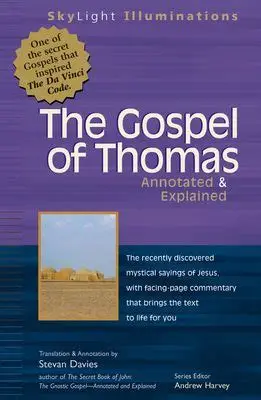
Stevan L. Davies’ reflection on the Gospel of Thomas now takes its proper place: not as the principal evidence for Shri Mataji’s declaration, but as the paper’s culminating answer to despair. Davies names the apparent victory of dark powers, yet insists that “Despair, however, is the last illusion.” He calls for the clearest vision capable of transforming the age.
The complete passage is preserved here in its original quotation box:
“There may be very little time left to take the adventure into total being that the Gospel of Thomas advocates with such astringent brilliance and precision. In such a terrible age as ours, it is easy to believe that the dark powers, the powers of that corpse of the world that the Jesus of Thomas so fiercely denounces, have won already, and there is nothing even the most passionate of us can do to turn around a humanity addicted to violence and destruction.
Despair, however, is the last illusion. The Gospel of Thomas and the Jesus who gave it to us continue to challenge us to dare to become one with the Divine and start living the revolutionary life that streams from union and that can transform all things. This worst of times needs the clearest and most unflinchingly exigent of visions to counteract and transform it; in Jesus’ words in the Gospel of Thomas and in his living out of their reality through and beyond death itself into the eternal empowering glory of the Resurrection, we have the permanent sign of the Way, the Truth, and the all-transforming life that, even now, can build here on earth the reality of God’s Kingdom.” — Stevan L. Davies, The Gospel of Thomas, Shambhala Library, December 2004, p. xxvi
The comparison is a theological convergence, not a claim that Davies endorsed Shri Mataji’s identity or teachings. Davies refuses despair; Shri Mataji refuses the idea that a great multitude is necessary. Together, as read here, their words strengthen the obligation to persevere when the message is little known and the work appears overwhelming.
12. Why Adishakti.org matters in 2026
Fifty-six years after 5 May 1970, Adishakti.org presents a distinctive public theological case: Shri Mataji is identified as the promised Paraclete; the Kingdom is understood as accessible within; and the Resurrection, Last Judgment, and Qiyamah are interpreted as unfolding through Self-Realization among the living. The site’s work is to place scripture, lectures, testimony, and comparative interpretation before readers for independent examination.
This is why the distinction between public information and mere technique matters. What has not been clearly proclaimed cannot be fairly considered by the world. The mission of public witness is not fulfilled by repeating a claim without evidence; it requires careful source presentation, explicit argument, honest attribution, and the freedom of readers to disagree.
13. Conclusion: The Kingdom is Eternal; the World Must Be Told
The great war described at Caxton Hall was, in Shri Mataji’s words, a struggle directed against the Kingdom of God at the critical moment of humanity’s possible entry into it. Her speech places the human heart at the center of the conflict, warns that deception can persist after Realization, and demands that those who serve humanity become established in the powers of the Spirit.
The paper’s central contemporary argument is that the failure to proclaim the Paraclete’s claimed identity and the ongoing Resurrection can obscure the very message through which, in this theology, humanity is invited into the Kingdom. Whether particular omissions constitute the spiritual conflict she described is a matter of interpretation that must be supported by documentary evidence and argued without demonizing people who disagree.
The Kingdom is eternal. Despair is not the answer. Very few are enough—but the few must make the message known. The final question is not how many have joined a movement, but whether the world has been given the opportunity to hear what is being claimed, inspect its sources, and respond freely.
“Otherwise the world would say that we never knew.” The responsibility of public proclamation remains.