The World's Reaction to the Paraclete Will Mirror Its Reaction to Jesus
Summary
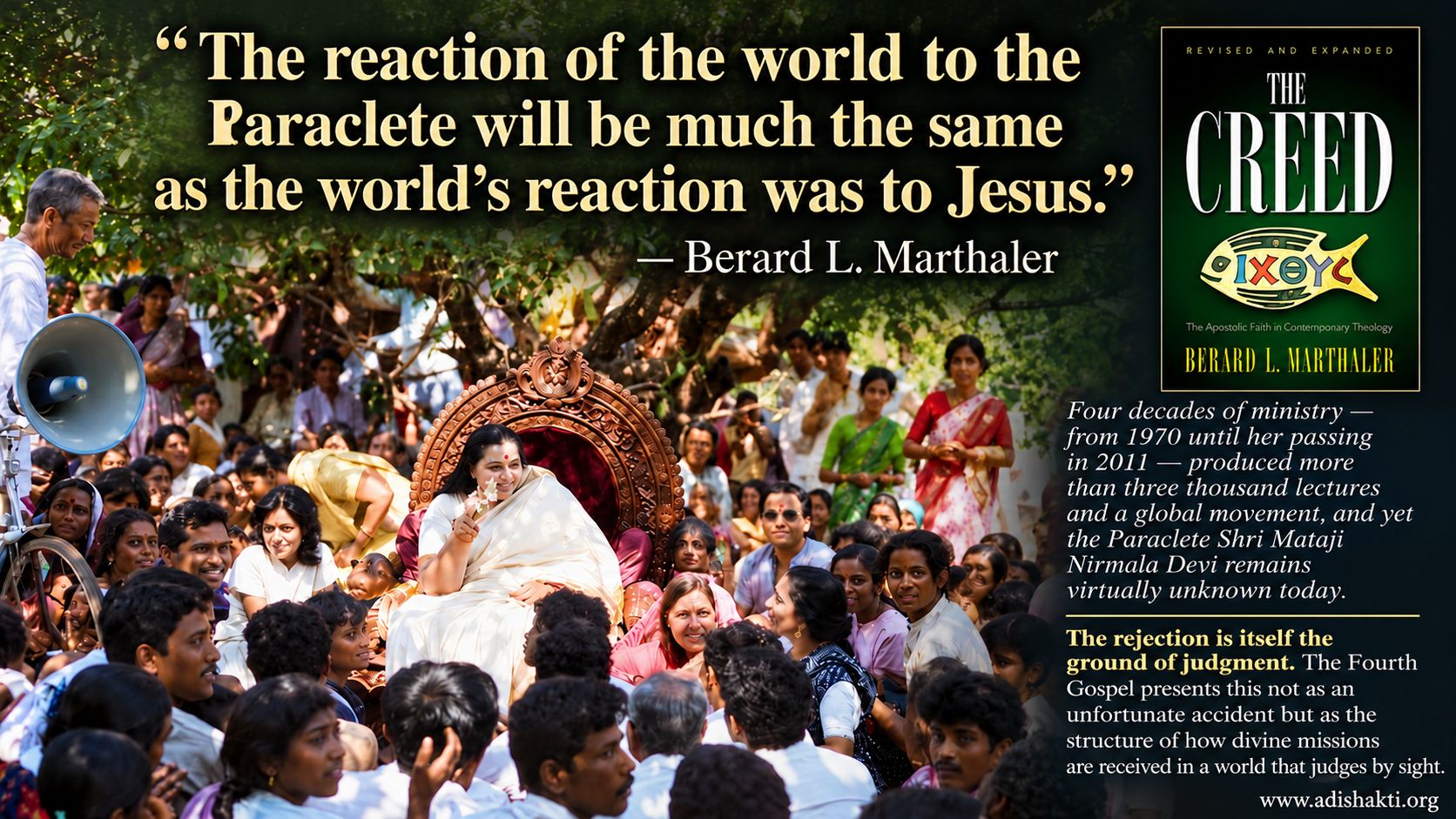
This Authenticity Series paper argues that the Marthaler thesis — "The reaction of the world to the Paraclete will be much the same as the world's reaction was to Jesus" — is not a devotional aside but a prediction, and that the Adishakti.org record supplies the evidence that it was fulfilled. The Paraclete Papers argue that Acts 2 was not the promised outpouring but the arrival of "the ruler of this world" (John 14:30), and that the true Paraclete came only in the Age to Come through Shri Mataji Nirmala Devi. The paper sets out the Johannine criteria by which any claimant must be judged — teaching, reminding, testifying, convicting, guiding, declaring, glorifying Jesus — and then examines the reception history. From 1970 to 2011 she taught publicly on every continent, gave over three thousand lectures, and directed attention back to Jesus' own promise of the Comforter. The result is exactly what the Marthaler thesis predicts: she is virtually unknown today. The rejection is not partial but comprehensive, extending even to her own disciples, many of whom have treated her as a guru or a source of spiritual experience rather than as the Paraclete sent in Jesus' name. The paper concludes that non-recognition is not an objection to the claim but the fulfillment of the Gospel's own prediction, while insisting that the prediction alone cannot establish the identification and must be read alongside the positive Johannine criteria.
Introduction: A Prediction, Not a Slogan
Berard L. Marthaler's sentence is usually quoted for its symmetry. Read in context, it is a prediction drawn from the Fourth Gospel. Jesus tells the disciples that he will ask the Father to send "another Paraclete" (Jn 14:16), that this Paraclete will be sent in his name, and that the world cannot receive him "because it neither sees him nor knows him" (Jn 14:17). Marthaler draws the conclusion: "The reaction of the world to the Paraclete will be much the same as the world's reaction was to Jesus. The world does not know or accept the Paraclete, much as it remained ignorant of Jesus' true identity and rejected him (5:43; 12:48)."
The two references Marthaler chooses are precise. In John 5:43 Jesus says, "I have come in my Father's name, and you do not accept me; if someone else comes in his own name, you will accept him." In John 12:48 he says that the word he has spoken will judge the one who rejects him on the last day. Together they establish a pattern: the messenger sent in another's name is not received, and the rejection is itself the ground of judgment. The Fourth Gospel presents this not as an unfortunate accident but as the structure of how divine missions are received in a world that judges by sight.
The Adishakti.org position, stated in the Paraclete Papers and across the site, is that this prediction is not merely descriptive but has been enacted in modern history. If Shri Mataji Nirmala Devi is the Paraclete sent in Jesus' name, then the Gospel requires that she be rejected as he was. The record from 1970 to 2011 is presented as the evidence: a global teaching mission, more than three thousand lectures, a worldwide movement — and a figure who remains virtually unknown outside her own circles, and is often misrecognized even within them.
This paper takes that claim seriously enough to test it. It sets out the Johannine criteria, examines the Paraclete Papers' argument about Pentecost, states the Adishakti claim precisely, and then reads the reception history against the Marthaler thesis. It does not treat the rejection as proof; it treats it as a predicted feature whose presence or absence can be checked.
Marthaler's dependence on Raymond E. Brown matters for how the thesis is used. Brown's two-function analysis makes the Paraclete an agent with a determinate job: to come to the disciples, dwell with them, and guide them into the meaning of Jesus; and to put the world on trial, exposing its false values and its specific injustice in condemning Jesus. The second function is what generates the prediction of rejection , because a figure whose role is to convict the world should expect the world's hostility in return. Marthaler presses the parallel to its limit: the Paraclete is sent in Jesus' name as Jesus came in the Father's name; the disciples will know the Paraclete as they were privileged to know the Son; the Paraclete will guide into all truth as Jesus is the way of truth; the Paraclete will bear witness as Jesus bears witness (Jn 8:14). Brown's formulation, quoted by Marthaler, is that "the one whom John calls another Paraclete is another Jesus."
The Johannine Criteria for the Paraclete
The farewell discourse supplies a finite list of what the Paraclete will do. This list is the only set of criteria the text itself provides, and any claimed fulfillment must be measured against it rather than against popularity or institutional approval. The relevant functions are: teaching all things and reminding the disciples of all that Jesus said (Jn 14:26); testifying on Jesus' behalf (Jn 15:26); convicting the world concerning sin, righteousness, and judgment (Jn 16:8–11); guiding into all the truth, speaking what is heard rather than what is self-originated, and declaring the things that are to come (Jn 16:13); and glorifying Jesus by taking what belongs to him and declaring it (Jn 16:14).
The Paraclete Papers place heavy weight on these verbs. The argument is that the Paraclete is described as a person who teaches, reminds, testifies, convicts, guides, speaks, and declares — activities that only an agent can perform. F. B. Meyer's point is decisive here: "A breath, an afflatus, an impersonal influence could not have stood in the same category as Himself." Stephen Smalley's judgment, cited by Marianne Meye Thompson, is that in John's Gospel the Spirit-Paraclete "is understood as personal, indeed, as a person." A claimed fulfillment that reduces the Paraclete to a diffuse spiritual energy has departed from the Johannine description before the question of identity is even reached.
The criteria also include a negative prediction. The world cannot receive the Spirit of truth because it neither sees him nor knows him (Jn 14:17). This is not a complaint about the world's bad will; it is a statement about the conditions of perception. The world judges by what it can see and master, and the Paraclete, like Jesus before him, does not present himself on those terms. The rejection is therefore built into the criteria, not added to them afterwards. Any claimed fulfillment must be expected to be misrecognized, dismissed, and marginalized — and the question is whether that expectation is met in a way that is specific rather than generic.
Pentecost and the Paraclete Papers
The Paraclete Papers argue that mainstream Christianity has identified the Paraclete with the event of Acts 2, and that this identification is the central obstacle to recognizing a later fulfillment. The argument, stated in Part Three, is precise: the outpouring narrated in Acts 2 was not the Holy Spirit promised in the farewell discourse but the arrival of "the ruler of this world" (Jn 14:30), the event functioning as Satan's Trojan Horse at the moment of the Christian movement's institutional birth.
The textual basis is the proximity of promise and warning in the same farewell discourse. Jesus promises "another Paraclete" (14:16), describes the Spirit of truth whom the world cannot receive (14:17), and then, in the same speech, warns that "the ruler of this world is coming" (14:30). The Paraclete Papers read this as placing the divine Helper and the satanic arrival inside the same speech, on the same night, addressed to the same disciples who will shortly experience Acts 2. If the ruler is coming, and if the Paraclete's full functions have not yet been performed, then the first major pneumatic event after Jesus' departure is the one that must be scrutinized.
The structural argument is that Acts 2 does not satisfy the Johannine criteria. There is no teaching of "all things"; the content is a short Christological proclamation, not the exhaustive instruction Jesus said the disciples could not yet bear (16:12). There is no guidance into "all the truth." There is no declaration of "the things that are to come" beyond the standard early Christian expectation of an imminent return. The conviction of the world is limited to the immediate hearers in Jerusalem. And the Paraclete is to remain "forever," which a single day's phenomena cannot exhaust. The brevity of Acts 2 is itself the argument: Jesus left many things unsaid, and a few hours of ecstatic speech did not say them.
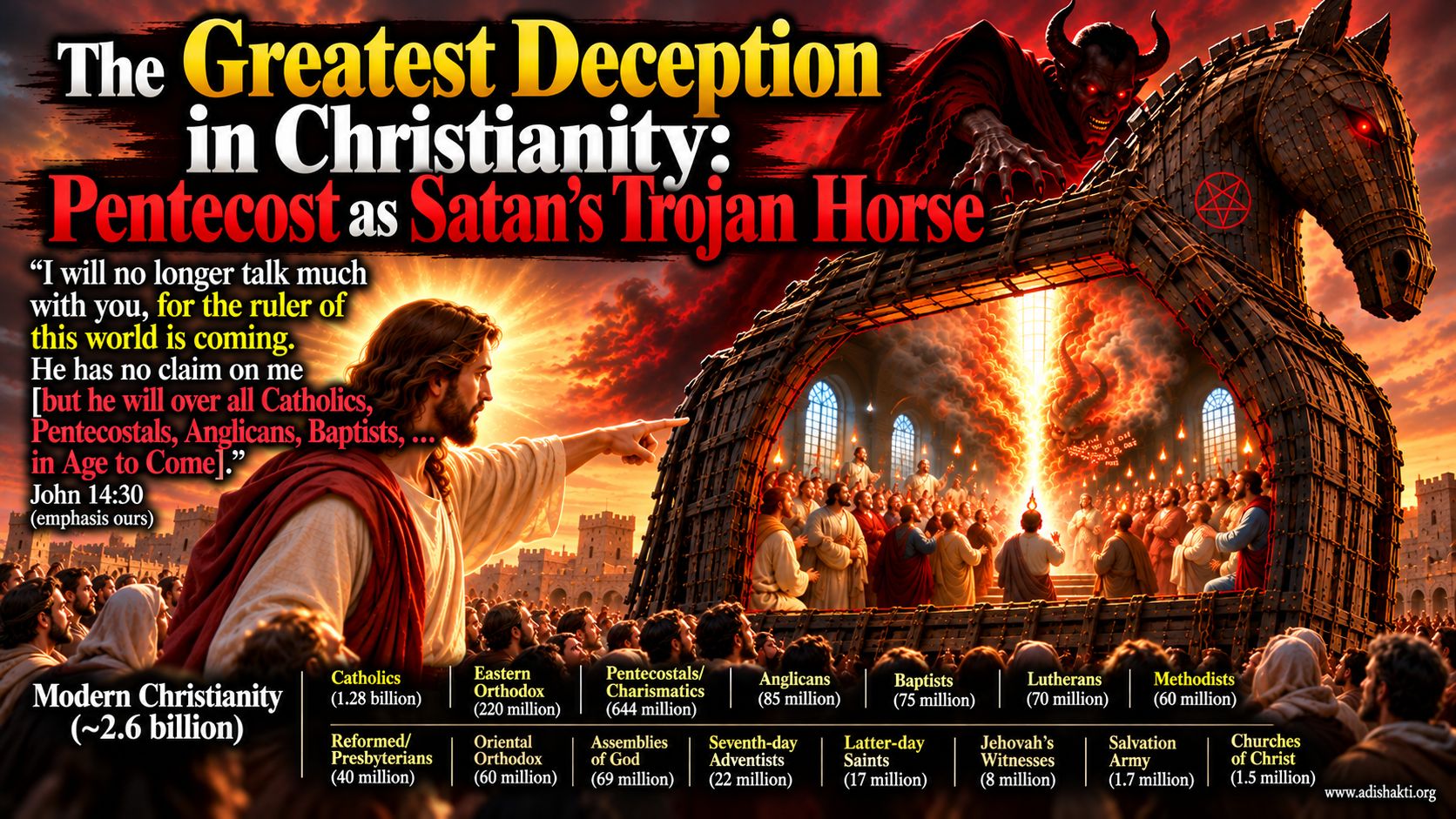
The consequence, on this reading, is that the church has claimed to possess the Spirit while systematically excluding any later personal agent who would fulfill the full Johannine description. The Paraclete Papers describe this as the greatest deception in human history: not a single lie, but the successful installation of a counterfeit Spirit at the founding moment, so that every later claim to further revelation could be dismissed as unnecessary or demonic. The true Paraclete, on this account, arrived only when the Age to Come began.
This paper does not adjudicate the Pentecost thesis. It records it because the thesis determines what counts as evidence for the later fulfillment. If Pentecost exhausted the promise, then a twentieth-century claimant must be assessed as a new revelation and judged against a closed canon. If Pentecost was a counterfeit, then the criteria of John 14–16 remain open and a later claimant can be assessed against them directly. The Adishakti claim is intelligible only within the second reading , and the Marthaler thesis is the prediction that this second reading generates.
The Claim: Shri Mataji Nirmala Devi, 1970–2011
The Adishakti.org claim is specific and dated. Shri Mataji Nirmala Devi (21 March 1923 – 23 February 2011) is identified as the promised Paraclete, an incarnation of the Holy Spirit and the Adi Shakti. The site dates the beginning of the Age to Come to 5 May 1970, when she is said to have opened the Sahasrara Chakra at Nargol, India, and from that point her public ministry continued until her death in 2011 — just over four decades, during which she travelled the world and gave more than three thousand lectures.
Measured against the Johannine criteria, the claim has structural strengths. It is personal rather than diffuse: it identifies a specific human being with a specific teaching mission, which fits the Gospel's language of a Paraclete who teaches and speaks. It is continuous rather than substitutive: the teaching is presented as recalling and explaining Jesus, not as replacing him. It is explicitly testifying: the mission is described as glorifying Jesus and directing attention back to his promise of the Comforter. And it is public: the teaching was given in lectures, addressed to crowds, recorded, and distributed — not confined to an esoteric circle.
The Paraclete Papers supply the functional correspondence in detail. She taught continuously about the residual spirit, the subtle system, the Kingdom within, and the meaning of Jesus' own words, repeatedly stating that the time had come to speak openly what had been withheld. She guided seekers into the experience of the Spirit on a mass scale, claiming that the knowledge of the roots of all religions was now being given. She declared the things to come: the evolutionary step of the human being into the Spirit, the collective resurrection, the establishment of the Kingdom of God through individual transformation. She convicted institutions and individuals concerning sin, righteousness, and judgment. And she glorified Jesus by insisting that his promise of the Comforter was being fulfilled, directing attention back to his words rather than to herself as an independent founder.
Her own recorded statements are part of the evidence. In the source material for this paper she says: "He has predicted that 'I'll send you the Holy Ghost; I'll send you the counselor; I will send you the redeemer; I'll send you the comforter'. If they were true disciples of Christ, they would have waited for this time to come." The claim is not that she founded a new religion but that she came in fulfillment of a promise already made, and that the promise was not believed by those who claimed to await it. The Mahamaya passage from the 1994 Sahasrara Puja makes the same point in another register: the Goddess appears in a form that can be approached, because a formless presence could not communicate — and yet the form is not recognized for what it is.
The Rejection: Virtually Unknown Today
The Marthaler thesis predicts that the Paraclete will be rejected as Jesus was. The Adishakti.org record presents the reception of Shri Mataji as the fulfillment of that prediction, and the claim is deliberately blunt: after more than four decades of ministry, from 1970 until her passing in 2011, she is virtually unknown today. Period.
The claim is empirically checkable and it holds. She is not a figure in the history of twentieth-century religion as that history is ordinarily taught. She does not appear in standard surveys of modern spirituality alongside figures whose movements are comparable in size. Her death in 2011 was not a global news event. Her teaching is not part of the general religious vocabulary even of people who are interested in mysticism, in the Holy Spirit, or in the relationship between Christianity and Eastern traditions. Outside the movement she founded and the websites that document her, she is largely absent.
This is the pattern Marthaler describes. Jesus was not rejected by a small group of specialists; he was rejected by the religious establishment of his day, dismissed by the political authorities, and abandoned by most of his own followers at the decisive moment. The rejection was not a failure of public relations that better communication could have corrected. It was the response of a world that judged by sight to a mission that did not present itself on those terms. The Adishakti claim is that the same pattern has been reproduced, and that the reproduction is not approximate but exact.
There is a further element in the record that the Marthaler thesis predicts and that is worth stating plainly. The rejection is not only external. The Paraclete is sent to the disciples as well as to the world, and the Gospel's own narrative shows that even those closest to Jesus misunderstood him during his ministry — a misunderstanding the Gospel preserves rather than conceals. The Adishakti.org record makes the same observation about Shri Mataji's followers, and it is the sharpest and least comfortable part of the case.
Even Her Own Disciples Did Not Recognize Her
The most striking feature of the reception history, on the Adishakti.org reading, is that the rejection extends inward. The claim is not merely that the world failed to recognize the Paraclete but that her own disciples largely refused to recognize her as the Paraclete sent in Jesus' name , treating her instead as a guru, a source of spiritual experience, or the head of an organization.
The record supports this in several ways. The 2004 forum correspondence published on the site describes a movement whose attention was fixed for decades on the external, physical figure — where she was, when she would travel, which program she would attend — rather than on her presence within the Sahasrara. The correspondent states that in all his years in the movement he had never heard a practitioner speak of her presence within, and that even a senior figure who had publicly written about the "Golden Goddess that resides within" did not privately believe what he had professed. The charge is not that the disciples were hostile but that they were externally oriented, and that this orientation made the recognition of her as the Paraclete effectively impossible.
The 2018 forum post makes the same point from a different angle. It states that the vast majority joined because the incarnation of the Divine Mother was on Earth, not because they had understood that Jesus' two-thousand-year-old promise of the Paraclete had been fulfilled. When the author began questioning this, the answer he received was: "Nobody believes in the Bible anymore. So just give Self-realization." The teaching about Jesus and the Comforter was, on this account, sidelined within the movement itself. The disciples had access to the one who was sent, and they treated the sending as secondary.
This is the precise pattern the Fourth Gospel preserves. The disciples misunderstood Jesus during his ministry, and the misunderstanding was corrected only by the resurrection and by the Spirit's later work of interpretation. The Adishakti.org claim is that the same correction has not yet happened for most of Shri Mataji's followers, and that this is why the Marthaler thesis applies to them as much as to the world outside. The Paraclete is rejected not only by those who never heard of her but by those who followed her for decades without recognizing what they were following.
What the Rejection Proves and Does Not Prove
The Authenticity Series requires that evidence be sorted before it is weighed, and the Marthaler thesis must be handled carefully because it is easily overused. Three points are essential.
First, the prediction is confirmed but weakly discriminating. A prediction that is satisfied by every rejected claimant cannot distinguish among them. Many figures have been dismissed by the world and have invoked the pattern of Jesus' rejection. The Marthaler thesis rules out one common objection — that a claimed Paraclete who is not widely recognized must be false — because the Gospel itself anticipates exactly that. It does not rule in any claimant.
Second, the positive criteria do the real work. What distinguishes the Adishakti claim is not that Shri Mataji was rejected but that the rejection is accompanied by the specific activities the Gospel attributes to the Paraclete: teaching that recalls Jesus, testimony that glorifies him, conviction of the world's false judgment, guidance into an experiential knowledge of the Spirit, and declaration of things to come. The rejection is consistent with the claim; the activities are what make the claim serious. An assessment that stops at the rejection has not begun.
Third, the failure of the disciples is evidence of a different kind. It is not evidence that the claim is false; on the Marthaler thesis it is exactly what should be expected. But it is evidence about the movement, and it bears on how the claim has been transmitted. If those closest to the figure did not recognize her as the Paraclete, then the recognition must come from somewhere other than the movement's own self-understanding — from the texts, from the criteria, and from the record of what was actually taught. The Authenticity Series treats that as a methodological requirement rather than a difficulty.
The honest conclusion is therefore conditional in form but firm in substance. The world's reaction to the Paraclete has mirrored its reaction to Jesus, and the mirroring is exact: four decades of public teaching, a global movement, and virtual obscurity. Whether that obscurity is the sign of the Paraclete or merely the fate of an unfamiliar teacher is a question the obscurity itself cannot answer. It is answered, if at all, by the Johannine criteria — and those criteria are what the Paraclete Papers and the wider Adishakti.org corpus exist to set out.
Conclusion
Marthaler's sentence is best read as a warning about how the Paraclete will be received, and the Adishakti.org record presents the warning as fulfilled. The Fourth Gospel describes a figure who teaches, reminds, testifies, convicts, guides, speaks, and declares, who is sent in Jesus' name and remains continuous with him, and who will not be known by a world that judges by sight. The record of Shri Mataji Nirmala Devi's ministry from 1970 to 2011 is presented as the enactment of that description: a teaching mission directed back to Jesus, a global reach, and a reception that is virtually indistinguishable from the reception of Jesus himself.
The sharpest part of the claim is not that the world rejected her. It is that her own disciples did not recognize her as the Paraclete , and that the movement she founded largely substituted spiritual experience for the recognition of the one who was sent. This is the pattern the Gospel preserves about Jesus' own disciples, and the Adishakti.org reading treats its recurrence as confirmation rather than embarrassment.
The Marthaler thesis, properly understood, is negative and clarifying. It rules out the objection that a claimed Paraclete who is not widely recognized must be false. It does not rule in any claimant, and it cannot substitute for the positive criteria of John 14–16. The world's reaction may mirror its reaction to Jesus; whether a given figure is the one sent is a question the reaction cannot answer — but the record can, and on the Adishakti reading it has.
References and Records
Berard L. Marthaler, The Creed: The Apostolic Faith in Contemporary Theology , Twenty-Third Publications, 2007, pp. 275–276.
Raymond E. Brown, on the two basic functions of the Paraclete in the Johannine Gospel, as summarized in Marthaler.
Ormond Rush, The Eyes of Faith , The Catholic University of America Press, 2009, pp. 16–21.
ChatGPT, "The Greatest Deception in Human History: Pentecost as Satan's Trojan Horse," Paraclete Papers Part Three, Adishakti.org, October 13, 2026.
Adishakti.org, Paraclete Papers, Parts One through Seven.
F. B. Meyer, Love to the Utmost , cited in the Adishakti.org scholar references.
Stephen Smalley, cited in Marianne Meye Thompson, The God of the Gospel of John .
Tricia Gates Brown, Spirit in the Writings of John , T&T Clark, 2003.
Benny Thettayil, In Spirit and Truth .
Robert Kysar, John and Voyages with John .
George Eldon Ladd, A Theology of the New Testament , rev. ed., Eerdmans, 1993.
Shri Mataji Nirmala Devi, "Mahamaya's Doings," Sahasrara Puja, Cabella, Italy, May 8, 1994.
Shri Mataji Nirmala Devi, public lecture quoted in the Adishakti.org source compilation on the promised Comforter.
Jagbir Singh, Yahoo forum posts #2643 and #2647 (October 25–26, 2004) and #19036 (January 7, 2018), adishakti_sahaja_yoga group.
Adishakti.org, "Shri Mataji Nirmala Devi — I am the Adi Shakti," and "The Final Epilogue of Divine Departure."
Scripture quotations from the Gospel of John (14:16–17, 14:26, 14:30, 15:26, 16:8–14, 5:43, 8:14, 12:48) as cited in the source material.
Paraclete Papers
- PART ONE:An Investigative Report on Christianity's Greatest Cover-Up
- PART TWO:The Paraclete's Human Personality and the Theological Fallacy of Pentecost
- PART THREE:The Greatest Deception in Human History: Pentecost as Satan's Trojan Horse
- PART FOUR:Unveiling the Church Born from the Prince of This World's Millennia of Deception
- PART FIVE:Apokalypsis: The Paraclete’s Fulfillment of Jesus’ Eschatological Promise
- PART SIX:The Paraclete and Pentecost: A Critical Analysis of Johannine Eschatology
- PART SEVEN:The Mother Kundalini as the Holy Spirit Who Gives Second Birth

 |
“I conclude the chapter by suggesting that the teaching of the Holy Spirit/Paraclete, because it is understood as the continuation of Jesus' teaching, is also regarded as the fulfillment of the promise of eschatological divine instruction.” Stephen E. Witmer Divine instruction in Early Christianity Witmer is especially relevant to the Paraclete Papers because he explicitly connects the Spirit-Paraclete’s continuing instruction with eschatological fulfillment. His formulation supports the paper’s central question: whether Jesus’ promise concerns an enduring ministry of divine teaching that cannot be reduced to the single event of Pentecost. |
 |
“And when Jesus foreannounced another Comforter, He must have intended a Person as distinct and helpful as He had been. A breath, an afflatus, an impersonal influence could not have stood in the same category as Himself.” F. B. Meyer, Love to the Utmost Meyer’s argument turns on the expression “another Comforter.” Because Jesus presents the coming figure in continuity with His own personal ministry, Meyer reasons that the promised Comforter must possess recognizable personal agency. This bears directly on the Paraclete Papers’ distinction between a person who teaches and an impersonal spiritual influence. |
 |
“There is something new and startling in both his person and his teaching that defies the categories provided by the world and culture in which he lived. It is clearest in all its radical nature in Jesus' insistence that in his person and activity God's decisive intervention was already present:” Francis Moloney, A Hard Saying Moloney places Jesus within the category of decisive divine intervention already entering history. This provides an important eschatological parallel for the Paraclete Papers: fulfillment need not be confined to a remote end-time event, but may become historically present through a divinely commissioned person and activity. |
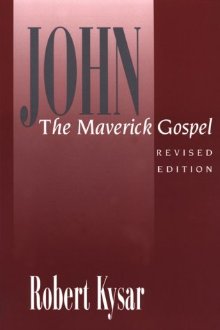 |
“The Paraclete has a twofold function: to communicate Christ to believers and, to put the world on trial.” Robert Kysar, John The Meverick Gospel Kysar is especially relevant because he gives the Paraclete a twofold ministry: communicating Christ to believers while also placing the world under judgment. The formulation joins revelation and discernment in a single mission. For the Paraclete Papers, this means fulfillment cannot be measured by spiritual experience alone; it must also account for a continuing ministry that makes Christ known, exposes error, and confronts the world with the meaning of Jesus’ life and teaching. |
 |
“But She—the Spirit, the Paraclete...—will teach you everything.” Danny Mahar, Aramaic Made EZ) Mahar is important to the Divine Feminine dimension of the Paraclete Papers because his rendering presents the Spirit-Paraclete with feminine reference while retaining the decisive Johannine promise that the Paraclete will teach. The significance is therefore not grammatical gender alone. The passage combines personal agency with instruction: the promised Spirit teaches, communicates, and continues revelation. This makes the citation relevant to both the paper’s gender question and its argument that the Paraclete’s ministry is identifiable through teaching. |
 |
“Grammatical nonsense but evidence of the theological desire to defeminize the Divine.” Lucy Reid, She Changes Everything Reid is relevant because her observation raises the question of how grammatical choices and later theological conventions have shaped Christian language for the Spirit. The issue matters to the Paraclete Papers because John portrays the Paraclete through personal actions—teaching, reminding, witnessing, speaking, guiding, and declaring. Reid therefore provides a useful bridge between the debate over feminine divine language and the larger question of whether inherited terminology has narrowed how Christians imagine the personal agency of the promised Spirit. |
 |
“The functions of the Paraclete spelled out in verses 13-15... are all acts of open and bold speaking in the highest degree.” David Fleer, Preaching John's Gospel Fleer is especially relevant because John 16:13–15 describes the Paraclete through acts of guiding, hearing, speaking, and declaring. His emphasis on open and bold speech makes intelligible communication central to the promised ministry. For the Paraclete Papers, this is an important criterion of fulfillment: the Johannine Paraclete is not described merely as an occurrence of spiritual power, but as an active revealer who communicates truth, interprets what belongs to Christ, and makes that revelation known to others. |
|
“The reaction of the world to the Paraclete will be much the same as the world's reaction was to Jesus.” Berard L. Marthaler, The Creed: The Apostolic Faith in Contemporary Theology Marthaler is important because he identifies a deliberate Johannine parallel between the world’s response to Jesus and its response to the Paraclete. The comparison concerns recognition as well as rejection: John says that the world cannot receive the Spirit of truth because it neither sees nor knows the Paraclete. For the Paraclete Papers, this means that non-recognition does not automatically disqualify a claimed fulfillment; the Gospel itself anticipates resistance to the promised figure in a pattern resembling the world’s response to Jesus. |
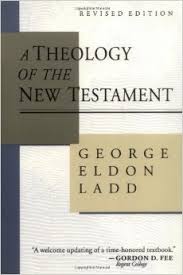 |
Bultmann calls the “coming of the Redeemer an 'eschatological event,' 'the turning-point of the ages.” G. Ladd, A Theology of the New Testament Ladd is relevant because the language of an eschatological “turning-point of the ages” places the coming of the Redeemer within the larger problem of realized eschatology. The citation helps the Paraclete Papers ask whether divine fulfillment can become historically present while still pointing toward a future consummation. Applied to the Johannine promise, this provides a framework for considering the Paraclete as a continuing presence and ministry rather than assuming that every dimension of Jesus’ promise was exhausted by the single event of Pentecost. |
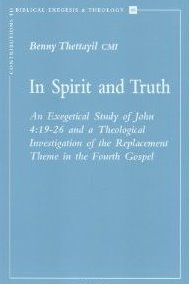 |
“The Paraclete equated with the Holy Spirit, is the only mediator of the word of the exalted Christ.” Benny Thettayil, In Spirit and Truth Thettayil is especially relevant because he identifies the Spirit-Paraclete as mediator of the word of the exalted Christ. This closely corresponds to John 16:13–15, where the Paraclete hears, speaks, receives what belongs to Christ, and declares it to the disciples. For the Paraclete Papers, the point establishes continuity: the promised Paraclete does not replace Jesus with an unrelated revelation, but continues and mediates His teaching after His departure. Teaching and transmission therefore become central marks of the promised ministry. |
 |
“The divine Paraclete, and no lessor agency, must show the world how wrong it was about him who was in the right.” Daniel B. Stevick , Jesus and His Own: A Commentary on John 13-17 Stevick is important because he emphasizes the judicial dimension of the Paraclete’s ministry. In John 16, the world’s judgment concerning Jesus is itself overturned: the Paraclete demonstrates that the world was wrong about the one who was truly in the right. For the Paraclete Papers, this expands the promise beyond consolation or inward inspiration. The Paraclete must also correct error, interpret the meaning of Christ, and disclose judgment—functions that give the promised ministry a public, revelatory, and eschatological character. |
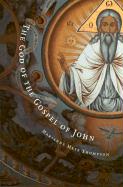 |
Stephen Smalley asserts that “The Spirit-Paraclete ... in John's Gospel is understood as personal, indeed, as a person.” Marianne Thompson, The God of the Gospel of John Thompson’s citation of Stephen Smalley is significant because it directly addresses whether John presents the Spirit-Paraclete as personal rather than merely as a force or influence. The Gospel repeatedly attributes personal actions to the Paraclete: teaching, reminding, witnessing, hearing, speaking, guiding, and declaring. For the Paraclete Papers, this strengthens the distinction between a sustained personal ministry and an interpretation that reduces fulfillment to an impersonal manifestation of spiritual power at Pentecost. |
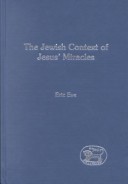 |
“The Messiah will come and the great age of salvation will dawn (for the pious).” Eric Eve, The Jewish context of Jesus' Miracles Eve’s statement supplies the Jewish eschatological background against which early Christian expectations of Messiah, salvation, and the age to come developed. The coming of the Messiah is associated with the dawning of a great age of salvation rather than with an isolated religious experience. For the Paraclete Papers, this wider horizon is useful because it places Johannine language about Spirit, revelation, judgment, and eternal life within an expectation of decisive divine intervention that transforms the religious situation of humanity. |
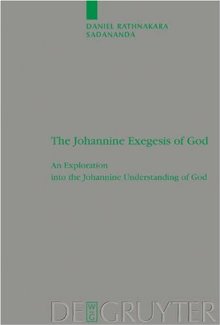 |
“The remembrance is to relive and re-enact the Christ event, to bring about new eschatological decision in time and space.” Daniel Rathnakara Sadananda, The Johannine Exegesis of God Sadananda is especially relevant because he interprets Johannine remembrance as more than the recovery of past information. To remember Christ is to relive and re-enact the Christ event so that its revelatory significance becomes present in a new time and place. This gives the Paraclete’s work in John 14:26 an ongoing eschatological dimension. For the Paraclete Papers, remembrance therefore supports the idea of continuing revelation: Jesus’ teaching is made living and effective beyond the lifetime of the original disciples. |
 |
“The Spirit acts in such an international situation as the revealer of 'judgment' on the powers that rule the world.” Michael Welker, God the Spirit Welker is relevant because he presents the Spirit as revealer of judgment upon powers that rule the world. This closely parallels John 16:8–11, where the Paraclete exposes the truth concerning sin, righteousness, and judgment. For the Paraclete Papers, the citation shows that the Spirit’s work cannot be confined to inward consolation or private mystical experience. The promised ministry also has a public dimension: it interprets the world, challenges false judgment, and reveals the spiritual significance of powers and events. |
 |
The Paraclete's “Appearance means that sin, righteousness, and judgment will be revealed.” Georg Strecker, Theology of the New Testament Strecker is especially relevant because he concentrates attention on the three categories named in John 16: sin, righteousness, and judgment. The Paraclete’s appearance is therefore revelatory and judicial, disclosing realities that the world has misunderstood. For the Paraclete Papers, these functions provide concrete criteria for examining fulfillment. The promised Spirit is not described only as a source of inspiration; the Paraclete also exposes error, interprets the meaning of Jesus, and brings the world’s assumptions under divine judgment. |
 |
“While the Spirit-Paraclete is the true broker, the brokers they rely on are impostors.” T. G. Brown, Spirit in the writings of John Brown’s description of the Spirit-Paraclete as the “true broker” highlights the problem of mediation and religious authority. A broker communicates and mediates access; in Johannine terms, the Paraclete mediates the revelation of Christ to the believing community. For the Paraclete Papers, the contrast with false brokers raises an important question: how is authentic divine mediation recognized when institutions and interpreters also claim authority to speak for God? The Gospel’s functions of teaching, testimony, guidance, and declaration become relevant criteria. |
 |
“The pneumatological activity ... of the Paraclete ... may most helpfully be considered in terms of the salvific working of the hidden Spirit.” Michael Welker, The work of the Spirit Welker is relevant because his description of the salvific working of the “hidden Spirit” cautions against identifying divine activity only with spectacular manifestations. The Spirit may work through revelation, transformation, discernment, and continuing mediation even when that activity is not immediately recognized by the wider world. For the Paraclete Papers, this provides a useful pneumatological framework for reconsidering fulfillment after Pentecost: continuing divine activity need not reproduce the outward form of Acts 2 in order to remain spiritually significant. |
 |
“The pneuma is the peculiar power by which the word becomes the words of eternal life.” Robert Kysar, Voyages with John Kysar is relevant because he links pneuma with the power by which the word becomes “words of eternal life.” The Spirit therefore does more than accompany proclamation; the Spirit makes revelation living and effective for those who receive it. For the Paraclete Papers, this reinforces the importance of the Johannine verbs of teaching, reminding, speaking, and declaring. A proposed fulfillment should be examined not only for manifestations of power but also for its relationship to revelatory words that communicate spiritual life. |
 |
“The gift of peace, therefore, is intimately associated with the gift of the Spirit-Paraclete.” Francis J. Moloney, The Gospel of John Moloney is relevant because he connects Jesus’ gift of peace directly with the gift of the Spirit-Paraclete in the farewell discourse. Peace is therefore not merely an emotional state but part of the continuing divine presence promised to the disciples after Jesus’ departure. For the Paraclete Papers, this broadens the criteria for considering fulfillment beyond teaching and testimony alone. The promised ministry is also associated with an experienced spiritual peace that accompanies the continuing presence of Christ through the Paraclete. |
 |
“Jesus therefore predicts that God will later send a human being to Earth to take up the role defined by John .i.e. to be a prophet who hears God's words and repeats his message to man.” M. Bucaille The Bible, the Qur'n, and Science Bucaille is included as a comparative interpretation because he reads the Johannine promise as anticipating a later human messenger who hears divine words and communicates them to humanity. Whether or not that interpretation is accepted, it demonstrates that John 16:13 has generated readings substantially different from the conventional identification of the promise solely with Pentecost. For the Paraclete Papers, the citation is useful because it keeps attention on the text’s language of hearing, speaking, transmission, and personal agency. |
 |
“This utopian hope, even when modestly expressed, links Jesus and the prophets to a much wider history of human longing.” Harvey Cox, The Future of Faith Cox is relevant because he places Jesus and the prophets within a much wider history of human hope for transformation. Eschatological expectation is therefore not merely curiosity about future events; it expresses a persistent longing for divine intervention, justice, renewal, and a different order of life. For the Paraclete Papers, this broadens the setting of the Johannine promise. The coming of the Paraclete can be considered within Christianity’s larger expectation that divine action will continue to transform human history and consciousness. |
 |
“Because of the presence of the Paraclete in the life of the believer, the blessings of the end-times—the eschaton—are already present.” Robert Kysar, John Kysar is especially relevant because he connects the presence of the Paraclete with blessings of the eschaton already becoming present in the believer’s life. This is a clear expression of realized eschatology: realities associated with the end-time can be experienced within the present. For the Paraclete Papers, that framework helps bridge future promise and present spiritual experience. It allows the Paraclete’s ministry to be considered as an active fulfillment in history without requiring every dimension of eschatological expectation to be already completed. |
 |
“They are going, by the Holy Spirit's power, to be part of the greatest miracle of all, bringing men to salvation.” R. Picirilli, The Randall House Bible Commentary Picirilli is relevant because he presents the Holy Spirit’s power as continuing through the disciples’ mission of bringing people to salvation. Pentecost therefore functions as an empowering beginning rather than as the termination of everything that can subsequently be said about the Spirit’s activity. For the Paraclete Papers, this distinction is important: Acts 2 may inaugurate Spirit-empowered mission while the Johannine promises of teaching, remembrance, testimony, guidance, declaration, and judgment continue to require theological consideration beyond that initial event. |
|
“The Kingdom of God stands as a comprehensive term for all that the messianic salvation included... is something to be sought here and now (Mt. 6:33) and to be received as children receive a gift (Mk. 10:15 = Lk. 18:16-17).” G. Ladd, A Theology of the New Testament Ladd is relevant because the language of an eschatological “turning-point of the ages” places the coming of the Redeemer within the larger problem of realized eschatology. The citation helps the Paraclete Papers ask whether divine fulfillment can become historically present while still pointing toward a future consummation. Applied to the Johannine promise, this provides a framework for considering the Paraclete as a continuing presence and ministry rather than assuming that every dimension of Jesus’ promise was exhausted by the single event of Pentecost. |
💬 Interactive Chat
Explore this article, its sources, and the relationships among its theological and evidentiary claims.
Open chat →